Here is suggested a solution to the accommodation-vergence mismatch problem in 3D stereoscopic displays. It can be achieved by compensating the mismatched focal length with refractive power of adjustable-focus 3D glasses. The compensation would make vergence of human eyes match with position of virtual stereoscopic motion pictures, reducing visual fatigue.
D-Y. Kim
IMID 2012 DIGEST
A Proposal for a Solution to the Accommodation-Vergence Mismatch Problem
in 3D Displays
Dal-Young Kim
Department of Optometry, Seoul Tech, 232 Gongneung-ro, Nowon-gu, Seoul 139-743, Korea
Tel.:82-2-970-6229, E-mail: dykim@seoultech.ac.kr
Keywords: 3D display, accommodation-vergence mismatch, visual fatigue
Abstract
Here is suggested a solution to the accommodation-
vergence mismatch problem in 3D stereoscopic displays.
It can be achieved by compensating the mismatched
focal length with refractive power of adjustable-focus
3D glasses. The compensation would make vergence of
human eyes match with position of virtual stereoscopic
motion pictures, reducing visual fatigue.
- Introduction
The accommodation-vergence mismatch (AVM) has
been considered as a cause of the visual fatigue induced by
watching three-dimensional (3D) stereoscopic displays,[1-3]
though some recent researches suggested that it was not an
essential cause.[4,5] Owing to rapid growth of the 3D TV and
cinema industry, much attention is paid to it. Various ideas
have been proposed to solve the AVM problem, and most of
solutions are belonged to one of two categories, that is, the
wave front reconstructing displays or the volumetric
displays.[6] Differently from those previous solutions, we
would propose a solution based on physiological optics and
adjustable-focus 3D glasses.
- The Accommodation-Vergence Mismatch
The AVM is a mismatch between focal length (adjusted
by accommodation) of human eye and binocular vergence
(convergence or divergence) angle when a viewer watches
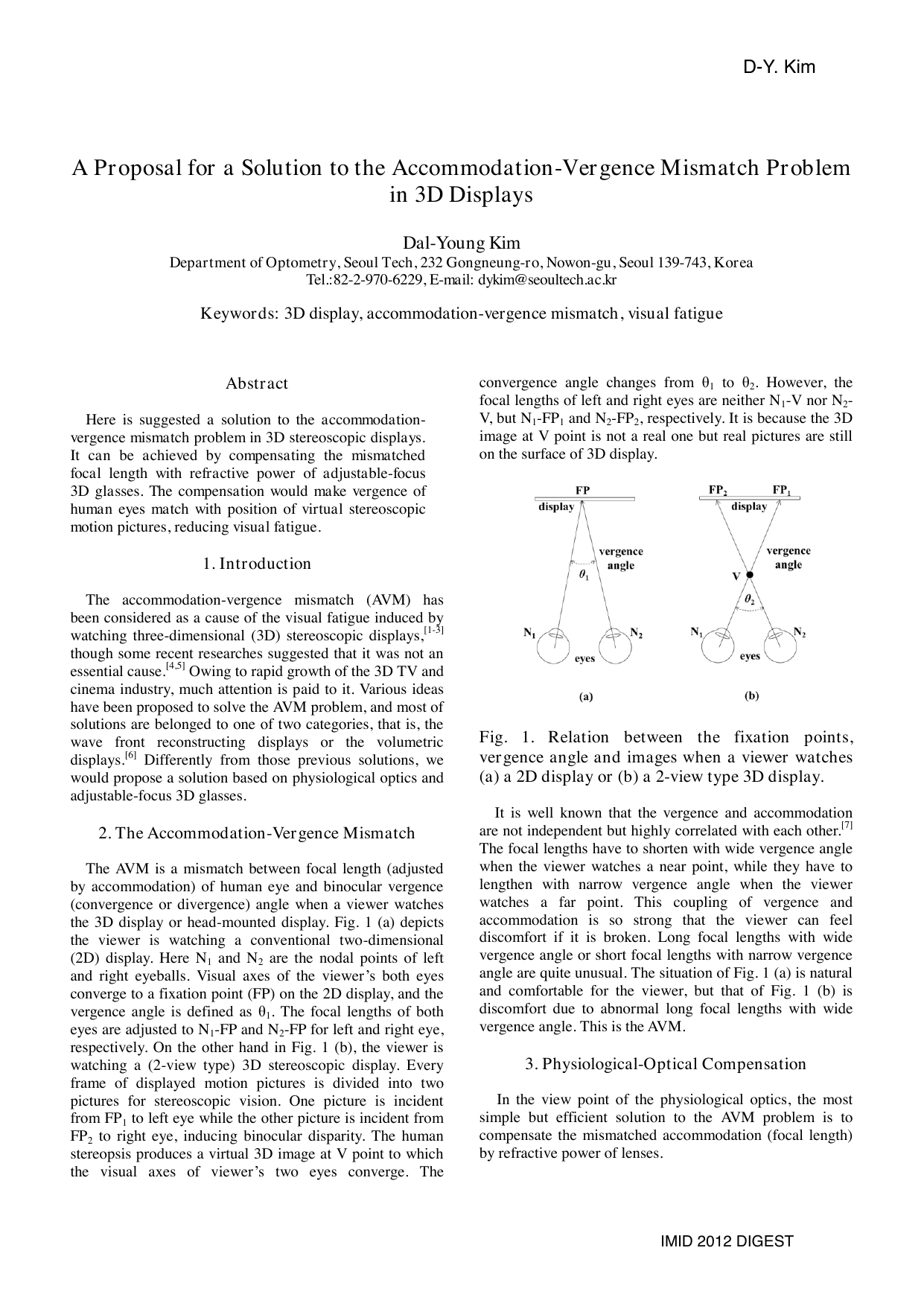
the 3D display or head-mounted display. Fig. 1 (a) depicts
the viewer is watching a conventional two-dimensional
(2D) display. Here N1 and N2 are the nodal points of left
and right eyeballs. Visual axes of the viewer’s both eyes
converge to a fixation point (FP) on the 2D display, and the
vergence angle is defined as θ1. The focal lengths of both
eyes are adjusted to N1-FP and N2-FP for left and right eye,
respectively. On the other hand in Fig. 1 (b), the viewer is
watching a (2-view type) 3D stereoscopic display. Every
frame of displayed motion pictures is divided into two
pictures for stereoscopic vision. One picture is incident
from FP1 to left eye while the other picture is incident from
FP2 to right eye, inducing binocular disparity. The human
stereopsis produces a virtual 3D image at V point to which
the visual axes of viewer’s two eyes converge. The
convergence angle changes from θ1 to θ2. However, the
focal lengths of left and right eyes are neither N1-V nor N2-
V, but N1-FP1 and N2-FP2, respectively. It is because the 3D
image at V point is not a real one but real pictures are still
on the surface of 3D display.
Fig. 1. Relation between the fixation points,
vergence angle and images when a viewer watches
(a) a 2D display or (b) a 2-view type 3D display.
It is well known that the vergence and accommodation
are not independent but highly correlated with each other.[7]
The focal lengths have to shorten with wide vergence angle
when the viewer watches a near point, while they have to
lengthen with narrow vergence angle when the viewer
watches a far point. This coupling of vergence and
accommodation is so strong that the viewer can feel
discomfort if it is broken. Long focal lengths with wide
vergence angle or short focal lengths with narrow vergence
angle are quite unusual. The situation of Fig. 1 (a) is natural
and comfortable for the viewer, but that of Fig. 1 (b) is
discomfort due to abnormal long focal lengths with wide
vergence angle. This is the AVM.
- Physiological-Optical Compensation
In the view point of the physiological optics, the most
simple but efficient solution to the AVM problem is to
compensate the mismatched accommodation (focal length)
by refractive power of lenses.
D-Y. Kim
IMID 2012 DIGEST
Fig. 2. Focal lengths of eye and a lens of 3D glasses.
Fig. 2 describes relations between the focal lengths of
the left eye and a spectacles-lens. Here let me introduce the
concept of refractive power D, which is defined as an
inverse of focal length. It is well known that total refractive
power DR of a certain ophthalmic-optical system is
approximately a sum of refractive powers of the eye and the
lens. Taking the refractive power of lens into account, DR in
Fig. 2 is given as
C
V
R
D
D
D
(1).
Here, DV and DC are refractive powers of the viewer’s eye
and the lens. In order to watch the real image (FP1) on the
surface of 3D display, the focal length and refractive power
of the total system must be N1-FP1 (fR) and 1/fR. As
mentioned above, the viewer feels comfortable when the
focal length and refractive power of eye are N1-V (fV) and
1/fV. From these constraints, focal length (fC) and refractive
power (DC) of the lens required to satisfy Eq. (1) is
calculated as;
C
V
R
V
R
C
f
f
f
D
D
D
1
1
1
This content is AI-processed based on open access ArXiv data.