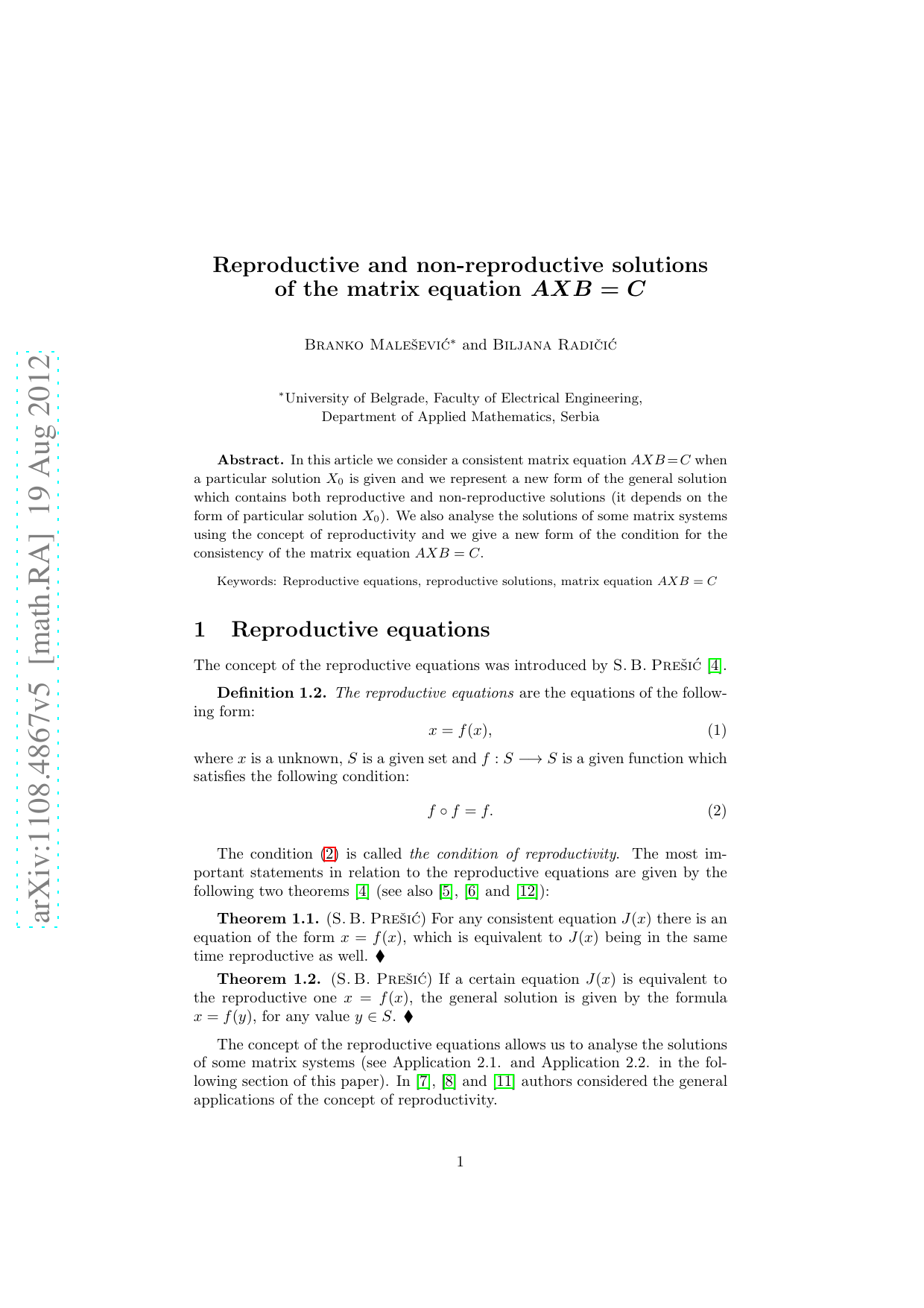
In this article we consider a consistent matrix equation $AXB = C$ when a particular solution $X_{0}$ is given and we represent a new form of the general solution which contains both reproductive and non-reproductive solutions (it depends on the form of particular solution $X_{0}$). We also analyse the solutions of some matrix systems using the concept of reproductivity and we give a new form of the condition for the consistency of the matrix equation $AXB=C$.
The concept of the reproductive equations was introduced by S. B. Prešić [4].
Definition 1.2. The reproductive equations are the equations of the following form:
where x is a unknown, S is a given set and f : S -→ S is a given function which satisfies the following condition:
The condition (2) is called the condition of reproductivity. The most important statements in relation to the reproductive equations are given by the following two theorems [4] (see also [5], [6] and [12]): Theorem 1.1. (S. B. Prešić) For any consistent equation J(x) there is an equation of the form x = f (x), which is equivalent to J(x) being in the same time reproductive as well.
Theorem 1.2. (S. B. Prešić) If a certain equation J(x) is equivalent to the reproductive one x = f (x), the general solution is given by the formula x = f (y), for any value y ∈ S.
The concept of the reproductive equations allows us to analyse the solutions of some matrix systems (see Application 2.1. and Application 2.2. in the following section of this paper). In [7], [8] and [11] authors considered the general applications of the concept of reproductivity.
Let m, n ∈ N and C is the field of complex numbers. The set of all matrices of order m × n over C is denoted by C m×n . For the set of all matrices from C m×n with a rank a we use denotement C m×n a . Let A = [a i,j ] ∈ C m×n . By A i→ we denote the i-th row of A, i = 1, …, m. For the j-th column of A, j = 1, …, n, we use denotement A ↓j .
A solution of the matrix equation
is called {1}-inverse of the matrix A and it is denoted by A (1) . The set of all {1}-inverses of the matrix A is denoted by A{1}. For the matrix A, let regular matrices Q ∈ C m×m and P ∈ C n×n be determined so that the following equality is true.
where a = rank(A). In [3] C. Rohde showed that the general {1}-inverse A (1) can be represented in the following form:
where X 1 , X 2 and X 3 are arbitrary matrices of suitable sizes.
Let A ∈ C m×n , B ∈ C p×q and C ∈ C m×q . In the paper [1] R. Penrose proved the following theorem related to the matrix equation
Theorem 2.1. (R. Penrose) The matrix equation ( 6) is consistent iff for some choice of {1}-inverses A (1) and B (1) of the matrices A and B the condition
is true. The general solution of the matrix equation ( 6) is given by the formula
where Y is an arbitrary matrix of suitable size.
If a particular solution X 0 of the matrix equation ( 6) is given, the formula of general solution is given in the following theorem. Theorem 2.2. If X 0 is a particular solution of the matrix equation ( 6), then the general solution of the matrix equation ( 6) is given by the formula
where Y is an arbitrary matrix of suitable size. The function g satisfies the condition of reproductivity (2) iff X 0 = A (1) CB (1) .
Proof. See [14] and [16] (where different proofs are given).
The formula (9) contains both reproductive and non-reproductive solutions. It depends on the form of particular solution X 0 .
Remark 2.1. In the paper [14] authors proved that there is a matrix equation (6) and a particular solution X 0 so that:
for any choice of {1}-inverses A (1) and B (1) . In that case the formula (9) gives the general non-reproductive solution. Otherwise, the formula (9) gives the general reproductive solution.
Example 2.1. Compared to [14], we give a simpler example of the matrix equation ( 6) and a particular solution X 0 so that (10) is valid. Let’s consider the matrix equation:
with
Then, there is a particular solution:
of the previous matrix equation. It is easy to show that A
From AXB -C = 0 ⇐⇒ x 1,1 + 3x 1,2 + 2x 2,1 + 6x 2,2 -12 = 0, where X = x i,j , we get that the matrix of general solution is given by the following form:
For p = -24, q = -36 and r = 12, we get the particular solution X 0 of the matrix equation ( 11), but X 0 = X 1 = A (1) CB (1) for any choice of {1}-inverses A (1) and B (1) , because from X 0 = X 1 we obtain the contradiction (ab = 1 and a = 0, b = 0).
In [2] S. B. Prešić analysed the matrix equation ( 3) and he proved the following theorem ♮) . Theorem 2.3. For any square matrix A ∈ C n×n and any general {1}-inverse A (1) the following equivalences are true: (1) .
In the general case the general solutions (E 3 )-(E 5 ) of Theorem 2.3. do not directly appear according to Penrose’s theorem. In [9] M. Haverić showed that we can get Penrose’s solutions from Prešić’s solutions. She proved the following statement.
The following theorem gives the new form of the condition for the consistency of the matrix equation (6). In the formulation of the theorem we use the following matrices
where T A is a permutation matrix which permutes linearly independent rows of the matrix A at the first a positions and T B is a permutation matrix which permutes linearly independent columns of the matrix B at the first b positions.
Therefore, the matrix A has linearly independent rows at the first a positions and the matrix B has linearly independent columns at the fir
This content is AI-processed based on open access ArXiv data.