PSR B1259-63/SS2883 is a binary system which consists of a 48-ms radio pulsar and a massive star in a highly eccentric orbit with a period of about 3.4 years. Non-pulsed and non-thermal emissions from this binary have been reported in the radio, X-ray and TeV gamma-ray energy ranges. Light curves in the radio and X-ray bands showed characteristic double-peaked features which can be attibuted to the interactions of the pulsar wind and the Be disk during the crossings by the pulsar. The TeV light curves around periastron differ between 2004 and 2007 observations, and the feature is not conclusive. We report a detection of GeV gamma-ray emission around the periastron passage in December 2010 with Fermi-LAT.
arXiv:1111.0367v1 [astro-ph.HE] 2 Nov 2011
2011 Fermi Symposium, Roma., May. 9-12
1
GeV Gamma-ray Emission from the Binary PSR B1259-63/SS2883 During the
2010 Periastron Passage
Masaki Mori
Department of Physical Sciences, Ritsumeikan University, Kusatsu, 525-8577 Shiga, Japan
Akiko Kawachi
Department of Physics, Tokai University, Hiratsuka, Kanagawa 259-1292, Japan
Shigehiro Nagataki
Yukawa Institute for Theoretical Physics, Oiwake-cho,
Kitashirakawa, Sakyo-ku, Kyoto 606-8502, Japan
Jumpei Takata
Department of Physics, University of Hong Kong, Pokfulam Road, Hong Kong, China
PSR B1259-63/SS2883 is a binary system which consists of a 48-ms radio pulsar and a massive star
in a highly eccentric orbit with a period of about 3.4 years. Non-pulsed and non-thermal emissions
from this binary have been reported in the radio, X-ray and TeV gamma-ray energy ranges. Light
curves in the radio and X-ray bands showed characteristic double-peaked features which can be
attibuted to the interactions of the pulsar wind and the Be disk during the crossings by the pulsar.
The TeV light curves around periastron differ between 2004 and 2007 observations, and the feature
is not conclusive. We report a detection of GeV gamma-ray emission around the periastron passage
in December 2010 with Fermi-LAT.
I.
INTRODUCTION
The PSR B1259-63/SS2883 system is one of a few
binary systems detected in TeV gamma-ray energies.
Gamma-rays should be emitted via interaction of
high-speed wind from the 48-ms pulsar with the Be
star wind and disk. The elliptic orbit with long (3.4-
yr) period offers a unique experimental field of wind
interaction with varying distance between the pulsar
and the Be star [1, 2]. In 2004 and 2007, H.E.S.S. de-
tected TeV gamma-rays as a marginal pre-periastron
peak and a clear post-periastron peak [4, 5]. We stud-
ied the 2010 periastron (December 14) passage in GeV
gamma-rays using the Fermi-LAT data and compared
the result with SPH simulation [2].
II.
FERMI-LAT OBSERVATION
Fermi-LAT data were obtained via Fermi Science
Support Center and analyzed using the Fermi Science
Tools (v9r17p0) with P6 V3 DIFFUSE instrument re-
sponse function by the standard pipeline [3]. Exam-
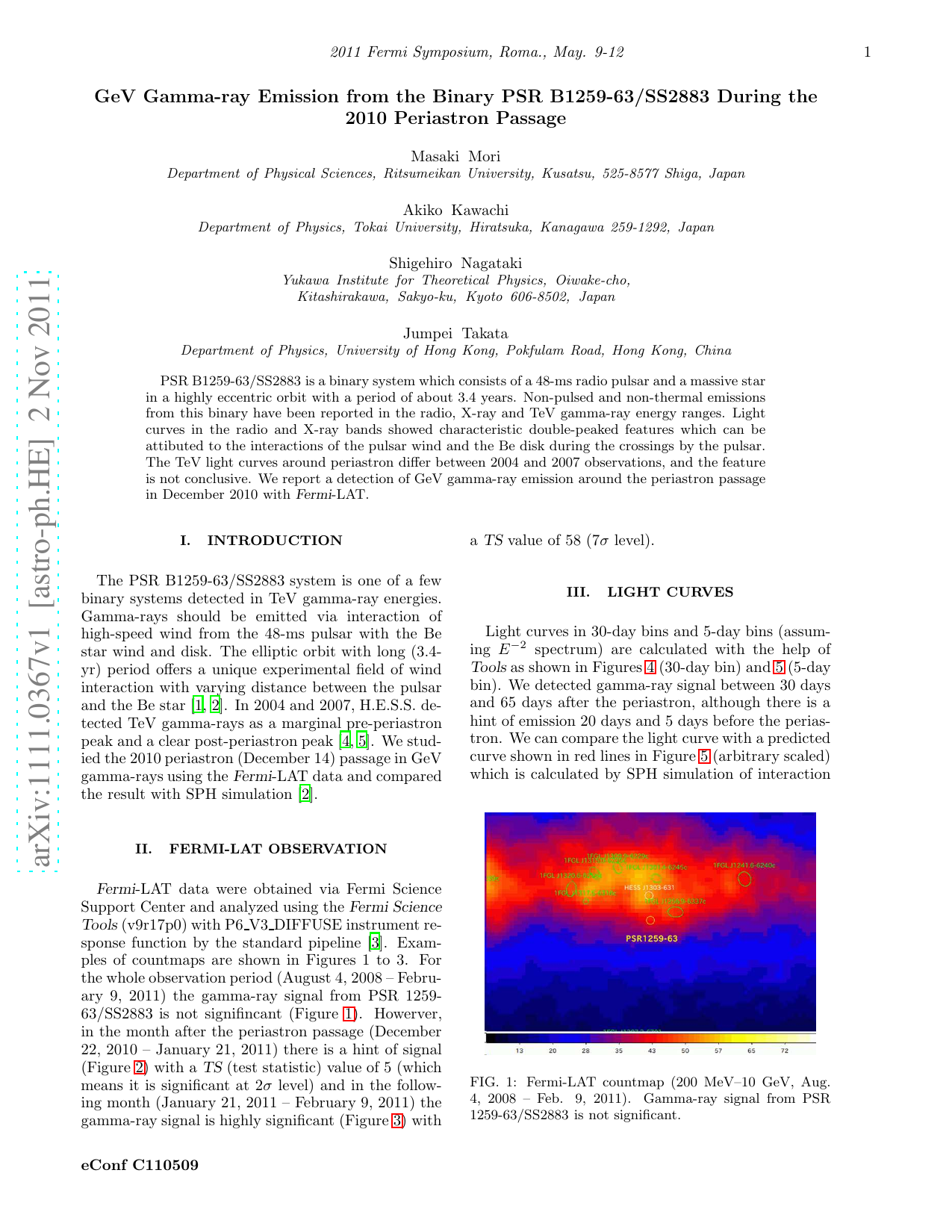
ples of countmaps are shown in Figures 1 to 3. For
the whole observation period (August 4, 2008 – Febru-
ary 9, 2011) the gamma-ray signal from PSR 1259-
63/SS2883 is not signifincant (Figure 1). Howerver,
in the month after the periastron passage (December
22, 2010 – January 21, 2011) there is a hint of signal
(Figure 2) with a TS (test statistic) value of 5 (which
means it is significant at 2σ level) and in the follow-
ing month (January 21, 2011 – February 9, 2011) the
gamma-ray signal is highly significant (Figure 3) with
a TS value of 58 (7σ level).
III.
LIGHT CURVES
Light curves in 30-day bins and 5-day bins (assum-
ing E−2 spectrum) are calculated with the help of
Tools as shown in Figures 4 (30-day bin) and 5 (5-day
bin). We detected gamma-ray signal between 30 days
and 65 days after the periastron, although there is a
hint of emission 20 days and 5 days before the perias-
tron. We can compare the light curve with a predicted
curve shown in red lines in Figure 5 (arbitrary scaled)
which is calculated by SPH simulation of interaction
FIG. 1: Fermi-LAT countmap (200 MeV–10 GeV, Aug.
4, 2008 – Feb.
9, 2011).
Gamma-ray signal from PSR
1259-63/SS2883 is not significant.
eConf C110509
2
2011 Fermi Symposium, Roma., May. 9-12
FIG. 2: Fermi-LAT countmap (200 MeV–10 GeV, Dec.
22, 2010 – Jan. 21, 2011). There is a hint of gamma-ray
signal from PSR 1259-63/SS2883 with TS=5.
FIG. 3: Fermi-LAT countmap (200 MeV–10 GeV, Jan.
21, 2011 – Feb. 9, 2011). Gamma-ray signal from PSR
1259-63/SS2883 is significant with TS=58.
between the pulsar and the Be star [6]. The general
tendency of the observed light curve is not inconsitent
with prediction.
IV.
DISCUSSION
We found a significant GeV gamma-ray signal from
this system between 30 days and 65 days after the
periastron. Emission in this epoch should be related
to the time-varying geometry of this system. We will
compare the gamma-ray light curves and spectra with
simulation [6] to understand the emission from this
binary system.
After the analysis presented here has been com-
pleted, we found similar results from Fermi-LAT data
have been reported [7, 8].
FIG. 4: 30-day-bin light curve. Positive detection is ob-
served only after the periastron. Open circles are fluxes
with marginal significance (∼3σ).
FIG. 5: Close-up of light curve in 5-day bins around pe-
riastron. Points are plotted including marginal detections
(9
📸 Image Gallery
Reference
This content is AI-processed based on open access ArXiv data.