Bringing the LHC and ATLAS to a regional planetarium
📝 Original Info
- Title: Bringing the LHC and ATLAS to a regional planetarium
- ArXiv ID: 1109.2839
- Date: 2011-09-14
- Authors: Reinhard Schwienhorst
📝 Abstract
An outreach effort has started at Michigan State University to bring particle physics, the Large Hadron Collider, and the ATLAS experiment to a general audience at the Abrams planetarium on the MSU campus. A team of undergraduate students majoring in physics, communications arts & sciences, and journalism are putting together short clips about ATLAS and the LHC to be shown at the planetarium.💡 Deep Analysis
📄 Full Content
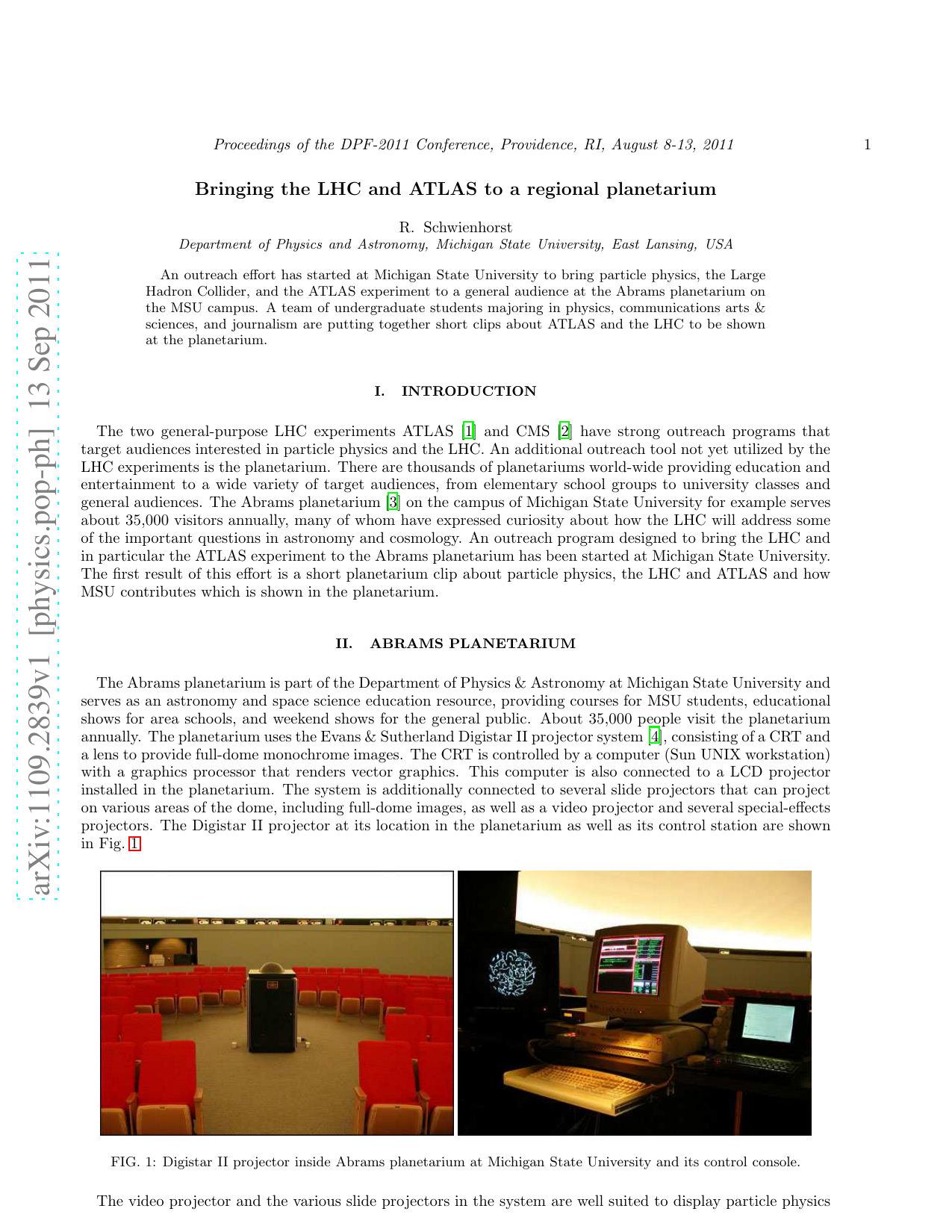
The Abrams planetarium is part of the Department of Physics & Astronomy at Michigan State University and serves as an astronomy and space science education resource, providing courses for MSU students, educational shows for area schools, and weekend shows for the general public. About 35,000 people visit the planetarium annually. The planetarium uses the Evans & Sutherland Digistar II projector system [4], consisting of a CRT and a lens to provide full-dome monochrome images. The CRT is controlled by a computer (Sun UNIX workstation) with a graphics processor that renders vector graphics. This computer is also connected to a LCD projector installed in the planetarium. The system is additionally connected to several slide projectors that can project on various areas of the dome, including full-dome images, as well as a video projector and several special-effects projectors. The Digistar II projector at its location in the planetarium as well as its control station are shown in Fig. 1. The video projector and the various slide projectors in the system are well suited to display particle physics information, and even the Digistar II projector can show particle collisions and accelerator parts or detectors as line-drawings. At MSU, the animators and graphic designers are working together with an audio production student, two students from the professional writing program, as well as a physics graduate student and a physics undergrad. This team is responsible for creating planetarium show modules, from putting the initial script together to creating the animations and images and assembling the pieces into a coherent self-contained piece. The team works well together despite the very different backgrounds of the individuals involved. This creative experience benefits all of the students. The main benefit to the physics students is much improved communication skills, while the main benefit for the graphic designers and animators is a better understanding of how science works and how to communicate it.
The students use comercial graphic design and animation software packages on dedicated high-end graphics workstations. The students are well-trained in the required software through their course-work and other projects. This includes 3D modeling and animation software, video editing and production programs, graphic design and image processing packages, and audio production programs.
While working mostly independently, the undergraduate students receive guidance from professors in the Information Graphics and in the Professional Writing programs at MSU. This connection, in addition to the support from Abrams planetarium staff, is useful to ensure that all aspects of the planetarium clip design process are covered and that the final result will be comprehensible to a general planetarium audience.
The creative team at MSU has spent the spring semester 2011 on creating a first five-minute long clip [6]. This clip plays at the end of each public Abrams planetarium show. The current public show is on the topic of dark matter, and the five-minute clip describes how the LHC and ATLAS expect to identify dark matter and how MSU students and researchers contribute to this effort. An example all-sky image from the short clips is shown in Fig. 2. All-sky images such as this one are projected onto the dome such that the bottom part of the image appears in the front, the top of the image appears at the back, and the center of the image is directly overhead. This particular image is combined with a Digistar animation of counter-circulating beams inside the LHC tunnel. The Digistar projector also shows stars in the night sky overhead.
Another example all-sky image is shown in Fig. 3. This image of the MSU campus with the planetarium and the physics building makes it easy for visitors to orient themselves and get a sense of where the researchers work.
Several other images and animations have been created in addition to the images show
📸 Image Gallery