The complexity of tangent words
📝 Original Info
- Title: The complexity of tangent words
- ArXiv ID: 1108.3632
- Date: 2011-08-19
- Authors: Thierry Monteil (CNRS - Universite Montpellier 2)
📝 Abstract
In a previous paper, we described the set of words that appear in the coding of smooth (resp. analytic) curves at arbitrary small scale. The aim of this paper is to compute the complexity of those languages.💡 Deep Analysis
📄 Full Content
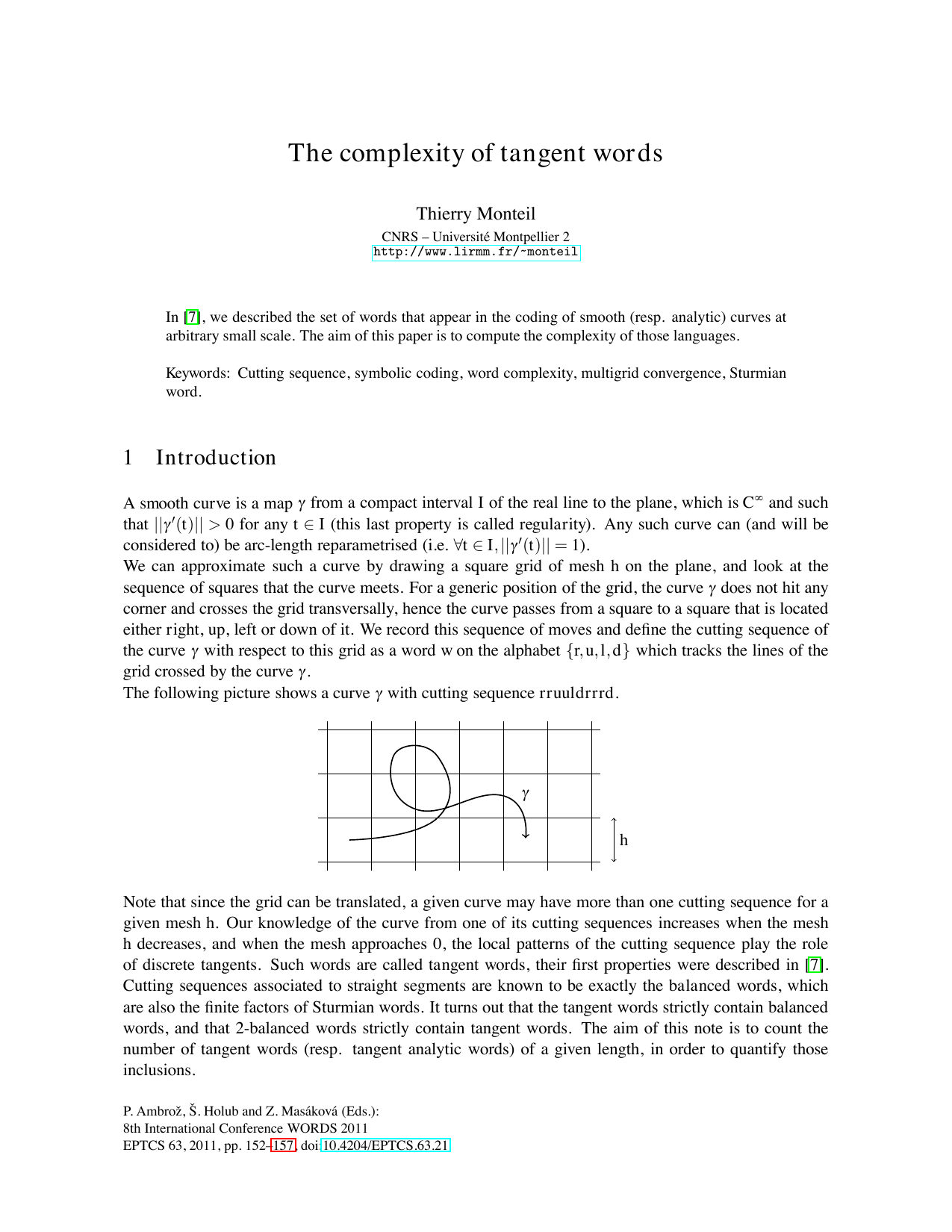
The following picture shows a curve γ with cutting sequence rruuldrrrd. h γ Note that since the grid can be translated, a given curve may have more than one cutting sequence for a given mesh h. Our knowledge of the curve from one of its cutting sequences increases when the mesh h decreases, and when the mesh approaches 0, the local patterns of the cutting sequence play the role of discrete tangents. Such words are called tangent words, their first properties were described in [7]. Cutting sequences associated to straight segments are known to be exactly the balanced words, which are also the finite factors of Sturmian words. It turns out that the tangent words strictly contain balanced words, and that 2-balanced words strictly contain tangent words. The aim of this note is to count the number of tangent words (resp. tangent analytic words) of a given length, in order to quantify those inclusions.
Tangent words are the finite words that appear in the cutting sequences of some smooth curve for arbitrary small scale. More precisely, let F(γ, G) denote the set of factors of the cutting sequence of the curve γ with respect to the square grid G (when the curve hits a corner, the cutting sequence is not defined and we set F(γ, G) = / 0). We define the asymptotic language of γ by
More generally, when X is a set of curves, let us denote by T (X ) the set γ∈X T (γ). When X is the set of smooth curves, we denote T (X ) by T ∞ , and call its elements tangent words. When X is the set of analytic curves, we denote T (X ) by T ω , and call its elements analytic tangent words. The two languages T ∞ and T ω are factorial and extendable.
For the sake of simplicity, we will focus on curves going right and up, i.e. smooth curves such that both coordinates of γ ′ (t) are positive for any t. Let us rename r and u by 0 and 1 respectively to stick to the usual notation about binary words.
The following results are proved in [7].
Balanced words are know to have a hierarchical structure, where the morphisms σ 0 = (0 → 0, 1 → 10) and σ 1 = (0 → 01, 1 → 1) play a crucial role [8] [5]. The same renormalisation applies to tangent words. Given a finite word w, we can “desubstitute” it by
• removing one 0 per run of 0 if 11 does not appear in w, or
• removing one 1 per run of 1 if 00 does not appear in w.
This desubstitution map (denoted by δ ) consists in removing one letter per run of the non-isolated letter.
An accelerated version of this desubstitution consists in removing a run equal to the length of the shortest inner run from any run of the non-isolated letter (including possible leading and trailing runs even if they have shorter length).
If we repeat this process as much as possible, we get a derivated word denoted by d(w). The word w is balanced if, and only if, d(w) is the empty word, and the derivation process is related to the continued fraction development of the slope of the associated straight segment.
A word is said to be diagonal if it is recognised by the following automaton with three states, which are all considered as initial and accepting: 0 1 0 1 A word is said to be thin diagonal if it is diagonal and only two states are visited during its recognition.
A word is said to be non-oscillating diagonal if it is recognised by the following automaton with eight states, which are all considered as initial and accepting: For example, the word w = 100100010010010010001001000100 is tangent analytic since it can be desubstituted as
, which is non-oscillating diagonal (start from the bottom left state).
Proposition 2 A word w is tangent if, and only if, for any ε > 0, w is the cutting sequence of a smooth curve γ which is ε-close (for the C 1 norm) to a straight segment (the grid is fixed). A word w is tangent analytic if, and only if, for any ε > 0, w is the cutting sequence of a smooth curve γ with nowhere zero curvature which is ε-close (for the C 1 norm) to a straight segment (the grid is fixed).
For example, the word 0110100110 is tangent and the word 1001010110 is tangent analytic: 0110100110 tangent 1001010110 tangent analytic
The complexity of a language L is the map that
📸 Image Gallery