Recursion Relations and Functional Equations for the Riemann Zeta Function
📝 Original Info
- Title: Recursion Relations and Functional Equations for the Riemann Zeta Function
- ArXiv ID: 1107.3479
- Date: 2011-08-10
- Authors: Henrik Stenlund
📝 Abstract
New recursion relations for the Riemann zeta function are introduced. Their derivation started from the standard functional equation. The new functional equations have both real and imaginary increment versions and can be applied over the whole complex plane. We have developed various versions of the recursion relations eliminating each of the coefficient functions, leaving plain zeta functions💡 Deep Analysis
📄 Full Content
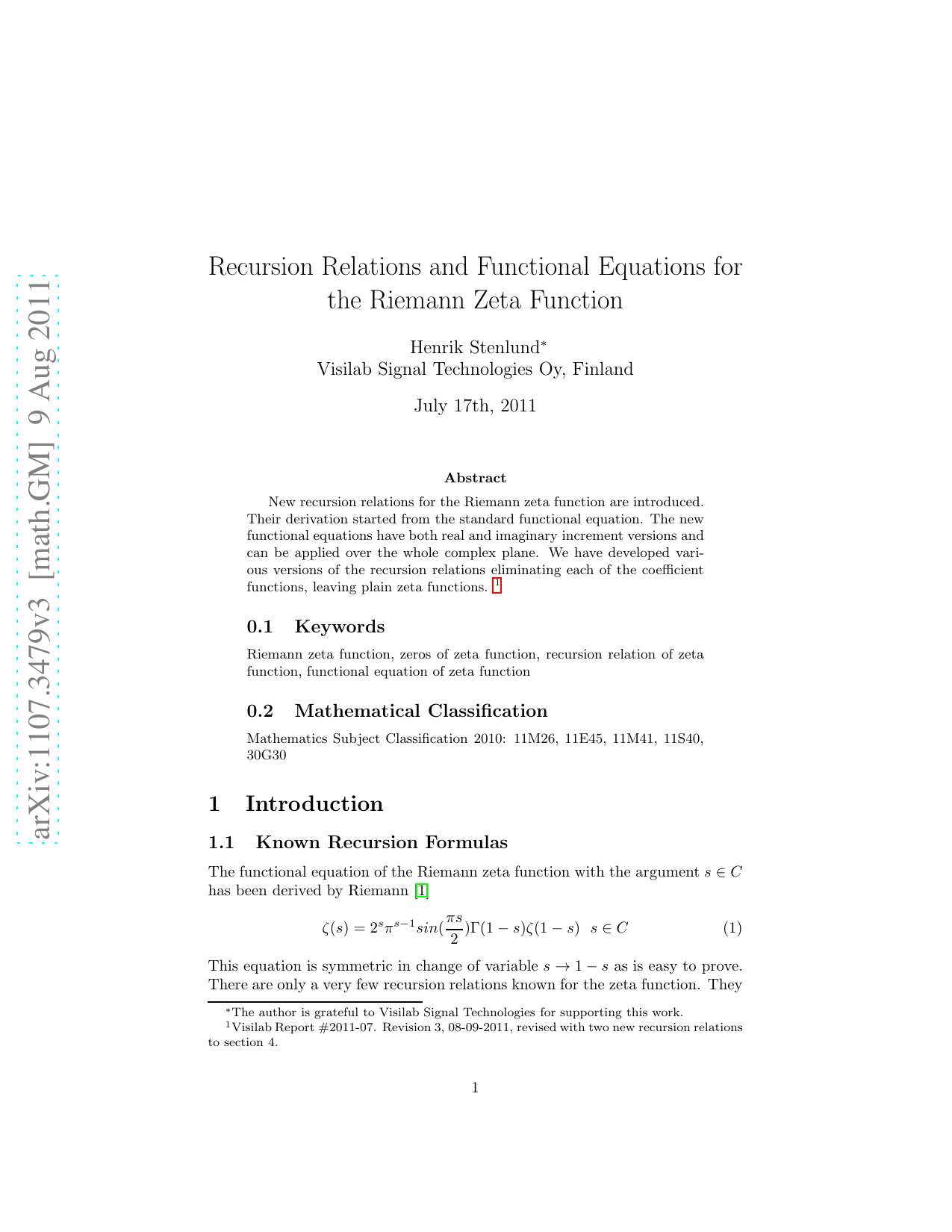
This equation is symmetric in change of variable s → 1 -s as is easy to prove. There are only a very few recursion relations known for the zeta function. They are mostly simple restatements of equation (1) (textbooks [12], [13] and [14]).
The following equation ( 2) is one of them and can be reached by elementary operations.
The third non-trivial functional equation is equation (6) below. These are the only known recursion relations without excessive complications, like integration or summation. Recursion relations with summations are handled e.g. in [2], [3], [4], [5], [6], [7] and [8] and thus outside the scope of this work. Some new ideas have appeared too. Lagarias [9] studied the Riemann ξ(s), developed originally by Riemann.
It has a functional equation
with an obvious symmetry. Lagarias developed some recursions for this function which is a bit different from the zeta function in behavior. Ossicini [10] has treated similar functions. Tyagi [11] derives a new integral formula for the zeta function, a new recursive summation formula and also displays a simple functional equation
Unfortunately, this equation is false. The correct form should be
which is a known variant of the basic functional equation (1). It can be derived easily by applying the Legendre duplication formula. A recent article [15] proves that certain types of recursion relations are not possible. The relations we are to develop do not fall into that category. Baez-Duarte has attempted to systematize the functional equations [16].
A recursion relation means an algebraic relationship between values of a function at various points over the argument space. For complex variables, this would mean a group of points over the whole complex plane. In general, the terms may have any multiplicative factors, either constant or any other function. In a more general case, the arguments may have any scaling, including reflection. Extending generalization further leads to combinations of functions with any argument values and with any coefficient function. The functional equations (1), ( 2) and ( 6) are examples having these features.
The motivation for finding new recursion relations is two-fold. First, the original equation ( 1) is complicated in behavior caused by the 2 s and sin( πs 2 ) functions together with the Γ(1 -s) function. They make it very obscure to see the function’s behavior when the argument s varies over the complex plane. Especially studying nontrivial zeros of the zeta function is difficult. Elimination of these functions from the functional equation may be useful. The second problem is the entire missing of imaginary increment recursions.
In the following we derive recursion relations for the Riemann zeta function from equation ( 1). They will be equivalent to the original functional equation. The zeta function is known to be analytic everywhere and has a single pole at s = 1. We perform only simple operations preserving analyticity throughout to the final functional equations. This applies to all operations in this work and all equations are analytic unless indicated otherwise. In the next section we present the resulting functional equations eliminating all unwanted functions. The imaginary-valued argument increments are treated in a similar way in the following section. In the last section we show some additional recursion relations and results.
Starting from equation ( 1) with an increment to eliminate the Γ(1 -s) function, in a simple manner, gives the following.
We managed to eliminate the 2 s function at the same time. We continue by eliminating the tan() function and get the following
We still have a polynomial in s and need to get rid of it yielding
Now there is a square of s remaining. The next step leads to the equation
The remaining s is eliminated and we will have
The constant term is the last one and we get
By allowing an increment of iα in equation ( 7) yields the following (α ∈ R)
This equation contains a parameter α which is formally set as α ∈ R. However, nothing is preventing it to behave as α ∈ C. This is valid for all following equations involving the α. By making an increment of iα in equation ( 8) yields the following.
On the other hand, by managing the s 2 + s term while allowing the increment of iα in equation ( 8) leads to the following
(15) We can eliminate s in equation ( 15) and we will obtain the following.
Eliminating the left hand side in this equation yields the following.
This equation is the most general recursion relation for the ζ(s) over the complex plane with no other functions involved. It has nine points (s + 1, s + 2, s + 3, s + 4, s + iα, s + 1 + iα, s + 2 + iα, s + 3 + iα, s + 4 + iα) around the point of interest s and ten points in other quadrants (1 -s, -1 -s, -2 -s, -s, -1 -siα, -2 -siα, 1 -siα, -3 -siα, -s -iα and -3 -s). If α → -i
📸 Image Gallery