To overcome the problem of unavailability of grid power in rural India, we explore the possibility of powering WSN gateways using a bicycle dynamo. The "Data mule" bicycle generates its own power to ensure a self sustainable data transfer for information dissemination to small and marginal farmers. Our multi-interface WSN gateway is equipped with Bluetooth, Wi-Fi and GPRS technologies. To achieve our goal, we exploit the DTN stack in the energy sense and introduce necessary modifications to its configuration.
💡 Deep Analysis
📄 Full Content
arXiv:1107.3294v1 [cs.NI] 17 Jul 2011
E-DTN : A Multi-Interface Energy DTN Gateway
Prabhakar T.V, Akshay Uttama Nambi S.N, Jamadagni H.S
Centre for Electronics Design and Technology, Indian Institute of Science, Bangalore, India
(tvprabs,akshay,hsjam)@cedt.iisc.ernet.in
Abstract—To overcome the problem of unavailability of grid
power in rural India, we explore the possibility of powering
WSN gateways using a bicycle dynamo. The “Data mule” bicycle
generates its own power to ensure a self sustainable data transfer
for information dissemination to small and marginal farmers.
Our multi-interface WSN gateway is equipped with Bluetooth,
Wi-Fi and GPRS technologies. To achieve our goal, we exploit
the DTN stack in the energy sense and introduce necessary
modifications to its configuration.
Index Terms—ICTs, Agriculture, Bicycle dynamo, Energy
Harvesting, DTN, WSNs, Wi-Fi, Bluetooth.
I. INTRODUCTION
Several gateway technologies exist today to relay data
aggregated from an ad-hoc sensor network cluster. Such tech-
nologies include Bluetooth, Wi-Fi, and GSM/GPRS. While
GPRS has the added advantage of relaying the data directly
to the Internet, Bluetooth and Wi-Fi can be used to relay
data over short to medium range respectively. One deterrent to
the wide-spread use of such technologies in the rural context
comes from the fact that most villages in India have very little
access to grid power. Often power cuts last for 12-16 hours
a day. GPRS technology requires sufficiently high energy
with peak currents of about 1.6A during data transmissions.
Even large battery backups are insufficient to guarantee its
continuous operation. Is there a solution to this problem? Can
we generate power just sufficient for GPRS transmission?
Our work positions itself to tackle the issue of powering
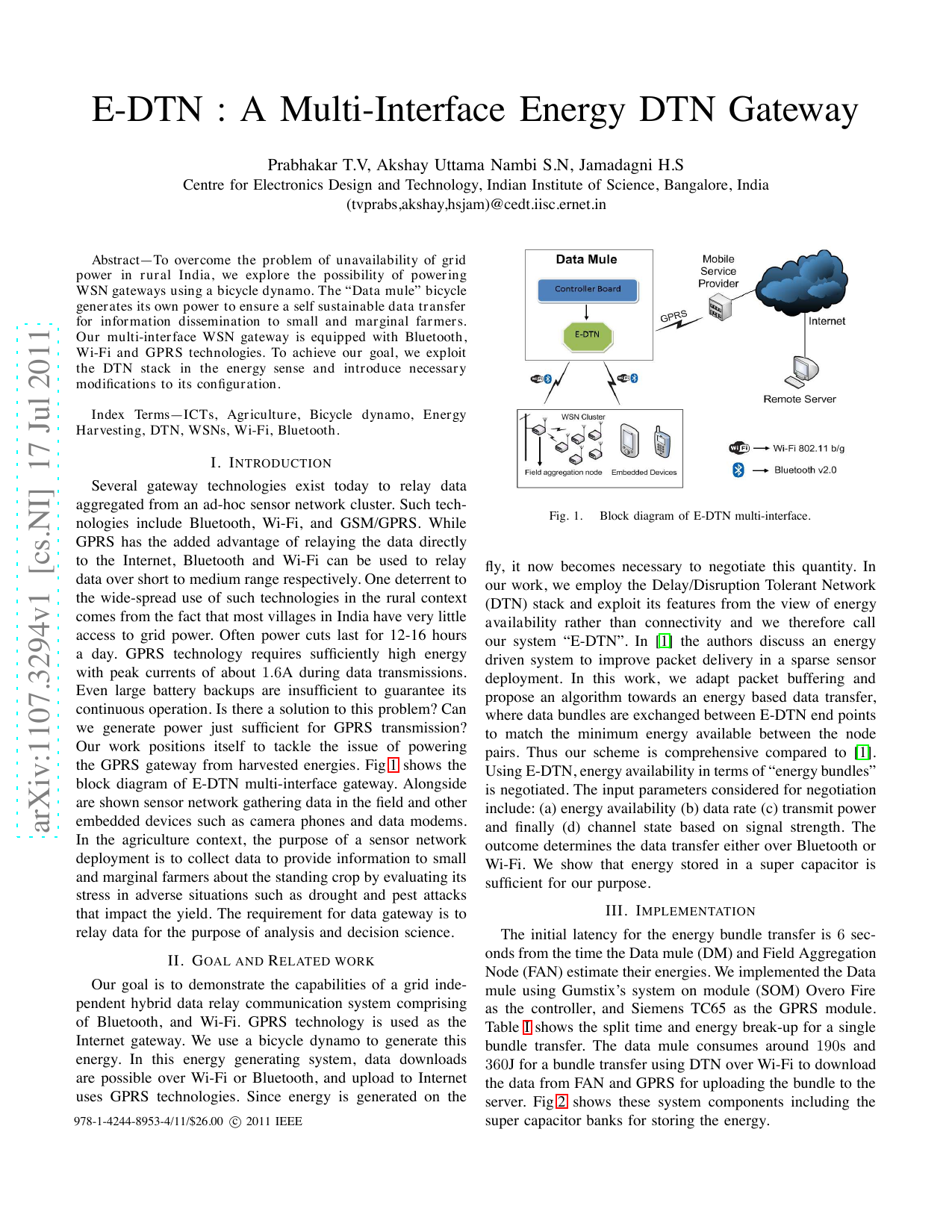
the GPRS gateway from harvested energies. Fig.1 shows the
block diagram of E-DTN multi-interface gateway. Alongside
are shown sensor network gathering data in the field and other
embedded devices such as camera phones and data modems.
In the agriculture context, the purpose of a sensor network
deployment is to collect data to provide information to small
and marginal farmers about the standing crop by evaluating its
stress in adverse situations such as drought and pest attacks
that impact the yield. The requirement for data gateway is to
relay data for the purpose of analysis and decision science.
II. GOAL AND RELATED WORK
Our goal is to demonstrate the capabilities of a grid inde-
pendent hybrid data relay communication system comprising
of Bluetooth, and Wi-Fi. GPRS technology is used as the
Internet gateway. We use a bicycle dynamo to generate this
energy. In this energy generating system, data downloads
are possible over Wi-Fi or Bluetooth, and upload to Internet
uses GPRS technologies. Since energy is generated on the
Fig. 1.
Block diagram of E-DTN multi-interface.
fly, it now becomes necessary to negotiate this quantity. In
our work, we employ the Delay/Disruption Tolerant Network
(DTN) stack and exploit its features from the view of energy
availability rather than connectivity and we therefore call
our system “E-DTN”. In [1] the authors discuss an energy
driven system to improve packet delivery in a sparse sensor
deployment. In this work, we adapt packet buffering and
propose an algorithm towards an energy based data transfer,
where data bundles are exchanged between E-DTN end points
to match the minimum energy available between the node
pairs. Thus our scheme is comprehensive compared to [1].
Using E-DTN, energy availability in terms of “energy bundles”
is negotiated. The input parameters considered for negotiation
include: (a) energy availability (b) data rate (c) transmit power
and finally (d) channel state based on signal strength. The
outcome determines the data transfer either over Bluetooth or
Wi-Fi. We show that energy stored in a super capacitor is
sufficient for our purpose.
III. IMPLEMENTATION
The initial latency for the energy bundle transfer is 6 sec-
onds from the time the Data mule (DM) and Field Aggregation
Node (FAN) estimate their energies. We implemented the Data
mule using Gumstix’s system on module (SOM) Overo Fire
as the controller, and Siemens TC65 as the GPRS module.
Table I shows the split time and energy break-up for a single
bundle transfer. The data mule consumes around 190s and
360J for a bundle transfer using DTN over Wi-Fi to download
the data from FAN and GPRS for uploading the bundle to the
server. Fig.2 shows these system components including the
super capacitor banks for storing the energy.
978-1-4244-8953-4/11/$26.00 c⃝2011 IEEE
Fig. 2.
Dynamo Driven Data mule.
Fig. 3.
Energy per packet vs Buffer size for 95% Confidence Interval
Table II shows the latency in a single bundle transfer between
the E-DTN end points over Bluetooth and Wi-Fi. We experi-
mentally evaluated the optimal size of the GPRS buffer. The
packet size was fixed at 32 bytes. Experiments were conducted
by varying the buffer size and programming