Centre for Mathematical Sciences India (CMS): Professor A.M. Mathais 75th Birthday
📝 Original Info
- Title: Centre for Mathematical Sciences India (CMS): Professor A.M. Mathais 75th Birthday
- ArXiv ID: 1101.4289
- Date: 2011-03-01
- Authors: H.J. Haubold
📝 Abstract
A brief overview on the Centre for Mathematical Sciences India, established in 1977, and its teaching and research programme is given.💡 Deep Analysis
📄 Full Content
Professor A.M. Mathai’s 75th Birthday
By Hans J. Haubold, United Nations, CMS Member since 1983
Abstract. A brief overview on the Centre for Mathematical Sciences India, established in 1977, and its teaching and research programme is given.
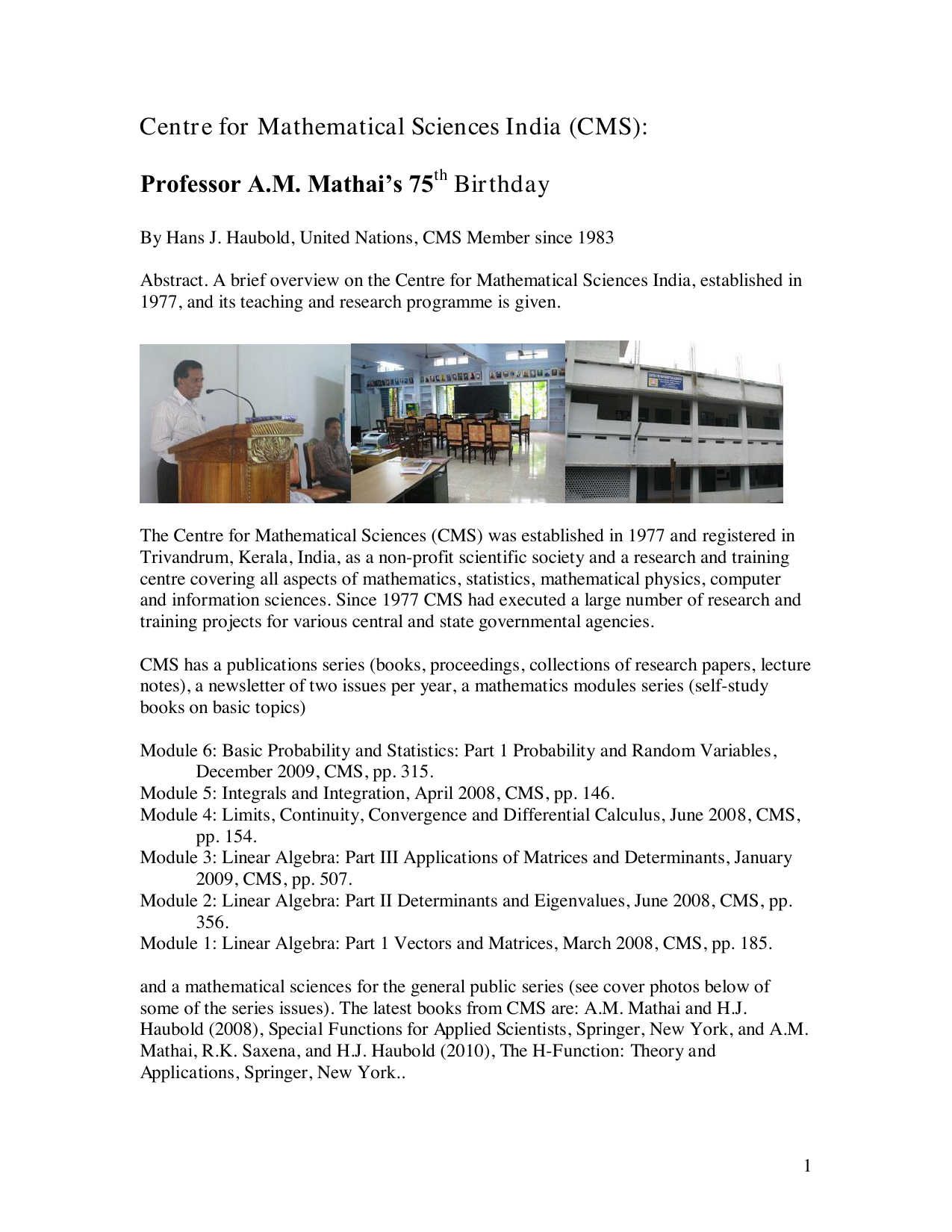
The Centre for Mathematical Sciences (CMS) was established in 1977 and registered in Trivandrum, Kerala, India, as a non-profit scientific society and a research and training centre covering all aspects of mathematics, statistics, mathematical physics, computer and information sciences. Since 1977 CMS had executed a large number of research and training projects for various central and state governmental agencies.
CMS has a publications series (books, proceedings, collections of research papers, lecture notes), a newsletter of two issues per year, a mathematics modules series (self-study books on basic topics)
Module 6: Basic Probability and Statistics: Part 1 Probability and Random Variables, December 2009, CMS, pp. 315. Module 5: Integrals and Integration, April 2008, CMS, pp. 146. Module 4: Limits, Continuity, Convergence and Differential Calculus, June 2008, CMS, pp. 154. Module 3: Linear Algebra: Part III Applications of Matrices and Determinants, January 2009, CMS, pp. 507. Module 2: Linear Algebra: Part II Determinants and Eigenvalues, June 2008, CMS, pp.
Module 1: Linear Algebra: Part 1 Vectors and Matrices, March 2008, CMS, pp. 185.
and a mathematical sciences for the general public series (see cover photos below of some of the series issues). The latest books from CMS are: A.M. Mathai and H.J. Haubold (2008), Special Functions for Applied Scientists, Springer, New York, and A.M. Mathai, R.K. Saxena, and H.J. Haubold (2010), The H-Function: Theory and Applications, Springer, New York..
2 In 2002, CMS Pala Campus was established in a two floors finished building donated to CMS by the Diocese of Palai in Kerala, India. In 2006, Hill Area Campus of CMS was established. The office, CMS library, and most of the facilities are at CMS Pala Campus. The other campuses, namely, the South Campus (or Trivandrum campus) and the Hill Area Campus have occasional activities and libraries are being developed at South and Hill Area campuses also.
Starting from 1985, Professor Dr. A.M. Mathai of McGill University, Canada, is the Director of CMS. After taking early retirement in 2000, Professor Mathai is spending most of time at CMS and directing various CMS activities in an honorary capacity. CMS library is being built up by using the books and journals donated by Professor Mathai’s colleagues, friends, and well-wishers in Canada and USA. CMS has the best library in Kerala, India, in mathematical sciences.
By the end of 2006 the Department of Science and Technology, Government of India (DST) gave a development grant to CMS. Thus, starting from December 2006 CMS is being developed as a DST Centre for Mathematical Sciences. DST has similar centres at three other locations in India.
From 1977 to 2010, CMS activities are carried out by a group of researchers in Kerala, mostly retired professors, through voluntary service. Starting from 2007 DST created full time salaried positions of three Assistant Professors, one Full Professor and one Liaison Officer. They are residing at CMS Pala Campus. DST approved up to 17 junior and senior research fellows (JRF/SRF). They are Ph.D students at CMS Pala Campus. They will receive their Ph.D degrees from Mahatma Gandhi University (MG University or Banaras Hindu University or Anna University Coimbatore), after fulfilling the residence requirements. All the JRFs and SRF are publishing papers accepted/published in international refereed journals.
CMS conducts a five-week research orientation course, called SERC School, every year. The main theme for the first sequence of five schools was special functions and functions of matrix argument and their applications.
SERC 1: Lecture Notes not published. SERC 2: Lecture Notes Special Functions and Functions of Matrix Arguments, July 2000, CMS Publication No. 31, pp. 309. SERC 3: Lecture Notes Special Functions and Functions of Matrix Argument: Recent Developments and Recent Applications in Statistics and Astrophysics, February 2005, CMS Publication No. 32, pp. 262. SERC 4: Lecture Notes Special Functions and Functions of Matrix Argument: Recent Advances and Applications in Stochastic Processes, Statistics and Astrophysics, February 2006, CMS Publication No. 33, pp. 325. SERC 5: Lecture Notes Special Functions and Functions of Matrix Argument: Recent
Advances and Applications in Stochastic Processes, Statistics, Wavelet Analysis and Astrophysics, February 2007, CMS Publication No. 34, pp. 358.
3 The theme for the second sequence of five schools is multivariable and matrix variable calculus, statistical distributions and model building.
SERC
📸 Image Gallery