Emergent Weyl Nodes and Berry Curvature in Bose Polarons via $p$-Wave Feshbach Coupling
We show that an impurity quasiparticle immersed in a Bose-Einstein condensate, known as a Bose polaron, exhibits topological properties characterized by a nonzero Berry curvature, which is induced by Weyl nodes that emerge via interspecies $p$-wave Feshbach resonance. Such nodes occur even in the absence of spin degrees of freedom and spin-orbit coupling. For charged impurities, the corresponding $p$-wave polarons are shown to be accompanied by chiral anomaly. The above predictions can be tested in a cold atomic environment by observing the Hall transport of the atomic or ionic impurity cloud.
💡 Research Summary
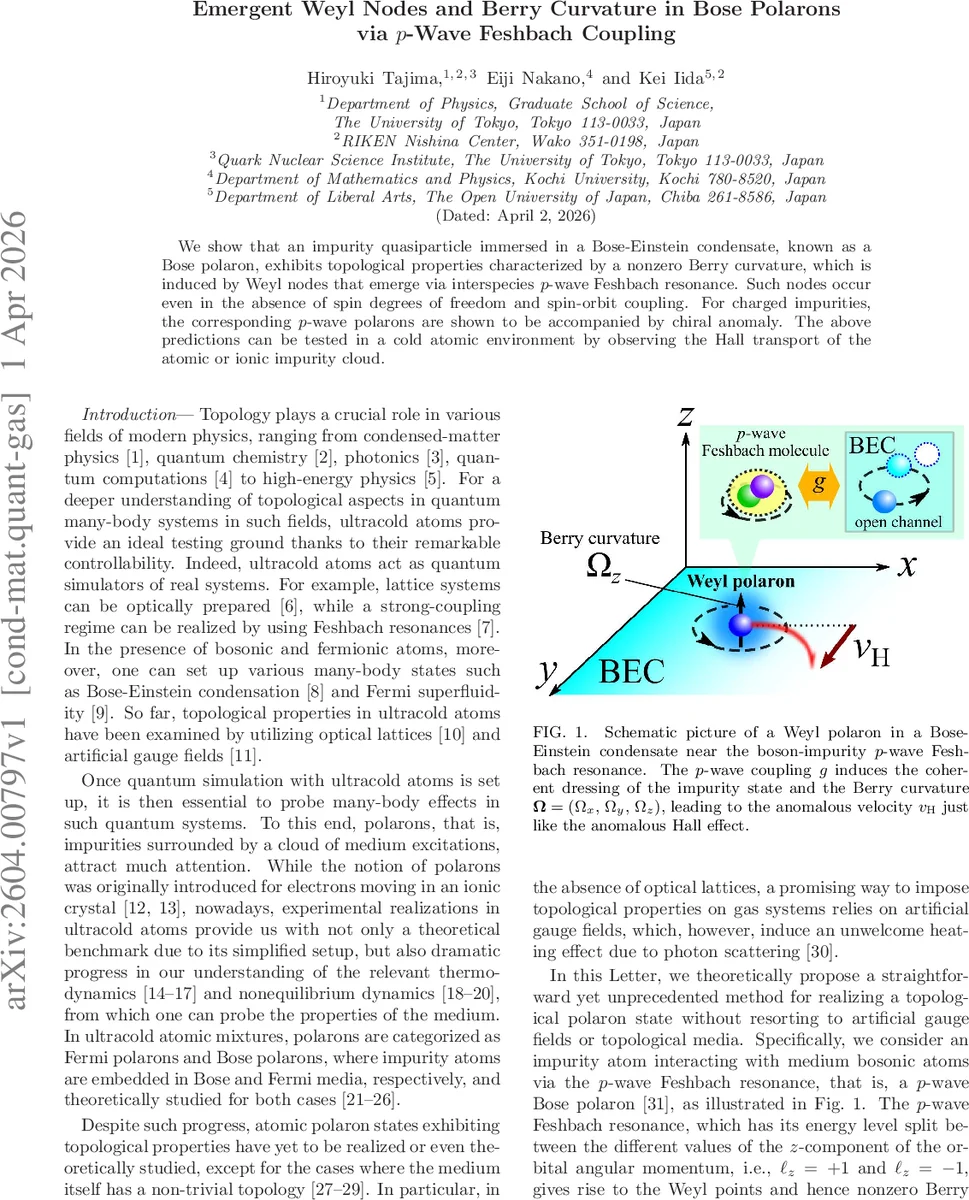
The authors theoretically investigate a Bose‑polaron system in which an impurity atom is immersed in a Bose‑Einstein condensate and interacts with the bosons via an interspecies p‑wave Feshbach resonance. Using a two‑channel Hamiltonian, they derive an effective low‑energy description that, near the ℓz = +1 resonance, reduces to a 2 × 2 spinor form H_eff = σ·d(p) + d₀(p). The vector d(p) vanishes at two isolated momenta p_W = (0,0,±p_W), establishing Weyl points of opposite chirality (χ = ±1) in momentum space. The associated Berry connection and curvature are computed analytically; the curvature diverges at the Weyl nodes, confirming a non‑trivial topological charge.
Semiclassical dynamics reveal an anomalous velocity term v_H = −F × Ω(p) that produces a Hall‑type transverse drift of the impurity cloud under an external force F. Near the p‑wave resonance this Hall response is strongly enhanced, scaling as v_H ∝ F ζ²/(ν₊₁ − μ_b)². For charged impurities, the Lorentz force adds to the equations of motion, and the continuity equation acquires a chiral‑anomaly source term χ q² E·B/(4π²), mirroring the chiral magnetic effect known from high‑energy physics.
The paper proposes concrete experimental signatures: measurement of the center‑of‑mass motion of the impurity cloud, observation of transverse Hall currents, and detection of the anomalous velocity via time‑resolved imaging. Realistic atomic mixtures such as ⁶Li‑⁵²Cr, ⁶Li‑⁵³Cr, and ⁶Li‑¹³³Cs are identified, with the large mass imbalance providing a natural platform for flat‑band and multi‑band topological simulations.
Beyond the immediate results, the authors discuss future directions, including the possibility of p‑wave mediated fermionic superfluidity with intrinsic Berry curvature, exploration of quantum‑geometric effects, and the use of impurity‑mediated interactions to engineer topological flat‑band superconductors without optical lattices. The work thus opens a pathway to study topological quasiparticles and chiral transport phenomena in highly controllable cold‑atom settings.
Comments & Academic Discussion
Loading comments...
Leave a Comment