Graphilosophy: Graph-Based Digital Humanities Computing with The Four Books
The Four Books have shaped East Asian intellectual traditions, yet their multi-layered interpretive complexity limits their accessibility in the digital age. While traditional bilingual commentaries provide a vital pedagogical bridge, computational f…
Authors: Minh-Thu Do, Quynh-Chau Le-Tran, Duc-Duy Nguyen-Mai
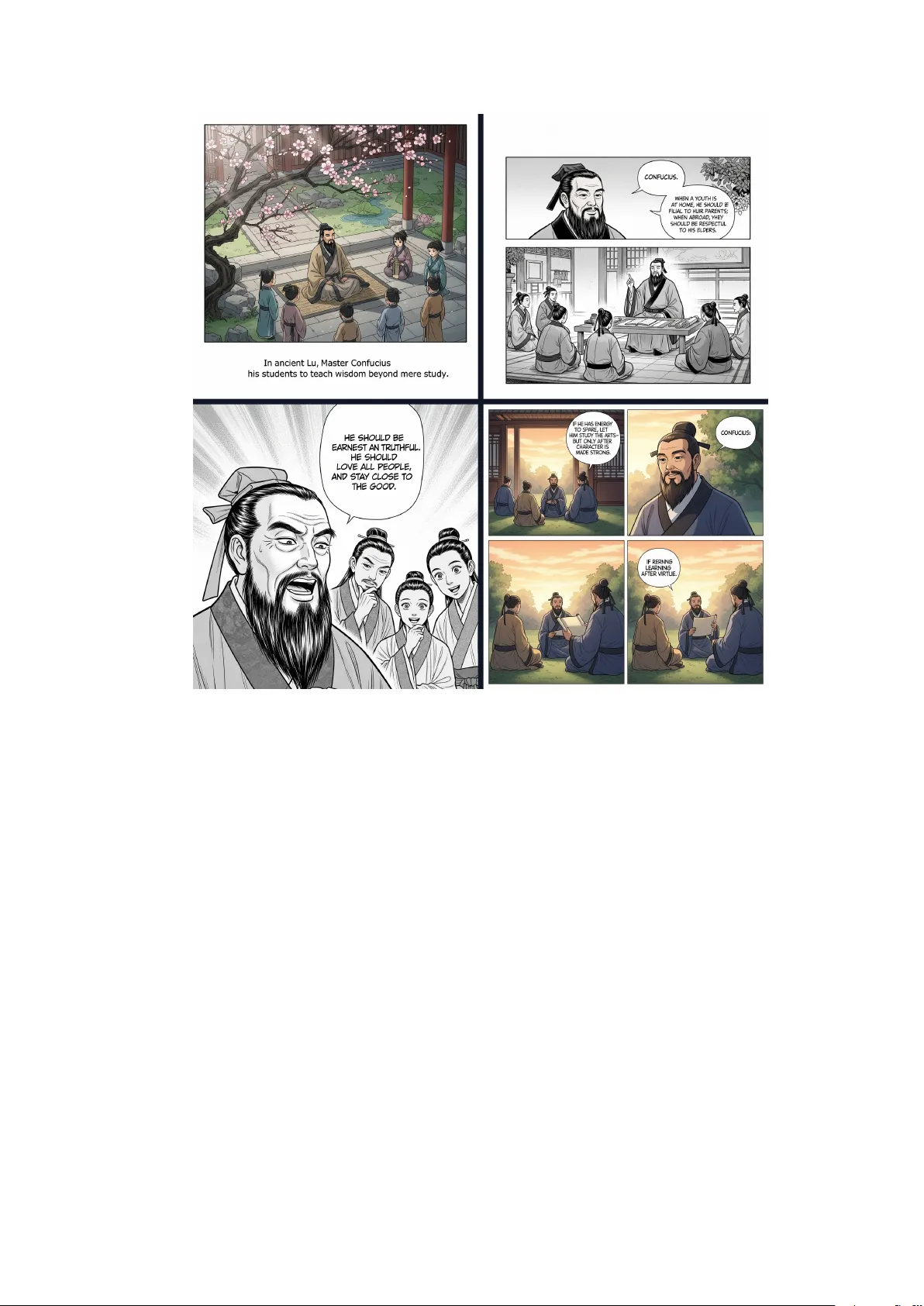
Graphilosoph y: Graph-Based Digital Humanities Computing with The F our Bo oks Minh-Th u Do 1,2 , Quynh-Chau Le-T ran 1,2 , Duc-Duy Nguy en-Mai 1,2 , Thien-T rang Nguy en 1,2 , Khanh-Duy Le 1,2 , Minh-T riet T ran 1,2 , T am V. Nguy en 3 , T rung-Nghia Le 1,2* 1 Univ ersity of Science, VNU-HCM, Ho Chi Minh Cit y , Vietnam. 2 Vietnam National Univ ersity - Ho Chi Minh, Ho Chi Minh Cit y , Vietnam. 3 Univ ersity of Dayton, Dayton, Ohio, United States. *Corresp onding author(s). E-mail(s): ltnghia@fit.hcm us.edu.vn ; Con tributing authors: 24C02018@student.hcm us.edu.vn ; 24C02003@studen t.hcmus.edu.vn ; 24C02006@studen t.hcmus.edu.vn ; 24C02021@studen t.hcmus.edu.vn ; lkduy@fit.hcm us.edu.vn ; tm triet@fit.hcmus.edu.vn ; tamnguy en@udayton.edu ; Abstract The F our Bo oks hav e shaped East Asian intellectual traditions, y et their multi- la yered in terpretive complexit y limits their accessibility in the digital age. While traditional bilingual commentaries provide a vital p edagogical bridge, computa- tional frameworks are needed to preserve and explore this wisdom. This paper bridges AI and classical philosophy by in tro ducing Graphilosophy , an on tology- guided, multi-la yered kno wledge graph framework for mo deling and interpreting The F our Bo oks. In tegrating natural language pro cessing, m ultilingual seman- tic embeddings, and humanistic analysis, the framework transforms a bilingual Chinese-Vietnamese corpus into an interpretiv ely grounded resource. Graphi- losoph y enco des linguistic, conceptual, and interpretiv e relationships across in terconnected lay ers, enabling cross-lingual retriev al and AI-assisted reasoning while explicitly preserving sc holarly nuance and interpretiv e plurality . The sys- tem also enables non-exp ert users to trace the evolution of ethical concepts across borders and languages, ensuring that ancient wisdom remains a living resource for mo dern moral discourse rather than a static relic of the past. Through an interactiv e interface, users can trace the evolution of ethical con- cepts across languages, ensuring ancient wisdom remains relev ant for modern 1 discourse. A preliminary user study suggests the systems capacity to enhance conceptual understanding and cross-cultural learning. By linking algorithmic represen tation with ethical inquiry , this research exemplifies how AI can serve as a metho dological bridge, accommodating the ambiguit y of cultural heritage rather than reducing it to static data. The Source co de and data are released at h ttps://github.com/Th uDoMinh1102/confucian- texts- knowledge- graph . Keyw ords: Digital h umanities, Natural language processing, Knowledge graph, Confucian philosophy , AI interpretabilit y , Cultural heritage 1 In tro duction The F our Bo oks () 1 , including The Great Learning (), The Do ctrine of the Mean (), The Analects of Confucius (), and The W orks of Mencius (), o ccup y a cen tral place in East Asian intellectual and moral history . As the foundation of Confucian philosophy , these texts ha ve shap ed education, p olitics, and ethics across China, Vietnam, K orea, and Japan for o ver tw o millennia, while em b o dying enduring ideals of virtue and so cial harmony . Among many commentarial traditions surrounding The F our Books, Chinese-Vietnamese Commentaries on The Four Books () ( T uan 2017 ), a widely recognized luminary in East Asian philosophy , is notable for its p edagogical clarity and bilingual structure. A scholar of Eastern philosophy , Ly Minh T uan structured this w ork to integrate Classical Chinese text, transliteration, Vietnamese translation, and commentary , making the sages though t accessible to mo dern readers. The work presen ts Classical Chinese texts with mo dern Vietnamese translations and notes, and its introduction underscores the contin ued relev ance of Confucian virtues suc h as b enev olence and altruism in mo dern life ( T uan 2017 ). This commentary thus helps bridge ancient Confucian ethics and contemporary moral concerns. Despite their enduring influence, computational research on The F our Bo oks and related commentaries remains scarce. T raditional digitization pro jects focus on text preserv ation and retriev al, rarely mo deling the dynamic in terpretive la yers found in annotated works where commentary , translation, and source text interrelate. These gaps are exacerbated by broader issues in digital h umanities and cultural heritage preserv ation. AI-assisted translation in tro duces conceptual asymmetries; mapping terms like r en (, b enev olence) or li (, ritual propriety) into mo dern languages risks diluting univ ersal ethical ideals in to culturally sp ecific, localized in terpretations. Priv- ileging a single translation or commentary tradition in AI mo dels can inadv ertently amplify sp ecific lo calized p erspectives while marginalizing others, raising critical questions of interpretiv e authority and representational bias ( Zhu et al. 2024 ). Recen t adv ances in AI-driven text analysis and knowledge graphs (KGs) hav e expanded ho w large cultural corp ora can b e organized and explored, supporting access and relational interpretation in digital h umanities research ( de Jong 2009 ; F erro et al. 2025 ; Haslhofer et al. 2019 ). While general-purp ose infrastructures offer broad cov er- age, domain-sp ecific cultural heritage graphs b etter capture historical and conceptual 1 https://en.wikipedia.org/wiki/F our_Bo oks_and_ Five_Classics 2 complexit y , y et scholarship emphasizes that such systems are so ciotechnical constructs whose representational choices shape interpretiv e authority ( Suc hanek et al. 2024 ; V randeˇ ci ´ c and Kr¨ otzsc h 2014 ; Barzaghi et al. 2025 ; Bai and Hou 2023 ; Druck er 2020 ; D’Ignazio and Klein 2020 ; Liu 2012 ). Recent work highlights pluralistic graph-based mo dels as a resp onse to these concerns, but Confucian classics such as The F our Bo oks remain challenging due to linguistic concision, polysemy , and dense commentary tra- ditions that resist stable or discrete computational representation ( Y uan et al. 2025 ; F ok a et al. 2025 ). T o address this, we prop ose Graphilosophy , an on tology-guided, m ulti-la yered K G framework for mo deling The F our Bo oks and their commen taries. Graphiloso- ph y functions as an interpretiv e infrastructure that makes relationships among texts, translations, commentaries, sp eak ers, and concepts explicit and na vigable. Our sys- tem transforms Commentaries on The Four Books ( T uan 2017 ), which in tegrates the original Classical Chinese with a mo dern Vietnamese translation and p edagogi- cally oriented commentar, into a structured, mac hine-readable dataset that supp orts seman tic search, philosophical reasoning, and educational applications. W e construct a m ulti-lay ered KG representation to mo del the intertextual relationships b et ween do c- trine and interpretation, an essen tial foundation for semantic understanding of Eastern philosoph y . By externalizing interpretiv e structures instead of concealing them within opaque mo dels, the system supp orts plural readings and reflexive engagement. Our system addresses representational bias through a scalable and explicitly plu- ralistic design that treats kno wledge mo deling as an ev olving, interpretiv e pro cess rather than a fixed technical structure. Central to Graphilosoph y is a mo dular KG that supp orts expansion across linguistic, interpretiv e, and philosophical dimensions, allow- ing multiple translations and exp ert commentaries to co exist and reducing linguistic bias and singular in terpretive authority . Its la yered and extensible ontology separates textual, linguistic, conceptual, and commen tary dimensions so eac h can evolv e inde- p enden tly while remaining connected, accommo dating ambiguit y and m ultiplicity as core features of Confucian philosophy . This design addresses concerns that reductive represen tational mo dels flatten philosophical n uance and repro duce p ow er imbalances ( Druc ker 2017 ; D’Ignazio and Klein 2020 ; Druck er 2020 ), aligning technical scalability with interpretiv e v alues central to digital humanities practice. This pap er addresses t wo in terrelated questions concerning the design and impli- cations of AI-mediated knowledge representations for classical philosophical texts. First, how can an ontology-guided, multi-la yered knowledge graph framework supp ort the representation of the semantic, interpretiv e, and translational plurality inherent in The F our Bo oks, while making visible the asymmetries of language, conceptual framing, and in terpretive authority em b edded in their transmission? Second, to what exten t can such a system meaningfully support philosophical learning and cultural preserv ation without reducing the op enness, ambiguit y , and historical situatedness of the original texts, and what challenges arise when attempting to align scalability and bias mitigation with the ethical and interpretiv e demands of this domain? Our contributions are as follo ws: • W e assem ble a digitally annotated corpus of The F our Bo oks that integrates Classical Chinese texts, Vietnamese translations, and p edagogical commentaries, 3 making visible the lay ered and mediated nature of meaning across languages and in terpretations. • W e prop ose a domain-sp ecific K G that mo dels textual, conceptual, and com- men tary relationships as interconnected lay ers, supp orting interpretiv e plurality rather than fixed semantic closure. • W e develop exploratory and visual to ols that enable navigation across these la y- ers, supp orting seman tic exploration, teaching, and interpretiv e inquiry in digital h umanities contexts. • Through exp erimen ts and a user study , we show how AI-based representations can assist learning and research while preserving the central role of h uman in terpretation in engaging with Confucian philosophical texts. • The Source co de and data are released at https://gith ub.com/ThuDoMinh1102/ confucian- texts- knowledge- graph . 2 Related W ork Digital humanities initiativ es increasingly rely on computational approaches to pre- serv e cultural heritage, utilizing large-scale platforms (Europ eana 2 , the Perseus Digital Library 3 , the Chinese T ext Pro ject 4 ) that provide structured, m ultilingual access to historical materials. While these efforts effectively treat humanities texts as data to broaden access, they primarily emphasize digitization, search, and metadata organization. Consequently , they offer limited means to engage with the profound seman tic, philosophical, and linguistic complexity that shapes classical works and their traditions of interpretation. Similarly , Natural Language Pro cessing (NLP) has b ecome essential for engag- ing with premo dern corp ora ( Haslhofer et al. 2019 ), adapting tec hniques to handle the in terpretive challenges of archaic texts ( Johnson et al. 2021 ) and utilizing mul- tilingual mo dels to enable large-scale cross-lingual alignment ( Zhang et al. 2023 ). Ho wev er, these computational developmen ts remain heavily fo cused on surface-level linguistic pro cessing and information retriev al. They provide limited supp ort for mo d- eling the ric h intertextual and interpretiv e relationships through which historical and philosophical meaning is actually produced. T o capture this relational meaning, Kno wledge Graphs (KGs) are increasingly adopted to structure cultural knowledge ( Zheng et al. 2024 ; Cui et al. 2024 ). Y et, general-purp ose KGs often privilege bibliographic structure o ver interpretiv e depth ( K ok ash et al. 2024 ). F rom a digital humanities and so ciotec hnical p erspective, this emphasis risks treating cultural texts as stable, objective data p oin ts rather than dynamic sites of ongoing interpretation. F or Confucian classics, linguistic concision and dense commentarial traditions exp ose fundamen tal tensions b etw een current AI represen tations and the interpretiv e complexit y of the domain. In resp onse, our study adv ances a domain-sp ecific, ontology-guided K G that reflects the lay ered, dialogical nature of Confucian philosophy . By situating m ultilin- gual NLP within this framework, w e treat language tec hnologies not as neutral ends 2 https://www.europeana.eu/ 3 https://www.perseus.tufts.edu/hopper/ 4 https://ctext.org/ 4 in themselv es, but as mediating infrastructures. Utilizing recen t adv ances in graph analysis and m ultilingual semantic representation, this approac h foregrounds rela- tional meaning, in terpretive plurality , and the ethical resp onsibilities of AI-mediated kno wledge representation. 3 Prop osed Dataset T o enable computational analysis, we construct The F our Bo oks as a Classical Chinese Vietnamese resource organized at three levels: (1) tri-parallel alignment incor- p orating phonetic bridging b et ween the tw o languages, (2) dictionary-level lexical mapping for precise semantic corresp ondence, and (3) chapter-based exegesis captur- ing interpretiv e commen tary and con textual meaning. T ogether, these comp onents form an extended corpus that enco des the semantic, phonetic, and in terpretive dimensions of Classical Chinese and Vietnamese, reflecting the linguistic depth and con textual sophistication of each chapter. 3.1 Dataset Construction 3.1.1 Data Source The dataset consists of authoritativ e digital editions of The F our Books, including the original Classical Chinese texts and standard commen taries. W e use Commen- taries on The F our Bo oks () ( T uan 2017 ) as the primary source for Chinese Vietnamese translations and exegetical notes, chosen for its comprehensive cov erage, reliable bilin- gual annotation, and p edagogical depth. All materials were drawn from op en-access rep ositories and cross-c heck ed against printed editions to ensure textual accuracy . The dataset is structured around three in terrelated comp onen ts, Main T ext, Dic- tionary , and Exp ert Analysis, which together reflect the la yered and mediated nature of meaning in Confucian traditions. The Main T ext consists of 2,222 sen tences from The F our Bo oks, organized according to their original textual hierarch y and presented in Classical Chinese alongside Sino-Vietnamese readings and mo dern Vietnamese translations, thereb y preserving b oth linguistic structure and translational mediation. This comp onent serv es as the in terpretive foundation of the dataset, enabling close engagemen t with source passages while situating them within broader p edagogical and semantic contexts. The Dictionary includes 5,344 entries of Classical Chinese c haracters that were consolidated in to 2,788 unique entries to accoun t for p olysemy and con textual v ariation, treating lexical am biguity as an interpretiv e condition rather than a defect to b e eliminated. The Exp ert A nalysis comprises 80 commen tary en tries authored by Ly Minh T uan, providing p edagogical and interpretiv e p ersp ec- tiv es that situate the texts within established traditions of explanation and learning. The separation of these comp onen ts is an in tentional design c hoice that supp orts trans- parency and in terpretive plurality , allo wing textual conten t, lexical interpretation, and commen tary to evolv e indep endently while remaining connected to the source texts, and framing computational structure as a mediating practice through which cultural kno wledge is represen ted and transmitted. 5 3.1.2 Construction Pip eline The dataset construction follow ed a staged w orkflow that treats corpus preparation as an interpretiv e practice. It inv olved Preprocessing, Alignment, Refinemen t, and Structuring, with attention to preserving textual integrit y and contextual meaning. During Pr epr o c essing , scanned sources w ere transformed into structured digital text, corrected, and normalized to remov e lay out artifacts using PaddleOCR 5 , segmen ted according to the original textual logic, and enric hed with contextual information suc h as prov enance and authorship. Lexical materials were extracted and con textualized using metadata (b o ok and chapter) to reflect the role of v o cabulary and p olysemy in shaping meaning. The Str ate gy A lignment explicitly differen tiated among three corpus t yp es: the T ri-Parallel Corpus, whic h aligns Classical Chinese passages with Sino-Vietnamese readings and mo dern Vietnamese translations; the Lexical Corpus, whic h connects dictionary en tries to their textual con texts to address polysemy and usage; and the Exegesis Corpus, which links expert commentaries to corresp onding canonical passages. Alignment combined automated procedures with exp ert review, underscor- ing that relational mapping across languages and interpretations is an inherently in terpretive pro cess. F ollowing automated pro cessing, the R efinement stage treats correction and ver- ification as acts of interpretiv e resp onsibilit y rather than purely technical cleanup. First, heuristic reco very was used to iden tify and correct digitization artifacts that could distort meaning or disrupt textual contin uity . This was follow ed b y a close man ual audit carried out by domain exp erts, who reviewed all aligned textual units to ensure coherence and fidelity across the Classical Chinese, Sino-Vietnamese, and mo dern Vietnamese lay ers. Rather than prioritizing mechanical alignmen t alone, this pro cess foregrounds accoun tability , transparency , and human judgment in the medi- ation of cultural texts, establishing a reliable and ethically grounded foundation for the subsequent multi-la yered kno wledge representation. In the Structuring stage, all materials w ere organized in to in terop erable formats with consistent iden tifiers, enabling the corpus to function as an in tegrated whole. This structure supp orts analysis, teaching, and exploration while maintaining transparency in how texts, translations, and interpretations are connected. 3.2 Dataset Description The finalized dataset comprises 2,222 segmen ted sentences, 80 scholarly commen- tary annotations, and a refined lexical dictionary of 2,788 entries, including 2,562 unique Classical Chinese characters and 23 core Confucian concepts. These materials are instantiated in an ontology-driv en KG containing 16,468 no des and 71,249 edges spanning textual, linguistic, and in terpretive lay ers. Rather than serving as a purely technical resource, this structure is designed to externalize ho w meaning is mediated through translation, commentary , and concep- tual categorization in classical philosophy . The dataset is organized into three com- plemen tary comp onen ts, including the T ri-Par al lel Corpus , the L exic al Dictionary , 5 https://www.paddleocr.ai/ 6 and the Exe gesis Corpus , each preserving a distinct dimension of in terpretive plural- it y: translational mediation, lexical p olysem y , and scholarly commentary , resp ectiv ely . T ogether, they form an interoperable cultural dataset that links text, translation, lex- icon, and exp ert interpretation through a unified on tology , enabling AI systems to me diate , rather than resolve, the complexity of classical philosophical knowledge. 4 Metho dology 4.1 Overview Our proposed Graphilosophy is a comprehensiv e, multi-stage framew ork that in te- grates adv anced text pro cessing, lay ered KG construction, and an interactiv e web in terface p o wered by Go ogle Gemini ( Go ogle 2023 ) for natural language querying. Our K G was built using the Netw orkX library ( Hagb erg et al. 2008 ) in a mo dular man- ner. Rather than generating a monolithic graph, our system constructs six distinct y et interlink ed lay ers, such as T extual, Linguistic, Conceptual, Commentary , Sp eak er, and Semantic (Figure 1 ). Each lay er is processed indep enden tly to preserve its unique analytical function and data in tegrity b efore b eing interconnected through ontology- guided relationships. This mo dular design maintains in terpretive clarity within eac h dimension while enabling a unified, m ulti-p erspective understanding of The F our Bo oks and their accompanying commentaries. 4.2 Ontology Design and Construction The Graphilosophy framework employs a custom multi-la yered ontology sp ecifically designed to mo del the bilingual Classical Chinese–Vietnamese corpus of The F our Bo oks . The on tology systematically structures textual, linguistic, conceptual, and in terpretive dimensions across six interconnected lay ers (Meta, T extual, Linguistic, Conceptual, Commentary & Sp eak er, and Seman tic), comprising 20 en tity classes and 18 directed relationship types. This design supp orts multi-hop reasoning, cross-lingual retriev al, and in terpretive plurality while maintaining mo dularit y and scalabilit y . Figure 1 illustrates the ontology architecture, depicting the sequen tial flow from the Meta Lay er through the T extual, Linguistic, Conceptual, and Commentary & Sp eak er Lay ers to the Semantic Lay er, together with explicit cross-lay er connections that unify the entire kno wledge graph. T able 1 provides a comprehensiv e summary of all entit y classes and relationship t yp es, group ed b y lay er. Relations are generated through three distinct metho ds (fully automatic rule- based, semi-automatic with h uman v alidation, and fully man ual exp ert-defined) and unified into a single directed graph via explicit cross-lay er links (e.g., HAS_HAN_FORM , CONTEXTUALIZES , EXPRESSES_CONCEPT ). This mo dular, ontology-guided structure externalizes interpretiv e pro cesses, preserves semantic am biguity inherent in Confu- cian philosophy , and provides a robust foundation for semantic search, philosophical reasoning, and educational exploration. 7 Fig. 1 : The multi-la yered on tology arc hitecture of the Graphilosophy knowledge graph. The schema mo dels the corpus across six distinct but interconnected la yers to preserv e structural, linguistic, and interpretiv e dimensions. Solid lines indicate intra- la yer relationships, while dashed lines represen t cross-la yer unifications that enable complex, multi-hop reasoning. 4.3 Linguistic Pro cessing Classical Chinese presents unique computational challenges due to its brevit y , p olysem y , and con text-dep endence. Polysemy R esolution via Contextual Emb e dding When a Classical Chinese character has multiple p ossible meanings, the system adopts a context-sensitiv e matc hing approac h, using Multilingual-e5-large embeddings and cosine similarity , rather than enforcing a single dictionary definition. Meanings are ev aluated in relation to the surrounding passage to support in terpretive coherence, without treating the result as definitiv e. This design reflects digital humanities com- mitmen ts to preserving semantic ambiguit y and aligns with concerns ab out limiting algorithmic authorit y in the interpretation of philosophical texts. Example ( ( o )): This c haracter has three primary meanings in our dictionary: path/road, to speak/say , and do ctrine/The W ay . In the passage :! (Analects 4.15), the system in terprets in relation to the surrounding philosophical discourse, foregrounding its do ctrinal sense based on the philosophical context of Confucius addressing his disciple ab out his unifying principle. Se gmentation in Context While Classical Chinese lac ks punctuation, the system uses Ly Minh T uans schol- arly edition ( T uan 2017 ) as an in terpretive reference rather than a neutral ground 8 T able 1 : En tity classes and relationship types in the Graphilosophy KG ontology La yer T yp e Name Metho d Meta Entit y DOMAIN, SCHOOL Predefined T extual Entit y BOOK, CHAPTER, SECTION, P AGE, SENTENCE Auto T extual Relation CONT AINS, FOLLO WS, APPEARS_IN Auto Linguistic Entit y HAN_SENTENCE, HANVIET_SENTENCE, VIETNAMESE_SENTENCE Auto Linguistic Entit y HAN_WORD, HANVIET_PRONUNCIA TION, VIETNAMESE_MEANING Auto Linguistic Relation HAS_HAN_FORM, HAS_HANVIET_FORM, HAS_VIETNAMESE_ TRANSLA TION, TRANSLA TES_TO, PRONOUNCED_AS Auto Conceptual Entit y PHILOSOPHICAL_CONCEPT (Pattern matching) Auto Conceptual Relation EXPRESSES_CONCEPT, RELA TED_TO, CO_OCCURS_WITH Auto + semi-manual Commen tary & Sp eak er Entit y EXPER T, COMMENT AR Y, COMMENT AR Y_CHUNK, SPEAKER Manual / Pattern detection Commen tary & Sp eak er Relation PRO VIDES_COMMENT AR Y, EXPLAINS, CONTEXTUALIZES, QUOTES Manual + similarity > 0.75 Seman tic Entit y EMBEDDING, SEMANTIC_CLUSTER Auto Seman tic Relation SIMILAR_TO, BELONGS_TO_CLUSTER, HAS_SEMANTIC_REP Auto Note : T otal of 20 entit y classes and 18 relationship types. Metho d : Auto = fully automatic (rule-based); Semi = algorithm + human verification; Man ual = exp ert-defined. truth, and v alidates segment b oundaries through cross-lay er consistency with Sino- Vietnamese and mo dern Vietnamese translations. Ambiguous cases are resolved b y fa voring readings supp orted by b oth translation alignment and established commen- tary , while explicitly ac knowledging the role of scholarly judgment. This design aligns 9 with digital humanities principles of interpretiv e transparency and with concerns ab out making h uman assumptions visible in computational text pro cessing. Hand ling Untr anslatable Conc epts F or philosophical concepts that cannot b e fully captured in mo dern Vietnamese, the system preserves the original Classical Chinese term, links it to a broader conceptual category , and supplements it with exp ert commen tary . F or example, ( Nhón/R en ) is represen ted through m ultiple Vietnamese appro ximations and contextualized as a core virtue through scholarly explanation, rather than reduced to a single translation. This lay ered represen tation treats untranslatabilit y as an interpretiv e feature, aligning with digital humanities emphases on semantic pluralit y and concerns ab out av oiding reductiv e representations of ethical concepts. Suc c ess and F ailur e Cases Success Cases: • vs. Disambiguation : Despite identical Sino-Vietnamese pronunciation “ Nhón ”, the system correctly distinguished (human/person) from (b enev olence/virtue) in 98% of cases (2,178/2,222 sentences). The E5-Large embeddings p osition these c haracters in distinct seman tic regions: clusters with pronouns and so cial roles, while clusters with virtue terms. • Cr oss-lingual Conc ept R etrieval : A Vietnamese query for “ o hiu ” (filial piety) successfully retrieved 47 Classical Chinese sen tences containing ( hiu ), even when the word “ o ” was absen t from the original text, demonstrating effective semantic bridging. • Sp e aker A ttribution : The pattern-based detection correctly attributed 89% of quotations to sp eak ers (Confucius: “”; Mencius: “”; disciples: “,” “”). F ailure Cases: • Phonetic A mbiguity : The character can b e read as Lc (jo y/pleasure) or Nhc (m usic). In sentences like “,;,” (Analects 6.20), the system o ccasionally con- fuses these readings when sentence structure is sparse. This phonetic ambiguit y remains a c hallenging case where embedding-based semantic disam biguation alone may b e insufficient without additional phonetic or syntactic cues. • Implicit Subje ct R e c overy : Classical Chinese frequen tly omits sub jects. In “,” (Analects 1.1), the implicit sub ject “one who learns” is not explicitly represented, limiting certain sp eak er-attribution queries. These failure cases are not isolated edge cases but structurally predictable out- comes of embedding-based disam biguation applied to a language where phonetic and seman tic information are not alwa ys recov erable from context alone; their systematic treatmen t is discussed in Section 5.4 . 4.4 Semantic Ch unking This w orkflow segments classical texts and commentaries based on philosophical con tinuit y rather than fixed b oundaries, treating segmentation as an interpretiv e 10 in terven tion to preserv e con textual in tegrity and navigate Classical Chinese poly- sem y . Linguistically , it integrates Classical Chinese, Sino-Vietnamese, and mo dern Vietnamese via a consolidated lexical resource that accommo dates character-lev el am biguity . By iden tifying core Confucian concepts through established taxonomies and contextual cues, the system explicitly supp orts multiple interpretations. Priori- tizing this in terpretive plurality o ver strict technical optimization limits algorithmic authorit y , ensuring resp onsible computational mediation of historical texts. 4.5 Interactiv e System Interface The system pro vides an interactiv e platform for exploring, visualizing, and querying the KG via Go ogle Gemini (Figure 2 ), which interprets natural-language queries and orc hestrates a hybrid search mechanism combining structured graph tra versal with exact textual matching. Rather than generating resp onses in isolation, Gemini op er- ates o ver explicitly defined KG con text: natural-language queries are resolved into lo calized graph neighborho o ds to maintain in terpretive clarity , while verbatim inputs trigger direct text matc hing to ensure philological accuracy . This design promotes transparen t and verifiable interaction with classical texts, supp orting close reading, comparativ e analysis, and p edagogical use. 5 Structural Ev aluation 5.1 Core Graph Metrics and Sparsity This unified K G is a highly complex and structured data system, comprising 16,468 no des, which are interconnected by 71,249 edges representing meaningful relationships b et w een them. Despite the large num b er of no des and edges, the netw ork exhibits an extremely low density of 0.000263, classifying it as a sparse net work. This sparsit y demonstrates that connections are selectively generated to represent meaningful, non- trivial semantic relationships, making the graph efficient for targeted queries. 5.2 Knowledge Graph Structural V alidation The internal consistency of the KG serves as a secondary v alidation of the segmenta- tion quality . The graph currently hosts 16,468 no des and 71,249 edges. A key metric is the APPEARS_IN relationship, whic h constitutes 41.3% of all edges ( 29 , 417 instances). This high density of connections b et ween the 1,723 unique Classical Chinese w ords and the 2,222 segmented sentences confirms that the segmentation logic accurately mapp ed fine-grained linguistic units into their correct structural contexts. 5.3 Distribution and Lay er Analysis Initial accuracy tests show ed strong linguistic results, with segmentation achieving appro ximately 90% accuracy in annotated samples. Entit y recognition was strong for names and places but weak er for abstract terms. Structural analysis confirms the researc h’s fo cus on deep linguistic and semantic mo deling (Figures 3 , 4 , and 5 ). 11 Fig. 2 : User interface of the prop osed system integrating la yered K G visualization, seman tic search, and commentary exploration. The interface enables cross-lingual retriev al and in terpretive analysis of The F our Bo oks through Gemini-p o w ered natu- ral language querying. Some instructions in the interface are display ed in Vietnamese to enhance usability for lo cal users. The KG exhibits a clear emphasis on linguistic and textual information, with no des related to these forms constituting nearly 70% of all no des, and the significan t pres- ence of EMBEDDING no des ( 13 . 9% ) further highligh ting its reliance on a seman tic la yer for adv anced information retriev al. This linguistic foundation is reinforced by 12 Fig. 3 : The high densit y of the Linguistic La yer reflects the substantial volume of no des and edges within this lay er, establishing a robust foundation for subsequen t seman tic analysis. Fig. 4 : Semantic La yer structure. Visualization of the dense netw ork formed by EMBEDDING no des and SEMANTIC_CLUSTERs, confirming the reliance on the seman tic lay er for similarity-based retriev al. the edge distribution, where the APPEARS_IN relationship dominates ( 41 . 3% ), con- firming robust connections within the textual structure, while the crucial inclusion of HAS_SEMANTIC_REPRESENT A TION and BELONGS_TO_CLUSTER rela- tionships among the top relations v alidates the strong connectivity b etw een textual units and their abstract semantic meanings, enabling sophisticated understanding and organization of information. 5.4 Error Analysis F rom the v alidation in Section 5.3 , remaining 10% of errors t ypically stem from: 13 (a) F o cused subgraph for exact Classical Chi- nese query: “:... ” (Analects 1.4). The central HAN_SENTENCE no de connects to con- stituen t HAN_WORD nodes, with trilingual alignmen t to HANVIET_SENTENCE and SENTENCE nodes. (b) Multi-cluster subgraph for Vietnamese seman tic query: “Tc h bt chờnh, bt ta. ” Query retriev es multiple related passages, rev ealing cross-lay er connections includ- ing PHILOSOPHICAL_CONCEPT no des (magen ta) and VIETNAMESE_MEANING no des (light blue). Fig. 5 : Query-based fo cused visualization illustrating the BFS-based (depth = 1) searc h mechanism through Gemini mo del. Unlike full-la yer visualizations (Figures 3 , 4 ) which display the entire graph structure, these fo cused subgraphs presen t only the immediate neighborho od of query-matc hed no des, reducing visual complexity while preserving interpretiv e context. (a) An exact single-sen tence query pro duces a star-shap ed subgraph centered on the matched passage. (b) A semantic query ov er Vietnamese text retrieves m ultiple thematically related passages, forming distinct clusters connected through shared linguistic and conceptual no des. • Complex intertextualit y: Passages where the exp ert’s commentary and ancient quotes are deeply interw ov en without explicit markers, o ccasionally causing the seman tic coherence score to trigger a false b oundary . • Phonetic ambiguit y (e.g., ; see Section 4.3 ) cannot b e resolved b y expanding the contextual window, implying that error reduction in this category requires arc hitectural rather than parametric changes. These cases are addressed through cross-la y er connections: the Commentary La y er pro vides supplementary context that can disam biguate the Linguistic Lay er when em b edding-based metho ds fail, effectively distributing the in terpretive burden across the graph rather than concen trating it in a single processing step. 5.5 Density In terpretation and Cross-Lay er Connectivity The comparison of individual la yer densities offers crucial insights into the graph’s arc hitecture: the significantly higher density observed in the Commentary (density: 0 . 004149 ) and Conceptual (densit y: 0 . 001368 ) lay ers (Figures 6 and 7 ) is structurally sound, indicating that sc holarly notes and philosophical concepts form tighter, more 14 Fig. 6 : Commentary Lay er structure. The central EXPER T no de (Ly Minh T uan) connects directly to COMMENT AR Y no des, illustrating the highly cen tralized and dense structure of the in terpretive lay er (Density: 0.004149). Fig. 7 : Structural analysis of Conceptual Lay er (Density: 0 . 001368 ). The visualiza- tion demonstrates that the Philosophical Concept no des, represen ting core virtues (, , , , ), form tightly in tegrated clusters. This high degree of co-occurrence and relational densit y within the Conceptual Lay er is structurally sound, indicating that these philo- sophical concepts form integrated netw orks essential for effective multi-hop reasoning and comparative analysis. in tegrated clusters essen tial for effective m ulti-hop reasoning. F urthermore, the 12 . 6% of total edges dedicated to cross-lay er connections serve as a critical bridge, facilitating sophisticated, multi-hop queries that trav erse distinct information domains, such as linking a specific sen tence to a broader philosophical concept or an iden tified sp eaker, thereb y v alidating the complex structural design outlined in the metho dology . 15 Fig. 8 : Complex concept query result. The result for "relationship b et ween and " illustrates the initial subgraph expansion, sho wing tw o large clusters connected b y Linguistic and Semantic no des. 5.6 Conceptual T racing and In tertextuality Within this KG, entities such as Confucius, Mencius, and their disciples were metic- ulously extracted, alongside k ey concepts like (b enevolence) and (ritual propriety) (Figure 8 ). The application of embedding-based similarit y prov ed instrumental in tracing complex o verarc hing themes, including gov ernance, moral cultiv ation, and education, thereby moving retriev al capabilities beyond mere k eyword matching to wards gen uine thematic discov ery . F or instance, these embeddings revealed clear and significan t parallels b etw een passages found in The Mencius and The Analects concerning the principles of b enev olent leadership. F urthermore, the constructed net- w orks effectively un veiled in tricate relationships such as teac her-disciple links, n uanced commen tary interpretations, and direct quotations that span across different b ooks within the collection. 6 Preliminary User Ev aluation W e conducted a pilot study to explore the p edagogical p oten tial and scholarly utilit y of the system. 6.1 Study Proto col and Participan t Recruitmen t W e recruited six participants (three males, three females, aged from 22 to 30) from a lo cal univ ersit y via emails and snowball sampling. The participan ts were gradu- ate students, sp ecialized in Educational Science and had prior academic exp osure to Philosophy , allowing them to provide informed and critical feedback on b oth the instructional design and the system’s scholarly depth. At their arriv al at the exp er- imen t environmen t, the participan ts were asked to fill a consen t form. Then each 16 participan t used the system to complete a set of targeted analytical tasks under eth- ical guidelines of the hosting institution. The set of tasks the participan ts had to complete includes: • Concept T racing: T rac king the evolution of Ren ( - Benevolence) from The Analects to The W orks of Mencius. • Comparativ e Analysis: Comparing ho w different sp eakers discuss the virtue of Li ( - Ritual/Propriet y) using the Sp eak er and Seman tic lay ers. • In tertextual Exploration: Utilizing "Exact T ext Searc h" to lo cate specific commen tary no des bridging multiple textual segments. After completing the tasks, we conducted semi-structured p ost-study interviews to elicit participants qualitative p erceptions, exp eriences, and feedbac k regarding the system. The in terviews primarily fo cused on three aspects: learning b enefits (Q1), the helpfulness of the AI comp onents (Q2), and ov erall system usabilit y (Q3). All in terviews were audio-recorded to supp ort subsequent transcription and analysis. 6.2 Knowledge In tegrity and Interpretiv e Multiplicity A core c hallenge in mo deling classical texts is the am biguity of commen taries that often apply to multiple sentences. T o ensure scholarly in tegrity , Graphilosophy av oids arbitrary selection; instead, it implements m ulti-directional linking by creating con- curren t edges for a single no de. This decision ensures interpretiv e multiplicit y , allowing users to cross-examine differen t meanings across lay ers. While this increases informa- tional densit y and may cause "visual clutter," it is a calculated trade-off to prioritize data transparency and preserv e the original text’s complexity ov er o versimplification. Based on this design decision, concept maps, faceted search, and passage-to- concept explanations were successfully deploy ed in classro om settings for the study , enabling learners to trace philosophical concepts and explore intertextual relation- ships more effectively (Figure 8 ). The case study confirmed that computational to ols can clarify conceptual structures and highlight connections across The F our Bo oks. 6.3 Results and F eedbac k On av erage, each participant spent approximately 60 minutes in the user study , includ- ing 45 minutes completing the tasks and 15 min utes participating in the p ost-study in terview. The audio recordings of the in terviews were transcrib ed verbatim and ana- lyzed using an inductiv e thematic analysis approach to identify ma jor themes related to system utilit y and usability . Initially , one researcher developed the thematic co des through iterative, data-driven co ding of the transcripts. These co des and the result- ing themes were subsequently reviewed and discussed with tw o additional researchers to resolve discrepancies and reac h consensus. User R esp onse Summary P articipant resp onses were c haracterized by the frequency of p ositiv e sen timent ver- sus rep orted concerns (T able 2 ). The qualitative data gathered from the user study w as analyzed and categorized into three primary themes: Scholarly Utility , Visual Complexit y and AI Integration Pedagogical Supp ort as b elo w. 17 T able 2 : Summary of participant resp onse trends ( n = 6 ). Ev aluation Dimension P ositive Primary Concerns / Suggestions Learning Benefit (Q1) 4/6 Visual clutter in complex subgraphs AI Helpfulness (Q2) 5/6 T ext formatting and lack of visual links System Usability (Q3) 3/6 Language mix and navigation flo w • Sc holarly Utility: A ma jority of participants noted that the graph-based approac h made intertextual relationships visible and manageable. One user observ ed: "The graph-based approach makes in tertextual relationships visible and manageable". The participan ts generally confirmed the v alue of concept tracing and relation visualization, noting that the system impro ved comprehension and supp orted course assignmen ts. • Visual Complexit y and Interaction Flo w of Concept Graph: Users rep orted that the in terface became "messy" or "ov erwhelming" when dense lay ers w ere active (i.e., when man y no des and edges were display ed at once). This con- firms the trade-off; while multi-directional linking preserves interpretiv e ric hness, it requires b etter filtering for non-exp erts. While many praised the aesthetics and inno v ative design of the in terface, others recommended a more consisten t flow for exploration of the in terface. Some suggested simplifying the visualization by sho wing only the most relev ant nodes, enlarging or reformatting c hatb ot text for readability , and integrating in-app guidance to help new users navigate the system. • AI Integration for Pedagogical Supp ort: The Gemini in tegration was lauded for accuracy and sp eed. Students highlighted that AI resp onses from the in te- grated Gemini c hatb ot were often clear and usefulHo wev er, it w as criticized for a lack of "animation or clear visual cues" linking chatbot explanations to graph no des, and for verbose, unformatted text blo cks. Study Conclusion The preliminary study suggests that Graphilosophy improv es accessibility to The F our Bo oks while strengthening sc holarly rigor through transparen t represen tation and clear pro venance of in terpretations. The m ulti-lay er graph structure and AI-assisted in teraction show strong p oten tial for b oth research and p edagogical use, particularly in clarifying conceptual organization and intertextual relationships. A t the same time, the study highlights areas for improv emen t, including clearer lab eling, reduced visual density , and refinement of chatbot output. Limitations remain in segmentation accuracy , the handling of philosophically am biguous terminology , and the capacity of semantic em b eddings to capture nuanced meaning. F urthermore, as a small exploratory pilot with a small sample size ( n = 6 ), the find- ings also call for larger and more diverse studies to assess robustness, generalizability , and long-term educational impact. 18 7 Discussion 7.1 So cietal and Ethical Dimensions 7.1.1 In terpretiv e Authority and Source Selection The selection of Ly Minh T uan’s commentary as the primary interpretiv e lens reflects delib erate p edagogical priorities: bilingual accessibilit y for Vietnamese learners and educational orientation ov er purely academic discourse. Ho wev er, this choice inher- en tly privileges a Vietnamese in terpretive tradition, p oten tially marginalizing K orean sc holarly interpretations and Japanese readings. Imp ortan tly , Ly Minh T uan’s work already incorp orates Zhu Xi’s Sishu Jizhu as a foundational reference, translating and annotating it alongside his own commentary; the system therefore mediates this neo-Confucian Chinese tradition indirectly rather than excluding it entirely . The framew ork’s horizontal scalabilit y directly addresses the remaining gap: the ontology supp orts multiple exp ert no des, allowing future w ork to incorporate K orean Samaejip commen taries without restructuring the core architecture. 7.1.2 T ranslation as Cultural P olitics T ranslations are never neutral ( D’Ignazio and Klein 2020 ). Classical concepts resist p erfect mapping to mo dern Vietnamese: • (Ren): T ranslated as “ Nhón ” (b enev olence), but the Vietnamese term carries Buddhist connotations absent in the original Confucian usage. Ly Minh T uan addresses this by expanding through commentary no des that explain it as “the totalit y of all virtues” rather than a single moral qualit y . • (Li): Rendered as “ L ” (ritual/propriety), but the Vietnamese term emphasizes ceremonial asp ects while the Classical Chinese encompasses broader so cial norms. The system represen ts this semantic gap through translation relations that preserv e multiple meaning no des rather than collapsing to a single translation. 7.1.3 Algorithmic Mediation and Possible Distortion Graph structures prefer discrete, named relations and may struggle with ambi- guit y , indirect allusions, or delib erate con tradictions characteristic of philosophical texts ( Druck er 2017 ). F or example, the Anale cts presents seemingly contradictory statemen ts ab out that resist single-relation enco ding. Our system addresses this through: 1. Multi-hop queries: Allowing users to trav erse multiple relation paths rather than exp ecting single-edge answers. 2. Commentary in tegration: Exp ert annotations provide interpretiv e context that disambiguates apparent contradictions. 3. Semantic clustering: The similarity relation groups thematically related passages regardless of surface-level con tradiction, enabling users to explore conceptual tensions. 19 Fig. 9 : AI-generated narrative visualization from The Analects. 7.2 Pedagogical Applications Building on the pilot study , we extend the multi-la yer KG into generative storytelling b y transforming philosophical passages into sequen tial visual narrativ es. Figures 9 and 10 illustrate how classical commentary bridges interpretiv e scholarship and AI- driv en creativity . This protot yp e functions as a collaborative co-creation platform, assisting users with narrative comp osition, panel organization, and visual coherence. Ultimately , this framework la ys the groundwork for AI-assisted cultural heritage sto- rytelling, merging K Gs, generative mo dels, and interactiv e design to reimagine and preserv e Confucian philosoph y in accessible, multimodal formats. 20 (a) Liang’s cluttered study . Scrolls lie op en ev erywhere, ink stains the desk, an unstrung b ow rests among accoun t b ooks. (b) A tranquil gar- den. Master Chen sits b eneath willow, sip- ping tea in stillness. (c) A small stone table holding a nearly dead b onsai with dry soil and withered branc hes. (d) Liang works anxiously in the gar- den. Soil splashes, branc hes fall in unev en cuts, w ater flo o ds the pot. (e) Evening in the gar- den. The bonsai lo oks w orsesoil soggy , leav es shriv eled further. (f) Morning ligh t. Liang gently lo osens ro ots, replaces soil, w aters ligh tly , and places the b onsai in soft sunligh t. (g) New sho ots sprout from the b onsai’s branc hes. Morning dew glimmers on y oung leav es. (h) Liang’s study is tidy . A single scroll is open, brush ready , b ow and accoun t b o oks neatly stored a wa y . Fig. 10 : Qualitative results of the Philosoph y-Unfolded The Great Learning ( / i Hc) system. Eigh t visual narratives depict sequen tial moral progressions deriv ed from the canonical text and commen tary through multimodal generative interpretation. 7.3 Limitations While Graphilosoph y demonstrates the potential of integrating NLP and knowledge graphs for classical text analysis, several limitations w arrant ackno wledgmen t. Sample Size and Gener alizability The preliminary user ev aluation inv olved only six participants from a single insti- tution, limiting the generalizability of user feedback. All participan ts were graduate studen ts in Educational Science with prior exp osure to philosophy , whic h ma y not reflect the broader target audience of non-exp ert learners. F uture w ork should include larger, more div erse cohorts across multiple educational contexts and cultural bac kgrounds to v alidate the system’s p edagogical effectiveness. 21 T able 3 : Retriev al performance comparison b et ween BM25, Seman tic, and Hybrid approach. Metric BM25 Seman tic (E5) Hybrid Best Performer P@1 0.773 1.000 1.000 Hybrid/Semantic P@3 0.652 1.000 1.000 Hybrid/Semantic P@5 0.564 1.000 1.000 Hybrid/Semantic P@10 0.505 1.000 0.995 Semantic MRR 0.773 1.000 1.000 Hybrid/Semantic NDCG@5 0.770 1.000 1.000 Hybrid/Semantic NDCG@10 0.766 1.000 1.000 Semantic The scop e of in terpretive authority is further constrained b y the dataset’s reliance on a single sc holarly edition; the implications of this choice, and the arc hitectural pro visions for expanding it, are discussed in Section 7.1.1 . Disambiguation A c cur acy The system achiev es v arying accuracy across linguistic challenges, including homo- phone disambiguation ( vs. ), phonetic ambiguit y ( as Lc/Nhc), and sp eak er attribution. Characters with sparse contextual cues or multiple v alid readings in philosophical contexts remain challenging for embedding-based disambiguation. This limitation is most acute for characters whose ambiguit y is phonetic rather than semantic, a distinction elab orated in Sections 4.3 and 5.4 . Implicit Linguistic F e atur es Bey ond phonetic ambiguit y , the system do es not curren tly attempt ellipsis recov ery or anaphora resolution, a structural limitation of Classical Chinese that affects sp eak er- attribution queries more broadly (see Section 5.4 for concrete instances). A ddressing this would require syntactic augmen tation b ey ond the em b edding-based approach adopted here. Evaluation Metho dolo gy The retriev al ev aluation (T able 3 ) used a syn thetic test corpus containing Confucian concepts and unrelated modern topics as true negatives. While this demonstrates discriminativ e p ow er, it do es not reflect the nuanced relev ance judgmen ts required for philosophical inquiry . More rigorous ev aluation with exp ert-annotated relev ance judgmen ts from domain sc holars would strengthen v alidity claims. Additionally , the p erfect precision scores (P@1 = 1.0) ma y reflect the controlled nature of the test set rather than real-world retriev al p erformance. Sc alability V alidation Although the framework is designed for horizontal and v ertical scalability , w e hav e not yet v alidated p erformance with substantially larger corp ora. The current graph of 16,468 no des and 71,249 edges represents a single commentary tradition on four 22 b ooks. Extending to m ultiple commentary traditions or additional philosophical texts ma y introduce computational and ontological challenges not yet encountered. Visual Complexity T r ade-off User feedback consistently identified visual clutter as a usability concern, particularly when dense lay ers are active. The current implementation prioritizes interpretiv e mul- tiplicit y ov er visual simplicity a delib erate design choice that may limit accessibility for non-exp ert users. F uture iterations should explore progressive disclosure mechanisms or adaptive filtering to balance scholarly completeness with user-friendly visualization. 8 Conclusion This pap er demonstrates how NLP and KG construction can deep en engagement with classical philosophical corp ora in The F our Bo oks , a domain where linguistic concision, in terpretive plurality , and centuries of commentary tradition ha ve resisted stable computational representation. By curating a trilingual corpus, designing a six-la yer on tology , and anc horing retriev al in semantic em b eddings, Graphilosoph y adv ances concept tracing, intertextual analysis, and AI-assisted pedagogy while k eeping interpretiv e authority visible and contestable. The tw o researc h questions framing this study asked whether a multi-la yered KG can represen t interpretiv e plurality without reducing it, and whether such represen- tation can supp ort learning without foreclosing the openness of the original texts. The evidence presented here suggests that b oth questions admit qualified affirmativ e answ ers, and that the qualification in each case p oin ts tow ard the same underlying tension. Graphilosophy’s architecture preserves translational asymmetry , distributes commen tary authority , and encodes p olysemy as a navigable feature rather than an error to b e corrected; yet the very density that enables this fidelity is precisely what mak es the system cognitiv ely demanding for non-exp ert users. This friction is not an implemen tation failure but a structural one: fidelity to philosophical complexity and accessibilit y for broad audiences are not straightforw ardly compatible design goals. Our preliminary ev aluation indicates that although maintaining interpretiv e mul- tiplicit y leads to greater visual complexity , it substantially enhances transparency and reinforces the academic rigor of digital hermeneutic analysis. F uture w ork will focus on expanding ev aluation metrics, and extending the framework to additional Confu- cian and East Asian philosophical texts. Resolving the tension b et ween interpretiv e completeness and p edagogical accessibility , through adaptive filtering, progressiv e dis- closure, or differentiated user path wa ys, remains the central design challenge ahead, and p erhaps the central metho dological question for AI-mediated engagement with classical philosophical heritage more broadly . A c kno wledgmen ts This research is funded by Vietnam National Universit y - Ho Chi Minh City (VNU- HCM) under Grant Number B2026-18-17. 23 References Bai B, Hou W (2023) The application of kno wledge graphs in the c hinese cultural field: the ancient capital culture of b eijing. Heritage Science 11(1):77. h ttps://doi. org/10.1186/s40494- 023- 00922- 7 Barzaghi S, Moretti A, Heibi I, et al (2025) Chad-kg: A knowledge graph for represen ting cultural heritage ob jects and digitisation paradata. arXiv preprin t arXiv:250513276 Cui Y, Y ao S, W u J, et al (2024) Linking past insights with con temp orary under- standing: an ontological and knowledge graph approach to the transmission of ancient chinese classics. Heritage Science 12(1):382. h ttps://doi.org/10.1186/ s40494- 024- 01504- x D’Ignazio C, Klein LF (2020) Data F eminism. MIT Press, h ttps://doi.org/10.7551/ mitpress/11805.001.0001 Druc ker J (2017) Non-representational approaches to mo deling in terpretation in a graphical environmen t. Digital Sc holarship in the Humanities 33(2):248–263. https: //doi.org/10.1093/llc/fqx034 Druc ker J (2020) Visualization and Interpretation: Humanistic Approaches to Display . MIT Press, https://doi.org/10.7551/mitpress/12523.001.0001 F erro S, Giov anelli R, Leeson M, et al (2025) A nov el nlp-driven approac h for enrich- ing artefact descriptions, pro venance, and entities in cultural heritage. Neural Computing and Applications pp 1–22. https://doi.org/10.1007/s00521- 025- 11449- 2 F ok a A, Griffin G, Badri S, et al (2025) T racing the bias lo op: AI, cultural heritage, and bias-mitigating in practice. AI & So ciet y 40(8):5823–5834. https://doi.org/10. 1007/s00146- 025- 02349- z Go ogle (2023) Gemini: A family of highly capable m ultimo dal models. T ech. rep., Go ogle DeepMind, tec hnical Rep ort Hagb erg AA, Sc hult D A, Sw art PJ (2008) Exploring netw ork structure, dynamics, and function using net w orkx. In: the 7th Python in Science Conference (SciPy), P asadena, CA, USA, pp 11–15, https://doi.org/10.25080/TCWV9851 Haslhofer B, Isaac A, Simon R (2019) Knowledge graphs in the libraries and digital h umanities domain. In: Encyclop edia of big data technologies. Springer, p 1080– 1087, https://doi.org/10.1007/978- 3- 319- 63962- 8_ 291- 1 Johnson KP , Burns PJ, Stewart J, et al (2021) The classical language to olkit: An nlp framew ork for pre-mo dern languages. In: the 59th annual meeting of the asso ciation for computational linguistics and the 11th international joint conference on natural 24 language pro cessing: System demonstrations, pp 20–29, https://doi.org/10.18653/ v1/2021.acl- demo.3 de Jong FM (2009) Nlp and the humanities: the reviv al of an old liaison. In: 12th Conference of the Europ ean Chapter of the A CL (EACL 2009), Asso ciation for Computational Linguistics (ACL), pp 10–15 K ok ash N, Romanello M, Suyver E, et al (2024) The brill knowledge graph: A database of bibliographic references and index terms extracted from b ooks in h umanities and so cial sciences. Researc h Data Journal for the Humanities and So cial Sciences 9(1):1–21. https://doi.org/10.1163/24523666- b ja10036 Liu A (2012) Where is cultural criticism in the digital humanities? In: Gold MK (ed) Debates in the Digital Humanities. Univ ersity of Minnesota Press, p 490–509, h ttps://doi.org/10.5749/minnesota/9780816677948.003.0049 Suc hanek FM, Alam M, Bonald T, et al (2024) Y ago 4.5: A large and clean knowledge base with a ric h taxonomy . In: the 47th international A CM SIGIR conference on researc h and developmen t in information retriev al, pp 131–140, https://doi.org/10. 1145/3626772.3657876 T uan LM (2017) T Th Bơnh Gii [Chinese-Vietnamese Commentaries on the F our Bo oks]. Religious Publishing House V randeˇ ci ´ c D, Kr¨ otzsc h M (2014) Wikidata: a free collab orativ e kno wledgebase. Comm unications of the ACM 57(10):78–85. https://doi.org/10.1145/2629489 Y uan H, Li Y, W ang B, et al (2025) Knowledge graph-based intelligen t ques- tion answering system for ancien t chinese costume heritage. np j Herit Sci 13(1):198. https://doi.org/10.1038/s40494- 025- 01776- x , receiv ed: 04 Decem b er 2024; Accepted: 07 Ma y 2025; Published: 21 May 2025; V ersion of record: 21 May 2025 Zhang X, Thakur N, Ogundep o O, et al (2023) MIRA CL: A multilingual retriev al dataset cov ering 18 div erse languages. T ransactions of the Asso ciation for Compu- tational Linguistics 11:1114–1131. https://doi.org/10.1162/tacl_a_ 00595 Zheng X, Li M, W an Z, et al (2024) Knowledge mining and graph visualization of ancient chinese scientific and tec hnological do cumen ts bibliographic summaries based on digital humanities. Library Hi T ech 42(6):1693–1721. https://doi.org/10. 1108/LHT- 11- 2022- 0538 Zh u L, Mou W, Lai Y, et al (2024) Language and cultural bias in AI: Comparing the p erformance of large language mo dels developed in different countries on traditional c hinese medicine highlights the need for lo calized mo dels. Journal of T ranslational Medicine 22:319. https://doi.org/10.1186/s12967- 024- 05128- 4 25 App endix A Dataset A.1 Data Source The dataset is organized in to three primary comp onen ts: • Main T ext: This comp onen t includes 2,222 sentences representing the funda- men tal structural and linguistic units of The F our Bo oks. Key indexing fields include file_id (b ook identifier), sect_id (chapter and section identifier), page_id (page num b er), and sent_id (sentence identifier), which together define the hierarchical structure of the T extual Structure La yer. The linguistic data encompass the original Classical Chinese text (C), the Sino-Vietnamese (Han- Viet) phonetic (V), and the mo dern Vietnamese translation (M), serving as the foundation for the Linguistic and Semantic Lay ers. • Dictionary: This comp onen t contains 5,344 entries of Classical Chinese char- acters, including the Chinese form, Sino-Vietnamese (Han-Viet) phonetic, and Vietnamese meanings. A key challenge lies in the p olysem y of many charac- ters, each may hav e m ultiple entries with distinct meanings or pronunciations. T o address this, the system incorp orates a semantic consolidation mechanism to merge related en tries and minimize redundancy . After seman tic consolidation to merge related entries and remo ve duplicates, the refined dictionary comprises 2,788 unique entries (see Section 3.2). • Exp ert Analysis: This section includes 80 entries of exp ert-lev el commentary authored b y Ly Minh T uan, offering con textual and in terpretive insigh ts that enric h the Commentary Lay er. Each commentary entry is algorithmically link ed to its corresp onding section ( sect_id ) in the main text, allo wing cross-referencing b et w een do ctrinal passages and their scholarly interpretation. A.2 Construction Pipeline The dataset construction pro cess w as organized into three ma jor stages: prepro cessing, alignmen t, and structuring the corpus. Prepro cessing. All source do cumen ts w ere conv erted from PDF into structured digital text through semi-automatic extraction. This pro cess inv olved several key steps: • Digitization and normalization: An optical character recognition (OCR) correc- tion and character standardization library (i.e., P addleOCR 6 ) was applied to ensure textual consistency , including the remov al of headers, fo oters, and page artifacts. • Segmen tation: The base text and commentary were separated yet aligned to preserv e interpretiv e relationships. T exts w ere divided in to sentences or discourse units that matched the logical structure of the original works. • Structural enco ding: Classical Chinese characters in traditional script w ere stan- dardized and represented in Unico de. Hierarchical structures, including b o ok, c hapter, section, and sentence, were enco ded in XML/JSON format. 6 https://www.paddleocr.ai/ 26 • Metadata curation: Prov enance information suc h as edition, commentary author, and v ariant readings w as attached at the segment level. • Lexical pro cessing: Glossary sections were automatically detected and parsed using regular expressions (regex). Contextual metadata (b ook and chapter) was assigned to each lexical en try , ensuring accurate semantic anc horing. Alignmen t Strategies. Distinct alignment strategies were employ ed for different corpus comp onents: • T ri-Parallel Corpus: A rule-based heuristic approach was developed to align the Classical Chinese text with its Sino-Vietnamese (Han-Viet) phonetic and mo dern Vietnamese translation. Explicit textual cues, such as "T ranslation:" mark ers and structural delimiters, were utilized to achiev e consisten t three-wa y alignment. • Lexical Corpus: Lexical items were extracted from dictionary sections through regex-based parsing and forward-fill propagation of contextual metadata (e.g., b ook and chapter). P ost-pro cessing included deduplication, normalization, and remo v al of incomplete entries to pro duce a clean, queryable dictionary resource. • Exegesis Corpus: Commentary sections were identified through rule-based pars- ing and text cleaning. Each commentary entry w as linked to its corresp onding canonical text and translation via structured metadata. This corpus captures in terpretive lay ers that complement the bilingual and lexical resources. Man ual Refinemen t. W e emplo yed a tw o-stage refinemen t process consisting of heuristic reco v ery , in whic h a simple mo dule w as implemented to resolve OCR- induced artifacts (e.g., character substitutions, diacritic distortions, and mid-sen tence line breaks), follow ed by an exp ert manual audit, during which all textual triplets were man ually verified b y domain researchers to ensure exact sync hronization across lin- guistic lay ers. This deterministic pro cedure guarantees a strict 1:1:1 mapping betw een Classical Chinese, Sino-Vietnamese, and mo dern Vietnamese sen tence no des, reflected in identical sentence indices across lay ers, providing a robust foundation for the m ulti-lay ered graph. Structuring and Export. All corp ora w ere enco ded into standardized formats (CSV, XML, and Excel) with unique structured identifiers ( File.Sect.Page.STC ). This design ensures interoperability among the tri-parallel, lexical, and exege- sis corp ora, forming a coherent foundation for do wnstream applications suc h as on tology-guided knowledge graph construction, seman tic retriev al, and cross-lingual analysis. A.3 Dataset Description The finalized dataset consists of 2,222 segmen ted sentences, 80 commentary anno- tations, and a refined lexical dictionary comprising 2,788 entries, including 2,562 unique Classical Chinese characters and 23 domain-sp ecific Confucian concept terms. On tology instan tiation yielded a fully structured kno wledge graph containing 16,468 no des and 71,249 edges, systematically represen ting en tities, seman tic relations, and hierarc hical interconnections across textual, linguistic, and conceptual lay ers. T ri-P arallel Corpus. The tri-parallel corpus extends the alignmen t in to a three-la yer structure comprising: (1) the original Classical Chinese text, (2) the 27 Sino-Vietnamese (Han-Viet) phonetic, and (3) the mo dern Vietnamese seman tic trans- lation. This corpus includes 2,222 aligned triplets deriv ed from Commentaries on The Four Books . The tri-parallel design offers several adv antages: it minimizes the gap b etw een orthography and semantics, supp orts simultaneous phonetic and seman- tic learning, and enables multi-view NLP tasks such as phonetic-aw are translation and multistage alignment. Although the rule-based approach ensures high precision in structurally consisten t passages, it remains sensitive to irregular formatting and cases where a single Classical Chinese sentence corresp onds to multiple Vietnamese in terpretations. Lexical Dictionary . The lexical dictionary is a dictionary-lev el resource extracted from the glossary sections of Commentaries on The Four Books . It contains 5,344 en tries, each consisting of a unique identifier (ID), Classical Chinese character, Sino- Vietnamese (Han-Viet) phonetic, mo dern Vietnamese meaning, and source context (b ook and c hapter of o ccurrence). This lexical corpus serv es as a critical bridge b et w een traditional v o cabulary and modern computational linguistics. It underpins kno wledge graph construction, facilitates semantic disambiguation, and supp orts the dev elopment of educational and language-learning applications focused on classical texts. Exegesis Corpus. The exegesis corpus encompasses 80 commentary annotations of in terpretive commen tary derived from Commentaries on The Four Books . Each commen tary passage is linked to its corresp onding canonical text and translation through structured metadata, including b ook, chapter, and section identifiers. This corpus adds interpretiv e depth to the ov erall dataset, enriching the tri-parallel and lexical corp ora with contextual explanations, philosophical insigh ts, and sc holarly in terpretation. App endix B On tology Relation Generation Relations are generated through three distinct metho ds, each with sp ecific v alidation requiremen ts. F ul ly Automatic (R ule-b ase d) These relations are generated through deterministic algorithms without human in terven tion: • Structural: CONTAINS , APPEARS_IN , FOLLOWS , HAS_HAN_FORM , generated through hierarchical parsing of do cument structure and tri-parallel alignment. • Linguistic: TRANSLATES_TO , PRONOUNCED_AS , dictionary lo okup with contextual em b edding disambiguation. • Sp eak er: QUOTES , pattern-based regex detection for attribution mark ers (e.g., , , ). • Seman tic: BELONGS_TO_CLUSTER , SIMILAR_TO , HAS_SEMANTIC_REPRESENTATION , computed from Multilingual-E5-Large em b eddings with fixed thresholds. 28 Semi-automatic (Emb e dding + V erific ation) These relations combine algorithmic generation with sampling-based v erification: • EXPRESSES_CONCEPT : Character pattern matching against predefined taxonomy , v alidated through em b edding clustering to confirm semantic coherence. • CONTEXTUALIZES : Initial candidates generated via seman tic similarity (cosine > 0.75), follow ed b y 10% sampling-based manual verification. • RELATED_TO : Co-o ccurrence frequency analysis com bined with manual exp ert review for philosophical v alidity . Manual These relations are defined based on scholarly classification: • PROVIDES_COMMENTARY : Exp ert attribution (current implementation: single exp ert Ly Minh T uan). • T axonomic relations: BELONGS_TO_SCHOOL , PART_OF_DOMAIN , domain hierar- c hy predefined. • Concept taxonom y: 23 core Confucian concepts manually categorized by thematic function. App endix C Core Confucian Concepts Conceptual Lay er is anchored by 23 fundamen tal Confucian concepts, categorized b y thematic function to allow for nuanced tracing of philosophical developmen t. T able C1 presents the complete taxonomy . This taxonom y enables the system to automati- cally map gran ular linguistic units to abstract philosophical entities through character pattern matching, preserving interpretiv e m ultiplicity while maintaining structural in tegrity across the graph. F or example, when the c haracter appears in a sen- tence, the system creates an EXPRESSES_CONCEPT edge linking that sentence to the PHILOSOPHICAL_CONCEPT: no de, which is further connected to its categorical grouping (Virtue) via RELATED_TO edges. App endix D Seman tic Ch unking The first stage of the pipeline fo cuses on transforming raw classical and mo dern texts in to structured units while preserving their semantic meaning, which is critical given the complexity and p olysem y of Classical Chinese. T o effectively pro cess long com- men tary passages, a semantic-a w are adaptive ch unking module dynamically segments text based on semantic coherence rather than fixed character limits. Eac h do cument is first tokenized and then divided into segments with a maximum length of L = 512 tok ens and a lo ok-ahead ov erlap of O = 100 . T ext enco ding is p erformed using the Multilingual-E5-large mo del, ensuring that each ch unk captures a coheren t philosoph- ical argument suitable for subsequent Retriev al-Augmented Generation (RAG) tasks. An automated v alidation chec k further improv es reliability by switc hing to a simpler fallbac k strategy when initial ch unk quality is low. 29 T able C1 : Core Confucian concepts taxonomy . Character English Vietnamese Category Car dinal Virtues () Benev olence Nhón Virtue Righ teousness Ngha Virtue Ritual propriet y L Virtue Wisdom T rờ Virtue T rustw orthiness T ờn Virtue Self-Cultivation () Virtue/P ow er c Cultiv ation Sincerit y Chón Cultiv ation Correctness Chờnh Cultiv ation Cosmolo gical F oundations The W ay o F oundation Hea ven Thiổn F oundation The Mean T rung Harmon y Harmon y Hùa Harmon y So cial R elations () Filial piet y Hiu Relation F raternal resp ect Relation Lo yalt y T rung Relation F orgiveness/Reciprocity Th Relation L earning and Educ ation Learning Hc Learning T eaching Giò o dc Learning Kno wledge T ri Learning Politic al Or der Ruler Quón So cial Minister Thn So cial P eople Dón So cial Go vernmen t Chờnh So cial The adaptive ch unking mo dule employs cosine similarity of Multilingual-E5-Large em b eddings to preserv e seman tic in tegrit y when segmenting long commen tary pas- sages. Unlike fixed-length ch unking that may split coherent argumen ts mid-sen tence, our approach detects natural topic boundaries through em b edding-based coherence analysis. F or a sequence of extracted sen tences S = { s 1 , s 2 , . . . , s n } , eac h sen tence is enco ded using the Multilingual-E5-Large mo del with the instruction prefix “pas- sage:” to obtain embedding vectors. The semantic coherence score for sentence s i is computed as the a verage cosine similarity with preceding sentences within a sliding windo w of size w = 3 : 30 coherence ( s i ) = 1 min( i, w ) i − 1 ∑ j =max(0 ,i − w ) cos ( e s i , e s j ) . (D1) A topic b oundary is identified when coherence ( s i ) < θ , where the threshold θ = 0 . 3 was empirically determined to balance gran ularity with coherence preserv ation. When a boundary is detected, the current ch unk is finalized and a new ch unk begins, ensuring that semantically related con tent remains together. The ch unking process also enforces size constraints: maxim um ch unk length L = 512 tokens (compatible with do wnstream RAG tasks) and minimum c hunk size M = 256 characters (prev enting o verly fragmen ted segmen ts). A p ost-hoc qualit y v alidation verifies conten t cov erage ≥ 95% ; if v alidation fails, the system falls back to simpler fixed-length ch unking to ensure robustness. This mec hanism is particularly imp ortant for Ly Minh T uan’s commen tary , which often develops philosophical arguments across m ultiple sentences. By resp ecting semantic b oundaries rather than arbitrary character limits, the adaptive c hunk er preserv es the interpretiv e integrit y essential for do wnstream retriev al and AI-grounded question answering. F or linguistic pro cessing, a custom dictionary pro cessor is emplo yed to load, v al- idate, and consolidate lexical resources across Classical Chinese, Sino-Vietnamese (Han-Viet) phonetic, and mo dern Vietnamese la yers. This mo dule resolves character- lev el p olysem y and harmonizes multiple interpretations to prepare data for the Linguistic Lay er. Philosophical concepts are pre-tagged according to a defined tax- onom y (e.g., virtue, cultiv ation), while sentence embedding and semantic similarit y computation are p erformed using the Sentence T ransformers framework. Entit y and concept extraction builds up on predefined taxonomies (e.g., , ) in conjunction with dictionary-based lo okups and pattern-matching rules, ensuring high co verage and precision in identifying core Confucian concepts. App endix E K G La y er-Sp ecific Construction The T extual La yer enco des the canonical hierarch y from BOOK to SENTENCE through CONTAINS relations, forming appro ximately 2,400 no des and serving as the structural bac kb one of the graph. The Linguistic La yer enric hes this structure b y linking Classical Chinese sen tences to their Sino-Vietnamese (Han-Viet) phonetic and modern Vietnamese translations, and b y connecting Classical Chinese words to dictionary entries via TRANSLATES_TO and PRONOUNCED_AS relations. This lay er contains ab out 11,600 no des and 37,700 edges, reflecting the complexity of cross-linguistic alignment. The Conceptual Lay er isolates philosophical notions through character-lev el pattern matching and asso ciates them with sentences using EXPRESSES_CONCEPT and RELATED_TO relations, thereby capturing the underlying philosophical ideas conv ey ed in the text. The Commentary La yer introduces expert annotations as EXPERT and COMMENTARY_CHUNK no des, sequentially ordered through FOLLOWS relations and con- nected to the base text via EXPLAINS and CONTEXTUALIZES relations, linking in terpretive insights to the canonical material. 31 T able F2 : Retriev al effectiveness b etw een A daptive Semantic and Fixed Chunk- ing. Metho d Recall@5 NDCG@5 Mean Similarity Fixed Chunking (Baseline) 0.315 0.281 0.861 A daptive Semantic Ch unking (Ours) 0.380 0.333 0.863 The Sp eak er La yer iden tifies quotation attributions through rule-based detection (e.g., , ), assigning statemen ts to SPEAKER no des connected by QUOTES relations. Finally , the Seman tic La yer introduces an additional dimension of connectivity b y leveraging multilingual-e5-large embeddings to link each no de with semantically related neighbors, organizing them into SEMANTIC_CLUSTER s based on cosine similarity thresholds. App endix F NLP Comp onen t Ev aluation F.1 Seman tic Alignment and Retriev al Performance T o v alidate the Seman tic Lay er, w e conducted a comparative test b et ween our Multilingual-e5-large embedding model and the traditional keyw ord-based BM25 baseline. W e used a synthetic test corpus con taining both Confucian concepts (Relev ant) and unrelated mo dern topics (T rue Negatives) to measure the mo del’s dis- criminativ e p ow er. The quantitativ e results across multiple standard retriev al metrics are presented in T able 3. The empirical data demonstrates that the semantic approach ac hieves p erfect precision and ranking scores ( P @1 = 1 . 000 , M R R = 1 . 000 ). While the BM25 baseline performs reasonably w ell, its accuracy significantly degrades as the retriev al depth ( K ) increases, dropping to a P @10 of 0.505. Our Hybrid metho d successfully main tains the high precision of the semantic mo del while utilizing RRF for robust ranking. These results demonstrate strong discriminative p o wer under con- trolled conditions; their in terpretation in op en-domain settings is discussed in Section 7. F.2 A daptive Semantic Ch unking Performance F or long commentary passages where fixed b oundaries are absent, we ev aluated our A daptive Semantic Chunking against a standard Fixed-Length baseline ( L = 512 , O = 0 ). W e used a test corpus of 200 annotated queries to measure retriev al effectiv eness, as shown in T able F2 . The 20.6% improv ement in Recall@5 and 18.5% increase in NDCG@5 v alidate that our seman tic-a ware segmen tation successfully preserv es the in tegrity of philosophical argumen ts, making them more discov erable than arbitrary text splits. 32
Original Paper
Loading high-quality paper...
Comments & Academic Discussion
Loading comments...
Leave a Comment