Joint Energy Efficiency Optimization for Uplink Multiuser Movable Antenna-Based Wireless Systems Assisted by Movable-Element RIS
This paper investigates energy efficiency (EE) optimization for an uplink multiuser system assisted by a movable-element reconfigurable intelligent surface (ME-RIS) and a base station equipped with movable antennas (MA-BS). We jointly optimize the up…
Authors: Ayda Nodel Hokmabadi, Mohamed Elhattab, Chadi Assi
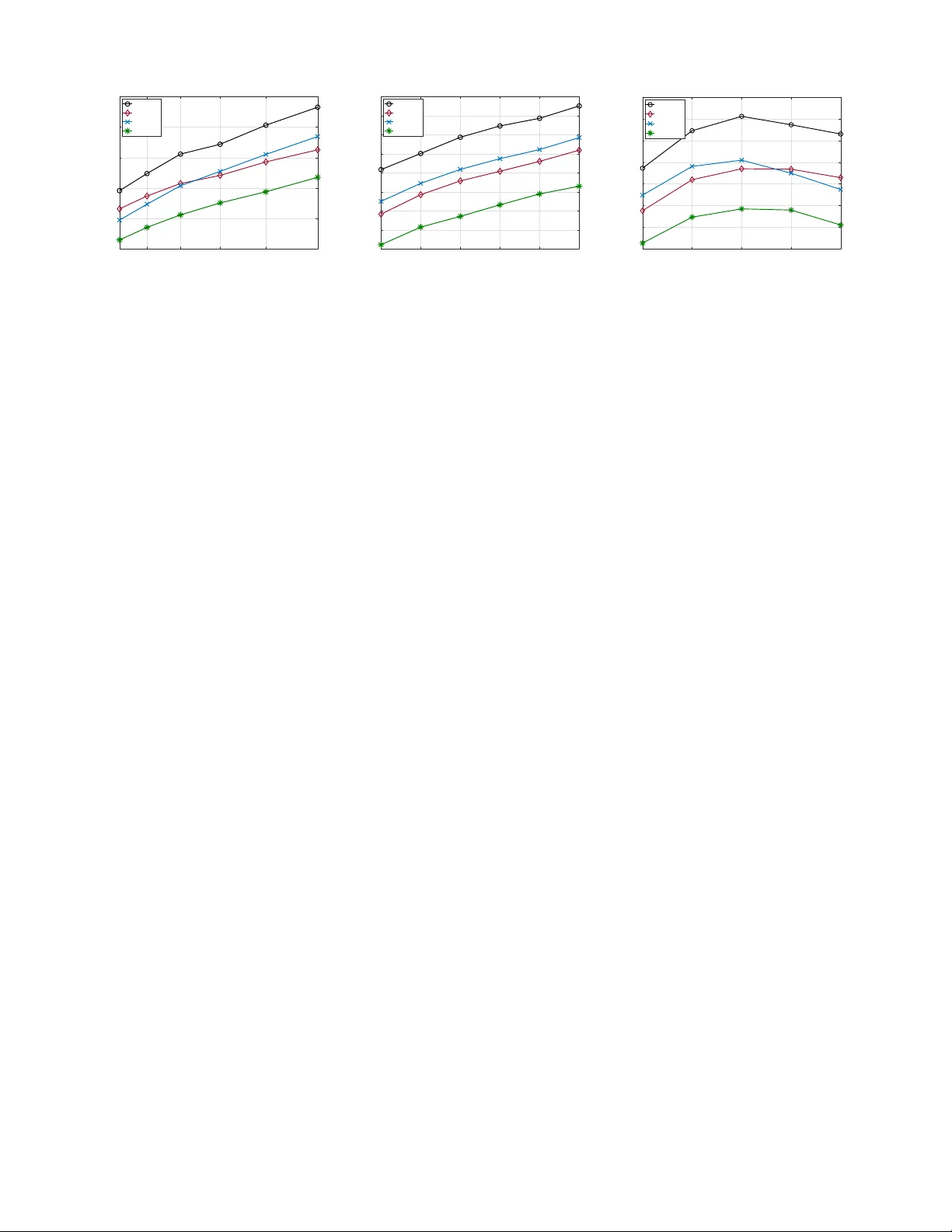
Join t Energy Eciency Optimization for Uplink Multiuser Mo v able An tenna-Based Wireless Systems Assisted b y Mo v able-Elemen t RIS A yda No del Hokmabadi, Mohamed Elhattab, Chadi Assi Concordia Univ ersit y , Mon treal, Canada a_no delh@encs.concordia.ca, mohamed.elhattab@concordia.ca, chadi.assi@concordia.ca Abstract—This pap er in vestigates energy eciency (EE) optimization for an uplink multiuser system assisted by a mo v able-element recongurable in telligent surface (ME-RIS) and a base station equipped with mo v able an tennas (MA- BS). W e jointly optimize the uplink postco der vectors, user transmit p ow ers, RIS phase shift, and the p ositions of b oth the BS antennas and RIS elemen ts to maximize the system EE. The resulting non-con vex fractional problem is solv ed using an alternating optimization (A O) framework, where subproblems are handled via Dinkelbac h’s metho d com bined with successiv e con vex appro ximation (SCA). Sim ulation results sho w that the prop osed sc heme achiev es signicant EE gains o ver xed- an tenna BS and xed-elemen t RIS b enchmarks. Index T erms—Energy eciency , mo v able antennas, mo v able-element recongurable intelligen t surface, uplink, 6G. I. Introduction Recongurable intelligen t surface (RIS) has emerged as a promising tec hnology for enhancing sp ectral and energy eciency in 6G wireless netw orks [1]. By passiv ely reecting incident signals with con trollable phase shifts, RIS can reshape the wireless propagation environmen t without requiring activ e radio-frequency chains, making it an energy-ecient solution for next-generation commu- nication systems [2], [3]. More recen tly , mo v able antenna (MA) systems hav e b een prop osed to utilize spatial degrees of freedom. Unlike conv entional xed-position an tennas, MAs can b e rep ositioned within a limited region, allo wing the system to impro ve c hannel conditions b y adjusting antenna lo cations [4], [5]. This additional exibilit y has been shown to provide signicant gains in b eamforming p erformance and in terference management. Ho wev er, mov able antennas and conv en tional RIS still ha ve inheren t limitations when used individually . Conv en- tional RIS can only adjust phase shifts with xed elemen t lo cations, limiting adaptation to spatial channel v aria- tions. Similarly , mov able an tennas can mitigate fading or blockage but cannot exploit programmable reections. These limitations motiv ate mo v able-element RIS (ME- RIS), where each reecting element can adjust both its ph ysical p osition within a limited region and its phase shift [6], [7]. Suc h dual recongurability enables more ex- ible channel shaping and improv ed p erformance [8], [9]. By jointly optimizing elemen t positions and phase shifts, ME-RIS provides additional spatial degrees of freedom to shap e the wireless environmen t, impro ving channel gains and in terference managemen t. Prior works ha ve studied ME-RIS for downlink sum-rate maximization in m ultiuser MISO and single-user SISO systems, typically assuming xed-position BS an tennas (FP A-BS) [10], [11]. Secure communication for ME-RIS-aided systems with FP A-BS has also b een studied through sum secrecy rate maximization [12]. Motiv ated b y these technologies, several works ha ve studied the join t use of RIS and mov able antennas [13]– [16]. How ever, most existing studies mainly fo cus on sp ectral eciency and assume either xed RIS elemen t p ositions or xed base station (BS) antenna lo cations, and none hav e considered the join t design of ME-RIS with mo v able-antenna base stations (MA-BS) under an energy eciency (EE) objective. Such assumptions limit the av ailable spatial exibilit y and prev ent the system from fully exploiting the p otential performance gains oered b y mo v able architectures. It is worth mentioning that EE has b ecome an imp ortan t design objective in future wireless netw orks, particularly in uplink scenarios where user devices op erate under tight p ow er budgets. Impro ving system p erformance without signicantly in- creasing p ow er consumption is therefore essential. In tegrating ME-RIS with MA-BS provides additional spatial adaptability . While ME-RIS reshap es the prop- agation environmen t through jointly optimized elemen t p ositions and controllable reections, mov able BS an ten- nas adjust the receive array geometry to b etter receive the incoming signals. This joint spatial adaptation can impro ve in terference managemen t and signal alignmen t in m ultiuser uplink systems, ultimately leading to improv ed energy eciency . A. Contributions W e consider a m ultiuser uplink system, where b oth the BS an tennas and the RIS elemen ts are mov able, forming an ME-RIS-aided MA-BS architecture. W e form ulate an EE maximization problem that jointly optimizes the receiv e p ostco ding vectors at BS, user transmit pow- ers, RIS phase shifts, and antenna/elemen t p ositions. The non-con vex fractional ob jective is tac kled through an alternating optimization (AO) framework combining Fig. 1: System mo del Dink elbach’s metho d and SCA. The main con tributions of this w ork are summarized as follo ws: • W e prop ose a joint optimization framew ork for EE maximization in an uplink multiuser system with ME-RIS and MA-BS, sub ject to p er-user qualit y of service (QoS) constraints and ph ysical placemen t limits. • W e develop an ecient AO-based algorithm where eac h subproblem is solved with guaranteed con ver- gence using Dink elbach and SCA methods. • Results conrm our prop osed scheme consisten tly outp erforms xed-p osition b enchmarks in energy eciency . I I. System Model A. Netw ork Mo del As sho wn in Fig. 1, we consider an uplink single- input multiple-output (SIMO) net work consisting of a BS equipp ed with M mov able receiving an tennas, a ME-RIS with N passive reecting elements, and K single-antenna uplink users. The sets of BS antennas, RIS elemen ts and users are denoted by M , N , and K , resp ectively . W e denote the channel b etw een the BS antennas and the RIS elements by H ∈ C M × N , the direct link b et ween the user k and the BS by h k ∈ C M × 1 , ∀ k ∈ K , and the c hannel b etw een the user k and the RIS by g k ∈ C N × 1 , ∀ k ∈ K . The noise at the BS is mo deled as circularly symmetric complex Gaussian, denoted by n ∼ C N (0 , σ 2 ) . B. Signal Model Let s k denote the transmitted information symbol of user k , with E {| s k | 2 } = 1 , ∀ k ∈ K . The BS applies a linear p ostco der vector v k ∈ C M × 1 to detect the signal of user k , and let the transmit p o wer of user k b e by p k ∈ [0 , P max ] . F urthermore, the RIS phase shift matrix is dened as a diagonal matrix Φ = diag ( e j ϑ 1 , . . . , e j ϑ N ) , where ϑ n ∈ (0 , 2 π ] , ∀ n ∈ N . Based on that, the receiv ed signal at the BS due to the uplink transmission can b e expressed as follows, y = X k ∈K √ p k ( h k + HΦg k ) s k + n . (1) After linear combining, the detected signal of user k is ˆ s k = v H k y . Thus, the signal-to-in terference-plus-noise ratio (SINR) ∀ k ∈ K is γ k = p k v H k ( h k + HΦg k ) 2 P j ∈K j = k p j v H k ( h j + HΦg j ) 2 + σ 2 ∥ v k ∥ 2 . (2) C. Field-Resp onse Based Channel Mo del Wireless links are mo deled using the eld-resp onse (FR) geometric channel model [15], [17]. Since the mo v able regions of the MA-BS an tennas and ME-RIS elemen ts are small relativ e to link distances, the far-eld assumption holds. Hence, the path angles and amplitudes remain appro ximately unchanged within the mo vemen t region, while the phases v ary with the antenna and RIS elements p ositions, enabling c hannel reconguration through p osition optimization. F or a link with L dominant paths, the c hannel matrix is mo deled as C = F H ΣE , (3) where E and F are the transmit and receive eld-resp onse matrices, and Σ = diag ( ζ 1 , . . . , ζ L ) is the path-resp onse matrix, with ζ ℓ ∼ C N 0 , β 0 d − α L , ∀ l ∈ { 1 , . . . , L } . De- tailed deriv ation of the FR channel model can b e found in [15]. 1) System Channels: Let L RB , L Bu , and L Ru denote the num b er of paths for the RIS–BS, user–BS, and user– RIS links, resp ectively . The MA-BS antenna positions are u m = [ x m , y m ] T with U = [ u 1 , . . . , u M ] , and the RIS elemen t p ositions are collected in T . The RIS–BS c hannel is H = F H RB Σ RB E RB ∈ C M × N , (4) where F RB and E RB dep end on the BS an tenna and RIS element p ositions, resp ectiv ely . The direct user–BS c hannel for user k and the user–RIS c hannel are h k = F H Bu ,k σ Bu ,k , g k = E H Ru ,k σ Ru ,k , (5) where σ xy ∈ C L × 1 and denotes the path-resp onse vectors in link xy with elements following C N 0 , β 0 d − α L . 2) Energy Eciency: A ccording to (2), the netw ork sum rate is given b y R sum = X k ∈K log 2 (1 + γ k ) . (6) The total pow er consumption of the netw ork is expressed as P tot = 1 η X k ∈K p k + P c , (7) where η ∈ (0 , 1] denotes the p o wer amplier eciency and P c represen ts the circuit p ow er consumption. Therefore, the EE of the system is dened as EE = R sum P tot . (8) I I I. Problem F ormulation W e aim to maximize the EE of the multiuser uplink system by join tly optimizing the receive beamforming v ectors, RIS phase shifts, user transmit p o wers, and the p ositions of the mo v able antennas at the MA-BS and elements at the ME-RIS. The design is sub ject to QoS constraints for each user’s rate, transmit p ow er limits, unit-mo dulus constrain ts on RIS elements, feasible mo vemen t regions for antennas/elemen ts, and minimum distance requiremen ts b etw een them. The resulting opti- mization problem is formulated in problem 9. Constrain t (9b) guaran tees the minimum rate require- men t for eac h user, while (9c) limits the transmit pow er. Constrain t (9d) normalizes the BS receive b eamformers and (9e) enforces the unit-mo dulus RIS phase shifts. Constrain ts (9f) and (9g) restrict antenna and RIS ele- men t p ositions within their feasible regions, and (9h)–(9i) ensure a minim um s pacing d 0 to av oid physical ov erlap. max p , v k , Φ , U , T EE (9a) s . t . R k ≥ R th , ∀ k ∈ K , (9b) 0 ≤ p k ≤ P max k , ∀ k ∈ K , (9c) ∥ v k ∥ 2 2 = 1 , ∀ k ∈ K , (9d) | [ Φ ] n,n | = 1 , ∀ n ∈ N , (9e) u m ∈ U m , ∀ m ∈ M , (9f ) T n ∈ T n , ∀ n ∈ N , (9g) ∥ u m − u m ′ ∥ 2 ≥ d 0 , ∀ m = m ′ , (9h) ∥ T n − T n ′ ∥ 2 ≥ d 0 , ∀ n = n ′ (9i) IV. Prop osed A O-based algorithms The main problem is non-conv ex due to the coupling b et ween v ariables, the fractional ob jectiv e function, and the non-con vex constraints. T o handle this, w e decompose it into ve subproblems and solv e them iteratively . Po wer allo cation is done using the Dinkelbac h metho d combined with SCA, while a closed-form solution is obtained for the uplink p ostco der v ectors. The BS antenna positions, ME- RIS element lo cations, and phase shifts are then optimized using rst-order SCA. The details of each subproblem are discussed b elow. A. Uplink P ostco ding V ectors at BS ( v k ) W e optimize the uplink receive p ostco ding vector at the BS for each user k , denoted by v k , while keeping { p , Φ , T , U } xed. The goal is to maximize the sum rate, since the denominator of the EE expression is indep enden t of v k . The corresponding subproblem is (P1.1): max { v k } R sum s . t . R k ≥ R th , ∀ k ∈ K , (10a) ∥ v k ∥ 2 2 = 1 , ∀ k ∈ K . (10b) Since v k app ears only in the SINR of user k and is indep enden t of the other users’ combining vectors, the subproblem decouples in to K indep endent ones that can b e solv ed in parallel. Each subproblem has a generalized Ra yleigh quotient structure [18]. The eective c hannel for user k is dened as a k ≜ h k + HΦg k . (11) Dening A k ≜ a k a H k and B k ≜ P j = k a j a H j , the SINR of user k can b e written using the generalized Rayleigh quotien t: γ k = p k v H k A k v k v H k ( B k + σ 2 I M ) v k . (12) The optimal combining vector is then given by the dominan t generalized eigenv ector [19]: v ⋆ k = ( B k + σ 2 I M ) − 1 a k ∥ ( B k + σ 2 I M ) − 1 a k ∥ 2 . (13) After computing v ⋆ k , w e c hec k whether the QoS constrain t (10a) is satised. If it is violated, v ⋆ k is reset to the previous feasible solution and the AO algorithm proceeds to up date the remaining optimization v ariables. B. Po wer Allocation ( p ) F urthermore, we optimize the uplink transmit p ow er v ector p = [ p 1 , . . . , p K ] T for xed { v k , Φ , T , U } , to maximize the system EE, while satisfying QoS and p ow er constrain ts. By dening A k,j = v H k ( h j + HΦg j ) 2 , the ac hiev able rate of user k is given as, R k ( p ) = log 2 1 + p k A k,k P j = k p j A k,j + σ 2 u ! . (14) The EE maximization problem is therefore, (P1.2): max p P K k =1 R k ( p ) 1 η P K k =1 p k + P c s . t . 0 ≤ p k ≤ P max k , ∀ k ∈ K , (15a) R k ( p ) ≥ R th , ∀ k ∈ K . (15b) The ab o ve problem is fractional and non-conv ex. W e rst apply Dinkelbac h’s method [20], which con verts the EE maximization in to a sequence of subtractive problems, max p R sum − λ ( 1 η K X k =1 p k + P c ) , (16) where λ is iteratively updated as λ ⋆ = R sum 1 η P K k =1 p k + P c . (17) F or a xed λ , the objective can be written in dierence- of-con vex (DC) form. Sp ecically , each user rate can b e expressed as R k ( p ) = log 2 σ 2 u + P K j =1 p j A k,j − log 2 σ 2 u + P j = k p j A k,j (18) Hence, R sum is a dierence of concav e functions. W e handle this structure using SCA metho d. At eac h inner iteration, the second concav e term is linearized using its rst-order T aylor expansion around the current p oint p ( t ) , whic h pro duces a conv ex surrogate problem. F urthermore, the QoS constrain t R k ≥ R th is equiv a- len tly written in SINR form as p k A k,k ≥ γ th σ 2 u + X j = k p j A k,j , (19) where γ th = 2 R th − 1 . This constrain t is linear in p and is enforced in every SCA iteration. T o guaran tee feasibilit y , we rst solve a minim um-sum- p o wer problem under the QoS constraints to obtain a feasible starting point. If no feasible solution exists within p max k , the problem is declared infeasible. The algorithm then alternates b etw een the inner SCA up dates and the outer Dinkelbac h up dates un til con vergence. C. ME–RIS Phase Shift Prole ( Φ ) W e optimize the ME–RIS phase shift matrix Φ for xed { v k , p , T , U } . The phase design is constrained by unit–mo dulus elements, which makes the problem highly non–con vex. The phase optimization subproblem is (P1.3): max Φ R sum ( Φ ) s . t . R k ( Φ ) ≥ R th , ∀ k ∈ K , (20a) | [ Φ ] n,n | = 1 , ∀ n ∈ N . (20b) T o solve (20), we use the SCA metho d, combined with a trust-region approach, to ensure the approximation accuracy , b y letting ϑ = [ ϑ 1 , . . . , ϑ N ] T . At iteration t , we construct con vex low er b ounds for the SINR constraints via rst–order T aylor expansions around ϑ ( t ) , denoted b y γ ( t ) k ( ϑ ) for k ∈ K . Also, we linearize the sum rate ob jectiv e to ensure stable conv ergence. The resulting con vex surrogate problem is max ϑ X k ∈K ∇ ϑ R k ( ϑ ( t ) ) ! T ( ϑ − ϑ ( t ) ) (21a) s . t . γ ( t ) k ( ϑ ) ≥ γ th , ∀ k ∈ K , (21b) 0 ≤ ϑ n ≤ 2 π , ∀ n ∈ N , (21c) ϑ − ϑ ( t ) 2 ≤ ∆ ( t ) . (21d) where (21d) is the trust region constraint with radius ∆ ( t ) . In trust-region-based SCA, the constrain t in (21d) limits the up date to a neighborho o d of the current iterate to maintain the v alidity of the rst-order approximation. The trust-region radius ∆ ( t ) is adjusted based on the accuracy of the surrogate mo del; it is increased when the appro ximation is accurate and reduced otherwise [21]. This approac h ensures stable conv ergence to a stationary p oin t [22], [23]. After solving (21), we up date ϑ and recon- struct Φ = diag( e j ϑ 1 , . . . , e j ϑ N ) . The gradien t expressions are provided in [App endix D, [15]]. D. Position Optimization of MA-BS ( U ) and ME-RIS ( T ) W e optimize the positions of the ME–RIS elemen ts ( T ) and the BS receive antennas ( U ) while keeping all other v ariables xed. These corresp ond to t wo separate subproblems. Since they hav e identical formulations and dier only in the optimization v ariable, we presen t them in a unied form to av oid rep etition. Let X denote the p osition v ariable, represen ting either the RIS element p ositions T = { t n } N n =1 or the BS an tenna p ositions U = { u m } M m =1 . The elemen t/antenna positions determine the eld-resp onse matrices and therefore aect the eec- tiv e c hannels in the SINR expressions. Hence, the position optimization problem can b e written as (P1.4): max X R sum ( X ) (22a) s . t . R k ( X ) ≥ R th , ∀ k ∈ K , (22b) x i ∈ X i , ∀ i, (22c) ∥ x i − x j ∥ 2 ≥ d 0 , ∀ i = j. (22d) where X = T corresp onds to RIS element optimization and X = U corresponds to BS antenna optimization. The problem is non-con vex due to the nonlinear de- p endence of FR matrices on the p osition v ariables. W e adopt a local update method based on the SCA approach in [App endix C, [15]]. A t iteration t , the linearized problem is max X X k ∈K ∇ X R k ( X ( t ) ) ! T v ec( X − X ( t ) ) (23a) s . t . γ ( t ) k ( X ) ≥ γ th , ∀ k ∈ K , (23b) x i ∈ X i , ∀ i, (23c) ∥ x i − x j ∥ 2 ≥ d 0 , ∀ i = j, (23d) ∥ v ec( X − X ( t ) ) ∥ 2 ≤ ∆ ( t ) . (23e) This con vex problem can b e ecien tly solv ed using standard solv ers such as CVX. The same formulation applies to both T and U by replacing X with the corresp onding position v ariable. Finally , the proposed A O algorithm is applied, solving the subproblems iterativ ely , as summarized in Algorithm 1. Algorithm 1 Alternating Optimization (AO) 1: Dene: Z ≜ { v , Φ , p , U , T } as the v ariables set, 2: Initialize: feasible Z (0) = { v (0) k , Φ (0) , p (0) U (0) , T (0) } ran- domly , ϵ = 0 . 0001 , n max , and compute EE (0) . 3: rep eat 4: Up date v ( n +1) k ∈ Z by solving (10) for xed Z \ { v k } . 5: Up date p ( n +1) ∈ Z by solving (15) for xed Z \ { p } . 6: Up date Φ ( n +1) ∈ Z by solving (21) for xed Z \ { Φ } . 7: Up date U ( n +1) ∈ Z by solving (23) for xed Z \ { U } . 8: Up date T ( n +1) ∈ Z by solving (23) for xed Z \ { T } . 9: Compute EE ( n +1) and set n ← n + 1 . 10: until EE ( n ) − EE ( n − 1) ≤ ϵ or n ≥ n max 11: Output: Z ⋆ = Z ( n ) . E. Computational Complexit y Analysis W e analyze the p er-iteration complexity of the pro- p osed AO algorithm, where I a denotes the num b er of A O iterations. The uplink p ostco ding v ectors are obtained via generalized eigenv alue decomp osition with complexity O ( M 3 ) [24]. The pow er allo cation problem is solved using Dink elbach’s metho d with SCA, where eac h SCA iteration requires SINR ev aluations with complexit y O ( K 2 M ) [25], rep eated for I p s inner iterations and I d Dink elbach up- dates [20], giving O ( I d I p s K 2 M ) . The RIS phase opti- mization uses SCA with I ϕ s iterations, eac h solving a con vex quadratic program with complexit y O ( N 3 . 5 ) [26]. The p osition up dates for the BS antennas and RIS elemen ts require O ( I u s M N L ) and O ( I t s N 2 L ) op erations, resp ectiv ely , where L = max { L RB , L Bu , L Ru } . The o verall p er-iteration complexity is O M 3 + I d I p s K 2 M + I ϕ s N 3 . 5 + ( I u s M + I t s N ) N L . (24) When N is large, the RIS phase and p osition up dates dominate. The xed-p osition b enc hmark reduces com- plexit y by remo ving p osition optimization terms, at the cost of lo wer EE p erformance. V. Numerical Results W e ev aluate the performance of the prop osed A O- based algorithm via Monte Carlo simulations. The results are av eraged ov er 100 indep endent c hannel realizations. F or comparison, w e consider four setups based on the mobilit y of the BS an tennas and RIS elements; mo v- able/xed antenna (MA/F A) and mo v able/xed RIS elemen t (ME/FE). The considered scenarios are: 1) MA– ME, 2) F A–ME, 3) MA–FE, and 4) F A–FE. Unless otherwise stated, all sc hemes are ev aluated under the setup of N = 49 , K = 4 , M = 8 , L = 4 , R th = 1 . 5 bps/Hz and maximum transmit p ow er of P max = 20 dBm, ∀ k ∈ K . The BS is placed at the origin (0 , 0 , 15) m and the RIS at (10 , 10 , 10) m . The K users with a heigh t of 1 . 5 m are randomly distributed within a circular area around the RIS at distances of 50 − 70 m . The mov able region for eac h BS antenna and RIS elemen t is a square of side A = 4 λ , where λ denotes the carrier wa velength at f c = 3 GHz. The minim um in ter-element spacing is set to d 0 = λ/ 2 . The rest of the simulation parameters are listed in T able I. T ABLE I: Simulation P arameters Parameter V alue Path loss exp onent for { h k , H , g k } α = { 3 . 9 , 2 , 2 . 2 } Noise p ow er ( σ 2 ) − 90 dBm Circuit p ow er consumption ( P c ) 20 dBm Po wer amplier eciency ( η ) 0 . 3 Fig. (2) shows the con vergence behavior of Algorithm 1 for the MA–ME scheme for dierent N v alues. The prop osed AO algorithm conv erges within approximately 20 iterations in all cases, conrming its eciency and stabilit y . Fig. (3) illustrates the system EE v ersus the maximum user transmit p ow er, P max , for the minimum ac hiev able 0 5 10 15 20 25 30 35 Iteration 20 40 60 80 100 Energy Efficiency (bps/Hz/W) N=16 N=36 N=64 N=81 Fig. 2: Con vergence behavior of the A O algorithm 4 6 8 10 12 14 16 18 20 P max (dBm) 55 60 65 70 75 80 85 Energy Efficiency (bps/Hz/W) MA-ME MA-FE FA-ME FA-FE Fig. 3: EE p erformance versus P max . rate of R th = 0 . 5 bps/Hz. The EE increases with P max at low p ow er levels since higher transmit p ow er improv es the achiev able rates while the p ow er consumption remains relativ ely small. How ever, b ey ond about 6–8 dBm, all curv es gradually saturate because the rate gro ws logarith- mically while the p ow er consumption increases linearly , resulting in diminishing EE gains. The prop osed MA–ME sc heme achiev es the highest EE across the entire p o wer range, outp erforming the F A–FE baseline b y ab out 42% at P max = 4 dBm and 34% at higher p o wer levels. The larger gap at low pow er highlights the b enet of jointly optimizing the BS an tenna and RIS elemen t positions when transmit pow er is limited. Among the partially mo v able setups, F A–ME consisten tly outp erforms MA– FE, indicating that RIS element mobilit y pro vides greater EE gains than BS antenna mobility in this setup. Finally , the F A–FE baseline ac hieves the lo west EE, highlight- ing that xed-position setups cannot fully exploit the a v ailable spatial degrees of freedom, resulting in limited b eamforming and propagation con trol. Fig. (4a) presents the system EE as a function of the num b er of RIS elements, N . The EE increases with N for all schemes b ecause a larger RIS pro vides greater passive beamforming gain and extended cov erage, impro ving the sum rates without a prop ortional increase in p ow er consumption. The prop osed MA–ME sc heme consisten tly achiev es the highest EE across all v alues of N , outp erforming the F A–FE baseline by appro ximately 35% at N = 49 . This gain results from the joint mobility 16 25 36 49 64 81 Number of RIS elements (N) 40 50 60 70 80 90 Energy Efficiency (bps/Hz/W) MA-ME MA-FE FA-ME FA-FE (a) 5 6 7 8 9 10 Number of BS Antennas (M) 40 45 50 55 60 65 70 75 80 Energy Efficiency (bps/Hz/W) MA-ME MA-FE FA-ME FA-FE (b) 2 3 4 5 6 Number of users (K) 45 50 55 60 65 70 75 80 Energy Efficiency (bps/Hz/W) MA-ME MA-FE FA-ME FA-FE (c) Fig. 4: EE p erformance versus N , M , and K . of the BS antennas and RIS elements, enabling b etter receiv e b eamforming and reected link alignmen t than xed or partially mo v able scenarios. F urthermore, the MA–FE outperforms F A–ME at small v alues of N since the RIS con tribution is limited, whereas the trend reverses as N increases and the RIS becomes more dominan t. Finally , the F A–FE baseline ac hieves the low est EE in all cases, as discussed previously . Fig. (4b) shows the system EE for dierent n umbers of BS receive antennas, M . The EE increases with M for all schemes, since more an tennas provide stronger receiv e beamforming gain and expand the spatial de- grees of freedom a v ailable at the BS, enabling sharp er b eamforming tow ard each user and better in terference suppression across users. The proposed MA–ME sc heme consisten tly achiev es the highest EE, outp erforming the F A–FE baseline b y about 37% at M = 10 , indicating that an tenna p osition optimization b ecomes more eective as the av ailable spatial degrees of freedom increase. Unlike the previous case, no crossov er o ccurs b etw een MA– FE and F A–ME; F A–ME consistently p erforms b etter, sho wing that for a xed RIS size N = 49 , rep ositioning RIS elements provides larger EE gains than moving BS an tennas. Also, the F A–FE baseline achiev es the low est EE, consistent with the observ ations discussed ab o ve. Fig. (4c) presen ts the EE of the system for dierent n umbers of uplink users, K . As K increases, the EE rst rises due to m ultiuser diversit y gain, where additional users con tribute to the ov erall sum rate. How ever, b eyond a certain point, inter-user interference gro ws faster than the sum rate improv ement, causing the EE to p eak and then slightly decrease at larger K . The prop osed MA– ME scheme consistently achiev es the highest EE across all v alues of K , outp erforming the F A–FE baseline b y appro ximately 39% at K = 5 . VI. Conclusion In this pap er, we studied an energy eciency maxi- mization problem for an uplink m ultiuser system with an ME-RIS and a MA-BS. W e jointly optimized the p ostco der v ectors, user transmit p ow ers, RIS phase shifts, and an tenna/element positions using an AO-based al- gorithm that combines Dinkelbac h’s metho d and SCA. Sim ulation results conrmed that the proposed scheme consisten tly outp erforms xed-p osition b enchmarks, as the additional spatial degrees of freedom from position optimization improv e channel conditions and suppress in ter-user in terference with low er p ow er consumption. References [1] E. Basar, M. Di Renzo, J. De Rosny , M. Debbah, M.-S. Alouini, and R. Zhang, “Wireless Communications Through Recongurable Intelligen t Surfaces,” IEEE Access, v ol. 7, pp. 116 753–116 773, 2019. [2] C. Huang, A. Zapp one, G. C. Alexandrop oulos, M. Debbah, and C. Y uen, “Recongurable In telligent Surfaces for Energy Eciency in Wireless Communication,” IEEE T ransactions on Wireless Communications, vol. 18, no. 8, pp. 4157–4170, 2019. [3] Q. W u and R. Zhang, “Intelligen t Reecting Surface Enhanced Wireless Net work via Join t Activ e and Passiv e Beamform- ing,” IEEE T ransactions on Wireless Communications, vol. 18, no. 11, pp. 5394–5409, 2019. [4] L. Zhu, W. Ma, and R. Zhang, “Mo v able Antennas for Wireless Communication: Opp ortunities and Challenges,” IEEE Com- munications Magazine, vol. 62, no. 6, pp. 114–120, 2023. [5] L. Zhu, W. Ma, B. Ning, and R. Zhang, “Mov able-Antenna Enhanced Multiuser Comm unication via Antenna P osition Op- timization,” IEEE T ransactions on Wireless Comm unications, 2023. [6] J. Zhao, Q. Huang, K. Cai, Q. Zhou, X. Mu, and Y. Liu, “Mov able-Element RIS-Aided Wireless Communications: An Element-Wise Position Optimization Approach,” IEEE Com- munications Letters, 2026. [7] Y. Zhang, I. Dey , and N. Marc hetti, “RIS-Aided Wireless Communication with Mov able Elements: Geometry Impact on Performance,” arXiv Preprint arXiv:2405.00141, 2024. [8] X. W ei, W. Mei, Q. W u, B. Ning, and Z. Chen, “Mov able An- tennas Meet Intelligen t Reecting Surface: When Do W e Need Mov able Antennas?” in 2025 IEEE Wireless Communications and Netw orking Conference (WCNC). IEEE, 2025, pp. 1–6. [9] Z. Zheng, Q. W u, W. Chen, X. W u, and W. Zhu, “Mov- able In telligent Surface (MIS) for Wireless Comm unications: Architecture, Mo deling, Algorithm, and Prototyping,” IEEE T ransactions on Wireless Comm unications, 2025. [10] Y. Geng, T. H. Cheng, K. Zhong, K. C. T eh, and Q. W u, “Joint Beamforming and An tenna Position Optimization for IRS- Aided Multi-User Mov able Antenna Systems,” IEEE T rans- actions on Wireless Communications, 2025. [11] Q. Bu, S. Y ang, J. Ge, B. Ning, and C. Y uen, “Element Coecient and Position Optimization for Flexible Intelligen t Metasurface-Aided Mov able Antenna Communications,” IEEE Wireless Communications Letters, 2025. [12] J. Zhao, Q. Xu, K. Cai, Y. Zh u, X. Mu, and Y. Liu, “Mo v able- Element ST ARS-Aided Secure Communications,” IEEE T rans- actions on V ehicular T echnology , 2025. [13] B. Zhang, K. Xu, X. Xia, G. Hu, C. W ei, C. Li, and K. Cheng, “Sum-Rate Enhancemen t for RIS-Assisted Mov able An tenna Systems: Joint T ransmit Beamforming, Reecting Design, and Antenna P ositioning,” IEEE T ransactions on V ehicular T ech- nology , v ol. 74, no. 3, pp. 4376–4392, 2024. [14] X. W ei, W. Mei, D. W ang, B. Ning, and Z. Chen, “Joint Beamforming and An tenna Position Optimization for Mov able Antenna-Assisted Spectrum Sharing,” IEEE Wireless Commu- nications Letters, 2024. [15] A. N. Hokmabadi and C. Assi, “Join t Beamforming and P osi- tion Optimization for Mov able-Antenna and Mov able-Element RIS-Aided F ull-Duplex 6G MISO Systems,” arXiv Preprint arXiv:2601.08922, 2026. [16] J. Zhao, Q. Zhou, X. Mu, K. Cai, Y. Zhu, and Y. Liu, “Exploit- ing Mov able-Element ST ARS for Wireless Communications,” IEEE T ransactions on Wireless Communications, 2026. [17] A. Amhaz, S. Khisa, M. Elhattab, C. Assi, and S. Sharafeddine, “Meta-Learning-Driven Resource Optimization in F ull-Duplex ISAC With Mov able Antennas,” IEEE Wireless Comm unica- tions Letters, 2026. [18] R.-C. Li, “Rayleigh Quotient Based Optimization Metho ds for Eigenv alue Problems,” Matrix F unctions and Matrix Equa- tions, 2015. [19] J. Ding, Z. Zhou, C. W ang, W. Li, L. Lin, and B. Jiao, “Secure F ull-Duplex Communication via Mo v able An tennas,” in IEEE Global Communications Conference. IEEE, 2024, pp. 885–890. [20] W. Dinkelbac h, “On Nonlinear F ractional Programming,” Management Science, vol. 13, no. 7, pp. 492–498, Mar. 1967. [21] G. Cheng, X. Song, Z. Lyu, and J. Xu, “Netw orked ISAC for Low-Altitude Econom y: T ransmit Beamforming and UA V T ra- jectory Design,” in 2024 IEEE/CIC International Conference on Communications in China (ICCC). IEEE, 2024, pp. 78–83. [22] Z. Lyu, G. Zhu, and J. Xu, “Joint T ra jectory and Beamforming Design for UA V-Enabled Integrated Sensing and Communi- cation,” in ICC 2022 - IEEE International Conference on Communications. IEEE, 2022. [23] J. Sun, L. Y ang, A.-A. A. Boulogeorgos, T. A. T siftsis, and H. Liu, “Dual-UA V-Aided Covert Communications for Air- to-Ground ISAC Netw orks,” arXiv Preprin t 2025. [24] G. H. Golub and C. F. V an Loan, Matrix Computations. JHU Press, 2013. [25] V. Kumar, R. Zhang, M. Di Renzo, and L.-N. T ran, “A Nov el SCA-Based Metho d for Beamforming Optimization in IRS/RIS-Assisted MU-MISO Downlink,” IEEE Wireless Com- munications Letters, vol. 12, no. 2, pp. 297–301, 2023. [26] S. Bo yd and L. V andenberghe, Conv ex Optimization. Cam- bridge Universit y Press, 2004.
Original Paper
Loading high-quality paper...
Comments & Academic Discussion
Loading comments...
Leave a Comment