The Supercritical Loop O(1) and Random Current models: Uniqueness and Mixing
Much recent rigorous study of the classical ferromagnetic Ising model has been powered by its graphical representations, such as the random current and loop O(1) model (high temperature expansion). In this paper, we prove uniqueness of Gibbs measures…
Authors: Ulrik Thinggaard Hansen, Frederik Ravn Klausen
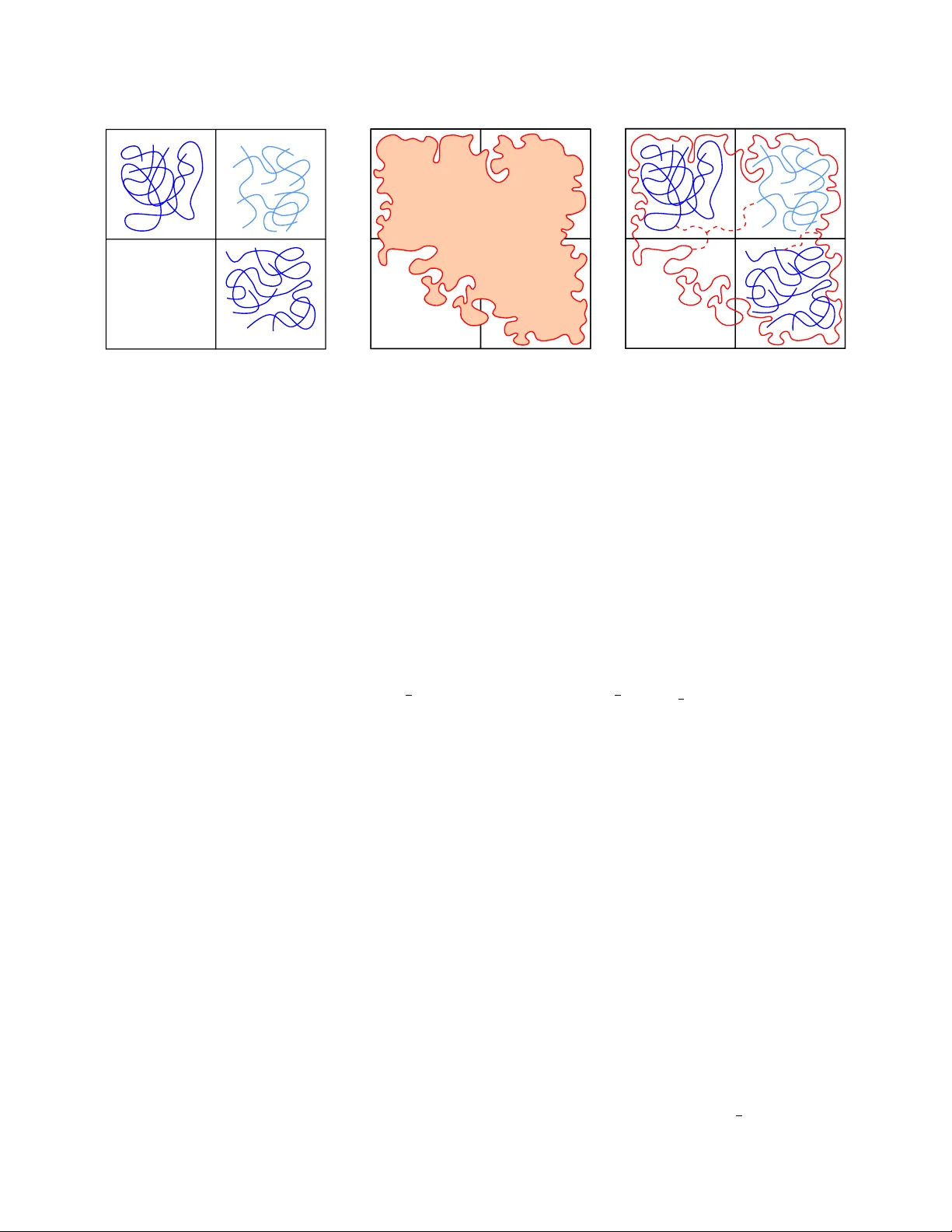
THE SUPER CRITICAL LOOP O(1) AND RANDOM CURRENT MODELS: UNIQUENESS AND MIXING ULRIK THINGGAARD HANSEN AND FREDERIK RA VN KLA USEN Abstract. Muc h recen t rigorous study of the classical ferromagnetic Ising model has been p o wered b y its graphical represen tations, suc h as the random curren t and lo op O(1) mo del (high temp erature expansion). In this pap er, w e pro ve uniqueness of Gibbs measures and exponential ratio w eak mixing for the lo op O(1) and random current models corresponding to the sup ercritical Ising mo del on the h yp ercubic lattice Z d in any dimension d ≥ 2. The main tec hnical innov ation is to establish unique crossing ev ents for conditional random-cluster measures b y a delicate exploration coupling of Pisz- tora’s coarse-graining metho d across scales. The results generalise to q -flo w mo dels and hav e natural applications for gradien t measures of Z /q Z -gauge theories. 1. Introduction The lo op O(1) mo del ℓ and the random current P are p ercolation mo dels arising as graphical repre- sen tations of the Ising mo del, enco ding its correlations in terms of connectivity prop erties of random graphs. T ogether with the FK-Ising mo del ϕ , they hav e b een cen tral to muc h recen t progress on the Ising mo del [4] and hav e increasingly b ecome ob jects of study in their o wn right [24]. A basic question ab out any such mo del is the uniqueness of its infinite-v olume Gibbs measure, which, b y the work of Pisztora [37] and Bodineau [10], see also [38], is now well-understoo d for the FK-Ising mo del. In this pap er, we resolv e this question for the lo op O (1) model and the random curren t in the supercritical regime on the hypercubic lattice Z d for all d ≥ 2. F or subgraphs G ⊆ Z d , w e denote b y A G the σ -algebra generated b y the restriction to G . As is standard, w e denote by Λ n the box of size n . A p ercolation measure ν on Z d is (exp onential ly) r atio we ak mixing if there exist constan ts c, C, k > 0 suc h that, ∀ n ∈ N ∀ A ∈ A Λ n ∀ B ∈ A Z d \ Λ kn : | ν [ A ∩ B ] − ν [ A ] ν [ B ] | ≤ C exp( − cn ) ν [ A ] ν [ B ] . (R WM) F or a finite subgraph G ⊆ Z d and x ∈ [0 , 1] , the lo op O(1) mo del on G with sources A ⊆ G (typically a subset of the vertex b oundary ∂ v G ) , denoted ℓ A G,x , is Bernoulli p ercolation at edge w eight p = x 1+ x , conditioned on all vertices in A having o dd degree, and all others having even degree. The loop O(1) mo del is tied to the Ising mo del through the high temp erature expansion, Kramers-W annier duality , and the uniform even subgraph. In particular, the infinite volume limit ℓ Z d ,x has exp onential decay if x < x c = tanh( β c ) and a p olynomial low er b ound on connection probabilities if x > x c , where β c is the critical in v erse temp erature of the Ising mo del in Z d [29]. Our first theorem is to prov e the existence of a unique thermo dynamic limit in the sup ercritical regime in arbitrary dimension, which, furthermore, is ratio weak mixing. W e say that a measure ν is Gibbs for the lo op O(1) model if its conditional distributions on a finite v olume Λ giv en its exterior comp orts with the finite v olume measures (see (SMP) and following discussion). Theorem 1.1. F or any d ≥ 2 and x > x c , ther e exists a me asur e ℓ Z d ,x such that for any exhaustion G N ↗ Z d and any A N ⊆ ∂ v G N with | A N | even, ℓ Z d ,x = lim N →∞ ℓ A N G N ,x . F urthermor e, ℓ Z d ,x is exp onential ly r atio we ak mixing. In p articular, ℓ Z d ,x is the unique Gibbs me asur e for the lo op O( 1 ) mo del. W e remark that the result is not new for d = 2 , where it is a combination of the Aizenman-Higuc hi Theorem [1, 30] and mixing results for the dual (subcritical) random-cluster mo del. W e include a 1 2 ULRIK THINGGAARD HANSEN AND FREDERIK RA VN KLA USEN pro of in the framew ork of our metho ds for completeness. The single random current measure P A G,β at in v erse temp erature β > 0 on a finite graph G with sources A is giv en by conditioning an i.i.d. family ( n e ) e ∈ E ( G ) of Poi ( β ) v ariables on E ( G ) for eac h v ∈ V ( G ) to hav e P wv ∈ E ( G ) n wv b e o dd if and only if v ∈ A . Theorem 1.1 is a k ey ingredient for uniqueness of the random current. Theorem 1.2. F or any d ≥ 2 and β > β c , ther e exists a me asur e P Z d ,β such that for any exhaustion G N ↗ Z d and any A N ⊆ ∂ v G N with | A N | even, lim N →∞ P A N G N ,β = P Z d ,β Mor e over, P Z d ,β and P Z d ,β ⊗ P Z d ,β ar e exp onential ly r atio we ak mixing. W e state the t wo main theorems in the case without sources in the bulk for readability and b ecause we tak e them to be of the most a priori in terest. How ever, our metho ds transfer with suitable mo difications to the setting where sources are left in the bulk (see Theorem 6.1 and Theorem 6.2) as well as the lo op represen tation of the q -state P otts mo del for other v alues of q > 2 (see Theorem 7.8 - here we cav eat that the final theorem is w eaker b ecause the a priori input for the random-cluster mo del is weak er). One motiv ation for pro ving mixing statemen ts of random curren ts is that they can b e used to gain further insight on the Ising mo del. Previously , p olynomial mixing of the critical random current was pro v en in t wo dimensions by Duminil-Copin, Lis and Qian using planar tec hniques [16]. A different mixing prop ert y of the double random current [4, Theorem 6.4] was men tioned as the core of the pro of of marginal triviality of φ 4 -fields and Ising mo dels [35]. A sup ercritical mixing result whic h go es in the direction of Theorem 1.1 was previously obtained in [29, Theorem 4.11], but we note that the metho d of pro of us ed there gives neither uniqueness of Gibbs measures nor stability under conditioning b y even ts of small probabilit y . In words, previous w ork was concerned with studying measures whic h can b e written as uniform even subgraphs of random-cluster mo dels, whereas the current paper prov es that an y Gibbs measure of the lo op O(1) mo del in the sup ercritical regime is the uniform ev en subgraph of the random-cluster mo del. 1.1. Organisation of Paper and Proof Sk etc h for Prop osition 3.1. The main tec hnical input needed to derive the results for the lo op O(1) mo del and random curren ts is Prop osition 3.1. In Section 3, it is shown how Theorem 1.1 and Theorem 1.2 follo w from Prop osition 3.1 b y com bining the relationship b etw een the lo op O(1) and FK-Ising mo del first dev elop ed in [21, 25] and extended to the setting with sources in [6]. These argumen ts yield w eak mixing, which for our mo dels implies ratio weak mixing by classical work of Alexander [7, Theorem 3.3]. Sections 4 and 5 are then dedicated to the pro of of Prop osition 3.1 and are entirely fo cused on the random-cluster mo del. The goal of these sections is to pro ve that the random-cluster mo del is insensitiv e to extra required connectivities (obtained by conditioning on an F A ev en t, whic h enco des the sources of the lo op O(1) mo del). T o this end, w e mak e use of Pisztora’s sup ercritical sharpness results [37], which hold throughout the en tire sup ercritical regime by Bo dineau’s result [9] (see [39] for a simpler pro of ). Roughly sp eaking, we p erform a m ultiscale argumen t where, at eac h scale, a p ositiv e fraction of the sources from the lo op O(1) mo del get connected to the unique giant component of the unconditioned random-cluster mo del, whence the conditioning will b e erased after a logarithmic n um b er of scales. Once uniqueness for the lo op O(1) mo del is established, one ma y deduce Theorem 1.2 b y abstract argumen ts, which are cov ered in Section 3. F urthermore, in Section 6, we discuss an adaptation of our metho ds to the setting with sources in the bulk. The methods of this pap er can also be applied to the q -flo w model defined in [42]. T o av oid notational clutter, we defer this discussion to Section 7. F urthermore, by the general dualit y of the loop O(1) mo del and Z 2 -lattice gauge theories, the results here hav e implications for the gradien t measure of lattice gauge theories, which we discuss in Section 8. In the app endix, we discuss uniqueness of the lo op O(1) and random current measures at the weak est but most general lev el. In particular, w e write do wn conditions under which the so-called wired and THE SUPERCRITICAL LOOP O(1) AND RANDOM CURRENT MODELS: UNIQUENESS AND MIXING 3 free measures coincide. W e tak e this fact to b e well-kno wn, but do not kno w of any written reference. Along the wa y , w e discuss infinite v olume relations b etw een the FK-Ising and lo op O(1) models. 1.2. Op en Problems. It is worth noting that we rely heavily on the mo del b eing sup ercritical and, indeed, uniqueness might fail for small x in high dimension. This would b e analogous to Dobrushin’s pro of of the existence of non-translation in v ariant Gibbs states for the Ising mo del [13]. More con- cretely , the Ising lattice gauge mo del (in teracting ov er co dimension 1 cells) ha ving non-translation in v arian t Gibbs states at v ery low temp erature is equiv alen t to having non-uniqueness of Gibbs mea- sures for ℓ x when x is small. Question 1.3. Do es ℓ Z d ,x always have a unique Gibbs me asur e for x < x c ? W e b elieve the answer migh t v ery well be y es. This would be analogous to the t w o-dimensional analysis in the celebrated Aizenman-Higuc hi Theorem [1, 30]. It is p ossible that the tec hniques from the recent pro of [12] adapt without to o muc h trouble. On the tec hnical side, while our tec hniques do prov e that the gian t sup ercritical cluster is robust enough that it can touc h an arbitrary boundary set in man y p oin ts, even under adverse b oundary conditions, they fall short of what should be a plausible result, and whic h w ould complemen t Pisztora’s original work [37] muc h b etter: Question 1.4. F or d ≥ 3 , p > p c , and a b ox Λ n , let A denote the set of p oints on ∂ v Λ n c onne cte d to the giant Giant Λ n (cf. Se ction 4). Do es | A | satisfy a lar ge deviation principle? The question is, on purp ose, sligh tly v ague, as b oundary conditions might come in to pla y - for instance, it w ould not at all b e surprising that the free and wired measures w ould hav e different t ypical sizes of | A | , even if they b oth agree that the giant should hav e size roughly θ | Λ n | (which, among other things, is the conten t of Pisztora’s Theorem). One apparent av enue of tackling the question would b e to prov e an analogous statemen t for half-space measures for the random-cluster mo del with constant b oundary conditions. In [15], the authors pro ve exp onen tial deca y of truncated correlations and sho w exponential ratio w eak mixing for the FK-Ising mo del. Here, our statement of Theorem 1.1 w ould imply exp onential ratio weak mixing of FK-Ising, since this measure, just as the random current, arises as a sprinkling of the lo op O(1) mo del. How ever, our pro of of Theorem 1.1 (but notably not that of the main technical input Prop osition 3.1), relies on the ratio weak mixing for the FK-Ising mo del from [15]. Nevertheless, the heuristic of our presen t results is that the sup ercritical lo op O(1) mo del (and its q -flo w cousins) mixes ”as well” as the corresp onding random-cluster mo del do es. This invites the following question: Question 1.5. Can the te chniques of this p ap er b e adapte d to give a new pr o of of exp onential r atio we ak mixing for the FK-Ising mo del? A p ositive answ er, along with our applications to the q -flo w mo del below in Section 7, w ould yield a pro of of truncated exp onen tial decay of correlations for the Potts mo del ab ov e the slab p ercolation threshold. The q -flow representation (of the P otts mo del) w as in tro duced b y Zhang et al. in [42] and generalised to the plaquette case in [28]. It is the natural generalisation of the lo op O(1) mo del to q > 2. F or x > x slab , Theorem 7.8 gives a characterisation of its Gibbs measures. The remaining case migh t b e non-trivial - esp ecially when q is large. Question 1.6. F or q = 2 , and x ≤ x slab , what ar e the Gibbs me asur es for the q -flow mo del on Z d ? W e also w onder whether something could b e said ab out the critical exponents for the random current and lo op O(1) mo dels, follo wing up on the recen t work on the random-cluster model in high-dimensions b y v an Engelenburg, Garban, Panis and Sev ero [20]. F or a lo cally finite, infinite graph G with finitely man y ends e 1 , . . . e n , say that an end is r obust if for any finite Λ whic h is large enough to separate the ends (as the infinite connected comp onen ts of G \ Λ), the threshold for Bernoulli p ercolation on the connected comp onent corresp onding to that end is strictly less than 1. Denote the set of robust ends of G by re ( G ). 4 ULRIK THINGGAARD HANSEN AND FREDERIK RA VN KLA USEN Question 1.7. Given a lo c al ly finite, infinite gr aph with finitely many ends G , do es ther e exist an x c < 1 such that for any x ∈ ( x c , 1) the set of extr emal Gibbs me asur es of ℓ G ,x is in natur al c orr esp ondenc e with { f ∈ { 0 , 1 } re ( G ) | | f | ∈ 2 N 0 } ? This would mimic the c haracterisation of [29, Cor. 3.17] of the extremal Gibbs measures of UEG G in terms of the ends of G by { f ∈ { 0 , 1 } e ( G ) | | f | ∈ 2 N } . A cknowledgments W e would lik e to thank Lorca Heeney-Brock ett for sev eral insightful remarks in casual discussion. W e would also like to thank Romain P anis for encouraging us to write Section 6. T ow ards the completion of this w ork, we b ecame a w are of a related effort announced b y Gunaratnam, P anagiotis, P anis and Severo [40] containing results similar to those presen ted here. How ever, their methods are v ery different, revolving around the geometry of the sup ercritical double random current mo del rather than that of the sup ercritical random-cluster model. One should therefore exp ect the techniques to generalise differen tly . No data were used for this study and the authors hav e no relev an t conflicts of in terest. FRK w as supp orted b y the Carlsb erg F oundation, gran t CF24-0466. This researc h w as funded in part by the Austrian Science F und (FWF) 10.55776/P34713. 2. Setup, not a tion, and necessar y basic proper ties W e start by fixing graph-theoretic notation. F or a graph G , denote b y V ( G ), resp ectively E ( G ), the set of vertices, resp ectiv ely edges, of G . W e will b e particularly concerned with the finite subgraphs Λ n = [ − n, n ] d ∩ Z d of Z d . F or G ⊆ Z d , w e denote b y ∂ v G the vertex b oundary of G , i.e. the set of v ertices in G with at least one neighbour outside of G . F or p ercolation configurations ω ∈ { 0 , 1 } E , w e generally identify ω with the graph ( V , ω − 1 ( { 1 } )) and equiv alently with the edge set ω − 1 ( { 1 } ) . W e write C v for the connected comp onent of the v ertex v and { A ↔ B } for the even t that there are v ∈ A, w ∈ B with C v = C w . In case of ambiguit y , w e let { A ω ← → B } denote the even t that ω ∈ { A ↔ B } . W e also remark at the outset that for a probabilit y measure ν and a me asurable function f , ν [ f ] denotes the exp ectation of f under ν . W e follo w the standard notation set in [14] and let P G,p denote Bernoulli p ercolation on the finite graph G ⊆ Z d , ϕ G,p b e the FK-Ising mo del, also kno wn as the random-cluster mo del with cluster w eigh t 2, with parameter p ∈ (0 , 1) and boundary condition ξ ∈ { 0 , 1 } E ( Z d ) defined by assigning a probabilit y to every edge configuration ω ∈ { 0 , 1 } E ( G ) , ϕ ξ G,p [ ω ] ∝ 2 κ ξ ( ω ) p 1 − p | ω | , where | ω | = P e ∈ E ω e is the num b er of op en edges in ω and κ ξ ( ω ) is the num b er of connected comp o- nen ts intersecting G in ( V ( Z d ) , ω ξ ) , where ω ξ e = ( ω e e ∈ E ( G ) ξ e e ∈ E ( Z d ) \ E ( G ) . W e will be particularly in terested in the cases ξ ≡ 0 and ξ ≡ 1 , referred to as the free and wired measures, resp ectively . Similarly , for x ∈ (0 , 1) and A ⊆ V ( G ) with | A | ev en, ℓ G,x denotes the lo op O(1) mo del defined on { 0 , 1 } E b y assigning probabilities ℓ A G,x [ η ] ∝ x | η | 1 1 ∂ η = A , where ∂ η = { v ∈ V ( G ) | P w : v w ∈ E ( G ) η v w o dd } denotes the set of sources of η . In general, w e denote 1 Ω A ( G ) = { η ∈ { 0 , 1 } E | ∂ η = A } . 1 Since an y finite graph must ha ve an ev en num b er of vertices with odd degree, this set is empty if | A | is odd. THE SUPERCRITICAL LOOP O(1) AND RANDOM CURRENT MODELS: UNIQUENESS AND MIXING 5 Both mo dels satisfy spatial Mark ov prop erties: F or H ⊆ G, ϕ ξ G,p [ ω | H | ω | G \ H ] = ϕ ( ω | G \ H ) ξ H,p [ ω | H ] ℓ A G,x [ η | H | η | G \ H ] = ℓ A △ ∂ ( η | G \ H ) H,x [ η | H ] , (SMP) b oth of which may b e c heck ed man ually . 2 The Marko v prop erty giv es rise to the following definition of Gibbs measures: Say that a measure ℓ is a Gibbs measure of the lo op O(1) mo del if ℓ -almost surely ℓ ∂ η | Z d \ G G,x [ · ] = ℓ [ · | η | Z d \ G ] . (1) While the main results of this pap er are related to the lo op O(1) mo del, most of the pap er is concerned with proving tec hnical results on the side of the random-cluster mo del. In Section 3.1, it is shown ho w the unique crossing even ts of the random-cluster mo del can b e transferred to the loop O(1) mo del using the lo op-cluster coupling. This coupling w as introduced in [21, 25] and generalised in [6, 28, 42]. Define F A = { ω ∈ { 0 , 1 } E | ∃ η ∈ Ω A ( G ) : η ⊆ ω } . Equiv alently , F A is the even t that for each connected comp onent C of ω , |C ∩ A | is even. F urthermore, we denote UG A G = ℓ A G, 1 , i.e. the uniform measure on Ω A ( G ). F or A = ∅ , UG ∅ is the uniform even subgraph, whic h w e denote UEG. The measures ϕ 0 G,p [ · | F A ] and ℓ A G,x [ · ] are coupled through UG A and Bernoulli sprinkling: Coupling 2.1 ([6, 21, 25]) . L et G = ( V , E ) b e a finite gr aph, x ∈ (0 , 1) , A ⊆ V with | A | even and let ( ω , η ) ∈ { 0 , 1 } E × Ω A ( G ) b e a r andom element with distribution P [( ω , η )] ∝ P G,x [ ω ]1 1 η ⊆ ω . Set p = 2 x 1+ x . The mar ginals ar e P [ ω ∈ · ] = ϕ 0 G,p [ · | F A ] and P [ η ∈ · ] = ℓ A G,x [ · ] , while the c onditional me asur es ar e P [ η | ω ] = UG A ω and P [ ω | η ] = δ η ∪ P G,x . Here, for t w o p ercolation measures µ and ν , we denote by µ ∪ ν the pushforw ard of µ ⊗ ν under the union map. Equiv alently , it is the distribution of the union of indep endent samples of µ and ν . Th us, the last item says that ϕ 0 G,p [ · | F A ] = ℓ A G,x ∪ P G,x [ · ] . (FK is sprinkled O(1)) Similarly , we can write the conclusion of the other conditional iden tity as ℓ A G,x [ · ] = ϕ 0 G,p [UG A ω [ · ] | F A ] . (2) Coupling 2.1 is one of the main to ols for extracting information ab out the lo op O(1) mo del, as it lacks man y nice prop erties, suc h as p ositiv e asso ciation, finite energy and monotonicit y [32]. Monotonicit y prop erties, in turn, pla y an immense role in the study of the FK-Ising mo del. There is a natural partial order ⪯ on { 0 , 1 } E giv en b y p oint wise comparison (i.e. inclusion). W e say that an ev ent A ⊆ { 0 , 1 } E is increasing if whenever ω ⪯ ω ′ and ω ∈ A, then ω ′ ∈ A . F or tw o p ercolation measures ν, µ on { 0 , 1 } E , w e say that µ sto chastic al ly dominates ν , written ν ⪯ µ , if µ [ A ] ≥ ν [ A ] for ev ery increasing even t A . By Strassen’s Theorem, this is equiv alent to the existence of a coupling ( ω 1 , ω 2 ) of ω 1 ∼ µ and ω 2 ∼ ν such that ω 2 ⪯ ω 1 almost surely . Suc h a coupling is called incr e asing . Tw o classical instances of sto chastic monotonicit y for the FK-Ising mo del are the comparison b etw een b oundary conditions (CBC) and the FKG inequalit y: ϕ ξ G,p ⪰ ϕ ξ ′ G,p for ξ ⪰ ξ ′ (CBC) ϕ ξ G,p [ · | A ] ⪰ ϕ ξ G,p for A increasing (FK G) W e refer to [14, 24] for the pro ofs and more thorough in tro ductions to the random-cluster mo del. In this pap er, w e shall also b e concerned with infinite volume versions of these measures, defined as w eak limits of the form lim G n ↗ Z d ϕ ξ n G n ,p , lim G n ↗ Z d ℓ A n G n ,x . Previous work has already established the existence of a unique infinite v olume measure ϕ Z d ,p = lim G n ↗ Z d ϕ ξ n G n ,p for all choices of exhaustion 2 Note that our definition of ϕ ξ G only dep ends on ξ | Z d \ G . 6 ULRIK THINGGAARD HANSEN AND FREDERIK RA VN KLA USEN ( G n ) n ∈ N , b oundary conditions ( ξ n ) n ∈ N and p ∈ (0 , 1). The most unified treatmen t of this fact can b e found in [38]. The existence of a measure ℓ Z d ,x = lim G n ↗ Z d ℓ ∅ G n ,x ma y b e justified purely via considerations of correlations in the Ising mo del along similar lines as [5], whereas the p ersp ective we will tak e in this pap er pro ceeds via an infinite v olume generalisation of the coupling from Coupling 2.1. That is, in [29], a construction w as given of a random pair ( ω , η ) with ω ∼ ϕ Z d ,p and η selected as an even subgraph of ω chosen uniformly at random - and this pair is the weak limit of the coupling in Coupling 2.1 with A = ∅ . In particular, the marginal η is the w eak limit of ℓ ∅ G n ,x for G n ↗ Z d . W e refer to [29, Section 3] for a general treatment of uniform ev en subgraphs in infinite v olume with some highligh ts rep eated in this pap er in our treatment of the q -flow mo del in Section 7, and some marginally new input app earing in the appendix. Similarly to (2), we write ℓ Z d ,x [ · ] = ϕ Z d ,p [UEG ω [ · ]] . (3) W e note that (SMP) transfers to the infinite v olume limit automatically for the lo op O(1) mo del, and holds for the FK mo del due to uniqueness of the infinite cluster [11]. In this pap er, we primarily study the sup ercritical phase. By techniques dating back to P eierls [36], when d ≥ 2 , there exists p c ∈ (0 , 1) suc h that ϕ Z d ,p [0 ↔ ∞ ] = 0 for p < p c and ϕ Z d ,p [0 ↔ ∞ ] > 0 for p > p c , where 0 ↔ ∞ denotes the even t that the origin lies in an infinite connected comp onent. With Coupling 2.1 in hand, we will attac h to this parameter the corresp onding critical parameter x c = p c 2 − p c for the lo op O(1) model. Finally , w e will discuss the relationship b et w een the random current and lo op O(1) mo del. A current on a graph G = ( V , E ) is a function n ∈ N E 0 . T o eac h current, w e naturally associate t wo p ercolation configurations, which w e will o ccasionally call the traced curren t and the o dd part of the current. They are defined through ˆ n e = 1 1 n e ≥ 1 and n odd e = 1 1 n e odd . The random curren t with source set A at inv erse temp erature β > 0 on the finite graph G = ( V , E ) is the measure on N E 0 giv en by P A G,β [ n ] ∝ 1 1 ∂ n odd = A Q e ∈ E β n e n e ! . One elementarily chec ks that P A G,β [ ˆ n , n odd ] ∝ 1 1 ˆ n ⊇ n odd ,∂ n odd = A (cosh( β ) − 1) | ˆ n \ n odd | sinh( β ) | n odd | ∝ 1 1 ˆ n ⊇ n odd ,∂ n odd = A 1 cosh( β ) | E |−| ˆ n | 1 − 1 cosh( β ) | ˆ n \ n odd | tanh( β ) | n odd | , from which one immediately gets that the o dd part of the single curren t has the law of the lo op O(1) mo del, P A G,β [ n odd ∈ · ] = ℓ A G,x [ · ] , x = tanh( β ) (4) and that one can sprinkle loop O(1) to get the traced curren t, P A G,β [ ˆ n ∈ · ] = ℓ A G,x ∪ P G, 1 − 1 cosh( β ) [ · ] = ℓ A G,x ∪ P G, 1 − √ 1 − x 2 [ · ] . (5) Since the only interactions in n are given by the constrain t n odd ∈ Ω A , one sees that the conditional distribution P A G,β [ n | n odd ] ∝ Q e ∈ n odd 1 1 n e ∈ 2 N 0 +1 β n e n e ! Q e ∈ E \ n odd 1 1 n e ∈ 2 N 0 β n e n e ! (6) is a pro duct measure. In fact, the conditional probabilities tell us how to sample a current from a lo op O(1) configuration in a robust w ay . This is standard, see e.g. [31, Equation 4.5]. In the following, for THE SUPERCRITICAL LOOP O(1) AND RANDOM CURRENT MODELS: UNIQUENESS AND MIXING 7 fixed β > 0 , let f even , f odd : [0 , 1] → N 0 b e given by f even ( u ) = f even ( u, β ) = min { n ∈ 2 N 0 | n/ 2 X k =0 β 2 k (2 k )! ≥ u cosh( β ) } f odd ( u ) = f odd ( u, β ) = min { n ∈ 2 N 0 + 1 | ( n − 1) / 2 X k =0 β 2 k +1 (2 k + 1)! ≥ u sinh( β ) } . It is immediate that if U is a uniform v ariable on [0 , 1] , then f even ( U ) resp ectiv ely f odd ( U ) is supported on 2 N 0 resp ectiv ely 2 N 0 + 1 and for an y n ∈ N 0 , P [ f even ( U ) = 2 n ] ∝ β 2 n (2 n )! and P [ f odd ( U ) = 2 n + 1] ∝ β 2 n +1 (2 n + 1)! . (7) In particular, (4) and (6) yield the following: Coupling 2.2. L et G b e a finite gr aph, ( U e ) e ∈ E ( G ) b e i.i.d. uniforms in [0 , 1] and η b e an indep endent sample of ℓ A G,x for A ⊆ V , x ∈ [0 , 1] . Then, the r andom variables n e = (1 − η e ) f even ( U e ) + η e f odd ( U e ) form a r andom curr ent n ∼ P A G,β . F or completeness, note that the random curren t measure also has a Spatial Marko v Prop erty , P A G,β [ n | H | n | G \ H ] = P A △ ∂ ( n | G \ H ) H,β [ n | H ] . (SMP Current) As in (1), the SMP can b e used to define Gibbs measures of the single random current. 2.1. On the use of constan ts. In this pap er, several constants will app ear throughout pro ofs. Our general approach is to try to mark a constan t c c hanging by e.g. writing c ′ . After the c hange has happ ened, we will rev ert bac k to writing c to prev ent notational bloat. In cases where a priori m ultiple constan ts are imp orted from different prop ositions, we will alwa ys uniformly pick one constant which satisfies b oth. 3. Proofs of Main Theorems 3.1. F rom unique crossings to unique measures: Pro of of Theorem 1.1. One of our main tec hnical results is the following. Here UC N is the ev ent that the annulus Λ N \ Λ N/ 2 has a unique cluster crossing from inner to outer b oundary . Prop osition 3.1. F or any d ≥ 2 and p > p c , ther e exists C > 0 such that for any N ∈ N and any A ⊆ ∂ v Λ N with | A | even, ϕ 0 Λ N ,p [ UC N | F A ] ≥ 1 − exp( − C N ) . Let us deduce the main theorem from Prop osition 3.1: Pr o of of The or em 1.1 F or any p ercolation configuration ω ∈ UC N and ev en source set A ⊆ ∂ v Λ N , it holds that ω ∈ F A if and only if ω | Λ N \ Λ N/ 2 ∈ F A . F urthermore, by a straightforw ard adaptation of 3 [29, Lemma 3.6], for ω ∈ UC N the marginal of UG A ω on Λ N/ 2 is equal to the marginal of UEG ω on Λ N/ 2 . Accordingly , for F ∈ A Λ N/ 4 , by (2) and (3), | ℓ A Λ N ,x [ F ] − ℓ Z d ,x [ F ] | = | ϕ 0 Λ N ,p [UG A ω [ F ] | F A ] − ϕ Z d ,p [UEG ω [ F ]] | ≤ | ϕ 0 Λ N ,p [UEG ω [ F ] | F A , UC N ] − ϕ Z d ,p [UEG ω [ F ]] | + 1 − ϕ 0 Λ N ,p [ UC N | F A ] . ≤ sup ξ | ϕ ξ Λ N/ 2 ,p [UEG ω [ F ]] − ϕ Z d ,p [UEG ω [ F ]] | + exp( − cN ) ≤ 2 exp − c ′ N , 3 See also Prop osition 7.2 b elo w. 8 ULRIK THINGGAARD HANSEN AND FREDERIK RA VN KLA USEN where the second inequality is due to Proposition 3.1 and (SMP), and the last inequalit y 4 is due to [29, Theorem 1.3]. Rearranging and applying (SMP) again, we get | ℓ Z d ,x [ F ∩ { ∂ ( η | Z d \ Λ N ) = A } ] − ℓ Z d ,x [ F ] ℓ Z d ,x [ ∂ ( η | Z d \ Λ N ) = A ] | = ℓ Z d ,x [ ∂ ( η | Z d \ Λ N ) = A ] | ℓ A Λ N ,x [ F ] − ℓ Z d ,x [ F ] | ≤ ℓ Z d ,x [ ∂ ( η | Z d \ Λ N ) = A ] exp( − cN ) . Deducing | ℓ Z d ,x [ F ∩ F ′ ] − ℓ Z d ,x [ F ] ℓ Z d ,x [ F ′ ] | ≤ exp( − cN ) ℓ Z d ,x [ F ′ ] for general F ′ ∈ A Z d \ Λ N follo ws again b y the Marko v prop ert y , and deducing ratio w eak mixing no w follows by a classical result of Alexander [7, Theorem 3.3] (note that the exp onentially b ounded con trolling regions prop ert y is automatically satisfied by ℓ Z d ,x since its interaction is finite range). □ 3.2. Consequences for random curren ts: Proof of Theorem 1.2. Let us first note the follo wing elemen tary fact, which is useful for pla ying around with ratio mixing: Lemma 3.2. F or any me asur e ρ , any at most c ountable index sets I and J and functions ( f i ) i ∈ I , ( g j ) j ∈ J satisfying 0 ≤ f i , g j , and that 0 < ρ [ f i ] , ρ [ g j ] for al l i ∈ I , j ∈ J , ρ [ P i,j f i g j ] ρ [ P i f i ] ρ [ P j g j ] − 1 ≤ sup i,j ρ [ f i g j ] ρ [ f i ] ρ [ g j ] − 1 . Pr o of. W rite ρ [ P i,j f i g j ] ρ [ P i f i ] ρ [ P j g j ] = X i,j ρ [ f i g j ] ρ [ f i ] ρ [ g j ] ρ [ f i ] ρ [ g j ] ρ [ P i f i ] ρ [ P j g j ] . Since all terms of the sum are p ositive and P i,j ρ [ f i ] ρ [ g j ] [ ρ P i f i ] ρ [ P j g j ] = 1, we conclude that inf i,j ρ [ f i g j ] ρ [ f i ] ρ [ g j ] ≤ ρ [ P i,j f i g j ] ρ [ P i f i ] ρ [ P j g j ] ≤ sup i,j ρ [ f i g j ] ρ [ f i ] ρ [ g j ] , whic h yields the desired. □ Note that our definition of ratio weak mixing (R WM) readily generalises to state spaces b eyond { 0 , 1 } . Corollary 3.3. If two pr ob ability me asur es µ and ν on S E r esp e ctively T E ar e exp onential ly r atio we ak mixing, then so is µ ⊗ ν as a me asur e on ( S × T ) E . Pr o of. F or readability , we giv e the proof in case S = T . The general pro of is analogous. F or general ev en ts F ∈ A Λ n ⊗ A Λ n and F ′ ∈ A Z d \ Λ kn ⊗ A Z d \ Λ kn of p ositive probability , use that sets of the form H × H ′ form an intersection stable generating set of the pro duct σ -algebra to write | 1 1 F − ∞ X i =1 1 1 F i × H i | = 1 1 Null and | 1 1 F ′ − ∞ X j =1 1 1 ( F ′ ) j × ( H ′ ) j | = 1 1 Null ′ for µ ⊗ ν -n ull sets Null and Null ′ , F i , H i ∈ A Λ n and ( F ′ ) j , ( H ′ ) j ∈ A Z d \ Λ kn . By Lemma 3.2 with ρ = µ ⊗ ν, f i = 1 1 F i × H i and g j = 1 1 ( F ′ ) j × ( H ′ ) j (for those indices where those functions are not 0 4 The very attentiv e reader will note that the pro of of [29, Theorem 1.3] in turn used exp onential ratio weak mixing of the FK-Ising mo del [15], which, in turn, used input from the random curren t. This is una v ailable for general v alues of q , whic h we will return to in Section 7. THE SUPERCRITICAL LOOP O(1) AND RANDOM CURRENT MODELS: UNIQUENESS AND MIXING 9 µ ⊗ ν -a.s.), µ ⊗ ν [ F ∩ F ′ ] µ ⊗ ν [ F ] µ ⊗ ν [ F ′ ] − 1 = µ ⊗ ν [ P i,j f i g j ] µ ⊗ ν [ P i f i ] µ ⊗ ν [ P j g j ] − 1 ≤ sup i,j µ [ F i ∩ ( F ′ ) j ] ν [ H i ∩ ( H ′ ) j ] µ [ F i ] µ [( F ′ ) j ] ν [ H i ] ν [( H ′ ) j ] − 1 ≤ C exp( − cn ) . □ With stabilit y of mixing and Theorem 1.1 in hand, w e are ready to deduce consequences for the random current. F or a c urren t n , we abbreviate b P A G,β = ℓ A G,x ∪ P G, √ 1 − x 2 the distribution of ˆ n (see (4)). Pr o of of The or em 1.2. By Theorem 1.1, for an y w eak limit b P Z d ,β of traced random current mo dels, b P Z d ,β = lim G n ↗ Z d b P A n G n ,β = lim G n ↗ Z d ℓ A n G n ,x ∪ P G n , 1 − √ 1 − x 2 = ℓ Z d ,x ∪ P Z d , 1 − √ 1 − x 2 , since the union is a con tinuous map ∪ : { 0 , 1 } E ( Z d ) × { 0 , 1 } E ( Z d ) → { 0 , 1 } E ( Z d ) . Ratio weak mixing follo ws from the ratio weak mixing of ℓ Z d ,x ⊗ P Z d , 1 − √ 1 − x 2 , which follows from Corollary 3.3. Similarly , we get ratio w eak mixing for b P Z d ,β ⊗ b P Z d ,β . Deducing mixing for the full curren ts follows from ratio w eak mixing of ℓ Z d ,x ⊗ Unif ([0 , 1]) ⊗ E ( Z d ) (whic h is another instance of Corollary 3.3) and Coupling 2.2. □ 3.3. Mixing, uniqueness of Gibbs measures and uniqueness of weak limits. The statistical mec hanics literature offers sev eral classical approaches to infinite volume systems. The most na ¨ ıv e is to start with a mo del µ ξ G indexed b y finite graphs G and b oundary conditions ξ and try to tak e a w eak limit lim G n ↗ Z d µ ξ n G n . Ho w ever, often in statistical mechanics, one is concerned with mo dels ha ving some sort of Marko v prop erty . This, in turn, gives rise to a notion of Gibbs measures for the mo dels, which are infinite v olume measures sharing the same Marko v prop ert y . The Bac kwards Martingale Conv ergence Theorem implies that an y tail-trivial Gibbs measure must also b e a weak limit in the previous sense 5 , whereas the non tail-trivial ones are generally only weak limits if one allo ws the b oundary conditions ξ n to b e random. Conv ersely , if the interactions of the mo del are lo cal, then the Mark o v prop erty necessarily surviv es in the weak limit, and any weak limit is just a Gibbs measure. Ho w ever, for mo dels with non-lo cal in teractions, the tw o notions start b eing a priori different and this pla ys a role e.g. for the random-cluster mo del on non-amenable graphs [26], and attempts ha ve b een made to remedy that [27]. The general moral stands that uniqueness of weak limits is the stronger of the tw o. Similarly , mixing statemen ts for an infinite volume Gibbs measure µ , with (R WM) b eing among the strongest one might hop e for, imply a certain indifference to b oundary conditions for the finite volume measures µ ξ n G n . More precisely , if µ has the finite energy prop erty 6 , and the interactions of the mo del are not to o long range 7 , one may imp ose arbitrary b oundary conditions ξ n on a finite graph G n under µ by hand. Thus, in this case, mixing will imply uniqueness of w eak limits. As such, morally , mixing should b e thought of as the strongest prop erty discussed in this paper. 4. Pisztora ’s giant meets the bound ar y The geometry of the random-cluster mo del b eyond the so-called slab p ercolation threshold has b een w ell-understo o d since the seminal w ork of Pisztora [37]: In a finite b ox, the infinite cluster manifests as a single giant cluster, and all other clusters are small. 5 See e.g. the pro of of [22, Theorem 6.63]. 6 Meaning that the state of any given edge e has full support on its state space conditionally on the state of all other edges 7 W e will allow ourselv es to b e v ague as to exactly what counts, but the moral is hopefully clear. 10 ULRIK THINGGAARD HANSEN AND FREDERIK RA VN KLA USEN The goal of this section is to pro ve Proposition 4.8, sho wing that for an y fixed subset of the boundary , Pisztora’s gian t cluster will touc h some prop ortion, ev en under adv erse b oundary conditions. In Section 5, we will leverage this to prov e Proposition 3.1. 4.1. Exploration coupling. In the follo wing, we rep eat a standard increasing coupling of FK- p ercolation measures and pro ve that it has certain properties that will suffice to study measures of the form ϕ [ · | F A ]. W e shall need a sligh tly stronger comparison than usual sto c hastic domination, which w e call strong sto c hastic domination. W e sa y that µ strongly sto chastically dominates ν, written ν s ⪯ µ, if, for every E ′ ⊆ E and every ξ ⪯ ξ ′ ∈ { 0 , 1 } E ′ suc h that µ [ ω | E ′ = ξ ′ ] , ν [ ω | E ′ = ξ ] > 0 , we ha ve ν [ · | ω | E ′ = ξ ] ⪯ µ [ · | ω | E ′ = ξ ′ ] . It is w orth noting that a lot of natural instances of sto c hastic domination in statistical mechanics are explicitly examples of strong sto chastic domination. In fact, it is often used to get explicit versions of Strassen’s Theorem: Coupling b y Exploration: Let E b e a finite set of edges and fix a total ordering e 1 , e 2 , ..., e | E | . Let ( U e ) e ∈ E b e i.i.d. and uniformly distributed on [0 , 1]. F or a measure ν on { 0 , 1 } E , we define the { 0 , 1 } E -v alued random v ariable ω ν recursiv ely by ω ν e 1 = 1 1[ U e 1 ≤ ν [ e 1 op en]] ω ν e j +1 = 1 1[ U e j ≤ ν [ e j +1 op en | ω | { e 1 ,...,e j } = ( ω ν e 1 , ..., ω ν e j )]] . Then, ω ν ∼ ν . F urthermore, if ν and ν ′ are t wo measures on { 0 , 1 } E suc h that ν ′ s ⪯ ν , then ω ν ′ ⪯ ω ν almost surely . Chec king the distribution of ω ν is a straightforw ard application of the Law of T otal Probability . Chec king that the coupling is increasing b et ween strongly dominating measures is simply the fact that { e op en } is an increasing ev ent for ev ery e ∈ E . One may note that in many applications (see e.g. [17, Prop osition 2.6]), the ordering is actually tak en to b e random, with the c hoice of e j +1 b eing a measurable function of ( U e i ) 1 ≤ i ≤ j . W e omit this additional (but harmless) complication as it will not pla y a role in the curren t pap er. Lemma 4.1. F or any finite gr aph G = ( V , E ) , any p ∈ (0 , 1) , and A ⊆ V with | A | even, we have that ϕ G,p s ⪯ ϕ G,p [ · | F A ] . Pr o of. Since F A is increasing, we get ordinary sto chastic domination by (FKG). No w, fix E ′ ⊆ E and ξ ⪯ ξ ′ ∈ { 0 , 1 } E ′ for whic h ϕ G,p [ ω | E ′ = ξ ′ | F A ] > 0. Denote b y A ξ ′ the set of classes in V /ξ ′ con taining an o dd n umber of elements of A . F or any F ⊆ E , the following identit y holds, F A ∩ { ω | ω | F = ξ } = { ω | ω | G \ F ∈ F A ξ , ω | F = ξ } . (8) Using this and (SMP), ϕ 0 G,p [ · | F A , ω | E ′ = ξ ′ ] = ϕ ξ ′ G \ E ′ ,p [ · | F A ξ ′ ] ⪰ ϕ ξ ′ G \ E ′ ,p ⪰ ϕ ξ G \ E ′ ,p = ϕ 0 G,p [ · | ω | E ′ = ξ ] , where the first inequality is, again, (FKG), and the second is (CBC). □ It is also the case that ϕ 0 B ′ ,p s ⪯ ϕ 0 B ,p for B ′ ⊆ B , where ϕ 0 B ′ ,p is identified with a measure on B such that every edge outside B ′ is deterministically closed. Indeed, for an y ξ ′ ⪯ ξ , ϕ 0 B ′ ,p [ · | ω E ′ = ξ ′ ] = ϕ 0 B ,p [ · | ω E ′ = ξ ′ ] = ϕ ξ ′ B \ E ′ ,p ⪯ ϕ ξ B \ E ′ ,p = ϕ 0 B ,p [ · | ω E ′ = ξ ] . Lemma 4.2. Under any explor ation c oupling P , the mar ginals ω B ∼ ϕ 0 B ar e c ouple d such that if B ′ ⊆ B , then ω B ′ ⪯ ω B and if ˜ E ( B ) ∩ E ( B ) = ∅ , then ω B ⊥ ⊥ ω ˜ B . THE SUPERCRITICAL LOOP O(1) AND RANDOM CURRENT MODELS: UNIQUENESS AND MIXING 11 Pr o of. Since ϕ 0 B ′ ,p s ⪯ ϕ 0 B ,p whenev er B ′ ⊆ B , the first item follows. Since ω B is ( U e ) e ∈ E ( B ) -measurable, the second item follows. □ 4.2. Pisztora’s gian ts touch a density of p oints on the b oundary. In the follo wing, w e argue that the lo cal gian ts will touch ev en free b oundaries robustly , in the sense that for an y designated set A ⊆ ∂ v Λ n , the giant will touch at least γ | A | of its vertices with go o d probabilit y . Our strategy for doing this is to couple a tree of several gian ts in increasing fashion and using the lo cal geometry of eac h giant to deduce sufficient regularit y of the biggest one. In the follo wing, w e let T d n denote the ro oted tree with n generations and each no de ha ving d children. F or v ∈ V ( T d n ), w e denote by gen ( v ) the generation of v , i.e. the graph distance from the ro ot o . W e denote b y V j = V j ( T d n ) the set of v ertices in the j ’th generation. The follo wing tec hnical lemma is the key to our pro of of Prop osition 4.8 b elo w. Lemma 4.3. L et n ∈ N , d > 2 , C > 0 , λ > 1 . Ther e exists C ′ > 0 with the fol lowing pr op erty: Supp ose that α > 0 and ν is a p er c olation me asur e on T d n satisfying i ) F or any v ∈ V , ν [ v closed] ≤ α exp − C λ n − gen ( v ) . ii ) F or any W , W ′ ⊆ V ( T d n ) with no c ommon desc endants, the σ -algebr as A W and A W ′ ar e indep endent. L et C o denote the cluster of the r o ot. Then, for every A ⊆ V n , ν [ |C o ∩ A | ≤ (1 − αC ′ − d − n/ 3 ) | A | ] ≤ αC ′ | A | − 1 / 3 . Pr o of. This will essentially b e a second momen t computation. F or A ⊆ V j , let Γ A j b e the set of simple paths from o to A and abbreviate Γ V j j = Γ j . Say that each suc h path is op en if all the vertices it tra verses are op en, and not op en if at least one vertex along the path is closed. Let C A j b e the set of non-op en paths in Γ A j . W e write C j for the set of non-op en paths from the ro ot o to the j ’th generation and C for the random set of all simple non-op en paths (whether or not they contain the root). F or the first momen t, for v ∈ V ( T d n ) , let γ v denote the unique path from v to the ro ot. Then, i ) yields that ν [ | C A n | ] = X v ∈ A ν [ γ v not op en] ≤ | A | α n X k =0 exp − C λ n − k ≤ αC ′ | A | . (9) T urn now to the second momen t. By ii ) and a union b ound, for γ , γ ′ ∈ Γ j , ν [ γ , γ ′ ∈ C ] ≤ ν [ γ \ γ ′ ∈ C ] ν [ γ ′ \ γ ∈ C ] + ν [ γ ∩ γ ′ ∈ C ] . On generic grounds, ν [ γ ∈ C j ] ν [ γ ′ ∈ C j ] ≥ ν [ γ \ γ ′ ∈ C ] ν [ γ ′ \ γ ∈ C ] , so, all in all, Co v ν [1 1 γ ∈ C , 1 1 γ ′ ∈ C ] ≤ ν [ γ ∩ γ ′ ∈ C ] . Letting D ( γ ) denote the descendants of the last vertex on γ , this yields V ar ν [ | C A n | ] ≤ X γ ,γ ′ ∈ Γ A n ν [ γ ∩ γ ′ ∈ C ] = n X k =0 X γ ∈ Γ A k ν [ γ ∈ C k ] | A ∩ D ( γ ) | 2 ≤ n X k =0 αe − C λ n − k d ( n − k ) | A | ≤ αC ′ | A | , where, in the middle equality , w e summed ov er the v alue of γ ∩ γ ′ ∈ Γ k . The second inequalit y used i ) together with the fact that γ ∈ Γ k has at most d n − k descendan ts in V n and that eac h v ∈ A is the descendan t of exactly one γ ∈ Γ A k . No w, by Chebyshev’s Inequality , ν [ | C A n − ν [ | C A n | ] | ≥ | A | 2 / 3 ] ≤ αC ′ | A | − 1 / 3 . 12 ULRIK THINGGAARD HANSEN AND FREDERIK RA VN KLA USEN This yields the following, which gives the final statemen t up on using | A | ≤ d n , ν [ |C 0 ∩ A | ≤ (1 − αC ′ −| A | − 1 / 3 ) | A | ] = ν [ | C A n | ≥ ( αC ′ + | A | − 1 3 ) | A | ] ≤ ν [ || C A n |− ν [ | C A n | ] | ≥ | A | 2 3 ] ≤ αC ′ | A | − 1 3 . □ gen 0 gen k gen n D ( γ ∩ γ ′ ) o v k v ∈ A v ′ ∈ A γ ∩ γ ′ γ \ γ ′ γ ′ \ γ Figure 1. Two ro ot-to-leaf paths γ , γ ′ ∈ Γ A n sharing a common prefix down to v k at generation k . By condition ( ii ), the non-op en even ts on γ \ γ ′ and γ ′ \ γ are independent, so Cov[ 1 γ ∈ C , 1 γ ′ ∈ C ] ≤ ν [ γ ∩ γ ′ ∈ C ]. Remark 4.4. One may note that an additional applic ation of ii ) and i ) actual ly makes it p ossible to b o otstr ap the de c ay in pr ob ability to something str etch-exp onential in | A | r ather than subline ar. However, for our purp oses, it suffic es to have some r ate of de c ay. Our next central input is Pisztora’s result for surface order large deviations. F or a b o x B , Pisztora considered the even t Pis B ( ε, θ , L 0 ) defined as follows: i ) There is a cluster Giant B touc hing all faces of ∂ v B . ii ) The cluster has a densit y: | Giant B | ≥ ( θ − ε ) | B | . iii ) Most other clusters ha ve size b ounded by L 0 : |{ v ∈ Λ n \ Giant B | |C v | ≥ L 0 }| ≤ ε | B | . When con venien t, we will also refer to Giant B as the lo cal gian t . Pisztora’s result (combined with Bo dineau’s) gives the following: Theorem 4.5 ([37]) . Fix d ≥ 3 , p > p c ( d ) , θ = ϕ Z d ,p [0 ↔ ∞ ] and ε = 2 − d θ . Ther e exist L 0 , N 0 , c > 0 such that for any n ≥ N 0 and any b oundary c ondition ξ , ϕ ξ Λ n ,p [ Pis Λ n ( ε, θ , L 0 )] ≥ 1 − e − cn d − 1 . Henceforth, we will fix θ = ϕ Z d ,p [0 ↔ ∞ ] and abbreviate Pis Λ n = Pis Λ n (2 − d θ , θ , L 0 ). One ma y note that the ev ent Pis is, regrettably , non-increasing. This often causes tec hnical difficulties when w orking with sup ercritical p ercolation mo dels in higher dimension. F urthermore, we restate [37, Lemma 3.3]. Recall that a slab is a graph of the form S h = Z 2 × { 0 , . . . , h } d − 2 . Lemma 4.6 ([37]) . F or d ≥ 3 , p > p c , ther e exists h ∈ N and a c onstant c > 0 such that for al l R ∈ N and al l v , w ∈ S h ∩ Λ R , we have ϕ 0 S h ∩ Λ R ,p [ v ↔ w ] > c . THE SUPERCRITICAL LOOP O(1) AND RANDOM CURRENT MODELS: UNIQUENESS AND MIXING 13 Corollary 4.7. F or d ≥ 3 and p > p c , ther e exists c > 0 such that for any n ∈ N and any v ∈ ∂ v Λ n , ϕ 0 Λ n ,p [ |C v | ≥ 2 d − 1 2 d +1 θ | Λ n | ] ≥ c. Pr o of. By insertion tolerance, it suffices to consider n large. Assume without loss of generalit y that the face of Λ n con taining v is con tained in the hyperplane { w 1 = n } = { ( w 1 , ..., w d ) ∈ Z d | w 1 = n } . Fix h as in Lemma 4.6. Let Λ ⊆ Λ n denote a translate of Λ n − h whic h has a face con tained in { w 1 = − n } . Note that whenev er ω ∈ Pis Λ , then there exists a cluster in ω | Λ n \{ w 1 ≥ n − h } whic h is larger than 2 d − 1 2 d θ | Λ n − h | , which, in turn, is larger than 2 d − 1 2 d +1 θ | Λ n | for n large. Let F denote the ev en t that ω | Λ n \{ w 1 ≥ n − h } con tains a cluster with size at least 2 d − 1 2 d +1 θ | Λ n | and which touches the h yp erplane { w 1 = n − h } . By applying Lemma 4.6 d − 2 times along with (FK G) and (SMP), there exists a constan t c ′ > 0 suc h that ϕ 0 Λ n ,p |C v | ≥ 2 d − 1 2 d +1 θ | Λ n | | ω | Λ n \{ w 1 ≥ n − h } ≥ c ′ 1 1 ω ∈ F . In tegrating yields ϕ 0 Λ n ,p |C v | ≥ 2 d − 1 2 d +1 θ | Λ n | ≥ c ′ ϕ 0 Λ n ,p [ F ] ≥ c ′ ϕ 0 Λ n ,p [ Pis Λ n ] ≥ c for some adjusted constant. □ The following prop osition shows that Pisztora’s giants touc h a densit y of any set with constant probabilit y . F or conv enience, in the sequel, we extend the definition of Giant K ⊆ V K so that it is the gian t in the even t that Pis K o ccurs and equal to ∅ otherwise. Prop osition 4.8 (The gian t touches a density of an y subset of the b oundary) . Fix d ≥ 3 , p > p c ( d ) . Ther e exist p ositive r e als ε, γ such that for e ach n ∈ N and any A ⊆ ∂ v Λ n , ϕ 0 Λ n [ | Giant Λ n ∩ A | ≥ γ | A | ] ≥ ε. Pr o of. Let us give an outline of the pro of. First we pro ve the proposition in case | A | ≤ M for some constan t M that will b e fixed at the end of the pro of. Then, w e do a dyadic decomp osition and sho w ho w the gian ts glue. This is used for the case | A | ≥ M afterw ards. W e finish b y combining those b ounds. Supp ose first | A | ≤ M . Then, by Corollary 4.7, a union b ound, and (FK G), ϕ 0 Λ n ,p [ A ⊆ Giant Λ n ] = ϕ 0 Λ n ,p ∩ v ∈ A |C v | ≥ 2 d − 1 2 d +1 θ | Λ n | ∩ Pis Λ n ≥ ϕ 0 Λ n ,p ∩ v ∈ A |C v | ≥ 2 d − 1 2 d +1 θ | Λ n | − exp − cn d − 1 ≥ c | A | − exp − cn d − 1 ≥ ( c ′ ) M for some adjusted constant. Next, w e will consider the following dyadic sub division scheme: F or fixed L , w e will split Λ n − L in to its 2 d h yp ero ctants and remov e from any h yp ero ctant the edges of the faces where one of the co ordinates is minimal - this ensures that an y t w o resulting b o xes are edge-disjoint. W e pro ceed in this wa y inductively with eac h of the resulting b oxes, stopping the iteration after j log( n ) log( L ) k steps, which yields that the last scale is of side-length roughly L . By p ossibly enlarging L, w e ma y assume that the last scale is strictly smaller than L . Among the last generation of boxes K , those of side length roughly L, at least | A | L − d m ust b e within distance L of a vertex a ∈ A . Fix a set B of size | A | L − d +1 ≤ | B | ≤ | A | , suc h that for every a ∈ A, there is a K ∈ B within distance L of a . 14 ULRIK THINGGAARD HANSEN AND FREDERIK RA VN KLA USEN Figure 2. One step of the dy adic subdivision pro cess. On the left: Giant clusters existing under free b oundary conditions on eac h smaller b o x in v arious shades of blue. In the middle: The giant comp onent under free b oundary conditions on the larger b o x in red and orange. On the righ t: The blue giants are so large that, under the increasing coupling, they m ust b e connected to the red gian t via red edges. Due to planar limitations of the graphical presentation, we hav e elected not to indicate that all giants are connected to the b oundary . Let P b e an exploration coupling under an arbitrary ordering of the edges of Λ n . F or G ⊆ Λ n , we denote by ω G the corresp onding sample of ϕ 0 G,p . F urthermore, we let K = { K ∈ B | Giant K ( ω K ) ω Λ n − L ← → Giant Λ n − L ( ω Λ n − L ) } A main technical step is to argue the follo wing: P |K| ≤ (1 − e − cL d 2 C ′ − 2 − d log ( n ) ) | B | ≤ e − cL d 2 C ′ | B | − 1 3 . (10) W e consider eac h dyadic b ox B as a vertex in a graph T , with an edge betw een t wo vertices of the graph if one of the corresp onding b o xes is included in the other. Note that T is a 2 d -regular rooted tree with ro ot corresp onding to Λ n . On T , define a site p ercolation τ whic h declares a vertex B op en if ω B ∈ Pis B . Denote b y ν its distribution. Whenev er L ≥ max { L 0 , N 0 } (as in Theorem 4.5), it is ensured that Giant B j ( ω B j ) ω B j − 1 ← → Giant B j − 1 ( ω B j − 1 ) whenev er B j is a hypero ctan t of B j − 1 and b oth are op en in τ . Indeed, supp ose ω B j − 1 ∈ Pis B j − 1 and ω B j ∈ Pis B j . By Lemma 4.2, ω B j ⪯ ω B j − 1 almost surely . Therefore, for any v ertex v ∈ Giant B j , its en- larged cluster C v ( ω B j − 1 ) has density at least θ · 2 − d . How ever, in ω B j − 1 , the lo cal giant Giant B j − 1 ( ω B j − 1 ) is the only cluster with diameter at least L and density larger than θ · 2 − d . Therefore, v ∈ Giant B j − 1 . See Figure 2. Iterating this argument sho ws that whenever B k ∈ T 2 d is an op en v ertex and there is a path of op en vertices from B k to the ro ot o then Giant B k ( ω B k ) ω Λ n − L ← → Giant Λ n − L ( ω Λ n − L ). Let us verify that the assumptions of Lemma 4.3 are satisfied. Item ii ) of Lemma 4.3 follo ws from Lemma 4.2 since, by construction, b o xes from the same generation are edge-disjoint. F or item i ) , first note that b y Pisztora’s result (Theorem 4.5) the probabilit y that a v ertex in gen ( v ) is closed is at most e − c (2 − gen ( v ) n ) d − 1 . Th us, denoting the probability measure on the constructed tree by ν , since there are log( n ) / log ( L ) generations in total, ν [ v closed] ≤ e − c 2 − gen ( v )( d − 1) n d − 1 = e − c 2 (log( n ) − gen ( v ))( d − 1) ≤ α · e − c 2 (log( n ) − gen ( v ))( d 2 − 1) , THE SUPERCRITICAL LOOP O(1) AND RANDOM CURRENT MODELS: UNIQUENESS AND MIXING 15 with α = e − cL d 2 . Since ev ery b o x is split in to d = 2 d b o xes, item i ) of Lemma 4.3 is satisfied with λ = 2 log 2 ( d ) 2 − 1 > 1, since d ≥ 3. Inputting all boxes K ∈ B into Lemma 4.3, the considerations ab out connecting the giants at dyadic scales abov e yield (10). No w, by possibly thinning B (but main taining the low er bound | B | ≥ 1 √ d L − d | A | ), for each K ∈ B one ma y choose a translate Λ K of Λ L suc h that a face of K is contained within a face of Λ K , Λ K = Λ K ′ for K = K ′ and suc h that A ⊆ ∪ K ∈ B Λ K . W e let Λ K, ◦ denote the edges of Λ K whic h do not lie on any face. Again, this ensures disjointness of the respective edge sets. Let A K denote the even t that every edge of Λ K, ◦ is op en in ω Λ K, ◦ . As the ω Λ K, ◦ are mutually indep endent and indep endent of K , by the Chernoff-Ho effding inequality , there exists a δ > 0, which dep ends on min K P [ A K ] ≥ c L d b y finite energy , such that P [ X K ∈K A K ≤ δ |K | | K ] ≤ exp( − δ |K | ) , Th us, for given γ ′ > 0 , P [ X K ∈K A K ≤ γ ′ | A | ] ≤ exp( − δ | A | ) P [ |K| ≥ γ ′ δ | A | ] + P [ |K | < γ ′ δ | A | ] . Applying (10) and the fact that | B | ≥ 1 √ d L − d | A | , we get P [ X K ∈K A K ≤ δ (1 − e − cL d 2 C ′ − 2 − d log ( n ) ) 1 √ d L − d | A | ] ≤ exp( − δ | A | ) + e − cL d/ 2 C ′′ L d/ 3 | A | − 1 / 3 . Note that on the ev ent { Giant K ( ω K ) ω Λ n − L ← → Giant ( ω Λ n − L ) } ∩ A K ∩ Pis Λ n ( ω Λ n ) , ev ery vertex in A ∩ Λ K is connected to the giant in ω Λ n . Thus, on Pis Λ n , P K ∈K A K ≥ L − d | Giant ∩ A | . All in all, for γ = δ (1 − e − cL d 2 C ′ − 2 − d log ( n ) ) L − d , by a union b ound P [ | A ∩ Giant Λ n − L | ≤ γ | A | ] ≤ P [ X K ∈K A K ≤ γ | A | , Pis Λ n ] + exp − cn d − 1 ≤ exp( − δ | A | ) + e − cL d/ 2 C ′ L d/ 3 | A | − 1 / 3 + 2 exp − cn d − 1 , and since | A | ≤ c ′′ n d − 1 and we get the desired b y c ho osing M large enough that exp( − δ M ) + e − cL d/ 2 C ′ L d/ 3 M − 1 / 3 + 2 exp − c ′′′ M < 1 and combining the upp er b ounds ac hiev ed. □ 5. Unique FK-crossings conditioned on F A : Pr oof of Proposition 3.1 In this section, w e prov e Prop osition 3.1. The strategy is, again, to use an exploration coupling to gradually relax the condition F A . Basically , w e slice up the box Λ n in to ann uli and use Proposition 4.8 to glue v ertices in A to gian ts under free boundary conditions in eac h ann ulus. This is the con tent of Section 5. This gives a useful b ound until the n umber of clusters in tersecting A starts lo oking sublinear, at whic h p oint rep eated application of Prop osition 4.8 is no longer strong enough to yield the righ t b ound. Ho wev er, at this point, realising the modified F A ′ ev en t giv en what w as already explored has an a priori cost which is at most exp onen tial with a rate w e can control. Th us, we can get aw ay with a union b ound. 16 ULRIK THINGGAARD HANSEN AND FREDERIK RA VN KLA USEN 5.1. Catc hing via exploration. The following tw o lemmata will b e used to control a single explo- ration step in Lemma 5.4 b elow. Define N k = N − k log N and the annulus Ann k = Λ N k − 1 \ Λ N k of width log ( N ). Similarly to the dyadic sub division in Prop osition 4.8, w e tile Ann k b y a maximal collection of edge disjoint b oxes of side length log( N ). Refer to one fixed suc h collection as B k . W e suggestively let Pis Ann k denote the even t that ω | B ∈ Pis B for all B ∈ B k and that Giant B ( ω | B ) ω Ann k ← → Giant B ′ ( ω | B ′ ) for B , B ′ ∈ B k . The follo wing is a standard application of Pisztora and its proof is more or less the same as the b eginning of the pro of of [29, Lemma 4.8] apart from the fact that the annulus under consideration is significantly thinner. Lemma 5.1 (All Giants Glue) . Fix d ≥ 3 and p > p c . F or any N ∈ N , ther e exists c > 0 such that for e ach k < ⌊ N 4 log N ⌋ , ϕ 0 Ann k ,p [ Pis Ann k ] ≥ 1 − e − c log ( N ) d − 1 . Pr o of. Let B k ⊇ B k b e an enlargement of B k with the following prop erties: (1) Each B ∈ B k is either a translate of Λ log N or a translate of Λ log( N ) / 2 and B ⊆ Ann k . W e will refer to the former as large b o xes and to the latter as small b oxes. (2) F or big boxes B , B ′ ∈ B k , there exists an alternating sequence B = B 0 , b 0 , 1 , B 1 , ..., b n − 1 ,n , B n = B ′ with each B i large and each b i,i +1 small and b i,i +1 ⊆ B i ∩ B i +1 . (3) | B k | ≤ C N d − 1 . F or instance, B k can b e chosen to b e the set of all large and small b oxes cen tered at a p oint on ∂ v Λ N k +(log N ) / 2 . Note that for a path as in (2) , if ( ω | B i , ω | b i,i +1 , ω | B i +1 ) ∈ Pis B i × Pis b i,i +1 × Pis B i +1 , then since | ω | b i,i +1 | ≥ 2 − d θ | B i | = 2 − d θ | B i +1 | , Giant b i,i +1 ( ω | b i,i +1 ) ⊆ Giant B i ( ω | B i ) ∩ Giant B i +1 ( ω | B i +1 ). In particular, ϕ 0 Ann k ,p [ Pis Ann k ] ≥ ϕ 0 Ann k ,p \ B ∈ B k Pis B ( ω B ) ≥ 1 −| B k | exp − c (log N / 2) d − 1 ≥ 1 − C N d − 1 exp − c (log N / 2) d − 1 , b y a union b ound. No w, since exp − c (log N / 2) d − 1 is sup erp olynomial, C N d − 1 exp − c (log N / 2) d − 1 ≤ exp − c ′ (log N / 2) d − 1 for an adjusted constant c ′ and N large. P ossibly adjusting the constant again to tak e care of smaller v alues of N yields the lemma. □ Let ∂ out Ann k denote the outer b oundary of the annu lus Ann k . F urthermore, on the ev ent that ω | Ann k has a unique large cluster with density 2 − d θ in each B ∈ B k , we denote by Giant Ann k the corresp onding cluster. If no such cluster exists, we define it to b e empt y . Lemma 5.2. L et A ⊆ ∂ out Ann k satisfy that | A | ≥ δ N . Ther e exists ε, α > 0 so that for al l N lar ge enough, ϕ 0 Ann k ,p [ | A ∩ Giant Ann k | ≥ ε | A | ] ≥ 1 − N − α . Pr o of. It is p ossible to choose the tiling B k to ha ve | B k | ≤ C ( N log N ) d − 1 . Since A ⊆ ∂ out Ann k , and | A | ≥ δ N it suffices to prov e that Giant Ann k touc hes a fraction of the co vered vertices. By Prop osition 4.8 for some ε 0 , γ > 0 (and n = log ( N )) for any B in the tiling, ϕ 0 B ,p [ | Giant B ∩ A | ≥ γ | A ∩ B | ] > ε 0 . Define G B = | Giant B ∩ A | and G = P B G B . Then P B ϕ 0 B ,p [ G B ] ≥ γ ε 0 | A | = 2 ε | A | and, determinis- tically , 0 ≤ G B ≤ | B | ≤ C log( N ) d − 1 . As the existence of the gian t is not increasing, we will make a sligh t detour to get concentration b ounds for G under ϕ 0 Ann k ,p out of ϕ 0 B ,p [ G B ]. Introduce the random v ariable corresponding to the p oin ts in dense clusters, H B = { a ∈ A ∩ B | |C a ( ω B ) | ≥ 2 − d θ | B |} and note that G B 1 1 Pis B = H B 1 1 Pis B . Therefore, ϕ 0 B ,p [ H B ] ≥ ϕ 0 B ,p [ H B | Pis B ] − e − c log ( N ) d − 1 = ϕ 0 B ,p [ G B | Pis B ] − e − c log ( N ) d − 1 . THE SUPERCRITICAL LOOP O(1) AND RANDOM CURRENT MODELS: UNIQUENESS AND MIXING 17 Set H = P B H B . Since H is increasing, Ho effding’s inequalit y shows that ϕ 0 Ann k ,p [ H < ε | A | ] ≤ ( ⊗ B ϕ 0 B ,p )[ H < ε | A | ] ≤ exp − 2( 1 2 ( ⊗ B ϕ 0 B )[ H ]) 2 P B | A ∩ B | 2 ! ≤ exp − 2 ε 2 | A | 2 log( N ) d − 1 P B | A ∩ B | ! = exp − 2 ε 2 log( N ) d − 1 | A | ! . All Pisztora’s even ts are likely enough to transfer to G : ϕ 0 Ann k [ G < ε | A | ] ≤ ϕ 0 Ann k [ G < ε | A | | ∩ B Pis B ] + e − c log ( N ) d − 1 ≤ ϕ 0 Ann k [ H < ε | A | | ∩ B Pis B ] + e − c log ( N ) d − 1 ≤ exp − 2 ε 2 log( N ) d − 1 | A | ! + 2 e − c log ( N ) d − 1 . Th us, as long as | A | ≥ δ N , a prop ortion of the vertices glue to their lo cal giant with high probabilit y . By Lemma 5.1, all lo cal gian ts (in b oxes of sizes log ( N )) exist simultaneously and glue together to Giant Ann k with high probability . The lemma follows by a union b ound. □ F urthermore, we will need the follo wing elementary b ound. Lemma 5.3. L et α > 0 , k = N / log ( N ) and p = N − α . Then, for any C > 0 , Bin k,p [ Y ≥ k − C log( N )] ≤ exp( − N ( α + o (1))) . Pr o of. By the (exp onential) Marko v inequality , for Y ∼ Bin k,p , Bin k,p [ Y ≥ k − c log( N )] = Bin k,p [exp( α log( N ) Y ) ≥ exp( α log ( N )( k − c log ( N )))] ≤ Bin k,p [exp( α log( N ) Y )] exp( − α log ( N )( k − c log ( N ))) . As Bin k,p [exp( α log( N ) Y )] = (1 − p + pe α log ( N ) ) k = (1 − N − α + N − α N α ) k ≤ 2 k , plugging in k = N / log N and expanding, the resulting exponent is at most − N ( α − log(2) log ( N ) − 1 − c log 2 ( N ) N − 1 ) = − N ( α + o (1)) . □ F or a p ercolation configuration ω and a set of vertices A, let C A ( ω ) denote the clusters of ω intersecting A . Lemma 5.4. Fix d ≥ 3 , p > p c . F or any δ > 0 , ther e exists C > 0 such that for every N ∈ N and A ⊆ ∂ v Λ N with | A | even, ϕ 0 Λ N ,p [ | C A ( ω | Λ N \ Λ 3 N/ 4 ) | ≥ δ N | F A ] ≤ C exp( − C N ) . Pr o of. Define N k = N − k log N and let k fin = ⌊ N 4 log N ⌋ . W e will consider Ann k = Λ N k − 1 \ Λ N k and the corresp onding free random-cluster measures ϕ 0 Ann k ,p . W e will explore the configuration in ω A ∼ ϕ 0 Λ N ,p [ · | F A ] one scale at a time under an (increasing) exploration coupling with ( ω k ) 1 ≤ k ≤ k fin , where ω k ∼ ϕ 0 Ann k ,p . That is, fix a total order of the edges such that every edge in Ann k is smaller than every edge in Ann k +1 for every k and denote the corresp onding exploration coupling b y P . By Lemma 4.2, the ω k are indep enden t. F urthermore, by Lemma 4.1, ω k ⪯ ω A for every k , and b y our choice of ordering, ω k is indep endent of ω A | Λ N \ Λ N k − 1 . Let A 0 = A and inductiv ely , define A k as follo ws: F or eac h cluster C of ω A | Ann k whic h in tersects A k − 1 , pic k one vertex v C ∈ ( ∂ v Λ N k ∩ C ) (say , the ones first in the lexicographical ordering). Set A k equal to the union of the v C ’s. Note that | A k | is decreasing in k and | A k fin | ≥ | C A ( ω | Λ N \ Λ 3 N/ 4 ) | . See Figure 3 for an illustration. 18 ULRIK THINGGAARD HANSEN AND FREDERIK RA VN KLAUSEN Λ N Λ N 1 Λ N 2 log N Ann 1 Ann 2 A 0 = A A 1 A 2 Giant Ann k Figure 3. Schematic of the strategy in the pro of of Lemma 5.4. In ev ery ann ulus of size log( N ), there is a gian t cluster in the ann ulus and with probability tending to 1 , an ε -fraction of the p oin ts in A k connect to this giant cluster. Let τ = inf { k | | A k | < δ N } . By Lemma 5.2 there exist α, ε > 0 suc h that, in every step, as long as 1 ≤ k ≤ τ , there is probabilit y at least 1 − N − α that an ε -fraction of the vertices in A k − 1 glue to a single cluster in ω k . Since ω k ⪯ ω A , P [ | A k | ≤ (1 − ε ) | A k − 1 | | A k − 1 , ω A | Λ N \ Λ N k − 1 ] ≥ ϕ 0 Ann k [ | Giant Ann k ∩ A k − 1 | ≥ ε | A k − 1 | ] ≥ 1 − N − α . (11) By the exploration coupling, each step is indep endent, so Lemma 5.3 implies the desired: ϕ 0 Λ N ,p [ | C A ( ω | Λ N \ Λ 3 N/ 4 ) | ≥ δ N | F A ] = P [ | C A ( ω A | Λ N \ Λ 3 N/ 4 ) | ≥ δ N ] ≤ P [ | A k fin | ≥ δ N ] ≤ exp ( − C N ) . □ 5.2. Unique crossings conditioned on F A . W e are now in p osition to prov e our main tec hnical prop osition, which generalises the corresp onding lemma for A = ∅ from [29, Lemma 4.8]. Pr o of of Pr op osition 3.1. If d = 2 , let Circ denote the even t that there is a circuit of op en edges in Λ N \ Λ N/ 2 . W e note that ϕ 0 Λ N ,p [ UC N | F A ] ≥ ϕ 0 Λ N ,p [ Circ | F A ] ≥ ϕ 0 Λ N ,p [ Circ ] = 1 − ϕ 1 Λ ∗ N ,p ∗ [Λ N/ 2 ↔ ∂ v Λ N/ 2 ] ≥ 1 − exp( − C N ) where the second inequalit y is FK G, the equalit y is planar duality [14, Proposition 2.17], and the third inequalit y is sharpness of the FK-mo del [18]. No w, consider d ≥ 3 . The strategy is first to sho w the lemma if there are relatively few elements in A and then use Lemma 5.4 to reduce the problem to the case when A do es not hav e that many vertices. THE SUPERCRITICAL LOOP O(1) AND RANDOM CURRENT MODELS: UNIQUENESS AND MIXING 19 Let θ, c > 0 b e such that ϕ 0 Λ k ,p [ |C v | ≥ θ 2 | Λ k | ] ≥ c for all k ∈ N , and all v ∈ ∂ v Λ k (cf. Corollary 4.7). By FKG and a union bound, for any A ′ ⊆ ∂ v Λ k /ξ , ϕ ξ Λ k ,p [ ∩ v ∈ A ′ ( v ↔ Giant Λ k )] ≥ ϕ ξ Λ k ,p ∩ v ∈ A ′ ( |C v | ≥ θ 2 | Λ k | ) ∩ Pis Λ k ≥ c | A ′ | − exp − c ′ k d − 1 . If all vertices in A ′ connect to the gian t, the ev ent F A ′ automatically o ccurs and so ϕ ξ Λ k ,p [ F A ′ ] ≥ c | A ′ | − exp − c ′ k d − 1 . By a slight extension of [29, Le mma 4.8], there exists a c > 0 such that for all k , inf ξ ϕ ξ Λ k ,p [ UC (Λ k , Λ 2 k/ 3 )] ≥ 1 − exp − c ′′ k , (12) where, for n > m , UC (Λ n , Λ m ) is the even t that there is a unique crossing in the annulus Λ n \ Λ m from inner to outer b oundary . Accordingly , by a union b ound, ϕ ξ Λ k ,p [ UC (Λ k , Λ 2 k/ 3 ) | F A ′ ] ≥ 1 − exp( − c ′′ k ) c | A ′ | − exp( − c ′ k d − 1 ) . No w fix the constan t δ = min { c ′ ,c ′′ } 2 log (1 /c ) . Whenever | A ′ | ≤ δ k , we hav e ϕ ξ Λ k ,p [ UC (Λ k , Λ 2 k/ 3 ) | F A ′ ] ≥ 1 − exp( − ck / 2) . Let ω exp b e the exploration of the comp onents of A inside ω | Λ N \ Λ 3 N/ 4 , and let A ′ ( ω exp ) b e the classes in Λ N \ ω exp con taining an odd num b er of elemen ts of A . Define E δ A ( ω exp ) = {|C A ( ω exp ) | < δ N } . Conditioned on ω exp , (SMP) and (8) gives ϕ 0 Λ N ,p [ UC N | E δ A ( ω exp ) , F A ] = X ω exp ϕ 0 Λ N ,p [ UC N | ω exp , E δ A ( ω exp ) , F A ] ϕ 0 Λ N ,p [ ω exp | E δ A ( ω exp ) , F A ] . = X ω exp ϕ ξ ( ω exp ) Λ N \ ω exp ,p [ UC N | F A ′ ( ω exp ) ] ϕ 0 Λ N ,p [ ω exp | E δ A ( ω exp ) , F A ] ≥ 1 − exp( − cN / 4) . Accordingly , ϕ 0 Λ N ,p [ UC N | F A ] ≥ 1 − exp − c 3 N 8 1 − ϕ 0 Λ N ,p [ | C A ( ω | Λ N \ Λ 3 N/ 4 ) | ≥ δ N | F A ] ≥ 1 − exp − c ′ N for an adjusted constant c ′ , where the last inequality is due to Lemma 5.4. □ 6. The main theorems with bulk sources In this section, we show how our techniques extend to handling sources in the bulk. F or any graph G ⊆ Z d and A ⊆ V ( G ) with | A | o dd, let ℓ A,δ G,x denote Bernoulli p ercolation at edge weigh t p = x 1+ x conditioned on the vertices of odd degree b eing equal to A and some v ertex in ∂ v G . F or A with | A | ev en, we denote ℓ A,δ G,x = ℓ A G,x . It is worth noting that for A o dd, then ℓ A,δ G,x fits in to Coupling 2.1 as the uniform subgraph of ω ∼ ϕ 1 G,p with sources A ∪ { ∂ v G } (the latter is counted as a single vertex in κ 1 ( ω )). Theorem 6.1. F or any d ≥ 2 , x > x c and finite subset A ⊆ V ( Z d ) , the we ak limit ℓ A Z d ,x = lim G n ↗ Z d ℓ A,δ G n ,x exists, and for any A n ⊆ ∂ v G n with | A ∪ A n | even, ℓ A Z d ,x = lim G n ↗ Z d ℓ A ∪ A n G n ,x . F urthermor e, ℓ A Z d ,x is exp onential ly r atio we ak mixing. 20 ULRIK THINGGAARD HANSEN AND FREDERIK RA VN KLAUSEN Of course, this again yields the corresp onding statemen t for random curren t. F or a finite graph G ⊆ Z d and A ⊆ V ( G ) such that | A | is o dd, define P A,δ G,β to b e an i.i.d. family n e of Poi ( β ) v ariables suc h that P w : w v ∈ E ( G ) n wv is o dd for v ∈ A and an o dd num b er of v ertices on ∂ v G . F or | A | even, we denote P A,δ G,β = P A G,β . Theorem 6.2. F or any d ≥ 2 , β > β c and finite subset A ⊆ V ( Z d ) , the we ak limit P A Z d ,β = lim G n ↗ Z d P A,δ G n ,β exists and for any A n ⊆ ∂ v G n with | A ∪ A n | even, P A Z d ,β = lim G n ↗ Z d P A ∪ A n G n ,β . F urthermor e, P A Z d ,β is exp onential ly r atio we ak mixing, and so is P A Z d ,β ⊗ P B Z d ,β for (p ossibly distinct) finite sets A and B . F or A with | A | o dd, let G n A denote the ev ent that ω | Λ n has a subgraph η with ∂ η = A ∪ B for some B ⊆ ∂ v Λ n with | B | o dd. Let G A denote the infinite v olume even t that ω has a subgraph η with ∂ η = A . Note that for | A | o dd, G k A ⊇ G k +1 A for ev ery k and that ∩ ∞ k =1 G k A = G A . F or | A | even, simply let G n A = { ω | Λ n ∈ F A } and note that G A = ∪ ∞ n =1 G n A . Regardless, for A ⊆ Λ k , k < n and ω ∈ ( G k A ∪ G n A ) ∩ Pis Λ k ∩ { Giant Λ k ↔ ∂ v Λ n } ∩ UC n , one ma y use the connection from Giant Λ k to b oundary to conclude that ω ∈ G k A ∩ G n A , whence G k A ∆ G n A ⊆ Pis c Λ k ∪ { Giant Λ k ↔ ∂ v Λ n } ∪ UC c k . (13) Theorem 6.3. F or d ≥ 2 , p > p c , any finite set A ⊆ Z d , we have that lim n →∞ ϕ ξ n Λ n ,p [ · | G n A ] = ϕ Z d ,p [ · | G A ] for any choic e of b oundary c onditions ξ n . F urthermor e, ϕ Z d ,p [ · | G A ] is exp onential ly r atio we ak mixing. Pr o of. Note that since G A ⊇ {∩ a ∈ A ( a ↔ ∞ ) } , by (FK G) ϕ Z d ,p [ G A ] > c | A | so that the conditional distribution ϕ Z d ,p [ · | G A ] is well-defined. F or k such that A ⊆ Λ k/ 2 , by a union b ound, ϕ ξ n Λ n ,p [ Giant Λ k ↔ ∂ v Λ n ] ≤ 1 − ϕ ξ n Λ n ,p [ Pis Λ n ] + ⌈ log 2 ( n/k ) ⌉ X j =0 1 − ϕ ξ n Λ n ,p [ Pis Λ 2 j k ] ≤ exp − ck d − 1 , b y Theorem 4.5. Plugging this in to (13), by [29, Lemma 4.8] (see also (12)), we get ϕ ξ n Λ n ,p [ G k A ∆ G n A ] ≤ exp − ck d − 1 + exp − ck d − 1 + exp( − ck ) . Hence, lim inf k →∞ lim inf n →∞ ϕ ξ n Λ n ,p [ G k A ] ≤ lim inf n →∞ ϕ ξ n Λ n ,p [ G n A ] ≤ lim sup n →∞ ϕ ξ n Λ n ,p [ G n A ] ≤ lim inf k →∞ lim inf n →∞ ϕ ξ n Λ n ,p [ G k A ] . Ho w ever, G k A b eing finitely supp orted, we hav e lim inf n →∞ ϕ ξ n Λ n ,p [ G k A ] = lim sup n →∞ ϕ ξ n Λ n ,p [ G k A ] = ϕ Z d ,p [ G k A ] . F urthermore, ϕ Z d ,p [ G k A ∆ G A ] ≤ 3 exp( − ck ) , since it is contained in the even t that either the giant do es not exist, is not connected to infinity , or ω ∈ UC k . All in all, lim n →∞ ϕ ξ n Λ n ,p [ G n A ] = ϕ Z d ,p [ G A ] . Similarly , one gets lim n →∞ ϕ ξ n Λ n ,p [ F ∩ G n A ] = ϕ Z d ,p [ F ∩ G A ] for ev ery finitely supp orted ev en t F . This gives the con v ergence. T o prov e that the limit is ratio weak mixing, w e handle the case where | A | is o dd. The case where | A | is even is analogous, although the inclusions are flipp ed. Note that for F ∈ A Λ n ⊗ A Z d \ Λ 4 n for THE SUPERCRITICAL LOOP O(1) AND RANDOM CURRENT MODELS: UNIQUENESS AND MIXING 21 whic h G A ∩ F = ∅ we hav e 1 ≤ ϕ Z d ,p [ F ∩ G 2 n A ] ϕ Z d ,p [ F ∩ G A ] = 1 + ϕ Z d ,p [ G 2 n A \ G A | F ] ϕ Z d ,p [ G A | F ] . Again, on G 2 n A \ G A , either the giant in Λ 2 n \ Λ n fails to exist, or it fails to connect to infinit y , or UC 2 n fails. F urthermore, ϕ Z d ,p [ G A | F ] ≥ c | A | , which ma y be obtained by (FK G) and (SMP), since ϕ 0 Λ 2 n \ Λ n [ v ↔ w ] > c uniformly in n and v , w ∈ Λ 2 n \ Λ n b y Corollary 4.7, (CBC) and (FKG). Therefore, 1 ≤ ϕ Z d ,p [ F ∩ G 2 n A ] ϕ Z d ,p [ F ∩ G A ] ≤ 1 + C exp( − cn ) . (14) T aking now F of the form H ∩ E , for H ∈ A Λ n and E ∈ A Λ c 4 n , we get ϕ Z d ,p [ E ∩ H | G A ] ϕ Z d ,p [ E | G A ] ϕ Z d ,p [ H | G A ] = (1 + O (exp( − cn )) ϕ Z d ,p [ G A ] ϕ Z d ,p [ G 2 n A ] ϕ Z d ,p [ E ∩ H | G 2 n A ] ϕ Z d ,p [ E | G 2 n A ] ϕ Z d ,p [ H | G 2 n A ] . (15) No w, ϕ Z d ,p [ G A ] ϕ Z d ,p [ G 2 n A ] = 1 + O (exp( − cn )) , by (14). F urthermore, t wo applications of ratio weak mixing for ϕ Z d ,p giv e ϕ Z d ,p [ E ∩ H | G 2 n A ] ϕ Z d ,p [ E | G 2 n A ] ϕ Z d ,p [ H | G 2 n A ] = (1 + O (exp( − cn ))) ϕ Z d ,p [ H ] ϕ Z d ,p [ H | G 2 n A ] = 1 + O (exp( − cn )) . (16) Com bining (14), (15) and (16) yields the desired. □ With Theorem 6.3 in hand, w e are ready to pro ve Theorem 6.1. Similarly to the case where all sources diverge, we will need the follo wing proposition: Prop osition 6.4. F or any d ≥ 2 , any p > p c and finite subset A ⊆ V ( Z d ) , ther e exists C > 0 such that for any N ≥ 8 max a ∈ A | a | and any A N ⊆ ∂ v Λ N with | A N ∪ A | even, ϕ 0 Λ N ,p [ UC N | F A ∪ A N ] ≥ 1 − exp( − C N ) . One prov es Prop osition 6.4 completely analogously to Prop osition 3.1: One explores ann uli from Λ N to w ards the origin 0 and from Λ K to w ards ∂ v Λ N in alternating fashion, where K = 2 max a ∈ A | a | is some fixed num b er, and then even tually pa y the cost of gluing δ N surviving sources to a giant cluster. W e omit the details. In the following, we define ℓ A Z d ,x [ · ] = ϕ Z d ,p [UG A ω [ · ] | G A ] . Our goal is then to pro ve that this is , indeed, equal to the right weak limits. Pr o of of The or em 6.1. F or an y p ercolation configuration ω out ∈ { 0 , 1 } E (Λ N \ Λ N/ 2 ) ∩ UC N and source set A N ⊆ ∂ v Λ N with | A ∪ A N | even, it holds that { ω | Λ N/ 2 ∈ { 0 , 1 } E (Λ N/ 2 ) | ω | Λ N/ 2 ∪ ω out ∈ F A ∪ A N } = { ω | Λ N/ 2 ∈ { 0 , 1 } E (Λ N/ 2 ) | ω | Λ N/ 2 ∪ ω out ∈ G N A } F urthermore, b y yet another straightforw ard adaption of [29, Lemma 3.6] (see also Prop osition 7.2 b elo w), for ω ∈ UC N the marginal of UG A ∪ A N ω on Λ N/ 2 is equal to the marginal of UG A,δ ω on Λ N/ 2 , where UG A,δ ω denotes the uniform measure on subgraphs η of ω with ∂ η = A ∪ { v } for some v ∈ ∂ v Λ N if | A | is o dd and simply UG A ω otherwise. Accordingly , for F ∈ A Λ N/ 8 , by (2) and our definition of ℓ A Z d ,x , | ℓ A ∪ A N Λ N ,x [ F ] − ℓ A Z d ,x [ F ] | = | ϕ 0 Λ N ,p [UG A ∪ A N ω [ F ] | F A ∪ A N ] − ϕ Z d ,p [UG A ω [ F ] | G A ] | ≤ | ϕ 0 Λ N ,p [UG A ∪ A N ω [ F ] | F A ∪ A N , UC N ] − ϕ Z d ,p [UG A ω [ F ] | G A ] | + 1 − ϕ 0 Λ N ,p [ UC N | F A ∪ A N ] . ≤ sup ξ ∈ UC N | ϕ ξ Λ N/ 2 ,p [UG A,δ ω [ F ] | ω ξ ∈ G N A ] − ϕ Z d ,p [UG A ω [ F ] | G A ] | + exp( − cN ) , 22 ULRIK THINGGAARD HANSEN AND FREDERIK RA VN KLAUSEN where the second inequality is due to Proposition 6.4 and (SMP). T o finish, w e argue similarly to the pro of of [29, Theorem 1.3], whic h, again, relies on unique crossings. W e ha ve that 1 1 UC N/ 4 ( ω ) UG A,δ ω [ F ] = 1 1 UC N/ 4 ( ω ) UG A ω [ F ] is a p ositive random v ariable b ounded from ab o ve b y 1 and whic h is measurable with respect to ω | Λ N/ 4 . Hence, applying ratio w eak mixing of ϕ Z d ,p [ · | G A ] , we get sup ξ ∈ UC N | ϕ ξ Λ N/ 2 ,p [UG A,δ ω [ F ] | ω ξ ∈ G N A ] − ϕ Z d ,p [UG A ω [ F ] | G A ] | = sup ξ ∈ UC N | ϕ ξ Λ N/ 2 ,p [1 1 UC N/ 4 UG A,δ ω [ F ] | ω ξ ∈ G N A ] − ϕ Z d ,p [1 1 UC N/ 4 UG A ω [ F ] | G A ] | + C exp( − cn ) ≤ sup ξ ∈ UC N | ϕ ξ Λ N/ 2 ,p [1 1 UC N/ 4 UG A,δ ω [ F ] | ω ξ ∈ G N A ] − ϕ Z d ,p [1 1 UC N/ 4 UG A ω [ F ] | ω | Λ N / Λ N/ 2 = ξ , G A ]] | + 2 C exp( − cN ) = sup ξ ∈ UC N | ϕ ξ Λ N/ 2 ,p [1 1 UC N/ 4 UG A,δ ω [ F ] | ω ξ ∈ G N A ] − ϕ ξ Λ N/ 2 ,p [1 1 UC N/ 4 UG A,δ ω [ F ] | ω ξ ∈ G N A ]] | + 2 C exp( − cN ) =2 C exp( − cN ) . The remainder follows from the Mark ov prop ert y , similarly to the pro of of Theorem 1.1. Again, the exp onentially bounded con trolling regions property of Alexander’s Theorem 3.3 is automatically satisfied. □ The pro of of Theorem 6.2 given Theorem 6.1 is v erbatim the same as that of Theorem 1.2 and we omit it here. 7. Adaption of the resul ts to the q -flow model In this section, we discuss how the arguments presented ab o ve apply to the q -flow mo del. W e recall the definition of the random-cluster mo del ϕ ξ G,p,q with cluster w eight q > 0 and b oundary condition ξ , on a finite graph G = ( V , E ) , as the percolation model with w eights ϕ ξ G,p,q [ ω ] ∝ q κ ξ ( ω ) p 1 − p | ω | . Note that ϕ ξ G,p, 1 = P G,p and ϕ ξ G,p, 2 = ϕ ξ G,p . Similar to before, there exist infinite v olume limits ϕ 1 Z d ,p,q = lim G n ↗ Z d ϕ 1 G n ,p,q and ϕ 0 Z d ,p,q = lim G n ↗ Z d ϕ 0 G n ,p,q , but it remains op en whether these limits are equal in general 8 . By [23], it is known 9 that the t wo differ for at most countably many v alues of p . By (CBC), when these tw o measures coincide, so do an y other w eak limits and hence, the definition of p c is unambiguous. Ho w ever, in previous sections, we used Bo dineau’s result [9] that the slab and p ercolation thresholds agree for q = 2 , whic h is not known for general q . Recall that a slab is a graph of the form S h = Z 2 × { 0 , . . . , h } d − 2 . Define the slab p ercolation threshold p slab = inf { p | sup h ϕ 0 S h ,p,q [0 ↔ ∞ ] > 0 } . Conjecturally , p c = p slab [37]. F or conv enience, w e define p slab ( Z 2 , q ) = p c ( Z 2 , q ). 7.1. Generalities on uniform cycles. In this section, we discuss the application of our argumen ts to the q -flow represen tation of the random-cluster mo del for integer q . F or a simple graph G = ( V , E ) , let O ( E ) denote its set of oriented edges and denote b y Ω q ( G ) the set of Z /q Z -v alued 1-forms on E . These are maps η : O ( E ) → Z /q Z such that η ( v ,w ) = − η ( w,v ) for all ( v , w ) ∈ O ( E ). There is a linear div ergence map ∂ G : Ω q ( G ) → ( Z /q Z ) V giv en by ( ∂ G η ) v = P w ∼ v η ( v ,w ) . In the q = 2 case, one gets η ( v ,w ) = − η ( v ,w ) and one may therefore simply regard a 1-form as a function on the edges. 8 And, indeed, Pirogo v-Sinai theory [33] gives that they will differ at p c when q is large enough. 9 And elemen tary arguments give equality when ϕ 1 Z d has no infinite cluster. THE SUPERCRITICAL LOOP O(1) AND RANDOM CURRENT MODELS: UNIQUENESS AND MIXING 23 It is a computation (see e.g. [28, Lemma 4.1]) that for a p ercolation configuration ω on a finite graph G , | ker ∂ ω | = q | ω | + κ ( ω ) −| V | and it follo ws that p 1 − p | ω | q κ ( ω ) ∝ x 1 − x | ω | | k er ∂ ω | for x = p p + q (1 − p ) . This motiv ates the q -flow meas ure ℓ G,x on k er ∂ G giv en b y ℓ G,x [ η ] ∝ x | ˆ η | , where, ˆ η v w = 1 1 η ( v,w ) =0 , is called the trace of η . The q -flow mo del couples to ω ∼ ϕ 0 G,p,q as the uniformly random divergence-free form on ω - such forms are also called cycles. In this section, we will also need the version with sources. Definition 7.1. F or q ∈ N ≥ 2 , x ∈ (0 , 1) , a finite gr aph G = ( V , E ) and A ∈ ( Z /q Z ) V with P v ∈ V A v = 0 , we define the q -flow mo del with sour c es A to b e the me asur e on Ω q ( G ) with ℓ q ,A G,x [ η ] ∝ 1 1 ∂ η = A x | ˆ η | . Analogously to (SMP), the q -flow measure has a Mark ov prop ert y , ℓ q ,A G,x [ η | H | η | G \ H ] = ℓ q ,A − ∂ ( η | G \ H ) H,x [ η | H ] . (17) W e will briefly discuss the uniform measure on the cycle space, whic h w e will denote UC G = UC q G , as w ell as the uniform measure on its cosets { ∂ η = A } for A ∈ ( Z /q Z ) V with P v A v = 0, denoted UC A G = UC q ,A G . In the pro of of Theorem 1.1, we used that unique crossing even ts decouple the uniform ev en subgraph (cf. [29, Lemma 3.6]). Here, we emphasise that the pro of of T heorem 1.1 is not sp ecific to the Z / 2 Z case and lift straightforw ardly to cycles with co efficients in Z /q Z (or any other compact, Ab elian group for that matter). First, w e note that if G is a graph and H ⊆ G is a subgraph, then the restriction map π H : k er( ∂ G ) → ( Z /q Z ) O ( E ) is a group homomorphism and since UC G is the Haar measure on ker( ∂ G ), it follows that the marginal of UC G on H is simply the uniform measure on the image of π H . This furthermore allows one to deduce conditional indep endence from unique crossings. The pro of is mutatis m utandis the same as in [29, Lemma 3.6] and is sk etched for completeness. F or an edge set E , w e denote by G ( E ) the induced graph, i.e. the graph with edge set E and vertex set equal to the set of end-points of elements of E . Prop osition 7.2. L et q ∈ N ≥ 2 , G = ( V , E ) b e a gr aph and let E 1 , E 3 ⊆ E . Denote E 2 := E \ ( E 1 ∪ E 3 ) . Supp ose that (i) E 1 and E 2 ar e finite. (ii) The induc e d gr aph G ( E 2 ) is c onne cte d. (iii) Any p ath ( γ j ) 1 ≤ j ≤ n in G with γ 1 ∈ G ( E 1 ) and γ n ∈ G ( E 3 ) must have a 1 < j < n with γ j ∈ G ( E 2 ) . Then, π G ( E 1 ) (k er( ∂ G )) = π G ( E 1 ) (k er( ∂ G ( E 1 ∪ E 2 ) )) . In p articular, for any A ∈ ( Z /q Z ) V ( G ( E 3 )) with P v A v = 0 , UC A G [ η | E 1 ∈ · ] = UC A G ( E 1 ∪ E 2 ) [ η | E 1 ∈ · ] = UC G ( E 1 ∪ E 2 ) [ η | E 1 ∈ · ] . F urthermor e, for η ∼ UC A G , we have that η | O ( E 1 ) and η | O ( E 3 ) ar e indep endent. Sketch of pr o of. W e start with the cycle case A ≡ 0 . Since ker( ∂ G ) is spanned by paths whic h are either simple loops or bi-infinite, it suffices to argue that for an y suc h path γ , there is a ˜ γ ⊆ G ( E 1 ∪ E 2 ) suc h that γ ∩ E 1 = ˜ γ ∩ E 1 . This is ac hieved by using ( iii ) to cut γ according to the times when it hits G ( E 2 ) and then using the connectedness of G ( E 2 ) to form lo ops. F or other v alues of A, we ma y take a representativ e η 0 with ∂ η = A and get a bijection ψ : { ∂ η = A } → k er ∂ , given b y η 7→ η − η 0 . Applying ( ii ) and ( iii ) again, one ma y pic k η 0 to ha ve supp ort in E 2 ∪ E 3 . Then, if η ∼ UC A G , then η − η 0 ∼ UC G , and deterministically , η | E 1 = ( η − η 0 ) | E 1 . The last conclusion, while p erhaps not immediately ob vious, is elementary - see [29, Corollary 3.7]. □ Similarly , one gets the natural generalisation of the determination of the Gibbs measures of the uniform even graph [29, Theorem 3.14]. W e say that a probabilit y measure µ on ker ∂ G is Gibbs for the uniform cycle if for an y finite Λ ⊆ G , we ha ve that µ [ · | η | G \ Λ ] is µ -a.s. uniform on { η ′ ∈ Ω q (Λ) | ∂ η ′ = − ∂ η | G \ Λ } . F urthermore, we denote b y (k er ∂ G ) < ∞ the set of finitely supp orted cycles 24 ULRIK THINGGAARD HANSEN AND FREDERIK RA VN KLAUSEN and (ker ∂ G ) 0 = (k er ∂ G ) < ∞ with the closure tak en in the top ology of p oint wise conv ergence. W e refer to (ker ∂ G ) 0 as the set of fr e e cycles. Since k er G is spanned b y finite lo ops and bi-infinite paths, we see that (ker ∂ G ) 0 = ker ∂ G if and only if G is one-ended b y arguments as those in [8, 29]. Again, the pro of lifts from [29] m utatis m utandis and w e include it for completeness. Theorem 7.3. F or any infinite, lo c al ly finite gr aph G , the set of extr emal Gibbs me asur es of the uniform cycle for q ≥ 2 is in 1-1 c orr esp ondenc e with ker ∂ G / (k er ∂ G ) 0 . Pr o of. By definition, a measure on k er ∂ G is Gibbs for the uniform cycle if and only if it is inv arian t under the natural action of (ker ∂ G ) < ∞ . Since this action is con tin uous, it extends to an in v ariance under all of (ker ∂ G ) 0 . By uniqueness of the Haar probabilit y measure, there is only one (ker ∂ G ) 0 - in v arian t measure on eac h co-set in k er ∂ G / (k er ∂ G ) 0 , which giv es that all of these m ust be extremal Gibbs measures for the uniform cycle. On the other hand, any (k er ∂ G ) 0 -in v arian t measure µ on k er ∂ G for which there is H ⊆ ker ∂ G / (k er ∂ G ) 0 with µ [ ∪ h ∈ H h ] ∈ (0 , 1) , w e of course ha ve µ [ · ] = µ [ ∪ h ∈ H h ] · µ [ · | ∪ h ∈ H h ] + (1 − µ [ ∪ h ∈ H h ]) · µ [ · | ker ∂ G \ ( ∪ h ∈ H h )] , and since b oth measures on the righ t-hand side are (k er ∂ G ) 0 -in v arian t and distinct, µ cannot be extremal. Since k er ∂ G / (k er( ∂ G )) 0 is a compact metric space, the only { 0 , 1 } -v alued measures on k er ∂ G / (k er( ∂ G )) 0 are Dirac masses. Accordingly , for an y k er( ∂ G ) 0 -in v arian t measure µ on k er( ∂ G ) whic h is not supported on a single co-set, there m ust exist H ⊆ k er ∂ G / (k er ∂ G ) 0 with µ [ ∪ h ∈ H h ] ∈ (0 , 1) . This finishes the proof. □ F urthermore, we hav e the follo wing natural marriage of [6, Theorem 3.2] and [28, Prop osition 4.3] (originally due to [42]). In the following, for A ∈ ( Z /q Z ) V with P v A v = 0, w e let F A denote the set of graphs ω ∈ { 0 , 1 } E suc h that there exists η ∈ ( Z /q Z ) O ( ω ) with ∂ η = A. W e note that this ev ent is not simply equal to F c ∂ η as in the q = 2 case - for instance, if q ≥ 3 and ∂ η = 1 1 v + 1 1 v ′ − 1 1 w − 1 1 w ′ , then F ∂ η = { v ↔ w } ∩ { v ′ ↔ w ′ } ∪ { v ↔ w ′ } ∩ { v ′ ↔ w } . Nonetheless, it remains true that the even ts F ∂ η are increasing, and that F A ∩ UC n is measurable with resp ect to ω | Λ n \ Λ n/ 2 for any A ∈ ( Z /q Z ) ∂ v Λ n/ 2 , making them amenable to the analysis from the rest of the pap er. Coupling 7.4. L et G b e a finite gr aph, x ∈ (0 , 1) , A ∈ ( Z /q Z ) V such that P v ∈ ∂ v Λ N A v = 0 , and ( ω , η ) b e a r andom element of { 0 , 1 } E × { ∂ η = A } with distribution P [( ω , η )] ∝ P G,x [ ω ]1 1 ˆ η ⊆ ω . Then, P [ ω ∈ · ] = ϕ 0 G,p,q [ · | F A ] satisfying x = p p + q (1 − p ) , P [ η ∈ · ] = ℓ q ,A G,x [ · ] , P [ η | ω ] ∝ 1 1 ˆ η ⊆ ω is uniform, and P [ ω | η ] ∝ ( δ ˆ η ∪ P x )[ ω ] . Pr o of. By [28, Theorem 1.1], P [ ω = ω 0 ] ∝ x 1 − x | ω 0 | |{ η : ∂ η = A, ˆ η ⊆ ω 0 }| = 1 1 F A ( ω 0 ) x 1 − x | ω 0 | | k er( ∂ ω ) | ∝ ϕ 0 G,p,q [ ω 0 | F A ] , P [ η = η 0 ] ∝ P G,x [ b η 0 op en] = x | ˆ η 0 | . P [ η | ω ] ∝ 1 1 ˆ η ⊆ ω P [ ω | η ] ∝ P G,x [ ω | ˆ η op en] = δ ˆ η ∪ P G,x , whic h was what we wan ted. □ F urthermore, a version of Lemma 4.1 holds for general q . The pro of is analogous, and we omit it. Lemma 7.5. F or any finite gr aph G = ( V , E ) , any p ∈ (0 , 1) , q ∈ N ≥ 2 and A ∈ ( Z /q Z ) V with P v A v = 0 , it holds that ϕ G,p,q s ⪯ ϕ G,p,q [ · | F A ] . THE SUPERCRITICAL LOOP O(1) AND RANDOM CURRENT MODELS: UNIQUENESS AND MIXING 25 No w, with the abov e lemmata in hand, our proof of Prop osition 3.1 in the q = 2 case m utatis m utandis yields Prop osition 7.6. F or any q ∈ N ≥ 2 , d ≥ 2 and p > p slab , ther e exists C > 0 such that for any N ∈ N and any A ∈ ( Z /q Z ) ∂ v Λ N with P v ∈ ∂ v Λ N A v = 0 , ϕ 0 Λ N ,p,q [ UC N | F A ] ≥ 1 − exp( − C N ) . The follo wing Corollary mirrors the input we used in the q = 2 case in the pro of of Theorem 1.1. The conclusion is weak er b ecause we do not know uniqueness of infinite volume measures for the random-cluster mo del for general q . Corollary 7.7. L et q ∈ N ≥ 2 , d ≥ 2 and p > p slab , and supp ose that ϕ is a we ak limit of the form ϕ [ · ] = lim G n ↗ Z d ϕ 0 G n ,p,q [ · | F A n ] for A n ∈ ( Z /q Z ) ∂ v G n with P v A n,v = 0 . Then, ther e exist ( ξ n ) n ∈ N ⊆ { 0 , 1 } E ( Z d ) (p ossibly r andom), such that ϕ = lim n →∞ ϕ ξ n Λ n ,p,q . Pr o of. Without loss of generality , w e may supp ose that Λ 2 n ⊆ G n . Note that, similarly to the q = 2 case, ϕ 0 G n ,p,q [ ω | Λ n ∈ · | F A n , UC n ] = X ξ ϕ ξ Λ n ,p,q [ · ] ϕ 0 Λ n ,p,q [ ω | G n \ Λ n = ξ | F A n , UC n ] . By Prop osition 7.6, d T V ( ϕ 0 G n ,p,q [ ω | Λ n ∈ · | F A n , UC n ] , ϕ 0 G n ,p,q [ ω | Λ n ∈ · | F A n ]) ≤ exp( − cn ) , where d T V denotes total v ariation distance. Thus, lim n →∞ ϕ 0 G n ,p,q [ ω | Λ n ∈ · | F A n ] = lim n →∞ ϕ 0 G n ,p,q [ ω | Λ n ∈ · | F A n , UC n ] = lim n →∞ ϕ ξ n Λ n ,p,q , where ξ n is random and chosen according to ϕ 0 Λ n ,p,q [ ω | G n \ Λ n ∈ · | F A n , UC n ]. □ Sa y that a measure ℓ on Ω q ( Z d ) is Gibbs for the q -flow mo del if for an y finite Λ ⊆ Z d , ℓ [ · | η | Z d \ Λ ] ∝ ℓ q , − ∂ ( η | Z d \ Λ ) Λ ,x [ · ] ℓ -a.s. F rom Prop osition 7.6, w e ma y conclude the following. Note that one-endedness of the infinite cluster under ϕ Z d ,p,q implies uniqueness of its uniform cycle b y Theorem 7.3. Theorem 7.8. L et q ∈ N ≥ 2 , d ≥ 2 and x > x slab . F or any Gibbs me asur e ℓ q Z d ,x of the q -flow mo del, ther e exists a we ak limit ϕ Z d ,p,q of finite-volume r andom-cluster me asur es such that ℓ q Z d ,x [ · ] = ϕ Z d ,p,q [UC ω [ · ]] . In p articular, whenever x > x slab , ther e is a unique Gibbs me asur e for the q -flow mo del if and only if ϕ 1 Z d ,p,q = ϕ 0 Z d ,p,q . Pr o of. By Prop osition 7.6, Coupling 7.4, Prop osition 7.2 and the Gibbs prop erty , we ha ve that ℓ q Z d ,x = µ [UC ω ] , where µ = ℓ q Z d ,x ∪ P Z d ,x . By Corollary 7.7, w e ha v e that µ is a w eak limit of random-cluster measures. Finally , note that the relation ℓ ∪ P x = ℓ ′ ∪ P x implies that ℓ = ℓ ′ (cf. [28, Claim B.5.]). □ 26 ULRIK THINGGAARD HANSEN AND FREDERIK RA VN KLAUSEN 8. Consequences for Codimension 1 La ttice Gauge Theories In this section, we discuss consequences of our work to dual spin representations. These are so-called lattice gauge mo dels, in teracting ov er high-dimensional cells. A k -cell in Z d is an embedded cop y of the h yp ercub e { 0 , 1 } k . F or k = 1 , these are simply edges and for k = 2 , these are t wo-dimensional plaquettes. F or a finite subset Λ ⊆ Z d , denote b y Λ k its set of k -cells and O (Λ k ) its set of orien ted k cells 10 . Each c ∈ O (Λ k ) has a b oundary ∂ c with orien tations inherited from c . Similarly to the q -flow mo dels, a Z /q Z -v alued k -chain on Λ is an anti-symmetric function σ : O (Λ k ) → Z /q Z (i.e. σ c = − σ − c for all c ∈ O (Λ k ) , where − c denotes the same k cell with the opp osite orientation). Let C k = C k (Λ) denote this set of forms. F or σ ∈ C d − 2 , we get a gradient dσ ∈ C d − 1 giv en by dσ c = P c ′ ∈ ∂ c σ c ′ . W e say that c ∈ O (Λ d − 1 ) is satisfied if dσ c = 0. W e note that since σ is a form, c is satisfied if and only if − c is and so, w e ma y talk ab out the corresp onding unorien ted cell b eing satisfied or not. W e denote b y S ( σ ) the num b er of satisfied unoriente d cells. F or q ∈ N ≥ 2 and d ≥ 3 and β > 0 , the P otts lattice gauge mo del (in teracting o v er co dimension 1 plaquettes) is a measure on C d − 2 giv en by µ Λ ,β [ σ ] ∝ exp( β | S ( σ ) | ) . The reason for in tro ducing this measure is that it is dual to the q -flo w model [41]. This generalises the planar case, where the lo op O(1) mo del has the distribution of the cluster in terfaces of the Ising mo del. That is, to each edge e ∈ E ( Z d ) corresp onds a dual ( d − 1)-cell e ∗ of the dual lattice Z d + (1 / 2 , 1 / 2 , ..., 1 / 2). This can b e made consistent with the orientations. Then, if η ∼ ℓ q Λ ,x and η ∗ ( v ,w ) ∗ = η ( v ,w ) , then η ∗ exactly has the distribution of the gradient dσ for x = 1 − exp( − β ) (see e.g. [28, Section D.1]). It is kno wn that the phase diagram of the random-cluster mo del corresp onds to different top ological phases for the gauge theories with p < p c corresp onding to the so-called p erimeter law regime and p > p slab corresp onding to the so-called area la w regime. W e refer to [3, 19] for further reading on these connections. As such, our work has the following c orollaries: W e sa y that an infinite v olume measure µ grad Z d ,β on C d − 1 ( Z d ) is a gradient Gibbs measure for µ β if it is dual to a Gibbs measure of ℓ q Z d ,x , see [19, 34] and [2, Theorem 9.1] and references therein, where area law and p erimeter law of lattice gauge theories is also defined. W e start with the q = 2 Ising case: Theorem 8.1. F or q = 2 , d ≥ 3 and any β > 0 such that the c o dimension 1 lattic e gauge Ising mo del has ar e a law, it also has a unique gr adient Gibbs me asur e, which, furthermor e, is r atio we ak mixing. W e b eliev e one could get a p erturbative version of this theorem via classical tec hniques such as the cluster expansion, but w e do not kno w of an y other pro of of this statemen t whic h wor ks throughout the sub critical phase of a gauge theory . F or the other v alues of q , we get: Theorem 8.2. F or q ∈ N ≥ 3 , d ≥ 3 and any β > 0 such that the c o dimension 1 lattic e gauge Potts mo del has ar e a law, it has a unique gr adient Gibbs me asur e if and only if ϕ 1 Z d ,p,q = ϕ 0 Z d ,p,q for the c orr esp onding dual r andom-cluster me asur es. Note that this statemen t is not a priori obvious. Even for the Ising mo del, it is not true that there is a unique gradient Gibbs measure at all temp eratures on Z d , as evidenced by the existence of Dobrushin states [13], although ϕ 1 Z d = ϕ 0 Z d . Appendix A. Miscellaneous A Priori Infinite Volume Identities In this app endix, we p ermit ourselv es to jot down some basic, a priori facts about the zoo of graphical represen tations of the Ising mo del that are well-kno wn in the comm unity but hard to come by in writing. W e claim no originality to Prop osition A.1 b elow, although the presen tation and proof is lik ely idiosyncratic. 10 Recall that an orientation of R k is a choic e of orthonormal basis up to the action of S O ( k ). THE SUPERCRITICAL LOOP O(1) AND RANDOM CURRENT MODELS: UNIQUENESS AND MIXING 27 F or an y finite graph G = ( V , E ) ⊆ Z d consider the wired graph G 1 = Z d / ( Z d \ G ) ∼ = G ∪ { δ } . One chec ks that ϕ 1 G,p = ϕ G 1 ,p under the natural identification of edges. As a step tow ards pro ving con tin uity of the Ising phase transition, Aizenman, Duminil-Copin and Sidoravicius [5] pro ved that the limit P + Z d ,β = lim G ↗ Z d P G 1 ,β exists. Similarly , one may introduce ℓ + Z d ,x = lim G ↗ Z d ℓ G 1 ,x , whic h exists on similar grounds. Many natural questions around uniqueness in random current measures go tow ards a priori understanding whether P + Z d ,β = P ∅ Z d ,β or, equiv alen tly , whether ℓ + Z d ,x = ℓ 0 Z d ,x . A p osteriori, how ever, this is known: Prop osition A.1 (F olklore) . If G is tr ansitive, amenable, and ϕ 1 G = ϕ 0 G , then ℓ + G = ℓ 0 G and P + G = P G . Note that ℓ + G = ℓ 0 G ⇐ ⇒ P + G = P G b y considering o dd parts and ℓ + G = ℓ G = ⇒ ϕ 1 G = ϕ 0 G follo ws from Coupling 2.1 by con tinuit y of taking unions. That is, we hav e highligh ted the least trivial implication. W e note that we b elieve that neither the assumption of transitivity nor that of amenability should b e necessary , but technical hurdles arise in cases where there are multiple infinite clusters. W e b eliev e that this pap er is neither the time nor the place to address this issue. The follo wing t w o prop ositions enable a new pro of of Proposition A.1, which will b e giv en at the end of this section. F or a general graph G , we denote by Λ n ( v ) the ball of radius n for the graph distance around v . Prop osition A.2. F or any infinite, lo c al ly finite, c ountable gr aph G and any x ∈ [0 , 1] , the limit ℓ 0 G ,x = lim G ↗ G ℓ G,x exists and satisfies ℓ 0 G ,x [ · ] = ϕ 0 G ,p [UEG 0 ω [ · ]] . F urthermor e, ϕ 0 G ,p = ℓ 0 G ,x ∪ P G ,x . Pr o of. F or finite G ⊆ G , w e iden tify ϕ 0 G,p with a measure on { 0 , 1 } E ( G ) for whic h edges outside of G are deterministically closed. Pick an increasing coupling of finite graphs ( ω G ) G ⊆ G of ϕ 0 G,p in the sense that if G ⊆ G ′ , then ω G ⪯ ω G ′ almost surely . Denote by P the joint distribution. In particular, ω G = lim G ↗ G ω G exists p oint wise almost surely and ω G ∼ ϕ 0 G ,p . By [29, Theorem 3.10], w e get that, almost surely , lim G ↗ G UEG ω G = UEG 0 ω G in the sense of weak limits. By the Dominated Conv ergence Theorem 11 , for an y ev ent A dep ending only on finitely many edges, lim G ↗ G ℓ G,x [ A ] = lim G ↗ G ϕ 0 G,p [UEG ω [ A ]] = lim G ↗ G P [UEG ω G [ A ]] = P [ lim G ↗ G UEG ω G [ A ]] = P [UEG 0 ω G [ A ]] = ϕ 0 G ,p [UEG 0 ω [ A ]] . Since the finitely supp orted even ts form an in tersection stable generating set for the Borel σ -algebra on { 0 , 1 } E ( G ) , this establishes the desired. The second statemen t follo ws from the finite v olume v ersion (cf. Coupling 2.1), since taking unions is a contin uous op eration. □ Prop osition A.3. F or any infinite, lo c al ly finite, c ountable gr aph G and any x ∈ [0 , 1] , the limit ℓ + G ,x = lim G ↗ G ℓ G 1 ,x exists and satisfies ℓ + G ,x [ · ] = ϕ 1 G ,p [UEG ω [ · ]] . F urthermor e, ϕ 1 G ,p = ℓ + G ,x ∪ P G ,x . Pr o of. This will be similar to the ab o v e, except that w e do not hav e access to [29, Theorem 3.10]. Ho w ever, uniqueness of the Haar measure sa ves the day . F or finite G ⊆ G , we identify ϕ 1 G,p with a measure on { 0 , 1 } E ( G 1 ) ∼ = { 0 , 1 } E ( G ) for whic h edges with no end-p oint 12 in G are sampled according to a Bernoulli p ercolation with parameter p - with components counted in G 1 . Pick an increasing coupling 11 There is, of course, no version of the Dominated Conv ergence Theorem for general nets, but note that there are only coun tably many finite subgraphs of G and so the limit can b e understo o d purely in terms of sequences. 12 The reason for not thro wing a wa y the edges outside G is that keeping them admits direct comparisons of the re- sp ectiv e spaces of even subgraphs, which previously prov ed an obstruction to getting an explicit a priori descriptions of Coupling 2.1 in infinite volume in the wired case (say , when ϕ 0 G = ϕ 1 G ) - contrast with [29, Theorem 3.11]. 28 ULRIK THINGGAARD HANSEN AND FREDERIK RA VN KLAUSEN of finite graphs ( ω G ) G ⊆ G of ϕ 1 G,p in the sense that if G ⊆ G ′ , then ω G ⪰ ω G ′ almost surely . Denote b y P the join t distribution. In particular, ω G = lim G ↗ G ω G exists p oin twise almost surely and ω G ∼ ϕ 1 G ,p . W e wan t to argue that lim G ↗ G UEG ω G = UEG ω G almost surely . By compactness of the space of probabilit y measures on { 0 , 1 } E ( G ) , it suffices to uniquely c haracterise an y accum ulation point. As supp(UEG ω G ) = Ω ∅ ( ω G ) , any accumulation p oint must ha ve supp ort on ∩ G ⊆ G ,G finite Ω ∅ ( ω G ) = Ω ∅ ( ω G ) . As for an y finite graph G ⊆ G , Ω ∅ ( ω G ) ⊆ Ω ∅ ( ω G ) and hence, UEG ω G is inv ariant under the action of Ω ∅ ( ω G ) . The conclusion is that any accumulation p oint UEG ω G is supp orted on Ω ∅ ( ω G ) and inv ariant under the action of Ω ∅ ( ω G ). The only suc h measure is UEG ω G and hence, lim G ↗ G UEG ω G = UEG ω G almost surely . In particular, by the Dominated Conv ergence Theorem, for any even t A dep ending only on finitely man y edges, lim G ↗ G ℓ G 1 ,x [ A ] = lim G ↗ G ϕ 1 G,p [UEG ω [ A ]] = lim G ↗ G P [UEG ω G [ A ]] = P [ lim G ↗ G UEG ω G [ A ]] = P [UEG ω G [ A ]] = ϕ 1 G ,p [UEG ω [ A ]] . Since the finitely supp orted even ts form an in tersection stable generating set for the Borel σ -algebra on { 0 , 1 } E ( G ) , this establishes the desired. The second statemen t follo ws from the finite v olume v ersion (cf. Coupling 2.1), since taking unions is a contin uous op eration. □ And so, we are in position: Pr o of of Pr op osition A.1 By amenability and transitivity , ϕ G is one-ended if it percolates for some p < 1. Accordingly , UEG ω = UEG 0 ω almost surely . Th us, by Prop osition A.2 and Prop osition A.3, w e get that ℓ + G = ℓ 0 G . This immediately implies P + G = P ∅ G since they hav e the same odd parts. □ An alternative, and plausibly more standard, proof would b e to plug ϕ 1 G = ϕ 0 G in to the Edw ards- Sok al coupling to deduce that the gradien t Gibbs measures for the Ising mo del with free resp ectively + boundary conditions agree. Then, one may retrace the pro of of the existence of P + G and P ∅ G (cf. the pro of of Theorem 2.3 in [5]) and realise that the only Ising correlations used are functions of the gradien t. A complemen tary p ersp ectiv e is the follo wing analogue of a well-kno wn result (cf. the pro of of [24, Theorem 5.33] a)) for the random-cluster mo del: Prop osition A.4. F or any infinite, lo c al ly finite, c ountable gr aph G and any x ∈ [0 , 1] , any Gibbs me asur e ℓ G ,x of the lo op O( 1 ) mo del which do es not p er c olate is ne c essarily ℓ 0 G ,x . Remark A.5. F or G = H the hexagonal lattic e, ϕ H ,p [UEG ω [ · ]] never p er c olates for any p ∈ [0 , 1] and so, the statement has nontrivial c ontent even in the r e gime x > x c . Pr o of. Let v ∈ V ( G ) , k ∈ N and A ∈ A Λ k b e giv en. F or N > k , denote b y C N the union of the clusters of ∂ v Λ N ( v ) in Λ N ( v ) and note that if C N do es not intersect Λ k ( v ) , b y the Gibbs prop erty , (1), that ℓ G ,x [ A | C N , η | Λ c N ( v ) ] = ℓ G ,x [ A | C N ] = ℓ Λ N ( v ) \ C N ,x [ A ] . Since σ (( C N , η | Λ N ( v ) c )) is decreasing in N , w e can apply the Backw ards Martingale Con v ergence Theorem and get ℓ G ,x [ A ] = lim N →∞ E [ ℓ G ,x [ A | C N , η | Λ N ( v ) c ]] = E [ lim N →∞ ℓ G ,x [ A | C N , η | Λ N ( v ) c ]] , where the second equality is due to the Dominated Conv ergence Theorem. Since ℓ G ,x do es not p erco- late, we get that Λ N ( v ) \ C N ↗ G almost surely and so, by Prop osition A.2, E [ lim N →∞ ℓ G ,x [ A | C N , η | Λ N ( v ) c ]] = E [ lim N →∞ ℓ Λ N ( v ) \ C N ,x [ A ]] = E [ ℓ 0 G ,x [ A ]] = ℓ 0 G ,x [ A ] . □ THE SUPERCRITICAL LOOP O(1) AND RANDOM CURRENT MODELS: UNIQUENESS AND MIXING 29 References [1] M. Aizenman. T ranslation inv ariance and instability of phase co existence in the tw o-dimensional Ising system. Comm. Math. Phys. , 73(1):83–94, 1980. [2] M. Aizenman. Geometric analysis of Ising mo dels, part I I I. Math. Phys. Anal. Ge om. , 28(4):32, 2025. [3] M. Aizenman, J. T. Chay es, L. Chay es, J. F r¨ ohlich, and L. Russo. On a sharp transition from area law to p erimeter la w in a system of random surfaces. Comm. Math. Phys. , 92(1):19–69, 1983. [4] M. Aizenman and H. Duminil-Copin. Marginal trivialit y of the scaling limits of critical 4D Ising and ϕ 4 4 mo dels. Ann. of Math. (2) , 194(1):163–235, 2021. [5] M. Aizenman, H. Duminil-Copin, and V. Sidora vicius. Random curren ts and con tinuit y of Ising model’s spontaneous magnetization. Comm. Math. Phys. , 334(2):719–742, 2015. [6] M. Aizenman, H. Duminil-Copin, V. T assion, and S. W arzel. Emergen t planarity in tw o-dimensional Ising mo dels with finite-range in teractions. Invent. Math. , 216(3):661–743, 2019. [7] K. S. Alexander. On weak mixing in lattice mo dels. Pr obab. Theory Relate d Fields , 110(4):441–471, 1998. [8] O. Angel, G. Ray , and Y. Spink a. Uniform even subgraphs and graphical represen tations of Ising as factors of i.i.d. Ele ctr on. J. Pr ob ab. , 29:Paper No. 39, 31, 2024. [9] T. Bo dineau. Slab p ercolation for the Ising mo del. Pr ob ab. The ory R elate d Fields , 132(1):83–118, 2005. [10] T. Bodineau. T ranslation inv arian t Gibbs states for the Ising mo del. Pr ob ab. The ory R elated Fields , 135(2):153–168, 2006. [11] R. M. Burton and M. Keane. Density and uniqueness in p ercolation. Comm. Math. Phys. , 121(3):501–505, 1989. [12] L. Co quille and Y. V elenik. A finite-volume version of Aizenman-Higuchi theorem for the 2d Ising mo del. Pr ob ab. The ory R elated Fields , 153(1-2):25–44, 2012. [13] L. R. Dobru ˇ sin. An inv estigation of Gibbs states for three-dimensional lattice systems. T e or. V er ojatnost. i Prime- nen. , 18:261–279, 1973. [14] H. Duminil-Copin. Lectures on the Ising and Potts mo dels on the hypercubic lattice. In R andom gr aphs, phase tr ansitions, and the Gaussian fre e field , volume 304 of Springer Pr o c. Math. Stat. , pages 35–161. Springer, Cham, [2020] © 2020. [15] H. Duminil-Copin, S. Goswami, and A. Raoufi. Exp onential decay of truncated correlations for the Ising mo del in an y dimension for all but the critical temp erature. Comm. Math. Phys. , 374(2):891–921, 2020. [16] H. Duminil-Copin, M. Lis, and W. Qian. Conformal in v ariance of double random currents I I: tightne ss and prop erties in the discrete. arXiv preprint , 2021. [17] H. Duminil-Copin and I. Manolescu. Planar random-cluster mo del: scaling relations. F orum Math. Pi , 10:Paper No. e23, 83, 2022. [18] H. Duminil-Copin, A. Raoufi, and V. T assion. Sharp phase transition for the random-cluster and Potts mo dels via decision trees. Ann. of Math. (2) , 189(1):75–99, 2019. [19] P . Duncan and B. Sch weinhart. A sharp deconfinement transition for Potts lattice gauge theory in co dimension tw o. Comm. Math. Phys. , 406(7):Paper No. 164, 57, 2025. [20] D. V. Engelenburg, C. Garban, R. Panis, and F. Severo. One-arm exp onents of the high-dimensional Ising mo del, 2025. arXiv: 2510.23423. [21] H. G. Evertz, H. Erkinger, and W. V on der Linden. New cluster method for the Ising mo del. In Computer Simulation Studies in Condense d-Matter Physics XIV: Pr o c e e dings of the F ourte enth Workshop, Athens, GA, USA, F ebruary 19–24, 2001 , pages 123–133. Springer, 2002. [22] S. F riedli and Y. V elenik. Statistic al mechanics of lattice systems. A c oncr ete mathematic al intro duction . Cambridge Univ ersity Press, Cambridge, 2018. [23] G. Grimmett. The sto chastic random-cluster pro cess and the uniqueness of random-cluster measures. Ann. Pr ob ab. , 23(4):1461–1510, 1995. [24] G. Grimmett. The R andom-Cluster Mo del , volume 333 of Grund lehr en der mathematischen Wissenschaften [F un- damental Principles of Mathematic al Scienc es] . Springer-V erlag, Berlin, 2006. [25] G. Grimmett and S. Janson. Random even graphs. Ele ctron. J. Combin. , 16(1):Research Paper, 46, 19, 2009. [26] O. H¨ aggstr¨ om. The random-cluster mo del on a homogeneous tree. Pr ob ab. The ory R elate d Fields , 104(2):231–253, 1996. [27] N. Halb erstam and T. Hutchcroft. Uniqueness of the infinite tree in low-dimensional random forests. Pr ob ab. Math. Phys. , 5(4):1185–1216, 2024. [28] U. T. Hansen, J. Jiang, and F. R. Klausen. A general coupling for Ising mo dels and beyond. arXiv pr eprint arXiv:2506.10765 , 2025. [29] U. T. Hansen, B. Kjær, and F. R. Klausen. The Uniform Even Subgraph and Its Connection to Phase Transitions of Graphical Represen tations of the Ising Mo del. Comm. Math. Phys. , 406(6):Paper No. 124, 2025. [30] Y. Higuchi. On the absence of non-translation in v ariant Gibbs states for the tw o-dimensional Ising mo del. In R andom fields, Vol. I, II (Eszter gom, 1979) , volume 27 of Col lo q. Math. So c. J´ anos Bolyai , pages 517–534. North-Holland, Amsterdam-New Y ork, 1981. 30 ULRIK THINGGAARD HANSEN AND FREDERIK RA VN KLAUSEN [31] T. Hutchcroft. Con tinuit y of the Ising phase transition on nonamenable groups. Comm. Math. Phys. , 404(1):227–286, 2023. [32] F. R. Klausen. On monotonicity and couplings of random currents and the loop-O(1)-mo del. ALEA L at. A m. J. Pr ob ab. Math. Stat. , 19(1):151–161, 2022. [33] L. Laanait, A. Messager, S. Miracle-Sol´ e, J. Ruiz, and S. Shlosman. Interfaces in the Potts mo del. I. Pirogov-Sinai theory of the Fortuin-Kasteleyn representation. Comm. Math. Phys. , 140(1):81–91, 1991. [34] J. L. Leb o witz and C.-E. Pfister. Surface tension and phase co existence. Physical Review Letters , 46(15):1031, 1981. [35] R. Panis. The incipien t infinite cluster of the FK-Ising mo del in dimensions d ≥ 3 and the susceptibility of the high-dimensional Ising mo del. Prob ab. The ory Relate d Fields , pages 1–43, 2025. [36] R. P eierls. On Ising’s mo del of ferromagnetism. In Mathematic al Pr o c e e dings of the Cambridge Philosophic al So ciety , v olume 32,3, pages 477–481. Cambridge Universit y Press, 1936. [37] A. Pisztora. Surface order large deviations for Ising, Potts and p ercolation mo dels. Pr obab. The ory R elate d Fields , 104(4):427–466, 1996. [38] A. Raoufi. T ranslation-inv ariant Gibbs states of the Ising mo del: general setting. The Annals of Pr ob ability , 48(2):760–777, 2020. [39] F. Severo. Slab p ercolation for the Ising mo del revisited. Ele ctr on. Commun. Pr ob ab. , 29:Paper No. 22, 11, 2024. [40] F. Sev ero. Sup ercritical sharpness for Ising double random curren ts. T alk giv en at Geometric metho ds in P ercolation and Spin Mo dels, ICTS Bangalore, 2026. [41] F. J. W egner. Duality in generalized Ising mo dels and phase transitions without lo cal order parameters. J. Math. Phys. , 12:2259–2272, 1971. [42] L. Zhang, M. Michel, E. M. El¸ ci, and Y. Deng. Lo op-cluster coupling and algorithm for classical statistical mo dels. Phys. Rev. Lett. , 125(20):200603, 6, 2020. Ulrik Thinggaard Hansen, Dep ar tment of Ma thema tics, Universit ¨ at Innsbruck, Technikerstrasse 13, 6020 Innsbruck, Austria Email address : ulrik.hansen@uibk.ac.at Frederik Ra vn Klausen, University of Cambridge, DPMMS, Cambridge, United Kingdom Email address : frk23@cam.ac.uk
Original Paper
Loading high-quality paper...
Comments & Academic Discussion
Loading comments...
Leave a Comment