The free tracial post-Lie-Rinehart algebra of planar aromatic trees for the design of divergence-free Lie-group methods
Aromatic Butcher series were successfully introduced for the study and design of numerical integrators that preserve volume while solving differential equations in Euclidean spaces. They are naturally associated to pre-Lie-Rinehart algebras and pre-H…
Authors: Adrien Busnot Laurent, Hans Munthe-Kaas, Venkatesh G. S
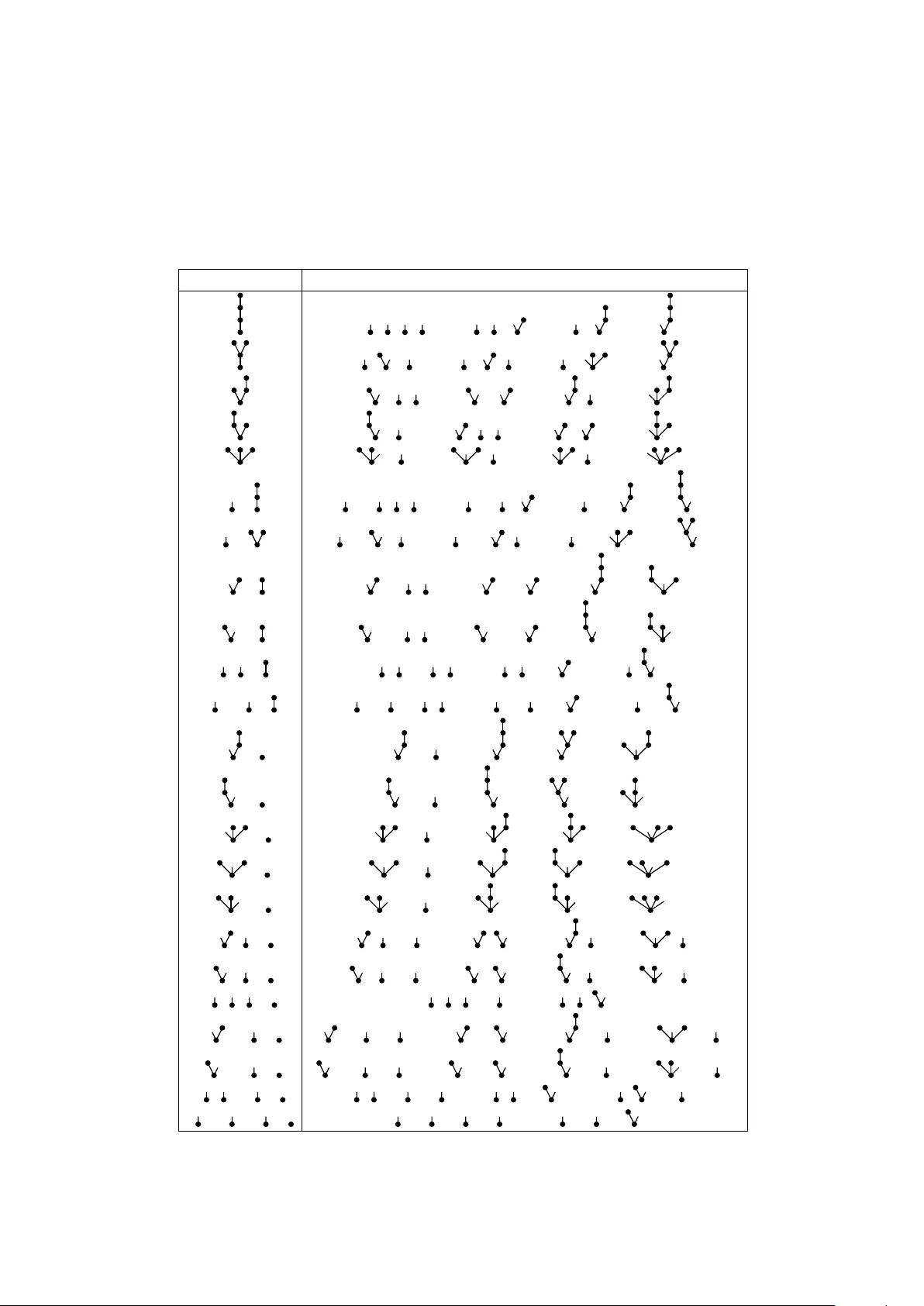
The free tracial p ost-Lie-Rinehart algebra of planar aromatic trees for the design of div ergence-free Lie-group metho ds A drien Busnot Lauren t 1 , Hans Mun the-Kaas 2 and V enkatesh G. S. 2 Marc h 31, 2026 Abstract Aromatic Butc her series were successfully in tro duced for the study and design of n umeri- cal integrators that preserve v olume while solving differen tial equations in Euclidean spaces. They are naturally asso ciated to pre-Lie-Rinehart algebras and pre-Hopf algebroids struc- tures, and aromatic trees were sho wn to form the free tracial pre-Lie-Rinehart algebra. In this pap er, we presen t the generalisation of aromatic trees for the study of div ergence-free in tegrators on manifolds. W e introduce planar aromatic trees, sho w that they span the free tracial p ost-Lie-Rinehart algebra, and apply them for deriving new Lie-group metho ds that preserv e geometric divergence-free features up to a high order of accuracy . K eywor ds: geometric numerical in tegration, Lie-Butcher series, aromatic trees, divergence- free, volume-preserv ation. AMS subje ct classific ation (2020): 41A58, 65L06, 37M15, 05C05, 16T05. 1 In tro duction Butc her trees and series were in tro duced in the 60’s for the creation of high-order integration metho ds [8, 9, 10, 23]. Sev eral extensions of the initial formalism were then in tro duced for the dev elopment of geometric numerical integration. In particular, planar trees and Lie-Butcher series w ere used for the design of Lie-group metho ds [24] and aromatic trees and aromatic B-series sho wed to b e crucial to ols for the study of volume-preserving integrators [15, 25]. The creation of n umerical metho ds on manifolds that preserve geometric inv arian ts is an activ e field of research. In particular, there are, to the b est of our knowledge, no existing work discussing the preserv ation of volume for intrinsic metho ds on manifolds. In general, the Lie-group metho ds (Lie-R unge- Kutta, Crouc h-Grossman or R unge-Kutta-Munthe-Kaas metho ds) and more generally LB-series metho ds, do not preserve v olume, ev en in the Euclidean case [15, 25]. The characterisation of Euclidean numerical volume-preserv ation is done through the use of bac kw ard error analysis [13, 23, 14, 11] and rewrites as the design of methods whose mo dified v ector field satisfies div p ˜ f q “ 0 . It is natural to consider aromatic mo difications of LB-series metho ds to obtain div ergence-free features for the numerical metho d at least up to a high order. A simple wa y to ac hieve high order of volume-preserv ation is obtained b y considering high order-metho ds, but this approach is costly and sub-optimal. Approaches for Euclidean pseudo-volume-preserv ation are first discussed in [3, 42]. There are other Euclidean techniques in the literature for building 1 Univ Rennes, INRIA (Researc h team MINGuS), IRMAR (CNRS UMR 6625) and ENS Rennes, F rance. A drien.Busnot-Laurent@inria.fr. 2 Departmen t of Mathematics and Statistics, UiT – The Arctic Univ ersity of Norwa y , T romsø, Norw ay . Hans.Mun the-Kaas@uib.no, Subbarao.V.Guggilam@uit.no. 1 v olume-preserving metho ds [54, 51], but their complexity blo ws up with the dimension of the problem, opp osite to the aromatic B-series approac h. The extension of the Euclidean results to in trinsic metho ds on manifolds ha ve not b een considered to the b est of our kno wledge. In this pap er, we in tro duce planar aromatic trees, study their algebraic structure, and apply them for the study and design of volume-preserving Lie-group metho ds. The analysis is successfully applied for the design of aromatic Lie-group metho ds with low con vergence order and high order of volume preserv ation. T o motiv ate the algebraic formalism below, and its relation to geometry and n umerical in tegration, we recall briefly the basic setup of Lie group integration and related numerical metho ds. Let E Ñ M b e a vector bundle ov er a manifold and R “ C 8 p M , R q and L “ Γ p E q the sections of the bundle (e.g. vector fields, tensor fields). If L is also equipp ed with a Lie brac ket r´ , ´s and a Lie algebra homomorphism ρ : L Ñ X p M q to the vector fields with the Jacobi brac ket, w e call L a Lie algebr oid . An imp ortan t example is the action algebroid obtained from the action of a Lie group on a manifold, which is the generic setup of numerical Lie group in tegration [40]. In numerical algorithms we define basic flo ws on M whic h can b e computed exactly , from which w e dev elop more adv anced in tegration algorithms. Such basic flows can often b e described as geo desics of a connection. F or the action algebroid, the canonical connection on L is inv ariant with zero curv ature and parallel torsion. This is called a p ost-Lie algebr oid [44]. In [45] an intimate relationship b et ween p ost-Lie algebroids and action algebroids is developed, and [1] explains why p ost-Lie algebroids are also fundamental in the understanding of geo desic flo ws of general non-in v arian t connections. There is a dual picture on the algebraic side, where the manifold M is replaced b y the comm utative ring of scalar functions R “ C 8 p M , R q , and vector bundles are studied through their space of sections L “ Γ p E q , whic h is algebraically describ ed as an R -mo dule, with the pro duct of a scalar function with a section defined p oin t wise. The Serre-Sw an theorem states that the category of finitely generated pro jectiv e mo dules o ver R is a faithful represen tation of the category of vector bundles E Ñ M . Informally: ‘pr oje ctive mo dules ar e like ve ctor bund les’ . The geometric concept of Lie algebroids are describ ed on the algebraic side as Lie-Rinehart algebras, and p ost-Lie algebroids as tr acial p ost-Lie-Rinehart algebr as , whic h is the main algebraic ob ject of study in this pap er. The trace condition, defined b elow, is fulfilled for an y finitely generated pro jectiv e mo dule, as those arising in the Serre-Sw an theorem. F rom the algebraic p oin t of view, planar trees generate the free p ost-Lie algebra [44], with n umerous applications in v arious fields (see, for instance, [57, 2, 26]). On the other hand, aromatic trees yield the free tracial pre-Lie-Rinehart algebra [20], and the use of aromas w as recen tly extended to a v ariety of contexts [31, 58]. The natural generalisation of these structures is p ost-Lie-Rinehart algebras, and ha ve b een recently mentioned in [22, 26, 7, 53]. In n umerical analysis, such structures are naturally used with their univ ersal en veloping algebras. P ost-Lie and pre-Lie-Rinehart algebras respectively give rise to p ost-Hopf algebras [46] and pre-Hopf algebroids [3, 5]. F or p ost-Lie-Rinehart algebras, the universal en veloping algebra yields a p ost- Hopf algebroid [7]. W e show in the present pap er that the newly defined planar aromatic trees generate the free tracial p ost-Lie-Rinehart algebra. The article is organized as follows. In Section 2, w e recall the definition and properties of Lie-Rinehart algebra. W e sp ecify suc h structures given an affine connection to define tracial Lie- Rinehart algebras and the divergence in S ection 3. In Section 4, w e define the main algebraic structures of this article, that are, p ost-Lie-Rinehart algebras. Section 5 introduces the planar aromatic trees, their algebraic prop erties, and shows that they are the free tracial post-Lie- Rinehart algebra. The approach is applied successfully in Section 6 for the design of Lie-group 2 metho ds that preserve div ergence-free features up to a high order. F uture w orks are discussed in Section 7. 2 Lie-Rinehart Algebras and their cohomology 2.1 Lie-Rinehart Algebras Let k b e a field of characteristic 0 . Definition 2.1. A k - Lie-Rinehart is a tuple p R , L, ρ q wher e R is a c ommutative k -algebr a and p L, r¨ , ¨sq is a k -Lie algebr a such that: (i) L is a R -mo dule, (ii) R is a L -mo dule wher e the action of L on R is given by the anchor map ρ viz, a Lie morphism, ρ : L Ý Ñ D er p R, R q , wher e D er p R , R q stands for Lie algebr a of derivations fr om R to R , (iii) (L eibniz R ule) : F or al l f P R and X , Y P L , r X , f Y s “ p X .f q Y ` f r X, Y s . Remark 2.2. F or the sake of br evity, the action of L on R via the anchor map is denote d as the fol lowing: X .f “ ρ p X qp f q , X P L, f P R . 2.2 Chev alley-Eilen b erg Cohomology Giv en a Lie-Rinehart algebra p L, R q , let the Chev alley-Eilen b erg co c hain complex denoted by CE p L, End R p L q , ω q “ p Ź ‚ L ˚ , End R p L qq where (i) End R p g q is the k -Lie algebra of R -linear endomorphisms of the R -mo dule g . The Lie brac ket of End R p g q is denoted by J ¨ , ¨ K , (ii) ω P g ˚ b End R p g q and is called a End R p g q -Lie algebra v alued c onne ction 1-form satisfying p ω p r .g 1 q ´ r .ω p g 1 qqp g 2 q “ p ρ p g 2 qp r qq g 1 , (2.1) (iii) g ˚ is the dual of the R -mo dule g , (iv) Ź ‚ g ˚ is the differen tial graded exterior algebra of the R -mo dule g ˚ . Giv en ω , then End R p g q is a g -mo dule with g -action: g .f “ J ω p¨qp g q , f p¨q K viz., p g .f qp g 1 q “ ω p f p g 1 qqp g q ´ f pp ω p g 1 qqqp g q “ J ω p¨qp g q , f p¨q K p g 1 q , for g , g 1 P g and f P End R p g q . It is straightforw ard to chec k via Jacobi identit y that g . p h.f q ´ h. p g .f q “ J g , h K .f and generalizes the adjoint action twiste d by connection form. 3 The Chev alley-Eilen b erg co c hain complex is End R p g q d Ý Ñ g ˚ b End R p g q d Ý Ñ 2 ľ g ˚ b End R p g q d Ý Ñ ¨ ¨ ¨ where the differen tial d is defined as: for all γ P Ź n g ˚ b End R p g q and x 1 , x 2 , . . . , x n P g : dγ p x 1 , x 2 , . . . , x n ` 1 q “ ÿ σ P Sh p 1 ,n q sgn p σ q x σ p 1 q ¨ γ p x σ p 2 q , x σ p 3 q , . . . , x σ p n ` 1 q q ´ ÿ σ P Sh p 2 ,n ´ 1 q sgn p σ q γ pr x σ p 1 q , x σ p 2 q s , x σ p 3 q , . . . , x σ p n ` 1 q q , where Sh p p, q q denote p p, q q -shuffles in the p erm utation group of p ` q letters. The curvatur e is a 2 -form R P Ź 2 g ˚ b End R p g q given by R “ dω ` 1 2 r ω ^ ω s . 2.3 Reductiv e Splitting and T orsion Sa y End R p g q has a reductive decomp osition viz., End R p g q “ h ‘ m as R -mo dules such that (i) h is a Lie subalgebra of g , (ii) m is a h -mo dule under adjoin t action of h i.e, J h , m K Ď m . The 1 -form whence splits as ω “ ω h ` ω m where ω h P g ˚ b h and ω m P g ˚ b m resp ectiv ely . The ω h is called princip al c onne ction form and ω m is called soldering form or vielb ein . Consequently , the Lie algebra v alued 2 -form curv ature R splits as R “ dω ` 1 2 r ω ^ ω s “ d p ω h ` ω m q ` 1 2 rp ω h ` ω m q ^ p ω h ` ω m qs “ dω h ` dω m ` 1 2 tr ω h ^ ω h s ` 2 r ω h ^ ω m s ` r ω m ^ ω m s u . Since m is not necessarily a Lie subalgebra, the term r ω m , ω m s can ha ve v alues in b oth h and m . W e obtain r ω m ^ ω m s “ r ω m ^ ω m s h ` r ω m ^ ω m s m . The curv ature form R thus splits into terms in h and m as R “ dω h ` 1 2 r ω h ^ ω h s ` r ω m ^ ω m s h l jh n terms in h ` dω m ` r ω h ^ ω m s ` 1 2 r ω m ^ ω m s m l jh n terms in m “ R ` T . The terms R is the intrinsic curvatur e 2 -f orm and T is the torsion . In the case where the Lie ideal m is an Ab elian Lie algebra, then the expressions for in trinsic curv ature and torsion reduce resp ectiv ely to R “ dω h ` 1 2 r ω h ^ ω h s , T “ dω m ` r ω h ^ ω m s . 4 3 Affine and Isometric Connections The connection form ω P g ˚ b End R p g q is an affine connection form when End R p g q – aff p n q where aff p n q is the Lie algebra of affine group. Note that, aff p n q has a reductive decomp osition: aff p n q “ gl p n q ‘ R n . 3.1 Levi-Civita and W eitzenbö ck Connection The connection form ω P g ˚ b End R p g q with End R p g q – iso p n q , the Lie algebra of isometries of the affine space R n . Recall that iso p n q ã Ñ aff p n q and has reductiv e decomp osition as iso p n q “ so p n q ‘ R n , where so p n q is the Lie subalgebra and R n is so p n q ideal. The b oth Levi-Civita and W eitzenbö ck connections are isometric connections which are explained shortly . The 2-form curv ature in isometric connection splits into intrinsic curv ature and torsion as R “ R ljhn v alued in so p n q ` T ljhn v alued in R n . The L evi-Civita c onne ction is the isometric connection where T “ 0 (torsion v anishes) and W eitzenb ö ck c onne ction is the isometric connection where R “ 0 (in trinsic curv ature v anishes). The Bianchi identit y for the Levi-Civita connection whence reduces to d R “ d R “ 0 , while for the W eitzenbö c k connection the Bianchi iden tity is d R “ d T “ 0 . An affine/linear connection on the Lie-Rinehart algebra can also be defined or rather de- scrib ed in a mor e elementary manner follo wing [20] which the current pap er also adheres to. Definition 3.1. A line ar c onne ction on a R -mo dule N with r esp e ct to Lie-R inehart algebr a p R, L q is a R -line ar map ∇ : L Ý Ñ End k p N q (3.1) X ÞÝ Ñ ∇ X (3.2) such that for al l f P R and X , Y P L : ∇ X p f Y q “ p X .f q Y ` f ∇ X Y . (3.3) Observ e that the asso ciativ e algebra End p N q can b e endo wed a Lie algebra structure via the comm utator J ¨ , ¨ K . Definition 3.2. L et N b e a R -mo dule e quipp e d with a c onne ction ∇ with r esp e ct to Lie-R inehart algebr a p R, L q . A n m r ank k -multiline ar map W : N b m Ý Ñ M is c al le d p ar al lel if for al l X P L and Y 1 , Y 2 , . . . , Y m ∇ X p W p Y 1 , Y 2 , . . . , Y m qq “ W p ∇ X Y 1 , Y 2 , . . . , Y m q ` W p Y 1 , ∇ X Y 2 , . . . , Y m q ` ¨ ¨ ¨ (3.4) ¨ ¨ ¨ ` W p Y 1 , Y 2 , . . . , ∇ X Y m q . 5 Definition 3.3. The curvatur e of the c onne ction ∇ on the R -mo dule N is the alternating biline ar map define d as R : L ^ L Ý Ñ E nd p N q p X , Y q ÞÝ Ñ R p X , Y q , wher e R p X , Y q “ J ∇ X , ∇ Y K ´ ∇ r X,Y s . Remark 3.4. The curvatur e R “ 0 if and only if N is a mo dule over the Lie algebr a L and the action is given by the c onne ction ∇ . Sinc e N is acte d by b oth R and L of the Lie-Rinehart p air p R, L q in this c ase, N is terme d as a mo dule over the Lie-Rinehart algebr a p R, L q . Definition 3.5 (Lie-Rinehart mo dule) . A R -mo dule N is a mo dule over the Lie-R inehart p air p R, L q or simply c al le d an p R , L q -mo dule), with a c onne ction ∇ if • N is a mo dule over the Lie algebr a L wher e the action is given by the c onne ction ∇ . ∇ r X 1 ,X 2 s Y “ p ∇ X 1 ˝ ∇ X 2 ´ ∇ X 2 ˝ ∇ X 1 q Y for al l X 1 , X 2 P L and Y P N . • The action of the c ommutaive algebr a R on N and the action on Lie algebr a L on N satisfy the Lie-Rinehart p air c omp atibility. F or al l X 1 , X 2 P L , f P R and Y P N : ∇ r X 1 ,f X 2 s Y “ p X 1 .f q ∇ X 2 Y ` f ∇ r X 1 ,X 2 s Y Example 3.6. F or a Lie-R inehart p air p R, L q , a primary example of Lie-Rinehart mo dule over p R, L q is the mo dule R . L o oking at R as R -mo dule, define the c onne ction ∇ : L Ý Ñ End k p R q X ÞÝ Ñ ∇ X , wher e ∇ X p f q “ X.f for al l X P L and f P R . The flatness of the c onne ction ∇ fol lows fr om the definition of p R, L q b eing a Lie-R inehart p air. Henc e, R is a Lie-Rinehart mo dule over p R, L q . Definition 3.7 (Morphism of Lie-Rinehart mo dules) . L et M , N b e p R, L q -mo dules with c onne c- tion ∇ , ∇ 1 r esp e ctively. A R -mo dule moprhism α : M Ý Ñ N is a morphism of p R, L q -mo dules if α is a morphism of L -mo dules viz. for al l X P L and Y P M α p ∇ X Y q “ ∇ 1 X p α p Y qq . F or a connection ∇ defined on the R -mo dule L with resp ect to Lie-Rinehart pair p R, L q , the torsion T of the connection ∇ is defined as T : L ^ L Ý Ñ L p X , Y q ÞÝ Ñ T p X , Y q , where T p X, Y q “ ∇ X Y ´ ∇ Y X ´ r X , Y s . Let N b e a R -mo dule endow ed with a connection ∇ with resp ect to the Lie-Rinehart pair p R, L q . The R -mo dule End R p N q is canonically equipp ed with the connection ˆ ∇ (with resp ect to p R, L q ), defined as p ˆ ∇ X ν qp Y q “ ∇ X p ν p Y qq ´ ν p ∇ X Y q , (3.5) 6 for all X P L, Y P N and ν P End R p N q . F rom p 3 . 5 q , it is straightforw ard to verify that for all X P L the connection ˆ ∇ X acts a deriv ation on the algebra End R p N q viz., for all ν, µ P End R p N q : ˆ ∇ X p ν ˝ µ q “ ˆ ∇ X p ν q ˝ µ ` ν ˝ ˆ ∇ X p µ q . (3.6) Prop osition 3.8. [20] If N is a Lie-Rinehart mo dule with r esp e ct to the Lie-Rinehart p air p R, L q , then End R p N q is also a Lie-R inehart mo dule over p R , L q . 3.2 T racial Lie-Rinehart Algebras Definition 3.9. L et L b e the R -mo dule endowe d with c onne ction ∇ over the Lie-Rinehart algebr a p R, L q and then define k -line ar maps d : L Ý Ñ End R p L q X ÞÝ Ñ dX, wher e dX p Z q “ ∇ Z X for al l Z, X P L and δ : L Ý Ñ End R p L q X ÞÝ Ñ δ X, wher e δ X p Y q “ T p Y , X q for al l X , Y P L . The k -linear map δ satisfies the follo wing prop erties 1. F or all X , Y P L : δ X p Y q ` δ Y p X q “ 0 , 2. If T is parallel, then for all X , Y 1 , Y 2 d p δ Y 1 p Y 2 qqp X q “ δ p d Y 1 p X qqp Y 2 q ´ δ p d Y 2 p X qqp Y 1 q . Define El R p L q as the R -algebra of elementary R -mo dule endomorphisms generated by the set of R -linear maps ␣ ˆ ∇ X 1 ˆ ∇ X 2 ¨ ¨ ¨ ˆ ∇ X k d Y , ˆ ∇ X 1 ˆ ∇ X 2 ¨ ¨ ¨ ˆ ∇ X k δ Y : k ě 0 , X 1 , X 2 , . . . , X k , Y P L ( . By definition, El R p L q is a subalgebra of the algebra of End R p L q . If L is a Lie-Rinehart mo dule, El R p L q is a Lie-Rinehart submo dule of the Lie-Rinehart mo dule End R p L q . Definition 3.10. A Lie-Rinehart algebr a p R, L q is tracial if L is a Lie-R inehart mo dule over p R, L q with c onne ction ∇ and a R -line ar map τ : El R p L q Ý Ñ R such that (i) τ is a homomorphism of p R , L q -mo dules fr om p El R , ˆ ∇ q to p R, ∇ q , that is, for nu P El R and X P L : τ p ˆ ∇ X ν q “ ∇ X p τ p ν qq “ X . p τ p ν qq (ii) for al l ν, µ P El R p L q τ p ν ˝ µ q “ τ p µ ˝ ν q , viz., τ is invariant under the action of cyclic p ermutations. Definition 3.11. The divergence map on p L, ∇ q in a tr acial Lie-Rinehart p air p R, L, τ q is div : L Ý Ñ R X ÞÝ Ñ div p X q “ p τ ˝ d qp X q . (3.7) Ther efor e, we have div “ τ ˝ d . 7 4 P ost-Lie-Rinehart algebras Let V b e a k -v ector space and let Ź : V b 2 Ý Ñ V b e a magmatic pro duct defined on V . Then, the A sso ciator map is defined as Ass Ź : V b 3 Ý Ñ V p a, b, c q ÞÝ Ñ a Ź p b Ź c q ´ p a Ź b q Ź c. P ost-Lie-Rinehart algebras w ere in tro duced recently in [22, 26]. They were further studied in [7], where their link with p ost-Hopf algebroids is discussed. Definition 4.1. A p ost-Lie-R inehart algebr a is a Lie-R inehart algebr a p R , L q endowe d with flat c onne ction ∇ : L Ý Ñ End k p L q with p ar al lel torsion or e quivalently ∇ : L b L Ý Ñ L p X , Y q ÞÝ Ñ X Ź Y : “ ∇ X Y . Hence for all X , Y , Z P L : (i) Ass Ź p X , Y , Z q ´ Ass Ź p Y , X , Z q “ T p Y , X q Ź Z ( R “ 0 ô L is a Lie-Rinehart mo dule), (ii) X Ź T p Y , Z q “ T pp X Ź Y q , Z q ` T p Y , p X Ź Z qq (torsion T is parallel). Example 4.2 (The co v arian t deriv ation algebra) . L et p M , ∇ q b e a manifold with a gener al TM - c onne ction ∇ (not ne c essarily flat nor c onstant torsion). A sso ciate d with this ge ometric sp ac e is a natur al p ost-Lie-R inehart algebr a which is governing the algebr a of flows of ve ctor fields and ge o desics on M . W e give a brief intr o duction and r efer to [1] for details. Define the tensor algebr a of ve ctor fields T p X p M qq : “ R ‘ X p M q ‘ p X p M q d X p M qq ‘ p X p M q d X p M q d X p M qq ‘ ¨ ¨ ¨ “ 8 à r “ 0 T r 0 , wher e X p M q d X p M q : “ X p M q b R X p M q . W e fol low [48, 18] and extend the c onne ction to an R -line ar pr o duct Ź on T p X p M qq , as the Guin-Odoum c onstruction: for φ P R , X , Y P X p M q and W 1 , W 2 P T p X p M qq let X Ź Y “ ∇ X Y , φ Ź W 1 “ φW 1 , X Ź p W 1 d W 2 q “ p X Ź W 1 q d W 2 ` W 1 d p X Ź W 2 q , p X d W 1 q Ź W 2 “ X Ź p W 1 Ź W 2 q ´ p X Ź W 1 q Ź W 2 . The pr o duct Ź is R multi-line ar in left ar gument and R line ar in the right. L et ∆ : T p X p M qq Ñ T p X p M qq b T p X p M qq denote the de-shuffle c o-pr o duct and define the asso- ciative Gr ossman—L arson pr o duct ˚ : T p X p M qq b T p X p M qq Ñ T p X p M qq as A ˚ B “ ÿ ∆ p A q A p 1 q d ` A p 2 q Ź B ˘ . Then W 1 Ź p W 2 Ź W 3 q “ p W 1 ˚ W 2 q Ź W 3 . 8 W e c al l D p M q : “ p T p X p M qq , d , Ź , ∆ , ˚q the cov arian t deriv ation algebra on p M , ∇ q . It acts natur al ly as higher or der c ovariant derivations on the tensor bund les T r s over M . The primitive elements g “ t W P D p M q : ∆ p W q “ W b I ` I b W u acts as first or der c ovariant derivations, in p articular g acts on R “ T 0 0 as derivations, which defines an anchor map ρ : g Ñ Der p R, R q “ X p M q . The lifte d c onne ction Ź on g is flat with p ar al lel torsion, henc e p g , r´ , ´s , Źq is a p ost-Lie algebr a with r A, B s “ A d B ´ B d A , and p g , J ´ , ´ K q is a Lie algebr a with J A, B K “ A ˚ B ´ B ˚ A “ r A, B s ` A Ź B ´ B Ź A. The tuple p R, L “ g , ρ, Źq is a tr acial p ost-Lie-R inehart algebr a with enveloping algebr a D p M q . The exp onential with r esp e ct to d yields pul lb ack series along ge o desics, while the exp onential with r esp e ct to ˚ yields pul lb ack series along the exact flow of a ve ctor field. It might b e a surprise that a gener al TM -c onne ction ∇ with torsion T ∇ and curvatur e R ∇ lifts to a flat p ost-Lie c onne ction Ź on g . The curvatur e R ∇ and torsion T ∇ app e ar thr ough a split exact se quenc e of Lie algebr as. L et r´ , ´s J b e the Jac obi br acket on ve ctor fields X p M q and for X , Y P X p M q define the curvatur e form s p X , Y q : “ J X , Y K ´ r X , Y s J , thus s is a tensor of mixe d typ e s P T 2 2 ‘ T 1 2 . Then R ∇ p X , Y q Z “ s p X, Y q Ź Z . L et I “ x s p X, Y q : X , Y P X p M qy b e the two-side d ide al of the Gr ossman—L arson Lie algebr a p g , J ´ , ´ K q gener ate d by the curvatur e forms. Then ther e is a split short exact se quenc e 0 I g X p M q 0 . ρ i Thus the G-L Lie algebr a p g , J ´ , ´ K q de c omp oses in a semi dir e ct pr o duct g – I ¸ X p M q , wher e the left p art c ontains the curvatur e forms and the right p art the torsion forms of ∇ . A s an example, we have for X , Y P X p M q that ρ pr X , Y sq “ ´ T ∇ p X , Y q and p 1 ´ ρ qpr X , Y sq “ s p X, Y q . W e r efer to [1] and forthc oming p ap ers for mor e details. Example 4.3. L et M n b e an n -dimensional r e al manifold and U b e an op en subset of M n . L et R “ C 8 p U q and L “ Γ p T M | U q b e the sp ac e of lo c al se ctions of the tangent bund le r estricte d to U with nonholonomic b asis p e 1 , e 2 , . . . , e n q e quipp e d with a flat c onne ction with p ar al lel torsion ∇ : L b 2 Ý Ñ L p X , Y q ÞÝ Ñ X Ź Y , such that for al l i, j, k “ 1 , 2 , . . . , n , r e i , e j s “ n ÿ k “ 1 c k ij e k , 9 wher e c k ij ar e structure constants and e i Ź e j “ ∇ e i p e j q “ n ÿ k “ 1 Γ k ij e k , wher e Γ k ij ar e connection co efficien ts . The torsion tensor is henc e c ompute d as T p e i , e j q “ n ÿ k “ 1 p Γ k ij ´ Γ k j i ´ c k ij q e k . Thus p C 8 p U q , Γ p T U q , ∇ q is a p ost-Lie-Rinehart algebr a and for al l X , Y P L with X “ ř n i “ 1 X i e i and Y “ ř n j “ 1 Y j e j wher e X i , Y j P R : X Ź Y “ n ÿ j “ 1 ˜ ÿ i “ 1 X i p e i .Y j q ¸ e j ` n ÿ k “ 1 ˜ n ÿ i “ 1 n ÿ j “ 1 X i Y j Γ k ij ¸ e k . Thus for a ve ctor field Y “ ř n j “ 1 Y j e j , the c orr esp onding endomorphism d Y maps e i ÞÝ Ñ n ÿ j “ 1 ` e i .Y j ˘ e j ` n ÿ k “ 1 ˜ n ÿ j “ 1 Y j Γ k ij ¸ e k . Ther efor e the diver genc e of Y is given by div p Y q “ τ p d Y q “ n ÿ i “ 1 ` e i .Y i ˘ ` n ÿ i “ 1 ˜ n ÿ j “ 1 Γ i ij Y j ¸ . Prop osition 4.4. In a p ost-Lie-Rinehart algebr a p R, L q , the algebr a of elementary R -mo dule endomorphisms, El R p L q is gener ate d by t dX , δ X : X P L u . Pr o of. The pro of is done by induction on the length n of arbitrary generators of El R p L q of the form ˆ ∇ Y n ˆ ∇ Y n ´ 1 ¨ ¨ ¨ ˆ ∇ Y 1 dX and ˆ ∇ Y n ˆ ∇ Y n ´ 1 ¨ ¨ ¨ ˆ ∇ Y 1 δ X for all X , Y 1 , Y 2 , . . . , Y n P L . (Base Case) n “ 1 : F or X , Y , Z P L (i) p ˆ ∇ Y dX qp Z q “ ∇ Y p dX p Z qq ´ dX p ∇ Y Z q “ Y Ź p Z Ź X q ´ p Y Ź Z q Ź X “ Z Ź p Y Ź X q ´ p Z Ź Y q Ź X ` T p Z , Y q Ź X “ ! d p Y Ź X q ´ dX ˝ d Y ` dX ˝ δ Y ) p Z q “ ! d p Y Ź X q ´ dX ˝ p d Y ´ δ Y q ) p Z q . (ii) p ˆ ∇ Y δ X qp Z q “ ∇ Y p δ X p Z qq ´ δ X p ∇ Y p Z qq “ ∇ Y p T p Z , X qq ´ T p ∇ Y Z, X q “ Y Ź T p Z , X q ´ T p Y Ź Z, X q “ T p Z , Y Ź X q “ δ p dX p Y qqp Z q . 10 T o chec k for n “ 2 , ˆ ∇ Y 2 ˆ ∇ Y 1 dX “ ˆ ∇ Y 2 p d p Y Ź X q ´ dX ˝ p d Y ´ δ Y q p from Case n “ 1 q p 3 . 6 q “ ˆ ∇ Y 2 d p Y Ź X q ´ ˆ ∇ Y 2 dX ˝ p d Y ´ δ Y q , where all the terms are generated by t dX , δ X : X P L u in view of the case n “ 1 . Successively , the cases for n “ 2 , 3 , . . . can b e pro ven in the same wa y . F or, ˆ ∇ Y 2 ˆ ∇ Y 1 δ X “ ˆ ∇ Y 2 p δ p dX p Y 1 qq , and is reduced to Case n “ 1 . Lik ewise, the cases for n “ 2 , 3 , . . . can iteratively b e reduced to the Case n “ 1 . 5 Planar aromatic trees and the free tracial p ost-Lie-Rinehart algebra This section gives a brief review of planar ro oted trees and introduces planar aromatic trees, whic h build up the explicit description of the free tracial p ost-Lie-Rinehart algebra. 5.1 Planar ro oted trees and free p ost-Lie-Rinehart algebra The planar ro oted trees are a conv enien t graphical representation of the free magma [44]. Definition 5.1. A planar tr e e, gather e d in the set T , is define d by induction: P T , p t 1 ¨ ¨ ¨ t p q ñ P T , t i P T , wher e p t 1 ¨ ¨ ¨ t p q ñ is an abstr act notation for the or der e d list of sub-tr e es t 1 , . . . , t p . The notation stands for a vertex of the tr e e, that ar e arbitr arily lab ele d (with differ ent lab els). The set of vertic es V p t q of a tr e e t “ p t 1 ¨ ¨ ¨ t p q ñ c ontains the r o ot and the vertic es of its subtr e es t k . The numb er of vertic es of a tr e e, denote d | t | is c al le d the or der of the tr e e. L et C b e a finite set of de c or ations, also c al le d c olours in numerics. A de c or ate d planar tr e e is a tuple p t, ϕ q with a tr e e t and a map ϕ : V Ý Ñ C . The de c or ate d tr e es ar e gather e d in the set T C and the sp ac e T C “ Span p T C q . Similarly, the subset/subsp ac e of de c or ate d planar tr e es of or der N ar e denote d T N C and T N C . The index C is omitted for examples and numerical applications, where one is mainly inter- ested in one colour C “ t u . Planar trees are drawn with the ro ot at the b ottom. The planar trees of order up to five in T are the following: ; ; , ; , , , , ; , , , , , , , , , , , , , . W e emphasize that the following trees are differen t as they are defined by induction as “ p ¨ p ñ qq ñ , “ pp ñ q ¨ q ñ . The left grafting product ñ : T C ˆ T C Ñ T C is defined on trees and then extended by bilinearit y as t 2 ñ t 1 “ ÿ v P V p t 1 q t 2 ñ v t 1 , 11 where t 2 ñ v t 1 attac hes the ro ot of t 2 to the no de v of t 2 on the left. F or instance, we find ñ “ ` ` ` . Let us consider the free Lie algebra spanned by decorated planar trees p Lie p T C q , r´ , ´sq . The grafting pro duct is extended on Lie p T C q by t 3 ñ r t 2 , t 1 s “ r t 3 ñ t 2 , t 1 s ` r t 2 , t 3 ñ t 1 s , r t 3 , t 2 s ñ t 1 “ Ass ñ p t 3 , t 2 , t 1 q ´ Ass ñ p t 2 , t 3 , t 1 q . Prop osition 5.2 ([44]) . The sp ac e p Lie p T C q , r´ , ´s , ñ q is the fr e e p ost-Lie algebr a over the set C , that is, for every set map F : C Ý Ñ L wher e p L, r´ , ´s , Źq is a p ost-Lie algebr a, ther e exists a unique p ost-Lie (epi-)morphism F : Lie p T C q Ý Ñ L extending the map F . C p L, r´ , ´s , Źq p Lie p T C q , r´ , ´s , ñ q F ι F Remark 5.3. L et us now c onsider the universal enveloping algebr a U p Lie p T C qq , e quipp e d with its pr o duct. It natur al ly is a c o c ommutative Hopf algebr a with the unshuffle c opr o duct ∆ and is isomorphic to the Hopf algebr a p T p T C q , ¨ , ∆ q by the Cartier-Quil len-Milnor-Mo or e the or em [37]. The gr afting pr o duct is extende d to T p T C q using the (p ost-Lie) Guin-Oudum c onstruction [48, 18] and p T p T C q , ⊛ , ∆ q , wher e ⊛ is the Gr ossman-L arson pr o duct. The enveloping algebr a of a p ost-Lie algebr a endows a c ointer acting structur e. The tuple p T p T C q , ¨ , ∆ q is a Hopf algebr a in the c ate gory of p T p T C q , ⊛ , ∆ q -c omo dules. This c ointer acting structur e is terme d as a p ost- Hopf algebr a [33]. Note that this c onstruction is c omp atible with the notation for the inductive definition of planar tr e es in Definition 5.1. The Hopf algebr as asso ciate d to planar tr e es have b e en extensively studie d in the numeric al liter atur e [24, 46, 34, 19], wher e they ar e use d for r epr esenting the T aylor exp ansion of Lie-gr oup metho ds. F or the Lie algebra Lie p T C q , the left adjoint Lie morphism for t P Lie p T C q is giv en b y δ t : Lie p T C q Ý Ñ End p Lie p T C qq η ÞÝ Ñ r t, η s Let T 0 C b e the set of decorated planar trees with one free edge. W e denote ˆ T 0 C the subset of decorated planar trees with the free edge attached to the ro ot. F or instance, we find P T 0 t , u , P ˆ T 0 t , u Ă T 0 t , u . The trees with a free edge can b e seen as endomorphisms in End p Lie p T C qq that act on trees by grafting on the free edge, : ÞÑ The (endomorphism) algebra generated by the Lie p T C q (via the left adjoint δ ¨ ) and T 0 C is defined b y ˝ “ , ˝ δ “ ´ . 12 This gives us in particular : r , s ÞÑ ´ . This yields that T 0 C “ Span p T 0 C q equipped with the comp osition ˝ is a subalgebra of p End p T C q , ˝q . Moreo ver, the subalgebra p T 0 C , ˝q is generated b y p ˆ T 0 C , ˝q (with ˆ T 0 C “ Span p ˆ T 0 C q ) as there is a unique wa y to decomp ose an element of T 0 C in to a comp osition of elemen ts of ˆ T 0 C : “ ˝ ˝ . Let the map d : T C Ñ T 0 C that sums ov er all p ossible w ays to graft from the left a free edge to the input: d “ ` ` ` . (5.1) Lemma 5.4. The algebr a of elementary mo dule morphisms El k p Lie p T C qq for the p ost-Lie- R inehart algebr a p k , Lie p T C q , r´ , ´s , ñ q is the algebr a gener ate d by ˆ T 0 C , the sub algebr a of tr e es with a fr e e e dge at the r o ot and the Lie sub algebr a δ p Lie p T C qq . Pr o of. This follows from (mimicking) Prop osition 4.4. The grafting op eration ñ on Lie p T C q is extended as the action of the Lie algebra on the trees with a free edge ñ : Lie p T C q ˆ T 0 C Ý Ñ T 0 C as for all t 1 , t 2 P Lie p T C q and t P T 0 C as t 1 ñ a “ ÿ v P V p a q t 1 ñ v t, r t 1 , t 2 s ñ t “ Ass ñ p t 1 , t 2 , t q ´ Ass ñ p t 2 , t 1 , t q . (5.2) The grafting of a planar tree t 1 on a planar tree with a free edge t is the sum of all p ossible grafting t 1 on all the v ertices of t . The important remark is that the fr e e e dge of a is not disturb e d at al l. F or example, one finds ñ “ ` ` . 5.2 Planar aromatic trees and free tracial p ost-Lie-Rinehart algebras Definition 5.5. A planar ar oma is a list p t 1 , . . . , t n q ö with t i P ˆ T 0 C that has cyclic invarianc e: p t 1 , . . . , t n q ö “ p t 2 , . . . , t n , t 1 q ö “ ¨ ¨ ¨ “ p t n , t 1 , . . . , t n ´ 1 q ö . W e imp ose the c onvention that the fr e e e dge in e ach t p is indic ate d with a cr oss ˆ . L et A C b e the symmetric algebr a gener ate d by planar ar omas, whose elements ar e c al le d multi-ar omas. The A C -mo dule of ar omatic tr e es is AT C “ A C b T C and the A C -Lie algebr a is Lie A C p AT C q “ A C b Lie p T C q e quipp e d with the A C -biline ar br acket r´ , ´s . These ve ctor sp ac es ar e gr ade d by the numb er of vertic es. 13 An example of planar aroma is the following: p ˆ , ˆ , ˆ q ö “ p ˆ , ˆ , ˆ q ö “ p ˆ , ˆ , ˆ q ö . In the Euclidean setting where there are no planar features, the lo cation of the cross would not matter. W e added the notation ˆ for the sake of clarity as we shall no w extend the map d to aromas, which shall yield additional free edges. The planar aromatic trees are the main ob ject of in terest for our numerical interests. F or a P A C , t P Lie p T C q , the asso ciated aromatic tree a b t is written as at for simplicity . The grafting pro duct is extended by the Leibniz rule: ñ : Lie A C p AT C q ˆ Lie A C p AT C q Ñ Lie A C p AT C q p a 1 t 1 q ñ p a 2 t 2 q “ a 1 a 2 p t 1 ñ t 2 q ` a 1 p t 1 ñ a 2 q t 2 , where the grafting of t P Lie p T C q on a multiaroma satisfies t ñ 1 “ 0 , t ñ p t 1 , . . . , t p q ö “ p t ñ t 1 , . . . , t p q ö ` ¨ ¨ ¨ ` p t 1 , . . . , t ñ t p q ö , r t 1 , t 2 s ñ a “ Ass ñ p t 1 , t 2 , a q ´ Ass ñ p t 2 , t 1 , a q , t ñ p a 1 a 2 q “ p t ñ a 1 q a 2 ` a 1 p t ñ a 2 q . The asso ciated anchor map is ρ : Lie A C p AT C q Ñ Der p A C q , ρ p x qp y q “ x ñ y . The following prop osition is an embo diment of the discussion so far in this subsection Prop osition 5.6. The sp ac e of planar ar omatic for ests p A C , Lie A C p AT C q , r´ , ´s , ρ, ñ q is a p ost-Lie-R inehart algebr a. Sa y the tree t 1 is with a free edge (other than the crossed free edge defining the aroma), then w e ha ve an aroma with a free edge. p t 1 , . . . , t p q ö : t P Lie p T C q Ñ p t 1 p t q , . . . , t p q ö . Here t 1 p t q denotes the grafting of t on the non-crossed free edge of t 1 . F or instance, we find p ˆ , ˆ , ˆ q ö p q “ p ˆ , ˆ , ˆ q ö , where we recall that the free edges with a cross are the one defining the aroma and cannot b e grafted up on. Thus hereafter unless otherwise mentioned, free edges for aromatic planar trees should imply that edges are non-crossed. Let Lie 0 A C p AT C q b e the Lie algebra of aromatic trees where exactly one aroma or one tree has a free edge. The algebra p Lie 0 A C p AT C q , ˝q forms a subalgebra of p End A C p Lie A C p AT C qq , ˝q b y imp osing A C -linearit y . The map d extends on aromatic trees by the Leibniz rule: d : Lie A C p AT C q Ñ Lie 0 A C p AT C q Ă End A C p Lie A C p AT C qq , d p at q “ d p a q t ` ad p t q , where we extend the map d defined in (5.1) on multiaromas and commutators b y d p 1 q “ 0 , 14 d p a 1 a 2 q “ d p a 1 q a 2 ` a 1 d p a 2 q , d pp t 1 , . . . , t n q ö q “ p d p t 1 q , . . . , t n q ö ` ¨ ¨ ¨ ` p t 1 , . . . , d p t n qq ö , d pr t 1 , t 2 sq “ r d p t 1 q , t 2 s ` r t 1 , d p t 2 qs . Here d p t 1 q is the sum of all p ossible graftings of a free edge from the left on to all the vertices of the planar tree t 1 and the the cr osse d fr e e e dge is not disturb e d at al l. F or example, d p ˆ q “ ˆ Lemma 5.7. Extend δ t o Lie A C p AT C q by A C -line arity. Then, the elementary endomorphisms of the p ost-Lie-R inehart algebr a of planar ar omatic for ests ar e given by El A C p Lie A C p AT C qq “ Lie 0 A C p AT C q ‘ δ p Lie A C p AT C qq . Using the unique decomp osition of elemen ts of T 0 C in to comp ositions of elements of ˆ T 0 C , we define the trace and the divergence maps. Examples of computations are presented in T able 1 and App endix A. Definition 5.8. The tr ac e is the A C -line ar map τ : El A C p Lie A C p AT C qq Ñ A C that vanishes on vanishes on δ p Lie A C p AT C qq and is given on Lie 0 A C p AT C q by the fol lowing. If the fr e e e dge is on a tr e e t : τ p t q “ p t 1 , . . . , t n q ö , t “ t 1 ˝ ¨ ¨ ¨ ˝ t n , t 1 , . . . , t n P ˆ T 0 C . If the fr e e e dge is on an ar oma: τ pp t 1 , . . . , t n q ö t q “ p t 1 , . . . , t n q ö p t q . If the fr e e e dge is in a c ommutator: τ pr t 1 , t 2 sq “ ˆ τ pr t 1 , t 2 sqp id q , wher e the auxiliary map ˆ τ satisfies ˆ τ p t 1 ˝ ¨ ¨ ¨ ˝ t n qp δ x q “ p t 1 , . . . , t n ˝ δ x q ö t, t 1 , . . . , t n P ˆ T 0 C , x P Lie p T C q , ˆ τ pr t 1 , t 2 sqp δ x q “ ˆ τ p t 1 qp δ x ˝ δ t 2 q , t 1 P Lie 0 p T C q , t 2 P Lie p T C q . The diver genc e map is then define d by div : Lie A C p AT C q Ñ A C , div “ τ ˝ d. Planar aromatic trees yield an imp ortan t example of tracial p ost-Lie-Rinehart algebra. Prop osition 5.9. The tuple p A C , Lie A C p AT C q , r´ , ´s , ρ, ñ , τ q is a k -tr acial p ost-Lie-R inehart algebr a. The main result of this section is that the Lie algebra of planar aromatic trees is a free ob ject, whic h generalises [20] to the p ost-Lie con text. Theorem 5.10. The fr e e k -tr acial p ost-Lie-Rinehart algebr a over the set C is the sp ac e of planar ar omatic tr e es p A C , Lie A C p AT C q , r´ , ´s , ρ, ñ , τ q , that is, for every set map F : C Ý Ñ L 15 t P Lie A p AT q d p t q div p t q p ˆ q ö ` p ˆ , ˆ q ö ` p ˆ q ö p ˆ q ö p ˆ q ö ` p ˆ q ö p ˆ q ö p ˆ q ö ` p ˆ q ö ` ` p ˆ , ˆ , ˆ q ö ` p ˆ , ˆ q ö ` p ˆ q ö ` ` p ˆ , ˆ q ö ` p ˆ , ˆ q ö ` p ˆ q ö p ˆ q ö p ˆ q ö ` p ˆ q ö ` p ˆ q ö p ˆ q ö p ˆ , ˆ q ö ` p ˆ q ö p ˆ q ö ` p ˆ q ö p ˆ q ö p ˆ q ö ` p ˆ q ö ` p ˆ q ö p ˆ q ö p ˆ q ö ` p ˆ q ö ` p ˆ q ö p ˆ q ö p ˆ q ö ` p ˆ q ö ` p ˆ q ö p ˆ q ö p ˆ q ö ` p ˆ q ö ` p ˆ q ö p ˆ , ˆ q ö p ˆ , ˆ q ö ` 2 p ˆ , ˆ q ö p ˆ , ˆ q ö p ˆ q ö ` 2 p ˆ , ˆ q ö p ˆ q ö p ˆ q ö p ˆ q ö p ˆ q ö ` 2 p ˆ q ö p ˆ q ö p ˆ q ö p ˆ q ö p ˆ q ö ` 2 p ˆ q ö p ˆ q ö r , s r , s ` r , s ` r , s p ˆ , ˆ q ö ´ p ˆ , ˆ q ö ` p ˆ q ö ´p ˆ q ö ` p ˆ q ö ´ p ˆ q ö T able 1: Divergence of elements of Lie A p AT q of order up to three (see also App endix A). wher e p R , L, r´ , ´s , ρ, ▷ , τ q is a k -tr acial p ost-Lie-Rinehart algebr a, ther e exists a unique (epi- )morphism of k -tr acial p ost-Lie-Rinehart algebr a F : p A C , Lie A C p AT C qq Ý Ñ p R , L q extending the map F . C p R, L, r´ , ´s , ρ, ▷ , τ q p A C , Lie A C p AT C q , r´ , ´s , ρ, ñ , τ q F ι F Let us now presen t a concise pro of of Theorem 5.10. W e refer to [53] for a fully detailed pro of of this result. Pr o of. As Lie p T C q is the free p ost-Lie algebra, there exists a unique p ost-Lie algebra morphism F : Lie p T C q Ñ L (see Prop osition 5.2). F ollowing the pro of of [44], it also naturally yields a unique algebra morphism ψ : El k p Lie p T C qq Ñ El R p L q , whic h naturally induces the following map (analogously to the pre-Lie-Rinehart case [20]): ˆ ψ : El k p Lie p T C qq{r T 0 C , T 0 C s ˝ Ñ El R p L q{r El R p L q , El R p L qs ˝ , where r u, v s ˝ “ u ˝ v ´ v ˝ u . W e th us obtain F : T 0 C {r T 0 C , T 0 C s ˝ Ñ R, F “ ˆ τ ˝ ˆ ψ , where we factor the trace ˆ τ : El R p L q{r El R p L q , El R p L qs ˝ Ñ R . As T 0 C {r T 0 C , T 0 C s ˝ is exactly the space of planar aromas, this defines F on aromas, and one thus extends F to the symmetric 16 algebra of multiaromas A C as an algebra morphism F : A C Ñ R . Then, we obtain the unique k -tracial p ost-Lie-Rinehart algebra F b y F : p A C , Lie A C p AT C qq Ñ p R, L q , F p at q “ F p a q F p t q . Hence the result. 6 Numerical preserv ation of div ergence-free features on mani- folds 6.1 P ost-Lie-Rinehart structure of the connection algebra Consider a manifold M on k equipp ed with a frame basis p E d q , defined globally for simplicit y 1 . The manifold is naturally equipp ed with the W eitzenbö c k connection, that we write as a pro duct on the v ector fields X p M q : Y Ź X “ Y r x i s E i , X “ x i E i , where we use the Einstein summation notation. The connection Ź is naturally curv ature-free R “ 0 , but do es not hav e constant torsion in general. Thus, w e further assume that the p E d q span a Lie algebra, or equiv alently that M is lo cally a Lie group, or equiv alently that w e hav e constan t torsion ∇ T “ 0 (see [47]). Let the Jacobi brac ket J ´ , ´ K J and the brack et derived from the torsion r´ , ´s “ ´ T , giv en explicitly for the W eitzenbö c k connection by r X , Y s “ x i y j J E i , E j K J , X “ x i E i , Y “ y j E j . Note that the tw o brack ets are link ed b y the identit y J X , Y K J “ r X , Y s ` X Ź Y ´ Y Ź X . Then, the connection algebra p X p M q , r´ , ´s , Źq is a p ost-Lie algebra [44]. A p ost-Lie-Rinehart structure on the C 8 p M q -mo dule X p M q is con venien tly defined when using the W eitzenbö ck connection. Let the anchor map ρ p X qp ϕ q “ X r ϕ s , X “ x i E i , ϕ P C 8 p M q , the trace τ p u q “ u i i , u P End C 8 p M q p X p M qq , u p E j q “ u i j E i , and the div ergence div p X q “ E i r x i s , X “ x i E i . Prop osition 6.1. A ssume that Ź has c onstant torsion, then p C 8 p M q , X p M q , r´ , ´s , ρ , Ź , τ q is a k -tr acial p ost-Lie-R inehart algebr a. Remark 6.2. The T aylor exp ansions of numeric al metho ds ar e not expr esse d dir e ctly in X p M q but r ather in the enveloping algebr a of X p M q , e quipp e d with the fr ozen pr o duct ¨ . F our our choic e of c onne ction, the fr ozen pr o duct ¨ acts on ve ctor fields and functions as the differ ential op er ator p X 1 ¨ ¨ ¨ X p q Ź Y “ pp X 1 ¨ ¨ ¨ X p q Ź y j q E j , p X 1 ¨ ¨ ¨ X p q Ź ϕ “ x i 1 1 . . . x i p p E i 1 r . . . E i p r ϕ s . . . s . It is showe d in p articular in [18, 7] that the universal enveloping algebr a of p ost-Lie algebr as (r esp e ctively p ost-Lie-Rinehart algebr as) ar e, under te chnic al assumptions, p ost-Hopf algebr as (r esp e ctively p ost-Hopf algebr oids). 1 The op erations used in Lie-group metho ds only require a lo cal frame family (see [49, 6]). 17 6.2 Div ergence-free vector fields, volume-preserv ation, and planar aromatic trees Let a smo oth ordinary differential equation on M led by a divergence-free v ector field y 1 p t q “ F p y p t qq , y p 0 q “ y 0 , F “ x i E i , div p F q “ 0 , (6.1) where F is a smo oth Lipschitz vector field. The divergence characterises geometric prop erties in sp ecific cases. Prop osition 6.3. A ssume that M is c omp act and e quipp e d with a Riemannian bi-invariant metric and the c orr esp onding volume form d vol . L et the volume of a me asur able set Ω of M b e V ol p Ω q “ ş Ω d vol . W e say that a flow φ t is volume-pr eserving if for al l me asur able Ω and al l t ą 0 , we have V ol p φ t p Ω qq “ V ol p Ω q . Then, the flow of (6.1) is volume-pr eserving if and only if div p F q “ 0 . Pr o of. The preserv ation of volume is characterised by the divergence for the Levi-Civita con- nection [32, Liouville’s theorem], which coincides with the W eitzenbö c k divergence div in the case of a bi-inv ariant metric. Example 6.4. Consider the differ ential e quation on the sp e cial ortho gonal gr oup SO d p R q : y 1 p t q “ A p y p t qq y p t q , A : SO d p R q Ñ so d p R q . Given a fr ame b asis of right-invariant ve ctor fields E i p y q “ A i y and p A i q b asis of so d p R q , the W eitzenb ö ck c onne ction b e c omes the standar d right-invariant c onne ction on SO d p R q . If A p y q “ f i p y q A i and E i r f i s “ 0 , then the flow pr eserves volume. Remark 6.5. Finding inte gr ators that pr eserve volume in a gener al ge ometric c ontext is a chal lenging op en pr oblem, for which this work is a first step. Inde e d, this r e quir es the design of a high-or der analysis and the study of algebr aic structur es for r epr esenting the c onne ction algebr a for a gener al c onne ction. W e cite in p articular the r e c ent works [55, 56, 41] that intr o duc e inte gr ators and algebr aic to ols for c onne ctions with vanishing torsion and c onstant curvatur e. The gener al c ase wil l b e studie d in futur e works. Planar aromatic trees represent sp ecific vector fields and functions through the application of the elemen tary differen tial map. Definition 6.6. Given a smo oth ve ctor field F P X p M q , the elementary differ ential map is define d on Lie k p T q by F F p q “ F , F F pp t 1 ¨ ¨ ¨ t p q ñ q “ p F F p t 1 q ¨ ¨ ¨ F F p t p qq Ź F , F F pr t 1 , t 2 sq “ r F F p t 1 q , F F p t 2 qs , wher e we use the fr ozen pr o duct of R emark 6.2. The map extends to T 0 by F F p ˆ qp X q “ X , F F pp t 1 ¨ ¨ ¨ t p q ñ qp X q “ p F F p t 1 qp X q ¨ ¨ ¨ F F p t p qp X qq Ź F , and on ar omas by F F p 1 q “ 1 , F F pp t 1 , . . . , t n q ö q “ F F p t 1 q i 1 p E i 2 q ¨ ¨ ¨ F F p t n q i n p E i 1 q . Final ly, F F extends into F F : Lie A p AT q Ñ X p M q as a morphism F F p a 1 . . . a n t q “ F F p a 1 q . . . F F p a n q F F p t q . 18 Prop osition 6.7. The elementary differ ential F F is a morphism of p ost-Lie-Rinehart algebr as: F F : p A , Lie A p AT q , r´ , ´s , ρ, ñ , τ q Ñ p C 8 p M q , X p M q , r´ , ´s , ρ, Ź , τ q . In addition, F F c ommutes with the diver genc e: div ˝ F F “ F F ˝ div . The divergence-free assumption of F yields degeneracies. Lemma 6.8. A ssume that div p F q “ 0 . Then, the differ ential asso ciate d to the fol lowing ar omas vanishes: F F pp t 1 ¨ ¨ ¨ t p ¨ ˆq ñ q ö q “ 0 . The degeneracies of Lemma 6.8 prov e useful in the design of efficient pseudo-divergence-free metho ds as it allo ws to use only first deriv atives to represen t some differen tial op erators of higher order in general. In particular, one obtains with div p F q “ 0 , F F ppˆ ¨ t q ñ q ö q “ J E i , F F p t q K J r f i s , where we recall that J E i , F F p t q K J is a v ector field and th us acts as a first order differen tial op erator. 6.3 Div ergence-free Lie-group metho ds with aromatic Lie-Butc her series Our aim is to create Lie-group metho ds [24] that satisfy similar prop erties as the flow of (6.1). Exact volume-preserv ation is an op en problem already in the Euclidean setting, so that we prop ose a metho dology for the design of pseudo-divergence-free metho ds. Let the exp onen tial exp p tX q p for X P X p M q b e the solution of the ODE y 1 p t q “ X p y p t qq , y p 0 q “ p. F reezing the comp onen ts at a p oin t q P M yields the frozen exp onen tial exp p tx d p q q E d q p , which giv es the geo desics for the connection Ź . W e consider Lie-Runge-Kutta metho ds of the form Y i “ exp p h ÿ j a ij f d p Y j q E d q y n , y n ` 1 “ exp p h ÿ i b i f d p Y i q E d q y n , (6.2) where A P R s ˆ s and b P R s are the co efficien ts of the metho ds, h is the timestep of the metho d, and s is the num ber of stages. Our approach extends straightforw ardly to RKMK metho ds [38, 43, 39, 40] and frozen-flo w metho ds [16, 50, 12, 49], and we restrict our approac h to the metho ds (6.2) for simplicity . As exact volume preserv ation is imp ossible for metho ds of the form (6.2) (see [15, 25]), we design prepro cessors to hav e a high-ord er of volume-preserv ation with a lo w order of conv ergence, similarly to the metho d prop osed in [3]. W e recall in particular that the metho ds (6.2) cannot b e of order more than tw o in general. Lie-group metho ds are naturally describ ed by planar Butcher trees and forests. 19 Definition 6.9. A Lie-Butcher (LB) series is a formal series indexe d by planar tr e es B F p a q “ ÿ t P T a p t q F F p t q , a P T ˚ . A nalo gously, an ar omatic LB series is a formal series indexe d by planar ar omatic tr e es B F p a q “ ÿ t P AT a p t q F F p t q , a P AT ˚ . Thanks to Prop osition 6.3, the backw ard error analysis of Lie-group metho ds allows us to c haracterise metho ds that preserve the features of the system (6.1) (see also [23, 14, 11]). Prop osition 6.10 ([35, 52]) . Consider a metho d of the form (6.2) . Then, its T aylor exp ansion c oincides with the one of the exact flow of the mo difie d ODE y 1 p t q “ ˜ F h p y p t qq , h ˜ F h “ B hF p b q , wher e the mo difie d ve ctor field ˜ F h is given by a LB series. Mor e gener al ly, if the metho d (6.2) is applie d to a pr epr o c esse d ve ctor field h ˆ F h “ B hF p b q given by an ar omatic LB series, then the mo difie d ve ctor field of the r esulting metho d ˜ F h is given by a LB series. The numeric al metho d is c al le d diver genc e-fr e e if its mo difie d ve ctor field satisfies div p ˜ F h q “ 0 and is c al le d pseudo-diver genc e-fr e e of or der p if div p ˜ F h q “ O p h p q . Example 6.11. Consider the Lie-Euler metho d y n ` 1 “ exp p hf d p y n q E d q y n . (6.3) Then, the first terms of its mo difie d ve ctor field ar e h ˜ F h “ F hF ´ ´ 1 2 ` 1 3 ` 1 12 ´ 1 12 r , s ` . . . ¯ . The combinations of planar aromatic forests of order up to four of v anishing divergence div p Ψ k q “ 0 are listed b elo w. Note that we reco ver the solenoidal forms from [28, 27] when remo ving the commutators and using non-planar aromatic trees. Ψ 1 “ ` p ˆ q ö ´ p ˆ q ö ´ p ˆ , ˆ q ö ` r , s , Ψ 2 “ ` ` p ˆ q ö ´ p ˆ q ö ´ p ˆ , ˆ q ö ´ p ˆ , ˆ , ˆ q ö ` r , s , Ψ 3 “ ` ` ` p ˆ q ö ´ ´ p ˆ q ö ´ p ˆ , ˆ q ö ´ p ˆ , ˆ q ö ` r , s , Ψ 4 “ p ˆ q ö ` p ˆ q ö ` p ˆ q ö p ˆ q ö ´ p ˆ q ö ´ p ˆ q ö p ˆ q ö ´ p ˆ q ö p ˆ , ˆ q ö ` p ˆ q ö r , s , Ψ 5 “ ` p ˆ q ö ` p ˆ q ö ` p ˆ , ˆ q ö ´ ´ p ˆ q ö ´ p ˆ q ö ´ p ˆ , ˆ q ö ` r , s ` r , s ` p ˆ q ö r , s ` r , r , ss . Our analysis with planar aromatic trees allo ws us to tac kle the tedious calculations for deriving pseudo-divergence-free metho ds of high order. In particular, we prop ose the following Lie-R unge-Kutta metho ds, where we use prepro cessed aromatic vector fields that only require the first deriv ative of the f d . 20 Prop osition 6.12. Consider the Lie-Euler metho d (6.3) for solving (6.1) with div p F q “ 0 . A pply the metho d with the pr epr o c esse d ve ctor field h ˆ F h “ F hF ´ ` 1 2 ´ 1 3 ´ 1 12 p ˆ q ö ´ 1 12 p ˆ , ˆ q ö ` 1 6 r , s ¯ “ hf i E i ` h 2 2 f j E j r f i s E i ´ h 3 3 f k E k r f j s E j r f i s E i ´ h 3 12 f k J E j , E k K J r f j s f i E i ´ h 3 12 E j r f k s E k r f j s f i E i ` h 3 6 f k f j E j r f i s J E k , E i K J . Then, the r esulting metho d has or der two of c onver genc e and is pseudo-diver genc e-fr e e of thir d or der. Prop osition 6.13. Consider the Lie-Runge-K utta metho d (6.2) with the fol lowing Butcher table au for solving (6.1) with div p F q “ 0 . 0 0 0 0 ´ 1 ` ? 5 12 ´ 1 ` ? 5 12 0 0 3 ` ? 5 12 ´ 9 ´ 5 ? 5 12 2 ` ? 5 2 0 ´ 7 ` 3 ? 5 2 0 9 ´ 3 ? 5 2 A pply the inte gr ator to the pr epr o c esse d ve ctor field h ˆ F h “ F hF ´ ´ 1 12 ` 1 ´ ? 5 24 p ˆ q ö ` 1 ´ ? 5 24 p ˆ , ˆ q ö ` 1 ` ? 5 24 r , s ` 1 8 ´ 1 12 ` ´ ˘ ` 1 36 ` p ˆ q ö ´ 2 p ˆ q ö ˘ ` 1 12 ` p ˆ , ˆ q ö ´ p ˆ , ˆ q ö ˘ ` 1 18 p ˆ , ˆ , ˆ q ö ´ 1 12 r , s ` 1 18 r , r , ss ¯ “ hF ` h 3 ´ ´ 1 12 f k E k r f j s E j r f i s E i ` 1 ´ ? 5 24 f k J E j , E k K J r f j s f i E i ` 1 ´ ? 5 24 E j r f k s E k r f j s f i E i ` 1 ` ? 5 24 f k f j E j r f i s J E k , E i K J ¯ ` h 4 ´ 1 8 f l E l r f k s E k r f j s E j r f i s E i ´ 1 12 f l f k E k r f j s J E l , E j K J r f i s E i ` 1 36 f l f k JJ E j , E l K J , E k K J r f j s f i E i ` 1 12 f l E j r f k s J E k , E l K J r f j s f i E i ` 1 18 E j r f l s E l r f k s E k r f j s f i E i ´ 1 12 f l f k E k r f j s E j r f i s J E l , E i K J ` 1 18 f l f k f j E j r f i s E i J E l , J E k , E i K J K J ¯ . Then, the r esulting ar omatic metho d has or der two of c onver genc e, but is pseudo-diver genc e-fr e e of fourth or der. 7 Conclusion In this pap er, we defined planar aromatic trees and show ed that they are the free tracial p ost-Lie- Rinehart algebra. This algebraic b ject finds concrete applications in the numerical integration of ODEs on manifolds for the design of pseudo-divergence-free maps via backw ard error analysis. 21 This work op ens sev eral research a ven ues that we will explore in future works. First, the c haracterisation and existence of divergence-free in tegrators is an imp ortant open problem of geometric integration, even for Euclidean ODEs . This calls for the generalisation of the works [4, 27, 28, 17] to the manifold case. The understanding of divergence-free maps for ODEs shows strong links with the discretisations of ergodic sto c hastic differen tial equations that sample the in v arian t measure exactly , with numerous applications in molecular dynamics, stochastic optimisation, and mac hine learning. This link is uncov ered in [30, 5] in R D and in [6] through the use of exotic Butc her series and extensions, so that generalising the present w ork to the stochastic con text is natural. On the geometric side, it w ould b e interesting to characterise planar aromatic B-series with univ ersal geometric prop erties in the spirit of [42, 36, 29]. On the algebraic side, the structures asso ciated to aromas were recently studied from v arious p oin t of views in [28, 7, 58] with p ossible applications b ey ond numerical analysis and combinatorial algebra. Moreov er, w e recall from [34, 21] that post-Lie algebras are asso ciated to the connection algebra in a context of constan t torsion and v anishing curv ature, which is not the natural framework for working with v olume forms. It is imp ortan t to generalise the concept of aromas to more general connection algebras in order to obtain general statemen ts for v olume-preserv ation on Riemannian manifolds. A ckno wledgemen ts. The authors ackno wledge the supp ort of the F renc h program ANR- 25-CE40-2862-01 (MaStoC - Manifolds and Sto c hastic Computations), the Researc h Council of Norw ay through pro ject 302831 “Computational Dynamics and Sto c hastics on Manifolds” (COD YSMA), and the UiT–MaSCoT pro ject at UiT, T romsø. The first author w ould like to thank Pauline Baudat for an enlightening discussion that inspired our notation of planar aro- mas. The present pap er and the work [53] were written sim ultaneously , unbeknownst to the authors, and b oth study the free tracial p ost-Lie-Rinehart algebra. The work [53] focuses on the algebraic structure, while the present pap er fo cuses on the geometric con text and the numerical applications. References [1] M. J. H. Al-Kaabi, K. Ebrahimi-F ard, D. Manchon, and H. Z. Mun the-Kaas. Algebraic asp ects of connections: F rom torsion, curv ature, and p ost-Lie algebras to Gavrilo v’s double exp onen tial and sp ecial polynomials. Journal of Nonc ommutative Ge ometry , 19(1):297–335, 2023. [2] C. Bai, L. Guo, and X. Ni. Nonab elian generalized Lax pairs, the classical Yang-Baxter equation and p ost-Lie algebras. Communic ations in Mathematic al Physics , 297(2):553–596, 2010. [3] G. Bogfjellmo. Algebraic structure of aromatic B-series. J. Comput. Dyn. , 6(2):199–222, 2019. [4] G. Bogfjellmo, E. Celledoni, R. I. McLachlan, B. Owren, and G. R. W. Quisp el. Using aromas to search for preserved measures and integrals in Kahan’s metho d. Math. Comp. , 93(348):1633–1653, 2024. [5] E. Bronasco and A. Busnot Laurent. Hopf algebra structures for the backw ard error analysis of ergo dic sto c hastic differen tial equations. Numer. Math. , pages 1–61, 2026. [6] E. Bronasco, A. Busnot Laurent, and B. Huguet. High order integration of stochastic dynamics on Riemannian manifolds with frozen-flow metho ds. , 2025. 22 [7] A. Busnot Laurent, Y. Li, and Y. Sheng. Post-Hopf algebroids, p ost-Lie-Rinehart algebras and geometric n umerical in tegration. , 2025. [8] J. C. Butcher. Co efficien ts for the study of Runge-Kutta integration pro cesses. J. A ustr al. Math. So c. , 3:185–201, 1963. [9] J. C. Butcher. The effectiv e order of Runge-Kutta metho ds. In Conf. on Numeric al Solution of Differ ential Equations (Dunde e, 1969) , pages 133–139. Springer, Berlin, 1969. [10] J. C. Butcher. An algebraic theory of integration metho ds. Math. Comp. , 26:79–106, 1972. [11] D. Calaque, K. Ebrahimi-F ard, and D. Manchon. T wo interacting Hopf algebras of trees: a Hopf-algebraic approach to comp osition and substitution of B-series. A dv. in A ppl. Math. , 47(2):282–308, 2011. [12] E. Celledoni, A. Marthinsen, and B. Owren. Comm utator-free Lie group metho ds. F utur e Gener ation Computer Systems , 19(3):341–352, 2003. [13] P . Chartier, E. Hairer, and G. Vilmart. A substitution law for B-series vector fields. Re- searc h Rep ort RR-5498, INRIA, 2005. [14] P . Chartier, E. Hairer, and G. Vilmart. Algebraic structures of B-series. F ound. Comput. Math. , 10(4):407–427, 2010. [15] P . Chartier and A. Murua. Preserving first integrals and volume forms of additively split systems. IMA J. Numer. A nal. , 27(2):381–405, 2007. [16] P . E. Crouc h and R. Grossman. Numerical integration of ordinary differential equations on manifolds. Journal of Nonline ar Scienc e , 3:1–33, 1993. [17] V. Dotsenk o and P . Laubie. V olume preserv ation of Butc her series metho ds from the op erad viewp oin t. International Mathematics R ese ar ch Notic es , 2025(13):rnaf187, 2025. [18] K. Ebrahimi-F ard, A. Lunderv old, and H. Z. Mun the-Kaas. On the Lie env eloping algebra of a p ost-Lie algebra. J. Lie The ory , 25(4):1139–1165, 2015. [19] K. Ebrahimi-F ard and L. Rahm. A survey on the Munthe-Kaas–Wrigh t Hopf algebra. Journal of Computational Dynamics , 2024. [20] G. Fløystad, D. Manc hon, and H. Z. Munthe-Kaas. The univ ersal pre-Lie-Rinehart alge- bras of aromatic trees. In Ge ometric and harmonic analysis on homo gene ous sp ac es and applic ations , volume 366 of Springer Pr o c. Math. Stat. , pages 137–159. Springer, Cham, [2021] © 2021. [21] E. Grong, H. Z. Munthe-Kaas, and J. Stav a. P ost-Lie algebra structure of manifolds with constan t curv ature and torsion. Journal of Lie The ory , 34(2):339–352, 2024. [22] L. Guo, H. Lang, and Y. Sheng. Integration and geometrization of Rota-Baxter Lie algebras. A dvanc es in Mathematics , 387:107834, 2021. [23] E. Hairer, C. Lubich, and G. W anner. Ge ometric numeric al inte gr ation , volume 31 of Springer Series in Computational Mathematics . Springer-V erlag, Berlin, second edition, 2006. Structure-preserving algorithms for ordinary differential equations. 23 [24] A. Iserles, H. Z. Munthe-Kaas, S. P . Nørsett, and A. Zanna. Lie-group methods. In A cta numeric a, 2000 , volume 9 of A cta Numer. , pages 215–365. Cam bridge Univ. Press, Cam bridge, 2000. [25] A. Iserles, G. R. W. Quisp el, and P . S. P . T se. B-series metho ds cannot b e v olume- preserving. BIT Numer. Math. , 47(2):351–378, 2007. [26] J.-D. Jacques and L. Zambotti. P ost-Lie algebras of deriv ations and regularity structures. Submitte d , arXiv:2306.02484, 2023. [27] A. Laurent. The Lie deriv ativ e and No ether’s theorem on the aromatic bicomplex for the study of v olume-preserving n umerical integrators. J. Comput. Dyn. , 11(1):10–22, 2024. [28] A. Lauren t, R. I. McLac hlan, H. Z. Mun the-Kaas, and O. V erdier. The aromatic bicomplex for the description of divergence-free aromatic forms and volume-preserving integrators. F orum Math. Sigma , 11:Paper No. e69, 2023. [29] A. Lauren t and H. Munthe-Kaas. The universal equiv ariance prop erties of exotic aromatic B-series. F ound. Comput. Math. , 25(5):1595–1626, 2025. [30] A. Laurent and G. Vilmart. Exotic aromatic B-series for the study of long time integrators for a class of ergo dic SDEs. Math. Comp. , 89(321):169–202, 2020. [31] A. Lauren t and G. Vilmart. Order conditions for sampling the in v arian t measure of ergo dic sto c hastic differential equations on manifolds. F ound. Comput. Math. , 22(3):649–695, 2022. [32] J. M. Lee. Intr o duction to Riemannian manifolds , volume 176 of Gr aduate T exts in Math- ematics . Springer, Cham, second edition, 2018. [33] Y. Li, Y. Sheng, and R. T ang. Post-Hopf algebras, relative Rota–Baxter operators and solutions to the Yang–Baxter equation. Journal of Nonc ommutative Ge ometry , 18(2):605– 630, 2023. [34] A. Lunderv old and H. Munthe-Kaas. Hopf algebras of formal diffeomorphisms and numeri- cal in tegration on manifolds. In Combinatorics and physics , volume 539 of Contemp. Math. , pages 295–324. Amer. Math. So c., Pro vidence, RI, 2011. [35] A. Lunderv old and H. Munthe-Kaas. Backw ard error analysis and the substitution law for Lie group in tegrators. F ound. Comput. Math. , 13(2):161–186, 2013. [36] R. I. McLac hlan, K. Mo din, H. Mun the-Kaas, and O. V erdier. B-series metho ds are exactly the affine equiv ariant metho ds. Numer. Math. , 133(3):599–622, 2016. [37] J. W. Milnor and J. C. Mo ore. On the structure of Hopf algebras. A nnals of Mathematics , 81(2):211–264, 1965. [38] H. Munthe-Kaas. Lie-Butc her theory for Runge-Kutta metho ds. BIT Numer. Math. , 35:572–587, 1995. [39] H. Munthe-Kaas. Runge-Kutta metho ds on Lie groups. BIT Numer. Math. , 38:92–111, 1998. [40] H. Mun the-Kaas. High order Runge-Kutta methods on manifolds. A pplie d Numeric al Mathematics , 29(1):115–127, 1999. 24 [41] H. Munthe-Kaas. Geometric integration on symmetric spaces. J. Comput. Dyn. , 11(1):43– 58, 2024. [42] H. Munthe-Kaas and O. V erdier. Aromatic Butcher series. F ound. Comput. Math. , 16(1):183–215, 2016. [43] H. Munthe-Kaas and A. Zanna. Numerical in tegration of differen tial equations on homo- geneous manifolds. In F oundations of Computational Mathematics: Sele cte d Pap ers of a Confer enc e Held at Rio de Janeir o, January 1997 , pages 305–315. Springer, 1997. [44] H. Z. Mun the-Kaas and A. Lundervold. On post-Lie algebras, Lie–Butcher series and mo ving frames. F ound. Comput. Math. , 13:583–613, 2013. [45] H. Z. Munthe-Kaas, A. Stern, and O. V erdier. In v ariant connections, Lie algebra actions, and foundations of numerical integration on manifolds. SIAM Journal on A pplie d A lgebr a and Ge ometry , 4(1):49–68, 2020. [46] H. Z. Mun the-Kaas and W. M. W right. On the Hopf algebraic structure of Lie group in tegrators. F ound. Comput. Math. , 8(2):227–257, 2008. [47] K. Nomizu. Inv ariant affine connections on homogeneous spaces. A meric an Journal of Mathematics , 76(1):33–65, 1954. [48] J.-M. Oudom and D. Guin. On the Lie env eloping algebra of a pre-Lie algebra. J. K-The ory , 2(1):147–167, 2008. [49] B. Owren. Order conditions for commutator-free Lie group metho ds. Journal of Physics A: Mathematic al and Gener al , 39(19):5585, 2006. [50] B. Owren and A. Marthinsen. Runge-Kutta metho ds adapted to manifolds and based on rigid frames. BIT Numer. Math. , 39(1):116–142, 1999. [51] G. R. W. Quisp el. V olume-preserving integrators. Phys. L ett. A , 206(1-2):26–30, 1995. [52] L. Rahm. An op eradic approach to substitution in Lie-Butcher series. F orum Math. Sigma , 10:P ap er No. e20, 29, 2022. [53] L. Rahm. The univ ersal p ost-Lie-Rinehart algebra of planar aromatic trees. arXiv pr eprint arXiv:2601.18528 , 2026. [54] Z. J. Shang. Construction of volume-preserving difference schemes for source-free systems via generating functions. J. Comput. Math. , 12(3):265–272, 1994. [55] J. Stav a. The connection algebra of reductiv e homogeneous spaces. arXiv pr eprint arXiv:2310.08310 , 2023. [56] J. Stav a. On c onne ction algebr as of symmetric sp ac es and r e ductive homo gene ous sp ac es . PhD thesis, Univ ersity of Bergen, 2024. [57] B. V allette. Homology of generalized partition p osets. Journal of Pur e and A pplie d A lgebr a , 208(2):699–725, 2007. [58] Z. Zhu and A. B. Lauren t. Aromatic and clump ed m ulti-indices: algebraic structure and Hopf embeddings. arXiv pr eprint arXiv:2603.13105 , 2026. 25 App endices A Computations on planar aromatic trees of order four t P Lie A p AT q div p t q p ˆ , ˆ , ˆ , ˆ q ö ` p ˆ , ˆ , ˆ q ö ` p ˆ , ˆ q ö ` p ˆ q ö p ˆ , ˆ , ˆ q ö ` p ˆ , ˆ , ˆ q ö ` p ˆ , ˆ q ö ` p ˆ q ö p ˆ , ˆ , ˆ q ö ` p ˆ , ˆ q ö ` p ˆ , ˆ q ö ` p ˆ q ö p ˆ , ˆ q ö ` p ˆ , ˆ , ˆ q ö ` p ˆ , ˆ q ö ` p ˆ q ö p ˆ , ˆ q ö ` p ˆ , ˆ q ö ` p ˆ , ˆ q ö ` p ˆ q ö p ˆ q ö p ˆ q ö p ˆ , ˆ , ˆ q ö ` p ˆ q ö p ˆ , ˆ q ö ` p ˆ q ö p ˆ q ö ` p ˆ q ö p ˆ q ö p ˆ q ö p ˆ , ˆ q ö ` p ˆ q ö p ˆ , ˆ q ö ` p ˆ q ö p ˆ q ö ` p ˆ q ö p ˆ q ö p ˆ q ö p ˆ , ˆ q ö ` p ˆ q ö p ˆ q ö ` p ˆ q ö ` p ˆ q ö p ˆ q ö p ˆ q ö p ˆ , ˆ q ö ` p ˆ q ö p ˆ q ö ` p ˆ q ö ` p ˆ q ö p ˆ , ˆ q ö p ˆ , ˆ q ö p ˆ , ˆ q ö ` p ˆ , ˆ q ö p ˆ q ö ` 2 p ˆ , ˆ q ö p ˆ q ö p ˆ q ö p ˆ q ö p ˆ q ö p ˆ , ˆ q ö ` p ˆ q ö p ˆ q ö p ˆ q ö ` 2 p ˆ q ö p ˆ q ö p ˆ q ö p ˆ q ö p ˆ q ö ` p ˆ q ö ` p ˆ q ö ` p ˆ q ö p ˆ q ö p ˆ q ö p ˆ q ö ` p ˆ q ö ` p ˆ q ö ` p ˆ q ö p ˆ q ö p ˆ q ö p ˆ q ö ` p ˆ q ö ` p ˆ q ö ` p ˆ q ö p ˆ q ö p ˆ q ö p ˆ q ö ` p ˆ q ö ` p ˆ q ö ` p ˆ q ö p ˆ q ö p ˆ q ö p ˆ q ö ` p ˆ q ö ` p ˆ q ö ` p ˆ q ö p ˆ , ˆ q ö p ˆ , ˆ q ö p ˆ q ö ` p ˆ , ˆ q ö ` p ˆ , ˆ q ö ` p ˆ , ˆ q ö p ˆ , ˆ q ö p ˆ , ˆ q ö p ˆ q ö ` p ˆ , ˆ q ö ` p ˆ , ˆ q ö ` p ˆ , ˆ q ö p ˆ , ˆ , ˆ q ö p ˆ , ˆ , ˆ q ö p ˆ q ö ` 3 p ˆ , ˆ , ˆ q ö p ˆ q ö p ˆ q ö p ˆ q ö p ˆ q ö p ˆ q ö ` p ˆ q ö p ˆ q ö ` p ˆ q ö p ˆ q ö ` p ˆ q ö p ˆ q ö p ˆ q ö p ˆ q ö p ˆ q ö p ˆ q ö p ˆ q ö ` p ˆ q ö p ˆ q ö ` p ˆ q ö p ˆ q ö ` p ˆ q ö p ˆ q ö p ˆ , ˆ q ö p ˆ q ö p ˆ , ˆ q ö p ˆ q ö p ˆ q ö ` p ˆ , ˆ q ö p ˆ q ö ` 2 p ˆ , ˆ q ö p ˆ q ö p ˆ q ö p ˆ q ö p ˆ q ö p ˆ q ö p ˆ q ö p ˆ q ö p ˆ q ö ` 3 p ˆ q ö p ˆ q ö p ˆ q ö 26 t P Lie A p AT q div p t q r , s p ˆ , ˆ , ˆ q ö ´ p ˆ , ˆ , ˆ q ö ` p ˆ , ˆ q ö ´ p ˆ , ˆ q ö `p ˆ q ö ´ p ˆ q ö ` p ˆ q ö ´ p ˆ q ö r , s p ˆ , ˆ q ö ´ p ˆ , ˆ q ö ` p ˆ q ö ´p ˆ q ö ` p ˆ q ö ´ p ˆ q ö p ˆ q ö r , s p ˆ q ö p ˆ , ˆ q ö ´ p ˆ q ö p ˆ , ˆ q ö ` p ˆ q ö p ˆ q ö ´ p ˆ q ö p ˆ q ö `p ˆ q ö p ˆ q ö ´ p ˆ q ö p ˆ q ö ` p ˆ q ö ´ p ˆ q ö r , r , ss p ˆ q ö ` p ˆ q ö ` p ˆ q ö ` p ˆ q ö ´ 2 p ˆ q ö ´ 2 p ˆ q ö `p ˆ q ö ` p ˆ q ö ´ 2 p ˆ q ö ` p ˆ q ö ` p ˆ q ö ´ 2 p ˆ q ö 27
Original Paper
Loading high-quality paper...
Comments & Academic Discussion
Loading comments...
Leave a Comment