Joint Detection and Identification for Scalable Control of Nanorobot Swarms under Harsh Communication Constraints
The coordination of large populations of highly constrained devices, such as micro- and nanoscale agents in biomedical applications, poses fundamental challenges to classical communication paradigms. In scenarios such as targeted drug delivery, devic…
Authors: Wafa Labidi, Holger Boche, Christian Deppe
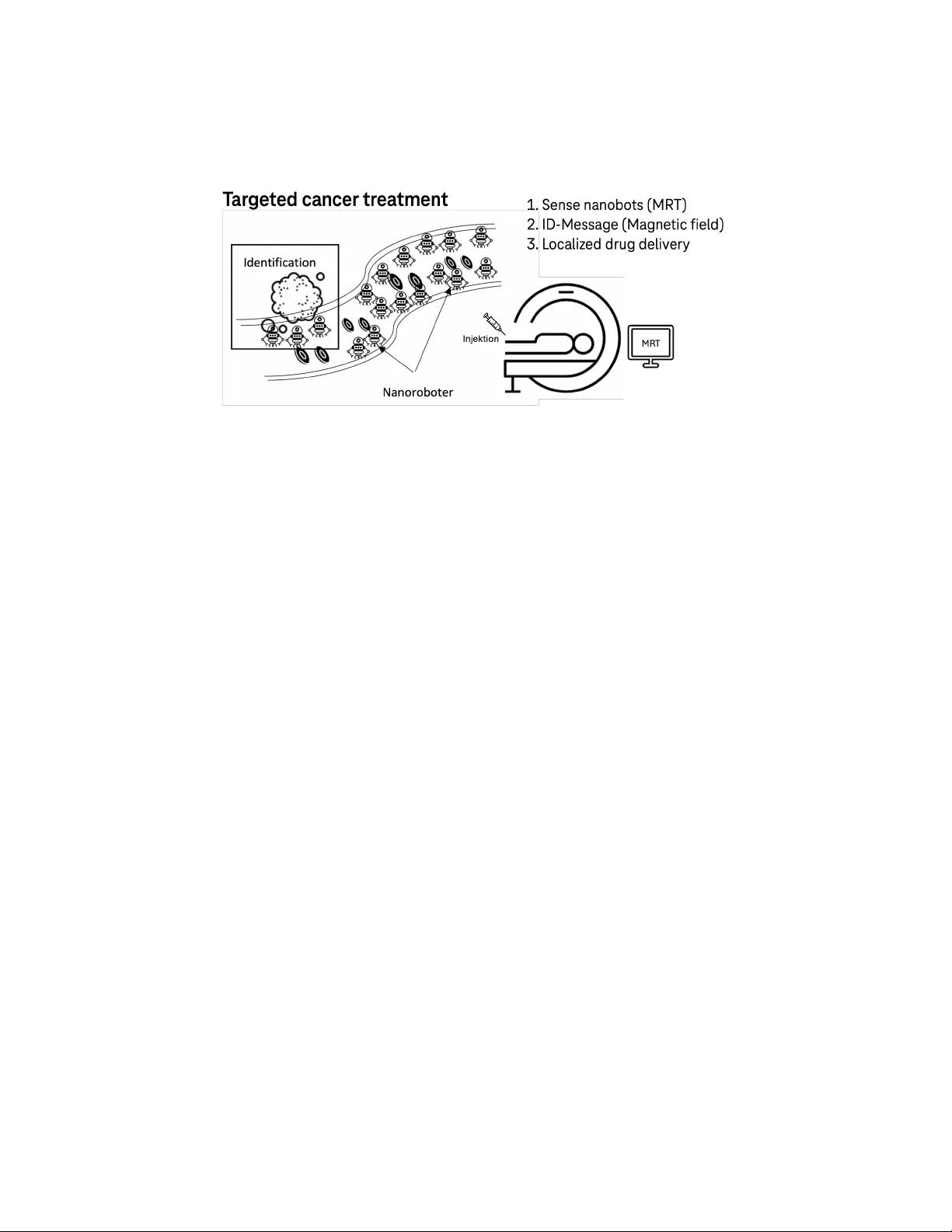
Join t Detection and Iden tification for Scalable Con trol of Nanorob ot Sw arms under Harsh Comm unication Constrain ts W afa Labidi 2 , Holger Bo c he 2 , 4 , Christian Depp e 1 , and Marc Geitz 3 1 T echnisc he Univ ersit¨ at Braunsch w eig, Germany 2 T echnical Univ ersit y of Munich, German y 3 T-Labs, Deutsche T elek om 4 Munic h Center for Quan tum Science and T echnology Abstract. The co ordination of large p opulations of highly constrained devices, suc h as micro- and nanoscale agen ts in biomedical applications, p oses fundamental challenges to classical communication paradigms. In scenarios suc h as targeted drug delivery , devices op erate under sev ere limitations in energy , size, and comm unication capabilities, while requir- ing precise and selective activ ation within spatially lo calized regions. In this work, w e prop ose the framew ork of Joint Detection and Iden tifi- cation (JDAI) as a system-level approach for scalable control under such constrain ts. The key idea is to shift from reliable message transmission to a con trol-oriented paradigm, in whic h devices locally decide whether a broadcast signal is relev ant. This enables implicit addressing and subset activ ation without the need for explicit per-device communication. W e demonstrate ho w message iden tification can be com bined with sens- ing. This enables the realization of a closed-lo op system that integrates detection, communication, and actuation. Using the example of targeted nanorob ot therapy , w e analyze the in terplay b etw een sensing resolution, comm unication constrain ts, and system dynamics. In particular, w e sho w that while identification exhibits fav orable asymptotic scaling, practical implemen tations are gov erned by finite blo c klength effects, noise, and latency . The prop osed framework complemen ts existing physical-la yer comm u- nication approaches, including molecular, electromagnetic, and acoustic tec hniques, b y providing a con trol-lay er abstraction for scalable subset selection. Ov erall, JDAI connects identification-theoretic principles with system-lev el design to control large, resource-limited en vironments. 1 In tro duction Emerging application domains such as large-scale Internet-of-Things (IoT) sys- tems, distributed autonomous agents, and in-b ody micro- and nanorob otics re- quire the coordination of massive p opulations of highly constrained devices [1, 2]. In man y such scenarios, individual devices are sev erely limited in terms of energy , computational capabilities, size, and communication bandwidth. As a 2 W afa Labidi, Holger Bo c he, Christian Depp e, and Marc Geitz consequence, classical communication paradigms based on explicit addressing and reliable message transmission b ecome increasingly inefficient, or even infea- sible, as the n umber of devices grows. This challenge is particularly pronounced in biomedical applications such as targeted drug delivery using micro- and nanoscale agents [3, 4]. In such en- vironmen ts, devices are often passively transp orted, for example through the blo odstream, and op erate under strict constraints on size and p o wer consump- tion. Communication b et w een an external con trol system and the devices ma y b e limited to low-rate broadcast mechanisms, for instance based on magnetic, acoustic, bio c hemical, or other highly constrained signaling mo dalities [5–9]. At the same time, precise con trol o v er subsets of devices is required, e.g., to acti- v ate therap eutic agents only within a spatially lo calized region such as a tumor site. This raises a fundamental question: ho w can a con trol system selectively activ ate relev ant subsets of devices without explicitly addressing each device individually? In many relev ant applications, it is not necessary that every individual de- vice reacts reliably . Instead, it is often sufficient that a subset of devices lo cated within a region of interest p erforms the desired action. The system no w fo cuses on reliably con trolling a subset of devices, not on deliv ering high-rate data to eac h one. This observ ation shifts the system ob jectiv e from reliable per-device comm unication to robust subset activ ation. Hence, the problem is not primarily one of high-rate data delivery , but of scalable control under extreme comm uni- cation constrain ts. A broad range of comm unication paradigms has b een proposed for nanoscale and in-b o dy systems, including molecular communication [5, 6], terahertz elec- tromagnetic communication [7], ultrasound-based links [8], and near-field mag- netic induction approaches [9]. These paradigms differ significan tly in terms of ac hiev able rates, propagation characteristics, and implementation complexity . Ho wev er, many of them fo cus primarily on physical-la y er data transmission and net working, while the problem of scalable control and selective activ ation under extreme comm unication constraints remains less explored. In this work, we show that message identification offers a new approach that is particularly well suited for such control problems. Identification via channels, in tro duced b y Ahlswede and Dueck [10], departs from the classical transmission paradigm b y fo cusing on the problem of deciding whether a specific message was sen t, rather than reconstructing it. A k ey result is that, under randomized encod- ing, the num ber of identification messages (also called identities) grows double- exp onen tially with the blo c klength, in contrast to the exp onen tial growth in classical transmission [10, 11]. While this scaling law is asymptotic and do es not directly translate into finite-blo c klength p erformance, it indicates a fundamen- tally differen t operating regime that is highly attractiv e for large-scale control systems. F rom a system p ersp ectiv e, identification enables receivers to lo cally decide whether a broadcast signal is relev ant. This naturally leads to a form of im- plicit addressing, where subsets of devices can b e selected without requiring the Join t Detection and Identification 3 comm unication to each device one b y one. In the scenarios considered here, an “iden tity”, that is an identification message, should therefore not b e in terpreted as the label of a single ph ysical device, but rather as a con trol instruction, for example sp ecifying a spatial region, a temp oral condition, and a desired action. Eac h device ev aluates the received signal based on lo cally av ailable information and p erforms a binary decision on whether the instruction is relev ant. In this sense, iden tification provides a natural control-orien ted abstraction for subset activ ation in large p opulations of simple agents. An additional imp ortan t asp ect is the role of shared randomness and feed- bac k. It is known that common randomness can enhance iden tification perfor- mance additively , and such randomness may in principle b e generated dynam- ically through in teraction, sensing, or feedback mec hanisms [12–15]. This ob- serv ation further strengthens the relev ance of message identification in settings where sensing and comm unication are tightly coupled. Building on these principles, w e prop ose the concept of Joint Dete ction and Identific ation (JDAI) as a system-lev el framework that in tegrates sensing and message identification. The key idea is to decouple the control pro cess into tw o tigh tly coupled stages: a sensing stage that identifies candidate regions of inter- est, and a communication stage that enables devices to lo cally decide whether to react to a broadcast signal. In this arc hitecture, the control system do es not explicitly address individual devices; instead, it detects where interv en tion is needed and then triggers appropriate actions in the relev an t subset of the p op- ulation through iden tification-based signaling. T o illustrate this concept, we consider a biomedical application scenario in whic h a large p opulation of micro- or nanoscale devices is deploy ed for targeted drug deliv ery in the human bo dy . In such a setting, sensing mechanisms suc h as magnetic resonance imaging (MRI) or related techniques pro vide coarse spa- tial information at a resolution that dep ends strongly on the sensing mo dalit y , acquisition time, and physical con trast mechanisms [16]. A t the same time, com- m unication ma y b e limited to extremely low-rate signals, for example based on lo w-frequency magnetic field mo dulation. Under these constrain ts, the con trol problem shifts from reliable message transmission to scalable subset selection. It is imp ortan t to emphasize that message identification do es not replace existing physical-la y er comm unication paradigms. Rather, it provides a com- plemen tary abstraction at the system level. In particular, the JD AI framew ork can b e interpreted as a con trol-la yer mechanism that operates alongside differ- en t ph ysical-lay er technologies, including molecular, electromagnetic, acoustic, or magnetic comm unication approaches. In this con text, molecular communication (MC) has b een iden tified as a key enabler for comm unication among nanoscale devices in biomedical environmen ts. F or an in tegration of MC in to future 6G systems, w e refer to [17]. A compre- hensiv e o v erview of MC technologies and their p otential for 6G applications is pro vided in [18, 19]. In con trast to classical communication paradigms, MC sys- tems are inherently constrained in terms of data rate, latency , and reliability . As a result, communication in such systems is often goal-oriented and even t-driven 4 W afa Labidi, Holger Bo c he, Christian Depp e, and Marc Geitz rather than based on the transmission of detailed messages. The p ost-Shannon comm unication paradigm considered in this pap er is therefore well aligned with the requirements of MC systems. In particular, identification-based comm unica- tion pro vides a natural abstraction for MC scenarios, where devices only need to decide whether a received signal is relev ant and whether to trigger a sp e- cific action. This is consistent with the en visioned integration of MC into future 6G systems, where efficient, lo w-complexity , and task-oriented comm unication mec hanisms are required. The goal of this pap er is not to provide a complete ph ysical realization of suc h a system, but to establish a conceptual and system-lev el framew ork that connects identification-theoretic principles with emerging application scenarios. More sp ecifically , we demonstrate ho w iden tification can b e interpreted as a mec hanism for selective activ ation, how it can be in tegrated with sensing, and ho w it enables scalable control in large p opulations of autonomous devices. F ur- thermore, we discuss k ey limitations arising from finite blo c klength, noise, la- tency , and physical-la yer constrain ts that must be addressed in practical imple- men tations. Recent adv ances in structured and practical identification co ding further indicate that such ideas are not only of theoretical interest, but ma y also serv e as useful building blo c ks in realistic systems [20–23]. The remainder of this pap er is organized as follows. Section 2 reviews the fundamen tals of iden tification via c hannels and highlights the key prop erties for scalable con trol of large device populations. Section 3 in tro duces the JD AI framew ork and its op erational principles. Section 4 presents a biomedical appli- cation scenario and illustrates the corresp onding system architecture. Section 5 discusses feasibilit y asp ects and system-lev el considerations. Finally , Section 6 concludes the pap er. 2 F undamen tals of Iden tification and Channel Mo del In this section, we review the concept of identification via channels and its fun- damen tal differences from classical transmission. The goal is to introduce the k ey definitions and results underlying the JD AI framework, while maintaining a clear system-orien ted interpretation. 2.1 F rom T ransmission to Identification The concept of iden tification via c hannels was in tro duced by Ahlsw ede and Duec k [10] and represents a fundamental departure from Shannon’s classical comm unication paradigm [24]. In the classical transmission setting, a sender enco des a message u ∈ M into a channel input sequence, and the receiv er aims to reliably reconstruct u from the c hannel output. The ob jectiv e is therefore accurate message recov ery . In contrast, identification considers a different task. The enco der selects an iden tity v ∈ N , while the deco der is not interested in reconstructing v itself. Instead, for a given query v ′ ∈ N , the deco der only decides whether v = v ′ Join t Detection and Identification 5 v Enc noisy c hannel W n Dec v ′ transmitted or not? Alice Bob x n ∈ X n y n ∈ Y n Fig. 1: Identification via channels. The encoder transmits an identit y v ov er a noisy channel, while the deco der ev aluates a query v ′ and decides whether v = v ′ . In contrast to classical transmission, the goal is not message reconstruction but a binary decision. or not. Thus, identification can b e interpreted as a family of binary hypothesis tests, one for eac h p ossible iden tity . A crucial asp ect is that the enco der do es not know the query v ′ at the receiv er. Therefore, the enco ding must enable reliable decisions for all p ossible queries based on a single c hannel output. Figure 1 illustrates this fundamental difference. F rom a system p erspective, this in terpretation aligns naturally with control problems: a receiv er ev aluates whether a broadcast signal is relev ant and decides lo cally whether to react. In the JD AI framework, iden tities correspond to control instructions rather than individual device lab els. 2.2 Channel Mo del W e consider a discrete memoryless c hannel (DMC) defined b y the triple ( X , Y , W ), where X and Y denote the input and output alphab ets and W ( y | x ) is the tran- sition probability [25]. F or sequences x n ∈ X n and y n ∈ Y n , the n -fold channel is giv en by W n ( y n | x n ) = n Y i =1 W ( y i | x i ) . (1) Random v ariables are denoted by upper-case letters and their realizations by lo wer-case letters. 2.3 T ransmission Co des A deterministic ( n, M , λ ) transmission co de consists of co dew ords u i ∈ X n and deco ding sets D i ⊂ Y n , and deco ding errors that satisfy W n ( D c i | u i ) ≤ λ, (2) D i ∩ D j = ∅ , (3) for all i, j = 1 , . . . , M with i = j and some λ ∈ (0 , 1). Randomized transmission codes replace eac h codeword b y a distribution ov er X n . How ever, randomization do es not increase the achiev able transmission rate. 6 W afa Labidi, Holger Bo c he, Christian Depp e, and Marc Geitz 2.4 Iden tification Codes A deterministic ( n, N , λ 1 , λ 2 ) identification co de is given b y co dew ords u i ∈ X n and deco ding sets D i ⊂ Y n , and with errors of the first and the second kind that satisfy W n ( D c i | u i ) ≤ λ 1 , (4) W n ( D j | u i ) ≤ λ 2 ( i = j ) , (5) for all i, j = 1 , . . . , N with i = j and some λ 1 + λ 2 < 1. In contrast to transmission co des, the deco ding sets are not required to b e disjoin t. A randomized identification co de is given by probability distributions Q ( ·| i ) o ver X n and deco ding sets D i ⊂ Y n , and with errors of the first and the second kind that satisfy X x n Q ( x n | i ) W n ( D c i | x n ) ≤ λ 1 , (6) X x n Q ( x n | j ) W n ( D i | x n ) ≤ λ 2 , (7) for all i, j = 1 , . . . , N with i = j and some λ 1 + λ 2 < 1. A k ey distinction from classical transmission is that randomization is essential to ac hieve optimal identification p erformance [10, 11]. 2.5 Capacit y Results Let W be a DMC. Let M ( n, δ ) b e the maximal num be r M ∈ N suc h that an ( n, M , δ ) transmission co de for W exists. Let N ( n, λ ) be the maximal n umber N ∈ N such that an identification co de ( n, N , λ, λ ) for W exists. Let C ( W ) b e the Shannon capacit y of W . Let C I D ( W ) b e the identification capacity of W . The classical c hannel co ding theorem [24] states that C ( W ) = lim n →∞ 1 n log M ( n, δ ) = max P X I ( X ; Y ) , for δ ∈ (0 , 1) . (8) In con trast, the identification co ding theorem [10, 11] shows that C ID ( W ) = lim n →∞ 1 n log log N ( n, λ ) = C ( W ) , for λ ∈ (0 , 1 / 2) . (9) Th us, identification enables a double-exp onen tial growth N ≈ 2 2 nC ( W ) . (10) Join t Detection and Identification 7 2.6 Key Prop erties and System Implications The iden tification paradigm exhibits several distinctiv e prop erties particularly relev an t for large-scale systems. Double-Exp onen tial Scaling: Identification allows selecting among ex- tremely large sets of p ossible actions or device subsets using very limited com- m unication resources. This behavior extends beyond DMCs to Poisson, Gaussian and MIMO c hannels [26, 27]. Role of Common Randomness: Common randomness b etw een sender and receiver increases the identification capacit y additively [12]. Such random- ness can b e generated via feedback or sensing mechanisms [13, 28]. F eedback and In teraction: F eedback can serve not only to improv e relia- bilit y but also as a resource for generating shared randomness, thereb y enhancing iden tification p erformance [14, 29, 15, 30, 31]. Con trol-Oriented Interpretation: In the JDAI framework, identification pro vides a mechanism for subset selection. Each device p erforms a lo cal binary decision (“Is this message in tended for me?”), which directly maps to a control action. This interpretation is essen tial for scalable control under communication constrain ts. Practical Implemen tations: Although identification theory is asymptotic, sev eral practical constructions hav e b een proposed, including structured co des suc h as Reed–Solomon and Reed–Muller co des, as w ell as combinatorial designs and pseudo-random implementations [20–23, 32]. These approac hes demonstrate that message identification paradigms can b e realized under finite blo c klength, hardw are, and latency constraints. Ov erall, these prop erties indicate that message identification is particularly w ell suited for scenarios in v olving massiv e n umbers of devices and stringen t com- m unication constraints, where classical transmission-based approaches become inefficien t or infeasible. 3 Join t Detection and Identification F ramework In this section, w e present the prop osed Joint Dete ction and Identific ation (JDAI) framew ork. The ob jective is to enable scalable monitoring and control of large p opulations of autonomous devices under severe communication constraints by tigh tly integrating sensing with message identification. In contrast to classical communication arc hitectures, whic h rely on explicit addressing and reliable message transmission, the JD AI framew ork adopts a fundamen tally different paradigm: sensing is used to determine wher e actions are required, while message identification determines which devic es should react. This decoupling is k ey to enabling scalable con trol in systems with massiv e n umbers of devices. 8 W afa Labidi, Holger Bo c he, Christian Depp e, and Marc Geitz Fig. 2: Illustration of the JDAI framew ork. A large p opulation of autonomous devices op erates in a global space. The control system p erforms joint detection to iden tify regions of in terest and broadcasts identification-based con trol signals. Although all devices receiv e the same signal, only a subset—determined by the iden tification mechanism—executes the corresp onding action. 3.1 System Overview W e consider a system consisting of a large p opulation of autonomous devices (e.g., sensors, rob ots, or nanomachines) op erating in a shared environmen t, re- ferred to as the glob al sp ac e . Within this space, we distinguish lo cal r e gions of inter est in which sp ecific actions should b e triggered. An external con trol system in teracts with the device p opulation via tw o com- plemen tary mechanisms: – Join t detection (sensing): The control s ystem observ es the global state and iden tifies regions in which relev ant devices are present. – Message identification: The con trol system broadcasts short signals that enable devices to lo cally decide whether to react. The ov erall architecture is illustrated in Fig. 2. The key principle is that sensing and communication are tightly coupled: sensing determines when and where communication is required, while identification determines which devices should react. 3.2 Autonomous Devices The system comprises a very large num b er of devices that are designed to p er- form simple, sp ecialized tasks. Due to strict constraints on size, energy con- sumption, and hardware complexit y , these devices typically ha ve only limited capabilities [1, 2]. Join t Detection and Identification 9 In particular, devices ma y: – ha ve only low-rate reception capabilities, – lac k contin uous bidirectional communication, – p ossess limited computational resources, – op erate passively (e.g., transp orted by environmen tal dynamics). Eac h device is equipp ed with a receiver that allows it to pro cess broadcast signals and p erform identification-based deco ding. Based on this deco ding, the device decides whether a receiv ed message is relev ant and whether a correspond- ing action should b e executed. Imp ortan tly , the n umber of devices is assumed to b e sufficiently large suc h that classical addressing and individual con trol b ecome infeasible. 3.3 Join t Detection via Sensing The control system is assumed to ha ve access to sensing mec hanisms that pro vide information ab out the global state of the system. Dep ending on the application, these mechanisms may include electromagnetic, acoustic, optical, or biomedical sensing tec hnologies [5, 6, 8, 9, 16]. The purp ose of sensing is not to track each individual device precisely , but to detect the presence of devices in regions of in terest. This constitutes the joint dete ction comp onen t of the framew ork, as it op erates on the en tire p opulation rather than on individual devices. More precisely , sensing provides a mapping from the global state to a set of candidate regions in which devices are likely to b e present. This information allo ws the control system to determine when it is b eneficial to initiate commu- nication. In man y practical systems, sensing and communication are tigh tly coupled. F or example, feedback signals or en vironmen tal observ ations can b e used to gen- erate common randomness, which in turn improv es identification performance [13–15, 29–31]. 3.4 Message Identification Once a relev ant region has b een detected, the con trol system broadcasts a con trol signal enco ded using identification co des [33, 32, 34–36]. Each device p erforms a lo cal decision of the form: “Is this message in tended for me?” Based on this decision, the device either executes a predefined action or remains inactiv e. A key adv an tage of this approac h is that communication does not require explicit addressing of individual devices. Instead, identification co des allo w the con trol system to implicitly select subsets of devices using short broadcast mes- sages, ev en when the num b er of devices is extremely large. The in terpretation of identification messages is inherently probabilistic, giv- ing rise to t wo types of errors: 10 W afa Labidi, Holger Bo c he, Christian Depp e, and Marc Geitz – Missed activ ation (error of the first kind), – F alse activ ation (error of the second kind). System design m ust ensure that b oth error probabilities remain within ac- ceptable limits for the giv en application. 3.5 Execution of Actions If a device identifies a receiv ed message as relev an t, it executes a corresp onding action. The nature of this action depends on the application and ma y include sensing, actuation, data collection, or release of a substance. Imp ortan tly , successful system operation does not require that all in tended devices react. In many scenarios, it is sufficient that at least one or a subset of devices within a region performs the desired action. This inherent redundancy significan tly increases system robustness. 3.6 Design Principles and Implications The JD AI framework induces several key design principles: Separation of Sensing and Comm unication: Sensing identifies where actions are needed, while comm unication selects which devices should act. Broadcast-Based Control: All devices receive the same signal, but only a subset reacts based on iden tification. Scalabilit y: Due to the prop erties of identification co ding, the communica- tion o verhead grows only weakly with the num b er of devices. Robustness through Redundancy: System reliabilit y is ac hieved through the collective b eha vior of many devices rather than precise control of individual units. T echnology-Agnostic In tegration: The framework is compatible with a wide range of ph ysical-lay er comm unication paradigms, including molecular, electromagnetic, acoustic, and magnetic comm unication systems [5–9]. Ov erall, the JD AI framework provides a system-lev el framework for con- trolling large p opulations of autonomous devices under severe communication constrain ts. It complements existing comm unication paradigms by introducing a con trol-oriented p ersp ectiv e based on identification. 4 Biomedical Application: T argeted Nanorob ot Therapy T o illustrate the p oten tial of the proposed JDAI framework, we consider a biomedical application in whic h a large population of micro- or nanoscale devices is deploy ed within the human bo dy for targeted drug deliv ery . This scenario high- ligh ts how the combination of sensing and message iden tification enables precise and scalable con trol under extremely constrained communication conditions. In the considered setting, a large num ber of nanorob ots is injected into the blo odstream of a patient and transp orted through the v ascular system, whic h Join t Detection and Identification 11 Fig. 3: Illustration of targeted nanorob ot therapy using the JD AI framework. Nanorob ots are injected into the blo odstream and transp orted through the v as- cular system. An external control system p erforms sensing (e.g., MRI) to detect regions of interest (e.g., tumor sites) and broadcasts identification-based signals to selectiv ely activ ate a subset of devices. forms the glob al sp ac e . A pathological region of in terest, such as a tumor, defines a lo calized target region in which a therapeutic action should be triggered. T o ensure that a sufficient n umber of devices reaches this region with high proba- bilit y , a large p opulation—potentially on the order of 10 5 devices or more—is deplo yed. Due to strict constraints on size, energy , and hardw are complexity , these nanorob ots t ypically do not actively na vigate but are instead transp orted passiv ely by the blo o d flow [4, 3]. An external control system, for example based on magnetic resonance imag- ing (MRI), p erforms b oth sensing and communication. In a first step, the system estimates the spatial distribution of nanorobots within the b o dy . Conv entional MRI cannot resolv e the nanorob ots, as its resolution is limited by the wa velength, which is far too large for nanometer-scale ma- c hines. Therefore, a Small-Scale Magneto-Oscillatory (SMOL) device—a Radio F requency (RF) sender integrated into the rob ot can b e used. One drawbac k of this solution is the size of the RF sender, which is t ypically in the millimeter range, exceeding practical limits. How ev er, MRI, do es not detect ob jects based on size alone, but rather through the RF resp onse of spins in a static gradi- en t magnetic field. The external RF is used to excite the spins, creating an RF resp onse signal, detectable b y MRI. Different tissues pro duce differen t RF re- sp onses, resulting in differen t measurements. Spatial resolution is significantly impro ved, as it is defined by the gradient magnetic field and the RF resonance of b o dy molecules within a longitudinal slice. Based on this principle, an alter- nativ e approach is to design the nanorob ots such that they exhibit tissue-like or otherwise distinguishable resonance prop erties. By arranging the gradient mag- netic field appropriately , the rob ots are detectable only when they come to the resonan t zone (within a sp ecific zone near the tumor). They would remain in- 12 W afa Labidi, Holger Bo c he, Christian Depp e, and Marc Geitz visible most of the time, but when entering the resonant zone, they would emit RF signals detectable by MRI. This approach would allow selective detection of the nanorob ots without requiring integrated RF senders. In a second step, it transmits identification-based con trol signals that selectively activ ate those devices located in the region of interest. This t wo-stage pro cess directly reflects the JDAI principle of separating detection and control while k eeping them tightly coupled. Eac h nanorob ot can b e mo deled as a minimal autonomous unit with highly constrained resources. It comprises a receiving structure, for instance based on magnetic induction, that enables the detection of externally generated signals. A light weigh t pro cessing unit p erforms identification-based deco ding, supp orted b y a small memory mo dule that stores pre-shared randomness. In addition, the device includes an actuation mec hanism, such as a con trolled drug release system, and op erates under a severely limited energy budget, potentially supp orted by energy harv esting mechanisms. Comm unication is realized via low-frequency or quasi-static magnetic fields generated b y the external control system. This design choice is motiv ated by the strong attenuation of high-frequency electromagnetic signals in biological tissue, w hic h makes conv entional wireless communication infeasible in such en- vironmen ts [9]. As a result, the ac hiev able comm unication rates are extremely limited, which further motiv ates the use of identification-based signaling rather than classical transmission-based approac hes. The sensing functionality is integrated into the external system, for example through MRI-based techniqu es [16]. The sensing pro cess excites the nanorob ots using an external magnetic field, after whic h the devices exhibit c haracteristic resp onses that can b e measured and pro cessed to infer their spatial distribution. By exploiting differences in resonance behavior or induced signals, it becomes p ossible to iden tify regions in whic h nanorobots are present with sufficien tly high probabilit y . Imp ortan tly , the ob jective is not to trac k eac h individual device pre- cisely , but rather to detect the presence of devices in regions of in terest. This corresp onds directly to the join t detection comp onen t of the JDAI framework. The achiev able spatial resolution dep ends on factors such as signal-to-noise ra- tio, acquisition time, and the physical properties of the sensing mo dalit y , which in tro duces a fundamen tal trade-off b et ween sensing accuracy and latency . A key challenge in the considered system is the sensing problem itself. Due to fundamental physical limitations, individual nanorob ots cannot b e directly resolv ed by imaging modalities such as MRI. Instead, detection relies on indirect mec hanisms, such as collective effects or engineered resonance prop erties of the devices. As a result, sensing provides only coarse and probabilistic information ab out the spatial distribution of the devices. This uncertaint y directly impacts the p erformance of the JD AI framework, as it affects b oth the identification stage and the reliabilit y of control decisions. Once the control system detects that nanorobots are present in the target region, it initiates comm unication by broadcasting an iden tification message. The communication is implemented via magnetic field mo dulation, where the Join t Detection and Identification 13 induced v oltage at a nanorob ot can b e approximated as U = A · dB dt , (11) with A denoting the effectiv e receiving area. Each nanorob ot ev aluates the re- ceiv ed signal using its lo cally stored randomness and p erforms a binary iden- tification test. If the message is relev ant, the device activ ates its drug release mec hanism; otherwise, it remains inactive. A central adv an tage of message identification lies in its fa vorable scaling b e- ha vior. While classical transmission sc hemes require communication resources that gro w logarithmically with the num b er of p ossible messages, iden tification allo ws a double-logarithmic scaling. F or example, for a system with 10 6 p ossible iden tities, the corresp onding identification rate scales as log log(10 6 ) ≈ 1 . 7 bits. This v alue should b e in terpreted as an information-theoretic indicator rather than a direct finite-blo c klength requirement, since practical implemen tations m ust accoun t for noise, reliabilit y constrain ts, and co ding o v erhead. Nev erthe- less, it illustrates that even extremely low-rate comm unication—suc h as mag- netic field mo dulation at a few Hertz—can enable timely control actions. The o v erall operational w orkflow can be describ ed as a closed-lo op pro cess in which sensing and communication are tightly in tegrated. After deploymen t of the nanorob ots, the control system contin uously monitors their spatial distribu- tion, detects regions of interest, and subsequen tly triggers identification-based con trol signals. The activ ated nanorob ots then execute the desired action, suc h as releasing a therap eutic agent. This reflects the key idea of JDAI; sensing de- termines when and where to act, while identification determines whic h devices should act. The presented application highlights several imp ortan t asp ects of the JDAI framew ork. First, it demonstrates that message iden tification enables scalable con trol of extremely large device p opulations under sev ere comm unication con- strain ts. Second, it sho ws that system robustness can be ac hieved through re- dundancy , since successful op eration do es not dep end on the precise behavior of individual devices but rather on the collectiv e resp onse of many agents. Third, it indicates that the framew ork is compatible with curren t tec hnological de- v elopments, including MRI-based sensing, magnetic field communication, and adv ances in nanotechnology [4, 3]. A t the same time, the example remains in ten tionally simplified and p oin ts to several imp ortan t extensions. In realistic scenarios, the state of the system is t ypically con tinuous-v alued, for example in terms of spatial p osition or velocity , and the communication channel is b etter mo deled by Gaussian or fading chan- nel mo dels. Moreov er, interactions b et ween multiple devices may lead to inter- ference effects that require multiuser communication mo dels. Finally , practical implemen tations must account for finite blo cklength constraints and latency re- quiremen ts, which pla y a crucial role in real-time biomedical applications. These asp ects motiv ate future work on extending the JDAI framework to more re- alistic comm unication and sensing mo dels while preserving its scalability and con trol-oriented structure. 14 W afa Labidi, Holger Bo c he, Christian Depp e, and Marc Geitz 5 F easibilit y and T ec hnical Considerations In this section, w e discuss the feasibility of the prop osed JD AI framework in ligh t of current technological capabilities. While a complete end-to-end realization of suc h a system is not y et av ailable, man y of its individual comp onen ts ha ve already been demonstrated in isolation. The main challenge therefore lies not in the absence of enabling tec hnologies, but in their integration in to a coherent and highly constrained system arc hitecture. F rom an information-theoretic persp ective, identification co ding has b een extensiv ely studied and is w ell understo od in terms of its asymptotic p erformance limits [10, 11]. More recently , practical constructions based on structured co des and pseudo-random implemen tations hav e b een developed, demonstrating that message iden tification can b e realized under realistic constrain ts such as finite blo c klength, limited computational resources, and hardw are imp erfections [20– 23, 32]. These developmen ts indicate that identification co ding is not merely of theoretical interest, but can serve as a practical building block in real-world systems. On the sensing side, technologies capable of detecting w eak signals with high spatial resolution are already widely a v ailable. In particular, magnetic resonance imaging (MRI) systems are able to generate controlled magnetic fields and mea- sure v ery small magnetic resp onses with high sensitivity [16]. Such systems nat- urally provide b oth the sensing and actuation capabilities required for the JDAI framew ork. In addition, other sensing modalities, including acoustic, optical, and bio c hemical metho ds, hav e b een studied extensively in the context of nanoscale and in-b ody communication systems [5, 6, 8, 7]. This suggests that the sensing comp onen t of JD AI can be implemen ted using a v ariety of ph ysical platforms, dep ending on the application. A t the level of nanoscale devices, significan t progress has b een made in mic ro- and nanotec hnology , including the developmen t of micro-scale sensors, simple pro cessing units, and energy harvesting mechanisms [4, 3]. Individual comp o- nen ts such as signal receivers, basic logic circuits, and actuation mec hanisms ha ve already b een demonstrated. Ho wev er, the integration of all these compo- nen ts in to a single nanoscale device remains a ma jor engineering challenge. In particular, constrain ts on size, energy consumption, and bio compatibilit y impose strict limitations on system design. Energy a v ailabilit y constitutes one of the most critical constrain ts. Nanorob ots m ust op erate under extremely limited energy budgets, whic h restricts both sens- ing and comm unication capabilities. This limitation reinforces the relev ance of message identification, since it minimizes the required communication ov erhead while still enabling effective control. A t the same time, it necessitates highly efficien t implementations of deco ding algorithms and p ossibly the use of energy harv esting techniques. Another imp ortan t asp ect concerns the reliabilit y of identification-based de- cisions. By design, identification allows for probabilistic errors of the first and second kind. In safet y-critical applications such as targeted drug delivery , these errors must b e carefully controlled. Ho wev er, the JDAI framew ork inherently Join t Detection and Identification 15 pro vides robustness through redundancy , since successful op eration does not rely on the correct b eha vior of individual devices but rather on the collective re- sp onse of many devices within a region of in terest. This system-lev el redundancy can b e exploited to mitigate the impact of individual deco ding errors. F rom a system p ersp ectiv e, several additional c hallenges arise. The interac- tion b et ween sensing and communication in tro duces timing constraints, since dela ys in sensing or actuation may affect system p erformance. F or example, the mo vemen t of nanorob ots due to blo o d flow implies that the spatial distribu- tion of devices may change b et ween sensing and actuation, which must b e tak en in to accoun t when designing con trol strategies. F urthermore, sync hronization b e- t ween sensing and comm unication phases is required to ensure consisten t system b eha vior. Another key challenge is scalability . While identification co ding pro vides fa- v orable scaling prop erties from an information-theoretic p erspective, practical implemen tations m ust ensure that sensing, signal pro cessing, and control mec h- anisms can handle large p opulations of devices in real time. This includes efficien t pro cessing of sensing data and the design of identification signals that remain robust under realistic noise and in terference conditions. Bio compatibilit y and safety considerations are also of central imp ortance in biomedical applications. All comp onen ts of the system, including nanorob ots and externally applied fields, must satisfy strict safet y constraints. In particular, the strength and frequency of electromagnetic or magnetic fields must remain within medically acceptable limits, and the materials used for nanorob ots must b e bio compatible. Finally , it is imp ortan t to emphasize that the JDAI framework do es not de- p end on a sp ecific tec hnology and can b e extended b eyond the specific biomedical scenario considered in this pap er. The same principles apply to other large-scale systems, including Internet-of-Things (IoT) netw orks, distributed sensor sys- tems, and autonomous rob otic sw arms. In all these scenarios, the com bination of sensing and message identification provides a promising approach to scalable con trol under communication constraints. Ov erall, the JDAI framew ork is feasible since its k ey components—iden tification co ding, sensing technologies, and nanoscale devices—are already av ailable or un- der activ e dev elopment. The main open challenge lies in their integration into a unified system that satisfies the strict constrain ts of real-w orld applications. F rom b oth an engineering and an information-theoretic p erspective, the pre- sen ted results indicate that suc h in tegration is c hallenging but ac hiev able, and that message identification can pla y a central role in enabling future large-scale con trol systems. 6 Conclusion In this pap er, we introduced the concept of Join t Detection and Identification (JD AI) as a framework for the scalable monitoring and control of large p opula- tions of autonomous devices under severe communication constraints. The key 16 W afa Labidi, Holger Bo c he, Christian Depp e, and Marc Geitz idea is to combine sensing-based detection with message identification, thereby replacing classical individual addressing by a broadcast paradigm in which only selected subsets of devices react. The theory of iden tification [10, 11], differs fundamentally from classical trans- mission. In particular, the double-exp onen tial scaling of iden tification messages enables efficien t selection among extremely large sets of possible actions, even when the underlying communication channel is highly constrained. This makes iden tification particularly attractiv e for emerging applications with limited re- sources and a large n umber of devices. F rom a system p ersp ectiv e, we show ed that identification can b e interpreted as a mechanism for subset selection, where devices lo cally decide whether a broadcast signal is relev an t. This interpretation allo ws the integration of identi- fication into con trol-oriented architectures and pro vides a natural bridge b etw een information-theoretic principles and practical system design. Based on these insights, we prop osed the JDAI framework, which decou- ples the control pro cess into t wo tightly coupled comp onen ts: a sensing stage that iden tifies regions of in terest, and a communication stage that enables de- vices to locally decide whether to act. This arc hitecture a voids the need for explicit addressing and enables scalable control in large p opulations of simple and resource-constrained devices. W e illustrated the prop osed framew ork using a biomedical application sce- nario in volving nanorob ots for targeted drug delivery . In this setting, sensing mec hanisms suc h as MRI pro vide coarse spatial information, while message iden- tification enables selective activ ation of devices under extremely limited commu- nication rates. The example demonstrates how the JDAI principle can b e realized in a physically constrained en vironment and highligh ts its p oten tial for practical applications. F urthermore, we discussed feasibilit y asp ects and sho wed that the key comp o- nen ts of the framework—iden tification coding, sensing technologies, and nanoscale devices—are already a v ailable or under active developmen t. While significant c hallenges remain, particularly in terms of system in tegration, energy constraints, and reliability , the presented results indicate that JDAI pro vides a promising and realistic approac h to scalable control in future systems. Sev eral directions for future work arise naturally from this study . On the theoretical side, extending the framework to con tinuous-v alued state spaces and Gaussian channel models is of particular in terest. In addition, multiuser settings and interference-limited scenarios require further inv estigation to understand the impact of interactions b et ween devices. F rom a practical p erspective, finite blo c klength constraints, latency requirements, and hardware limitations must b e incorp orated in to the design of message identification schemes. Finally , the in tegration of sensing, communication, and actuation into unified system archi- tectures remains a cen tral challenge that calls for interdisciplinary research. Ov erall, the JDAI framew ork highlights a shift in p ersp ectiv e: rather than transmitting detailed information to each device, control is done through global observ ation and minimal, iden tification-based signaling. This paradigm is partic- Join t Detection and Identification 17 ularly well suited for emerging large-scale systems, including biomedical appli- cations, In ternet-of-Things netw orks, and distributed autonomous systems. This op ens new directions for the design of communication and control architectures under extreme constrain ts. Ac kno wledgment The authors gratefully ackno wledge the financial supp ort of the F ederal Min- istry of Research, T echnology and Space of Germany (BMFTR) within the pro- gramme “Souv er¨ an. Digital. V ernetzt.”, joint pro ject 6G-life (gran t num b ers 16KIS2414 and 16KIS2415). This w ork was further supported b y the BMFTR Quan tum Programme, including the pro jects QUIET (grants 16KISQ093 and 16KISQ0170), QD-CamNetz (gran ts 16KISQ077 and 16KISQ169), and QST ARS (gran ts 16KIS2611 and 16KIS2602). Additional supp ort was provided by the German Research F oundation (DFG) within the pro ject “Post-Shannon The- ory and Implementation” (grants DE1915/2-1 and BO 1734/38-1). The authors also ackno wledge financial supp ort from the F ederal Ministry of Education and Researc h of Germany (BMBF) within the pro ject Internet of Bio-Nano-Things (IoBNT) under gran t num b er 5310223. References 1. Ian F. Akyildiz, F ernando Brunetti, and Cristina Bl´ azquez. Nanonetw orks: A new comm unication paradigm. Computer Networks , 52(12):2260–2279, 2008. 2. Ian F. Akyildiz and Josep Miquel Jornet. The internet of nano-things. IEEE Wir eless Communic ations , 17(6):58–63, 2010. 3. Sylv ain Martel. Magnetic micro- and nanorob otics in medicine. Annual R eview of Biome dic al Engine ering , 14:15–38, 2012. 4. Metin Sitti. Miniature devices: V o yage of the microrob ots. Natur e , 458(7242):1121– 1122, 2009. 5. Nils F arsad, H. Birk an Yilmaz, Andrew W. Ec kford, Chan-By oung Chae, and W eisi Guo. A comprehensive survey of recen t adv ancemen ts in molecular comm unication. IEEE Communications Surveys & T utorials , 18(3):1887–1919, 2016. 6. T adashi Nak ano, Andrew W. Eckford, and T okuko Haraguchi. Molecular commu- nication. Cambridge University Press , 2013. 7. Ian F. Akyildiz and Josep Miquel Jornet. The internet of nano-things and appli- cations. Computer Networks , 61:266–278, 2014. 8. W eisi Guo, Nils F arsad, and Andrew W. Ec kford. Ultrasonic communication for biomedical applications. IEEE T r ansactions on Communic ations , 66(9):4070–4083, 2018. 9. Zhi Sun and Ian F. Akyildiz. Magnetic induction communications for wireless underground sensor netw orks. IEEE T r ansactions on Antennas and Prop agation , 58(7):2426–2435, 2010. 10. Rudolf Ahlswede and Gunter Dueck. Iden tification via channels. IEEE T r ansac- tions on Information The ory , 35(1):15–29, 1989. 11. T e Sun Han. Information-Sp e ctrum Metho ds in Information The ory . Springer, 2003. 18 W afa Labidi, Holger Bo c he, Christian Depp e, and Marc Geitz 12. Rudolf Ahlswede. General theory of information transfer: Up dated. Discr ete Ap- plie d Mathematics , 156(9):1348–1388, 2008. 13. Rami Ezzine, W afa Labidi, Holger Bo c he, and Christian Deppe. Common ran- domness generation and identification o ver gaussian c hannels. In GLOBECOM 2020-2020 IEEE Glob al Communic ations Confer enc e , pages 1–6. IEEE, 2020. 14. Moritz Wiese, W afa Labidi, Christian Depp e, and Holger Boche. Iden tification o ver additive noise c hannels in the presence of feedback. IEEE T r ansactions on Information Theory , 69(11):6811–6821, 2022. 15. W afa Labidi, Y aning Zhao, Christian Deppe, and Holger Bo che. Join t identification and sensing for discrete memoryless channels. Entr opy , 27(1):12, 2025. 16. Bernhard Gleich and J ¨ urgen W eizeneck er. T omographic imaging using the nonlin- ear resp onse of magnetic particles. Natur e , 435(7046):1214–1217, 2005. 17. W olfgang Haselmayr, Andreas Springer, Georg Fischer, Christoph Alexiou, Holger Bo c he, and Peter A. Hoeher. In tegration of molecular communications into future generation wireless netw orks. In Pr o c. 6G Wir eless Summit (6GWS) , pages 1–2, 2019. 18. Alexander Bienau, Holger Bo c he, Christian Depp e, F rank H. P . Fitzek, Patric k Hofmann, W olfgang Kellerer, W afa Labidi, Andreas Rich ter, F riedrich C. Simmel, Armin Wietfeld, Rui Zheng, and Peng Zhou. Molecular communication for 6g net- w orks. In F rank H. P . Fitzek, Holger Bo c he, W olfgang Kellerer, and P atric k Seeling, editors, 6G-life: Unveiling the F utur e of T echnolo gic al Sover eignty, Sustainability and T rustworthiness . Academic Press, 2026. 19. Philipp Sc hw entec k, Giang T. Nguyen, Holger Bo che, W olfgang Kellerer, and F rank H. P . Fitzek. 6g p erspective of mobile netw ork op erators, manufacturers, and v erticals. IEEE Networking L etters , 5(3):169–172, 2023. 20. Rob erto F errara, Luis T orres-Figueroa, Holger Boche, Christian Deppe, W afa Labidi, J. Ullrich M¨ onic h, and Vlad-Costin Andrei. Implementation and exp eri- men tal ev aluation of reed-solomon identification. In Eur op e an Wir eless 2022; 27th Eur op e an Wir eless Confer enc e , pages 1–6, 2022. 21. Caspar v on Lengerke, Juan A. Cabrera, and F rank H. P . Fitzek. Identification co des for increased reliability in digital twin applications ov er noisy channels. In 2023 IEEE International Confer enc e on Metaverse Computing, Networking and Applic ations (MetaCom) , pages 550–557, 2023. 22. Caspar von Lengerke, Juan A. Cabrera, Martin Reisslein, and F rank H. P . Fitzek. Co des for identification via channels: T utorial for communications generalists. IEEE Communications Surveys & T utorials , 2025. 23. Alb erto G. Perotti, F redrik Berggren, and Branislav M. Popovi ´ c. Identification co des for w ake-up signals. In ICC 2024 – IEEE International Confer enc e on Com- munic ations , pages 3839–3844, 2024. 24. Claude Elwoo d Shannon. A mathematical theory of communication. The Bel l system technic al journal , 27(3):379–423, 1948. 25. Thomas M. Cov er and Joy A. Thomas. Elements of Information The ory . Wiley- In terscience, Hob oken, NJ, 2 edition, 2006. 26. W afa Labidi, Christian Depp e, and Holger Bo c he. Identification for multi-an tenna gaussian channels. In WSA 2021; 25th International ITG Workshop on Smart Antennas , pages 1–6. VDE, 2021. 27. W. Labidi, C. Deppe, and H. Bo c he. Information-theoretical analysis of even t- triggered molecular communication. In Europ e an Wir eless 2024 , September 2024. 28. R. Ezzine, W. Labidi, C. Depp e, and H. Bo c he. Optimal signal pro cessing for common randomness generation ov er mimo gaussian channels with applications Join t Detection and Identification 19 in iden tification. In C. Depp e, A. Win ter, R. W. Y eung, H. Bo che, I. Alth¨ ofer, J. Sto ye, U. T amm, and R. Ezzine, editors, Information The ory and R elate d Fields: Essays in Memory of Ning Cai , volume 14620 of L e ctur e Notes in Computer Sci- enc e , pages 365–393. Springer, Cham, 2025. 29. W afa Labidi, Holger Bo c he, Christian Depp e, and Moritz Wiese. Iden tification o ver the gaussian channel in the presence of feedback. In 2021 IEEE International Symp osium on Information The ory (ISIT) , pages 278–283, 2021. 30. Y. Zhao, W. Labidi, H. Bo c he, E. Jorswieck, and C. Depp e. An achiev able rate- distortion region of joint iden tification and sensing for multiple access channels. In GLOBECOM 2024 - 2024 IEEE Glob al Communic ations Confer enc e, Cap e T own , 2024. accepted. 31. Y aning Zhao, W afa Labidi, Holger Boche, Eduard Jorswiec k, and Christian Depp e. Iden tification via gaussian multiple access channels in the presence of feedback. In 2024 IEEE Information The ory Workshop (ITW) , pages 783–788, 2024. 32. Sergio V erd ´ u and V. K. W ei. Explicit construction of optimal constant-w eight co des for identification via c hannels. IEEE T ransactions on Information Theory , 39(1):30–36, 1993. 33. R. Ahlsw ede and G. Duec k. Iden tification in the Presence of F eedbac k-A Discov ery of New Capacity F orm ulas. IEEE T r ansactions on Information The ory , 35(1):30– 36, Jan 1989. 34. M. Spandri, R. F errara, C. Depp e, M. Wiese, and H. Bo c he. Information- theoretically secret reed-muller identification with affine designs. In Eur op e an Wir eless 2023 . IEEE, 2023. 35. K. Kurosa wa and T. Y oshida. Strongly Universal Hashing and Iden tification Co des via Channels. IEEE T r ansactions on Information The ory , 45(6):2091–2095, 1999. 36. On ur G ¨ unl ¨ u, J¨ org Kliewer, Rafael F. Schaefer, and Vladimir Sidorenk o. Doubly- exp onen tial identification via channels: Co de constructions and b ounds. In 2021 IEEE International Symp osium on Information The ory (ISIT) , pages 1147–1152, 2021.
Original Paper
Loading high-quality paper...
Comments & Academic Discussion
Loading comments...
Leave a Comment