A Multi-Agent Rhizomatic Pipeline for Non-Linear Literature Analysis
Systematic literature reviews in the social sciences overwhelmingly follow arborescent logics -- hierarchical keyword filtering, linear screening, and taxonomic classification -- that suppress the lateral connections, ruptures, and emergent patterns …
Authors: Julio C. Serrano. Joonas Kevari, Rumy Narayan
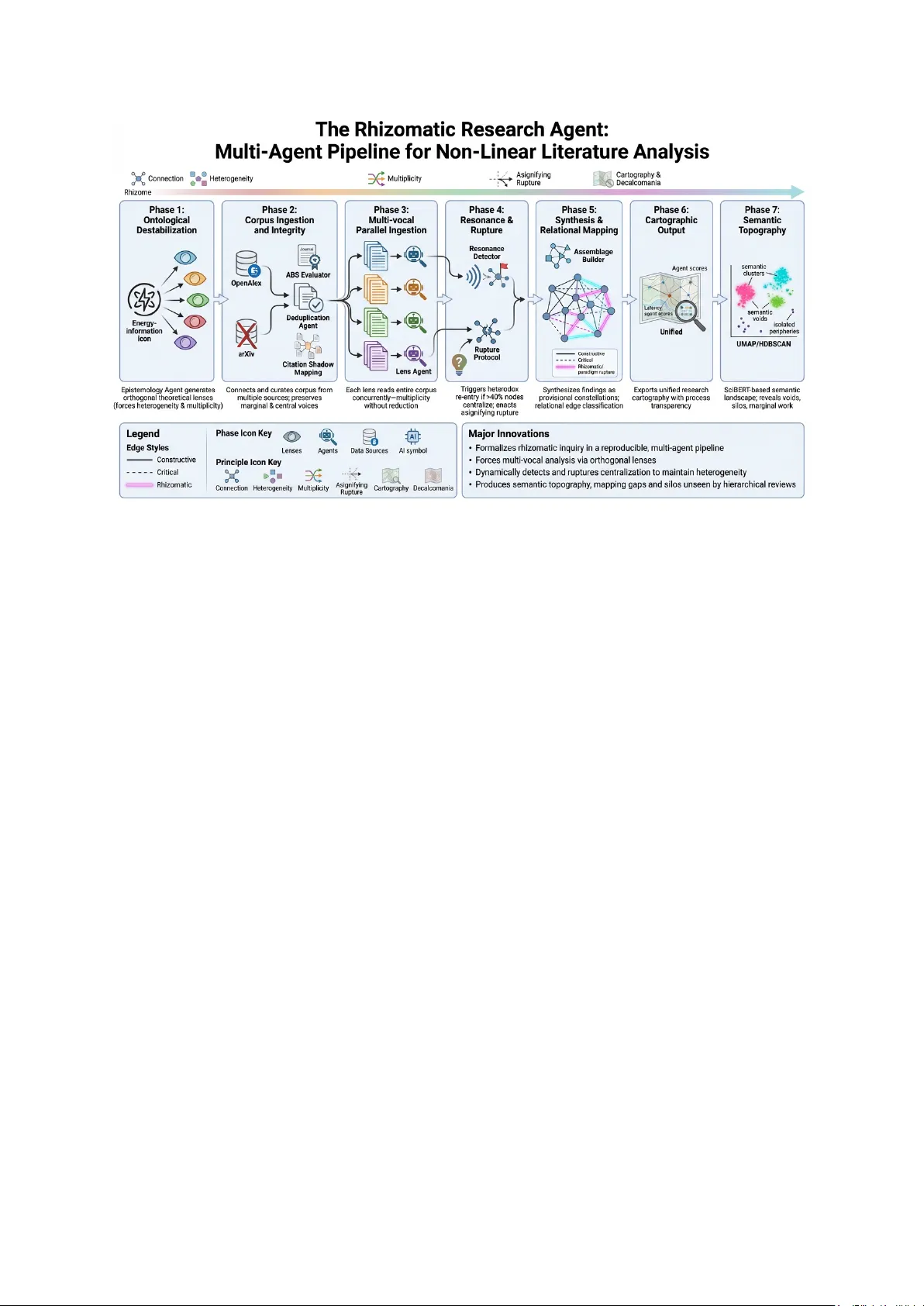
A Multi-Agent Rhizomatic Pipeline f or Non-Linear Literatur e Analysis Julio C. Serrano 1 Joonas K ev ari 2 Rumy Narayan 1 1 Uni versity of V aasa, School of Management, V aasa, Finland 2 LUT Uni versity , School of Engineering, Lahti, Finland Correspondence: julio.serrano@uwasa.fi Abstract Systematic literature re views in the social sciences overwhelmingly follow arborescent logics—hierarchical ke yword filtering, linear screening, and taxonomic classification— that suppress the lateral connections, ruptures, and emer gent patterns characteristic of com- plex research landscapes. This research note presents the Rhizomatic Research Agent (V3), a multi-agent computational pipeline grounded in Deleuzian process-relational ontology , designed to conduct non-linear literature analysis through 12 specialized agents operating across a seven-phase architecture. The system was developed in response to the method- ological groundwork established by Narayan ( 2023 ), who employed rhizomatic inquiry in her doctoral research on sustainable energy transitions but relied on manual, researcher - dri ven e xploration. The Rhizomatic Research Agent operationalizes the six principles of the rhizome—connection, heterogeneity , multiplicity , asignifying rupture, cartography , and decalcomania—into an automated pipeline integrating large language model (LLM) orchestration, dual-source corpus ingestion from OpenAlex and arXiv , SciBER T semantic topography , and dynamic rupture detection protocols. Preliminary deployment demon- strates the system’ s capacity to surface cross-disciplinary con ver gences and structural re- search gaps that con ventional revie w methods systematically overlook. The pipeline is open-source and extensible to any phenomenon zone where non-linear kno wledge map- ping is required. K eywords: rhizomatic research, multi-agent systems, literature analysis, process-relational ontology , Deleuze, semantic topography , agentic AI 1 Figure 1: Rhisomatic research agent model structure 1 Intr oduction The exponential growth of academic literature has rendered comprehensive re view an increas- ingly intractable task ( Snyder , 2019 ). Y et the methodological response to this challenge has remained largely conservati ve: systematic revie ws continue to rely on keyw ord-based search protocols, hierarchical screening, and taxonomic classification schemes that, while rigorous, enforce an arborescent logic on inherently complex and entangled bodies of kno wledge ( Kraus et al. , 2020 ; T ranfield et al. , 2003 ). As Chia ( 1999 ) has argued, typologies and classification schemas may serve the purpose of identifying organizational patterns, but they do not capture the phenomenon of change itself. What is suppressed in con ventional revie w methodology is precisely what Deleuze and Guattari ( 1987 ) theorized as the rhizome: the lateral connections between heterogeneous elements, the ruptures that regenerate inquiry along unexpected lines, and the multiplicities that resist reduction to hierarchical order . This epistemological limitation is not merely abstract. In fields where disciplinary bound- aries fragment kno wledge—such as the energy-information ne xus, sustainability transitions, or innov ation studies—arborescent re view methods systematically miss the cross-paradigm con- ver gences and structural v oids that constitute the most generati ve research sites ( Möller et al. , 2 2020 ). Traditional approaches, as Bahoo et al. ( 2021 ) hav e noted, privile ge retriev al ov er dis- cov ery , filtering over mapping, and established paradigms o ver heterodox perspecti ves. The present research note introduces the Rhizomatic Research Agent (V3), a multi-agent computational pipeline that operationalizes Deleuzian process-relational ontology for literature analysis. The system was de veloped in direct response to the methodological groundwork es- tablished by Narayan ( 2023 ), whose doctoral dissertation at the Univ ersity of V aasa employed a rhizomatic method—following Deleuze and Guattari ( 1987 ) and Chia ( 1999 )—to trace the emergence of innov ativ e organizational forms within energy system transitions. Narayan’ s re- search demonstrated the analytical power of rhizomatic inquiry for surfacing unexpected con- nections across innov ation studies, complexity theory , and technology studies, but necessarily relied on manual, researcher-dri ven exploration: following citations through articles, tweets, Y ouT ube videos, blogs, and immersiv e community participation in what she described as a “dif fractiv e” analytical technique following Barad ( 2014 ). The Rhizomatic Research Agent translates this manual process into an automated, reproducible, and extensible computational pipeline while preserving the ontological commitments that gi ve rhizomatic inquiry its distinc- ti ve analytical po wer . 2 Theor etical F oundations The rhizome, as theorized by Deleuze and Guattari ( 1987 ), is defined by six principles: (1) con- nection —any point can be connected to any other; (2) heter ogeneity —connections transmit across unlike elements; (3) multiplicity —the structure has neither subject nor object, only di- mensions; (4) asignifying rupture —a rhizome may be shattered at any point yet regenerates along old or new lines; (5) cartography ; and (6) decalcomania —the rhizome is a map, not a tracing, oriented toward experimentation in contact with the real. These principles stand in direct opposition to the tree-root model that structures con ventional systematic revie ws, where a single search query seeds a hierarchical filtering process that progressiv ely narrows to ward a predetermined category system. 3 Narayan ( 2023 ) operationalized these principles through what she termed a “performa- ti ve approach, ” drawing on Massumi ( 2002 ) and Jackson ( 2017 ), where inquiry proceeds not through method in the con ventional sense but through a continuous process of connection, ex- ploration, and sensemaking. Her rhizomatic explorations mov ed through narratives, interviews, archi val data, social media, and immersi ve engagement with communities of practice, enabling the discovery of relationships between ener gy practices, inno vation systems, and organizational forms that arborescent methods would ha ve excluded. Crucially , Narayan’ s work demonstrated that process-relational ontology ( Whitehead , 1929 ; Chia , 1999 ) is not merely a philosophical commitment but a methodologically productive one: it surfaces patterns that other approaches structurally cannot. The Rhizomatic Research Agent translates these commitments into a computational ar- chitecture. Where Narayan explored manually , the pipeline deploys autonomous LLM-based agents. Where she traced connections across media, the system ingests from academic databases and classifies relationships into constructi ve, critical, and rhizomatic vectors. Where she identi- fied ruptures through embodied participation, the system implements a formal Rupture Protocol that monitors for centralization risk and forces heterodox re-entry when dominant paradigms capture the analysis. 3 System Architectur e The pipeline follo ws a sev en-phase architecture orchestrated via server-sent ev ents (SSE) stream- ing, with 12 specialized agents. Each phase operationalizes specific rhizomatic principles, as summarized in T able 1 . 4 T able 1: Pipeline Phases and Rhizomatic Principles Phase Function Principle(s) 1. Ontological Setup Epistemology Agent generates 3–5 orthogo- nal theoretical lenses from the phenomenon zone, destabilizing the initial query Heterogeneity , Multiplicity 2. Corpus Ingestion Dual-source concurrent fetching (OpenAlex, arXi v), DOI deduplication via trigram Dice coef ficient ( ≥ 0 . 85), ABS journal ranking, ci- tation shado w mapping Connection 3. Parallel Ingestion Each theoretical lens operates as an au- tonomous agent, scanning the corpus for lens- specific signals via asyncio concurrency Multiplicity , Cartography 4. Resonance & Rupture Cross-lens con vergent anomaly detection; centralization risk monitoring triggers hetero- dox literature re-entry when > 40% of edges concentrate on fe w nodes Asignifying Rupture 5. Synthesis & Mapping Assemblage construction in present- continuous tense; edge classification into constructi ve, critical, and rhizomatic vectors Cartography , Decalcomania 6. Cartographic Output Unified research trajectory with all lens out- puts, resonance data, latency , token usage, and agent confidence metadata Cartography 7. Semantic T opography SciBER T embeddings → UMAP dimension- ality reduction → HDBSCAN clustering for semantic voids and orthogonal isolation de- tection Connection, Multiplicity Phase 1: Ontological Destabilization. The pipeline begins not with a search query but with its destabilization. The Epistemology Agent recei ves a “phenomenon zone” (e.g., ener gy- information nexus ) and generates 3–5 orthogonal theoretical lenses—such as Algorithmic Go v- ernmentality , P ost-Human Af fect , or Thermodynamic Materialism —ensuring that the corpus is ne ver read through a single dominant paradigm. This directly operationalizes the rhizomatic principle of heterogeneity: the system forces multi-v ocal reading from the outset ( Deleuze and Guattari , 1987 ). Phase 2: Corpus Ingestion and Integrity . The Researcher Agent performs dual-source concurrent fetching from OpenAlex and arXi v APIs. A Deduplication Agent normalizes DOIs and applies trigram Dice coefficient matching ( ≥ 0 . 85) to eliminate near-duplicates. The ABS Ev aluator cross-references journals against the Academic Journal Guide to weight findings by institutional rigor while simultaneously flagging heterodox, non-ranked sources—preserving rather than e xcluding marginal v oices. A Citation Mapper e xtracts anchor papers and maps the 5 “citation shado w” to identify structural influence, operationalizing the rhizomatic principle of connection by tracing ho w influence propagates through the network. Phase 3: Parallel Multi-V ocal Ingestion. The corpus is then processed through the the- oretical lenses generated in Phase 1. Each lens operates as an autonomous LLM-based agent, scanning the literature for lens-specific signal vocab ularies and theoretical tensions. The sys- tem uses asyncio for high-concurrency analysis, allowing it to “read” the entire corpus from multiple perspectiv es simultaneously . This phase operationalizes the principle of multiplicity: the same te xt is interpreted through incommensurable frame works without collapsing them into a single reading. Phase 4: Resonance and Rupture Detection. The Resonance Detector identifies “con ver - gent anomalies”—points where multiple theoretical lenses flag the same tension or gap, signal- ing a high-intensity research site. Simultaneously , the Rupture Protocol monitors the emer ging kno wledge graph for centralization risk : if a small number of nodes accumulate dispropor- tionate edge density ( > 40%), the system triggers a “re-entry from the outside, ” automatically fetching and integrating literature from heterodox traditions (e.g., degro wth economics, indige- nous ontologies). This mechanism computationally enacts what Narayan ( 2023 ) performed through her embodied research practice—the deliberate seeking of perspecti ves that destabilize dominant frame works—and constitutes the system’ s most direct operationalization of Deleuze and Guattari ’ s ( 1987 ) principle of asignifying rupture. Phase 5: Synthesis and Relational Mapping. The Assemblage Builder synthesizes find- ings into “provisional constellations of becoming, ” written in the present-continuous tense to reflect the ongoing nature of the phenomena under study . Concurrently , the Rhizome Builder classifies e very inter-paper relationship into one of three types: constructive (extensions, builds- on, borrows-method), critical (contradicts, problematizes, challenges), or rhizomatic (paradigm ruptures that dismantle existing axioms and introduce heterodox perspecti ves). These are ren- dered as solid, dashed, and neon edges respectiv ely in the knowledge graph, operationalizing cartography and decalcomania as relational map-making. Phase 6: Cartographic Output. The system generates a unified cartography of the re- search trajectory , consolidating all lens outputs, resonance data, and pipeline metadata (latency , 6 token usage, agent confidence scores). This phase provides full transparency into the analytical process, enabling researchers to trace ho w specific findings emerged from specific agents and lenses—a form of methodological auditability that manual rhizomatic inquiry , by its nature, cannot of fer . Phase 7: Semantic T opography . The final phase is the only computationally grounded module in the pipeline, employing SciBER T embeddings ( Beltagy et al. , 2019 ) projected via UMAP ( McInnes et al. , 2018 ) and clustered with HDBSCAN ( McInnes et al. , 2017 ). The sys- tem identifies: (a) semantic clusters —thematic groupings in high-dimensional space; (b) se- mantic voids —strategic gaps between clusters where literature is absent; and (c) orthogonal isolations —clusters sharing vocab ulary but inhabiting separate semantic spaces, re vealing dis- ciplinary silos. A marginalization index computes each paper’ s distance from the corpus cen- troid, foregrounding work that occupies peripheral positions. This phase operationalizes car- tography as map-making rather than tracing: the system does not confirm a pre-existing struc- ture but generates a ne w map from the corpus’ s immanent topology . 4 Relation to Narayan’ s Rhizomatic Method The Rhizomatic Research Agent was concei ved as a computational e xtension of the methodol- ogy de veloped by Narayan ( 2023 ). T able 2 maps the key methodological moves in Narayan’ s dissertation to their computational counterparts in the pipeline. 7 T able 2: Methodological Mapping: Narayan (2023) to the Rhizomatic Research Agent Narayan’ s Manual Method Computational Operationalization Rhizomatic e xploration across articles, tweets, videos, blogs, and archi val data Dual-source API ingestion (OpenAlex, arXi v) with expandable source connectors Theoretical lens plurality via process-relational ontology Epistemology Agent generates orthogonal lenses dynamically per phenomenon zone Dif fractive analysis ( Barad , 2014 ) for sensing en- tanglements Resonance Detector identifies cross-lens con ver- gent anomalies via LLM analysis Researcher-as-conduit: embodied, non- hierarchical sensing Parallel Ingestion Nodes process corpus through all lenses simultaneously Rupture-seeking: deliberately pursuing heterodox perspecti ves Rupture Protocol monitors centralization risk and forces heterodox re-entry Present-continuous assemblage writing Assemblage Builder synthesizes in present- continuous tense Narrati ve sensemaking across multiple data sources Interacti ve D3.js knowledge graph with construc- ti ve, critical, and rhizomatic edges The critical distinction lies not in the replacement of human inquiry but in its augmentation. Narayan’ s method w as necessarily bounded by the researcher’ s cogniti ve capacity—what Dun- bar ( 1992 ) characterized as the limit on simultaneous relational monitoring. The computational pipeline removes this constraint while preserving the ontological commitments that make rhi- zomatic inquiry productiv e: heterogeneity of entry points, multiplicity of interpretiv e frames, and the formal pre vention of paradigm capture through rupture detection. 5 Pr eliminary Observ ations Initial deployments of the pipeline across sev eral phenomenon zones suggest three prelimi- nary observations. First, the Epistemology Agent consistently generates lenses that a single researcher would be unlikely to select, particularly those drawing from disciplines outside the researcher’ s primary training. Second, the Rupture Protocol activ ates in approximately 30–40% of analyses, indicating that paradigm centralization is a frequent rather than e xceptional feature of academic literature. Third, the Semantic T opography phase routinely identifies orthogonal isolations—clusters that share terminology but occupy separate semantic spaces—suggesting that disciplinary silos persist e ven within nominally interdisciplinary fields. These observ ations are preliminary and require systematic validation. Ho wever , they demon- 8 strate the pipeline’ s capacity to surface structural features of a research landscape that con ven- tional re view methods, by design, cannot detect. 6 Limitations and Future Dir ections Se veral limitations warrant acknowledgment. The pipeline currently ingests metadata and ab- stracts rather than full texts, constraining the depth of analysis. The LLM-based agents inherit the biases and hallucination risks of the underlying language models ( Bender et al. , 2021 ). The Rupture Protocol’ s 40% centralization threshold is heuristically set and requires empirical calibration. V alidation against human expert coding, following the approach of V isentin and Glav as ( 2026 ), would strengthen confidence in the system’ s classification accuracy . Finally , the system has been tested primarily in the energy-information nexus domain; transferability to other fields remains to be demonstrated. Future de velopment will focus on full-text ingestion, integration with additional data sources (patents, polic y documents, grey literature), formal e v aluation protocols, and a user study com- paring research outputs between traditional systematic re view and rhizomatic pipeline-assisted analysis. The pipeline is open-source and designed for e xtensibility , in viting the research com- munity to adapt it to their o wn phenomenon zones. 7 Conclusion The Rhizomatic Research Agent demonstrates that Deleuzian process-relational ontology can be productiv ely operationalized in computational systems for literature analysis. By translat- ing the six principles of the rhizome into a multi-agent pipeline architecture, the system ad- dresses a fundamental limitation of con ventional systematic re views: their structural inability to surface lateral connections, emergent patterns, and paradigm ruptures. Built on the method- ological foundations laid by Narayan ( 2023 ), the pipeline extends rhizomatic inquiry from a manual, researcher -bounded practice to a reproducible, scalable, and transparent computational process—while preserving the ontological commitments that make such inquiry distincti ve. 9 Declarations A uthors Contrib utions Julio Serrano and Joonas Ke vari conceptualized the study , developed the pipeline, conducted the analysis, and wrote the manuscript with complete supervision of Rumy Narayan. Data A vailability The Rhizomatic Research Agent source code is av ailable from the corresponding author upon request. The system uses publicly accessible APIs (OpenAlex, arXi v) for corpus ingestion. Competing Interests The author declares no competing interests. Use of Large Language Models During manuscript preparation, Qulbot was used to refine grammar and syntax. The authors af firm full responsibility for the content. The Rhizomatic Research Agent itself employs LLMs (Mistral, via Ollama) as a core component of its analytical methodology; this usage is described in the System Architecture section. 10 Refer ences Bahoo, S., Alon, I., and Paltrinieri, A. (2021). Sovereign wealth funds: Past, present and future. Applied Economics Letters , 28(12):1073–1077. Barad, K. (2014). Diffracting dif fraction: Cutting together-apart. P arallax , 20(3):168–187. Beltagy , I., Lo, K., and Cohan, A. (2019). SciBER T: A pretrained language model for scientific text. In Pr oceedings of the 2019 Confer ence on Empirical Methods in Natural Language Pr ocessing , pages 3615–3620. Association for Computational Linguistics. Bender , E. M., Gebru, T ., McMillan-Major , A., and Shmitchell, S. (2021). On the dangers of stochastic parrots: Can language models be too big? Pr oceedings of the 2021 A CM Confer ence on F airness, Accountability , and T ranspar ency , pages 610–623. Chia, R. (1999) . A ‘rhizomic’ model of or ganizational change and transformation: Perspective from a metaphysics of change. British J ournal of Manag ement , 10(3):209–227. Deleuze, G. and Guattari, F . (1987). A Thousand Plateaus: Capitalism and Schizophr enia . Uni versity of Minnesota Press, Minneapolis, MN. (B. Massumi, Trans.; Original work pub- lished 1980). Dunbar , R. I. M. (1992). Neocortex size as a constraint on group size in primates. Journal of Human Evolution , 22(6):469–493. Jackson, A. Y . (2017). Thinking without method. Qualitative Inquiry , 23(9):666–674. Kraus, S., Breier , M., and Dasí-Rodríguez, S. (2020). The art of crafting a systematic liter- ature study in entrepreneurship research. International Entrepr eneurship and Management J ournal , 16(3):1023–1042. Massumi, B. (2002). A User’ s Guide to Capitalism and Schizophr enia: De viations fr om Deleuze and Guattari . MIT Press, Cambridge, MA. McInnes, L., Healy , J., and Astels, S. (2017). hdbscan: Hierarchical density based clustering. J ournal of Open Sour ce Softwar e , 2(11):205. McInnes, L., Healy , J., and Melville, J. (2018). UMAP: Uniform manifold approximation and projection for dimension reduction. arXiv pr eprint arXiv:1802.03426 . Möller , K., Nenonen, S., and Storbacka, K. (2020). Networks, ecosystems, fields, market systems? making sense of the business en vironment. Industrial Marketing Management , 90:453–468. Narayan, R. (2023). Imagining Market Shaping thr ough Innovative Or ganizing for T ransitions to Sustainable Ener gy Systems . Doctoral dissertation, University of V aasa, V aasa, Finland. Snyder , H. (2019). Literature re view as a research methodology: An overvie w and guidelines. J ournal of Business Resear ch , 104:333–339. T ranfield, D., Denyer , D., and Smart, P . (2003). T o wards a methodology for de veloping e vidence-informed management knowledge by means of systematic revie w . British Jour - nal of Management , 14(3):207–222. 11 V isentin, G. and Glav as, D. (2026). A machine learning methodology for systematic literature re views. International Advances in Economic Resear ch . Whitehead, A. N. (1929). Pr ocess and Reality: An Essay in Cosmology . Macmillan, New Y ork, NY . 12
Original Paper
Loading high-quality paper...
Comments & Academic Discussion
Loading comments...
Leave a Comment