Cyclic sieving phenomena on parabolic classes of faces of the cluster complex
The cyclic sieving phenomenon was introduced by Reiner, Stanton and White in 2004 as a generalization of Stembridge's $q=-1$ phenomenon. In a paper from 2008, Eu and Fu studied many occurrences of this phenomenon on the faces of the generalized clust…
Authors: Lucas Pouillart
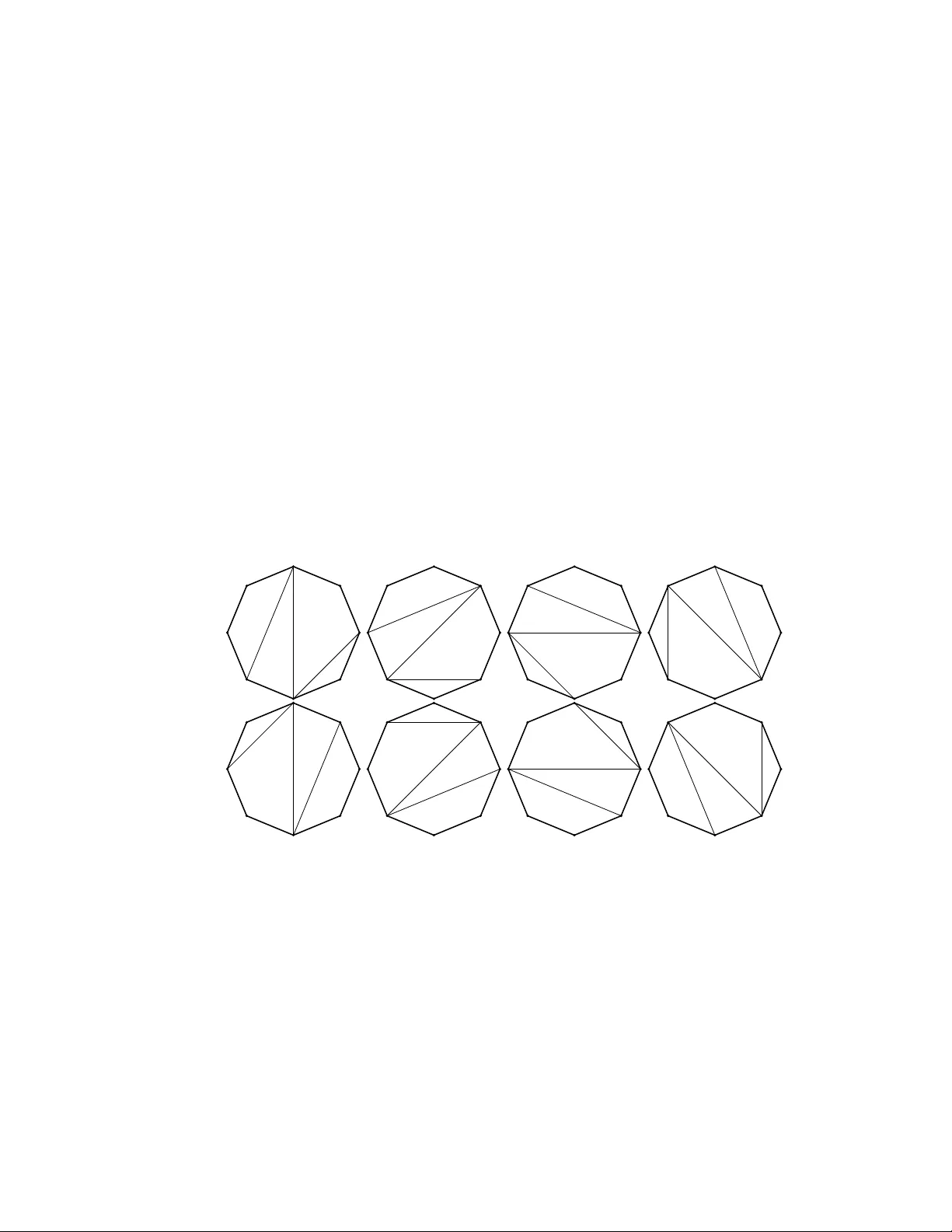
CYCLIC SIEVING PHENOMENA ON P ARABOLIC CLASSES OF F A CES OF THE CLUSTER COMPLEX LUCAS POUILLAR T Abstract. The cyclic sieving phenomenon w as introduced by Reiner, Stan ton and White in 2004 as a generalization of Stem bridge’s q = − 1 phenomenon. In a pap er from 2008, Eu and F u studied many occurrences of this phenomenon on the faces of the generalized cluster complex with the action of the F omin-Reading rotation in the classical t yp es A n , B n , D n and I 2 ( k ). There w as yet no known uniform q -analogue of the k -face n umbers of these complexes. In a more recent pap er from 2023, Douvrop oulos and Josuat-V erg` es pro vided a refinement of the enumeration of the faces of the generalized cluster complex using a uniform form ula. F or a parab olic subgroup W X ⊂ W of the asso ciated Co xeter group W , their form ula factorises nicely under the assumption that N W ( W X ) /W X acts as a reflection group on X , whic h is v ery often the case. Using this condition, we provide a uniform refinement of these cyclic sieving phenomena using a q -analogue of their main form ula with a t yp e b y type proof based on the classification of finite irreducible Co xeter groups. 1. Introduction Let X ⟲ C b e a finite set acted on by a finite cyclic group C . One sa ys that together with P ∈ Z [ q ], the triple ( X , C, P ( q )) exhibits the cyclic sieving phenomenon (CSP for short) if the following relation holds: P ( e 2 iπ d ) = | X g | where g ∈ C has order d . In particular P (1) = | X | . This phenomenon w as in tro duced in [RSW04] as a generalization of Stem bridge’s ” q = − 1” phenomenon and many of its o ccurences ha v e been studied o ver the past t w o decades. One of the main occurences of the CSP is the follo wing theorem due to Reiner, Stan ton and White in [RSW04]: Theorem 1.1. [RSW04] L et X b e th e set of triangulations of the ( n + 2) -gon using non- cr ossing diagonals. L et Cat n ( q ) := 1 [ n + 1] q 2 n n q . L et the gr oup C n +2 act on X as the p olygon r otation. Then ( X , C n +2 , Cat n ( q )) exhibits the CSP. Universit ´ e P aris Cit ´ e, CNRS, IRIF, F-75013, P aris, France 1 2 CYCLIC SIEVING PHENOMENA IN THE CLUSTER COMPLEX This theorem provides us with a CSP on a Catalan ob ject, using the natural q -analogue of the classical Catalan num bers. The Catalan num b ers hav e several generalizations, one b eing the Kirkman numb ers Kirk k,n , which count the dissection of the ( n + 2)-gon using k noncrossing diagonals. Using a natural q -analogue of these num bers, Reiner, Stanton and White generalized their previous result: Theorem 1.2. [RSW04] L et X b e the set of disse ctions of a r e gular ( n + 2) -gon using k noncr ossing diagonals. L et Kirk k,n ( q ) := 1 [ n + 1] q n + k + 1 k q n − 1 k q . L et the gr oup C n +2 act on X as the p olygon r otation. Then ( X , C n +2 , Kirk k,n ( q )) exhibits the CSP. The dissection p oset of the ( n + 2)-gon can b e seen representation theoretically as the cluster c omplex Γ of type A n − 1 , associated to the ro ot system A n − 1 . Its clockwise rota- tion is the F omin-Zelevinsky r otation of Γ as defined in [FZ03]. In [EF08], Eu and F u exhibited sev eral CSP on the faces of the cluster complex of irreducible types using natural q -analogues of coun ting form ulas of the faces of a certain dimension. In particular they exhibited the follo wing uniform CSP on the facets of irreducible cluster complexes using a natural q -analogue of the gener alise d Catalan numb ers Cat(Φ): Theorem 1.3. [EF08] L et Φ b e an irr e ducible r o ot system with Coxeter numb er h and exp onents e 1 , · · · , e n , let X b e the set of fac ets of Γ(Φ) acte d on by the gr oup C h +2 as the F omin-Zelevinsky r otation, and let Cat(Φ , q ) := n Y i =1 [ h + e i + 1] q [ e i + 1] q . Then ( X , C h +2 , Cat(Φ , q )) exhibits the cyclic sieving phenomenon. One could hope to generalise the Kirkman num b ers to other irreducible t ypes as well, but the uniform form ulas exhibited by F omin and Reading in [FR05] can only b e expressed up to a ”m ysterious factor”. Recen t results b y Douvropoulos and Josuat-V erg` es in [DJV23] pro vided us with the uniform coun ting formula µ λ recalled in Theorem 2.4 for faces of type λ . W e can define a q -analogue µ λ ( q ) of the formula µ λ giv en by (5) in man y cases. With this q -analogue, w e get the main result of this pap er: Theorem 1.4. L et Γ(Φ) λ b e the set of fac es of Γ(Φ) of p ar ab olic typ e λ and R b e the F omin-Zelevinsky r otation. Assume that ther e exists a p ar ab olic sub gr oup W λ of typ e λ such that N ( W λ ) /W λ acts as a r efle ction gr oup on X := Fix( W λ ) and let µ λ ( q ) b e the p olynomial define d by (5) . Then (Γ(Φ) λ , ⟨R⟩ , µ λ ( q )) exhibits the CSP. The condition of N W ( W X ) /W X b eing a reflection group on X is very common: it is automatic in t yp es A n , B n , I 2 ( k ), F 4 , H 3 and H 4 , and is true in most cases in types D n , E 6 , E 7 and E 8 . These groups ha v e b een studied thoroughly b y Ho wlett [H80] in the 80’s, and a recen t new description of their structure in [DPR25] highligh ts the reason wh y this condition holds so often. CYCLIC SIEVING PHENOMENA IN THE CLUSTER COMPLEX 3 R emark. Theorem 1.4 partially solv es an op en problem giv en at the end of [EF08]. CSPs on disjoin t unions of C -sets behav e nicely with the sieving p olynomials: the sieving p olyno- mials P and Q for A and B resp ectiv ely giv e rise to a CSP on A ⊎ B with sieving polynomial P + Q . A natural q -analogue of the face num bers of the cluster complex is then given b y an appropriate sum of p olynomials µ λ ( q ). After some preliminaries ab out the generalized cluster complex in section 2, we will review the structure of normalizers of parab olic subgroups in Section 3 so that w e can define our q -analogue in Section 4. Sections 5, 6, 7 and 8 will be devoted to proving our main theorem for each classical family (namely A n , B n , I 2 ( k ) and D n ), and we will look at the case of exceptional root systems in Section 9. 2. The cluster complex Let Φ b e a root system with reflection group W and simple system ∆ = ∆ + ⊔ ∆ − suc h that ∆ ϵ con tains only ro ots which are pairwise orthogonal. Let h b e its Coxeter n um b er, and let Φ ≥− 1 := − ∆ ∪ Φ + b e its set of almost p ositive r o ots . Consider the bip artite Coxeter element c := c + c − where c ϵ = Q i ∈ ∆ ϵ s i . F omin and Zelevinsky defined in [FZ03] the follo wing action of C h +2 on Φ ≥− 1 : Definition 2.1. [FZ03] The F omin-Zelevinsky r otation of Φ ≥− 1 is the bijection R : Φ ≥− 1 → Φ ≥− 1 defined b y: R ( α ) = ( − α if α ∈ ( − ∆ + ) ∪ ∆ − , c ( α ) otherwise. This rotation has order h +2 2 whenev er − id ∈ W (namely in irreducible types B n , D 2 k , I 2 (2 k ), E 7 , E 8 , F 4 , H 3 and H 4 ) and h + 2 otherwise (in irreducible types A n , D 2 k +1 , I 2 (2 k + 1) and E 6 ) and thus induces an action of C h +2 on Φ ( m ) ≥− 1 . This action can b e generalized to the following ob ject: Definition 2.2. [FR05] W e call m -c olor e d almost p ositive r o ots and denote by Φ ( m ) ≥− 1 the union of the following subsets of Φ × N : • Φ ( m ) + := { α i : α ∈ Φ + , 1 ≤ i ≤ m } , • {− α 1 : α ∈ − ∆ } . The F omin-R e ading r otation R m is the following bijection R : Φ ( m ) ≥− 1 → Φ ( m ) ≥− 1 : R m ( α i ) = ( α i +1 if α i ∈ Φ ( m ) + and i < m, R ( α 1 ) otherwise. In the case m = 1, we get the classical almost p ositiv e ro ots and the F omin-Zelevinsky rotation. The F omin-Reading rotation has order d | mh + 2 and induces an action of C mh +2 on Φ ( m ) ≥− 1 . F rom this action we can define the follo wing binary relation: 4 CYCLIC SIEVING PHENOMENA IN THE CLUSTER COMPLEX Definition 2.3. [FR05] Let || b e the binary relation on Φ ( m ) ≥− 1 defined by the following conditions: • if α ∈ ∆, then − α || β if and only if α do es not app ear in the decomp osition of β as a linear combination of simple roots, • R m ( α ) || R m ( β ) ⇐ ⇒ α || β . This relation is called the c omp atibility r elation of Φ ( m ) ≥− 1 . The m -cluster c omplex Γ ( m ) of Φ is the flag complex of the compatibility relation on Φ ( m ) ≥− 1 . In the case m = 1 and Φ cristallographic, it has an in terpretation in terms of the cluster v ariables of a cluster algebra. Another represen tation-theoretic in terpretation in the general case is due to Thomas in [T08] as a complex of irreducible components of cluster-tilting ob jects in a certain category . T oy mo del. The classical example of cluster complex is giv en by Γ ( m ) ( A n − 1 ), the m -cluster complex of t yp e A n − 1 . T ype A ob jects are often classical combinatorial ob jets and its cluster complexes make no exceptions. The type A n − 1 m -cluster complex can b e realized as the complex of m -divisible dissections of the ( mn + 2)-gon using noncrossing diagonals. The action of the F omin-Reading rotation on the faces of Γ ( m ) ( A n − 1 ) can b e seen as the clo c kwise rotation of the ( mn + 2)-gon. In particular, its facets are the ( m + 2)-angulations of the ( mn + 2)-gon, and are coun ted by the famous F uß-Catalan numb er Cat m n . Figure 1. The orbit under the rotation of a face of Γ( A 5 ). Instead of classifying the faces of Γ ( m ) ( W ) by dimension, we will use a thinner criterion, its p ar ab olic typ e . Let us first recall some definitions and facts ab out generalized noncrossing partitions: Definition 2.4. The interse ction lattic e of Φ, which w e denote by Π(Φ) or Π( W ) is the p oset defined b y the following: CYCLIC SIEVING PHENOMENA IN THE CLUSTER COMPLEX 5 • its elements are the in tersections of the reflecting h yp erplanes H α , α ∈ Φ + , • X ≤ Y ⇐ ⇒ X ⊇ Y for all X , Y ∈ Π( W ). This poset is also called the gener alise d p artition p oset of the ro ot system. If X is a flat, w e denote by Π( W ) X the in tersection lattice obtained by replacing the h yp erplanes H α b y ( H α ∩ X ). R emark. W e can notice the following: • The lattice Π( W ) is isomorphic to the lattice of parab olic subgroups. Let X ∈ Π( W ) and W X b e the p oint wise stabilizer of X in W . The map X 7→ W X is a lattice isomorphism. • In type A , these lattices are the classical set partition p osets. The other classical t yp es also admit go o d com binatorial descriptions using certain set partitions with some symmetry conditions. • When X ∈ Π( W ), Π( W ) X is naturally isomorphic to the in terv al [ X, { 0 } ] in Π( W ). Let us denote by T the set of all reflections of W , and l T ( w ) the r efle ction length of w ∈ W . The absolute or der on W is the partial order relation defined on W by u ⪯ v ⇐ ⇒ l T ( v ) = l T ( u ) + l T ( u − 1 v ) . The in terv al [ e, c ] in the absolute order is called the gener alise d noncr ossing p artition lattic e of W which w e denote by NC( W ). It is naturally isomorphic to a subposet of Π( W ) b y w 7→ Fix( w ). Prop osition 2.1. F or every fac e f ∈ Γ ( m ) ( W ) , ther e exists an indexing f = { α i 1 1 , · · · , α i k k } such that Y f := k Y i =1 t α i ∈ NC( W ) wher e t α i is the r efle ction asso ciate d to the r o ot α i . This prop osition is a consequence of an alternative definition of Γ ( m ) ( W ) due to Athanasiadis and Tzanaki in [A T08]. W e can no w define f := c + ( Q f ) c − whic h is also a noncrossing partition of W . R emark. The application w 7→ c + w c − is an antiautomorphism of NC( W ), called the bip ar- tite Kr ewer as c omplement . T o eac h face f ∈ Γ ( m ) ( W ), w e asso ciate the noncrossing partition f . As seen b efore, a noncrossing partition is a parab olic subgroup W f in a certain wa y , so we can asso ciate a parab olic subgroup to eac h face of the complex. The follo wing theorems due to Dou- vrop oulos and Josuat-V erg ` es in [DJV23] justify this choice: Theorem 2.2. The link of f ∈ Γ ( m ) ( W ) is isomorphic to Γ ( m ) ( W f ) . Theorem 2.3. F or every f ∈ Γ ( m ) ( W ) , W f and W R m ( f ) ar e p ar ab olic al ly c onjugate. 6 CYCLIC SIEVING PHENOMENA IN THE CLUSTER COMPLEX In other terms, it is enough to study the action of the rotation in the parab olic classes of the cluster complex. W e denote by Γ ( m ) ( W ) λ the set of faces of Γ ( m ) ( W ) of parab olic t yp e λ . The main result of [DJV23] states the following: Theorem 2.4. Assume that W is irr e ducible, and let W X ⊂ W b e a p ar ab olic sub gr oup of typ e λ the fac es of Γ ( m ) ( W ) λ ar e c ounte d by: (1) µ λ := ( − 1) dim X p X ( − mh − 1) [ N ( W X ) : W X ] , wher e p X is the char acteristic p olynomial of Π( W ) X . As these num bers refine the face n um b ers of the generalized cluster complex, whic h are the generalized Kirkman num bers, w e call them the r efine d Kirman numb ers . 3. Normalizers of p arabolic subgroups In this section, let W b e a finite Co xeter group, V b e the ambien t vector space of its geometric representation and P b e a parabolic subgroup of W . The num bers [ N W ( P ) : P ] app earing in (1) ha ve appeared many times in the theory of reflection groups and h yp er- plane arrangemen ts with a lot of other quotien t groups in v olving the parab olic subgroups of W . F ollowing [H80] and [DPR25], let us study t wo decomp ositions of N W ( P ). 3.1. Ho wlett’s decomp osition. Before anything, let us introduce the notion of How lett c omplement of a group through the follo wing lemma: Lemma 3.1 ([H80], Lemma 2) . L et G b e a gr oup of ortho gonal automorphisms of V and W b e a r efle ction gr oup in V with r o ot system Φ such that W ⊴ G . Then W has a c omplement H (in the sense that G = W H ), wher e H = { g ∈ G | g (Φ + ) = Φ + } . H is c al le d the How lett c omplement of W in G . It is obvious that P ⊴ N W ( P ), so this lemma has the follo wing consequence: Corollary 3.2. If J ⊂ ∆ , then N ( W J ) /W J ∼ = { w ∈ W | w ( J ) = J } . This result comes from the identification of { w ∈ W | w ( J ) = J } as the How lett c omple- ment of W J b y Howlett. The fact that P has a complement in N W ( P ) is a straigh tforward consequence of this corollary . This decomp osition giv es us the following decomposition of N W ( P ): N W ( P ) = P ⋊ W ′ . Consequen tly W ′ ∼ = N W ( P ) /P . It app ears quickly that W ′ is ’almost’ a reflection group: in [H80], Howlett exhibits a subgroup W ′′ ⊂ W ′ whic h is generated b y special elements of W ′ called the R -elemen ts see [[H80], Page 2] for more details. Lemma 3.3. The R -elements ar e r efle ctions in Fix( P ) so W ′′ acts as a r efle ction gr oup on Fix( P ) . F urthermor e, W ′′ ⊴ W ′ and W ′′ admits a c omplement in W ′ . CYCLIC SIEVING PHENOMENA IN THE CLUSTER COMPLEX 7 With that decomp osition we get (2) N W ( P ) = P ⋊ ( W ′′ ⋊ D ) for some D ⊂ W ′ whic h w as explicitly describ ed by Howlett [[H80], Corollary 7]. This decomp osition already allo wed Howlett to lo ok at the action of N W ( P ) /P on Fix( P ) in most cases, but let us lo ok at another recen t description of this group. 3.2. Douglass-Pfeiffer-R¨ ohrle decomp osition. This decomp osition is really recen t at the time w e are writing this sen tence. The idea b ehind this other decomposition is that N W ( P ) can actually b e realized as a subgroup of O ( X ) × O ( X ⊥ ), where X = Fix P so P acts on X ⊥ . The in teresting part for our work is that it allows us to decomp ose the action of N W ( P ) into a direct sum of three N W ( P )-mo dules, tw o of which are of direct interest for us. Let T W b e the set of reflections of a reflection group W . Definition 3.1. Let U b e a reflection subgroup of W , the ortho gonal c omplement of U is the group U † defined b y U † = ⟨ t ∈ T W | ts = st for all s ∈ U ∩ T W ⟩ . This definition is crucial for our decomp osition: let Q = P † . It is ob vious that: • Q acts on X , • P × Q ⊂ N W ( P ), • Q is a parab olic subgroup of W , which allows us to decompose V = Y ⊕ Y ⊥ with Y = Fix Q . As X ⊥ ∩ Y ⊥ = { 0 } and Y ⊥ ⊂ X , we get that V = X ⊥ ⊕ ( X ∩ Y ) ⊕ Y ⊥ . Prop osition 3.4. P × Q has a How lett c omplement D in N W ( P ) . The idea of the rest of the decomp osition is to use Goursat’s lemma [[DPR25], Section 4] to identify D as a subgroup of O ( X ⊥ ) × O ( X ∩ Y ) × O ( Y ⊥ ). It is naturally describ ed in Sections 5 and 6 of [DPR25] as a pro duct D = ( A × B ) ⋊ C using Goursat’s isomorphism [[DPR25], Section 4]. ( A × B ) can alwa ys b e complemented b ecause C is often trivial, and w e can explicitly find D = C case b y case otherwise. Prop osition 3.5. X = Fix( P ) = ( X ∩ Y ) ⊕ Y ⊥ and the de c omp osition N W ( P ) = ( P × Q ) ⋊ (( A × B ) ⋊ C ) is such that: • P fixes X , • Q fixes Y = ( X ∩ Y ) ⊕ X ⊥ , • A fixes Y ⊥ , • B fixes X ∩ Y . In other wor ds, we get that: • X ⊥ is a ( P ⋊ (( A × B ) ⋊ C )) -mo dule, • X ∩ Y is a ( A ⋊ C ) -mo dule, • Y ⊥ is a ( Q ⋊ ( B ⋊ C )) -mo dule. 8 CYCLIC SIEVING PHENOMENA IN THE CLUSTER COMPLEX It is to o muc h to ask N W ( P ) to b e a reflection group on V , but this decomp osition helps us lo ok clearly at the W ′ of Howlett’s decomp osition to see if N W ( P ) /P is a reflection group. As P only acts non trivially on X ⊥ , we need to lo ok at the action of N W ( P ) on X = ( X ∩ Y ) ⊕ Y ⊥ . This is done precisely for ev ery irreducible group in [DPR25]. Corollary 3.6. The gr oup N W ( P ) /P is a r efle ction gr oup on X if and only if C is trivial, A is a r efle ction gr oup on X ∩ Y , and Q ⋊ B is a r efle ction gr oup on Y ⊥ . In what follows, we will giv e combinatorial descriptions of N W ( P ) /P for P ⊂ W , where W is a group of a classical t ype. 3.3. P arab olic quotients in t yp e A n − 1 . Let us recall some well-kno wn facts: A n − 1 = S n and its Coxeter n umber is n . The parab olic subgroups of S n are in bijection with the partitions of the set [ n ]: • consider a partition P = { B 1 , · · · , B k } of [ n ], the parab olic subgroup of S n asso ci- ated with P is S B 1 × · · · × S B k , • tw o partitions P 1 and P 2 giv e rise to tw o parab olically conjugate subgroups if and only if their blo ck sizes form the same integer partition. As a consequence, the parab olic conjugacy relation on Y oung subgroups is exceptionally exactly the isomorphism relation. When we consider the representation of S n as p ermutation matrices, a parab olic subgroup W X = Q S i k k is isomorphic to a subgroup of blo c k-diagonal matrices. These matrices con tain one k -size permutation blo c k for every factor of t yp e S k of W X , or equiv alen tly a k -size p ermutation blo c k for every part k of the asso ciated λ ⊢ n . In that case, N ( W X ) /W X is isomorphic to the group of p erm utations of same-size blo cks. In other terms, for a parab olic subgroup W X = S n 1 1 × · · · × S n k k (so n i = m ult( i, λ )) of rank n − 1 − l , w e hav e: N ( W X ) /W X ∼ = A n 1 − 1 × · · · × A n k − 1 . This is explicitly pro v ed in [H80] and [DPR25], along with the fact that this group acts as a reflection group on X . 3.4. P arab olic quotients in type B n . Let us recall that B n is the n -th group of signed p erm utations, its Co xeter n um ber is 2 n and its parab olic subgroups ma y hav e t yp e A and B irreducible comp onents. The parabolic conjugacy relation in t yp e B n has been describ ed b y Gec k and Pfeiffer in [GP00] in the same w a y as in type A : • If W X do es not con tain an y transp osition of the form ( j − j ), then W X ⊂ A n − 1 ⊂ B n form a c hain of parab olic subgroups. W e can asso ciate the same λ ⊢ n as in t yp e A n − 1 . • If it do es contain suc h a transp osition, then W X has a type B m comp onen t. One can asso ciate a partition λ ⊢ n − m describing the type A comp onents as a parab olic subgroup of A n − m − 1 using the chain W X /B m ⊂ A n − m − 1 ⊂ B n . R emark. It makes sense combinatorially to consider the diagram B 1 ∼ = A 1 as the only sub diagram of B n con taining the remark able v ertex. CYCLIC SIEVING PHENOMENA IN THE CLUSTER COMPLEX 9 The parab olic quotien ts N ( W X ) /W X b eha ve similarly as in type A . They act as re- flection groups on X , see [H80]. W e give an explicit representation of N W ( W X ) for every W X ⊆ B n whic h allows us to describ e explicitly its quotien t by W X . W e can use the rep- resen tation of B n as the group of n × n signed permutation matrices. This represen tation giv es us a represen tation of a parab olic subgroup W X of type λ ⊢ k ≤ n which can b e describ ed as the following group of blo c k-diagonal matrices: • F or each blo ck size k of λ , there is a k × k sized block corresp onding to classical p erm utations matrices. • If the t ype B j comp onen t exists, then w e hav e a j × j sized blo ck of signed p erm u- tation matrices. These representations are faithful, so W X is isomorphic to this group. Up to parab olic conjugacy , W X can be illustrated b y the following: A i 1 . . . A i k B j . Using this representation, let us lo ok at N W ( W X ): • The type A k blo c ks are preserved only by signed p erm utation matrices exchangin g t yp e A k blo c ks with coefficients of the same sign on each blo ck. • If the type B j comp onen t exists, it is preserv ed b y any action of a type B j matrix. A t the quotien t level, the t yp e B j blo c k v anishes and the only remaining information remaining on the type A k blo c ks are the blo cks p ermuted and the sign of the p ermutation. F or W X of t ype λ where for an integer i , n i = m ult( i, λ ), we get the follo wing: N ( W X ) /W X ∼ = B n 1 × · · · × B n k . 3.5. P arab olic quotien ts in t yp e D n . Let us recall that D n is the index 2 subgroup of B n defined b y σ ∈ D n ⇐ ⇒ |{ i ∈ [ n ] | σ ( i ) < 0 }| is even. Its Coxeter num b er is 2 n − 2, and its parab olic subgroups are index 1 or 2 subgroups of parab olic subgroups of B n , containing t yp e A irreducible comp onents in the same w ay , and at most one t yp e D comp onent. The parab olic conjugacy classes has again b een describ ed b y Gec k and Pfeiffer in [GP00] as integer partitions in the follo wing wa y: • if W X has a type D k comp onen t, then W X giv es rise to the same λ ⊢ n − k as in t yp e B n . • if W X has no t yp e D comp onent, then w e asso ciate the same λ ⊢ n as in type B n but the classification is not o v er: – if λ has an o dd part, the parab olic conjugacy class is entirely given by λ . – If λ is all-even, then up to conjugacy exactly one of the tw o remark able reflec- tions s 0 or s 1 is in W X . Thus we associate ( λ, ± ) to W X dep ending on whic h one belongs in W X up to conjugacy . 10 CYCLIC SIEVING PHENOMENA IN THE CLUSTER COMPLEX R emark. In a com binatorial p oin t of view, it makes sense to consider the diagrams D 2 ∼ = A 1 × A 1 and D 3 ∼ = A 3 as subdiagrams of D n con taining the remark able v ertices 0 and 1. No w let W X ⊂ D n b e a parab olic subgroup of type λ ⊢ k ≤ n . If k ≤ n , let n i = m ult( i, λ ). Then if k ≤ n , the D factor in Ho wlett’s decomposition (2) is trivial, therefore N ( W X ) /W X acts as a reflection group and we get: N ( W X ) /W X = Y i ∈ λ B n i . If k = n , then Howlett’s decomp osition is a bit more complicated. Let I be the num b er of o dd sizes of parts in λ , then W ′′ = Y i o dd D n i × Y i even B n i and D = Z I − 1 2 . It is immediate to see that if I = 1, then W ′ = W ′′ and it is therefore a reflection group on X . If I > 1, then W ′ is not a reflection group on X . This could b e deduced from [H80] and [DPR25] but w e will give a w a y simpler argumen t. Parabolic subgroups of D n can, just lik e in t ype B n , be represented as the follo wing group of blo ck-diagonal n × n -matrices: • F or each blo ck size k of λ , there is a k × k sized block corresp onding to classical p erm utations matrices. • If the type D j comp onen t exists, then we hav e a j × j sized blo ck of signed p ermu- tation matrices. These representations are also faithful, so W X is isomorphic to this group. Up to parab olic conjugacy , W X can be illustrated b y the following: A i 1 . . . A i k D j . In that case N ( W X ) /W X is a subgroup of index 1 or 2 of the corresp onding group in t yp e B n . Two even blo c k sizes can be permuted at will, but only an even num ber of pairs of o dd blo ck sizes can be p ermuted in one go. Then it is an index 2 subgroup if and only if λ has an o dd part. The only possible w a y to obtain an index 2 subgroup of B n 1 × · · · × B n k with the structure of a reflection group is to reduce one of the B l comp onen t to D l . it is ob vious that t w o such groups are not isomorphic if I = 1. 3.6. P arab olic quotients in dihedral type. Let us consider here the dihedral type W = I 2 ( k ) = ⟨ s 1 , s 2 ⟩ . This family con tains exactly the rank 2 Coxeter groups. There are exactly 4 standard parab olic subgroups in these cases, tw o of which are the trivial parab olic subgroups ( { e } and I 2 ( k )). The only tw o remaining cases, namely ⟨ s 1 ⟩ and ⟨ s 2 ⟩ are isomorphic of t yp e A 1 . The problem of deciding whether they are parab olically conjugate or not is w ell kno wn: all rank 1 parab olic subgroups of I 2 ( k ) are conjugate if and only if k is o dd. Even if they are not conjugate, their normalizers are isomorphic b ecause CYCLIC SIEVING PHENOMENA IN THE CLUSTER COMPLEX 11 of the automorphism defined b y s 1 ↔ s 2 . The case of these groups is explicitly treated in [[DPR25], T ables 12 and 13). Prop osition 3.7. L et k ≥ 3 and W X = ⟨ t α ⟩ : • if k is o dd, N W ( W X ) /W X ∼ = A 0 , • if k is even, N W ( W X ) /W X ∼ = A 1 . R emark. In this case, N ( W X ) /W X is alwa ys a reflection group on X : in rank 0 and 2 this is ob vious, and in rank 1 A 0 is a reflection group. It is enough to notice that dim X = 1 and A 1 ∼ = Z 2 can only act faithfully as the reflection group generated b y 1 ↔ − 1. 4. q -analogues of counting f ormulas F rom now on, let W be an irreducible Co xeter group of Co xeter n um b er h . The previous form ula (1) µ X := ( − 1) dim X p X ( − mh − 1) [ N ( W X ) : W X ] has a natural q -analogue in man y cases, let us describ e this q -analogue in this section. Let us first notice that the p olynomial p X splits, and that its ro ots, called the exp onents of the lattice Π( W ) X , are p ositive integers. The exp onents of ev ery Π( W ) X , with W finite irreducible, hav e all b een computed by Orlik and Solomon in [OS83]. The ( − 1) dim X factor is here to ensure that the result is p ositive, so w e can rewrite the n umerator of (1) in the follo wing w a y: (3) ( − 1) dim X p X ( − mh − 1) = k Y i =1 ( e X i + 1 + mh ) , where e X i are the exponents of Π( W ) X . As men tioned abov e, they hav e b een explicitly computed b y Orlik and Solomon in man y cases in [OS83]. Let us look at some examples: • The t yp e A n partition lattice is isomorphic to the classical partition lattice of the set [ n + 1] . • The type B n partition lattice is isomorphic to the n -th signed partition lattice. • The type D n partition lattice is is omorphic to the sublattice of B n obtained by forbidding the blo c ks of shap e { i, − i } . • The t yp e I 2 ( k ) partition lattice is the rank 2 lattice with unique minimal and maximal elemen ts and k rank 1 elemen ts, see Figure 2. W e need to lo ok at the upp er sets of Π( W ). This problem is easily solv ed in types A n and B n , as they exhibit the same heredity prop ert y . Prop osition 4.1. If W is an irr e ducible Coxeter gr oup of typ e A n (r esp. B n ) and X ∈ Π( W ) , the upp er set [ X , { 0 } ] is isomorphic to the lattic e Π( A n − rk( X ) ) (r esp. Π( B n − rk( X ) ) ). It is obvious that a strict upp er set of I 2 ( k ) has either type A 1 or A 0 dep ending on its rank, so it remains to lo ok at the case of type D n . Sa y that an upp er set of Π( D n ) has t yp e D k n if it is generated by a partition X with no central blo ck and k blo cks of size > 1. 12 CYCLIC SIEVING PHENOMENA IN THE CLUSTER COMPLEX { 0 } V H α 1 H α 2 · · · H α k − 1 H α k Figure 2. The in tersection lattice of type I 2 ( k ) The exp onents of suc h a lattice ha v e b een again computed in [OS83]. It is useful to notice that D 0 l ∼ = D l and D l l ∼ = B l . Prop osition 4.2. L et W X ⊂ D n b e a p ar ab olic sub gr oup such that rk( W X ) = n − l . • If W X has typ e λ ⊢ k < n , then Π( D n ) X has typ e B l . • If W X has typ e λ ⊢ n with no 1-p art in λ , then Π( D n ) X has typ e B l . • If W X has typ e λ ⊢ n with i p arts = 1 in λ , then Π( D n ) X has typ e D i l . As for the denominator, let us first recall that if G is a reflection group (on an y field) then | G | can b e factorized as the pro duct of its de gr e es as defined with the Chev alley-Shephard- T o dd theorem. The group N ( W X ) /W X acts faithfully on X as X = Fix W X , meaning that W X = ker ρ | N ( W X ) , where ρ is the geometric representation of W . The decomp ositions of [H80] and [DPR25] review ed in Section 3 sho w that in a lot of cases, the group N ( W X ) /W X acts as a reflection group on X . In that case, as mentioned b efore we hav e: (4) [ N ( W X ) : W X ] = l Y i =1 d X i , where d X i are the de gr e es of N ( W X ) /W X . By com bining (3) and (4), we get: (5) µ λ = Q k i =1 ( e X i + 1 + mh ) Q l i =1 d X i . A natural candidate for a q -analogue of this formula is the follo wing: (6) µ λ ( q ) := Q k i =1 [ e X i + 1 + mh ] q Q l i =1 [ d X i ] q . R emark. Whenev er N ( W X ) /W X acts on X as a reflection group, the faithfulness of this action automatically gives us l ≤ dim X . As k = dim X , w e notice that in most cases we get k = l . The only cases where we actually get k > l are found in t ype E 6 and H 4 . Throughout the pro of of our main theorem, we will rep eatedly use the following results: Prop osition 4.3. L et n , k and d b e p ositive inte gers, and let ζ d b e a primitive d -th r o ot of unity. Then • [ n ] q = ζ d = 0 ⇐ ⇒ d | n , CYCLIC SIEVING PHENOMENA IN THE CLUSTER COMPLEX 13 • if n ≡ k mo d d , lim q → ζ d [ n ] q [ k ] q = ( n k if n ≡ k ≡ 0 mo d d 1 otherwise, • ( q -Luc as the or em) if n = ad + b and k = r d + s , wher e 0 ≤ b, s < d , then m k q = ζ d = a r b s q = ζ d . No w that µ λ ( q ) is defined, we hav e all the to ols to start pro ving our main theorem. 5. Proof of the main theorem in type A n − 1 A face of Γ ( m ) ( A n − 1 ) of t yp e Q S i k k is a dissection of the ( mn + 2)-gon con taining exactly i k inner ( mk + 2)-gons for ev ery k . One can associate a partition λ ⊢ n to any dissection: if a ( n + 2)-gon can b e dissected into a family S of subgons, then P τ ∈ S k ( τ ) = n , where k ( τ ) + 2 is the num b er of edges of τ . The set of k ( τ )’s is an integer partition who matches the one asso ciated to the parab olic t yp e of the dissection. Figure 3. A face of parab olic t ype A 2 1 (or [1 , 1 , 2 , 2]) of Γ( A 5 ). W e will b egin our pro of by iden tifying our p olynomial in t yp e A n − 1 . By Prop osition 4.1, the upper sets of the lattice can b e iden tified as partition lattices themselv es. Prop osition 5.1. [OS83] The exp onents of the lattic e Π( A n − 1 ) X ar e 1 , 2 , · · · , dim X . Com bining Subsection 3.3 and [H80] gives us the set of d X i for every X ∈ Π( A n − 1 ). F or simplicit y let us denote by l the sum n 1 + n 2 + · · · + n k . W e can now compute (3) for ev ery parabolic subgroup W X of A n − 1 . F ollowing the notations of Section 6, w e get the 14 CYCLIC SIEVING PHENOMENA IN THE CLUSTER COMPLEX p olynomial: µ λ ( q ) = Q l i =1 [ e X i + 1 + n ] q Q l i =1 [ d X i ] q , = Q k i =2 [ n + i ] q [ n 1 ] q ![ n 2 ] q ! · · · [ n k ] q ! , = 1 [ n + 1] q Q k i =1 [ n + i ] q [ n 1 ] q ![ n 2 ] q ! · · · [ n k ] q ! , = 1 [ n + 1] q [ n + l ] q ! [ n 1 ] q ![ n 2 ] q ! · · · [ n k ] q ![ n ] q ! . The second factor can b e rewritten as a q -multinomial co efficien t, so we get: (7) µ λ ( q ) = 1 [ n + 1] q n + l n 1 , · · · , n k , n q . Theorem 5.2. The triple (Γ( A n − 1 ) X , C n +2 , µ λ ( q )) exhibits the cyclic sieving phenomenon. Pr o of. This is equiv alent to Theorem 1 in [AB25]: • we are counting dissections with n k inner ( k + 2)-gons for eac h k , • these dissections ob viously use l − 1 noncrossing diagonals, • our p olynomial µ λ can be rewritten again as µ λ ( q ) = 1 [ n + 1] q n + l l q l n 1 , · · · , n k q whic h gives us exactly the p olynomial considered by Adams and Banaian for our case. R emark. This cyclic sieving phenomenon also holds for the generalized cluster complexes of t yp e A . The C mn +2 -set Γ ( m ) ( A n − 1 ) X is isomorphic to Γ( A mn − 1 ) Y where W Y ⊂ A mn − 1 has an irreducible comp onent of type A km for every irreducible comp onent of t yp e A k of W X . 6. Proof of the main theorem in type B n 6.1. Com binatorics of the t yp e B n cluster complexes. W e can now start lo oking at the case of type B n . The complex Γ ( m ) ( B n ) can b e combinatorially in terpreted as the complex of m -divisible cen trally symmetric dissections of the (2 mn + 2)-gon in the follo wing w a y: • A typ e B n diagonal is either a diameter or a centrally symmetric pair of diagonals. • Two t ype B n diagonals are compatible if they are noncrossing and form only ( mk + 2)-gons for some integer k . • The F omin-Reading rotation acts again as the classical clo ckwise rotation of the (2 mn + 2)-gon. The parabolic type of a face f ∈ Γ ( m ) ( B n ) can b e found in the follo wing w a y: CYCLIC SIEVING PHENOMENA IN THE CLUSTER COMPLEX 15 • Consider µ = [1 n 1 , 2 n 2 , · · · , k n k ] ⊢ 2 n the partition asso ciated to f as a classical dissection. • Let λ ⊢ k ≤ n be the in teger partition λ = [1 ⌊ n 1 2 ⌋ , 2 ⌊ n 2 2 ⌋ , · · · , k ⌊ n k 2 ⌋ ]. The partition λ characterizes the parab olic t yp e of f in the same fashion as the parab olic subgroups (see Subsection 3.4).One could notice that a face of Γ ( m ) ( B n ) has a type B k com- p onen t in its parabolic t ype if and only if it has a central (2 mk + 2)-gon. The comp onen ts of t ype A l coun t the differen t subgons on a half of the p olygon. Figure 4. F aces of t yp e [1 , 2] on the left, and [1 , 1] on the middle and the righ t, of Γ( B 3 ). R emark. If λ = [1 n 1 , 2 n 2 , · · · , k n k ] then Γ ( m ) ( B n ) λ ∼ = Γ (1) ( B mn ) mλ as C 2 mn +2 -sets. 6.2. Sieving p olynomials in t yp e B n . Using the preceding remark, w e treat the case m = 1 and deduce the general case from it. All the previous data allo ws us to compute the p olynomial µ λ ( q ) for a parab olic subgroup W X of t ype λ = [1 n 1 , 2 n 2 , · · · , k n k ] ⊢ t ≤ n : µ λ ( q ) = Q l i =1 [ e X i + 1 + 2 n ] q Q l i =1 [ d i ] q = Q l i =1 [2 n + 2 i ] q [2 n 1 ] q !! · · · [2 n k ] q !! = Q l i =1 [2 n + 2 i ] q [2 n 1 ] q !! · · · [2 n k ] q !! . As all integers inv olv ed are even, this p olynomial can b e rewritten as: µ λ ( q ) = Q l i =1 [ n + i ] q 2 [ n 1 ] q 2 ! · · · [ n k ] q 2 ! = n + l n 1 , · · · , n k , n q 2 . This expression of µ X ( q ) is the one we are going to use to ev aluate it on ζ d , where ζ m is an y m -th primitiv e ro ot of unit y . 16 CYCLIC SIEVING PHENOMENA IN THE CLUSTER COMPLEX Lemma 6.1. If d is o dd, then µ λ ( ζ d ) = µ λ ( ζ 2 d ) . Pr o of. The pro of here is very straigh tforw ard so we leav e it as an exercise to the reader. R emark. If d is even and d | 2 n + 2, it is useful to notice that d 2 | n + 1, or equiv alently n ≡ ( d 2 − 1) mo d d 2 . A consequence of this lemma is that w e only hav e to ev aluate µ X on ev en divisors of 2 n + 2. Lemma 6.2. If µ λ ( ζ d ) = 0 , then: (1) d 2 | l , (2) d 2 | n i for every n i , (3) d | 2 j + 2 , wher e j = n − t . Pr o of. Let us c hec k these case by case: (1) If d 2 ∤ l , let us rewrite µ λ ( q ) as the following expression: (8) µ λ ( q ) = l n 1 , · · · , n k q 2 n + l n q 2 . By q -Lucas theorem (Prop osition 4.3), when ev aluated in ζ d , the second factor of the righ t-hand side of (8) has a factor (9) i d 2 − 1 ζ 2 d , with i < d 2 . If d 2 ∤ l , we get i < d 2 − 1, which makes (9) equal to 0. (2) In addition to what w e previously assumed, let us assume that d 2 | l , making the righ t hand side of (8) p otentially nonzero. Supp ose there exist n i suc h that d 2 ∤ n i . The first factor of the same expression can b e decomp osed as a pro duct of q -binomial co efficients of the follo wing form: k Y s =1 P s t =1 n t n s q 2 . Up to p ermutation of the n p ’s, we are able to get the following q -binomial as a factor: (10) l n i q 2 . Using q -Lucas theorem to ev aluate (10) in ζ d giv es us a factor of the form 0 s q 2 , where s = n i mo d d 2 , which is nonzero, then this factor is zero and so is the whole ev aluation. CYCLIC SIEVING PHENOMENA IN THE CLUSTER COMPLEX 17 (3) Supp ose no w that d 2 | l and d 2 | n i for all n i , let us sho w that these conditions imply d | 2 j + 2. Remem b er that rk( W X ) = n − l ≡ d 2 − 1 mod d 2 . W e get that P n p i p + j ≡ d 2 − 1 mod d 2 , whic h means that j ≡ d 2 − 1 mod d 2 , so we get 2 j ≡ d − 2 mo d d and d | 2 j + 2. In an y other case µ λ ( ζ d ) = 0. Lemma 6.3. If d 2 | l and d 2 | n i for every n i , then: µ λ ( ζ d ) = 2 l d 2 n 1 d , 2 n 2 d , · · · , 2 n k d 2 n +2 d + 2 l d − 1 2 l d . Pr o of. W e will ev aluate the first and second factor of (8) separately: • The first factor of (8) can b e written in the following form: k Y s =1 P s t =1 n t n s q 2 . Using q -Lucas theorem on eac h of its subfactors, and knowing that d divides eac h n i and l , w e ev aluated at q = ζ d , w e get: k Y s =1 0 0 ζ 2 d P s t =1 2 n t d 2 n s d , whic h simplifies as the follo wing: k Y s =1 P s t =1 2 n t d 2 n s d . W e can once again rewrite this expression as a m ultinomial co efficien t: (11) 2 l d 2 n 1 d , 2 n 2 d , · · · , 2 n k d . • W e will ev aluate the second factor of (8) at q = ζ d using q -Lucas theorem, we get: d 2 − 1 d 2 − 1 ζ 2 d 2 n +2 d + 2 l d − 1 2 n +2 d − 1 , whic h b y the symmetry argument n + k k = n + k n can be written as: d 2 − 1 d 2 − 1 ζ 2 d 2 n +2 d + 2 l d − 1 2 l d . The remaining q -binomial is the unit p olynomial, so w e get (12) 2 n +2 d + 2 l d − 1 2 l d . By com bining (11) and (12), we get the result. 18 CYCLIC SIEVING PHENOMENA IN THE CLUSTER COMPLEX 6.3. Coun ting stable faces of B n . It now remains to coun t the faces which are stable under a d -fold rotation: Lemma 6.4. If d is o dd, then a typ e B n disse ction is stable under a d -fold r otation if and only if it is stable under a 2 d -fold r otation. Pr o of. The case d = 1 is trivial, so assume d > 1 is odd. If f ∈ Γ( B n ) is stable under a d -fold rotation and under half-turn (which is automatic in type B ), then it is stable under their composition ρ . It follows that ρ is expressed as: e 2 iπ d · e iπ = e 2( d +2) iπ 2 d . As d is o dd, d and d + 2 are coprime, so ρ has order 2 d . W e can again restrict ourselves to the case where d is even, and prov e the ”face counting v ersion” of Lemmas 6.2 and 6.3. Lemma 6.5. If ther e exists f ∈ Γ( B n ) λ stable under d -fold r otation, then: (1) d 2 | l , (2) d | n i for every n i , (3) d | 2 j + 2 . Pr o of. The pro of is really straightforw ard. W e only hav e to translate the prop ositions into the shape of the dissection: (1) l is the num b er of subgons on each half of the dissection, except for the central p olygon. If d 2 ∤ l , a d -fold rotation cannot alwa ys send a p olygon onto another one. As a consequence, the dissection cannot b e stable under suc h a rotation. (2) Assume d 2 | l , n i is the num b er of ( i + 2)-gons on each half of the dissection, so if d 2 ∤ n i for any i , a d -fold rotation cannot alwa ys send an ( i + 2)-gon onto another one. As a consequence, the dissection cannot be stable under suc h a rotation. (3) This is straigh tforw ard, the B j comp onen t of W X giv es rise to a cen tral (2 j + 2)-gon in the dissections, if d ∤ 2 j + 2, then a d -fold rotation cannot preserve the edges of this polygon. In every other case, the num ber of faces stable under d -fold rotation, where d is ev en, can be deduced from Adams and Banaian’s form ula in [AB25]: Lemma 6.6. If d is even, the numb er of fac es of Γ ( m ) ( B n ) λ stable under d -fold r otation is given by: 2 l d 2 n 1 d , 2 n 2 d , · · · , 2 n k d 2 n +2 d + 2 l d − 1 2 l d . Theorem 6.7. The triple (Γ ( m ) ( B n ) λ , C 2 mn +2 , µ λ ( q )) exhibits the cyclic sieving phenom- enon. Pr o of. Lemmas 6.1 and 6.4 allo w us restrict ourselves to the case where d is even. By Lemmas 6.3, 6.6, 6.2 and 6.5 the n um b er of faces in Γ ( m ) ( B n ) X stable under d -fold rotation is the same as µ λ ( ζ d ) whenev er d is ev en. So we conclude the CSP . CYCLIC SIEVING PHENOMENA IN THE CLUSTER COMPLEX 19 7. Proof of the main theorem in dihedral types 7.1. Com binatorics of the dihedral cluster complexes. The complex Γ ( m ) ( I 2 ( k )) can b e explicitly realized as the follo wing complex of dissections of the ( mk + 2)-gon: • a v ertex of this complex is a family of parallel m -allo w able diagonals suc h that the subgon defined by tw o suc h consecutive parallel diagonals is a (2 m + 2)-gon, • tw o v ertices are c omp atible if and only if all the diagonals of the dissection are noncrossing and form an ( m + 2)-angulation of the polygon. Figure 5. A v ertex and a facet of Γ (3) ( I 2 (5)). This combinatorial m o del relies on the inclusion I 2 ( k ) → S k , see [[DJV25], Section 2.5] for more details. 7.2. Sieving p olynomials in dihedral t yp es. Let us compute our polynomial µ λ in ev ery case: µ λ ( q ) = [1] q [1] q if W X = W , [ mk +2] q [2] q if k is ev en and and rk( W X ) = 1 , [ mk +2] q [1] q if k is o dd and rk( W X ) = 1 , [ mk +2] q [( m +1) k ] q [2] q [ k ] q if W X is trivial . R emark. A cardinality argument shows that the tw o rank 1 standard parab olic subgroups of W are parab olically conjugate if and only if k is o dd: there are exactly k + 2 v ertices in Γ( I 2 ( k )), whic h are split into tw o parab olic types if and only if k is ev en. Lemma 7.1. If d | mk + 2 , d > 2 and W X = W , then µ λ ( ζ d ) = 0 . Pr o of. Let us split the cases by the rank of W X : • If rk( W X ) = 1, as d > 2 the denominator is nonzero in any case. Then as d | mk + 2, the n umerator v anishes and so do es µ λ ( ζ d ). • If rk( W X ) = 0, then the numerator v anishes as d | mk + 2. Again as d > 2, we ha v e [2] q = ζ d = 0, and as d | mk + 2, w e hav e mk ≡ d − 2 mo d d , so that d ∤ k , and [ k ] q = ζ d = 0. So µ λ ( ζ d ) = 0. 20 CYCLIC SIEVING PHENOMENA IN THE CLUSTER COMPLEX Lemma 7.2. If k is o dd and mk + 2 is even, then: • µ λ ( − 1) = 0 if rk( W X ) = 1 , • µ λ ( − 1) = mk +2 2 if W X is trivial, and if k is even: • µ λ ( − 1) = mk +2 2 if rk( W X ) = 1 , • µ λ ( − 1) = ( mk +2)( m +1) 2 if W X is trivial. Pr o of. Let us split the cases by rank again: • Let rk( W X ) = 1, as mk + 2 is even w e hav e [ mk + 2] q = − 1 = 0, which concludes the case when k is o dd. When k is ev en, as mk + 2 and 2 are b oth even, then by 4.3 [ mk +2] q = − 1 [2] q = − 1 = mk +2 2 . • Let W X b e trivial, if we use the factorization µ λ ( q ) = [ mk +2] q [2] q [( m +1) k ] q [ k ] q , w e get: – By a preceeding argumen t, [ mk +2] q = − 1 [2] q = − 1 = mk +2 2 . – If k is ev en then so is ( m + 1) k , and then [( m +1) k ] q = − 1 [ k ] q = − 1 = ( m +1) k k . – If k is o dd and mk + 2 is ev en, then m is ev en to o and therefore m + 1 is odd. Then w e get that ( m + 1) k is odd and so [( m +1) k ] q = − 1 [ k ] q = − 1 = 1. The result follows. 7.3. Coun ting stable faces in dihedral t yp es. In this section we consider Γ ( m ) = Γ ( m ) ( I 2 ( k )) and d | mk + 2. Let us count the faces of Γ ( m ) whic h are stable under d -fold rotation: Lemma 7.3. If W X = W and d > 2 , then no f ∈ Γ ( m ) X is stable under d -fold r otation. Pr o of. This simply follows from prop osition 1 of [AB25]: such a dissection do es not hav e a c en tral p olygon link ed to more than 2 other subgons in its adjacency graph. Therefore there can b e no d -fold rotation for d > 2. Lemma 7.4. L et rk( W X ) = 1 : • if k is o dd, then no f ∈ Γ ( m ) X is stable under half-turn; • if k is even, then every f ∈ Γ ( m ) X is stable under half-turn. Pr o of. W e consider dissections made using only parallel diagonals. Let us consider the adjacency graph of the dissection: if k is o dd, its adjacency graph m ust ha ve the follo wing shap e m + 2 2 m + 2 . . . 2 m + 2 2 m + 2 whic h cannot giv e rise to a half-turn as we would need the only ( m + 2)-gon to b e fixed. If k is ev en, a v ertex of Γ ( m ) can ha v e either one of the follo wing shap es: m + 2 2 m + 2 . . . 2 m + 2 m + 2 , 2 m + 2 2 m + 2 . . . 2 m + 2 2 m + 2 . CYCLIC SIEVING PHENOMENA IN THE CLUSTER COMPLEX 21 Suc h a set of diagonals is preserved by a half-turn, which acts nontrivially on the adja- cency graph of the dissection. W e get the result. Lemma 7.5. If W X is trivial, then: • if k is even, al l fac ets of Γ ( m ) ar e stable under half-turn; • if k is o dd, exactly mk +2 2 fac ets of Γ ( m ) ar e stable under half-turn. Pr o of. When k is ev en, by the previous lemma all the vertices are preserved by the half- turn. Then an y set of vertices must b e preserved by half-turn to o. No w when k is o dd, let us notice that a ( m + 2)-angulation consisting only of parallel diagonals is preserved b y such a rotation. Let us notice that as no v ertex is stable under half-turn in that case, ( α, β ) is stable under half-turn if and only if α 7→ β and β 7→ α . As the half-turn maps a diagonal into a parallel diagonal, a dissection stable by half-turn alw a ys has the describ ed structure. The c hoice of such a dissection is equiv alen t to that of a class of parallel diagonals, which is itself equiv alen t to the c hoice of a diameter of the p olygon. Therefore there are mk +2 2 suc h dissections. Theorem 7.6. The triple (Γ ( m ) ( I 2 ( k )) X , C k +2 , µ X ( q )) exhibits the cyclic sieving phenom- enon. Pr o of. Com bining Lemmas 7.1, 7.2, 7.3, 7.4 and 7.5 gives us that the num bers w e are comparing are the same. W e conclude the CSP . 8. Proof of the main theorem in type D n In this section, let W = D n with Co xeter n umber h = 2 n − 2. W e will again w ork directly on the generalized cluster complex. It is interesting to notice that for the first time w e will not treat all parabolic conjugacy classes of parabolic subgroups. 8.1. Com binatorics of the t yp e D n cluster complexes. The combinatorics of the t yp e D n ob jects is often a lot more irregular than the other classical types, and the cluster complexes reflect this. W e follow the combinatorial in terpretation of Γ ( m ) ( D n ) given in [FR05]. Let us consider the 2 m ( n − 1) + 2-gon with coun terclo c kwise lab eled vertices { 1 , · · · m ( n − 1) +1 , ¯ 1 , · · · , m ( n − 1) + 1 } . W e call the edges { ( mj + 1 , mj +2) | 0 ≤ j ≤ n − 1 } c olor-switching . • A typ e D n diagonal is either a centrally symmetric pair of diagonals, or a diameter endo w ed with a color among t w o. • The F omin-Reading rotation of the complex is the clo ckwise rotation of the p olygon, sending the v ertex 2 on 1, which c hanges the color of a diameter if it passes through a color-switc hing edge. • Two t ype D n diameters are compatible if and only if one of the follo wing conditions hold: (1) One of them is a non-diameter diagonal and they are noncrossing. (2) They are confounded diameters of different color. (3) They are b oth non-confounded diameters and, up to rotation, when one of them is the diameter { 1 , − 1 } they ha v e the same color. 22 CYCLIC SIEVING PHENOMENA IN THE CLUSTER COMPLEX Classifying the faces f ∈ Γ ( m ) ( D n ) by parab olic t yp e is more complicated than in the previous t ypes. W e describ e an algorithm. Consider µ = [ ] for the moment. F or ev ery subgon P of f : • If P is an ( mk + 2)-gon whic h is not adjacen t to exactly unicolored diameter, add a part k to µ . • If P is an ( mk + 2)-gon, if there is a unique unicolored diameter in f and if P is adjacen t to this diameter, add a part ( k + 1) to µ . • If P is adjacen t to t w o diameters it can b e an y ( mk + 2 + i )-gon, where 1 ≤ i < m . In that case, add a part ( k + 1) to µ . A t this stage, y ou get µ = [1 n 1 , · · · , k n k ]. The partition you get is λ = [1 ⌊ n 1 2 ⌋ , · · · , k ⌊ n k 2 ⌋ ]. If λ ⊢ n and λ is all-even, add the sign ± corresp onding to the R m -orbit of the diameter. Figure 6. F aces of Γ (2) ( D 3 ). 8.2. Sieving p olynomials in t yp e D n . Unlik e in the previous t ypes, the sieving p oly- nomials in type D n are not so uniform. Due to N ( W X ) /W X not alw a ys b eing a reflection group (see Subsection 3.5), w e lack a q -analogue of our formula in some families. W e treat the follo wing cases sep erately: (1) λ ⊢ k < n ; (2) ( λ, ± ), λ ⊢ n all even; (3) λ = [2 n 2 , 3 n 3 , · · · , k n k ] ⊢ n , with unique o dd k = 1 suc h that n m > 0 ; (4) λ = [2 n 2 , 3 n 3 , · · · , k n k ] ⊢ n , with n m = 0 for every o dd m = 1. Let us first treat case 1, namely λ ⊢ k < n . Let us recall that w e consider rk( W X ) = n − l . Section 4 and Subsection 3.5 show us that w e hav e Π( D n ) X ∼ = Π( B dim X ) and CYCLIC SIEVING PHENOMENA IN THE CLUSTER COMPLEX 23 N ( W X ) /W X ∼ = Q i ∈ λ B n i . The p olynomial µ λ in case 1 can b e computed as follows: µ λ ( q ) = Q l i =1 [2 m ( n − 1) + 2 i ] q [2 n 1 ] q !! · · · [2 n k ] q !! , = Q l i =1 [ m ( n − 1) + i ] q 2 [ n 1 ] q 2 ! · · · [ n k ] q 2 ! , = [ m ( n − 1) + l ] q 2 ! [ n 1 ] q 2 ! · · · [ n k ] q 2 ![ m ( n − 1)] q 2 ! , = m ( n − 1) + l n 1 , · · · , n k , m ( n − 1) q 2 . This p olynomial is exactly the sieving polynomial µ λ for faces of Γ ( m ) ( B n − 1 ) of t yp e λ , th us its ev aluation on the ro ots of unit y of interest for us is detailed in Subsection 6.2. Case 2 is also quite easy . Let λ ⊢ n b e an all-ev en partition. Section 4 and Subsection 3.5 sho w us again that Π( D n ) X ∼ = Π( B dim X ) an d N ( W X ) /W X ∼ = Q i ∈ λ B n i . Then again we get µ λ ( q ) = m ( n − 1) + l n 2 , n 4 , · · · , n k , m ( n − 1) q 2 whic h ev aluates in the same wa y as the preceding case by Subsection 6.2. Case 3 is given by λ ⊢ n with only one nonzero n i for i o dd = 1. Let λ b e suc h a partition, and fix k the o dd in teger suc h that n i > 0. Section 4 and Subsection 3.5 show us that Π( D n ) X ∼ = Π( B dim X ) and N ( W X ) /W X ∼ = D n k × Q i = k B n i . In that case µ X is giv en b y µ λ ( q ) = Q l i =1 [2 m ( n − 1) + 2 i ] q [2 n 2 ] q !![2 n 4 ] q !! · · · [2 n k − 1] q !![ n k ] q . Multiply b y [2 n k ] q [2 n k ] q and rearrange to get (13) µ λ ( q ) = m ( n − 1) + l n 2 , n 4 , · · · , n k , m ( n − 1) q 2 [2 n k ] q [ n k ] q . Lemma 8.1. If λ ⊢ n b elongs in c ase 3 and d | 2 m ( n − 1) + 2 , then: µ λ ( ζ d ) = 2 m ( n − 1)+1 d + l d − 1 n 2 d , n 4 d , ··· , n k d , m ( n − 1)+1 d − 1 if d | n i for every n i and d is o dd , 2 2 m ( n − 1)+2 d + 2 l d − 1 2 n 2 d , 2 n 4 d , ··· , 2 n k d , 2 m ( n − 1)+2 d − 1 if d is even, d 2 | n i for every n i and d | n k , 0 otherwise. Pr o of. The left hand side of expression (13) can b e computed using Lemmas 6.1, 6.2 and b y replacing n b y m ( n − 1). By splitting cases according to the parity of d , we either find that if the left hand side of (13) is nonzero when ev aluated in ζ d , then d | m ( n − 1) + 1, d | l and d | n i for ev ery n i ; or w e find that d 2 | m ( n − 1) + 1, d 2 | l and d 2 | n i for ev ery n i . When d is o dd, then the righ t hand side of (13) automatically ev aluates to 2 whenever the 24 CYCLIC SIEVING PHENOMENA IN THE CLUSTER COMPLEX left hand side is nonzero, thanks to Prop osition 4.3 and the fact that d | n k . If d is ev en, the same argument applies if d | n k . How ever if d ∤ n k , then [2 n k ] q [ n k ] q ev aluates to 0 in ζ d . Let us finally treat case 4, giv en b y λ ⊢ n where n k = 0 for o dd k = 1. Section 4 and Subsection 3.5 sho w us that w e ha v e Π( D n ) X ∼ = Π( D l ( λ ) − n 1 dim X ) and N ( W X ) /W X ∼ = D n 1 × Q i ≥ 2 B n i . The p olynomial µ λ in that case can b e computed as follows: µ λ ( q ) = Q l − 1 i =1 [2 m ( n − 1) + 2 i ] q [2 n 1 − 2] q !! · · · [2 n k ] q !! [2 m ( n − 1) + 2 l − n 1 ] q [ n 1 ] q . Whic h can be seen as: (14) µ λ ( q ) = m ( n − 1) + l − 1 n 1 − 1 , · · · , n k , m ( n − 1) q 2 [2 m ( n − 1) + 2 l − n 1 ] q [ n 1 ] q . By adding factors [2 m ( n − 1)+2 l ] q [2 m ( n − 1)+2 l ] q and [2 n 1 ] q [2 n 1 ] q , w e get (15) µ λ ( q ) = m ( n − 1) + l n 1 , · · · , n k , m ( n − 1) q 2 [2 m ( n − 1) + 2 l − n 1 ] q [2 m ( n − 1) + 2 l ] q [2 n 1 ] q [ n 1 ] q . Lemma 8.2. If λ b elongs in c ase 4, then: • if n is o dd, then µ λ ( − 1) = m ( n − 1)+ l − 1 n 1 − 1 ,n 2 ,n 4 , ··· ,m ( n − 1) ; • if n is even, then µ λ ( − 1) = µ λ (1) ; • if d > 2 , d | n and d | n i for every i ∈ λ , then µ λ ( ζ d ) = 2 m ( n − 1)+1 d + l d − 1 n 1 d , n 2 d , n 4 d , ··· , m ( n − 1)+1 d − 1 if d | n i for every n i and d is o dd , 2 2 m ( n − 1)+2 d + 2 l d − 1 2 n 1 d , 2 n 2 d , 2 n 4 d , ··· , 2 m ( n − 1)+2 d − 1 if d is even, d 2 | n i for every n i and d | n 1 , 0 otherwise. Pr o of. Let us first treat the case q = − 1, and then q = ζ d with d > 2. • Let us notice that n and n 1 ha v e the same parit y . If n is even, it is therefore clear that all the q -in tegers in volv ed in µ λ are ev en and then it follows easily that µ λ (1) = µ λ ( − 1). If n is o dd, then so is n 1 and we get that 2 m ( n − 1) + 2 l − n 1 and n 1 are b oth o dd, meaning that [2 m ( n − 1)+2 l − n 1 ] q = − 1 [ n 1 ] q = − 1 = 1. It follo ws in that case using expression (14) that µ λ ( − 1) = m ( n − 1)+ l − 1 n 1 − 1 ,n 2 ,n 4 ··· ,m ( n − 1) . • Supp ose no w d > 2. Using expression (15) we already kno w by the previous cases ho w to ev aluate m ( n − 1) + l n 1 , · · · , n k , m ( n − 1) q 2 [2 n 1 ] q [ n 1 ] q in q = ζ d . It remains to ev aluate [2 m ( n − 1) + 2 l − n 1 ] q [2 m ( n − 1) + 2 l ] q CYCLIC SIEVING PHENOMENA IN THE CLUSTER COMPLEX 25 in q = ζ d . This is done quic kly b y noticing that as d | n 1 if µ X ( ζ d ) = 0, 2 m ( n − 1) + 2 l − n 1 ≡ 2 m ( n − 1) + 2 l ≡ d − 2 mod d . It follo ws that [2 m ( n − 1) + 2 l − n 1 ] q = ζ d [2 m ( n − 1) + 2 l ] q = ζ d = 1 . W e get the exp ected result. 8.3. Coun ting stable faces of D n . Coun ting the faces of Γ ( m ) ( D n ) stable b y a d -fold rotation is again muc h more complicated than the previous cases. The classification of the faces b y parabolic type strictly separates the faces with at least one diameter (giv en b y cases 2, 3 and 4) and the ones without diameter (giv en b y cas e 1). Case 1 is treated by the follo wing Lemma. Lemma 8.3. L et λ ⊢ m < n − 1 . If d is even, the fac es of typ e λ stable under d -fold r otation ar e c ounte d by 2 l d 2 n 1 d , 2 n 2 d , · · · , 2 n k d 2 m ( n − 1)+2 d + 2 l d − 1 2 l d if d | 2 n i for every i , and 0 otherwise. If d is o dd, then a fac e of typ e λ is stable by a d -fold r otation if and only if it is stable by a 2 d -fold r otation. Pr o of. Let us notice that the faces of type λ can b e describ ed as the faces of the same type in Γ ( m ) ( B n − 1 ). The result follo ws from Lemmas 6.4 and 6.6. W e now ha v e to deal with the existence of a diameter in the dissection, the tw o following Lemmas will b e useful. Lemma 8.4 ([EF08], Lemma 5.6) . If d ≥ 3 , d | 2 m ( n − 1) + 2 , d | 2 l and ther e exists f ∈ Γ ( m ) ( D n ) of dimension l − 1 stable under d -fold r otation with at le ast one diameter, then d | n . R emark. Notice the follo wing: • If f ∈ Γ ( m ) ( D n ) is stable under a d -fold rotation, then we m ust hav e d | 2 m ( n − 1) + 2 and d | 2 l . • Given d | 2 m ( n − 1) + 2, the condition d | n is equiv alen t to 2 n d b eing even and to ⌊ 2 m ( n − 1)+2 dm ⌋ being even as w ell. Lemma 8.5. L et d | 2 m ( n − 1) + 2 such that d ≥ 3 and let λ = [1 n 1 , · · · , k n k ] . Fix a c olor for the diameter P 1 = {− 1 , 1 } and fix the c olor of the other diameters by taking the c olor that makes it c omp atible with P 1 . The subset G d,λ, ± ⊂ Γ ( m ) ( D n ) λ forme d by disse ctions with diameters of the right c olor that ar e stable under (pur ely ge ometric al) d -fold r otation ar e in bije ction with: (1) the fac es of Γ ( m ) D n d λ ′ with at le ast a diameter of the right c olor and λ ′ = h 1 n 1 d , · · · , k n k d i if n is o dd and d | n i for every i ; 26 CYCLIC SIEVING PHENOMENA IN THE CLUSTER COMPLEX (2) the fac es of Γ ( m ) D 2 n d λ ′ with at le ast a diameter of the right c olor and λ ′ = h 1 2 n 1 d , · · · , k 2 n k d i if n is even and d | 2 n i for every i ; (3) ∅ otherwise. R emark. W e authorize a diameter to be bicolored in the image dissection, that ma y happen in the case where t w o diameters end up b eing confounded. Pr o of. Let us lo ok at a necessary condition for suc h a dissection to b e stable under d -fold rotation: • When d is o dd, b ecause of the half-turn stabilit y condition w e need the diameters to divide the (2 m ( n − 1) + 2)-gon into 2 d identical regions. This can be formed using d diameters such that t w o consecutiv e of thes e diameters form a π d angle. • When d is ev en, we need the diameters to divide the (2 m ( n − 1) + 2)-gon in to d iden tical regions. This can b e formed using d 2 diameters such that t w o consecutive of these diameters form a 2 π d angle. In every case we need the divisions to make sense b ecause all the regions m ust b e equiv alen t, so the classification of faces b y their parab olic type forces these conditions to hold. Figure 7. A face of Γ (4) ( D 9 ) [1 3 , 2 3 ] stable under 3-fold rotation (not 6-fold b ecause of the color-switches). Consider the v ertices of the (2 m ( n − 1) + 2)-gon to be roots of unity , the data of such a dissection is then considered to b e the data of a small p ortion of the unit circle determined b y a region. By applying the homeomorphism z 7→ z d or z 7→ z d 2 dep ending on the parit y of d , the families of dissections that we get are exactly the ones w e w an ted. Using Lemma 8.5, we now treat case 2: Corollary 8.6. L et d | 2 m ( n − 1) + 2 . If d is even, the set of fac es of typ e ( λ, ± ) , wher e λ ⊢ n is al l-even, stable by a d -fold r otation is c ounte d by: 2 l d 2 n 2 d , · · · , 2 n k d 2 m ( n − 1)+2 d + 2 l d − 1 2 l d CYCLIC SIEVING PHENOMENA IN THE CLUSTER COMPLEX 27 Figure 8. A face of Γ (4) ( D 9 ) [1 3 , 2 3 ] stable under 3-fold rotation and its image b y the bijection. if d | 2 n i for every i , and 0 otherwise. If d is o dd, then it is c ounte d by: l d n 2 d , · · · , n k d m ( n − 1)+1 d + l d − 1 l d if d | n i for every i , and 0 otherwise. Pr o of. This follows straight from Lemma 8.5: • The set w e are counting is exactly G d,λ, ± . • The constrain ts on d and λ force the condition d | n . Thus the d -fold F omin-Reading rotation preserv es the color of eac h diameter in every f ∈ G d,λ, ± . • The bijection from Lemma 8.5 is in that case a bijection b et ween G d,λ, ± and Γ ( m ) ( D 2 n d ) λ ′ or Γ ( m ) ( D 2 n d ) λ ′ dep ending on the parity of d . W e will also treat case 3 using Lemma 8.5: Corollary 8.7. L et d | 2 m ( n − 1) + 2 . If d is even, the set of fac es of typ e λ , wher e λ b elongs in c ase 3, stable by a d -fold r otation is c ounte d by: 2 2 l d 2 n 2 d , · · · , 2 n k d 2 m ( n − 1)+2 d + 2 l d − 1 2 l d if d | 2 n i for every i , and 0 otherwise. If d is o dd, then it is c ounte d by: 2 l d n 2 d , · · · , n k d m ( n − 1)+1 d + l d − 1 l d if d | n i for every i , and 0 otherwise. Pr o of. This follows straight from Lemma 8.5: • The set w e are counting is exactly G d,λ, + ⊎ G d,λ, − . 28 CYCLIC SIEVING PHENOMENA IN THE CLUSTER COMPLEX • The constrain ts on d and λ force the condition d | n . Thus the d -fold F omin-Reading rotation preserv es the color of eac h diameter in every f ∈ G d,λ, ± . • The bijection from Lemma 8.5 is in that case a bijection b etw een G d,λ, + ⊎ G d,λ, − and Γ ( m ) ( D 2 n d ) λ ′ or Γ ( m ) ( D 2 n d ) λ ′ dep ending on the parity of d . Case 4 is again treated using Lemma 8.5: Corollary 8.8. L et λ ⊢ n such that λ b elongs in c ase 4, and let d | 2 m ( n − 1) + 2 . The fac es of Γ ( m ) ( D n ) λ stable by d -fold r otation ar e c ounte d by: • m ( n − 1)+ l − 1 n 1 − 1 ,n 2 ,n 4 , ··· ,m ( n − 1) if n is o dd and d = 2 ; • µ λ if n is even and d = 2 ; • 2 m ( n − 1)+1 d + l d − 1 n 1 d , n 2 d , n 4 d , ··· , m ( n − 1)+1 d − 1 if d > 2 is o dd and d | n i for every i ∈ λ ; • 2 2 m ( n − 1)+2 d + 2 l d − 1 2 n 1 d , 2 n 2 d , 2 n 4 d , ··· , 2 m ( n − 1)+2 d − 1 if d > 2 is even and d 2 | n i for every i ∈ λ and d | n 1 ; • 0 otherwise. Pr o of. If d = 2, then this is quick: if n is ev en then ev ery diameter is stable under half- turn, and if n is o dd then no diameter is stable under half-turn. Th us for n o dd, the only p ossibility is to ha v e a bicolored diameter. This is equiv alent to coun ting classical dissections with a unique diameter, so by [AB25] this set is counted by m ( n − 1)+ l − 1 n 1 − 1 ,n 2 ,n 4 , ··· ,m ( n − 1) . This follo ws straigh t from Lemma 8.5: • The set w e are counting is exactly G d,λ, + ⊎ G d,λ, − . • The constrain ts on d and λ force the condition d | n . Thus the d -fold F omin-Reading rotation preserv es the color of eac h diameter in every f ∈ G d,λ, ± . • The bijections from Lemma 8.5 induce a surjection G d,λ, + ⊎ G d,λ, − ↠ Γ ( m ) ( D 2 n d ) λ ′ or G d,λ, + ⊎ G d,λ, − ↠ Γ ( m ) ( D 2 n d ) λ ′ dep ending on the parity of d . This function fails to b e bijective b ecause the image of a dissection with inner triangles formed with tw o diameters of the same R 2 m ( n − 1)+2 d m -orbit or R m ( n − 1)+1 d m -orbit (dep ending on the parit y of d ) do es not dep end on the choice of R m -orbit of diameter we c ho ose for the colors. The images of these dissections happ en to b e the dissections of Γ ( m ) ( D 2 n d ) λ ′ or Γ ( m ) ( D n d ) λ ′ with a bicolored diameter, thus w e hav e to count these sp ecific dissections with multiplicit y 2. W e know the cardinality k of this set dep ending on the parity of d , and a quic k calculation of the sum | Γ ( m ) ( D 2 n d ) λ ′ | + k giv es us the result. Theorem 8.9. L et λ ⊢ m < n or λ ⊢ n with unique o dd i such that n i > 0 . The triple (Γ ( m ) ( D n ) λ , C 2 m ( n − 1)+2 , µ X ( q )) exhibits the cyclic sieving phenomenon. Pr o of. Let us consider the cases separately: (1) F or case 1, combine Lemmas 6.1, 6.2, 6.3 and 8.3. (2) F or case 2, combine Lemmas 6.1, 6.2, 6.3 and Corollary 8.6. (3) F or case 3, combine Lemma 8.1 and Corollary 8.7. CYCLIC SIEVING PHENOMENA IN THE CLUSTER COMPLEX 29 Figure 9. Two faces of Γ (1) ( D 12 ) on the left and the middle whic h b oth ha v e the righ t dissection as an image by the bijections of Lemma 8.5. (4) F or case 4, combine Lemma 8.2 and Corollary 8.8. 9. Proof of the main theorem in the exceptional types A t this point there only remains a finite num b er of classical irreducible cluster complexes, so w e can easily computer-chec k our result in the case m = 1. W e use the tables in [H80] and [DPR25] as a reference for the structure of the groups N ( W X ) /W X and [OS83] for the exp onen ts of Π( W ) X . In every table, w e list the parab olic classes which satisfy the reflection prop ert y , except for the Catalan case whic h was pro v en in [EF08] and the group W itself whic h alwa ys yields 1 (the empty face), and giv e the corresp onding sieving p olynomial. The reader who wishes to kno w the n um b er of faces stable under d -fold rotation should use Proposition 4.3 to ev aluate the polynomial in ζ d in all the divisors of h + 2. Some groups in these tables do not satisfy the reflection prop erty , but using the [DPR25] decomp osition, we ha v e b een able to find a suitable q -analogue b y taking the reflection action on X ∩ Y and Y ⊥ . These groups are preceeded in the tables by a *. λ µ λ ( q ) Divisors of h + 2 A 1 [16] q [12] q [2] q [2] q 1,2,3,4,6,12 A 2 1 , A 2 , I 2 (5) [12] q [2] q T able 1. Sieving p olynomials and divisors in type H 3 30 CYCLIC SIEVING PHENOMENA IN THE CLUSTER COMPLEX λ µ λ ( q ) Divisors of h + 2 A 1 [50] q [42] q [32] q [2] q [6] q [10] q 1,2,4,8,16,32 A 1 × A 1 [42] q [32] q [2] q [4] q A 2 [42] q [32] q [2] q [6] q I 2 (5) [40] q [32] q [2] q [10] q A 1 × A 2 , I 2 (5) × A 1 , A 3 , H 3 [32] q [2] q T able 2. Sieving p olynomials and divisors in type H 4 λ µ λ ( q ) Divisors of h + 2 A 1 [20] q [18] q [14] q [2] q [4] q [6] q 1,2,7,14 A 1 × A 1 [18] q [14] q [2] q [2] q A 2 [18] q [14] q [2] q [6] q B 2 [16] q [14] q [2] q [4] q B 3 , A 2 × A 1 [14] q [2] q T able 3. Sieving p olynomials and divisors in type F 4 CYCLIC SIEVING PHENOMENA IN THE CLUSTER COMPLEX 31 λ µ λ ( q ) Divisors of h + 2 A 1 [21] q [20] q [18] q [17] q [14] q [2] q [3] q [4] q [5] q [6] q 1,2,7,14 A 1 × A 1 [20] q [18] q [17] q [14] q [2] q [4] q [6] q A 3 1 [18] q [17] q [14] q [2] q [2] q [3] q A 2 × A 1 [18] q [17] q [14] q [2] q [3] q A 3 [17] q [16] q [14] q [2] q [4] q A 4 , A 3 × A 1 [16] q [14] q [2] q A 2 × A 2 [18] q [14] q [2] q [6] q A 2 × A 2 1 [17] q [14] q [2] q D 4 [15] q [14] q [2] q [3] q A 5 , A 2 2 × A 1 [14] q [2] q D 5 , A 4 × A 1 [14] q [1] q T able 4. Sieving p olynomials and divisors in type E 6 32 CYCLIC SIEVING PHENOMENA IN THE CLUSTER COMPLEX λ µ λ ( q ) Divisors of h + 2 A 1 [32] q [30] q [28] q [26] q [24] q [20] q [2] q [4] q [6] q [8] q [10] q [6] q 1,2,4,5,10,20 A 1 × A 1 [30] q [28] q [26] q [24] q [20] q [2] q [4] q [6] q [8] q [2] q * A 2 × A 1 [27] q [26] q [24] q [20] q [2] q [3] q [2] q [4] q ( A 3 1 ) ′ [28] q [26] q [24] q [20] q [2] q [6] q [8] q [12] q ( A 3 1 ) ′′ [28] q [26] q [24] q [20] q [2] q [2] q [4] q [6] q A 3 [26] q [24] q [24] q [20] q [2] q [2] q [4] q [6] q ( A 3 × A 1 ) ′ , A 4 1 [26] q [24] q [20] q [2] q [4] q [6] q ( A 3 × A 1 ) ′′ , A 2 × A 2 1 [26] q [24] q [20] q [2] q [2] q [2] q A 2 × A 2 , * A 4 [26] q [24] q [20] q [2] q [2] q [6] q D 4 [24] q [22] q [20] q [2] q [4] q [6] q A ′ 5 , A 2 × A 3 1 [24] q [20] q [2] q [6] q A ′′ 5 , D 5 [22] q [20] q [2] q [2] q D 4 × A 1 [22] q [20] q [2] q [4] q A 2 × A 3 , A 2 2 × A 1 , A 3 × A 2 1 [24] q [20] q [2] q [2] q E 6 , D 6 , D 6 × A 1 , A 6 , A 1 × A 5 , A 4 × A 4 , A 1 × A 2 × A 3 [20] q [2] q T able 5. Sieving p olynomials and divisors in type E 7 CYCLIC SIEVING PHENOMENA IN THE CLUSTER COMPLEX 33 λ µ λ ( q ) Divisors of h + 2 A 1 [54] q [50] q [48] q [44] q [42] q [38] q [32] q [2] q [6] q [8] q [10] q [12] q [14] q [18] q 1,2,4,8,16,32 A 1 × A 1 [50] q [48] q [44] q [42] q [38] q [32] q [2] q [4] q [6] q [8] q [10] q [12] q A 3 1 [48] q [44] q [42] q [38] q [32] q [2] q [2] q [6] q [8] q [12] q A 3 [48] q [44] q [42] q [38] q [32] q [2] q [4] q [6] q [8] q [10] q A 4 1 [44] q [42] q [38] q [32] q [2] q [4] q [6] q [8] q A 2 × A 2 1 [44] q [42] q [38] q [32] q [2] q [2] q [4] q [6] q A 3 × A 1 [42] q [40] q [38] q [32] q [2] q [2] q [4] q [6] q D 4 [42] q [40] q [38] q [32] q [2] q [6] q [8] q [12] q D 4 × A 1 , D 5 [38] q [36] q [32] q [2] q [4] q [6] q A 5 [38] q [36] q [32] q [2] q [2] q [6] q A 2 2 × A 1 , A 2 × A 3 1 [42] q [38] q [32] q [2] q [2] q [6] q A 3 × A 2 1 , A 3 × A 2 [42] q [38] q [32] q [2] q [2] q [4] q D 6 [34] q [32] q [2] q [4] q E 6 , D 4 × A 2 [36] q [32] q [2] q [6] q A 3 × A 2 × A 1 , A 4 × A 2 , A 4 × A 2 1 [38] q [32] q [2] q [2] q A 5 × A 1 , D 5 × A 1 , A 6 [36] q [32] q [2] q [2] q A 2 2 × A 2 1 , A 2 3 [38] q [32] q [2] q [4] q E 7 , D 7 , A 4 × A 2 × A 1 , A 4 × A 3 , A 6 × A 1 , D 5 × A 2 , A 7 , E 6 × A 1 [32] q [2] q T able 6. Sieving p olynomials and divisors in type E 8 34 CYCLIC SIEVING PHENOMENA IN THE CLUSTER COMPLEX References [AB25] Ashleigh Adams and Esther Banaian , The Cyclic Sieving Phenomenon and frieze p atterns , to app ear in Journal of Algebra and its Applications. [A T08] Christos A. A thanasiadis and Eleni Tzanaki , Shel lability and higher c ohen-mac aulay c on- ne ctivity of gener alize d cluster c omplexes , Isr. J. Math. 167, 2008. [DPR25] J. Ma tthew Douglass, G ¨ otz Pfeiffer and Gerhard Roehrle , Par ab olic Normalizers in Finite Coxeter Gr oups as Sub dir e ct Pr o ducts , , 2025. [DJV23] Theo Douvropoulos and Ma tthieu Josua t-Ver g ` es , The gener alize d cluster c omplex : R e- fine d enumer ation of fac es and relate d p arking sp ac es , SIGMA 19, 069, 2023. [DJV25] Theo Douvropoulos and Ma tthieu Josua t-Ver g ` es , Cluster p arking functions , Bull. Belg. Math. So c. Simon Stevin 32(1): 1-44, 2025. [EF08] Sen-Peng Eu and Tung-Shan Fu , The cyclic sieving phenomenon for faces of gener alize d cluster complexes , Adv ances in Applied Mathematics 40, no. 3, 350–376, 2008. [FZ03] Sergey Fomin and Andrei Zelevinsky , Y-Systems and Gener alize d Asso ciahe dr a , Annals of Mathematics, 158(3), 977–1018, 2003. [FR05] Sergey F omin and Na than Reading , G ener alize d cluster c omplexes and Coxeter c ombina- torics , In t. Math. Res. Not. 2005, no. 44, 2709–2757, 2005. [GP00] Meinolf Geck and G ¨ otz Pfeiffer , Char acters of Finite Coxeter Gr oups and Iwahori-He cke Algebr as , London Mathematical So ciety Monographs. New Series, vol. 21, The Clarendon Press, Oxford Univ ersity Press, New Y ork, 2000. [H92] James E. Humphreys , R efle ction Gr oups and Coxeter Gr oups , Cambridge: Cambridge univer- sit y press, 1992. [H80] R ober t B. Howlett , Normalizers of p ar ab olic sub gr oups of r efle ction gr oups , J. London Math. So c. (2) 21, no. 1, 62–80, 1980. [OS83] Peter Orlik and Louis Solomon , Coxeter arr angements , In Singularities, volume 40 of Pro c. Symp. Pure Math., pages 269–292. Amer. Math. So c., 1983. [RSW04] Victor Reiner, Dennis St anton and D a vid White , The cyclic sieving phenomenon , Journal of Com binatorial Theory , Series A, V olume 108, Issue 1, Pages 17-50, 2004. [S11] Bruce E. Sagan , The cyclic sieving phenomenon: a survey , in ”Surveys in Combinatorics 2011”, Robin Chapman ed., London Mathematical So ciety Lecture Note Series, V ol. 392, Cambridge Univ ersity Press, Cambridge, 183-234, 2011. [T08] Hugh Thomas , Defining an m-cluster c ate gory , Journal of Algebra, V olume 318, Issue 1, Pages 37-46, 2007.
Original Paper
Loading high-quality paper...
Comments & Academic Discussion
Loading comments...
Leave a Comment