Critical phase transitions in minimum-energy configurations for the exponential kernel family $e^{-|x-y|^q}$ on the unit interval
We study the optimal placement of $k$ ordered points on the unit interval for the bounded pair potential \[ K_q(d)=e^{-d^q}, \qquad q>0. \] The family interpolates between strongly cusp-like kernels for $0<q<1$, the threshold kernel $e^{-d}$, and the…
Authors: Michael T. M. Emmerich
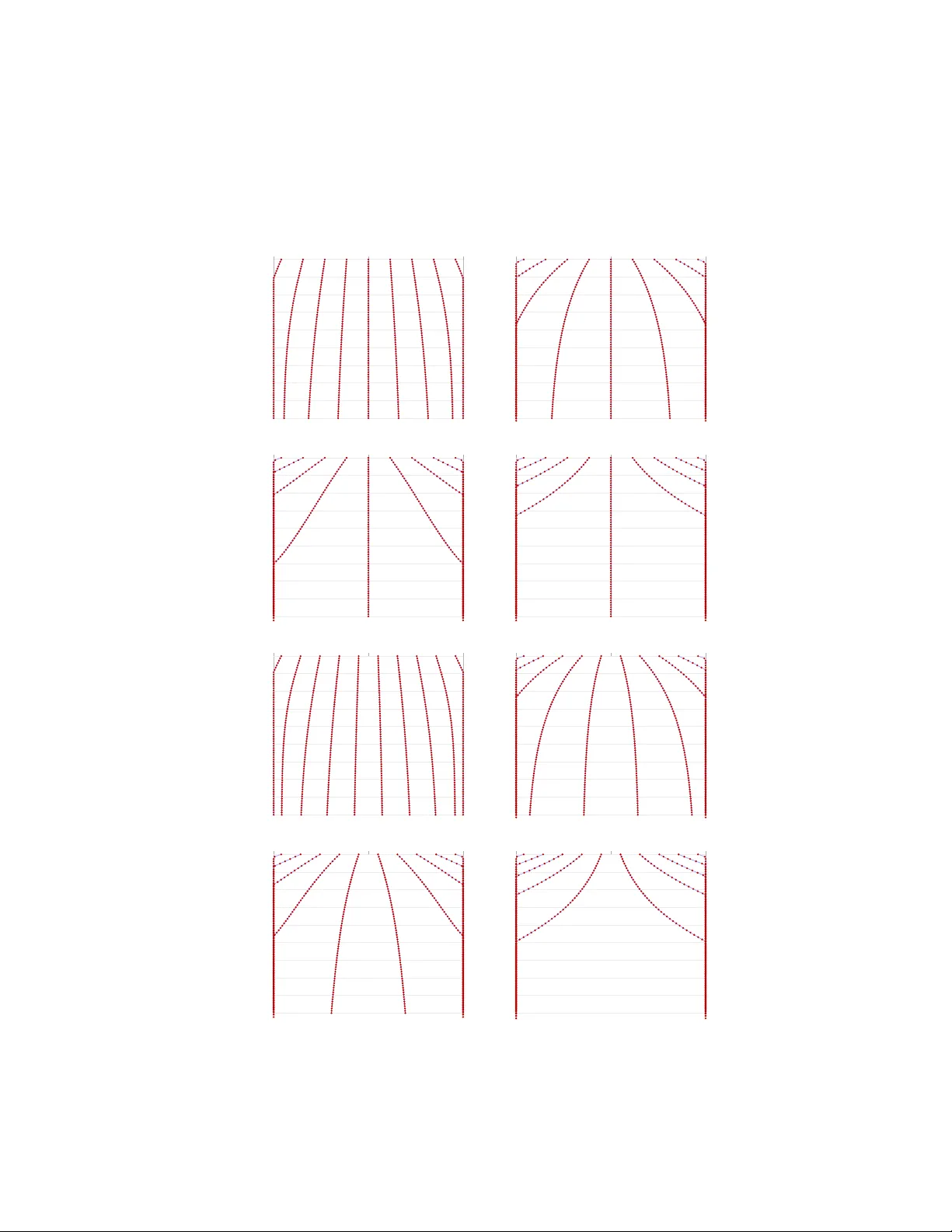
Critical phase transitions in minimum-ener gy configura tions f or the exponential kernel f amil y e −| x − y | q on the unit inter v al Mic hael T.M. Emmeric h F acult y of Information T echnology , Univ ersity of Jyv äskylä, Finland m.t.m.emmerich@jyu.fi Abstract W e study the optimal placement of k ordered p oints on the unit in terv al for the b ounded pair p otential K q ( d ) = e − d q , q > 0 . The family interpolates b et ween strongly cusp-like kernels for 0 < q < 1 , the threshold kernel e − d , and the flatter Gaussian-t ype regime q > 1 . Our emphasis is on the transition from collision-free minimizers to endpoint-collapsed minimizers. W e reformulate the problem in gap v ariables, record conv exit y , symmetry , and the Karush-Kuhn-T uc ker conditions, and give a short pro of that collisions are imp ossible for 0 < q < 1 . A t the threshold q = 1 w e reco ver the endpoint-clustering la w for e − d , while for q > 1 w e iden tify critical exp onen ts q k b ey ond whic h in terior p oin ts are no longer optimal. F or o dd k w e deriv e the exact universal v alue q 2 m +1 = log(1 / ( − log((1 + e − 1 ) / 2))) log 2 ≈ 1 . 396363475 , and for even k = 4 , 6 , . . . , 20 w e compute the numerical transition v alues q 4 ≈ 1 . 062682507 , q 6 ≈ 1 . 155601329 , q 8 ≈ 1 . 206132611 , q 10 ≈ 1 . 238523533 , q 12 ≈ 1 . 261308114 , q 14 ≈ 1 . 278305167 , q 16 ≈ 1 . 291510874 , q 18 ≈ 1 . 302082885 , q 20 ≈ 1 . 310744185 . W e also include comparison tables and diagrams for the k ernels e − √ d , e − d , and e − d 2 , briefly relate the b ounded family to the singular Riesz kernel d − s , and identify the q → 0 + limit with the F ekete/Cheb yshev–Lobatto configuration on [0 , 1] . 1 In tro duction F or an ordered k -tuple 0 ≤ x 1 ≤ · · · ≤ x k ≤ 1 , consider the discrete energy E k,q ( x 1 , . . . , x k ) := X 1 ≤ i 0 . (1) The purp ose of this note is to do cumen t and organize a transition phenomenon in the one-dimensional minimization of ( 1 ). The parameter q go verns the local shap e of the k ernel near the origin: e − d q = 1 − d q + O ( d 2 q ) ( d ↓ 0) . Hence q < 1 corresponds to an infinite lo cal slop e, q = 1 is the b orderline case, and q > 1 produces a k ernel that is flat at the origin. F or singular k ernels such as the Riesz family d − s , collisions are forbidden b ecause the energy div erges at zero; this is the classical setting of discrete energy minimization on rectifiable sets [ 1 , 3 , 4 ]. In con trast, PRIME AI p ap er the b ounded family ( 1 ) p ermits collisions in principle. The question is therefore not whether collisions are admissible, but when they become energetically optimal. The main findings of the present rep ort are the follo wing. • F or 0 < q < 1 , minimizers are collision-free. The pro of is based on the comparison ε q ≫ ε as ε ↓ 0 . • At the threshold q = 1 , partial endp oin t clustering o ccurs. Numerically one observ es m ( k ) = k + 1 3 coinciden t p oin ts at each endp oin t for k ≥ 2 . • F or q > 1 , one obtains a family of critical exp onents q k suc h that for q > q k all minimizers for the tested v alues k = 3 , . . . , 20 are supported only on { 0 , 1 } . • As q → 0 + for fixed k , the minimizers conv erge to the F ekete configuration on [0 , 1] , i.e. to the affine Cheb yshev–Lobatto p oin ts. • F or o dd k , the critical exp onen t is indep enden t of k and can b e derived in closed form. F or ev en k , the transition is describ ed b y a one-parameter symmetric branc h and yields the numerical v alues listed in T ables 1 and 2 . The pap er is organized as follows. Section 2 in tro duces the gap form ulation together with con vexit y , symmetry , and the KKT conditions. Section 3 giv es the local argument excluding collisions for 0 < q < 1 . Section 4 discusses the threshold case q = 1 , while Section 5 derives the critical exponents for q > 1 . Section 6 treats the asymptotic regime q → 0 + , and Section 7 compares the behavior with three representativ e k ernels and with the Riesz family . Section 8 provides numerical studies for gradien t flow at differen t v alues of k and q . Section 9 summarizes the picture and includes a first phase diagram for the ( k , q ) -plane. The app endix then records op en questions and collects the illustrative p oint diagrams. 2 Gap v ariables, con v exity , symmetry , and KKT conditions Let g r := x r +1 − x r , r = 1 , . . . , k − 1 . Then g r ≥ 0 and x j − x i = g i + · · · + g j − 1 . W riting g = ( g 1 , . . . , g k − 1 ) , the energy b ecomes E k,q ( g ) = X 1 ≤ i 0 and every k ≥ 2 , every minimizer of ( 1 ) satisfies x 1 = 0 and x k = 1 . Equivalently, in gap variables, k − 1 X r =1 g r = 1 . Pr o of. The kernel d 7→ e − d q is strictly decreasing on (0 , ∞ ) . If x 1 > 0 or x k < 1 , one can mo ve the leftmost p oin t to 0 or the rightmost p oint to 1 without decreasing any pairwise distance, and with at least one strict increase unless the p oin t is already at the endp oin t. Hence the energy strictly decreases. Lemma 2.2 (Conv exit y for q ≥ 1 ) . F or every fixe d k and q ≥ 1 , the gap-ener gy ( 2 ) is c onvex on the simplex ∆ k − 1 := n g ∈ [0 , ∞ ) k − 1 : k − 1 X r =1 g r = 1 o . Pr o of. F or q ≥ 1 , the map t 7→ t q is con vex and increasing, and u 7→ e − u is con vex and decreasing on [0 , ∞ ) . Th us t 7→ e − t q is conv ex. Each term in ( 2 ) is the comp osition of this conv ex function with a linear form in the gaps, and summing preserv es con v exity . 2 PRIME AI p ap er R emark 2.3 . F or 0 < q < 1 the map t 7→ e − t q is no longer conv ex on the whole half-line, but the lo cal argumen t excluding collisions b elo w uses only the short-distance asymptotics and not global conv exit y . Reflection ab out the midp oint sends ( x 1 , . . . , x k ) 7→ (1 − x k , . . . , 1 − x 1 ) and preserves the energy . In gap v ariables this is the rev ersal ( g 1 , . . . , g k − 1 ) 7→ ( g k − 1 , . . . , g 1 ) . Therefore symmetric minimizers exist whenev er con v exity p ermits av eraging. Lemma 2.4 (KKT condition) . A ssume q ≥ 1 and let g minimize ( 2 ) on ∆ k − 1 . Then ther e exists λ ∈ R such that for every r = 1 , . . . , k − 1 , X i ≤ r 0 , and the left-hand side is at most λ whenever g r = 0 . Pr o of. This is the standard Karush-Kuhn-T uc ker condition for minimization on the simplex. Differentiating ( 2 ) with resp ect to g r giv es ∂ E k,q ∂ g r = − X i ≤ r 0 . F or ε > 0 small, define a p erturb ed gap vector g ( ε ) b y increasing g r to ε and decreasing g s b y ε , lea ving all other gaps unc hanged. This keeps the total sum equal to 1 . P airs that cross the formerly zero gap g r gain at least 1 − e − ε q = ε q + O ( ε 2 q ) . Hence the total energy decreases by a quan tity b ounded b elow b y c 1 ε q for some c 1 > 0 . P airs affected b y the decrease of the p ositiv e gap g s lie at a strictly p ositiv e distance at ε = 0 , so their change is differentiable and b ounded in magnitude b y c 2 ε for some c 2 > 0 . Therefore E k,q ( g ( ε ) ) − E k,q ( g ) ≤ − c 1 ε q + c 2 ε + o ( ε ) . Since 0 < q < 1 , one has ε q ≫ ε as ε ↓ 0 , and the right-hand side is negativ e for all sufficiently small ε . This con tradicts minimalit y . R emark 3.2 (Threshold in terpretation) . A t q = 1 the tw o contributions are b oth of order ε , so the lo cal argumen t no longer forces p ositivit y of ev ery gap. This explains wh y the k ernel e − d is the threshold case at whic h collisions first become p ossible. F or q > 1 , the gain from op ening a zero gap is only of order ε q , whic h is to o small to dominate the global O ( ε ) balance. 3 PRIME AI p ap er 4 The threshold case q = 1 : endp oin t clustering F or q = 1 we recov er the exp onen tial k ernel K ( d ) = e − d . The computed minimizers on [0 , 1] display a remarkably regular endp oin t-clustering la w. F or k = 2 , . . . , 20 , the numerics supp ort m ( k ) = k + 1 3 coinciden t p oin ts at each b oundary , and therefore z ( k ) = m ( k ) − 1 = k − 2 3 zero gaps at eac h side. Equiv alen tly , only a cen tral blo c k of approximately one third of the gaps remains activ e. F or k = 1 , . . . , 10 the minimizing configurations are k = 1 : (0) , k = 2 : (0 , 1) , k = 3 : (0 , 1 2 , 1) , k = 4 : (0 , 0 . 121997 , 0 . 878003 , 1) , k = 5 : (0 , 0 , 1 2 , 1 , 1) , k = 6 : (0 , 0 , 0 . 251705 , 0 . 748295 , 1 , 1) , k = 7 : (0 , 0 , 0 . 070484 , 1 2 , 0 . 929516 , 1 , 1) , k = 8 : (0 , 0 , 0 , 0 . 312315 , 0 . 687685 , 1 , 1 , 1) , k = 9 : (0 , 0 , 0 , 0 . 167687 , 1 2 , 0 . 832313 , 1 , 1 , 1) , k = 10 : (0 , 0 , 0 , 0 . 049548 , 0 . 349849 , 0 . 650151 , 0 . 950452 , 1 , 1 , 1) . 5 Critical exp onen ts for q > 1 W e now ask for whic h v alues of q > 1 interior p oints cease to b e optimal. F or each k ≥ 3 , define q k := inf n q > 1 : all tested minimizers for E k,q are supp orted only on { 0 , 1 } o . The phrase “supp orted only on { 0 , 1 } ” means that every minimizing configuration found n umerically consists en tirely of a balanced split betw een the tw o endp oints. W e next derive exact and numerical formulas for q k when k = 3 , . . . , 20 . 5.1 Odd k : an exact universal critical v alue Let k = 2 m + 1 with m ≥ 1 . Consider the symmetric comp etitor with one in terior point, X odd , int = (0 , . . . , 0 | {z } m , 1 2 , 1 , . . . , 1 | {z } m ) , and the endp oin t-only configuration X odd , end = (0 , . . . , 0 | {z } m , 1 , . . . , 1 | {z } m +1 ) , up to reflection. Their energies are E odd , int ( q ) = m ( m − 1) + m 2 e − 1 + 2 me − 2 − q , and E odd , end ( q ) = m 2 + m ( m + 1) e − 1 . Equating them gives 2 e − 2 − q = 1 + e − 1 , hence q 2 m +1 = log 1 / − log ((1 + e − 1 ) / 2) log 2 ≈ 1 . 396363475 . (3) 4 PRIME AI p ap er Prop osition 5.1. F or every o dd k = 2 m + 1 , the explicit one-midp oint br anch X odd , int = (0 ( m ) , 1 2 , 1 ( m ) ) and the b alanc e d endp oint-only br anch X odd , end = (0 ( m ) , 1 ( m +1) ) cr oss exactly at the universal value ( 3 ) . Mor e pr e cisely, E odd , int ( q ) − E odd , end ( q ) = m 2 e − 2 − q − (1 + e − 1 ) , so the sign of the br anch differ enc e is indep endent of m . Pr o of. Subtracting the ab ov e formulas for E odd , int ( q ) and E odd , end ( q ) gives E odd , int ( q ) − E odd , end ( q ) = m 2 e − 2 − q − (1 + e − 1 ) . Hence the tw o branches cross exactly when 2 e − 2 − q = 1 + e − 1 , whic h is equiv alent to ( 3 ) . Since the factor m is positive, the sign of the branch difference is indep enden t of m . R emark 5.2 (Strengthened o dd- k evidence) . The prop osition pro ves that the crossing b et ween the tw o natural o dd branches is univ ersal for al l o dd k . What remains op en is whether this branch crossing is the true global transition for every odd k , i.e. whether no comp eting branc h with t w o or more in terior p oin ts can hav e lo wer energy near the transition. F or the o dd v alues chec ked n umerically b ey ond T able 1 , namely k = 11 , 13 , 15 , 19 , the same transition p ersists. W riting q odd for the v alue in ( 3 ), one finds for example at k = 11 that E odd , int (1 . 35) ≈ 35 . 95205407 < 36 . 03638324 ≈ E odd , end , while at q = 1 . 43 , E odd , int (1 . 43) ≈ 36 . 09652229 > 36 . 03638324 ≈ E odd , end . The same sign c hange is observed for k = 13 , 15 , 19 , supp orting the conjecture that ( 3 ) is the true critical exp onen t for every o dd k . 5.2 Ev en k : a one-parameter symmetric branc h Let k = 2 m with m ≥ 2 . The natural in terior branc h consists of tw o symmetric in terior p oin ts, X even , in t ( a ) = (0 , . . . , 0 | {z } m − 1 , a, 1 − a, 1 , . . . , 1 | {z } m − 1 ) , 0 ≤ a ≤ 1 2 , with energy E even , in t ( a ; q ) = ( m − 1)( m − 2) + ( m − 1) 2 e − 1 (4) + 2( m − 1) e − a q + e − (1 − a ) q + e − (1 − 2 a ) q . (5) The endp oint-only comp etitor is X even , end = (0 , . . . , 0 | {z } m , 1 , . . . , 1 | {z } m ) , with energy E even , end ( q ) = m ( m − 1) + m 2 e − 1 . Th us the ev en critical exp onen t is determined numerically by the equation min 0 ≤ a ≤ 1 / 2 E even , in t ( a ; q ) = E even , end ( q ) . The resulting v alues are display ed in T ables 1 and 2 . In particular, q 4 ≈ 1 . 062682507 , q 6 ≈ 1 . 155601329 , q 8 ≈ 1 . 206132611 , q 10 ≈ 1 . 238523533 , q 12 ≈ 1 . 261308114 , q 14 ≈ 1 . 278305167 , q 16 ≈ 1 . 291510874 , q 18 ≈ 1 . 302082885 , q 20 ≈ 1 . 310744185 . The o dd v alues remain pinned at ( 3 ) , whereas the ev en v alues increase with k throughout the tested range 4 ≤ k ≤ 20 . 5 PRIME AI p ap er T able 1: Critical exp onen ts q k for k = 3 , . . . , 10 . F or o dd k the v alue is exact and independent of k ; for ev en k the v alue is numerical, obtained b y comparing the symmetric interior branch ( 5 ) with the balanced endp oin t-only split. k q k transition branch 3 1 . 396363475 o dd: (0 ( m ) , 1 2 , 1 ( m ) ) 4 1 . 062682507 ev en: (0 ( m − 1) , a, 1 − a, 1 ( m − 1) ) 5 1 . 396363475 o dd: (0 ( m ) , 1 2 , 1 ( m ) ) 6 1 . 155601329 ev en: (0 ( m − 1) , a, 1 − a, 1 ( m − 1) ) 7 1 . 396363475 o dd: (0 ( m ) , 1 2 , 1 ( m ) ) 8 1 . 206132611 ev en: (0 ( m − 1) , a, 1 − a, 1 ( m − 1) ) 9 1 . 396363475 o dd: (0 ( m ) , 1 2 , 1 ( m ) ) 10 1 . 238523533 ev en: (0 ( m − 1) , a, 1 − a, 1 ( m − 1) ) T able 2: Extended numerical v alues of the ev en critical exponents q 2 m up to k = 20 . The data are consisten t with monotone increase in the tested range. k q k k q k k q k 4 1.062682507 10 1.238523533 16 1.291510874 6 1.155601329 12 1.261308114 18 1.302082885 8 1.206132611 14 1.278305167 20 1.310744185 6 The asymptotic regime q → 0 + The small- q limit do es not lead to equally spaced p oin ts. Instead, the first nontrivial term in the expansion of the energy selects the classical F ekete configuration on the in terv al. Prop osition 6.1 (Small- q asymptotics) . Fix k ≥ 2 and let X = ( x 1 , . . . , x k ) with 0 ≤ x 1 < · · · < x k ≤ 1 . Then, as q → 0 + , E k,q ( X ) = k 2 e − 1 − q e − 1 X 1 ≤ i 0 is equiv alen t, to first order, to maximizing P i 0 , collisions are imp ossible b ecause the pair energy diverges at d = 0 . In that sense the b ounded family e − d q exhibits a genuine b ounded-kernel phase transition absent from the Riesz case; see [ 1 , 3 , 4 ] for the classical background on Riesz energies. 8 Gradien t-flo w studies for differen t ( q , k ) regimes T o complemen t the static minimizers, it is helpful to visualize how p oint configurations mo ve under the energy gradient. F or this purp ose, we generated a family of gradient-flo w pictures in which the horizon tal axis represents the unit interv al [0 , 1] , while the v ertical axis represen ts an artificial time v ariable t , increasing from top to b ottom. Each horizontal slice therefore shows one intermediate configuration of the k p oin ts, and the full picture records a discrete gradient-descen t path. The resulting plots for q = 0 . 1 , q = 1 , q = q critical ( k ) , and q = 2 , with k = 9 , 10 , are sho wn in Figure 5 . F or fixed k and q , w e consider the energy E k,q ( x 1 , . . . , x k ) = X 1 ≤ i 1 , interior p oin ts persist only up to critical exp onen ts q k . • F or o dd k , the critical exp onent is the exact universal v alue ( 3 ). • F or ev en k , the critical exp onent is described by the symmetric t w o-interior-point branch and increases with k for the tested v alues k ≤ 20 . • As q → 0 + , the minimizing configurations con verge to the Chebyshev–Lobatto/F ek ete points rather than to the uniform grid. A first phase diagram in the ( k , q ) -plane is shown in Figure 3 . It summarizes the pro ved collision-free regime 0 < q < 1 , the threshold line q = 1 , the universal o dd critical v alue ( 3 ) , and the numerically computed ev en critical v alues up to k = 20 . Sev eral natural questions remain op en. Is the odd critical v alue ( 3 ) v alid for all o dd k ? Do es the sequence ( q 2 m ) m increase monotonically? Can one c haracterize the full large- k phase diagram in the ( k , q ) -plane? These app ear to b e tractable questions for a fuller pap er. 9 PRIME AI p ap er q k 0 0.5 1 1.5 2 4 6 8 10 12 14 16 18 20 q = 1 q odd ≈ 1 . 39636 collision-free regime (0 < q < 1) partial clustering endpoint-only states observ ed odd critical v alues even critical v alues Figure 3: A first attempt at a ( q , k ) phase diagram for the k ernel e −| x − y | q on [0 , 1] . The green region marks the prov ed collision-free regime 0 < q < 1 . The blue vertical line at q odd records the exact branch crossing for o dd k , while the red p oints show the computed even critical v alues for k = 4 , 6 , . . . , 20 . F or further study and result verification we refer to [ 2 ] Includes an op en-source online Python sim ulator for exploring numerically computed minimizing configurations for different v alues of k and q . An accompanying GitHub rep ository with Python code for the n umerical results is av ailable at https://github.com/TO- BE- INSERTED A App endix: Op en questions This app endix records three natural follow-up questions suggested b y the explicit form ulas and numerics ab o v e. Each question appears approachable b ecause the one-dimensional problem admits a gap form ulation, a strong symmetry reduction, and for q ≥ 1 a conv ex structure on the simplex of admissible gaps. A.1 Does the o dd critical v alue persist for all o dd k ? Prop osition 4.1 prov es that the branch crossing b et w een the one-midp oin t o dd configuration and the endp oin t- only o dd configuration o ccurs at the universal v alue ( 3 ) for every o dd k = 2 m + 1 . The remaining issue is global optimalit y: can one exclude the existence of a low er-energy competing branch with more than one in terior p oin t? A plausible route is to combine symmetry with a finite-dimensional reduction. F or odd k = 2 m + 1 , any symmetric configuration can b e written as (0 ( a 0 ) , y 1 , . . . , y r , 1 2 , z r , . . . , z 1 , 1 ( a 1 ) ) with a 0 + a 1 + 2 r + 1 = 2 m + 1 . At the candidate transition one would like to sho w that ev ery suc h branc h has energy at least that of the one-midp oint branch. Since the explicit branch difference in Prop osition 4.1 is linear in m , the real challenge is not the crossing itself but the exclusion of additional o dd branches. The numerical evidence currently av ailable is consistent with a positive answer: in addition to k = 3 , 5 , 7 , 9 , the v alues k = 11 , 13 , 15 , 19 displa y the same sign c hange at the universal o dd v alue. This strongly suggests the following conjecture. Conje ctur e A.1 . F or every o dd k = 2 m + 1 , the true global critical exponent equals the universal o dd v alue in ( 3 ). 10 PRIME AI p ap er A.2 Is the even sequence ( q 2 m ) m monotone? F or even k = 2 m the critical exp onents obtained from the symmetric t wo-in terior-point branch are q 4 ≈ 1 . 06268 , q 6 ≈ 1 . 15560 , q 8 ≈ 1 . 20613 , q 10 ≈ 1 . 23852 , q 12 ≈ 1 . 26131 , q 14 ≈ 1 . 27831 , q 16 ≈ 1 . 29151 , q 18 ≈ 1 . 30208 , q 20 ≈ 1 . 31074 . This suggests that ( q 2 m ) m is increasing. See also Figure 2 . If true, suc h monotonicit y would b e quite natural: as k gro ws, more colliding pairs can b e created at the endpoints, while the interv al budget remains fixed, so one exp ects endp oin t-only states to become fav orable for progressively smaller in terior branc hes. A p ossible proof strategy is to study the ev en branc h energy ( 5 ) after minimizing in a and to compare the resulting v alue for successive m . One w ould lik e to sho w that the function Φ m ( q ) := min 0 ≤ a ≤ 1 / 2 E even , in t ( a ; q ) − E even , end ( q ) c hanges sign exactly once and that the zero of Φ m mo ves monotonically with m . Because the formulas are explicit, this may b e accessible either analytically or via computer-assisted inequalities. A.3 What is the large- k phase diagram in the ( k , q ) -plane? The family e − d q app ears to exhibit three regimes. • F or 0 < q < 1 , all minimizers are collision-free. • At q = 1 , partial endpoint clustering emerges and empirically follows a one-third law. • F or q > 1 , endp oint-only configurations even tually dominate, with a parity effect b et w een odd and ev en k . A fuller phase diagram would describ e, for each pair ( k , q ) , the num b er of endp oin t-collapsed p oin ts and the dimension of the activ e in terior blo c k. F or large k , a natural goal is to identify asymptotic transition curv es separating regions with different n umbers of active interior p oin ts. The o dd/ev en dic hotom y already visible in T ables 1 and 2 suggests that parity surviv es at finite scale, but it is not yet clear whether it p ersists in a meaningful asymptotic form. Another attractiv e question is whether the threshold law for q = 1 can b e generalized to nearby v alues of q b y a p erturbativ e analysis. A t the end of this app endix we also note that an accompan ying GitHub repository with Python co de for the n umerical results is av ailable at https://github.com/emmerichmtm/phaseTransitionExpKernelsUnitLine References [1] S. V. Boro dac ho v, D. P . Hardin, and E. B. Saff, Discr ete Ener gy on R e ctifiable Sets , Springer Monographs in Mathematics, Springer, New Y ork, 2019. [2] M. T. M. Emmerich, Betw een Uniformity and Collision: A New Phase-T ransition, blog p ost, March 29, 2026. A v ailable at: https://emmerix.net/2026/03/29/between- uniformity- and- collision/ . [3] D. P . Hardin and E. B. Saff, Discretizing manifolds via minimum energy p oin ts, Notic es A mer. Math. So c. 51 (2004), no. 10, 1186–1194. [4] D. P . Hardin and E. B. Saff, Minimal Riesz energy p oint configurations for rectifiable d -dimensional manifolds, A dv. Math. 193 (2005), no. 1, 174–204. [5] F. Pausinger, Greedy energy minimization can coun t in binary: p oin t charges and the v an der Corput sequence, A nn. Mat. Pur a A ppl. 200 (2021), no. 1, 165–186. [6] S. Steinerb erger, Exp onen tial sums and Riesz energies, J. Numb er The ory 182 (2018), 37–56. 11 PRIME AI p ap er Collision-free regime q = 1 2 : e − √ d k = 1 k = 2 k = 3 k = 4 k = 5 k = 6 k = 7 k = 8 k = 9 k = 10 0 1 Threshold regime q = 1 : e − d k = 1 k = 2 k = 3 k = 4 k = 5 k = 6 k = 7 k = 8 k = 9 k = 10 0 1 Flat regime q = 2 : e − d 2 k = 1 k = 2 k = 3 k = 4 k = 5 k = 6 k = 7 k = 8 k = 9 k = 10 0 1 Figure 4: Stack ed p oin t diagrams for three representativ e kernels. Boundary p oin ts are drawn in dark red and stack ed v ertically when coincident. 12 PRIME AI p ap er Figure 5: Gradient flow plots for differen t com binations of q , k . 0 1 k = 9 , q = 0 . 1 x t = 0 t 0 1 k = 9 , q = 1 x t = 0 t 0 1 k = 9 , q = q odd ≈ 1 . 39636 x t = 0 t 0 1 k = 9 , q = 2 x t = 0 t 0 1 k = 10 , q = 0 . 1 x t = 0 t 0 1 k = 10 , q = 1 x t = 0 t 0 1 k = 10 , q = q 10 ≈ 1 . 23852 x t = 0 t 0 1 k = 10 , q = 2 x t = 0 t 13
Original Paper
Loading high-quality paper...
Comments & Academic Discussion
Loading comments...
Leave a Comment