Simplicial shells and thickness in the partition graph
For each positive integer $n$, let $G_n$ be the graph whose vertices are the partitions of $n$, with edges given by elementary transfers of one unit between parts, followed by reordering. We study the local simplex dimension in the clique complex $K_…
Authors: Fedor B. Lyudogovskiy
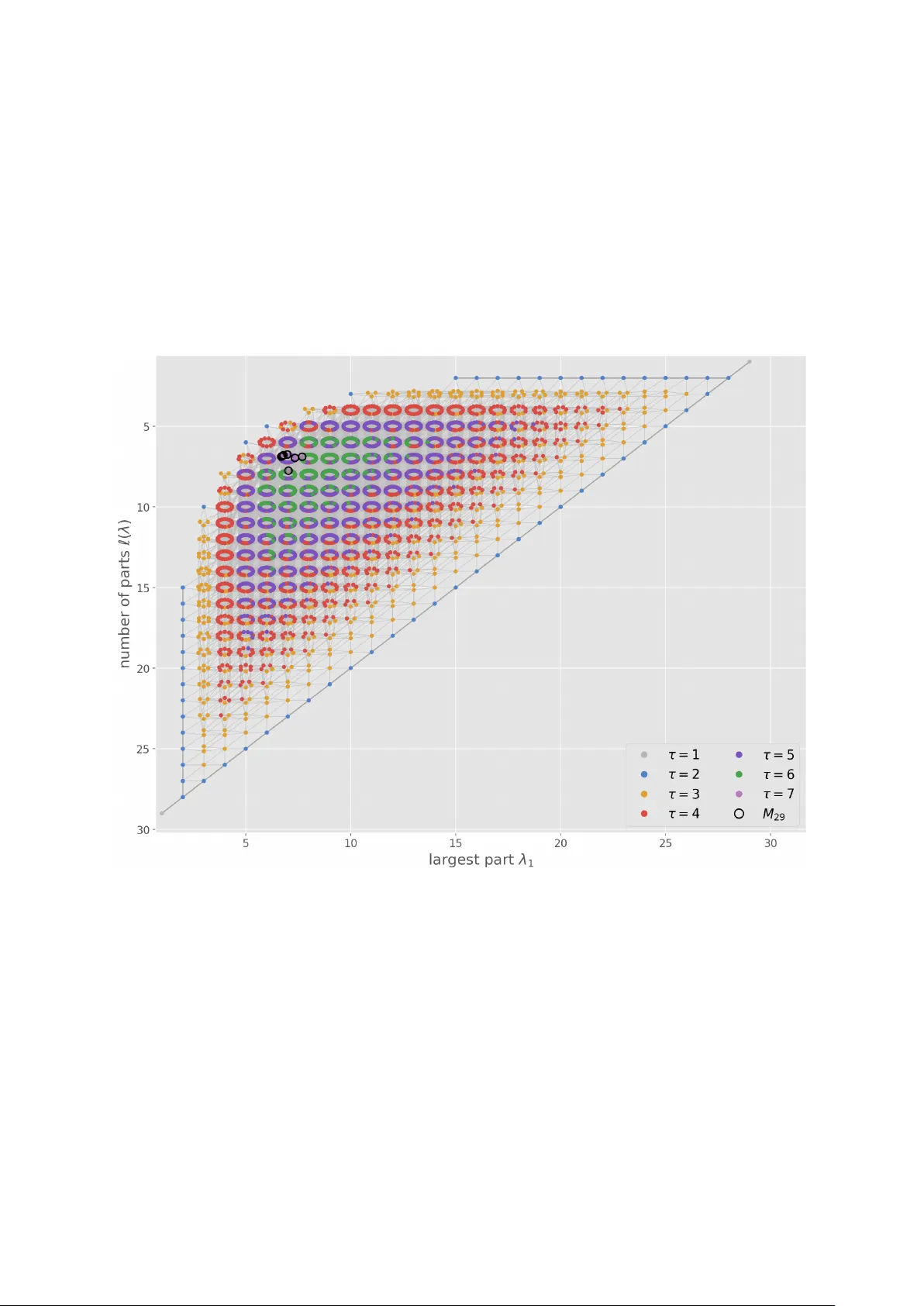
Simplicial shells and thic kness in the partition graph F edor B. Lyudogo vskiy Abstract F or eac h positive in teger n , let G n b e the graph whose v ertices are the partitions of n , with edges giv en by elemen tary transfers of one unit betw een parts, follow ed by reordering. In this pap er w e study the distribution of lo cal simplex dimension in the clique complex K n = Cl( G n ) as a geometric thickness in v ariant of the partition graph. F or a partition λ ⊢ n , let τ n ( λ ) := dim loc ( λ ) b e its simplicial thickness. This giv es rise to the threshold thick zones T ≥ r ( n ) = { λ : τ n ( λ ) ≥ r } , as w ell as to a shell/core decomp osition relativ e to the b oundary framew ork of G n : the outer shell S h r ( n ) is the b oundary-attached part of T ≥ r ( n ) , while the inner core C or e r ( n ) is its complemen tary interior part. Using lo cal-morphology results established earlier in the series, we work with simplicial thic kness as a lo cal inv arian t. In the present paper we pro ve that it is preserved b y conjuga- tion, that the induced thick zones, shells, and cores are conjugation-in v ariant, and that the an tennas remain strictly one-dimensional in the simplicial sense and are excluded from all non trivial thick zones. The first shell order at whic h a non trivial shell can o ccur is therefore 2 , and the corresp onding shell S h 2 ( n ) is the triangular skin, while the tetrahedral and higher simplicial regimes form nested higher-order shells inside the triangular regime. The paper also develops a computational atlas of simplicial thic kness for small and medium v alues of n . This yields first-occurrence tables for the regimes T ≥ r ( n ) and sup- p orts a stable atlas-based geometric pattern: substan tial higher-dimensional thick ening is concen trated not at the front extremes of the graph, but in its rear-central part. The pap er thereb y develops a systematic language for the b o dy geometry of the partition graph, distinguishing thin regions, a triangular skin, higher simplicial thick ening, outer shells, and inner cores. Keyw ords. integer partitions; partition graph; clique complex; simplicial thickness; lo cal simplex dimension; shells; cores; discrete geometry . MSC 2020. 05A17, 05C25, 05C38, 52B05. 1 In tro duction The partition graph G n is the graph whose vertices are the partitions of n , with adjacency giv en b y an elementary transfer of one unit b etw een t wo parts, follow ed by reordering. Although this graph is defined by a v ery simple lo cal mov e, its global geometry is highly nonuniform. Some parts of G n remain essen tially linear, some supp ort a p ersistent triangular structure, and others exhibit genuinely higher-dimensional simplicial b ehaviour. The purp ose of the present pap er is to in tro duce a first systematic language for this phenomenon. Graphs on in teger partitions defined by minimal lo cal mo ves b elong to the broader com- binatorial setting of partition Gra y codes and minimal-change generation; see, for example, Sa v age [12], Rasm ussen, Sav age, and W est [11], and Mütze [10]. F or a different graph mo del on partitions, based on binary-word enco dings and Hamming adjacency , see Bal [2]. 1 More precisely , we study the simplicial thickness of the partition graph. This is measured b y the lo cal simplex dimension in the clique complex K n := Cl( G n ) , that is, b y the dimension of the largest simplex of K n passing through a given vertex. In earlier pap ers of this series, this inv arian t was analyzed lo cally in terms of the transfer structure of a partition [4], while the global clique complex K n w as studied from a homotopy-theoretic p oint of view [3]. The fo cus here is different. Rather than studying the global homotopy t yp e of K n , w e study the geometric distribution of low- and high-dimensional simplicial regimes inside the graph G n itself. The guiding geometric picture is that the partition graph has not only an outer framework but also an in terior b o dy , and that this b o dy thick ens unevenly as n grows. A t the tw o extreme an tennas the graph sta ys thin. F urther in, one encoun ters a b oundary-attached triangular lay er. Only later do tetrahedral and higher-dimensional lo cal regimes app ear, and the av ailable data suggest that this stronger thic kening is not nucleated at the front end of the graph but in its rear-cen tral part in the descriptive sense of the atlas la yout. The aim is to express this geometric picture in a conserv ative com binatorial language. This viewp oint con tinues the geometric and morphological line initiated in [5, 7]. The starting p oin t is the lo cal simplicial thickness τ n ( λ ) := dim loc ( λ ) , defined for every partition λ ⊢ n . F rom this inv ariant we obtain the threshold thic k zones T ≥ r ( n ) := { λ ∈ Par( n ) : τ n ( λ ) ≥ r } . These zones give a natural nested filtration of the graph by increasing simplicial complexit y . Ho wev er, they do not b y themselves distinguish betw een b oundary-attached and gen uinely in terior b eha viour. F or this reason, w e in tro duce for eac h order r an outer simplicial shel l S h r ( n ) , defined as the b oundary-attached part of T ≥ r ( n ) relative to the b oundary framework, and an inner simplicial c or e C or e r ( n ) , defined as the complementary part of the same threshold zone. This language allows us to separate several levels of description that should not b e confused. First, there is the strictly combinatorial thickness filtration given by the sets T ≥ r ( n ) . Second, there is the geometric shell/core decomp osition of those thick zones relative to the b oundary framew ork. Third, there are broader in terpretive patterns, suc h as rear-cen tral concentration of high-dimensional b ehaviour, which ma y b e strongly supp orted by computation without y et b eing a v ailable in full theorem form. One of the metho dological aims of the paper is to k eep these lev els distinct. Main results The results of the pap er hav e tw o levels. First, we in tro duce a shell language for simplicial thick ening in the partition graph. This includes the threshold thick zones T ≥ r ( n ) , the outer shells S h r ( n ) , and the inner cores C or e r ( n ) . Within this framework, w e use from earlier w ork the fact that simplicial thickness is a lo cal in v arian t, and we prov e: • it is preserved by conjugation; • the an tennas are strictly one-dimensional in the simplicial sense; • the first shell order at which a non trivial shell can o ccur is 2 , with corresp onding shell S h 2 ( n ) , the triangular skin; 2 • higher shells are nested and develop inside the triangular regime. Second, we build a computational atlas of simplicial thickness and determine the first o ccur- rences of the regimes T ≥ r ( n ) in the computed range. This atlas supp orts a stable rear-cen tral thic kening pattern for tetrahedral and higher simplicial b ehaviour, in the descriptiv e sense of the c hosen co ordinate lay out. The pap er is organized as follows. Section 2 recalls the necessary bac kground on the partition graph, lo cal simplex dimension, and the boundary framew ork. Section 3 in tro duces the shell language and fixes the definitions of simplicial thickness, threshold thick zones, outer shells, and inner cores. Section 4 studies the exact one-dimensional regime and the role of the framework as the outer supp orting structure. Section 5 turns to the triangular skin. Section 6 studies the tetrahedral and higher simplicial regimes. Section 7 is devoted to maximal-thickness lo ci and the rear-cen tral thic kening pattern. Section 8 presen ts the computational atlas and the first-o ccurrence tables. The final section collects conclusions, conjectures, and op en problems. Collectiv ely , these results constitute a first dedicated study of the spatial b o dy geometry of G n . The aim is not merely to stratify the graph by lo cal simplex dimension, but to describ e where and how the partition graph ceases to b e thin. 2 Preliminaries and recalled notation In this section w e briefly recall the ob jects and pieces of terminology needed in the sequel. Only the material used directly in the present pap er is included. 2.1 The partition graph Let Par( n ) denote the set of all partitions of n . W e write partitions in weakly decreasing form, λ = ( λ 1 , λ 2 , . . . , λ ℓ ) , λ 1 ≥ λ 2 ≥ · · · ≥ λ ℓ > 0 , ℓ X i =1 λ i = n. The p artition gr aph G n is the graph whose vertex set is Par( n ) , with t wo partitions adjacent if one is obtained from the other b y an elementary transfer of one unit b etw een tw o parts, follo wed by reordering. Equiv alently , in F errers-diagram language, an edge corresp onds to remo ving one cell from one ro w, adding it to another row, and then restoring weakly decreasing order. W e write K n := Cl( G n ) for the clique complex of G n . F or standard background on in teger partitions and F errers dia- grams, see Andrews [1]. Lemma 2.1. F or every n ≥ 2 , the p artition gr aph G n is c onne cte d. Pr o of. Let λ = ( λ 1 , . . . , λ ℓ ) ⊢ n. If λ = ( n ) , there is nothing to prov e. Otherwise, one has ℓ ≥ 2 , so the first part and the last nonzero part are distinct. Remo ving one unit from the last nonzero part and adding it to the first part therefore pro duces, after reordering, a different partition of n obtained by an admissible elementary transfer in the sense defining the edges of G n . The first part strictly increases under this mo ve, while the total sum remains n ; equiv alently , the num b er of cells outside the first row strictly decreases. Rep eating this mov e therefore ev entually reaches ( n ) . Th us every vertex is connected to ( n ) , so G n is connected. 3 2.2 Lo cal simplex dimension F or a v ertex λ ∈ Par( n ) , the lo c al simplex dimension of λ in K n is dim loc ( λ ) := max { dim σ : λ ∈ σ, σ a simplex of K n } . Th us dim loc ( λ ) = 1 means that λ b elongs to an edge but to no triangle, while dim loc ( λ ) ≥ 2 means that λ lies in at least one triangle, and dim loc ( λ ) ≥ 3 means that it lies in at least one tetrahedron. In the present pap er we use the notation τ n ( λ ) := dim loc ( λ ) and refer to τ n ( λ ) as the simplicial thickness of λ . W e shall use the follo wing result from the earlier lo cal-morphology pap er. Prop osition 2.2. F or e ach n ≥ 1 , the value τ n ( λ ) is determine d by the or der e d lo c al tr ansfer typ e of λ . In p articular, simplicial thickness is a lo c al invariant in the tr ansfer-the or etic sense. W e do not rep eat the full formal definition of ordered lo cal transfer t yp e here, since only this lo calit y consequence is used in the present pap er. Roughly sp eaking, it records the partitions reac hable from λ by one admissible transfer together with the lo cal adjacency pattern among those neigh b ors, in the ordered form used in [4]. 2.3 Conjugation symmetry If λ = ( λ 1 , λ 2 , . . . ) is a partition, its conjugate partition is denoted by λ ′ . Conjugation acts naturally on F errers diagrams b y reflection across the main diagonal. Since elemen tary transfers are preserv ed by this op eration, conjugation defines an automorphism of the graph G n . Consequen tly , it also induces a simplicial automorphism of K n . 2.4 Boundary framew ork W e no w recall the outer supp orting structure of the partition graph. The t wo extreme vertices ( n ) and (1 n ) are called the antennas of G n . The main chain is the distinguished path joining the tw o antennas, namely ( n ) − − ( n − 1 , 1) − − ( n − 2 , 1 2 ) − − · · · − − (2 , 1 n − 2 ) − − (1 n ) . The left b oundary e dge is the family of tw o-part partitions ( n − k , k ) , 1 ≤ k ≤ ⌊ n/ 2 ⌋ , forming a distinguished b oundary path in G n . The right b oundary e dge is its conjugate family (2 k , 1 n − 2 k ) , 1 ≤ k ≤ ⌊ n/ 2 ⌋ . F or consecutiv e v alues of k , the partitions ( n − k , k ) and ( n − k − 1 , k + 1) are adjacent by a single elementary transfer from the first part to the second, so the left b oundary edge forms a path in G n . The right b oundary edge is its conjugate and therefore also forms a path. Definition 2.3. The b oundary fr amework of G n , denoted b y B n , is the union of the main chain, the left b oundary edge, and the right b oundary edge. This framework will serve as the reference b oundary relativ e to which shells and cores are defined. Its large-scale role was introduced in [5] and studied more sp ecifically from the outer and rear p oin t of view in [8]. 4 2.5 Axis, spine, and cen tral language T wo additional pieces of terminology will b e used later when discussing the lo calization of thic k zones. The self-c onjugate axis of G n is the set of self-conjugate partitions of n . It is fixed p oint wise b y conjugation. The spine is the distinguished axial substructure formed by the self-conjugate axis together with the chosen short bridges b et ween consecutive self-conjugate v ertices. In the present pap er the spine is used only as a geometric reference ob ject: we do not need its finer structural prop er- ties in the formal dev elopment of shells and cores. F or the axial and directional formalizations, see [6, 9]. Lik ewise, the terms fr ont , side , and r e ar are used only in the relative geometric sense es- tablished earlier in the series: the antennas represent the front extremes, the b oundary edges represen t the lateral b oundary , and the region opp osite the antennas will b e referred to as the rear part of the graph. 2.6 Scop e of recalled material The present pap er do es not revisit the global homotopy theory of the clique complex K n ; for that theory , see [3]. What matters for the present study is instead the local and mesoscopic geometry of the partition graph: the distribution of vertices of thic kness at least 2 , at least 3 , and higher, and the wa y these thick zones are attached to the b oundary framework or separated from it. 3 Simplicial thic kness, threshold zones, shells, and cores In this section we introduce the basic language used in the pap er to describ e the “thickness” of the partition graph G n . The starting p oin t is the local simplex dimension, which records the largest simplex of the clique complex K n = Cl ( G n ) passing through a given v ertex. F rom this in v ariant we obtain a nested family of threshold thic k zones. How ever, these threshold zones should not by themselves b e iden tified with geometric shells or cores. T o this end, w e in tro duce an explicit p ositional distinction b etw een the b oundary-facing part of a thic k zone and its interior remainder. 3.1 Lo cal simplicial thic kness F or a v ertex λ ∈ Par( n ) , define its simplicial thickness by τ n ( λ ) := dim loc ( λ ) , that is, the maximum dimension of a simplex of K n con taining λ . Equiv alently , if the largest clique of G n con taining λ has size m + 1 , then τ n ( λ ) = m. Th us: • τ n ( λ ) = 1 means that λ lies on an edge of G n but in no triangle; • τ n ( λ ) ≥ 2 means that λ participates in at least one triangle; • τ n ( λ ) ≥ 3 means that λ participates in at least one tetrahedron; • and so on. W e refer to τ n as the lo c al simplicial thickness pr ofile of G n . 5 3.2 Threshold thic k zones and exact regimes F or eac h integer r ≥ 0 , define the r -th thr eshold thick zone b y T ≥ r ( n ) := { λ ∈ Par( n ) : τ n ( λ ) ≥ r } . W e also define the exact r -dimensional simplicial r e gime by T = r ( n ) := { λ ∈ Par( n ) : τ n ( λ ) = r } . These sets form a nested filtration P ar( n ) = T ≥ 0 ( n ) ⊇ T ≥ 1 ( n ) ⊇ T ≥ 2 ( n ) ⊇ T ≥ 3 ( n ) ⊇ · · · . R emark 3.1 . The sets T ≥ r ( n ) are purely combinatorial and are defined en tirely in terms of lo cal simplex dimension. They should b e viewed as thickness zones , not yet as geometric shells. In particular, a set T ≥ r ( n ) ma y hav e several connected comp onents, may contain b oth b oundary and in terior vertices, and need not resem ble a shell in any geometric sense. R emark 3.2 . The exact regimes T = r ( n ) are useful for statistics and visualization, but they are not well suited to serve as th e primary shell language of the pap er. Indeed, the sets T = r ( n ) are generally not nested and need not reflect the outer-to-inner organization of the graph. F or this reason, the main geometric language b elow is built from the threshold zones T ≥ r ( n ) rather than from the exact levels T = r ( n ) . 3.3 Outer shells and inner cores Let B n ⊆ G n denote the b oundary framew ork recalled in Section 2. F or eac h r ≥ 1 , consider the induced subgraph G n [ T ≥ r ( n )] . Definition 3.3. The outer simplicial shel l of or der r , denoted S h r ( n ) ⊆ Par( n ) , is the set of v ertices b elonging to connected comp onents of G n [ T ≥ r ( n )] that meet the b oundary framew ork B n . Definition 3.4. The inner simplicial c or e of or der r , denoted C or e r ( n ) ⊆ Par( n ) , is the complementary subset C or e r ( n ) := T ≥ r ( n ) \ S h r ( n ) . Equiv alently , it is the set of v ertices b elonging to connected comp onen ts of G n [ T ≥ r ( n )] that do not meet B n . Th us each threshold zone splits canonically in to tw o disjoin t parts: T ≥ r ( n ) = S h r ( n ) ⊔ C or e r ( n ) . R emark 3.5 . The terminology “shell” is justified here in a conserv ative combinatorial sense: S h r ( n ) is not assumed to b e a top ological sphere, a manifold-like la yer, or even connected. It is simply the b oundary-attached part of the r -th thick zone. Likewise, C or e r ( n ) is not assumed to b e connected or unique. 6 R emark 3.6 . The notions S h r ( n ) and C or e r ( n ) are defined relative to the chosen b oundary framew ork B n . They are therefore not absolute geometric ob jects indep enden t of that choice, although in the present pap er the framework is fixed canonically . W e use the follo wing symmetry statement throughout the pap er. Prop osition 3.7. F or every n ≥ 1 and every p artition λ ⊢ n , τ n ( λ ) = τ n ( λ ′ ) . Conse quently, for every r ≥ 0 , the sets T ≥ r ( n ) and T = r ( n ) ar e invariant under c onjugation. Mor e over, for every r ≥ 1 , the shel ls S h r ( n ) and the c or es C or e r ( n ) ar e also c onjugation- invariant. Pr o of. Conjugation is an automorphism of the partition graph G n , hence a simplicial automor- phism of the clique complex K n . Therefore it preserves lo cal simplex dimension, so τ n ( λ ) = τ n ( λ ′ ) . The conjugation-in v ariance of the threshold zones and exact regimes follows immediately . Since the b oundary framework B n is conjugation-in v arian t, conjugation preserv es the prop- ert y of a connected comp onen t of G n [ T ≥ r ( n )] to meet B n . Hence it preserves b oth S h r ( n ) and C or e r ( n ) . 3.4 Lo w-dimensional sp ecial cases The first tw o nontrivial threshold lev els are esp ecially imp ortant. Definition 3.8. The threshold zone T ≥ 2 ( n ) is called the triangular r e gime of the partition graph. Its b oundary-attached part S h 2 ( n ) is called the triangular skin . Definition 3.9. The threshold zone T ≥ 3 ( n ) is called the tetr ahe dr al r e gime of the partition graph. Its b oundary-attac hed part S h 3 ( n ) is the outer tetr ahe dr al shel l , and its interior part C or e 3 ( n ) is the inner tetr ahe dr al c or e . F or r ≥ 4 , the zone T ≥ r ( n ) will be called the higher simplicial r e gime of or der r , with asso ciated shell S h r ( n ) and core C or e r ( n ) . 3.5 Wh y this c hoice of language There are several conceiv able w ays to formalize shell geometry in the partition graph. A first p ossibilit y would b e to identify the shell of order r with the exact lev el T = r ( n ) . This is to o rigid for the present pap er: exact levels are useful descriptiv ely , but they do not capture the monotone inw ard thick ening of the graph. A second p ossibility w ould be to call the full threshold zone T ≥ r ( n ) the shell of order r . This is to o broad: it mixes outer and inner b ehaviour and obscures the distinction b etw een a b oundary skin and a genuinely interior b o dy . W e therefore adopt a third, in termediate choice: • T ≥ r ( n ) is the formal r -thick zone; 7 • S h r ( n ) is its outer shell; • C or e r ( n ) is its inner core. This choice preserv es the com binatorial filtration by lo cal simplex dimension, while still allo wing a geometric discussion of outer skin, inner structure, and rear-cen tral n ucleation of thic kness. 4 The exact one-dimensional regime and the b oundary frame- w ork W e no w turn to the low est simplicial level. At first sight, the phrase “one-dimensional regime” ma y suggest the threshold zone T ≥ 1 ( n ) . Ho wev er, for n ≥ 2 this threshold is in fact trivial: ev ery vertex of G n b elongs to at least one edge. Th us the gen uinely informative ob ject at the lo west level is the exact one-dimensional regime T =1 ( n ) = T ≥ 1 ( n ) \ T ≥ 2 ( n ) , consisting of vertices that b elong to edges but to no triangles. This section has tw o aims. First, w e isolate the strictly one-dimensional b ehaviour of the an- tennas. Second, we explain wh y the b oundary framework serv es as the natural outer supp orting structure of the graph, while not b eing identified with the exact one-dimensional regime. 4.1 The first threshold lev el Prop osition 4.1. F or every n ≥ 2 , T ≥ 1 ( n ) = Par( n ) . F or n = 1 , one has T ≥ 1 (1) = ∅ . Pr o of. F or n = 1 , the graph G 1 consists of a single isolated vertex, so no vertex b elongs to an edge. Let no w n ≥ 2 . By Lemma 2.1, the graph G n is connected. Since | Par( n ) | ≥ 2 , no v ertex of a connected graph on more than one vertex can b e isolated. Hence every partition b elongs to at least one edge of G n , so τ n ( λ ) ≥ 1 for every λ ⊢ n . Corollary 4.2. F or every n ≥ 2 , T =1 ( n ) = Par( n ) \ T ≥ 2 ( n ) . Thus, for n ≥ 2 , the exact one-dimensional r e gime is pr e cisely the c omplement of the triangular r e gime within Par( n ) . Pr o of. Immediate from Prop osition 4.1. Prop osition 4.1 shows that the first threshold level carries essentially no in ternal geometry once n ≥ 2 . The first meaningful lo w-dimensional distinction therefore app ears b etw een the exact regime T =1 ( n ) and the triangular regime T ≥ 2 ( n ) . 8 4.2 The an tennas W e next isolate the strongest strictly one-dimensional vertices. Prop osition 4.3. F or every n ≥ 2 , the antennas ( n ) and (1 n ) have de gr e e 1 in G n . Pr o of. The partition ( n ) has a unique admissible elementary transfer, namely to ( n − 1 , 1) . Hence ( n ) has degree 1 . The statement for (1 n ) follo ws by conjugation symmetry . Lemma 4.4. L et v b e a de gr e e-one vertex of a gr aph G . Then the lo c al simplex dimension of v in the clique c omplex Cl( G ) e quals 1 . Pr o of. A degree-one vertex b elongs to an edge but to no triangle. Hence the largest simplex of Cl( G ) con taining it is 1 -dimensional. Prop osition 4.5. F or every n ≥ 2 , τ n (( n )) = τ n ((1 n )) = 1 . In p articular, for every r ≥ 2 , ( n ) , (1 n ) / ∈ T ≥ r ( n ) . Pr o of. Com bine Prop osition 4.3 with Lemma 4.4. Th us the tw o front extremes of the partition graph remain strictly one-dimensional in the simplicial sense. No nontrivial thick ening b egins at the an tennas. 4.3 The b oundary framew ork W e no w return to the b oundary framework B n recalled in Section 2. Although B n is not defined in terms of simplicial thic kness, it provides the geometric b oundary relative to whic h shells and cores are measured. Prop osition 4.6. F or every n ≥ 2 , the b oundary fr amework B n is a c onne cte d c onjugation- invariant sub gr aph of G n c ontaining b oth antennas. Pr o of. By construction, the main c hain is a path joining the tw o antennas. The left b oundary edge contains ( n − 1 , 1) , while the right b oundary edge con tains (2 , 1 n − 2 ) ; b oth of these vertices lie on the main c hain. Hence each b oundary edge meets the main chain and lies in the same connected comp onent as the main chain. Their union with the main c hain is therefore connected. Conjugation in v ariance is immediate from the symmetric construction, and the union contains b oth an tennas. R emark 4.7 . The b oundary framework B n should not b e iden tified with the exact one-dimensional regime T =1 ( n ) . The framework is a distinguished geometric carrier of the graph, whereas T =1 ( n ) is a thickness-defined lo cus. Some framework v ertices ma y b elong to triangles or higher sim- plices, so the tw o notions need not coincide. R emark 4.8 . The b oundary framework is the reference b oundary used in the shell/core formal- ism. Outer shells are defined relative to their attachmen t to B n , even though B n is not required to b e con tained in any fixed threshold zone T ≥ r ( n ) . 9 4.4 In terpretation The conclusions of this section can b e summarized as follows. F or n ≥ 2 , the threshold condition τ n ( λ ) ≥ 1 is automatic, so the first meaningful lo w- dimensional distinction is b etw een the exact one-dimensional regime T =1 ( n ) and the triangular regime T ≥ 2 ( n ) . A t the v ery front ends of the graph, the situation is completely rigid: the antennas ha ve simplicial thickness exactly 1 and are excluded from all higher thick zones. A t the same time, the b oundary framework pro vides the natural outer carrier relativ e to which higher shells are attac hed. This makes it the natural geometric reference ob ject for the study of triangular skin, tetrahedral regime, and subsequent thick ening. 5 The triangular skin W e no w pass to the first genuinely non trivial lev el of simplicial thic kening. Since T ≥ 1 ( n ) = P ar( n ) for n ≥ 2 , the first informative shell is the shell of order 2 , namely the boundary- attac hed part of the triangular regime. This is the ob ject that w e call the triangular skin of G n . 5.1 The first non trivial shell order Prop osition 5.1. F or every n ≥ 2 , S h 1 ( n ) = Par( n ) , C or e 1 ( n ) = ∅ . Henc e or der 2 is the first shel l or der at which a nontrivial shel l may o c cur. The c orr esp onding shel l S h 2 ( n ) , is the triangular skin. Pr o of. By Prop osition 4.1, one has T ≥ 1 ( n ) = Par( n ) . Th us the induced subgraph G n [ T ≥ 1 ( n )] is just G n itself. Since G n is connected and con tains the b oundary framework B n , every vertex b elongs to a connected comp onen t of G n [ T ≥ 1 ( n )] meeting B n . Therefore S h 1 ( n ) = Par( n ) . By definition, C or e 1 ( n ) = T ≥ 1 ( n ) \ S h 1 ( n ) = ∅ . Definition 5.2. The shell S h 2 ( n ) is called the triangular skin of the partition graph G n . Th us the triangular skin is defined as the shell of order 2 , which is the first shell order at whic h a nontrivial shell may o ccur. 10 5.2 Basic structural prop erties W e next record the elementary structural prop erties inherited from the general theory of shells and thic kness zones. Corollary 5.3. F or every n ≥ 1 , the triangular skin S h 2 ( n ) and the c omplementary c or e C or e 2 ( n ) ar e invariant under c onjugation. Pr o of. This is the case r = 2 of Prop osition 3.7. Corollary 5.4. F or every n ≥ 2 , ( n ) , (1 n ) / ∈ S h 2 ( n ) ∪ C or e 2 ( n ) . Pr o of. By Prop osition 4.5, the antennas do not b elong to T ≥ 2 ( n ) . Since S h 2 ( n ) ∪ C or e 2 ( n ) = T ≥ 2 ( n ) , the claim follows. Corollary 5.5. If S h 2 ( n ) = ∅ , then every c onne cte d c omp onent of the triangular skin me ets the b oundary fr amework away fr om the antennas. Pr o of. By definition, every connected component of the triangular skin meets B n . By Corol- lary 5.4, the antennas themselves do not b elong to S h 2 ( n ) . These statements already distinguish the triangular skin from the trivial first shell: it is b oundary-attac hed, but it do es not include the front extremes. 5.3 The triangular regime v ersus the exact one-dimensional regime Because T ≥ 1 ( n ) is trivial for n ≥ 2 , the first meaningful low-dimensional split is the decomp o- sition P ar( n ) = T =1 ( n ) ⊔ T ≥ 2 ( n ) . In this decomp osition, T =1 ( n ) is the exact one-dimensional regime, while T ≥ 2 ( n ) is the triangular regime. Th us the triangular regime T ≥ 2 ( n ) is the first threshold zone that distinguishes gen uinely simplicially thic k vertices from strictly one-dimensional ones. Equiv alently , by Corollary 4.2, T =1 ( n ) = Par( n ) \ T ≥ 2 ( n ) . The triangular skin S h 2 ( n ) is therefore the outer part of the first p otentially nontrivial thic k zone. By contrast, C or e 2 ( n ) measures an y interior triangle-b earing b ehaviour that is already detac hed from the framework. 5.4 In terpretation The preceding results justify the triangular skin as the first geometric shell of the partition graph in the simplicial sense. First, it o ccurs at the first shell order at which a nontrivial shell can arise: the shell of order 1 is still the whole graph, whereas the shell of order 2 isolates the b oundary-attac hed part of the triangular regime. Second, it is already separated from the front extremes: the antennas remain strictly one- dimensional and do not b elong to the triangular regime. Third, it is symmetric under conjugation, and hence naturally compatible with the axial geometry of the graph. 11 A t this stage, how ever, w e do not claim that the triangular skin is alwa ys connected, or that it alwa ys forms a single uniform strip along the whole outer b oundary . Those stronger geometric features b elong to the computational atlas and to the descriptive analysis dev elop ed later in the pap er. The p oint established in this section is more mo dest: S h 2 ( n ) is the b oundary-attached shell of order 2 , which is the first shell order at which a non trivial shell can o ccur. 6 T etrahedral and higher-dimensional thic k ening W e now pass from the shell of order 2 to the genuinely higher simplicial regimes. The trian- gular skin S h 2 ( n ) captures the b oundary-attached part of the triangular regime whenev er it is nonempt y . Beyond that level, one encoun ters vertices lying in tetrahedra and, later, in still higher-dimensional simplices of the clique complex. The emphasis in this section is structural rather than asymptotic. W e record the formal hierarc hy of higher thick zones, show how it in teracts with the shell language, and isolate the tetrahedral regime as the first level at which one can sp eak ab out a gen uinely higher-dimensional simplicial b o dy . 6.1 The tetrahedral and higher simplicial regimes Definition 6.1. The threshold zone T ≥ 3 ( n ) = { λ ∈ Par( n ) : τ n ( λ ) ≥ 3 } is called the tetr ahe dr al r e gime of the partition graph G n . Its shell S h 3 ( n ) will b e called the outer tetr ahe dr al shel l , and its core C or e 3 ( n ) the inner tetr ahe dr al c or e . Definition 6.2. F or each r ≥ 4 , the threshold zone T ≥ r ( n ) = { λ ∈ Par( n ) : τ n ( λ ) ≥ r } is called the higher simplicial r e gime of or der r . Its associated shell and core are denoted S h r ( n ) and C or e r ( n ) . Th us the simplicial-thickness filtration contin ues b eyond the triangular level as T ≥ 2 ( n ) ⊇ T ≥ 3 ( n ) ⊇ T ≥ 4 ( n ) ⊇ · · · . 6.2 Higher thic k ening o ccurs inside the triangular regime The filtration b y threshold thick zones immediately implies that ev ery genuinely higher-dimensional simplicial region is contained in the triangular regime. Prop osition 6.3. F or every n ≥ 1 and every r ≥ 3 , T ≥ r ( n ) ⊆ T ≥ 2 ( n ) . Conse quently, S h r ( n ) ⊆ S h 2 ( n ) . 12 Pr o of. The first inclusion is immediate from the definition: if τ n ( λ ) ≥ r with r ≥ 3 , then in particular τ n ( λ ) ≥ 2 . F or the second inclusion, every b oundary-attached connected comp onent of G n [ T ≥ r ( n )] is con tained in a connected comp onen t of G n [ T ≥ 2 ( n )] . If the smaller comp onen t meets the b ound- ary framework, then the larger one do es as well. Hence ev ery vertex of S h r ( n ) b elongs to S h 2 ( n ) . Corollary 6.4. F or every n ≥ 1 , T ≥ 3 ( n ) ⊆ T ≥ 2 ( n ) and S h 3 ( n ) ⊆ S h 2 ( n ) . Thus tetr ahe dr al b oundary b ehaviour, when pr esent, o c curs inside the triangular skin. Pr o of. This is the case r = 3 of Prop osition 6.3. This expresses a basic geometric principle: higher simplicial thick ening do es not replace the triangular la yer, but develops inside it. 6.3 Nested shells and non-nested cores The threshold zones are nested by definition. F or the shell language, this has an imp ortant one-sided consequence. Prop osition 6.5. F or every n ≥ 1 and every r ≥ 1 , S h r +1 ( n ) ⊆ S h r ( n ) . In p articular, S h 2 ( n ) ⊇ S h 3 ( n ) ⊇ S h 4 ( n ) ⊇ · · · . Pr o of. Ev ery b oundary-attached connected comp onent of G n [ T ≥ r +1 ( n )] is contained in a con- nected comp onent of G n [ T ≥ r ( n )] . If the smaller comp onent meets the b oundary framework, then the larger one do es as well. Hence every vertex of S h r +1 ( n ) b elongs to S h r ( n ) . R emark 6.6 . No analogous monotonicity for the inner cores C or e r ( n ) is asserted here. A higher- order interior comp onent ma y b e con tained in a b oundary-attached component of a low er-order threshold zone. R emark 6.7 . The monotonicit y in Prop osition 6.5 is monotonicit y in the thickness order r for fixed n . It should not b e confused with any monotonicity statement in the parameter n . This distinction is one of the reasons for separating shells from cores rather than working only with the threshold zones themselves. 6.4 First-o ccurrence parameters T o describ e the onset of higher simplicial regimes, we introduce the corresp onding first-o ccurrence parameters; their concrete v alues will b e determined in Section 8. Definition 6.8. F or each integer r ≥ 2 , define n r := min { n ≥ 1 : T ≥ r ( n ) = ∅ } , whenev er this set is nonempty . Equiv alently , n r is the first v alue of n for whic h the partition graph G n con tains a vertex of simplicial thic kness at least r . Th us n 2 is the first triangular threshold, n 3 the first tetrahedral threshold, and so on. The concrete v alues of these parameters, as w ell as the corresp onding geometric atlases, will b e determined in Section 8. R emark 6.9 . The present section do es not attempt to prov e explicit v alues of n r . Its purp ose is only to define the hierarch y of higher regimes and to establish the formal relations b etw een them. The actual first-o ccurrence table b elongs to the computational part of the pap er. 13 6.5 In terpretation The tetrahedral regime T ≥ 3 ( n ) is the first genuinely higher simplicial regime of the partition graph. F ormally , it sits inside the triangular regime, and its shell sits inside the triangular skin. This leads to a useful picture. The triangular skin provides the first nontrivial outer simpli- cial shell. Inside that shell, one ma y then encounter stronger forms of lo cal simplicial thickness: first tetrahedral, then higher-order. The nested shell structure S h 2 ( n ) ⊇ S h 3 ( n ) ⊇ S h 4 ( n ) ⊇ · · · captures the b oundary-facing part of this pro cess. A t the same time, the corresp onding inner cores require more caution. They are the natural candidates for the genuinely interior b o dy of the graph, but they do not automatically form a nested sequence. F or that reason, the geometric analysis of rear-central thick ening in the next section will b e formulated in terms of lo calization patterns rather than in terms of a naive monotone core filtration. 7 Maximal-thic kness lo ci and rear-central thic kening The previous sections in tro duced the shell language and the hierarc hy of triangular, tetrahedral, and higher simplicial regimes. W e no w turn to the geometric question that motiv ated muc h of this pap er: wher e do es the first substan tial thick ening of the partition graph o ccur? The guiding geometric observ ation is that higher simplicial thick ening do es not app ear to b e n ucleated at the antennas, nor uniformly along the outer b oundary . Instead, the av ailable data indicate a p ersisten t concentration of tetrahedral and higher b eha viour in the rear-central part of the graph. In this section we separate what can b e stated formally from what is presently supp orted primarily b y computation. 7.1 Maximal-thic kness lo ci A natural first ob ject is the set of vertices of maximal simplicial thickness. Definition 7.1. F or each n ≥ 1 , let τ max ( n ) := max { τ n ( λ ) : λ ∈ Par( n ) } , and define the maximal-thickness lo cus b y M n := { λ ∈ Par( n ) : τ n ( λ ) = τ max ( n ) } . Th us M n consists of the vertices where the simplicial thickness of G n is largest. Equiv alently , M n = T = τ max ( n ) ( n ) . In particular, if τ max ( n ) ≥ r , then M n ⊆ T ≥ r ( n ) . Prop osition 7.2. F or every n ≥ 1 , the maximal-thickness lo cus M n is invariant under c onju- gation. Pr o of. Immediate from Prop osition 3.7. Corollary 7.3. If τ max ( n ) ≥ 2 , then neither antenna b elongs to M n . Pr o of. By Prop osition 4.5, b oth antennas hav e simplicial thic kness 1 . Th us maximal-thickness lo ci are automatically separated from the t wo front extremes once the graph exhibits any nontrivial thick ening. 14 7.2 F ormal limits of the shell language The shell/core formalism is well suited for separating b oundary-attached and genuinely interior b eha viour. Ho wev er, it do es not b y itself iden tify a distinguished r e ar-c entr al region. That notion in volv es additional geometric interpretation relative to the ov erall shap e of the graph. More precisely , the follo wing facts are strict consequences of the previous sections: • higher simplicial regimes are contained in the triangular regime; • higher shells are nested inside the triangular skin; • an tennas are excluded from all nontrivial thic k zones; • maximal-thic kness lo ci are conjugation-inv ariant. What these facts do not yet determine is whether the first tetrahedral or higher zones are concen trated near the side b oundary , near the self-conjugate axis, around the spine, or more sp ecifically in the rear-central part of the graph. That further lo calization question is addressed computationally b elo w. R emark 7.4 . In this pap er, the term “rear-cen tral” is used as a descriptive term anchored in the computational la yout rather than as a formally axiomatized subset of G n . Roughly sp eaking, in the co ordinate la yout ( λ 1 , ℓ ( λ )) it refers to regions aw a y from the tw o antennas and the extreme b oundary strips, where the largest part and the num b er of parts are comparativ ely balanced. 7.3 Computational rear-cen tral pattern The atlas developed in Section 8 supp orts the following stable finite-range phenomenon. Observ ation 7.5 (Computational rear-central pattern) . In the c ompute d r ange 7 ≤ n ≤ 30 , that is, fr om the first tetr ahe dr al thr eshold onwar d, the maximal-thickness lo ci M n and the first r e alizations of tetr ahe dr al and higher simplicial r e gimes ar e c onc entr ate d in the r e ar-c entr al p art of the p artition gr aph. This is a finite-r ange observation, supp orte d by the c omputational atlas in Se ction 8 and dr awn fr om the c ompute d values of τ n ( λ ) , the first-o c curr enc e tables, and the r epr esentative figur es ther e. This restriction to n ≥ 7 is essen tial. F or 4 ≤ n ≤ 6 , the maximal simplicial thic kness is still only 2 , so the graph has not yet entered the tetrahedral regime. This formulation is delib erately restrained. It do es not claim that every vertex of T ≥ 3 ( n ) is rear-central, nor that the higher-dimensional regimes are ev entually connected, unique, or asymptotically confined to a sharply defined axial neighborho o d. The claim made here is weak er and more robust: the onset of substantial thickening is c onsistently r e ar-c entr al r ather than fr ontal. 7.4 Relation to the axis and the spine The rear-cen tral pattern is naturally related to the axial morphology developed earlier in the series. Because the maximal-thic kness lo cus is conjugation-in v arian t, it is compatible with the self- conjugate symmetry of the graph. This makes the self-conjugate axis and the spine natural reference ob jects for describing the placemen t of thick zones. In particular, when a high- thic kness region app ears in a conjugation-symmetric p osition, it is reasonable to compare it with the axis or with neighborho o ds of the spine. 15 Ho wev er, the present pap er does not require a theorem asserting that maximal-thickness v ertices lie on the axis or even at uniformly b ounded distance from the spine. The computed examples often suggest such a relationship, but at presen t this b elongs to the descriptive and conjectural lev el rather than to the strict theorem la yer. R emark 7.6 . F or the purp oses of this pap er, the axis and the spine are used as r efer enc e ge- ometries rather than as exact carriers of the thic k b o dy . They help describ e the lo cation of thic kening, but the shell/core formalism itself do es not reduce to axial language. 7.5 A conjectural strengthening The computational evidence suggests a stronger statement, which we form ulate separately . Conjecture 7.7. F or al l sufficiently lar ge n , the first genuinely higher simplicial b ehaviour of the p artition gr aph is nucle ate d in the r e ar-c entr al p art of G n . Equivalently, the e arliest tetr ahe dr al and higher-or der thick zones ar e asymptotic al ly sep ar ate d fr om the fr ont extr emes and ar e or ganize d ar ound the c entr al r e ar b o dy of the gr aph r ather than ar ound its antennas. A stronger v ariant w ould assert that the maximal-thickness lo cus even tually remains within a b ounded geometric neighborho o d of the spine, or of the rear-cen tral part of the self-conjugate axis. A t present w e do not formulate this as a principal conjecture, b ecause the current evidence, though suggestive, is b etter suited to motiv ate further computation than to supp ort a sharp er univ ersal claim. 7.6 In terpretation The results of this section clarify the role of rear-central thick ening in the pap er. A t the strict formal level, one can prov e that h igher simplicial regimes sit inside the triangular regime, that higher shells are nested, that antennas are excluded from all nontrivial thic k zones, and that maximal-thickness lo ci are conjugation-symmetric. A t the computational level, one observes something stronger: the first substantial thic kening is not merely non-an tennal, but rear-central. This is the sense in whic h the partition graph app ears to develop an inner bo dy . The graph does not simply b ecome thick er ev erywhere at once. Rather, higher-dimensional simplicial b ehaviour emerges in a geometrically biased w ay , with the rear-central part of the graph acting as the first stable site of substan tial thick ening. This rear-central nucleation pattern is one of the main geometric messages of the pap er. Its curren t status, how ev er, is inten tionally limited: it is supp orted strongly b y the computed atlas, but only partially by formal theorem-level arguments. 8 Computational atlas and first-o ccurrence tables This section contains the finite computational part of the pap er. Its purp ose is fourfold: • to record the first-o ccurrence v alues n r := min { n : T ≥ r ( n ) = ∅ } , for the first simplicial regimes; • to presen t an atlas of simplicial thickness maps for small and medium v alues of n ; • to describ e the placement of the maximal-thickness lo ci M n = { λ : τ n ( λ ) = τ max ( n ) } ; 16 • to pro vide the explicit finite evidence b ehind the rear-central thick ening pattern form ulated in Section 7. Throughout this section, all statements are finite computational statemen ts relative to the en umeration range under consideration. In the present v ersion, the computed range is 1 ≤ n ≤ 30 , so the upp er b ound is N = 30 . 8.1 Computational setup The computed range in the present pap er is 1 ≤ n ≤ 30 . F or each such n , w e enumerate the vertices of the partition graph G n , that is, all partitions λ ⊢ n . In particular, this is a complete finite computation rather than a sampled one; the largest graph considered is G 30 , with | P ar(30) | = 5604 v ertices. F or eac h partition λ ⊢ n , w e enumerate all admissible elemen tary transfers starting from λ . This determines the full lo cal transfer data of λ : the set of admissible mov es together with the ordered source/target structure required by Prop osition 2.2. Applying that imp orted result then yields the simplicial thickness τ n ( λ ) = dim loc ( λ ) . F rom these v alues we then derive the asso ciated threshold zones T ≥ r ( n ) = { λ : τ n ( λ ) ≥ r } , their shell/core decomp ositions, and the maximal-thickness lo ci M n = { λ : τ n ( λ ) = τ max ( n ) } . Equiv alently , the first-o ccurrence v alues are read off from the maxima τ max ( n ) = max { τ n ( λ ) : λ ∈ Par( n ) } via the identit y n r = min { n : τ max ( n ) ≥ r } . No heuristic search or partial sampling is used at this stage. Prop osition 8.1. F or e ach fixe d n with 1 ≤ n ≤ 30 , the pr o c e dur e describ e d ab ove c omputes the ful l function τ n : P ar( n ) → Z ≥ 0 . Conse quently it c omputes τ max ( n ) = max { τ n ( λ ) : λ ∈ Par( n ) } and de cides, for every r ≥ 0 , whether the r e gime T ≥ r ( n ) is empty. 17 Pr o of. F or fixed n ≤ 30 , the set Par( n ) is finite, and for each λ ∈ P ar( n ) the set of admissible elemen tary transfers out of λ is finite. Complete enumeration of those transfers therefore deter- mines, for every partition λ ⊢ n , the full lo cal transfer data needed to recov er its ordered lo cal transfer type. By Prop osition 2.2, this in turn determines τ n ( λ ) for ev ery suc h λ , and hence determines the maximum v alue τ max ( n ) . The final claim is immediate from the definition T ≥ r ( n ) = { λ ∈ Par( n ) : τ n ( λ ) ≥ r } . R emark 8.2 . The computation used in this pap er is completely finite and exhaustive in the range 1 ≤ n ≤ 30 : ev ery partition λ ⊢ n is pro cessed, ev ery admissible lo cal transfer out of λ is enumerated, and the resulting lo cal transfer data are then conv erted in to the v alue τ n ( λ ) via Prop osition 2.2. Th us the theorem-level claims of this section rest on the full computed dataset { τ n ( λ ) : λ ⊢ n, 1 ≤ n ≤ 30 } , not on visual insp ection of the atlas figures. The complete dataset is a v ailable from the author up on request. W e organize the resulting data in tw o complementary w ays: 1. as first-o c curr enc e tables , recording the smallest n for whic h a given simplicial regime ap- p ears; 2. as a ge ometric atlas , consisting of drawings of G n colored by the thickness function τ n and, where con venien t, b y the threshold zones T ≥ r ( n ) for small v alues of r . R emark 8.3 . The role of the atlas is not merely illustrativ e. It is part of the evidence for the geometric claims of the pap er, esp ecially for the distinction b et ween b oundary-attached triangular b ehaviour and the later rear-central nucleation of tetrahedral and higher thick ening. 8.2 First o ccurrences of simplicial regimes W e first record the v alues of n r := min { n : T ≥ r ( n ) = ∅ } for the first few nontrivial orders r . r n r first observ ed geometric description 2 4 first non trivial triangular regime 3 7 first tetrahedral regime; rear-cen tral 4 -v ertex maximal-thic kness lo cus 4 11 first regime of order 4 ; rear-cen tral 5 -v ertex maximal-thic kness lo cus 5 16 first regime of order 5 ; rear-cen tral 6 -v ertex maximal-thic kness lo cus 6 22 first regime of order 6 ; rear-cen tral 7 -v ertex maximal-thic kness lo cus 7 29 first regime of order 7 ; rear-cen tral 8 -v ertex maximal-thic kness lo cus T able 1: First-o ccurrence v alues n r for the regimes T ≥ r ( n ) in the computed range 1 ≤ n ≤ 30 . Theorem 8.4. The first-o c curr enc e values n 2 , n 3 , n 4 , . . . in the c ompute d r ange ar e exactly those liste d in T able 1. In p articular, the triangular, tetr ahe dr al, and higher simplicial r e gimes app e ar in strictly incr e asing or der thr oughout the c ompute d r ange. 18 Pr o of. By Prop osition 8.1, the complete computation determines the v alues τ max ( n ) for every in teger n with 1 ≤ n ≤ 30 . F or each fixed order r , the regime T ≥ r ( n ) is nonempty if and only if τ max ( n ) ≥ r . Hence the first-o ccurrence v alue n r = min { n : T ≥ r ( n ) = ∅ } is exactly the smallest integer n in the computed range with τ max ( n ) ≥ r . Applying this criterion to the computed v alues of τ max ( n ) for 1 ≤ n ≤ 30 yields the entries recorded in T able 1. The displa yed v alues are strictly increasing for r = 2 , 3 , 4 , 5 , 6 , 7 , whic h prov es the final claim. R emark 8.5 . The complete finite output of the computation consists of the v alues τ n ( λ ) f or all partitions λ ⊢ n with 1 ≤ n ≤ 30 . T ables 1 and 2 record only the threshold changes and selected geometric summaries extracted from that full dataset. 8.3 A tlas of simplicial thic kness maps T o visualize the b o dy geometry of G n , w e draw the partition graph with vertices colored ac- cording to the v alue of τ n ( λ ) . The atlas is organized by representativ e v alues of n chosen to sho w: • the first app earance of the triangular regime; • the first app earance of the tetrahedral regime; • the subsequen t growth of higher-order thick zones; • the c hanging relation b etw een b oundary-attac hed shells and interior cores. A t ypical atlas page contains: 1. the full graph G n colored b y τ n ; 2. the triangular skin S h 2 ( n ) highligh ted separately; 3. the tetrahedral regime T ≥ 3 ( n ) , when nonempty; 4. the maximal-thic kness lo cus M n . In the figures b elow, vertices are placed using the co ordinates ( λ 1 , ℓ ( λ )) , that is, largest part v ersus n umber of parts, with small offsets added when several partitions share the same pair of v alues. This pro duces a stable triangular reference lay out compatible with conjugation symmetry . F or visu al consistency with the framework-orien ted drawings used elsewhere in the pap er, smaller v alues of ℓ ( λ ) are placed higher on the page. R emark 8.6 . The six figures ab o ve show the first triangular, tetrahedral, and order- 4 , order- 5 , order- 6 , and order- 7 thresholds. Their role is to mark the decisiv e transitions in the gro wth of simplicial thic kness, rather than to provide an exhaustiv e pictorial census. 8.4 Maximal-thic kness lo ci W e next record the lo ci M n = { λ : τ n ( λ ) = τ max ( n ) } of v ertices of maximal simplicial thickness. 19 1 2 3 4 l a r g e s t p a r t 1 1 2 3 4 n u m b e r o f p a r t s ( ) ( 4 ) ( 1 4 ) = 1 = 2 = 3 M n Figure 1: Thic kness map of G 4 at the first triangular threshold n 2 = 4 . V ertices are colored by simplicial thickness τ 4 ( λ ) , and the maximal-thic kness lo cus M 4 is indicated b y blac k outlines. A t th is stage the only non trivial thic kness v alue is τ = 2 , realized b y the first triangular regime. n τ max ( n ) | M n | represen tative elemen t(s) of M n lo cation 7 3 4 (4 , 2 , 1) ; (3 , 3 , 1) rear-cen tral 11 4 5 (5 , 3 , 2 , 1) ; (4 , 4 , 2 , 1) rear-cen tral 16 5 6 (6 , 4 , 3 , 2 , 1) ; (5 , 5 , 3 , 2 , 1) rear-cen tral 22 6 7 (7 , 5 , 4 , 3 , 2 , 1) ; (6 , 6 , 4 , 3 , 2 , 1) rear-cen tral 29 7 8 (8 , 6 , 5 , 4 , 3 , 2 , 1) ; (7 , 7 , 5 , 4 , 3 , 2 , 1) rear-cen tral T able 2: Selected maximal simplicial thic kness data at the transition v alues where a new highest regime first app ears. R emark 8.7 . The geometric lab els in T able 2 are partly interpretiv e and should b e read together with Figures 2, 3, 4, 5, and 6. In particular, the designation “rear-cen tral” is used here as a descriptiv e lay out lab el rather than as a formally axiomatized subset of G n . The conjugation symmetry prov ed earlier implies that each M n is conjugation-in v ariant. T able 2 records the transition v alues at which a new maximal simplicial-thickness level first app ears. The atlas shows that this symmetry is compatible with a pronounced geometric bias: the maximal-thic kness lo ci are not distributed uniformly across the graph. 8.5 Boundary-attac hed shells v ersus in terior cores The atlas also allows one to compare the outer shells S h r ( n ) with the inner cores C or e r ( n ) for the first few nontrivial orders. A t the triangular lev el, the dominan t visible phenomenon is b oundary-attac hed: the shell of order 2 is the triangular skin S h 2 ( n ) . At the tetrahedral level and ab ov e, one b egins to see a differen t b eha viour: the first substantial higher-dimensional zones are no longer well describ ed 20 1 2 3 4 5 6 7 l a r g e s t p a r t 1 1 2 3 4 5 6 7 n u m b e r o f p a r t s ( ) ( 7 ) ( 1 7 ) T = 1 S h 2 C o r e 3 M 7 Figure 2: Threshold-zone view of G 7 at the first tetrahedral threshold n 3 = 7 . Gray v ertices form the exact one-dimensional regime T =1 (7) , blue v ertices b elong to the triangular skin S h 2 (7) , and red vertices form the inner tetrahedral core C or e 3 (7) . The maximal-thic kness lo cus M 7 is indicated b y black outlines; its cardinalit y is recorded in T able 2. simply as a uniform thick ening of the b oundary , but instead appear as lo calized interior or rear-cen tral concentrations. R emark 8.8 (Computational shell/core atlas pattern) . In the computed range, the passage from S h 2 ( n ) to T ≥ 3 ( n ) marks the transition from an outer tw o-dimensional skin to a more lo calized higher-dimensional b o dy . In particular, tetrahedral and higher-order b eha viour is more concen trated and less purely b oundary-driven than the triangular regime. 8.6 What the atlas do es and do es not pro v e The computational atlas establishes finite facts and stable finite-range geometric patterns. It pro ves the explicit first-o ccurrence table in the computed range and supp orts the finite-range v ersion of rear-central thick ening expressed in Observ ation 7.5. A t the same time, the atlas do es not by itself pro ve stronger asymptotic claims. In particular, it do es not establish any of the following: • ev entual connectedness or uniqueness of C or e 3 ( n ) ; • ev entual monotonic growth of the cores C or e r ( n ) ; • confinemen t of maximal-thickness lo ci to a uniformly b ounded neigh b orho o d of the spine; • a univ ersal asymptotic law for the geometry of T ≥ r ( n ) . These remain op en problems, even if the computed examples strongly suggest some of them. 21 1 2 3 4 5 6 7 8 9 10 11 l a r g e s t p a r t 1 1 2 3 4 5 6 7 8 9 10 11 n u m b e r o f p a r t s ( ) ( 1 1 ) ( 1 1 1 ) = 1 = 2 = 3 = 4 M 1 1 Figure 3: Thic kness map of G 11 at the first threshold n 4 = 11 for simplicial thickness 4 . The order- 4 regime is outlined in black and is embedded inside the broader triangular and tetrahedral la yers. Its cardinality is recorded in T able 2. 8.7 In terpretation The atlas confirms the central geometric picture of the pap er. The first shell order at whic h a nontrivial shell o ccurs in the computed range is triangular and b oundary-attached. This is the outer skin of the partition graph in the simplicial sense. Stronger thick ening app ears later, first at the tetrahedral lev el and then at higher orders. When it app ears, as in Figures 2, 3, 4, 5, and 6, it is not front-an tennal but rear-central. Th us the graph do es not merely accum ulate simplices in an undifferen tiated wa y . Rather, it dev elops a stratified b o dy: first an outer triangular skin, then a more lo calized tetrahedral and higher-dimensional interior. This is the sense in whic h the shell language introduced in the pap er captures the spatial organization of simplicial thickness in the partition graph. 22 Figure 4: Thic kness map of G 16 at the first threshold n 5 = 16 for simplicial thickness 5 . The maximal-thic kness locus is outlined in black and remains lo calized w ell inside the triangular skin and aw ay from the fron t extremes of the framew ork. Its cardinality is recorded in T able 2. 23 Figure 5: Thic kness map of G 22 at the first threshold n 6 = 22 for simplicial thickness 6 . The maximal-thic kness lo cus M 22 is outlined in blac k. Its cardinality is recorded in T able 2. Its p osition is consisten t with the same rear-central bias observ ed at earlier transition levels. 24 Figure 6: Thic kness map of G 29 at the first threshold n 7 = 29 for simplicial thickness 7 . The maximal-thic kness lo cus M 29 is outlined in blac k. Its cardinality is recorded in T able 2. Its p osition con tinues the same rear-central lo calization pattern at the next transition level. 25 9 Conclusion and op en problems In this pap er w e in tro duced a first systematic language for the simplicial b o dy geometry of the partition graph G n . The starting p oin t was the lo cal simplex dimension τ n ( λ ) = dim loc ( λ ) , view ed here as a simplicial thickness function on the vertices of G n . F rom it w e obtained the threshold thic k zones T ≥ r ( n ) = { λ : τ n ( λ ) ≥ r } , and then refined this formal filtration b y separating eac h threshold zone in to its b oundary- attac hed part S h r ( n ) and its complementary interior part C or e r ( n ) . This language makes it p ossible to distinguish several phenomena that should not b e iden- tified with one another: • the exact simplicial stratification by the v alues of τ n ; • the threshold thick zones T ≥ r ( n ) ; • the outer shells S h r ( n ) attac hed to the b oundary framework; • the inner cores C or e r ( n ) detac hed from that framework; • the broader geometric interpretation of the graph as acquiring an interior b o dy . A t the strict structural level, the pap er established the following p oin ts. Using earlier lo cal- morphology results, simplicial thickness is treated here as a lo cal in v arian t determined by the lo cal transfer structure of a partition. In the presen t pap er we pro ve that it is preserved b y conjugation, and so are the induced threshold zones, shells, and cores. The antennas remain strictly one-dimensional in the simplicial sense and are excluded from all nontrivial thic k zones. The shell filtration S h 2 ( n ) ⊇ S h 3 ( n ) ⊇ S h 4 ( n ) ⊇ · · · is monotone, whereas no comparable monotonicity is asserted for the inner cores. These facts pro vide a conserv ative combinatorial framework for talking ab out thick ening in G n . A t the geometric level, the pap er iden tified the triangular skin S h 2 ( n ) as the shell of order 2 , that is, the first shell order at whic h a nontrivial shell can o ccur in the simplicial-thic kness filtration. This is the b oundary-attac hed part of the first triangular regime. Bey ond it lies the tetrahedral regime T ≥ 3 ( n ) and then the higher simplicial regimes T ≥ r ( n ) , r ≥ 4 , whose emergence is interpreted as the onset of a gen uinely higher-dimensional b o dy . The computational atlas then adds a further geometric message. Within the computed range, the first substantial higher-dimensional thic kening is concen trated not at the front ex- tremes of the graph, but in its rear-cen tral part. This rear-central bias is one of the main qualitativ e conclusions of the pap er, although its present status remains computational rather than fully asymptotic. The language in tro duced here is intended as an initial framework rather than a final theory . It isolates the minimal formal structure needed to discuss the b o dy geometry of the partition graph, while leaving several natural directions op en. 26 9.1 Op en problems W e conclude b y listing some natural problems suggested by the presen t work. Problem 9.1 (First-occurrence theory) . Determine explicit formulas, b ounds, or structur al criteria for the first-o c curr enc e values n r = min { n : T ≥ r ( n ) = ∅ } . Even p artial r esults for the first few values n 2 , n 3 , n 4 would alr e ady clarify the onset of simplicial thickening. Problem 9.2 (T riangular skin geometry) . Give a finer structur al description of the triangular skin S h 2 ( n ) . Is it c onne cte d for al l sufficiently lar ge n ? Do es it eventual ly form a single c oher ent b oundary strip? How do es it inter act with the r e ar c ontour and the side b oundary e dges? Problem 9.3 (T etrahedral core geometry) . Study the first nontrivial inner c or es C or e 3 ( n ) , C or e 4 ( n ) , . . . . When ar e they nonempty? A r e they c onne cte d? Do they eventual ly c ontain a distinguishe d main c omp onent that deserves to b e c al le d the tetr ahe dr al c or e of the gr aph? Problem 9.4 (Rear-central n ucleation) . T urn the r e ar-c entr al thickening p attern into a pr e cise asymptotic the or em. This r e quir es a sufficiently r obust c ombinatorial definition of “r e ar-c entr al” that is c omp atible with the ge ometry of G n and stable acr oss gr owing values of n . Problem 9.5 (Thic kness and axial morphology) . Clarify the r elation b etwe en high-thickness lo ci and the self-c onjugate axis or the spine. Do maximal-thickness vertic es eventual ly stay ne ar the axis? Do higher thick zones or ganize themselves ar ound a b ounde d neighb orho o d of the spine? Problem 9.6 (Thic kness v ersus b oundary morphology) . Study the inter action b etwe en simpli- cial thickness and the pr eviously develop e d outer morpholo gy of the gr aph. How exactly do the shel ls S h r ( n ) r elate to the fr amework, to the r e ar c ontour, and to the e ar structur es? Can one describ e the tr ansition fr om outer b oundary ge ometry to inner b o dy ge ometry in a uniform way? Problem 9.7 (Monotonicit y and p ersistence) . Determine which asp e cts of thickening p ersist monotonic al ly as n gr ows. The shel l filtr ation is monotone in the thickness or der r for fixe d n , but little is curr ently known ab out monotonicity in the p ar ameter n . Do the first tetr ahe dr al and higher zones p ersist under natur al overlays G n → G n + k ? Problem 9.8 (Quan titative thickness statistics) . Develop glob al statistics for simplicial thick- ness: the distribution of the values of τ n , the size of the thr eshold zones T ≥ r ( n ) , the size and multiplicity of maximal-thickness lo ci, and the asymptotic pr op ortion of vertic es b elonging to the triangular, tetr ahe dr al, and higher r e gimes. Problem 9.9 (Alternative shell formalisms) . Comp ar e the shel l/c or e formalism use d in this p ap er with other p ossible appr o aches. F or example, one may ask whether exact levels T = r ( n ) , distanc e-b ase d c entr al neighb orho o ds, or spine-b ase d neighb orho o ds yield e quivalent or genuinely differ ent notions of b o dy ge ometry. 27 9.2 Final p ersp ective The partition graph is not merely a graph with man y lo cal simplices. It has a discernible spatial organization of simplicial complexity . Some parts remain thin, some form an outer triangular skin, and some develop gen uinely higher-dimensional b ehaviour. The present pap er provides a first conserv ative language for describing this transition. In this sense, the pap er offers not a final classification but an initial geometric accoun t of the b o dy of G n , aimed at form ulating the next questions precisely . The central contribution of the pap er is to formulate the next questions precisely: where thick ening b egins, how it propagates, ho w outer shells pass into inner cores, and why the strongest thick ening app ears to b e organized rear-cen trally rather than frontally . A c kno wledgemen ts The author ackno wledges the use of ChatGPT (Op enAI) for discussion, structural planning, and editorial assistance during the preparation of this manuscript. All mathematical statemen ts, pro ofs, computations, and final wording were chec k ed and approv ed b y the author, who takes full resp onsibilit y for the conten ts of the pap er. References [1] George E. Andrews. The The ory of Partitions . Encyclop edia of Mathematics and its Ap- plications, V ol. 2. A ddison–W esley , Reading, MA, 1976. [2] Hartosh Singh Bal. Lognormal degree distribution in the partition graphs. arXiv pr eprint arXiv:2202.09819 , 2022. [3] F edor B. Lyudogovskiy . The homotopy t yp e of the clique complex of the partition graph. arXiv pr eprint arXiv:2603.14370 , 2026. [4] F edor B. Lyudogo vskiy . Lo cal morphology of the partition graph. arXiv pr eprint arXiv:2603.18696 , 2026. [5] F edor B. Lyudogo vskiy . The partition graph as a growing discrete geometric ob ject. arXiv pr eprint arXiv:2603.21221 , 2026. [6] F edor B. Lyudogovskiy . Axial morphology of the partition graph: self-conjugate axis, spine, and concen tration. arXiv pr eprint arXiv:2603.22546 , 2026. [7] F edor B. Lyudogovskiy . Simplex stratification and phase b oundaries in the partition graph. arXiv pr eprint arXiv:2603.23228 , 2026. [8] F edor B. Lyudogo vskiy . Boundary framew ork, rear morphology , and rectangular ears in the partition graph. arXiv pr eprint arXiv:2603.24824 , 2026. [9] F edor B. Lyudogo vskiy . Directional geometry and anisotropy in the partition graph. arXiv pr eprint arXiv:2603.25488 , 2026. [10] T orsten Mütze. Combinatorial Gray co des—an up dated survey . Ele ctr onic Journal of Com- binatorics , 30(3):#DS26, 2023. [11] Da vid Rasmussen, Carla D. Sav age, and Douglas B. W est. Gray code enumeration of families of integer partitions. Journal of Combinatorial The ory, Series A , 70(2):201–229, 1995. 28 [12] Carla D. Sav age. Gray co de sequences of partitions. Journal of Algorithms , 10(4):577–595, 1989. 29
Original Paper
Loading high-quality paper...
Comments & Academic Discussion
Loading comments...
Leave a Comment