Diffusion Maps is not Dimensionality Reduction
Diffusion maps (DMAP) are often used as a dimensionality-reduction tool, but more precisely they provide a spectral representation of the intrinsic geometry rather than a complete charting method. To illustrate this distinction, we study a Swiss roll…
Authors: Julio C, anedo, Alej
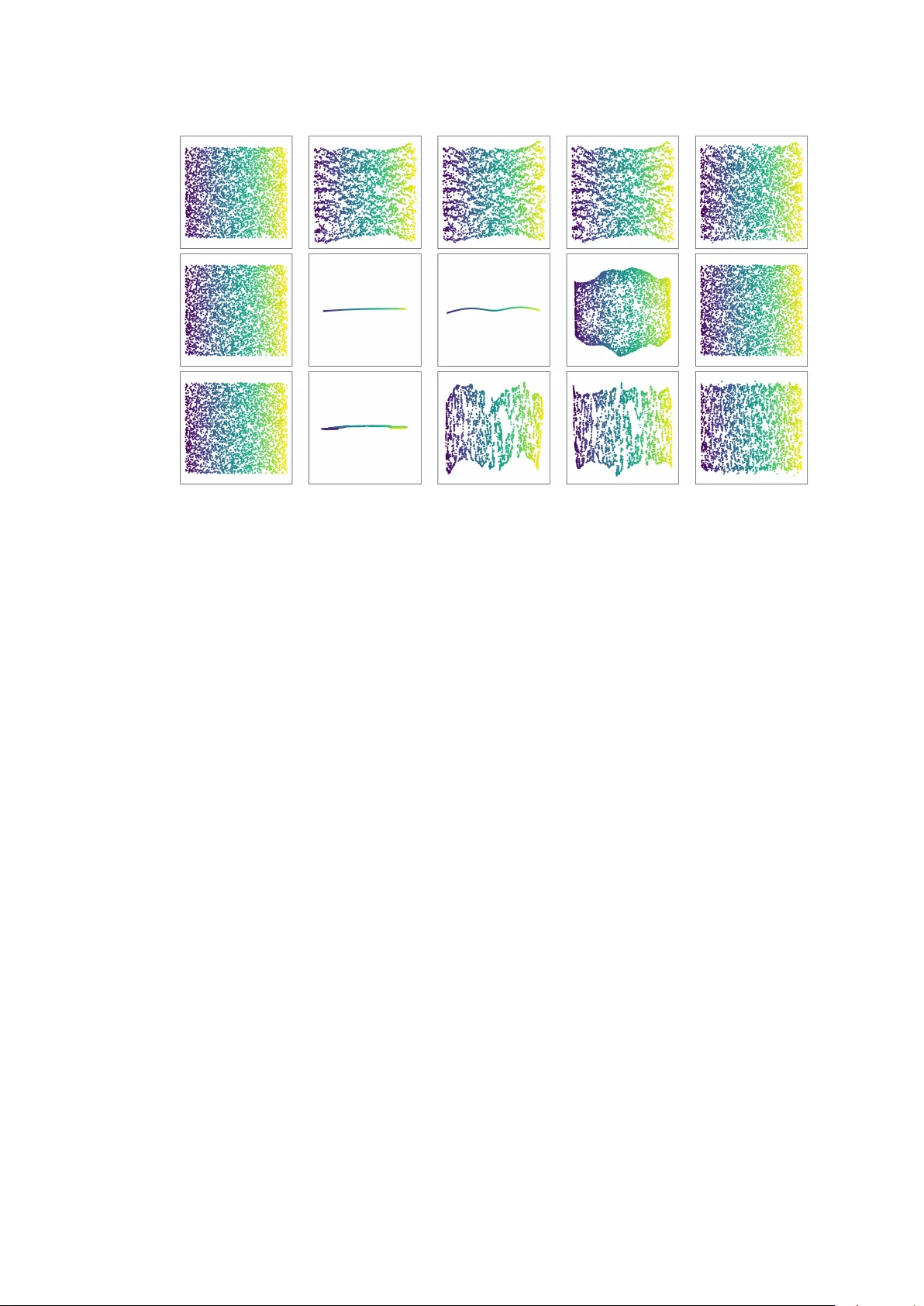
Diffusion Maps is not Dimensionalit y Reduction Julio Candanedo ∗ Alejandro P ati ˜ no † Abstract Diffusion maps (DMAP) are often used as a dimensionality-reduction to ol, but more precisely they pro vide a sp ectral represen tation of the in trinsic geometry rather than a complete c harting method. T o illustrate this distinction, w e study a Swiss roll with kno wn isometric co ordinates and compare DMAP , Isomap, and UMAP across latent dimensions. F or eac h representation, we fit an oracle affine readout to the ground-truth c hart and measure reconstruction error. Isomap most efficiently recov ers the lo w-dimensional c hart, UMAP pro vides an in termediate tradeoff, and DMAP becomes accurate only after combining m ultiple diffusion mo des. Thus the correct chart lies in the span of diffusion co ordinates, but standard DMAP do not b y themselv es iden tify the appropriate com bination. 1. In tro duction High-dimensional data are often mo deled as samples from, or near, a low-dimensional Riemannian manifold M , in the sense of the manifold hypothesis [F efferman et al., 2016]. In this setting, the natural geometric ob ject is not a co ordinate c hart chosen in adv ance, but the manifold itself together with its in trinsic differential operators, foremost the Laplace–Beltrami (LB) op erator ∆ M . On a compact manifold, the eigenfunctions { ϕ n } n ≥ 0 of ∆ M form an orthonormal basis of L 2 ( M ), so any sufficiently regular scalar function f : M → R admits a sp ectral expansion, a manifold-based F ourier-transform: f ( r ) = X n ∈ N L n ϕ n ( r ) . (1) Applied co ordinate-wise to an embedding F : M → R D , this yields a discrete manifold analogue of a discrete F ourier expansion: eac h am bient co ordinate function F x can b e expressed in the Laplace–Beltrami basis, at least in the infinite-mo de limit [Gin ´ e and Koltc hinskii, 2006, Jones et al., 2008, Bates, 2014]. In sampled form, this suggests a discrete relation of the t yp e R ix ≈ X n L nx ϕ in , (2) where ϕ in denotes sampled LB eigenfunctions and L nx the corresp onding sp ectral co effi- cien ts. F rom this p ersp ectiv e, the essen tial ob ject is a sp ectral represen tation of geometry , not y et a low-dimensional em b edding in the sense of a chart or compression map. A discrete version of this construction is pro vided b y graph-based Laplacian metho ds. Laplacian Eigenmaps show ed that one can approximate manifold geometry b y eigen vectors of a graph Laplacian constructed from sampled data, while also emphasizing that such co ordinates do not in general furnish an isometric embedding of the manifold [B ´ erard et al., 1994, Belkin and Niyogi, 2003]. Diffusion-maps (DMAP) sharp en this picture b y ∗ SparseT race.ai. Appleton, WI, USA. julio@sparsetrace.ai . † Univ ersidad Nacional de Colom bia sede Manizales. Manizales, Caldas, Colombia 1 in tro ducing a Marko v normalization of the kernel graph together with the Coifman–Lafon drift correction [Coifman and Lafon, 2006, Nadler et al., 2005]. In this sense, diffusion co ordinates should first b e read as eigenfunctions of a data-driv en diffusion op erator, with the Nystr¨ om extension supplying an interpolation rule a wa y from the training set, rather than as immediate evidence of dimensionalit y reduction [Bengio et al., 2003]. This distinction is the starting p oint of the present note. Methods such as Isomap (IMAP), UMAP , PHA TE, or t-SNE are explicitly designed to pro duce a low-dimensional em b edding [T enenbaum et al., 2000, v an der Maaten and Hin ton, 2008, McInnes et al., 2018, Moon et al., 2019, Gildenblat and P ahnke, 2026]. DMAP b y contrast, begin with an op erator and its sp ectrum. A finite collection of diffusion mo des ma y furnish an accurate appro ximation to diffusion distance, and in sp ecial cases ma y supp ort a useful parametrization, but this is a do wnstream truncation of a richer sp ectral ob ject rather than the defining act of the metho d itself. T o discretize the smo oth manifold picture into an sampled-data construction, let the dataset matrix R iX ∈ R N × D denote the ambien t co ordinates of N observ ations, and define the pairwise squared Euclidean distances D 2 = D 2 ij = ∥ R iX − R j X ∥ 2 . A Gaussian affinity k ernel is then formed as: P = exp( − β D 2 ) , (3) with scale parameter β > 0. DMAP replaces this raw affinity b y the ro w-sto chastic Mark ov-operator: P + = diag( P 1 ) − 1 P , whic h defines a random w alk on the sampled data cloud. Since P + is generally non- symmetric, it is con v enient to instead diagonalize the similar symmetric-matrix S = diag ( P 1 ) − 1 / 2 P diag ( P 1 ) − 1 / 2 , whic h has the same eigenv alues as P + and yields the same sp ectral conten t up to the usual change of basis. The asso ciated random-w alk Laplacian is ∆ + = I − P + , (4) suc h that if P + ϕ n = λ n ϕ n , then ∆ + ϕ n = µ n ϕ n , µ n = 1 − λ n . (5) Th us the diffusion-map sp ectrum λ n ∈ [0 , 1] and the random-walk Laplacian sp ectrum µ n ≥ 0 carry equiv alent information, expressed either as slo w Mark o v mo des or as Laplacian deca y rates. The role of the k ernel scale β is subtle, but imp ortant. In the flat-k ernel limit β → 0, P approac hes the rank-one matrix 11 ⊤ and the Marko v chain b ecomes trivial, dominated b y a single stationary mode. In the opp osite limit β → ∞ , the off-diagonal affinities v anish and P approac hes the identit y , so the p oin ts b ecome effectiv ely disconnected and the sp ectrum spreads to w ard its full discrete rank [Barthelm ´ e and Usevich, 2019]. F or any finite set of distinct samples and any fixed β > 0, the Gaussian kernel matrix, eq. 3, is generically strictly p ositive definite, and hence has full algebraic rank. The relev ant notion is therefore not exact rank but effe ctive rank, denoted r eff ( β ), whic h measures how man y eigenmo des carry appreciable w eigh t at scale β ; this ma y b e quantified, for example, b y sp ectral thresholding, stable rank, or entrop y rank [Hofmann et al., 2008, Buhmann, 2000]. F rom this p ersp ectiv e, β do es more than determine a neighborho o d size: it con trols the sp ectral resolution of the kernel, ranging from a coarse lo w-rank description to an increasingly lo calized represen tation of the data. 2 A natural heuristic for the dep endence of r eff ( β ) on scale comes from viewing the Gaussian k ernel as a discrete heat op erator. One then exp ects that mo des with Laplace– Beltrami eigen v alues λ ℓ ≲ β remain appreciable at scale β . By W eyl’s law [Chitour et al., 2024], the n umber of suc h modes on a d -dimensional manifold scales as β d/ 2 , leading to the asymptotic estimate: r eff ( β ) ∼ β d/ 2 , (6) up to a geometry-dep enden t pre-factor and saturation at the finite sample size N . This observ ation already hints at a limitation of in terpreting DMAP as dimensionalit y reduction in the same sense as a geometric embedding. The classical inv erse-sp ectral question “Can one hear the shap e of a drum?” asks whether the sp ectrum of the Laplacian uniquely determines the underlying geometry; in general, it do es not, since distinct non- isometric domains may be isosp ectral [Kac, 1966, Gordon et al., 1992]. The diffusion-map sp ectrum inherits this tension. It is highly informativ e ab out diffusion geometry and time scales, but eigen v alues alone do not determine a unique c hart, parametrization, or ambien t reconstruction. Recov ering an embedding from sp ectral data is therefore an additional in verse problem, not something guaranteed by the sp ectrum itself. Here the relev an t notion of isometry is the preserv ation of in trinsic distances on M : tw o em b eddings are isometric if they induce the same Riemannian metric, even if they app ear v ery different in am bient space. DMAP is designed to reflect intrinsic geometry , but this is precisely wh y a lo w-frequency sp ectral description need not coincide with a low-dimensional Euclidean c hart. In short, one may hear aspects of diffusion geometry , but one do es not in general obtain an em b edding for free. Although a low-dimensional embedding may often b e approximated as a linear com bi- nation of diffusion eigenfunctions, this fact is only diagnostic when a target embedding is already av ailable. In the unsup ervised setting, no such target c hart is given. The diffusion sp ectrum pro vides a basis of smo oth mo des, but it do es not b y itself sp ecify which com bination of these mo des should b e in terpreted as a lo w-dimensional parametrization. Th us DMAP furnishes a representation of geometry , whereas dimensionality reduction re- quires an additional c hart-selection principle, such as geo desic preserv ation, neighborho o d preserv ation, reconstruction, or a task-sp ecific criterion. Recen t work has clarified that diffusion-based constructions can supp ort muc h ric her geometric structure than a lo w-dimensional embedding alone. Sp ectral exterior calculus reconstructs differential forms and form Laplacians from the scalar Laplace–Beltrami sp ectrum [Berry and Giannakis, 2020], while empirical Ho dge-theoretic approac hes build direct p oint-cloud analogues of exterior calculus under the manifold hypothesis [Lerch and W ahl, 2025]. Classical discrete exterior calculus provides an important related simplicial preceden t, though its mesh-based setting differs from the point-cloud and operator-learning p ersp ective emphasized here [Desbrun et al., 2005]. In terestingly , while the manifold h yp othesis is a useful first appro ximation, the as- sumption of a single global intrinsic dimension is often to o rigid for real data. Recen t diffusion-geometric w ork mak es this explicit: on a smo oth manifold the p oint wise metric has constan t rank, but on empirical data the corresp onding diffusion dimension can v ary across space, suggesting that many datasets are b etter mo deled as unions or stratifica- tions of lo w-dimensional pieces than as a single smo oth manifold [Jones, 2024, Jones and Lanners, 2026]. In trinsic dimension should therefore often b e understo o d as a lo cal, and p ossibly scale-dep endent, quan tity rather than a fixed global parameter. This p ersp ectiv e is consisten t with recent work on stratification learning and on graph Laplacians near singularities [Aamari and Berenfeld, 2024, Andersson and Avelin, 2025]. It also clarifies the 3 Figure 1: Ab o v e is a randomly sampled 2D sheet (left) and its p erfect rolling in 3D (right). scop e of different geometric constructions: Lerch and W ahl develop a higher-order empiri- cal exterior calculus with con vergence guarantees under the classical closed-submanifold mo del [Lerc h and W ahl, 2025], whereas the broader diffusion-geometry program seeks to extend metric, differen tial, and top ological constructions to v ariable-dimensional and singular data. Even outside pure geometry , this shift tow ard lo cal structure is no w op era- tional in generativ e mo deling, where Carr ´ e du c hamp flo w matching replaces isotropic noise with anisotropic cov ariances adapted to lo cal data geometry [Bam b erger et al., 2025]. F or the purp oses of this pap er, a constant in trinsic dimension should therefore b e read as an idealized sp ecial case. 2. Exp erimen ts W e designed our exp eriments to distinguish b et w een tw o differen t questions: whether a metho d captures the in trinsic geometry of the manifold, and whether it directly returns a useful lo w-dimensional chart. T o make this distinction precise, we used a synthetic Swiss-roll for whic h the correct t w o-dimensional unrolling is known exactly . W e then compared Isomap (IMAP), Diffusion Maps (DMAP), and UMAP across a range of laten t dimensions, and ev aluated how efficien tly the ground-truth chart could b e recov ered from eac h representation. 2.1. Ground-truth Swiss-roll construction W e generated a Swiss-roll dataset with kno wn in trinsic co ordinates b y first sampling p oin ts uniformly from a rectangular sheet ( s, h ) ∈ [0 , W ] × [0 , H ] , with W = 60 and H = 10. These sheet co ordinates define the true isometric chart. W e then embedded the sheet isometrically in to R 3 using the Arc himedean Swiss-roll construction describ ed earlier, pro ducing ambien t observ ations X i ∈ R 3 together with kno wn in trinsic co ordinates Q i ∈ R 2 . Figure 1 illustrates the unrolled sheet, the rolled surface, and the in verse unrolling. This construction remov es the am biguity presen t in standard manifold-learning b enc h- marks: the target chart is kno wn exactly , so reconstruction error can b e measured directly in the correct in trinsic co ordinates. 4 2.2. Represen tations and dimension scan F or eac h dataset, w e computed embeddings using IMAP , DMAP , and UMAP . F or a target laten t dimension d , each method pro duced a represen tation U ( d ) ∈ R N × d . F or IMAP and UMAP , the em b edding w as recomputed separately for each d . F or DMAP , w e instead computed a single ordered sp ectral basis up to d max = 1024 and then truncated to the first d co ordinates as needed. This reflects the nested structure of diffusion co ordi- nates: higher-dimensional trials simply extend the same sp ectral representation. Across all metho ds, we used the common scan d ∈ { 1 , 2 , 3 , 4 , 5 , 6 , 7 , 8 , 16 , 32 , 64 , 128 , 256 , 512 , 1024 } . 2.3. Oracle linear readout Our goal was not to ask whether a metho d directly outputs the correct c hart, but whether the correct c hart is contained in the span of its learned co ordinates. F or eac h em b edding U ( d ) , w e therefore fit the affine least-squares mo del Q ≈ U ( d ) L + b, where Q ∈ R N × 2 is the ground-truth unrolled sheet, L ∈ R d × 2 is a linear readout matrix, and b ∈ R 2 is a bias term. Equiv alen tly , this can b e implemen ted as a single least-squares solv e using an augmented design matrix. This readout should b e interpreted as an oracle prob e rather than an unsup ervised algorithm. It answ ers the question: given a learned represen tation, ho w w ell can the correct c hart b e linearly reco vered from it? In this w ay , the exp erimen t separates represen tational capacit y from chart selection. A metho d may con tain the correct geometry without exp osing it directly in its first tw o co ordinates. 2.4. Ev aluation metrics F or each metho d and eac h latent dimension d , w e formed the reconstructed chart ˆ Q ( d ) = U ( d ) L + b and compared it with the ground truth. Our primary metric w as the squared F rob enius error ∥ Q − ˆ Q ( d ) ∥ 2 F , together with the corresp onding mean-squared error and relative F rob enius error. Because the target c hart is kno wn exactly , these quantities directly measure how compactly eac h represen tation supp orts reco very of the isometric coordinates. 2.5. Reconstruction results Figure 2 shows reconstruction error as a function of laten t dimension. IMAP ac hiev es lo w error at v ery small d , consisten t with its explicit ob jectiv e of recov ering a compact isometric chart from appro ximate graph geo desics. UMAP exhibits intermediate b ehavior: substan tial c hart information is already present at lo w dimension, but reconstruction con tinues to improv e as additional co ordinates are included. DMAP b ehav es differen tly . Its first few co ordinates are relatively inefficien t for direct chart recov ery , but the error 5 Figure 2: Reconstruction error of the ground-truth sheet as a function of latent dimension d . IMAP compresses the geometry most efficien tly at lo w dimension, UMAP pro vides an in termediate tradeoff, and DMAP requires more mo des but ultimately yields the most accurate reconstruction. decreases steadily with dimension and ev entually falls b elow that of b oth IMAP and UMAP . This difference reflects the distinct roles of the represen tations. IMAP exp oses a usable c hart quickly , but it is built from Dijkstra-type graph distance appro ximations, so its accuracy tends to saturate once the information in those appro ximate geo desics has b een exhausted. DMAP , b y con trast, do es not directly solve the c harting problem. Instead, it provides a sp ectral representation of the intrinsic geometry , with the relev ant c hart information distributed across many diffusion mo des. As more mo des are included, the oracle readout can exploit progressively ric her geometric information, so the reconstruction impro ves monotonically and ultimately surpasses IMAP . The qualitativ e reconstructions in Figure 3 sho w the same pattern. IMAP reco vers the sheet accurately at small d but then c hanges little, UMAP improv es more gradually , and DMAP b egins with distorted lo w-dimensional pro jections yet recov ers the unrolled sheet accurately once enough diffusion mo des are combined. Thus, for DMAP , the failure of the first few co ordinates to pro duce the correct chart does not mean that the geometry is absen t; rather, the geometry is present in the diffusion basis but is not directly exp osed as a leading lo w-dimensional embedding. 2.6. Spectral structure of the DMAP readout T o understand how the ground-truth c hart is assem bled from diffusion co ordinates, we examined the affine readout matrix L ∈ R d × 2 , whic h assigns w eights to diffusion mo des when reconstructing the t wo in trinsic co ordinates. Figure 4 sho ws the magnitudes of these co efficien ts as a function of the diffusion sp ectral 6 truth d = 2 d = 4 d = 8 d = 1024 UMAP DMAP IMAP Figure 3: Ground-truth sheet and affine reconstructions from IMAP , DMAP , and UMAP as the latent dimension d increases. IMAP pro duces the correct sheet at small d , DMAP initially collapses to low-dimensional sp ectral mo des b efore recov ering the sheet at large d , and UMAP transitions b etw een these behaviors. v ariable 1 − λ n . The resulting sp ectra indicate that the target c hart is distributed across m ultiple diffusion mo des rather than b eing concentrated in a unique leading pair. Notably , Figure 4 also exhibits isolated spik es at relativ ely high spectral frequency . These do not app ear to signal a uniquely meaningful geometric co ordinate; rather, they are more plausibly explained b y residual gauge freedom in the least-squares readout together with n umerical sensitivit y in the high-frequency tail, i.e. the high frequency mo des contribute nearly zero suc h that their co efficients are unimp ortant, hence their large v alues are by c hoice of the regressor. Figure 5 makes this point visually b y pairing DMAP mo de 0 with higher mo des. The low est pairings remain essentially curv e-like, indicating redundancy with mo de 0, whereas certain higher pairings o ccup y substantial tw o-dimensional area and b egin to resem ble sheet-like parameterizations. This suggests a practical chart-selection heuristic: mo des that increase the apparen t lo cal dimension of the join t em b edding are plausible candidates for intrinsic co ordinates. Ho wev er, this criterion is only heuristic. Sp ectral orthogonalit y alone do es not guaran tee that the resulting map is injectiv e or lo w-distortion, so suc h selections should ultimately b e assessed through a lo cal Jacobian or reconstruction criterion. 3. Conclusion The main p oint of this pap er is not that DMAP fail to capture meaningful low-dimensional structure, but that their role should b e stated precisely . In the Swiss-roll example, the correct isometric c hart can b e recov ered accurately from diffusion co ordinates, but only after an external readout selects an appropriate combination of mo des. DMAP therefore pro vide a p o werful sp ectral represen tation of in trinsic geometry , but not by themselves a complete c hart-selection principle. 7 Figure 4: DMAP readout sp ectra for the tw o ground-truth co ordinates, sho wing the co efficient magnitudes | L ni | v ersus the diffusion sp ectral v ariable 1 − λ n . Lo w v alues of 1 − λ n corresp ond to slow diffusion modes, while v alues near 1 corresp ond to high-frequency mo des. The broad lo w-amplitude bac kground and irregular spikes are consisten t with residual least-squares gauge freedom and numerical noise, rather than a unique geometric signal. Our exp eriments clarify this distinction. IMAP is the most efficient metho d when the ob jective is direct recov ery of a low-dimensional isometric c hart, while UMAP pro vides a compact em b edding that supp orts go o d reconstruction at mo derate dimension. DMAP b eha v es differen tly: its leading co ordinates do not directly yield the desired unrolling, yet the correct c hart lies in the span of its diffusion mo des and can b e reco vered accurately through an appropriate linear com bination. In this sense, DMAP is best understoo d as supplying the sp ectral ingredients for meaningful reduced co ordinates, rather than uniquely determining those co ordinates on their o wn. This distinction matters in applications such as protein conformational dynamics and cry o-EM heterogeneity analysis, where diffusion co ordinates often reveal slow collective structure in extremely high-dimensional data. Their practical v alue is therefore undeniable. But the scientifically relev an t v ariable is often not a single diffusion co ordinate; rather, it is a task-dep endent combination of mo des. What remains, then, is an inv erse problem: how to pass from a diffusion basis to the ph ysically or geometrically correct parametrization. 8 Figure 5: Tw o-dimensional char ts formed by pairing DMAP mo de 0 with mo des 1–10. The figure shows that the unrolled sheet is not directly recov ered from the first t w o diffusion mo des; instead, sheet-lik e co ordinates app ear only for particular mo de combinations, consisten t with the sp ectrum in fig. 4 (mo de 5), inline with the view of DMAP as a sp ectral basis rather than a canonical chart. References [Aamari and Berenfeld, 2024] Aamari, E. and Berenfeld, C. (2024). A theory of stratifi- cation learning. arXiv . [Andersson and Av elin, 2025] Andersson, M. and Av elin, B. (2025). Exploring singulari- ties in p oint clouds with the graph laplacian: An explicit approach. J. Comput. Math. Data Sci. , 14:100113. [Bam b erger et al., 2025] Bam b erger, J., Jones, I., Duncan, D., Bronstein, M. M., V an- dergheynst, P ., and Gosztolai, A. (2025). Carr ´ e du c hamp flow matc hing: better qualit y-generalisation tradeoff in generativ e mo dels. arXiv . GitHub:Dynamics-of- Learning-Researc h-Group/cdcfm. [Barthelm ´ e and Usevich, 2019] Barthelm ´ e, S. and Usevic h, K. (2019). Spectral prop erties of k ernel matrices in the flat limit. . [Bates, 2014] Bates, J. (2014). The em b edding dimension of laplacian eigenfunction maps. A CHA , 37(3):516–530. [Belkin and Niy ogi, 2003] Belkin, M. and Niyogi, P . (2003). Laplacian eigenmaps for dimensionalit y reduction and data representation. Neur al Comput. , 15(6):1373–1396. 9 [Bengio et al., 2003] Bengio, Y., Paiemen t, J.-F., Vincent, P ., Delalleau, O., Le Roux, N., and Ouimet, M. (2003). Out-of-sample extensions for LLE, Isomap, MDS, eigenmaps, and sp ectral clustering. In NeurIPS , v olume 16 of A dv. Neur al Inf. Pr o c ess. Syst. , pages 177–184. [Berry and Giannakis, 2020] Berry , T. and Giannakis, D. (2020). Sp ectral exterior calcu- lus. Commun. Pur e Appl. Math. , 73(4):719–786. [Buhmann, 2000] Buhmann, M. D. (2000). Radial basis functions. A cta Numer. , 9:1–38. [B ´ erard et al., 1994] B ´ erard, P ., Besson, G., and Gallot, S. (1994). Em b edding Riemannian manifolds b y their heat kernel. GAF A , 4(4):373–398. CNRS link. [Chitour et al., 2024] Chitour, Y., Prandi, D., and Rizzi, L. (2024). W eyl’s la w for singular Riemannian manifolds. J. Math. Pur es Appl. , 181:113–151. [Coifman and Lafon, 2006] Coifman, R. R. and Lafon, S. (2006). Diffusion maps. ACHA , 21(1):5–30. [Desbrun et al., 2005] Desbrun, M., Hirani, A. N., Leok, M., and Marsden, J. E. (2005). Discrete exterior calculus. arXiv . [F efferman et al., 2016] F efferman, C., Mitter, S., and Nara yanan, H. (2016). T esting the manifold h yp othesis. J. Amer. Math. So c. , 29(4):983–1049. [Gilden blat and Pahnk e, 2026] Gilden blat, J. and Pahnk e, J. (2026). Dimensionalit y reduction with strong global structure preserv ation. Pattern A nal. Appl. , 29(1):38. bioRxiv:2025.03.09.642213. [Gin ´ e and Koltchinskii, 2006] Gin ´ e, E. and Koltchinskii, V. (2006). Empirical graph laplacian appro ximation of laplace–b eltrami op erators: Large sample results. In High Dimensional Pr ob ability , v olume 51 of L e ctur e Notes–Mono gr aph Series , pages 238–259. Institute of Mathematical Statistics. arXiv:math/0612777. [Gordon et al., 1992] Gordon, C., W ebb, D. L., and W olp ert, S. (1992). One can- not hear the shap e of a drum. Bul l. Amer. Math. So c. (N.S.) , 27(1):134–138. arXiv:math/9207215. [Hofmann et al., 2008] Hofmann, T., Sch¨ olk opf, B., and Smola, A. J. (2008). Kernel metho ds in mac hine learning. Ann. Statist. , 36(3):1171–1220. arXiv:math/0701907. [Jones, 2024] Jones, I. (2024). Manifold diffusion geometry: Curv ature, tangen t spaces, and dimension. . [Jones and Lanners, 2026] Jones, I. and Lanners, D. (2026). Computing diffusion geometry . arXiv . GitHub:Iolo-Jones/DiffusionGeometry. [Jones et al., 2008] Jones, P . W., Maggioni, M., and Sch ul, R. (2008). Manifold parametrizations by eigenfunctions of the Laplacian and heat kernels. PNAS , 105(6):1803–1808. [Kac, 1966] Kac, M. (1966). Can one hear the shap e of a drum? A mer. Math. Monthly , 73(4P2):1–23. [Lerc h and W ahl, 2025] Lerc h, J.-P . and W ahl, M. (2025). On empirical ho dge laplacians under the manifold h yp othesis. arXiv . 10 [McInnes et al., 2018] McInnes, L., Healy , J., and Melville, J. (2018). UMAP: Uniform manifold appro ximation and pro jection for dimension reduction. . [Mo on et al., 2019] Mo on, K. R., v an Dijk, D., W ang, Z., Gigante, S., Burkhardt, D. B., Chen, W. S., Yim, K., Elzen, A. v. d., Hirn, M. J., Coifman, R. R., Iv ano v a, N. B., W olf, G., and Krishnaswam y , S. (2019). PHA TE: A dimensionalit y reduction metho d for visualizing tra jectory structures in high-dimensional data. Nat. Biote chnol. , 37(12):1482– 1492. bioRxiv:120378. [Nadler et al., 2005] Nadler, B., Lafon, S., Coifman, R. R., and Kevrekidis, I. G. (2005). Diffusion maps, sp ectral clustering and eigenfunctions of F okker–Planc k op- erators. In NeurIPS , v olume 18 of A dv. Neur al Inf. Pr o c ess. Syst. , pages 955–962. arXiv:math/0506090. [T enenbaum et al., 2000] T enenbaum, J. B., de Silv a, V., and Langford, J. C. (2000). A global geometric framework for nonlinear dimensionalit y reduction. Scienc e , 290(5500):2319–2323. [v an der Maaten and Hinton, 2008] v an der Maaten, L. and Hin ton, G. (2008). Visualizing data using t-SNE. J. Mach. L e arn. R es. , 9:2579–2605. 11
Original Paper
Loading high-quality paper...
Comments & Academic Discussion
Loading comments...
Leave a Comment