Note on the thickness of the Cartesian product of a complete graph and a path
We determine the thickness of the Cartesian product $K_{6p+4} \square P_2$ for $p \ge 0$ and of the Cartesian product $K_8 \square P_m$ for $m \ge 1$, where $K_n$ and $P_m$ denote the complete graph on $n$ vertices and the path on $m$ vertices, respe…
Authors: Kenta Noguchi
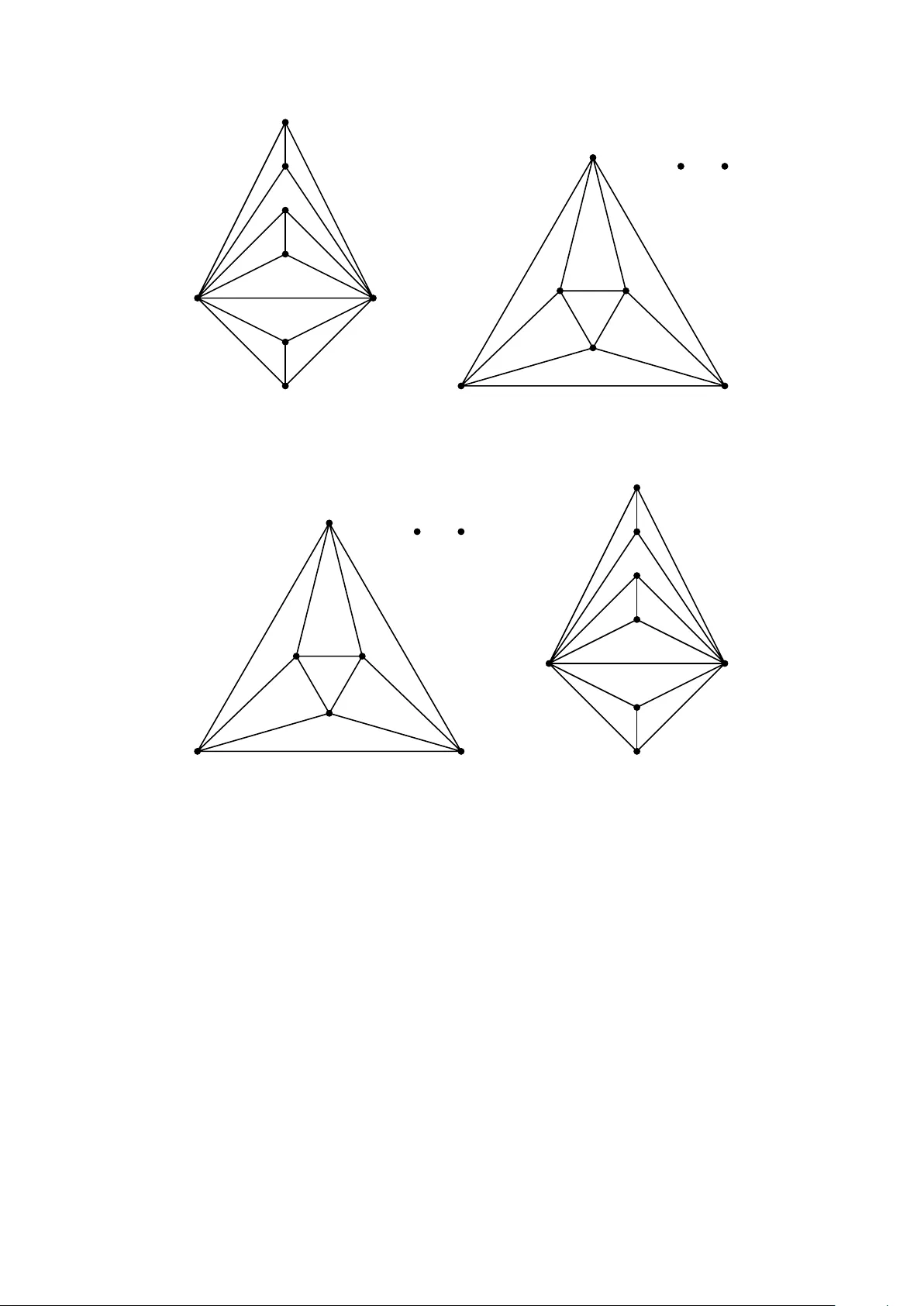
Note on the thic kness of the Cartesian pro duct of a complete graph and a path Ken ta Noguc hi ∗ Abstract W e determine the thic kness of the Cartesian pro duct K 6 p +4 □ P 2 for p ≥ 0 and of the Cartesian product K 8 □ P m for m ≥ 1, where K n and P m denote the complete graph on n v ertices and the path on m vertices, resp ectiv ely . Keyw ords. th ickness, Cartesian pro duct of graphs, planar graph, edge decomposition 1 In tro duction T o find a go o d decomp osition of graphs is widely studied in the literature. In this pap er, we deal with one of them, called the thickness. F or a graph G , the thickness θ ( G ) is defined as the minim um integer k suc h that there exists an edge decomposition E ( G ) = A 1 ∪ · · · ∪ A k so that A i induces a planar graph for 1 ≤ i ≤ k . The thickness of some well-kno wn graph families has b een in vestigated, for example, for the complete graphs [1, 3] and for the complete bipartite graphs [4]. Esp ecially , the thickness of the complete graph K n is completely determined as follows. Theorem 1 ([1], [3]) . The thickness of K n is θ ( K n ) = n +7 6 , exc ept that θ ( K 9 ) = θ ( K 10 ) = 3 . F or graphs G and H , the Cartesian product of them, denoted b y G □ H , is defined as: V ( G □ H ) = V ( G ) × V ( H ) , E ( G □ H ) = { ( u, v ) , ( u, v ′ ) } | u ∈ V ( G ) , v v ′ ∈ E ( H ) ∪ { ( u, v ) , ( u ′ , v ) } | uu ′ ∈ E ( G ) , v ∈ V ( H ) . Chen and Yin [7], Y ang and Chen [12], and Guo and Y ang [8] inv estigated the thickness of the Cartesian pro duct of graphs. Esp ecially , Y ang and Chen [12] considered the thickness of the Cartesian product of the complete graph K n and the path P m , and claimed that the follo wing statemen ts are true. (false) Theorem A (Theorem 16 in [12]) The thickness of the Cartesian pr o duct K n □ P 2 ( n ≥ 2) is θ ( K n □ P 2 ) = n + 8 6 , exc ept that θ ( K 8 □ P 2 ) = θ ( K 9 □ P 2 ) = 3 . (false) Theorem B (Theorem 17 in [12]) The thickness of the Cartesian pr o duct K n □ P m ( n ≥ 2 , m ≥ 3) is θ ( K n □ P m ) = n + 9 6 , exc ept that θ ( K 3 □ P m ) = 1 , θ ( K 8 □ P m ) = 3 and p ossibly when n = 6 p + 3 ( p ≥ 2) . ∗ Departmen t of Information Sciences, T okyo Univ ersity of Science, Noda, Japan. Email: noguchi@rs.tus.ac.jp 1 Ho wev er, unfortunately there is an error in the b oth pro ofs. In fact, the statements are false as Chen, Kohonen, and Y ang [6] sho wed θ ( K 8 □ P 2 ) = θ ( K 8 □ P 3 ) = 2. Instead, they show ed the follo wing theorems. Theorem 2 (Theorem 2 in [6]) . The thickness of the Cartesian pr o duct K n □ P 2 ( n ≥ 2) is θ ( K n □ P 2 ) = n + 8 6 , exc ept that θ ( K 9 □ P 2 ) = 3 and p ossibly when n = 6 p + 4 ( p ≥ 2) . Theorem 3 (Theorem 3 in [6]) . The thickness of the Cartesian pr o duct K n □ P m ( n ≥ 2 , m ≥ 3) is θ ( K n □ P m ) = n + 9 6 , exc ept that θ ( K 3 □ P m ) = 1 and p ossibly when n = 6 p + 3 , 6 p + 4 and n = 8 ( p ≥ 2) . Mor e over, θ ( K 8 □ P 3 ) = 2 . In the present pap er, we sho w the follo wing theorems. Theorem 4. L et p ≥ 0 b e an inte ger. The thickness of the Cartesian pr o duct K 6 p +4 □ P 2 is θ ( K 6 p +4 □ P 2 ) = p + 2 . Theorem 5. L et m ≥ 1 b e an inte ger. The thickness of the Cartesian pr o duct K 8 □ P m is θ ( K 8 □ P m ) = 2 . Com bined Theorems 4 and 2, the thic kness of K n □ P 2 is completely determined as the fol- lo wing corollary , which corresp onds to the true version of Theorem A. Corollary 1. L et n ≥ 1 b e an inte ger. The thickness of the Cartesian pr o duct K n □ P 2 is θ ( K n □ P 2 ) = n + 8 6 , exc ept that θ ( K 9 □ P 2 ) = 3 . Also, combined Theorems 4, 5, and 3, we hav e the following corollary , which corresp onds to the true version of Theorem B. Corollary 2. L et n ≥ 1 and m ≥ 3 b e inte gers. The thickness of the Cartesian pr o duct K n □ P m is θ ( K n □ P m ) = n + 9 6 , exc ept that θ ( K 3 □ P m ) = 1 and p ossibly when n = 6 p + 3 ( p ≥ 2) . 2 Preliminary W e refer to the basic terminology in [5]. In this pap er all graphs are simple. Recall that K n and P m denote the complete graph on n vertices and the path on m v ertices, respectively . F or the thic kness, we often use the fact that if H is a subgraph of G , then θ ( H ) ≤ θ ( G ). F or a graph G with thic kness k , we call a family of planar graphs { G 1 , . . . , G k } a planar de c omp osition if V ( G 1 ) = · · · = V ( G k ) = V ( G ) and E ( G 1 ) ∪ · · · ∪ E ( G k ) = E ( G ) is an edge decomp osition. When k = 2, w e also call a pair of planar graphs G 1 and G 2 a biplanar de c omp osition . W e note some results on the Cartesian pro duct K n □ P m . In 1977, Ringel [10] considered the gen us of K n □ P 2 and determined it for about five-sixths of all v alues n . Recently , Sun [11] completely determined it for all n . Badgett, Millichap, and the author [2] determined the genus of K 4 □ P 3 , to characterize the toroidal Cartesian product where one factor is 3-connected. 2 3 Pro ofs of the main theorems Let G b e a plane graph. Let F ( G ) b e the face set, where a face is not necessarily a 2-cell region when G is disconnected. If there exists a non-2-cell region f , that is, the num b er of boundary closed walks of f is at least tw o, then the length of the b oundary closed walks of f is defined as the summation of all the closed walks. See Figure 1 for an example. The disconnected plane graph H m 2 has eight faces, and one of them, the outer face f , is a non-2-cell region. The face f has three b oundary closed w alks v m 3 , v m 5 v m 6 v m 7 v m 5 , and v m 8 , and their lengths are 0, 3, 0, resp ectiv ely . Hence, the length of the b oundary closed walks of f is 0 + 3 + 0 = 3. W e prepare the follo wing lemma. Lemma 1. L et G b e a c onne cte d gr aph with thickness k ≥ 2 . Ther e exists a planar de c omp osition { G 1 , . . . , G k } of G such that G i has at le ast two e dges for 1 ≤ i ≤ k . Pr o of. Supp ose that G 1 has exactly one edge. In this case, each G i with i = 1 has at least three edges since E ( G 1 ) ∪ E ( G i ) should induce a non-planar graph. T herefore, removing an edge from G 2 to G 1 results in a desired k -planar decomp osition. Pr o of of The or em 4. By the inequalit y (2) in [12] and Theorem 1, we hav e θ ( K 6 p +4 □ P 2 ) ≤ θ ( K 6 p +5 ) = p + 2. W e now sho w that θ ( K 6 p +4 □ P 2 ) ≥ p + 2. Let θ := θ ( K n □ P 2 ) and { G 1 , . . . , G θ } b e a planar decomp osition of K n □ P 2 suc h that G i has at least t w o edges for 1 ≤ i ≤ θ , whic h can b e assumed by Lemma 1. Considering some fixed planar embedding of G i , let V i , E i , F i b e the v ertex set, edge set, and face set of G i , resp ectiv ely . Let F = S θ i =1 F i . By the same argumen t in [11, Section 2.1], w e hav e | F | ≤ 2 n 2 − n 3 ; we here write its pro of for the completeness. Notice that for every face f in F , the length of the b oundary closed walk(s) of f is at least 3 since eac h G i has at least t wo edges. Notice also that every edge e ∈ E ( K n □ P 2 ) is con tained in either (a) exactly t wo closed w alks in F eac h of which contains e precisely once, or (b) exactly one closed walk in F that con tains e twice. Let F P ⊆ F denote the set of closed w alks eac h of whic h con tains at least one edge corresp onding to P 2 (that is, an edge joining differen t K n ’s). Since every closed walk passes through an even n umber of such edges, | F P | ≤ n . Moreov er, the length of closed w alk(s) of an y face in F P is at least 4. Since | E ( K n □ P 2 ) | = n 2 , the n umber of sides remaining in F \ F P is at most 2 n 2 − 4 n . Hence, there are at most 2 n 2 − 4 n 3 faces in F \ F P . Th us, | F | = | F P | + | F \ F P | ≤ n + 2 n 2 − 4 n 3 ≤ 2 n 2 − n 3 . By Euler’s p olyhedral formula, for 1 ≤ i ≤ θ , | V i | − | E i | + | F i | ≥ 2 holds. Then, we ha ve 2 θ ≤ θ X i =1 ( | V i | − | E i | + | F i | ) = 2 nθ − | E ( K n □ P 2 ) | + | F | ≤ 2 nθ − n 2 + 2 n 2 − n 3 . Therefore, we hav e 2(1 − n ) θ ≤ − n ( n + 1) 3 θ ≥ n ( n + 1) 6( n − 1) > n + 2 6 . Substituting n = 6 p + 4, w e ha ve θ > p + 1, as desired. 3 H m 1 u m 1 u m 5 u m 6 u m 4 u m 7 u m 2 u m 3 u m 8 H m 2 v m 3 v m 8 v m 5 v m 2 v m 4 v m 1 v m 6 v m 7 Figure 1: Planar graphs H m 1 and H m 2 . I m 1 u m 4 u m 7 u m 5 u m 2 u m 3 u m 1 u m 6 u m 8 I m 2 v m 1 v m 5 v m 6 v m 3 v m 8 v m 2 v m 4 v m 7 Figure 2: Planar graphs I m 1 and I m 2 . Pr o of of The or em 5. By Theorem 1 and the fact K 8 □ P m ⊇ K 8 , we hav e θ ( K 8 □ P m ) ≥ θ ( K 8 ) = 2. W e no w show that θ ( K 8 □ P m ) ≤ 2 for all m ≥ 1, by constructing a biplanar decomp osition { G m 1 , G m 2 } of K 8 □ P m recursiv ely . Note that for m ∈ { 2 , 3 } , Chen, Kohonen, and Y ang [6, Figures 1 and 2] has already constructed them. F or m = 1, let G 1 1 = H m 1 and G 1 2 = H m 2 where H m 1 and H m 2 are depicted in Figure 1. (Assuming u m i = v m i for 1 ≤ i ≤ 8, we see that the pair G 1 1 and G 1 2 is a biplanar decomp osition of K 8 ≃ K 8 □ P 1 .) Let m ≥ 2 and assume that w e ha ve a biplanar decomp osition { G m − 1 1 , G m − 1 2 } of K 8 □ P m − 1 that is constructed along this pro of. Now, for conv enience, let V ( G m − 1 1 ) = S m − 1 j =1 { u j 1 , . . . , u j 8 } and V ( G m − 1 2 ) = S m − 1 j =1 { v j 1 , . . . , v j 8 } so that iden tifying u j i and v j i for 1 ≤ i ≤ 8 and 1 ≤ j ≤ m − 1 results in the graph K 8 □ P m − 1 . If m is even, then prepare the graphs I m 1 and I m 2 depicted in Figure 2. (a-1) Insert G m − 1 1 in to the triangular face u m 1 u m 2 u m 3 in I m 1 \ { u m 4 } and add the three edges u m − 1 1 u m 1 , u m − 1 2 u m 2 , u m − 1 3 u m 3 , and (a-2) insert the v ertex u m 4 in to G m − 1 1 and add the edge u m − 1 4 u m 4 ; let the resulting graph b e G m 1 . (b-1) Insert G m − 1 2 \ { v m − 1 8 } in to the quadrilateral face v m 5 v m 4 v m 6 v m 7 in I m 2 and add the three edges v m − 1 5 v m 5 , v m − 1 6 v m 6 , v m − 1 7 v m 7 , and (b-2) insert the vertex v m − 1 8 in to I m 2 and add the edge v m − 1 8 v m 8 ; let the resulting graph b e G m 2 . 4 If m is o dd, then prepare the graphs H m 1 and H m 2 depicted in Figure 1. (a-1) insert G m − 1 1 \ { u m − 1 7 } into the quadrilateral face u m 5 u m 3 u m 6 u m 8 in H m 1 and add the three edges u m − 1 5 u m 5 , u m − 1 6 u m 6 , u m − 1 8 u m 8 , and (a-2) insert the v ertex u m − 1 7 in to H m 1 and add the edge u m − 1 7 u m 7 ; let the resulting graph b e G m 1 . (b-1) Insert G m − 1 2 in to the triangular face v m 1 v m 2 v m 4 in H m 2 \ { v m 3 } and add the three edges v m − 1 1 v m 1 , v m − 1 2 v m 2 , v m − 1 4 v m 4 , and (b-2) insert the vertex v m 3 in to G m − 1 2 and add the edge v m − 1 3 v m 3 ; let the resulting graph b e G m 2 . In both cases, it is straigh tforw ard to chec k that the pair G m 1 and G m 2 is a biplanar decom- p osition of K 8 □ P m . Notice that, for every even m , the outer face of G m 1 is b ounded by u m 5 u m 6 u m 8 (and the isolated v ertex u m 7 ) and the outer face of G m 2 is b ounded by v m 1 v m 4 v m 2 v m 7 ; for every o dd m , the outer face of G m 1 is b ounded by u m 1 u m 3 u m 2 u m 8 and the outer face of G m 2 is b ounded by v m 5 v m 6 v m 7 (and the isolated v ertex v m 8 ) so that the pro of works. Pr o of of Cor ol lary 1. The case n = 1 obviously follows. The case n = 6 p + 4 follo ws from Theorem 4 since θ ( K 6 p +4 □ P 2 ) = p + 2 = j (6 p +4)+8 6 k . The other cases follo w from Theorem 2. Pr o of of Cor ol lary 2. Let m ≥ 3 b e an integer. The case n = 1 obviously follows. The case n = 8 follows from Theorem 5 since θ ( K 8 □ P m ) = 2 = 8+9 6 . F or n = 6 p + 4 ( p ≥ 0), it has already shown by the inequality (3) in [12] and Theorem 1 that θ ( K 6 p +4 □ P m ) ≤ θ ( K (6 p +4)+2 ) = p + 2 = j (6 p +4)+9 6 k . Additionally , b y Theorem 4, θ ( K 6 p +4 □ P m ) ≥ θ ( K 6 p +4 □ P 2 ) = p + 2. Hence, the case n = 6 p + 4 follo ws for all p ≥ 0. The other cases follow from Theorem 3. 4 Concluding remarks On Corollary 2, for the remaining case n = 6 p + 3 deciding whether θ ( K 6 p +3 □ P m ) = p + 2 or p + 1 seems to b e difficult by the follo wing reason. As prov en in [12], the truth of θ ( K 6 p +5 − e ) = p + 1, which is conjectured by Hobbs [9] for p ≥ 3, would imply that θ ( K 6 p +3 □ P m ) = p + 1 < j (6 p +3)+9 6 k . How ev er, proving θ ( K 6 p +5 − e ) = p + 1 is v ery challenging since it is m uch harder than proving θ ( K 6 p +4 ) = p + 1, whose pro of is already m uch inv olved (see [1]). Unlike the case n = 8, w e feel that it is hard to prov e θ ( K 6 p +3 □ P m ) ≤ p + 1 without using the assumption of θ ( K 6 p +5 − e ) = p + 1. References [1] V. B. Alekseev and V. S. Gonˇ chak ov, The thickness of an arbitr ary c omplete gr aph, Math. Sb ornik. 30 (1976), 187–202. [2] E. Badgett, C. Millichap, and K. Noguc hi, T or oidal Cartesian pr o ducts wher e one factor is 3 -c onne cte d , to app ear in Graphs and Com binatorics. [3] L. W. Beineke and F. Harary , The thickness of the c omplete gr aph , Canadian J. Math. 17 (1965), 850–859. [4] L. W. Beinek e, F. Harary , and J. W. Moon, On the thickness of the c omplete bip artite gr aph , Math. Pro c. Cam bridge Philos. So c. 60 (1964), 1–5. [5] J. A. Bondy , U. S. R. Murty , Gr aph The ory, Gr aduate T exts in Mathematics 244, Springer , New Y ork, 2008. 5 [6] Y. Chen, J. Kohonen, and Y. Y ang, Err atum to “The thickness of amalgamations and Cartesian pr o duct of gr aphs” , Discuss. Math. Graph Theory 46 (2026), 91–95. [7] Y. Chen and X. Yin, The thickness of the Cartesian pr o duct of two gr aphs , Canad. Math. Bull. 59 (2016), 705–720. [8] X. Guo and Y. Y ang, The thickness of some Cartesian pr o duct gr aphs , Ars Combin. 147 (2019), 97–107. [9] A. M. Hobbs, A survey of thickness , in: Recen t Progress in Combinatorics (Pro c. 3rd W aterloo Conf. on Com binatorics, 1968), W. T. T utte (Ed(s)), (New Y ork, Academic Press, 1969) 255–264. [10] G. Ringel, On the genus of the gr aph K n × K 2 or the n -prism , Discrete Math. 20 (1977), 287–294. [11] T. Sun, Settling the genus of the n -prism , Europ ean J. Com bin. 110 (2023), Paper No. 103667, 12 pp. [12] Y. Y ang and Y. Chen, The thickness of amalgamations and Cartesian pr o duct of gr aphs , Discuss. Math. Graph Theory 37 (2017), 561–572. F unding This research was partially supported by JSPS KAKENHI Grant Number JP21K13831. Av ailabilit y of data and materials Not applicable. Comp eting Interests The author has no relev an t financial or non-financial in terests to disclose. 6
Original Paper
Loading high-quality paper...
Comments & Academic Discussion
Loading comments...
Leave a Comment