On the Golomb-Dickman constant under Ewens sampling
We define a generalized Golomb-Dickman constant $λ_θ$ as the limiting expected proportion of the longest cycle in random permutations under the Ewens measure with parameter $θ> 0$. Exploiting the independence properties of Kingman's Poisson process c…
Authors: José Ricardo G. Mendonça, Luis Jehiel Negret
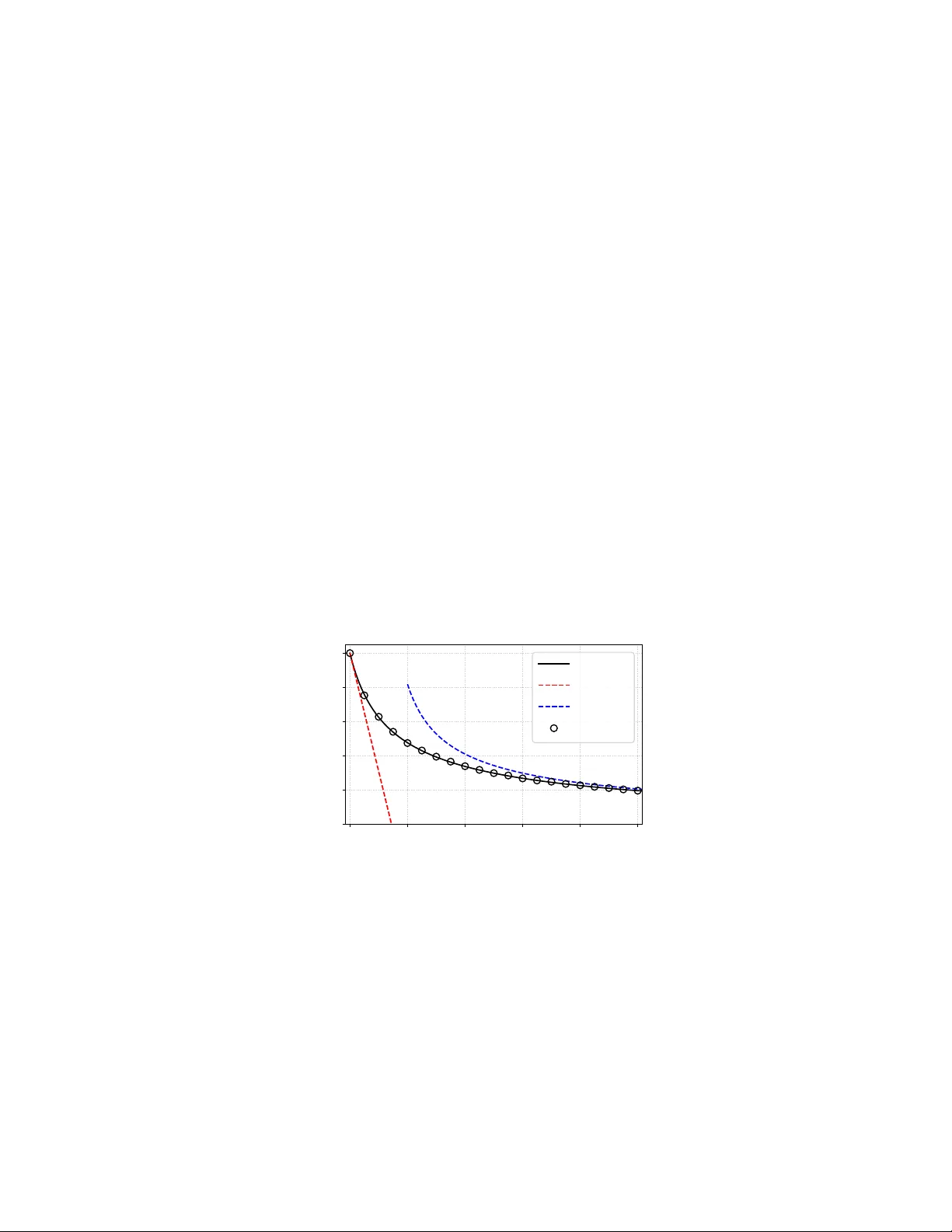
ON THE GOLOMB–DICKMAN CONST ANT UNDER EWENS SAMPLING JOS ´ E RICARDO G. MENDONC ¸ A AND LUIS JEHIEL NEGRET Abstract. W e define a generalized Golom b–Dickman constan t λ θ as the lim- iting exp ected prop ortion of the longest cycle in random p ermutations under the Ew ens measure with parameter θ > 0. Exploiting the independence prop- erties of Kingman’s P oisson pro cess construction of the Poisson–Diric hlet dis- tribution, we obtain an explicit integral representation for λ θ in terms of the exponential in tegral. The dependence of λ θ on θ reflects the transition betw een regimes dominated b y long cycles (small θ ) and those with many small cycles (large θ ). W e also derive the asymptotic b eha vior of λ θ for small and large θ , and illustrate our results with numerical computations and Mon te Carlo simulations of the Hopp e urn. Our result can b e viewed as an extension of the classical calculations of Shepp and Lloyd to the Ewens setting b y relativ ely elementary means. 1. Introduction The cycle structure of random permutations is a classical, almost foundational topic in probabilistic com binatorics [ 9 , 18 ]. F or p erm utations of [ n ] : = { 1 , . . . , n } ⊆ N drawn uniformly at random, a classical result of Shepp and Lloyd [ 15 ] sho ws that the normalized length L n /n of the longest cycle conv erges to a non-degenerate random v ariable with exp ectation (1.1) lim n →∞ E L n n = λ, where λ ≈ 0 . 624330 is the Golomb–Dic kman constan t. The distribution of L n /n con v erges to a non-degenerate limit closely related to the Dic kman function [ 2 ]. A natural extension of the uniform measure is the Ewens distribution with pa- rameter θ > 0, which assigns probabilit y prop ortional to θ C ( σ ) to a p erm utation σ , where C ( σ ) denotes its num ber of cycles [ 5 , 7 , 17 ]. This mo del arises in p op- ulation genetics as the sampling distribution of allele frequencies under neutral ev olution. Under the Ewens distribution, the n um b ers of cycles of fixed length con v erge asymptotically to ind ep enden t Poisson random v ariables, and the nor- malized ordered cycle lengths con v erge to a Poisson–Diric hlet distribution PD( θ ) with parameter θ [ 2 , 3 , 14 ]. The P oisson approximation for cycle counts, according to which the num bers of cycles of length j b eha v e approximately as indep enden t P oisson( θ /j ) v ariables, greatly simplifies the analysis of cycle statistics. Similar Date : March 25, 2026. 2010 Mathematics Subje ct Classific ation. Primary 60C05. Key wor ds and phr ases. Random permutations; probabilistic combinatorics; cycle structure; Ewens sampling formula; Poisson pro cess; Kingman’s construction. JRGM was partially supported by research grant AP .R 2020/04475-7 from F APESP , Brazil. LJN was partially supp orted by a postgraduate fellowship from CNPq, Brazil. 1 2 J. R. G. MENDONC ¸ A AND L. J. NEGRET constructions app ear in the study of the prime factorization of large in tegers, re- v ealing a form of universalit y in the decomp osition of large ob jects into smaller comp onen ts [ 8 , 16 ]. While the global structure of cycles is w ell established, explicit characterizations of extremal statistics remain scarce. The general Poisson–Diric hlet framework de- v elop ed in [ 2 , 3 , 14 ] expresses everything in terms of the Dickman function (which lac ks a closed-form solution in terms of elementary functions), the somewhat un- yielding GEM distribution, or the Poisson pro cess itself, besides all the combina- torics, and extracting computable integrals for cycle statistics can b e challenging. Our goal is to ev aluate the asymptotic exp ectation of the longest cycle under Ew ens sampling using a more direct, probabilistic approach. W e introduce the constant (1.2) λ θ : = lim n →∞ E θ n [ L n ] n , whic h extends the classical Golom b–Dickman constant, and derive an explicit in- tegral representation for λ θ in terms of the exp onen tial integral. Such an integral represen tation for the limiting exp ected v alue ( 1.2 ) w as previously derived in the con tin uous P oisson–Dirichlet setting by Holst [ 10 ] (see Remark 4.3 ). W e reco v er this exact formula using Kingman’s P oisson process construction of PD( θ ) and the distribution of its largest atom. This discrete-to-contin uous deriv ation allo ws us to analyze λ θ , including its asymptotic b ehavior and com binatorial interpretations. The pap er is organized as follows. After briefly recalling the P oisson representa- tion of Ewens p erm utations, we derive the limiting distribution of the largest atom of the Poisson pro cess in the asso ciated weigh ted mo del. W e then establish an in tegral represen tation for λ θ b y exploiting the independence properties of King- man’s Poisson pro cess construction of the P oisson–Diric hlet distribution PD( θ ), and extract the asymptotic behavior of λ θ for small and large θ . W e conclude with n umerical computations, Mon te Carlo sim ulations of the Hoppe urn, and a com binatorial application to the spaghetti ho ops problem. 2. The Poisson represent a tion of Ewens permut a tions W e briefly recall the Poisson represen tation of Ew ens p erm utations [ 2 , 3 , 14 ]. Let S n denote the symmetric group on [ n ], and for σ ∈ S n , let C j ( σ ) b e its num b er of cycles of length j and C ( σ ) = P j ≥ 1 C j ( σ ) its total num b er of cycles (note that C j = 0 for j > n ). The Ewens measure with parameter θ > 0 ov er S n is given b y (2.1) P θ n ( σ ) = θ C ( σ ) θ ( θ + 1) · · · ( θ + n − 1) , and the ensuing distribution, known as the Ew ens sampling formula of parameter θ , is denoted by ESF( θ ). The cycle coun ts in this mo del admit a P oisson approxi- mation. F or each fixed j , the distribution of C j ( σ ) is well appro ximated by (2.2) C j ( σ ) ≈ Poisson( θ/j ) , and the v ariables ( C j ) j ≥ 1 are asymptotically indep endent in total v ariation when restricted to cycle lengths j ≤ b ( n ) with b ( n ) = o ( n ) or, equiv alently , are restricted to finitely man y cycle lengths [ 3 , 14 ]. A con v enien t wa y to formalize this appro xi- mation is through the construction of a suitable Poisson pro cess. ON THE GOLOMB–DICKMAN CONST ANT UNDER EWENS SAMPLING 3 Let ( N ( t )) t ≥ 0 b e a Poisson pro cess of rate 1, and let ( I j ) j ≥ 1 b e disjoin t interv als in [0 , ∞ ) with | I j | = θ /j , j ≥ 1. Define (2.3) µ j : = N ( I j ) , j ≥ 1 . The v ariables ( µ j ) j ≥ 1 are indep enden t and satisfy (2.4) µ j ∼ Poisson( θ/j ) . In terms of these v ariables, the Ew ens distribution can b e related to the law of ( µ j ) j ≥ 1 conditioned on the total size constraint (2.5) X j ≥ 1 j µ j = n. This representation translates questions ab out cycle structure to prop erties of in- dep enden t Poisson v ariables. V ariants of this construction arise in more general mo dels of random p ermutations with non uniform cycle weigh ts as well [ 6 ]. T o approximate the constrained mo del in which ( 2.5 ) holds, w e replace the Pois- son means θ /j by θe − sj /j , where s > 0 is a conjugate parameter controlling the ex- p ected total size. This parameter shifts the unconstrained expectation E [ P j ≥ 1 j µ j ] to a v alue of order 1 /s , so that choosing s ∼ 1 /n tunes the mo del to the correct scale. F or s > 0, w e shall thus consider indep enden t random v ariables ( µ j ) j ≥ 1 with (2.6) µ j ∼ Poisson θ e − sj j , j ≥ 1 , This exp onential tilting isolates the contribution of large cycles and facilitates the analysis of the longest cycle. Relaxing the size constraint to obtain independent cycle coun ts is analogous to the passage from the canonical to the grand-canonical ensem ble in statistical mechanics [ 4 ]. R emark 2.1 . One m ust distinguish the actual cycle counts C j , whic h are strictly dep enden t due to the partition constraint P j ≥ 1 j C j = n , from the unconstrained auxiliary v ariables µ j . The indep enden t P oisson model ( µ j ) j ≥ 1 circum v en ts the con- strain t, allowing the longest cycle under the Ewens measure to b e analyzed directly via the largest o ccupied index of the unconstrained sequence and the indep endence prop erties of Kingman’s Poisson pro cess construction (see Section 4 ). 3. The scaling limit of the largest Poisson a tom W e no w determine the distribution of the largest o ccupied index in the Poisson mo del. As shown in Section 4 , this coincides with the distribution of the largest atom in a Kingman Poisson pro cess, yielding λ θ . Let ( µ j ) j ≥ 1 b e indep enden t random v ariables, eac h distributed as in ( 2.6 ), for some s > 0, and define the largest o ccupied index in the Poisson model as (3.1) L ( µ ) : = max { j ≥ 1 : µ j > 0 } . The distribution of L ( µ ) can b e computed explicitly and admits a scaling limit. Lemma 3.1. F or e ach k ≥ 1 , we have (3.2) P ( L ( µ ) < k ) = exp − X j ≥ k θ e − sj j . 4 J. R. G. MENDONC ¸ A AND L. J. NEGRET Mor e over, under the sc aling x = sk , we have (3.3) P ( sL ( µ ) ≤ x ) − → exp − θ E 1 ( x ) as s → 0 , wher e (3.4) E 1 ( x ) = Z ∞ x e − t t dt is the exp onential inte gr al function of a nonne gative r e al ar gument [ 12 , § 15.09] . Pr o of. By indep endence, (3.5) P ( L ( µ ) < k ) = Y j ≥ k P ( µ j = 0) = exp − X j ≥ k θ e − sj j . A standard sum–integral comparison for the monotone function x 7→ e − sx /x yields (3.6) X j ≥ k e − sj j = Z ∞ sk e − u u du + o (1) as s → 0 , whic h gives the stated limit. □ The function exp[ − θ E 1 ( x )] is the probabilit y that a Poisson pro cess on (0 , ∞ ) with in tensity θ e − t /t places no atoms abov e x ; it is, therefore, the distribution func- tion of the largest atom of this pro cess. F or general θ > 0, it approximates but does not quite equal the distribution of the largest PD( θ ) comp onen t; the discrepancy comes from the normalization by the total mass. Despite this somewhat subtle difference, the distribution of the largest atom suffices to compute the exp ectation of the largest normalized cycle via Kingman’s construction in the next section. 4. Integral represent a tion of λ θ and its asymptotics 4.1. The mai n theorem. Our main result, an integral formula for λ θ , is giv en by the following theorem. Theorem 4.1. L et L n denote the length of the longest cycle of a r andom p ermu- tation distribute d ac c or ding to the Ewens me asur e with p ar ameter θ > 0 . Then the limit (4.1) λ θ : = lim n →∞ E θ n [ L n ] n exists and is given by (4.2) λ θ = Z ∞ 0 exp − t − θ E 1 ( t ) dt. Pr o of. W e compute the expected v alue of the longest cycle of a random p ermutation under the Ewens measure by exploiting the indep endence prop erties of Kingman’s P oisson pro cess construction of the Poisson–Diric hlet pro cess PD( θ ) [ 13 ]. The ar- gumen t relies on the indep endence of the normalized partition from the total mass, together with the distribution of the largest atom from Lemma 3.1 . Let L ( µ ) denote the largest o ccupied index in the P oisson mo del. Lemma 3.1 sho ws that, under the scaling x = sk , (4.3) P ( sL ( µ ) ≤ x ) − → exp − θ E 1 ( x ) , ON THE GOLOMB–DICKMAN CONST ANT UNDER EWENS SAMPLING 5 so that sL ( µ ) conv erges in distribution to a random v ariable X with distribution function (4.4) P ( X ≤ x ) = exp − θ E 1 ( x ) . This limiting distribution do es not coincide p oin t wise with the distribution of the largest comp onent of the P oisson–Diric hlet partition due to the lack of mass nor- malization. Denote b y Y θ the largest component of a PD( θ ) random partition. The conv ergence of the normalized cycle lengths to PD( θ ) implies L n /n → Y θ in distribution, and since L n /n ≤ 1, dominated conv ergence gives λ θ = E [ Y θ ]. T o compute E [ Y θ ], w e app eal to Kingman’s P oisson pro cess construction of PD( θ ). Let Π b e a Poisson pro cess on (0 , ∞ ) with intensit y θ e − x /x , let X 1 > X 2 > · · · denote its atoms in decreasing order, and let Σ = P i X i denote the total mass. The normalized sequence ( X 1 / Σ , X 2 / Σ , . . . ) has the PD( θ ) distribution, and Σ is indep enden t of the normalized partition, with Σ ∼ Gamma( θ , 1) [ 13 ] (see also [ 14 , § 3.2] and [ 16 ]). Now, since Y θ = X 1 / Σ and Σ is indep enden t of Y θ , on the one hand w e ha ve E [ X 1 ] = E [Σ] E [ Y θ ] = θ λ θ , while on the other hand the distribution of X 1 is given by Lemma 3.1 . The tail exp ectation form ula for non-negative random v ariables then giv es (4.5) E [ X 1 ] = Z ∞ 0 1 − exp[ − θ E 1 ( x )] dx. No w, since E ′ 1 ( x ) = − e − x /x we ha v e (4.6) 1 − exp[ − θ E 1 ( x )] = θ Z ∞ x e − t t exp[ − θ E 1 ( t )] dt. Substituting this in to the expression for E [ X 1 ], in tegrating o v er x , and swapping the integrations in dx and dt (the in tegrand is non-negative) furnishes (4.7) E [ X 1 ] = θ Z ∞ 0 e − t exp[ − θ E 1 ( t )] dt, whic h divided by θ finally yields (4.8) λ θ = E [ Y θ ] = Z ∞ 0 exp[ − t − θ E 1 ( t )] dt. □ Since E 1 ( t ) is p ositiv e and decreasing, the integrand exp − t − θE 1 ( t ) is de- creasing in θ for each fixed t > 0, and therefore λ θ is decreasing in θ . F or θ < 1, the contribution of large v alues of t is less suppressed, leading to larger v alues of λ θ and a regime dominated by long cycles. When θ = 0, λ 0 = 1, meaning that the longest cycle is also the only cycle in the p ermutation. F or θ > 1, the factor exp[ − θ E 1 ( t )] decays more rapidly , resulting in smaller v alues of λ θ and a regime where the mass is distributed among many smaller cycles. As θ → ∞ , the Ewens measure increasingly fav ors p erm utations with man y short cycles, and the longest cycle b ecomes negligible relative to n . This agrees with known behavior under the Ew ens distribution and the Poisson–Diric hlet framework [ 2 , 3 , 6 , 8 , 14 ]. R emark 4.2 . W e do not address the rate of con v ergence of E θ n [ L n ] /n to its limit or the full distribution of L n /n . Quantitativ e b ounds on the total v ariation distance b et ween the cycle counts and their P oisson appro ximation are a v ailable in [ 3 , 8 ] and could b e used to estimate the conv ergence rate, but we do not pursue this here. 6 J. R. G. MENDONC ¸ A AND L. J. NEGRET R emark 4.3 . Lars Holst obtained, among other results, an in tegral expression for the k -th moment of the largest PD( θ ) comp onen t that reads [ 10 , Prop osition 2.2] (4.9) E [ Y k θ ] = Z ∞ 0 y k − 1 exp[ − y − θE 1 ( y )] ( θ + 1) · · · ( θ + k − 1) dy . Although equation ( 4.8 ) is the special case k = 1 of Holst’s equation, our deriv ation and subsequen t analysis differ from Holst’s work. Metho dologically , our deriv ation pro ceeds via the scaling limit of the largest o ccupied index in the tilted Poisson mo del (Lem ma 3.1 ) follow ed b y an exc hange of integrations that yields the closed- form in tegrand exp − t − θ E 1 ( t ) directly , whereas Holst integrates the density of the largest atom against p ow ers of its argument within a finite-dimensional Diric h- let framew ork. In terms of scop e, we emphasize the systematic study of λ θ as a one-parameter extension of the classical Golomb–Dic kman constant and analyze its monotonicity in θ , asymptotic b eha vior in the regimes θ → 0 and θ → ∞ (Sec- tion 4.2 ), n umerical computation and simulation (Sections 5.1 and 5.2 ), and p ossible com binatorial interpretations. None of these asp ects app ear in Holst’s work. 4.2. Asymptotic b ehavior of λ θ . In this section we extract the leading asymp- totic b ehavior of λ θ in the regimes of θ → 0 and θ → ∞ directly from the integral represen tation ( 4.8 ). Prop osition 4.4. As θ → 0 , (4.10) λ θ = 1 − (ln 2) θ + O ( θ 2 ) . Pr o of. Expanding exp[ − θ E 1 ( t )] = 1 − θE 1 ( t ) + O ( θ 2 ) in ( 4.8 ) and in tegrating term b y term gives λ θ = Z ∞ 0 e − t dt − θ Z ∞ 0 e − t E 1 ( t ) dt + O ( θ 2 ) = 1 − θ Z ∞ 0 e − t E 1 ( t ) dt + O ( θ 2 ) . (4.11) Substituting the definition of E 1 ( t ) and swaping the order of integration yields for the remaining integral ab o ve Z ∞ 0 e − t E 1 ( t ) dt = Z ∞ 0 e − t Z ∞ t e − u u du dt = Z ∞ 0 e − u u Z u 0 e − t dt du = Z ∞ 0 1 − e − u u e − u du. (4.12) If we write (1 − e − u ) /u = R 1 0 e − uv dv and integrate ( 4.12 ) in du first w e get ln 2, and we are done. □ Prop osition 4.5. As θ → ∞ , (4.13) λ θ = ln θ θ − ln ln θ − γ θ + o 1 θ , wher e γ ≈ 0 . 577215 is Euler’s c onstant. Pr o of. As θ → ∞ , the in tegral ( 4.8 ) is dominated by large v alues of t , where the exp onen tial integral behav es as E 1 ( t ) ∼ e − t /t . Since u = θ E 1 ( t ) ≈ θ e − t /t for large t , the relation θe − t /t = u gives du = − θ e − t ( t + 1) /t 2 dt ≈ − u dt . Inv erting the ON THE GOLOMB–DICKMAN CONST ANT UNDER EWENS SAMPLING 7 asymptotic relation b et w een u and t giv es t = ln θ − ln ln θ − ln u + o (1), which substituted into the integral furnishes (4.14) λ θ ≈ Z ∞ 0 t θ e − u du = 1 θ Z ∞ 0 (ln θ − ln ln θ − ln u ) e − u du. Ev aluating the standard integral R ∞ 0 e − u ln u du = − γ yields the stated result. □ Note that the deca y of ln θ/θ is slo wer than 1 /θ . Since 1 /θ would b e the exp ected prop ortion of the longest cycle if all cycles had equal length, the logarithmic correc- tion reflects the fact that random fluctuations p ersisten tly pro duce one cycle that captures a disprop ortionate share of the total mass, ev en when the Ew ens measure strongly fav ors man y small cycles. Note also that the appearance of Euler’s con- stan t in ( 4.13 ) reflects the logarithmic gro wth of the harmonic sums that gov ern the cycle count distribution. 5. Numerics, simula tions and applica tions 5.1. Numerical v alues. The generalized Golom b–Dic kman constant ( 4.8 ) can b e n umerically computed to virtually any desired precision. F or example, for a given v alue of theta the Mathematica command [ 19 ] N[Integrate[Exp[-t-theta*ExpIntegralE[1, t]], { t, 0, Infinity } ], 100] computes λ θ to 100 significant digits almost instantly in a 2021-vintage laptop. Figure 1 displa ys the behavior of λ θ × θ for 0 ≤ θ ≤ 5, while T able 1 lists λ θ for a few selected θ . These v alues w ere calculated in Python to a precision of ≈ 10 − 12 from the routines scipy.integrate.quad and scipy.special.exp1 . The particular v alue λ θ = 0 . 5 app ears when θ ≃ 1 . 784910. 0 1 2 3 4 5 θ 0 . 0 0 . 2 0 . 4 0 . 6 0 . 8 1 . 0 λ θ λ 1 ≈ 0 . 624330 λ θ Figure 1. Generalized Golomb–Dic kman constant λ θ , equation ( 4.8 ). F ormula ( 4.8 ) gives the exp ected prop ortion of the longest comp onen t in the “spaghetti hoops problem” [ 17 ]. In this problem, one starts with n strands of spaghetti and rep eatedly picks t w o free ends uniformly at random and ties them together until no free ends remain, pro ducing a collection of closed lo ops. This pro cess giv es rise to the Ewens distribution with parameter θ = 1 / 2, and the exp ected prop ortion of the total length con tained in the longest loop is therefore giv en b y λ 1 / 2 in the limit n → ∞ . F rom T able 1 , we see that approximately 75 . 8% of the spaghetti will end up tied together in one big lo op. 8 J. R. G. MENDONC ¸ A AND L. J. NEGRET T able 1. Numerical v alue of λ θ (rounded to 6 decimal places) for a few selected θ . θ λ θ 1 / 10 0 . 936295 1 / 8 0 . 921937 1 / 6 0 . 899210 1 / 5 0 . 882027 1 / 4 0 . 857758 1 / 3 0 . 820854 1 / 2 0 . 757823 2 / 3 0 . 705779 θ λ θ 3 / 4 0 . 682960 1 0 . 624330 3 / 2 0 . 537540 2 0 . 475639 3 0 . 391838 4 0 . 336771 5 0 . 297288 10 0 . 194884 5.2. Sim ulation of the Hopp e urn mo del. The Hopp e urn provides a stochastic mec hanism to generate random partitions whose distribution coincides with the Ew ens sampling form ula [ 1 , 11 ]. The pro cess starts with a distinguished, say , blac k ball of w eigh t θ . At each step, a ball is selected with probability prop ortional to its weigh t. If the blac k ball is chosen, a new color is in tro duced; otherwise, the selected color is reinforced. After n steps, the resulting color classes define a random partition of [ n ] according to the ESF( θ ) distribution. An algorithmic description of the pro cess go es as follows: 1. Initialize one color class and set its size to zero. 2. F or k = 1 , . . . , n , a. With probability θ/ ( θ + k − 1), create a new color class; b. Otherwise, c ho ose an existing class with probabilit y prop ortional to its size and add one element to it. 3. Return the class sizes n 1 , . . . , n ℓ , 1 ≤ ℓ ≤ n . Figure 2 displa ys the time evolution of the color prop ortions in one simulation of 50 draws in a Hopp e urn with θ = 1. 0 10 20 30 40 50 n 0 . 0 0 . 2 0 . 4 0 . 6 0 . 8 1 . 0 Color prop ortion Figure 2. Timeline of the color prop ortions in one simulation of 50 draws in a Hopp e urn with θ = 1. ON THE GOLOMB–DICKMAN CONST ANT UNDER EWENS SAMPLING 9 R emark 5.1 . The Hopp e urn is closely related to the Chinese restauran t pro- cess (CRP), another sequential construction that generates p erm utations with the ESF( θ ) distribution [ 1 , 14 ]. In the CRP , customers lab eled 1 , 2 , . . . , n enter a restau- ran t one at a time; customer k either joins an o ccupied table with probabilit y pro- p ortional to its o ccupancy , or op ens a new table with probabilit y θ/ ( θ + k − 1). The tw o constructions are equiv alent: drawing the black ball in the Hopp e urn corresp onds to op ening a new table, and drawing a num b ered ball to joining an existing one. W e refer to [ 5 ] for an o v erview of b oth the Hopp e urn and the CRP and their connections to the Ewens sampling form ula. The sim ulation of the Hoppe urn model from the description given ab ov e is immediate, and the size of the largest class in the urn, normalized b y n , provides a Mon te Carlo estimator for λ θ . Rep eating the simulation many times and a veraging the results yields empirical estimates of the asymptotic exp ected prop ortion of the largest cycle. Figure 3 displays the Monte Carlo estimates of λ θ for sev eral v alues of θ obtained from av eraging 10000 runs of the Hopp e urn up to n = 1000 draws, together with the exact v alue of λ θ from ( 4.8 ) and the asymptotic curv es ( 4.10 ) and ( 4.13 ). The simulations illustrate the dependence of λ θ on θ and agree with the theoretical predictions. R emark 5.2 . The empirical a v erages obtained from the simulations are sub ject to standard Mon te Carlo sampling errors. F or the sample sizes considered to pro duce Figure 3 , these statistical fluctuations are negligible and therefore omitted, as the n umerical data are included for illustration only . 0 2 4 6 8 10 θ 0 . 0 0 . 2 0 . 4 0 . 6 0 . 8 1 . 0 λ θ λ θ θ → 0 θ → ∞ Hopp e Figure 3. Monte Carlo estimates of λ θ obtained via the Hopp e urn simulation compared with the theoretical curves. References [1] D. J. Aldous, Exchange ability and r elated topics , In: P . L. Hennequin (Ed.), ´ Ecole d’Et´ e de Probabilit´ es de Saint-Flour XI II, 1983, Lecture Notes in Mathematics 1117 , Springer, Berlin, 1985, pp. 1–198. MR 0883646 [2] R. Arratia, A. D. Barbour, and S. T av ar´ e, L o garithmic Combinatorial Structur es: A Pr oba- bilistic Appro ach , Europ ean Mathematical So ciet y , Z ¨ uric h, 2003. MR 2032426 [3] R. Arratia and S. T av ar ´ e, The cycle structur e of r andom permutations , The Annals of Prob- ability 20 (1992), no. 3, 1567–1591. MR 1175278 10 J. R. G. MENDONC ¸ A AND L. J. NEGRET [4] M. Campisi, L e ctur es on the Me chanic al F oundations of Thermo dynamics , 2nd ed. Springer, Cham, 2024. [5] H. Crane, The ubiquitous Ewens sampling formula , Statistical Science 31 (2016), no. 1, 1–19. MR 3458585 [6] N. M. Ercolani and D. Ueltschi, Cycle structur e of r andom p ermutations with cycle weights , Random Structures & Algorithms 44 (2014), no. 1, 109–133. MR 3143592 [7] W. J. Ewens, The sampling theory of sele ctively neutr al al leles , Theoretical Population Biol- ogy 3 (1972), 87–112. MR 0325177 [8] K. F ord, Cycle typ e of r andom p ermutations: A to olkit , Discrete Analysis (2022), art. 9 (36pp). MR 4481406 [9] V. Gon ˇ carov, On the field of c ombinatory analysis , In: Tw elve Papers on Number The- ory and F unction Theory , American Mathematical So ciet y T ranslations (2) 19 (1962), 1–46. MR 0131369 [Originally published in Izv estiya Ak ademii Nauk SSSR, Seriya Matematich- esk ay a 8 (1944), no. 1, 3–48, in Russian. MR 0010922] [10] L. Holst, The Poisson-Dirichlet distribution and its r elatives r evisite d , preprint (2001), Roy al Institute of T ec hnology , Sto c kholm, Sweden, URL: https://www.math.kth.se/matstat/fofu/ reports/PoiDir.pdf . [11] F. M. Hopp e, P´ olya-like urns and the Ewens’ sampling formula , Journal of Mathematical Biology 20 (1984), no. 1, 91–94. [12] H. Jeffreys and B. S. Jeffreys, Metho ds of Mathematic al Physics , 3rd ed., Cambridge Univer- sity Press, Cambridge, 1972. MR 1744997 [13] J. F. C. Kingman, R andom discr ete distributions , Journal of the Roy al Statistical So ciet y . Series B (Methodological) 37 (1975), no. 1, 1–22. MR 0368264 [14] J. Pitman, Combinatorial Sto chastic Pro c esses , In: J. Picard (Ed.), ´ Ecole d’Et´ e de Proba- bilit´ es de Saint-Flour XXXII, 2002, Lecture Notes in Mathematics 1875 , Springer, Heidel- berg, 2006. MR 2245368 [15] L. A. Shepp and S. Lloyd, Or der e d cycle lengths in a r andom p ermutation , T ransactions of the American Mathematical Society 121 (1966), 340–357. MR 195117 [16] T. T ao, The Poisson–Dirichlet pr o c ess, and lar ge prime factors of a r andom numb er , What’s New Daily Archiv e, URL: https://terrytao.w ordpress.com/2013/09/21/ . [17] S. T av ar´ e, The magic al Ewens sampling formula , Bulletin of the London Mathematical So- ciety 53 (2021), no. 6, 1563–1582. MR 4368686 [18] J. T ouchard, Sur les cycles des substitutions , Acta Mathematica 70 (1939), no. 1, 243–297. MR 1555449 [19] W olfram Researc h, Mathematica, V ersion 14.3. Wolfr am R esear ch, Inc. , Champaign, IL, 2025. Escola de Ar tes, Ci ˆ encias e Humanidades, Universidade de S ˜ ao P aulo, SP, Brazil. Email address : jricardo@usp.br Instituto de Ma tem ´ atica e Est a t ´ ıstica, Universidade de S ˜ ao P aulo, SP, Brazil Email address : ljnegrett@ime.usp.br
Original Paper
Loading high-quality paper...
Comments & Academic Discussion
Loading comments...
Leave a Comment