Log-concavity from enumerative geometry of planar curve singularities
We propose a log-concavity conjecture for BPS invariants arising in the enumerative geometry of planar curve singularities, identified with the local Euler obstructions of Severi strata in their versal deformations. We further extend this conjecture …
Authors: Tao Su, Baiting Xie, Chenglong Yu
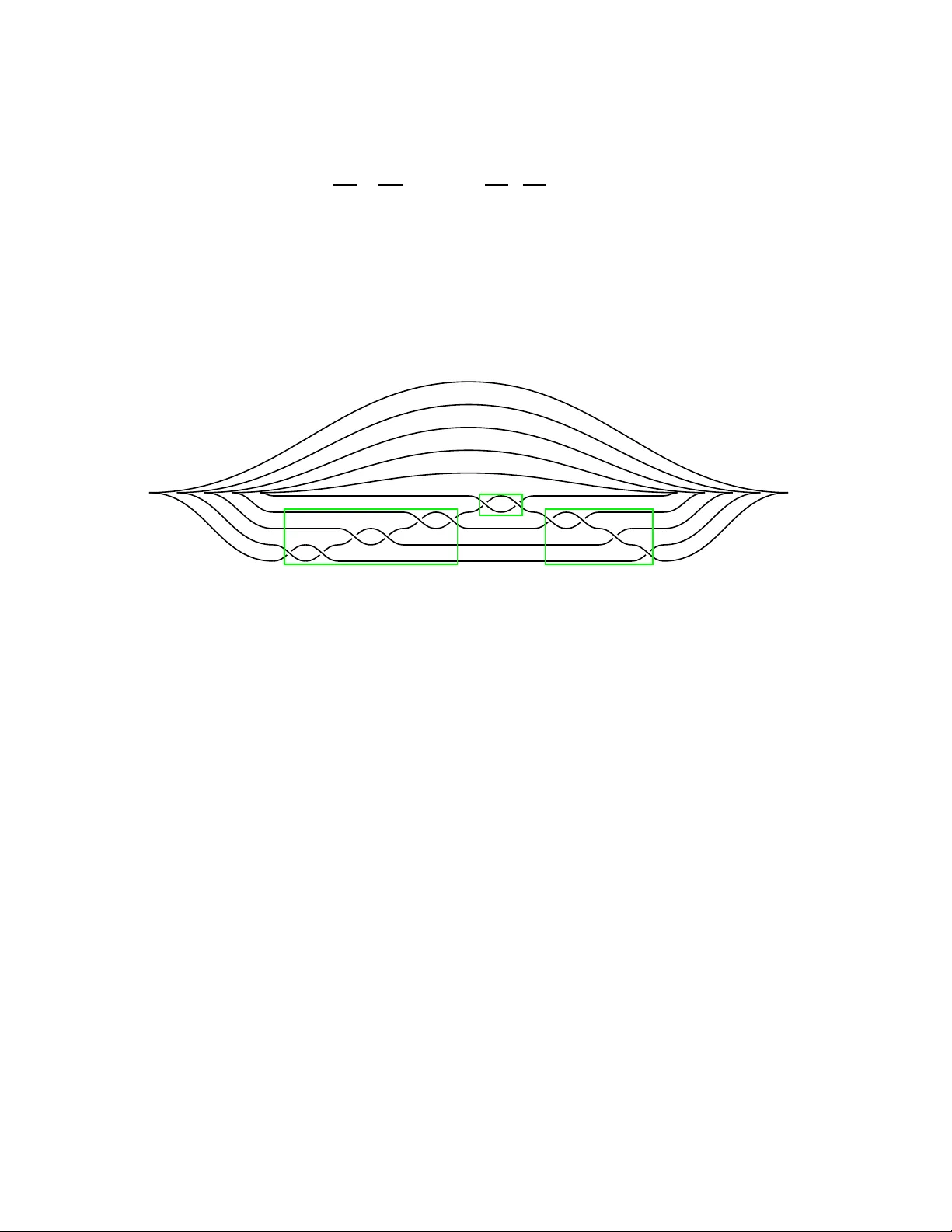
LOG-CON CA VITY FR OM ENUMERA TIVE GEOMETR Y OF PLAN AR CUR VE SINGULARITIES T A O SU, B AITING XIE, AND CHEN GLONG YU Abstra ct . W e propose a log-concavity conjecture for BPS invariants arising in the enumerative geometry of planar curve singularities, identified with the local Euler obstructions of Sev eri strata in their versal def or mations. W e further extend this conjecture to ruling polynomials of Leg endrian links and to 𝐸 -polynomials of character varieties. W e establish these conjectures f or ir reducible weighted-homog eneous singularities (tor us knots) and f or ADE singularities, and prov e a multiplicativ e proper ty f or ruling polynomials compatible with log-concavity . Contents Introduction 1 1. BPS in variants in the enumerativ e geometry of planar curve singularities 2 2. Ruling pol ynomials of Legendrian links 3 3. 𝐸 -polynomials of character v ar ieties 4 4. The interconnections 5 4.1. BPS in variants vs. ruling polynomials 5 4.2. BPS in variants vs. 𝐸 -polynomials 6 4.3. A heuristic relation with the BPS picture 7 4.4. The wild case 8 5. Main evidence 9 5.1. T orus knots 9 5.2. ADE singularities 10 5.3. A multiplicativ e property for ruling polynomials 14 Ref erences 15 Intr oduction Log-conca vity is a pervasiv e phenomenon in combinatorics, algebraic geometry , and representation theory . A landmark e xample is the log-conca vity of the coefficients of c hromatic pol ynomials of graphs, pro v ed by Huh using Hodg e-theoretic methods [ Huh12 ]; see also [ AHK18 ] f or a f ar -reaching generalization. More broadl y , log-conca vity often reflects the presence of hidden g eometric structures, such as hard Lefsc hetz theorems or intersection-theoretic inequalities. Giv en a seq uence of nonneg ativ e real numbers 𝑎 0 , 𝑎 1 , · · · , 𝑎 𝑛 , recall the f ollowing basic notions. The sequence is log-conca v e if 𝑎 2 𝑗 ≥ 𝑎 𝑗 − 1 𝑎 𝑗 + 1 f or all 1 ≤ 𝑗 ≤ 𝑛 − 1; it has no internal zer os if there do not e xist 𝑖 < 𝑗 < 𝑘 such that 𝑎 𝑖 , 𝑎 𝑘 > 0 and 𝑎 𝑗 = 0; and it is unimodal if there exis ts 𝑗 such that 𝑎 0 ≤ 𝑎 1 ≤ · · · ≤ 𝑎 𝑗 ≥ 𝑎 𝑗 + 1 ≥ · · · ≥ 𝑎 𝑛 . W e recall the f ollowing elementary proper ties: • An y log-concav e sequence with no internal zeros is unimodal. 2020 Mathematics Subject Classification. Primar y: 14N10, 14H20; Secondar y: 57K10, 14F43, 14D15. Key w ords and phrases. planar curve singularities; BPS inv ariants; log-concavity ; Sev eri strata; local Euler obstr uctions; Legen- drian links; r uling polynomials; c haracter varieties; 𝐸 -polynomials. 1 2 • ( Multiplicativity ) Suppose that 𝐾 𝑘 = 0 𝑐 𝑘 𝑤 𝑘 = 𝐼 𝑖 = 0 𝑎 𝑖 𝑤 𝑖 ! © « 𝐽 𝑗 = 0 𝑏 𝑗 𝑤 𝑗 ª ® ¬ . If ( 𝑎 𝑖 ) and ( 𝑏 𝑗 ) are both log-concav e with no inter nal zeros, then so is ( 𝑐 𝑘 ) . In this paper , we propose and study a new source of log-concavity ar ising from enumerative geometry of planar curve singularities, together with se v eral e xtensions and variations, including r uling polynomials of Legendrian links and 𝐸 -polynomials of character varieties. Throughout the paper, we w ork o v er k = C unless otherwise specified. 1. BPS inv ariants in the enumerative geometr y of planar cur ve singularities Our first object of study is the BPS in variants ar ising in the enumerative geometry of planar cur v e singularities, together with their global analogue. See [ She12 ] for bac kground. Let ( 𝐶 , 0 ) be a reduced planar curve singularity o ver k , and let 𝛿 be its 𝛿 -inv ariant. Let 𝑅 = b O 𝐶 , 0 be the complete local ring, and let e 𝑅 be its normalization. Then 𝛿 = 𝛿 ( 𝐶 , 0 ) = dim k ( e 𝑅 / 𝑅 ) . Let 𝜇 = 𝜇 ( 𝐶 , 0 ) be the Milnor number , and let 𝑏 = 𝑏 ( 𝐶 , 0 ) be the number of local branc hes of ( 𝐶 , 0 ) . Then 𝜇 = 2 𝛿 + 1 − 𝑏 . Let Hilb [ 𝜏 ] = Hilb [ 𝜏 ] ( 𝐶 , 0 ) be the punctual Hilbert scheme of 𝜏 points on ( 𝐶 , 0 ) , namely Hilb [ 𝜏 ] : = { 𝐼 ⊂ 𝑅 | 𝐼 is an ideal and dim k ( 𝑅 / 𝐼 ) = 𝜏 } . By [ She12 , Def. 7, Cor . 10], there exis t unique integ ers 𝑛 ℎ ( 𝐶 , 0 ) , 0 ≤ ℎ ≤ 𝛿 , such that 𝑞 − 𝛿 ( 1 − 𝑞 ) 𝑏 𝜏 ≥ 0 𝜒 ( Hilb [ 𝜏 ] ) 𝑞 𝜏 = 𝛿 ℎ = 0 𝑛 ℎ ( 𝐶 , 0 ) 𝑧 2 ℎ , 𝑧 : = 𝑞 1 / 2 − 𝑞 − 1 / 2 . (1.1) This e xpansion is called the g enus expansion of the generating function of Euler c haracter istics of Hilbert schemes of points on ( 𝐶 , 0 ) . F ollowing [ She12 , § 6] and [ PT10 , Appendix B], w e ref er to 𝑛 ℎ ( 𝐶 , 0 ) as the ℎ -th BPS inv ariant of ( 𝐶 , 0 ) . Conjecture 1.1 (Main conjecture) . The sequence 𝑛 0 ( 𝐶 , 0 ) , · · · , 𝑛 𝛿 ( 𝐶 , 0 ) is log-concav e with no inter nal zeros. In particular, it is unimodal. There is also a global analogue. Let 𝐶 be an integral projective locally planar cur v e o v er k . Let 𝑔 = 𝑔 ( 𝐶 ) and ˜ 𝑔 = ˜ 𝑔 ( 𝐶 ) denote its arithmetic and g eometr ic g enera, respectiv ely ; equiv alentl y , if ˜ 𝐶 → 𝐶 is the normalization, then ˜ 𝑔 is the g enus of ˜ 𝐶 . Write 𝛿 ( 𝐶 ) : = 𝑔 − ˜ 𝑔 . Let Hilb [ 𝜏 ] ( 𝐶 ) be the Hilber t scheme of 𝜏 points on 𝐶 . By [ She12 , Def. 2, Cor . 11], there exis t unique integers 𝑛 ℎ ( 𝐶 ) 1 , 0 ≤ ℎ ≤ 𝛿 ( 𝐶 ) , such that 𝑞 − 𝑔 ( 1 − 𝑞 ) 2 𝜏 ≥ 0 𝜒 ( Hilb [ 𝜏 ] ( 𝐶 ) ) 𝑞 𝜏 = 𝛿 ( 𝐶 ) ℎ = 0 𝑛 ℎ ( 𝐶 ) 𝑧 2 ( ˜ 𝑔 + ℎ ) , 𝑧 : = 𝑞 1 / 2 − 𝑞 − 1 / 2 . (1.2) W e call 𝑛 ℎ ( 𝐶 ) the ℎ -th BPS in variant of 𝐶 . Conjecture 1.2. The sequence 𝑛 0 ( 𝐶 ) , · · · , 𝑛 𝛿 ( 𝐶 ) ( 𝐶 ) is log-concav e with no inter nal zeros. In par ticular, it is unimodal. Lemma 1.3. Conjectur e 1.1 holds if and only if Conjecture 1.2 holds. 1 In Shende’ s conv ention, his “ 𝑛 ℎ ( 𝐶 ) ” cor responds to our “ 𝑛 ℎ − ˜ 𝑔 ( 𝐶 ) ”. 3 Proof. ‘ ⇐ ’ . Any reduced planar cur v e singularity ( 𝐶 , 0 ) can be realized as the unique singular ity of an integral rational projective curv e 𝐶 . Then b y [ She12 , Prop. 8], 𝑛 ℎ ( 𝐶 ) = 𝑛 ℎ ( 𝐶 , 0 ) . ‘ ⇒ ’ . Let { 𝑐 𝑖 } 𝑖 ∈ 𝐼 be the singular points of 𝐶 . Ag ain by [ She12 , Prop. 8], w e hav e 𝑛 ℎ ( 𝐶 ) = Í 𝑖 ∈ 𝐼 ℎ 𝑖 = ℎ Ö 𝑖 ∈ 𝐼 𝑛 ℎ 𝑖 ( 𝐶 , 𝑐 𝑖 ) . The claim then f ollow s from the multiplicativity of log-conca vity . □ There is a fur ther g eometric inter pretation of the BPS in variants. Let 𝜋 : C → 𝑆 be a projectiv e flat famil y of integ ral locally planar curv es ov er a smooth base suc h that 𝐶 = C 0 . Suppose that 𝜋 is v ersal at 0 ∈ 𝑆 , i.e., 𝜋 : ( C , sing ( C 0 ) ) → ( 𝑆 , 0 ) is a versal deformation of ( 𝐶 , sing ( 𝐶 ) ) , and let 𝜋 : C → 𝑆 be a small representativ e. The global Sev eri strat a are defined by 𝑆 ℎ : = { 𝑠 ∈ 𝑆 | C 𝑠 is nodal with 𝛿 ( 𝐶 ) − ℎ nodes } . By [ GS14 , Thm. 47], w e hav e 𝑛 ℎ ( 𝐶 ) = Eu 𝑆 ℎ ( 0 ) , where Eu 𝑆 ℎ ( 0 ) denotes the local Euler obstruction at 0. In par ticular , if 𝐶 is rational and ( 𝐶 , 0 ) is its unique singularity , then 𝑛 ℎ ( 𝐶 , 0 ) = Eu 𝑉 ℎ ( 0 ) , where 𝑉 ℎ = 𝑉 ℎ ( 𝐶 , 0 ) denotes the ℎ -th local Sev eri stratum in a versal def or mation C → 𝑉 of ( 𝐶 , 0 ) , i.e., 𝑉 ℎ : = { 𝑣 | C 𝑣 is nodal with 𝛿 − ℎ nodes } . Remar k 1.4 . It is known that 𝑆 ℎ has pure codimension 𝛿 ( 𝐶 ) − ℎ . Its multiplicity at 0, denoted deg 0 ( 𝑆 ℎ ) , is called the ℎ -th global Sev eri deg ree. W e thank V . Shende f or kindl y pointing out an issue 2 in the proof of the main result of [ She12 ], and theref ore we a void using the identity 𝑛 ℎ ( 𝐶 ) = deg 0 ( 𝑆 ℎ ) . T o the bes t of our kno w ledg e, no countere xample to this identity is currently kno wn. Ne vertheless, one still has the f ollo wing multiplicativity proper ty . Let { 𝑐 𝑖 } 𝑖 ∈ 𝐼 be the singular points of 𝐶 , and let 𝑉 ( 𝑐 𝑖 ) be the base of the miniv ersal deformation of ( 𝐶 , 𝑐 𝑖 ) with local Sev er i strata 𝑉 ℎ 𝑖 ( 𝑐 𝑖 ) . Then there e xists a smooth morphism 𝑝 : 𝑆 → Ö 𝑖 ∈ 𝐼 𝑉 ( 𝑐 𝑖 ) such that 𝑆 ℎ = 𝑝 − 1 © « Ö ℎ = Í ℎ 𝑖 𝑉 ℎ 𝑖 ( 𝑐 𝑖 ) ª ® ¬ , and hence deg 0 ( 𝑆 ℎ ) = ℎ = Í ℎ 𝑖 Ö 𝑖 ∈ 𝐼 deg 0 𝑉 ℎ 𝑖 ( 𝑐 𝑖 ) . See [ She12 , p. 532]. This is again compatible with the multiplicativity of log-conca vity . 2. R uling pol ynomials of Legendrian links Let Λ ↩ → ( R 3 𝑥 , 𝑦 , 𝑧 , 𝛼 std = 𝑑 𝑧 − 𝑦 𝑑𝑥 ) be an or iented Legendrian link in the standard contact three-space. Let 𝜋 𝑥 𝑧 : R 3 𝑥 , 𝑦 , 𝑧 → R 2 𝑥 , 𝑧 denote the front projection. Let 𝑅 Λ ( 𝑧 ) ∈ Z ≥ 0 [ 𝑧 ± 1 ] be the Z / 2 -graded ruling polynomial of Λ [ HR15 , Def. 2.3]. Define the normalized Z / 2 -graded ruling polynomial by e 𝑅 Λ ( 𝑧 ) : = 𝑧 ℓ 𝑅 Λ ( 𝑧 ) , where ℓ : = | 𝜋 0 ( Λ ) | is the number of connected components of Λ . It is known that e 𝑅 Λ ( 𝑧 ) ∈ Z ≥ 0 [ 𝑧 2 ] . 2 More precisely , [ She12 , Lem. 18] is not correct as stated. 4 Conjecture 2.1. Let Λ = 𝛽 > be the rainbo w closure [ STZ17 , § 6.1] of a positiv e braid 𝛽 . W r ite e 𝑅 Λ ( 𝑧 ) = 𝛿 𝑗 = 0 𝑎 𝑗 𝑧 2 𝑗 . Then the sequence ( 𝑎 0 , . . . , 𝑎 𝛿 ) is log-concav e with no inter nal zeros. In par ticular , it is unimodal. Example 2.2. Let Λ = ( 𝜎 2 1 𝜎 2 2 𝜎 2 3 𝜎 2 4 𝜎 2 3 𝜎 2 𝜎 1 ) > , then ℓ = | 𝜋 0 ( Λ ) | = 3, and b y a direct computation we hav e e 𝑅 Λ ( 𝑧 ) = 4 + 20 𝑧 2 + 33 𝑧 4 + 24 𝑧 6 + 8 𝑧 8 + 𝑧 10 = ( 1 + 𝑧 2 ) ( 2 + 𝑧 2 ) 2 ( 1 + 3 𝑧 2 + 𝑧 4 ) , which indeed satisfies Conjecture 2.1 . For a simpler computation, see also Proposition 5.6 . Our original motivation comes from the Legendrian knot atlas of Chongchitmate–Ng [ CN24 ], where the normalized r uling polynomials e 𝑅 Λ ( 𝑧 ) = 𝑧 𝑅 Λ ( 𝑧 ) are listed f or many Leg endrian knots ( ℓ = 1). A direct chec k sho ws that all e xamples in the atlas satisfy Conjecture 2.1 . Remar k 2.3 . W e are very grateful to Y u Pan for kindly shar ing with us their results [ CSP26 ], whic h state that an y polynomial in 𝑧 2 with nonnegativ e integer coefficients can be realized as the nor malized ( Z -graded) ruling pol ynomial of a Legendrian link. Thus, Conjecture 2.1 does not e xtend to arbitrary Legendrian links. Ne vertheless, our pr imary interest lies in Leg endrian links associated with planar curv e singular ities, f or which the conjecture does not appear to contradict their results. Remar k 2.4 . Let 𝑃 ( 𝑎 , 𝑧 ) denote the HOMFL Y –PT polynomial of or iented links, defined b y 𝑎 − 1 𝑃 ( ) − 𝑎 𝑃 ( ) = 𝑧 𝑃 ( ) , 𝑃 ( unknot ) = 1 . (2.1) By [ R ut06 , Thm. 4.3] 3 , the lo wes t 𝑎 -degree of 𝑃 Λ ( 𝑎 , 𝑧 ) (with nonzero coefficient) is at least tb ( Λ ) + 1, and 𝑧 𝑅 Λ ( 𝑧 ) = coeff 𝑎 tb ( Λ ) + 1 𝑃 Λ ( 𝑎 , 𝑧 ) . (2.2) Here tb ( Λ ) denotes the Thurston–Bennequin number of Λ . 3. 𝐸 -pol ynomials of chara cter v arieties Let Σ 𝑔 , 𝑘 be a Riemann sur face of g enus 𝑔 with 𝑘 > 0 punctures such that 2 − 2 𝑔 − 𝑘 < 0. Let 𝐺 = GL 𝑛 ( k ) , and let 𝑇 ⊂ 𝐺 be the diagonal maximal torus. Fix 𝐶 𝑖 ∈ 𝑇 for 1 ≤ 𝑖 ≤ 𝑘 such that Î 𝑘 𝑖 = 1 det 𝐶 𝑖 = 1. Define M B to be the 𝐺 -character variety of Σ 𝑔 , 𝑘 with local monodrom y at the 𝑖 -th puncture conjugate to 𝐶 𝑖 . More precisel y , M B : = 𝐴 𝑗 , 𝐵 𝑗 ∈ 𝐺 , 𝑀 𝑖 ∈ 𝐺 · 𝐶 𝑖 𝑔 Ö 𝑗 = 1 ( 𝐴 𝑗 𝐵 𝑗 𝐴 − 1 𝑗 𝐵 − 1 𝑗 ) · 𝑘 Ö 𝑖 = 1 𝑀 𝑖 = 𝐼 𝑛 𝐺 , where 𝐺 · 𝐶 𝑖 denotes the conjugacy class of 𝐶 𝑖 , and // denotes the affine GIT quotient. By work of Hausel–Letellier –Rodriguez- V illegas [ HLR V11 , HLR V13 ], under a generic condition, M B is a smooth connected affine variety . By results of Shende [ She17 ] and Mellit [ Mel25 ], its compactly supported cohomology 𝐻 ∗ 𝑐 ( M B ) is of Hodg e–T ate type. Thus the mix ed Hodg e structure is determined b y the w eight filtration. The 𝐸 -polynomial of M B is defined b y 𝐸 ( M B ; 𝑞 ) = 𝑖 , 𝑗 dim Gr 𝑊 2 𝑖 𝐻 𝑗 𝑐 ( M B ) 𝑞 𝑖 ( − 1 ) 𝑗 . A theorem of Katz [ HR V08 , Appendix] identifies this pol ynomial with the point count of M B o v er finite fields. Moreo v er , Mellit [ Mel25 ] show ed that M B satisfies the cur ious hard Lefsc hetz proper ty , which implies that 𝐸 (M B ; 𝑞 ) is palindromic. As a consequence, there e xists a unique pol ynomial e 𝑅 ( M B ; 𝑧 ) ∈ Z [ 𝑧 2 ] such that 𝑞 − 𝑑 2 𝐸 ( M B ; 𝑞 ) = e 𝑅 ( M B ; 𝑧 ) , 𝑧 = 𝑞 1 / 2 − 𝑞 − 1 / 2 , 3 In Rutherf ord’ s con vention f or the HOMFL Y –PT polynomial, his “ 𝑎 ” cor responds to our “ 𝑎 − 1 ”. 5 where 𝑑 = dim k M B . W e ref er to this expansion as the g enus expansion of the character v ariety . Conjecture 3.1. W r ite e 𝑅 ( M B ; 𝑧 ) = 𝑑 / 2 ℎ = 0 𝑎 ℎ 𝑧 2 ℎ . Then the sequence ( 𝑎 0 , · · · , 𝑎 𝑑 / 2 ) is nonnegativ e, log-concav e, and has no inter nal zeros. In par ticular , it is unimodal. Note. For simplicity , we state the conjecture only f or tame character varieties. The same conjecture e xtends to smooth wild character v ar ieties. Remar k 3.2 . Let 𝜇 𝑖 ∈ P 𝑛 be the partition encoding the eig env alue multiplicities of 𝐶 𝑖 ∈ 𝑇 , and wr ite 𝝁 = ( 𝜇 1 , · · · , 𝜇 𝑘 ) . Then by [ HLR V11 ], 𝐸 ( M B ; 𝑞 ) = 𝑞 𝑑 2 H 𝝁 ( 𝑞 1 / 2 , 𝑞 − 1 / 2 ) , where H 𝝁 is the HLR V function defined via modified Macdonald symmetric functions. Thanks to Remark 3.2 , we can compute 𝐸 ( M B ; 𝑞 ) in man y e xamples. For instance, let ( 𝑔 , 𝑘 , 𝑛 ) = ( 2 , 2 , 3 ) and let 𝐶 1 , 𝐶 2 ∈ 𝑇 ( k × ) 3 be regular semisimple. Then 𝑑 = dim M B = 32, and e 𝑅 ( M B ; 𝑧 ) = 𝑞 − 𝑑 2 𝐸 ( M B ; 𝑞 ) = 𝑧 32 + 32 𝑧 30 + 460 𝑧 28 + 3916 𝑧 26 + 21902 𝑧 24 + 84340 𝑧 22 + 227630 𝑧 20 + 429340 𝑧 18 + 552720 𝑧 16 + 461160 𝑧 14 + 225000 𝑧 12 + 51120 𝑧 10 + 2640 𝑧 8 . A direct chec k sho ws that Conjecture 3.1 holds in this e xample. 4. The inter connections At first sight, the three conjectures abov e appear to be unrelated. Ho we ver , we e xplain below that, when combined with kno wn results, Conjecture 2.1 and Conjecture 3.1 can be vie wed as generalizations of Conjecture 1.1 . 4.1. BPS in variants v s. ruling polynomials. Let ( 𝐶 , 0 ) be a reduced planar cur v e singularity as in Conjecture 1.1 . Let 𝑅 = b O 𝐶 , 0 be the complete local ring, and let e 𝑅 be its normalization. Then 𝛿 = 𝛿 ( 𝐶 , 0 ) = dim k ( e 𝑅 / 𝑅 ) . Let 𝜇 = 𝜇 ( 𝐶 , 0 ) be the Milnor number , and let 𝑏 = 𝑏 ( 𝐶 , 0 ) be the number of local branc hes of ( 𝐶 , 0 ) . Then 𝜇 = 2 𝛿 + 1 − 𝑏 . By Maulik’ s proof [ Mau16 ] of the Oblomko v–Shende conjecture [ OS12 , Conj. 1, Conj. 2’], w e hav e 𝑞 − 𝜇 / 2 ( 1 − 𝑞 ) 𝜏 ≥ 0 𝜒 ( Hilb [ 𝜏 ] ) 𝑞 𝜏 = coeff 𝑎 𝜇 𝑃 𝐿 ( 𝐶 , 0 ) ( 𝑎 , 𝑧 ) , (4.1) where 𝑃 𝐿 ( 𝐶 , 0 ) ( 𝑎 , 𝑧 ) is the HOMFL Y –PT polynomial of the singularity link 𝐿 ( 𝐶 , 0 ) . Define e 𝑅 𝐿 ( 𝐶 , 0 ) ( 𝑧 ) : = 𝑧 𝑏 − 1 · lo w est 𝑎 -coefficient of 𝑃 𝐿 ( 𝐶 , 0 ) ( 𝑎 , 𝑧 ) . Combining the definition ( 1.1 ) of BPS in variants and ( 4.1 ), w e obtain 𝛿 ℎ = 0 𝑛 ℎ ( 𝐶 , 0 ) 𝑧 2 ℎ = e 𝑅 𝐿 ( 𝐶 , 0 ) ( 𝑧 ) . (4.2) Ne xt, as an algebraic link, 𝐿 ( 𝐶 , 0 ) can be represented as the closure of a positiv e braid. W r ite 𝐿 ( 𝐶 , 0 ) = 𝛽 ◦ ( 𝛽 ∈ Br + 𝑛 ) . 6 By [ Sta78 , Thm. 2], 𝐿 ( 𝐶 , 0 ) is a fibered link whose or iented fiber sur face 𝑇 𝛽 is obtained as the union of 𝑛 disks, one for each strand, with the 𝑖 -th and ( 𝑖 + 1 ) -st disks joined by one half-twisted strip f or each occurrence of 𝜎 𝑖 in 𝛽 . Since the associated fibration 4 𝑆 3 \ 𝐿 ( 𝐶 , 0 ) → 𝑆 1 is unique up to isotopy , so is the fiber sur face. By the Milnor fibration theorem [ Mil68 , Thm. 4.8, Thm. 7.2], it f ollow s that 𝑇 𝛽 is the Milnor fiber of the planar curve singularity ( 𝐶 , 0 ) , and hence 𝜇 = rank 𝐻 1 ( 𝑇 𝛽 ) = 1 − 𝜒 ( 𝑇 𝛽 ) = 1 − 𝑛 + 𝑒 ( 𝛽 ) , where 𝑒 ( 𝛽 ) is the number of crossings of 𝛽 . No w let Λ : = 𝛽 > be the rainbo w closure of 𝛽 [ STZ17 , § 6.1], view ed as a Leg endr ian link in the standard contact three-space ( R 3 𝑥 , 𝑦 , 𝑧 , 𝛼 std = 𝑑 𝑧 − 𝑦 𝑑𝑥 ) . Then tb ( Λ ) = 𝑒 ( 𝛽 ) − 𝑛, and theref ore 𝜇 = 1 + tb ( Λ ) . By the definition of e 𝑅 𝐿 ( 𝐶 , 0 ) ( 𝑧 ) and Remark 2.4 , w e conclude that e 𝑅 𝐿 ( 𝐶 , 0 ) ( 𝑧 ) = e 𝑅 Λ ( 𝑧 ) . (4.3) In summary , we obtain the f ollowing implication. Lemma 4.1. Conjectur e 2.1 implies Conjecture 1.1 . 4.2. BPS in variants vs. 𝐸 -polynomials. Let ( 𝐶 , 0 ) , 𝛽 ∈ Br + 𝑛 , and Λ = 𝛽 > be as abov e. R ecall that 𝑇 ⊂ GL 𝑛 ( k ) is the standard diagonal torus. By [ Su25 , Thm. 0.6, Rmk. 3.7], w e hav e [ A ug ( 𝛽 > , ∗ 1 , · · · , ∗ 𝑛 ) / 𝑇 ] 𝔐 1 ( P 1 , { ∞} , ( Δ 𝛽 Δ ) ◦ ) [ 𝑋 ( Δ 𝛽 , 𝑤 0 ) / 𝑇 ] , (4.4) where: • A ug ( 𝛽 > , ∗ 1 , · · · , ∗ 𝑛 ) is the augmentation v ariety associated to the Legendrian link 𝛽 > , where ∗ 𝑖 is a base point placed at the 𝑖 -th inner most right cusp of 𝛽 > . See [ Su17 ] f or details; • 𝑋 ( Δ 𝛽 , 𝑤 0 ) is the braid v ariety associated to ( 𝛽, 𝑤 0 ) , where 𝑤 0 is the long est element of 𝑆 𝑛 . In f act, there is a natural 𝑇 -equivariant isomor phism A ug ( 𝛽 > , ∗ 1 , · · · , ∗ 𝑛 ) 𝑋 ( Δ 𝛽 , 𝑤 0 ) ; • 𝔐 1 ( P 1 , { ∞} , ( Δ 𝛽 Δ ) ◦ ) is the wild character stack on P 1 with one ir regular singularity at ∞ , specified b y the Stok es Legendrian link ( Δ 𝛽 Δ ) ◦ . More concretely , the Legendrian link liv es in the cosphere bundle 𝑇 ∞ ( P 1 \ { ∞ } ) , and is identified with its front diag ram ( Δ 𝛽 Δ ) ◦ encircling ∞ , where Δ is the half-twist. The stac k 𝔐 1 ( P 1 , { ∞} , ( Δ 𝛽 Δ ) ◦ ) is the moduli stack of microlocal rank -one constructible sheav es on P 1 with acy clic stalk at ∞ , whose microsupport at contact infinity is contained in ( Δ 𝛽 Δ ) ◦ . Let 𝔐 B ( 𝛽 ) : = 𝔐 1 ( P 1 , { ∞} , ( Δ 𝛽 Δ ) ◦ ) , and let 𝑑 𝛽 : = dim Aug ( 𝛽 > , ∗ 1 , · · · , ∗ 𝑛 ) − 𝑛 = dim 𝑋 ( Δ 𝛽, 𝑤 0 ) − 𝑛 . By [ Su17 ], w e kno w that 𝑑 𝛽 = tb ( 𝛽 > ) . Define 𝑅 ( 𝔐 B ( 𝛽 ) ; 𝑧 ) : = 𝑞 − 𝑑 𝛽 / 2 | 𝔐 B ( 𝛽 ; F 𝑞 ) | = 𝑞 − 𝑑 𝛽 / 2 | Aug ( 𝛽 > , ∗ 1 , · · · , ∗ 𝑛 ; F 𝑞 ) | ( 𝑞 − 1 ) 𝑛 = 𝑞 − 𝑑 𝛽 / 2 | 𝑋 ( Δ 𝛽, 𝑤 0 ; F 𝑞 ) | ( 𝑞 − 1 ) 𝑛 . Then e 𝑅 ( 𝔐 B ( 𝛽 ) ; 𝑧 ) : = 𝑧 𝑏 𝑅 ( 𝔐 B ( 𝛽 ) ; 𝑧 ) 4 Note . Such a fibration corresponds to a pr imitive class in 𝐻 1 ( 𝑆 3 \ 𝐿 ( 𝐶 , 0 ) , Z ) = Z 𝑏 . 7 is a wild analogue of e 𝑅 ( M B ; 𝑧 ) from Conjecture 3.1 . Moreo ver , by [ HR15 ] (see also [ Su17 ] f or a simpler proof ), w e ha v e e 𝑅 ( 𝔐 B ( 𝛽 ) ; 𝑧 ) = e 𝑅 𝛽 > ( 𝑧 ) . (4.5) Combined with ( 4.3 ), this giv es the f ollowing implication. Lemma 4.2. Conjectur e 3.1 in the wild case implies Conjecture 1.1 . 4.3. A heuristic relation with the BPS picture. It is also worth mentioning a more intuitive relationship betw een character v arieties and the BPS picture. Start with a g eneric (hence smooth) character variety M B of dimension 𝑑 on Σ 𝑔 , 𝑘 whose local monodrom y at the 𝑗 -th puncture is conjugate to 𝐶 𝑗 = diag ( 𝑒 2 𝜋 𝑖 𝑎 𝑗 , 1 𝐼 𝜇 𝑗 1 , · · · , 𝑒 2 𝜋 𝑖 𝑎 𝑗 , 𝑟 𝑗 𝐼 𝜇 𝑗 𝑟 𝑗 ) ∈ 𝑇 , where 0 ≤ 𝑎 𝑗 , 1 < 𝑎 𝑗 , 2 < · · · < 𝑎 𝑗 ,𝑟 𝑗 < 1 , 𝑖 𝜇 𝑗 𝑖 = 𝑛 . By nonabelian Hodge theor y f or punctured curves [ Sim90 , Sim92 , Sim94 , Kon93 ], there is a diffeomorphism N AH : M Dol ≃ M B , where M Dol is the moduli space of stable parabolic regular 𝐺 -Higgs bundles E par = ( E , 𝜃 , { F 𝑗 } 𝑘 𝑗 = 1 ) on ( Σ 𝑔 , 𝐷 = 𝑝 1 + · · · + 𝑝 𝑘 ) of parabolic deg ree zero. Here: • E is a rank - 𝑛 holomor phic v ector bundle on Σ 𝑔 ; • 𝜃 : E → E ⊗ 𝐾 Σ 𝑔 ( 𝐷 ) is an O Σ 𝑔 -linear Higgs field; • f or each 𝑗 , E 𝑝 𝑗 = F 𝑗 , 1 ⊃ · · · ⊃ F 𝑗 ,𝑟 𝑗 + 1 = 0 , rank ( F 𝑗 , 𝑖 /F 𝑗 , 𝑖 + 1 ) = 𝜇 𝑗 𝑖 ; • the residue satisfies Res 𝑝 𝑗 ( 𝜃 ) F 𝑗 , 𝑖 ⊂ F 𝑗 , 𝑖 + 1 ; • the parabolic degree is pardeg ( E par ) = deg ( E ) + 𝑘 𝑗 = 1 𝑟 𝑗 𝑖 = 1 𝑎 𝑗 , 𝑖 𝜇 𝑗 𝑖 . Thus N AH induces an isomor phism N AH ∗ : 𝐻 ∗ ( M B ) 𝐻 ∗ ( M Dol ) . By the 𝑃 = 𝑊 conjecture [ dCHM12 ], no w prov ed in [ HMMS22 , MS24 , MSY25 ] and expected to extend to the present setting, one has 𝑃 • 𝐻 ∗ ( M Dol ) 𝑊 2 • 𝐻 ∗ ( M B ) , where 𝑃 • is the perverse filtration with respect to the Hitc hin fibration ℎ : M Dol → A , and 𝑊 • is the w eight filtration. For a partial g eometric interpretation, see [ Sim16 , KNPS15 , Su23 ]. Denote 𝑃 ( M Dol ; 𝑞 , 𝑡 ) : = 𝑖 , 𝑗 dim Gr 𝑃 𝑖 𝐻 𝑗 ( M Dol ) 𝑞 𝑖 𝑡 𝑗 . Then 𝐸 ( M B ; 𝑞 ) = 𝑃 ( M Dol ; 𝑞 , − 1 ) , which ma y be view ed as a per verse 𝐸 -polynomial. By a suitable g eneralization of the spectral cor respondence [ BNR89 ], the Hitc hin fibration can be interpreted as a “relative compactified Jacobian ” 𝐽 C Dol → A , where 𝜋 Dol : C Dol → A 8 is the famil y of “spectral cur v es ”. In par ticular , if the spectral cur v e 𝐶 𝑎 : = C Dol , 𝑎 is integ ral, then the Hitchin fiber ℎ − 1 ( 𝑎 ) = 𝐽 𝐶 𝑎 is the compactified Jacobian of 𝐶 𝑎 . The nilpotent residue condition yields a G 𝑚 -action on M Dol scaling the Higgs field. It f ollow s that 𝑃 • 𝐻 ∗ ( M Dol ) 𝑃 • 𝐻 ∗ ( ℎ − 1 ( 0 ) ) . Ignoring for the moment the nonreduced issues of the central spectral cur v e, one is led to consider an abstract integral cur v e 𝐶 = 𝐶 0 . By the Macdonald f or mula f or integral locally planar curv es [ MS13 , MY14 ], 𝐻 𝑘 ( Hilb [ 𝜏 ] ( 𝐶 ) ) Ê 𝑖 + 𝑗 ≤ 𝜏 , 𝑖 , 𝑗 ≥ 0 Gr 𝑃 𝑖 𝐻 𝑘 − 2 𝑗 ( 𝐽 𝐶 ) ( − 𝑗 ) , where Hilb [ 𝜏 ] ( 𝐶 ) is the Hilber t scheme of 𝜏 points on 𝐶 . Hence 𝑘 ≥ 0 , 𝜏 ≥ 0 dim 𝐻 𝑘 ( Hilb [ 𝜏 ] ( 𝐶 ) ) 𝑞 𝜏 𝑡 𝑘 = 𝑃 ( M Dol ; 𝑞 , 𝑡 ) ( 1 − 𝑞 ) ( 1 − 𝑡 2 𝑞 ) . In particular, at 𝑡 = − 1, using the definition ( 1.2 ) of BPS in variants, 𝑃 ( 𝐽 𝐶 ; 𝑞 , − 1 ) = ( 1 − 𝑞 ) 2 𝜏 ≥ 0 𝜒 ( Hilb [ 𝜏 ] ( 𝐶 ) ) 𝑞 𝜏 = 𝑞 𝑔 ( 𝐶 ) 𝛿 ( 𝐶 ) ℎ = 0 𝑛 ℎ ( 𝐶 ) 𝑧 2 ( ˜ 𝑔 ( 𝐶 ) + ℎ ) . (4.6) Since 𝑑 = dim M Dol = 2 dim ℎ − 1 ( 0 ) = 2 𝑔 ( 𝐶 0 ) , this sugges ts the heur istic identity e 𝑅 ( M B ; 𝑧 ) = 𝑞 − 𝑑 / 2 𝑃 ( M Dol ; 𝑞 , − 1 ) = 𝛿 ( 𝐶 0 ) ℎ = 0 𝑛 ℎ ( 𝐶 0 ) 𝑧 2 ( ˜ 𝑔 ( 𝐶 0 ) + ℎ ) . Here 𝑛 ℎ ( 𝐶 0 ) is inter preted as the ℎ -th BPS inv ariant of 𝐶 0 , while the central “spectral curve ” 𝐶 0 ma y be highl y non-reduced. Ne vertheless, this pro vides a conceptual bridge betw een Conjecture 3.1 and Conjecture 1.2 . 4.4. The wild case. In fact, the abov e discussion becomes more precise in the wild case. Let 𝐶 be a rational integral projective curv e with a unique ir reducible planar cur v e singularity ( 𝐶 , 0 ) . Then 𝑏 = 1 , ˜ 𝑔 ( 𝐶 ) = 0 , dim 𝐽 𝐶 = 𝑔 ( 𝐶 ) = 𝛿 . Let 𝐿 ( 𝐶 , 0 ) = 𝛽 ◦ , 𝛽 ∈ Br + 𝑛 , be the singular ity knot. Then 𝑃𝑇 : = 𝑇 / G 𝑚 acts freely on Aug ( 𝛽 > , ∗ 1 , · · · , ∗ 𝑛 ) . Define the wild character variety M B ( 𝛽 ) to be the good moduli space, in the sense of [ Alp13 ], associated to 𝔐 1 ( P 1 , { ∞} , ( Δ 𝛽 Δ ) ◦ ) . By ( 4.4 ), M B ( 𝛽 ) = Spec k [ Aug ( 𝛽 > , ∗ 1 , · · · , ∗ 𝑛 ) ] 𝑇 = Aug ( 𝛽 > , ∗ 1 , · · · , ∗ 𝑛 ) / 𝑃𝑇 . Then 𝑑 : = dim M B ( 𝛽 ) = dim A ug ( 𝛽 > , ∗ 1 , · · · , ∗ 𝑛 ) − dim 𝑃𝑇 = tb ( 𝛽 > ) + 1 = 𝜇 = 2 𝛿 . By ( 4.5 ) and Remark 2.4 , e 𝑅 ( M B ( 𝛽 ) ; 𝑧 ) : = 𝑞 − 𝑑 / 2 𝐸 ( M B ( 𝛽 ) ; 𝑞 ) = 𝑞 − 𝑑 / 2 | M B ( 𝛽 ; F 𝑞 ) | = 𝑧 𝑅 ( 𝔐 B ( 𝛽 ) ; 𝑧 ) = e 𝑅 𝛽 > ( 𝑧 ) = coeff 𝑎 𝜇 ( 𝑃 𝐿 ( 𝐶 , 0 ) ( 𝑎 , 𝑧 ) ) . No w a wild 𝑃 = 𝑊 conjecture predicts that 𝑃 • 𝐻 ∗ ( 𝐽 𝐶 ) 𝑊 2 • 𝐻 ∗ ( M B ( 𝛽 ) ) . 9 At the le vel of the 𝑡 = − 1 specialization, this indeed holds b y ( 4.6 ) and ( 4.1 ): 𝑞 − 𝜇 / 2 𝑃 ( 𝐽 𝐶 ; 𝑞 , − 1 ) = 𝑞 − 𝜇 / 2 ( 1 − 𝑞 ) 2 𝜏 ≥ 0 𝜒 ( Hilb [ 𝜏 ] ( 𝐶 ) ) 𝑞 𝜏 = 𝑞 − 𝜇 / 2 ( 1 − 𝑞 ) 𝜏 ≥ 0 𝜒 ( Hilb [ 𝜏 ] ( 𝐶 , 0 ) ) 𝑞 𝜏 = coeff 𝑎 𝜇 ( 𝑃 𝐿 ( 𝐶 , 0 ) ( 𝑎 , 𝑧 ) ) = 𝑞 − 𝑑 / 2 𝐸 ( M B ( 𝛽 ) ; 𝑞 ) . Here, w e use Hilb [ 𝜏 ] ( 𝐶 ) = ⊔ 0 ≤ 𝜏 ′ ≤ 𝜏 Hilb [ 𝜏 ′ ] ( 𝐶 , 0 ) × A 𝜏 − 𝜏 ′ . Finall y , by definition ( 1.1 ) of BPS in v ar iants, e 𝑅 ( M B ( 𝛽 ) ; 𝑧 ) = 𝑞 − 𝜇 / 2 𝑃 ( 𝐽 𝐶 ; 𝑞 , − 1 ) = 𝛿 ℎ = 0 𝑛 ℎ ( 𝐶 , 0 ) 𝑧 2 ℎ . Theref ore, Conjecture 1.1 can be view ed as a special case of Conjecture 3.1 , realized by the wild c haracter variety M B ( 𝛽 ) ov er P 1 with one irregular singular ity at ∞ . 5. Main evidence In this section, w e present evidence f or the conjectures stated abo ve. 5.1. T orus knots. Let ( 𝐶 , 0 ) be the plane curve singularity defined by 𝑦 𝑛 − 𝑥 𝑚 = 0 , where 𝑛, 𝑚 are copr ime positive integers. Then 𝛿 = ( 𝑛 − 1 ) ( 𝑚 − 1 ) 2 , and the singularity link 𝐿 ( 𝐶 , 0 ) is the ( 𝑛 , 𝑚 ) -tor us knot 𝑇 𝑛, 𝑚 = ( ( 𝜎 1 · · · 𝜎 𝑛 − 1 ) 𝑚 ) ◦ . Theorem 5.1. Conjecture 1.1 holds f or ( 𝐶 , 0 ) = { 𝑦 𝑛 − 𝑥 𝑚 = 0 } with ( 𝑛, 𝑚 ) = 1 . Proof. By the discussion in the pre vious section, it suffices to prov e log-concavity f or e 𝑅 𝑇 𝑛, 𝑚 ( 𝑧 ) ∈ Z [ 𝑧 2 ] . Step 1. By Jones [ Jon87 ]: 𝑃 𝑇 𝑛, 𝑚 ( 𝑎 , 𝑧 ) = ( 1 − 𝑞 ) ( 𝑎 / √ 𝑞 ) ( 𝑛 − 1 ) ( 𝑚 − 1 ) Í 𝑛 − 1 𝑗 = 0 ( − 1 ) 𝑗 𝑞 𝑗 𝑚 + ( 𝑛 − 𝑗 − 1 ) ( 𝑛 − 𝑗 ) 2 [ 𝑗 ] 𝑞 ! [ 𝑛 − 1 − 𝑗 ] 𝑞 ! Î 𝑗 𝑖 = − ( 𝑛 − 1 − 𝑗 ) ( 𝑞 𝑖 − 𝑎 2 ) ( 1 − 𝑞 𝑛 ) ( 1 − 𝑎 2 ) , (5.1) where [ 𝑟 ] 𝑞 ! : = ( 1 − 𝑞 𝑟 ) [ 𝑟 − 1 ] 𝑞 ! , [ 0 ] 𝑞 ! = 1; 𝑧 = 𝑞 1 / 2 − 𝑞 − 1 / 2 . Step 2. Using the 𝑞 -binomial theorem 𝑁 − 1 Ö 𝑗 = 0 ( 1 + 𝑞 𝑗 𝑡 ) = 𝑁 𝑗 = 0 𝑞 𝑗 ( 𝑗 − 1 ) 2 𝑁 𝑗 𝑞 𝑡 𝑗 , with appropriate substitutions, this yields e 𝑅 𝑇 𝑛, 𝑚 ( 𝑧 ) = 𝑞 − ( 𝑛 − 1 ) ( 𝑚 − 1 ) 2 𝑚 + 𝑛 𝑛 𝑞 𝑚 + 𝑛 1 𝑞 , 𝑎 𝑏 𝑞 : = [ 𝑎 ] 𝑞 ! [ 𝑏 ] 𝑞 ! [ 𝑎 − 𝑏 ] 𝑞 ! . (5.2) Step 3. From ( 5.2 ), we observe that e 𝑅 𝑇 𝑛, 𝑚 ( 𝑧 ) = ( 𝑛 − 1 ) ( 𝑚 − 1 ) 2 Ö 𝑗 = 1 ( 𝑞 1 / 2 − 𝜉 𝑗 𝑞 − 1 / 2 ) ( 𝑞 1 / 2 − 𝜉 − 1 𝑗 𝑞 − 1 / 2 ) = ( 𝑛 − 1 ) ( 𝑚 − 1 ) 2 Ö 𝑗 = 1 𝑧 2 + 2 − 𝜉 𝑗 − 𝜉 − 1 𝑗 , (5.3) where each 𝜉 𝑗 is a root of unity . Each factor 𝑧 2 + 2 − 𝜉 𝑗 − 𝜉 − 1 𝑗 is a polynomial in 𝑧 2 with nonnegativ e coefficients and is log-conca v e. By the multiplicativity of log-concavity , the product e 𝑅 𝑇 𝑛, 𝑚 ( 𝑧 ) is log-concav e with no internal zeros. □ 10 5.2. ADE singularities. Recall the ADE planar curv e singularities: • 𝐴 𝑛 ( 𝑛 ≥ 1 ) : 𝑦 2 + 𝑥 𝑛 + 1 = 0; • 𝐷 𝑛 ( 𝑛 ≥ 4 ) : 𝑥 𝑦 2 + 𝑥 𝑛 − 1 = 0; • 𝐸 6 : 𝑦 3 + 𝑥 4 = 0; 𝐸 7 : 𝑦 3 + 𝑦 𝑥 3 = 0; 𝐸 8 : 𝑦 3 + 𝑥 5 = 0. Proposition 5.2 ([ She12 , § 5]) . The BPS invariants of ADE singularities ar e as follo ws: 𝐴 2 𝛿 − 1 : 𝑛 ℎ = 𝛿 + ℎ 𝛿 − ℎ , (5.4) 𝐴 2 𝛿 : 𝑛 ℎ = 𝛿 + ℎ + 1 𝛿 − ℎ , (5.5) 𝐷 2 𝛿 − 1 : 𝑛 ℎ = 𝛿 + ℎ − 2 𝛿 − ℎ + 2 𝛿 + ℎ − 2 𝛿 − ℎ − 1 + 𝛿 + ℎ − 1 𝛿 − ℎ − 2 , (5.6) 𝐷 2 𝛿 − 2 : 𝑛 ℎ = 𝛿 + ℎ − 3 𝛿 − ℎ + 2 𝛿 + ℎ − 3 𝛿 − ℎ − 1 + 𝛿 + ℎ − 2 𝛿 − ℎ − 2 , (5.7) 𝐸 6 : ( 𝑛 0 , . . . , 𝑛 3 ) = ( 5 , 10 , 6 , 1 ) , (5.8) 𝐸 7 : ( 𝑛 0 , . . . , 𝑛 4 ) = ( 2 , 11 , 15 , 7 , 1 ) , (5.9) 𝐸 8 : ( 𝑛 0 , . . . , 𝑛 4 ) = ( 7 , 21 , 21 , 8 , 1 ) . (5.10) Equiv alently, f or each Γ ∈ { 𝐴 𝑛 , 𝑛 ≥ 1; 𝐷 𝑛 , 𝑛 ≥ 4; 𝐸 6 ; 𝐸 7 ; 𝐸 8 } with 𝛿 -invariant 𝛿 ( Γ ) , define 𝑚 𝑘 ( Γ ) : = # { independent sets of size 𝑘 in the Dynkin diagr am Γ } . Then 𝑛 ℎ ( Γ ) = 𝑚 𝛿 ( Γ ) − ℎ ( Γ ) . Remar k 5.3 . For each ADE singular ity Γ , Proposition 5.2 sho w s that the sequence ( 𝑛 𝛿 ( Γ ) − ℎ ) coincides with the sequence ( 𝑚 𝑘 ( Γ ) ) of coefficients of the independence polynomial 𝐼 ( Γ ; 𝑥 ) : = 𝑘 ≥ 0 𝑚 𝑘 ( Γ ) 𝑥 𝑘 of the Dynkin diagram Γ . This identification is a special f eature of ADE singular ities and does not seem to e xtend to the general setting of our conjectures. In par ticular, independence pol ynomials of trees are not log-concav e in general f or sufficiently large order (see [ KL25 ]). This does not contradict our results, since the sequences considered here ar ise from geometric in variants rather than arbitrary independence polynomials. Proof. The statement was or iginally prov ed in [ She12 , § 5] b y computing the Euler characteristics of the first 𝛿 punctual Hilber t schemes. W e giv e an alter native proof using ruling pol ynomials. By [ Cas22 , Ex. 2.5], the Legendrian links associated to ADE singularities are: • 𝐴 𝑛 : ( 𝜎 𝑛 + 1 1 ) > ; • 𝐷 𝑛 : ( 𝜎 𝑛 − 2 1 𝜎 2 𝜎 2 1 𝜎 2 ) > ; • 𝐸 𝑛 ( 𝑛 = 6 , 7 , 8): ( 𝜎 𝑛 − 3 1 𝜎 2 𝜎 3 1 𝜎 2 ) > . For Γ ∈ { 𝐴 𝑛 , 𝐷 𝑛 , 𝐸 6 , 𝐸 7 , 𝐸 8 } , define 𝑁 Γ ( 𝑧 ) : = 𝑘 𝑚 𝑘 ( Γ ) 𝑧 2 ( 𝛿 ( Γ ) − 𝑘 ) . By abuse of notation, we also denote b y Γ the associated Legendrian link. By ( 4.2 ) and ( 4.3 ), it suffices to pro v e e 𝑅 Γ ( 𝑧 ) = 𝑁 Γ ( 𝑧 ) , where e 𝑅 Γ ( 𝑧 ) = 𝑧 ℓ ( Γ ) 𝑅 Γ ( 𝑧 ) and ℓ ( Γ ) denotes the number of connected components of Γ . Recall from [ HR15 , Def. 2.3] that 𝑅 Γ ( 𝑧 ) = 𝜌 𝑧 − 𝜒 ( 𝜌 ) , 11 where 𝜌 r uns ov er all Z / 2-graded nor mal r ulings of Γ , and − 𝜒 ( 𝜌 ) = | 𝑆 ( 𝜌 ) | − # { right cusps } , where 𝑆 ( 𝜌 ) denotes the set of switches of 𝜌 , i.e. the crossings at which the r uling replaces the crossing by a pair of parallel strands. 𝑎 1 𝑎 𝑛 − 2 · · · · · · 𝜎 𝑛 − 2 1 𝑏 1 𝑏 2 𝑏 3 𝑏 4 Figure 1. The Leg endr ian link associated to the 𝐷 𝑛 -singularity: the rainbow closure 𝜎 𝑛 − 2 1 𝜎 2 𝜎 2 1 𝜎 2 > . W e treat the most nontr ivial case 𝐷 𝑛 (see Figure 1 ). Let 𝜌 be a Z / 2-graded nor mal r uling. From the figure, the tw o innermost cusps alwa ys bound the same e ye. Consequently , • either 𝑏 1 , 𝑏 4 ∈ 𝑆 ( 𝜌 ) ; • or 𝑏 1 , 𝑏 4 ∉ 𝑆 ( 𝜌 ) , in which case either both 𝑏 2 , 𝑏 3 are switches or neither is. This giv es rise to three disjoint cases: (1) 𝑏 1 , 𝑏 4 ∈ 𝑆 ( 𝜌 ) . Replacing the crossings at 𝑏 1 , 𝑏 4 b y parallel strands and removing the inner most ey e corresponds canonically to a ruling 𝜌 ′ of ( 𝜎 𝑛 1 ) > = 𝐴 𝑛 − 1 . Moreo v er , | 𝑆 ( 𝜌 ) | = | 𝑆 ( 𝜌 ′ ) | + 2 , − 𝜒 ( 𝜌 ) = − 𝜒 ( 𝜌 ′ ) + 1 . (2) 𝑏 1 , 𝑏 4 ∉ 𝑆 ( 𝜌 ) and 𝑏 2 , 𝑏 3 ∈ 𝑆 ( 𝜌 ) . After resolving 𝑏 2 , 𝑏 3 and removing the innermost ey e, the remaining data corresponds canonically to a ruling 𝜌 ′ of ( 𝜎 𝑛 − 2 1 ) > = 𝐴 𝑛 − 3 . Ag ain, | 𝑆 ( 𝜌 ) | = | 𝑆 ( 𝜌 ′ ) | + 2 , − 𝜒 ( 𝜌 ) = − 𝜒 ( 𝜌 ′ ) + 1 . (3) 𝑏 1 , 𝑏 2 , 𝑏 3 , 𝑏 4 ∉ 𝑆 ( 𝜌 ) . Remo ving the inner most ey e cor responds canonically to a r uling 𝜌 ′ of ( 𝜎 𝑛 − 2 1 ) > = 𝐴 𝑛 − 3 with | 𝑆 ( 𝜌 ) | = | 𝑆 ( 𝜌 ′ ) | , − 𝜒 ( 𝜌 ) = − 𝜒 ( 𝜌 ′ ) − 1 . Summing o v er all rulings, we obtain 𝑅 𝐷 𝑛 ( 𝑧 ) = 𝑧 𝑅 𝐴 𝑛 − 1 ( 𝑧 ) + 𝑧 𝑅 𝐴 𝑛 − 3 ( 𝑧 ) + 𝑧 − 1 𝑅 𝐴 𝑛 − 3 ( 𝑧 ) . Since ℓ ( 𝐷 𝑛 ) = ℓ ( 𝐴 𝑛 − 1 ) + 1 = ℓ ( 𝐴 𝑛 − 3 ) + 1, this becomes e 𝑅 𝐷 𝑛 ( 𝑧 ) = 𝑧 2 e 𝑅 𝐴 𝑛 − 1 ( 𝑧 ) + 𝑧 2 e 𝑅 𝐴 𝑛 − 3 ( 𝑧 ) + e 𝑅 𝐴 𝑛 − 3 ( 𝑧 ) . (5.11) On the combinator ial side, label the Dynkin diagram of 𝐷 𝑛 as 1 2 · · · 𝑛 − 2 𝑛 − 1 𝑛 . Recall that 𝑚 𝑘 ( 𝐷 𝑛 ) is the number of independent sets of size 𝑘 in 𝐷 𝑛 . W e distinguish according to whether the terminal nodes 𝑛 and 𝑛 − 1 are included. This yields 𝑚 𝑘 ( 𝐷 𝑛 ) = 𝑚 𝑘 ( 𝐴 𝑛 − 1 ) + 𝑚 𝑘 − 1 ( 𝐴 𝑛 − 3 ) + 𝑚 𝑘 − 2 ( 𝐴 𝑛 − 3 ) . Equiv alently , 𝑁 𝐷 𝑛 ( 𝑧 ) = 𝑧 2 𝑁 𝐴 𝑛 − 1 ( 𝑧 ) + 𝑧 2 𝑁 𝐴 𝑛 − 3 ( 𝑧 ) + 𝑁 𝐴 𝑛 − 3 ( 𝑧 ) , (5.12) since 𝛿 ( 𝐷 𝑛 ) = 𝑛 2 + 1 = 𝛿 ( 𝐴 𝑛 − 1 ) + 1 = 𝛿 ( 𝐴 𝑛 − 3 ) + 2 . 12 Comparing ( 5.11 ) and ( 5.12 ), w e see that e 𝑅 𝐷 𝑛 ( 𝑧 ) and 𝑁 𝐷 𝑛 ( 𝑧 ) satisfy the same recursion. Since e 𝑅 𝐴 𝑚 ( 𝑧 ) = 𝑁 𝐴 𝑚 ( 𝑧 ) by a similar ar gument, or by [ Kal06 , Prop. 7.1], it f ollo ws that e 𝑅 𝐷 𝑛 ( 𝑧 ) = 𝑁 𝐷 𝑛 ( 𝑧 ) . The remaining cases are treated similarl y or by direct v er ification. □ Theorem 5.4. Conjecture 1.1 holds f or all ADE singularities. Proof. W e treat each type separatel y . T ype 𝐴 (odd): 𝐴 2 𝛿 − 1 , 𝛿 ≥ 1. Here 𝑛 ℎ = 𝛿 + ℎ 𝛿 − ℎ . The log-concavity can be check ed directly from the identity 𝛿 + ℎ 𝛿 − ℎ 2 − 𝛿 + ℎ − 1 𝛿 − ℎ + 1 𝛿 + ℎ + 1 𝛿 − ℎ − 1 = ( 2 ℎ + 2 ) ( 𝛿 + ℎ ) ! ( 𝛿 − ℎ ) ! ( 𝛿 − ℎ + 1 ) ! 2 ( 𝛿 + ℎ + 1 ) ≥ 0 . Remar k 5.5 . Alternativel y , the log-conca vity f or type 𝐴 2 𝛿 − 1 can also be deduced from a f actor ization as in Theorem 5.1 . Set 𝑤 = 𝑧 2 and 𝑝 𝛿 ( 𝑤 ) : = Í 𝛿 ℎ = 0 𝛿 + ℎ 2 ℎ 𝑤 ℎ . Then 𝑝 𝛿 satisfies the Cheb yshe v-type recurrence 𝑝 𝛿 + 1 ( 𝑤 ) = ( 2 + 𝑤 ) 𝑝 𝛿 ( 𝑤 ) − 𝑝 𝛿 − 1 ( 𝑤 ) , 𝑝 0 = 1 , 𝑝 1 = 1 + 𝑤 . Substituting 𝑤 = 𝑡 − 2 giv es 𝑝 𝛿 ( 𝑡 − 2 ) = 𝑈 𝛿 ( 𝑡 / 2 ) − 𝑈 𝛿 − 1 ( 𝑡 / 2 ) , where 𝑈 𝛿 is the Cheb yshe v polynomial of the second kind. From the e xplicit zeros of 𝑈 𝛿 − 𝑈 𝛿 − 1 , one obtains 𝑝 𝛿 ( 𝑤 ) = 𝛿 − 1 Ö 𝑗 = 0 𝑤 + 4 sin 2 ( 2 𝑗 + 1 ) 𝜋 2 ( 2 𝛿 + 1 ) . Each linear factor 𝑤 + 𝑐 𝑗 with 𝑐 𝑗 > 0 is log-conca v e as a polynomial in 𝑧 , and the multiplicativity of log-conca vity yields the result. T ype 𝐴 (ev en): 𝐴 2 𝛿 , 𝛿 ≥ 1. Here 𝑛 ℎ = 𝛿 + ℎ + 1 𝛿 − ℎ . The log-conca vity f ollo w s from the tor us-knot case (Theorem 5.1 ), since 𝐴 2 𝛿 is the singularity 𝑦 2 − 𝑥 2 𝛿 + 1 = 0 (after replacing 𝑥 by − 𝑥 ), with link 𝑇 2 , 2 𝛿 + 1 . T ype 𝐸 : 𝐸 6 , 𝐸 7 , 𝐸 8 . The log-conca vity is v erified directly from the e xplicit sequences in ( 5.8 )–( 5.10 ): • 𝐸 6 : 10 2 = 100 ≥ 5 · 6 = 30, and 6 2 = 36 ≥ 10 · 1 = 10; • 𝐸 7 : 11 2 = 121 ≥ 2 · 15 = 30, 15 2 = 225 ≥ 11 · 7 = 77, and 7 2 = 49 ≥ 15 · 1 = 15; • 𝐸 8 : 21 2 = 441 ≥ 7 · 21 = 147, 21 2 = 441 ≥ 21 · 8 = 168, and 8 2 = 64 ≥ 21 · 1 = 21. T ype 𝐷 : 𝐷 𝑛 , 𝑛 ≥ 4. W r ite 𝛿 = j 𝑛 2 k + 1 , 𝑘 = 𝛿 − ℎ . Then b y Proposition 5.2 , 𝑚 𝑘 = 𝑛 ℎ = 𝑛 − 𝑘 𝑘 + 𝑛 − 𝑘 − 1 𝑘 − 1 + 𝑛 − 𝑘 𝑘 − 2 , (5.13) where 𝑎 𝑏 = 0 for 𝑏 < 0 or 𝑏 > 𝑎 . Recall that 𝑚 𝑘 is the coefficient of 𝑥 𝑘 in 𝐼 ( 𝐷 𝑛 ; 𝑥 ) (see Remark 5.3 ). After simplification, w e hav e 𝑚 𝑘 = ( 𝑛 − 𝑘 − 1 ) ! 𝑘 ! ( 𝑛 − 2 𝑘 + 2 ) ! 𝑓 ( 𝑛 , 𝑘 ) , (5.14) where 𝑓 ( 𝑛 , 𝑘 ) : = 𝑛 ( 𝑛 − 2 𝑘 + 1 ) ( 𝑛 − 2 𝑘 + 2 ) + 𝑘 ( 𝑘 − 1 ) ( 𝑛 − 𝑘 ) . (5.15) W e must v er ify 𝑚 2 𝑘 ≥ 𝑚 𝑘 − 1 𝑚 𝑘 + 1 f or all admissible 𝑘 . T rivial rang e. If 𝑘 ≤ 0, then 𝑚 𝑘 − 1 = 0, so the inequality is tr ivial. Similarl y , if 𝑘 ≥ 𝑛 + 1 2 , then 𝑚 𝑘 + 1 = 0, so the inequality is ag ain trivial. When 𝑛 is ev en and 𝑘 = 𝑛 2 , w e hav e 𝑚 𝑘 + 1 = 1 , 𝑚 𝑘 = 𝑘 2 − 𝑘 + 4 2 , 𝑚 𝑘 − 1 = 𝑘 4 − 2 𝑘 3 + 23 𝑘 2 + 2 𝑘 24 , and a direct computation v erifies the inequality . 13 Reduction to a polynomial inequality . F or 𝑘 ≤ 𝑛 − 1 2 , the condition 𝑚 2 𝑘 ≥ 𝑚 𝑘 − 1 𝑚 𝑘 + 1 can be rewritten, using ( 5.14 ), as 𝑓 ( 𝑛 , 𝑘 − 1 ) 𝑓 ( 𝑛 , 𝑘 + 1 ) 𝑓 ( 𝑛 , 𝑘 ) 2 < ( 𝑘 + 1 ) ( 𝑛 − 𝑘 − 1 ) 𝑘 ( 𝑛 − 𝑘 ) · ( 𝑛 − 2 𝑘 + 4 ) ( 𝑛 − 2 𝑘 + 3 ) ( 𝑛 − 2 𝑘 + 2 ) ( 𝑛 − 2 𝑘 + 1 ) . (5.16) Since 𝑛 − 2 𝑘 − 1 ≥ 0, it suffices to pro v e 𝑓 ( 𝑛 , 𝑘 − 1 ) 𝑓 ( 𝑛 , 𝑘 + 1 ) − 𝑓 ( 𝑛, 𝑘 ) 2 𝑓 ( 𝑛 , 𝑘 ) 2 < 𝑛 − 2 𝑘 − 1 𝑘 ( 𝑛 − 𝑘 ) + 4 𝑛 − 8 𝑘 + 10 ( 𝑛 − 2 𝑘 + 2 ) ( 𝑛 − 2 𝑘 + 1 ) . (5.17) Explicit computation. Expanding 𝑓 ( 𝑛, 𝑘 ) as a polynomial in 𝑘 , we ha ve 𝑓 ( 𝑛 , 𝑘 ) = − 𝑘 3 + ( 5 𝑛 + 1 ) 𝑘 2 − ( 4 𝑛 2 + 7 𝑛 ) 𝑘 + 𝑛 3 + 3 𝑛 2 + 2 𝑛 . Set 𝐹 ( 𝑛, 𝑘 ) : = 𝑓 ( 𝑛, 𝑘 − 1 ) 𝑓 ( 𝑛, 𝑘 + 1 ) − 𝑓 ( 𝑛, 𝑘 ) 2 . A direct computation using the discrete T a ylor e xpansion gives 𝐹 ( 𝑛, 𝑘 ) = 𝑓 ( 𝑛, 𝑘 ) 𝑓 ′′ ( 𝑛 , 𝑘 ) − ( 𝑓 ′ ( 𝑛 , 𝑘 ) ) 2 + 1 4 ( 𝑓 ′′ ( 𝑛 , 𝑘 ) ) 2 + 2 𝑓 ′ ( 𝑛 , 𝑘 ) − 1 , (5.18) where 𝑓 ′ , 𝑓 ′′ denote derivativ es with respect to 𝑘 . Hence 𝐹 ( 𝑛, 𝑘 ) = − 3 𝑘 4 + ( 20 𝑛 + 4 ) 𝑘 3 − ( 50 𝑛 2 + 20 𝑛 − 1 ) 𝑘 2 + ( 34 𝑛 3 + 60 𝑛 2 − 8 𝑛 − 2 ) 𝑘 − 6 𝑛 4 − 24 𝑛 3 − 6 𝑛 2 . (5.19) Asympto tic analysis for lar ge 𝑛 . Setting 𝑘 = 𝑑 𝑛 with 0 < 𝑑 < 1 / 2, w e ha v e 𝑓 ( 𝑛 , 𝑘 ) = ( 1 − 4 𝑑 + 5 𝑑 2 − 𝑑 3 ) 𝑛 3 + ( 3 − 7 𝑑 + 𝑑 2 ) 𝑛 2 + 2 𝑛 = 1 9 + 9 2 4 9 − 𝑑 2 + 𝑑 2 1 2 − 𝑑 ! 𝑛 3 + − 1 4 + 1 2 − 𝑑 13 2 − 𝑑 𝑛 2 + 2 𝑛 ≥ 1 9 𝑛 3 − 1 4 𝑛 2 + 2 𝑛, and 𝐹 ( 𝑛, 𝑘 ) = ( − 6 + 34 𝑑 − 50 𝑑 2 + 20 𝑑 3 − 3 𝑑 4 ) 𝑛 4 + ( − 24 + 60 𝑑 − 20 𝑑 2 + 4 𝑑 3 ) 𝑛 3 + ( − 6 − 8 𝑑 + 𝑑 2 ) 𝑛 2 − 2 𝑑 𝑛 = 49 40 − 40 17 40 − 𝑑 2 − 20 𝑑 2 1 2 − 𝑑 − 3 𝑑 4 ! 𝑛 4 + 3 2 − ( 51 − 18 𝑑 ) 1 2 − 𝑑 − 4 𝑑 2 1 2 − 𝑑 𝑛 3 + − 39 4 − 1 2 − 𝑑 15 2 − 𝑑 𝑛 2 − 2 𝑑 𝑛 ≤ 49 40 𝑛 4 + 3 2 𝑛 3 − 39 4 𝑛 2 . Hence 𝐹 ( 𝑛, 𝑘 ) 𝑓 ( 𝑛 , 𝑘 ) 2 ≤ 49 40 𝑛 4 + 3 2 𝑛 3 − 39 4 𝑛 2 1 9 𝑛 3 − 1 4 𝑛 2 + 2 𝑛 2 . On the other hand, the right-hand side of ( 5.17 ) satisfies 𝑛 − 2 𝑘 − 1 𝑘 ( 𝑛 − 𝑘 ) + 4 𝑛 − 8 𝑘 + 10 ( 𝑛 − 2 𝑘 + 2 ) ( 𝑛 − 2 𝑘 + 1 ) > 8 𝑛 − 16 3 𝑛 2 + 4 𝑛 ( 𝑛 + 2 ) ( 𝑛 + 1 ) 0 < 𝑘 ≤ 𝑛 4 , 8 𝑛 ( 𝑛 + 4 ) ( 𝑛 + 2 ) 𝑛 4 < 𝑘 ≤ 𝑛 − 1 2 . When 𝑛 > 25, in both cases we ha ve 𝑛 − 2 𝑘 − 1 𝑘 ( 𝑛 − 𝑘 ) + 4 𝑛 − 8 𝑘 + 10 ( 𝑛 − 2 𝑘 + 2 ) ( 𝑛 − 2 𝑘 + 1 ) > 173 30 𝑛 , while 𝐹 ( 𝑛, 𝑘 ) 𝑓 ( 𝑛 , 𝑘 ) 2 ≤ 49 40 𝑛 4 + 3 2 𝑛 3 − 39 4 𝑛 2 1 9 𝑛 3 − 1 4 𝑛 2 + 2 𝑛 2 < 265 2 𝑛 2 . 14 Since 265 2 𝑛 2 < 173 30 𝑛 f or 𝑛 > 265 2 · 30 173 ≈ 22 . 98 , the inequality ( 5.17 ) holds f or all 𝑛 > 25. F inite chec k . For 𝑛 ≤ 25, the required log-concavity can be v erified b y direct computation. This completes the proof f or type 𝐷 . □ 5.3. A multiplicative property for ruling polynomials. Our conv ention is to label 𝑁 parallel strands from bottom to top by 1 , 2 , · · · , 𝑁 . Let 𝛽 1 , 𝛽 2 ∈ Br + 𝑛 , and 𝛾 ∈ Br + 𝑚 , and 𝑁 = 𝑛 + 𝑚 − 1. Denote b y ˜ 𝛾 ∈ Br + 𝑁 the positive braid obtained from 𝛾 by adding 𝑛 − 1 parallel strands from the bottom. In other words, if 𝛾 = 𝜎 𝑖 1 · · · 𝜎 𝑖 𝑘 with 1 ≤ 𝑖 𝑗 ≤ 𝑚 − 1, then ˜ 𝛾 = 𝜎 𝑖 1 + 𝑛 − 1 · · · 𝜎 𝑖 𝑘 + 𝑛 − 1 ∈ Br + 𝑁 . See Figure 2 f or an illustration. 𝛽 1 𝛾 𝛽 2 Figure 2. An illus tration f or the rainbow closure ( 𝛽 1 ˜ 𝛾 𝛽 2 ) > : in the figure, 𝑛 = 4, 𝑚 = 2, 𝛽 1 = 𝜎 2 1 𝜎 2 2 𝜎 2 3 , 𝛽 2 = 𝜎 2 3 𝜎 2 𝜎 1 ∈ Br + 4 , 𝛾 = 𝜎 2 1 ∈ Br + 2 , hence ˜ 𝛾 = 𝜎 2 4 ∈ Br + 5 . Proposition 5.6 (Multiplicativity f or ruling polynomials) . W e hav e 𝑅 ( 𝛽 1 ˜ 𝛾 𝛽 2 ) > ( 𝑧 ) = 𝑧 𝑅 𝛾 > ( 𝑧 ) 𝑅 ( 𝛽 1 𝛽 2 ) > ( 𝑧 ) . In particular , if Conjecture 2.1 holds f or 𝛾 > and ( 𝛽 1 𝛽 2 ) > , then it also holds f or ( 𝛽 1 ˜ 𝛾 𝛽 2 ) > . As an application, Example 2.2 can be computed easil y using Proposition 5.6 . Proof. See Figure 2 f or an illustration. In any nor mal r uling 𝜌 of ( 𝛽 1 ˜ 𝛾 𝛽 2 ) > , for each 𝑖 , the pair of 𝑖 -th innermost cusps bound the same ey e. It f ollo w s that the ( 𝑚 − 1 ) inner most ey es of 𝜌 deter mine a unique normal ruling 𝜌 1 of 𝛾 > . Moreo v er , after resolving the switches of 𝜌 1 (which are supported inside the 𝛾 -region) and removing these ( 𝑚 − 1 ) innermost ey es, the remaining data of 𝜌 amounts to a nor mal r uling 𝜌 2 of ( 𝛽 1 𝛽 2 ) > . In par ticular , − 𝜒 ( 𝜌 ) = | 𝑆 ( 𝜌 ) | − 𝑁 = ( | 𝑆 ( 𝜌 1 ) | − 𝑚 ) + ( | 𝑆 ( 𝜌 2 ) | − 𝑛 ) + 1 = − 𝜒 ( 𝜌 1 ) − 𝜒 ( 𝜌 2 ) + 1. Con v ersely , any such 𝜌 1 , 𝜌 2 giv es rise to a nor mal r uling 𝜌 . Geometr ically , this decomposition reflects the fact that the rainbo w closure separates into tw o nes ted regions corresponding to 𝛾 and 𝛽 1 𝛽 2 , whic h interact through a single shared e y e, producing the e xtra factor 𝑧 . Thus, 𝑅 ( 𝛽 1 ˜ 𝛾 𝛽 2 ) > = 𝜌 𝑧 − 𝜒 ( 𝜌 ) = 𝜌 1 , 𝜌 2 𝑧 𝑧 − 𝜒 ( 𝜌 1 ) 𝑧 − 𝜒 ( 𝜌 2 ) = 𝑧 𝑅 𝛾 > ( 𝑧 ) 𝑅 ( 𝛽 1 𝛽 2 ) > ( 𝑧 ) , where 𝜌 , 𝜌 1 , 𝜌 2 run o v er all Z / 2-graded nor mal r ulings of ( 𝛽 1 ˜ 𝛾 𝛽 2 ) > , 𝛾 > , ( 𝛽 1 𝛽 2 ) > respectiv ely . The final statement f ollow s immediately from the multiplicativity of log-conca vity . □ Corollary 5.7. If 𝛽 = 𝜎 𝑒 1 𝑖 1 · · · 𝜎 𝑒 𝑀 𝑖 𝑀 ∈ Br + 𝑁 , and ther e exis ts 1 ≤ 𝑘 ≤ 𝑀 such that 𝑖 1 < 𝑖 2 < · · · < 𝑖 𝑘 > 𝑖 𝑘 + 1 > · · · > 𝑖 𝑀 , then Conjectur e 2.1 holds for 𝛽 > . Proof. By Theorem 5.4 , Conjecture 2.1 holds f or the rainbow closures ( 𝜎 𝑛 1 ) > of all 2-strand positiv e braids. No w , apply Proposition 5.6 inductiv ely along the unique peak in the inde x sequence. □ 15 A ckno wledg ements. W e thank the f ollo wing people and institutions for their hospitality , where par ts of this work were presented and dev eloped: Y u Pan (Center f or Applied Mathematics, Tianjin Univ ersity); Jun Zhang and Y ongqiang Liu (Institute of Geometr y and Phy sics, USTC); Jie Zhou and Dingxin Zhang (YMSC); and Michael McBreen and Conan Leung (IMS, CUHK). W e also thank Botong W ang and Laurentiu Maxim f or helpful conv ersations. The first author is grateful to V iv ek Shende, Da vid Nadler , and Lenhard Ng f or their continued suppor t and encouragement. References [AHK18] K. Adiprasito, J. Huh, and E. Katz, Hodg e theor y f or combinatorial g eometries , Ann. of Math. (2) 188 (2018), 381–452. [Alp13] J. Alper , Good moduli spaces for Artin stac ks , Ann. Inst. Fourier 63 (2013), 2349–2402. [BNR89] A. Beauville, S. Ramanan, and M. S. N arasimhan, Spectr al curves and the g eneralized t heta divisor , J. Reine Angew . Math. 398 (1989), 169–179. [Cas22] R. Casals, Lagr angian skeleta and plane curve singularities , J. Fix ed Point Theory Appl. 24 (2022), Ar ticle 34. [CN24] W . Chongchitmate and L. Ng, The Legendrian knot atlas , https://services.math.duke.edu/ ˜ ng/atlas/ atlas- standalone- 0324.pdf . [CSP26] O. Capovilla-Sear le and Y . Pan, On the ruling polynomial of Leg endrian links , in preparation. [dCHM12] M. de Cataldo, T . Hausel, and L. Migliorini, T opology of Hitchin systems and Hodge theor y of char acter varieties: the case 𝐴 1 , Ann. of Math. (2) 175 (2012), 1329–1407. [GS14] L. G ¨ ottsche and V . Shende, Refined curve counting on complex surfaces , Geom. T opol. 18 (2014), 2245–2307. [HLR V11] T . Hausel, E. Letellier, and F . R odriguez- Villegas, Arithmetic harmonic analysis on char acter and quiver v arieties , Duke Math. J. 160 (2011), 323–400. [HLR V13] T . Hausel, E. Letellier , and F. Rodriguez- Villegas, Arithme tic harmonic analy sis on c haracter and quiv er varie ties II , Adv . Math. 234 (2013), 85–128. [HMMS22] T . Hausel, A. Mellit, A. Minets, and O. Schiffmann, 𝑃 = 𝑊 via 𝐻 2 , [HR15] M. Henry and D. Rutherford, Ruling polynomials and augmentations o ver finit e fields , J. T opol. 8 (2015), 1–37. [HR V08] T . Hausel and F. Rodriguez- Villeg as, Mixed Hodge polynomials of charact er varieties (with an appendix by N. M. Katz) , Inv ent. Math. 174 (2008), 555–624. [Huh12] J. Huh, Milnor number s of pr ojectiv e hyper surfaces and the c hromatic polynomial of gr aphs , J. Amer. Math. Soc. 25 (2012), 907–927. [Jon87] V . F . R. Jones, Hecke alg ebra r epresentations of br aid gr oups and link polynomials , Ann. of Math. (2) 126 (1987), 335–388. [Kal06] T . K ´ alm ´ an, Braid-positiv e Legendrian links , Int. Math. R es. Not. IMRN 2006, Art. ID 14874, 1–29. [KL25] O. Kadrawi and V . E. Levit, The independence polynomial of trees is not always log-concave starting from or der 26 , Ars Math. Contemp. 25 (2025), Paper 4–03. [KNPS15] L. Katzarko v , A. Noll, P . Pandit, and C. Simpson, Harmonic maps to buildings and singular perturbation theory , Comm. Math. Phy s. 336 (2015), 853–903. [Kon93] H. Konno, Construction of the moduli space of stable parabolic Higgs bundles on a Riemann sur face , J. Math. Soc. Japan 45 (1993), 253–276. [Mau16] D. Maulik, Stable pairs and t he HOMFLY polynomial , In vent. Math. 204 (2016), 787–831. [Mel25] A. Mellit, T oric str atifications of char acter v arieties , Publ. Math. Inst. Hautes ´ Etudes Sci. 142 (2025), 153–240. [Mil68] J. Milnor , Singular points of complex hypersurfaces , Princeton Univ . Press, Princeton, NJ, 1968. [MS13] L. Migliorini and V . Shende, A support theorem f or Hilbert schemes of planar curves , J. Eur . Math. Soc. 15 (2013), 2353–2367. [MS24] D. Maulik and J. Shen, The 𝑃 = 𝑊 conjecture f or 𝐺 𝐿 𝑛 , Ann. of Math. (2) 200 (2024), 529–556. [MSY25] D. Maulik, J. Shen, and Q. Yin, P erverse filtr ations and F ourier transf or ms , Acta Math. 234 (2025), 1–69. [MY14] D. Maulik and Z. Y un, Macdonald formula f or cur ves wit h planar singularities , J. Reine Ang e w . Math. (2014), 27–48. [OS12] A. Oblomk ov and V . Shende, The Hilbert sc heme of a plane curve singularity and the HOMFLY polynomial of its link , Duk e Math. J. 161 (2012), 1277–1303. [PT10] R. Pandharipande and R. Thomas, Stable pairs and BPS inv ariants , J. Amer . Math. Soc. 23 (2010), 267–297. [Rut06] D. Rutherford, The Thurst on–Bennequin number , Kauffman polynomial, and r uling invariants of a Legendrian link , Int. Math. Res. N ot. IMRN 2006, Art. ID 78591, 1–35. [She12] V . Shende, Hilbert schemes of points on a locally planar curve and the Severi str ata of its v ersal deformation , Compos. Math. 148 (2012), 531–547. [She17] V . Shende, The weights of the tautological classes of c haracter v arieties , Int. Math. R es. Not. IMRN 2017, 6832–6840. [Sim90] C. T . Simpson, Harmonic bundles on noncompact cur ves , J. Amer . Math. Soc. 3 (1990), 713–770. [Sim92] C. T . Simpson, Higgs bundles and local syst ems , Publ. Math. Inst. Hautes ´ Etudes Sci. 75 (1992), 5–95. [Sim94] C. T . Simpson, Moduli of repr esentations of the fundamental gr oup of a smoot h pr ojective v ariety II , Publ. Math. Ins t. Hautes ´ Etudes Sci. 80 (1994), 5–79. [Sim16] C. T . Simpson, The dual boundar y complex of the 𝑆 𝐿 2 char acter variety of a punctured sphere , Ann. Fac. Sci. T oulouse Math. (6) 25 (2016), 317–361. [Sta78] J. R. Stallings, Constructions of fibred knots and links , in: Alg ebraic and Geometric T opology , Proc. Sympos. Pure Math., V ol. 32, Amer . Math. Soc., 1978, pp. 55–60. [STZ17] V . Shende, D. T reumann, and E. Zaslow , Leg endrian kno ts and constructible sheav es , In vent. Math. 207 (2017), 1031–1133. [Su17] T . Su, Ruling polynomials and augmentations for Leg endrian tangles , arXiv :1707.04948. 16 [Su23] T . Su, Cell decomposition and dual boundar y complexes of char acter varieties , arXiv :2307.16657. [Su25] T . Su, Dual boundary complexes of Betti moduli spaces ov er the two-spher e with one irregular singularity , Adv . Math. 462 (2025), 110101. Email address : sutao@bimsa.cn Beijing Institute of Ma thematic al Sciences and Applications, Beijing, China Email address : xbt23@mails.tsinghua.edu.cn Tsinghu a University , Beijing, China Email address : yuchenglong@simis.cn Center for Mathema tics and Interdisciplinar y Sciences, Fud an University and Shanghai Institute for Mathema tics and Interdisciplinar y Sciences (SIMIS), Shanghai, China
Original Paper
Loading high-quality paper...
Comments & Academic Discussion
Loading comments...
Leave a Comment