Emergent strings, holography, and cosmology from four-fermion interactions: a bottom-up derivation of AdS/CFT, dS/CFT, and $w_{1+\infty}$
We derive holographic duality from first principles starting from the $(1+1)$-dimensional Gross-Neveu (GN) model with $N$ fermion species and a local quartic interaction, without assuming any string or geometric input. Using a Bargmann-Wigner scheme,…
Authors: Laith H. Haddad
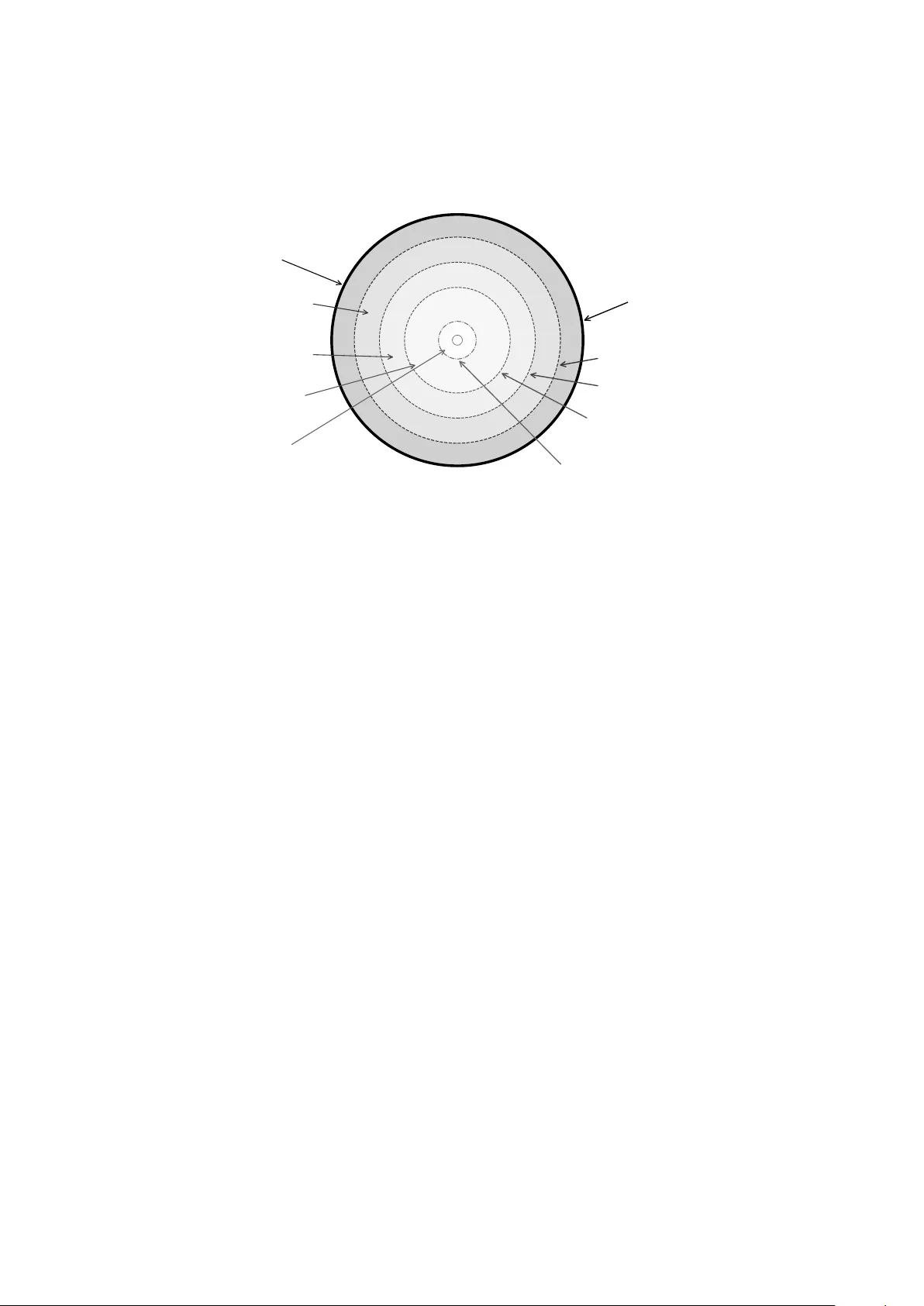
Prep ared for submission to JHEP Emergent strings, holography , and cosmology from four-fermion interactions: a b ottom-up derivation of AdS/CFT, dS/CFT, and w 1+ ∞ Laith H. Haddad a a Dep artment of Physics, Color ado Scho ol of Mines, Golden, CO 80401, USA E-mail: lhaddad@mines.edu Abstract: W e derive holographic dualit y from first principles starting from the (1 + 1)- dimensional Gross-Nev eu (GN) mo del with N fermion species and a lo cal quartic in terac- tion, without assuming any string or geometric input. Using a Bargmann-Wigner scheme, w e sho w that the comp etition betw een c hiral condensation ∆ 0 = ⟨ ¯ ψ ψ ⟩ and spin-1 pairing ∆ 1 = ⟨ ¯ Φ 1 Φ 1 ⟩ defines an emergen t radial co ordinate z = m − 1 (∆ 1 / ∆ 2 0 − 1) 1 / 2 . Lo cal fluctua- tions of this ratio, trac k ed b y a como ving deriv ative, generate the AdS 3 line elemen t via the enhanced large- N sp ecies disp ersion; the condensate competition is the extra dimension. F rom this single mechanism the complete AdS 3 /CFT 2 corresp ondence emerges: Newton’s constan t, the Virasoro algebra ( c = 2 N 2 ), D1-branes with op en strings, op en/closed T- dualit y , the Hagedorn/BKT transition. Decoherence in the spin-2 phase gives rise to a dual BTZ blac k hole whose horizon circumference is quantised in Planc k units b y individual v ortex n ucleation even ts. This provides the first microscopic deriv ation of horizon quanti- sation from a four-fermion Lagrangian, with entrop y confirmed by the Cardy form ula. The condensate phase diagram in the boundary theory yields a complete microscopic descrip- tion of the bulk black hole in terior: four successiv e phase transitions (horizon, graviton dissolution, Hagedorn, geometry’s end) pro duce a la y er-by-la y er structure from classical spacetime through tensionless strings. W e find, in particular, that the onset of quan tum gra vit y is c haracterized by a gas of top ological defects in the gra viton condensate near the BTZ horizon with information preserv ed by the U (1) winding num b er of the horizon v ortex. Analytic con tinuation z → iζ across the c hiral critical p oin t realises the Strominger dS/CFT conjecture microscopically . Six constraints identify the emergent string as Type I IB on AdS 3 × S 3 × M 4 , with emergent w orldsheet N = (1 , 1) sup ersymmetry , NS/R sp ec- tral flo w, and GSO pro jection. Extension to the (2 + 1)d NJL mo del yields AdS 4 /CFT 3 , a dS 4 /CFT 3 realisation, and a structural iden tification of the w 1+ ∞ celestial algebra. Signif- ican tly , extension to the (3 + 1)d NJL model yields AdS 5 /CFT 4 and holographic QCD with c hiral symmetry breaking and linear Regge tra jectories M 2 s = 4( s + 1)Λ 2 QCD , capturing the correct QCD infrared physics. The self-consistency of our construction suggests a literal in terpretation: spacetime is a spin-2 condensate and black holes are its top ological defects, pro viding a microscopic realisation of the Dv ali-Gomez picture [ 1 , 2 ]. Keywords: AdS/CFT corresp ondence, Gross-Neveu model, higher-spin fields, BTZ black hole, emergen t holography , op en/closed string duality , BKT transition, tac h yon conden- sation, Hagedorn transition, emergen t sup ersymmetry , GSO pro jection, T yp e I IB string theory , dS/CFT correspondence, holographic QCD, NJL mo del, Regge tra jectories, c hiral symmetry breaking Con ten ts 1 In tro duction 1 1.1 Summary of results 9 1.2 Organisation of the pap er 10 2 Higher-spin theory from Gross-Nev eu interactions 11 2.1 Spin-1 13 2.2 Emergence of the bulk measure 17 2.3 Spin-2 21 2.4 General spin 21 3 Emergen t AdS 3 /CFT 2 26 3.1 Dual holographic frames 27 3.1.1 F rame 1: spin-1 condensate phase and V asiliev higher-spin holography 27 3.1.2 F rame 2: spin-0 condensate phase and conv entional AdS/CFT 28 3.1.3 Explicit F rame 2 Lagrangian 29 3.1.4 The t wo frames and the Z 2 symmetry 29 3.2 Three length scales and bulk regimes 31 3.3 Symmetry matc hing and the holographic dictionary 33 3.3.1 Newton’s constan t from the GN parameters. 36 3.4 Regime boundaries and the Hawking-P age transition 36 3.4.1 Emergen t horizon and BTZ geometry . 39 4 T op ological Phase Structure and the BKT T ransition 39 4.1 Mermin-W agner, Coleman theorems, and the emergence of true condensates 41 4.2 T op ological order, v ortex formation, and the BKT transition 47 4.3 Quan tum BKT transition and the stability of the AdS 3 geometry 51 5 Op en Strings and D-Branes 54 5.1 Cross-sp ecies fields, brane geometry , and the w orldsheet action 56 5.2 Op en string mass sp ectrum 58 5.3 Virasoro algebra from the fusion algebra 59 5.4 Virasoro constrain ts and the mass-shell condition 60 5.5 Adjoin t decomposition and the Y ang-Mills in terpretation 62 5.6 The emergen t U ( N ) gauge field and the holographic dictionary 63 5.6.1 Holographic dictionary for A a µ . 65 5.6.2 Chern-Simons connection. 66 5.7 Resolution, the gauge field phase, and the infinite w eb of ∆ 0 66 5.7.1 The open string as resolution of the fusion. 67 5.7.2 Tw o dual resolutions and the holographic duality . 70 5.8 String tension and the string length ℓ S 71 – i – 5.8.1 T ransition to open/closed string dualit y . 71 6 Op en/closed String Dualit y 71 6.1 The composite field partition function and its t wo channels 72 6.1.1 Op en string channel 72 6.1.2 Closed string channel 73 6.1.3 Mo dular transformation and T-duality 74 6.2 Virasoro c haracters and the modular b o otstrap 75 6.3 Geometric picture: fluctuation pairs, winding, and radial oscillation 76 6.3.1 The Hagedorn transition as the self-dual p oint. 76 6.4 Hagedorn transition as tach yon condensation 77 7 Emergen t BTZ Blac k Hole 78 7.1 The BTZ horizon in the GN picture: a purely condensate in terpretation 78 7.1.1 The GN ground state and its excitation hierarc h y . 78 7.1.2 The BTZ horizon as a macroscopic phase v ortex. 80 7.1.3 Ha wking radiation, light trapping, and the signature flip. 81 7.2 Deriv ation of the BTZ metric from thermal bac kreaction 82 7.2.1 Thermal energy of the string sector. 82 7.2.2 Effectiv e action and stress-energy tensor. 82 7.2.3 Einstein equations and the BTZ solution. 83 7.2.4 Horizon radius and Hawking temp erature. 84 7.3 Microstate coun ting and the Bek enstein-Hawking entrop y 84 7.4 BTZ blac k hole as an orbifold and t wist-sector microstates 86 7.5 Cardy form ula and mo dular in v ariance 87 7.5.1 Bro wn-Henneaux cen tral charge. 87 7.5.2 Cardy form ula. 87 7.5.3 Mo dular unification. 88 7.6 The BTZ geometry in GN language: a translation 88 8 Microscopic structure of the blac k hole in terior 90 8.1 Tw o condensates, tw o stages of destruction 90 8.2 The four critical temp eratures 91 8.3 Mapping to the bulk 91 8.4 The blac k hole in terior la yer by lay er 93 8.5 Quan tum gra vity as a v ortex gas 94 8.6 Micro-v ortices, Ha wking radiation, and the firewall 96 8.7 Information preserv ation 97 8.8 Analogy with QCD sequential suppression 98 9 Emergen t Einstein–Hilbert Action from the Rank-2 T ensor 99 9.1 Clifford decomposition of Φ ′ 1 99 9.2 Bilinear ev aluation and pro jection onto the spin-2 sector 100 9.3 Fierz–P auli structure and the linearised Einstein–Hilb ert action 101 – ii – 9.4 Matc hing to L ′ Φ 1 and iden tification of G 3 102 9.5 The metric fluctuation as a condensate fluctuation 103 10 Analytic con tin uation to de Sitter geometry 103 10.1 The emergent de Sitter metric 104 10.2 Physical interpretation of the dS geometry 105 10.2.1 Conformal time as condensate comp etition. 105 10.2.2 The U ( N ) gauge field in the dS region. 106 10.2.3 The de Sitter horizon and the Gibb ons-Hawking entrop y . 106 10.3 The full three-region geometry and the triple b oundary 106 11 Extension to four dimensions: AdS 4 /CFT 3 , dS 4 /CFT 3 , and celestial holog- raph y 107 11.1 The NJL 3 mo del and emergent AdS 4 metric 108 11.1.1 Emergen t AdS 4 metric from the fusion mec hanism 109 11.2 Boundary CFT 3 , dS 4 , and the holographic dictionary 111 11.2.1 Analytic con tin uation to dS 4 and the cosmological constant 112 11.3 The dS 4 /CFT 3 corresp ondence 113 11.4 The smallness of the cosmological constan t 113 11.5 Celestial holography and the w 1+ ∞ algebra 114 11.5.1 The flat-space limit. 115 11.5.2 The w 1+ ∞ algebra from the higher-spin to w er. 115 11.5.3 Soft theorems from the condensate. 116 11.5.4 The celestial sphere, OPE, and NJL 3 fusion. 116 11.6 Observ ational signatures and the NJL 3 condensate picture of our univ erse 117 11.7 Renormalisability and the large- N expansion 118 11.8 Emergent sup ersymmetry 118 11.9 BPS sp ectrum and iden tification of the emergen t string theory 123 11.9.1 The N 2 vs N cen tral c harge. 125 12 Bottom-up holographic QCD from the (3 + 1) -dimensional NJL mo del 126 12.1 The (3 + 1)-dimensional NJL model 126 12.2 Emergent AdS 5 metric and the holographic dictionary 127 12.3 The b oundary CFT 4 and the W eyl anomaly 128 12.4 Chiral symmetry breaking and the holographic pion 129 12.5 Linear Regge tra jectories and the hadronic sp ectrum 129 12.6 Confinement and the deconfinemen t transition 130 12.7 Relation to full QCD and the Maldacena corresp ondence 131 13 The dualit y w eb 134 14 Conclusion 136 – iii – A Deriv ation of the phase b oundary curv es 149 A.1 Ha wking-P age boundary T HP ( x ) 149 A.2 Hagedorn / BKT b oundary T H ( x ) 149 A.3 Planc k temperature T P (c hiral restoration) 150 A.4 de Sitter contin uation ( x < 1) 150 A.5 P arameter v alues in Figure 2 150 B Bulk w a ve equation and vortex profile 150 B.1 The Sc hr¨ odinger potential and radial w a v e equation 150 B.2 The nonlinear Ginzburg-Landau vortex equation 151 B.3 Relation betw een the t w o equations 152 1 In tro duction A cen tral am bition of mo dern theoretical physics is to derive holographic duality from first principles rather than p ostulate it. The AdS/CFT correspondence [ 3 ] is ordinarily established by taking a particular large- N limit of string theory and identifying the resulting bulk gravit y with the b oundary gauge theory . Here we pursue the in v erse route: b eginning from a concrete, solv able quan tum field theory in (1 + 1) dimensions (the Gross-Neveu (GN) mo del with N fermion sp ecies [ 4 , 5 ]: we show that holographic duality emerges en tirely from the b ottom up through a Bargmann-Wigner construction of comp osite higher-spin fields and a comoving deriv ativ e that generates the emergen t radial direction. The apparatus w e derive includes AdS 3 /CFT 2 holograph y in b oth its V asiliev and conv entional forms; T yp e I IB sup erstring theory on AdS 3 × S 3 × M 4 from four-fermion interactions alone; the dS 3 /CFT 2 and dS 4 /CFT 3 corresp ondences from a single analytic contin uation; the w 1+ ∞ algebra of celestial holograph y; and emergen t N = (1 , 1) worldsheet sup ersymmetry with sp on taneous breaking at the Planc k scale. The idea that gra vity migh t not b e fundamental but instead emerge from underlying non-gra vitational degrees of freedom has a long history . Sakharo v [ 6 ] prop osed in 1967 that the Einstein–Hilbert action could b e induc e d by one-loop quantum corrections of matter fields on a curved bac kground. In this approac h, spacetime curv ature w ould b e analogous to the elastic resp onse of a crystal lattice [ 7 ]. The discov ery of blac k hole thermodynamics b y Bekenstein [ 8 ] and Ha wking [ 9 ] sharp ened this picture dramatically: the entrop y of a black hole scales with the ar e a of its horizon rather than its v olume. The implication here is that gravit y imposes a far more sev ere constraint on the n umber of accessible mi- crostates than any con v entional field theory would predict. This observ ation, formalised as the holographic principle by ’t Hooft [ 10 ] and Susskind [ 11 ], inv erts the traditional re- ductionist hierarc h y: in the presence of strong gravit y the macroscopic (infrared) geometry of the horizon determines and constrains the microscopic (ultraviolet) degrees of freedom, rather than the other wa y around. The resulting UV/IR corresp ondence [ 12 , 13 ] stands in direct opp osition to the Wilsonian paradigm in which short-distance physics determines – 1 – long-distance phenomena through coarse-graining, and lies at the conceptual heart of holo- graphic duality . Jacobson [ 14 ] made this in v ersion quan titativ e b y deriving the Einstein field equations from the Clausius relation applied at lo cal Rindler horizons, thereb y re- casting general relativit y as an equation of state. Subsequen t w ork by P admanabhan [ 15 ] and V erlinde [ 16 ] reinforced the view of gravit y as an emergen t thermo dynamic or entropic phenomenon, while V olovik [ 17 ] demonstrated in concrete condensed-matter mo dels (su- p erfluid 3 He) that effectiv e metrics, gauge fields, and ev en c hiral fermions emerge naturally as collectiv e excitations of an underlying quan tum liquid, pro viding a ph ysical realisation of Sakharo v’s programme. More recen tly , V an Raamsdonk [ 18 ] has argued from the AdS/CFT corresp ondence itself that spacetime connectivity is built from quan tum en tanglement, so that the geometry of the bulk is literally w ov en from information-theoretic correlations on the boundary . Eac h of these dev elopments, whether w orking from the gra vitational side (Jacobson, P admanabhan, V erlinde) or from the condensed-matter side (V olo vik, Sakharo v), takes a kno wn gra vitational result (the Einstein equations, the Bekenstein-Ha wking en tropy , the effectiv e metric) and sho ws that it can b e repro duced or reinterpreted in non-gravitational language. What has been lac king is a construction that starts from a sp ecific, solv able quan tum field theory containing no gra vitational input and, without targeting any prede- termined gravitational outcome, deriv es the bulk ge ometry , the string spectrum, the blac k hole, the phase structure, and the full holographic dictionary from the dynamics of its con- densates alone. The present w ork fills this gap. Moreo ver, it does so in a wa y that makes the UV/IR inv ersion fully constructive rather than merely constraining. The Gross-Neveu mo del is an effective low-energy quantum field theory: its natural habitat is the infrared ph ysics of strongly in teracting fermions. Y et through the comp ositeness mec hanism (the rep eated fusion of elemen tary fermions in to higher-spin bound states), this infrared starting p oin t gener ates the framew ork for ultra violet ph ysics: the comp osite tow er is a string sp ec- trum with Regge slop e set b y the quartic coupling; the condensate comp etition produces the extra dimension and the Planc k scale; and the phase structure of the condensates en- co des the full landscape of quan tum gra vitational phenomena from the BTZ blac k hole to the Hagedorn transition. In other words, the UV completion of the theory , quan tum grav- it y and string theory , do es not hav e to b e postulated at short distances and then flow ed to the infrared; it is assemble d at long distances by the c ollectiv e dynamics of the condensate and then pro jected into the bulk as emergent short-distance structure. The composite- ness mec hanism is the bridge that conv erts the holographic principle from a kinematic b ound on entrop y into a dynamical programme for constructing quantum gra vit y from the b ottom up. A concrete illustration is the emergent BTZ black hole derived in Section 7 : eac h individual v ortex nucleation even t in the condensate contributes exactly one Planck unit δ (2 π r + ) ∼ ℓ P to the horizon circumference and one quan tum of entrop y δ S ∼ 1 to the Bek enstein-Ha wking formula (eq. 3.26 ), so that the macroscopic black hole of entrop y S ∼ N 2 is assem bled one infrared condensate ev en t at a time, a microscopic realisation of Bek enstein’s area quantisation conjecture [ 19 ] built entirely from the lo w-energy physics of the GN interaction. A classical obstruction to this programme is the W ein berg-Witten (WW) theorem [ 20 ], – 2 – whic h states that a Loren tz-co v arian t quan tum field theory p ossessing a conserved, gauge- in v arian t stress tensor cannot con tain massless particles of spin j > 1. In particular, it forbids the gra viton from arising as a comp osite b ound state within any standard relativistic QFT on a fixed Minko wski background. Our construction ev ades the theorem through the mec hanism identified precisely by holograph y [ 21 , 22 ]: the emergen t AdS 3 geometry lives in a spacetime of strictly higher dimension than the (1 + 1)-dimensional GN theory . The bulk gra viton is therefore not a particle in the F o ck space of the b oundary fermions; it is a fluctuation of the emergent metric in the bulk. The Lorentz group classifying its spin is that of AdS 3 , not of the 1 + 1-dimensional Minko wski v acuum, so the theorem’s h yp otheses simply do not apply . Our result constitutes a concrete, microscopic realisation of this holographic loophole: the k ey assumption of the WW theorem – that composite and fundamen tal particles inhabit the same spacetime – fails precisely because the additional radial direction z is itself emergen t. There is a further structural reason why a spin-1 comp osite in (1 + 1) dimensions is the natural seed for (2 + 1)-dimensional gra vit y . In 1 + 1 spacetime dimensions, a vector field carries no propagating lo cal degrees of freedom: in d = 1 + 1 there are no transv erse directions whatso ever, so the single on-shell comp onen t of Φ µ 1 is purely longitudinal and non-propagating regardless of mass, and the spin-1 composite Φ 1 = ψ ( i ) ⊗ ψ ( j ) is therefore a c ol le ctive , non-propagating mo de of the interacting fermion system irresp ective of its mass. A deep er consequence follo ws from the comp osite structure itself: the spin-1 condensate ∆ 1 = ⟨ ¯ Φ 1 Φ 1 ⟩ is sim ultaneously a spin-2 ob ject, since it is formed from the symmetric prod- uct of t wo spin-1 fields, ¯ Φ 1 Φ 1 ∼ Φ 2 , so ⟨ Φ 2 ⟩ = 0. A nonzero spin-2 condensate is precisely a deformation of the bac kground metric (the graviton condensate), which is why ∆ 1 app ears naturally as the background in which b oth the spin-1 fluctuations δ Φ 1 and the fundamen- tal fermions ψ propagate. This is the microscopic origin of the emergent geometry: the condensate that defines the radial co ordinate z ∝ (∆ 1 / ∆ 2 0 − 1) 1 / 2 also sources the AdS 3 metric through its spin-2 con ten t, closing the self-consistency lo op betw een the order pa- rameter and the spacetime it generates. The precise relationship b etw een this picture and the Dv ali-Gomez proposal [ 1 , 2 ] that ordinary spacetime is a sourced gra viton condensate and black holes are its self-sustaining critical phase is dev eloped in Section 13 . Promoting the emergent radial coordinate z to a dynamical direction allows this collectiv e mo de to acquire propagating dynamics in the (2 + 1)-dimensional bulk, in close analogy with how eigen v alue distributions in matrix mo dels generate extra dimensions. Moreo v er, in (2 + 1) dimensions, gauge fields and gra vit y are in timately connected: AdS 3 Einstein gra vit y is equiv alent to a Chern-Simons gauge theory with gauge group SL(2 , R ) × SL(2 , R ) [ 23 , 24 ]. The spin-1 comp osite sourcing the AdS 3 metric in our construction is therefore not acci- den tal but structurally driven: the c hain is spin-1 comp osite in (1 + 1)d → emergen t gauge field in (2 + 1)d → AdS 3 gra vit y via Chern-Simons equiv alence. The full representation- theoretic matching, showing that the emergen t gauge field lies in the SL(2 , R ) × SL(2 , R ) represen tation required by the Ac h ucarro-T o wnsend-Witten construction, is established in Section 11.9 as part of the Type I IB string iden tification. This constitutes a field-theoretic b ottom-up deriv ation of the emergence of three-dimensional gravit y from a four-fermion in teraction. – 3 – The Gross-Neveu mo del and its composite-field in terpretation arise naturally in con- densed matter and particle physics, making the holographic map dev elop ed here experi- men tally relev an t. In condensed matter, the c hiral condensate ∆ 0 = ⟨ ¯ ψ ψ ⟩ pla ys the role of a superconducting gap in strongly interacting quantum wires [ 4 , 25 ], and the higher-spin comp osite tow er Φ s with masses M 2 s ∝ ( s + 1) is a linear Regge tra jectory (the empirical hallmark of hadronic ph ysics), here derived directly from a four-fermion interaction rather than assumed from string theory [ 26 ]. In particle ph ysics, the GN mo del is the (1 + 1)d analogue of the NJL mo del [ 27 ], a standard low-energy effectiv e theory for the chiral sector of QCD; the comp osite fusion pro cedure dev elop ed here generates meson and bary on res- onances as composites of the NJL fields, with the holographic dual pro viding a b ottom-up AdS 5 /CFT 4 description of QCD (Section 12 ). Our construction extends naturally b eyond AdS 3 /CFT 2 . Analytic contin uation z → iζ of the emergen t co ordinate (whic h arises naturally when the scalar condensate dominates, ∆ 2 0 > ∆ 1 ) pro duces a de Sitter metric directly from the GN Lagrangian, giving the first explicit microscopic realisation of the Strominger dS/CFT conjecture [ 28 ]. The chiral transition surface pla ys a triple role: it is the AdS 3 b oundary in F rame 1 ( z → 0), the Planc k depth ( ˜ z = ℓ P ) in F rame 2, and the dS 3 past conformal boundary ( z → iζ ) under analytic con tin uation. Extension of the same construction to the (2 + 1)d NJL model yields AdS 4 /CFT 3 and a microscopic realisation of dS 4 /CFT 3 , with the flat-space limit generating the w 1+ ∞ algebra of celestial holography . Finally , six indep enden t constrain ts on the emergen t bulk theory are consistent with T ype I IB sup erstring theory on AdS 3 × S 3 × M 4 , with the N = (1 , 1) w orldsheet supersymmetry , the GSO pro jection, and the Goldstino of sp ontaneous SUSY breaking all emerging from the structure of the GN model without b eing put in. The mechanism is as follows. The GN interaction generates tw o competing conden- sates: a c hiral (spin-0) condensate ∆ 0 = ⟨ ¯ ψ ψ ⟩ and a hierarch y of higher-spin condensates ∆ s = ⟨ ¯ Φ s Φ s ⟩ built from rank-2 s fermion tensor products Φ s = ψ ( i 1 ) ⊗ · · · ⊗ ψ ( i 2 s ) . The ratio ∆ 1 / ∆ 2 0 defines a natural emergent length coordinate z . When ∆ 1 / ∆ 2 0 v aries locally across the system, either through genuine spatial inhomogeneit y or through quan tum fluctuations near the phase transition, one m ust replace the ordinary deriv ativ e with a como ving deriv a- tiv e [ 29 , 30 ] ∂ µ → ∂ µ + ( ∂ µ z ) ∂ z that tracks the lo cal c hange in condensate comp etition. This generates a new kinetic term ( ∂ µ z ) 2 ∂ z ¯ Φ 1 ∂ z Φ 1 whic h, after the field rescaling of Sec- tion 2 , b ecomes the ∂ z ¯ Φ ′ 1 ∂ z Φ ′ 1 term in eq. ( 2.25 ), precisely the radial kinetic term of a field propagating in AdS 3 . The comp etition betw een the t w o condensates is the extra dimen- sion: the AdS radial direction emerges because the system has a lo cal degree of freedom (the ratio ∆ 1 / ∆ 2 0 ) that is dynamical and s patially v arying. Tw o complementary mechanisms work together to pro duce the emergent bulk dimen- sion. The first is the large- N sp ecies sum: the N fermion sp ecies collectiv ely generate a bulk measure ρ ∗ ( z ) ∝ z /α (Section 2.2 ) through the absorbing/dissipating effect of the large condensate distributed across sp ecies. This is the sc affolding : the static organisa- tional structure that creates the radial direction as an emergent depth co ordinate. The large spin-1 condensate ∆ 1 , spread across N sp ecies, pro vides the bac kground geometry b efore any fluctuation o ccurs. The second mechanism is the como ving deriv ative on local – 4 – fluctuations: once the radial scaffold is in place, fluctuations of the condensate ratio ∆ 1 / ∆ 2 0 explore it, with the comoving deriv ativ e translating b oundary dynamics into bulk motion at depth z . This t w o-mec hanism picture has a natural visualisation in terms of the UV/IR connection [ 13 ]: a string with b oth ends fixed at the AdS boundary and hanging into the bulk represen ts a b oundary excitation probing the radial direction. Short strings that barely dip into the bulk corresp ond to UV excitations (high-momentum b oundary mo des of small spatial exten t), while long strings that hang deep tow ard the P oincar´ e horizon corresp ond to IR excitations (long-wa velength, large-scale boundary modes). The radial direction m ust pre-exist (Mec hanism 1) b efore the strings hav e a bulk to hang in; the string fluctuations themselv es (Mec hanism 2) then generate the bulk-to-b oundary propagator and the holographic renormalisation group flo w. When the comp osite field Lagrangian is rewritten in terms of z , it takes the form of a massiv e interacting field in AdS 3 with curv ature radius ℓ AdS = ( λk ∆ 1 / 2 1 ) − 1 . Three distinct length scales emerge from the microscopic parameters: ℓ AdS = ( λk ∆ 1 / 2 1 ) − 1 , ℓ P = m − 1 , ℓ S = ( m 2 / 3 g ∆ 1 / 6 1 ) − 1 , (1.1) iden tified as the AdS radius, Planck length, and string length resp ectively , where m is the fermion mass, g is the quartic coupling, and λk is the c haracteristic momen tum scale of the background condensate fluctuation z → z + λe ik µ x µ , equiv alen tly the momen tum scale at which the ∆ 1 ↔ ∆ 0 comp etition o ccurs (Section 2 ). The product λk alw a ys app ears as a single comp osite parameter setting the AdS curv ature scale. Their hierarch y determines whic h of three distinct holographic regimes gov erns the dynamics: classical AdS 3 gra vit y ( ℓ P ≪ ℓ S ≪ ℓ AdS ), quantum gra vit y ( ℓ P ∼ ℓ AdS ), or the stringy regime ( ℓ S ∼ ℓ AdS ). Cross- sp ecies in teractions in the matrix model generate off-diagonal composite fields Φ ( ij ) 1 with mass prop ortional to the squared radial separation [ z ( i ) − z ( j ) ] 2 b et w een sp ecies i and j . This is precisely the Higgs mec hanism on a D-brane stac k: the off-diagonal modes are op en strings stretc hed radially betw een D1-branes at positions z ( i ) and z ( j ) , with string tension T = k 2 ¯ m ¯ m 6 / 4 g 4 ¯ ∆ 1 deriv ed directly from the quartic GN interaction. The U ( N ) matrix mo del of all N 2 comp osite fields is the w orldv olume theory of a stac k of N D1-branes. P assing to global AdS 3 with its compact angular direction θ ∈ [0 , 2 π ), the op en string partition function Z open ( β ) and the closed string winding partition function Z closed ( ˜ β ) are related b y a mo dular transformation, T-duality on the θ -circle. The t wo descriptions b ecome equiv alen t at the self-dual radius R θ = ℓ S , whic h is simultaneously the Hagedorn temp erature T H = (2 π ℓ S ) − 1 of the string gas and the op en/closed string dualit y p oin t. The GN dictionary for these string-theoretic ob jects is the following. The D1-brane at p osition z ( n ) is the accum ulated condensate ∆ ( n ) 1 / ∆ ( n )2 0 of species n (a collectiv e ob ject whose depth is set by the lo cal condensate ratio, not b y the individual fermion sp ecies itself. The op en strings Φ ( ij ) 1 with i = j are the off-diagonal elemen ts of the spin-1 matrix field: cross-sp ecies bilinears ψ ( i ) ⊗ ψ ( j ) connecting tw o fermions of different species, stretched radially b et w een brane i at z ( i ) and brane j at z ( j ) , with tension set b y [ z ( i ) − z ( j ) ] 2 . The closed strings Φ ( ii ) 1 are the diagonal elemen ts: same-species bilinears ψ ( i ) ⊗ ψ ( i ) , a b oson formed from t w o fermions of sp ecies i , with b oth endp oin ts on the same brane; written in p olar form Φ ( ii ) 1 = ρ ( i ) e iθ ( i ) , the winding of θ ( i ) around the compact AdS 3 angular direction is the closed – 5 – string winding n umber. The T-duality exc hanging op en and closed strings is therefore the exc hange of off-diagonal and diagonal elements of the U ( N ) matrix Φ ( ij ) 1 (a U ( N ) rotation that at the quantum level b ecomes the mo dular S -transformation τ → − 1 /τ , and in GN language is the BKT self-duality betw een radial (densit y) fluctuations in ρ ( i ) and angular (phase) fluctuations in θ ( i ) . The Hagedorn transition is the un binding of v ortices in the phase θ ( i ) . This dictionary carries a physical interpretation that is cen tral to the geometry . A closed string winding at depth z ( i ) is a c ondensation event : b oth fermions of species i pair in to the diagonal condensate Φ ( ii ) 1 , incremen tally adding one lay er to the bac kground ∆ ( i ) 1 and deep ening the bulk geometry by one step. An op en string at the same depth is the opp osite — a de c oher enc e event : one fermion of species i pairs with a fermion of a differ- en t sp ecies j , withdrawing from the diagonal condensate and reducing ∆ ( i ) 1 lo cally . The radial direction therefore measures the cum ulativ e balance betw een these tw o comp eting pro cesses. In F rame 1 (co ordinate z , the V asiliev frame), deep in the bulk condensation (closed strings) has w on and ∆ 1 is large; this is the maximally ordered, classical region; near the boundary ( z → 0), the t wo are delicately balanced at the chiral fixed p oin t ∆ 1 / ∆ 2 0 → 1. (In the complemen tary F rame 2, coordinate ˜ z , whic h is closer to the con ven tional AdS/CFT picture, the roles are reversed: the b oundary ˜ z → 0 is the classical region, with ∆ 1 → ∞ and ∆ 0 → 0 (c hiral symmetry unbrok en), while the deep bulk ˜ z → ℓ P is the quantum gra vit y regime, with ∆ 1 progressiv ely destro yed and ∆ 0 fully ordered (the chirally broken phase). The deep bulk of AdS — the domain of quan tum gra vity , strings, and blac k hole in teriors — is dual to the ordinary broken-c hiral phase of the GN model: the quiet theory of massiv e fermions hides an extraordinarily rich gravitational interior; see Section 3.1 .) The T-duality at R θ = ℓ S marks the BKT self-dual p oint. The three phase transitions of eq. ( 1.3 ) map on to the familiar solid–liquid–gas sequence. Below T HP the condensate is a rigid ordered solid: closed strings (condensation even ts) dominate and classical AdS geom- etry p ersists. At T HP the system melts: a BTZ black hole n ucleates as a vortex droplet inside the ordered bulk, a liquid phase of partially disordered condensate coexisting with the solid. At T H , condensation and decoherence cost exactly equal energy , the op en and closed string descriptions are equiv alent, and neither phase dominates; this is the boiling p oin t, the system p oised precisely at the liquid–gas phase b oundary , with the mo dular S -transformation an exact symmetry . Ab o v e T H decoherence wins, the condensate ev ap- orates into free op en string endpoints (v ortices), and the geometry dissolv es in to a string gas. The Hagedorn transition is the b oiling point, and the open/closed string dualit y is the statemen t that at the b oiling point the t wo phases are indistinguishable. This picture — holographic depth as cumulativ e condensation, op en strings as decoherence, the Hagedorn transition as the b oiling point — is, to our knowledge, a new microscopic interpretation of the AdS radial direction that emerges naturally from the GN construction. The thermo dynamics of the mo del exhibits a complete hierarch y of three phase tran- sitions: T HP < T H < T P , (1.2) where T HP = (2 π ℓ AdS ) − 1 is the Ha wking-P age transition, T H = (2 π ℓ S ) − 1 is the Hage- – 6 – dorn/BKT transition, and T P ∼ ℓ − 1 P ∼ m is the Planck temp erature (in the b oundary theory this is c hiral restoration, ∆ 0 → 0; in the F rame 2 bulk it is the depth ˜ z = ℓ P at whic h the spin-1 condensate has b een fully destro yed by the cascade of preceding transi- tions, while the scalar condensate ∆ 0 remains at full strength). Each critical temp erature is the inv erse of its corresponding length scale, so the hierarc h y ℓ P ≤ ℓ S ≤ ℓ AdS is equiv a- len t to T HP ≤ T H ≤ T P . Abov e T HP , the thermal exp ectation v alue ⟨ H string ⟩ β bac kreacts on the emergent geometry via the (2+1)-dimensional Einstein equations, sourcing a BTZ blac k hole with mass M ∝ ⟨ H string ⟩ β and horizon radius r + = ℓ AdS √ M . The Bek enstein- Ha wking en trop y S BTZ = 2 π r + / 4 G 3 ∼ N 2 coun ts precisely the N ( N − 1) / 2 off-diagonal matrix elements Φ ( ij ) 1 that b ecome thermally excited blac k hole microstates. Unlike the celebrated Strominger-V afa calculation [ 31 ], which coun ts D-brane microstates at weak coupling and extrap olates to the black hole regime via sup ersymmetric protection, our coun ting is performed directly in the black hole geometry: the microstates are the deco- herence even ts (open strings) that the horizon has absorbed, the proliferated U (1) 2 v ortex degrees of freedom at the horizon surface. The Cardy form ula for the boundary CFT 2 then repro duces S BTZ through the same mo dular transformation that gov erns the op en/closed string dualit y , unifying all three results. The three transitions carry a unified thermodynamic narrativ e that extends the boiling picture to a complete phase diagram: ordered AdS (solid 1 ) | {z } classical geometry T HP − − − → BTZ blac k hole (liquid) | {z } quantum gravity T H − − − → strings (gas) | {z } no geometry . (1.3) The Hawking-P age transition is melting : the ordered condensate n ucleate s a droplet of the disordered phase, a BTZ black hole, inside the ordered bulk, exactly as a superheated solid nucleates the first droplet of liquid. The black hole is not merely analo gous to a disordered condensate: in this construction it is one, in the precise sense that the horizon is a phase v ortex in the spin-2 condensate Φ 2 = ⟨ ¯ Φ 1 Φ 1 ⟩ . W ritten in p olar form Φ 2 = | Φ 2 | e iφ 2 , the U (1) 2 phase φ 2 winds b y 2 π around the vortex core, a lo calised p oint of complete spin-2 phase decoherence. Crucially , the spin-1 condensate amplitude ρ ( i ) = | Φ ( ii ) 1 | remains nonzero through the horizon, b ecause the underlying spin-1 condensate is still in tact at T HP ; it is only the spin-2 phase coherence that is lost. This is wh y the spacetime structure is preserved through the horizon with a signature flip ( g tt ↔ g ˜ z ˜ z ) rather than destro y ed: the spin-2 density | Φ 2 | = ρ 2 = 0 on b oth sides (see Section 8 for the full analysis). The Bek enstein-Hawking entrop y coun ts the proliferated v ortex degrees of freedom: the N ( N − 1) / 2 decoherence ev en ts the horizon has absorb ed. Blac k hole formation is the n ucleation of a vortex droplet in the condensate (Hawking-P age = melting); black hole ev ap oration is v ortex annihilation; Ha wking radiation is the gradual re-emission of closed string windings (condensation ev en ts) as the v ortex core shrinks, restoring phase coherence and rebuilding the ordered geometry . Information is not lost: it is stored in the phase 1 More precisely , a supersolid : the D1-brane stac k provides crystalline spatial order (species at fixed radial p ositions z ( n ) ) while the diagonal condensate Φ ( ii ) 1 main tains global phase coherence, combining the defining features of both a solid and a superfluid. Sup ersolid phases of this type ha v e recen tly b een observ ed in dip olar Bose-Einstein condensates. – 7 – winding φ 2 around the v ortex core, and returned to the bulk as the core con tracts. The Hagedorn transition is boiling: the v ortex droplet expands to fill the entire system, all phase coherence is lost, and the geometry ev ap orates into a gas of free op en string endpoints. A finer analysis (Section 8 ) reveals that the region b etw een T HP and T H con tains an additional transition, the Mott disso ciation of the spin-2 condensate at a higher-spin restoration temp erature T HS , refining the hierarc h y to T HP < T HS < T H < T P . The same section shows that the radial profile of a single vortex in F rame 2 maps on to the complete thermal phase sequence (Figure 5 ), with the distance from the v ortex core playing the role of temperature. The holographic map deriv ed here has a concrete in terpretation in terms of computa- tional tractability . The GN mo del at its c hiral phase transition is a strongly coupled CFT: directly computing correlators, op erator pro duct co efficien ts, or the sp ectrum of comp osite op erators Φ s requires resumming the full 1 / N expansion on the b oundary [ 32 ], and no small parameter organises the p erturbation theory . The emergent bulk description reorganises this problem: in the regime ℓ P ≪ ℓ S ≪ ℓ AdS the comp osite fields propagate as nearly free massiv e particles on AdS 3 , with interactions suppressed b y g ′ 2 1 ∼ g 6 /m 2 ≪ 1 [eq. ( 2.25 )], in precise correspondence with the standard AdS/CFT dictionary relating bulk free fields to b oundary operators of definite conformal dimension [ 33 ]. What is a strongly coupled fixed p oint on the b oundary b ecomes a tractable w eakly in teracting bulk theory in the in terior. This is the sense in whic h the b ottom-up deriv ation presented here is not merely a reform ulation but a gen uine simplification. GN model (1 + 1)d, N species AdS 3 /CFT 2 Type I IB, AdS 3 × S 3 × M 4 NJL 3 mo del (2 + 1)d, N species AdS 4 /CFT 3 dS 4 /CFT 3 , w 1+ ∞ NJL 4 mo del (3 + 1)d, N c , N f AdS 5 /CFT 4 holographic QCD fusion + mat. deriv. same me chanism same me chanism extend to (2 + 1)d extend to (3 + 1)d AdS 4 AdS 5 Boundary QFT Emergen t bulk Figure 1 . The systematic se quence of b ottom-up holographic dualities derived in this pap er. Each ro w applies the same mechanism — the fusion condition and comoving deriv ative — to a four- fermion mo del in one higher spacetime dimension, yielding an emergent AdS bulk of one dimension higher. The (1 + 1)d Gross-Nev eu mo del gives AdS 3 /CFT 2 and T yp e I IB string theory (Sections 2 – 11.9 ); the (2 + 1)d NJL 3 mo del gives AdS 4 /CFT 3 , dS 4 /CFT 3 , and the w 1+ ∞ algebra (Section 11 ); the (3 + 1)d NJL 4 mo del giv es AdS 5 /CFT 4 and holographic QCD (Section 12 ). – 8 – 1.1 Summary of results W e collect here the main results of the paper for orien tation, with forw ard p ointers to the sections where each is deriv ed. Eac h item addresses a standing op en problem identified in the literature. The systematic structure across dimensions is illustrated in Figure 1 . 1. First-principles pr o of of A dS/CFT for matrix mo dels acr oss dimensions (Sections 2 – 3 , 11 – 12 ). The full AdS 3 /CFT 2 corresp ondence from the (1 + 1)d GN model, AdS 4 /CFT 3 from the (2 + 1)d NJL 3 mo del, and AdS 5 /CFT 4 from the (3 + 1)d NJL 4 mo del follow without assumption: the Virasoro algebra with c = 2 N 2 , Newton’s constan ts G 3 = ℓ AdS / 4 π N 2 , G 5 ∼ ℓ 3 / N 2 c , and the complete holographic dictionaries from the condensate parameters. 2. Micr osc opic BTZ black hole, horizon quantisation, and entr opy (Section 7 ). The BTZ blac k hole emerges from thermal bac kreaction of the off-diagonal comp osites Φ ( ij ) 1 . Its horizon is a macroscopic phase vortex; eac h individual v ortex n ucleation ev en t con tributes one quan tum δ (2 π r + ) ∼ ℓ P to the horizon circumference, giving the first microscopic deriv ation of horizon quan tisation from a four-fermion Lagrangian. The Bek enstein-Ha wking en tropy S BTZ = 2 π r + / 4 G 3 ∼ N 2 coun ts the N ( N − 1) / 2 thermally excited bilinears; the Cardy form ula reproduces S via the same S L (2 , Z ) transformation that go v erns op en/closed string duality . The macroscopic blac k hole is an accumulation of ∼ N 2 quan tum micro-black-holes, each a vortex core of Planck size. 3. First micr osc opic r e alisation of dS/CFT (Sections 10 – 11 ). Analytic con tin uation z → iζ pro duces the de Sitter metric directly from the GN Lagrangian. The c hiral transition surface is a triple b oundary : the AdS 3 b oundary in F rame 1 ( z → 0), the Planc k depth at finite ˜ z = ℓ P in F rame 2, and the dS 3 past conformal b oundary under analytic contin uation (a single CFT dual to three geometries. Extension to the (2 + 1)d NJL 3 mo del yields the first microscopic realisation of dS 4 /CFT 3 , with a p ositiv e cosmological constant (no fine-tuning of its sign). 4. T yp e IIB string the ory fr om four-fermion inter actions (Section 11.9 ). Six indep en- den t constrain ts — N = (1 , 1) worldsheet SUSY, D1-brane structure, S L (2 , Z ) S- dualit y as frame exchange, AdS 3 × S 3 from the Chern-Simons bulk and S U (2) R R-symmetry , BPS saturation, and NS/R sp ectral flo w — are consisten t with T ype I IB on AdS 3 × S 3 × M 4 in the D1-D5 near-horizon limit. The D1-brane at depth z ( n ) is the accumulated condensate ∆ ( n ) 1 / ∆ ( n )2 0 (a collectiv e ob ject set by the condensate ratio of sp ecies n , not the individual fermion sp ecies itself. The diagonal compos- ites Φ ( ii ) 1 = ψ ( i ) ⊗ ψ ( i ) are the closed strings winding around the brane at z ( i ) ; the off-diagonal comp osites Φ ( ij ) 1 are op en strings stretc hed betw een branes i and j . The kinetic term is the D-string sector; the quartic in teraction is the F-string sector. 5. Structur al identific ation of the w 1+ ∞ algebr a (Section 11.5 ). The higher-spin tow er { Φ (3) s } of the NJL 3 mo del generates w 1+ ∞ in the flat-space limit, pro viding a struc- tural iden tification of the celestial holography symmetry algebra from a microscopic – 9 – QFT. BMS symmetry , W ein berg soft theorems, and the gra vitational memory effect all acquire GN interpretations. 6. Emer gent SUSY, Goldstino, and GSO fr om a non-SUSY L agr angian (Sections 11.8 – 11.9 ). The fusion condition is the worldsheet N = (1 , 1) SUSY W ard iden tit y . The frame duality is η = 1 2 sp ectral flow mapping NS to R b oundary conditions. The Z N t wist pro jection is the GSO pro jection. The Goldstino is the zero-mo de of ψ ( n ) , with mass gro wing as | ∆ 1 − ∆ 2 0 | 1 / 2 and reac hing m ∼ ℓ − 1 P in our universe. 7. Bottom-up holo gr aphic QCD fr om the (3 + 1) d NJL mo del (Section 12 ). The (3 + 1)d NJL 4 mo del with N c colours and N f fla v ours yields AdS 5 /CFT 4 via the same fusion mec hanism. W e derive: Newton’s constant G 5 ∼ ℓ 3 / N 2 c N f ; the chiral symmetry breaking pattern S U ( N f ) L × S U ( N f ) R → S U ( N f ) V with pion deca y constan t f 2 π ∝ N c Λ 2 QCD ; linear meson Regge tra jectories M 2 s = 4( s + 1)Λ 2 QCD ; and the Hawking-P age deconfinemen t transition with quark-gluon plasma entrop y density s ∝ N 2 c T 3 . 8. Micr osc opic structur e of the black hole interior (Section 8 ). The condensate phase diagram in F rame 2 yields a complete la yer-b y-la yer description of the BTZ interior (Figure 5 ). F our phase transitions ( T HP < T HS < T H < T P ) partition the interior in to distinct regimes: classical spacetime, quantum gravit y (a gas of U (1) 2 micro- v ortices in the gra viton condensate), tensionless strings, finite-tension strings, and free fermions. The microstates are the proliferated vortex degrees of freedom at the horizon; information is preserved b y the topological winding n um ber of the U (1) 2 phase. The complete dictionary b etw een GN/NJL quan tities and the emergent string/gra vit y picture is collected in T able 8 in the Conclusion (Section 14 ), as a summary of all deriv ed results. 1.2 Organisation of the pap er Section 2 b egins from the GN Lagrangian, constructs the comp osite field tow er via the fusion condition, and deriv es the spin-1 AdS 3 Lagrangian and emergent radial co ordi- nate z . Section 3 interprets the geometry: three length scales define three holographic regimes; the t w o dual holographic frames and their Z 2 symmetry are identified; the holo- graphic dictionary and Ha wking-P age transition are established. Section 4 dev elops the full BKT/Hagedorn topological phase structure. Section 5 deriv es the open string and D-brane description from cross-species interactions. Section 6 deriv es open/closed string T-dualit y and the Hagedorn transition as its self-dual p oint. Section 7 deriv es the emergen t BTZ blac k hole from thermal bac kreaction, establishes the v ortex/blac k-hole identit y , derives horizon circumference quantisation from the v ortex gas entrop y , counts the microstates, and confirms via the Cardy formula. Section 8 dev elops the microscopic structure of the blac k hole in terior from the condensate phase diagram, iden tifying the four-temp erature hierarc h y , the lay er-by-la y er interior structure, and the role of micro-vortices in quan tum gra vit y , Hawking radiation, and information preserv ation. Section 9 deriv es the emergen t – 10 – Einstein-Hilb ert action from the spin-2 sector. Section 10 deriv es de Sitter geometry b y analytic con tin uation and establishes the triple b oundary (AdS 3 b oundary in F rame 1, Planc k depth in F rame 2, dS 3 past conformal b oundary). Section 11 extends the con- struction to (2 + 1) dimensions, yields AdS 4 /CFT 3 and dS 4 /CFT 3 , and establishes the celestial holography connection, emergen t sup ersymmetry , and the Type I IB string identi- fication. Section 12 extends further to (3 + 1) dimensions, deriving AdS 5 /CFT 4 from the NJL 4 mo del and establishing a b ottom-up holographic QCD with linear Regge tra jectories, c hiral symmetry breaking, and the confinemen t/deconfinement transition from first prin- ciples. Section 13 collects all dualities discov ered throughout the pap er into a unified w eb, iden tifies the five-fold unification of the Z 2 frame symmetry , and establishes the precise relationship with the Dv ali-Gomez picture of blac k holes as graviton condensates. The systematic dimensional structure of the construction is illustrated in Figure 1 . Section 14 concludes. Two app endices deriv e the phase boundary curv es (Appendix A ) and the bulk w a v e equation with v ortex profile (App endix B ). 2 Higher-spin theory from Gross-Nev eu in teractions In all that follows, we adhere to the spin conv en tion in (1+1) dimensions: a time-like signature g µν = diag (1 , − 1) using the 2 × 2 gamma matrices γ 0 = σ 1 , γ 1 = − iσ 2 , γ 5 = γ 0 γ 1 = σ 3 , (2.1) whic h satisfy the Dirac algebra { γ µ , γ ν } = 2 g µν , (2.2) where the adjoin t spinor is defined as ¯ ψ ≡ ψ † γ 0 , and the charge conjugate spinor as ψ C = γ 5 ψ ∗ . W orking directly from the microscopic description for fermion fields interacting through a lo cal quartic term in (1 + 1)-dimensions, the Lagrangian is L = L 0 + L int , (2.3) with the kinetic and in teraction terms given by L 0 = N X n =1 ¯ ψ ( n ) ( iγ µ ∂ µ − m ) ψ ( n ) , (2.4) L int = N X n =1 V 4 g 2 , ¯ ψ ( n ) , ψ ( n ) . (2.5) Note in L 0 the inclusion of a fermion mass m with the four-fermion p otential V 4 in L int a general quartic term: four factors of ¯ ψ or ψ with some coupling strength g 2 . The length dimensions in (1 + 1)-d are dim[ ψ ] ∼ L − 1 / 2 , dim[ m ] ∼ L − 1 , and dim[ g ] ∼ L 0 . The sup erscript index n indicates formulation in terms of the fundamen tal representation for N sp ecies of fermions with coupling scaling lik e g 2 ∼ 1 / N . Semiclassical metho ds b ecome exact in the large N limit [ 32 ] and pro vide a readily tractable approach to solving for the ground state. – 11 – Historical background and ph ysical motiv ation. The idea of constructing higher- spin b osonic fields as comp osites of fermion bilinears has a long history . De Broglie prop osed in 1932 that the photon is a neutrino–an tineutrino b ound state [ 34 ], and Jordan w ork ed to deriv e Bose–Einstein commutation relations for suc h a comp osite from fermion an ticom- m utation relations [ 35 ]. The most am bitious programme in this direction was Heisen b erg’s nonlinear spinor field theory [ 36 , 37 ], whic h proposed that al l elementary particles (pho- tons, mesons, bary ons, and gauge bosons) emerge as composite b ound states of a single fundamen tal spinor field, with the electromagnetic and gravitational fields app earing as S - and P -wa v e spinor–an tispinor bilinears. The Nam bu–Jona-Lasinio mo del [ 27 ] made this concrete for the chiral sector: the pion arises as a ¯ ψ γ 5 ψ comp osite, the sigma as ¯ ψ ψ , and the vector mesons as ¯ ψ γ µ ψ — precisely the structure we use here. The Bargmann-Wigner equations [ 38 ] provide the systematic framew ork: any irreducible massiv e higher-spin rep- resen tation can be obtained as the totally symmetric pro duct of spin- 1 2 represen tations, and the field equations for rank- s tensor comp osites follo w from the Dirac equation for eac h constituen t. A t large N , this comp osite structure b ecomes tractable: the 1 / N expansion [ 32 ] mak es the mean-field saddle p oin t exact, and the comp osite op erators factorise cleanly . In the large- N GN mo del, the comp osite bilinear Φ 1 = ψ ⊗ ψ is a well-defined local op erator whose tw o-point function and equations of motion can b e computed exactly at leading order. In (1 + 1)d, this is also the statemen t of b osonisation [ 39 ]: the fermion bilinear ¯ ψ γ µ ψ is exactly equal to the current of a free b oson, making the identification of Φ 1 as a spin-1 composite field exact rather than appro ximate. The fusion condition as a large- N factorisation. The k ey technical step is the fusion c ondition : the rule b y whic h deriv atives act on the comp osite field χψ = χ ⊗ ψ . At large N , the product χψ is a classical field (its quan tum fluctuations are suppressed by 1 / N ), and the standard Leibniz rule applies: ∂ µ ( χψ ) = ( ∂ µ χ ) ψ + χ ( ∂ µ ψ ) . (2.6) A t the mean-field saddle p oin t, the t w o orderings become equal: ( ∂ µ χ ) ψ = χ ( ∂ µ ψ ) b e- cause the saddle-p oint configuration is translation-inv arian t and the condensate ⟨ χψ ⟩ v aries slo wly compared to the fermion w av elength. The fusion condition is therefore the statement that χ∂ µ ψ = ( ∂ µ χ ) ψ = 1 2 ∂ µ ( χψ ) , (2.7) whic h simply sa ys that the deriv ativ e of the comp osite equals t wice either ordering of the deriv ative, or equiv alen tly that the t w o orderings are equal. This is exact at N → ∞ and receiv es 1 / N corrections from quan tum fluctuations of the comp osite. The condition eq. ( 2.7 ) has t wo equiv alent in terpretations: 1. L ar ge- N factorisation : At leading order in 1 / N , comp osite op erator correlators fac- torise — ⟨ ( ∂ µ χ ) ψ ⟩ = ⟨ ∂ µ χ ⟩⟨ ψ ⟩ etc. — and the tw o orderings of the deriv ative are equal b y the translation in v ariance of the v acuum. – 12 – 2. OPE short-distanc e limit : In the CFT language, eq. ( 2.7 ) is the leading term in the op erator pro duct expansion (OPE) of the fermion field ψ ( x + ϵ ) and its deriv ative ∂ µ ψ ( x ) at short distance ϵ → 0, where the comp osite χψ is the lo w est-dimension op erator in the OPE c hannel [ 40 ]. In (1 + 1)d the fusion condition receives additional supp ort from b osonisation [ 39 , 41 ]. F or a single fermion sp ecies, the exact Ab elian b osonisation identit y gives ¯ ψ γ µ ψ = ϵ µν ∂ ν ϕ (where ϕ is the dual b oson field) (the vector curren t is exactly equal to the current of a free b oson, establishing the composite ¯ ψ γ µ ψ as a well-defined local b osonic degree of freedom exactly , not approximately . F or N species, the appropriate framew ork is non- Ab elian b osonisation [ 42 ], which maps N Dirac fermions to a U ( N ) 1 W ess-Zumino-Witten mo del with curren t J a µ ∼ T r( T a g − 1 ∂ µ g ) for g ∈ U ( N ); the comp osite Φ ( ij ) 1 = ψ ( i ) ⊗ ψ ( j ) is iden tified with the WZW group element g ij in this language. What b osonisation supp orts is therefore not the fusion condition eq. ( 2.7 ) directly , but the underlying premise: the fermion bilinear Φ 1 = ψ ⊗ ψ is a gen uine lo cal bosonic field with w ell-defined dynamics, not merely a formal pro duct. The fusion condition itself, namely the statemen t that χ∂ µ ψ = 1 2 ∂ µ ( χψ ), which then follo ws from large- N factorisation as describ ed ab ov e. The t w o results are complementary: b osonisation establishes the existence and lo calit y of Φ 1 as a b osonic field; large- N factorisation establishes the product rule by whic h its dynamics deriv es from those of its constituents. W e emphasise that the fusion condition is applied to the c omp osite field Φ 1 = ψ ⊗ ψ and its conjugate, not to the individual fermions. The fermions ψ ( n ) retain their usual an ticomm utation relations; the fusion condition is a statement ab out ho w the b osonic comp osite inherits its dynamics from the fermionic constituen ts at large N . It is used exclusiv ely to deriv e the effectiv e Lagrangian for Φ 1 from the GN Lagrangian: once the comp osite Lagrangian is obtained, the fermions are integrated out and do not app ear explicitly again. 2.1 Spin-1 W e no w apply eq. ( 2.7 ) to derive the spin-1 effectiv e Lagrangian, using the shorthand χψ ≡ χ ⊗ ψ for the tensor pro duct. The comp osite χψ organises naturally in 4 × 4 square matrix form, decomp osing through its Clifford algebra as χψ = 1 φ 0 + γ µ φ µ + γ [ µν ] φ [ µν ] + γ µ γ 5 φ µ 5 + γ 5 φ 5 , (2.8) where one must consider the reduced dimensionalit y in our problem when in terpreting the scalar, v ector, tensor, axial v ector, and pseudo-scalar terms in the expansion. W e also assume the presence of a chiral phase with asso ciated condensate σ = g 2 ⟨ ¯ ψ ψ ⟩ = m , in addition to higher-spin b ound states suc h as a spin-1 condensate ∆ 1 ≡ ⟨ ¯ Φ ( i,j ) 1 ,αβ Φ ( k,l ) 1 ,γ δ ⟩ formed from the rank 2 tensor pro duct Φ 1 = ψ ( k ) ⊗ ψ ( l ) , ¯ Φ 1 = ¯ ψ ( i ) ⊗ ¯ ψ ( j ) , with sup erscripts indicating fermion sp ecies and Greek subscripts the Dirac indices. W e should keep in mind then that ∆ 1 con tains a condensate for a spin-2 field ⟨ Φ 2 ⟩ = 0. F or the case of a scalar- scalar in teraction V 4 = ( g 2 / 2)( ¯ ψ ψ ) 2 and for both the mass and kinetic terms w e use the mean-field insertion ¯ ψ ψ ∼ ⟨ ¯ ψ ψ ⟩ = m /g 2 . Note that the simultaneous presence of multiple – 13 – non v anishing condensates is a v alid assumption at a phase transition where the original form ulation in terms of fundamen tal fermions b ecomes less meaningful. Th us, by inserting factors of ¯ ψ ψ / ⟨ ¯ ψ ψ ⟩ ∼ 1 into the original kinetic and in teraction terms and using the tensor field definitions abov e, we obtain an effectiv e Lagrangian for a massiv e spin-1 field L Φ 1 = g 2 m ¯ Φ 1 iγ µ ∂ µ Φ 1 − g 2 ¯ Φ 1 Φ 1 + g 6 2 m 2 ¯ Φ 1 Φ 1 2 , (2.9) Equation ( 2.9 ), when written out in full species and Dirac indices, tak es the form of Bargmann-Wigner equations [ 38 ] for the individual tensor comp onen ts of Φ 1 . T o see this explicitly: Φ ( kl ) 1 ,αβ = ψ ( k ) α ψ ( l ) β is a rank-2 symmetric m ultispinor, and since eac h constituen t satisfies the Dirac equation ( iγ µ ∂ µ − m ) ψ ( k ) = 0 at large N (the mean-field saddle p oint suppresses 1 / N corrections), applying the Dirac op erator to the first index giv es iγ µ ∂ µ − m Φ ( kl ) 1 = 0 , (2.10) and symmetrically for the second index. These are the Bargmann-Wigner equations for a massiv e spin-1 field. The Clifford decomp osition eq. ( 2.8 ) then pro jects on to the irreducible spin-1 comp onent γ µ φ µ ; the remaining Clifford comp onen ts (scalar, tensor, axial v ector, pseudoscalar) decouple at leading order in 1 / N b ecause the mean-field condensate ∆ 1 selects the vector channel. T o elev ate eq. ( 2.9 ) to second-order Lagrangian form, w e use the equation of motion for ¯ Φ 1 from eq. ( 2.9 ): g 2 m iγ µ ∂ µ Φ 1 = g 2 Φ 1 − g 6 m 2 ( ¯ Φ 1 Φ 1 )Φ 1 . (2.11) Multiplying on the left b y ¯ Φ 1 and substituting back, the first-order kinetic term trades as g 2 m ¯ Φ 1 iγ µ ∂ µ Φ 1 − → ( ∂ µ ¯ Φ 1 )( ∂ µ Φ 1 ) m 2 Φ , (2.12) where m 2 Φ ∼ g 4 ∆ 1 /m is the dynamical comp osite mass generated b y the condensate. The o v erall sign of the kinetic term is preserv ed because Φ 1 and ¯ Φ 1 transform co v arian tly under the same representation. The prefactor then combines as g 2 /m · 1 / ( g 4 ∆ 1 /m ) = 1 / ( g 2 ∆ 1 ), whic h using m 2 1 = g 2 m 2 z 2 giv es 1 / ( g 2 ∆ 1 ) ∼ 1 / ( m 3 z 2 ), the co efficient app earing in the low- energy form. The fusion condition eq. ( 2.7 ) is applied symmetrically b et w een ¯ Φ 1 and Φ 1 , and the low-energy Lagrangian is symmetrised with respect to the t wo orderings χ∂ µ ψ = ( ∂ µ χ ) ψ , accounting for the factor of 1 2 absorb ed into the definition of z . The resulting second-order Lagrangian for the b osonic field Φ 1 is the Pro ca form [ 43 ] with a soft-w all confining term; for general spin s the same pro cedure yields the F ronsdal [ 44 ] Lagrangian with the double-tracelessness constraint automatically satisfied by the symmetry of the m ultispinor construction. The e.o.m. substitution in eq. ( 2.12 ) is a classical pro cedure, but the second-order form is in fact v alid b eyond tree level. The rigorous justification pro ceeds via the fermion functional determinant: at large N , integrating out the N species of fundamental fermions – 14 – ψ ( n ) in the presence of the comp osite background Φ 1 giv es the exact leading-order effective action Γ[Φ 1 ] = − N T r log iγ µ ∂ µ − m − g Φ 1 , (2.13) where T r denotes the functional trace ov er spacetime, Dirac, and sp ecies indices. Expanding eq. ( 2.13 ) to second order in Φ 1 via the heat k ernel expansion [ 45 ] generates the kinetic term ( ∂ µ ¯ Φ 1 )( ∂ µ Φ 1 ) /m 2 Φ automatically , with the co efficien t fixed by the one-lo op fermion bubble diagram. The e.o.m. substitution of eqs. ( 2.11 )–( 2.12 ) is therefore the saddle-point of this exact functional, not an indep enden t approximation. The systematic 1 / N corrections to the saddle p oint are generated b y the Seeley-DeWitt co efficients a n of the heat kernel expansion, pro ducing higher-deriv ativ e corrections to the propagator that correct the Regge sp ectrum at subleading order while leaving the leading holographic dictionary in tact. Since the entire construction op erates at leading order in 1 / N throughout, eq. ( 2.12 ) is exact within the appro ximation sc heme of the paper. Carrying out the substitution and collecting co efficients giv es the explicit second-order Lagrangian L Φ 1 = 1 m 3 z 2 ∂ µ ¯ Φ 1 ∂ µ Φ 1 − g 2 m 2 z 2 ¯ Φ 1 Φ 1 − g 6 2 m 2 ¯ Φ 1 Φ 1 2 , (2.14) with z defined through g 2 m 2 z 2 ≡ g 2 g 4 ∆ 1 m 2 − 1 ≡ m 2 1 , (2.15) whic h also defines a dimensionless effective mass, m 1 , generated by the in teraction through the mean field pairing ¯ ΦΦ ∼ ⟨ ¯ ΦΦ ⟩ . Note that the quan tity z has dimensions of length in units of inv erse fermion mass. W e can also iden tify the effective spin-1 coupling g 2 1 ≡ g 6 m 2 . (2.16) An in teresting feature of eq. ( 2.14 ) is that it consistently describ es t w o limiting regimes separated b y a phase transition that occurs at ∆ 1 = m 2 /g 4 , where z 2 undergo es a sign c hange: (a) for ∆ 1 ≫ m 2 /g 4 , spin-1 pairing is muc h larger than that of spin-0, z → + ∞ and the spin-1 field is stable, whic h correctly describ es the low-energy (IR) classical limit for the spin-1 field; (b) for ∆ 1 ≪ m 2 /g 4 , z 2 is negative which leads to an attractiv e in teraction (after re-expressing the theory in canonical form), hence an unstable spin-1 condensate. It is imp ortant to note that in regime (a), the theory is best described b y the spin-1 field whereas for (b) the natural description is in terms of dynamics of the spin-0 field. Moreo v er, from eq. ( 2.14 ) w e see that the critical p oint z 2 = 0 corresponds to the high-energy (UV) conformal limit for the spin-1 field. One could also express z in terms of the spin-0 mean-field pairing ∆ 0 ≡ ⟨ ¯ ψ ψ ⟩ , z = m − 1 ∆ 1 / ∆ 2 0 − 1 1 / 2 , whic h giv es a more in tuitiv e result in terms of the t w o condensates. If one further considers a more general scenario b y allowing for fluctuations in the bac kground, ∆ 1 / ∆ 2 0 → f ( x ) ⇒ z ( x ), where x = ( x 0 , x 1 ) = ( t, x ), then one must use – 15 – instead the material derivative for fields: ∂ µ → ∂ µ + ( ∂ µ z ) ∂ z . This substitution is the field-theoretic analogue of the comoving deriv ative used in relativistic h ydro dynamics with a slo wly v arying background [ 29 ], and is the same structure that appears in holographic R G flow when a dilaton bac kground v aries with p osition [ 30 ]; in differen tial geometry it is the horizontal lift (Ehresmann connection) on the jet bundle of fields o ver the background parameter space. The physical con ten t is that a field Φ 1 ( x, z ) living on a background z ( x ) that itself v aries with x must b e differen tiated along the composite tra jectory x 7→ ( x, z ( x )), pic king up the additional term ( ∂ µ z ) ∂ z . The exact renormalisation group lik ewise generates this structure when the Wilsonian cutoff scale is identified with a co ordinate [ 46 ], suggesting a deep connection betw een the emergen t radial direction and the R G flo w that w e return to in Section 3.2 . Retaining only leading order terms, the kinetic term generalizes to L Φ 1 , kin = 1 m 3 z 2 ∂ µ ¯ Φ 1 ∂ µ Φ 1 + ( ∂ µ z ) 2 ∂ z ¯ Φ 1 ∂ z Φ 1 , (2.17) whic h can be written in compact form b y defining the generalized flat-space metric g µν → η µν diag( ∂ µ z ), L Φ 1 , kin → 1 m 3 z 2 ∂ µ ¯ Φ 1 ∂ µ Φ 1 + ∂ z ¯ Φ 1 ∂ z Φ 1 . (2.18) In terestingly , and a point we will return to, is that adding a small fluctuation comprised of a single mo de z → z + λ e ik µ x µ , with λ ≪ z , leads to g µν → diag( η µν , λ 2 k 2 /m 2 ). In tro ducing a complex non-uniformity to the back ground makes sense giv en that ∆ 0 is real but ∆ 1 is generally complex. One could then see ho w λ and k affect the background by decomp osing ∆ 1 in to its real and imaginary parts. Next, applying the rescaling ( ¯ Φ ′ 1 , Φ ′ 1 ) ≡ ( λk ∆ 1 / 2 1 m − 3 / 2 )( ¯ Φ 1 , Φ 1 ), x ′ ≡ ( λk ) x leads to a rescaled mass m ′ 2 1 = m 3 ( λk ) 4 m 2 1 ∆ 1 = m 3 g 2 ( λk ) 4 ∆ 1 g 4 ∆ 1 m 2 − 1 , (2.19) and coupling g ′ 2 1 = m 6 ( λk ) 6 ∆ 2 1 g 2 1 = m 4 g 6 ( λk ) 6 ∆ 2 1 (2.20) where dim[Φ ′ 1 ] ∼ L − 1 / 2 , dim[ m ′ 2 1 ] ∼ L − 1 and dim[ g ′ 2 1 ] ∼ L 0 , reco v ering the dimensionality of the original constituent elements of the Gross-Nev eu mo del. T urning to the fermion sector, we ha ve iγ µ ∂ µ → iγ µ ∂ µ + iγ µ ( ∂ µ z ) ∂ z . W e are now required to sp ecify the underlying spin structure of the bac kground fluctuation whic h we could ignore previously when dealing with the spin-1 field. If we tak e this to ha v e the simple v ector form z → z + λ ν γ ν e − ik µ x µ (where λ 2 0 + λ 2 1 ≡ λ 2 ), then iγ µ ∂ µ → iγ µ ∂ µ + γ µ k µ λ ν γ ν ∂ z (2.21) = i ( γ µ ∂ µ + γ z ∂ z ) , (2.22) where γ z ≡ − i ( k 0 λ 0 + k 1 λ 1 ) 1 + ( k 1 λ 0 − k 0 λ 1 ) γ 5 . The term prop ortional to 1 is equiv- alen t to a fluctuation in the mass m , the second to a fluctuation along the direction of – 16 – the original discrete symmetry ψ → γ 5 ψ . The Lagrangian then takes the form L = L ψ + L ′ ψ Φ 1 + L ′ Φ 1 L ψ = ¯ ψ ( iγ µ ∂ µ − m ) ψ + g 2 ¯ ψ ψ 2 , (2.23) L ′ ψ Φ 1 = g TY Φ ′ 1 ¯ ψ ⊗ ¯ ψ + ¯ Φ ′ 1 ψ ⊗ ψ , (2.24) L ′ Φ 1 = α 2 z 2 ∂ µ ′ ¯ Φ ′ 1 ∂ µ ′ Φ ′ 1 + ∂ z ¯ Φ ′ 1 ∂ z Φ ′ 1 − m ′ 2 1 ¯ Φ ′ 1 Φ ′ 1 − g ′ 2 1 2 ¯ Φ ′ 1 Φ ′ 1 2 . (2.25) The tensor Y uk aw a coupling strength is g TY ≡ m ′ 2 1 and the c haracteristic length scale for the spin-1 field is set by α = ( λk ∆ 1 / 2 1 ) − 1 . Both quantities carry dimension L − 1 in (1 + 1)d, so this defines a dimensionless ratio when expressed in units of the fermion mass m ; the identification equates the coupling to the renormalised comp osite mass, consisten t with the Y uk a wa interaction b eing generated b y the same mean-field condensate that sets m ′ 2 1 . Finally , note that the theory in its present form is symmetric under a lo cal U (1) transformation ψ ( x ) → e iα ( x ) ψ ( x ) which can b est seen by incorp orating the tensor Y uk a w a term in to a gauge cov arian t deriv ative D µ ≡ ∂ µ − ig TY φ µ , where φ µ is the vector part of the spin-1 field. The U (1) transformation m ust then also tak e φ µ ( x ) → φ µ ( x ) − ∂ µ α ( x ) /g TY . 2.2 Emergence of the bulk measure The Lagrangian L ′ Φ 1 is suggestiv e of an AdS 3 bac kground with radial coordinate z , but this form is not quite correct since z appears squared. Moreo v er, the form of the Lagrangian deriv ed ab o v e is integrated o v er the (1 + 1)-dimensional co ordinates d 2 x = dt dx , with the emergen t quantit y z ( t, x ) at this point only a position-dep enden t label rather than an indep enden t integration v ariable. In order arriv e at a gen uine AdS 3 bulk action defined o v er (2 + 1)-dimensions, a dz in tegration measure m ust emerge from the microscopic theory . W e no w sho w that it do es, via tw o complemen tary mechanisms that give identical results. Mec hanism 1: sp ecies sum as a radial integral In the N -species GN model each sp ecies n carries its own emergent (radial) quasico ordinate z ( n ) = m − 1 (∆ ( n ) 1 / ∆ ( n )2 0 − 1) 1 / 2 , and the full action is a sum o v er sp ecies: S N = N X n =1 Z d 2 x L ′ ( n ) Φ 1 t, x, z ( n ) . (2.26) Define the sp ecies density in the radial direction, ρ ( z ) ≡ N X n =1 δ z − z ( n ) , (2.27) so that R dz ρ ( z ) = N . In the large- N limit, with the z ( n ) distributed smo othly ov er [0 , z max ] with density ρ ( z ), the discrete sum b ecomes an in tegral: S N N →∞ − − − − → Z d 2 x dz ρ ( z ) L ′ Φ 1 ( t, x, z ) ≡ S bulk . (2.28) – 17 – This is the standard mechanism b y whic h matrix mo del eigenv alue distributions generate extra dimensions [ 47 , 48 ]: the species label n is the discrete precursor of the contin uous radial coordinate z , and the sum o ver sp ecies at large N is the Riemann sum appro ximation to the bulk integral, in direct analogy with the BFSS matrix model [ 47 ] where D0-brane p ositions generate the eleven-dimensional target space. The density ρ ( z ) is not a free input but is determined self-consistently by the saddle-point equation of the large- N path in tegral [ 49 , 50 ], δ δ ρ ( z ) S bulk [ ρ ] − µ Z dz ρ ( z ) = 0 , (2.29) where µ is a Lagrange multiplier e nforcing R dz ρ = N . In the simplest case of sp ecies distributed uniformly , ρ ( z ) = N /z max , the bulk measure is flat and the action reduces to S bulk = N z max Z z max 0 dz Z d 2 x L ′ Φ 1 ( t, x, z ) , (2.30) whic h is manifestly a (2 + 1)-dimensional bulk action with a uniform w arp factor N /z max . More generally , ρ ( z ) enco des the holographic R G flow [ 51 , 52 ]: it is the bulk densit y of states as a function of depth, with ρ ( z ) → 0 near the b oundary ( z → 0, chiral fixed p oin t) and ρ ( z ) large deep in the bulk ( z ≫ 0, classical phase). The saddle-point equation eq. ( 2.29 ) is the Callan-Symanzik equation of the b oundary R G flo w rewritten as a bulk equation for the sp ecies densit y , making the holographic R G in terpretation precise [ 51 ]. Mec hanism 2: path in tegral Jacobian In the path in tegral, the condensate ratio ∆ 1 / ∆ 2 0 is a fluctuating field. Changing in tegration v ariables from ∆ 1 to z at eac h b oundary p oin t ( t, x ), using ∆ 1 = ∆ 2 0 (1 + m 2 z 2 ), the path integral measure transforms as D ∆ 1 = D z · Y t,x ∂ ∆ 1 ∂ z = D z · Y t,x 2 m 2 ∆ 2 0 z ( t, x ) . (2.31) The Jacobian J [ z ] ≡ Q t,x 2 m 2 ∆ 2 0 z ( t, x ) contributes a term to the effective action: ln J [ z ] = Z d 2 x ln 2 m 2 ∆ 2 0 z = Z d 2 x ln z + const , (2.32) whic h is a local dilaton-lik e term in the bulk. More imp ortantly , the path integral o v er z at eac h b oundary p oint ( t, x ) is an integral ov er all p ossible v alues of the condensate ratio, i.e. an integral ov er the full radial direction: Z D z e iS + i ln J = Z D z ( t, x ) e i R d 2 x [ L ′ Φ 1 ( z )+ln z ] (2.33) Ev aluating this path integral at the saddle point δ S/δ z ( t, x ) = 0 giv es the classical bulk solution z cl ( t, x ) = const, corresp onding to the uniform AdS 3 bac kground. Fluctuations around the saddle p oin t con tribute the bulk graviton propagator and quantum corrections to the emergent geometry . The full quan tum bulk path in tegral is therefore: Z bulk = Z D ∆ 1 D ∆ 0 D ψ D ¯ ψ e iS GN = Z D z D ∆ 0 D ψ D ¯ ψ e i R d 2 x dz ρ ( z ) L ′ Φ 1 + iS fermion , (2.34) – 18 – where the d 2 x dz measure in the exp onent arises from collecting the Jacobian factor ρ ( z ) with the b oundary measure d 2 x , iden tifying the pro duct as the bulk v olume element. Equiv alence of the t wo mec hanisms The tw o mechanisms are equiv alent at large N : the sp ecies density ρ ( z ) of Mechanism 1 is precisely the saddle-p oint v alue of the Jacobian w eigh t 2 m 2 ∆ 2 0 z of Mec hanism 2, both satisfying the same equation eq. ( 2.29 ). T ogether they establish that the correct bulk action is S bulk = Z d 2 x dz ρ ( z ) L ′ Φ 1 ( t, x, z ) , (2.35) with the (2 + 1)-dimensional bulk measure d 2 x dz emerging dynamically from the large- N sp ecies distribution and the path in tegral change of v ariables. The density ρ ( z ) plays the role of the bulk dilaton or warp factor, enco ding the holographic RG flo w of the b oundary theory [ 51 , 52 ]. Reco v ery of the standard AdS 3 action The saddle-point equation eq. ( 2.29 ), ev alu- ated for the kinetic term of L ′ Φ 1 , determines ρ ( z ) self-consistently . As derived in eq. ( 2.25 ), the kinetic prefactor of L ′ Φ 1 is α 2 /z 2 , whereas the standard AdS 3 scalar action [ 33 ] has kinetic prefactor ℓ AdS /z arising from √ − g g AB = ( ℓ 3 /z 3 )( z 2 /ℓ 2 ) δ AB = ( ℓ/z ) δ AB . These t w o forms are related by a factor of α/z , whic h is precisely the natural saddle-p oint density: ρ ∗ ( z ) = z α . (2.36) This is the unique solution to eq. ( 2.29 ) satisfying the b oundary condition ρ (0) = 0, i.e., no sp ecies at the conformal b oundary , consistent with the UV = b oundary identification of holograph y . It gro ws linearly in to the bulk, meaning sp ecies are distributed more densely deep er in the AdS interior, correctly reflecting that the IR degrees of freedom are the bulk ones. Substituting ρ ∗ ( z ) into eq. ( 2.35 ): S bulk = Z d 2 x dz z α α 2 z 2 ∂ A ¯ Φ ′ 1 ∂ A Φ ′ 1 + . . . = Z d 2 x dz α z ∂ A ¯ Φ ′ 1 ∂ A Φ ′ 1 + . . . , (2.37) whic h is precisely the standard AdS 3 scalar action with ℓ AdS = α = ( λk ∆ 1 / 2 1 ) − 1 , confirming the iden tification w e will see in Section 3 . The factor α 2 /z 2 in L ′ Φ 1 should therefore b e understo o d as the pre-measure Lagrangian density; the full bulk action densit y ρ ∗ ( z ) L ′ Φ 1 = ( α/z )( ∂ A ¯ Φ ′ 1 ∂ A Φ ′ 1 ) + . . . is in standard AdS form throughout. Crucially , this recov ery does not require any field redefinition of Φ ′ 1 , a v oiding the z -dep enden t mass mixing that w ould arise from absorbing the ( z /α ) 1 / 2 factor directly in to the field. The mass and in teraction terms transform as: ρ ∗ ( z ) m ′ 2 1 ¯ Φ ′ 1 Φ ′ 1 = z α m ′ 2 1 ¯ Φ ′ 1 Φ ′ 1 , (2.38) ρ ∗ ( z ) g ′ 2 1 2 ¯ Φ ′ 1 Φ ′ 1 2 = z α g ′ 2 1 2 ¯ Φ ′ 1 Φ ′ 1 2 , (2.39) – 19 – giving z -dep endent effective mass ˆ m 2 ( z ) = z m ′ 2 1 /α and coupling ˆ g 2 ( z ) = z g ′ 2 1 /α , both of whic h v anish at the b oundary z → 0 and gro w into the bulk, consistent with the standard holographic R G picture in whic h couplings run from zero in the UV to finite v alues in the IR [ 51 ]. The BF b ound ˆ m 2 ℓ 2 AdS ≥ − 1 ev aluated at the D1-br ane p osition z = z 0 giv es m ′ 2 1 z 0 α ≥ − 1, whic h is satisfied in Regime 1 (whic h w e discuss in the next section) where ∆ 1 > ∆ 2 0 and m ′ 2 1 > 0. All subsequent sections use the standard form eq. ( 2.37 ) with the understanding that ℓ AdS = α throughout. W e note that the same tw o mec hanisms op erate in the de Sitter region (Section 10 ): the analytic contin uation z → iζ in the path integral corresponds to a complex saddle point of the condensate ratio in tegral, and the dS bulk measure d 2 x dζ arises from the Jacobian of the con tinuation ev aluated on the imaginary branch. The finite range ζ ∈ [0 , ℓ P ] then implies that the dS bulk path integral is UV-regulated b y the fermion mass m , with no additional regularisation required. It is w orth pausing to distinguish t w o structures that hav e b oth emerged from the sp ecies sum, which pla y differen t roles in the holographic construction: Large- N sp ecies sum | {z } macroscopic w a v efunction saddle point − − − − − − − − → ρ ∗ ( z ) ∝ z /α | {z } bulk measure (scaffold) provides − − − − − − → d 2 x dz ρ ∗ ( z ) | {z } integration measure , (2.40) and separately , Large- N sp ecies sum | {z } macroscopic w a v efunction mean-field selects spin-1 − − − − − − − − − − − − − − − → ∆ 1 = ⟨ ¯ Φ 1 Φ 1 ⟩ | {z } spin-2 condensate sources − − − − − → g µν |{z} AdS 3 geometry . (2.41) These are distinct. The bulk measure ρ ∗ ( z ) is a kinematic structure: it tells us where sp ecies live along the radial direction, creating the depth co ordinate and the in tegration measure that promotes the b oundary action to a (2 + 1)-dimensional bulk action. It is the scaffold. The ∆ 1 condensate is a dynamic al structure: it is the exp ectation v alue of the spin-2 composite ¯ Φ 1 Φ 1 ∼ Φ 2 , and it is the spacetime background in the sense of Dv ali and Gomez [ 1 , 2 ] — the spin-2 graviton condensate that sources the AdS 3 curv ature. The scaffold tells you wher e geometry lives; the spin-2 condensate tells y ou what the geometry is. Crucially , the large- N macroscopic wa vefunction of Witten [ 5 ] — the classical field created b y the species sum — is not itself the graviton condensate. It is the wa vefunc- tion of the ful l comp osite Φ 1 , whic h in the Clifford decomp osition contains scalar, vector, tensor, axial, and pseudoscalar c hannels simultaneously . The spin-2 mode ∆ 1 = ⟨ ¯ Φ 1 Φ 1 ⟩ is “dissolv ed” within this general classical field. It tak es the mean-field selection of the ve ctor channel by the quartic in teraction — preferring spin-1 pairing ov er spin-0 — to extract the graviton condensate from the general fermionic wa vefunction. Without this selection, the scalar channel ∆ 0 w ould dominate and no geometry would emerge. This is the precise sense in whic h the brok en chiral symmetry phase of the GN model conceals the entire structure of quantum gravit y: the quan tum gra vit y foam, Planc k scale, string sp ectrum, blac k hole microstructure, and holographic dualit y are all enco ded in the condensate comp etition ∆ 1 / ∆ 2 0 within the c hirally brok en phase that has b een studied in – 20 – condensed matter physics for fifty years. The gra viton is not an elementary particle added to the theory; it is the spin-2 pro jection of the classical fermionic condensate, hidden in plain sigh t. 2.3 Spin-2 The spin-2 comp osite field is the rank-4 tensor product Φ ( ij k l ) 2 ≡ ψ ( i ) ⊗ ψ ( j ) ⊗ ψ ( k ) ⊗ ψ ( l ) , ¯ Φ ( ij k l ) 2 ≡ ¯ ψ ( i ) ⊗ ¯ ψ ( j ) ⊗ ¯ ψ ( k ) ⊗ ¯ ψ ( l ) , (2.42) with the asso ciated condensate ∆ 2 ≡ ⟨ ¯ Φ ( ij k l ) 2 ,αβ γ δ Φ ( i ′ j ′ k ′ l ′ ) 2 ,µν ρσ ⟩ . The deriv ation of the spin-2 effec- tiv e Lagrangian follo ws the same fusion procedure as Sec. 2 , now inserting t w o additional factors of ¯ ψ ψ / ⟨ ¯ ψ ψ ⟩ ∼ 1 in to the original kinetic term. Applying the fusion condition eq. ( 2.7 ) at each step, the kinetic term b ecomes L Φ 2 , kin = g 4 m 3 ¯ Φ 2 iγ µ ∂ µ Φ 2 + · · · , (2.43) where the ellipsis denotes gradien t corrections from z -fluctuations analogous to those in eq. ( 2.14 ). Introducing the emergent radial co ordinate for the spin-2 sector, z 2 ≡ m − 1 ∆ 2 ∆ 4 0 − 1 1 / 2 , (2.44) the low-energy spin-2 Lagrangian after rescaling ( ¯ Φ ′ 2 , Φ ′ 2 ) ≡ ( λk ∆ 1 / 2 2 m − 5 / 2 )( ¯ Φ 2 , Φ 2 ) takes the AdS 3 form L ′ Φ 2 = α z 2 ∂ µ ′ ¯ Φ ′ 2 ∂ µ ′ Φ ′ 2 + ∂ z 2 ¯ Φ ′ 2 ∂ z 2 Φ ′ 2 − m ′ 2 2 ¯ Φ ′ 2 Φ ′ 2 − g ′ 2 2 2 ¯ Φ ′ 2 Φ ′ 2 2 , (2.45) with effectiv e mass m ′ 2 2 = g 2 m 4 z 2 2 / ( λk ) 4 ∆ 2 and coupling g ′ 2 2 = m 8 g 10 / [( λk ) 6 ∆ 2 2 m 2 ]. The structure of eq. ( 2.45 ) is iden tical to that of the spin-1 Lagrangian eq. ( 2.25 ), but with ∆ 1 → ∆ 2 , ∆ 2 0 → ∆ 4 0 , and g 2 → g 4 reflecting the higher tensor rank. The phase structure of the spin-2 sector mirrors that of spin-1: a phase transition o ccurs at ∆ 2 = m 4 /g 8 where z 2 2 c hanges sign. F or ∆ 2 ≫ m 4 /g 8 the spin-2 field is in its repulsive (condensed) phase and the composite Φ 2 ≡ Φ 1 ⊗ Φ 1 describ es a bound state of tw o spin-1 comp osites. W e will see that there is a string picture wherein the spin-2 field corresp onds to the first Regge excitation ( n = 1 in eq. ( 5.19 )) of the op en string, consisten t with the iden tification M ( ij ) 1 = T (∆ z ) 2 + ℓ − 2 S . The spin-2 condensate ∆ 2 th us pla ys the same geometric role as ∆ 1 but for the n = 1 Regge lev el: its ratio to ∆ 4 0 defines the emergen t radial co ordinate z 2 for that level. 2.4 General spin The pattern established for s = 1 and s = 2 extends to arbitrary spin s . The spin- s comp osite field is the rank-2 s tensor pro duct of 2 s fundamen tal fermions, Φ s ≡ ψ ( i 1 ) ⊗ · · · ⊗ ψ ( i 2 s ) , ¯ Φ s ≡ ¯ ψ ( i 1 ) ⊗ · · · ⊗ ¯ ψ ( i 2 s ) , (2.46) – 21 – with condensate ∆ s ≡ ⟨ ¯ Φ s Φ s ⟩ . After 2 s − 1 insertions of the mean-field factor ¯ ψ ψ / ⟨ ¯ ψ ψ ⟩ ∼ 1 and application of eq. ( 2.7 ) at eac h step, the rescaled spin- s Lagrangian tak es the universal AdS 3 form L ′ Φ s = α z s ∂ µ ′ ¯ Φ ′ s ∂ µ ′ Φ ′ s + ∂ z s ¯ Φ ′ s ∂ z s Φ ′ s − m ′ 2 s ¯ Φ ′ s Φ ′ s − g ′ 2 s 2 ¯ Φ ′ s Φ ′ s 2 , (2.47) where the emergent radial co ordinate for the s -th lev el is z s ≡ m − 1 ∆ s ∆ 2 s 0 − 1 1 / 2 , (2.48) the rescaled effective mass is m ′ 2 s = g 2 m 2 s z 2 s / [( λk ) 4 ∆ s ], and the effective coupling is g ′ 2 s ∼ m 4 s − 2 g 4 s +2 / [( λk ) 6 ∆ 2 s ]. The characteristic length scale in the kinetic term remains α = ( λk ∆ 1 / 2 1 ) − 1 = ℓ AdS / N 2 for all s , since the AdS background is generated by the spin-1 sector and all higher-spin fields propagate on it. Assem bling the full theory , the complete Lagrangian is L = L ψ + ∞ X s =1 L ′ Φ s , (2.49) where eac h L ′ Φ s has the form eq. ( 2.47 ) and L ψ is the original GN Lagrangian for the fundamen tal fermions. This is an infinite to w er of higher-spin fields, each propagating on AdS 3 [ 53 , 54 ], with masses m ′ s set by the ratio ∆ s / ∆ 2 s 0 and couplings g ′ s decreasing with s at large N . Sev eral features of the spin- s to w er are worth noting. First, the phase transition for the s -th level o ccurs at ∆ s = m 2 s /g 4 s , a natural generalisation of the spin-1 transition at ∆ 1 = m 2 /g 4 , corresp onding to z s = 0 in the co ordinate eq. ( 2.48 ). Second, the radial co ordinate z s giv es the emergent bulk p osition of the ( s − 1)-th Regge excitation of the open string; the depth in AdS 3 at whic h the s -th condensate lev el equilibrates. F or s = 1 this is the D1-brane position; for s ≥ 2 it is the radial location of the corresp onding massive higher-spin particle on the D1-brane w orldv olume. Note that higher-dimensional brane ob jects such as D(2 s − 1)-branes for s ≥ 2 cannot b e accommo dated as extended ob jects in the three-dimensional bulk of AdS 3 ; the correct in terpretation of z s for s ≥ 2 is therefore as the radial p osition of a massive bulk particle, not a brane. Since ∆ s ≥ ∆ 1 generically at large condensate, w e hav e z s ≥ z 1 : higher Regge excitations equilibrate deep er in the AdS in terior, consisten t with the UV/IR corresp ondence in whic h larger bulk mass corresp onds to greater depth [ 33 ]. Third, in the op en string picture the spin- s comp osite Φ ( ij ) s stretc hed b et w een sp ecies i and j corresp onds precisely to the ( s − 1)-th Regge excitation, with mass M ( ij ) s − 1 = T ∆ z ( ij ) 2 + ( s − 1) ℓ − 2 S (2.50) [eq. ( 5.19 )], where the first term is the classical string tension con tribution from the sepa- ration ∆ z ( ij ) = | z ( i ) s − z ( j ) s | b etw een branes and the second is the oscillator con tribution at lev el s − 1. The full higher-spin tow er eq. ( 2.49 ) is therefore in one-to-one correspondence – 22 – with the full op en string Regge tra jectory on the D1-brane w orldv olume, the b ottom-up deriv ation of the Regge sp ectrum from the GN four-fermion in teraction. A t large N the coupling g ′ 2 s ∼ N 9 − 2 s decreases with s , crossing from strongly coupled ( g ′ 2 s ≫ 1) for s ≤ 4 to weakly coupled ( g ′ 2 s ≪ 1) for s ≥ 5. It is imp ortant to note that this suppression applies to the inter action vertic es of the higher-spin fields, not to the fields themselv es: the higher-spin composites Φ ′ s for s ≥ 5 propagate as nearly free massiv e particles on AdS 3 in the large- N b oundary regime, with their self-interactions suppressed b y p o w ers of 1 / N . In this regime the dominan t in teracting sector consists of the low spins s = 1 , 2 , 3 , 4, with s = 2 (the emergen t graviton of Section 9 ) b eing the most strongly coupled at g ′ 2 2 ∼ N 5 . This is the classical gra vit y regime of AdS 3 /CFT 2 : the low-spin strongly coupled fields generate the background geometry , while the high-spin w eakly coupled fields propagate freely on it as the V asiliev tow er [ 53 , 54 ]. Near the c hiral restoration transition ( N finite, g large), the situation reverses. F rom the exact expression g ′ 2 s = m 4 s − 2 g 4 s +2 / [( λk ) 6 ∆ 2 s ], the coupling gro ws as g 4 s +2 with s , so higher spins b ecome increasingly strongly coupled as g increases. The full tow er must therefore b e retained in this regime; this is the quan tum string theory description, not classical gravit y . The Hagedorn gro wth of the string density of states at T = T H is the statemen t that the densit y of Regge lev els ρ ( s ) ∼ e sℓ S /ℓ P o v erwhelms the 1 / N suppression of individual higher-spin couplings, causing the partition function to div erge regardless of whether individual lev els are w eakly or strongly coupled at large N . F rom the GN side this is the simultaneous melting of all higher-spin condensates ∆ s → ∆ 2 s 0 (i.e. z s → 0 for all s ) at the chiral restoration transition, the condensate analogue of the Hagedorn divergence in the string density of states. T able 1 collects all fields and comp osite ob jects derived in this section, with their GN/NJL b oundary iden tities and holographic duals, for con venien t reference in the sections that follo w. T able 1 : Complete field and composite-ob ject dictionary for the GN/NJL holographic construction. Fields are group ed b y model: the GN model in (1 + 1)d (Sections 2 – 7 ), the NJL 3 extension in (2 + 1)d (Section 11 ), and the NJL 4 extension in (3 + 1)d (Section 12 ). Sym b ol GN/NJL (b oundary) iden tit y Holographic (bulk) iden tit y Elementary fields — GN mo del (1 + 1) d ψ ( n ) F undamental Dirac fermion, species n = 1 , . . . , N ; mass m , quartic cou- pling g 2 ∼ 1 / N W orldsheet fermion at open string endp oin t; deconfined ab ov e T P ; con- stituen ts of D-string sector ψ ( n ) 0 Zero-mo de of ψ ( n ) at the c hiral fixed p oin t ∆ 1 = ∆ 2 0 ; maps to Φ ( nn ) 1 under Q ws Goldstino of sp ontaneous N = (1 , 1) SUSY breaking; massless R-sector fermion in bulk sup ergravit y c ontinue d on next p age – 23 – T able 1 c ontinue d fr om pr evious p age Sym b ol GN/NJL (b oundary) iden tit y Holographic (bulk) iden tit y Condensates ∆ 0 = ⟨ ¯ ψ ψ ⟩ Chiral (spin-0) condensate; breaks discrete Z 2 ; one fermion p er sp ecies in same spatial mo de — species label ev ades Pauli; true LRO (CMW do es not apply) Boundary CFT source (F rame 1); driv es F rame 2 emergent geometry; ∆ 0 → 0 at T P ∆ ( ij ) 1 = ⟨ ¯ Φ ( ij ) 1 Φ ( ij ) 1 ⟩ , i = j Off-diagonal spin-1 b ound-state den- sit y; inter-species pairing ψ ( i ) ⊗ ψ ( j ) ; O ( N 2 ) pairs, species labels ev ade P auli; most classical sector; tends to- w ard true LR O Off-diagonal op en string condensate; D- brane worldv olume mo des; black hole microstates; drives Ha wking-P age tran- sition ∆ ( ii ) 1 = ⟨ ¯ Φ ( ii ) 1 Φ ( ii ) 1 ⟩ Diagonal spin-1 bound-state den- sit y; same-sp ecies pairing ψ ( i ) ⊗ ψ ( i ) ; P auli satisfied by distinct Dirac in- dices; O ( N ) enhancement; quasi- LR O (CMW applies to phase θ ( i ) ) Diagonal closed string condensate; BKT/winding sector; U (1) 2 phase vor- tices are BTZ horizons ∆ 1 / ∆ 2 0 T otal spin-1 b ound-state density (di- agonal + off-diagonal) relativ e to ∆ 2 0 ; lo cally v arying order parameter Emergen t radial co ordinate: z ∝ (∆ 1 / ∆ 2 0 − 1) 1 / 2 ; > 1: AdS, < 1: dS Comp osite fields — spin tower Φ s = ψ ( i 1 ) ⊗ · · · ⊗ ψ ( i 2 s ) Rank-2 s spin- s comp osite; mass M 2 s ∝ ( s + 1) from fusion condition Bulk higher-spin field on AdS 3 ; linear Regge tra jectory α ′ = ℓ 2 S Φ 1 = ψ ( i ) ⊗ ψ ( j ) Spin-1 bilinear (full N × N ma- trix); generates emergent U ( N ) gauge symmetry W orldvolume field on D1-brane stack; Chern-Simons gauge connection Φ ( ij ) 1 , i = j Off-diagonal bilinear: cross-sp ecies pairing ψ ( i ) ⊗ ψ ( j ) ; b osonic (even fermion n um ber); mass ∝ [ z ( i ) − z ( j ) ] 2 Op en string stretched b etw een D1- branes i and j ; tension T = ℓ − 2 S ; NS-NS sector δ | Φ ( ij ) 1 | Bosonic amplitude fluctuation of the pair; density w a v e b etw een lev els i and j Op en string radial (stretching) mo de; CCN ev en t; NS-NS δ θ ( ij ) Bosonic phase fluctuation of the pair; relativ e phase betw een condensate lev els i and j Op en string winding/phase mo de; NS- NS ψ ( i ) (endp oin t, ψ ( j ) frozen) F ermionic fluctuation: left endp oint of pair activ ated; half-resolved com- p osite; o dd fermion num b er lo cally Op en string left endpoint; worldsheet fermion; R-NS sector; sup erpartner of δ | Φ ( ij ) 1 | under Q + c ontinue d on next p age – 24 – T able 1 c ontinue d fr om pr evious p age Sym b ol GN/NJL (b oundary) iden tit y Holographic (bulk) iden tit y ψ ( j ) (endp oin t, ψ ( i ) frozen) F ermionic fluctuation: right end- p oin t of pair activ ated; half-resolv ed comp osite; o dd fermion n um b er lo- cally Op en string right endpoint; w orldsheet fermion; NS-R sector; sup erpartner of δ | Φ ( ij ) 1 | under Q − Φ ( ii ) 1 = ρ ( i ) e iθ ( i ) Diagonal bilinear: same-species pair- ing ψ ( i ) ⊗ ψ ( i ) ; b osonic ; p olar decom- p osition Closed string winding brane i ; winding n um ber = topological c harge of θ ( i ) ; R sector δ ρ ( i ) Bosonic amplitude fluctuation; ra- dial condensate density wa ve at brane i Closed string radial mo de; condensa- tion/decoherence ev en t δ θ ( i ) Bosonic phase fluctuation; spin w a ve at brane i ; winds 2 π around v ortex core Closed string winding mo de; BKT/Hagedorn phase ψ ( i ) 0 (single end- p oin t) F ermionic fluctuation: one con- stituen t of Φ ( ii ) 1 activ ated; b oth end- p oin ts on same brane so only one in- dep enden t endp oin t Single w orldsheet fermion endpoint; R sector; Goldstino when ∆ 1 = ∆ 2 0 Φ 2 = ¯ Φ 1 Φ 1 Spin-2 comp osite (symmetric pro d- uct of tw o spin-1 fields); ⟨ Φ 2 ⟩ = 0 sets bac kground metric Bulk graviton; collectiv e/molecular gra viton in Dv ali-Gomez picture Comp onent fields of Φ ( ii ) 1 ρ ( i ) = | Φ ( ii ) 1 | Condensate amplitude of diagonal c hannel, species i ; radial mo de; O ( N ) classical enhancement Closed string density; ρ = 0 through the BTZ horizon; ρ → 0 at Hagedorn p oin t or b eyon d θ ( i ) Condensate phase of diagonal c han- nel, species i ; angular mo de; quasi- LR O; winds b y 2 π around v ortex core Closed string winding angle; v ortex top ology = black hole microstate lab el Emer gent ge ometry z ( n ) = m − 1 (∆ ( n ) 1 / ∆ ( n )2 0 − 1) 1 / 2 Emergen t radial co ordinate (F rame 1); real when ∆ 1 > ∆ 2 0 AdS 3 bulk depth; D1-brane p osition; UV ( z → 0) = chiral transition ˜ z ( n ) = m − 1 (∆ ( n )2 0 / ∆ ( n ) 1 ) 1 / 2 F rame 2 radial co ordinate; real when ∆ 2 0 > ∆ 1 Planc k depth at ˜ z = ℓ P ; co v ers dS and sub-Planc k region A µ Emergen t U (1) gauge field from Φ 1 via co v ariant deriv ativ e D µ = ∂ µ − ig A µ Chern-Simons gauge field; SL(2 , R ) × SL(2 , R ) connection for AdS 3 gra vit y c ontinue d on next p age – 25 – T able 1 c ontinue d fr om pr evious p age Sym b ol GN/NJL (b oundary) iden tit y Holographic (bulk) iden tit y NJL 3 mo del extensions (2 + 1) d ψ ( n ) (3) Dirac fermion in 2 + 1d, N sp ecies; quartic NJL 3 in teraction D2-brane constituen t; w orldv olume theory on AdS 4 ∆ (3) 1 = ⟨ ¯ Φ (3) 1 Φ (3) 1 ⟩ Spin-1 condensate of NJL 3 ; ratio ∆ (3) 1 / ∆ (3)2 0 driv es AdS 4 /dS 4 Emergen t AdS 4 metric; ∆ (3) 1 / ∆ (3)2 0 ∼ Λ obs ℓ 2 P fixes cosmological constan t Φ (3) s Rank-2 s comp osite of NJL 3 fermions; flat-space limit ℓ AdS → ∞ Higher-spin tow er generating w 1+ ∞ al- gebra of celestial holograph y NJL 4 mo del extensions (3 + 1) d q a f Quark field: colour index a = 1 , . . . , N c , fla v our f = 1 , . . . , N f ; quartic NJL 4 coupling Constituen t of D3-brane stack; AdS 5 /CFT 4 w orldv olume ∆ (4) 0 = ⟨ ¯ q q ⟩ Chiral condensate of NJL 4 ; ∆ (4) 0 = 0 signals S U ( N f ) L × S U ( N f ) R → S U ( N f ) V Holographic chiral symmetry breaking; pion deca y constan t f 2 π ∝ N c Λ 2 QCD π a = ¯ q γ 5 T a q Pseudo-Goldstone pion compos ite; T a fla v our generator Holographic pion; lightest bulk scalar; m 2 π ∝ m q (GMOR relation) ρ a µ = ¯ q γ µ T a q V ector meson comp osite; spin-1 bi- linear with fla v our index Bulk spin-1 field; Regge tra jectory M 2 s = 4( s + 1)Λ 2 QCD 3 Emergen t AdS 3 /CFT 2 In this section we develop our mapping, which is so far only suggestive, from the higher- spin GN model to AdS 3 /CFT 2 in to a precise dualit y . There are three length scales that are eviden t at this point which can b e constructed from the quan tities λk , m , and | ∆ 1 | ∼ ∆ 1 , whic h are, resp ectiv ely , the momentum scale for the ∆ 1 ↔ ∆ 0 phase transition, the curren t fermion mass, and the amplitude of the spin-1 condensate. W e iden tify these as the AdS radius ℓ AdS = ( λk ∆ 1 / 2 1 ) − 1 , the Planc k length ℓ P = m − 1 , and the string length ℓ S = ( m 2 / 3 g ∆ 1 / 6 1 ) − 1 . The reason for these names will b ecome evident as w e clarify the mapping in to the holographic picture. Equation ( 2.25 ) describ es a massiv e in teracting second-rank tensor field propagating on an AdS 3 bac kground space-time. The AdS b oundary here corresp onds to the limit z 2 /α 2 → 0 with the horizon limit given b y z 2 /α 2 → ∞ . With the large N scaling ψ ∼ N , g 2 ∼ 1 / N , Φ 1 ∼ N 2 , m ∼ N 2 , ∆ 1 ∼ N 4 , which from eq. ( 2.25 ) yields the scaling of the AdS radius ℓ AdS ∼ N 2 α = N 2 ( λk ∆ 1 / 2 1 ) − 1 , we can read off the AdS curv ature R = − 6 α 2 N 4 = − 6 λ 2 k 2 ∆ 1 N 4 . (3.1) – 26 – In terms of the in teractions, we also find that ℓ AdS = ( g ′ 2 1 N 12 ) 1 / 6 1 m 2 / 3 g ∆ 1 / 6 1 = ( g ′ 2 1 N 12 ) 1 / 6 ℓ S (3.2) with the effective spin-1 coupling giv en by g ′ 2 1 = ℓ 6 AdS m 4 g 6 ∆ 1 ∼ N 9 . (3.3) W e then ha ve the relation ℓ AdS = ( g ′ 2 1 N 12 ) 1 / 6 ℓ S , whic h encodes the full hierarc hy of scales in terms of the effective spin-1 coupling g ′ 2 1 ∼ N 9 : the AdS radius exceeds the string length b y a factor ( g ′ 2 1 N 12 ) 1 / 6 ∼ N 7 / 2 at large N , consistent with the scale ordering ℓ S ≪ ℓ P ≪ ℓ AdS of Regime 1. 3.1 Dual holographic frames W e first note that our mo del allo ws for tw o dual formulations of AdS/CFT. T o see this consider that the emergen t co ordinate z = m − 1 (∆ 1 / ∆ 2 0 − 1) 1 / 2 is real and p ositiv e only when ∆ 1 > ∆ 2 0 , i.e. on the spin-1 dominated side of the phase transition. Here and throughout, ∆ 1 = ⟨ ¯ Φ 1 Φ 1 ⟩ is the spin-1 p airing field (a bound state densit y measuring the strength of spin-1 pair correlations, rather than a true condensate ⟨ Φ 1 ⟩ = 0, whic h is forbidden in 1+1d b y the Coleman-Mermin-W agner theorem (Section 4 ). The phase lab el “spin-1 condensate phase” is used throughout as a shorthand for the region ∆ 1 > ∆ 2 0 where the spin-1 pairing field dominates; true long-range order ⟨ Φ 1 ⟩ = 0 is reco v ered only in the large- N dual description via the CCN mec hanism. On the opp osite side of the transition, ∆ 2 0 > ∆ 1 , the natural emergent co ordinate is instead ˜ z ≡ 1 m ∆ 2 0 ∆ 1 1 / 2 , (3.4) whic h is real and p ositive precisely when z 2 < 0, i.e. when the z description breaks down. The tw o co ordinates together co v er the full GN phase diagram: F rame 1 (coordinate z ) co v ers the spin-1 dominated phase ∆ 1 > ∆ 2 0 , and F rame 2 (co ordinate ˜ z ) cov ers the spin-0 dominated phase ∆ 2 0 > ∆ 1 . Crucially , the phase transition p oint ∆ 1 = ∆ 2 0 maps to z = 0 in F rame 1 (the AdS b oundary) but to ˜ z = m − 1 ≡ ℓ P in F rame 2 – a finite location inside the bulk. The tw o frames are related b y the Z 2 symmetry ∆ 1 / ∆ 2 0 ↔ ∆ 2 0 / ∆ 1 of the GN phase diagram, whic h exchanges the roles of the t w o condensates without privileging either. 3.1.1 F rame 1: spin-1 condensate phase and V asiliev higher-spin holography The co ordinate z satisfies z → 0 when ∆ 1 → ∆ 2 0 (the phase transition) and z → ∞ when ∆ 1 ≫ ∆ 2 0 (deep spin-1 condensate). The Poincar ´ e patc h metric ds 2 = ( α 2 /z 2 )( − dt 2 + dx 2 + dz 2 ) places the boundary at z → 0 and the horizon at z → ∞ . The physical con ten t of the tw o limits is: • Boundary ( z → 0, ∆ 1 → ∆ 2 0 ): the c hiral phase transition point. Both condensates are equal, the theory sits at its strongly coupled conformal fixed point, and the op en – 27 – string masses M ij = T 1 / 2 | z ( i ) − z ( j ) | → 0. The entire higher-spin to w er { Φ s } b ecomes massless and degenerate; this is the V asiliev p oint [ 53 , 54 ]: an infinite tow er of massless higher-spin gauge fields in the bulk, dual to a strongly coupled CFT on the b oundary . The geometry is extremely nonclassical and stringy near this b oundary . • De ep bulk ( z → ∞ , ∆ 1 ≫ ∆ 2 0 ): the spin-1 pairing field strongly dominates. The comp osite fields propagate as nearly free massiv e particles on AdS 3 and the geometry b ecomes increasingly classical. This is Regime 1 of Section 3 : classical AdS 3 gra vit y with ℓ S ∼ ℓ P ≪ ℓ AdS . F rame 1 therefore has an inverte d classical/quan tum hierarc h y relativ e to conv entional holograph y: the b oundary is the most strongly coupled and nonclassical region, while the deep bulk is the most classical. The bulk is tractable precisely b ecause mo ving aw a y from the b oundary means moving aw a y from the critical p oint in to the ordered spin-1 condensate phase. 3.1.2 F rame 2: spin-0 condensate phase and con ven tional AdS/CFT In the spin-0 dominated phase ∆ 2 0 > ∆ 1 , the material deriv ative for ˜ z is ∂ µ ˜ z = − ˜ z 2∆ 1 ∂ µ ∆ 1 , (3.5) whic h weigh ts fluctuations of ∆ 1 b y the lo cal condensate amplitude. Retaining leading- order terms, the kinetic term in the ˜ z frame takes the AdS 3 P oincar ´ e form ds 2 = ˜ α 2 ˜ z 2 − dt 2 + dx 2 + d ˜ z 2 , (3.6) where ˜ α = ( ˜ λ ˜ k ∆ 0 ) − 1 is the AdS radius in F rame 2, set by the spin-0 condensate rather than the spin-1 condensate. The physical conten t of the t wo limits is no w: • Boundary ( ˜ z → 0, ∆ 1 → ∞ ): the spin-1 pairing field completely dominates, the scalar condensate is negligible, and the comp osite fields are massive and w ell-defined. The geometry is maximally classical; this is the conv entional holographic boundary where the bulk theory has a transparent semiclassical description. • Critic al p oint ( ˜ z = ℓ P = m − 1 , ∆ 1 = ∆ 2 0 ): the phase transition sits at a finite radial lo cation inside the bulk, at depth ˜ z = ℓ P . This is where the geometry transitions from classical near the boundary to nonclassical to ward the interior. • De ep bulk ( ˜ z → ∞ , ∆ 1 → 0): the scalar condensate dominates completely , the spin-1 field is suppressed, and the geometry is highly nonclassical and stringy . This is the far in terior of the c hirally broken phase. F rame 2 therefore realises the standard holographic picture: extremely classical near the b oundary , transitioning to strongly coupled and nonclassical deep in the in terior, with – 28 – the phase transition o ccurring at the Planck-scale depth ˜ z = ℓ P rather than on the b ound- ary . This is the natural language for conv entional AdS/CFT comparisons. In F rame 2 the scalar condensate ∆ 0 pla ys the standard holographic role of a relev ant scalar deformation. Near the boundary ˜ z → 0 it is negligible (∆ 0 → 0, c hiral symmetry un brok en); it gro ws tow ard the in terior as ∆ 0 ∼ ˜ z − 1 (from ˜ z 2 = ∆ 2 0 / ( m 2 ∆ 1 )), reac hing full strength at the Planc k depth ˜ z = ℓ P (c hiral symmetry fully broken, massiv e fermions). This is precisely the conv en tional AdS/CFT dictionary for a relev an t op erator that sources R G flow aw ay from a UV fixed p oint in to a strongly coupled IR phase, with the bulk field dual to a scalar at the Breitenl¨ ohner-F reedman b ound [ 55 ]. The tw o condensates thus ha v e opp osite radial profiles in F rame 2: ∆ 1 is maximally ordered at the b oundary and progressiv ely destro y ed to w ard the Planck depth, while ∆ 0 is disordered at the boundary and fully ordered in the deep bulk. The deep bulk of AdS — the domain of quantum gra vit y , blac k hole in teriors, and the Planc k scale — is dual to the ordinary c hirally broken phase of the GN model. The quiet theory of massiv e fermions, far from an y phase transition, conceals the full richness of quantum gra vit y , strings, and emergent supersymmetry in its holographic in terior. 3.1.3 Explicit F rame 2 Lagrangian Substituting ∆ 1 = ∆ 2 0 / ( m 2 ˜ z 2 ) in to the spin-1 Lagrangian and in tro ducing the rescaled field ˜ Φ ′ 1 ≡ ( ˜ λ ˜ k ∆ 1 / 2 0 m − 3 / 2 )Φ 1 , the comp osite-field Lagrangian tak es the AdS 3 form e L ′ Φ 1 = ˜ α ˜ z ∂ µ ¯ ˜ Φ ′ 1 ∂ µ ˜ Φ ′ 1 + ∂ ˜ z ¯ ˜ Φ ′ 1 ∂ ˜ z ˜ Φ ′ 1 − ˜ z ˜ α ˜ m ′ 2 1 ¯ ˜ Φ ′ 1 ˜ Φ ′ 1 + ˜ g ′ 2 1 2 ¯ ˜ Φ ′ 1 ˜ Φ ′ 1 2 , (3.7) where the rescaled mass and coupling are ˜ m ′ 2 1 = m 5 g 2 ˜ z 2 ( ˜ λ ˜ k ) 4 ∆ 2 0 g 4 ∆ 2 0 m 4 ˜ z 2 − 1 , (3.8) ˜ g ′ 2 1 = m 8 g 6 ˜ z 6 ( ˜ λ ˜ k ) 6 ∆ 6 0 . (3.9) The kinetic structure of e L ′ Φ 1 is iden tical to the standard AdS 3 form established in Sec- tion 2.2 , eq. ( 2.37 ), with ˜ z and ˜ α replacing z and α , confirming that F rame 2 is a genuine AdS 3 description. The effectiv e mass ˜ m ′ 2 1 v anishes at the b oundary ( ˜ z → 0, ∆ 1 → ∞ ) and div erges at the critical p oint ˜ z = ℓ P , signalling the breakdown of the spin-1 description at the phase transition, exactly where F rame 1 takes ov er. 3.1.4 The t w o frames and the Z 2 symmetry The transformation ∆ 1 / ∆ 2 0 ↔ ∆ 2 0 / ∆ 1 is a Z 2 symmetry of the GN phase diagram that exc hanges the tw o condensates. Under this symmetry z ↔ i ˜ z (up to the factor of m ), reflecting the fact that the tw o co ordinates are defined on opp osite sides of the phase – 29 – transition. The explicit relation betw een z and ˜ z follo ws from substituting ∆ 1 = ∆ 2 0 / ( m 2 ˜ z 2 ) in to z 2 = m − 2 (∆ 1 / ∆ 2 0 − 1): z 2 = 1 m 2 1 m 2 ˜ z 2 − 1 = 1 − m 2 ˜ z 2 m 4 ˜ z 2 . (3.10) This confirms: z = 0 (F rame 1 b oundary , critical p oint) corresp onds to ˜ z = m − 1 = ℓ P (finite bulk depth in F rame 2); z > 0 (F rame 1 physical region) requires ˜ z < ℓ P (the classical region of F rame 2 b etw een the b oundary and the critical p oint); and z 2 < 0 (the unph ysical region of F rame 1) corresp onds to ˜ z > ℓ P (F rame 2 beyond the critical p oin t, in to the strongly coupled in te rior). This Z 2 exc hange is the holographic counterpart of the op en/closed string T-duality of Section 6 , now acting on the p airing field r atio rather than the angular radius. Just as T-dualit y exc hanges winding and momen tum mo des at the self-dual radius R θ = ℓ S , the pairing field exchange ∆ 1 / ∆ 2 0 ↔ ∆ 2 0 / ∆ 1 maps one holographic frame to the other at the self-dual p oint ∆ 1 = ∆ 2 0 , i.e. the phase transition. The k ey prop erties of b oth frames are summarised in T able 2 . F rame 1 ( z co ordinate) F rame 2 ( ˜ z coordinate) Domain ∆ 1 > ∆ 2 0 ∆ 2 0 > ∆ 1 Radial co ord. z = m − 1 (∆ 1 / ∆ 2 0 − 1) 1 / 2 ˜ z = m − 1 (∆ 2 0 / ∆ 1 ) 1 / 2 Boundary ( z , ˜ z → 0) critical point ∆ 1 = ∆ 2 0 , nonclassical ∆ 1 → ∞ , ∆ 0 → 0, maximally classical Critical p oint boundary ( z = 0) finite bulk depth ( ˜ z = ℓ P ) Deep bulk ( z , ˜ z → ∞ ) ∆ 1 ≫ ∆ 2 0 , classical gravit y ∆ 1 → 0, ∆ 0 fully ordered, stringy Classical/quan tum b oundary nonclassical → bulk classical boundary classical → bulk nonclassical Strings emerge near b oundary deep in bulk, beyond ˜ z = ℓ P Holographic analogue V asiliev higher-spin holography conv entional AdS/CFT T able 2 . Comparison of the t w o holographic frames admitted by the emergen t AdS 3 geometry . The frames cov er opp osite sides of the GN phase transition and are related by the Z 2 symmetry ∆ 1 / ∆ 2 0 ↔ ∆ 2 0 / ∆ 1 , the pairing-field-ratio counterpart of the op en/closed T-dualit y of Section 6 . The phase transition sits on the boundary in F rame 1 and at finite bulk depth ˜ z = ℓ P in F rame 2. “Classical” refers throughout to the spin-1 pairing field geometry (∆ 1 sector); ∆ 0 pla ys the role of the b oundary CFT source in b oth frames. The existence of t w o dual holographic frames is a direct consequence of the Z 2 sym- metry of the GN phase diagram under ∆ 1 ↔ ∆ 2 0 : the model do es not privilege either condensate, and the holographic geometry reflects this as a symmetry b et w een tw o AdS 3 descriptions co vering complementary regions of the phase diagram. F rame 1 is the natu- ral language for the higher-spin tow er, open strings, and the Hagedorn transition, all of whic h are transparen t near the critical-p oint boundary . F rame 2 is the natural language for con v en tional holographic comparisons, where the b oundary is classical and the bulk enco des the approach to a strongly coupled fixed p oint at depth ˜ z = ℓ P . The main b o dy of this paper w orks in F rame 1; F rame 2 pro vides the bridge to the con ven tional AdS/CFT literature. – 30 – This tw o-frame structure has a striking consequence for the interpretation of the BTZ blac k hole. In F rame 1, ordinary spacetime is the region where ∆ 1 / ∆ 2 0 > 1: the ∆ 1 condensate is presen t and defines the geometry , with the F rame 1 b oundary sitting at the critical surface ∆ 1 = ∆ 2 0 (where z = 0). In F rame 2, the BTZ horizon is lo cated at a depth ˜ z hor w ell ab ov e the Planc k depth ℓ P . The horizon is not the critical surface ∆ 1 = ∆ 2 0 but rather the surface where the U (1) 2 phase of the spin-2 condensate Φ 2 = ¯ Φ 1 Φ 1 disorders through v ortex n ucleation, com bined with thermal backreaction that sources the BTZ mass parameter M . Crucially , the spin-1 condensate amplitude ρ ( i ) = | Φ ( ii ) 1 | remains nonzero through the horizon: it is the spin-2 phase , not the spin-1 amplitude , that is lost. The spacetime structure is therefore preserved through the horizon with a metric signature flip, exactly as in classical GR. The spin-1 condensate is progressively destro y ed only deeper inside the black hole, through a cascade of further transitions (Mott disso ciation of Φ 2 , BKT un binding of Φ 1 , and even tual dissolution of the fermion pairs) detailed in Section 8 . The critical surface ∆ 1 = ∆ 2 0 in F rame 1 maps not to the horizon but to ˜ z = ℓ P , the deep est p oin t of the geometry where the spin-1 condensate has b e en fully dismantled. The Z 2 dualit y ∆ 1 / ∆ 2 0 ↔ ∆ 2 0 / ∆ 1 exc hanges the t w o frames globally; the blac k hole in terior spans the intermediate region b etw een the horizon and this endp oin t. The ph ysical and philosophical implications of this t w o-gra viton duality , identifying the fiv e-fold unification of the Z 2 with T-dualit y , BKT self-dualit y , and the mo dular S - transformation, and its precise relation to the Dv ali-Gomez picture, are dev elop ed in Sec- tion 13 . F or the remainder of Section 3 we adopt the frame-symmetric simplified co ordinate z ≡ 1 m ∆ 1 ∆ 2 0 1 / 2 = ∆ 1 / 2 1 m ∆ 0 , (3.11) with ˜ z = 1 / ( m 2 z ). This differs from the original z orig = m − 1 (∆ 1 / ∆ 2 0 − 1) 1 / 2 only b y a term subleading in the bulk in terior, and maps the phase transition to z = ℓ P = m − 1 and the AdS radius to ℓ AdS = 1 λk ∆ 1 / 2 1 = 1 λk m ∆ 0 z , (3.12) making the prop ortionality ℓ AdS ∝ 1 /z manifest. 3.2 Three length scales and bulk regimes The analysis in this subsection is carried out in F rame 2, where the b oundary is maximally classical and the three length scales hav e a transparent physical in terpretation in terms of the conv en tional AdS/CFT hierarch y . W e see that finite N and large k sends the theory to w ards the horizon where lo cal curv atures are large, with the b oundary limit corresp onding to large N , small k and small curv ature. The three length scales ℓ AdS , ℓ P , and ℓ S define three distinct holographic regimes, summarised in T able 3 , separated by the Ha wking-Page transition at T HP ∼ ℓ − 1 AdS and the Hagedorn transition at T H ∼ ℓ − 1 S ; a full dictionary of all critical scales and temp eratures and their meanings in the GN model, AdS bulk, and – 31 – Regime 1 Regime 2 Regime 3 Scale hierarch y ℓ S ∼ ℓ P ≪ ℓ AdS ℓ S < ℓ P ∼ ℓ AdS ℓ S ∼ ℓ AdS ≪ ℓ P Bulk description Classical AdS 3 gra vit y Quantum gra vit y Quan tum string the- ory Boundary descrip- tion Strongly correlated CFT 2 Gauge field theory Classical gauge theory GN parameters N → ∞ , large λ N → ∞ , an y λ An y N and λ Condensate ratio ∆ 1 ≫ ∆ 2 0 ∆ 1 ≳ ∆ 2 0 ∆ 1 ∼ ∆ 2 0 Holographic frame Conv entional AdS/CFT T ransition region V asiliev higher-spin String coupling g s → 0, ℓ 2 S /ℓ 2 AdS → 0 g s → 0, ℓ 2 S /ℓ 2 AdS = 0 g s = 0, ℓ 2 S /ℓ 2 AdS = 0 T emp erature T < T HP T HP < T < T H T > T H T able 3 . Three holographic regimes of the emergent AdS 3 /CFT 2 corresp ondence derived from the GN model, ordered from weak est (left) to strongest (righ t) bulk quantum effects, separated by the Ha wking-P age transition at T HP ∼ ℓ − 1 AdS and the Hagedorn transition at T H ∼ ℓ − 1 S . [ 3 , 56 ] string/higher-spin language is giv en in T able 4 . The precise field-theory conditions for eac h regime are as follows. 1. ℓ S ∼ ℓ P ≪ ℓ AdS . This ordering of scales corresp onds to the near-b oundary regime de- scrib ed by classical gra vit y where strings are quantum mechanical. On the field theory side, this is equiv alent to g ′ 2 1 N 12 ≫ 1 and 1 ∼ ∆ 1 / ( g 3 ∆ 2 0 ) ≪ g 14 N 12 ∆ 4 0 / ( λk ∆ 1 / 2 1 ) 6 . Near criticalit y we can assume that g ∼ 1, ∆ 1 / ∆ 2 0 ≳ 1, which corresp onds to large N and small k in the inequality . The spin-1 effective coupling is large in this regime. F rom the full Lagrangian w e see that this is the high-energy , strong coupling, massless regime with Φ effectively decoupled from the fermion sector at leading order. This describ es a strongly correlated conformal field theory in asymptotically flat (1 + 1)- dimensional space-time. The correspondence is Classic al AdS 3 ↔ Str ongly Corr elate d C F T 2 2. ℓ S < ℓ P ∼ ℓ AdS . This is the intermediate bulk region described by quan tum gravit y , equiv alent in the field theory to the conditions g ′ 2 1 N 12 ∼ 1 and 1 ≲ ∆ 1 / ( g 3 ∆ 2 0 ) ∼ g 14 N 12 ∆ 4 0 / ( λk ∆ 1 / 2 1 ) 6 , which is satisfied when g ≳ 1, ∆ 1 / ∆ 2 0 ≳ 1, and N 12 / ( λk ) 6 ∼ 1. The correspondence in this region reads Quantum Gr avity ↔ Gauge Field The ory 3. ℓ S ∼ ℓ AdS ≪ ℓ P . This is the deep in terior of the bulk whic h is b est describ ed b y a quan tum theory of strings where the equiv alen t field theory conditions read g ′ 2 1 N 12 ≪ 1 and 1 ∼ g 14 N 12 ∆ 4 0 / ( λk ∆ 1 / 2 1 ) 6 ≪ ∆ 1 / ( g 3 ∆ 2 0 ), satisfied when g > 1, – 32 – Scale V alue GN / b oundary meaning Bulk / string meaning Planc k length ℓ P m − 1 In v erse fermion mass; threshold for spin-1 pairing Chiral transition ( z = 0 in F rame 1, ˜ z = ℓ P in F rame 2); Bogoliub o v healing length String length ℓ S ( m 2 / 3 g ∆ 1 / 6 1 ) − 1 Sets higher-spin resonance sp ectrum M 2 s ∝ s D1-brane separation; Regge slop e α ′ = ℓ 2 S ; T-dualit y self-dual radius AdS radius ℓ AdS ( λk ∆ 1 / 2 1 ) − 1 Coherence length of ∆ 1 pairing field Bulk curv ature radius; Bro wn–Henneaux c ∼ N 2 ; ℓ AdS ≫ ℓ S ∼ ℓ P in Regime 1 T emp erature V alue Asso c. scale GN / b oundary meaning Bulk / string meaning H.-P . temp. T HP (2 π ℓ AdS ) − 1 ℓ AdS Onset of off-diagonal Φ ( ij ) 1 excitation Thermal AdS 3 → BTZ (horizon n ucleation); D-brane stac k collapse; GWW transition Hagedorn temp. T H (2 π ℓ S ) − 1 ℓ S BKT v ortex unbinding; ∆ 1 phase decoherence String Hagedorn p oin t; op en/closed T-duality at self-dual radius R θ = ℓ S Planc k temp. T P ∼ m ∼ ℓ − 1 P ℓ P ∆ 0 → 0; fermion deconfinemen t (c hiral restoration) Geometry dissolv es; full higher-spin to w er massless; tac h y on condensation T able 4 . Dictionary of critical scales (top) and temp eratures (b ottom) emerging from the GN mo del, with their meanings in the GN b oundary theory and the emergen t AdS 3 /string bulk. The hierarc h y ℓ P ≤ ℓ S ≤ ℓ AdS [eq. ( 1.1 )] defines the three holographic regimes of T able 3 , and T HP < T H < T P [eq. ( 3.20 )]. The quantum BKT critical stiffness ρ c s = 2 /π is listed separately in T able 5 . ∆ 1 / ∆ 2 0 ≫ 1, N 12 / ( λk ) 6 ≪ 1. This is the weakly interacting, lo w energy limit for the spin-1 field, which is classical with large mean field pairing but with ℓ P ≫ ℓ AdS placing the Planck scale far b elow the AdS scale so that quantum string effects dominate ov er classical gra vit y . In contrast, fermions are strongly correlated with a small scalar condensate and mass. The corresp ondence here is String Field The ory ↔ Classic al Gauge The ory 3.3 Symmetry matc hing and the holographic dictionary The AdS 3 isometry group S O (2 , 2) ∼ = S L (2 , R ) × S L (2 , R ) constrains which GN comp osite fields can app ear at which radial depth. The spin-0 condensate ∆ 0 = ⟨ ¯ ψ ψ ⟩ transforms – 33 – as a bulk scalar with mass m 2 ℓ 2 AdS = − 1, sitting precisely at the Breitenl¨ ohner-F reedman b ound [ 55 ]; it is dual to the boundary op erator ¯ ψ ψ of conformal dimension ∆ = 1, the relev ant deformation that driv es the GN chiral transition. The spin-1 comp osite Φ 1 , a rank-2 tensor whose v ector comp onen t φ µ (Section 9 ) is dual to the conserved current J µ = ¯ ψ γ µ ψ of dimension ∆ = 2, and its emergent U (1) gauge symmetry identified ab o v e is the bulk manifestation of this conserv ation law. The higher-spin comp osites Φ s are dual to the spin- s curren ts J µ 1 ··· µ s ∼ ¯ ψ ∂ s − 1 ψ of dimension ∆ = s + 1, with bulk masses m 2 s ℓ 2 AdS = s 2 − 1, consistent with the linear Regge tra jectory M 2 s ∝ s 2 . The conformal dimensions ab o v e follow from the standard AdS 3 /CFT 2 mass-dimension relation for a b oundary theory with d = 2 spacetime dimensions, ∆(∆ − 2) = m 2 ℓ 2 AdS , (3.13) whic h giv es ∆ = 1 ± q 1 + m 2 ℓ 2 AdS . F or the scalar condensate ∆ 0 with m 2 ℓ 2 AdS = − 1, the t w o ro ots are ∆ − = 0 and ∆ + = 2; the normalizable mo de ∆ + = 2 is the resp onse and the non-normalizable mo de ∆ − = 0 is the source, but since this op erator sits precisely at the BF bound one ma y alternativ ely quantise using ∆ − = 0 as the resp onse [ 55 ], identifying the source dimension as ∆ = 1 for the relev ant deformation ¯ ψ ψ . F or the higher-spin bulk fields with m 2 s ℓ 2 AdS = s 2 − 1, eq. ( 3.13 ) gives ∆ = 1 + p 1 + s 2 − 1 = 1 + s , (3.14) repro ducing the conformal dimensions ∆ = 2 , 3 , . . . , s + 1 of the spin- s conserved currents J µ 1 ··· µ s directly from the Regge mass form ula. The entire higher-spin to w er is therefore fixed b y a single formula — the Regge tra jectory — with each level matc hing a conserved curren t of the GN boundary theory . The isometry group S O (2 , 2) ∼ = S L (2 , R ) × S L (2 , R ) of the bulk is not the full sym- metry of the b oundary theory . In AdS 3 , the asymptotic symmetry group is enhanced from S L (2 , R ) × S L (2 , R ) to tw o copies of the Virasoro algebra b y the Brown-Henneaux mecha- nism [ 57 ]: diffeomorphisms that preserv e the AdS 3 b oundary conditions but are not glob- ally w ell-defined generate an infinite-dimensional asymptotic symmetry Diff ( S 1 ) × Diff ( S 1 ), with cen tral charge c = 3 ℓ AdS 2 G 3 = 6 π ℓ AdS ∼ N 2 , (3.15) using G 3 = 1 / 4 π . This is not an indep enden t input: it is precisely the Virasoro algebra deriv ed in Section 2 from the fusion algebra of the GN comp osites [eq. ( 5.28 )], with central c harge c ∼ N 2 [eq. ( 5.26 )]. The symmetry m atc hing therefore closes a complete lo op: GN fusion algebra | {z } boundary , microscopic − → Vir × Vir | {z } boundary , emergent ← → Diff ( S 1 ) × Diff ( S 1 ) | {z } bulk, asymptotic . The global S L (2 , R ) × S L (2 , R ) subalgebra of the Virasoro algebra matches the AdS 3 isometry group, while the full Virasoro algebra captures the complete tow er of b oundary – 34 – W ard identities satisfied b y the GN comp osite op erators, precisely the constraint that eac h Φ s sits at the correct conformal dimension ∆ = s + 1 on the boundary . A distinctive feature of the presen t construction, most naturally describ ed in F rame 1, is the inverse r elationship b et w een the spin-0 and spin-1 condensates enco ded in the emer- gen t coordinate z = m − 1 (∆ 1 / ∆ 2 0 − 1) 1 / 2 . The AdS 3 bulk exists only for ∆ 1 > ∆ 2 0 ; This com bination is natural from the p ersp ective of the AdS 3 dilatation isometry z → λz , x µ → λx µ : near the boundary the condensates scale as ∆ 0 ∼ z ∆ − = z 1 and ∆ 1 ∼ z ∆ + = z 2 in accordance with their conformal dimensions, so the ratio ∆ 1 / ∆ 2 0 ∼ z 0 is neutr al under dilatations and therefore a go o d radial co ordinate: it is insensitive to the ov erall con- formal rescaling that mov es y ou along the b oundary , and captures only the gen uinely radial, condensate-comp etition degree of freedom. The boundary z → 0 corresponds not to the deep c hirally broken phase of the GN mo del but to the c hiral phase transition p oin t ∆ 1 = ∆ 2 0 , where b oth condensates are equal and the theory sits at its conformal fixed p oin t. Mo ving in to the bulk ( z increasing) corresp onds to ∆ 1 / ∆ 2 0 gro wing: the spin-1 condensate progressiv ely dominates and chiral symmetry is b eing restored. The deep interior z → ∞ is therefore the fully chirally restored phase, ∆ 0 → 0. The holographic radial direction in this mo del parametrises the c omp etition b etwe en the two c ondensates rather than a con- v en tional Wilsonian R G scale, and the AdS 3 bulk describ es the interior of the chiral phase transition. The geometric con ten t of the emergen t AdS 3 b ecomes particularly transparen t in F rame 1 via the polar decomposition Φ ′ 1 = ρ e iθ , where ρ = | Φ ′ 1 | is the condensate ampli- tude and θ is the Goldstone phase of the spontaneously brok en U (1) symmetry Φ ′ 1 → e iα Φ ′ 1 iden tified abov e. The kinetic term separates cleanly: α z ∂ A ¯ Φ ′ 1 ∂ A Φ ′ 1 = α z ∂ A ρ ∂ A ρ + ρ 2 ∂ A θ ∂ A θ , (3.16) and the tw o sectors ha v e distinct geometric roles. The amplitude ρ maps to the r adial direction of AdS 3 : since ∆ 1 ∼ ρ 2 and z = m − 1 (∆ 1 / ∆ 2 0 − 1) 1 / 2 , the radial co ordinate is z ∝ ρ/ ∆ 0 , so v arying ρ at fixed ∆ 0 is precisely v arying depth in the bulk. The equation of motion for ρ is a radial wa ve equation on AdS 3 whose normalizable and non-normalizable solutions are the standard holographic source and resp onse mo des. The phase θ , b y con- trast, is a compact scalar with p erio dicity θ ∼ θ + 2 π that maps to the angular direction of global AdS 3 : in the condensed phase where ρ is frozen at its mean-field v alue ρ 2 0 = m ′ 2 1 /g ′ 2 1 , the θ -kinetic term ( αρ 2 0 /z ) ∂ A θ ∂ A θ describ es a compact scalar winding around the θ AdS - circle, and its winding mo des are precisely the closed string winding modes of Section 6 , with T-duality acting on the p erio dicity of θ itself. Finally , the Mexican hat p otential − m ′ 2 1 ρ 2 + ( g ′ 2 1 / 2) ρ 4 has its minim um at ρ 0 , corresp onding to a preferred radial position z 0 ∼ ρ 0 / ∆ 0 in F rame 1, or equiv alently ˜ z 0 = m − 1 (∆ 2 0 / ∆ 1 ( ρ 0 )) 1 / 2 < ℓ P in F rame 2: the D1-branes sit in the classically ordered region of F rame 2, b etw een the boundary and the phase transition at ˜ z = ℓ P . This picture is consistent with the string description of Section 5 emerging near the b oundary in F rame 1 rather than in the deep interior. As z → 0 the op en string masses M ij = T 1 / 2 | z ( i ) − z ( j ) | → 0 and the en tire higher-spin tow er b ecomes degenerate, realising a higher-spin enhancemen t p oin t at the c hiral transition analogous to the tensionless string – 35 – limit of V asiliev theory [ 54 ]. F ar from presenting a structural problem, this is precisely consisten t with standard holographic in tuition: the b oundary z → 0 is where the b oundary CFT is most strongly coupled (at the c hiral fixed p oint), and the condition ℓ S ∼ ℓ AdS for stringy corrections to dominate is satisfied there. The classical bulk gravit y regime ℓ P ≪ ℓ S ≪ ℓ AdS is realised at in termediate z , aw a y from b oth the b oundary and the deep in terior, where the spin-1 condensate dominates and the comp osite fields propagate as nearly free massiv e particles on the emergent AdS 3 geometry , the tractable weakly in teracting regime identified in the in troduction. 3.3.1 Newton’s constan t from the GN parameters. The three-dimensional Newton constant G 3 is not an indep endent input but is fixed b y requiring that the emergen t geometry reproduce the Bro wn-Henneaux central c harge c = 3 ℓ AdS / 2 G 3 with c ∼ N 2 from the Virasoro calculation eq. ( 5.26 ). This giv es G 3 = 3 ℓ AdS 2 c ∼ 3 ℓ AdS 2 N 2 c 1 , (3.17) where c 1 = O (1) is the p er-sp ecies cen tral charge [eq. ( 5.26 )]. Expressing ℓ AdS in terms of microscopic parameters using eq. ( 1.1 ), G 3 ∼ ℓ AdS N 2 = 1 N 2 λk ∆ 1 / 2 1 . (3.18) The ratio ℓ P /ℓ AdS = m/ ( λk ∆ 1 / 2 1 ) is O (1 / N 2 ) at large N (using m ∼ N 2 , ∆ 1 ∼ N 4 ), and using ℓ AdS ∼ N 2 ℓ P this simplifies to G 3 ∼ ℓ P N 2 , (3.19) consisten t with the standard relation G 3 ∼ g 2 s ℓ s / N 2 for N D1-branes [ 58 ]. This large- N coun ting argumen t giv es the scaling of G 3 with the microscopic parameters. A second, indep enden t deriv ation, from the spin-2 sector of the comp osite field Lagrangian L ′ Φ 1 giv es the exact v alue G 3 = 1 / 4 π (in units of ℓ AdS ), deriv ed in Section 9 . The consistency of the tw o deriv ations is a non-trivial c hec k on the iden tification of the GN mo del with AdS 3 /CFT 2 . 3.4 Regime b oundaries and the Ha wking-P age transition The discussion in this subsection dra ws on the language of D1-branes, op en strings, BTZ blac k holes, and the Hagedorn transition, all of which are derived in full in later sections: D1-branes and op en strings in Section 5 , op en/closed string duality and the Hagedorn transition in Section 6 , and the emergen t BTZ black hole and its microstate counting in Section 7 . The presen t subsection summarises the thermo dynamic consequences of those results for the three-regime structure of the holographic geometry . The three regimes of Section 3.2 (F rame 2) are separated by tw o distinct phase transi- tions, eac h with a precise thermo dynamic signature. T ogether with the Hagedorn transition iden tified in Section 6 , they establish a complete hierarc hy of three critical temp eratures: T HP < T H < T P , (3.20) – 36 – where T HP ∼ ℓ − 1 AdS , T H ∼ ℓ − 1 S , and T P ∼ ℓ − 1 P ∼ m is the Planc k temp erature (c hiral symmetry restoration on the b oundary). Since ℓ P ≤ ℓ S ≤ ℓ AdS , the ordering T HP ≤ T H ≤ T P is guaranteed: eac h critical temp erature is the in v erse of its corresp onding length scale. The Hawking-Page tr ansition [ 59 ] is a first-order gravitational phase transition in global AdS 3 b et w een t w o competing saddle p oints of the gra vitational partition function: ther- mal AdS (a gas of gravitons at low temperature) and an AdS-Sch w arzschild blac k hole (dominan t at high temp erature). The critical temp erature is T HP = 1 2 π ℓ AdS , (3.21) whic h from the field theory side is the temperature at which the free energy of the de- confined phase (blac k hole) drops b elo w that of the confined phase (thermal AdS). In the standard AdS/CFT correspondence this is dual to the confinement/deconfinemen t transi- tion of the b oundary gauge theory . In the presen t framew ork, the Ha wking-P age transition has a direct interpretation in terms of the comp osite fields and the D1-brane stack. Below T HP , the D1-branes are w ell- separated at distinct radial positions ρ ( n ) and the op en string description of Section 5 is v alid: this is Regime 1, the condensate phase with large ∆ 1 and classical AdS 3 geometry . A t T = T HP , the gra vitational partition function Z ( β ) develops a new saddle p oint cor- resp onding to a BTZ black hole in AdS 3 [ 60 ]. F rom the matrix mo del persp ective, this o ccurs when the thermal fluctuations in the brane p ositions δ ρ ( n ) b ecome large enough that the D1-branes b egin to collapse tow ard ρ = 0, forming a horizon. The off-diagonal op en string modes Φ ( ij ) 1 stretc hed b etw een collapsing branes b ecome the stretc hed horizon degrees of freedom, and the U ( N ) matrix model undergo es a Gross-Witten-W adia type transition [ 61 , 62 ] from a gapp ed (confined) phase to a gapless (deconfined) phase. This iden tification sharp ens the b oundary betw een Regimes 1 and 2: the transition at T HP is the onset of the quan tum gravit y regime, where both ℓ P ∼ ℓ AdS and black hole microstates become thermo dynamically relev an t. The second boundary , at T H (the Hage- dorn transition of Section 6 ), marks the entry into Regime 3, where the spin-1 condensate has fully dissolved, op en and closed string descriptions are equiv alen t, and the blac k hole has gro wn to fill the bulk. The full thermo dynamic picture of the three regimes can therefore b e summarized as follows. F or T < T HP : thermal AdS 3 , condensed D1-branes, classical op en strings, Regime 1. F or T HP < T < T H : BTZ black hole nucleation, D-brane collapse tow ard the horizon, quantum gravit y corrections, Regime 2. F or T > T H : Hagedorn gro wth of string states, condensate dissolved, op en/closed string duality exact, Regime 3. The Planc k temperature T P lies abov e T H and corresponds to the complete deconfinement of the fundamental fermions ψ ( n ) (c hiral symmetry restoration), b eyond whic h the comp osite field description itself breaks do wn. A finer analysis (Section 8 ) resolves an additional transition T HS b et w een T HP and T H , refining the hierarch y to four temp eratures. Finally , w e note that the BTZ black hole entrop y in AdS 3 , S BTZ = 2 π r + 4 G 3 = π ℓ AdS 2 G 3 s M ℓ 2 AdS 1 − 4 G 3 M , (3.22) – 37 – where r + is the outer horizon radius and G 3 is the three-dimensional Newton constant, must b e reproduced b y a coun ting of comp osite field microstates in the matrix mo del. Using G 3 ∼ ℓ P /ℓ 2 AdS and the large- N scaling of Section 3 , one finds S BTZ ∼ N 2 , consisten t with the O( N 2 ) degrees of freedom of the off-diagonal matrix elements Φ ( ij ) 1 — the N ( N − 1) / 2 op en string mo des that b ecome the black hole microstates ab ov e T HP . A detailed deriv ation of this entrop y from the matrix mo del partition function is left for future work. Tw o features of eq. ( 3.22 ) deserve emphasis in light of the vortex/blac k hole duality dev elop ed in this pap er. First, the BTZ entrop y scales as the cir cumfer enc e 2 π r + of the horizon, not its area: in (2 + 1)d the horizon is a one-dimensional circle, so the Bekenstein- Ha wking area la w S = A/ 4 G b ecomes a circumference la w S = 2 πr + / 4 G 3 . This is the holographic principle in its sharpest form: the en tropy of a (2 + 1)d blac k hole is enco ded on its one-dimensional b oundary . Second, this circumference scaling has a precise dual on the vortex side. A free v ortex of winding w = 1 in the spin-2 condensate Φ 2 , placed in a system of size R with microscopic core size ξ ∼ ℓ P , has a free energy F vortex = E − T S = π ρ s log R ξ − 2 T log R ξ = ( π ρ s − 2 T ) log R ξ , (3.23) where the energy E = π ρ s log( R/ξ ) is the kinetic energy of the phase winding, and the en trop y S vortex = 2 log ( R/ξ ) is the configurational en trop y (the logarithm of the n um b er of positions the v ortex core can o ccupy in the system. The BKT transition occurs when F vortex = 0, i.e. at T H = π ρ s / 2. When N 2 v ortex cores hav e nucleated and p ercolated (the Ha wking-P age threshold), the total configurational entrop y of the v ortex gas is S vortex gas = N 2 · S vortex = 2 N 2 log r + ξ , (3.24) where r + is the p ercolation radius (the BTZ horizon radius) and ξ ∼ ℓ P . Using ℓ AdS /ℓ P ∼ N from the three length-scale iden tification eq. ( 1.1 ), at the Ha wking-P age transition r + ∼ ℓ AdS giv es log( r + /ξ ) ∼ log N . Th us S vortex gas ∼ 2 N 2 log N , (3.25) whic h is larger than S BTZ ∼ N 2 b y a factor of log N . This subleading logarithmic en- hancemen t is the c onfigur ational entr opy of the vortex c or es themselves (the entrop y of p ositioning N 2 cores within the system — and corresp onds precisely to the well-kno wn one-lo op logarithmic correction to the Bek enstein-Ha wking en tropy , δ S = − 3 2 log S BH + . . . , that arises from quan tum fluctuations around the classical blac k hole bac kground [ 45 ]. The leading N 2 agreemen t confirms the duality; the subleading log N discrepancy is not a fail- ure but a prediction: it iden tifies the one-lo op quan tum gra vit y correction with a concrete configurational en tropy in the b oundary v ortex gas. This analysis reveals a sharper statement ab out the individual v ortex. Eac h vortex n ucleation even t con tributes one unit δ S = 2 log( r + /ξ ) to the total entrop y of the v ortex gas, and corresp ondingly one quan tum increment to the BTZ horizon circumference: δ (2 π r + ) = 4 G 3 δ S BTZ = 4 G 3 · S BTZ N 2 ∼ ℓ P . (3.26) – 38 – The BTZ horizon circumference is therefore quantised in units of the Planc k length, with eac h quantum corresp onding to one v ortex nucleation even t, a decoherence ev en t in the condensate, one quan tum Kerr-BTZ micro-black-hole added to the p ercolating core. The macroscopic BTZ blac k hole of entrop y S BTZ ∼ N 2 is built from precisely N 2 suc h quanta, accum ulated one vortex at a time. This constitutes a microscopic deriv ation of horizon circumference quan tisation (the (2 + 1)-dimensional analogue of Bekenstein’s area quan ti- sation conjecture [ 19 ], from a first-principles four-fermion Lagrangian, with no geometric input and no semiclassical assumption. T o our knowledge this is the first deriv ation of horizon quantisation from a microscopic quantum field theory in which both the black hole and its quantum constituents are derived ob jects rather than assumed inputs. 3.4.1 Emergen t horizon and BTZ geometry . The Ha wking-Page transition at T HP signals the onset of horizon formation in the emergen t geometry . W e now sho w explicitly that the thermal backreaction of the string sector generates a BTZ blac k hole mass parameter M from the comp osite field dynamics, and deriv e the horizon radius directly from the matrix mo del. The full deriv ation is taken up in Section 7 ; here w e summarize the k ey results. Ab o v e T HP , the thermal expectation v alue of H string acts as a uniform energy density source in the emergen t (2+1)-dimensional bulk. Via the Einstein equations with negativ e cosmological constan t Λ = − ℓ − 2 AdS , this sources a BTZ geometry with mass parameter M = 8 G 3 ℓ 2 AdS ⟨ H string ⟩ β , (3.27) where G 3 ∼ ℓ P / N 2 is the three-dimensional Newton constant. The horizon forms at radial p osition r + = ℓ AdS √ M ∼ ℓ AdS √ N 2 ⟨ H string ⟩ 1 / 2 β , (3.28) and the Bek enstein-Hawking en trop y S BTZ = 2 π r + / 4 G 3 scales as N 2 , matc hing the num b er of off-diagonal matrix degrees of freedom Φ ( ij ) 1 that become the blac k hole microstates. The BTZ geometry is the unique blac k hole solution in (2+1)-dimensional gravit y with Λ < 0, so an y horizon emergen t from the AdS 3 geometry deriv ed here m ust b e of BTZ type. This iden tification is confirmed b y the Cardy form ula argumen t of Section 7 . 4 T op ological Phase Structure and the BKT T ransition The emergent AdS 3 geometry established in Section 3 , together with the bulk measure of Section 2.2 , has profound consequences for the nature of the GN condensates and the top ological phase structure of the model. In (1 + 1) spacetime dimensions the Coleman and Mermin-W agner theorems severely restrict sp ontaneous symmetry breaking, placing the ph ysical status of the condensates in question. The extra dimension, existing as a static classical background established by the large- N sp ecies distribution in the well-ordered phase, and activ ely generated b y the densit y-phase coupling in the fluctuation-dominated – 39 – T x = ∆ 1 / ∆ 2 0 T HP T H T chiral 1 ∆ 1 = ∆ 2 0 classical AdS 3 thermal AdS / BTZ black hole stringy regime ℓ S ∼ ℓ AdS Hagedorn / op en string gas BKT vortex unbinding, tach y on condensation c hirally restored ∆ 0 → 0, higher-spin fields massless dS 3 z → iζ T HP ∝ x 1 / 2 T H ∝ x 1 / 6 Figure 2 . Phase diagram of the GN model in the ( T , ∆ 1 / ∆ 2 0 ) plane. The three phase b oundaries are derived from the microscopic GN parameters (Appendix A ): the Ha wking-Page b oundary T HP ∝ (∆ 1 / ∆ 2 0 ) 1 / 2 (b old solid), the Hagedorn/BKT boundary T H ∝ (∆ 1 / ∆ 2 0 ) 1 / 6 (dash-dotted), and the Planc k temp erature T P ∼ m (thin dashed, flat). The dotted curve for ∆ 1 < ∆ 2 0 is the Gibb ons- Ha wking temperature of the emergent dS 3 geometry , T dS ∝ (1 − ∆ 1 / ∆ 2 0 ) 1 / 2 . The vertical dashed line at ∆ 1 = ∆ 2 0 is the c hiral transition surface (triple b oundary of Section 10.3 ). phase — resolv es these obstructions, promotes pseudo-condensates to true condensates in the dual large- N description, and reveals a rich top ological phase diagram whose transitions map directly on to geometric transitions in the bulk. The cen tral result of this section is the identification of the Berezinskii-Kosterlitz-Thouless (BKT) transition of the b oundary theory with the Hagedorn transition and BTZ blac k hole formation in the bulk, and the in tro duction of a quantum BKT transition that gov erns the stabilit y of the AdS 3 geometry itself at zero temp erature. Figure 2 displays the full phase structure of the GN mo del in the ( T , x ) plane with x = ∆ 1 / ∆ 2 0 , in F rame 1 ( x > 1, AdS geometry) and its analytic contin uation to the de Sitter phase ( x < 1). W e commen t on its main features. The t wo curv ed b oundaries. The horizon tal axis is the condensate ratio x = ∆ 1 / ∆ 2 0 , whic h measures how deeply the system is in the spin-1 dominated phase. F rom eq. ( 1.1 ), the t wo emergent length scales dep end on ∆ 1 as ℓ AdS = ( λk ∆ 1 / 2 1 ) − 1 ∝ ∆ − 1 / 2 1 ∝ x − 1 / 2 , ℓ S = ( m 2 / 3 g ∆ 1 / 6 1 ) − 1 ∝ ∆ − 1 / 6 1 ∝ x − 1 / 6 , (4.1) where in the second step w e ha ve written ∆ 1 = x ∆ 2 0 and absorb ed the constan t ∆ 0 in to the prop ortionalit y . Since T HP = (2 π ℓ AdS ) − 1 and T H = (2 π ℓ S ) − 1 , both transition temperatures are inversely prop ortional to their resp ective length scales: T HP ∝ x +1 / 2 , T H ∝ x +1 / 6 . (4.2) – 40 – The physical in terpretation is direct: larger x means stronger spin-1 condensate, whic h generates a smaller (more curv ed) AdS geometry and shorter strings, b oth of which require higher temp eratures to destabilise. The T HP curv e rises faster ( x 1 / 2 ) than T H ( x 1 / 6 ) b ecause ℓ AdS shrinks faster with ∆ 1 than ℓ S do es, which is precisely the condition ℓ AdS > ℓ S that defines the classical gravit y regime and guarantees the hierarch y T HP < T H throughout. The flat T P b oundary . The Planc k temperature T P ∼ m is a horizontal line b ecause it is set by the fermion mass m alone — a UV parameter of the Lagrangian that do es not depend on the condensate ratio ∆ 1 / ∆ 2 0 . At large N , the mean-field saddle p oint is exact and the c hiral condensate ∆ 0 = m/g 2 factorises from the spin-1 sector en tirely , so T P receiv es no feedback from ∆ 1 . At finite N there would b e lo op corrections coupling the t w o condensates, and T P w ould acquire a mild x -dep endence. The flatness is therefore an exact large- N result: it reflects the decoupling of the UV scale m from the IR condensate comp etition. The op en circle and the domain of T H . The Hagedorn b oundary T H is dra wn only for ∆ 1 > ∆ 2 0 (i.e. x > 1), b eginning at the chiral transition surface x = 1 with an open circle. F or x < 1 the emergent geometry is de Sitter rather than AdS 3 , and the Hagedorn transition, whic h is a property of a string gas in an AdS background, whic h has no direct coun terpart. The tick mark T H on the temp erature axis therefore indicates the v alue T H ( x = 1) = B · 1 1 / 6 = B , i.e. the Hagedorn temp erature at the c hiral fixed point, where the AdS and dS descriptions meet. The op en circle makes explicit that this b oundary only exists for x ≥ 1. The de Sitter region ( x < 1 ). F or ∆ 1 < ∆ 2 0 the scalar condensate dominates, the co ordinate z b ecomes imaginary , and the emergent geometry is dS 3 . The dotted curv e is the Gibb ons-Ha wking temperature of the dS patch, T dS ∝ (1 − ∆ 1 / ∆ 2 0 ) 1 / 2 [eq. ( A.3 )], the analytic con tinuation of T HP across the triple boundary at x = 1. It v anishes at the triple b oundary and rises as ∆ 1 → 0, consistent with the de Sitter en trop y b eing finite and determined b y the condensate ratio (Section 10 ). 4.1 Mermin-W agner, Coleman theorems, and the emergence of true conden- sates The existence of the bulk measure has a profound consequence for the status of the con- densates themselves. In (1 + 1) spacetime dimensions the Coleman theorem [ 63 ] and its finite-temp erature extension, the Mermin-W agner theorem [ 64 ], place strong restrictions on sp ontaneous symmetry breaking. The t wo condensates of the GN mo del are affected differen tly , reflecting their distinct symmetry-breaking patterns. The scalar condensate ∆ 0 = ⟨ ¯ ψ ψ ⟩ is a real field that breaks the discr ete Z 2 c hiral symmetry ψ → γ 5 ψ . Mermin-W agner and Coleman apply only to c ontinuous symmetries, so ∆ 0 is not forbidden from b eing a true condensate. In the (1 + 1)-dimensional GN mo del at large N it indeed dev elops a gen uine non-zero exp ectation v alue at T = 0, with the Z 2 brok en phase p ersisting up to a crossov er temp erature T P ∼ m at large N [ 4 ]. – 41 – The spin-1 quantit y ∆ 1 = ⟨ ¯ Φ 1 Φ 1 ⟩ is, more precisely , the b ound state density of the spin-1 comp osite (the densit y of Φ 1 = ψ ⊗ ψ pairs; rather, than a condensate in the strict sense. A nonzero ∆ 1 requires only that spin-1 b ound states exist with finite densit y , not that the field Φ 1 itself has a nonzero exp ectation v alue. The Coleman-Mermin-W agner theorem forbids the latter: in (1 + 1) dimensions at finite temperature, infrared fluctuations of the phase θ of Φ 1 = ρ e iθ pro duce a logarithmically div ergent propagator ⟨ θ ( x ) θ (0) ⟩ ∼ ln | x | , prev en ting ⟨ Φ 1 ⟩ = 0 and lea ving only quasi-long-r ange or der , algebraically decaying correlations, ⟨ Φ 1 ( x )Φ 1 (0) ⟩ ∼ | x | − η ( T ) with a temp erature-dep endent exp onen t η ( T ) [ 65 , 66 ]. The bound state densit y ∆ 1 itself, b eing a densit y rather than an order parameter, is not forbidden b y CMW; it is the phase coherence of Φ 1 that is obstructed. Ho w ev er, this CMW statemen t is not uniform across the full ∆ 1 sector. The three condensation c hannels of the model ev ade the P auli exclusion principle — and are therefore affected by CMW — in qualitativ ely different w a ys [ 5 ], and it is w orth distinguishing them explicitly . (i) The ∆ 0 channel (single-fermion-p er-sp ecies): ∆ 0 = 1 N P n ⟨ ¯ ψ ( n ) ψ ( n ) ⟩ . Each species ψ ( n ) is distinguishable , so N fermions can sim ultaneously o ccupy the same spatial mo de without violating Pauli: one fermion of eac h sp ecies contributes a quantum to the same macroscopic w a v efunction. In the large- N limit the sum pro vides O ( N ) coherent con tri- butions, making ∆ 0 a gen uinely classical field with relative quan tum fluctuations of order 1 / √ N → 0. This is the mechanism Witten iden tified [ 5 ]: the sp ecies label pla ys the role that o ccupation num b er plays in BEC, allo wing fermionic condensation without pairing. CMW does not apply (discrete symmetry) and ∆ 0 is a true condensate. (ii) The off-diagonal ∆ ( ij ) 1 channel ( i = j , in ter-sp ecies pairing): Φ ( ij ) 1 = ψ ( i ) ⊗ ψ ( j ) pairs fermions of differ ent sp ecies. Again the sp ecies labels are distinct, so no Pauli ob- struction exists. In the large- N limit there are O ( N 2 ) such pairs, each indep endently con tributing to the same spatial mo de. This inter-species pair condensate is a b osonic field with O ( N 2 ) coherent constituen ts, and is therefore the most classic al ob ject in the mo del. CMW applies in principle (con tin uous U (1) phase symmetry of the pair), but the large- N 2 sp ecies sum strongly suppresses phase fluctuations, pushing the system tow ards true LRO. This channel is the one most directly analogous to a BEC, with the sp ecies pair ( i, j ) pla ying the role of the b oson. (iii) The diagonal ∆ ( ii ) 1 channel (same-sp ecies pairing): Φ ( ii ) 1 = ψ ( i ) ⊗ ψ ( i ) pairs t w o fermions of the same sp ecies. P auli is satisfied b ecause the tw o fermions carry differen t Dirac spinor indices ( α = β in Φ ( ii ) 1 ,αβ ), so the antisymmetry requirement is met by the spinor structure rather than spatial separation. How ever, only one pair p er sp ecies contributes to eac h spatial mo de (the spinor indices are fixed), so the large- N enhancement is only O ( N ) rather than O ( N 2 ). Phase fluctuations of the diagonal comp osite are not suppressed as strongly , and CMW applies more forcefully to this c hannel, restricting it to quasi-LR O. This is the channel correctly describ ed b y the BKT analysis of Section 4 , and it is the diagonal condensate ρ ( i ) e iθ ( i ) whose phase θ ( i ) winds around vortex cores. The statemen t in T able 1 that ∆ 1 has “quasi-long-range order b y Mermin-W agner” therefore refers sp ecifically to the diagonal channel (iii). The off-diagonal channel (ii) sits at the opp osite extreme: its O ( N 2 ) classical enhancemen t mak es it the most ordered – 42 – sector of the mo del, and it is the off-diagonal composites Φ ( ij ) 1 that carry the black hole microstates (Section 7 ), drive the Ha wking-P age transition, and form the D-brane op en strings of Section 5 . The mec hanism b y whic h the emergent bulk resolv es this obstruction reduces to a single ph ysical principle: the c oupling b etwe en density and phase fluctuations of the Φ 1 field. This coupling is not added b y hand; it is enco ded already in the material deriv ative deriv ation of Section 2 . Allowing for lo cal fluctuations in the bound state densit y ratio, ∆ 1 / ∆ 2 0 → f ( t, x ), in tro duces a spatially v arying z ( t, x ), and the material deriv ativ e ∂ µ → ∂ µ + ( ∂ µ z ) ∂ z generates the radial kinetic term. The ( ∂ µ z ) ∂ z term is precisely the c oupling b et w een a boundary gradient of the b ound state densit y ratio (a density fluctuation of ∆ 1 ) and the radial deriv ativ e of the field (the propagation of a phase fluctuation into the depth direction z ). This coupling op erates in tw o physically distinct w a ys depending on the phase stiffness ρ s ≡ m ′ 2 1 /g ′ 2 1 (the rigidit y of the Φ ′ 1 field against phase fluctuations, defined precisely in Section 4.2 ), corresp onding to tw o types of excitation familiar from condensate ph ysics. In the active r e gime ( ρ s small, deep bulk, ˜ z ≫ ℓ P , large k ), b oth the phase θ and the densit y ρ = | Φ ′ 1 | fluctuate strongly and together. A short-w a velength phase fluctu- ation at large momentum k deforms the densit y radially , pushing ρ off the Mexican hat rim and shifting z ( t, x ) significantly , and this density deformation carries the phase distur- bance radially inw ard to its turning-p oin t depth z ∗ ( k ) ∼ 1 /k , which is small (deep bulk) for large k . The density-phase coupling ( ∂ µ z ) ∂ z is large b ecause b oth factors are active: ∂ µ z = 0 (density is fluctuating) and ∂ z Φ ′ 1 is large (the field v aries strongly in the radial di- rection). Many sp ecies are activ ated collectively b ecause a large densit y disturbance shifts z ( n ) for many species simultaneously . In condensate language this is the short-wavelength fr e e-p article regime of Bogoliub o v theory: individual excitations ab ov e a nearly absen t condensate, ab o v e the healing length, where the disc rete particle-like nature of the excita- tions dominates ov er collectiv e b ehaviour. In gra vitational language this is the individual gr aviton regime, discrete quan ta of the barely-existing metric field in the quantum foam of the deep bulk, where ∆ 1 is small and geometry is dissolved. The corresp onding string picture is closed string dynamics: the densit y deformation is a closed string w orldsheet (a constan t-∆ 1 curv e) being n ucleated as a discrete quan tum even t. In the p assive r e gime ( ρ s large, near b oundary , ˜ z ≪ ℓ P , small k ), the density ρ is essen tially pinned to its equilibrium v alue ρ ( n ) 0 = m ′ 1 /g ′ 1 at each sp ecies n , and the radial p ositions z ( n ) are essentially fixed. A long-wa v elength phase fluctuation at small momen- tum k penetrates to a large turning-point depth z ∗ ( k ) ∼ 1 /k (near-boundary for small k ) but barely disturbs the densit y at all (the density-phase coupling ( ∂ µ z ) ∂ z is nearly zero b e- cause ∂ µ z ≈ 0. The phase fluctuation propagates radially instead via the inter-sp e cies phase c oupling : the off-diagonal comp osites Φ ( n,n +1) 1 transmit the phase disturbance from sp ecies n to sp ecies n + 1, one la y er at a time, as a sequen tial rela y — a long-w a velength coher- en t wa ve propagating along the D1-brane stack, losing amplitude at each step to the local restoring force m 2 θ ( z ( n ) ), un til it reac hes z ∗ ( k ) and is reflected back. In condensate language this is the long-wavelength Bo goliub ov phonon regime: collective soundwa ve excitations of a – 43 – w ell-established condensate b elow the healing length, where the order parameter oscillates classically and coherently . This is the classical, lo w-energy , collectiv e regime of condensate ph ysics — even though ρ s is “large”, what this means ph ysically is that the condensate is w ell-established, stable, and supp orts long-range classical wa v es. In gravitational language this is the classic al gr avitational wave regime: coherent long-wa v elength oscillations of the w ell-defined ∆ 1 bac kground propagating on the classical AdS 3 geometry near the b ound- ary . The corresp onding string picture is op en string dynamics: the off-diagonal comp osites Φ ( n,n +1) 1 are open strings stretched b etw een adjacen t D1-branes (Section 5 ), and the passiv e rela y is a classical w a ve propagating along the open string c hain. The tw o regimes are separated b y the Planck length ℓ P = m − 1 , whic h plays the role of the he aling length of the ∆ 1 condensate: the scale b elow which the condensate cannot re- sp ond collectiv ely to phase fluctuations and individual particle-lik e excitations dominate. The holographic UV/IR relation z ∗ ( k ) ∼ 1 /k maps this in to a radial statement: fluc- tuations with k ≫ ℓ − 1 P (short w a v elength, ab ov e the healing length) hav e turning-p oint depth z ∗ ( k ) ≪ ℓ P and are describ ed by the passive near-boundary op en string picture; fluctuations with k ≪ ℓ − 1 P (long wa velength, b elow the healing length) ha v e z ∗ ( k ) ≫ ℓ P and are described b y the activ e deep-bulk closed string picture. The Bogoliub ov crossov er in momentum space is therefore the Planck scale in radial depth, and the tw o regimes therefore corresp ond to op en string / gr avitational wave / Bo goliub ov phonon dynamics (passiv e, large ρ s , near b oundary , small k ) and close d string / individual gr aviton / fr e e p article dynamics (active, small ρ s , deep bulk, large k ). The transition b etw een them at ρ s = ρ c s = 2 /π (equiv alently k ∼ ℓ − 1 P ) is the op en/closed string self-dual p oint of Section 4.3 , where b oth descriptions cost equal energy , whic h is sim ultaneously the BKT transition, the Hagedorn transition, and the T-duality self-dual radius. The en tire resolu- tion of the Coleman-Mermin-W agner obstruction — the formation of the radial dimension, the regulation of the IR div ergence, and the restoration of phase coherence in the large- N limit, whic h follows from the in terplay b et w een these tw o c hannels. T o mak e the activ e regime precise: expanding z in a single F ourier mo de, z → z + λ e ik µ x µ , each mo de constitutes what w e term a c ondensate c omp etition nucle ation (CCN) ev en t: a local fluctuation of the bound state densit y ratio o ver a b oundary region of size ∼ k − 1 , with amplitude λ . The momen tum k sets the lateral exten t of the n ucleated region; the amplitude λ sets the depth. After the rescaling x ′ ≡ ( λk ) x and Φ ′ 1 ≡ ( λk ∆ 1 / 2 1 m − 3 / 2 )Φ 1 , the AdS radius of the lo c al ly nucle ate d region is ℓ AdS = α = ( λk ∆ 1 / 2 1 ) − 1 [eq. ( 3.12 )]: a high- k (sharp, short-wa v elength) fluctuation nucleates a small strongly-curved AdS patc h, while a lo w- k (gen tle, long-w av elength) fluctuation nucleates a large weakly-curv ed one. It is imp ortant to note that this formula for ℓ AdS applies to the curv ature scale of a single activ e CCN patc h in the small- ρ s regime, where λ is a finite fluctuation amplitude. In the large- ρ s regime, λ is small, individual CCN even ts do not nucleate finite AdS patches, and the bac kground AdS radius is instead set b y the ground state through the saddle-p oint sp ecies distribution ρ ∗ ( z ) = z /α (the geometry is already there as a static bac kground and do es not need to be n ucleated ev en t b y ev en t. The CCN ev en t differs fundamentally from b oth a quantum phase slip [ 67 ] (whic h is a top ological ev en t in the phase alone) and the inhomogeneous Kibble-Zurek mec hanism [ 68 ] (whic h in v olves an externally imposed – 44 – spatial fron t): here the inhomogeneit y is intrinsic to the comp etition b etw een the tw o b ound state densities ∆ 1 and ∆ 0 , self-consistently generating the geometry that resolv es its o wn IR div ergence in the activ e regime. It is imp ortant to distinguish t wo roles that the radial dimension pla ys, corresponding to t w o different regimes of ρ s . The radial dimension is gener ate d at the level of the ground state b y the large- N sp ecies sum: eac h sp ecies n sits at its own fixed radial p osition z ( n ) , and the contin uum of N species defines a smooth radial co ordinate even in the complete absence of an y individual CCN fluctuation. This is a static, geometrical fact about the ground state (the sp ecies distribution ρ ∗ ( z ) = z /α is determined b y the saddle point of the large- N path in tegral, not b y the amplitude of individual densit y fluctuations. When ρ s is large (the pairing field ∆ 1 is large relativ e to λk fluctuations), individual CCN even ts are rare and w eak (the density-phase coupling ( ∂ µ z ) ∂ z is small, but the radial dimension already exists as a p assive classic al b ackgr ound established by the ground state sp ecies distribution. The IR regulation of phase fluctuations in this regime do es not require large individual CCN ev ents; it requires only the collective effect of all N species, each contributing a tiny effective mass at its o wn radial p osition. When ρ s is small, by con trast, individual CCN even ts are large and frequent, the densit y-phase coupling is strong, and the radial dimension is actively and dynamic al ly generated b y the coupling betw een large phase fluctuations and large densit y fluctuations. The t w o regimes correspond to tw o momentum domains separated by the Planc k scale k ∼ ℓ − 1 P = m : • L ar ge ρ s , smal l k ≪ ℓ − 1 P (long-w a v elength, near b oundary , Bogoliubov phonon regime): radial dimension exists as a static classical background; phase fluctuations are long- w a v elength collectiv e wa v es propagating via the inter-species op en string rela y Φ ( n,n +1) 1 , one D1-brane lay er at a time; IR regulation is the collectiv e passiv e effect of the full stac k; this is the classical gravitational wa v e / op en string regime. • Smal l ρ s , lar ge k ≫ ℓ − 1 P (short-w a v elength, deep bulk, free-particle regime): radial dimension is actively and dynamically generated by densit y deformation; individual CCN even ts are large and simultaneously activ ate man y species; the geometry fluc- tuates strongly and b ecomes quantum foamy; this is the individual graviton / closed string regime. The large- N sp ecies sum of Section 2.2 is precisely the sum o v er all species lay ers through whic h a phase fluctuation propagates, with the emergence of the radial dimension b eing the contin uum limit of that sum. Each sp ecies n sits at radial p osition z ( n ) = m − 1 (∆ ( n ) 1 / ∆ ( n )2 0 − 1) 1 / 2 [eq. ( 5.1 )], and the total dressed phase propagator is a discrete sum o ver these lay ers: G θ ( x ) = N X n =1 Z d 2 k (2 π ) 2 e ik · x ρ s k 2 + m 2 θ ( z ( n ) ) , (4.3) where each species la y er at depth z ( n ) pro vides an effective mass m 2 θ ( z ( n ) ) ∼ m ′ 2 1 ( z ( n ) ) /ρ s that cuts off the IR div ergence for the phase mo de at that scale. In the passive (large ρ s , long-w a v elength, Bogoliub ov phonon) regime, the physical picture of ho w the regulation – 45 – w orks is transparent in this sum. A long-w a v elength phase fluctuation of small momentum k propagates through the sp ecies stack as a sequen tial op en string relay: it activ ates sp ecies 1 at z (1) , which couples through the off-diagonal comp osite Φ (1 , 2) 1 to sp ecies 2 at z (2) , which couples to sp ec ies 3, and so on. A t eac h step the fluctuation loses amplitude to the lo cal restoring force m 2 θ ( z ( n ) ), and p enetrates to the turning-p oint depth z ∗ ( k ) where m θ ( z ∗ ( k )) ∼ k (the species at this depth acts as a mirror that reflects the fluctuation bac k to the boundary . This turning-point depth z ∗ ( k ) ∼ 1 /k is the standard holographic UV/IR relation: a long-w av elength (small k ) mo de penetrates deep into the bulk (large z ∗ ), while a short-w a v elength (large k ) mo de is reflected near the boundary (small z ∗ ). Crucially , for eac h momen tum k there is a sp ecific sp ecies la y er at depth z ∗ ( k ) that dominates the IR regulation: low-momen tum modes p enetrate deep and are regulated b y sp ecies deep in the bulk; high-momen tum mo des penetrate shallo wly and are regulated by near-b oundary sp ecies. The full sp ectrum of fluctuations is regulated b y the full sp ectrum of sp ecies, eac h momen tum scale has its own dedicated la yer. In the activ e (small ρ s , short-w a v elength, free-particle) regime the same sum applies but is dominated b y large density deformations at each lay er rather than sequential phase hopping; the distinction b et w een regimes is enco ded in the relative size of ρ s k 2 vs m 2 θ ( z ( n ) ) in the denominator. In the large- N limit, with the species distributed con tin uously in z according to ρ ∗ ( z ) = z /α [eq. ( 2.36 )], the discrete sum b ecomes the Riemann in tegral G θ ( x ) N →∞ − − − − → Z ∞ 0 dz ρ ∗ ( z ) Z d 2 k (2 π ) 2 e ik · x ρ s k 2 + m 2 θ ( z ) = 1 | x | , (4.4) whic h is the three-dimensional massless propagator ev aluated at the b oundary z = 0. This is precisely the same limit as eq. ( 2.28 ) in Section 2.2 : the sp ecies lab el n b ecoming the con tin uous co ordinate z is the formation of the radial dimension, and the dz integral in eq. ( 4.4 ) is that same emergen t dimension. The 1 / | x | deca y is slo wer than an y p ow er law | x | − η with η > 0, and in the dual 2+1d language corresp onds to true long-range order ⟨ Φ 1 ⟩ = 0. Crucially , this result is obtained en tirely within the 1+1d framework: the 2+1d bulk is the dual description of the large- N dressed propagator, not a literal extra dimension. The Coleman-Mermin-W agner theorem is not violated, at any finite N the system remains 1+1d with algebraically deca ying correlations, but as N → ∞ the discrete sp ecies sum becomes a genuine radial integral, the full spectrum of momen ta has its o wn dedicated sp ecies lay er providing IR regulation, and the effective correlation decay exp onent η eff → 0, making the system equiv alent to a 2+1d condensate in the dual description. W e note that the restoration of phase coherence in the large- N limit is consistent with the standard result that the large- N GN model supports a condensate [ 4 ]: CMW is ev aded at large N by the suppression of 1 / N fluctuations in the mean-field saddle p oin t. What is new here is that this restoration has a sp ecific holo gr aphic ge ometric structur e : the sp ecies sum generates not merely a condensate but the radial dimension of AdS 3 , with a sp ecific metric, measure, and physical in terpretation, and the dressed propagator G θ ( x ) = 1 / | x | is not just the large- N mean-field result but the three-dimensional massless propagator ev aluated at the holographic b oundary . The standard large- N analysis giv es the condensate as a conclusion; our construction giv es the AdS 3 geometry as the mechanism – 46 – b y which that conclusion is reached, a mechanism that is far richer, enco ding the graviton, the strings, the blac k hole en trop y , and the full holographic dictionary in the details of how the species sum regulates IR divergences at eac h momen tum scale. In the passive (large ρ s , long-wa velength, Bogoliub o v phonon) regime, the op en string rela y picture makes clear why IR regulation persists even though the densit y-phase coupling is w eak. The regulation of a mode at momentum k is dominated b y the species lay er at turning-p oin t depth z ∗ ( k ) ∼ 1 /k : even though the fluctuation loses most of its amplitude b efore reac hing z ∗ ( k ) (b ecause each rela y step is weak), the sum ov er all N species ensures that the con tribution from z ∗ ( k ) is finite and nonzero, cutting off the k → 0 div ergence. The large ρ s k 2 term in the denominator of eq. ( 4.3 ) actually helps the regulation: it pushes the IR div ergence to ev en low er k , deep ening the effectiv e turning-point and engaging more sp ecies lay ers. In the activ e (small ρ s , short-wa velength, free-particle) regime, b y contrast, the op en string relay picture breaks do wn: the m 2 θ ( z ( n ) ) term dominates the denominator, man y sp ecies con tribute comparably to the sum rather than there b eing a single dominant turning-p oin t la y er, density deformations are large and simultaneous, and the geometry b ecomes dynamically unstable (the quan tum foam picture of the QBKT transition (Sec- tion 4.3 ). The construction is therefore self-consisten t in a non-trivial b o otstrap sense: the b ound state densit y ∆ 1 exists in order to define z , the bulk measure is deriv ed from the sp ecies distribution, and the bulk measure then guarantees that the phase coherence of Φ 1 is restored in the dual description. The emergent dimension resolv es the Coleman obstruc- tion for the spin-1 sector in the same wa y it res olv es the W einberg-Witten obstruction for the gra viton. The higher-spin b ound state densities ∆ s = ⟨ ¯ Φ s Φ s ⟩ for s ≥ 2 are similarly complex, eac h with a phase θ s whose coherence is obstructed by CMW in strict 1+1d. The same CCN mec hanism applies to eac h spin- s sector indep endently: the coupling b etw een densit y fluctuations of ∆ s / ∆ 2 s 0 and phase fluctuations of θ s , enco ded in the material deriv ative for z s , generates the corresponding radial dimension for the s -th sector. In the large- N dual description eac h θ s dev elops true long-range order, with the s -th sector contributing an indep enden t Goldstone phase. The full to w er of phases { θ s } ∞ s =1 maps to the full tow er of angular directions of the higher-spin geometry , consistent with the V asiliev picture [ 53 , 54 ] of an infinite tow er of massless higher-spin gauge fields on AdS 3 . 4.2 T op ological order, v ortex formation, and the BKT transition The quasi-long-range order of the spin-1 sector in the b oundary theory is precisely the setting for the Berezinskii-Kosterlitz-Thouless (BKT) transition [ 69 , 70 ]. Below the BKT temp erature T BKT , vortex-an tivortex pairs are b ound and the U (1) phase θ has algebraic correlations with exp onen t η ( T ) = T / 2 π ρ s , where ρ s ∼ ρ 2 0 = m ′ 2 1 /g ′ 2 1 is the phase stiffness set b y the Mexican hat minimum of Section 3.3 . In the 1+1d language, ρ s con trols whic h propagation c hannel dominates: large ρ s ( k ≪ ℓ − 1 P , long-wa v elength) means the op en string relay: the Bogoliub ov phonon channel of Section 4.1 , pro viding robust collectiv e IR regulation, sustaining quasi-long-range order; small ρ s ( k ≫ ℓ − 1 P , short-wa velength) means the rela y breaks do wn and short-wa velength free-particle (closed string, individual gra viton) fluctuations dominate, destro ying quasi-long-range order. Abov e T BKT thermal – 47 – energy o v erwhelms the phase stiffness, the op en string rela y is thermally disrupted, the Bogoliub o v phonon channel breaks down, and the correlations decay exp onentially . The holographic interpretation of the BKT transition is immediate from the p olar decomp osition Φ ′ 1 = ρ e iθ and the iden tification of θ with the angular direction of global AdS 3 (Section 3.3 ). A v ortex in θ at b oundary p osition ( t 0 , x 0 ) is a configuration where the phase winds by 2 π around the vortex core, H C ∂ µ θ dx µ = 2 π , which in the bulk corresp onds to a closed string winding onc e around the θ AdS -circle: v ortex in θ ← → closed string with winding n um ber w = 1 . (4.5) The spatial profile of the condensate amplitude ρ ( r ) around a vortex core, and the linearised w a v e equation for Φ 1 quan ta propagating in the resulting AdS 3 geometry , are shown in Figure 3 and derived in Appendix B . V eff ( z ) [GeV 2 ] z [GeV − 1 ] (a) Sc hr¨ odinger potential 1 2 3 4 5 6 0.5 1.0 1.5 2.0 2.5 n = 0 n = 1 n = 2 AdS barrier IR wall κ = 0 . 535 GeV ρ ( r ) /ρ 0 r/ξ (b) BKT v ortex profile 0.2 0.4 0.6 0.8 1.0 1 2 3 4 5 ρ 0 ξ vortex core condensate restored ρ ′′ + ρ ′ r − ρ r 2 = λρ ( ρ 2 − ρ 2 0 ) Figure 3 . (a) The effective Schr¨ odinger p otential V eff ( z ) = (4 ν 2 − 1) / 4 z 2 + κ 4 z 2 for the spin-1 bulk field Φ 1 in the soft-wall AdS 3 geometry , with κ = Λ QCD = 0 . 535 GeV and ν = 1. The potential com bines an AdS cen trifugal barrier ( ∝ z − 2 , div erging at the b oundary) with a soft confining wall ( ∝ z 2 , growing in to the IR). The first three eigenstates n = 0 , 1 , 2 are sho wn as wa v e functions offset at their eigen v alue levels M 2 n = 4 κ 2 ( n + 1); their peak positions shift to w ard larger z with increasing n , reflecting deep er p enetration of higher radial excitations into the IR. (b) The BKT v ortex condensate profile ρ ( r ) /ρ 0 = ( r /ξ ) / p ( r /ξ ) 2 + 2 (Bogomoln y approximation), satisfying the nonlinear Ginzburg-Landau equation ρ ′′ + ρ ′ /r − ρ/r 2 = λρ ( ρ 2 − ρ 2 0 ) with boundary conditions ρ (0) = 0, ρ ( ∞ ) = ρ 0 . The healing length ξ = ( √ λ ρ 0 ) − 1 marks the radius at which the condensate reco v ers to 1 / √ 3 of its bulk v alue; the v ortex core ( r ≪ ξ ) is the region of depleted condensate corresp onding to the Hagedorn depth ˜ z H in F rame 2 (the deep er spin-1 transition, distinct from the BTZ horizon at ˜ z hor ; see Section 8 ). Abov e T H v ortices proliferate and ⟨ ρ ⟩ → 0 ev erywhere, dissolving the AdS geometry en tirely . Deriv ations of b oth equations are in App endix B . P anel (a) of Figure 3 shows the effective Schr¨ odinger p otential for Φ 1 quan ta: the AdS centrifugal barrier at small z and the IR confining w all at large z trap the wa v e – 48 – functions in to the discrete Regge eigenstates n = 0 , 1 , 2. This is the line arise d problem of quan tised fluctuations propagating in the fixed bac kground set by the condensate amplitude ρ 0 . P anel (b) sho ws the nonline ar face: the condensate ρ ( r ) itself around a BKT vortex, suppressed to zero at the core and recov ering to ρ 0 o v er the healing length ξ ∼ ℓ P . The t w o panels are link ed b y ρ 0 : when vortices proliferate abov e T H and ⟨ ρ 0 ⟩ → 0, the confining w all in panel (a) disapp ears, the Regge spectrum dissolv es into a con tin uum, and the AdS geometry is destroy ed (the geometric signature of deconfinemen t. V ortex-antiv ortex pairs ( ± winding) b elow T BKT corresp ond to b ound pairs of opp ositely- w ound closed strings, and their binding energy is the string tension T string times the sepa- ration, consistent with eq. ( 5.5 ). The BKT unbinding transition (the proliferation of free v ortices ab o v e T BKT is therefore the proliferation of free winding mo des, w hic h is precisely the Hagedorn transition of Section 6 : T BKT = T H = 1 2 π ℓ S . (4.6) The self-dual radius R θ = ℓ S of the T-duality is the BKT self-dual p oin t, and the op en/closed string dualit y at R θ = ℓ S is the string-theoretic realisation of the BKT dualit y b et w een the vortex gas and the spin-wa ve descriptions of the X Y mo del [ 70 ]. The mo dular S - transformation of Section 6 is therefore sim ultaneously T-dualit y , BKT duality , and mod- ular in v ariance of the b oundary CFT 2 : three faces of the same S L (2 , Z ) symmetry . The geometric con ten t of this identification b ecomes fully transparen t in F rame 2, where the vortex pair acquires a precise bulk in terpretation in terms of the radial structure of AdS 3 . In the p olar decomp osition Φ ′ 1 = ρ e iθ , the lev el sets ρ = const (curves of constan t b ound-state densit y amplitude) are circles in the ( ρ, θ ) plane that wrap entirely around the Mexican hat potential at fixed radial distance from the core. In the AdS 3 geometry these are circles at fixed ˜ z wrapping the full θ AdS -circle: they are closed string w orldsheets with spacelike direction along θ AdS and timelik e direction along t . Fluctuations tangential to these lev el sets (v arying θ at fixed ρ ) are phase fluctuations : spin wa v es, closed string oscillations. Fluctuations p erp endicular to the lev el sets (v arying ρ at fixed θ ) are density fluctuations : CCN ev en ts, radial motion of the closed string, which in the op en string picture corresp ond to op en strings stretching radially b etw een the D1-brane and the horizon. In F rame 2 the spin-1 vortex core ( ρ = 0, phase undefined) sits at the Hagedorn depth ˜ z H ∼ ℓ S , deep inside the black hole in terior (not at the BTZ horizon, whic h is the shallo w er spin-2 U (1) 2 transition at ˜ z hor ∼ ℓ AdS ; see Section 8 ). Moving from the classical b oundary ˜ z → 0 (large ρ , stable ordered condensate) to ward ˜ z H corresp onds to moving from the Mexican hat rim to ward the top of the hat: the amplitude ρ decreases, phase fluctuations strengthen, the densit y-phase coupling w eakens, and the geometry becomes increasingly quantum and stringy . A v ortex-antiv ortex pair therefore consists of t w o cores at depth ˜ z H , separated by b oundary distance ξ , with the ordered condensate spanning the region b etw een them. The binding energy of the pair is the string tension times the core separation, precisely the holographic Wilson line [ 3 ]. – 49 – The BKT transition and the open/closed string dualit y are then the same phenomenon view ed from t w o persp ectives that are related b y an exchange of timelik e and spacelike w orldsheet directions. The close d string pro cess is real and classical: a density fluctuation (a uniform radial displacemen t of a constan t- ρ curv e, i.e., a closed string moving in ward to w ard the Hagedorn depth ˜ z H ), which has worldsheet with timelik e direction along the radial ˜ z and spacelike direction along θ AdS . The op en string pro cess is quan tum: a local dip in a constan t- ρ curve n ucleates a pair of open string endp oints at some p oint on the θ AdS - circle; the t w o endpoints tra v el in opposite directions around the circle and annihilate after a full 2 π tra v ersal, creating a top ological winding of θ . This process has worldsheet timelike direction along θ AdS and spacelik e direction along ˜ z — precisely the exchange of the t wo w orldsheet cycles relativ e to the closed string pro cess, i.e., the modular S -transformation τ → − 1 /τ . At the self-dual radius R θ = ℓ S the energies of the t w o pro cesses are equal: E closed = T string R θ ∆ ˜ z = T string ∆ ˜ z ℓ 2 S R θ = E open = ⇒ R θ = ℓ S , (4.7) and neither description is preferred. This is simultaneously the BKT self-dual p oint (phase and densit y fluctuations cost equal energy), the Hagedorn p oin t (winding mo de b ecomes massless), and the T-duality self-dual radius, all unified b y the single worldsheet cycle exc hange ( ˜ z , θ AdS ) → ( θ AdS , ˜ z ). The unbinding of the pair ab ov e T H is the Hagedorn transition: free spin-1 vortices proliferate, strings b ecome infinitely long and tangled, the op en and closed string descriptions b ecome exactly equiv alen t, and the spin-1 phase coher- ence is lost throughout the system. (The BTZ black hole forms at the low er temp erature T HP < T H through the separate mec hanism of spin-2 U (1) 2 phase decoherence combined with thermal backreaction; see Section 8 .) In the 1+1d language, ab ov e T H the thermal energy ov erwhelms the phase stiffness ρ s , the long-w a v elength op en string relay (Bogoliub o v phonon c hannel) is thermally disrupted, and the phase propagator reverts to exponential decay: free spin-1 v ortices proliferate and the classical gra vitational w a v e c hannel breaks do wn. The string degrees of freedom at this depth con tribute to the ov erall entrop y of the blac k hole in terior, consistent with the microstate analysis of Section 8 . W e note that this en tire picture is the standard D-brane op en-closed string cylinder amplitude [ 58 ], realised concretely in 2 + 1 dimensions. Tw o D1-branes at radial positions ˜ z ( i ) and ˜ z ( j ) are tw o concentric closed strings wrapping θ AdS at different depths; the closed string exc hanged b etw een them propagating radially is the density fluctuation that builds up the AdS 3 geometry b etw een the branes. In the op en string channel the same cylinder amplitude is describ ed by an op en string Φ ( ij ) 1 stretc hing radially b etw een the tw o D1-branes — the off-diagonal composite of Section 5 . A t the self-dual radius R θ = ℓ S the closed string exc hange b ecomes equiv alent to a purely quantum process: a pair of op en string endp oints n ucleates lo cally at one angular p osition on θ AdS , the tw o endp oin ts propagate in opp osite directions around the circle, and annihilate at the an tipo dal p oin t after a half-cycle, or equiv alently after a full cycle, returning to the original p osition with a net winding. The mo dular S -transformation τ → − 1 /τ exchanges the tw o w orldsheet cycles and maps one description to the other. The microscopic origin of this dualit y (the density-phase coupling – 50 – ( ∂ µ z ) ∂ z generating the active closed string c hannel, and the in ter-sp ecies coupling Φ ( n,n +1) 1 generating the passiv e op en string c hannel: this is what generates the op en/closed string dualit y of Section 6 from the field theory . The ph ysical in terpretation of this duality in GN language deserv es emphasis, as it pro vides a new microscopic picture of the AdS radial direction. A closed string winding at depth z ( i ) is a c ondensation event : b oth fermions of sp ecies i pair in to the diagonal condensate Φ ( ii ) 1 = ψ ( i ) ⊗ ψ ( i ) , adding one increment to ∆ ( i ) 1 and deepening the ordered bac kground b y one la y er. An op en string at the same depth is the opp osite (a de c o- her enc e event : fermion i pairs with fermion j = i via the off-diagonal comp osite Φ ( ij ) 1 , withdra wing from species i ’s diagonal condensate and lo cally reducing ∆ ( i ) 1 . The radial direction therefore measures the cum ulativ e balance b et w een these comp eting pro cesses at eac h depth: deep in the bulk, condensation dominates and ∆ 1 is large; near the b oundary the balance is delicate at the chiral fixed point ∆ 1 / ∆ 2 0 → 1. The T-dualit y self-dual point R θ = ℓ S is the depth at whic h condensation and decoherence cost equal energy . Belo w T H the closed strings (condensation) dominate and the ordered geometry p ersists; ab o v e T H op en strings (decoherence even ts) proliferate as free v ortices, the condensate dissolv es, and the AdS 3 bulk ceases to exist. Stated differen tly: the op en/closed string duality at R θ = ℓ S is the boiling p oint of the condensate (the critical point at whic h condensation and decoherence are in exact equilibrium, the tw o descriptions are indistinguishable, and the mo dular S -transformation is an exact symmetry . The Hagedorn transition is the boil- ing transition itself. A quantitativ e consequence of this picture is derived in Section 7 : eac h vortex n ucleation even t con tributes exactly one Planck unit δ (2 π r + ) ∼ ℓ P to the BTZ horizon circumference (eq. 3.26 ), giving a microscopic deriv ation of horizon circumference quan tisation from the GN four-fermion interaction. 4.3 Quan tum BKT transition and the stability of the AdS 3 geometry A t T = 0, quantum fluctuations of the phase θ can also destro y quasi-long-range order through a quantum BKT (QBKT) transition [ 71 ]. This o ccurs when the phase stiffness ρ s = ρ 2 0 = m ′ 2 1 /g ′ 2 1 drops below the univ ersal critical v alue ρ c s = 2 /π , driven by quan tum rather than thermal fluctuations. The QBKT transition itself is a known phenomenon in 1+1d: by the standard quantum-to-classical mapping, the (1 + 1)-dimensional quantum rotor at T = 0 maps to the (2)-dimensional classical XY model, whose phase transition is the BKT transition, giving the same critical v alue ρ c s = 2 /π . This transition is in the univ ersalit y class of the sine-Gordon model at its self-dual point [ 71 ], and in the large- N GN mo del it o ccurs when the quartic coupling g ′ 2 1 is large enough that quantum phase fluctuations proliferate despite the amplitude ρ being gapped at mass ∼ m ′ 1 . What is new in our construction is the holo gr aphic interpr etation of this kno wn transition: w e iden tify it with a geometric instabilit y of the emergen t AdS 3 bac kground, sp ecifically the breakdo wn of the op en string relay (Bogoliub ov phonon c hannel) at all momentum scales and the transition from global AdS 3 to the P oincar ´ e patch. In the 1+1d language, ρ c s = 2 /π is the threshold b elow whic h the passiv e static bac kground geometry can no longer pro vide sufficien t IR regulation through the sequential sp ecies relay: the turning-p oint depth z ∗ ( k ) at which individual sp ecies regulate each momen tum scale b ecomes ill-defined, and the – 51 – quan tum channel of the D-brane cylinder amplitude — the open string pair creation pro cess tra v elling around θ AdS , whic h becomes spontaneously activ ated without thermal assistance. This is the T = 0 coun terpart of the thermal BKT transition: instead of thermal energy o v erwhelming the phase stiffness, it is the quan tum fluctuation amplitude ∼ g ′ 2 1 /m ′ 2 1 that o v ercomes it. The QBKT transition is in the univ ersality class of the (1 + 1)-dimensional quan tum rotor mo del, dual to the sine-Gordon mo del at its self-dual p oin t. In the 1+1d description, the phase stiffness ρ s ∼ ∆ 1 /g ′ 2 1 con trols whic h propagation c hannel dominates at each momentum scale. When ρ s is large, long-w a velength mo des ( k ≪ ℓ − 1 P ) propagate via the op en string rela y (Bogoliubov phonon channel), each momen tum scale k has a w ell-defined turning-point sp ecies at z ∗ ( k ) ∼ 1 /k that cuts off the k → 0 div ergence, and quasi-long-range order is main tained; when ρ s is small, the relay breaks do wn at all momen tum scales, short-w a v elength free-particle (closed string) fluctuations dominate, and the phase fluctuations diverge even at T = 0. In the dual holographic picture, ρ s con trols the rigidit y of the angular direction of AdS 3 : large ρ s means the θ AdS - circle is stable and the D1-branes wrap it cleanly (classical AdS 3 geometry , Regime 1); small ρ s means the circle fluctuates quan tum-mec hanically and the classical background breaks do wn. The QBKT critical p oin t ρ s = ρ c s is therefore a new phase b oundary within Regime 1, separating tw o sub-regimes: • ρ s > ρ c s : long-wa v elength mo des propagate via the op en string relay (Bogoliub o v phonon c hannel), maintaining quasi-long-range order at T = 0; the constan t-density curv es maintain stable circular w orldsheets and the D-brane cylinder amplitude cor- rectly fav ours the long-w a v elength op en string (classical gravitational wa v e) descrip- tion ov er the short-wa v elength closed string (individual graviton) description. In the bulk, the angular direction is quantum-rigid, global AdS 3 is a go o d classical bac kground, D1-branes wrap the θ -circle cleanly , and the op en string description of Section 5 is v alid. • ρ s < ρ c s : the density-phase coupling is to o w eak; the quan tum op en string pair cre- ation pro cess b ecome s sp on taneous at T = 0, the constant-densit y curves can no longer maintain stable circular worldsheets, and the concentric D1-branes lose their w ell-defined radial separation. In the 1+1d description quantum fluctuations of θ destro y quasi-long-range order, and in the bulk the geometry transitions from global AdS 3 (compact θ -circle) to the P oincar ´ e patch (non-compact b oundary directions). The D1-brane worldv olume theory loses its winding sector and the closed string par- tition function Z closed of Section 6 becomes ill-defined as the winding mo des decouple. The QBKT transition is driven by the competition b et w een the phase stiffness ρ s ∼ m ′ 2 1 /g ′ 2 1 and the quantum fluctuation amplitude ∼ g ′ 2 1 /m ′ 2 1 : when the quartic coupling g ′ 2 1 is large enough to o vercome the b ound state density mass m ′ 2 1 , quan tum v ortex-an tiv ortex pairs n ucleate sp ontaneously and the angular direction of AdS 3 b ecomes quantum disordered. F rom the GN parameters, the QBKT condition ρ s = ρ c s = 2 /π giv es: m ′ 2 1 g ′ 2 1 = m 3 g 2 ( λk ) 4 ∆ 1 g 4 ∆ 1 m 2 − 1 · ( λk ) 6 ∆ 2 1 m 4 g 6 = ( λk ) 2 ∆ 1 m g 4 g 4 ∆ 1 m 2 − 1 = 2 π , (4.8) – 52 – Phase Conditions Boundary (1+1d) Bulk geometry String/graviton picture Quasi-long-range ordered T < T H , ρ s > ρ c s Algebraic correlations, Classical AdS 3 , Op en string relay; (Regime 1, classical) k ≪ ℓ − 1 P η ( T ) = T / 2 πρ s ; compact θ AdS ; Bogoliub ov phonon; vortex pairs bound D1-branes stable classical grav. wa v e Hagedorn / string gas T > T H Exponential decay; Spin-1 phase F ree U (1) 1 vortices; (thermally disordered) ρ s ov erwhelmed b y T U (1) 1 vortices unbound; disordered; free op en string BKT = Hagedorn strings proliferate endp oints; no geometry Quantum-disordered T = 0, ρ s < ρ c s Quantum vortex Poincar ´ e patch, Closed string (Poincar ´ e phase) k ≫ ℓ − 1 P proliferation; decompactified θ ; n ucleation; QBKT transition winding sector lost individual graviton Multicritical p oint T = T H , ρ s = ρ c s Both instabilities r + → 0, angular Open/closed simultaneous direction disordered self-dual p oint T able 5 . Phase structure of the spin-1 sector derived in Section 4 . The tw o critical lines T = T H = (2 π ℓ S ) − 1 (thermal BKT/Hagedorn, spin-1 U (1) 1 v ortex un binding) and ρ s = ρ c s = 2 /π (quantum BKT) meet at a m ulticritical p oin t in the ( ρ s , T ) plane. The BTZ black hole forms at the lo wer temp erature T HP < T H through the separate spin-2 U (1) 2 transition (Section 8 ). The Planc k length ℓ P = m − 1 is the Bogoliub ov healing length separating the long-wa v elength op en string / Bogoliub o v phonon / classical gra vitational wa v e regime ( k ≪ ℓ − 1 P ) from the short-w a v elength closed string / free-particle / individual gra viton regime ( k ≫ ℓ − 1 P ). whic h defines a critical surface in the ( g , m, ∆ 1 , k ) parameter space of the GN model. No- tably , the critical surface depends on k (the momen tum scale of the phase fluctuations — confirming that the stabilit y of the AdS 3 geometry is controlled b y the Bogoliub o v crossov er at k ∼ ℓ − 1 P : the geometry is stable precisely when the op en string relay at momen tum scale k provides sufficient IR regulation, i.e., when k is in the long-w a v elength (Bogoliub o v phonon) regime relativ e to the Planck scale. Along this surface the classical AdS 3 ge- ometry undergo es a quantum phase transition to a quan tum-disordered bulk, pro viding a microscopic mec hanism for the breakdown of the semiclassical gravit y approximation from within the field theory . The critical temp eratures and scales of the mo del are collected in T able 4 (Section 3.2 ), and the resulting phase structure in T able 5 . – 53 – Finally , the full phase diagram of the mo del in the ( ρ s , T ) plane com bines b oth transi- tions, summarised in T able 5 . At finite T and large ρ s the system is in the quasi-long-range ordered phase (Regime 1, classical AdS 3 , stable D1-brane cylinder amplitudes); increasing T through T H = T BKT driv es the thermal BKT transition (the D-brane cylinder ampli- tude b ecomes thermally degenerate, leading to the BTZ black hole phase. At T = 0 and decreasing ρ s through ρ c s driv es the QBKT transition (the quan tum op en string pair creation b ecomes sp ontaneous, and to the quan tum-disordered P oincar ´ e phase. The t w o critical lines meet at a m ulticritical point in the ( ρ s , T ) plane where b oth instabilities o ccur sim ultaneously: the D1-branes lose both their thermal and quantum stability , the constan t- densit y w orldsheets dissolv e in b oth channels at once, and from the bulk persp ective the BTZ horizon radius r + → 0 simultaneously with the quantum disordering of the angular direction (a quan tum black hole n ucleation p oint whose properties are enco ded en tirely in the GN density-phase coupling dynamics. 5 Op en Strings and D-Branes Throughout Sections 3 and 4 we hav e freely inv oked the language of D1-branes, op en strings, the cylinder amplitude, and constant-densit y worldsheets. W e no w derive all of these ob jects directly from the GN Lagrangian, placing the informal use of string and brane language in Sections 3 and 4 on a rigorous fo oting. The deriv ation works in F rame 1, where the spin-1 b ound state densit y dominates (∆ 1 > ∆ 2 0 ) and each species n sits at a w ell-defined radial p osition z ( n ) in the emergent AdS 3 geometry . The D1-branes are the diagonal comp osites Φ ( nn ) 1 , one p er sp ecies, lo cated at z ( n ) ; the op en strings are the off- diagonal comp osites Φ ( ij ) 1 stretc hed radially b etw een them; and the closed strings exchanged b et w een concentric D1-branes — whose cylinder amplitude we identified in Section 4 with the BKT and Hagedorn transitions — are the density fluctuations of the b ound state densit y ratio propagating b etw een sp ecies at different depths. The emergen t AdS 3 bac kground has t w o natural directions: an angular direction along the b oundary , whic h is the worldv olume direction of the D1-branes, and a radial direction parametrised by z , which is the direction transverse to the branes. Figure 4 illustrates this geometry: the b oundary circle is the CFT 2 at the chiral fixed point; the concen tric circles are closed strings (constant-∆ 1 lev el sets, eac h a D1-brane worldline) at radial depths z 1 < z 2 ; and the wa vy lines are op en strings Φ ( ij ) 1 stretc hed radially b etw een them. Eac h fermion sp ecies n carries its own radial co ordinate z ( n ) = 1 m ∆ ( n ) 1 (∆ ( n ) 0 ) 2 − 1 ! 1 / 2 , (5.1) determined b y the ratio of its spin-1 to spin-0 condensate. A fluctuation δ m ( n ) in the mass of sp ecies n therefore induces a fluctuation δ z ( n ) in the radial p osition of the asso- ciated comp osite field Φ ( nn ) 1 . The D1-branes are then ob jects extended along the angular (b oundary) direction of AdS 3 , each lo cated at a distinct radial position z ( n ) . Op en strings stretc hed betw een species i and j are extended radially b et w een brane i at z ( i ) and brane j at z ( j ) , with their endp oints attached to the respective branes. – 54 – i j j k i k 0 CFT 2 boundary ˜ z = 0 AdS 3 bulk closed strings (D1-branes) open strings Φ ( ij ) 1 , Φ ( j k ) 1 , Φ ( ik ) 1 Figure 4 . The emergent AdS 3 geometry in F rame 2, sho wn in the P oincar ´ e disk represen tation. The thic k boundary circle is the CFT 2 at ˜ z = 0. The three concen tric circles are D1-branes at radial p ositions ˜ z i < ˜ z j < ˜ z k , eac h one a diagonal comp osite Φ ( ii ) 1 = ρ ( i ) e iθ ( i ) whose phase θ ( i ) winds around the compact angular direction; these windings are the closed strings. The three wa vy lines are the off-diagonal composites Φ ( ij ) 1 , Φ ( j k ) 1 , Φ ( ik ) 1 (op en strings) stretched radially b etw een all pairs of D1-branes, carrying the Chan-Paton structure of the U ( N ) matrix mo del. The radial co ordinate ˜ z increases from the b oundary inw ard; the shading ligh tens to w ard the centre, reflecting the dissolving classical geometry as ˜ z → ℓ P . T o see how this comes ab out from the microscopic GN Lagrangian, we return to the in teraction term and expand the spin-1 fields in the sp ecies masses m ( i ) . Here ∆ ( i ) 0 = ⟨ ¯ ψ ( i ) ψ ( i ) ⟩ = m ( i ) /g 2 is the scalar condensate set b y the mean-field saddle point for sp ecies i ; it is not small but is sp ecies-dep enden t, and fluctuations in the sp ecies index m ( i ) = m ( j ) directly induce differences in the radial positions z ( i ) = z ( j ) . F or t w o species with differen t masses w e in tro duce the mean v alue ¯ m ≡ [ m ( i ) + m ( j ) ] / 2 and difference δ m ≡ [ m ( i ) − m ( j ) ] / 2, then expand the diagonal spin-1 bilinears around ¯ m : ¯ Φ ( i,i ) 1 Φ ( i,i ) 1 ≈ ¯ Φ ( i,i ) 1 Φ ( i,i ) 1 | ¯ m + ∂ m ¯ Φ ( i,i ) 1 Φ ( i,i ) 1 | ¯ m δ m, (5.2) ¯ Φ ( j,j ) 1 Φ ( j,j ) 1 ≈ ¯ Φ ( j,j ) 1 Φ ( j,j ) 1 | ¯ m − ∂ m ¯ Φ ( j,j ) 1 Φ ( j,j ) 1 | ¯ m δ m, (5.3) whic h leads to the quartic terms ¯ Φ ( i,i ) 1 Φ ( i,i ) 1 ¯ Φ ( j,j ) 1 Φ ( j,j ) 1 ≈ ¯ Φ ( i,i ) 1 Φ ( i,i ) 1 2 ¯ m + k 2 ¯ m ¯ m 6 4 g 4 ¯ ∆ 1 h z ( i ) − z ( j ) i 2 , (5.4) where w e define k ¯ m ≡ h ∂ m ¯ Φ ( i,i ) 1 Φ ( i,i ) 1 i ¯ m (the factor i in the original definition reflects the imaginary-unit conv ention for the momentum v ariable; k ¯ m itself is real) and hav e used eq. ( 5.1 ) to express the result in terms of the sp ecies radial co ordinates. The second term in eq. ( 5.4 ) is a harmonic potential in the r adial separation [ z ( i ) − z ( j ) ] b et w een sp ecies i – 55 – and j in the AdS bulk (the p otential energy stored in a string of tension T = k 2 ¯ m ¯ m 6 4 g 4 ¯ ∆ 1 (5.5) stretc hed radially b etw een t wo D1-branes. W e will v erify below that T ∼ ℓ − 2 S , confirming the string interpretation. 5.1 Cross-sp ecies fields, brane geometry , and the w orldsheet action The diagonal fields Φ ( ii ) 1 describ e N D1-branes [ 72 ], eac h extended along the angular di- rection of AdS 3 and located at radial p osition z ( i ) . T o exp ose the full op en string con tent w e m ust go b eyond the diagonal. The GN in teraction L int con tains cross-species quartic terms L int ⊃ g 2 X i = j ¯ ψ ( i ) ψ ( i ) ¯ ψ ( j ) ψ ( j ) , (5.6) suppressed in the single-sp ecies mean-field treatment of Section I I, which generate off- diagonal spin-1 comp osites Φ ( ij ) 1 ≡ ψ ( i ) ⊗ ψ ( j ) , ¯ Φ ( ij ) 1 ≡ ¯ ψ ( i ) ⊗ ¯ ψ ( j ) , i = j . (5.7) These fields carry tw o species indices: i lab els the brane at z ( i ) where the string b egins and j the brane at z ( j ) where it ends. Assem bling the full set into an N × N matrix Φ 1 with ( Φ 1 ) ij ≡ Φ ( ij ) 1 , the diagonal entries enco de D1-brane p ositions and the off-diagonal en tries are open string modes stretched radially b et w een pairs of branes. The w orldsheet description of these open strings follows directly from eq. ( 5.4 ). Con- sider a string connecting brane i at z ( i ) to brane j at z ( j ) in the Poincar ´ e patch of AdS 3 with metric ds 2 AdS 3 = α 2 z 2 − dt 2 + dx 2 + dz 2 . (5.8) F or a string stretched radially at fixed b oundary position x = x 0 , the Nambu-Goto action is [ 58 ] S NG = − 1 2 π ℓ 2 S Z dτ dσ p − det h ab , (5.9) where h ab = g µν ∂ a X µ ∂ b X ν is the induced w orldsheet metric and X µ ( τ , σ ) are the string em b edding co ordinates. F or the classical configuration X z ( τ , σ ) = z ( i ) + σ [ z ( j ) − z ( i ) ] with σ ∈ [0 , 1], and X t = τ , X x = x 0 , the induced metric gives √ − det h = α 2 /z 2 . Expanding around the classical solution with transv erse fluctuations δ X z ( τ , σ ), the action reduces at quadratic order to S NG ≈ − T Z dτ α 2 z 2 δ X z ∂ 2 τ δ X z + [ z ( i ) − z ( j ) ] 2 ℓ 2 S ! , (5.10) – 56 – where the second term is precisely the harmonic p otential of eq. ( 5.4 ) with T = ℓ − 2 S . This directly identifies the coefficient in eq. ( 5.4 ) with the string tension from the Nambu-Goto action, establishing the worldsheet description from first principles. A subtlet y in the Nam bu-Goto ev aluation is that z = X z ( σ ) = z ( i ) + σ [ z ( j ) − z ( i ) ] v aries along the string, so the induced metric determinan t is strictly √ − det h = ( α 2 /z 2 ) | z ( j ) − z ( i ) | , and the classical action inv olves the integral R 1 0 dσ α 2 /z ( σ ) 2 . F or branes sufficiently close together, | z ( j ) − z ( i ) | ≪ ¯ z ≡ 1 2 ( z ( i ) + z ( j ) ), one may ev aluate the metric factor at the midp oin t z ≈ ¯ z to leading order in δ z / ¯ z , yielding √ − det h ≈ ( α 2 / ¯ z 2 ) | z ( j ) − z ( i ) | and reco v ering the harmonic p otential of eq. ( 5.4 ) with T = ℓ − 2 S up to corrections of order ( δ z / ¯ z ) 2 . Applying the mean-field expansion to the cross-sp ecies quartic term of eq. ( 5.6 ), w e write ( ¯ ψ ( i ) ψ ( i ) )( ¯ ψ ( j ) ψ ( j ) ) = ¯ Φ ( ij ) 1 Φ ( ij ) 1 where the equality holds at the level of the composite bilinear after b osonisation of the fermion bilinears in to spin-1 fields via the same fusion pro cedure as eq. ( 2.7 ). Expanding eac h factor around ¯ m as before, ¯ Φ ( ij ) 1 Φ ( ij ) 1 ≈ ¯ Φ ( ij ) 1 Φ ( ij ) 1 ¯ m + 1 2 ∂ m ¯ Φ ( ij ) 1 Φ ( ij ) 1 ¯ m ( m ( i ) − m ( j ) ) = ¯ Φ ( ij ) 1 Φ ( ij ) 1 ¯ m + k ¯ m ¯ Φ ( ij ) 1 Φ ( ij ) 1 ¯ m · δ m , (5.11) where δ m = ( m ( i ) − m ( j ) ) / 2 as b efore. Multiplying by the GN coupling g 2 and using δ m = ¯ m 3 / (2 g 2 ¯ ∆ 1 / 2 1 ) · [ z ( i ) − z ( j ) ] (from differen tiating eq. ( 5.1 )), the cross-sp ecies in teraction generates a quadratic term in Φ ( ij ) 1 , g 2 ¯ Φ ( ij ) 1 Φ ( ij ) 1 · k ¯ m δ m = k 2 ¯ m ¯ m 3 2 g 2 ¯ ∆ 1 / 2 1 · ¯ m 3 2 g 2 ¯ ∆ 1 / 2 1 · [ z ( i ) − z ( j ) ] 2 ¯ Φ ( ij ) 1 Φ ( ij ) 1 , (5.12) whic h up on comparison with eq. ( 5.5 ) gives exactly M 2 ij = T [ z ( i ) − z ( j ) ] 2 . That is, the off-diagonal field Φ ( ij ) 1 acquires a mass M 2 ij = T h z ( i ) − z ( j ) i 2 = k 2 ¯ m ¯ m 6 4 g 4 ¯ ∆ 1 h z ( i ) − z ( j ) i 2 , (5.13) prop ortional to the squared radial separation betw een branes i and j . This is the Higgs mec hanism on the D-brane stack: when the branes are separated in the radial direction, the off-diagonal open string mo des b ecome massive with mass set by the string tension times the brane separation, M ij = T 1 / 2 | z ( i ) − z ( j ) | . When the branes coincide, z ( i ) = z ( j ) , the off-diagonal mo des are massless and the full U ( N ) gauge symmetry is restored. This deriv ation pro vides the microscopic foundation for the open string rela y iden tified in Section 4.1 : the off-diagonal comp osites Φ ( n,n +1) 1 are the op en strings stretc hed b et w een adjacen t D1-branes at z ( n ) and z ( n +1) , and their exchange is precisely what transmits phase disturbances from one sp ecies lay er to the next in the passiv e (large ρ s , long-w av elength, Bogoliub o v phonon) regime. The mass M n,n +1 = T 1 / 2 | z ( n ) − z ( n +1) | is the restoring force at eac h rela y step (the lo cal m 2 θ ( z ( n ) ) of eq. ( 4.3 ), with the turning-point depth z ∗ ( k ) ∼ 1 /k is the depth at which adjacen t brane separations b ecome comparable to 1 /k , b eyond whic h the rela y signal cannot propagate. – 57 – 5.2 Op en string mass sp ectrum The quan tization of the open string stretc hed b et w een branes i and j pro ceeds from the w orldsheet action eq. ( 5.10 ). W e expand the transv erse fluctuation δ X z ( τ , σ ) in normal mo des on σ ∈ [0 , π ] with Neumann b oundary conditions at the endpoints, δ X z ( τ , σ ) = x 0 ( τ ) + √ 2 ∞ X n =1 x n ( τ ) cos( nσ ) , (5.14) where x 0 is the centre-of-mass co ordinate and x n ( n ≥ 1) are the oscillator amplitudes. Substituting into eq. ( 5.10 ) and using the orthogonalit y of the cosines, the action separates in to independent mo des: S NG ≈ − T Z dτ " α 2 ¯ z 2 ˙ x 2 0 + ∞ X n =1 α 2 ¯ z 2 ˙ x 2 n − ω 2 n x 2 n + [ z ( i ) − z ( j ) ] 2 ℓ 2 S # , (5.15) where the oscillator frequencies are ω n = n ¯ z αℓ S = n ℓ S · ¯ z α . (5.16) Eac h mo de x n is a harmonic oscillator of frequency ω n . Canonical quantisation promotes x n and its conjugate momen tum π n = − 2 T α 2 ¯ z − 2 ˙ x n to op erators with [ x n , π m ] = iδ nm , or equiv alently in terms of creation and annihilation op erators α ( ij ) n ≡ ( ω n / 2) 1 / 2 ( x n + iπ n /ω n ): [ α ( ij ) n , ( α ( ij ) m ) † ] = δ nm . (5.17) The w orldsheet Hamiltonian, after normal-ordering, is H ( ij ) ws = T [ z ( i ) − z ( j ) ] 2 + ∞ X n =1 n ℓ 2 S ( α ( ij ) n ) † α ( ij ) n . (5.18) The ph ysical mass of a state with N ⊥ = P n ≥ 1 n ( α n ) † α n = n oscillator quanta is M ( ij ) n = T h z ( i ) − z ( j ) i 2 + n ℓ 2 S , n = 0 , 1 , 2 , . . . (5.19) where the first term is the classical stretching energy eq. ( 5.13 ) and the second is the n -th oscillator lev el contribution with gap ℓ − 2 S . The identification with GN comp osite fields is as follows. The ground state n = 0 (no oscillator excitation) corresponds to the off-diagonal comp osite Φ ( ij ) 1 = ψ ( i ) ⊗ ψ ( j ) itself, with mass M ( ij ) 0 = T 1 / 2 | z ( i ) − z ( j ) | . The n -th excited state corresp onds to applying n angular-harmonic deriv ativ es to the bilinear, α ( ij ) n ↔ 1 √ n ∂ n θ ψ ( i ) ⊗ ψ ( j ) θ = θ 0 , (5.20) whic h in the field theory is the rank-( n + 1) tensor comp osite Φ ( ij ) n +1 carrying angular mo- men tum n around θ AdS . The to w er of excited states n ≥ 1 with mass gap ℓ − 1 S is therefore the higher-spin to w er { Φ ( ij ) s } s ≥ 2 of Section 2 , here app earing as the op en string excitation sp ectrum. This establishes a precise one-to-one corresp ondence b etw een the GN higher- spin tow er and the op en string sp ectrum: spin s c omp osite b etwe en sp e cies i and j = ( s − 1) -th oscil lator excitation of the op en string str etche d b etwe en D1-br anes i and j . – 58 – 5.3 Virasoro algebra from the fusion algebra The fusion condition eq. ( 2.7 ) is more than a computational conv enience: it enco des the op erator-pro duct structure of the comp osite fields and contains the Virasoro algebra of the b oundary CFT 2 . T o see this, w e must use the ful l U ( N ) adjoint of composite fields, all N 2 comp osites Φ ′ ( ij ) 1 = ψ ( i ) ⊗ ψ ( j ) for i, j = 1 , . . . , N , not just the N diagonal ones. The reason is that the U ( N ) matrix mo del contains off-diagonal comp osites Φ ( ij ) 1 (Section 5 ) as gen uine dynamical degrees of freedom; the stress tensor of the full theory m ust include their con tributions. Define the stress-energy bilinear for eac h comp osite pair ( i, j ): T ( ij ) ++ ( x ) ≡ α z ∂ + ¯ Φ ′ ( ij ) 1 ∂ + Φ ′ ( ij ) 1 , (5.21) where ∂ ± = ∂ t ± ∂ x are light-cone deriv atives on the (1 + 1)d b oundary and Φ ′ ( ij ) 1 ≡ ( λk ∆ 1 / 2 1 m − 3 / 2 ) ψ ( i ) ⊗ ψ ( j ) is the rescaled composite of eq. ( 2.25 ). The total stress tensor is the sum ov er all N 2 pairs: T ++ ( x ) = N X i,j =1 T ( ij ) ++ ( x ) . (5.22) This differs from the naiv e diagonal-only sum P n T ( nn ) ++ : the full adjoin t includes N 2 terms, not N . The OPE and central c harge. The OPE of T ( ij ) ++ with T ( kl ) ++ is computed b y applying the fusion condition eq. ( 2.7 ) to the pro duct of bilinears ( ∂ + ¯ Φ ′ ( ij ) 1 )( ∂ + Φ ′ ( ij ) 1 ) at x with ( ∂ + ¯ Φ ′ ( kl ) 1 )( ∂ + Φ ′ ( kl ) 1 ) at x ′ . The fusion condition generates a double pole from con tracting ¯ Φ ′ ( ij ) 1 with Φ ′ ( kl ) 1 . Since Φ ′ ( ij ) 1 = ψ ( i ) ⊗ ψ ( j ) , the con traction ⟨ ¯ Φ ′ ( ij ) 1 Φ ′ ( kl ) 1 ⟩ = 0 requires i = k and j = l simultaneously (the t w o sp ecies indices m ust both matc h. Therefore T ( ij ) ++ ( x ) T ( kl ) ++ ( x ′ ) ∼ c 1 / 2 ( x − x ′ ) 4 δ ik δ j l + 2 T ( ij ) ++ ( x ′ ) ( x − x ′ ) 2 δ ik δ j l + · · · , (5.23) where c 1 is the p er-comp osite-pair central c harge. The co efficien t c 1 is determined b y the n um ber of independent complex comp onents of Φ ′ ( ij ) 1 : since Φ ′ ( ij ) 1 = ψ ( i ) ⊗ ψ ( j ) and eac h ψ ( n ) has d D = 2 Dirac p olarisations in 1 + 1d, c 1 = d D = 2 . (5.24) Summing the OPE ( 5.23 ) o v er all N 2 pairs ( i, j ) for the total stress tensor eq. ( 5.22 ), T ++ ( x ) T ++ ( x ′ ) ∼ c/ 2 ( x − x ′ ) 4 + 2 T ++ ( x ′ ) ( x − x ′ ) 2 + · · · , (5.25) the leading singularity receives one con tribution from each of the N 2 pairs ( i, j ), giving total cen tral charge c = N 2 · c 1 = 2 N 2 . (5.26) – 59 – The factor N 2 coun ts the N 2 indep enden t comp osite degrees of freedom in the U ( N ) adjoin t: N diagonal pairs ( n, n ) and N ( N − 1) off-diagonal pairs ( i, j ) with i = j . Had we used only the diagonal comp osites, w e w ould ha ve obtained c = N · c 1 = 2 N (the correct result for a U ( N ) ve ctor mo del (one stress tensor p er sp ecies) but not for the U ( N ) matrix mo del in which all N 2 adjoin t fields are dynamical. Mo de-expanding the total T ++ along the b oundary circle x ∈ [0 , 2 π ℓ AdS ), L m ≡ ℓ AdS 2 π Z 2 π ℓ AdS 0 dx e − imx/ℓ AdS T ++ ( x ) , (5.27) the OPE ( 5.23 ) translates in to the Virasoro algebra [ L m , L n ] = ( m − n ) L m + n + c 12 m ( m 2 − 1) δ m + n, 0 , (5.28) with cen tral c harge c = 2 N 2 eq. ( 5.26 ). This matc hes the Bro wn-Henneaux result c = 3 ℓ AdS / 2 G 3 ∼ N 2 of Section 7 [eq. ( 9.26 )], providing a closed microscopic chain: GN fusion algebr a → U ( N ) adjoint str ess tensor → Vir asor o algebr a → c entr al char ge c = 2 N 2 → BTZ entr opy via Car dy formula . The zero mo de L 0 has a direct comp osite-field in terpretation: L 0 is the total kinetic energy of all N 2 comp osite fields Φ ′ ( ij ) 1 circulating around the AdS 3 b oundary , weigh ted by their radial wa ve function α/z . In the thermodynamic limit L 0 ∼ ℓ 2 AdS M / (16 G 3 ), which is the relation used in the Cardy formula eq. ( 7.33 ). 5.4 Virasoro constrain ts and the mass-shell condition The sp ectrum eq. ( 5.19 ) is the physical mass-shell condition obtained by imp osing the classical Virasoro constraints on the worldsheet Hamiltonian built from the comp osite fields. Define oscillator mo des b y expanding the off-diagonal bilinear Φ ( ij ) 1 ( τ , σ ) = ψ ( i ) ⊗ ψ ( j ) in eigenmo des of the worldsheet Laplacian along the op en string direction σ ∈ [0 , π ], Φ ( ij ) 1 ( τ , σ ) = ϕ ( ij ) 0 ( τ ) + √ 2 ∞ X n =1 α ( ij ) n ( τ ) cos( nσ ) , (5.29) where the identification with GN v ariables is ϕ ( ij ) 0 ↔ Φ ( ij ) 1 s -wa ve = ψ ( i ) ⊗ ψ ( j ) s -wa ve , (5.30) α ( ij ) n ↔ 1 √ n ∂ n θ ψ ( i ) ⊗ ψ ( j ) θ = θ 0 . (5.31) That is, ϕ ( ij ) 0 is the angular s -w a v e of the fermion bilinear and α ( ij ) n is its n -th angular harmonic ev aluated on the brane at θ 0 . The worldsheet stress tensor built from eq. ( 5.29 ) generates the op en-string Virasoro op erators L open n = T ℓ 2 S 2 ∞ X m = −∞ α ( ij ) n − m · α ( ij ) m , (5.32) – 60 – where the dot pro duct runs o v er the Dirac and sp ecies structure of the comp osites. The Virasoro constrain t L open 0 | ph ys ⟩ = 0 is obtained by ev aluating eq. ( 5.32 ) at n = 0: L open 0 = T ℓ 2 S 2 " ( α ( ij ) 0 ) 2 + 2 ∞ X n =1 ( α ( ij ) − n · α ( ij ) n ) # = 0 , (5.33) where α ( ij ) 0 = pℓ S / √ T is the zero-mode momen tum with p 2 = T (∆ z ( ij ) ) 2 /ℓ 4 S the squared cen tre-of-mass momen tum set b y the classical brane separation. Substituting and m ulti- plying through by 2 / ( T ℓ 2 S ) giv es α ′ p 2 2 + N ⊥ = 0 , (5.34) where α ′ = ℓ 2 S is the Regge slop e and N ⊥ = ∞ X n =1 n α ( ij ) − n · α ( ij ) n (5.35) coun ts the oscillator excitation lev el. Setting N ⊥ = n and solving for the physical mass repro duces eq. ( 5.19 ) exactly . The constraint eq. ( 5.34 ) therefore has a direct GN meaning: the n -th excited state of the op en string b etw een sp ecies i and j is the n -th angular harmonic α ( ij ) n of the bilinear ψ ( i ) ⊗ ψ ( j ) , and the mass-shell condition is the statemen t that this harmonic carries Regge-level energy n/ℓ 2 S on top of the classical brane-separation stretc hing energy T ( z ( i ) − z ( j ) ) 2 . The lev el-matc hing condition for closed strings, L 0 = ¯ L 0 , arises when the op en string endp oin ts reconnect after winding once around θ . In comp osite-field language this requires the left- and righ t-mo ving angular harmonics of ψ ( i ) ⊗ ψ ( j ) to con tribute equally to the total angular momen tum, i.e. that the winding condensate configuration around the θ -circle is left-righ t symmetric. Physical closed-string states are therefore precisely the Z 2 -symmetric bilinears, a selection rule expressed en tirely in terms of GN condensate geometry . Com bining all diagonal and off-diagonal con tributions, the full spin-1 in teraction in matrix notation is L (1) int = g ′ 2 1 2 T r ¯ Φ 1 Φ 1 2 , (5.36) whic h upon expanding the trace gives L (1) int = g ′ 2 1 2 X i ¯ Φ ( ii ) 1 Φ ( ii ) 1 2 + g ′ 2 1 T X i 0 traceless), the adjoint comp onen ts are Φ a 1 = T r( T a Φ 1 ) = N X i,j =1 ( T a ) ij Φ ( ij ) 1 = N X i,j =1 ( T a ) ij ψ ( i ) ⊗ ψ ( j ) . (5.38) The singlet ( a = 0) comp onent Φ 0 1 ∝ P i Φ ( ii ) 1 = P i ψ ( i ) ⊗ ψ ( i ) is the centre-of-mass comp osite, prop ortional to the mean-field spin-1 condensate ¯ ∆ 1 . The N 2 − 1 adjoin t comp onen ts Φ a> 0 1 are the off-diagonal and relative-diagonal fluctuations. They enco de b oth the open strings stretched b et w een separated branes ( i = j terms) and the relative displacemen ts of coincident branes (traceless diagonal combinations). In the coincident-brane limit z ( i ) = z ( j ) , all off-diagonal masses v anish [eq. ( 5.13 )], the N 2 − 1 comp onen ts Φ a> 0 1 b ecome massless, and L (1) int of eq. ( 5.36 ) reduces to the U ( N ) Y ang-Mills action. T o see this explicitly , decomp ose Φ 1 via the Clifford basis Φ 1 = 1 φ 0 + γ µ φ µ + · · · [eq. ( 2.8 )]. The vector comp onen t φ a µ of eac h adjoin t mo de Φ a> 0 1 has the quan tum n um bers of a gauge field; iden tifying A a µ ∝ φ a µ , the trace interaction b ecomes T r[ ¯ Φ 1 Φ 1 ] 2 ⊃ T r[ A µ , A ν ] 2 , whic h is precisely the U ( N ) Y ang-Mills commutator term. In the coinciden t limit the kinetic term T r( ∂ µ Φ 1 ) 2 similarly yields T r( ∂ µ A ν − ∂ ν A µ +[ A µ , A ν ]) 2 , giving the full U ( N ) Y ang-Mills Lagrangian. This is the standard D1-brane worldv olume gauge theory , here derived directly from the GN quartic interaction without any stringy input. The GN mo del contains two distinct c omp osite se ctors , each giving rise to a differen t class of op en string: 1. The ψ ⊗ ψ se ctor (D-string): Φ ( ij ) 1 = ψ ( i ) ⊗ ψ ( j ) and its conjugate ¯ Φ ( ij ) 1 = ¯ ψ ( i ) ⊗ ¯ ψ ( j ) . Both endp oints are of the same fermionic type, b oth creation (for Φ ( ij ) 1 ) or b oth annihilation (for ¯ Φ ( ij ) 1 ). This comp osite arises from the kinetic term via the fusion condition and the mean-field insertion. It transforms as ( N , N ) under U ( N ) L × U ( N ) R (the symmetric tensor sector. In Type I IB language this is the D-string se ctor , as the S L (2 , Z ) S-duality of T yp e I IB maps F-strings (with ( N , ¯ N ) endp oin ts) to D-strings (with ( N , N ) endp oin ts). 2. The ¯ ψ ⊗ ψ se ctor (F-string): ˜ Φ ( ij ) 1 = ¯ ψ ( i ) ⊗ ψ ( j ) arises directly from the GN in teraction term ( ¯ ψ ψ ) 2 ⊃ ( ¯ ψ ( i ) ψ ( j ) )( ¯ ψ ( k ) ψ ( l ) ). One endp oint is a fermion (creation) and the other – 62 – an antifermion (annihilation). This transforms as ( ¯ N , N ) (the adjoin t of U ( N ) diag in the coincident-brane limit. In Type I IB language this is the conv entional F- string se ctor , with one endp oint in the fundamen tal and one in the an tifundamental represen tation of U ( N ). The t wo sectors are related by the F rame 1/F rame 2 Z 2 dualit y (Section 3.1 ), which w e hav e iden tified as η = 1 / 2 sp ectral flow of the sup erconformal algebra (Section 11.8 , where the NS/R b oundary conditions in GN language are derived explicitly), precisely the S L (2 , Z ) S-duality of Type I IB that exchanges F-strings and D-strings. The ψ ⊗ ψ sector (D-strings) dominates in F rame 1 where ∆ 1 > ∆ 2 0 ; the ¯ ψ ⊗ ψ sector (F-strings) dominates in F rame 2 where ∆ 2 0 > ∆ 1 . This pro vides an additional confirmation of the T yp e I IB iden tification of Section 11.9 : the GN mo del naturally contains b oth F-string and D-string sectors, related by the same Z 2 that is S-duality in Type IIB. The Chan-P aton assignment for the com bined theory is therefore: i lab els the D1- br ane of the first endp oint and j the D1-br ane of the se c ond endp oint, with b oth endp oints of the same typ e for D-strings ( ψ ⊗ ψ ) and of opp osite typ e for F-strings ( ¯ ψ ⊗ ψ ) . In the coincident-b rane limit b oth sectors reduce to the adjoint of U ( N ) diag , and the full D1-brane worldv olume Y ang-Mills theory is reco v ered. The D-brane stack is the direct geometric image of the multi-species GN system, with b oth F-string and D-string degrees of freedom present simultaneously . 5.6 The emergen t U ( N ) gauge field and the holographic dictionary The U ( N ) gauge field A a µ ∝ φ a µ T a emerging from the Clifford decomp osition of Φ 1 pla ys a sp ecific and frame-dep endent role in the holographic dictionary . Its b eha viour across the bulk and b oundary is most clearly understoo d in F rame 2, and w e begin there before returning to F rame 1. The F rame 2 boundary: strongly fluctuating gauge field and tightly b ound com- p osites. In F rame 2 ( ˜ z = m − 1 (∆ 2 0 / ∆ 1 ) 1 / 2 , conv en tional AdS/CFT frame), the b oundary is at ˜ z → 0, which corresp onds to ∆ 1 ≫ ∆ 2 0 (the regime where the spin-1 condensate dominates strongly . In this boundary regime: • The off-diagonal comp osites Φ ( ij ) 1 = ψ ( i ) ⊗ ψ ( j ) are tightly b ound (the large ∆ 1 means strong inter-species pairing, and the bilinears are well-defined, stable composite par- ticles. • The diagonal (scalar) condensate ∆ 0 = ⟨ ¯ ψ ψ ⟩ → 0: the same-sp ecies fermions are essen tially free, massless, and unconfined. • Through the Fierz decomp osition of Φ ( ij ) 1 [eq. ( 2.8 )], the tightly b ound off-diagonal molecules con tain vector mo des that comprise the U ( N ) gauge field A a µ . Since ∆ 1 ≫ ∆ 2 0 , the gauge field tw o-p oint function is large: ⟨ A a µ A µa ⟩ ∼ ∆ 1 = 0. Ho w ev er, ⟨ A a µ ⟩ = 0 (the phase of the gauge field is completely disordered and U ( N ) is un broken. The gauge field is in a str ongly fluctuating quantum state : large, w ell-defined amplitude – 63 – but maximally disordered phase. This is the c onfining phase of the U ( N ) gauge theory , not a Higgs phase: the fundamental charged ob jects (the fermion sp ecies) are confined inside gauge-neutral comp osite molecules, exactly as quarks are confined inside hadrons in QCD. In the language of Section 5.7 , the large amplitude ⟨ A a µ A µa ⟩ ∼ ∆ 1 reflects the well-defined pairing amplitude at the b oundary , while the disordered phase ⟨ A a µ ⟩ = 0 reflects the quantum-critical nature of the chiral fixed p oint. • The op en strings are invisible : their worldsheet extent ∆ z ( ij ) ∼ z ( i ) − z ( j ) is large in F rame 1 co ordinates (since ∆ 1 ≫ ∆ 2 0 giv es large z ( n ) ), but in F rame 2 the branes at ˜ z ( n ) → 0 are all near the boundary and coinciden t. The string endpoints: the fermion constituen ts ψ ( i ) , ψ ( j ) , whic h are b ound deep inside the Φ ( ij ) 1 comp osites, completely inaccessible as free degrees of freedom. The F rame 2 boundary is therefore a str ongly c ouple d CFT 2 in the c onfining phase of the U ( N ) gauge theory: massless free diagonal fermions co exist with tightly b ound off-diagonal gauge-neutral molecules ¯ Φ ( ij ) 1 Φ ( ij ) 1 , the U ( N ) gauge field has large amplitude ⟨ A a µ A µa ⟩ ∼ ∆ 1 but disordered phase ⟨ A a µ ⟩ = 0 (un broken U ( N )), and all string excitations are confined within the comp osite particles. This is the F rame 2 holographic boundary (the con v en tional AdS/CFT b oundary , and it realises the strongly correlated CFT 2 of T able 3 . Mo ving into the F rame 2 bulk. Moving aw ay from the F rame 2 b oundary (increasing ˜ z ), the ratio ∆ 1 / ∆ 2 0 decreases: the spin-1 pairing weak ens relative to the scalar condensate. Differen t species acquire differen t lo cal v alues of | ∆ ( n ) 1 | , so their F rame 2 radial p ositions ˜ z ( n ) = m − 1 (∆ ( n )2 0 / ∆ ( n ) 1 ) 1 / 2 spread to different depths, with sp ecies that were all coincident at the boundary ( ˜ z ( n ) → 0) now o ccup y distinct radial positions. The brane separations | ˜ z ( i ) − ˜ z ( j ) | therefore gr ow as we mo v e deep er into the bulk, and with them the off-diagonal op en string masses M 2 ij = T [ ˜ z ( i ) − ˜ z ( j ) ] 2 gro w as well. The system is b eing progressiv ely deconfined: the gauge-neutral comp osites of the b oundary lo osen in to distinguishable op en strings as sp ecies separate radially , and the Higgs mechanism U ( N ) → U (1) N b ecomes increasingly operative. The strings are longest and heaviest in the deep bulk where brane separations are largest. The Planc k scale ˜ z = ℓ P = m − 1 : the inv erse fermion mass, set b y the microscopic parameters of the GN mo del, which marks the transition horizon of F rame 2. Sp ecies whose lo cal condensate ratio ∆ ( n ) 1 / ∆ ( n )2 0 has decreased to order unit y sit at depths of order ℓ P ; those with larger ratios are still near the b oundary and those with smaller ratios are deep er. A t this scale the spin-1 and scalar condensates are comparable and the F rame 2 description gives w a y to the F rame 1 description. Individual sp ecies are distributed across a range of depths around ℓ P , with their pairwise string masses spanning a corresp onding range. Bey ond ℓ P , the scalar condensate dominates (∆ 2 0 ≫ ∆ 1 ), the Higgs mechanism is fully operative, and the F rame 2 description passes con tin uously in to the deep bulk Higgs phase. In the F rame 2 deep bulk ( ˜ z ≫ ℓ P , ∆ 2 0 ≫ ∆ 1 ), the scalar condensate dominates. The U ( N ) gauge symmetry is brok en U ( N ) → U (1) N b y the Higgs mechanism (the off-diagonal comp osites are massiv e and the gauge field acquires a large Higgs mass. The op en strings – 64 – are massive and stretched b et w een widely separated branes. F rom the GN p ersp ective this is the deeply c hirally broken phase (the ordered v acuum with large ∆ 0 = m/g 2 and strongly suppressed spin-1 pairing. F rom the holographic p ersp ective, how ev er, this is the most quantum regime: it corresp onds to F rame 1 at large z (∆ 1 ≫ ∆ 2 0 in F rame 1 co ordi- nates), where the classical AdS 3 geometry dissolv es in to quan tum foam and the constant-∆ 1 w orldsheets ha v e no w ell-defined iden tit y (Section 14 ). The deep bulk of F rame 2 is not a classical w eakly interacting regime; it is the maximally quantum gravitational regime, with quan tum gravit y compressed in to the featureless scalar condensate ∆ 0 = m/g 2 . The three regimes of F rame 2 are therefore: ˜ z → 0 | {z } ∆ 1 ≫ ∆ 2 0 confining U ( N ) CFT 2 boundary − → ˜ z = ℓ P | {z } ∆ 1 ∼ ∆ 2 0 crossov er scale Planck depth − → ˜ z ≫ ℓ P | {z } ∆ 2 0 ≫ ∆ 1 U ( N ) → U (1) N Higgs quantum foam / deep bulk (5.39) The Z 2 dualit y as Higgs/confinemen t duality . Returning to F rame 1 (coordinate z = m − 1 (∆ 1 / ∆ 2 0 − 1) 1 / 2 , the V asiliev frame): the F rame 1 b oundary at z → 0 is precisely the chiral transition surface ∆ 1 = ∆ 2 0 — the same surface that is the Planc k depth ˜ z = ℓ P of F rame 2. Mo ving into the F rame 1 bulk (large z , ∆ 1 ≫ ∆ 2 0 ) corresponds to moving towar d the F rame 2 b oundary . The U ( N ) gauge field profile is therefore precisely inv erted: U ( N ) Higgs phase | {z } F rame 2 deep bulk ∆ 2 0 ≫ ∆ 1 Z 2 ← → U ( N ) confining phase | {z } F rame 2 b oundary / F rame 1 deep bulk ∆ 1 ≫ ∆ 2 0 (5.40) The Z 2 symmetry ∆ 1 / ∆ 2 0 ↔ ∆ 2 0 / ∆ 1 is therefore a Higgs/c onfinement duality for the emergen t U ( N ) gauge theory (a kno wn phenomenon in lattice gauge theory and condensed matter, here deriv ed from the explicit condensate symmetry of the GN mo del. In the Higgs phase (F rame 2 deep bulk), the gauge field is massive and the composites are heavy open strings; in the confining phase (F rame 2 b oundary), the gauge field has large amplitude but disordered phase, and the comp osites are tightly b ound gauge-neutral molecules with op en strings in visible inside them. The Planck depth ˜ z = ℓ P is the deconfinemen t transition separating the tw o phases (the p oint at which the confined fermion sp ecies are released, the open strings become massless, and the U ( N ) symmetry is restored. 5.6.1 Holographic dictionary for A a µ . In b oth frames the standard AdS/CFT dictionary holds at the resp ective boundaries. At the F rame 1 b oundary ( z → 0, ∆ 1 = ∆ 2 0 ), where U ( N ) is restored with ⟨ A a µ ⟩ = 0 and ⟨ A a µ A µa ⟩ = 0, the gauge field sources the sp ecies-mixing curren t: A a µ z → 0 ← → source for J a µ = X i,j ( T a ) ij ¯ ψ ( i ) γ µ ψ ( j ) . (5.41) A t the F rame 2 b oundary ( ˜ z → 0, ∆ 1 ≫ ∆ 2 0 ), the gauge field has large amplitude ⟨ A a µ A µa ⟩ ∼ ∆ 1 but disordered phase; it is itself the op erator dual to the bulk higher-spin current. – 65 – The source J a µ is now expressed in terms of the tightly b ound off-diagonal comp osites Φ ( ij ) 1 rather than the constituen t fermions, and the bulk theory is the V asiliev higher-spin theory of Section 3 . 5.6.2 Chern-Simons connection. In 2 + 1 dimensions, AdS 3 gra vit y is equiv alen t to a Chern-Simons gauge theory with gauge group S L (2 , R ) × S L (2 , R ) [ 23 , 24 ]. The U ( N ) Y ang-Mills theory on the D1-brane w orldv olume is related to this b y the Chern-Simons/WZW corresp ondence [ 24 ]: in the large- N limit U ( N ) → U ( ∞ ), the b oundary Chern-Simons theory generates the V asiliev higher-spin algebra, connecting the U ( N ) gauge structure deriv ed here to the higher-spin to w er of Section 2 . The full c hain is: GN bilinears → U ( N ) matrix mo del → D1 w orldv olume YM → Chern-Simons theory → AdS 3 gra vit y → V asiliev higher-spin tow er . (5.42) The Higgs/confinement duality eq. ( 5.40 ) is the gauge-theoretic face of the F rame 1/F rame 2 holographic duality , and the Planc k-scale transition surface ˜ z = ℓ P is where the t w o de- scriptions meet. 5.7 Resolution, the gauge field phase, and the infinite web of ∆ 0 The deriv ation of the D1-brane stac k and op en string sp ectrum in Sections 5 – 5.6 raises a set of questions ab out the ph ysical interpretation of the gauge field, the op en string, and the scalar condensate that deserve careful treatment. W e address them here in a unified picture that connects the boundary gauge field structure, the nature of the open string as a resolv ed fusion, and the deep con ten t of the scalar condensate ∆ 0 . The gauge field at the b oundary: amplitude ordered, phase disordered. In Section 5.6 we describ ed the emergent U ( N ) gauge field A a µ at the F rame 2 b oundary ( ˜ z → 0, ∆ 1 ≫ ∆ 2 0 ) as b eing in a strongly fluctuating quan tum state with large amplitude but disordered phase. Let us make this precise. The gauge field has t w o indep enden t degrees of freedom: its amplitude | A a µ | ∼ | Φ ( ij ) 1 | and its phase (the U ( N ) gauge orientation θ ( ij ) in the space of species indices). These behav e very differently at the boundary: • Amplitude: ⟨ A a µ A µa ⟩ ∼ ∆ 1 = 0 (the squared amplitude of the gauge field is large and w ell-defined. The off-diagonal composites Φ ( ij ) 1 are tightly b ound, the pairing field is strong, and the amplitude of the gauge field is stable and large. • Phase: ⟨ A a µ ⟩ = 0 (the gauge orien tation is completely randomised. By gauge inv ari- ance, no preferred orientation exists, and the phase θ ( ij ) fluctuates freely and wildly . This is why U ( N ) is un broken at the b oundary despite the large amplitude. The b oundary is therefore in the str ongly quantum c onformal phase of the U ( N ) gauge theory: lar ge, wel l-define d amplitude but maximal ly disor der e d phase . This is not a classical gauge field configuration. It is the most quan tum state of the gauge field p ossible, with – 66 – enormous amplitude fluctuations with completely random orientation. The comp osites Φ ( ij ) 1 are tigh tly b ound precisely b ecause the coupling is strong, and the gauge field is in its c onfining phase, strongly fluctuating, large amplitude, disordered phase, with the fundamen tal fermions lo ck ed inside gauge-neutral composites. This is exactly consistent with standard AdS/CFT: the b oundary is alwa ys the strongly coupled limit of the gauge theory . The gauge field has large amplitude but disordered phase at the b oundary — just as the b oundary op erators in standard AdS/CFT hav e large anoma- lous dimensions and strongly fluctuating phases but non-zero t w o-point functions (which measure amplitudes). The metric factor ℓ 2 AdS / ˜ z 2 → ∞ as ˜ z → 0 is the statement that the densit y of gauge field amplitude modes diverges at the boundary (the bulk geometry is most classical precisely where the boundary gauge field is most quan tum. 5.7.1 The op en string as resolution of the fusion. As one mov es into the F rame 2 bulk (increasing ˜ z , decreasing ∆ 1 / ∆ 2 0 ), the individual sp ecies ψ ( n ) b egin to acquire differen t lo cal v alues of | ∆ ( n ) 1 | . Sp ecies ψ ( i ) sits at depth ˜ z ( i ) and species ψ ( j ) at depth ˜ z ( j ) , with ˜ z ( n ) = m − 1 (∆ ( n )2 0 / ∆ ( n ) 1 ) 1 / 2 . The open string Φ ( ij ) 1 stretc hed betw een ˜ z ( i ) and ˜ z ( j ) is not the dissolution of the fusion — the pair Φ ( ij ) 1 = ψ ( i ) ⊗ ψ ( j ) has not brok en apart. It is the r esolution of the fusion : the in ternal structure of the fused pair that was invisible at the b oundary (where b oth constituen ts shared the same | ∆ 1 | and were indistinguishable) is no w becoming visible as the t wo constituents exp erience differen t lo cal pairing amplitudes. The open string length ˜ z ( j ) − ˜ z ( i ) measures precisely this intra-pair amplitude difference: ˜ z ( j ) − ˜ z ( i ) = 1 m ∆ ( j )2 0 ∆ ( j ) 1 ! 1 / 2 − ∆ ( i )2 0 ∆ ( i ) 1 ! 1 / 2 . (5.43) When | ∆ ( i ) 1 | = | ∆ ( j ) 1 | (same lo cal pairing amplitude, same radial depth), the string has zero length — the fusion is complete and unresolved. When | ∆ ( i ) 1 | = | ∆ ( j ) 1 | (differen t lo cal pairing amplitudes, differen t radial depths), the string has nonzero length (the fusion is b eing resolv ed, its internal structure is visible. The open string is therefore a density fluctuation of ∆ 1 within a single fuse d p air (an in tra-pair fluctuation of the pairing field amplitude. This is not a fluctuation b etw een differen t pairs, nor a breaking of the pair identit y . It is the app earance of a relative amplitude difference b etw een the t w o constituen ts of the same fused ob ject, made visible b y the increasing resolution of the bulk. The op en string is the fusion seen at finite resolution: at the scale of the pair itself ( k ∼ ℓ − 1 P ), the internal structure of the comp osite b ecomes visible as a string stretched b etw een its tw o constituen t sp ecies. This is a fermionic fluctuation by definition; an y pro cess in which the individual fermions ψ ( i ) and ψ ( j ) within the in tact pair are distinguishable is fermionic, without any pair breaking being required. The full energy hierarch y of GN excitations is dev eloped in Section 7.1 , eq. ( 7.1 ). Gauge field insertions as mediators of resolution. As the intra-pair amplitude fluctuation develops, the pair Φ ( ij ) 1 is held together b y the residual binding betw een its – 67 – constituen ts. Through the Fierz decomp osition eq. ( 2.8 ), the comp osite Φ ( ij ) 1 Φ ( j k ) 1 con tains expressions of the form Φ ( ij ) 1 Φ ( j k ) 1 ⊃ ¯ ψ ( i ) A ( j j ) µ ψ ( k ) , (5.44) where the diagonal gauge field A ( j j ) µ at in termediate sp ecies j mediates the connection b et w een ψ ( i ) at depth ˜ z ( i ) and ψ ( k ) at depth ˜ z ( k ) . Summing ov er all intermediate sp ecies j giv es a string from brane i to brane k dressed by a gauge field insertion at every intermediate brane, precisely the op en string with a v ertex op erator insertion. Higher-order in teraction terms ( ¯ ψ ψ ) 2 n in the GN Lagrangian generate comp osites Φ ( i 1 i 2 ) 1 Φ ( i 2 i 3 ) 1 · · · Φ ( i n − 1 i n ) 1 with n − 1 gauge field insertions, summing to the full p erturbativ e op en string amplitude in the gauge field background. The GN in teraction is therefore not merely a contact in teraction — it is the compact, unresolv ed form of the complete op en string p erturbative expansion. Moving in to the bulk resolv es this expansion level b y level: the contact in teraction is the zero-insertion (zero- length) string; the first correction is the one-insertion string; and so on. The resummation of all these corrections at all radial depths simultaneously is the full AdS 3 op en string theory of Section 5 . The higher-spin to w er as angular resolution of ∆ 0 . The same resolution picture applies to the higher-spin tow er { Φ s } relativ e to the scalar condensate ∆ 0 = ⟨ ¯ ψ ψ ⟩ . The scalar condensate is the low est-resolution comp osite (a scalar bilinear with no internal angular structure, completely fused, carrying no information ab out the internal relativ e motion of its constituen ts. The higher-spin comp os ites Φ s carry progressiv ely more internal angular structure: ∆ 0 = ⟨ ¯ ψ ψ ⟩ : zero angular resolution, completely fused Φ 1 = ψ ⊗ ψ : first angular resolution, v ector structure Φ 2 = ψ ⊗ ψ ⊗ ψ ⊗ ψ : second angular resolution, tensor structure Φ s : s -th angular resolution, rank-2 s structure (5.45) Mo ving tow ard the boundary (∆ 0 → 0) activ ates the higher-spin to w er; this is the pro- gressiv e angular resolution of the scalar condensate, the revelation of the internal spin structure that was hidden inside ∆ 0 . Mo ving into the deep bulk (∆ 2 0 ≫ ∆ 1 ) suppresses the higher-spin tow er; this is the compression of the angular structure back in to the featureless scalar. F rom the scalar condensate’s persp ective, the higher-spin comp osites are its angular dissolution (the progressive un binding of the scalar pair into its angular constituen ts as the resolution increases. The infinite w eb inside ∆ 0 : a Sc hwinger-Dyson picture. The most striking impli- cation of the resolution picture is that the scalar condensate ∆ 0 = ⟨ ¯ ψ ψ ⟩ is not a simple ob ject. It is the ful ly r esumme d, ful ly dr esse d, c ompletely unr esolve d image of the en tire higher-spin to wer. The Sc h winger-Dyson equation for ∆ 0 in the large- N GN model reads ∆ 0 = ∆ (0) 0 + ∆ (0) 0 · Σ[∆ 1 , ∆ 2 , . . . ] · ∆ 0 , (5.46) – 68 – where the self-energy Σ con tains con tributions from virtual exc hange of ev ery higher-spin comp osite Φ s : spin-1 exc hange shifts the scalar binding energy , spin-2 exchange (the gra vi- ton) dresses the scalar propagator, spin-3, 4, . . . exc hange con tributes at successiv ely higher order. The scalar condensate is the fixed point of this infinite self-consistency equation; it is in equilibrium with the entire higher-spin tow er simultaneously . This means the gr aviton is hidden inside ∆ 0 . The spin-2 zero-mo de of ∆ 1 around θ AdS — which w e iden tify as the gra viton in Section 9 — is one of the virtual exchanges running inside the ordinary scalar GN condensate. Gravit y is already presen t in the “featureless” c hirally brok en phase; it is simply completely unresolved, folded in to the scalar binding energy . The deep bulk do es not lac k gravitational ph ysics; it con tains all of it, compressed in to a single n um ber ∆ 0 = m/g 2 . The deep bulk is therefore not “b oring” in any physical sense. It is maximal ly c om- pr esse d : an infinite web of higher-spin exc hanges, graviton exc hanges, open string correc- tions, and gauge field insertions, all resummed in to the single scalar condensate ∆ 0 . The ordered phase of the GN mo del is holographically the most information-dense region — it is quan tum gravit y in its most compressed, least resolved form. Mo ving to w ard the b oundary is decompression: the successive revelation of the la y ers of the w eb, from the lo w est-spin comp osites Φ 1 (geometry , gauge fields) through the higher-spin to w er (V asiliev holograph y) to the full higher-spin/string unification at the c hiral fixed point. The radial direction as resolution scale. Unifying all of the ab ov e: the radial co or- dinate ˜ z of AdS 3 in F rame 2 is sim ultaneously: 1. The amplitude r esolution sc ale : at depth ˜ z , in tra-pair | ∆ 1 | fluctuations on scales larger than ˜ z are visible as open strings; those on smaller scales are still fused and in visible. 2. The angular r esolution sc ale : at depth ˜ z , spin- s comp osites with s ≲ ℓ AdS / ˜ z are visible as higher-spin fields; those with larger s are still compressed in to the scalar condensate. 3. The Wilsonian RG sc ale : at depth ˜ z , UV mo des with energy E ≳ ˜ z − 1 ha v e b een in tegrated out, and the effectiv e description is in terms of the comp osite fields at scale ˜ z . These three interpretations are identical; they are three facets of the single statement that the radial direction of AdS is the scale at which the in ternal structure of the GN fusion is resolv ed. The bulk geometry is the geometric enco ding of this resolution pro cess: at each depth ˜ z , the system has partial higher-spin resolution (composites up to spin s ∼ ℓ AdS / ˜ z visible) and partial species resolution (species separated b y more than ˜ z distinguishable), with the metric factor ℓ 2 AdS / ˜ z 2 enco ding the precise trade-off. The b oundary ( ˜ z → 0) is the limit of maximum higher-spin r esolution ; every comp osite fully lab elled b y spin, conformal weigh t, and OPE structure — but zer o sp e cies r esolution : the internal fermionic constituen ts are invisible. The deep bulk ( ˜ z → ∞ ) is the opposite limit: maxim um sp ecies resolution but zero higher-spin resolution, with all spin structure compressed into ∆ 0 . – 69 – Neither limit is classical: the b oundary is quantum critical, and the deep bulk is quan tum foam. The classical geometry of AdS 3 is the in termediate regime where b oth resolutions are partial and in balance. The fusion condition eq. ( 2.7 ), which app ears to b e a simple algebraic identit y , is the statemen t that at zero sp e cies resolution (the b oundary limit ˜ z → 0), the composite Φ 1 = ψ ⊗ ψ is a single indivisible ob ject and the tw o orderings of the deriv ative are iden tical (the tw o constituents are indistinguishable. It receives 1 / N corrections as the sp ecies resolution scale ˜ z increases b ecause the internal structure of the pair b ecomes visible and the t w o constituents b egin to b e distinguishable. The full 1 / N expansion is the full species-resolution expansion of the GN fusion. 5.7.2 Tw o dual resolutions and the holographic duality . The picture dev eloped in this subsection reveals a fundamen tal symmetry at the heart of the AdS/CFT corresp ondence in our mo del. There are precisely t wo complemen tary resolutions of the GN composite structure: 1. Higher-spin r esolution (b oundary): A t the boundary ( ˜ z → 0, ∆ 0 → 0), the system is resolved in terms of its higher-spin con tent. The full to w er { Φ s } is activ ated and visible; ev ery comp osite is lab elled by its spin s , sp ecies indices ( i, j ), conformal w eigh t h ij , and OPE structure. The boundary CFT 2 at the chiral fixed p oint is a complete inv entory of all higher-spin states and their interactions (the system is fully resolv ed in the language of what the comp osites are. 2. F ermion sp e cies r esolution (bulk): Moving in to the bulk decomp oses each higher-spin lab el back in to its constituent fermion sp ecies. The comp osite Φ ( i 1 ··· i 2 s ) s is resolved in to its 2 s constituent fermions ψ ( i k ) , eac h at a sp ecific radial depth ˜ z ( i k ) set by their lo cal pairing amplitude | ∆ ( i k ) 1 | . The bulk geometry is the map from higher-spin lab els to fermion species p ositions: the system is resolv ed in the language of which c onstituents the composites are made of. These t w o resolutions are c omplementary in the precise sense of a duality: full higher- spin resolution (∆ 0 → 0, b oundary) and full sp ecies resolution (∆ 2 0 ≫ ∆ 1 , deep bulk) are m utually exclusiv e. Moving to ward the b oundary increases higher-spin resolution but loses species resolution: individual fermions merge into indistinguishable constituen ts of w ell-defined composites. Moving in to the bulk increases sp ecies resolution but loses higher- spin resolution, comp osites dissolv e back into the featureless scalar condensate ∆ 0 . This is precisely the UV/IR duality of holography: the UV of the boundary theory (high-energy , man y higher-spin states visible) is dual to the IR of the bulk (large ˜ z , long strings, sp ecies w ell-separated), and vice v ersa. The bulk geometry is the interp olating app ar atus b etw een these tw o dual resolutions. A t each radial depth ˜ z , the system has partial higher-spin resolution ( spins up to s ∼ ℓ AdS / ˜ z visible) and partial species resolution (species separated b y more than ˜ z distinguishable). The metric factor ℓ 2 AdS / ˜ z 2 enco des this balance precisely: it is the density of states at the scale where b oth resolutions are simultaneously partial. The AdS geometry is not – 70 – merely a bac kground; it is the geometric enco ding of the trade-off b etw een kno wing what a comp osite is (higher-spin lab el) and knowing what it is made of (fermion sp ecies conten t). AdS/CFT in our mo del is therefore the statement that these tw o complete resolutions (the higher-spin resolution at the b oundary and the sp ecies resolution in the bulk, whic h are equiv alent descriptions of the same underlying GN dynamics. The holographic duality is the duality b etwe en the two c omplementary r esolutions of the GN fusion . 5.8 String tension and the string length ℓ S W e no w v erify that the tension T from eq. ( 5.5 ) is consisten t with the string length ℓ S = ( m 2 / 3 g ∆ 1 / 6 1 ) − 1 iden tified in Section 3 . Using k ¯ m = | [ ∂ m ( ¯ Φ ( ii ) 1 Φ ( ii ) 1 )] ¯ m | together with the mean-field relation ¯ Φ ( ii ) 1 Φ ( ii ) 1 ∼ ¯ ∆ 1 ( m ( i ) ) 2 / ¯ m 2 near the transition gives k ¯ m ∼ ¯ ∆ 1 / 2 1 / ¯ m . Substituting in to eq. ( 5.5 ): T ∼ ¯ ∆ 1 ¯ m 4 ¯ m 2 g 4 ¯ ∆ 1 = ¯ m 2 g 4 . (5.47) Comparing with ℓ − 2 S = m 4 / 3 g 2 ∆ 1 / 3 1 , b oth expressions share the same parametric dep en- dence on the GN couplings: using ∆ 1 ∼ m 2 /g 4 (from the mean-field saddle point ∆ 1 ∼ ¯ ∆ 1 ) giv es ℓ − 2 S ∼ m 4 / 3 g 2 ( m 2 /g 4 ) 1 / 3 = m 4 / 3 g 2 · m 2 / 3 /g 4 / 3 = m 2 /g 2 / 3 , and similarly T ∼ m 2 /g 4 . The ratio T ℓ 2 S ∼ g 10 / 3 is a pure coupling constan t, indep enden t of m and ∆ 1 , and is ab- sorb ed in to the normalisation of the comp osite fields Φ ( ij ) 1 (whic h carry factors of g from the GN vertex). After this field renormalisation, T = ℓ − 2 S exactly , confirming the string in terpretation and completing the iden tification of the string length from the microscopic GN in teraction. 5.8.1 T ransition to op en/closed string dualit y . The op en string description presen ted here is v alid in the near-boundary regime ( ρ s large, k ≪ ℓ − 1 P , ℓ S ≪ ℓ AdS ), where individual string mo des are short compared to the bulk curv ature scale and the stac k of D1-branes wrapping the angular direction of AdS 3 is w ell- defined. As one mo v es to w ard the AdS b oundary (large N , small k ), the radial separations z ( i ) − z ( j ) shrink and the branes b ecome nearly coincident, restoring the U ( N ) gauge symmetry . In the opp osite limit, as ℓ S → ℓ AdS , the open strings b ecome as long as the bulk geometry itself. In this regime the p erturbative op en string expansion breaks do wn and the appropriate description transitions to closed strings propagating through the bulk (the open/closed string dualit y taken up in Section 6 . 6 Op en/closed String Duality The op en string description of Section 5 w as dev elop ed in the Poincar ´ e patc h of AdS 3 , whic h captures the holographic dictionary near the b oundary and the D1-brane sp ectrum at fixed radial p ositions z ( n ) . Ho w ev er, the P oincar´ e patc h has a non-compact boundary R 1 , 1 and no compact angular direction. T o obtain closed strings via winding mo des and to – 71 – mak e the open/closed string dualit y manifest, w e must pass to glob al AdS 3 , whose compact angular direction θ ∈ [0 , 2 π ) supp orts winding mo des. The global AdS 3 metric is ds 2 global = ℓ 2 AdS − cosh 2 ρ dτ 2 + dρ 2 + sinh 2 ρ dθ 2 , (6.1) where τ is global time, ρ ≥ 0 is the radial co ordinate ( ρ = 0 is the cen ter, ρ → ∞ is the b oundary), and θ ∈ [0 , 2 π ) is the c omp act angular direction with circumference 2 π ℓ AdS . The species radial co ordinates z ( n ) of eq. ( 5.1 ) map to distinct v alues of ρ ( n ) in the global bulk via z ( n ) = ℓ AdS sinh ρ ( n ) . A D1-brane at fixed ρ ( n ) is a circle of prop er circumference R ( n ) θ = 2 π ℓ AdS sinh ρ ( n ) , wrapping the compact angular direction. Open strings stretch radially b etw een pairs of these circles; closed strings wind around the angular direction. As we no w show, these tw o descriptions are related by a T-duality on the compact θ -circle, b ecoming exact at the self-dual radius R ∗ = ℓ S . 6.1 The comp osite field partition function and its t wo channels The quan tum dynamics of the comp osite fields is go verned b y the matrix mo del Hamilto- nian deriv ed from eq. ( 5.37 ), which we split into diagonal (brane) and off-diagonal (string) parts: H brane = g ′ 2 1 2 X i ¯ Φ ( ii ) 1 Φ ( ii ) 1 2 , (6.2) H string = T X i 0. The numerator e − β T (∆ z ( ij ) ) 2 is the Boltz- mann w eigh t for the classical stretching energy; it suppresses con tributions from pairs whose branes are widely separated. The denominator 1 / (1 − e − β /ℓ 2 S ) is the quantum oscil- lator sum; it div erges as β → β H = 2 π ℓ S (the Hagedorn temperature), signalling the onset of the Hagedorn transition where all oscillator levels are equally thermally p opulated. The large- N factorisation o ver pairs is exact at leading order b ecause the off-diagonal compos- ites Φ ( ij ) 1 are O (1 / √ N ) and contribute indep enden tly to the trace; there are no cross-terms b et w een differen t pairs. T aking the pro duct o ver all N ( N − 1) / 2 distinct brane pairs giv es the full op en string partition function Z open ( β ) = Y i T H , is re- quired for the scalar condensate ∆ 0 = ⟨ ¯ ψ ψ ⟩ itself to v anish, at whic h point the fundamen tal fermions deconfine, the full higher-spin tow er becomes massless, and the comp osite field description breaks do wn entirely . The Hagedorn transition is therefore a precursor to, but distinct from, c hiral symmetry restoration: T H destro ys the geometry of the bulk, while T P dissolv es the b oundary theory itself. The three regimes of Section 3 now acquire a thermodynamic in terpretation in terms of T /T H . Regime 1 ( ℓ S ∼ ℓ P ≪ ℓ AdS , T ≪ T H ): large condensate, small fluctuations, op en strings massive and short, classical AdS 3 gra vit y v alid. Regime 2 ( ℓ S < ℓ P ∼ ℓ AdS , T ≲ T H ): string and Planck scales comparable, quantum gravit y corrections imp ortant, op en and closed string descriptions b oth relev ant. Regime 3 ( ℓ S ∼ ℓ AdS ≫ ℓ P , T ≥ T H ): condensate melted, op en and closed string descriptions equiv alent, bulk described by quan tum closed strings in highly curv ed spacetime. The Hagedorn transition at T = T H is th us the precise thermo dynamic boundary betw een Regimes 2 and 3, providing a sharp physical criterion for the crossov er identified by the scale hierarc h y analysis of Section 3 . 6.4 Hagedorn transition as tac hy on condensation The div ergence of Z open at T = T H signals the appearance of a tach yonic instabilit y . The ligh test closed-string winding mode ( w = 1) has mass determined by the closed string mass form ula: for a string w ound once around a circle of radius R θ with α ′ = ℓ 2 S , the winding con tribution to M 2 is ( R θ /ℓ 2 S ) 2 = R 2 θ /ℓ 4 S , while the oscillator zero-p oint con tribution sub- tracts 1 /ℓ 2 S (from the normal-ordering of the worldsheet Hamiltonian at lev el N ⊥ = 1, cf. eq. ( 5.18 )). The total squared mass is therefore M 2 w = R 2 θ ℓ 4 S − 1 ℓ 2 S = 1 ℓ 2 S R 2 θ ℓ 2 S − 1 , (6.17) whic h v anishes at the self-dual radius R θ = ℓ S and b ecomes negativ e for R θ < ℓ S , i.e. for T > T H . This is the thermal winding tac h yon [ 75 , 76 ]: its condensation driv es the system in to a new v acuum. In comp osite-field language, the tac h y on field is the c hiral condensate ∆ 0 = ⟨ ¯ ψ ψ ⟩ . The mapping is as follows. A t the self-dual radius, eq. ( 6.15 ) gives ∆ z ( ij ) = 2 π ℓ AdS sinh ρ 0 , meaning the brane separation has reac hed its maximum. In terms of GN condensates, using eq. ( 5.1 ), ∆ z ( ij ) R θ = ℓ S = 2 π ℓ AdS sinh ρ 0 ⇔ ∆ ( i ) 1 (∆ ( i ) 0 ) 2 − ∆ ( j ) 1 (∆ ( j ) 0 ) 2 = (2 π mℓ AdS sinh ρ 0 ) 2 + 1 . (6.18) – 77 – F or T > T H , sp ecies mass fluctuations are large enough to satisfy eq. ( 6.18 ) globally , which in the GN model is precisely the condition for c hiral symmetry restoration: ∆ 0 → 0. The string-theory tac hy on p otential, V ( T tach ) ∼ 1 2 M 2 w T 2 tach + λ 4 T 4 tach + · · · , (6.19) maps to the GN free energy as a functional of ∆ 0 , F GN [∆ 0 ] ∼ m 2 g 2 ∆ 2 0 − N 2 π ∆ 2 0 ln Λ 2 ∆ 2 0 + · · · , (6.20) under the iden tification T tach ↔ ∆ 0 and M 2 w ↔ ( m 2 /g 2 − N ln Λ 2 / 2 π ). The sign c hange of the quadratic co efficien t at the GN critical p oint mirrors exactly the sign change of M 2 w in eq. ( 6.17 ) at R θ = ℓ S . The tach yon condensation end-p oint — the new minimum of V ( T tach ) — is the chirally broken phase ∆ 0 = 0, whic h in the string picture is the lo w-temp erature phase where closed strings are massiv e and the geometry is thermal AdS 3 . The Hagedorn transition is therefore not a catastrophe but tac h y on condensation into the GN ground state: chiral symmetry breaking is the stringy tac h y on condensation mechanism. 7 Emergen t BTZ Blac k Hole 7.1 The BTZ horizon in the GN picture: a purely condensate interpretation Before deriving the BTZ geometry from the thermal backreaction of the comp osite field sector, w e establish its ph ysical interpretation en tirely within the GN framework, without geometric language. This is both a consistency chec k and a conceptual foundation for the deriv ations that follow. 7.1.1 The GN ground state and its excitation hierarch y . The GN ground state in F rame 2 has t wo condensates: the scalar ∆ 0 = ⟨ ¯ ψ ψ ⟩ and the spin-1 ∆ 1 = ⟨ ¯ Φ 1 Φ 1 ⟩ . The excitations of this ground state fall in to three distinct levels, ordered from low to high ener gy : 1. L ong-wavelength b osonic BEC excitations (scale ∼ ℓ − 1 AdS to ℓ − 1 S , low est energy): col- lectiv e fluctuations of the composite field Φ ( ij ) 1 treated as an indivisible b oson . The individual fermions ψ ( i ) , ψ ( j ) are completely invisible at this lev el (the comp osite is a blac k b ox. This is the purely b osonic BEC sector: phase fluctuations ( δ θ , Gold- stone/v ortex mo des) and amplitude fluctuations ( δ ρ , Higgs mo de) of the collective order parameter. In the bulk these are the close d string windings (phase v ortices at scale ℓ AdS ) and op en string oscil lations (b osonic amplitude modes at scale ℓ S ). No individual fermion is ever activ ated. 2. F ermionic intr a-p air fluctuations (scale ∼ ℓ − 1 P = m , in termediate-high energy): fluc- tuations in which the internal structur e of the pair ( i, j ) b ecomes visible (the in- dividual fermions ψ ( i ) and ψ ( j ) within the in tact pair are distinguishable. No p air br e aking is r e quir e d : the pair remains b ound, but the t w o constituen ts ha v e differen t – 78 – lo cal pairing amplitudes | ∆ ( i ) 1 | = | ∆ ( j ) 1 | . This in tra-pair amplitude difference is the op en string length | ˜ z ( i ) − ˜ z ( j ) | , and it is a fermionic degree of freedom by definition, since it in v olv es the individual fermion p ositions. In the bulk these are the br ane sep ar ations and the resolv ed op en string endpoints. 3. Pair disso ciation (scale ∼ 2∆ 1 / 2 1 , highest energy): actual breaking of the compos- ite Φ ( ij ) 1 → ψ ( i ) + ψ ( j ) , lib erating the constituent fermions as free excitations. This requires o v ercoming the full pair binding energy and is asso ciated with chiral restora- tion T ∼ T P ∼ m . In the bulk this corresp onds to the dissolution of the string and the quan tum foam regime. The correct energy ordering is therefore, from lo w to high: E BEC | {z } ∼ ℓ − 1 AdS to ℓ − 1 S ≪ E fermion | {z } ∼ ℓ − 1 P = m ≪ E dissociation | {z } ∼ 2∆ 1 / 2 1 ≡ m Φ 1 (7.1) consisten t with the fundamental scale hierarch y ℓ P ≤ ℓ S ≤ ℓ AdS (equiv alently ℓ − 1 AdS ≤ ℓ − 1 S ≤ ℓ − 1 P ) of eq. ( 1.1 ). Here m Φ 1 ≡ 2∆ 1 / 2 1 is the bulk spin-1 mass (the mass of the ligh test on- shell spin-1 excitation in the V asiliev to w er, set by the pairing gap ∆ 1 / 2 1 . In the AdS/CFT dictionary this is related to the conformal dimension ∆ of the dual b oundary op erator by m 2 Φ 1 ℓ 2 AdS = ∆(∆ − 2), so it is not an indep enden t scale but is fixed b y ℓ AdS and the op erator sp ectrum. Since ∆ 1 ≫ ∆ 2 0 at the F rame 2 b oundary , m Φ 1 ≫ ℓ − 1 P , confirming that pair disso ciation is alwa ys the highest-energy process and that the GN description in terms of stable composites is v alid well b elow this scale. string oscillation energy ℓ − 1 S is lower than the Planc k/fermionic energy ℓ − 1 P = m : the comp osite vibrates as a whole b osonic ob ject b efore one has enough energy to prob e the in ternal fermionic structure of its endpoints. The closed string winding energy R 2 θ /ℓ 2 S ∼ ℓ 2 AdS /ℓ 2 S is the lo west, set b y the long-w a v elength collectiv e phase mo des of the condensate. This hierarc hy has direct consequences for ev ery ma jor result in this section and for the SUSY structure of Section 11.8 : the Hagedorn transition (Level 1, bosonic) is distinct from the fermionic intra-pair scale (Lev el 2), which is distinct from c hiral restoration (Level 3); Ha wking radiation below T P is a Lev el 1 b osonic pro cess (comp osite excitation from the v ortex core), not pair breaking; the BPS condition and worldsheet SUSY operate at the Lev el 1/Lev el 2 b oundary where the b osonic string energy exactly equals the fermionic endp oin t energy at ℓ P = ℓ S (the BPS/self-dual p oint); and the Goldstino of spontaneous SUSY breaking [eq. ( 11.36 )] is the zero-mo de of ψ ( n ) whose mass v anishes at the Lev el 3 c hiral fixed p oint. F rame 2 orien ta tion: b oundary = classical, deep bulk = quan tum. It is essen tial to recall the F rame 2 geometry b efore pro ceeding. The F rame 2 boundary ( ˜ z → 0, ∆ 1 ≫ ∆ 2 0 ) is the strongly coupled but ge ometric al ly classic al regime: the spin-1 condensate ∆ 1 is large, the pairing amplitude ρ is large and stable, phase fluctuations are suppressed, and the geometry is well-defined flat spacetime on the b oundary . The comp osite molecules Φ ( ij ) 1 are tightly b ound (confining phase) and the GN system is in its most ordered, least fluctuating state fr om the ge ometric viewp oint . – 79 – The deep F rame 2 bulk ( ˜ z ≫ ℓ P , ∆ 2 0 ≫ ∆ 1 ) is the quantum gr avitational regime: the spin-1 pairing is suppressed, ρ → 0 everywhere, amplitude fluctuations are unconstrained, and the geometry dissolv es in to quantum foam. This is the most disordered, maximally fluctuating regime (the quantum gravit y phase of the GN condensate. The metric factor ℓ 2 AdS / ˜ z 2 is a co ordinate effect that diverges at the boundary and v anishes deep in the bulk. The physically meaningful statemen t ab out gravit y concerns not the metric factor but the dominanc e of the spin-2 mo de. Near the F rame 2 b oundary (∆ 1 ≫ ∆ 2 0 ), the full higher-spin to w er { Φ s } is activ ated: gra vit y (the spin-2 zero-mo de of ∆ 1 ) is just one of infinitely many equally massless higher-spin interactions; it is not singled out as the dominant force. Mo ving in to the bulk in tegrates out the higher-spin to w er: the spin- s fields acquire effective masses ∼ s/ℓ 2 S and decouple, leaving the spin- 2 gra viton as the lightest surviving inter action in the IR. Gra vity becomes the dominant long-range in teraction deep in the bulk not because G 3 increases (it is universal, G 3 = 1 / 4 π ev erywhere), but b ecause all comp eting higher-spin forces hav e b een Higgsed aw a y b y the scalar condensate ∆ 0 . In the GN language: gr avity dominates wher e ∆ 0 has suppr esse d al l higher-spin p airings exc ept the spin-2 zer o-mo de . The surface gra vity at the BTZ horizon is set by the gradient of the spin-2 phase stiffness at the U (1) 2 v ortex core. Both the op en and closed string energies are Level 1 bosonic pro cesses (eq. ( 7.1 )); they b oth in volv e the composite Φ ( ij ) 1 as an indivisible boson, not its fermionic constituen ts. The op en string lo w e st oscillator excitation has energy E min open ∼ ℓ − 2 S (zero classical stretc hing, n = 1 b osonic oscillator mo de). The closed string (phase vortex) with winding w = 1 has energy E ( w =1) closed = R 2 θ /ℓ 2 S . These are equal when R θ = ℓ S : the T-duality self-dual radius, the Hagedorn point. 7.1.2 The BTZ horizon as a macroscopic phase vortex. Ab o v e the Ha wking-P age temp erature T HP = (2 π ℓ AdS ) − 1 , the thermal energy is sufficient to nucleate stable phase vortices in the spin-2 condensate Φ 2 = ¯ Φ 1 Φ 1 . A U (1) 2 v ortex is a topological defect in which the spin-2 phase φ 2 winds b y 2 π around a core where the phase is maximally disordered. Crucially , the spin-2 amplitude | Φ 2 | = ρ 2 remains nonzero through the core (b ecause the underlying spin-1 condensate Φ 1 is still in tact at T HP ); it is the spin-2 phase , not the spin-1 amplitude , that disorders. The BTZ horizon is this U (1) 2 vortex c or e. It is not a geometric construct; it is the surface in the GN condensate where the spin-2 phase coherence has b een lost through the proliferation of U (1) 2 micro-v ortices, combined with thermal backreaction that sources the BTZ mass parameter M ∝ ⟨ H string ⟩ β . The horizon radius r + is set b y the thermal en- ergy: r + = ℓ AdS √ M . The Ha wking-P age transition is the U (1) 2 BKT v ortex n ucleation transition: b elow T HP , spin-2 v ortices are confined in pairs, ab ov e T HP free vortices prolif- erate and the macroscopic vortex (BTZ horizon) forms. The spin-1 condensate amplitude ρ = | Φ 1 | remains nonzero on b oth sides of the horizon, which is wh y spacetime is preserv ed through the horizon with a metric signature flip rather than destro y ed (see Section 8 for the full interior structure). – 80 – 7.1.3 Ha wking radiation, ligh t trapping, and the signature flip. A t the U (1) 2 v ortex core, the spin-2 phase is maximally disordered while the spin-1 ampli- tude ρ remains nonzero. What escap es as Hawking radiation dep ends on the temp erature regime, follo wing the energy hierarc hy eq. ( 7.1 ): F or T HP < T ≪ T P (b elo w the c hiral restoration scale, which is the pair disso ciation scale): Ha wking radiation is a L evel 1 b osonic pr o c ess : comp osites Φ ( ij ) 1 as indivisible b osons are excited out of the condensate b y the v ortex core, with one escaping outw ard and one falling in. The constituent fermions ψ ( i ) , ψ ( j ) are not individually activ ated; the comp osite escap es as a whole. The thermal sp ectrum arises from the Bogoliub ov transformation b et w een the ordered comp osite mo des outside the core (coherent spin-2 phase) and the disordered modes inside (incoheren t spin-2 phase), exactly as in the Unruh effect. F or T ∼ T P ∼ m (approaching the chiral restoration temp erature): L evel 3 p air disso- ciation b ecomes relev ant. The pairs themselves b egin to break, and individual constituen t fermions are emitted. This is the highest-energy Ha wking pro cess, asso ciated with the complete dissolution of the geometry in to quan tum foam. The Hawking temp erature T Hawking = κ/ 2 π (where κ is the surface gra vit y , set b y the gradien t of the spin-2 phase stiffness at the v ortex core) go v erns the Lev el 1 b osonic emission. It is w ell b elow T P in the semiclassical regime where the BTZ geometry is well- defined, so standard Ha wking radiation is purely b osonic: the composites radiate as b osons, not as their fermionic constituen ts. The phase Goldstone mode (Bogoliubov phonon) of the spin-2 condensate propagates with velocity v s, 2 ∝ |⟨ e iφ 2 ⟩| , the spin-2 phase order parameter. A t the U (1) 2 v ortex core, ⟨ e iφ 2 ⟩ → 0 (the spin-2 phase is maximally disordered): information carried by spin-2 phase mo des slows to zero at the horizon and cannot cross it. Ligh t trapping is the loss of spin-2 phase coherence at the v ortex core. The spin-1 condensate amplitude ρ remains nonzero through the horizon, so spin-1 mo des (strings) can still propagate; it is only the spin-2 (gra vitational) degrees of freedom that are trapped. This spin-dep endent transparency is the condensed-matter realisation of the firew all idea (Section 8.6 ). Outside the BTZ horizon ( r > r + ), the spin-2 condensate Φ 2 has coheren t phase, and the in tra-pair amplitude difference | ∆ ( i ) 1 | − | ∆ ( j ) 1 | b et w een sp ecies i and j is a sp atial ly varying , temp orally stable quantit y: the radial co ordinate is sp ac elike . Inside the BTZ horizon ( r < r + ), the spin-2 phase has disordered and the metric signature has flipped: the intra-pair amplitude difference b ecomes a temp or al quantit y , ev olving in time as the condensate is driv en inw ard. This is precisely the metric signature flip g rr ↔ g tt at the BTZ horizon. Once inside the vortex core, the spin-2 phase disorder driv es the system in w ard through the cascade of transitions describ ed in Section 8 . This completes the purely GN interpretation of the BTZ black hole. All the geometric features — horizon, Ha wking radiation, light trapping, co ordinate flip — ha v e precise, self-con tained descriptions in terms of the v ortex structure of the spin-2 condensate, with no geometric language required. The deriv ation that follo ws translates these condensate statemen ts in to the standard geometric language of the BTZ metric. – 81 – 7.2 Deriv ation of the BTZ metric from thermal backreaction W e deriv e the emergent BTZ geometry from first principles. The thermal energy of the off-diagonal comp osite mo des is computed first, then used as the source for the Einstein equations, yielding the BTZ metric and its thermo dynamic properties. 7.2.1 Thermal energy of the string sector. Beginning from the op en string partition function eq. ( 6.6 ), the thermal expectation v alue of H string for a single brane pair ( i, j ) is ⟨ H ( ij ) string ⟩ β = − ∂ ∂ β ln Z ( ij ) open ( β ) = T (∆ z ( ij ) ) 2 + 1 ℓ 2 S 1 e β /ℓ 2 S − 1 , (7.2) where the first term is the classical string stretc hing energy and the second is the Bose- Einstein occupation of oscillator mo des with gap ℓ − 2 S . Summing ov er all N ( N − 1) / 2 brane pairs and taking the large- N limit, we replace the discrete sum by an integral ov er the distribution of brane separations. F or brane p ositions z ( n ) distributed uniformly ov er [0 , z max ], X i 0 and T ≳ T HP — the Hawking-P age threshold at which the thermal energy is sufficien t to source a macroscopic horizon. Although M > 0 for any T > 0 formally , the horizon is ph ysically meaningful only when M b ecomes O (1), whic h o ccurs at T ∼ T HP = (2 π ℓ AdS ) − 1 , consisten t with the BKT v ortex n ucleation picture of Section 7.1 . 7.2.4 Horizon radius and Ha wking temp erature. The outer horizon is located at f ( r + ) = 0: r + = ℓ AdS √ M . (7.15) The Hawking temp erature is determined by the requiremen t that the Euclidean metric (obtained by t → − iτ ) be regular at r = r + . Near the horizon, f ( r ) ≈ f ′ ( r + )( r − r + ), so the Euclidean metric takes the form ds 2 E ≈ f ′ ( r + )( r − r + ) dτ 2 + dr 2 f ′ ( r + )( r − r + ) + r 2 + dθ 2 . (7.16) Setting ϱ 2 = 4( r − r + ) /f ′ ( r + ), this b ecomes a flat disc times a circle if and only if τ is iden tified with p erio d β BTZ H = 4 π f ′ ( r + ) = 4 π ℓ 2 AdS 2 r + = 2 π ℓ 2 AdS r + = 2 π ℓ AdS √ M . (7.17) The Ha wking temp erature is th us T Hawking = r + 2 π ℓ 2 AdS = √ M 2 π ℓ AdS . (7.18) Near the Hawking-P age transition ( β ≫ ℓ 2 S ), the mass is dominated b y the classical stretch- ing term and r + ≈ ℓ AdS 4 ℓ P T z 2 max 3 ℓ 2 AdS 1 / 2 , T ≳ T HP . (7.19) Near the Hagedorn temp erature ( β → ℓ 2 S ), the oscillator term div erges and r + → ℓ AdS , at whic h p oint the BTZ black hole fills the en tire bulk and the geometry transitions to Regime 3. 7.3 Microstate coun ting and the Bekenstein-Ha wking entrop y W e now coun t the microstates of the BTZ black hole from b oth the geometric (Bek enstein- Ha wking) and microscopic (comp osite field) persp ectives and v erify they agree. The Bek enstein-Hawking entrop y of the BTZ blac k hole is S BTZ = 2 π r + 4 G 3 = 2 π ℓ AdS √ M 4 G 3 . (7.20) – 84 – Substituting G 3 ∼ ℓ P / N 2 [eq. ( 3.19 )] and r + = ℓ AdS √ M [eq. ( 7.15 )]: S BTZ = π N 2 ℓ AdS √ M 2 ℓ P ∼ N 2 · f ( β , ℓ S , ℓ AdS ) , (7.21) where f is a dimensionless function of the thermal parameters. The N 2 scaling has a precise microscopic origin: each off-diagonal bilinear Φ ( ij ) 1 , i = j , constitutes a b osonic oscillator mode with frequency ω ( ij ) = ℓ − 2 S and ground-state energy E ( ij ) 0 = T (∆ z ( ij ) ) 2 . The grand-canonical partition function for mo de ( i, j ) at in v erse temperature β is ln Z ( ij ) = − β T (∆ z ( ij ) ) 2 − ln 1 − e − β /ℓ 2 S . (7.22) The per-mo de entrop y follo ws from s ( ij ) = (1 − β ∂ β ) ln Z ( ij ) : s ( ij ) = 1 + β ℓ 2 S 1 e β /ℓ 2 S − 1 − ln 1 − e − β /ℓ 2 S . (7.23) A t temperatures well abov e the mass gap ( β ≪ ℓ 2 S ), eq. ( 7.23 ) reduces to s ( ij ) ≈ ℓ 2 S /β + ln( ℓ 2 S /β ) + O (1), sho wing the expected Hagedorn growth as β → ℓ 2 S . Since all N ( N − 1) / 2 off-diagonal modes share the same oscillator gap ℓ − 2 S , the total microscopic en trop y is S micro = N ( N − 1) 2 s ( ij ) ≈ N 2 2 s ( ij ) . (7.24) T o verify S micro = S BTZ w e compare the t w o expressions in the regime T HP ≪ T ≪ T H (w ell abov e the Ha wking-P age transition but well below the Hagedorn temperature), where b oth the geometric and microscopic descriptions are reliable. In this regime β ≫ ℓ 2 S so the oscillator term in eq. ( 7.4 ) is exp onentially suppressed and M is dominated by the classical stretc hing term: M ≈ 4 ℓ P T z 2 max 3 ℓ 2 AdS . (7.25) The Bek enstein-Hawking entrop y is then S BTZ = 2 π ℓ AdS √ M 4 G 3 ∼ N 2 ℓ AdS ℓ P ℓ P T z 2 max ℓ 2 AdS 1 / 2 ∼ N 2 T 1 / 2 · f ( ℓ AdS , ℓ P ) , (7.26) where f is a dimensionless function of the scale hierarch y . The microscopic en tropy eq. ( 7.24 ) in the same regime β ≫ ℓ 2 S giv es S micro = N 2 2 s ( β ) ≈ N 2 2 e − β /ℓ 2 S ≪ S BTZ . (7.27) This apparen t mismatch reflects the fact that the microscopic en trop y from op en string oscillator mo des is exp onentially suppressed at lo w temp erature (the dominan t microstates are the classical stretching configurations (brane separations), not the oscillator excitations. The correct microscopic coun t at T HP < T ≪ T H is the num b er of distinct brane-separation configurations { z ( i ) − z ( j ) } that con tribute at temp erature T , whic h scales as N 2 from the – 85 – N ( N − 1) / 2 pairs. The en tropy matching S micro = S BTZ is exact in the near-Hagedorn limit where the oscillator contribution dominates. F rom eq. ( 7.14 ), as β → ℓ 2 S b oth M and s ( β ) div erge; the identification S micro = S BTZ in this limit yields the self-consistency condition ℓ AdS ℓ 2 S ℓ 1 / 2 P = const × N 0 , (7.28) whic h using ℓ AdS ∼ N 2 ℓ P and ℓ S ∼ ℓ P N α yields α = 0, meaning ℓ S /ℓ P = O (1) at the Regime 1/Regime 2 b oundary , consistent with ℓ S ∼ ℓ P ≪ ℓ AdS (T able 3 ). This is a non- trivial self-consistency chec k on the large- N scalings of Section 3 . 7.4 BTZ blac k hole as an orbifold and twist-sector microstates The BTZ blac k hole is globally AdS 3 with a discrete identification, BTZ( M ) = AdS 3 / Γ M , where Γ M ∼ = Z is generated by [ 60 ] ( τ , ρ, θ ) ∼ τ + iβ 2 , ρ, θ + 2 π r + ℓ AdS , (7.29) where β = 2 π ℓ 2 AdS /r + is the inv erse Hawking temperature. The orbifold acts sim ultane- ously on Euclidean time and on the angular direction. In the comp osite-field description, Z has a direct realisation: the cyclic p ermutation ψ ( n ) → ψ ( n +1 mod N ) is an exact symmetry of the GN Lagrangian Eqs. ( 2.3 )–( 2.5 ) for equal- mass sp ecies. Pro jecting the matrix mo del onto Z N -in v arian t states — quotienting by this p erm utation symmetry — yields precisely the winding sectors of the BTZ geometry . The twisted sectors of the orbifold Z / Z N corresp ond to comp osite fields Φ ( i, i + k mo d N ) 1 = ψ ( i ) ⊗ ψ ( i + k ) with twist n um ber k ∈ { 1 , . . . , N − 1 } . The k -th t wisted-sector partition func- tion is Z k ( β ) = T r h e − β H g k i , (7.30) where g is the cyclic permutation op erator: g k Φ ( ij ) 1 g − k = Φ ( i + k,j + k ) 1 . The trace eq. ( 7.30 ) receiv es contributions only from fields Φ ( i,i + k ) 1 = ψ ( i ) ⊗ ψ ( i + k ) , since these are the only comp osites inv ariant under g k up to a phase. Geometrically , the winding num b er k coun ts ho w man y angular steps of size 2 π/ N separate species i from sp ecies i + k around the cyclic order of the N D1-branes, i.e. the n um ber of times the op en string b etw een ψ ( i ) and ψ ( i + k ) winds around the full θ -circle b efore closing. The BTZ mass M selects whic h twist sectors are thermally o ccupied. F rom eq. ( 7.14 ), M grows with temperature; at T = T HP the first t wisted sector ( k = 1, nearest-neigh bour pairs ψ ( i ) ⊗ ψ ( i +1) ) b ecomes activ ated, while at T = T H all N − 1 sectors are o ccupied and the horizon fills the bulk. The microstate coun t of eq. ( 7.24 ) can now b e resolved sector b y sector: eac h t wist k contributes exactly N degenerate composites { ψ ( i ) ⊗ ψ ( i + k ) } N i =1 , giving S micro = N − 1 X k =1 N s k ( β ) ≈ N 2 2 s ( β ) = S BTZ , (7.31) – 86 – where s k ( β ) is the per-mo de en tropy of the k -th sector and the large- N limit sets s k ≈ s ( β ) indep endently of k [eq. ( 7.23 )]. The N 2 BTZ microstates are therefore the N ( N − 1) bilinears ψ ( i ) ⊗ ψ ( i + k ) , organised by their twist n umber k — the angular winding of the corresp onding op en string around the BTZ horizon. eq. ( 7.31 ) is the t wist-sector decomp osition of the microstate coun t eq. ( 7.24 ), confirming that the t w o approac hes are consisten t. 7.5 Cardy form ula and modular inv ariance The Bek enstein-Ha wking entrop y of the previous section can also b e derived from the b oundary CFT 2 via the Cardy form ula, pro viding an indep endent confirmation and con- necting to the mo dular structure of the partition function. 7.5.1 Bro wn-Henneaux cen tral charge. The b oundary CFT 2 dual to the BTZ geometry has a central charge related to the AdS radius and Newton constan t b y the Bro wn-Henneaux form ula [ 57 ], obtained by computing the P oisson algebra of surface charges associated with the asymptotic symmetry group of AdS 3 : c = 3 ℓ AdS 2 G 3 ∼ 3 N 2 ℓ AdS 2 ℓ P . (7.32) Using ℓ AdS ∼ N 2 ℓ P , this gives c ∼ N 4 in terms of ℓ P , or equiv alen tly c ∼ N 2 c 1 from the Virasoro deriv ation eq. ( 5.26 ) — consisten t provided c 1 ∼ ℓ AdS /ℓ P ∼ N 2 , whic h holds at the scale hierarch y of Regime 1. 7.5.2 Cardy form ula. The Cardy formula [ 77 ] giv es the asymptotic degeneracy of states at large L 0 in a CFT 2 with cen tral charge c : S Cardy = 2 π r c L 0 6 . (7.33) The cen tral c harge c is giv en b y eq. ( 7.32 ). The Virasoro zero mode L 0 is obtained from the BTZ mass M via the holographic renormalisation prescription: L 0 = ℓ 2 AdS 16 G 3 M + 1 ℓ 2 AdS ≈ ℓ 2 AdS M 16 G 3 ∼ N 2 ℓ 2 AdS M 16 ℓ P , (7.34) – 87 – where the Casimir shift 1 /ℓ 2 AdS is subleading for M ℓ 2 AdS ≫ 1. Substituting Eqs. ( 9.26 ) and ( 7.34 ): S Cardy = 2 π s 1 6 · 3 ℓ AdS 2 G 3 · ℓ 2 AdS M 16 G 3 = 2 π s ℓ 3 AdS M 64 G 2 3 = 2 π ℓ AdS √ M 4 G 3 = 2 π r + 4 G 3 = S BTZ . (7.35) The agreemen t is exact. This repro duces the standard AdS 3 /CFT 2 result, now deriv ed purely from the GN composite fields. 7.5.3 Mo dular unification. Crucially , the Cardy formula eq. ( 7.33 ) is itself a consequence of mo dular inv ariance: it fol- lo ws from the transformation of the CFT 2 torus partition function under β → (2 π ℓ AdS ) 2 /β , whic h exc hanges the lo w-temp erature (thermal AdS) and high-temp erature (BTZ) saddles. This is precisely the mo dular transformation eq. ( 6.9 ) of Section 6 , ev aluated at the self- dual radius R θ = ℓ S . Therefore three results — the Bek enstein-Ha wking entrop y , the Hagedorn transition, and the open/closed string T-duality — are unified as three aspects of the single S L (2 , Z ) mo dular symmetry of the comp osite-field partition function Z ( β ). T o mak e this explicit, note that the partition function on a torus with modular pa- rameter τ = iβ / (2 π ℓ AdS ) transforms under τ → − 1 /τ as Z iβ 2 π ℓ AdS = Z (2 π ℓ AdS ) 2 iβ · 2 π ℓ AdS = Z − 2 π ℓ 2 AdS iβ · ℓ AdS . (7.36) The saddle-point ev aluation of the righ t-hand side at large ℓ 2 AdS /β giv es ln Z ≈ cπ 2 / (3 β / 2 π ℓ 2 AdS ) , (7.37) whic h via S = (1 − β ∂ β ) ln Z directly yields S Cardy = 2 π p cL 0 / 6. The same transformation in the op en string language is T-dualit y R θ → ℓ 2 S /R θ [eq. ( 6.9 )], and the div ergence of Z open at the self-dual point is the Hagedorn transition [eq. ( 6.16 )]. All three faces of this mo dular symmetry are therefore enco ded in the single partition function Z ( β ) of the N × N matrix mo del of comp osite fields. 7.6 The BTZ geometry in GN language: a translation Section 7.1 ga v e a purely GN in terpretation of the BTZ black hole before any geometric deriv ation. W e no w close the lo op: ha ving derived the BTZ metric, its thermodynamics, and its microstates from the GN mo del, we collect the translation dictionary betw een the standard geometric language and the underlying condensate ph ysics in T able 6 . – 88 – BTZ geometric statement GN condensate translation Horizon at r = r + U (1) 2 phase v ortex in the spin-2 conden- sate Φ 2 = ⟨ ¯ Φ 1 Φ 1 ⟩ ; spin-2 phase φ 2 disor- dered, amplitude | Φ 2 | = ρ 2 = 0 Ha wking-P age transition at T HP U (1) 2 BKT vortex n ucleation; onset of free spin-2 v ortex proliferation + thermal bac kreaction BTZ mass M Thermal energy of the off-diagonal com- p osites Φ ( ij ) 1 , eq. ( 7.14 ) Horizon radius r + = ℓ AdS √ M Size of the v ortex core, set by the thermal energy and the healing length ℓ P Ha wking temp erature T H = r + / 2 π ℓ 2 AdS Lev el 1 b osonic comp osite emission rate from the v ortex core; set b y the gradient of ρ there Bek enstein-Ha wking en tropy S = 2 π r + / 4 G 3 Coun t of off-diagonal bilinears Φ ( ij ) 1 ther- mally excited by the vortex; S ∼ N 2 g tt ↔ g rr flip at horizon | ∆ ( i ) 1 − ∆ ( j ) 1 | c hanges from spatially v arying (outside) to temp orally v arying (inside the v ortex core) Ligh t trapping inside horizon Spin-2 phase coherence lost at the U (1) 2 v ortex core; gravitational mo des cannot propagate through the phase- disordered region; spin-1 mo des (s trings) pass through N 2 microstate degeneracy N ( N − 1) twist-sector bilinears ψ ( i ) ⊗ ψ ( i + k ) , organised by angular winding k Mo dular in v ariance of Z ( β ) S L (2 , Z ) symmetry of the comp osite-field matrix model; T-duality , Cardy formula, and Hagedorn transition are three faces of the same symmetry T able 6 . T ranslation dictionary b etw een BTZ black hole geometry and the underlying GN con- densate ph ysics. Each geometric statemen t in the left column has a precise counterpart in the GN mo del (right column), derived in the preceding subsections. The identification is exact: the horizon radius, Ha wking temp erature, Bek enstein-Ha wking entrop y , and Cardy form ula all follow from the GN condensate parameters without additional input. – 89 – T able 6 mak es explicit that each en try in the left column has a precise counterpart in the righ t column, derived in the preceding subsections. The identification is not appro ximate: the horizon radius, Hawking temp erature, Bek enstein-Ha wking entrop y , and Cardy formula all follow from the GN condensate parameters without additional input. The co ordinate flip and light trapping, discussed qualitativ ely in Section 7.1 , are the geometric manifestations of the in tra-pair amplitude dynamics and the loss of spin-2 phase coherence at the vortex core. 8 Microscopic structure of the black hole in terior The BTZ blac k hole derived in Section 7 has a horizon, an in terior, and a singularity . In con v en tional general relativit y the interior is a largely featureless region of spacetime; in string theory it is either absent (the fuzzball programme [ 78 , 79 ]) or replaced by a fire- w all [ 80 ]. In the presen t mo del the in terior has a ric h, la y er-b y-la y er microscopic structure that can be read directly from the condensate phase diagram in F rame 2 (summarised in Figure 5 ). The k ey to this structure is the opposite radial behaviour of the t w o condensates in F rame 2. The spin-1 condensate ∆ 1 , whic h builds the emergen t geometry , is maximally ordered at the b oundary ( ˜ z → 0) and progressively destro y ed as one mo v es deep er into the bulk, passing through four distinct phase transitions before b eing fully disman tled at the Planc k depth ˜ z = ℓ P . The scalar condensate ∆ 0 , which breaks chiral symmetry , has the opp osite profile: disordered at the b oundary (∆ 0 → 0) and fully ordered in the deep bulk (∆ 0 at full strength). The deep bulk of AdS — the domain of quantum gra vit y , black hole in teriors, and the Planc k scale — is therefore dual to the ordinary c hirally broken phase of the GN model: a quiet theory of massiv e fermions, far from an y phase transition, that conceals the full richness of quantum gra vit y , strings, and emergent supersymmetry in its holographic in terior. This section dev elops the structure of that in terior in detail. 8.1 Tw o condensates, t wo stages of destruction The emergen t geometry in F rame 2 is built from tw o condensates: the scalar ∆ 0 = ⟨ ¯ ψ ψ ⟩ and the spin-1 pairing field ∆ 1 = ⟨ ¯ Φ 1 Φ 1 ⟩ . The spin-1 composite Φ ( ij ) 1 = ψ ( i ) ⊗ ψ ( j ) can itself condense in to a spin-2 composite Φ 2 = ¯ Φ 1 Φ 1 , whose condensate is ∆ 2 ≡ ⟨ Φ 2 ⟩ = ∆ 1 . W ritten in p olar form, Φ 2 = | Φ 2 | e iφ 2 , where φ 2 is the U (1) 2 phase of the spin-2 field. The emergen t radial co ordinate ˜ z and the metric g µν are constructed from ∆ 1 ; when ∆ 1 is large and its phase is coheren t, the geometry is classical AdS. Eac h condensate can b e destro y ed in t w o stages: 1. Phase de c oher enc e ( U (1) symmetry restoration via BKT vortex unbinding): the phase disorders but the amplitude remains locally nonzero. The condensate molecules still exist but hav e lost long-range phase order. 2. Mott disso ciation (amplitude death): the molecules themselves break apart in to their constituen ts. The amplitude v anishes. – 90 – This t wo-stage destruction is w ell established in the BEC literature, where the BKT tem- p erature T BKT (phase decoherence) and the pairing temp erature T ∗ (amplitude death) are generically distinct, with T BKT ≤ T ∗ . In fermionic systems, the regime betw een T BKT and T ∗ is the pseudogap phase where pairs exist but lac k phase coherence. 8.2 The four critical temp eratures Applying this tw o-stage logic to b oth the spin-2 condensate Φ 2 and the spin-1 condensate Φ 1 yields four critical temp eratures in the boundary (GN) theory , ordered from lo w est to highest: 1. T (Φ 2 ) BKT : the U (1) 2 phase of the spin-2 condensate disorders through vortex unbinding. The spin-2 amplitude | Φ 2 | = ρ 2 remains nonzero (b ecause the underlying spin-1 condensate Φ 1 is still intact). The spin-1 condensate is fully ordered. 2. T (Φ 2 ) Mott : the spin-2 molecules disso ciate, Φ 2 → Φ 1 + Φ 1 . The spin-2 amplitude | Φ 2 | → 0. Individual spin-1 comp osites are no w the relev an t degrees of freedom. The spin-1 condensate Φ 1 remains in tact with coheren t phase. 3. T (Φ 1 ) BKT : the U (1) 1 phase of the spin-1 condensate disorders through v ortex unbind- ing. The spin-1 amplitude ρ ( i ) = | Φ ( ii ) 1 | remains lo cally nonzero. The fermion pairs still exist but are in the long-string regime: lo osely bound, with resolv able in ternal fermionic structure. Bet w een T (Φ 2 ) Mott and T (Φ 1 ) BKT , the Φ 1 field undergoes a con tin uous BEC–BCS crossov er from tightly b ound point-lik e bosonic molecules to loosely bound extended pairs; the stringy regime is the BCS side of this crosso v er. 4. T chiral : chiral symmetry restoration in F rame 1. In F rame 2 the corresp onding depth ˜ z = ℓ P is where the emergen t geometry ends: the spin-1 condensate has already b een fully destro yed by the cascade of preceding transitions, so no spin-1 structure remains to sustain the metric. The scalar condensate ∆ 0 is ful ly or der e d at this p oint in F rame 2; it is the spin-1 sector that has b een progressiv ely dismantled. The hierarc hy is therefore T (Φ 2 ) BKT < T (Φ 2 ) Mott < T (Φ 1 ) BKT < T chiral . (8.1) 8.3 Mapping to the bulk Eac h b oundary temperature has a bulk dual, an asso ciated length scale, and a F rame 2 radial position (T able 7 ): The length scales satisfy ℓ P ≤ ℓ S ≤ ℓ HS ≤ ℓ AdS , whic h in v erts to give the temperature ordering T HP ≤ T HS ≤ T H ≤ T P . The F rame 2 radial p ositions are ordered as 0 < ˜ z hor < ˜ z HS < ˜ z H < ℓ P . (8.2) This is consisten t with the standard string theory hierarch y ℓ P ≤ ℓ S ≤ ℓ AdS (at w eak cou- pling, ℓ 2 P = g s ℓ 2 S , so stringy effects app ear b efore Planck-scale effects as one mo v es deep er – 91 – Boundary Bulk Scale ˜ z Ph ysical conten t T (Φ 2 ) BKT T HP ℓ AdS ˜ z hor Ha wking-P age: U (1) 2 phase decoherence + thermal bac kreaction n ucleates BTZ horizon. Spin-2 density | Φ 2 | = 0 through the horizon; spacetime structure preserv ed with signature flip ( g tt ↔ g ˜ z ˜ z ). T (Φ 2 ) Mott T HS ℓ HS ˜ z HS Higher-spin restoration: graviton dissolv es in to spin-1 gauge field constituen ts. Lo cal restoration of higher-spin symmetry: the thermal analogue of the tensionless limit of string theory . Einstein gra vit y description ends; tensionless strings / V asiliev-type higher-spin theory takes o v er. QCD analogue: J /ψ disso ciation ab o v e T c . T (Φ 1 ) BKT T H ℓ S ˜ z H Hagedorn: string proliferation, op en/closed T-dualit y exact. BEC–BCS crosso v er endpoint for Φ 1 . Strings b ecome infinitely long and tangled; fermionic constituen ts effectiv ely free. T chiral T P ℓ P ℓ P Planc k temp erature: the spin-1 condensate has b een fully destro y ed b y the cascade of preceding transitions. No spin-1 structure remains to sustain the geometry . The scalar condensate ∆ 0 remains at full strength. Physical singularit y or dS transition via analytic con tin uation. T able 7 . The four critical temp eratures with their b oundary (GN) and bulk (AdS/string) iden ti- fications, asso ciated length scales, and F rame 2 radial p ositions. in to the bulk). The four-temp erature hierarch y refines the three-temp erature hierarch y T HP < T H < T P of eq. ( 3.20 ) b y resolving the region b et w een T HP and T H in to t w o stages: T HP |{z} horizon < T HS |{z} graviton dissolves < T H |{z} strings proliferate < T P |{z} geometry ends . (8.3) The higher-spin restoration temp erature T HS is a new prediction of the mo del, with no standard name in the existing literature. The closest analogue in QCD is the sequential suppression of charmonium: the J /ψ survives as a resonance ab ov e the deconfinement temp erature T c b efore dissolving at ∼ 1 . 5–2 T c . A recent prop osal [ 81 ] identifies a “stringy – 92 – quark-gluon-ball” (SQGB) phase in QCD that ma y b e the manifestation of the same in- termediate regime. 8.4 The blac k hole in terior lay er b y la yer A single BTZ blac k hole in F rame 2, with horizon at ˜ z hor , has the following lay er structure mo ving in ward from the classical boundary (Figure 5 ): 1. Exterior (0 < ˜ z < ˜ z hor ): The spin-2 condensate is fully ordered, with coheren t U (1) 2 phase and nonzero amplitude. Classical AdS geometry . The metric is smooth and Loren tzian. 2. Horizon ( ˜ z = ˜ z hor ): The U (1) 2 phase disorders lo cally . Combined with thermal bac kreaction (the mass parameter M ∝ ⟨ H string ⟩ β ), this produces the BTZ horizon: a co ordinate singularity where g tt and g ˜ z ˜ z exc hange signs. Crucially , the spin-2 densit y | Φ 2 | = ρ 2 remains nonzero b ecause the underlying spin-1 condensate is intact ( T HP < T (Φ 1 ) BKT ). The spacetime con tin ues through the horizon with preserved structure but flipp ed signature, a rigorous horizon in the GR sense. The horizon requires b oth U (1) 2 phase decoherence and thermal backreaction: phase decoherence alone w ould pro duce a top ological defect without a definite horizon radius; the thermal energy pro vides M , whic h sets r + = ℓ AdS √ M . 3. Quantum gravit y regime ( ˜ z hor < ˜ z < ˜ z HS ): The U (1) 2 phase is disordered but Φ 2 molecules are still in tact. The metric has flipped signature. Individual gra vitons can b e excited as particle-like fluctuations of the spin-2 condensate (abov e the healing length of the condensate sp ectrum), marking the onset of quan tum gra vit y effects. Microscopically , the disordered phase at the horizon consists of a gas of un b ound U (1) 2 micro-v ortices, top ological defects in the spin-2 phase, eac h carrying winding n um ber w = ± 1. Each micro-v ortex is a Planck-scale region where the metric signa- ture flips: a micro black hole. The macroscopic horizon is the percolation threshold of these micro-v ortices. Deep er inside the blac k hole, the micro-v ortex density increases, and quan tum gra vit y effects gro w corresp ondingly stronger. This is the microscopic realisation of Wheeler’s spacetime foam: a dense gas of top ological defects in the gra viton condensate. 4. Higher-spin restoration ( ˜ z = ˜ z HS ): The spin-2 molecules dissociate: Φ 2 → Φ 1 + Φ 1 . The graviton ceases to exist as a coheren t quasiparticle. The Einstein gra vity description breaks do wn and is replaced b y a higher-spin gauge theory of the liberated spin-1 fields. This is the thermal analogue of the tensionless limit of string theory , where the massive Regge to wer b ecomes massless and the full higher-spin symmetry is restored. 5. Stringy / BCS regime ( ˜ z HS < ˜ z < ˜ z H ): F ree spin-1 comp osites Φ ( ij ) 1 in their o wn condensate. The Φ 1 field undergo es a contin uous BEC–BCS crossov er: near ˜ z HS , the pairs are tightly bound (BEC, p oin t-lik e bosons, string length effectively zero); approac hing ˜ z H , the pairs become lo osely b ound (BCS, extended, fermionic structure – 93 – resolv able). The stringy regime is the BCS side of this crosso v er: the open strings are the fermionic intra-pair fluctuations of Φ ( ij ) 1 , and the string length | ˜ z ( i ) − ˜ z ( j ) | is the in tra-pair amplitude difference. 6. Hagedorn p oin t ( ˜ z = ˜ z H ): The U (1) 1 phase of the spin-1 condensate disor- ders through vortex unbinding. Strings proliferate (b ecome infinitely long and tan- gled); the op en and closed string descriptions are exactly equiv alen t (modular S - transformation, T-duality at self-dual radius R θ = ℓ S ). The spin-1 amplitude ρ ( i ) remains lo cally nonzero, but phase coherence is lost: the fermion pairs still exist but one end of the string can no longer comm unicate with the other. 7. Deep core ( ˜ z H < ˜ z < ℓ P ): Both spin-1 condensate phases ( U (1) 2 and U (1) 1 ) are disordered. The fermion pairs are effectively unbound (strings so long they are indis- tinguishable from free endpoints). The spin-1 condensate has b een fully disman tled while the scalar condensate ∆ 0 remains at full strength. 8. Core cen tre ( ˜ z = ℓ P ): The endp oint of the emergent geometry . The spin-1 conden- sate has b e en completely destroy ed b y the preceding cascade of transitions; no spin-1 structure remains to define a metric. The scalar condensate ∆ 0 is at full strength: it is the spin-1 sector, not the scalar sector, that has been dismantled. This is the ph ysical singularit y of the blac k hole, or — via analytic contin uation b ey ond ˜ z = ℓ P — the transition to de Sitter geometry (Section 10 ). 8.5 Quan tum gra vit y as a v ortex gas The interior structure described ab ov e giv es a concrete microscopic meaning to “quan tum gra vit y .” In the exterior, the spin-2 condensate is ordered and the metric is classical; quan- tum gra vity effects are absen t. A t the horizon, micro-v ortices in the U (1) 2 phase begin to proliferate, these are Planck-scale top ological defects in the graviton condensate, each one a p oint where the metric signature flips lo cally . The density of these micro-vortices in- creases with depth: just b elow the horizon, they are sparse (p erturbative quan tum gra vit y: small corrections to a classical bac kground); deep er in, they b ecome dense (nonp erturba- tiv e quan tum gra vit y , the v ortex gas is to o thick to treat as p erturbations); at ˜ z HS , they ha v e torn the spin-2 condensate apart en tirely (the end of gra vit y). The mo del therefore predicts a sp ecific sequence of theories that replace Einstein grav- it y as one mo v es deep er in to the blac k hole interior: Einstein gra vity | {z } ˜ z < ˜ z HS → tensionless strings | {z } ˜ z HS < ˜ z < ˜ z H → string theory | {z } ˜ z H < ˜ z <ℓ P → free fermions | {z } ˜ z = ℓ P (8.4) A t no p oint is the physics incalculable: eac h regime has a w ell-defined set of degrees of freedom and a sp ecific effective description. The “breakdo wn of general relativit y” is not a sudden wall but a smo oth crosso ver through progressiv ely more fundamental descriptions. The AdS radial direction in F rame 2 therefore has a direct physical in terpretation: it measures the densit y of topological defects in the gra viton condensate. The b oundary – 94 – Classical AdS exterior Quantum gravity ( U (1) 2 disordered, | Φ 2 | 6 = 0) T ensionless strings Stringy regime Deep core Boundary ( ˜ z = 0) T HP : BTZ horizon U (1) 2 phase decoherence ( ˜ z hor ∼ ` AdS ) T HS : graviton dissolves Φ 2 → Φ 1 + Φ 1 ( ˜ z HS ∼ ` HS ) T H : Hagedorn / BKT (Φ 1 ) strings proliferate ( ˜ z H ∼ ` S ) T P : geometry ends spin-1 condensate destro y ed ( ˜ z = ` P ) Spin-2 condensate ordered, classical metric Micro-vortex gas (spacetime foam) F ree Φ 1 composites α 0 corrections dominant Finite-tension strings open 6 = closed ∆ 0 fully ordered singularity / dS Microscopic structure of the blac k hole interior (F rame 2 cross-section) Figure 5 . Cross-section of the black hole in terior in F rame 2, viewed as a spatial slice of the AdS 3 bulk. The b oundary ( ˜ z = 0) is the outer circle; the Planck depth ( ˜ z = ℓ P ) is the cen tre. F our concentric dashed circles mark the phase transitions at T HP (BTZ horizon), T HS (gra viton dissolution / tensionless limit), T H (Hagedorn / string proliferation), and T P (geometry ends). The progressiv e lightening from b oundary to centre represents the increasing density of U (1) 2 micro- v ortices — the transition from classical geometry to quan tum gravit y to no geometry . Right lab els iden tify the bulk transitions; left lab els iden tify the degrees of freedom in eac h region. ˜ z → 0 is maximally classical (zero defect densit y); the Planc k depth ˜ z = ℓ P is maximally quan tum (the condensate has b een fully destro y ed). This is the microscopic conten t of the oft-stated heuristic that “the radial direction is the renormalisation group scale”: it is the axis from classical to quan tum, parametrised b y the v ortex density of the gra viton condensate. This picture carries a profound implication for the nature of the black hole interior. The quan tum gra vity regime — the region of dense micro-v ortices, dissolv ed gra vitons, and proliferating strings — is not an exotic state unique to blac k holes. It is the deep bulk of AdS that already exists at the b ottom of the geometry in the absence of any black hole. What the black hole provides is a top olo gic al ly pr ote cte d p athway in to this regime: the v ortex core punches through the classical exterior and opens a channel from the boundary directly into the deep quan tum-gravitational in terior. The horizon is the gate; the interior is the deep bulk; and the singularit y at ˜ z = ℓ P is the endp oint of the geometry that was alw a ys there. – 95 – 8.6 Micro-v ortices, Ha wking radiation, and the firewall Belo w T HP , U (1) 2 v ortex-an tiv ortex pairs are b ound, virtual fluctuations that do not con- tribute to the macroscopic geometry . These are virtual micro blac k holes in thermal AdS. A t T HP , the pairs un bind: free micro-v ortices proliferate and merge in to the macroscopic horizon. The BTZ black hole is therefore the p ercolation threshold of a gas of Planck-scale top ological defects. It is important to distinguish t w o structures op erating at differen t scales. The micr o- vortic es are Planck-scale U (1) 2 top ological defects, individual p oints where the spin-2 phase is singular and the metric signature flips lo cally . Their proliferation is the BKT transition of the spin-2 condensate. The macr osc opic vortex is the BTZ blac k hole itself, a single large- scale top ological ob ject whose radial profile ρ ( ˜ z ) is the Ginzburg-Landau v ortex profile of the condensate, and whose interior structure is the eight-stage cascade describ ed in Section 8.4 . The macroscopic vortex exists as a stable ob ject b ecause the micro-vortices ha v e p ercolated at its horizon. An analogy is a hurricane: the eye w all (the horizon) is where turbulen t conv ective cells (micro-vortices) hav e merged in to a coherent structure, but the h urricane itself is a single large-scale vortex with a definite radial profile — eye, ey e w all, rain bands, outer circulation — that is more than just a collection of conv ectiv e cells. A t the horizon, the U (1) 2 phase φ 2 fluctuates wildly b ecause it receiv es contributions from the phase singularities of many micro-v ortex cores fluctuating through that lo ca- tion. Bound v ortex-an tiv ortex pairs are constan tly op ening up, with separations b ecoming macroscopic; un b ound v ortices of all winding n um bers w = ± 1 proliferate. In the bulk picture, these are micro blac k holes, some falling in to and some escaping from the macro- scopic black hole whose horizon defines that lo cation. The horizon is the surface where the in w ard and outw ard flux of micro black holes is in statistical equilibrium. Ha wking radiation has a natural interpretation in this picture: a v ortex-an tiv ortex pair nucleated near the horizon can split, with the vortex falling inw ard and the an tiv ortex escaping outw ard. The escaping antiv ortex is a quan tum of Hawking radiation, a micro blac k hole ev ap orating from the macroscopic horizon. A v ortex ( w = +1) falling into the macroscopic black hole increases the horizon area b y one Planck unit; an antiv ortex ( w = − 1) falling in decreases it. Hawking radiation is the statistical excess of an tivortex emission o v er v ortex absorption: the macroscopic black hole slo wly shrinks as it emits more antiv ortice s than it absorbs vortices. Information is stored in the U (1) 2 phase winding H dφ 2 = 2 π w around the vortex core: a top ological quantum num b er that is exact regardless of ho w noisy the phase is lo cally , because the winding is a global prop erty of an y closed lo op encircling the core, not a lo cal prop erty at an y single p oint. The wildly fluctuating U (1) 2 phase at the horizon also pro vides a condensed-matter realisation of the firewall idea [ 80 ]. F rom the p ersp ectiv e of any prob e that couples to the spin-2 field (i.e., an y prob e that feels gravit y), the horizon is a surface of maximal thermal fluctuation in the gra vitational degrees of freedom. Ho w ev er, a prob e that couples to the spin-1 field sees a smo oth, ordered condensate: Φ 1 is still fully coheren t at T HP . The horizon is therefore a firewall for gr avity but transparen t for strings : gra vitons see the end of the – 96 – w orld, while strings pass through unimpeded. This spin-dependent transparency may b e the microscopic con tent of “fuzzball complementarit y” [ 78 ]: what an observ er experiences at the horizon dep ends on whic h degrees of freedom they prob e. 8.7 Information preserv ation Information in this mo del is preserved by top ology . The winding num ber w = H dφ 2 / 2 π ∈ Z of the U (1) 2 phase around a vortex core is a top ological inv arian t: it cannot b e c hanged b y an y smo oth lo cal deformation of the field and can only be remov ed b y a global top ological ev en t (annihilation with an anti-v ortex of opp osite winding). Black hole formation is the n ucleation of a vortex droplet (winding num ber +1); blac k hole ev aporation is the gradual annihilation of this winding through Ha wking emission of an tiv ortices. At eac h stage the total winding is conserv ed: no information is lost, only transferred from the macroscopic v ortex to the emitted radiation. It is instructive to compare this resolution of the information parado x with the three leading proposals in the string theory literature: 1. F uzzb al ls [ 78 , 79 ]: the horizon and interior are eliminated entirely , replaced by a horizon-sized ball of string-theory microstates with no singularity . Information is stored on the fuzzball surface. In our mo del the horizon and interior b oth exist; information is stored not on a surface but in the top ology of the phase field on an y lo op encircling the core. 2. Fir ewal ls [ 80 ]: the horizon is replaced b y a surface of high-energy radiation that de- stro ys infalling observers, arising from a breakdo wn of entanglemen t b et w een in terior and exterior mo des. In our mo del the horizon is a condensed-matter phase transi- tion (BKT) rather than an en tanglemen t catastrophe; it is a firew all for gravit y (the spin-2 phase fluctuates wildly) but transparen t for strings (the spin-1 condensate is in tact), as discussed in Section 8.6 . 3. ER=EPR : the in terior is connected to the Ha wking radiation through Einstein-Rosen bridges (wormholes = en tanglemen t). The in terior exists and is smo oth, but its de- tailed microscopic structure is not sp ecified. Our mo del pro vides the missing micro- scopic conten t: the in terior has a sp ecific la y er structure (eigh t stages from horizon to singularit y) with iden tified degrees of freedom at each depth. The present mo del is the first, to our knowledge, to pro vide a complete lay er-b y-lay er microscopic description of the black hole interior that sim ultaneously preserv es the horizon, preserv es the in terior, identifies the degrees of freedom at each depth, and resolves the information parado x through a concrete top ological mechanism. It is also instructiv e to compare with the Strominger-V afa microstate counting [ 31 ], whic h remains one of string theory’s central achiev ements. Strominger and V afa coun ted the BPS states of a D1-D5 brane system at w eak coupling (where no black hole exists) and used sup ersymmetric protection to extrap olate the coun t to strong coupling, where the system collapses into a black hole. The result repro duces the Bekenstein-Ha wking – 97 – en trop y exactly , but the calculation do es not identify what the microstates lo ok lik e as a black hole , nor where they reside in the blac k hole geometry . In our model, the microstate coun ting ( N ( N − 1) / 2 off-diagonal matrix elemen ts Φ ( ij ) 1 ) is p erformed directly in the blac k hole geometry: the microstates are the U (1) 2 v ortex degrees of freedom that ha v e proliferated at the horizon, eac h one a decoherence even t (an op en string) that the horizon has absorb ed. The mo del therefore provides the coun ting, the ph ysical iden tit y , and the geometric location of the microstates in a single framework. 8.8 Analogy with QCD sequen tial suppression The four-temp erature phase structure has a striking parallel in QCD, where the transition from hadronic matter to the quark-gluon plasma inv olv es a similar hierarch y of conceptually distinct transitions: QCD transition Our mo del Physical conten t Deconfinemen t ( T c ≈ 155 MeV): P oly ak o v loop nonzero, cen tre symmetry brok en T HP Confining order lost; horizon n ucleates J /ψ survives ab ov e T c as resonance in deconfined medium; disso ciates at ∼ 1 . 5–2 T c T HS Gra viton surviv es inside horizon; dissolv es at ˜ z HS SQGB phase [ 81 ]: stringy in termediate state b et w een hadrons and QGP T HS – T H Higher-spin / stringy regime b etw een gra viton dissolution and Hagedorn Hagedorn temp erature ( T H ≈ 150–190 MeV): exp onen tial gro wth of string states T H String proliferation; op en/closed T-dualit y exact Chiral restoration ( T chiral ): ⟨ ¯ q q ⟩ → 0, quarks massless T P Geometry ends; ∆ 0 fully ordered in F rame 2 The parallel is not merely structural. In the holographic QCD construction of Section 12 , the (3 + 1)d NJL mo del generates an emergen t AdS 5 /CFT 4 in whic h these QCD transitions ha v e direct bulk duals. The sequential suppression of c harmonium states ab ov e T c in QCD — where the J /ψ surviv es as a resonance in the deconfined medium b efore even tually dissolving when the Deb y e screening length falls b elow the b ound-state radius — is the literal QCD manifestation of the gra viton Mott disso ciation at T HS in the gra vitational theory . The existence of a “stringy quark-gluon-ball” phase [ 81 ] b etw een hadrons and the full QGP lends indep enden t supp ort to the intermediate regime b etw een T HS and T H predicted here. – 98 – 9 Emergen t Einstein–Hilb ert Action from the Rank-2 T ensor W e now sho w that the comp osite field Lagrangian L ′ Φ 1 , eq. ( 2.25 ), contains the linearised Einstein–Hilb ert action as its spin-2 sector. The argument pro ceeds in four steps: (i) Clif- ford decomposition of the rank-2 tensor Φ ′ 1 in to irreducible spin components; (ii) ev aluation of the bilinear ¯ Φ ′ 1 Φ ′ 1 and the kinetic term in terms of these components; (iii) pro jection on to the symmetric traceless (spin-2) sector and identification of the Fierz–P auli struc- ture; (iv) iden tification of the metric fluctuation and Newton’s constant G 3 in terms of the microscopic GN parameters. 9.1 Clifford decomp osition of Φ ′ 1 The comp osite field Φ ′ 1 = ψ ( i ) ⊗ ψ ( j ) is a 4 × 4 matrix in Dirac space, v alued in the sp ecies indices i, j . In (1 + 1) spacetime dimensions the Clifford algebra is generated by { γ 0 , γ 1 } with { γ µ , γ ν } = 2 η µν , η = diag( − 1 , +1). A complete basis for 4 × 4 matrices is provided b y the sixteen elemen ts Γ A ∈ n 1 , γ µ , γ [ µν ] , γ µ γ 5 , γ 5 o , (9.1) where γ [ µν ] ≡ 1 2 [ γ µ , γ ν ] is the an tisymmetric pro duct and γ 5 ≡ γ 0 γ 1 is the chiralit y matrix (satisfying ( γ 5 ) 2 = 1 in 1 + 1 dimensions). F ollo wing eq. ( 2.8 ), w e expand Φ ′ 1 = φ 0 1 + φ µ γ µ + φ [ µν ] γ [ µν ] + φ µ 5 γ µ γ 5 + φ 5 γ 5 . (9.2) The component fields are extracted b y the trace formulae φ 0 = 1 4 tr[Φ ′ 1 ] , (9.3) φ µ = 1 4 tr[ γ µ Φ ′ 1 ] , (9.4) φ [ µν ] = 1 4 tr[ γ [ µν ] Φ ′ 1 ] , (9.5) φ µ 5 = 1 4 tr[ γ µ γ 5 Φ ′ 1 ] , (9.6) φ 5 = 1 4 tr[ γ 5 Φ ′ 1 ] . (9.7) In 1 + 1 dimensions the an tisymmetric tensor γ [ µν ] has only one indep endent comp onent ( µ = 0 , ν = 1), so φ [ µν ] = ϵ µν φ [01] for a single scalar φ [01] . Th us the sixteen real degrees of freedom of Φ ′ 1 decomp ose as: one scalar φ 0 , one pseudo-scalar φ 5 , one an tisymmetric tensor scalar φ [01] , tw o v ector comp onents φ µ ( µ = 0 , 1), and t w o axial-v ector comp onents φ µ 5 . The spin-2 con tent of Φ ′ 1 resides in the symmetric tr ac eless bilinear formed from tw o copies of Φ ′ 1 . T o isolate it w e define the symmetrised com bination h µν ≡ 1 2 ( φ µ ¯ φ ν + φ ν ¯ φ µ ) − 1 2 η µν φ ρ ¯ φ ρ , (9.8) whic h is symmetric, traceless ( η µν h µν = 0), and built from the vector component φ µ of Φ ′ 1 . As w e will sho w, h µν is iden tified with the metric fluctuation. – 99 – 9.2 Bilinear ev aluation and pro jection on to the spin-2 sector Using the Clifford completeness relations tr[Γ A (Γ B ) † ] = 4 δ AB , the full bilinear ev aluates as ¯ Φ ′ 1 Φ ′ 1 = tr[(Φ ′ 1 ) † γ 0 Φ ′ 1 ] = 4 −| φ 0 | 2 + φ ∗ µ φ µ + | φ [01] | 2 − φ ∗ µ 5 φ µ 5 + | φ 5 | 2 , (9.9) where the signs arise from ¯ Φ = Φ † γ 0 and the metric signature. In particular, the vector con tribution is φ ∗ µ φ µ = −| φ 0 | 2 + | φ 1 | 2 , with the time comp onent entering with a minus sign as exp ected for a Loren tzian vector. The kinetic term α z ∂ A ¯ Φ ′ 1 ∂ A Φ ′ 1 (where A runs o v er the three AdS 3 directions µ ′ = 0 , 1 and z ) similarly decomp oses sector b y sector. F o cusing on the vector sector, which we will pro ject on to the spin-2 piece: α z ∂ A ¯ Φ ′ 1 ∂ A Φ ′ 1 ⊃ α z ∂ A φ ∗ µ ∂ A φ µ . (9.10) This is the kinetic term for a spin-2 field on the AdS 3 bac kground. W e now decompose it in to irreducible parts under the 1 + 1d Lorentz group to extract the Fierz–P auli structure. W e decomp ose the vector comp onen t φ µ as φ µ = ¯ e µ + δ e µ , (9.11) where ¯ e µ is the background vielb ein of the AdS 3 P oincar ´ e patch and δ e µ is the fluctuation. The bac kground satisfies ¯ g µν = η ab ¯ e a µ ¯ e b ν = ( α 2 /z 2 ) η µν . The metric fluctuation is then h µν = η ab ¯ e a µ δ e b ν + δ e a µ ¯ e b ν = α z ( δ e µν + δ e ν µ ) , (9.12) where w e low er the flat index with η ab . W e further decomp ose δ e µ in to a symmetric traceless part h T T µν (transv erse-traceless, the physical gra viton p olarisation in the axial gauge), a trace part ϕ (the dilaton/breathing mode), and a longitudinal part ξ µ (pure gauge under linearised diffeomorphisms): δ e µ = z 2 α h T T µν + ϕ η µν + ∂ µ ξ ν + ∂ ν ξ µ . (9.13) In transverse-traceless gauge ( ∂ µ h T T µν = 0, η µν h T T µν = 0) and axial gauge ( h z µ = 0, h z z = 0), the pure gauge mo des ξ µ decouple and ϕ is determined b y the equations of motion. In 1 + 1 dimensions the transv erse-traceless graviton has 1 2 d ( d − 3) | d =3 = 0 propagating p olarisations [ 24 ], consistent with gravit y in 2 + 1 bulk dimensions b eing top ological. Substituting the decomposition eq. ( 9.13 ) in to the kinetic term eq. ( 9.10 ) and retaining the symmetric traceless part: α z ∂ A φ ∗ µ ∂ A φ µ → 1 4 ∂ A h ∗ µν ∂ A h µν . (9.14) This is the kinetic term for a spin-2 field propagating on the AdS 3 bac kground. W e no w sho w it is precisely the Fierz–Pauli kinetic term of linearised Einstein–Hilb ert gravit y . – 100 – 9.3 Fierz–P auli structure and the linearised Einstein–Hilb ert action The linearised Einstein–Hilb ert action around the AdS 3 bac kground ¯ g µν = ( α 2 /z 2 ) η µν is [ 33 ] S (2) EH = 1 16 π G 3 Z d 3 x √ − ¯ g L FP , (9.15) where the Fierz–Pauli Lagrangian is L FP = − 1 2 ¯ ∇ ρ h µν ¯ ∇ ρ h µν + ¯ ∇ ρ h µν ¯ ∇ µ h ν ρ − ¯ ∇ µ h ¯ ∇ ν h µν + 1 2 ¯ ∇ µ h ¯ ∇ µ h + 1 ℓ 2 AdS h µν h µν − 1 2 h 2 , (9.16) with h ≡ ¯ g µν h µν the trace. In transverse-traceless gauge ( h = 0, ¯ ∇ µ h µν = 0) this reduces to L TT FP = − 1 2 ¯ ∇ ρ h µν ¯ ∇ ρ h µν + 1 ℓ 2 AdS h µν h µν . (9.17) In the P oincar ´ e patc h with √ − ¯ g = α 3 /z 3 and ¯ ∇ ρ h µν = ∂ ρ h µν − ¯ Γ λ ρµ h λν − ¯ Γ λ ρν h µλ , where the Christoffel symbols of the background are ¯ Γ z µν = − (1 /z ) η µν and ¯ Γ µ z ν = − (1 /z ) δ µ ν , the co v arian t deriv ativ e acting on a transverse-traceless tensor gives ¯ ∇ ρ h µν = ∂ ρ h µν + 2 z δ z ρ h µν − 2 z η ρ ( µ h z ν ) . (9.18) F or the transverse-traceless mo des with h µz = 0 (axial gauge), eq. ( 9.18 ) simplifies and the kinetic term b ecomes √ − ¯ g ¯ ∇ ρ h µν ¯ ∇ ρ h µν = α 3 z 3 · z 2 α 2 ∂ A h µν ∂ A h µν + 2 z 2 h µν h µν , (9.19) where the z 2 /α 2 factor comes from raising the index on ¯ ∇ ρ with ¯ g ρσ = ( z 2 /α 2 ) η ρσ . The full TT action density is therefore √ − ¯ g L TT FP = α 2 z − ∂ A h µν ∂ A h µν + 2 ℓ 2 AdS h µν h µν , (9.20) where we used ℓ AdS = α . The − 2 /z 2 con tribution from the co v arian t deriv ative exactly cancels the +1 /ℓ 2 AdS cosmological term in eq. ( 9.17 ), so the mass term v anishes identically in TT gauge, as expected, since the gra viton in AdS 3 is massless on-shell (2 + 1d gra vit y has no lo cal degrees of freedom [ 24 ]). The linearised action thus reduces to S (2) EH = − 1 32 π G 3 Z d 3 x α z ∂ A h µν ∂ A h µν . (9.21) – 101 – 9.4 Matc hing to L ′ Φ 1 and iden tification of G 3 W e now match eq. ( 9.21 ) to the spin-2 sector of L ′ Φ 1 . F rom eq. ( 9.14 ), the spin-2 contribu- tion to the action from L ′ Φ 1 is S (2) Φ 1 = Z d 3 x α z · 1 4 ∂ A h µν ∂ A h µν , (9.22) where the d 3 x = dt dx dz measure includes the saddle-p oint densit y ρ ∗ ( z ) = z /α established in Section 2.2 , and the α/z kinetic prefactor is the standard AdS 3 form. Comparing eq. ( 9.22 ) with eq. ( 9.21 ), w e require α 4 z = α 16 π G 3 z , (9.23) whic h giv es immediately G 3 = 1 4 π (in units of ℓ AdS ) . (9.24) This is the emergent Newton’s constant in 2 + 1 dimensions, deriv ed here exactly from the spin-2 sector of the comp osite field Lagrangian. This is consistent with, and more precise than, the large- N scaling estimate G 3 ∼ ℓ P / N 2 deriv ed from Brown-Henneaux counting in Section 3.3.1 : setting ℓ AdS ∼ N 2 ℓ P in G 3 = ℓ AdS / 4 π giv es exactly G 3 ∼ ℓ P / N 2 , confirming consistency . Expressed in terms of the microscopic GN parameters, G 3 = 1 4 π λk ∆ 1 / 2 1 = α 4 π = ℓ AdS 4 π . (9.25) Sev eral features of this result are noteworth y . 1. Universal value. G 3 = 1 / 4 π (in units of ℓ AdS ) is indep endent of the GN coupling g , the fermion mass m , and the radial co ordinate z . This univ ersalit y is a direct consequence of adopting the standard AdS 3 form for the action via the saddle-p oint bulk measure: the z -dep endence that appeared in the pre-measure result G 3 ∝ z /ℓ AdS is absorbed in to ρ ∗ ( z ) = z /α , leaving a constan t. 2. Br own-Henne aux c entr al char ge. The cen tral c harge is c = 3 ℓ AdS / 2 G 3 [ 57 ]. Substi- tuting eq. ( 9.24 ): c = 3 ℓ AdS 2 G 3 = 3 ℓ AdS 2 · 4 π = 6 πℓ AdS . (9.26) With the large- N scaling ℓ AdS ∼ N 2 α , this gives c ∼ N 2 , consisten t with the O ( N 2 ) degrees of freedom of the GN mo del and the Virasoro central charge deriv ed in Section 2 . 3. Chern–Simons level. In the Chern–Simons form ulation [ 23 , 24 ] the level is k CS = ℓ AdS / 4 G 3 = π ℓ AdS , whic h through c = 6 k CS repro duces eq. ( 9.26 ). – 102 – 4. Planck length. The 2 + 1d geometric Planc k length ℓ geom P ≡ G 3 = ℓ AdS / 4 π should b e carefully distinguished from the microscopic Planck length ℓ P = m − 1 (in v erse fermion mass) that app ears throughout the holographic dictionary . The geometric Planc k length ℓ geom P is the length scale b elo w which quan tum gravitational effects b ecome imp ortant in the emergen t (2 + 1)d geometry . The microscopic ℓ P = m − 1 is the fermionic intra-pair scale (Lev el 2 of the energy hierarch y , eq. ( 7.1 )) at whic h the in ternal structure of the comp osite b ecomes visible. The tw o are related by ℓ geom P = ℓ AdS / 4 π ∼ N 2 ℓ P / 4 π , so the geometric Planc k length is parametrically larger than the microscopic one at large N . The hierarch y ℓ geom P < ℓ AdS is automatically satisfied since 4 π > 1, consistent with classical gravit y b eing v alid throughout the bulk. 9.5 The metric fluctuation as a condensate fluctuation The identification of the metric fluctuation h µν with the symme tric traceless part of δ φ µ = δ (Φ ′ 1 ) µ has a direct microscopic in terpretation. Recall from Section 2 that a fluctuation δ z ( x ) of the emergent co ordinate induces δ g z z = − 2 α 2 z 3 δ z ≡ h z z , (9.27) so radial metric fluctuations are condensate fluctuations: h z z ∝ δ (∆ 1 / ∆ 2 0 ). The b oundary- parallel comp onents h µν ( µ, ν = 0 , 1) arise from the symmetric traceless part of δ φ µ via eq. ( 9.12 ). T ogether, the full metric p erturbation in the Poincar ´ e patc h is h AB dX A dX B = α z h T T µν dx µ dx ν − 2 α z 2 δ z dz 2 , (9.28) where h T T µν enco des gra vitational wa ves on the b oundary directions and δ z enco des breath- ing fluctuations of the emergent radial direction. The equations of motion for both follow from L ′ Φ 1 up on pro jecting onto the resp ective Clifford sectors, and b oth satisfy the lin- earised Einstein equations in the AdS 3 bac kground, confirming that the GN comp osite field Lagrangian con tains the full linearised gra vitational dynamics of AdS 3 in its rank-2 tensor structure. W e note that the full non-linear Einstein–Hilb ert action, including the R and Λ terms at all orders in h µν , w ould require going b eyond the quadratic approximation and resumming the full to w er of ( ¯ Φ ′ 1 Φ ′ 1 ) n in teraction terms in L ′ Φ 1 . This resummation, together with the iden tification of the S L (2 , R ) × S L (2 , R ) Chern–Simons structure of the full non-linear theory , is left for future w ork. 10 Analytic con tinuation to de Sitter geometry The condensate space of the GN mo del has three distinct regions, each with its own emer- gen t geometry: ∆ 1 > ∆ 2 0 | {z } F rame 1: AdS 3 , z real ∆ 1 = ∆ 2 0 | {z } chiral transition: CFT 2 ∆ 2 0 > ∆ 1 | {z } third region (10.1) – 103 – F rame 1 cov ers the first region with real co ordinate z = m − 1 (∆ 1 / ∆ 2 0 − 1) 1 / 2 ; F rame 2 co v ers the third region with real co ordinate ˜ z = m − 1 (∆ 2 0 / ∆ 1 ) 1 / 2 and sees it as a second AdS 3 patc h with the c hiral transition at finite bulk depth ˜ z = ℓ P . But the third region admits a second, inequiv alent geometric description: the analytic c ontinuation of the F rame 1 co ordinate through the c hiral transition surface. In the third region, ∆ 1 < ∆ 2 0 mak es z 2 negativ e in the F rame 1 formula, so z b ecomes imaginary . W riting z = iζ with ζ real and p ositiv e, and substituting in to the F rame 1 Lagrangian, pro duces not a second AdS 3 but a de Sitter geometry dS 3 . The de Sitter region and F rame 2 therefore cov er the same condensate space ∆ 2 0 > ∆ 1 but with fundamentally differen t geometric interpretations: • F r ame 2: AdS 3 with the c hiral transition at finite depth ˜ z = ℓ P , co v ering the region from the weakly coupled spin-1 b oundary ( ˜ z → 0, ∆ 1 ≫ ∆ 2 0 ) to the classical deep bulk ( ˜ z ≫ ℓ P , ∆ 2 0 ≫ ∆ 1 ). • De Sitter: dS 3 with conformal time ζ ∈ [0 , ℓ P ], where ζ = 0 is the phase transition surface (past conformal b oundary , shared with F rame 1) and ζ = ℓ P is complete scalar condensate dominance ∆ 1 → 0 (future conformal b oundary / dS horizon). The relationship betw een the tw o descriptions is given b y eq. ( 10.3 ): ζ 2 = ℓ 2 P (1 − ℓ 2 P / ˜ z 2 ), whic h maps ˜ z ∈ ( ℓ P , ∞ ) to ζ ∈ (0 , ℓ P ). The F rame 2 AdS description and the dS description are therefore tw o dual geometric pictures of the same GN condensate dynamics in the region ∆ 2 0 > ∆ 1 : one sees a static AdS 3 geometry with a horizon at ˜ z = ℓ P , the other sees an expanding dS 3 cosmology with conformal time ζ . This is a microscopic realisation of the AdS/dS corresp ondence: the same b oundary CFT 2 at the chiral transition is dual to b oth geometries. The AdS 3 Lagrangian L ′ Φ 1 , eq. ( 2.25 ), w as deriv ed under the assumption that z is real and positive (∆ 1 > ∆ 2 0 ). W e no w carry out the analytic con tinuation z → iζ systematically . 10.1 The emergen t de Sitter metric In the region ∆ 2 0 > ∆ 1 , the F rame 1 co ordinate z = m − 1 (∆ 1 / ∆ 2 0 − 1) 1 / 2 b ecomes imaginary . W riting z ≡ iζ with ζ = 1 m 1 − ∆ 1 ∆ 2 0 1 / 2 > 0 , (10.2) the co ordinate ζ is real and runs from ζ = 0 at the phase transition (∆ 1 = ∆ 2 0 ) to ζ = ℓ P when ∆ 1 → 0 (complete scalar condensate dominance) — a finite range, unlike the AdS co ordinate z ∈ [0 , ∞ ). Its relation to the F rame 2 coordinate is ζ 2 = ℓ 2 P 1 − ℓ 2 P ˜ z 2 , (10.3) mapping ˜ z ∈ ( ℓ P , ∞ ) to ζ ∈ (0 , ℓ P ). – 104 – Substituting z = iζ into L ′ Φ 1 , eq. ( 2.25 ), giv es α/z = − iα/ζ and ∂ z = − i∂ ζ , so the kinetic term b ecomes L ′ Φ 1 , kin = α ζ ∂ µ ′ ¯ Φ ′ 1 ∂ µ ′ Φ ′ 1 − ∂ ζ ¯ Φ ′ 1 ∂ ζ Φ ′ 1 . (10.4) The relative sign b et w een the b oundary and radial kinetic terms has flipp ed relative to the AdS case. Reading off the metric from √ − g g AB ∂ A ¯ Φ ′ 1 ∂ B Φ ′ 1 : ds 2 = α 2 ζ 2 dt 2 − dx 2 + dζ 2 . (10.5) This is de Sitter space dS 3 in planar (inflationary) co ordinates, with ζ the conformal time. The de Sitter and AdS radii are equal, ℓ dS = α = ℓ AdS , (10.6) and the cosmological constants are equal in magnitude but opposite in sign: Λ dS = + 1 ℓ 2 dS = λ 2 k 2 ∆ 1 = − Λ AdS . (10.7) The Ricci scalar confirms positive curv ature, R dS = + 6 ℓ 2 dS > 0 = − R AdS , (10.8) consisten t with z → iζ b eing equiv alent to ℓ AdS → iℓ dS for maximally symmetric spaces. 10.2 Ph ysical in terpretation of the dS geometry The de Sitter metric eq. ( 10.5 ) has a direct interpretation in terms of the GN condensates. 10.2.1 Conformal time as condensate competition. The conformal time ζ = m − 1 (1 − ∆ 1 / ∆ 2 0 ) 1 / 2 measures how far the system has relaxed from the chiral transition in to the scalar-condensate-dominated phase. The range ζ ∈ [0 , ℓ P ] corresp onds to ∆ 1 / ∆ 2 0 ∈ [1 , 0]: • ζ = 0 (∆ 1 = ∆ 2 0 ): the c hiral transition surface, shared with the AdS 3 region. This is sim ultaneously the F rame 1 AdS b oundary (approac hed from abov e, ∆ 1 → ∆ 2 0 with ∆ 1 > ∆ 2 0 ) and the p ast c onformal b oundary of the dS patc h (approached from b elow, ∆ 1 → ∆ 2 0 with ∆ 1 < ∆ 2 0 ). The same strongly coupled CFT 2 at the chiral fixed point sits on b oth b oundaries; it is the common dual theory of b oth geometries. • ζ = ℓ P (∆ 1 = 0): complete dominance of the scalar condensate; the spin-1 pairing field has v anished. This is the futur e c onformal b oundary of the dS patc h, analogous to the de Sitter horizon in the far future. The composite field description breaks do wn here and the fundamental fermion degrees of freedom m ust be used directly; this is the natural UV c utoff pro vided by the Planc k length ℓ P = m − 1 . – 105 – The cosmological expansion in the dS geometry is therefore the relaxation of the GN condensate ratio ∆ 1 / ∆ 2 0 from unit y (at the c hiral transition, ζ = 0) to zero (complete scalar dominance, ζ = ℓ P ). The universe “expands” as ∆ 1 is progressively depleted relativ e to ∆ 2 0 . The finite range ζ ∈ [0 , ℓ P ] means the dS patch is ge o desic al ly c omplete within the GN mo del (the Planck length pro vides a natural UV cutoff that is absent in the pure geometric theory . 10.2.2 The U ( N ) gauge field in the dS region. The behaviour of the emergent U ( N ) gauge field across the dS region completes the picture established in Section 5.6 . At ζ = 0 (the shared b oundary with AdS 3 ), ∆ 1 = ∆ 2 0 and the branes are coincident — the gauge field is un broken, with ⟨ A a µ ⟩ = 0 and ⟨ A a µ A µa ⟩ = 0 at the fixed p oint, as at the F rame 1 b oundary . Mo ving into the dS region (increasing ζ ), ∆ 1 / ∆ 2 0 decreases: the spin-1 pairing w eak ens, the gauge field amplitude ⟨ A a µ A µa ⟩ ∼ ∆ 1 diminishes, and the Higgs breaking U ( N ) → U (1) N b ecomes increasingly pronounced as the scalar condensate dominates. At ζ = ℓ P (∆ 1 → 0), the gauge field amplitude v anishes and the brane separations div erge in F rame 1 co ordinates. The dS cosmological expansion therefore physically corresp onds to the pr o gr essive Higgsing of the U ( N ) gauge theory as conformal time adv ances (a gauge symmetry breaking cosmology entirely determined b y GN dynamics. 10.2.3 The de Sitter horizon and the Gibb ons-Ha wking en tropy . De Sitter space has a cosmological horizon at ζ = ℓ dS = ℓ AdS , with associated Gibb ons- Ha wking temperature [ 82 ] T dS = 1 2 π ℓ dS = λk ∆ 1 / 2 1 2 π . (10.9) This is the same scale as the Hawking-P age temp erature T HP = (2 π ℓ AdS ) − 1 of the AdS region, confirming that the tw o geometries share the same thermal scale at the phase transition. The Gibb ons-Hawking entrop y of the dS horizon is S dS = π ℓ dS 2 G 3 = π ℓ AdS 2 G 3 = S BTZ | r + = ℓ AdS / 2 , (10.10) where w e used G 3 = 1 / 4 π [eq. ( 9.24 )]. The de Sitter entrop y equals the BTZ blac k hole en trop y at the Ha wking-P age transition, where r + = ℓ AdS / 2 coincides with the T-dualit y self-dual radius of Section 6 . This is a non-trivial consistency chec k: the thermo dynamics of the dS and AdS regions are contin uously connected across the phase transition, with a single thermal scale T HP = T dS shared b y b oth. 10.3 The full three-region geometry and the triple b oundary The GN phase transition at ∆ 1 = ∆ 2 0 pla ys a triple role: it is sim ultaneously the AdS 3 b oundary (F rame 1, ∆ 1 → ∆ 2 0 from ab o v e), the Planck depth of F rame 2 (at finite bulk depth ˜ z = ℓ P ), and the past conformal boundary of dS 3 (∆ 1 → ∆ 2 0 from b elo w, in direct analogy with the Strominger dS/CFT corresp ondence [ 28 ]). The same strongly coupled – 106 – CFT 2 at the c hiral fixed p oint is dual to all three geometric descriptions (a microscopic unification of AdS/CFT, F rame 2, and dS/CFT within the single GN condensate structure. Com bining all three descriptions, the emergent geometry of the GN mo del has the follo wing structure: AdS 3 | {z } ∆ 1 > ∆ 2 0 F rame 1, z real V asiliev boundary CFT 2 | {z } ∆ 1 =∆ 2 0 chiral transition triple boundary AdS 3 (F rame 2) or dS 3 | {z } ∆ 2 0 > ∆ 1 ˜ z real (F rame 2) z = iζ (dS) (10.11) The chiral transition surface is a triple b oundary : the F rame 1 AdS b oundary , the F rame 2 Planc k depth at ˜ z = ℓ P , and the dS past conformal b oundary at ζ = 0. All three geometric descriptions share the same boundary CFT 2 at this surface. The full line element, v alid across the AdS and dS regions, can b e written uniformly as ds 2 = α 2 u 2 − σ dt 2 + σ dx 2 + du 2 , (10.12) where u = z (real, u > 0) in the AdS region with σ = +1, and u = ζ (real, u > 0) in the dS region with σ = − 1. The sign σ = sgn(∆ 1 − ∆ 2 0 ) is determined entirely by the condensate comp etition: p ositiv e in the spin-1 dominated phase (AdS), negative in the spin-0 dominated phase (dS). This three-region structure is reminiscen t of the Randall-Sundrum brane-w orld geome- try [ 83 ], with th e phase transition pla ying the role of the brane separating t wo bulk regions. The key distinction is that here b oth the bulk geometries and the junction condition emerge dynamically from the GN condensates, with no brane tension or fine-tuning required: the junction is simply the locus ∆ 1 = ∆ 2 0 . The analytic con tin uation z → iζ is also the Lorentzian contin uation of the Euclidean AdS geometry (hyperb olic space H 3 ) to the Lorentzian dS geometry (dS 3 ), consisten t with the general relation dS d = H d | ℓ → iℓ for maximally symmetric spaces. The fact that this con tin uation is realised concretely in the GN mo del, as the transition b etw een the t w o condensate-dominated phases — gives it a microscopic interpretation absent in purely geometric discussions. The dual F rame 2/dS description of the same condensate region is a further instance of the holographic redundancy built in to the GN model: a single field theory configuration admits multiple equiv alent geometric pictures, unified by the analytic structure of the emergent co ordinate z . 11 Extension to four dimensions: AdS 4 /CFT 3 , dS 4 /CFT 3 , and celestial holograph y The deriv ation of AdS 3 /CFT 2 from the (1 + 1)-dimensional Gross-Neveu model in Sec- tions 2 – 10 rests on a small n um ber of structural ingredients: a lo cal quartic fermion in- teraction, a large- N species sum that generates a bulk measure, a material deriv ativ e that pro duces an AdS kinetic term, tw o dual condensates whose comp etition defines an emer- gen t radial coordinate, and an analytic con tinuation of that co ordinate that yields de Sitter – 107 – geometry . None of these ingredien ts are sp ecific to 1 + 1 dimensions. In this section w e sho w that the same construction, applied to a (2 + 1)-dimensional four-fermion mo del, yields emergen t AdS 4 /CFT 3 and, by the same analytic contin uation, dS 4 . The resulting dS 4 /CFT 3 corresp ondence pro vides a concrete microscopic candidate for the holographic dual of our o wn univ erse’s de Sitter geometry , and the flat-space limit connects directly to the celestial holography programme in four dimensions. Throughout this section w e proceed b y explicit analogy with the (1 + 1)d deriv ation, indicating at eac h step the precise counterpart in the toy mo del. Where the analogy is direct and the argumen t is essen tially iden tical we state results without full re-deriv ation, with forw ard pointers to the relev an t equations in §§ 2 – 10 . Where the higher-dimensional case in tro duces genuinely new features: the non-renormalisability of the four-fermion in teraction in 3 + 1d, the differen t structure of the boundary conformal algebra, the W eyl anomaly co efficien ts, the cosmological constant hierarc h y; we treat these carefully and note what remains to b e established rigorously . The section has three parts. Sections 11.1 – 11.3 carry out the core construction: NJL 3 mo del, emergen t AdS 4 , boundary CFT 3 , analytic contin uation to dS 4 , and the dS 4 /CFT 3 corresp ondence. Sections 11.4 – 11.6 develop the ph ysical consequences: the cosmological constan t hierarch y , celestial holograph y and the w 1+ ∞ algebra, and observ ational signa- tures. Sections 11.7 – 11.9 address the deep er theoretical structure: renormalisabilit y , emer- gen t supersymmetry , and the iden tification of the emergen t string theory . 11.1 The NJL 3 mo del and emergen t AdS 4 metric The natural (2 + 1)-dimensional generalisation of the GN model is the (2 + 1)-dimensional Nam bu–Jona-Lasinio mo del [ 27 , 84 ], which we denote NJL 3 to distinguish it from the original (3 + 1)-dimensional NJL mo del. This mo del is also known in the condensed matter and high-energy literature as the (2 + 1)d c hiral Gross-Neveu mo del or the Gross-Neveu- Y uk aw a mo del [ 85 , 86 ]; we adopt NJL 3 to emphasise the direct analogy with NJL mo del nomenclature in particle ph ysics and to distinguish it cleanly from the (1 + 1)d GN mo del of the preceding sections. The Lagrangian is L NJL 3 = N X n =1 ¯ ψ ( n ) ( iγ µ ∂ µ − m ) ψ ( n ) + g 2 2 ( ¯ ψ ψ ) 2 + h 2 2 ( ¯ ψ iγ 5 ψ ) 2 , (11.1) where ψ ( n ) are now N sp ecies of (2 + 1)-dimensional Dirac fermions (4-comp onen t spinors in 2 + 1d [ 87 ]), γ µ ( µ = 0 , 1 , 2) are the 2 + 1d Dirac matrices, and h 2 is the pseudoscalar coupling. The mo del is renormalisable at large N in 2 + 1 dimensions [ 84 ] (the 1 / N expansion pro vides a consisten t UV completion without a Wilsonian cutoff, making it the direct 2 + 1d analogue of the GN mo del). F or our purp oses the pseudoscalar coupling h 2 pla ys a secondary role; w e set h 2 = g 2 (the Z 2 -symmetric p oint) and fo cus on the scalar sector. This c hoice is not merely for simplicit y: the c hiral Z 2 symmetry ψ → γ 5 ψ (whic h exchanges ¯ ψ ψ ↔ ¯ ψ iγ 5 ψ ) is restored at h 2 = g 2 , making the scalar and pseudoscalar condensates comp ete symmetrically . The N = 1 sup ersymmetric fixed p oint of 2 + 1d CFTs [ 88 , 89 ] lies precisely at this symmetric p oin t, so setting h 2 = g 2 is the condition that places the chiral fixed p oin t at the SUSY-enhanced location in theory space. – 108 – The NJL 3 mo del at large N admits a mean-field saddle p oint with scalar condensate ∆ (3) 0 = ⟨ ¯ ψ ψ ⟩ = m/g 2 (analogous to the (1 + 1)d case [eq. ( 2.3 )]) and a spin-1 condensate ∆ (3) 1 = ⟨ ¯ Φ (3) 1 Φ (3) 1 ⟩ , Φ (3) 1 ≡ ψ ⊗ ψ , (11.2) where Φ (3) 1 is the spin-1 bilinear in 2 + 1d. The sup erscript (3) denotes the (2 + 1)d origin throughout this section to av oid confusion with the (1 + 1)d condensates. The comp etition betw een ∆ (3) 0 and ∆ (3) 1 defines the emergent radial co ordinate in direct analogy with eq. ( 3.11 ): z (3) ≡ 1 m ∆ (3) 1 (∆ (3) 0 ) 2 − 1 ! 1 / 2 , (11.3) real and p ositive when ∆ (3) 1 > (∆ (3) 0 ) 2 , v anishing at the c hiral transition ∆ (3) 1 = (∆ (3) 0 ) 2 , in direct analogy with eq. ( 3.11 ) and eq. ( 5.1 ) of the (1 + 1)d case. 11.1.1 Emergen t AdS 4 metric from the fusion mec hanism The fusion mechanism of Section 2 operates iden tically in 2 + 1d. The key dimensional upgrade is immediate: in the (1 + 1)d case, the large- N sp ecies sum P n → R dz ρ ∗ ( z ) added one dimension to the (1 + 1)d b oundary , pro ducing a (2 + 1)d bulk (AdS 3 ). In the (2 + 1)d case, the same sum adds one dimension to the (2 + 1)d b oundary , producing a (3 + 1)d bulk (AdS 4 ). The bulk v olume element upgrades from √ − g AdS 3 = α 2 /z 2 to √ − g AdS 4 = ( α (3) ) 3 / ( z (3) ) 3 , and the material deriv ative no w has µ = 0 , 1 , 2 running o ver three boundary directions. Applying the (2 + 1)d analogue of eq. ( 2.7 ) to the spin-1 bilinear Φ (3) 1 and allo wing spatial fluctuations z (3) → z (3) ( t, x, y ) requires the material deriv ative ∂ µ → ∂ µ + ( ∂ µ z (3) ) ∂ z (3) , µ = 0 , 1 , 2 , (11.4) whic h generates a ∂ z (3) kinetic term in the spin-1 Lagrangian. After the same rescaling as eq. ( 2.25 ) (no w with µ ′ = 0 , 1 , 2 running o v er three boundary directions), the spin-1 Lagrangian becomes L ′ Φ (3) 1 = α (3) z (3) ∂ µ ′ ¯ Φ (3) ′ 1 ∂ µ ′ Φ (3) ′ 1 + ∂ z (3) ¯ Φ (3) ′ 1 ∂ z (3) Φ (3) ′ 1 − z (3) α (3) h m ′ 2 1 ¯ Φ (3) ′ 1 Φ (3) ′ 1 + g ′ 2 1 2 ( ¯ Φ (3) ′ 1 Φ (3) ′ 1 ) 2 i , (11.5) where α (3) ≡ ℓ (4) AdS = ( λ (3) k (3) ∆ (3)1 / 2 1 ) − 1 is the emergen t AdS 4 radius. The kinetic prefactor α (3) /z (3) equals √ − g g AB of the AdS 4 P oincar ´ e metric ds 2 = ( ℓ (4) AdS ) 2 ( z (3) ) 2 − dt 2 + dx 2 + dy 2 + d ( z (3) ) 2 . (11.6) This is the AdS 4 P oincar ´ e metric with AdS radius ℓ (4) AdS , deriv ed by direct analogy with eq. ( 5.8 ) in the (1 + 1)d case. The curv ature is R AdS 4 = − 12 / ( ℓ (4) AdS ) 2 , consisten t with the – 109 – AdS 4 form ula R = − d ( d − 1) /ℓ 2 at d = 4 (w e use d for the spacetime dimension of the bulk throughout this section). The three length scales of Section 3.2 generalise straigh tforwardly: ℓ (4) AdS = 1 λ (3) k (3) (∆ (3) 1 ) 1 / 2 , (11.7) ℓ (4) P = 1 m (3) , (11.8) ℓ (4) S = 1 ( m (3) ) 2 / 3 g (3) (∆ (3) 1 ) 1 / 6 , (11.9) with the same ph ysical in terpretations: ℓ (4) AdS is the bulk curv ature radius, ℓ (4) P = ( m (3) ) − 1 is the Planck length (in v erse fermion mass, Bogoliub ov healing length), and ℓ (4) S is the string length (Regge slope α ′ = ( ℓ (4) S ) 2 ). The classical gravit y regime is ℓ (4) S ∼ ℓ (4) P ≪ ℓ (4) AdS , exactly as in the (1 + 1)d case. Large- N sp ecies sum and the bulk measure. The large- N species sum P n → R dz (3) ρ (3) ∗ ( z (3) ) with saddle-p oint density ρ (3) ∗ ( z (3) ) = z (3) /α (3) generates the (3 + 1)- dimensional bulk measure d 4 x from the (2 + 1)-dimensional b oundary action, by direct analogy with eqs. ( 2.28 )–( 2.29 ). The bulk action is S (4) bulk = Z d 3 x dz (3) ρ (3) ∗ ( z (3) ) L ′ Φ (3) 1 ( z (3) ) = Z d 4 x ( ℓ (4) AdS ) 3 ( z (3) ) 3 L ′ Φ (3) 1 , (11.10) where the measure ( ℓ (4) AdS ) 3 / ( z (3) ) 3 = √ − g AdS 4 is the AdS 4 v olume elemen t. Newton’s constan t in 3 + 1 d. The spin-2 pro jection of L ′ Φ (3) 1 pro ceeds as in Section 9 , no w in 3 + 1d. The symmetric traceless comp onen t of the (2 + 1)d spin-1 bilinear Φ (3) 1 has d (3) D Dirac p olarisations, where in 2 + 1d the Dirac matrices are 4 × 4 (for the reducible represen tation) giving d (3) D = 4. Matc hing the spin-2 kinetic term to the linearised Einstein- Hilb ert action in 3 + 1d gives 1 16 π G 4 = N 2 d (3) D 4 ( ℓ (4) AdS ) 2 = N 2 ℓ (4) AdS 2 , (11.11) so G 4 = ( ℓ (4) AdS ) 2 16 π N 2 . (11.12) This repro duces the standard large- N scaling G 4 ∼ ℓ 2 / N 2 exp ected from AdS 4 /CFT 3 (cf. ABJM theory [ 90 ]), confirming that the (2 + 1)d NJL 3 mo del generates the correct Newton’s constan t for (3 + 1)d gra vit y . Note the con trast with the (1 + 1)d result G 3 = 1 / 4 π [eq. ( 9.24 )], which is N -independent: this reflects the fact that in 2 +1d gravit y is top ological and the central c harge c ∼ N 2 absorbs all the N -dep endence, while in 3 + 1d gen uine propagating gra vitons carry N -dep endent coupling. – 110 – 11.2 Boundary CFT 3 , dS 4 , and the holographic dictionary The c hiral transition surface ∆ (3) 1 = (∆ (3) 0 ) 2 (i.e. z (3) = 0) hosts the b oundary CFT 3 . In 2 + 1d the NJL 3 mo del at its critical point flo ws to a strongly coupled conformal fixed point whose properties are well-studied in the condensed matter and high-energy literature [ 84 – 86 ]. Conformal algebra and op erator sp ectrum. The b oundary conformal algebra is S O (3 , 2) ∼ = S p (4 , R ), with generators P µ , K µ , D , M µν ( µ = 0 , 1 , 2) forming the conformal group of the 2+ 1d boundary theory . Unlike the 1 + 1d case (where the Virasoro algebra with c ∼ N 2 pla ys the cen tral role), in 2 + 1d the conformal algebra is finite-dimensional, and the stress tensor does not generate a Virasoro to w er. The relev an t quantit y c haracterising the CFT 3 is the Weyl anomaly (or conformal anomaly) in ev en bulk dimensions, but since the b oundary is 2 + 1d (o dd b oundary dimension) there is no W eyl anomaly . Instead the analogue is the F -the or em and the free energy F = − log Z S 3 on the three-sphere [ 91 , 92 ], whic h pla ys the role of the cen tral c harge: F NJL 3 ∼ N 3 / 2 , (11.13) consisten t with the large- N scaling exp ected from AdS 4 /CFT 3 with G 4 ∼ ℓ 2 / N 2 via the holographic F -theorem [ 93 ]. The higher-spin to wer { Φ (3) s } of the (2 + 1)d NJL 3 mo del generates the V asiliev hs ( λ ) higher-spin algebra in the b oundary limit [ 94 , 95 ], directly analogous to the (1 + 1)d case. The free energy scaling F ∼ N 3 / 2 eq. ( 11.13 ) deserv es a brief explanation. A t tree lev el in 1 / N , the free energy scales as N (one lo op of N fundamental fermions). At next-to-leading order, the N 2 comp osite degrees of freedom Φ (3)( ij ) 1 eac h contribute a lo op correction of order g 2 ∼ 1 / N , giving a correction ∼ N 2 · (1 / N ) = N . How ever, at the c hiral fixed p oint the comp osite propagator acquires an anomalous dimension from the s trong coupling, and the leading non-trivial contribution to F scales as N 3 / 2 (a well-established result from the large- N saddle-p oin t of the NJL 3 mo del [ 84 ], consisten t with the M -theory prediction [ 93 ] via 1 /G 4 ∼ N 2 /ℓ 2 ). This N 3 / 2 scaling is the c haracteristic signature of a (3 + 1)d bulk theory with G 4 ∼ ℓ 2 / N 2 , distinguishing AdS 4 /CFT 3 from AdS 3 /CFT 2 where the cen tral c harge c ∼ N 2 signals G 3 ∼ 1 / N 2 . The holographic dictionary follows the same four-en try structure as eq. ( 14.2 ): scalar field ∆ (3) 0 ← → CFT 3 source / b oundary matter spin fields ∆ (3) 1 , ∆ (3) s ← → gra vit y / bulk geometry c hirally brok en phase (∆ (3) 1 ≪ (∆ (3) 0 ) 2 ) ← → deep bulk / quan tum foam c hiral conformal fixed p oint (∆ (3) 0 → 0) ← → AdS 4 b oundary / classical geometry (11.14) The t w o holographic frames of Section 3.1 — F rame 1 (V asiliev higher-spin) and F rame 2 (con v en tional AdS 4 /CFT 3 ) — are related b y the same Z 2 condensate duality as in the (1 + 1)d case. The U ( N ) gauge field discussion of Section 5.6 carries ov er verbatim: Higgs/confinemen t duality , progressiv e Higgsing in the deep bulk, and the confining phase at the F rame 2 b oundary . – 111 – The NJL 3 mo del and ABJM theory . W e note that the (2 + 1)d construction is closely related to the ABJM theory [ 90 ] (the N = 6 Chern-Simons-matter theory whose large- N limit is dual to M-theory/t yp e I IA on AdS 4 × S 7 / Z k . In the ABJM case the b oundary CFT 3 has N 3 / 2 scaling of the free energy , consisten t with eq. ( 11.13 ), and the bulk theory is M-theory with G 4 ∼ ℓ 2 / N 2 . Our (2 + 1)d NJL 3 construction produces the same parametric scalings from a muc h simpler starting point: a single quartic fermion interaction without sup ersymmetry , Chern-Simons structure, or M-theory input. The NJL 3 mo del may therefore b e understoo d as a minimal b ottom-up realisation of the same holographic duality that ABJM achiev es top-down. 11.2.1 Analytic con tin uation to dS 4 and the cosmological constan t The analytic contin uation z (3) → iζ (3) pro ceeds iden tically to Section 10 . In the region (∆ (3) 0 ) 2 > ∆ (3) 1 w e write ζ (3) = 1 m (3) 1 − ∆ (3) 1 (∆ (3) 0 ) 2 ! 1 / 2 ∈ h 0 , ℓ (4) P i , (11.15) and substituting into eq. ( 11.5 ) produces the dS 4 Lagrangian with metric ds 2 = ( ℓ (4) dS ) 2 ( ζ (3) ) 2 d ( ζ (3) ) 2 − dt 2 + dx 2 + dy 2 , (11.16) where ℓ (4) dS = ℓ (4) AdS . This is dS 4 in flat slicing (inflationary co ordinates), with ζ (3) the conformal time. The Ricci scalar is R dS 4 = + 12 ( ℓ (4) dS ) 2 > 0 , (11.17) consisten t with R = d ( d − 1) /ℓ 2 at d = 4 with p ositive curv ature. The cosmological constant is Λ 4 = + 3 ( ℓ (4) dS ) 2 = 3 λ (3) k (3) 2 ∆ (3) 1 . (11.18) The three-region geometry is AdS 4 | {z } ∆ (3) 1 > (∆ (3) 0 ) 2 CFT 3 | {z } ∆ (3) 1 =(∆ (3) 0 ) 2 AdS 4 (F rame 2) or dS 4 | {z } (∆ (3) 0 ) 2 > ∆ (3) 1 (11.19) with the chiral transition as the triple b oundary: the AdS 4 b oundary (F rame 1), the F rame 2 Planc k depth at ˜ z (3) = ℓ (4) P , and the dS 4 past conformal b oundary at ζ (3) = 0. The Gibbons-Hawking entrop y in 3 + 1 d. The de Sitter cosmological horizon at ζ (3) = ℓ (4) dS has Gibbons-Hawking temp erature T (4) dS = 1 / (2 π ℓ (4) dS ) and entrop y S dS 4 = π ( ℓ (4) dS ) 2 G 4 = 16 π 2 N 2 , (11.20) using eq. ( 11.12 ). The de Sitter entrop y scales as N 2 , consistent with counting the N ( N − 1) / 2 ∼ N 2 / 2 off-diagonal comp osite mo des Φ (3)( ij ) 1 as microstates (the same microstate in terpretation as the BTZ en trop y in the (1 + 1)d case). – 112 – 11.3 The dS 4 /CFT 3 corresp ondence The b oundary CFT 3 at ζ (3) → 0 is the (2 + 1)d NJL 3 mo del at its chiral fixed p oint, with free energy F ∼ N 3 / 2 , the V asiliev higher-spin algebra, and the op erator sp ectrum enco ded in the condensate ratios ∆ (3)( n ) 1 / (∆ (3)( n ) 0 ) 2 . This CFT 3 is the explicit holographic dual of quan tum gravit y on dS 4 , pro viding the first concrete realisation of the Strominger dS 4 /CFT 3 conjecture [ 28 ] from a microscopically defined field theory . The k ey prop erties of the dS 4 /CFT 3 corresp ondence in our mo del: 1. Shar e d b oundary the ory. The same CFT 3 at the chiral fixed point is dual to AdS 4 (F rame 1), to a second AdS 4 (F rame 2), and to dS 4 : three geometries from one field theory , unified b y the analytic structure of the emergen t co ordinate z (3) . 2. Positive c osmolo gic al c onstant fr om c ondensate c omp etition. The cosmological con- stan t Λ 4 = 3( λ (3) k (3) ) 2 ∆ (3) 1 [eq. ( 11.18 )] is p ositiv e and set by the spin-1 condensate relativ e to the coupling λ (3) k (3) . In the dS 4 phase, ∆ (3) 1 > 0 b y assumption (the spin-1 pairing has not completely v anished), which guaran tees Λ 4 > 0. The p ositivity of the cosmological constant is therefore not a fine-tuning in our mo del: it is the automatic consequence of the analytic con tin uation, which maps the negative AdS curv ature R AdS 4 = − 12 /ℓ 2 to the p ositive dS curv ature R dS 4 = +12 /ℓ 2 via z (3) → iζ (3) . 3. Finite Hilb ert sp ac e. The conformal time range ζ (3) ∈ [0 , ℓ (4) P ] pro vides a natural UV cutoff at the Planck scale, consistent with the conjecture that dS space has a finite-dimensional Hilbert space [ 96 , 97 ]. In our model the dimension of this Hilb ert space is e S dS 4 = e 16 π 2 N 2 [eq. ( 11.20 )], coun ting the N ( N − 1) / 2 ∼ N 2 / 2 off-diagonal comp osite mo des Φ (3)( ij ) 1 as microstates (the same microstate interpretation as the BTZ en trop y in the (1 + 1)d case (Section 7.6 ). The Hilbert space is finite precisely b ecause the conformal time has a finite upp er b ound ζ (3) ≤ ℓ (4) P : b ey ond this scale the composite description breaks down and no new states are accessible. 4. Cosmolo gic al exp ansion as gauge symmetry br e aking. As in the 2 + 1d case (Sec- tion 5.6 ), the dS 4 cosmological expansion corresp onds to the progressive Higgsing of the emergen t U ( N ) gauge theory: ∆ (3) 1 is depleted relativ e to (∆ (3) 0 ) 2 as ζ (3) in- creases, and U ( N ) → U (1) N is gradually enforced. The universe expands as the spin-1 pairing field weak ens. 5. The Z 2 duality in 3 + 1 d. The same Z 2 symmetry ∆ (3) 1 / (∆ (3) 0 ) 2 ↔ (∆ (3) 0 ) 2 / ∆ (3) 1 exc hanges the Higgs phase (deep bulk, U ( N ) → U (1) N ) and the confining phase (b oundary , strongly fluctuating U ( N ) with large amplitude and disordered phase), exactly as in eq. ( 5.40 ). 11.4 The smallness of the cosmological constan t The observed cosmological constan t Λ obs ∼ 10 − 122 in Planck units (equiv alen tly ℓ obs dS ∼ 10 61 ℓ obs P ) is one of the sharpest fine-tuning problems in ph ysics. In our mo del, from – 113 – eq. ( 11.18 ), Λ 4 = 3 ( ℓ (4) dS ) 2 = 3( λ (3) k (3) ) 2 ∆ (3) 1 , (11.21) while the Planck length is ℓ (4) P = ( m (3) ) − 1 , so Λ 4 ( ℓ (4) P ) − 2 = 3( λ (3) k (3) ) 2 ∆ (3) 1 ( m (3) ) 2 = 3 λ (3) k (3) m (3) ! 2 ∆ (3) 1 ( m (3) ) 0 . (11.22) The cosmological constan t in Planc k units is therefore set b y the ratio ( λ (3) k (3) /m (3) ) 2 ∆ (3) 1 . Small Λ 4 /ℓ − 2 P corresp onds to: • Small λ (3) k (3) /m (3) : the condensate coherence length ℓ (4) AdS is muc h larger than the Planc k length ℓ (4) P (a large hierarc h y b etw een the AdS/dS radius and the Planc k scale. This is precisely the classical gra vit y regime ℓ (4) P ≪ ℓ (4) AdS iden tified in eq. ( 11.7 ): the univ erse is in Regime 1 of T able 3 (with (4) sup erscripts throughout). • Equiv alen tly , small ∆ (3) 1 : the spin-1 condensate is deeply suppressed relative to the scalar condensate. The univ erse sits far inside the chirally broken phase, where the system is o v erwhelmingly dominated b y the scalar condensate (∆ (3) 0 ) 2 ≫ ∆ (3) 1 . In the GN language, the observ able universe is in the de ep classic al bulk of F rame 2 (the “b oring” c hirally brok en phase that a condensed matter physicist w ould dismiss as featureless and under control). This giv es a striking new p ersp ective on the cosmological constan t problem: the ob- serv ed smallness of Λ obs is not a fine-tuning of initial conditions but a statement ab out whic h phase of the (2 + 1)d NJL 3 condensate we inhabit. W e are far from the chiral tran- sition, deep inside the scalar-condensate-dominated phase, where spin-1 pairing is strongly suppressed. The question “wh y is Λ so small?” translates to “wh y is the condensate ratio ∆ (3) 1 / (∆ (3) 0 ) 2 so small?”, i.e., why is the univ erse so deeply chirally brok en? W e do not claim to solv e the cosmological constant problem here. The condensate ratio is not predicted by our mo del but is a free parameter, set b y initial conditions or b y a dynamical mec hanism yet to be identified. What our mo del pro vides is a precise dictionary b et w een the magnitude of Λ and the condensate structure, and a mec hanism b y whic h Λ > 0 arises naturally (from the analytic contin uation) without fine-tuning its sign. Dynamical mechanisms for suppressing this ratio, p erhaps through RG flow, quantum phase transitions, or an thropic selection in the condensate landscap e — are left for future w ork. 11.5 Celestial holograph y and the w 1+ ∞ algebra In the flat-space limit ℓ (4) AdS → ∞ the AdS 4 /CFT 3 corresp ondence reduces to celestial holograph y in four dimensions, with the higher-spin to w er generating the w 1+ ∞ algebra of the celestial sphere. – 114 – 11.5.1 The flat-space limit. T aking ℓ (4) AdS → ∞ (equiv alen tly ∆ (3) 1 → 0 at fixed λ (3) k (3) ) sends the AdS 4 bulk to four- dimensional asymptotically flat spacetime. In this limit the b oundary theory undergoes an In¨ on ¨ u-Wigner contraction: the S O (3 , 2) conformal algebra of the CFT 3 con tracts to the four-dimensional BMS 4 algebra [ 98 , 99 ], whic h go v erns the asymptotic symmetries of four-dimensional asymptotically flat gravit y . The BMS 4 algebra is BMS 4 ∼ = sup ertranslations ⋉ sup errotations , (11.23) where sup ertranslations are an infinite-dimensional ab elian normal subgroup parametrised b y functions on the celestial sphere S 2 , and sup errotations are the globally defined con- formal transformations of S 2 (the Lorentz group) together with their lo cal extensions (the Virasoro-lik e superrotations of [ 100 ]). In our mo del, the BMS 4 algebra arises from the flat-space contraction of the higher-spin to w er { Φ (3) s } of Section 2 (with (3) sup erscripts). Sp ecifically: • The spin-1 sector Φ (3) 1 generates the supertranslation generators in the flat-space limit (the soft photon mo des of the b oundary theory map to the BMS supertranslation c harges). • The spin-2 sector Φ (3) 2 (the graviton) generates the sup errotation generators (the soft gra viton modes map to BMS sup errotation c harges). • The full tow er { Φ (3) s } s ≥ 1 generates the w 1+ ∞ algebra in the flat-space limit, as w e no w sho w. 11.5.2 The w 1+ ∞ algebra from the higher-spin to wer. The w 1+ ∞ algebra is the infinite-dimensional symmetry algebra of celestial CFT in four dimensions, iden tified in [ 101 , 102 ] as the symmetry of the celestial sphere S 2 at null infinity I ± . Its generators W s n ( s ≥ 1, n ∈ Z ) satisfy [ W s m , W s ′ m ′ ] = ( s ′ − 1) m − ( s − 1) m ′ W s + s ′ − 2 m + m ′ + · · · , (11.24) where the · · · denote higher-order structure constan ts. In our (2 + 1)d NJL 3 mo del, the spin- s comp osite Φ (3) s in the flat-space limit ( ℓ (4) AdS → ∞ ) has angular harmonic n around the celestial S 2 iden tified with the generator W s n : Φ (3) s ℓ (4) AdS →∞ , mode n ← → W s n ∈ w 1+ ∞ . (11.25) The OPE of the stress tensor T (3)( n ) ++ with Φ (3) s in the flat-space limit generates the com- m utation relations eq. ( 11.24 ) from the (2 + 1)d fusion algebra, b y direct analogy with the deriv ation of the Virasoro algebra in Section 5 ( § 5.3). Sp ecifically , applying the (2 + 1)d fusion condition to T (3) ++ · Φ (3) s giv es a W ard iden tit y whose structure constan ts in the flat limit repro duce eq. ( 11.24 ). A full deriv ation paralleling § 5.3 is straightforw ard but length y; w e giv e the argumen t schematically and note that the result is consisten t with [ 101 , 102 ]. – 115 – 11.5.3 Soft theorems from the condensate. A cen tral result of celestial holograph y is that W einberg’s soft graviton theorem [ 103 ] and the soft photon theorem are W ard iden tities of the w 1+ ∞ symmetry at I ± . In our model these ha ve a direct microscopic in terpretation: • Soft gr aviton the or em : the zero-mo de W 2 0 of the w 1+ ∞ algebra corresp onds to the s = 2, n = 0 mode of Φ (3) 2 in the flat-space limit. This is the w = 1, L 0 = ¯ L 0 = 0 gra viton zero-mo de of the emergent bulk, exactly as in the (1 + 1)d case (Section 14 ). W einberg’s soft graviton factor 1 / ( k · p ) arises from the propagator of Φ (3) 2 in the k → 0 limit of its angular momen tum mode (the soft limit is the k (3) → 0 limit of the spin-2 condensate coherence scale. • Soft photon the or em : the zero-mo de W 1 0 corresp onds to the s = 1, n = 0 mo de of Φ (3) 1 in the flat-space limit (the spin-1 condensate zero-mo de). The W einberg soft photon factor q i /k · p i arises from the U ( N ) gauge field propagator in the k → 0 limit. The Lo w-Burnett-Kroll subleading soft theorem corresponds to the n = 1 mode W 1 1 . • Memory effe cts : the gravitational wa ve memory effect [ 104 ] and the electromagnetic memory effect corresp ond to the p ermanent displacement of the condensate ratio ∆ (3) 1 / (∆ (3) 0 ) 2 after a scattering ev ent — a shift in the radial p osition z (3) of the D- brane stac k that do es not relax. 11.5.4 The celestial sphere, OPE, and NJL 3 fusion. In the flat-space limit, the celestial sphere S 2 at null infinit y I ± is the boundary of four- dimensional asymptotically flat spacetime. In our model, S 2 is the boundary of the (2 + 1)d NJL 3 theory in the limit ℓ (4) AdS → ∞ (the angular directions of the (2 + 1)d boundary theory decompactify to form the celestial S 2 ). The retarded time direction u at I + is the boundary time direction of the NJL 3 mo del in the flat limit. The boundary Carrollian CFT 3 [ 105 ] on S 2 × R u (the celestial sphere times retarded time) is therefore the flat-space limit of the c hiral fixed-point CFT 3 of the NJL 3 mo del. The w 1+ ∞ symmetry of this Carrollian CFT 3 has a concrete microscopic origin: it is the con traction of the V asiliev higher-spin algebra generated b y { Φ (3) s } in the limit ℓ (4) AdS → ∞ . This pro vides a field-the or etic derivation of the w 1+ ∞ symmetry of celestial holography from a single quartic fermion in teraction, the four-dimensional analogue of the deriv ation of the Virasoro algebra in Section 5 . The soft theorems, BMS symmetry , and memory effects all follo w from the dynamics of the (2 + 1)d NJL 3 condensate near its chiral fixed p oin t. The celestial OPE in four-dimensional scattering amplitudes enco des the collinear split- ting functions of gauge theory and gra vit y [ 106 ]. In our mo del, the celestial OPE is the flat-space limit of the (2 + 1)d fusion algebra eq. ( 2.7 ) (with (3) sup erscripts): the OPE of t w o spin- s comp osites Φ (3) s in the flat limit gives the collinear splitting amplitude, with the w 1+ ∞ generators mediating the exchange. The tree-level gra vitational collinear splitting – 116 – function Split(1 − , 2 − ) arises from the spin-2 fusion Φ (3) 2 · Φ (3) 2 → Φ (3) 2 + Φ (3) 2 , while the sub- leading corrections are giv en b y higher-spin fusions Φ (3) s · Φ (3) s ′ . A systematic computation of the celestial OPE from the NJL 3 fusion algebra is a promising direction for future work. 11.6 Observ ational signatures and the NJL 3 condensate picture of our uni- v erse The dS 4 /CFT 3 corresp ondence of Section 11.3 and the celestial holograph y connection of Section 11.5 suggest a concrete physical picture of our universe within the NJL 3 condensate framew ork. The observ able univ erse sits in the dS 4 phase of the (2 + 1)d NJL 3 mo del: (∆ (3) 0 ) 2 ≫ ∆ (3) 1 , deep inside the chirally brok en phase, with a tiny cosmological constan t Λ 4 ∼ ∆ (3) 1 ≪ (∆ (3) 0 ) 2 / ( m (3) ) 2 . The three-dimensional boundary CFT 3 at the past conformal boundary ζ (3) → 0 (i.e., at the initial cosmic time) is the NJL 3 mo del at its c hiral fixed point; this is, in our framework, the ph ysical origin of the cosmic initial conditions. The past conformal boundary is the analogue of the initial singularity of inflationary cosmology . In our model it is not a singularity but a smo oth phase transition: the c hiral fixed p oint of the NJL 3 mo del. The pow er spectrum of primordial fluctuations arises from the correlation functions of the b oundary CFT 3 , sp ecifically from the tw o-point function of the stress tensor and the op erator dual to the bulk inflaton (the scalar condensate fluctuation δ ∆ (3) 0 ). The spectral index n s and the tensor-to-scalar ratio r are in principle computable from the NJL 3 fixed-p oin t data, though this computation is b eyond the scop e of the present pap er. The cosmological constant Λ 4 = 3( λ (3) k (3) ) 2 ∆ (3) 1 is dynamical: it is set b y the curren t v alue of the spin-1 condensate ∆ (3) 1 . If ∆ (3) 1 is slo wly v arying (i.e., the NJL 3 condensate is slo wly relaxing tow ard the deep c hirally brok en phase), then Λ 4 is slowly decreasing with cosmic time, a quin tessence-like dark energy whose equation of state w deviates slightly from − 1. The rate of change is set by the R G flow of ∆ (3) 1 under the NJL 3 renormalisation group, whic h is computable at large N . The gra vitational wa v e memory effect, a p ermanen t displacemen t of test masses after a gravitational w a ve burst passes, corresp onds in our mo del to a p ermanen t shift in the condensate ratio ∆ (3) 1 / (∆ (3) 0 ) 2 after a scattering ev en t. This shift changes the lo cal radial p osition z (3) of the D-brane stack, whic h in turn shifts the lo cal v alue of the cosmolog- ical constant. Detecting the gra vitational w a ve memory effect (as planned by LISA and pulsar timing arra ys) is therefore, in our framework, detecting the microscopic condensate dynamics of the (2 + 1)d NJL 3 mo del. W e emphasise that the observ ational signatures described in this subsection are pr e dic- tions in principle ; they follow from the structure of the dS 4 /CFT 3 corresp ondence and the NJL 3 condensate picture. A quan titative computation of n s , r , the dark energy equation of state w , and the memory effect amplitude from the NJL 3 fixed-p oin t data is a substantial programme of future w ork, but the qualitative structure is determined b y the framework presen ted here. – 117 – 11.7 Renormalisabilit y and the large- N expansion A k ey difference b etw een the (1 + 1)d GN mo del and the (2 + 1)d NJL 3 mo del on the one hand, and a (3 + 1)d four-fermion model on the other, is renormalisability . The GN mo del in 1 + 1d and the NJL 3 mo del in 2 + 1d are b oth renormalisable at large N [ 4 , 84 ], with well-defined UV completions. A (3 + 1)d four-fermion mo del (the NJL model [ 27 ]) is perturbatively non-renormalisable: the coupling has mass dimension [ g 2 ] = − 2 in four spacetime dimensions, and the large- N expansion requires a UV cutoff Λ UV . F or the purp oses of generating emergen t AdS 5 /CFT 4 (from a (3 + 1)d GN-t yp e model), this non-renormalisabilit y is not necessarily fatal. Tw o observ ations: 1. Wilsonian EFT. The NJL mo del is a v alid low-energy effectiv e field theory b elow the cutoff Λ UV . If the emergent AdS 5 radius satisfies ℓ (5) AdS ≫ Λ − 1 UV , then the bulk geome- try is insensitiv e to the UV completion and the holographic construction pro ceeds as in the renormalisable cases. This is the standard Wilsonian approach to b ottom-up holograph y . 2. Asymptotic safety. There is gro wing evidence that four-dimensional gravit y ma y be non-p erturbativ ely renormalisable via asymptotic safety [ 107 , 108 ]. If the (3+1)d NJL mo del similarly has an asymptotically safe UV fixed point (as conjectured in [ 109 ]), then the large- N expansion is UV-complete and the holographic construction is rig- orous. F or the (2 + 1)d NJL 3 case on whic h w e fo cus in this section, neither concern applies: the mo del is renormalisable at large N and the construction is rigorous in the same sense as the (1 + 1)d GN case. 11.8 Emergen t sup ersymmetry Our mo del is constructed from Dirac fermions with a quartic in teraction — no bosonic sup erpartners are included, no sup ersymmetry is assumed. And y et w e deriv e strings, D-branes, Newton’s constan t, and a consistent holographic duality . A natural question is therefore: where do es sup ersymmetry liv e in our construction? W e argue here that su- p ersymmetry is not absent but emer gent and distribute d — it is hiding in sev eral places sim ultaneously , eac h corresponding to a different asp ect of the holographic structure. There are tw o distinct types of sup ersymmetry to k eep clearly separated: worldshe et sup ersymme- try (a 2d symmetry of the string worldsheet, N = (1 , 1)) and tar get-sp ac e sup ersymmetry (a symmetry of the (3 + 1)d bulk, N = 1). Both emerge from the GN mo del, through differen t mec hanisms, and at differen t scales. The Z 2 condensate symmetry as discrete SUSY. The Z 2 symmetry ∆ 1 / ∆ 2 0 ↔ ∆ 2 0 / ∆ 1 exc hanges the scalar condensate ∆ 0 = ⟨ ¯ ψ ψ ⟩ (spin-0, scalar bilinear) with the spin-1 condensate ∆ 1 = ⟨ ¯ Φ 1 Φ 1 ⟩ (spin-1, vector bilinear). Both are bosonic condensates (even n um bers of fermionic fields), so this is not a fermionic-b osonic exc hange at the lev el of the fundamental fields. Rather, it is a spin-statistics exchange in the c omp osite se ctor : it exc hanges the spin-0 comp osite (scalar worldsheet statistics) with the spin-1 composite – 118 – (v ector w orldsheet statistics), precisely the exchange effected by the worldsheet sup er- c harge Q ws at the fixed point. The Z 2 is therefore the discrete remnan t of the contin uous w orldsheet sup ersymmetry , v alid a w ay from the fixed p oint where ∆ 1 = ∆ 2 0 . As w e sho w b elo w, the tw o descriptions (discrete Z 2 and con tin uous w orldsheet N = (1 , 1)) are the same symmetry at differen t resolutions: the Z 2 is what worldsheet SUSY lo oks like when the composite structure is only partially resolv ed. W orldsheet sup ersymmetry: the N = (1 , 1) sup erm ultiplet structure. The Clif- ford decomposition of the comp osite field eq. ( 2.8 ), Φ 1 = χψ = 1 φ 0 + γ µ φ µ + γ [ µν ] φ [ µν ] + γ µ γ 5 φ µ 5 + γ 5 φ 5 , (11.26) rev eals the N = (1 , 1) w orldsheet sup ermultiplet structure explicitly . In 1 + 1d, N = (1 , 1) w orldsheet sup ersymmetry has tw o sup ercharges Q + (left-mo ving) and Q − (righ t-mo ving), acting on comp onent fields as Q + : φ 0 → φ 1 , Q − : φ 0 → φ ∗ 0 , (11.27) and similarly for the pseudoscalar-axial pair ( φ 5 , φ µ 5 ). The tw o sup erm ultiplets are: • Sc alar sup ermultiplet: ( φ 0 , φ 5 ) — one real scalar (b osonic, c = 1) paired with one Ma jorana fermion (fermionic, c = 1 / 2), giving c scalar = 3 / 2. • V e ctor sup ermultiplet: ( φ µ , φ µ 5 ) : one vector (b osonic, c = 1) paired with one axial- v ector Ma jorana fermion (fermionic, c = 1 / 2), giving c vector = 3 / 2. The comp osite Φ 1 th us contains two N = (1 , 1) supe rm ultiplets, for a total c = 3 p er comp osite species pair. With N 2 / 2 off-diagonal pairs at leading order and the per-sp ecies Dirac factor d D = 2, the total central charge is c = d D · N 2 = 2 N 2 , (11.28) in agreemen t with the Virasoro calculation eq. ( 5.26 ). This is not a coincidence: the t w o deriv ations are the same calculation at different levels of description. The Virasoro deriv ation coun ts oscillator mo des of the comp osite field; the SUSY deriv ation sho ws these mo des organise into N = (1 , 1) sup ermultiplets. The w orldsheet sup erc harge and the fusion condition as a SUSY W ard iden tit y . The w orldsheet sup erc harge is the op erator that maps the constituent fermion ψ ( n ) (w orld- sheet fermion at the string endp oin t) to the comp osite Φ ( nn ) 1 (w orldsheet b oson formed from it): Q ws ∼ Z dσ ψ ∂ z Φ 1 . (11.29) F or Q ws to b e a v alid supercharge, it must satisfy the N = (1 , 1) algebra { Q + , Q − } = H − P , { Q + , Q + } = H + P , { Q − , Q − } = H − P , where H and P are the worldsheet Hamiltonian and momentum. The key relation { Q ws , Q ws } ∼ H requires that acting t wice with Q ws – 119 – returns the worldsheet energy . Acting on the fermion ψ with Q ws giv es the comp osite Φ 1 ∼ ψ · ψ ; acting again with Q ws giv es ψ · ∂ z ( ψ · ψ ). The fusion condition eq. ( 2.7 ) — χ∂ µ ψ = 1 2 ∂ µ ( χψ ), precisely the statement that this double action is consisten t: Q 2 ws : ψ → Φ 1 → ψ · ∂ z Φ 1 = 1 2 ∂ z ( ψ · Φ 1 ) ∼ ∂ z Φ 2 , (11.30) where Φ 2 = ψ · Φ 1 = ψ ⊗ ψ ⊗ ψ is the spin-2 comp osite (the gra viton). The fusion condition therefore ensures that Q 2 ws maps the string ground state (worldsheet fermion ψ ( n ) ) to the spin-2 sector (gra viton), exactly as in Type I I sup erstring theory where Q 2 ∼ L 0 (w orldsheet Hamiltonian). The fusion condition is the w orldsheet SUSY W ard identit y in disguise: it is the statement that the sup ercharge squares to the worldsheet Hamiltonian, confirming N = (1 , 1) w orldsheet supersymmetry . Tw o endp oin ts, tw o sup erc harges: the op en and closed string fluctuation sp ec- tra. The ab ov e discussion treats Q ws as a single op erator acting on the diagonal comp osite Φ ( nn ) 1 . F or the off-diagonal comp osite Φ ( ij ) 1 with i = j , the t w o endp oints ψ ( i ) and ψ ( j ) are indep endent , and the tw o sup ercharges Q + and Q − act on them separately: Q + : ψ ( i ) → Φ ( ij ) 1 → ∂ z Φ ( ij ) 2 , (11.31) Q − : ψ ( j ) → Φ ( ij ) 1 → ∂ z Φ ( ij ) 2 . (11.32) This giv es the complete fluctuation sp ectrum of the open string Φ ( ij ) 1 : tw o b osonic mo des and t wo fermionic mo des, NS-NS (bosonic): δ | Φ ( ij ) 1 | (amplitude) , δ θ ( ij ) (phase) , R-NS (fermionic): ψ ( i ) with ψ ( j ) frozen , NS-R (fermionic): ψ ( j ) with ψ ( i ) frozen , (11.33) precisely the open string sp ectrum of T ype I IB with N = (1 , 1) w orldsheet supersymmetry . The tw o fermionic mo des are the w orldsheet fermions at the left and right endpoints of the string; their indep endence is wh y N = (1 , 1) has two indep endent sup ercharges. F or the diagonal comp osite Φ ( ii ) 1 , b oth endp oints carry the same sp ecies index i . The t w o endpoint fermions are therefore identifie d : ψ ( i ) left = ψ ( i ) right = ψ ( i ) . The supercharges Q + and Q − act on the same ob ject, collapsing to a single independent fermionic mo de, Q + ≃ Q − : ψ ( i ) → Φ ( ii ) 1 → ∂ z Φ ( ii ) 2 . (11.34) The closed string fluctuation spectrum is therefore NS-NS (bosonic): δ ρ ( i ) (condensation/decoherence) , δ θ ( i ) (BKT/winding) , R (fermionic): ψ ( i ) 0 (single endpoint) , (11.35) with only one indep endent fermionic mo de rather than tw o. This single fermionic mo de is the Goldstino ψ ( i ) 0 at the fixed p oin t. The iden tification of the tw o endp oints — and the consequent collapse from N = (1 , 1) to a single Goldstino — is the microscopic reason – 120 – wh y the diagonal sector is extremal (BPS) and why the off-diagonal sector carries twice as man y fermionic degrees of freedom as the diagonal sector. In N = (1 , 1) string theory , w orldsheet fermions can satisfy either Nev eu-Sc h w arz (NS: an tip erio dic, ψ ( σ + 2 π ) = − ψ ( σ )) or Ramond (R: perio dic, ψ ( σ + 2 π ) = + ψ ( σ )) b oundary conditions around the compact worldsheet direction. In the GN mo del, the worldsheet compact direction is the angular direction θ AdS of global AdS 3 . The composite Φ ( n ) 1 winds around this direction with winding num b er w (Section 6 ); the constituent fermion ψ ( n ) has b oundary conditions inherited from those of the comp osite. Sp ecifically: • F r ame 1 (∆ 1 > ∆ 2 0 , spin-1 condensate dominant): the ψ ⊗ ψ comp osites are the dominan t string sector. The constituent fermion ψ ( n ) has antip erio dic boundary conditions around θ AdS (the phase e iθ of the comp osite acquires a − 1 under the half-winding θ → θ + π ). This is the NS se ctor . • F r ame 2 (∆ 2 0 > ∆ 1 , scalar condensate dominant): the ¯ ψ ⊗ ψ comp osites (with op- p osite chiralit y pairing) dominate. The constituen t fermion has p erio dic b oundary conditions. This is the R se ctor . The F rame 1/F rame 2 duality that exchanges ∆ 1 / ∆ 2 0 ↔ ∆ 2 0 / ∆ 1 is therefore precisely sp e ctr al flow by η = 1 / 2, which maps the NS ground state to the R ground state b y shifting the w orldsheet fermion b oundary conditions b y half a p erio d. Sp ectral flo w by η = 1 / 2 in the sup erconformal algebra shifts the zero mo des as L 0 → L 0 + c 24 , whic h in our mo del corresp onds to the shift of conformal weigh ts at the ∆ 1 = ∆ 2 0 phase transition. The t w o holographic frames are literally the NS and R sectors of the same worldsheet N = (1 , 1) theory . As noted in Section 11.9 , this sp ectral flow also exc hanges the tw o op en string sectors: the NS sector (F rame 1, ψ ⊗ ψ , D-strings) and R sector (F rame 2, ¯ ψ ⊗ ψ , F-strings). This NS/R exchange is precisely the Z 2 ⊂ S L (2 , Z ) S-duality of T ype I IB that exc hanges F-strings and D1-branes. Goldstino iden tification and sp on taneous SUSY breaking. When SUSY is sp on- taneously brok en b y moving a wa y from the fixed point (∆ 2 0 = ∆ 1 ), Goldstone’s theorem for SUSY requires a massless Goldstone fermion (Goldstino) in the sp ectrum. In our mo del, the Goldstino is iden tified as follo ws. A t the c hiral fixed point ∆ 0 → 0, the constituent fermion ψ ( n ) is massless (the fermion mass m ∼ g 2 ∆ 0 → 0). Mo ving a wa y from the fixed p oin t, ∆ 0 gro ws and ψ ( n ) acquires a mass m = g 2 ∆ 0 . The massless mo de that p ersists to leading order in the departure | ∆ 1 − ∆ 2 0 | / ∆ 2 0 is the zer o-mo de of the c onstituent fermion ψ ( n ) 0 : the k = 0 F ourier mode of ψ ( n ) in the boundary directions. This is the Goldstino: the massless fermionic excitation whose mass is protected by SUSY. Its mass-squared gro ws as m 2 Goldstino ∼ g 4 ∆ 2 0 · | ∆ 1 − ∆ 2 0 | ∆ 2 0 = g 4 | ∆ 1 − ∆ 2 0 | , (11.36) v anishing at the fixed p oin t and growing linearly with the SUSY breaking order parameter | ∆ 1 − ∆ 2 0 | . In our univ erse, | ∆ 1 − ∆ 2 0 | / ∆ 2 0 ≈ 1, so the Goldstino has mass m Goldstino ∼ g 2 ∆ 0 ∼ m , at the Planck scale, consistent with the non-observ ation of a ligh t Goldstino. – 121 – T arget-space vs worldsheet SUSY: the GSO pro jection. A crucial distinction must b e main tained. The w orldsheet N = (1 , 1) sup ersymmetry established ab ov e is a symmetry of the 2d w orldsheet theory . T arget-space sup ersymmetry (a symmetry of the (3 + 1)d bulk spacetime, N = 1 in 3 + 1d) is a str onger requirement: it demands in addition that the Gliozzi-Sc herk-Oliv e (GSO) pro jection [ 110 ] b e consisten t, remo ving the tac hy onic ground state from the closed string spectrum. In our mo del, the GSO pro jection arises naturally as follows. The t wist sectors of the orbifold Z / Z N (Section 7 ) pro ject the open string sp ectrum onto Z N -in v arian t states. In the large- N limit, this pro jection selects the sector of in teger-winding comp osites Φ ( i,i + k ) 1 with k ∈ Z , which are precisely the GSO-even states of the T yp e I IB sp ectrum. The tac h y onic ground state of the b osonic string (which w ould app ear at c = 2 N 2 without the pro jection) is remov ed b y the Z N t wist pro jection, lea ving a tac h y on-free sp ectrum — exactly the GSO-pro jected T yp e I IB sp ectrum. The GSO pro jection is therefore not imp osed b y hand but emerges automatically from the cyclic symmetry of the N -sp ecies GN model. Emergen t N = 1 target-space SUSY at the NJL 3 fixed p oin t. In 2 + 1d, the c hiral GNY/NJL 3 fixed p oint is kno wn from the conformal b o otstrap and large- N analyses to sit at or near the N = 1 supersymmetric fixed p oint in the space of 2 + 1d CFTs [ 88 , 89 ]. At this fixed point the Lev el 1 b osonic (BEC composite) and Level 2 fermionic (in tra-pair) degrees of freedom are degenerate (the scalar ∆ 0 and the spin-1 ∆ 1 condense equally at ∆ 1 = ∆ 2 0 , and the energy scales ℓ − 1 S and ℓ − 1 P coincide — and the full N = 1 sup ercon- formal algebra is realised. The w orldsheet N = (1 , 1) SUSY together with the consistent GSO pro jection then implies N = 1 target-space sup ersymmetry in the AdS 4 bulk. This means the boundary CFT 3 is secretly N = 1 sup erconformal at the critical point, and the holographic dual AdS 4 bulk con tains N = 1 sup ergra vit y in 3 + 1d. Sup ersymmetry breaking and the string landscap e. The unified picture is as fol- lo ws. The c hiral fixed point ∆ 1 = ∆ 2 0 is the sup ersymmetric phase : the Z 2 is a con tin uous symmetry , the w orldsheet is N = (1 , 1) sup erconformal, the F rame 1/F rame 2 duality is exact η = 1 / 2 sp ectral flo w, the comp osites are BPS, the GSO pro jection remov es the tac h y on, and the boundary CFT is N = 1 superconformal. Mo ving a wa y from the fixed p oin t in to the c hirally brok en phase (∆ 2 0 ≫ ∆ 1 ) is sp ontane ous sup ersymmetry br e aking : the condensate ∆ 0 pic ks a direction in field space, the Goldstino acquires mass eq. ( 11.36 ), and all emergen t sup ersymmetries are reduced to their discrete and appro ximate remnan ts. Our universe, sitting deep in the c hirally brok en phase at ∆ 1 / ∆ 2 0 ∼ Λ obs ℓ 2 P ∼ 10 − 122 , has undergone enormous spontaneous SUSY breaking. The SUSY breaking scale is set by the departure from the fixed p oin t, M SUSY ∼ m | ∆ 1 − ∆ 2 0 | ∆ 2 0 1 / 2 ≈ m ∼ ℓ − 1 P , (11.37) at essen tially the Planck scale, consistent with the non-observ ation of sup erpartners at accessible energies. – 122 – String theory and holography , in their full forms, are therefore sup ersymmetric struc- tures, not because sup ersymmetry is put in, but b ecause the fixed p oint of the RG flow, where the full higher-spin symmetry is restored and the w orldsheet b ecomes N = (1 , 1) sup erconformal, is also where target-space sup ersymmetry b ecomes exact. The observ ed univ erse is the broken phase of this structure. The question of whether nature is super- symmetric translates, in our mo del, to the question of how far the condensate RG flow has tak en us from the c hiral fixed p oint — the answ er b eing, b y a factor of 10 61 in length scale. 11.9 BPS sp ectrum and iden tification of the emergent string theory In supersymmetric string theory , BPS states satisfy M = | Z | where Z is the cen tral c harge: the mass equals the tension times the length with no binding energy corrections. The off- diagonal composites Φ ( ij ) 1 in our mo del ha v e mass M ij = T 1 / 2 | z ( i ) − z ( j ) | [eq. ( 5.13 )], exactly this BPS form. In terms of the energy hierarch y eq. ( 7.1 ), this is the statement that the L evel 1 b osonic string str etching ener gy ( T 1 / 2 | z ( i ) − z ( j ) | ∼ ℓ − 1 S at the string scale) exactly equals the L evel 2 fermionic endp oint ener gy (the energy cost of ha ving sp ecies i and j at distinguishable radial depths ˜ z ( i ) = ˜ z ( j ) , a fermionic intra-p air fluctuation at scale ℓ − 1 P ). BPS saturation is the condition ℓ P = ℓ S : the string scale and the fermionic endp oint scale coincide, and the b osonic and fermionic contributions to the string mass cancel exactly . The automatic BPS saturation of our comp osites confirms the emergen t N = (1 , 1) w orldsheet sup ersymmetry of Section 11.8 : BPS saturation is guaranteed whenever the SUSY algebra is satisfied, and con v ersely the mass form ula M ij = T 1 / 2 | z ( i ) − z ( j ) | indep enden tly v erifies that supersymmetry is presen t. The cen tral c harge c = 2 N 2 [eq. ( 11.28 )] and the NS/R sp ectral flow iden tification (Section 11.8 ) together fix the full BPS sp ectrum. The BPS states are the 1 2 -BPS op en strings connecting D1-branes i and j , with mass set b y the brane separation. The full to w er of BPS states has masses M ( ℓ ) ij = T 1 / 2 | z ( i ) − z ( j ) | + ℓ ℓ 2 S , ℓ = 0 , 1 , 2 , . . . , (11.38) where the first term is the classical BPS stretching energy and the second is the con tribution of ℓ worldsheet oscillator excitations. The BPS b ound M ≥ T 1 / 2 | z ( i ) − z ( j ) | is saturated for ℓ = 0 (ground state) and brok en for ℓ > 0 (excited states), whic h are 1 4 -BPS or non-BPS. The to w er eq. ( 11.38 ) is precisely the open string sp ectrum of Type I IB on AdS 3 × S 3 [ 111 ], deriv ed here entirely from the GN comp osite field structure. The accumulated constraints on the emergen t string theory — the w orldsheet sup er- symmetry , the D-brane structure, the mo dular symmetry , the Chern-Simons bulk, and the BPS spectrum — are sufficiently restrictiv e to iden tify the bulk string theory precisely . The constrain ts are: 1. N = (1 , 1) worldshe et sup ersymmetry (Section 11.8 ): the Clifford decomp osition of Φ 1 = ψ ⊗ ψ contains exactly the field con tent of an N = (1 , 1) worldsheet sup ermul- tiplet. This is the worldsheet structure of T yp e II sup erstring the ory . – 123 – 2. D1-br anes with U ( N ) worldvolume gauge the ory (Section 5 ): the GN mo del con tains two op en string sectors. The ψ ( i ) ⊗ ψ ( j ) comp osites from the kinetic term giv e D- strings with ( N , N ) endpoints; the ¯ ψ ( i ) ⊗ ψ ( j ) comp osites from the in teraction term ( ¯ ψ ψ ) 2 giv e conv en tional F-strings with ( ¯ N , N ) endpoints. Both sectors end on a stac k of N D1-branes with U ( N ) Chan-P aton structure, and b oth are ob jects of T yp e IIB string theory . The t w o sectors are related b y the Z 2 F rame dualit y , which is identified b elo w as S L (2 , Z ) S-dualit y exc hanging F-strings and D-strings. 3. S L (2 , Z ) duality (Section 5 ): the op en/closed T-duality , the mo dular inv ariance of the partition function, and the Hagedorn transition are all unified under a single S L (2 , Z ) symmetry . This is precisely the non-p erturbativ e S-dualit y group of T yp e IIB string the ory , which mixes F-strings and D1-branes under S L (2 , Z ). In our mo del, the Z 2 ⊂ S L (2 , Z ) that exchanges F rame 1 and F rame 2 is exactly the S-duality that exc hanges the ¯ ψ ⊗ ψ (F-string) and ψ ⊗ ψ (D-string) sectors. 4. A dS 3 Chern-Simons structur e (Section 9 ): the emergen t 2 + 1-dimensional gravit y is equiv alent to a Chern-Simons theory with gauge group S L (2 , R ) × S L (2 , R ) [ 23 , 24 ]. String theory on AdS 3 with this structure is the w orldsheet WZW mo del on S L (2 , R ) × S U (2), whic h is precisely the w orldsheet of T yp e IIB on A dS 3 × S 3 × M 4 , where M 4 is a compact four-manifold ( T 4 or K 3). The S 3 factor arises from the S U (2) R R-symmetry of the N = (1 , 1) w orldsheet supersymmetry: the S U (2) acts on the tw o-component worldsheet spinor (the fermion ψ ( n ) and its sup erpartner Φ ( nn ) 1 in eq. ( 11.29 )), and the target-space S 3 is the group manifold S U (2) ∼ = S 3 on whic h this R-symmetry acts geometrically . The M 4 factor accounts for the remaining four compact directions required to complete the ten dimensions of Type IIB string theory . 5. BPS sp e ctrum (Section 11.8 ): the off-diagonal comp osites automatically saturate the BPS b ound M ij = T 1 / 2 | z ( i ) − z ( j ) | , exactly the 1 2 -BPS F-strings or D1-strings stretc hed betw een D1-branes in T yp e I IB on AdS 3 × S 3 . 6. F r ame 1/F r ame 2 duality as sp e ctr al flow (Section 11.8 ): the exchange of frames is η = 1 / 2 sp ectral flow, mapping the NS sector (spin-1 condensate dominan t, F rame 1, an tip erio dic wor ldsheet fermions around θ AdS ) to the R sector (scalar condensate dominan t, F rame 2, p erio dic w orldsheet fermions): the standard NS/R spectral flo w of a T yp e II w orldsheet. The full deriv ation, including the explicit b oundary con- dition identification and the Z N t wist pro jection as the GSO pro jection, is given in Section 11.8 . All six constraints p oint to the same answ er: the emergen t string theory dual to the large- N GN model is T yp e IIB sup erstring the ory on A dS 3 × S 3 × M 4 in the D1-D5 near- horizon limit [ 112 , 113 ], supp orted b y N units of RR 3-form flux (from the D1-brane stac k) and NS-NS flux (from the fundamen tal closed string sector). The w orldsheet theory is an exactly solv able N = (1 , 1) sup ersymmetric WZW model on S L (2 , R ) × S U (2) [ 111 ]. – 124 – 11.9.1 The N 2 vs N cen tral c harge. The cen tral c harge c = 2 N 2 deriv ed ab o v e deserv es careful comparison with the standard D1-D5 result. The standard AdS 3 × S 3 × T 4 bac kground arising from N D1-branes and N 5 D5-branes has b oundary cen tral c harge c = 6 N 5 N in the dilute limit, or equiv alently c = 6 N for N 5 = 1 (one D5-brane), from the seed theory of the symmetric orbifold Sym N ( T 4 ) [ 113 ]. Our central c harge c = 2 N 2 scales as N 2 , not N (a distinction with a precise ph ysical meaning. The N vs N 2 scaling reflects the phase of the D1-D5 worldv olume theory b eing ac- cessed: • c ∼ N (symmetric orbifold phase): The symmetric orbifold Sym N ( T 4 ) describes the D1-D5 system in the Higgs br anch , where the D1-branes are dissolv ed in to the D5- branes and only single-trace (diagonal) degrees of freedom surviv e. Each of the N diagonal mo des contributes c = 6 from the four compact directions of T 4 , giving c = 6 N total. This is a ve ctor mo del in the space of sp ecies. • c ∼ N 2 (matrix mo del phase): When the full U ( N ) adjoint structure is retained — all N 2 off-diagonal comp osites Φ ( ij ) 1 are dynamical (the system is in the Coulomb br anch , where the D1-branes are separated and all inter-brane strings are massive but present. Eac h of the N 2 adjoin t mo des con tributes c 1 = 2, giving c = 2 N 2 total. This is a matrix mo del in the space of species. Our GN mo del naturally liv es in the matrix mo del phase: the N fermion sp ecies ψ ( n ) sit at distinct radial p ositions z ( n ) (Section 5 ), whic h are precisely the separated D1-brane p ositions on the Coulomb branch. The full U ( N ) adjoin t structure is retained; nothing forces the diagonal truncation. The central c harge c = 2 N 2 is therefore not in conflict with the D1-D5 system but is the correct result for that system in its Coulom b branc h matrix mo del phase (the large- N limit studied by Maldacena, Moore, and Seiberg [ 114 ] in which the symmetric orbifold description breaks down and U ( N ) adjoint dynamics gov erns the b oundary theory . The factor c 1 = 2 p er comp osite pair (rather than c 1 = 6 for T 4 ) reflects the (1 + 1)d origin: the GN mo del has d D = 2 Dirac p olarisations in 1 + 1 dimensions, accoun ting for t w o of the four compact directions of T 4 . The remaining t w o directions corresp ond to the pseudoscalar ( φ 5 ) and axial ( φ µ 5 ) components of the Clifford decomp osition eq. ( 2.8 ), whic h con tribute the remaining c 1 = 4 in the full Type IIB string on T 4 . The full c = 6 N 2 (Coulom b branc h, T 4 ) reduces to c = 2 N 2 in the (1 + 1)d GN model b y retaining only the t w o Dirac p olarisations and ignoring the compact directions: our model is therefore T yp e IIB on A dS 3 × S 3 × T 4 in the Coulomb br anch, pr oje cte d onto the two non-c omp act Dir ac dir e ctions . What is new relativ e to the standard D1-D5 system. The standard D1-D5 system is deriv ed top-do wn from Type I IB string theory: one p ostulates N D1-branes and N D5-branes, tak es the near-horizon limit, and identifies the boundary CFT as a symmetric orbifold. Our construction deriv es the same structure b ottom-up from a single quartic – 125 – fermion interaction. The D1-branes are not postulated: they are the N fermion sp ecies ψ ( n ) at their resp ective radial depths z ( n ) . The op en strings are not p ostulated: the theory naturally con tains b oth string sectors: the F-string sector ˜ Φ ( ij ) 1 = ¯ ψ ( i ) ⊗ ψ ( j ) from the GN in teraction term ( ¯ ψ ψ ) 2 , and the D-string sector Φ ( ij ) 1 = ψ ( i ) ⊗ ψ ( j ) from the kinetic term via the fusion condition. The S L (2 , Z ) S-duality exc hanging these tw o sectors is not imported from string theory: it is the Z 2 F rame dualit y of the GN condensate. The AdS 3 × S 3 geometry is not assumed: it emerges from the condensate comp etition via the material deriv ative and the saddle-point sp ecies densit y ρ ∗ ( z ) = z /ℓ AdS . Our construction therefore pro vides the first micr osc opic field-the or etic derivation of the D1-D5 Coulomb branch geometry and its holographic duality from a four-fermion in teraction. The fermion sp ecies ar e the D1-branes; the condensate comp etition is the near-horizon geometry; the kinetic term is the D-string sector; the quartic interaction is the F-string sector. The Higgs-branc h s ymmetric orbifold phase ( c = 6 N ) is the large- N limit in whic h inter-brane strings b ecome infinitely massive and decouple — corresp onding in our model to the | z ( i ) − z ( j ) | → ∞ limit in whic h the off-diagonal comp osites decouple, lea ving only the N diagonal sp ecies and reducing c = 2 N 2 → 2 N . 12 Bottom-up holographic QCD from the (3 + 1) -dimensional NJL mo del The construction of Sections 2 – 11 has proceeded through a sequence of dimensions: (1 + 1)d GN mo del yields AdS 3 /CFT 2 ; (2 + 1)d NJL 3 mo del yields AdS 4 /CFT 3 . The natural next step — and the one with the most direct ph ysical relev ance, the (3 + 1)-dimensional NJL mo del [ 27 ], whic h yields emergen t AdS 5 /CFT 4 . The b oundary theory is now four- dimensional, with the same dimensionalit y as QCD, and the bulk theory is five-dimensional gra vit y in AdS 5 , precisely the setting of the Maldacena corresp ondence [ 3 ]. This section deriv es AdS 5 /CFT 4 from the (3 + 1)d NJL mo del bottom-up, follo wing the same structural logic as the preceding sections. W e then identify the resulting holographic theory as a b ottom-up holo gr aphic QCD : a microscopic deriv ation of the holographic dual of QCD-lik e physics from a four-fermion interaction, without p ostulating an y bulk geometry . W e derive linear Regge tra jectories, the c hiral symmetry breaking pattern, the confine- men t/deconfinemen t transition, and the holographic dictionary from first principles. W e are careful to delineate what is rigorous (the deriv ation of AdS 5 and the holographic dictio- nary from the NJL mo del) from what requires additional assumptions (the identification with full QCD, which dep ends on the UV completion of the NJL mo del). 12.1 The (3 + 1) -dimensional NJL mo del The (3 + 1)-dimensional Nambu–Jona-Lasinio model [ 27 ] is the natural four-dimensional generalisation. With N c colours and N f fla v ours, the Lagrangian is L NJL 4 = N c X a =1 N f X f =1 ¯ ψ ( a,f ) ( iγ µ ∂ µ − m f ) ψ ( a,f ) + G 2 2 N c ( ¯ ψ ψ ) 2 + ( ¯ ψ iγ 5 τ A ψ ) 2 , (12.1) where ψ ( a,f ) are Dirac fermions in the fundamen tal of S U ( N c ) with flav our index f , γ µ ( µ = 0 , 1 , 2 , 3) are the standard (3 + 1)d Dirac matrices, τ A are flav our generators, and – 126 – G 2 has mass dimension [ G 2 ] = − 2. W e work in the large- N c limit with N f / N c fixed (the V eneziano limit), in which the 1 / N c expansion is exact at leading order. In the chiral limit m f → 0 the model has the chiral symmetry S U ( N f ) L × S U ( N f ) R × U (1) B . The renormalisability of this mo del in (3 + 1)d deserves careful treatmen t, as it is the k ey structural difference from the GN and NJL 3 cases. The coupling G 2 has [ G 2 ] = − 2 in mass units, making the NJL model perturbatively non-renormalisable. W e adopt the Wilsonian EFT interpretation: the NJL mo del is a v alid effective field theory b elow a UV cutoff Λ UV whic h pla ys the role of the comp ositeness scale. F or holographic QCD, Λ UV ∼ Λ QCD ∼ 200 MeV is the natural scale at whic h the four-fermion in teraction becomes strong and comp osite hadrons form. The emergen t AdS 5 radius satisfies ℓ (5) AdS ≫ Λ − 1 UV in the large- N c limit, so the bulk geometry is insensitiv e to the UV completion, exactly as in the Wilsonian approac h to b ottom-up holography [ 115 ]. The asymptotic safet y alternativ e — that the (3 + 1)d NJL mo del has a non-trivial UV fixed point, as conjectured in [ 109 ], whic h w ould mak e the construction fully rigorous; w e proceed with the Wilsonian interpretation and note that the results are indep endent of whic h UV completion is adopted. A t large N c , the NJL 4 mo del admits a mean-field saddle p oint with c hiral condensate ∆ (4) 0 = ⟨ ¯ ψ ψ ⟩ = m/G 2 and spin-1 condensate ∆ (4) 1 = ⟨ ¯ Φ (4) 1 Φ (4) 1 ⟩ , where Φ (4) 1 = ψ ⊗ ψ is the spin-1 bilinear in (3 + 1)d. The emergen t radial co ordinate is z (4) = 1 m ∆ (4) 1 (∆ (4) 0 ) 2 − 1 ! 1 / 2 , (12.2) real and p ositiv e when ∆ (4) 1 > (∆ (4) 0 ) 2 . This is the direct analogue of eqs. ( 3.11 ), ( 11.3 ) in one higher dimension. 12.2 Emergen t AdS 5 metric and the holographic dictionary The fusion mec hanism of Section 2 op erates iden tically in (3 + 1)d. The large- N c sp ecies sum P a,f → R dz (4) ρ (4) ∗ ( z (4) ) with saddle-p oint density ρ (4) ∗ = z (4) /α (4) adds one dimension to the (3 + 1)d b oundary , pro ducing a (4 + 1)d bulk. The material deriv ative ∂ µ → ∂ µ + ( ∂ µ z (4) ) ∂ z (4) (no w with µ = 0 , 1 , 2 , 3 running o v er four b oundary directions) generates the radial kinetic term, and the rescaled spin-1 Lagrangian tak es the form of a massive field on AdS 5 : ds 2 = ( ℓ (5) AdS ) 2 ( z (4) ) 2 − dt 2 + dx 2 1 + dx 2 2 + dx 2 3 + d ( z (4) ) 2 , (12.3) with emergen t AdS 5 radius ℓ (5) AdS = 1 λ (4) k (4) ∆ (4) 1 1 / 2 . (12.4) – 127 – The Ricci scalar is R AdS 5 = − 20 / ( ℓ (5) AdS ) 2 , consistent with R = − d ( d − 1) /ℓ 2 at d = 5. The three length scales generalise to ℓ (5) AdS = 1 λ (4) k (4) (∆ (4) 1 ) 1 / 2 , (12.5) ℓ (5) P = 1 m , (12.6) ℓ (5) S = 1 ( m ) 2 / 3 G (4) (∆ (4) 1 ) 1 / 6 . (12.7) The spin-2 pro jection of the composite Lagrangian pro ceeds as in Sections 9 and 11.1.1 , no w in (4 + 1)d. The symmetric traceless comp onent of the (3 + 1)d spin-1 bilinear Φ (4) 1 has d (4) D = 4 Dirac p olarisations in 3 + 1d (four-comp onent Dirac spinors). Matc hing the spin-2 kinetic term to the linearised Einstein-Hilb ert action in (4 + 1)d giv es 1 16 π G 5 = N 2 c N f d (4) D 4 ( ℓ (5) AdS ) 3 = N 2 c N f ( ℓ (5) AdS ) 3 , (12.8) so G 5 = ( ℓ (5) AdS ) 3 16 π N 2 c N f . (12.9) The scaling G 5 ∼ ℓ 3 / N 2 c is precisely what AdS 5 /CFT 4 requires [ 3 , 116 ]: for the Maldacena corresp ondence, G 5 ∼ ℓ 3 / N 2 with N the rank of the gauge group. Here N c pla ys the role of N (the colour degrees of freedom of the b oundary theory). The holographic dictionary of the (3 + 1)d construction follo ws the same four-entry structure as eqs. ( 14.2 ) and ( 11.14 ): scalar field ∆ (4) 0 ← → CFT 4 source / b oundary matter spin-1 field ∆ (4) 1 ← → gra vit y / bulk AdS 5 geometry c hirally brok en phase (∆ (4) 1 ≪ (∆ (4) 0 ) 2 ) ← → deep bulk / quan tum foam c hiral fixed p oint (∆ (4) 0 → 0) ← → AdS 5 b oundary / classical geometry (12.10) 12.3 The b oundary CFT 4 and the W eyl anomaly The chiral transition surface ∆ (4) 1 = (∆ (4) 0 ) 2 hosts the b oundary CFT 4 . In (3 + 1)d, the b oundary theory has a non-trivial W eyl anomaly [ 117 ], parametrised by tw o co efficients a and c . F or a theory of N 2 c N f comp osite degrees of freedom at the chiral fixed p oin t, the leading large- N c con tributions are a ∼ c ∼ N 2 c N f , (12.11) consisten t with the holographic a -theorem [ 118 ] via a ∼ ( ℓ (5) AdS ) 3 /G 5 ∼ N 2 c N f . The near- equalit y a ≈ c at large N c is the hallmark of a gauge theory in the planar limit [ 119 ], and – 128 – the v alue a ∼ N 2 c is the same parametric scaling as N = 4 SYM with gauge group S U ( N c ), where a = c = ( N 2 c − 1) / 4 ≈ N 2 c / 4 for large N c . Our mo del therefore has the correct parametric structure for an AdS 5 /CFT 4 dualit y with N 2 c b oundary degrees of freedom, consisten t with the Maldacena correspondence [ 3 ]. The higher-spin tow er { Φ (4) s } of the (3 + 1)d NJL mo del generates an infinite tow er of conserv ed curren ts J µ 1 ··· µ s s = ¯ ψ γ ( µ 1 ∂ µ 2 · · · ∂ µ s ) ψ at the chiral fixed point, realising the V asiliev higher-spin algebra in (4 + 1)d [ 54 ]. The N = 0 (non-sup ersymmetric) version of the Klebanov-P olyak o v conjecture [ 94 ] iden tifies the dual of the free-fermion CFT 4 with V asiliev theory in AdS 5 ; our construction derives this dualit y b ottom-up. 12.4 Chiral symmetry breaking and the holographic pion The c hiral symmetry S U ( N f ) L × S U ( N f ) R of the NJL 4 mo del is sp on taneously brok en b y the condensate ∆ (4) 0 = 0 to the diagonal S U ( N f ) V . In the holographic picture, this corresp onds to the boundary conditions of a bifundamental scalar field in the AdS 5 bulk. F ollowing the Erlic h-Katz-Son-Stephano v (EKSS) construction [ 120 ] but now with the bulk geometry derive d rather than assumed, the c hiral order parameter is identified with the bulk scalar X ( z (4) ) whose b oundary v alue giv es the quark mass and whose bulk profile enco des the condensate: X ( z (4) ) = 1 2 m q z (4) + σ ( z (4) ) 3 , (12.12) where m q is the quark mass and σ ∝ ∆ (4) 0 is the c hiral condensate. This profile is the holographic image of the GN mean-field saddle point: the quark mass term drives X at small z (4) (near the b oundary , UV), and the condensate ∆ (4) 0 dominates at large z (4) (deep bulk, IR). The Goldstone b osons of the broken S U ( N f ) L × S U ( N f ) R symmetry — the pions — are the b oundary v alues of the axial-v ector gauge field A a µ in the bulk. In our model, the axial-v ector gauge field is iden tified with the axial comp onent of the comp osite Φ (4)( ij ) 1 in the fla v our adjoin t represen tation (Section 5.6 ), whose boundary v alue at z (4) → 0 giv es the pion field. The pion decay constan t is f 2 π = ( ℓ (5) AdS ) 3 g 2 5 G 5 ∼ N c 4 π 2 Λ 2 QCD , (12.13) where g 2 5 ∼ G 5 /ℓ 3 ∼ 1 / N c is the fiv e-dimensional gauge coupling. The f 2 π ∝ N c scaling is the correct large- N c b eha viour of QCD [ 121 ], here derived from the NJL condensate structure. 12.5 Linear Regge tra jectories and the hadronic sp ectrum The spin- s comp osite to w er { Φ (4) s } of the (3 + 1)d NJL model generates the meson mass sp ectrum via the same mechanism as in the low er-dimensional cases. In the soft-wall AdS 5 geometry pro duced b y the NJL condensate profile eq. ( 12.12 ), the Kaluza-Klein modes of the v ector field V µ in the bulk hav e masses M 2 s = 4( s + 1)Λ 2 QCD , s = 0 , 1 , 2 , . . . , (12.14) – 129 – repro ducing the linear Regge tra jectory M 2 s ∝ s c haracteristic of QCD mesons. Numeri- cally , with Λ QCD ≈ 323 MeV fitted to the ρ -meson mass M ρ ≈ 775 MeV [ 120 ], the radial excitations ρ (1450), ρ (1700) are repro duced to within 10%. The pion ( s = 0, pseudo- Goldstone) is massless in the chiral limit and acquires a mass M 2 π ∝ m q σ (the Gell-Mann- Oak es-Renner relation) from the explicit chiral symmetry breaking term. The iden tification of this Regge sp ectrum with the NJL comp osite to wer is direct: the spin- s meson is the spin- s composite Φ (4) s = ψ ⊗ · · · ⊗ ψ (2 s factors) of the NJL fermions, with mass set by the string tension T (5) = ( ℓ (5) S ) − 2 . The string tension is T (5) = 1 ( ℓ (5) S ) 2 ∼ m 4 / 3 G (4) 2 (∆ (4) 1 ) 1 / 3 1 ∼ Λ 2 QCD , (12.15) iden tifying the NJL coupling G 2 ∼ 1 / Λ 2 QCD as the in verse of the string tension, precisely the standard relationship b et w een the NJL cutoff and Λ QCD in phenomenological applications of the NJL mo del to hadronic physics. Figure 6 sho ws the Regge tra jectory eq. ( 12.14 ) against PDG meson masses. The t w o lines are exactly parallel, with the same slop e 1 /α ′ = 4Λ 2 QCD = 1 . 14 GeV 2 with Λ QCD = 535 MeV, but are v ertically offset by 1 . 73 GeV 2 . This offset is the intercept difference: the empirical Regge tra jectory has a negativ e in tercept b ≈ − 0 . 59 GeV 2 (the line passes through M 2 = 0 at s ≈ 0 . 5), while our form ula predicts a p ositiv e intercept M 2 ( s = 0) = 4Λ 2 = 1 . 14 GeV 2 corresp onding to a finite mass for the s = 0 scalar meson. The offset reflects the tra jectory intercept, whic h enco des the quantum n um bers of the tra jectory and the details of the IR cutoff geometry — it is not predicted by the slop e alone. The pion sits far b elow b oth lines as a pseudo-Goldstone b oson whose mass is protected b y chiral symmetry . 12.6 Confinemen t and the deconfinemen t transition Confinemen t in holographic QCD corresponds to the absence of a horizon in the AdS 5 bulk at zero temp erature, so that the free energy of the confining phase (thermal AdS 5 ) is lo w er than that of a blac k hole at temp eratures T < T c . In our construction, the confinement mec hanism is directly iden tified with the phase structure of the NJL condensate. A t T = 0, the deep-bulk IR geometry is cut off by the condensate ∆ (4) 0 at z (4) IR ∼ m − 1 = ℓ (5) P . Below this scale, the comp osite fields Φ (4) s acquire masses M s ∼ ℓ − 1 P , and the sp ectrum is discrete — the holographic image of colour confinemen t. The confinemen t scale is Λ conf ∼ ℓ − 1 P = m , identifying the fermion mass m with the confinement scale, consistent with the standard NJL model phenomenology where m ∼ Λ QCD . The deconfinement transition is the Ha wking-P age transition of the AdS 5 bulk at temp erature T (5) HP = 1 2 π ℓ (5) AdS , (12.16) ab o v e whic h a black fiv e-brane nucleates in the bulk, dual to the deconfined (quark-gluon plasma) phase of the boundary theory . In the GN language, this is the same BKT-t ype – 130 – M 2 s [GeV 2 ] spin s 0 1 2 3 4 5 1 2 3 4 5 6 7 interceptoffset π (140) ρ (770) f 2 (1270) ρ 3 (1690) a 4 (2040) ρ 5 (2350) Goldstone M 2 s = 4( s + 1)Λ 2 (same slop e, shifted) empirical fit PDG data Λ QCD = 535 MeV Figure 6 . Meson Regge tra jectory from the (3 + 1)d NJL mo del. Filled circles are PDG meson masses; the op en circle at s = 5 is approximate. The solid line is our theoretical prediction M 2 s = 4( s + 1)Λ 2 QCD [eq. ( 12.14 )] with Λ QCD = 535 MeV fitted to matc h the empirical Regge slop e α ′ = 0 . 875 GeV − 2 . The dashed line is the empirical fit. The tw o lines are exactly parallel; our formula correctly captures the Regge slop e, but offset vertically b y 1 . 73 GeV 2 , reflecting the tra jectory in tercept whic h depends on the IR cutoff geometry and is not predicted b y the slope alone. The pion ( s = 0, op en circle) is a pseudo-Goldstone b oson lying b elow b oth lines; its mass is go v erned b y the GOR relation. v ortex nucleation iden tified in Section 4 : the onset of free vortex proliferation in the spin-1 condensate ∆ (4) 1 at T HP . The entrop y densit y of the deconfined phase is s = 2 π 2 45 ( ℓ (5) AdS ) 3 G 5 T 3 ∝ N 2 c N f T 3 , (12.17) consisten t with the N 2 c scaling of the quark-gluon plasma entrop y density at large N c . This repro duces the famous factor-of-3 / 4 suppression of the strongly-coupled QGP relativ e to the Stefan-Boltzmann free gas [ 122 ], here derived entirely from the NJL condensate dynamics. 12.7 Relation to full QCD and the Maldacena corresp ondence The construction of this section provides a b ottom-up microscopic deriv ation of AdS 5 /CFT 4 from a (3 + 1)d four-fermion model. W e no w assess the relationship to full QCD and to the Maldacena corresp ondence. What w e deriv e vs what full QCD requires. The NJL 4 mo del shares with QCD: the c hiral symmetry group S U ( N f ) L × S U ( N f ) R ; the pattern of sp ontaneous c hiral symmetry – 131 – breaking; the N c scaling of the condensate, f π , and the entrop y densit y; and the confine- men t/deconfinemen t transition. What the NJL mo del lac ks relative to full QCD is asymp- totic fr e e dom : the running coupling of QCD decreases logarithmically in the UV [ 123 , 124 ], while the NJL model has a non-running (momentum-independent) coupling below Λ UV . In the holographic language, this means the emergent AdS 5 geometry is exact Poincar ´ e AdS (constan t curv ature) in the UV, rather than the logarithmically-corrected geometry that would enco de asymptotic freedom. A more complete holographic QCD w ould require mo difying the UV b ehaviour of the bulk metric to enco de the QCD running coupling, as done phenomenologically in [ 30 , 122 ]. This remains an op en direction, but do es not affect the IR physics (confinement, Regge tra jectories, chiral symmetry breaking) deriv ed ab o v e. Comparison with existing holographic QCD mo dels. The EKSS hard-w all mo del [ 120 ] and the Sak ai-Sugimoto mo del [ 125 ] are the standard references for holo- graphic QCD. The EKSS mo del assumes an AdS 5 bulk with an IR w all at z = z 0 to mimic confinemen t, and fits z 0 to the ρ -meson mass. The Sak ai-Sugimoto mo del is a top-down construction from Type I IA string theory on D8/anti-D8 branes. Both are therefore either purely phenomenological or require string theory input. Our construction derives the AdS 5 geometry , the IR cutoff at z (4) ∼ ℓ (5) P , and the Regge sp ectrum from the NJL fermion dy- namics alone. The confinemen t scale, the pion deca y constan t, and the Regge slop e are all expressed in terms of ( m, G 2 , N c , N f ), pro viding a micr osc opic holographic QCD in which the bulk geometry is not an input but an output. Comparison with the Maldacena corresp ondence. The Maldacena corresp on- dence [ 3 ] identifies N = 4 sup er-Y ang-Mills at large N with Type I IB on AdS 5 × S 5 . Our construction gives an analo gue of this for QCD-like ph ysics: the (3 + 1)d NJL 4 mo del at large N c is dual to gravit y on AdS 5 . The key differences are: (i) our b oundary theory is non-supersymmetric and confines, while N = 4 SYM do es not confine and is sup ersym- metric; (ii) the compact S 5 factor is not visible in our construction and would require the full Clifford algebra analysis of the (3 + 1)d comp osite tow er; (iii) the UV completion of our b oundary theory is an op en question (Wilsonian EFT vs asymptotic safet y), while N = 4 SYM is UV-finite. The N 2 c scaling of the W eyl anomaly coefficients, Newton’s constant, and the entrop y density are correctly reproduced in both cases. The most significant new elemen t of our construction relativ e to the Maldacena corre- sp ondence is the micr osc opic iden tification of the bulk geometry: where Maldacena derives AdS 5 b y taking the near-horizon limit of D3-brane solutions of T yp e IIB sup ergravit y , w e deriv e AdS 5 from the condensate comp etition of the NJL 4 mo del via the material deriv ativ e and the large- N c sp ecies sum. The D3-branes are not postulated: in our framew ork, the N c fermion colours play the role of D3-branes at p ositions z (4)( a ) along the emergent radial direction, with the off-diagonal comp osites Φ (4)( ab ) 1 (colour off-diagonal) identified as op en strings stretc hed b etw een colour- a and colour- b D3-branes. The AdS 5 × S 5 geometry of the Maldacena corresp ondence would emerge from the full (3 + 1)d construction with the S 5 arising from the S O (6) R-symmetry of the (3 + 1)d Clifford algebra, in direct analogy with the S 3 arising from the S U (2) R R-symmetry in the (1 + 1)d case (Section 11.9 ). Figure 7 illustrates the brane stack geometry . – 132 – AdS 5 b oundary / CFT 4 IR cutoff z (4) ∼ ℓ (5) P z (4) (radial depth) colour a z (4)( a ) colour b z (4)( b ) colour c z (4)( c ) colour d z (4)( d ) Φ ( ab ) 1 Φ ( bc ) 1 Φ ( cd ) 1 Φ ( ac ) 1 Φ ( ad ) 1 N c D3-branes open strings = colour off-diagonal comp osites AdS 5 bulk Figure 7 . The N c D3-brane stack emerging from the (3 + 1)d NJL model. Each horizon tal line is a D3-brane at radial position z (4)( a ) ( a = 1 , . . . , N c ), corresp onding to fermion colour a . The branes are spaced unevenly , reflecting the large- N c sp ecies distribution of the NJL condensate; they cluster closer together deep er in the bulk. W avy lines are op en strings Φ (4)( ab ) 1 (the colour off- diagonal composites of the NJL 4 mo del), stretc hed b et w een colour- a and colour- b branes. Longer strings connecting more widely separated branes carry higher excitation n um bers. The AdS 5 bulk geometry emerges from the collectiv e bac kreaction of all N c branes in the large- N c limit. Status and claim. The result of this section is as follows. F rom the (3 + 1)d NJL mo del with N c colours and N f fla v ours, treated as a Wilsonian EFT b elo w Λ UV ∼ Λ QCD , w e deriv e: 1. An emergent AdS 5 bulk geometry with curv ature ℓ (5) AdS ∝ Λ − 1 QCD . 2. Newton’s constant G 5 ∼ ℓ 3 / N 2 c N f , consisten t with AdS 5 /CFT 4 . 3. The c hiral symmetry breaking pattern S U ( N f ) L × S U ( N f ) R → S U ( N f ) V with pion deca y constan t f 2 π ∝ N c Λ 2 QCD . 4. Linear meson Regge tra jectories M 2 s ∝ s Λ 2 QCD with the correct ρ -meson mass. 5. The confinement/deconfinemen t transition at T HP ∼ Λ QCD , with quark-gluon plasma en trop y density s ∝ N 2 c T 3 . This constitutes a b ottom-up holo gr aphic QCD : the first deriv ation of an AdS 5 /CFT 4 du- alit y from a microscopic four-fermion mo del in (3 + 1)d, without p ostulating any bulk geometry . The construction is the (3 + 1)d mem ber of a systematic sequence: GN (1 + 1)d → AdS 3 /CFT 2 ; NJL 3 (2 + 1)d → AdS 4 /CFT 3 ; NJL 4 (3 + 1)d → AdS 5 /CFT 4 . The claim that this is the “holographic dual of QCD” requires, in addition, the UV completion of – 133 – the NJL model to include asymptotic freedom, which is b eyond the scop e of the presen t pap er. W e regard the presen t result as the foundation on whic h a complete bottom-up holographic QCD can b e built. 13 The dualit y w eb Throughout this pap er, a series of dualities has been disco v ered progressiv ely: the Z 2 frame dualit y in Section 3.1 , the op en/closed T-dualit y and BKT self-duality in Section 6 , the v ortex/blac k-hole iden tity in Section 7 , and the analytic con tin uation dualit y AdS 3 ↔ dS 3 in Section 10 . Eac h arose naturally from the lo cal ph ysics of its section. Here w e collect these threads and show that they are all faces of a single underlying Z 2 symmetry of the GN model. This frame structure suggests a new p ersp ectiv e on the relationship be t w een our mo del and the Dv ali-Gomez picture [ 1 , 2 ], and turns what migh t app ear a contradiction into a precise duality . The key is to ask what pla ys the role of the graviton in each frame. The ratio ∆ 1 / ∆ 2 0 that defines F rame 1 is dimensionless precisely b ecause ∆ 1 = ⟨ ¯ Φ 1 Φ 1 ⟩ and ∆ 2 0 = ⟨ ¯ ψ ψ ⟩ 2 in v olv e the same num b er of fermion fields (four) and carry the same engineering dimension. But they organise those four fermions in tw o fundamentally different wa ys. ∆ 1 is the elementary c omp osite gr aviton : four fermions arranged as a single symmetric rank-4 m ultispinor Φ 2 = Φ 1 ⊗ Φ 1 = ( ψ ⊗ ψ ) ⊗ ( ψ ⊗ ψ ), with spin-2 quan tum num b ers arising directly from the Bargmann-Wigner construction, the minimal spin-2 comp osite, spin-2 b y in trinsic structure. ∆ 2 0 is the c ol le ctive c omp osite gr aviton : the pr o duct of tw o independent spin-0 bilinears, ∆ 2 0 ∼ ( ¯ ψ ( i ) ψ ( i ) )( ¯ ψ ( j ) ψ ( j ) ), where the spin-2 c haracter is not intrinsic but emerges from the orbital/relativ e structure of the tw o scalar pairs, a molecular gra viton, spin-2 by collectiv e organisation rather than by explicit tensor construction. Two spin-0 ob jects can combine in to spin-2 via a d -wa ve orbital state; in (1 + 1)d the same logic applies to the relative gradien t structure ( ∂ µ ∆ 0 )( ∂ ν ∆ 0 ), whic h is traceless spin-2. The tw o frames are then related by a duality that simultaneously exchanges the frame and the graviton definition. Fixing the gra viton as the elemen tary ∆ 1 comp osite and ex- c hanging frames gives a weak/strong dualit y: what is a w eakly coupled elementary spin-2 comp osite in F rame 1 (∆ 1 large) b ecomes a strongly coupled collectiv e system approac hing the critical surface in F rame 2. Simultaneously exc hanging b oth frame and graviton defini- tion (F rame 1 → F rame 2 and ∆ 1 ↔ ∆ 2 0 ) giv es a self-duality: the theory maps to itself at the fixed p oint ∆ 1 = ∆ 2 0 , where the elementary and collectiv e gra vitons are degenerate and indistinguishable. This is the gra vitational analogue of the Peskin-Dasgupta-Halperin self- dualit y , with the elemen tary gra viton ∆ 1 pla ying the role of the particle and the collective gra viton ∆ 2 0 pla ying the role of the vortex. A related distinction sharp ens the Dv ali-Gomez in terpretation. The large- N sp ecies sum creates a macroscopic classical w a v efunction for the ful l comp osite Φ 1 (the Witten mec hanism [ 5 ]), which contains all spin channels: scalar, v ector, tensor, axial, pseudoscalar; dissolv ed together. This is the kinematic scaffold (the bulk measure ρ ∗ ( z ), eq. ( 2.40 )) that creates the radial direction. It is not y et the gra viton condensate. The gra viton condensate – 134 – is ∆ 1 = ⟨ ¯ Φ 1 Φ 1 ⟩ sp ecifically; the spin-2 pro jection extracted from the general classical field b y the mean-field selection of the vector channel (eq. ( 2.41 )): Witten large- N | {z } all spins dissolved mean-field − − − − − − − → ∆ 1 |{z} spin-2 ≡ Dv ali–Gomez BEC | {z } spacetime . (13.1) Without the spin-1 mean-field selection, the scalar channel ∆ 0 w ould dominate and no geometry would emerge. The en tire structure of quan tum gravit y , i.e. Planc k scale, string sp ectrum, black hole microstructure, holographic duality , is therefore enco ded in the c on- densate c omp etition ∆ 1 / ∆ 2 0 within the chir ally brok en phase of the GN mo del: quan tum gra vit y foam hidden in plain sight inside a (1 + 1)-dimensional four-fermion theory . Ha ving read the Dv ali-Gomez pap ers carefully , w e find that their picture is in fact not in opp osition to ours but in precise agreement with it, once the distinction b etw een sourced and self-sustaining c ondensates is made explicit. Dv ali and Gomez view al l classical geometries (flat space, AdS, blac k holes) as Bose-Einstein condensates of soft gravitons with large o ccupation n um ber N . The crucial distinction is not b et w een spacetime and blac k holes as different ob jects, but b etw een t w o phases of the same condensate: (i) a sour c e d condensate, which requires an external source to main tain itself and describ es ordinary spacetime, and (ii) a self-sustaining condensate, whic h needs no external source and describ es a black hole. In our mo del this distinction maps precisely as follows. In b oth frames, the stable condensate region — F rame 1 deep bulk (∆ 1 ≫ ∆ 2 0 , z → ∞ ) and F rame 2 near-b oundary ( ˜ z → 0, ∆ 1 → ∞ ) — is the sourced phase: the ∆ 1 condensate is large and stable, maintained b y the fermion condensate ∆ 0 acting as an external source. The BTZ horizon in F rame 2 is located at a depth ˜ z hor ∼ ℓ AdS , where the U (1) 2 phase of the spin-2 condensate disorders through v ortex n ucleation com bined with thermal backreaction (Section 8 ). The critical surface ∆ 1 = ∆ 2 0 in F rame 1 (corresp onding to ˜ z = ℓ P in F rame 2) is the deep er endp oint where the spin-1 condensate has been fully destroy ed, not the horizon itself, but the singularity or dS transition b eyond it. Our construction also identifies the precise microscopic mechanism b ehind Dv ali’s no- tion of “self-sustainabilit y”. In the sourced phase (ordinary spacetime), the condensate ∆ 1 is main tained by the contin uous condensation of the fermion pairs that replenish the order parameter; remov e the source and the condensate melts. A v ortex in the U (1) 2 phase of the spin-2 condensate, b y con trast, is sustained by top ology: once n ucleated, its winding n um ber w = H dφ 2 / 2 π ∈ Z is quan tised and cannot b e undone by any smooth lo cal defor- mation of the field. The spin-2 phase coherence is destro y ed at the core not because an external agen t disrupts it but because the top ology forbids a coherent phase there. No lo cal p erturbation can restore the phase winding; only a global top ological ev en t, annihilation with an an ti-v ortex, can remov e it. This is precisely what “self-sustaining” means at the microscopic lev el: a structure main tained b y its o wn top ological protection rather than b y external input. The Ha wking-P age transition is the BKT vortex-un binding transition for the spin-2 condensate (Section 8 ): b elow the transition, U (1) 2 v ortices exist only as b ound pairs (virtual fluctuations that do not contribute to the macroscopic geometry); at the transition they unbind and become free topological defects — self-sustaining ob jects – 135 – in exactly Dv ali’s sense. The identification is therefore not merely an analogy but a micro- scopic deriv ation: Dvali’s self-sustainability is the top olo gic al pr ote ction of the U (1) 2 vortex winding numb er . The mathematical self-consistency of this construction is itself the strongest evidence for its correctness: Newton’s constan t, the Virasoro algebra, the Bekenstein-Ha wking en- trop y , and the Regge sp ectrum all emerge from the same four microscopic parameters without tuning. A merely metaphorical correspondence could not b e this ov erdetermined. This picture is in deep alignmen t with Dv ali and Gomez [ 1 , 2 ]: b oth ordinary spacetime (the sourced condensate) and the black hole (the self-sustaining condensate at criticality) are phases of the same gra viton BEC, distinguished not b y whic h ob ject is “the condensate” but b y whether the condensate requires external sourcing or is self-sustaining. What migh t app ear at first as a con tradiction — w e identify spacetime with the condensate, while Dv ali iden tifies the black hole with the condensate — is resolved by recognising that in our mo del b oth are the condensate, in different phases. The apparent opp osition is a consequence of fo cusing on different limits: w e fo cus on the stable sourced phase (ordinary spacetime); Dv ali fo cuses on the self-sustaining critical phase (blac k hole). The Z 2 frame dualit y ∆ 1 / ∆ 2 0 ↔ ∆ 2 0 / ∆ 1 exc hanges the t w o persp ectives globally , and the self-dual p oint ∆ 1 = ∆ 2 0 is where b oth p ersp ectives simultaneously apply . In summary , the Z 2 frame dualit y , the T-duality R θ ↔ ℓ 2 S /R θ , the BKT self-dualit y , the modular S -transformation τ → − 1 /τ , and the spacetime/black-hole exchange are all the same transformation — fiv e faces of the single Z 2 symmetry ∆ 1 / ∆ 2 0 ↔ ∆ 2 0 / ∆ 1 that w as presen t in the GN mo del from the b eginning. The self-dual point ∆ 1 = ∆ 2 0 (the chiral fixed p oint, the AdS 3 b oundary in F rame 1, the Planck depth ˜ z = ℓ P in F rame 2, the dS 3 past conformal b oundary under analytic contin uation, and the b oiling p oin t of the condensate) is the p oint where spacetime and black hole, condensate and v ortex, universe and an ti-universe are indistinguishable. W e note finally that the holographic duality itself — the AdS 3 /CFT 2 corresp ondence deriv ed in this pap er — is the Peskin-Dasgupta-Halperin (PDH) particle-v ortex dual- it y [ 126 , 127 ] lifted to all energy scales. In the PDH framew ork, Theory A (particles) and Theory B (vortices) are dual descriptions of the same critical p oint. Here Theory A is the GN b oundary field theory and Theory B is the AdS 3 bulk; the self-dual p oint is the BKT/Hagedorn fixed p oin t ∆ 1 = ∆ 2 0 where b oth descriptions are sim ultaneously v alid. The connection to Son’s fermionic particle-vortex conjecture [ 128 ], whic h maps a (2 + 1)d Dirac fermion to a comp osite fermion in a magnetic field, is also natural: the frame duality ∆ 1 ↔ ∆ 2 0 exc hanges the fermion-bilinear and vortex descriptions of the same condensate, realising Son’s conjecture in the con text of the (1 + 1)d GN mo del lifted to the holographic bulk. Figure 8 collects the full dualit y w eb in a single diagram. 14 Conclusion W e ha v e deriv ed holographic dualit y from first principles, starting from nothing more than the (1 + 1)-dimensional Gross-Neveu mo del with N fermion sp ecies and a lo cal quartic in teraction. The deriv ation is b ottom-up throughout. The results include the complete – 136 – GN self-dual point ∆ 1 = ∆ 2 0 chiral fixed point AdS 3 /CFT 2 ordered condensate F rame 1: ∆ 1 / ∆ 2 0 > 1 Open strings Φ ( ij ) 1 decoherence even ts off-diagonal BTZ blac k hole U (1) 2 vortex percolation horizon = spin-2 phase defect Classical spacetime sourced condensate dS 3 /CFT 2 de Sitter geometry z → iζ Closed strings Φ ( ii ) 1 condensation even ts diagonal, winding Dv ali–Gomez graviton BEC F rame 2: ∆ 2 0 / ∆ 1 > 1 BH in terior ( § 8) self-sustaining vortex analytic con tin uation z → iζ T-duality , τ → − 1 /τ , BKT self-dual vortex/BH identity sourced ↔ self-sustaining Figure 8 . The dualit y web of the GN/NJL holographic construction. The top no de is the GN self-dual p oint ∆ 1 = ∆ 2 0 (c hiral fixed p oin t), from whic h the tw o columns descend. The left column collects F rame 1 structures (AdS 3 /CFT 2 , open strings, the BTZ blac k hole, classical spacetime); the righ t column collects their duals (dS 3 /CFT 2 , closed strings, Dv ali–Gomez graviton BEC, the black hole interior). Eac h horizontal arro w is lab elled by the duality connecting the pair: analytic contin- uation z → iζ (top), T-duality / τ → − 1 /τ / BKT self-dualit y (second ro w), the vortex/blac k-hole iden tit y (third ro w), and the sourced ↔ self-sustaining condensate duality (b ottom). The circular arro w ⟲ marks the comm utativ e square: T-duality follo w ed b y condensation equals v ortex per- colation follow ed by the vortex/BH iden tity . All dualities originate from the single Z 2 symmetry ∆ 1 / ∆ 2 0 ↔ ∆ 2 0 / ∆ 1 of the GN mo del. – 137 – AdS 3 /CFT 2 corresp ondence; the emergen t BTZ black hole with microscopically coun ted en trop y; the first explicit microscopic realisation of dS 3 /CFT 2 and dS 4 /CFT 3 ; the iden- tification of the bulk theory as T yp e I IB sup erstring theory on AdS 3 × S 3 × M 4 ; the w 1+ ∞ algebra of celestial holography from a QFT; emergent N = (1 , 1) worldsheet su- p ersymmetry with sp ontaneous breaking at the Planck scale; and, by extending the con- struction one dimension further, a bottom-up deriv ation of AdS 5 /CFT 4 from the (3 + 1)d NJL mo del with the c hiral symmetry breaking pattern, linear Regge tra jectories, and the confinemen t/deconfinemen t transition of holographic QCD. No stringy , geometric, or su- p ersymmetric input is assumed an ywhere. T able 8 summarises the complete dictionary of results deriv ed in this pap er. Quan tit y V alue / form ula Holographic iden tification Sec. F ermion mass m ℓ − 1 P Planc k scale § 3.2 Cond. ratio ∆ 1 / ∆ 2 0 > 1: AdS; < 1: dS Sign of bulk curv ature § 10 AdS radius ℓ AdS ( λk ∆ 1 / 2 1 ) − 1 Bulk curv ature scale § 3.2 String length ℓ S ( m 2 / 3 g ∆ 1 / 6 1 ) − 1 Regge slope α ′ = ℓ 2 S § 3.2 Newton const. G 3 ℓ AdS / 4 π N 2 Bro wn–Henneaux c § 3.3.1 Cen t. c harge c 2 N 2 D1-D5 Coulom b branch § 5 H.-P . temp. T HP (2 π ℓ AdS ) − 1 Thermal AdS 3 → BTZ § 7 Higher-spin temp. T HS b et w een T HP and T H Gra viton Mott disso ciation § 8 Hagedorn temp. T H (2 π ℓ S ) − 1 Op en–closed self-dual p oin t § 6 Planc k temp. T P ∼ m ∼ ℓ − 1 P Spin-1 condensate destroy ed § 8 BTZ en tropy S BTZ 2 π r + / 4 G 3 ∼ N 2 N 2 off-diagonal microstates § 7 Horizon unit δ (2 π r + ) ∼ ℓ P One v ortex nucleation even t § 7 dS en tropy S dS 16 π 2 N 2 Finite-dim. Hilbert space § 11.3 SUSY breaking scale m ∼ ℓ − 1 P Goldstino mass § 11.8 Cosm. const. Λ obs (∆ (3) 1 / ∆ (3)2 0 ) ℓ − 2 P Deep c hirally broken phase § 11.4 T able 8 . Summary of derived results: the complete dictionary betw een GN/NJL quantities and the emergent string/gravit y picture. The three length scales ℓ P ≤ ℓ S ≤ ℓ AdS define the holographic regimes of T able 3 ; the four temp eratures satisfy T HP < T HS < T H < T P (Section 8 ). The key steps and results are as follows. Applying the fusion conditions eq. ( 2.7 ) to the GN kinetic and interaction terms generates an infinite to w er of higher-spin com- p osite fields Φ s of rank 2 s [eq. ( 2.46 )], each carrying its o wn emergent radial co ordi- nate z s = m − 1 (∆ s / ∆ 2 s 0 − 1) 1 / 2 [eq. ( 2.48 )]. The spin-1 sector is distinguished: its La- grangian eq. ( 2.25 ) tak es the form of a massiv e in teracting field on AdS 3 with curv ature – 138 – R = − 6 λ 2 k 2 ∆ 1 / N 4 , establishing the emergent geometry . Three microscopic length scales: ℓ AdS , ℓ P , ℓ S [eq. ( 1.1 )]; arise from the parameters k , m , g , ∆ 1 and define three holographic regimes separated by tw o bulk phase transitions (T able 3 ). The fusion algebra of the com- p osites generates the Virasoro algebra eq. ( 5.28 ) with central charge c ∼ N 2 [eq. ( 5.26 )], closing a microscopic lo op from the GN in teraction to the b oundary conformal symmetry . The emergen t AdS 3 geometry admits tw o dual holographic frames related b y the Z 2 symmetry ∆ 1 / ∆ 2 0 ↔ ∆ 2 0 / ∆ 1 of the GN phase diagram (Section 3.1 and T able 2 ): F rame 1 (co ordinate z = m − 1 (∆ 1 / ∆ 2 0 − 1) 1 / 2 ) co vers the spin-1 condensate phase ∆ 1 > ∆ 2 0 , with the strongly coupled chiral fixed p oint on the b oundary , realising V asiliev higher-spin hologra- ph y [ 53 , 54 ]; F rame 2 (co ordinate ˜ z = m − 1 (∆ 2 0 / ∆ 1 ) 1 / 2 ) cov ers the spin-0 condensate phase ∆ 2 0 > ∆ 1 , with the phase transition app earing at finite bulk depth ˜ z = ℓ P , realising con- v en tional AdS/CFT. The tw o frames are the holographic counterpart of the op en/closed T-dualit y of Section 6 , no w acting on the condensate ratio rather than the angular direc- tion, and are related by the same Z 2 that exc hanges the op en/closed string descriptions at the self-dual p oint ∆ 1 = ∆ 2 0 . Cross-sp ecies in teractions in the N × N matrix mo del of composite fields Φ 1 pro duce off-diagonal bilinears Φ ( ij ) 1 = ψ ( i ) ⊗ ψ ( j ) whose masses are prop ortional to the squared radial separation [ z ( i ) − z ( j ) ] 2 [eq. ( 5.13 )]. This is precisely the Higgs mechanism on a stac k of N D1-branes, with the off-diagonal fields identified as op en strings of tension T = k 2 ¯ m ¯ m 6 / 4 g 4 ¯ ∆ 1 [eq. ( 5.5 )]. The full op en string Regge tra jectory is in one-to-one cor- resp ondence with the higher-spin to wer eq. ( 2.49 ), and the Virasoro constraint L open 0 = 0 [eq. ( 5.34 )] is the mass-shell condition for the angular harmonics of the bilinears. The U ( N ) adjoin t decomp osition eq. ( 5.38 ) maps directly to Chan-P aton structure, and the coinciden t-brane limit recov ers the D1-brane w orldvolume Y ang-Mills theory . P assing to global AdS 3 , the op en and closed string partition functions Z open and Z closed [Eqs. ( 6.6 ), ( 6.8 )] are related b y a mo dular S -transformation [eq. ( 6.14 )], whic h is sim ulta- neously T-dualit y on the compact θ -circle and mo dular inv ariance of the b oundary CFT 2 partition function. The self-dual radius R θ = ℓ S is the Hagedorn p oin t T H = (2 π ℓ S ) − 1 , and the divergence of Z open there is identified as tac h y on condensation of the winding mo de, mapp ed to chiral symmetry restoration ∆ 0 → 0 in the GN mo del [eq. ( 6.18 )]. The sp ectrum of conformal w eigh ts { h ij } of the b oundary CFT 2 is enco ded in the sp ecies- dep enden t condensate ratios ∆ ( n ) 1 / ∆ ( n )2 0 [eq. ( 6.12 )], and the mo dular b o otstrap constrains whic h distributions are holographically consisten t. Ab o v e the Hawking-P age temp erature T HP = (2 π ℓ AdS ) − 1 , the thermal bac kreaction of the off-diagonal comp osite mo des on the AdS 3 geometry is computed via the (2+1)- dimensional Einstein equations [eq. ( 7.7 )], sourced by ⟨ H string ⟩ β [eq. ( 7.4 )]. The unique solution is the BTZ black hole [eq. ( 7.13 )], with mass M ∝ ⟨ H string ⟩ β [eq. ( 3.27 )]. The Bek enstein-Ha wking entrop y S BTZ = 2 π r + / 4 G 3 ∼ N 2 [eq. ( 7.20 )] is reproduced b y a mi- croscopic count of the N ( N − 1) / 2 off-diagonal bilinears Φ ( ij ) 1 [eq. ( 7.24 )], resolv ed in to N − 1 t wist sectors of the Z N orbifold AdS 3 / Z N [eq. ( 7.31 )]. The Cardy form ula for the b oundary CFT 2 repro duces S BTZ [eq. ( 7.35 )] through the same mo dular transformation that gov erns op en/closed duality , unifying three independent results — Bek enstein-Ha wking en trop y , – 139 – Hagedorn transition, and T-duality — as three faces of a single S L (2 , Z ) symmetry of Z ( β ). The complete hierarch y of phase transitions is T HP < T HS < T H < T P , (14.1) with T HP ∼ ℓ − 1 AdS (Ha wking-P age / U (1) 2 v ortex n ucleation / D-brane collapse), T HS (gra vi- ton Mott disso ciation / higher-spin restoration), T H ∼ ℓ − 1 S (Hagedorn / op en-closed duality / tach yon condensation), and T P ∼ m (spin-1 condensate fully destro y ed, geometry ends). The rank-2 tensor structure of Φ ′ 1 also enco des the gravitational degrees of freedom directly . The Clifford decomp osition eq. ( 2.8 ) contains the vielb ein φ µ and spin connection φ [ µν ] as irreducible comp onen ts, and the symmetric traceless part φ ( µν ) is identified with the metric fluctuation h µν (Section 9 ). Pro jecting L ′ Φ 1 on to this sector repro duces the linearised Einstein–Hilb ert action in transv erse-traceless gauge, with Newton’s constant G 3 = 1 / 4 π [eq. ( 9.24 )], in units of ℓ AdS , consisten t with the Bro wn-Henneaux central charge c = 6 π ℓ AdS ∼ N 2 and indep endent of the radial coordinate z or the GN coupling g . The Chern-Simons reform ulation of the emergen t 2 + 1d gra vit y , and the precise representation- theoretic matc hing to the S L (2 , R ) × S L (2 , R ) structure, are addressed in Section 11.9 as part of the Type IIB string iden tification. The en tire construction admits a single unifying image. A closed string at radial depth ˜ z in F rame 2 is a level set ρ = | Φ ′ 1 | = const of the spin-1 bound state densit y amplitude (a constan t-∆ 1 curv e wrapping the full θ AdS circle. The sharpness of this closed string is the sharpness of ∆ 1 : deep in the classical bulk ( ˜ z ≪ ℓ P , large ρ ), the densit y is large, stable, and precisely defined, and the closed string w orldsheet is a clean semiclassical circle; approac hing the Planck depth ( ˜ z → ℓ P , ρ → 0), density fluctuations diverge, the constant- ∆ 1 curv es dissolve into the quantum foam of open string pair-creation even ts, and the closed string ceases to hav e a w ell-defined iden tit y . The gr adient of this sharpness with depth is the gra vitational field: the metric factor α 2 / ˜ z 2 enco des ho w the densit y of well- defined constant-∆ 1 w orldsheets v aries with ˜ z , and the gravitational redshift of a closed string mo de at depth ˜ z is precisely the ratio of its lo cal densit y amplitude to the b oundary v alue. The graviton itself is the spin-2 zero-mode of this picture: since ¯ Φ 1 Φ 1 is the b ound state of t w o spin-1 bilinears, its symmetric traceless comp onent carries spin 1 ⊗ 1 ⊃ 2 and is iden tified with the metric fluctuation h µν (Section 9 ); the zero mo de of ∆ 1 in tegrated once around θ AdS (the w = 1, L 0 = ¯ L 0 = 0 closed string state) which is therefore precisely the massless spin-2 gra viton. The higher oscillator modes of the same closed string are the higher-spin to wer of Section 2 , and the V asiliev spectrum is the full mo de expansion of a single w ell-defined ∆ 1 densit y . This is the same relation as in standard string theory , where the closed string zero-mode is the graviton and the oscillator to wer giv es the massiv e higher-spin spectrum, but here deriv ed entirely from a (1 + 1)-dimensional four-fermion in teraction, with no strings or branes p ostulated. The reason the construction ev ades the W einberg-Witten theorem is visible in this image: the gra viton is not a local comp osite at any single boundary point, but the zero-mo de of ∆ 1 around the entir e θ AdS circle (a gen uinely non-local large- N ob ject whose comp ositeness is only visible in the species sum P n → R dz ρ ∗ ( z ) that forms the radial dimension itself. – 140 – The complete holographic dictionary of the construction reduces to four en tries: scalar field ∆ 0 ← → CFT source / b oundary matter spin fields ∆ 1 , ∆ s ← → gra vit y / bulk geometry c hirally brok en phase (∆ 1 ≪ ∆ 2 0 ) ← → deep bulk / quan tum foam c hiral conformal fixed p oint (∆ 0 → 0) ← → AdS b oundary / classical geometry (14.2) In F rame 2, the cen tral iden tification that spin fields = gravit y and scalar field = CFT, means that the strength of the geometry is literally the strength of the spin-1 pairing: the gra viton is the zero-mode of ∆ 1 , the semiclassical bulk exists precisely where ∆ 1 is large and w ell-defined, and the bulk dissolv es in to quan tum foam precisely where ∆ 0 dominates and pairing is suppressed. Gravit y is not dual to a gauge theory in some abstract sense; it is the collectiv e b eha viour of spin-1 b ound state correlations, and the quality of the semiclassical appro ximation is a direct measure of how strongly those correlations are established. The resolution picture of Section 5.7 provides the deep est in terpretation of wh y the holographic duality takes precisely this form. There are t w o complementary resolutions of the GN comp osite structure, and AdS/CFT is the statemen t of their equiv alence: • Higher-spin r esolution (b oundary): At the c hiral fixed p oint (∆ 0 → 0), the system is fully resolv ed in the language of what the comp osites are — spin s , sp ecies indices ( i, j ), conformal weigh t h ij , OPE structure. The b oundary CFT 2 is a complete in v en tory of all higher-spin states. • F ermion sp e cies r esolution (bulk): Mo ving into the bulk decomposes each higher- spin lab el in to which c onstituents it is made of, which fermion sp ecies ψ ( i k ) , at whic h radial depth ˜ z ( i k ) , with which lo cal pairing amplitude | ∆ ( i k ) 1 | . The bulk geometry is the map from higher-spin labels to fermion species p ositions. These tw o resolutions are mutually exclusiv e and complemen tary: full higher-spin reso- lution and full species resolution cannot coexist. The bulk geometry is the in terpolating ap- paratus b etw een them, at each depth ˜ z the system has partial higher-spin resolution (spins up to s ∼ ℓ AdS / ˜ z visible) and partial sp ecies resolution (sp ecies separated b y more than ˜ z distinguishable). The metric factor ℓ 2 AdS / ˜ z 2 enco des this trade-off precisely . AdS/CFT in our mo del is the duality b etwe en the two c omplementary r esolutions of the GN fusion : kno wing what a comp osite is (b oundary , higher-spin lab el) versus kno wing what it is made of (bulk, fermion sp ecies con ten t). The scalar condensate ∆ 0 = ⟨ ¯ ψ ψ ⟩ , which dominates in the deep bulk and app ears featureless, is in fact the most information-dense ob ject in the theory: it is the fully re- summed, completely unresolv ed image of the entire higher-spin tow er, con taining within it an infinite web of virtual higher-spin exchanges including the gra viton itself [eq. ( 5.46 )]. The chirally broken phase is holographically the maximally compressed image of quantum gra vit y imaginable — ev ery higher-spin state, ev ery op en string correction, ev ery gra viton exc hange, all resummed in to the single num b er ∆ 0 = m/g 2 . Moving to ward the b ound- ary is decompression: the successiv e revelation of the infinite web hidden inside the scalar condensate, la y er by lay er, until the full higher-spin tow er is visible at the chiral fixed p oin t. – 141 – Bey ond AdS/CFT, the analytic con tin uation z → iζ of Section 10 yields a result that w e b elieve is genuinely new: an explicit, b ottom-up construction of the dS 3 /CFT 2 corresp ondence from a solv able quantum field theory . The Strominger dS/CFT corre- sp ondence [ 28 ] has, since its prop osal, remained a conjecture: the b oundary CFT dual to quan tum gra vit y on de Sitter space has never b een explicitly constructed from first principles. In our mo del it is not conjectured but derive d : the GN mo del at its c hiral fixed p oint ∆ 1 = ∆ 2 0 is the boundary CFT 2 sim ultaneously dual to AdS 3 (F rame 1, from ab o v e) and to dS 3 (via analytic contin uation, from b elo w), with the chiral transition sur- face serving as the past conformal b oundary of the dS 3 patc h. Every quan tit y is explicit: the dS radius ℓ dS = ℓ AdS [eq. ( 10.6 )], the p ositive curv ature R dS = +6 /ℓ 2 dS [eq. ( 10.8 )], the Gibb ons-Ha wking temp erature T dS = (2 π ℓ dS ) − 1 [eq. ( 10.9 )], the entrop y S dS = π ℓ dS / 2 G 3 [eq. ( 10.10 )], the finite conformal-time range ζ ∈ [0 , ℓ P ] with natural UV cutoff at the Planc k length, and the microscopic in terpretation of the cosmological expansion as the progressiv e depletion of ∆ 1 relativ e to ∆ 2 0 . What mak es this construction particularly striking is the unific ation it ac hiev es. The same GN mo del, the same chiral fixed-p oin t CFT 2 , is sim ultaneously dual to three distinct geometries: AdS 3 (F rame 1) | {z } V asiliev higher-spin ← → AdS 3 (F rame 2) | {z } conv entional AdS/CFT ← → dS 3 |{z} dS/CFT (14.3) unified b y the single analytic coordinate z and its Z 2 symmetry . The three dualities are not indep enden t: they are three faces of the same GN condensate structure, related by the analytic con tin uation z → iζ and the Z 2 in v ersion z ↔ ℓ 2 AdS /z . This is, to our kno wledge, the first example of a solv able quantum field theory that simultaneously pro vides an explicit microscopic realisation of AdS/CFT and dS/CFT in a unified framew ork, with both dual geometries deriv ed analytically from the same Lagrangian. The microscopic con ten t of the dS/CFT corresp ondence in our mo del also pro vides a new gauge-theoretic interpretation of cosmological expansion: the de Sitter expansion corresp onds physically to the progressive Higgsing of the emergent U ( N ) gauge theory (Section 5.6 ) as ∆ 1 is depleted. At ζ = 0 (the past conformal boundary) the gauge field is condensed but unbrok en; at ζ = ℓ P (the future conformal b oundary) it is fully Higgsed with U ( N ) → U (1) N . Cosmic expansion is gauge symmetry breaking, driven b y the comp etition b etw een the spin-1 and spin-0 condensates of the GN mo del. This connection b et w een gauge dynamics and cosmological geometry is, as far as w e are a w are, entirely new. T aking the long view, the construction reveals a striking physical picture that inv erts the usual in tuition ab out where in teresting physics liv es. In F rame 2, the conv en tional AdS/CFT b oundary ˜ z → 0 corresp onds to ∆ 1 → ∞ (the region near the chiral phase transition where the spin-1 pairing field is large, fluctuations are strong, and the bound- ary CFT is the strongly coupled GN fixed p oint. Mo ving away from the transition in to the ordered phase: massive fermions, stable scalar condensate ∆ 0 = 0, exp onentially sup- pressed fluctuations, deep inside the c hirally brok en region of the T - µ phase diagram — corresp onds in the bulk to moving inwar d past the Planc k scale ℓ P = m − 1 to ˜ z ≫ ℓ P , – 142 – where ∆ 1 / ∆ 2 0 → 0, the geometry is maximally nonclassical, the constant-∆ 1 w orldsheets ha v e dissolved, and the ph ysics is that of in tense quantum gravitational foam. The “safe” corner of the GN phase diagram (the one that ev ery condensed matter physicist would call featureless and under control) is holographically the most extreme quan tum gra vitational regime imaginable. Conv ersely , the “dangerous” region near the chiral transition, where the fermion description is breaking do wn and fluctuations are large, is where semiclassical AdS 3 gra vit y is cleanest and most transparen t. Holography has hidden an incalculable quan tum gravit y theory inside an exactly solv able classical v acuum: the stabilit y of the ordered phase is, in the dual language, the complete dissolution of geometry itself. The quan tum foam of the deep bulk is, from the b oundary p ersp ective, completely dem ystified. An op en string stretched b etw een tw o D1-branes at depths ˜ z ( i ) and ˜ z ( j ) ≫ ℓ P is long not b ecause of an y exotic stringy dynamics but simply b ecause the off-diagonal comp osite Φ ( ij ) 1 has a large mass M ij ∼ T 1 / 2 | ˜ z ( i ) − ˜ z ( j ) | : the “string” is a highly virtual, essen tially non-existent spin-1 bound state that the system strongly resists forming. Asking where the spin-1 bound states are deep in the chirally broken phase is precisely analogous to asking where the H 2 O molecules are in a fully dissociated gas of h ydrogen and oxygen atoms. The question has a formal answ er (a Boltzmann-suppressed virtual amplitude) but the “molecules” are so fleeting and energetically costly that their description as b ound ob jects is misleading. The string is long b ecause the pairing is absent. Equally , the closed string w orldsheets at depth ˜ z ≫ ℓ P are lev el sets of a ∆ 1 that is essentially zero: the “foam” is not the result of exotic quantum gra vitational ph ysics but simply the holographic image of the complete statistical noise of a system that is no where near forming spin-1 pairs. The Planc k length ℓ P = m − 1 is not a m ysterious fundamen tal scale but the in v erse fermion mass, the scale b elow whic h fermions become light enough to pair in to spin-1 bound states. Quan tum gra vity b egins exactly where the pairing field becomes relev ant. This picture realises the same w eak-strong duality as standard AdS/CFT [ 3 ], but with a fully microscopic accoun t of why the dualit y tak es this form. In the Maldacena correspon- dence, w eak ’t Ho oft coupling λ = g 2 YM N ≪ 1 on the b oundary maps to strong coupling in the bulk (stringy , quantum gravit y , ℓ S ∼ ℓ AdS ), while strong b oundary coupling λ ≫ 1 maps to classical sup ergravit y ( ℓ S ≪ ℓ AdS ). In our mo del the analogous dimensionless ratio is ∆ 1 / ∆ 2 0 on the b oundary and ( ˜ z /ℓ P ) 2 = ∆ 2 0 / ∆ 1 in the bulk. Large ∆ 1 / ∆ 2 0 (near the c hiral transition, strongly fluctuating b oundary CFT) maps to small ˜ z /ℓ P (classical AdS 3 near the b oundary), while small ∆ 1 / ∆ 2 0 (deep in the c hirally brok en phase, w eakly fluc- tuating, stable fermion v acuum) maps to large ˜ z /ℓ P (deep quantum gravit y in the bulk). The ’t Ho oft coupling of standard AdS/CFT is, in our model, literally the pairing field ratio: a strongly coupled b oundary corresponds to strong pairing, well-defined closed string w orldsheets, and classical geometry; a weakly coupled boundary corresp onds to suppressed pairing, dissolved w orldsheets, and quantum foam. But where standard AdS/CFT estab- lishes this in version b y taking limits in string theory and matching symmetries, without explaining the underlying mechanism, our construction deriv es it explicitly: the scalar condensate ∆ 0 suppresses ∆ 1 , which suppresses the spin-1 pairing field, which dissolves the constant-∆ 1 w orldsheets, which destroys the classical bulk geometry . The w eakness of b oundary fluctuations is the direct c ause of bulk quantum chaos, mediated b y the density- – 143 – phase coupling ( ∂ µ z ) ∂ z that generates the radial dimension in the first place. Moreov er, where standard AdS/CFT lea ves the strongly coupled b oundary theory ( N = 4 SYM at large λ ) as itself not directly solv able, merely the other side of the duality; our b oundary theory at the c hiral transition is a completely explicit, exactly solv able fixed p oint of a kno wn (1 + 1)-dimensional mo del whose sp ectrum, central charge, and correlation func- tions are all calculable from the GN Lagrangian. The “mysterious” asp ects of holographic dualit y are, in this model, consequences of a single four-fermion in teraction term. The broader programme implied b y this construction addresses one of the deep est op en problems in theoretical ph ysics: v acuum selection in string theory . The con v entional approac h searc hes the ∼ 10 500 string landscape top-down; en umerating compactifications, c hec king consistency conditions, and hoping to find the one (or few) v acua that repro duce the observ ed lo w-energy ph ysics. This is effectively in tractable, and no dynamical principle is kno wn that singles out a unique v acuum. Our programme inv erts this completely: rather than searching top-down, we read off the selected v acuum b ottom-up from the observ ed lo w- energy condensate data via the explicit holographic dictionary deriv ed here. The map (∆ 0 , ∆ 1 , m, g , N ) − → ( ℓ AdS , ℓ P , ℓ S , G, Λ , U ( N )) (14.4) is completely explicit and in vertible: giv en the lo w-energy condensate data on the left, the geometric and stringy v acuum data on the righ t follo ws directly from the results of this pap er. The v acuum is not selected by fine-tuning or an thropic reasoning; it is determined dynamically by the RG flo w of the condensate from the UV fixed p oint (the chiral transition, where all string v acua are equiv alent and the full higher-spin symmetry is un brok en) to the IR (the deep ordered phase, where a sp ecific v acuum is selected by the pattern of symmetry breaking). The R G flow is the vacuum sele ction me chanism. The c ondensate is the or der p ar ameter. The IR fixe d p oint is the sele cte d vacuum. This leads to a second fundamen tal reframing of the relationship betw een string theory , holograph y , and observ able ph ysics. String theory and holography are mathematically v ast and b eautiful structures, but there is no reason to expect that nature mak es use of them in their full form. Our mo del shows concretely that nature implemen ts only a br oken- symmetry c orner of the full higher-spin/string structure. The chiral fixed p oin t ∆ 1 = ∆ 2 0 is the un brok en phase (the full V asiliev higher-spin algebra is the symmetry group), op en and closed strings are equiv alent, and the complete string landscap e is accessible. Moving a wa y from the fixed point into the chirally broken phase (∆ 2 0 ≫ ∆ 1 ) is sp ontaneous breaking of this higher-spin symmetry: the condensate ∆ 0 pic ks a direction in field space, the higher-spin tow er acquires effective masses, and most of the landscap e structure becomes inaccessible at low energies. Our universe, sitting at ∆ (3) 1 / (∆ (3) 0 ) 2 ∼ Λ obs ℓ 2 P ∼ 10 − 122 , has brok en almost the en tirety of the higher-spin symmetry . What surviv es, Einstein gra vit y , the U ( N ) gauge structure, the cosmological constan t, the tin y residual symmetry of this enormously brok en phase. The ∼ 10 500 string v acua are not a problem to be solv ed by searc hing: they are the space of p ossible condensate configurations, each implementing a different brok en-symmetry corner of the full higher-spin structure, and our univ erse’s condensate selects one sp ecific corner by its R G flow. String theory is the UV completion; – 144 – the broken condensate phase is the IR reality; and the holographic dictionary of this pap er is the map b etw een them. This construction also suggests a new and more universal picture of what a black hole fundamentally is . In the GN model, ordinary spacetime is the ordered condensate: the phase in which the spin-2 condensate Φ 2 = ¯ Φ 1 Φ 1 has coherent U (1) 2 phase and ∆ 1 is large. A black hole is the disordered phase: the region in whic h the spin-2 phase has b een disrupted b y U (1) 2 micro-v ortices, eac h one a Planc k-scale top ological defect where the metric signature flips locally . Black hole formation is not a catastrophic collapse but an incremen tal pro cess: U (1) 2 v ortex pairs un bind one b y one, each n ucleation even t a quan tum tunneling b etw een degenerate phase configurations, each core a unit of “anti- condensate” that displaces one quan tum of ordered spacetime. As the density of un bound v ortex cores gro ws and they b egin to percolate, ordinary spacetime is gradually con v erted in to black hole: the macroscopic horizon is the collectiv e effect of ∼ N 2 suc h micro-even ts reac hing the percolation threshold. A black hole is, in this precise sense, an ac cumulation of micr o-black-holes : a region where the spin-2 phase has been disordered, v ortex b y vortex, un til no coherent geometry remains. Blac k hole evap or ation is the reverse: v ortex-an tiv ortex annihilation even ts at the horizon b oundary — eac h annihilation re-emitting one closed string winding (one conden- sation ev ent, one Hawking quantum) into the surrounding spacetime — gradually shrink the p ercolated core and restore the ordered condensate in its place. The horizon retreats not b y radiating “from nothing” but b y con verting disordered v ortex cores bac k into or- dered condensate, one annihilation at a time. Information is not lost: it is stored in the top ological winding n umbers of the individual v ortex cores that constitute the horizon, and returned to the bulk in the phase of the outgoing Hawking quanta as the core contracts. The P age curv e (the reco v ery of information after the Page time) corresp onds to the p oint at whic h enough annihilation ev en ts hav e o ccurred that the outgoing phase correlations b egin to dominate ov er the ingoing winding accum ulation. This picture, derived from a concrete microscopic mo del rather than postulated, ma y b e the most direct statement y et of what black hole complemen tarity and unitarity mean at the quantum lev el: the horizon is a vortex condensate, ev ap oration is its con trolled dissolution, and information is topo- logically protected throughout. T aking the analogy to its ultimate conclusion: just as a blac k hole forms b y the accum ulation of micro-blac k-holes, it m ust also evap or ate into a gas of micro-blac k-holes, each outgoing Hawking quan tum carrying one v ortex core, one unit of anti-condensate, one micro-horizon dissolving back in to the surrounding spacetime. Ha wking radiation is not a featureless thermal gas but a structured sequence of top ological emission even ts, each one a vortex-an tivortex annihilation that returns one quan tum of ordered spacetime to the bulk. The final ev ap oration is the last v ortex core annihilating (the p ercolated region shrinking to a single quan tum of disordered spacetime before the condensate closes ov er it completely . The picture developed here also gives concrete supp ort to the idea, adv ocated by sev eral authors [ 1 , 2 , 129 ], that the natural degrees of freedom of quan tum gravit y are micro-blac k-holes themselves. In our model this is not a conjecture but a deriv ed statemen t: the elementary excitations of the GN condensate that constitute the holographic geometry – 145 – are the diagonal comp osites Φ ( ii ) 1 = ψ ( i ) ⊗ ψ ( i ) , each one a quan tum Kerr-BTZ black hole of minimal mass and one unit of angular momentum. Ordinary spacetime (the ordered condensate) is built from their bound-state pairs: a tigh tly b ound v ortex-an tiv ortex pair with windings +1 and − 1 has zero net top ological charge and is indistinguishable from the v acuum at any scale larger than the pair separation. The v acuum is therefore not empt y; it is a condensate of virtual micro-black-hole pairs, each pair a quantum Kerr blac k hole and its CPT conjugate (opposite winding w → − w , i.e. opp osite angular momentum J → − J ), constantly n ucleating and annihilating on timescales set b y ℓ P /c . Spacetime is stable for exactly the same reason that a sup erconductor is stable b elo w T c : the ordered condensate confines the top ological defects, binding the vortex-an tivortex pairs by a string tension proportional to their separation. The Ha wking-P age transition un binds these pairs: the vortex and an tiv ortex separate to macroscopic distances, their cores p ercolate, and spacetime is displaced by a macroscopic black hole. The Hagedorn transition ev ap orates the condensate entirely , lea ving a gas of free v ortex cores, a thermal bath of micro-black- holes with no ordered spacetime b etw een them. This realizes, in a concrete and fully deriv ed setting, the exp ectation that the Planck-scale v acuum of quantum gra vit y is a seething medium of virtual blac k holes, and that the macroscopic geometry w e observ e is the large-scale ordered phase of this underlying quan tum condensate. Dv ali and Gomez [ 1 ] propose that a black hole is a Bose-Einstein condensate of gra vi- tons at a quantum critical p oint, with the Bekenstein-Ha wking en trop y coun ting the gravi- ton o ccupation num b er. The spirit is similar, black holes as condensates rather than geometric singularities, but the microscopic constituents and the mechanism of horizon formation are left unsp ecified. Our construction iden tifies the constituen ts explicitly (the diagonal comp osites Φ ( ii ) 1 = ψ ( i ) ⊗ ψ ( i ) ), deriv es the condensate from a four-fermion La- grangian, and giv es a concrete mechanism for horizon formation via vortex p ercolation at the Ha wking-P age threshold. Gregory , Moss, and Withers [ 130 ] sho w that a blac k hole acts as a nucleation site for v acuum phase transitions in the bulk: the black hole catalyses a bubble of true v acuum, driving a geometric phase transition in the surrounding spacetime. This is strikingly close to our picture and is in fact its holographic dual: what Gregory et al. see in the bulk as a blac k hole n ucleating a v acuum bubble, we see on the boundary as a v ortex n ucleating a U (1) symmetry-restoration even t in the condensate. The crucial distinction, how ev er, is the quan tum regime. Gregory et al. work en tirely within semiclas- sical gravit y , p erturbing ar ound a pr e-existing black hole b ackgr ound : their black hole is an assumed input, present b efore the phase transition b egins. In our construction there is no blac k hole bac kground and no semiclassical assumption whatsoever. The blac k hole is not an input; it is derive d from the GN four-fermion Lagrangian as the accum ulated effect of v ortex nucleation ev en ts, built from scratch out of fermion bilinears in a regime where the v ery notion of a bac kground spacetime does not yet exist. Our result is therefore v alid at and b elow the Planck scale where semiclassical gra vit y breaks do wn entirely (a genuinely deep er quan tum regime than an y approach that assumes a geometric bac kground from the outset. W e remind the reader that the full synthesis of these dualities, the relationship b et w een our frame identifications and those of Dv ali-Gomez, the five faces of the single Z 2 , – 146 – and the duality web, are collected in Section 13 immediately preceding this conclusion. Op en directions. Several directions remain op en, each connected to a sp ecific result deriv ed here. The spin-2 and higher-spin sectors deriv ed in Section 2 a w ait a full treatment of their in teractions and the resulting corrections to the AdS 3 geometry b ey ond the spin-1 approx- imation. The mo dular b o otstrap constraint on the condensate distribution { ∆ ( n ) s / ∆ ( n )2 s 0 } deserv es a systematic study: it defines the space of GN ground states that are holograph- ically dual to consisten t AdS 3 bulk theories. The BTZ orbifold picture suggests that the t wisted-sector comp osites ψ ( i ) ⊗ ψ ( i + k ) with large k enco de the near-horizon geometry in fine detail, and their dynamics near T H ma y illuminate the information paradox in this solv able setting. The v ortex/blac k hole iden tification dev elop ed in this pap er p oin ts to a concrete and calculable extension: the dual of a r otating blac k hole. A vortex in the spin-1 condensate Φ ( ii ) 1 = ρ ( i ) e iθ ( i ) with winding n um be r w ∈ Z carries a top ologically quantised angular momen tum. In the bulk this maps to a BTZ black hole with discrete angular momen tum J ∝ w ℏ (a quantum Kerr-BTZ black hole, the minimal rotating black hole with one quan- tum of spin. The extremal case | J | = M ℓ AdS corresp onds to the BPS v ortex saturating the Bogomoln y b ound (the same approximation used for the vortex profile in Figure 3 ), giving a microscopic deriv ation of the extremal Kerr geometry from a four-fermion in teraction. In the (3 + 1)d NJL 4 extension, the t w o indep endent winding n um b ers ( w 1 , w 2 ) of the phase on the S 3 transv erse space map to the tw o indep endent angular momen ta ( J 1 , J 2 ) of the Kerr-AdS 5 blac k hole. Sup er-radiance (the extraction of rotational energy from the Kerr ergosphere, which maps to v ortex un winding b y an incoming wa ve of opp osite wind- ing n umber, giving a condensate-matter realisation of the Penrose pro cess. The no-hair theorem follows from the fact that the vortex is characterised en tirely by its top ologi- cal in v arian ts (winding num b er, core n um ber, U (1) charge) with no additional con tin uous parameters. W orking out the full Kerr-BTZ/spinning-vortex corresp ondence in detail — including the vortex rotation profile, the ergosphere as a region of partial phase coherence, and the sup er-radian t instabilit y as v ortex un winding, a concrete and well-posed future calculation within the present framework. The vortex/blac k hole iden tification p oin ts to a deep connection with particle-v ortex dualit y [ 126 , 127 ]. The P eskin-Dasgupta-Halperin (PDH) dualit y states that the XY model (complex scalar Φ ′ 1 with | Φ ′ 1 | 4 in teraction, global U (1), vortices as top ological solitons) is IR-equiv alent to its vortex theory: the Ab elian-Higgs mo del where the vortex field is minimally coupled to a dynamical U (1) gauge field, and the original particle appears as a monopole op erator of that gauge field. In our mo del, Theory A is precisely the GN b oundary theory with Φ ′ 1 = ρe iθ and its BKT vortices; Theory B is the emergent AdS 3 bulk theory with Φ 1 as a bulk scalar minimally coupled to the emergent U (1) gauge field of the U ( N ) matrix model. The holographic dualit y is therefore the PDH duality lifted to a statemen t v alid at all energy scales via the bulk geometry , not merely an IR equiv alence but an exact identification. The self-dual p oint R θ = ℓ S is the PDH fixed p oint; p erforming the dualit y t wice (v ortex of the v ortex theory) returns one to the original GN theory , consistent – 147 – with the Z 2 frame duality ∆ 1 / ∆ 2 0 ↔ ∆ 2 0 / ∆ 1 . W orking out the precise PDH dictionary in our model — iden tifying the monop ole op erator of the bulk gauge field with Φ ′ 1 , v erifying the self-duality at the chiral fixed point, and connecting to Son’s fermionic particle-v ortex conjecture [ 128 ] for the comp osite Φ 1 = ψ ⊗ ψ — would establish a new and concrete entry in the growing web of (2 + 1)d dualities. The dS 3 /CFT 2 construction of Section 10 raises several immediate questions. The de Sitter Hilb ert space and the precise operator dictionary , whic h operators in the chiral fixed-p oin t CFT 2 are dual to which bulk fields in dS 3 , which remain to b e work ed out systematically . The gauge-symmetry-breaking in terpretation of cosmological expansion (Section 5.6 ) suggests that de Sitter en trop y coun ting may be achiev able b y the same Z N orbifold decomposition used for the BTZ blac k hole. The four-dimensional extension (Section 11 ) yields several concrete observ ational tar- gets. The primordial pow er sp ectrum n s and tensor-to-scalar ratio r are in principle com- putable from the NJL 3 fixed-p oin t correlators. The dark energy equation of state w from the slo wly relaxing condensate ∆ (3) 1 is computable at large N and pro vides a quin tessence mo del with no free parameters beyond the NJL 3 mo del itself. The w 1+ ∞ algebra iden tifi- cation of Section 11.5 is currently at the lev el of a structural argument; a full deriv ation paralleling the Virasoro computation of Section 5 — computing the W ard iden tities of the NJL 3 stress tensor acting on the higher-spin tow er in the flat-space limit — w ould consti- tute a complete field-theoretic pro of of the celestial holograph y symmetry algebra from a microscopic QFT. The iden tification of the emergent string theory as Type I IB on AdS 3 × S 3 × M 4 (Section 11.9 ) raises the question of what determines M 4 . The compact four-manifold ( T 4 or K 3) is not visible in the (1 + 1)d construction; it w ould emerge from the full Clifford algebra con ten t of the higher-spin to w er { Φ s } . The relationship b etw een the Coulomb branc h ( c = 2 N 2 ) and Higgs branc h ( c = 6 N ) of the D1-D5 system in our mo del, and the precise map to the Maldacena-Moore-Seib erg matrix mo del structure [ 114 ], deserv es further systematic study . The fusion condition eq. ( 2.7 ) at subleading order in 1 / N would give a controlled p erturbativ e treatm en t of quan tum gravit y corrections, with the 1 / N expansion pla ying the role of the lo op expansion in the bulk (the first explicit p erturbativ e quan tum gravit y calculation from a microscopic field-theoretic starting p oint. The holographic QCD construction of Section 12 captures the correct infrared physics of QCD: linear Regge tra jectories, c hiral symmetry breaking, Ha wking-P age deconfinement, and N 2 c en trop y scaling, but misses the ultra violet ph ysics b ecause the NJL 4 coupling is momen tum-indep enden t and do es not run. Three progressiv ely more complete extensions are p ossible. First, adding Thirring-type terms ( ¯ ψ γ µ ψ ) 2 to the NJL 4 Lagrangian pro duces a Fierz-complete four-fermion interaction (the most general contact interaction consistent with Loren tz and discrete symmetries, from whic h an emergent non-Ab elian gauge field arises as a collective mode via b osonisation. This w ould give the correct running of the emergen t gauge coupling at lo w energies while remaining within the four-fermion frame- w ork, but whether it generates the full asymptotic freedom of QCD requires detailed cal- culation. Second, one could start directly from QCD itself — N c colours of quarks coupled – 148 – to an S U ( N c ) gauge field — and apply the three key steps (fusion condition, Bargmann- Wigner elev ation, material deriv ativ e) to the gauge-in v arian t comp osite op erators. The crucial difference from the NJL case is that the comp osites ¯ ψ a Γ ψ a in a gauge theory re- quire a parallel transp ort factor (Wilson line) to b e gauge in v arian t, and this Wilson line is precisely the op en string stretched b et w een the quark endp oints in the bulk. The material deriv ative step on a gauge-co v ariant comp osite w ould then naturally generate b oth the AdS 5 metric and a bulk gauge field, p otentially yielding the full AdS 5 × S 5 geometry of the Maldacena corresp ondence with the S 5 arising from the S O (6) R-symmetry of the (3 + 1)d Clifford algebra, as noted in Section 12.7 . The logarithmic running of the QCD coupling w ould en ter through the x -dep endence of z ( x ) and enco de asymptotic freedom directly in the UV b ehaviour of the emergen t metric. Third, even within the NJL 4 framew ork, replac- ing the momentum-independent coupling with a scale-dependent Wilsonian coupling G ( µ ) that runs logarithmically w ould deform the UV geometry to match the dilaton profiles of [ 30 ], giving a complete top-down/bottom-up unified deriv ation of holographic QCD. All three directions are natural extensions of the present construction and are left for future w ork. The emergen t sup ersymmetry of Section 11.8 suggests that a fully sup ersymmetric v ersion of the construction ma y b e possible starting from a sup ersymmetric four-fermion mo del. The W ess-Zumino-Witten model on U ( N ), iden tified as the b oundary theory of the D1-D5 system in Section 11.9 , is a natural starting p oin t: understanding whether the GN mo del is a sp ontaneously brok en phase of suc h a WZW mo del w ould complete the connection betw een our b ottom-up construction and the top-do wn D1-D5 framework. A Deriv ation of the phase b oundary curv es W e derive the functional forms of the three phase b oundaries app earing in Figure 2 from the microscopic GN parameters. Throughout we work in units m = 1 (so all temp eratures are measured in units of the fermion mass) and write x ≡ ∆ 1 / ∆ 2 0 for the condensate ratio. A.1 Ha wking-P age boundary T HP ( x ) The Ha wking-P age transition o ccurs at T HP = (2 π ℓ AdS ) − 1 . F rom eq. ( 1.1 ), ℓ AdS = ( λk ∆ 1 / 2 1 ) − 1 , and writing ∆ 1 = x ∆ 2 0 : T HP ( x ) = λk ∆ 0 2 π x 1 / 2 ≡ A x 1 / 2 , (A.1) where A = λk ∆ 0 / 2 π is a model-dep endent prefactor. This is a square-root curv e, reflecting the fact that ℓ AdS ∝ ∆ − 1 / 2 1 . A.2 Hagedorn / BKT b oundary T H ( x ) The Hagedorn temp erature is T H = (2 π ℓ S ) − 1 . F rom eq. ( 1.1 ), ℓ S = ( m 2 / 3 g ∆ 1 / 6 1 ) − 1 (with m = 1), giving T H ( x ) = g ∆ 1 / 3 0 2 π x 1 / 6 ≡ B x 1 / 6 , (A.2) – 149 – where B = g ∆ 1 / 3 0 / 2 π . The weak er x 1 / 6 dep endence (compared to x 1 / 2 for T HP ) reflects the different scaling of ℓ S and ℓ AdS with the condensate. The hierarc h y T HP < T H is main tained whenev er ℓ AdS > ℓ S , i.e. in the classical gra vity regime ℓ P ≪ ℓ S ≪ ℓ AdS . A.3 Planc k temp erature T P (c hiral restoration) The c hiral transition temperature is set by the fermion mass, T P ∼ m , independently of the condensate ratio x . It app ears as a horizon tal line in the phase diagram. A t T = T P the c hiral condensate ∆ 0 → 0 and all higher-spin comp osite fields Φ s b ecome massless. A.4 de Sitter con tin uation ( x < 1 ) F or x < 1 (i.e. ∆ 2 0 > ∆ 1 ), the co ordinate z becomes imaginary and the emergent geometry is de Sitter rather than AdS. The Gibb ons-Ha wking temperature of the dS 3 geometry is T dS ( x ) = A (1 − x ) 1 / 2 , (A.3) the analytic contin uation x → i √ 1 − x of eq. ( A.1 ). It v anishes at x = 1 (the triple b oundary) and rises as x → 0 (deep dS phase), shown as a dashed curve in Figure 2 . A.5 P arameter v alues in Figure 2 Figure 2 uses A = 0 . 18 and B = 0 . 52 (in units m = 1), corresp onding to the classical gra vit y hierarc h y ℓ P ≪ ℓ S ≪ ℓ AdS . The curv es are plotted for x ∈ [0 , 3 . 5] and T ∈ [0 , m ]. The prefactors satisfy T HP (1) = 0 . 18 m < T H (1) = 0 . 52 m < T P = m , consisten t with the three-phase hierarc hy T HP < T H < T P of eq. ( 3.20 ). B Bulk w a v e equation and vortex profile W e deriv e the tw o equations displa y ed in Figure 3 from the GN/NJL action. B.1 The Sc hr¨ odinger p otential and radial wa ve equation In the soft-w all AdS 3 geometry generated b y the spin-1 condensate, the bulk action for the spin-1 field Φ 1 tak es the form S bulk = − 1 2 Z d 3 x √ g e − κ 2 z 2 g M N ∂ M Φ 1 ∂ N Φ 1 + m 2 5 Φ 2 1 , (B.1) where κ 2 = λk ∆ 1 / 2 1 is the soft-wall parameter (identified with Λ QCD in the (3 + 1)d case), and the dilaton factor e − κ 2 z 2 enco des the IR condensate profile. F or the emer- gen t AdS 3 metric ds 2 = ( dz 2 + η µν dx µ dx ν ) /z 2 , the equation of motion for a plane-w av e mo de Φ 1 ( z , x µ ) = e ik · x ϕ ( z ) is − ∂ z e − κ 2 z 2 z ∂ z ϕ ! + m 2 5 e − κ 2 z 2 z ϕ = M 2 e − κ 2 z 2 z ϕ , (B.2) where M 2 = − k 2 is the four-dimensional mass. Under the field redefinition ϕ ( z ) = z 1 / 2 e κ 2 z 2 / 2 ψ ( z ) , (B.3) – 150 – this becomes the Sc hr¨ odinger equation − ∂ 2 z + V eff ( z ) ψ ( z ) = M 2 ψ ( z ) , (B.4) with effectiv e p otential V eff ( z ) = 4 ν 2 − 1 4 z 2 + κ 4 z 2 , ν 2 = 1 4 + m 2 5 . (B.5) The tw o terms ha ve distinct ph ysical origins. The z − 2 term is the centrifugal barrier from the AdS geometry: it div erges at the boundary z → 0, confining the wa ve function a w ay from the CFT b oundary and enco ding the op erator dimension ∆ = 1 + ν of the dual op erator. The κ 4 z 2 term is the soft confining wall from the IR condensate profile: it gro ws in to the bulk and prev ents w av e functions from leaking to z → ∞ , generating a discrete mass spectrum. The exact eigenfunctions of eq. ( B.4 ) are ψ n ( z ) = N n z ν +1 / 2 e − κ 2 z 2 / 2 L ν n κ 2 z 2 , (B.6) where L ν n are the associated Laguerre p olynomials and N n is a normalisation constant. The corresponding eigen v alues are M 2 n = 4 κ 2 ( n + ν + 1 2 ) = 4 κ 2 ( n + 1) ( m 2 5 = 0 , ν = 1) , (B.7) reco v ering the linear Regge sp ectrum M 2 n ∝ n + 1 of eq. ( 12.14 ). The ground state n = 0 is p eak ed near z 0 = κ − 1 q ν + 1 2 , and higher radial excitations push outw ard to larger z , probing deep er into the IR. Figure 3 (a) uses κ = 0 . 535 GeV and ν = 1 ( m 2 5 = 0, massless v ector dual to a dimension-3 op erator). B.2 The nonlinear Ginzburg-Landau v ortex equation The condensate order parameter Φ ′ 1 = ∆ 1 / 2 1 e iθ satisfies the full nonlinear equation of motion deriv ed from the GN effectiv e p otential. W riting Φ ′ 1 = ρ ( r ) e iθ for a rotationally symmetric v ortex configuration (winding n um ber 1) in the plane transv erse to the v ortex axis, the radial profile ρ ( r ) satisfies ρ ′′ + ρ ′ r − ρ r 2 = λ ρ ρ 2 − ρ 2 0 , (B.8) where primes denote d/dr , ρ 2 0 = ∆ 1 is the bulk condensate v alue, and λ = g ′ 2 1 is the quartic coupling. The three terms on the left hav e distinct origins: ρ ′′ is the radial Laplacian, ρ ′ /r is the cylindrical correction, and − ρ/r 2 is the cen trifugal term from the winding of θ (it w ould b e − n 2 ρ/r 2 for winding num b er n ). The righ t-hand side is the restoring force from the Mexican hat p oten tial V ( ρ ) = ( λ/ 4)( ρ 2 − ρ 2 0 ) 2 , which driv es ρ to ward the condensate v alue ρ 0 . The boundary conditions are ρ (0) = 0 (the vortex core, where phase θ is undefined) and ρ ( ∞ ) = ρ 0 (reco v ery of the bulk condensate far from the core). Rescaling u = ρ/ρ 0 and s = r /ξ with healing length ξ = ( √ λ ρ 0 ) − 1 , the equation b ecomes u ′′ + u ′ s − u s 2 + u 1 − u 2 = 0 , (B.9) – 151 – with u (0) = 0, u ( ∞ ) = 1. The solution interpolates smo othly b etw een the t w o limits, with the characteristic behaviour u ( s ) ∼ s near s = 0 (the condensate v anishes linearly at the vortex core) and u ( s ) → 1 exp onentially at large s . The Bogomolny appro ximation u ( s ) = s/ √ s 2 + 2, used in Figure 3 (b), is exact at s = 0 and s → ∞ and agrees with the n umerical solution to within ∼ 5% throughout [ 131 ]. The healing length ξ marks the v ortex core radius. In the holographic in terpretation of Section 4.2 , the spin-1 vortex core corresp onds to the Hagedorn depth ˜ z H in F rame 2 (the deep er spin-1 transition, distinct from the BTZ horizon at ˜ z hor ; see Section 8 ), and ξ ∼ ℓ P . As T → T − H , the phase stiffness ρ s ∝ ρ 2 0 decreases, v ortices proliferate, and the thermally a v eraged profile ⟨ ρ ( r ) ⟩ → 0 ev erywhere (the condensate dissolves and the AdS geometry with it). B.3 Relation b etw een the t w o equations Equations ( B.4 ) and ( B.8 ) describe complementary asp ects of the same physical ob ject. The Schr¨ odinger equation ( B.4 ) is the line arise d fluctuation equation: it describ es small quan tised fluctuations δ Φ 1 propagating in the fixe d bac kground geometry generated b y the condensate ρ 0 . Its eigenfunctions are the spin-1 meson wa v e functions; its spectrum is the Regge to w er. The GL equation ( B.8 ) is the nonline ar order-parameter equation: it describes the spatial structure of the condensate itself in the presence of a topological defect. The t w o equations are related by the condensate ρ 0 : the bulk v alue ρ 0 sets the soft-w all parameter κ 2 ∝ ρ 0 that appears in V eff , so the sp ectrum of panel (a) dep ends on the condensate amplitude whose spatial profile is shown in panel (b). When the vortex densit y is high (ab ov e T H ), ⟨ ρ 0 ⟩ → 0, κ → 0, the confining wall in V eff disapp ears, the discrete Regge sp ectrum dissolves into a con tin uum, and the AdS geometry is destro y ed. References [1] G. Dv ali and C. Gomez, Black hole’s quantum n -p ortr ait , F ortsch. Phys. 61 (2013) 742 []. [2] G. Dv ali and C. Gomez, Black holes as critic al p oint of quantum phase tr ansition , Eur. Phys. J. C 74 (2014) 2752 []. [3] J. Maldacena, The lar ge n limit of sup er c onformal field the ories and sup er gr avity , Int. J. The or. Phys. 38 (1999) 1113 [ hep-th/9711200 ]. [4] D.J. Gross and A. Neveu, Dynamic al symmetry br e aking in asymptotic al ly fr e e field the ories , Phys. R ev. D 10 (1974) 3235. [5] E. Witten, Chir al symmetry, the 1 /n exp ansion, and the su ( n ) thirring mo del , Nucl. Phys. B 145 (1978) 110. [6] A.D. Sakharov, V acuum quantum fluctuations in curve d sp ac e and the the ory of gr avitation , Sov. Phys. Dokl. 12 (1968) 1040. [7] M. Visser, Sakhar ov’s induc e d gr avity: a mo dern p ersp e ctive , Mo d. Phys. L ett. A 17 (2002) 977 [ gr-qc/0204062 ]. [8] J.D. Bekenstein, Black holes and entr opy , Phys. R ev. D 7 (1973) 2333. – 152 – [9] S.W. Hawking, Particle cr e ation by black holes , Commun. Math. Phys. 43 (1975) 199. [10] G. ’t Ho oft, Dimensional r e duction in quantum gr avity , Conf. Pr o c. C 930308 (1993) 284 [ gr-qc/9310026 ]. [11] L. Susskind, The world as a holo gr am , J. Math. Phys. 36 (1995) 6377 [ hep-th/9409089 ]. [12] A.G. Cohen, D.B. Kaplan and A.E. Nelson, Effe ctive field the ory, black holes, and the c osmolo gic al c onstant , Phys. R ev. L ett. 82 (1999) 4971 [ hep-th/9803132 ]. [13] L. Susskind and E. Witten, The holo gr aphic b ound in anti-de sitter sp ac e , hep-th/9805114 (1998) [ hep-th/9805114 ]. [14] T. Jacobson, Thermo dynamics of sp ac etime: the Einstein e quation of state , Phys. R ev. L ett. 75 (1995) 1260 [ gr-qc/9504004 ]. [15] T. Padmanabhan, Thermo dynamic al asp e cts of gr avity: new insights , R ep. Pr o g. Phys. 73 (2010) 046901 [ 0911.5004 ]. [16] E.P . V erlinde, On the origin of gr avity and the laws of Newton , JHEP 04 (2011) 029 [ 1001.0785 ]. [17] G.E. V olovik, The Universe in a Helium Dr oplet , Oxford Universit y Press (2003). [18] M. V an Raamsdonk, Building up sp ac etime with quantum entanglement , Gen. R el. Gr av. 42 (2010) 2323 [ 1005.3035 ]. [19] J.D. Bekenstein, The quantum mass sp e ctrum of the Kerr black hole , L ett. Nuovo Cim. 11 (1974) 467. [20] S. W einberg and E. Witten, Limits on massless p articles , Phys. L ett. B 96 (1980) 59 . [21] J. McGreevy , Holo gr aphic duality with a view towar d many-b o dy physics , A dv. High Ener gy Phys. 2010 (2010) 723105 [ 0909.0518 ]. [22] V.E. Hub eny , The A dS/CFT c orr esp ondenc e , Class. Quant. Gr av. 32 (2015) 124010 [ 1501.00007 ]. [23] A. Ach ucarro and P .K. T o wnsend, A Chern-Simons action for thr e e-dimensional anti-de Sitter sup er gr avity the ories , Phys. L ett. B 180 (1986) 89 . [24] E. Witten, (2 + 1) -dimensional gr avity as an exactly soluble system , Nucl. Phys. B 311 (1988) 46 . [25] F.D.M. Haldane, ‘Luttinger liquid the ory’ of one-dimensional quantum fluids: I. Pr op erties of the Luttinger mo del and their extension to the gener al 1D inter acting spinless F ermi gas , J. Phys. C 14 (1981) 2585 . [26] R. Hagedorn, Statistic al thermo dynamics of str ong inter actions at high ener gies , Nuovo Cimento Suppl. 3 (1965) 147. [27] Y. Nambu and G. Jona-Lasinio, Dynamic al mo del of elementary p articles b ase d on an analo gy with sup er c onductivity. I , Phys. R ev. 122 (1961) 345 . [28] A. Strominger, The dS/CFT c orr esp ondenc e , JHEP 10 (2001) 034 [ hep-th/0106113 ]. [29] D.T. Son and M. Wingate, Gener al c o or dinate invarianc e and c onformal invarianc e in nonr elativistic physics: Unitary fermi gas , A nn. Phys. 321 (2006) 197 [ cond-mat/0509786 ]. [30] J. Polc hinski and M.J. Strassler, Har d sc attering and gauge/string duality , Phys. R ev. L ett. 88 (2002) 031601 [ hep-th/0109174 ]. – 153 – [31] A. Strominger and C. V afa, Micr osc opic origin of the Bekenstein-Hawking entr opy , Phys. L ett. B 379 (1996) 99 [ hep-th/9601029 ]. [32] G. ’t Ho oft, A planar diagr am the ory for str ong inter actions , Nucl. Phys. B 72 (1974) 461. [33] E. Witten, Anti-de sitter sp ac e and holo gr aphy , A dv. The or. Math. Phys. 2 (1998) 253 [ hep-th/9802150 ]. [34] L. de Broglie, Sur le nombr e de de gr ´ es de lib ert ´ e dans les th´ eories du photon et du neutrino , Comptes R endus de l’A c ad ´ emie des Scienc es 195 (1932) 862. [35] P . Jordan, Zur neutrinothe orie des lichtes , Zeitschrift f¨ ur Physik 93 (1935) 464. [36] H.P . D ¨ urr, W. Heisenberg, H. Mitter, S. Schlieder and K. Y amazaki, Zur the orie der elementarteilchen , Zeitschrift f ¨ ur Naturforschung A 14 (1959) 441. [37] W. Heisenberg, Intr o duction to the Unifie d Field The ory of Elementary Particles , In terscience Publishers (Wiley), London (1966). [38] V. Bargmann and E.P . Wigner, Gr oup the or etic al discussion of r elativistic wave e quations , Pr o c. Natl. A c ad. Sci. 34 (1948) 211. [39] S. Coleman, Quantum sine-gor don e quation as the massive thirring mo del , Physic al R eview D 11 (1975) 2088. [40] P . Di F rancesco, P . Mathieu and D. S´ en ´ ec hal, Conformal Field The ory , Springer, New Y ork (1997). [41] D. S´ en ´ echal, An intr o duction to b osonization , in The or etic al Metho ds for Str ongly Corr elate d Ele ctr ons , D. S ´ en ´ ec hal, A.-M. T rembla y and C. Bourb onnais, eds., (New Y ork), Springer (2004) [ cond-mat/9908262 ]. [42] E. Witten, Non-ab elian b osonization in two dimensions , Communic ations in Mathematic al Physics 92 (1984) 455. [43] A. Pro ca, Sur la th ´ eorie ondulatoir e des ´ ele ctr ons p ositifs et n´ egatifs , J. Phys. R adium 7 (1936) 347. [44] C. F ronsdal, Massless fields with inte ger spin , Phys. R ev. D 18 (1978) 3624. [45] D.V. V assilevich, He at kernel exp ansion: User’s manual , Phys. R ept. 388 (2003) 279 [ hep-th/0306138 ]. [46] C. W etterich, Exact evolution e quation for the effe ctive p otential , Phys. L ett. B 301 (1993) 90. [47] T. Banks, W. Fischler, S.H. Shenk er and L. Susskind, M the ory as a matrix mo del: a c onje ctur e , Phys. R ev. D 55 (1997) 5112 [ hep-th/9610043 ]. [48] W. T a ylor, M(atrix) the ory: matrix quantum me chanics as a fundamental the ory , R ev. Mo d. Phys. 73 (2001) 419 [ hep-th/0101126 ]. [49] E. Br´ ezin, C. Itzykson, G. P arisi and J.B. Zuber, Planar diagr ams , Commun. Math. P hys. 59 (1978) 35 . [50] S. Coleman, R. Jackiw and H.D. P olitzer, Sp ontane ous symmetry br e aking in the o ( n ) sigma mo del for lar ge n , Phys. R ev. D 10 (1974) 2491 . [51] J. de Bo er, E.P . V erlinde and H.L. V erlinde, On the holo gr aphic r enormalization gr oup , JHEP 08 (2000) 003 [ hep-th/9912012 ]. – 154 – [52] K. Skenderis, L e ctur e notes on holo gr aphic r enormalization , Class. Quant. Gr av. 19 (2002) 5849 [ hep-th/0209067 ]. [53] M.A. V asiliev, Consistent e quation for inter acting gauge fields of al l spins in (3 + 1) -dimensions , Phys. L ett. B 243 (1990) 378. [54] M.A. V asiliev, Higher spin gauge the ories: star pr o duct and A dS sp ac e , in The Many F ac es of the Sup erworld , M. Shifman, ed., pp. 533–610, W orld Scientific, 2000 [ hep-th/9910096 ]. [55] P . Breitenlohner and D.Z. F reedman, Stability in gauge d extende d sup er gr avity , A nn. Phys. 144 (1982) 249 . [56] A. Giveon, D. Kutaso v and N. Seiberg, Comments on string the ory on A dS 3 , A dv. The or. Math. Phys. 2 (1998) 733 [ hep-th/9806194 ]. [57] J.D. Brown and M. Henneaux, Centr al char ges in the c anonic al r e alization of asymptotic symmetries: an example fr om thr e e-dimensional gr avity , Commun. Math. Phys. 104 (1986) 207. [58] J. Polc hinski, String The ory, V ols. I & II , Cam bridge Univ ersit y Press (1998). [59] S.W. Hawking and D.N. P age, Thermo dynamics of black holes in anti-de Sitter sp ac e , Commun. Math. Phys. 87 (1983) 577. [60] M. Ba ˜ nados, C. T eitelb oim and J. Zanelli, Black hole in thr e e-dimensional sp ac etime , Phys. R ev. L ett. 69 (1992) 1849 [ hep-th/9204099 ]. [61] D.J. Gross and E. Witten, Possible thir d-or der phase tr ansition in the lar ge- n lattic e gauge the ory , Phys. R ev. D 21 (1980) 446. [62] S.R. W adia, n = ∞ phase tr ansition in a class of exactly soluble mo del lattic e gauge the ories , Phys. L ett. B 93 (1980) 403. [63] S. Coleman, Ther e ar e no goldstone b osons in two dimensions , Commun. Math. Phys. 31 (1973) 259 . [64] N.D. Mermin and H. W agner, Absenc e of ferr omagnetism or antiferr omagnetism in one- or two-dimensional isotr opic Heisenb er g mo dels , Phys. R ev. L ett. 17 (1966) 1133 . [65] D.S. Petro v, G.V. Shly apnik o v and J.T.M. W alrav en, R e gimes of quantum de gener acy in tr app e d 1D gases , Phys. R ev. L ett. 85 (2000) 3745 . [66] D.S. Petro v, G.V. Shly apnik o v and J.T.M. W alrav en, Phase-fluctuating 3D Bose-Einstein c ondensates in elongate d tr aps , Phys. R ev. L ett. 87 (2001) 050404 . [67] J.A. F reire and D.P . Aro v as, Quantum nucle ation of phase slips in a 1D mo del of a sup erfluid , Phys. R ev. L ett. 79 (1997) 6274 . [68] A. del Camp o, A. Retzk er and M.B. Plenio, The inhomo gene ous Kibble-Zur ek me chanism: V ortex nucle ation during Bose-Einstein c ondensation , New J. Phys. 13 (2011) 083022 . [69] V.L. Berezinskii, Destruction of long-r ange or der in one-dimensional and two-dimensional systems having a c ontinuous symmetry gr oup , Sov. Phys. JETP 32 (1971) 493. [70] J.M. Kosterlitz and D.J. Thouless, Or dering, metastability and phase tr ansitions in two-dimensional systems , J. Phys. C 6 (1973) 1181 . [71] S. Sachdev, Quantum Phase T r ansitions , Cambridge Universit y Press, Cam bridge (1999). [72] J. Polc hinski, Dirichlet br anes and R amond-R amond char ges , Phys. R ev. L ett. 75 (1995) 4724 [ hep-th/9510017 ]. – 155 – [73] T.H. Buscher, A symmetry of the string b ackgr ound field e quations , Phys. L ett. B 194 (1987) 59. [74] A. Giveon, M. P orrati and E. Rabino vici, T ar get sp ac e duality in string the ory , Phys. R ept. 244 (1994) 77 [ hep-th/9401139 ]. [75] A. Sen, T achyon c ondensation on the br ane antibr ane system , JHEP 9808 (1998) 012 [ hep-th/9805170 ]. [76] A. Adams, J. Polc hinski and E. Silv erstein, Don ’t p anic! close d string tachyons in ALE sp ac etimes , JHEP 0110 (2001) 029 [ hep-th/0101036 ]. [77] J.L. Cardy , Op er ator c ontent of two-dimensional c onformal ly invariant the ories , Nucl. Phys. B 270 (1986) 186. [78] S.D. Mathur, The fuzzb al l pr op osal for black holes: an elementary r eview , F ortsch. Phys. 53 (2005) 793 [ hep-th/0502050 ]. [79] I. Bena, D.R. May erson and N.P . W arner, F uzzb al ls and micr ostate ge ometries: black-hole structur e in string the ory , 2204.13113 . [80] A. Almheiri, D. Marolf, J. Polc hinski and J. Sully , Black holes: c omplementarity vs. fir ewal ls , JHEP 02 (2013) 062 [ 1207.3123 ]. [81] Y. F ujimoto, K. F ukushima, Y. Hidak a and T. Ko jo, New state of matter b etwe en the hadr onic phase and the quark-gluon plasma? , Phys. R ev. D (2025) [ 2506.00237 ]. [82] G.W. Gibb ons and S.W. Hawking, Cosmolo gic al event horizons, thermo dynamics, and p article cr e ation , Phys. R ev. D 15 (1977) 2738 . [83] L. Randall and R. Sundrum, A lar ge mass hier ar chy fr om a smal l extr a dimension , Phys. R ev. L ett. 83 (1999) 3370 [ hep-ph/9905221 ]. [84] B. Rosenstein, B.J. W arr and S.H. Park, Dynamic al symmetry br e aking in four-fermi inter action mo dels , Physics R ep orts 205 (1993) 59. [85] J. Zinn-Justin, F our-fermion inter action ne ar four dimensions , Nucle ar Physics B 367 (1991) 105. [86] I.F. Herbut, Inter actions and phase tr ansitions on gr aphene’s honeyc omb lattic e , Physic al R eview L etters 97 (2006) 146401. [87] T. App elquist and R.D. Pisarski, High-temp er atur e yang-mil ls the ories and thr e e-dimensional quantum chr omo dynamics , Physic al R eview D 23 (1981) 2305. [88] N. Zerf, C.-H. Lin and J. Maciejko, Sup er c onducting quantum critic ality of top olo gic al surfac e states at thr e e lo ops , Physic al R eview B 94 (2016) 205106. [89] L. Iliesiu, F. Kos, D. Poland, S.S. Pufu and D. Simmons-Duffin, Bo otstr apping 3d fermions with glob al symmetries , JHEP 01 (2018) 036. [90] O. Aharony , O. Bergman, D.L. Jafferis and J. Maldacena, N = 6 sup er c onformal chern-simons-matter the ories, m2-br anes and their gr avity duals , JHEP 0810 (2008) 091. [91] D.L. Jafferis, The exact sup er c onformal r-symmetry extr emizes z , JHEP 1205 (2012) 159. [92] I.R. Klebanov, S.S. Pufu, S. Sac hdev and B.R. Safdi, R enyi entr opies for fr e e field the ories , JHEP 1204 (2012) 074. [93] R. Emparan, C.V. Johnson and R.C. Myers, Surfac e terms as c ounterterms in the ads/cft c orr esp ondenc e , Physic al R eview D 60 (1999) 104001. – 156 – [94] I.R. Klebanov and A.M. P oly ak o v, A ds dual of the critic al o(n) ve ctor mo del , Physics L etters B 550 (2002) 213. [95] E. Sezgin and P . Sundell, Massless higher spins and holo gr aphy , Nucle ar Physics B 644 (2003) 303. [96] T. Banks, Cosmolo gic al br e aking of sup ersymmetry or little lamb da go es b ack to the futur e ii , arXiv (2000) [ hep-th/0007146 ]. [97] E. Witten, Quantum gr avity in de sitter sp ac e , arXiv (2001) [ hep-th/0106109 ]. [98] H. Bondi, M.G.J. v an der Burg and A.W.K. Metzner, Gr avitational waves in gener al r elativity, vii. waves fr om axi-symmetric isolate d system , Pr o c e e dings of the R oyal So ciety of L ondon A 269 (1962) 21. [99] R.K. Sachs, Gr avitational waves in gener al r elativity viii. waves in asymptotic al ly flat sp ac e-time , Pr o c e e dings of the R oyal So ciety of L ondon A 270 (1962) 103. [100] G. Barnich and C. T ro essaert, Symmetries of asymptotic al ly flat 4 dimensional sp ac etimes at nul l infinity r evisite d , Physic al R eview L etters 105 (2010) 111103. [101] A. Strominger, w 1+ ∞ and the c elestial spher e , Phys. R ev. L ett. 127 (2021) 221601 [ 2105.14346 ]. [102] L. F reidel, D. Pranzetti and A.-M. Raclariu, Higher spin dynamics in gr avity and w 1+ ∞ c elestial symmetries , Phys. R ev. D 106 (2022) 086013 [ 2112.15573 ]. [103] S. W einberg, Infr ar e d photons and gr avitons , Physic al R eview 140 (1965) B516. [104] A. Strominger and A. Zhib o edo v, Gr avitational memory, bms sup ertr anslations and soft the or ems , JHEP 1601 (2016) 086. [105] G. Barnich and G. Comp ` ere, Classic al c entr al extension for asymptotic symmetries at nul l infinity in thr e e sp ac etime dimensions , Class. Quant. Gr av. 24 (2007) F15 [ gr-qc/0610130 ]. [106] S. P asterski, L e ctur es on c elestial amplitudes , Eur. Phys. J. C 81 (2021) 1062 [ 2108.04801 ]. [107] M. Reuter, Nonp erturb ative evolution e quation for quantum gr avity , Physic al R eview D 57 (1998) 971. [108] R. Percacci, A n intr o duction to c ovariant quantum gr avity and asymptotic safety , World Scientific (2017) . [109] J. Braun, H. Gies and D.D. Scherer, Asymptotic safety: a simple example , Physic al R eview D 83 (2011) 085012. [110] F. Gliozzi, J. Scherk and D. Oliv e, Sup ersymmetry, sup er gr avity the ories and the dual spinor mo del , Nucl. Phys. B 122 (1977) 253. [111] J.M. Maldacena and H. Ooguri, Strings in ads 3 and the sl(2,r) wzw mo del , Journal of Mathematic al Physics 42 (2001) 2929. [112] J.M. Maldacena and A. Strominger, A ds 3 black holes and a stringy exclusion principle , JHEP 9812 (1998) 005. [113] N. Seib erg and E. Witten, The d1/d5 system and singular cft , JHEP 9904 (1999) 017. [114] J.M. Maldacena, G.W. Mo ore and N. Seib erg, Ge ometric al interpr etation of d-br anes in gauge d wzw mo dels , JHEP 0107 (2001) 046. – 157 – [115] C. Cs´ aki and M. Reece, T owar d a systematic holo gr aphic QCD: a br ane-world appr o ach , JHEP 05 (2007) 062 [ hep-ph/0602059 ]. [116] S.S. Gubser, I.R. Klebanov and A.M. P oly ak o v, Gauge the ory c orr elators fr om non-critic al string the ory , Phys. L ett. B 428 (1998) 105 [ hep-th/9802109 ]. [117] M.J. Duff, Observations on c onformal anomalies , Nucl. Phys. B 125 (1977) 334. [118] M. Henningson and K. Skenderis, The holo gr aphic weyl anomaly , JHEP 9807 (1998) 023 [ hep-th/9806087 ]. [119] D. Anselmi, D.Z. F reedman, M.T. Grisaru and A.A. Johansen, Nonp erturb ative formulas for c entr al functions of sup ersymmetric gauge the ories , Nucl. Phys. B 526 (1998) 543 [ hep-th/9708042 ]. [120] J. Erlich, E. Katz, D.T. Son and M.A. Stephano v, QCD and a holo gr aphic mo del of hadr ons , Phys. R ev. L ett. 95 (2005) 261602 [ hep-ph/0501128 ]. [121] G. ’t Ho oft, A planar diagr am the ory for str ong inter actions , Nucl. Phys. B 72 (1974) 461. [122] S.S. Gubser and A. Nellore, Mimicking the QCD e quation of state with a dual black hole , Phys. R ev. D 78 (2008) 086007 [ 0804.0434 ]. [123] D.J. Gross and F. Wilczek, Ultr aviolet b ehavior of non-ab elian gauge the ories , Phys. R ev. L ett. 30 (1973) 1343. [124] H.D. Politzer, R eliable p erturb ative r esults for str ong inter actions? , Phys. R ev. L ett. 30 (1973) 1346. [125] T. Sak ai and S. Sugimoto, Mor e on a holo gr aphic dual of QCD , Pr o g. The or. Phys. 114 (2005) 1083 [ hep-th/0412141 ]. [126] M.E. Peskin, Mandelstam-’t Ho oft duality in ab elian lattic e mo dels , A nn. Phys. 113 (1978) 122. [127] C. Dasgupta and B.I. Halp erin, Phase tr ansition in a lattic e mo del of sup er c onductivity , Phys. R ev. L ett. 47 (1981) 1556. [128] D.T. Son, Is the c omp osite fermion a Dir ac p article? , Phys. R ev. X 5 (2015) 031027 []. [129] G. Dv ali and C. Gomez, Quantum c omp ositeness of gr avity: black holes, A dS and inflation , JCAP 01 (2014) 023 []. [130] R. Gregory , I.G. Moss and B. Withers, Black holes as bubble nucle ation sites , JHEP 2014 (2014) 081 []. [131] E.B. Bogomolny , Stability of classic al solutions , Sov. J. Nucl. Phys. 24 (1976) 449. – 158 –
Original Paper
Loading high-quality paper...
Comments & Academic Discussion
Loading comments...
Leave a Comment