Impact of Inverter-Based Resources on the Protection of the Electrical Grid
In recent years, the contribution of renewable energy resources to the electrical grid has increased drastically; the most common of these are photovoltaic solar panels and wind turbines. These resources rely on inverters to interface with the grid, …
Authors: John Slane, Adam Mate
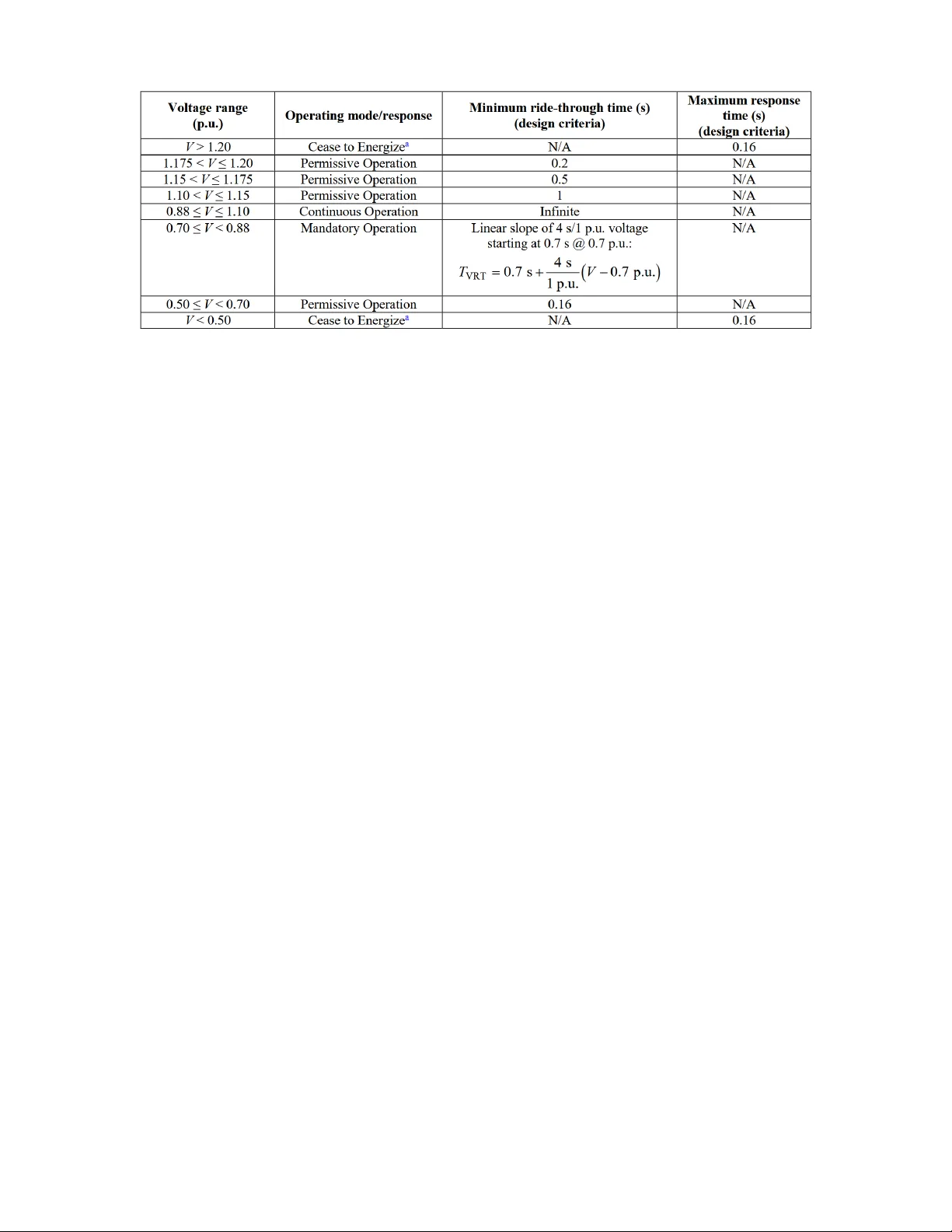
IEEE/IAS 62ND INDUSTRIAL & COMMERCIAL POWER SYSTEMS TECHNICAL CONFERENCE, MA Y 2026 1 Impact of In v erter -Based Resources on the Protection of the Electrical Grid John Slane 1 and Adam Mate 1 , 2 Abstract —In recent years, the contribution of renewable en- ergy resources to the electrical grid has increased drastically; the most common of these are photovoltaic solar panels and wind turbines. These r esources rely on in verters to interface with the grid, which do not inherently exhibit the same fault characteristics as synchronous generators. Consistently , they can strain grid reliability and security , cause increased number of blackouts, and, in some cases, allow relativ ely minor faults to tur n into cascading failures. Solar and wind energy provide benefits and can support grid stability; howev er , several challenges and gaps in understanding must be explored and addr essed bef ore this can be realized. This paper pro vides a comprehensiv e literatur e re view of grid codes, modeling techniques, and tools, as well as current methods f or responding to various faults. It also presents an overview of the industry’s state as it relates to grid fault response in the presence of in verter -based resources. Index T erms —inv erter -based resour ces, power system protec- tion, in verter faults, grid modeling and simulation, power system reliability I . I N T RO D U C T I O N Grid faults occur when a portion of the electrical grid is unexpectedly disrupted. This may result from equipment failure, damage to infrastructure caused by weather or other natural phenomena, or malicious attacks. When a fault occurs, sev eral things can happen: protection devices (such as circuit breakers) may open or close to reroute po wer around the faulted area; generators may adjust to account for an y change in generation or demand; and grid operators may dispatch repair cre ws. The electrical grid was designed and built on the premise that energy is provided primarily (or entirely) by synchronous generators (SGs). The stability , control, and reliability of the grid hav e traditionally been established by the frequency control, inertia, and voltage regulation of SGs, with fault protection de vices, practices, and tools designed around an SG-driv en grid. T oday , energy sources that do not use SGs are becoming f ar more common, including photovoltaic (PV) solar , wind, and battery storage; these are collectiv ely referred to as in v erter-based resources (IBRs). When the share of IBRs on an electrical grid relati ve to SGs is low , the impact may be small enough that traditional protection practices remain adequate. Howe ver , as the IBRs- to-SGs ratio increases, protection practices become insuf ficient to manage f aults, and grid reliability and security declines. Manuscript submitted: Jan. 9, 2026. Current version: Mar . 21, 2026. 1 The authors are with the Norm Asbjornson College of Engineering at Montana State Uni versity , Bozeman MT . Emails: johnslane@montana.edu and adam.mate@montana.edu. 2 The author is with the Analytics Intelligence and T echnology Division at Los Alamos National Laboratory , Los Alamos NM 87545. Color versions of one or more of the figures in this paper are av ailable online at https://ieeexplore.ieee.or g. A primary example is how SGs provide inertia to help stabilize the electrical grid. SGs are rotating generators with inertia relativ e to their mass. If a fault takes a generator offline, the inertia of the remaining SGs keeps them spinning for a short interv al, gi ving the system time to replace the generation lost. IBRs, by contrast, do not have the same b uilt-in inertia. Consequently , on a grid with a high share of IBRs, if a generator were to fail, there may be a gap between when the generator fails and new generation is brought up to replace it. During that gap, there would not be enough generation to meet the load, potentially causing blackouts [1], [2]. Solutions exist for the lack of kinetic inertia in IBRs. IBRs can react to control inputs far more quickly than SGs, as such, fast frequency response can allow them to respond to faults almost instantaneously . IBRs can also be equipped with synthetic inertia, emulating the inertial response of SGs, and sev eral control schemes have been dev eloped to compensate for the absence of inertia [2], [3]. The key point is that as IBRs replace SGs, there will be less inertia to help buf fer against faults, and it will become more important that IBRs be designed to so that grid reliability and security is maintained, or e ven improved. Events hav e already been observed in which grid faults were tied to the increasing penetration of IBRs. In 2016, a fire in Southern California caused sev eral faults to re gister on the transmission network ov er the course of sev eral hours. Multiple IBRs responded to those faults by automatically tripping offline; they re-energized within a few seconds, but ev en that brief disruption resulted in cascading failures and a blackout [4]. These early incidents underscore the need to examine how IBRs behave under fault conditions. In 2025, a cascading failure caused a system-wide blackout affecting all of Spain, Portugal, and parts of France. The root cause is still under inv estigation at the time of writing; howe ver , the first generators to go offline were sev eral wind and solar units in Spain, followed shortly by a surge in load on distribution networks that appears to be linked to rooftop solar generators going offline [5]. Although in vestigations are ongoing, the ev ent already suggests that a better understanding of IBR fault response would benefit the blackout inv estigation and help implement changes to prevent similar ev ents in the future. IBRs are a relativ ely new technology , so their impact on electrical grids is not yet as well understood as that of SGs. At the same time, as demand for reliable electricity gro ws and alternative energy becomes increasingly affordable, the share of IBRs is expected to grow rapidly . This paper revie ws the current protection systems and practices that have been dev eloped for grid fault response in networks with high IBR penetration. IEEE/IAS 62ND INDUSTRIAL & COMMERCIAL POWER SYSTEMS TECHNICAL CONFERENCE, MA Y 2026 2 The contributions of this paper include the following: Section II provides a brief technology background on the functionality of protection devices and DC/A C inv erters for IBRs; Section III revie ws current grid codes related to IBR protection; Section IV re vie ws grid models, including common modeling practices and industry tools; Section V revie ws literature for specific grid fault conditions and how IBRs respond to those faults, as well as the high-level overall directions observed; and Section VI summarizes ke y findings and potential for future work. By e xamining the impact of IBRs on protection systems— taking into account the requirements, modeling tools, and rele- vant literature—this paper provides a comprehensi ve, system- lev el ov erview of grid fault conditions. As more and more IBRs are introduced, this paper will serve as a starting point to help industry professionals to av oid costly ov ersights and provide a stepping-stone for future research aimed at a more reliable and secure electrical grid. I I . T E C H N O L O G Y B AC K G RO U N D A. Pr otection Systems Standard protection de vices include circuit breakers and relays. Circuit breakers are switches that remain closed, unless a sufficiently large current is detected, at which point they trip open. Rather than only tripping due to overcurrent, circuit breakers may be controlled by relays. Most circuit breakers are reclosers: when a fault current is detected, they open, remain open, and then automatically reclose after a few grid cycles (on the order of milliseconds). In case the fault current is still detected after reclosure, they open and reclose again; howe ver , after a handful of times (giv en the f ault current persists), they remain open until after the faulted condition is addressed and an operator resets them. The reclosing function pre vents circuit break ers from tripping and remaining open in the event of transient or sub-transient current spikes. Relays have significantly more control and can be designed to trip a circuit breaker for various conditions. Overcurrent relays operate much like standard circuit breakers, howe ver , the tripping current can be defined with precision. V oltage relays trip when an anomalous voltage is detected. Distance relays, or impedance relays, detect both current and voltage, and respond to the v oltage-to-current ratio—the voltage-to- current ratio, at a specific location on the grid, changes as a result of how far the fault is from the relay , therefore, these relays can be designed to trip for faults that occur at specific distances away . Differential relays compare the voltage or current between two locations on the grid, often two phases of a power line, and trip when that dif ference reaches a threshold; these relays are used to detect unbalanced faults. More complicated relays (based on frequency detection, phase detection, or phase differential) exist as well, or others that can be designed to respond to specific A C signal shapes. [6] Certain relays, in particular distance relays, can be pro- grammed to respond to well-defined fault conditions. The responses of SGs to many types of faults, especially to the most common ones (such as shorts), is well understood, therefore, the tripping thresholds can be set accordingly . Dis- tance relays commonly use “fault-type classification” (FTC) to determine the fault type based on either the voltage phase angle differences per phase or the current magnitude differ- ences of symmetric components [7]. IBRs have different fault characteristics than SGs, which, if not taken into account, may result in relays not tripping open when a fault occurs, or misidentifying f aults [8]. B. In verter-Based Resour ces IBRs rely on power electronics to digitally transform the electric signal from DC to A C. The simplest and most fre- quently used technology is current controlled inv erters, also called as grid following in verters (GFLIs). GFLIs regulate the input DC v oltage and use switching transistors and pulse width modulation (PWM) to control the output A C current at the point of common coupling (PCC); the y track the phase angle of the grid to achie ve phase loop lock (PLL), then adjust the current to match the grid phase at the PCC and maximize generation. GFLIs are unable to function without a grid signal to track, and have v ery limited ability to benefit grid stability— as the ratio of IBRs to SGs shifts in fav or of IBRs, grid stability is becoming more challenging to maintain. Solutions hav e been de veloped to allow GFLIs to help maintain grid stability during transient e vents, such as implementing a time delay to the control loop that allows them to continue operating through short-duration faults, as well as introducing pseudo- inertia to the grid[9] A ne wer but far less frequently used technology is voltage controlled in verters, also called as grid forming in verters (GFMIs). GFMIs regulate the input DC current and use PWM to adjust the output AC voltage; the benefit is that they can continue to generate an A C signal ev en when disconnected from the grid, such as during grid failures. In the ev ent of faults, GFMIs are able to help regulate voltage and frequency , and can benefit the grid in terms of withstanding and/or recov ering from faults; howe ver , they trade off the ability to maximize their power output [10]. GFMIs are mostly seen on microgrids—either on test systems or real world electrical grids, such as on the island of Kauai, Ha waii—where implementing a ne wer technology has more flexibility and less potential for ne gati ve impacts [11]. In verters may respond to faulted conditions in a range of ways, which can be grouped by their modes of operation. During normal operation, GFLIs and GFMIs function based on the control methodologies outlined abov e. When a f ault is detected (as in voltage, frequenc y , or current is being outside of nominal operating bounds), the in verter may switch to fault- ride-through (FR T) mode: it will continue to supply po wer , b ut may use a dif ferent control paradigm to support grid stability and recovery . In case grid conditions are outside of FR T bounds, an in verter may enter current blocking mode (also known as momentary cessation), in which it stops outputting current, but does not ramp down power generation, meanwhile it is continuously reading grid conditions, so that once the grid is within acceptable bounds, it can nearly instantaneously reconnect and continue to output power . Finally , in case grid IEEE/IAS 62ND INDUSTRIAL & COMMERCIAL POWER SYSTEMS TECHNICAL CONFERENCE, MA Y 2026 3 conditions are too far beyond acceptable bounds or have been outside of acceptable bounds for a suf ficient amount of time, an in verter may trip offline, at which point it disconnects from the grid and the IBR generator stops generating power . GFMIs hav e another operating mode, islanded mode: in the event of a loss of signal from the grid, rather than going offline, an in verter can disconnect from the main grid, but continue to provide power to a set number of loads, thereby forming a microgrid [12], [13]. It must be noted that in verters are much more sensitiv e to thermal damage as a result of ov ercurrent than SGs; as a result, in verters ha ve built-in current limits to protect internal components. SGs often hav e a current spike of 5pu or more when a fault occurs, whereas, due to thermal protection, an in verter may only have a current spike of 2pu or less. Many protection devices rely on a spike in current to indicate that a fault has occurred, therefore, the lower current response of an IBR is a primary reason for protection devices to fail to engage in the event of a fault [14]. I I I . G R I D C O D E Multiple standards have been written over the years; some are requirements by governments for their electrical grids, others are best practices by organizations without gov ern- ing authority . The International Electrotechnical Commission (IEC) is an international body—IEC releases standards to sup- port any grid operating entity internationally; typically , these standards cover a wider scope than other organizations’, but with less specificity . The Institute of Electrical and Electronics Engineers (IEEE) is a technical organization across a broad scope of disciplines and industries—IEEE has several lo wer- lev el bodies that write and manage specific standards; while they do not hav e authority to enforce standards, their guidance are widely accepted as best practice and often adopted into grid requirements. The North American Electrical Reliability Corporation (NERC) o versees sub-or ganizations in Canada, the United States of America, and parts of Mexico, which are directly answerable to those gov ernments—NERC sets and enforces standards for the North American grid, subject to the approv al of its sub-organizations; in the United States, its sub- organization is the Federal Energy Re gulatory Commission (FERC), which is directly answerable to the United States Congress. For the German electrical grid, the “German Grid Code” is the standard that gov erns system operators—this code has been more proactiv e than most other grid requirements and standards set by organizations in terms of enacting re- quirements for IBR response to fault conditions. A. International Electr otechnical Commission IEC has published two technical reports related to IBR response to fault conditions: IEC/TR 63401 Dynamic Charac- teristics of Inverter -Based Resources in Bulk P ower Systems , and IEC/TS 63389 Developing a Profile Composed of a Set of Basic Application Pr ofiles of IEC 61850 for Distributed Ener gy Resour ce Compliant to IEEE 1547 . These reports are sometimes referenced in relation to IBR operation on electrical grids, howe ver , they in turn reference IEEE standards while typically being less detailed than those. B. Institute of Electrical and Electr onics Engineers IEEE Std 1547 Standard for Inter connection and Inter- operability of Distributed Energy Resources with Associated Electric P ower Systems Interfaces —first published in 2003, then has gone through multiple re visions with the latest version being published in 2018—applies to distributed ener gy resources (DERs) that are defined as “ sour ce of electric power that is not dir ectly connected to a bulk power system , ” which typically are IBRs in a distribution netw ork [15]. The Ener gy P olicy Act of 2005 [16] set IEEE Std 1547 as the United States national standard. Iterations introduced sections on cy- bersecurity , testing (to ensure that standards are appropriately met), and background studies (on where the set standards came from); ho wev er , the most important section for IBR fault protection is Section 6, which outlines different voltage and frequency ranges at the PCC and defines required responses. Figure 1, taken ov er from IEEE Std 1547, shows the table of zones for voltage ranges of DER IBRs. The first (nominal) operating region is the Continuous Operation mode, where the IBR provides optimal po wer at nominal voltage and frequency . Just outside of this is the Permissi ve Operation re gion, where the IBR must either be in Momentary Cessation mode or Mandatory Operation mode. In Momentary Cessation mode, the IBR disconnects from the grid, b ut does not cease current output; during this mode, the IBR will continuously attempt to re-acquire PLL, at which point it can almost immediately begin outputting current to the grid again. In Mandatory Operation mode, the IBR is required to continue to provide acti ve and/or reactiv e power to the grid; unlike other more recent electric codes, IEEE Std 1547 does not specify the type of power (activ e and/or reactive) that the IBR is to supply during over - voltage or under-voltage e vents, howe ver , for under-frequency ev ents it does specify that the IBR shall continue to provide a minimum amount of activ e power . Should the voltage or frequency at the PCC go low or high enough to be outside of these regions, the requirement for the IBR is to cease to energize. Regardless of voltage at the PCC, some specific instances (such as when a phase is open at the PCC) require the IBR to trip. IEEE Std 2800 Standar d for Inter connection and In- ter operability of In verter-Based Resources Inter connecting with Associated T ransmission Electric P ower Systems — published in 2022—is the transmission network equiv alent of IEEE Std 1547; howe ver , it is not required to be adapted by system operators in the United States, unless the local or state governing body (in which the transmission network is being operated) mandates it [17]. Section 7 outlines standards for fault response of IBRs on transmission networks, using the con ventions of IEEE Std 1547 (i.e., defining Continuous and Permissi ve Operation regions), but with two important differences: (1) when outside of all defined regions, rather than requiring an IBR to cease to operate, IEEE Std 2800 states that the IBR “may ride through or may trip”; and (2) the expectation for the type of power to be provided while in FR T mode is for balanced faults, the IBR is to inject positiv e sequence current with reactiv e current priority (though the method for allocating reactive and active power is not IEEE/IAS 62ND INDUSTRIAL & COMMERCIAL POWER SYSTEMS TECHNICAL CONFERENCE, MA Y 2026 4 Fig. 1. IEEE Std 1547-2018, T able 14 – Fault-Ride-Through [15] specified), while for unbalanced faults, the IBR is to inject negati ve sequence current that is proportional to the PCC voltage (per unit) and that leads PCC voltage by 90-to-100 degrees. Both IEEE Std 1547 and IEEE Std 2800 define operating ranges for IBRs. Continuous Operation Region (COR) is the standard, steady-state operating mode, in which voltage and frequency are within a set range. If voltage and/or frequency deviate(s) from this range, there is a Mandatory Operation Region (MOR), in which IBRs are required to continue to provide po wer, but may (or in some cases must) go into FR T mode. If v oltage and/or frequency are outside of the MOR, there is a Permissiv e Operation Region, in which IBRs are required to continue operation, but may go into current blocking mode for a set amount of time. C. North American Electrical Reliability Corporation Before introducing new requirements and standards, NERC always seeks approv al from FERC and other relev ant orga- nizations. At present, NERC has three requirements in work, though not yet enforceable, concerning IBR fault protection [13]: PRC-028-1 Disturbance Monitoring and Reporting Re- quir ements for Inverter -Based Resour ces , which will require IBR systems to monitor and record data for grid faults; PRC- 029-1 F r equency and V oltage Ride-thr ough Requirements for In verter-based Resour ces , which sets requirements based on IEEE Std 2800, with identical operating regions and timing; and PRC-030-1 Une xpected In verter-Based Resour ce Event Mitigation , which sets requirements for IBRs on both trans- mission and distribution networks to identify and record any unexpected loss of po wer of sufficient magnitude and duration, that is “at least 20 MW and at least 10% of the plant’ s gross nameplate rating, occurring within a 4 second period”. D. Grid Code Considerations The abov e discussed grid codes almost exclusi vely refer to stead-state or transient response to a fault. As mentioned earlier , in verters limit current output to protect themselves, howe ver , during a fault, the sub-transient response can have a much higher current spike, which is emitted to the grid before the in verter controls limit the current—the effects of sub- transient inv erter fault response is explored more in Section V. Grid codes generally do not differentiate between GFLIs and GFMIs, howe ver , they do not include any standards for in verters switching to or from islanding mode. Grid codes often include exceptions for system owners to set their own practices for IBR fault response. For example, IEEE Std 2800 Section 7.2.2.3.2 Low- and High-V oltage Ride-Thr ough Ca- pability states: “If requested by the [transmission network] owner , and mutually agreed with the IBR owner , the IBR unit may operate in activ e current priority mode for both the high- and lo w-voltage ride-through ev ents. ” While similar statements and guidance in standards provide more fle xibility for system owners and operators to employ protections that work best for them, it also allo ws for more variety in possible IBR responses to grid f aults. Even though other requirements and standards exist, the abov e outlined grid codes, particularly the IEEE standards, are the most well-established best practices for grid operation. T o date, very few grid entities or legislati ve bodies hav e set enforceable requirements to IBR fault response. I V . G R I D M O D E L S Electric utilities use modeling and simulation software tools for fault analysis to demonstrate compliance with legal requirements. Both IEEE and NERC hav e requirements for IBR owners to share their models with the utility they are connected to. It is common to provide a model in the form of a dynamic-link library (DLL) file, containing code and data that multiple softw are can use simultaneously , which provides the IBR terminal currents given v arious grid v oltage and frequenc y conditions. Aside from direction on how IBRs are expected to respond to dif ferent grid conditions, no standard exists on what specific IBR control techniques should be follo wed. In fact, in verter manufacturers each use their o wn intellectual property for control systems, which often change between IBR models; as such, a grid with 10 IBRs may ha ve different control algorithms on each in verter . IBRs must be tested before they can be connected to the electrical grid. V alidation tests ensure functionality and that grid requirements are met, and verify that protection devices IEEE/IAS 62ND INDUSTRIAL & COMMERCIAL POWER SYSTEMS TECHNICAL CONFERENCE, MA Y 2026 5 function; howe ver , these tests do not include fault testing for all fault conditions. Not only would that be an overly cumbersome task, it would also be impossible to completely verify IBR response for all possible fault conditions. In many cases, fault requirements can be verified through modeling and simulation. IEEE Std 2800 notes that all models have simplifications and approximations: e.g., a PV array is rarely modeled down to each indi vidual inv erter within an IBR plant, rather the entire plant is modeled as a single generator . In practice, it is possible for individual IBRs within a plant to respond differently: when a specific fault condition occur, some IBRs may trip while others do not. OpenDSS 1 is a widely used software tool, dev eloped by the Electric Power Research Institute (EPRI), with built-in fault analysis capability . A User can construct or import a model, define a fault condition—a fault object is an impedance object connected to either two nodes or a single node and ground— and receiv e either “snapshot” (i.e., single point in time) or dynamic current and v oltage conditions given that fault. IBRs may be modeled to reflect control modes, such as current limiting and reactiv e or active current priority (which may be required by code as a capability). Settings have limitations, such as considering an IBR system to be a single IBR instead of an array of IBRs feeding a collector , as is common— this may also oversimplify the control response of an IBR system (which, depending on conditions, may have more than one FR T or off-nominal control mode) or may not take into account dynamic conditions that cause an IBR to repeatedly enter and e xit different control modes (introducing harmonics or unexpected grid conditions by continuously transitioning into and out of different control modes). OpenDSS can import a DLL file and is capable of modeling both GFLIs and GFMIs; howe ver , documentation suggests that GFMI models only be used for islanded microgrids. The Los Alamos National Laboratory (LANL) of the US Department of Ener gy (DOE) has developed a series of tools for grid analysis under their InfrastructureModels.jl software ecosystem. These open-source frameworks are built using the Julia programming language: PowerModels.jl 2 (PMs) is for steady-state po wer transmission network optimization; PowerModelsDistrib ution.jl 3 (PMsD), an extension of PMs, is specialized for distrib ution networks; and Po werModelsProtec- tion.jl 4 (PMsP) is a fault study tool for use with either PMs or PMsD. PMsP allo ws to model generators as GFLIs or GFMIs: GFLIs are modeled with PQ control and include positi ve sequence current injection constraints—it does not appear to include options for GFLI negativ e sequence current injection that is now required by certain grid codes—while GFMIs use a current limiting model and may be defined with droop control. PMsP models SGs as a voltage source with an impedance; the sub-transient impedance is used. For IBRs, a virtual impedance is used, though it does not differentiate between sub-transient and transient impedance; this is significant for IBRs since transient current is limited to the saturation current of the 1 https://opendss.epri.com/ 2 https://github .com/lanl- ansi/PowerModels.jl 3 https://github .com/lanl- ansi/PowerModelsDistrib ution.jl 4 https://github .com/lanl- ansi/PowerModelsProtection.jl in verter , but sub-transient current is only limited by the true internal impedance. Although PMsP only has a limited range of modeling options, Users may take advantage of its open- source nature and introduce additional custom control logics. T ypically , an IBR owner generates a DLL file that defines in verter output parameters giv en possible input parameters. Grid operators import these DLL files into their fault analysis tools without having to completely model inv erters. As the share of IBRs on the grid continues to grow , and as in verter control techniques become more di verse and more compli- cated, currently held assumptions on the validity of models and simulation results will no longer hold true or will result in lo wer grid reliability [18]. A major dif ficulty in modeling the fault response of inv erters is the non-linearity of the control systems, which requires IBRs’ parameters to be modeled with respect to time. Tra- ditional load-flow models are not time-dependent but state- dependent, which is much more efficient for computers to solve and less prone to error . Plet et al. (2010) [14] proposed a strategy to predict the fault response in a grid with many IBRs (not just a single generating unit fault response) and to do so without adding to the computational burden of existing fault models. The proposed strategy expands on existing load- flow modeling to account for multiple IBRs on a grid; the fault analysis method is able to correctly predict the output current on IBRs giv en dif ferent fault conditions; ho wev er , it only does so for a specific control strategy . Nev ertheless, simulating faults on grids with IBRs remains a challenge: expanding on modeling approaches is necessary , and then dev eloping best practices or standards (including new models in fault simulation tools) so that faults can be predicted and managed with confidence. V . R E V I E W O F G R I D F AU L T C O N D I T I O N S A. Literatur e Revie w Research exploring the impact of IBRs on grid protection systems began to appear in peer-re viewed publications in the mid-2000s. Prior published work focused on the effects of DERs, high-voltage DC (HVDC) systems, and DC-to-AC con version; technologies that had been deployed in po wer systems for decades. Howe ver , HVDC projects are typically large-scale undertakings that provide only a actual connection points to the BES. It wasn’t until IBRs, a class of DERs, be gan to grow that prompted additional research into their impact on grid reliability . Figure 2 shows the number of papers published from 2000 to early 2025 that directly discuss grid fault response with respect to IBRs. Note that this collection is not exhausti ve, but it cov ers the majority of publications and is representative of the o verall body of work. The rise in publications from 2004 to 2007 focused largely on the impact of DERs [14], [19]–[33]. During 2011-2014 a large number of papers were published discussing the impact and control of wind turbines during grid faults [34]–[47]. Since 2016, papers have addressed sev eral topics related to IBR fault response, including control, modeling techniques for various faults, DER and transmission network impacts, machine-learning-based protection, and more [2], [7]–[9], [11], [12], [18], [48]–[152]. IEEE/IAS 62ND INDUSTRIAL & COMMERCIAL POWER SYSTEMS TECHNICAL CONFERENCE, MA Y 2026 6 Fig. 2. Annual Papers on IBR Fault Response Published A few institutions have emerged as leaders in IBR fault research: EPRI [153]–[160], the National Laboratory of the Rockies (NLR) [9], [25], [49], and Schweitzer Engineering Laboratories [161]–[163] hav e continuously released multiple publications each since 2019. The University of Novisad (Serbia), the University of W aterloo (Canada), and Aalborg Univ ersity (Denmark) all maintain research teams that have published papers on IBR fault response, primarily within the past fi ve-to-six years. The majority of papers on IBR fault response focus on specific aspects of IBR fault response or specific failure modes. Belo w is a summary of various fault modes that ha ve been discussed and their implications for grid code, modeling practices, and protection schemes. B. IBR F ault Revie w SGs are designed so that, during a short-circuit, their current rises to 5 p.u. or more. Protection systems use this ov ercurrent as a reliable fault indicator . Because IBRs must satisfy current- limiting requirements, an IBR may only contribute approx. 2 p.u. of current during a fault. Such limited current can prev ent protection systems from detecting the fault, causing them to fail to operate promptly and allowing additional grid disturbances to de velop. This phenomenon is minor when only one IBR (or a small number) is connected to a transmission or distribution network, but its impact grows as the share of IBRs increases. Moreover , the fault response of an SG is essentially independent of the bus v oltage to which it is connected. This is not the case for GFLIs, whose control algorithms use the bus voltage as an input. Consequently , this represent another key difference between SGs and IBRs that can cause misoperation of protection systems unless it is accounted for [14]. The steady-state fault current of an inv erter is limited to the saturation current of its power electronics. Howe ver , its sub-transient current can rise to approx. 5 times the in verter’ s rated current [48]. Section III noted that grid codes provide guidance only for the transient response of IBRs, not for their sub-transient behavior . For a single IBR, the sub-transient fault response is generally negligible because it last only a few milliseconds and contributes only a small fraction of the total grid current and voltage variation. As the share of IBRs increases, the collecti ve sub-transient response of many units can become significant. These overcurrent spikes may exceed the design limits of existing protection systems, causing some relays to operate prematurely , which tripping can result in the loss of additional grid sections and damage to grid components. For example, the 2016 Blue Cut Canyon fire in California damaged the transmission network and produced a series of faults [4]. Each registered fault was cleared rapidly , within four cycles (approx. 70 ms), ne vertheless, multiple solar PV in verters entered momentary cessasation. Once in momentary cessation, it took sev eral seconds for each in verter to recognize that the grid conditions were stable before reconnecting. The abrupt disconnection of PV generators caused a grid-wide voltage dip, which in turn cascaded to other PV installations; during that interval, the remaining of the transmission network (at one point the grid lost nearly 1,200 MW of generation) was forced to respond by increasing generation from other sources or by shedding load. In addition, the PV generators used a v ariety of in verter models, some of which entered momentary cessation mode when distinct faults were detected (e.g., voltage and frequency deviation or frequency instability). IEEE Std 2800 was pub- lished six years later, in 2022, which requires an IBR to detect a fault that lies outside both the COR and the Continuing Operation Region (CO VR) before it may enter momentary cessation. Once outside the COR, the inv erter must remain there for a prescribed amount of time, which varies with the magnitude of the voltage of frequency . If fully implemented, this standard should prev ent the recurrence of this cascading failure; ne vertheless, the 2016 ev ent demonstrates that the elec- trical grid remains vulnerable to faults caused by insufficient understanding of IBR fault behavior . Grid faults may result in an instantaneous phase-angle shift when the voltage suddenly jumps by several degrees [49]. SGs hav e built-in damping that helps them absorb such shifts; IBRs lack this capability . The abrupt shift can disrupt an in verter’ s PLL, causing frequency or v oltage dips/spikes, or ev en a IEEE/IAS 62ND INDUSTRIAL & COMMERCIAL POWER SYSTEMS TECHNICAL CONFERENCE, MA Y 2026 7 complete current collapse and inv erter disconnect if the shift is large enough. In such an event, the PLL continues to track the grid waveform, but the supplied current may become unstable (or be lost entirely) for several seconds, pro viding enough time for other grid-connected devices to respond. This can result in unexpected dynamics or cascading failures, similar to those observed during the 2016 Blue Cut Can yon Fire black out. Grid code differences may result in misoperation of distance relays during faults. Khan et al. (2022) [52] present several simulated scenarios in which FTC cannot correctly identify a fault when IBRs are added to a transmission network. W ithout grid code requirements governing IBR fault response, FTC relies on fault-response data derived from SGs; consequently , faults may be misidentified due to the current limiting of IBRs. Even when grid codes guide IBR fault response, FTC may still misidentify faults for a variety of reasons. If a grid code is newly introduced and not strictly enforced, FTC may not classify faults correctly , leaving grid operators uncertain about the reliability of their protection devices. Simulated examples of misidentified fault responses with one or two IBRs added to transmission networks are shown in Khan et al. (2022) [52]; this paper also presents examples of an IBR injecting negati ve sequence current during an unbalanced fault, in accordance with current German grid code requirements. In some instances, the negati ve sequence current injection is suf ficient for FTC to identify the fault correctly , howe ver , in other instances it is unable to ov ercome the in verter’ s current limiting beha vior [51]. GFMIs introduce a wide range of new issues and potential solutions for grid f ault protection. The primary concern is determining the exact moment an in verter will either discon- nect from the grid and switch to islanded mode, or reconnect from islanded mode. If a GFMI switches to islanded mode unexpectedly , it may appear to a utility operator as if that section of the grid has gone dark. The resulting transient can trigger protection systems to engage, potentially creating a fault that would not otherwise exist. Should sev eral GFMIs disconnect simultaneously due to a perceiv ed fault in the grid, especially when the grid relies on those IBRs to maintain stability , a cascading failure could follo w . Consequently , in the e vent of a blackout caused by an e xtreme e vent (such as a hurricane), operating microgrids could pose a risk to repair crews: if an islanded GFMI reconnects to the grid while cre ws are still working, it could energize sections of the grid unexpectedly [50]. When handled correctly , GFMIs (and the ability to form microgrids) can provide benefits to grid resiliency , provided that control dynamics are understood and well-written standards are in place. V I . C O N C L U S I O N In verter-based resources have a wide range of designs and control strategies. Consequently , the way IBRs respond during faults (or impact the broader electrical grid with their fault response) is not well understood and continue to ev olving as newer technologies and control methods are de veloped. Some locations have started establishing requirements and standards for IBRs fault response; ho wev er , these standards are not yet comprehensiv e, and it is uncertain how well IBR owners will be able to meet them or how rigorously they will be en- forced. Modeling tools v ary in their ability to represent IBRs, particularly regarding the response characteristics required by emerging standards; this makes it challenging to verify the e xpected performance of both IBRs and the associated fault protection schemes. The key gaps in understanding and dev elopment that must be addressed to ensure a reliable grid are outlined ne xt. Among the v arious impacts on grid protection, the most pressing is grid modeling, specifically the need for operators to hav e accurate information av ailable when conducting fault analysis studies. The 2016 Blue Cut Canyon fire provides a concrete example of what can happen when expected IBR behavior differ from reality . IEEE standards provide common practice and specific operating requirements for IBRs, which helps impro ve the fidelity of their models. More detailed guid- ance on IBR fault-ride-through behavior , including positive and negati ve sequence current injection profiles, would allow operators to model IBRs more accurately and to assess their impacts across interconnected grids. Electric grid operation today still relies primarily on syn- chronous generators to maintain balance and respond to faults, with only limited support from IBRs. Many issues introduced by IBRs are easily overlook ed because each unit’ s individual impact is minor . While it is difficult to quantify ho w a giv en IBR penetration level will affect grid reliability , it is likely that faults resulting in loss of po wer will increase as IBR penetration grows. Consequently , protection devices and IBR control systems will need to be updated to accommodate higher penetration le vels. Recent research has produced protection and control schemes capable of handling both the high-current sub- transient and the current-limited transient responses of IBRs during faults. Other studies hav e addressed rapid grid-phase changes, improved distance relay algorithms to identify faults on grids with high IBR penetration, and examined other fault types described abov e. It will be important for these improv ements to be implemented as early as possible to av oid costly disruptions. The use of IBRs is increasingly necessary , gi ven rising electricity demand and the declining cost of renewable en- ergy technologies. Research must continue into how best to implement and integrate IBRs. Howe ver , giv en the rapid rate of growth, it will be critical to understand and proactively manage their impact on the electric grid. IEEE/IAS 62ND INDUSTRIAL & COMMERCIAL POWER SYSTEMS TECHNICAL CONFERENCE, MA Y 2026 8 R E F E R E N C E S [1] P . Kundur. Po wer System Stability and Control, 1994. [2] P . Denholm, T . Mai, R. K enyon, B. Kroposki, and M. O’Malle y. Inertia and the Power Grid: A Guide Without the Spin. National Renewable Ener gy Laboratory , May 2020. [3] P . Unruh, M. Nuschke, P . Strauss, and F . W elck. Overview on Grid- Forming Inverter Control Methods. Energies , 2020. [4] North American Reliability Corporation. In verter -Based Resource Disturbance Analysis: K ey Findings and Recommendations, Feb 2018. [5] Expert Panel on the Grid Incident on 28 April 2025. Grid Incident in Spain and Portugal on 28 April 2025, Oct 2025. [6] J. Glov er , M. Sarma, and T . Overbye. Power System Analysis and Design, 2010. [7] M. M. Mobashsher , A. A. Abdoos, S. M. Hosseini, S. M. Hashemi, and M. Sanaye-P asand. A New Fault T ype Classification Method in the Presence of Inv erter-Based Resources. International Journal of Electrical P ower and Energy Systems , 147, 2023. [8] A. Haddadi, E. Farantatos, I. Kocar , and U. Karaagac. Impact of In verter Based Resources on System Protection. Energies , 2021. [9] Y . Lin, J. H. Eto, B. B. Johnson, J. D. Flicker , R. H. Lasseter, H. N. V illegas Pico, G.-S. Seo, B. J. Pierre, A. Ellis, J. Miller , and G. Y uan. Pathways to the Next-Generation Power System W ith In verter -Based Resources: Challenges and Recommendations. IEEE Electrification Magazine , 10, Mar 2022. [10] D. B. Rathnayake, M. Akrami, C. Phurailatpam, S. P . Me, S. Hadavi, G. Jayasinghe, Z. Zabihi, and B. Bahrani. Grid Forming Inv erter Modeling, Control, and Applications. The Institute of Electrical and Electr onics Engineers IEEE Access , 2021. [11] R. W alton. Island-W ide Outage on Kaua’i: Clouds Block Solar Recovery After Generator’ s Cable Failure, Jul 2019. [12] B. W eise. Impact of K-factor and Active Current Reduction Dur- ing Fault-Ride-Through of Generating Units Connected via V oltage- Sourced Conv erters on Power System Stability . IET Renewable P ower Generation , Jan 2015. [13] North American Electrical Reliability Corporation. Reliability Stan- dards Under De velopment. [14] C. A. Plet, M. Graovac, T . C. Green, and R. Iravani. Fault Response of Grid-Connected In verter Dominated Networks. In Pr oceedings of the 2010 IEEE PES General Meeting , Jul 2010. [15] Institute of Electrical and Electronics Engineers Standards Association. IEEE Standard for Interconnection and Interoperability of Distributed Energy Resources with Associated Electric Power Systems Interfaces, Apr 2018. [16] 109th Congress of the United States of America. Energy Policy Act of 2005, Aug 2005. [17] Institute of Electrical and Electronics Engineers Standards Association. IEEE Standard for Interconnection and Interoperability of Inverter - Based Resources Interconnecting with Associated Transmission Elec- tric Po wer Systems, Apr 2022. [18] Y . Lin, J. H. Eto, B. B. Johnson, J. D. Flicker , R. H. Lasseter, H. N. V illegas Pico, G. Seo, B. J. Pierre, and A. Ellis. Research Roadmap on Grid-F orming In verters. National Renewable Ener gy Laboratory , NREL/TP-5D00-73476, Nov 2020. [19] A. V . T imbus, P . Rodriguez, R. T eodorescu, M. Liserre, and F . Blaabjerg. Control Strategies for Distributed Power Generation Sys- tems Operating on Faulty Grid. In Proceedings of the 2006 IEEE International Symposium on Industrial Electronics , 2006. [20] M. Brucoli, T . C. Green, and J. D. F . McDonald. Modelling and Analysis of Fault Beha viour of Inverter Microgrids to Aid Future Fault Detection. In Pr oceedings of the 2007 IEEE International Conference on System of Systems Engineering , 2007. [21] K. Kauhaniemi and L. Kumpulainen. Impact of Distributed Generation on the Protection of Distribution Networks. In Proceedings of the 8th IEEE International Confer ence on Developments in P ower System Pr otection , 2004. [22] M. E. Baran and I. El-Markaby. Fault Analysis on Distrib ution Feeders with Distributed Generators. IEEE T ransactions on P ower Systems , 20, Nov 2005. [23] N. Nimpitiwan, G. T . Heydt, R. A yyanar , and S. Suryanarayanan. Fault Current Contribution From Synchronous Machine and Inverter Based Distributed Generators. IEEE T ransactions on P ower Delivery , 22, Jan 2007. [24] D. T urcotte and F . Katiraei. F ault Contribution of Grid-Connected In verters. In Proceedings of the 2009 IEEE Electrical P ower and Ener gy Confer ence , 2009. [25] J. Keller and B. Kroposki. Understanding Fault Characteristics of In verter -Based Distributed Energy Resources. National Renewable Ener gy Laboratory T echnical Report , Jan 2010. [26] R. M. T umilty , M. Brucoli, G. M. Burt, and T . C. Green. Approaches to Netw ork Protection for In verter Dominated Electrical Distribution Systems. In Pr oceedings of the 3rd IET International Conference on P ower Electr onics , 2006. [27] H. Hooshyar and M. E. Baran. F ault Analysis on Distribution Feeders W ith High Penetration of PV Systems. IEEE T ransactions on P ower Systems , 28(3):2890–2896, Aug 2013. [28] M. E. Baran and I. El-Markaby. Fault Analysis on Distrib ution Feeders with Distributed Generators. IEEE T ransactions on P ower Systems , 20, Nov 2005. [29] G. T ang and R. Irav ani. Application of a Fault Current Limiter to Minimize Distributed Generation Impact on Coordinated Relay Protection. In Pr oceedings of the 2005 International Conference on P ower Systems T ransients , Jan 2005. [30] R. J. Brav o, R. Salas, R. Y inger , and S. Robles. Solar Photov oltaic In verters Transient Over-V oltages. In Pr oceedings of the 2013 IEEE P ower and Ener gy Society General Meeting , 2013. [31] D. V . T u and S. Chaitusaney. Impacts of In verter-Based Distributed Generation Control Modes on Short-circuit Currents in Distribution Systems. In Pr oceedings of the 7th IEEE Conference on Industrial Electr onics and Applications , 2012. [32] T . S. Sidhu and D. Bejmert. Short-Circuit Current Contribution from Large Scale PV Power Plant in the Context of Distribution Power System Protection Performance. In Pr oceedings of the 2011 IET Confer ence on Renewable P ower Generation , 2011. [33] F . Katiraei, J. Holbach, T . Chang, W . Johnson, D. W ills, B. Y oung, L. Marti, A. Y an, P . Baroutis, G. Thompson, and J. Rajda. Inv estigation of Solar PV In verters Current Contrib utions during Faults on Distribution and T ransmission Systems Interruption Capacity. In Proceedings of the 2012 W estern Pr otective Relay Confer ence , Oct 2012. [34] s. V . Pico and S. Aliprantis. V oltage Ride-Through Capability V erifica- tion of Wind T urbines with Fully-Rated Con verters using Reachability Analysis. In Proceedings of the 2015 IEEE P ower and Ener gy Society General Meeting , 2015. [35] R. A. W alling, E. Gursoy , and B. English. Current Contributions from T ype 3 and T ype 4 Wind T urbine Generators During Faults. In Pr oceedings of the 2012 IEEE P ower and Energy Society T ransmission and Distribution Conference and Exposition , 2012. [36] T . Kauffmann, U. Karaagac, I. Kocar , H. Gras, J. Mahseredjian, B. Cetindag, and E. Farantatos. Phasor Domain Modeling of T ype III W ind Turbine Generator for Protection Studies. IEEE P ower and Ener gy Society General Meeting , 2015. [37] IEEE Po wer and Energy Society Joint W orking Group. Fault Current Contributions from Wind Plants. In Pr oceedings of the 68th Annual Confer ence for Pr otective Relay Engineers , 2015. [38] M. Fischer and A. Mendonca. Representation of V ariable Speed Full Con version Wind Energy Converters for Steady State Short-Circuit Calculations. In Pr oceedings of the 2017 IEEE PES T ransmission and Distribution Conference and Exposition , 2017. [39] E. F arantatos, U. Karaagac, H. Saad, and J. Mahseredjian. Short-Circuit Current Contrib ution of Con verter Interfaced W ind T urbines and the Impact on System Protection. In Pr oceedings of the IREP Symposium Bulk P ower System Dynamics and Contr ol , 2013. [40] I. Erlich, T . Neumann, F . Shew arega, P . Schegner , and J. Meyer. W ind T urbine Negativ e Sequence Current Control and its Effect on Power System Protection. In Pr oceedings of the 2013 IEEE P ower and Energy Society General Meeting , 2013. [41] J. C. Boemer, M. Gibescu, M. A. M. M. vd Meijden, B. G. Ra wn, and W . L. Kling. Network Fault Response of W ind Power Plants in Distribution Systems During Reverse Power Flows. In Pr oceedings of the 12th International W orkshop on Larg e-Scale Inte gration of W ind P ower into P ower Systems as well as on T ransmission Networks for Offshor e W ind P ower Plants , Oct 2013. [42] I. Erlich, F . She warega, S. Engelhardt, J. Kretschmann, J. Fortmann, and F . Koch. Effect of W ind T urbine Output Current During Faults on Grid V oltage and the Transient Stability of W ind Parks. In Pr oceedings of the 2009 IEEE P ower and Ener gy Society General Meeting , 2009. [43] O. Goksu, R. T eodorescu, C. L. Bak, F . Iov , and P . C. Kjar. Instability of W ind T urbine Conv erters During Current Injection to Low V oltage Grid Faults and PLL Frequency Based Stability Solution. IEEE Tr ansactions on P ower Systems , 29, Jul 2014. [44] J. Morren and S. W . H. de Haan. Short-Circuit Current of W ind T urbines W ith Doubly Fed Induction Generator . IEEE T ransactions on Ener gy Con version , 22, Mar 2007. IEEE/IAS 62ND INDUSTRIAL & COMMERCIAL POWER SYSTEMS TECHNICAL CONFERENCE, MA Y 2026 9 [45] T . Kauffmann, U. Karaagac, I. Kocar , S. Jensen, E. Farantatos, A. Haddadi, and J. Mahseredjian. Short-Circuit Model for T ype-IV W ind T urbine Generators W ith Decoupled Sequence Control. IEEE T ransactions on P ower Delivery , 34, Oct 2019. [46] A. Hooshyar , M. A. Azzouz, and E. F . El-Saadany. Distance Protection of Lines Connected to Induction Generator -Based Wind Farms During Balanced Faults. IEEE T ransactions on Sustainable Energy , 5, Oct 2014. [47] L. He, C.-C. Liu, A. Pitto, and D. Cirio. Distance Protection of A C Grid W ith HVDC-Connected Offshore Wind Generators. IEEE T ransactions on P ower Delivery , 29, Apr 2014. [48] B Popadic, B Dumnic, and L Strezoski. Modeling of Initial Fault Response of In verter-Based Distributed Energy Resources for Future Power System Planning. International Journal of Electrical P ower and Ener gy Systems , May 2020. [49] O. A woro and B Mather. Experimental Determination of PV Inverter Response to Grid Phase Shift Events. National Renewable Energy Laboratory , Aug. 2018. [50] B. O. W inter , N. Schulz, and B. Engel. Effects of the Use of Grid-Forming Conv erters on the Islanding Detection of Existing Low- V oltage Systems. In Pr oceedings of the 2024 Conference on Sustain- able Ener gy Supply and Energy Stor age Systems , 2024. [51] A. Haddadi, M. Zhao, I. K ocar, U. Karaagac, K. W . Chan, and E. F aran- tatos. Impact of In verter Based Resource Negati ve Sequence Current Injection on T ransmission System Protection. IEEE T ransactions on P ower Delivery , 36(1), Feb 2021. [52] Y . U. Khan, O. D. Naidu, and A. K. Pradhan. A Fault Classification Method For Po wer T ransmission Line Connected to Con verter Inter- faced Renewable Power Plants. In Proceedings of the 22nd National P ower Systems Confer ence , 2022. [53] N. Cho, S. Y un, and J. Jung. Shunt Fault Analysis Methodology for Power Distribution Networks with In verter-Based Distributed Energy Resources of the Korea Electric Po wer Corporation. Renewable and Sustainable Ener gy Revie ws , 133, 2020. [54] P . K. Mansani, M. Zadeh, and I. V oloh. Impact of IBR Negativ e Se- quence Current Characteristic on Distance Protection. In Proceedings of the 2021 Geor gia Institute of T echnology Pr otective Relaying V irtual Confer ence , Apr 2021. [55] A. Camacho, M. Castilla, J. Miret, L. G. de V icu ˜ na, and R. Guzman. Positiv e and Negativ e Sequence Control Strategies to Maximize the V oltage Support in Resistive–Inducti ve Grids During Grid Faults. IEEE T ransactions on P ower Electr onics , 33(6):5362–5373, Jun 2018. [56] A. Haddadi, M. Zhao, I. K ocar , U. Karaagac, K. W . Chan, and E. Farantatos. Impact of In verter-Based Resources on Ne gativ e Sequence Quantities-Based Protection Elements. IEEE T ransactions on P ower Delivery , 36, Feb 2021. [57] M. R. D. Zadeh, P . K. Mansani, and D. T ing. Impact of Inverter -Based Resources on Impedance-Based Protection Functions. In Pr oceedings of the 2010 International Confer ence on Developments in P ower System Pr otection , 2020. [58] Quispe, J.C., and Orduna, E. Transmission Line Protection Challenges Influenced by Inverter -Based Resources: A Revie w. Protection and Contr ol of Modern P ower Systems , 2022. [59] R. Cho wdhury , M. Alla, N. Fischer , and S. Samineni. Restricted Earth Fault Protection in Low-Impedance Grounded Systems W ith Inv erter- Based Resources. IEEE T ransactions on P ower Delivery , 38, Feb 2023. [60] S. Paladhi and A. K. Pradhan. Adaptiv e Fault T ype Classification for Transmission Network Connecting Con verter-Interf aced Renewable Plants. IEEE Systems Journal , 15, 2021. [61] S. Paladhi, Q. Hong, and C. Booth. Adaptive Faulted Phase Selection for Lines Connecting Con verter-Based Sources. In Pr oceedings of the 11th International Confer ence on Renewable P ower Generation , 2022. [62] V . K. Gaur, S. Chakrabarti, and A. Sharma. Improving faulty phase selection in PV integrated system with compensation angle approach. Electric P ower Systems Research , 226, 2024. [63] H. Zhang, W . Xiang, Q. Hong, and J. W en. Activ e Phase Control to Enhance Distance Relay in Conv erter-Interf aced Rene wable Energy Systems. International Journal of Electrical P ower and Energy Systems , 143, 2022. [64] W . Liu, X. Guo, M. Savaghebi, and J. M. Guerrero. Fault Ride Though Control of Photovoltaic Grid-connected In verter with Current- limited Capability under Offshore Unbalanced V oltage Conditions. In Pr oceedings of the 2016 Offshor e Energy and Storage Symposium , Jul 2016. [65] T . Qoria, H. Wu, X. W ang, and I. Colak. V ariable V irtual Impedance- Based Overcurrent Protection for Grid-Forming Inverters: Small- Signal, Lar ge-Signal Analysis and Improv ement. IEEE T ransactions on Smart Grid , 14, Sep 2023. [66] R. Chowdhury and N. Fischer . T ransmission Line Protection for Systems With Inv erter-Based Resources – Part I: Problems. IEEE T ransactions on P ower Delivery , 36, Aug 2021. [67] R. Chowdhury and N. Fischer . T ransmission Line Protection for Systems With Inv erter-Based Resources – Part II: Solutions. IEEE T ransactions on P ower Delivery , 36, Aug 2021. [68] S. Kariyawasam, J. W ijekoon, and A. Rajapakse. Assessment of the Performance of Phasor-Based and Transients-Based Faulted Phase Identification T echniques in the Presence of Inv erter Interfaced Re- sources. Energies , 2023. [69] Z. Y ang, W . Liao, Q. Zhang, C. L. Bak, and Z. Chen. Fault Co- ordination Control for Con verter-Interf aced Sources Compatible W ith Distance Protection During Asymmetrical Faults. IEEE T ransactions on Industrial Electr onics , 70, July 2023. [70] C. Chao, X. Zheng, Y . W eng, Y . Liu, P . Gao, and N. T ai. Adaptiv e Distance Protection Based on the Analytical Model of Additional Impedance for Inverter -Interfaced Renewable Power Plants During Asymmetrical Faults. IEEE Tr ansactions on P ower Delivery , 37, Oct 2022. [71] Z. Y ang, W . Liao, H. W ang, C. L. Bak, and Z. Chen. Improved Euclidean Distance Based Pilot Protection for Lines W ith Renewable Energy Sources. IEEE T ransactions on Industrial Informatics , 18, Dec 2022. [72] A. Azizi, A. Banaiemoqadam, A. Hooshyar , and M. Patel. A Blind Spot in the L VRT Current Requirements of Modern Grid Codes for In verter -Based Resources. IEEE T ransactions on P ower Delivery , 38, Feb 2023. [73] A. Ghorbani and H. Mehrjerdi. Distance Protection with Fault Resis- tance Compensation for Lines Connected to PV Plant. International Journal of Electrical P ower and Ener gy Systems , 148, 2023. [74] M. J. B. B. Davi, M. Olesko vicz, and F . V . Lopes. Study on IEEE 2800-2022 Standard Benefits for Transmission Line Protection in the Presence of Inverter -Based Resources. Electric P ower Systems Resear ch , 220, 2023. [75] M. A. Nasr and A. Hooshyar . Controlling Grid-Forming Inv erters to Meet the Negative-Sequence Current Requirements of the IEEE Standard 2800-2022. IEEE T ransactions on P ower Delivery , 38, Aug 2023. [76] Z. Y ang, Q. Zhang, W . Liao, C. L. Bak, and Z. Chen. Harmonic Injection Based Distance Protection for Line With Con verter -Interfaced Sources. IEEE T ransactions on Industrial Electr onics , 70, Feb 2023. [77] A. Banaiemoqadam, A. Hooshyar , and M. A. Azzouz. A Control-Based Solution for Distance Protection of Lines Connected to Converter - Interfaced Sources During Asymmetrical Faults. IEEE T ransactions on P ower Delivery , 35, Jun 2020. [78] G. Song, P . Chang, J. Hou, W . Li, and C. Zhang. A T ime-Domain Distance Protection Method Applicable to In verter-Interf aced Systems. Electric P ower Systems Research , 225, 2023. [79] P . Jafarian and F . Aminifar. A Comparison of the Impact of Current Priority Modes of In verter -Based Resources on the Performance of Grid Protectiv e Relays. In Pr oceedings of the 2024 International Conference on Pr otection and Automation in P ower Systems , 2024. [80] S. Cao, Q. Hong, D. Liu, and C. Booth. Review and Evaluation of Control-Based Protection Solutions for Con verter-Dominated Po wer Systems. IEEE Belgrade P owerT ech , 2023. [81] R. Luo, H. Gao, F . Peng, and Y . Guo. An Adaptive Low-V oltage Ride-Through Method for V irtual Synchronous Generators During Asymmetrical Grid Faults. IEEE T ransactions on Sustainable Ener gy , 15, Jul 2024. [82] A. Haddadi, I. K ocar, J. Mahseredjian, U. Karaagac, and E. Farantatos. Negati ve Sequence Quantities-Based Protection Under Inverter -Based Resources: Challenges and Impact of the German Grid Code. Electric P ower Systems Resear ch , 188, 2020. [83] J. Jia, G. Y ang, A. H. Nielsen, and P . Ronne-Hansen. Impact of VSC Control Strategies and Incorporation of Synchronous Condensers on Distance Protection Under Unbalanced Faults. IEEE Tr ansactions on Industrial Electr onics , 66, Feb 2019. [84] A. Haddadi, I. K ocar, J. Mahseredjian, U. Karaagac, and E. Farantatos. Performance of Phase Comparison Line Protection Under Inv erter- Based Resources and Impact of the German Grid Code. In Pr oceedings of the 2020 IEEE P ower and Ener gy Society General Meeting , 2020. [85] A. Hooshyar , M. A. Azzouz, and E. F . El-Saadany. Distance Protection of Lines Emanating From Full-Scale Converter -Interfaced Renewable Energy Po wer Plants—Part I: Problem Statement. IEEE T ransactions on P ower Delivery , 30, Aug 2015. IEEE/IAS 62ND INDUSTRIAL & COMMERCIAL POWER SYSTEMS TECHNICAL CONFERENCE, MA Y 2026 10 [86] R. Kabiri, D. G. Holmes, and B. P . McGrath. Control of Activ e and Reactiv e Power Ripple to Mitigate Unbalanced Grid V oltages. IEEE T ransactions on Industry Applications , 52, Apr 2016. [87] J. Gui, H. Lei, and B. K. Johnson. A Superimposed Quantity-Based Protection Method for Power Systems with In verter-Based Resources. Electric P ower Systems Research , 232, Nov 2024. [88] A. Banaiemoqadam, A. Azizi, A. Hooshyar, M. Kanabar , and E. F . El-Saadany. Impact of Inv erter-Based Resources on Different Imple- mentation Methods for Distance Relays – Part I: Phase Comparators. IEEE T ransactions on P ower Delivery , 38, Dec 2023. [89] A. Banaiemoqadam, A. Azizi, A. Hooshyar, M. Kanabar, and E. F . El-Saadany. Impact of In verter-Based Resources on Different Implementation Methods for Distance Relays – Part II: Reactance Method. IEEE T ransactions on P ower Delivery , 38, Dec 2023. [90] A. Banaiemoqadam, S. M. Hashemi, and A. Hooshyar . Loss-of- V oltage Detection for Relays Protecting Systems With In verter-Based Resources. IEEE T ransactions on P ower Delivery , 37, Feb 2022. [91] K. Xu, Z. Zhang, Z. Lai, and X. Yin. Fault Phase Selection Method Applied to Tie Line of Renewable Energy Power Stations. IET Generation, Tr ansmission, and Distrib ution , 14, May 2020. [92] Q. Alsafasfeh, O. A. Saraereh, I. Khan, and S. Kim. LS-Solar-PV System Impact on Line Protection. Electr onics , 2019. [93] E. Martinez Carrasco, M. P . Comech Moreno, M. T . V illen Martinez, and S. Borroy V icente. Improved Faulted Phase Selection Algorithm for Distance Protection under High Penetration of Renew able Energies. Ener gies , 2020. [94] M. A. Azzouz, A. Hooshyar , and E. F . El-Saadany. Resilience Enhancement of Microgrids W ith Inverter -Interfaced DGs by Enabling Faulty Phase Selection. IEEE T ransactions on Smart Grid , 9, Nov 2018. [95] A. A. Aboelnaga, M. A. Azzouz, A. S. A. A wad, and H. F . Sindi. Dual Current Control of In verter-Based Resources for Enhanced Resilience and Complying Grid Codes. In Pr oceedings of the 2023 IEEE P ower and Energy Society Confer ence on Innovative Smart Grid T echnologies Middle East , 2023. [96] X. Zhao, J. M. Guerrero, M. Savaghebi, J. C. V asquez, X. W u, and K. Sun. Low-V oltage Ride-Through Operation of Po wer Con verters in Grid-Interactive Microgrids by Using Negati ve-Sequence Droop Control. IEEE T ransactions on P ower Electr onics , 32, Apr 2017. [97] M. A. Azzouz and A. Hooshyar . Dual Current Control of In verter - Interfaced Renewable Energy Sources for Precise Phase Selection. IEEE T ransactions on Smart Grid , 10, Sep 2019. [98] A. A. Aboelnaga and M. A. Azzouz. Dual Stationary Frame Control of In verter -based Resources for Reliable Phase Selection. In Pr oceedings of the 19th IEEE International Conference on Industrial Informatics , 2021. [99] A. Banaiemoqadam, A. Hooshyar , and M. A. Azzouz. A Compre- hensiv e Dual Current Control Scheme for Inverter -Based Resources to Enable Correct Operation of Protective Relays. IEEE Tr ansactions on P ower Delivery , 36, Oct 2021. [100] M. A. Azzouz, H. H. Zeineldin, and E. F . El-Saadany. Selective Phase Tripping for Microgrids Powered by Synchronverter -Interfaced Renew able Energy Sources. IEEE T ransactions on P ower Delivery , 36, Dec 2021. [101] Z. Shuai, W . Huang, C. Shen, J. Ge, and Z. J. Shen. Characteristics and Restraining Method of Fast Transient Inrush Fault Currents in Synchron verters. IEEE T ransactions on Industrial Electr onics , 64, Sep 2017. [102] L. He, Z. Shuai, X. Zhang, X. Liu, Z. Li, and Z. J. Shen. T ransient Characteristics of Synchron verters Subjected to Asymmetric Faults. IEEE T ransactions on P ower Delivery , 34, Jun 2019. [103] M. A. Jarrahi, H. Samet, and T . Ghanbari. Protection Framework for Microgrids with In verter-Based DGs: A Superimposed Component and W av eform Similarity-Based Fault Detection and Classification Scheme. The Institution of Engineering and T echnology , 16, Mar 2022. [104] J. Ge, Z. Shuai, C. T u, A. Luo, and Z. J. Shen. Flexible Control Strategy for Enhancing Power Injection Capability of Three-Phase Four -W ire In verter During Asymmetrical Grid Faults. IEEE T ransactions on P ower Electr onics , 36, Aug 2021. [105] A. Mora, R. Cardenas, M. Urrutia, M. Espinoza, and M. Diaz. A V ector Control Strategy to Eliminate Acti ve Power Oscillations in Four -Leg Grid-Connected Converters Under Unbalanced V oltages. IEEE Journal of Emer ging and Selected T opics in P ower Electr onics , 8, Jun 2020. [106] Z. Shuai, M. Xiao, J. Ge, and Z. J. Shen. Overcurrent and its Restrain- ing Method of PQ-Controlled Three-Phase Four-W ire Con verter Under Asymmetrical Grid Fault. IEEE Journal of Emerging and Selected T opics in P ower Electr onics , 7, Sep 2019. [107] W . Medhat and M. A. Azzouz. Triple Current Control of F our-W ire In verter -Interfaced DGs for Correct Fault T ype Identification. IEEE T ransactions on Smart Grid , 13, Sep 2022. [108] V . Boscaino, V . Ditta, G. Marsala, N. Panzavecchia, G. Tine, V . Cosentino, A. Cataliotti, and D. Di Cara. Grid-Connected Photov oltaic In verters: Grid Codes, T opologies and Control T echniques. Rene wable and Sustainable Ener gy Reviews , 189, 2024. [109] Z. Y ang, W . Liao, C. L. Bak, and Z. Chen. Control-Based Faulty Phase Detection Methods for Lines W ith Con verter-Interf aced Sources. IEEE T ransactions on Industrial Electr onics , 71, July 2024. [110] K. Jia, Z. Y ang, Y . Fang, T . Bi, and M. Sumner. Influence of In verter - Interfaced Rene wable Energy Generators on Directional Relay and an Improved Scheme. IEEE T ransactions on P ower Electronics , 34, Dec 2019. [111] A. K. Barnes and A. Mate. Implementing Admittance Relaying for Microgrid Protection. In Pr oceedings of the 2021 IEEE/IAS 57th Industrial and Commer cial P ower Systems T echnical Confer ence , pages 1–9, Apr 2021. [112] A. Jodaei, Z. Moravej, and M. Pazoki. Effecti ve Protection Scheme for T ransmission Lines Connected to Large Scale Photovoltaic Power Plants. Electric P ower Systems Resear ch , 228, 2024. [113] Moises J. B. B. Davi, Mario Oleskovicz, and Felipe V . Lopes. Ex- ploring the Potential of a Machine Learning-Based Methodology for Fault Classification in Inv erter-Based Resource Interconnection Lines. Electric P ower Systems Research , 223, 2023. [114] A. Jodaei, Z. Mora vej, and M. P azoki. Fault Detection and Classi- fication in Parallel and semi-parallel Transmission Lines Connected to Large-Scale Photovoltaic Power Plants Using Artificial Neural Networks and Support V ector Machines. In Proceedings of the 2024 International Conference on Protection and Automation in P ower Systems , 2024. [115] H. Panahi, M. Sanaye-P asand, and M. Dav arpanah. Three-T erminal Lines Fault Location Using T wo Main T erminals Data in the Presence of Renewable Energy Sources. IEEE T ransactions on Smart Grid , 14, May 2023. [116] T . R. Mabote, J. E. T abarez, A. K. Barnes, A. Mate, R. W . Bent, and E. Cotilla-Sanchez. Developing Optimization-Based In verter Models for Short Circuit Studies. In Pr oceedings of the 2023 IEEE International Confer ence on En vir onment and Electrical Engineering and 2023 IEEE Industrial and Commercial P ower Systems Europe , pages 1–6, Jun 2023. [117] B. Kasztenn y. Distance Elements for Line Protection Applications Near Uncon ventional Sources. In Proceedings of the 58th Annual Minnesota P ower Systems Confer ence , Nov 2022. [118] F . V . Lopes, M. J. B. B. Davi, M. Oleskovicz, A. Hooshyar , X. Dong, and A. A. A. Neto. Maturity Analysis of Protection Solutions for Po wer Systems Near In verter-Based Resources. IEEE T ransactions on P ower Delivery , 39, Oct 2024. [119] A. Azizi and A. Hooshyar . Fault Current Limiting and Grid Code Compliance for Grid-Forming In verters – Part II: Solution. IEEE T ransactions on Sustainable Ener gy , 15, Oct 2024. [120] J. Alvidrez, S. Ranade, S. Brahma, S. Bukowski, C. Silva-Monroy , and A. Ellis. An Analytical Model of a Single Phase DQ-Controlled In verter for Po wer System Short Circuit Calculations. In Proceedings of the 2016 North American P ower Symposium , 2016. [121] K. Jones, P . Pourbeik, G. Kobet, and A. Berner. Impact of In verter Based Generation on Bulk Po wer System Dynamics and Short-Circuit Performance. IEEE PES T echnical Report , July 2018. [122] T . Sadamoto, A. Chakrabortty , T . Ishizaki, and J.-I. Imura. Dynamic Modeling, Stability , and Control of Power Systems W ith Distributed Energy Resources: Handling Faults Using T wo Control Methods in T andem. IEEE Contr ol Systems Magazine , 39, Apr 2019. [123] A. Gir gis and S. Brahma. Effect of Distrib uted Generation on Protecti ve Device Coordination in Distribution System. In Proceedings of the 2001 Lar ge Engineering Systems Confer ence on P ower Engineering , 2001. [124] A. Mojallal and S. Lotfifard. Enhancement of Grid Connected PV Arrays Fault Ride Through and Post Fault Recovery Performance. IEEE T ransactions on Smart Grid , 10, Jan 2019. [125] M. Ndreko, M. Popov , and M. A. M. M. van der Meijden. Study on FR T Compliance of VSC-HVDC Connected Offshore Wind Plants During AC Faults Including Requirements for the Negati ve Sequence Current Control. International Journal of Electrical P ower and Energy Systems , 85, 2017. [126] W .-M. Guo, L.-H. Mu, and X. Zhang. Fault Models of In verter - Interfaced Distributed Generators Within a Low-V oltage Microgrid. IEEE T ransactions on P ower Delivery , 32, Feb 2017. IEEE/IAS 62ND INDUSTRIAL & COMMERCIAL POWER SYSTEMS TECHNICAL CONFERENCE, MA Y 2026 11 [127] J. Jia, G. Y ang, and A. H. Nielsen. A Revie w on Grid-Connected Con verter Control for Short-Circuit Power Provision Under Grid Un- balanced Faults. IEEE T ransactions on P ower Delivery , 32, Apr 2018. [128] F . W ang, J. L. Duarte, and M. A. M. Hendrix. Active Power Control Strategies for In verter-Based Distrib uted Power Generation Adapted to Grid-Fault Ride-Through Requirements. In Proceedings of the 13th Eur opean Confer ence on P ower Electr onics and Applications , 2019. [129] I. T odorovic, S. Grabic, and Z. Iv anovic. Grid-Connected Conv erter Activ e and Reactiv e Power Production Maximization with Respect to Current Limitations During Grid Faults. International Journal of Electrical P ower and Energy Systems , 101, 2018. [130] L. V . Strezoski, B. Dumnic, B. Popadic, M. Prica, and K. A. Loparo. Novel Fault Models for Electronically Coupled Distributed Energy Resources and Their Laboratory V alidation. IEEE Tr ansactions on P ower Systems , 35, Mar 2020. [131] L. Strezoski, M. Prica, and K. A. Loparo. Generalized Delta-Circuit Concept for Integration of Distributed Generators in Online Short- Circuit Calculations. IEEE T ransactions on P ower Systems , 32, Jul 2017. [132] G. Kou, L. Chen, P . V anSant, F . V elez-Cedeno, and Y . Liu. Fault Characteristics of Distributed Solar Generation. IEEE T ransactions on P ower Delivery , 35, Apr 2020. [133] W orking Group C32. Protection Challenges and Practices for Inter- connecting Inverter Based Resources to Utility T ransmission Systems. P ower System Relaying and Control Committee , 2017. [134] G. Kou, J. Jordan, B. Cockerham, R. Patterson, and P . V anSant. Negati ve-Sequence Current Injection of Transmission Solar Farms. IEEE T ransactions on P ower Delivery , 35, Dec 2020. [135] M. Nagpal and C. Henville. Impact of Po wer-Electronic Sources on T ransmission Line Ground Fault Protection. IEEE Tr ansactions on P ower Delivery , 33, Feb 2018. [136] A. Haddadi, I. Kocar , U. Karaagac, H. Gras, and E. F arantatos. Impact of Wind Generation on Power Swing Protection. IEEE T ransactions on P ower Delivery , 34, Jun 2019. [137] N. M. Sapari, H. Mokhlis, J. A. Laghari, A. H. A. Bakar, and M. R. M. Dahalan. Application of Load Shedding Schemes for Distribution Network Connected with Distributed Generation. Renewable and Sustainable Ener gy Revie ws , 82, 2018. [138] P . Rodriguez, R. T eodorescu, I. Candela, A. V . Timb us, M. Liserre, and F . Blaabjerg. New Positi ve-Sequence V oltage Detector for Grid Synchronization of Power Conv erters Under Faulty Grid Conditions. In Proceedings of the 37th IEEE P ower Electronics Specialists Con- fer ence , 2006. [139] D. V an Tu, S. Chaitusaney , and A. Y okoyama. Maximum Allowable Distributed Generation Considering Fault Ride Through Requirement and Reach Reduction of Utility Relay. In Proceedings of the 10th International P ower and Energy Confer ence , 2012. [140] F . Peng, H. Gao, Y . Fang, and H. Song. A Calculation Method of Electrical Quantities During F aults for Distribution Network with Grid-Forming Inverter -Based Resources. In Pr oceedings of the 18th International Confer ence on De velopments in P ower System Pr otection , 2025. [141] M. Farshad and M. Pazoki. A Data-Driv en Compensation Method for Distance Relays Near In verter-Based Resources During Phase-to-Phase Faults. IEEE T ransactions on Smart Grid , 16, Nov 2025. [142] K. Opoku and A. Dimitro vski. A Dynamic Phasor-Based Approach to Fault Detection in Power Systems with Inv erter-Based Resources. In Pr oceedings of the IEEE T exas P ower and Energy Conference , 2025. [143] M. J. B. B. Da vi, M. Oleskovicz, and F . V . Lopes. A Nov el High- Sensitivity Time-Domain Fault Classifier Applied to Inv erter-Based Resource Interconnection Lines. IEEE Access , 13, Mar 2025. [144] F . Mahr. Control and Protection of 100 Percent In verter-based Power Systems. Springer V iew , 2025. [145] L. N. Rueda-Can, V . H. Gonzalez-Sanchez, V . T orres, and S. Zavala. Evaluation of the Performance of Impedance-Based Fault Location Methods in the Presence of High Penetration of Inv erter-Based Re- sources. In Pr oceedings of the IEEE International Autumn Meeting on P ower , Electr onics and Computing , Nov 2025. [146] A. N. Praveen and S. A. Rabbani. Incremental Quantity Based Protection for T ransmission Line connecting In verter Based Resources. In Pr oceedings of the 2025 Saudi Arabia Smart Grid , Dec 2025. [147] K. Agarwal, P . Gajare, J. Benzaquen, and D. Divan. Inverter F ault Current Multiplier for Grid-Interactiv e Con verters. IEEE Ttranscations on P over Electronics , 41(4), Oct 2025. [148] J. D. Pinzon, F . Santamaria, and A. Espinel. Machine Learning-Based V oltage Fault Ride-Through Assessment of Inverter -Based Resources Using Phasor Measurement Units. Renewable Ener gy , 256, Jan 2026. [149] D. Liu, C. K. Tse, J. Y ang, and X. Zhang. Re vealing Cascading F ailure V ulnerability in Evolving Power Grids W ith Increasing Penetration of In verter -Based Resources. IEEE T ranscations On Cir cuits and Systems , 72(9), Sep 2025. [150] M. Fresia, M. Minetti, A. Bonfiglio, and R. Procopio. Short Circuit Analysis and V oltage Support Needs in Po wer Systems with Relevant Share of Inverter -Based Resources. Sustainable Energy , Grids and Networks , 44, Dec 2025. [151] H. Hugo and J. Beuk es. The Impact of Disturbances on Grid Connected In verter -Based Resources. In Proceedings of the 33r d Southern African Universities P ower Engineering Conference , 2025. [152] A. Saeed, M. Jensen, A. Zamani, T . I. Raffield, A. Bidram, and M. J. Reno. Utility Experience with Inverter -Based Resource Impacts on Transmission Protection. Sandia National Laboratories T echnical Report , Feb 2025. [153] A. Haddadi, E. Farantatos, I. Kocar , and U. Karaagac. Impact of In verter Based Resources on System Protection. Energies , 2013. [154] A. Haddadi, E. Farantatos, I. Kocar , and U. Karaagac. Impact of In verter Based Resources on System Protection. Energies , Feb 2021. [155] A. Haddadi, M. Zhao, I. K ocar , U. Karaagac, K. W . Chan, and E. Farantatos. Impact of In verter-Based Resources on Ne gativ e Sequence Quantities-Based Protection Elements. IEEE T ransactions on P ower Delivery , 36, Feb 2021. [156] A. Haddadi, E. Farantatos, I. K ocar , and U. Karaagac. System Protection Guidelines for Systems with In verter Based Resources: Performance of Line Current Differential, Phase Comparison, Neg- ativ e Sequence, Communication-Assisted, and Frequency Protection Schemes Under Inverter -Based Resources and Impact of German Grid Code. Electric P ower Resear ch Institute T echnical Report , Dec 2019. [157] A. Haddadi, E. Farantatos, I. K ocar, and U. Karaagac. Short-Circuit Phasor Models of In verter-Based Resources for Fault Studies: Model V alidation Case Studies. Electric P ower Resear ch Institute T echnical Report , Dec 2018. [158] A. Haddadi, I. K ocar, T . Kauffmann, and H. Gras. Protection Guide- lines for Systems with High Levels of In verter Based Resources. Electric P ower Resear ch Institute T echnical Report , Dec 2018. [159] A. Haddadi, I. K ocar, U. Karaagac, and J. Mahseredjian. Adv anced Short-Circuit Modeling, Analysis, and Protection Schemes Design for Systems with Renewables. Electric P ower Resear ch Institute T echnical Report , Oct 2017. [160] A. Haddadi, I. Kocar , U. Karaagac, and J. Mahseredjian. Impact of Rene wables on System Protection: Wind/PV Short-Circuit Phasor Model Library and Guidelines for System Protection Studies. Electric P ower Resear ch Institute T echnical Report , Dec 2016. [161] R. Chowdhury , R. McDaniel, and N. Fischer . Applying Line Current Differential Protection in Systems with In verter-Based Resources. SSRN Electr onic Journal , Mar 2022. [162] M. Bini, R. Abboud, P . Lima, and F . Lollo. Challenges and Solutions in the Protection of Transmission Lines Connecting Nonconv entional Power Sources. In Pr oceedings of the 48th Annual W estern Protective Relay Confer ence , Jan 2022. [163] M. Nagpal, A. Saeed, R. Rangel, D. Zhang, and R. Chowdhury . Fault Contrib utions From In verter-Based Resources: Field Insights and Protection Challenges. In Proceedings of the 52nd Annual W estern Pr otective Relay Confer ence , Oct 2025.
Original Paper
Loading high-quality paper...
Comments & Academic Discussion
Loading comments...
Leave a Comment