Engineering Mythology: A Digital-Physical Framework for Culturally-Inspired Public Art
Navagunjara Reborn: The Phoenix of Odisha was built for Burning Man 2025 as both a sculpture and an experiment-a fusion of myth, craft, and computation. This paper describes the digital-physical workflow developed for the project: a pipeline that lin…
Authors: Jnaneshwar Das, Christopher Filkins, Rajesh Moharana
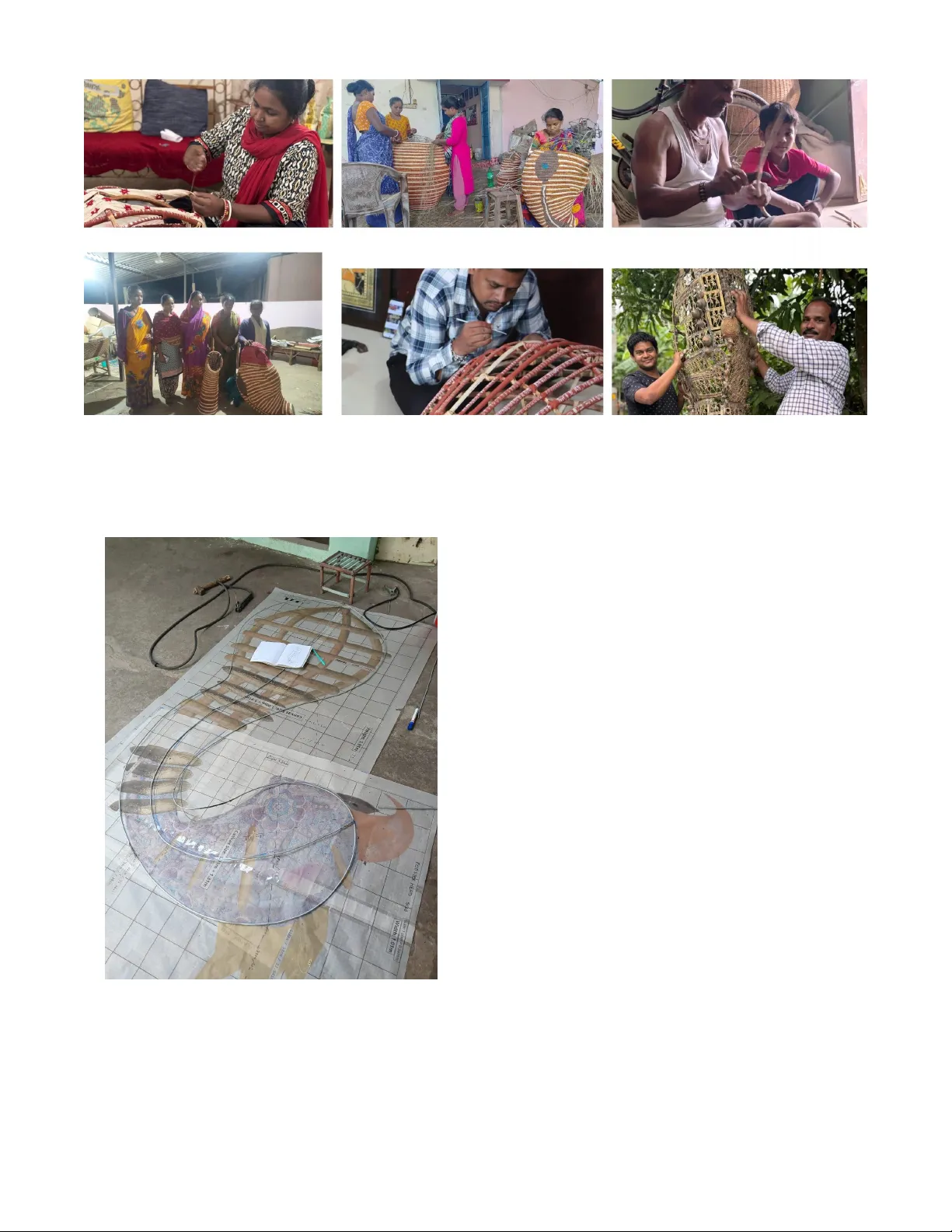
Engineering Mythology: A Digital-Physical Frame work for Culturally-Inspired Public Art Jnaneshwar Das, Christopher Filkins, Rajesh Moharana, Ekadashi Barik, Bishweshwar Das, David A yers, Christopher Skiba, Rodney Staggers Jr , Mark Dill, Swig Miller , Daniel T ulberg, Patrick Smith, Seth Brink, Kyle Breen, Harish Anand, Ramon Arro wsmith Abstract —Nav agunjara Reborn: The Phoenix of Odisha was built for Burning Man 2025 as both a sculpture and an ex- periment—a fusion of myth, craft, and computation. This paper describes the digital–physical workflow developed f or the project: a pipeline that linked digital sculpting, distributed fabrication by artisans in Odisha (India), modular structural optimization in the U .S., iterative feedback through photogrammetry and digital twins, and finally , one-shot full assembly at the art site in Black Rock Desert, Nevada. The desert installation tested not just materials, but also systems of collaboration: between artisans and engineers, between myth and technology , between cultural specificity and global experimentation. W e share the lessons learned in design, fabrication, and deployment and offer a framework for future interdisciplinary projects at the intersection of cultural heritage, STEAM education, and public art. In retrospect, this workflow can be read as a con ver gence of many knowledge systems—artisan practice, structural engi- neering, mythic narrative, and en vironmental constraint—rather than as execution of a single fixed blueprint. Index T erms —Cultural heritage, modular fabrication, public art, digital twin, STEAM, XR workflows, 3D modeling, mythol- ogy , Navagunjara, Phoenix I . I N T R O D U C T I O N Fig. 1: T raditional ‘Pattachi- tra’ painting of Nav agunjara in Raghurajpur , Odisha, India. Photo courtesy: Lipikka Sahoo In recent decades, large- scale public art has become a stage where engineering and mythology meet. Burning Man [1], through its Honoraria Arts Grant program, has nurtured this trend, supporting monumental installations that combine community-driv en technical innov ations with symbolic storytelling. Nav agunjara Reborn was realized on a $14,870 Honoraria grant against a total project budget of approximately $25,000, with the balance supported by cro wdfunding and the lead and co-artists, demonstrating that internationally distributed, craft-integrated public art at monumental scale is achiev able with modest resources when digital-physical workflo ws are designed for resilience and adaptability . Nav agunjara Reborn (Figure 2) was conceived in this spirit. The work fuses the Phoenix [2], [3]—a univ ersal emblem of transformation—with the Nav agunjara [4], a hybrid figure from Odia 1 mythology composed of nine animals, together embodying multiplicity and rene wal. Fig. 2: Navagunjara Reborn: An 18-foot sculptural fusion of the Nav agunjara and Phoenix myths, is illuminated by interactiv e flame effects at Burning Man 2025. Each animal section showcases tradi- tional Odia crafts—including dhokra metalwork, sabai grass weaving, pattachitra painting, and indigenous textiles—brought together in a monumental installation that celebrates resilience, unity , and the transformativ e power of mythology through participatory public art. The project was realized through an unusual global pipeline: 3D design in Arizona, traditional crafts sculpted in Odisha, structural elements optimized and fabricated in Arizona based on sculpted crafts, and final assembly in Black Rock Desert, Nev ada, spanning a year-long journey . The outcome was an 18-foot hybrid sculpture shaped by both myths and algorithms, hands and machines. The design did not proceed from a fixed blueprint; rather, it emerged from a pr oduct kernel : each con- tributor brought inductive priors encoding their domain—the lead artist’ s kno wledge of Burning Man and mythology , the dhokra artisan’ s decades of metalwork intuition, the cane craftsperson’ s sense of tensile form, the structural engineer’ s material yield calculations, and the desert’ s own 75 mph wind requirement. The final form is the configuration that scored high under all these kernels simultaneously , arriving through constraint-satisfying iteration as craft realities, structural data, and field conditions progressively narrowed the reachable design space. At its core, the project explores con vergence—of artisans, designers, and builders—in the creation of a monumental public artwork. The digital–physical workflow documented here integrates div erse methods and original ideas, aiming to leav e a practical, reproducible, and open frame work for future 1 Odia refers to the culture and language of Odisha, a coastal state in southeastern India. Fig. 3: Conceptual synthesis and design-to-build progression of Navagunjara Reborn. (A) Traditional painting of the Nav agunjara (source: W ikipedia), the mythological nine-formed composite from Odisha’ s Mahabharata retelling that anchors the cultural concept. (B) 2D design concept from Boito. (C) Refined Blender digital twin for India Art Fair 2025 (8 ft). (D) 3D render from the Burning Man 2025 full proposal (15–18 ft), submitted for the Honoraria Arts Grant. (E) 3D-printed physical twin of the sculpture, produced in Phoenix, AZ, for structural validation and artisan communication. (F) Crafts atlas mapping traditional Odia craft techniques to each animal section, guiding the fabrication build in Odisha. (G) Full digital twin during India crafts build phase. (H) Completed aluminum CAD superstructure digital twin prior to transport to playa, with scanned crafts staged in Phoenix, AZ. Bottom row: Nav agunjara Reborn at Black Rock City , August 2025, with activ e poofer flame effects. works that connect cultural heritage with computational design and enable distributed creation of monumental art. I I . C U LT U R A L C O N T E X T The Nav agunjara [4], [5], drawn from Odisha’ s regional retellings of the Mahabharata [6], is a composite being of nine forms—peacock, serpent, lioness, elephant, tigress, deer , bull, human, and rooster . Each element represents a different dimension of experience, together expressing the multiplicity of paths toward truth and enlightenment [4]. In contrast, the Phoenix, rooted in global traditions, embodies a cycle of destruction and renewal through fire, becoming a univ ersal emblem of transformation [2]. For Burning Man 2025, these archetypes were deliberately brought into dialogue. The Phoenix provided a uni versally legible icon for a global audience, while the Navagunjara an- chored the work in the cultural specificity of Odisha [7]. Their fusion generated a transcultural emblem of resilience—at once particular and uni versal—capable of speaking to both regional heritage and the broader mythic imagination. The final form represented different crafts from different regions of Odisha amalgamated to form the whole. These include dhokra [7]–[9], canew ood, pattachitra (painted wood storytelling) [10], sabai grass weaving, and different forms of Odisha textiles such as pipli and kotpad [11]–[14]. The craft selection itself underwent significant adaptation between the original proposal and the final b uild—an ev olution driv en by scale, logistics, material weight, artisan av ailability , and safety constraints. T able II documents this arc. The orig- inal full proposal en visioned terracotta (rooster), pattachitra painting (peacock), papier-m ˆ ach ´ e (human arm), ikat textiles (elephant), wood carving (cow), grass weaving (lioness), stone carving (tiger), silver filigree (deer), and dhokra metal casting (snake). The final build replaced nearly all of these: stone carving was eliminated due to shipping weight; terracotta and papier-m ˆ ach ´ e were replaced by metal wireframing and sabai grass which could survive desert conditions; ikat textiles ga ve way to sabai grass weaving on the elephant leg; and the tiger and human arm became dhokra metalwork. New craft forms not in the original proposal—kotpad weaving, pipli appliqu ´ e, and ringa textiles—entered as artisan relationships deepened in Odisha. The result was a craft vocab ulary shaped as much by what artisans could best offer at scale as by the original design vision. Each of these traditions carries its own inductive kernel : a function, learned through years of apprenticeship and practice, that ev aluates which forms are possible, which joints are sound, and which motifs are true to tradition. Rajesh Moha- rana’ s dhokra kernel li ves in his hands and his knowledge of lost-wax bronze topology; the sabai wea vers’ kernel is encoded in the tensile memory of grass and the geometry of wrapping; Ekadasi Barik’ s cane kernel expresses curvature constraints no CAD tool was asked to specify . The Nav agunjara itself—a composite of nine distinct animal forms, no one of which can stand for the whole—is a mythological anticipation of this principle: multiplicity of perspective as the only adequate representation of truth. In retrospect, the Nav agunjara can be read as a maximum-entropy configuration [15] ov er animal morphologies subject to the constraint of expressing a unified being—the most di verse form that still coheres. That the myth arriv ed at what amounts to a MaxEnt solution millennia before the mathematics is a striking conv ergence, one the authors recognized only after the frame work dev eloped in this paper took shape. The final sculpture is precisely the configuration that scored high under all these k ernels simultaneously: mytho- logically coherent, structurally sound, craftable by human hands, and resilient to desert winds. This synthesis shaped three design imperatives: • Scaling artistic sketches into an aesthetically pleasing and stable 18-foot sculptural design. Sculptural Components Crafts T echniques Skillsets Required Primary Artisans Elephant Le g, Peacock Neck, Rooster head Metal Wireframing + Sabai Grass W eaving Precision steel forming, structured wea ving, dye work, large-format frame work construction Rajesh Moharana, Malli Mani Nayak, Purnima Nayak, Pankajini Nayak, Arsu Marandi, Geeta Nayak, Jayanti Nayak, Gowri Mahapatra, Minu Nayak, Bina Pani Patra , Basamati Nayak Human Arm & Tigress Leg Dhokra/brass metal- work/filigree Lost-wax in vestment casting with bronze, motifs with brass filigree Rajesh Moharana Deer Leg, Lioness T orso Cane W ood Mesh/exo- skeleton, Pattachitra Painting, K otpad W eaving, Appliqu ´ e Cane curvature, tensioned meshwork, traditional painting Ekadasi Barik, Akshaya Bariki, Jagabandhu Panika, Purnachandra Ghose, Kotuli Sitaka T ABLE I: Mapping Odisha artisan skills and techniques to sculpture components. Animal Proposed Craft Actual Craft Rooster (head) T erracotta Sabai grass + metal wireframe Peacock (neck) Pattachitra painting Sabai grass + metal wireframe Human (arm) Papier -m ˆ ach ´ e Dhokra brass metalwork Elephant (leg) Ikat/bandha textiles Metal wireframe + sabai grass Lioness (torso) Grass weaving Cane mesh, pattachitra, kotpad T iger (leg) Stone carving Dhokra brass metalwork Deer (leg) Silver filigree Cane mesh + pattachitra Snake (tail) Dhokra metal casting Integrated into metal- work T ABLE II: Craft adaptation arc: proposed vs. realized material assignments per animal section. Scale, shipping weight, artisan av ailability , and LNT constraints drove the substitutions. • T ranslating traditional Indian craft techniques into com- putationally optimized engineering workflo ws. • Ensuring resilience of the final installation against desert winds, dust, and storms. Design strategies shifted in response to external constraints. The original vision was far more radical: the full proposal called for a ceremonial full burn of the entire cane and textile structure at the festiv al’ s close—a literal Phoenix ris- ing—leaving only the metal skeleton behind. This was not a v ague aspiration but the philosophical centerpiece of the concept, echoing the myth of destruction and rebirth. F AST (Flame Art Safety T eam) revie w and Black Rock City’ s LNT protocols rendered a full structural burn untenable at the 18-foot scale with embedded crafts. The piv ot to controlled poofer flame effects was therefore a significant artistic adap- tation—preserving the fire symbolism while abandoning the self-immolation arc. This shift had a structural consequence: since the cane and textile forms would surviv e the e vent rather than b urn, the engineering emphasis shifted tow ard dura- bility , modularity , and metal craftsmanship. The adaptation ultimately deepened the cultural integrity of the piece, as the preserved craft elements could be reused in future iterations. In retrospect, this piv ot is best read as a constraint-driven philosophical shift rather than a failure of intent: symbolic fire was preserved while cultural material surviv ed. This adaptation strengthened the balance between cultural fidelity and structural durability under festiv al conditions. Ultimately , the design framework proved flexible, accom- modating dynamic changes in materials and parameters while preserving the integrity of the cultural and mythological foundations. The fire-emitting installation not only references the mythological Phoenix and Nav agunjara archetypes, but also transforms ancient symbols into collectiv e, participatory experiences. The act of public spectacle, as witnessed in the dramatic engagement around the sculpture, bridges cultural specificity and univ ersal transformation, embodying the tran- scultural ambitions discussed herein. Beyond the intrigue and awe at the craftsmanship of the art, interactions at the ev ent highlighted common threads globally on various craft forms, in particular dhokra and lost wax [16], and what it might have meant across different cultures. K E Y C O N T R I B U T I O N S The primary contrib utions of this work are summarized as follows: • Demonstration of one-shot full-scale assembly of the sculpture directly on-site in the Black Rock Desert—nev er previously assembled, not ev en partially . In hindsight, this amounts to committing to a single sample drawn from a probabilistic design distribution, without rehearsal. That it stood v alidates, retrospecti vely , that the digital-physical pipeline had generated sufficient mutual information to make one draw from the posterior enough. • An adaptive engineering philosophy where the super- structure was designed with consideration to the unique topologies of handcrafted components, rather than forc- ing traditional crafts to conform to rigid pre-determined topologies of truss structures and such. • A novel global digital-physical feedback loop that used Structure-from-Motion (SfM) photogrammetry to create digital twins of ev olving craft pieces, enabling near real- Structura l Design + FE A US / D IG ITAL I N DI A / C R AF T Inductive Priors BM experience, mythology , motifs Digital T win BM 2025 LOI (12–13’) Post-Accept. (15–18’) BM Kickoff FEA (bounds est.) Phoenix Staging FEA Adj. (full SfM) Superstructure Fabrication Load & Transport IAF Constraints IAF 2025 Proposal (8’) Craft Fab Odisha Air Freight Shipping BM Construct. crates arrive IAF Exec. Feb 2025 (8’) indep. timelines design iters. craft iters. FEA loop seeds DT authorises fab templates → ← SfM delay Fig. 4: Project timeline for Navagunjara Reborn as two con ver ging branches. Inductive Priors seed both rails. The U S / D I G ITA L rail carries the approval and design spine. The I ND I A / C R AF T rail carries two independent timelines: the IAF proposal (submitted Oct 1, 2024) seeds the digital twin and executes independently at India Art Fair in Feb 2025; the BM craft fabrication is a separate timeline that begins only after BM Kickoff authorises it (downw ard dashed). The dotted line between them indicates independent timelines, not a causal dependency . During the craft build, templates flow from the digital twin to artisans and SfM scans return to structural design (teal arrows). Shipping delays compress the structural design window (red). Self-loops mark optimization iterations. Both rails merge at BM Construction—a single-sample draw from the collective design posterior. Fig. 5: Blender render of the Burning Man 2025 sculpture design with the controlled torch-based poofer flame effects configuration, with a human figure for scale. The hexagonal tripodal aluminum base is visible. This design followed the pivot from the original open- flame burn concept after F AST revie w and Black Rock City’ s LNT protocols necessitated a safer approach to fire. time design updates and situational awareness between distributed teams in India and the U.S. • The dual-use of DeepGIS [17], a web-based digital twin ecosystem originally for earth and Space sciences, as both an accessible 3D model viewer for artisans and a workflo w engine for generating metrically accurate, 1:1 2D paper-printable templates for fabrication. • The development of a practical and reproducible open framew ork for large-scale, culturally-inspired public art, offering a ne w model for interdisciplinary collaboration that integrates traditional craft, computational design, and engineering in extreme en vironments. Source code, Blender tools, FreeCAD truss scripts, and orthographic PDF generation utilities are publicly av ailable [18]. • A philosophical framing, developed retrospectiv ely , that interprets the final artifact as a conv ergence of multiple knowledge systems and constraints rather than a top- down execution of a fixed design. I I I . D E S I G N A N D B U I L D W O R K FL OW The Na v agunjara Reborn project demanded a process that could handle logistical uncertainty while integrating digital precision with heritage crafts traditions. The workflow cen- tered on linked digital and physical representations. The 3D model captured artistic intent, informed engineering choices, supported cross-continental communication, and provided a reproducible fabrication reference. Scaled 3D prints enabled tolerance checks and form communication, helping storyboard the sculpture much like clay maquettes in automotiv e design. Structural and fire safety requirements for large-scale art in- stallations at Black Rock City—including rigorous wind/safety engineering and flame effects protocols—shaped the iterativ e dev elopment of both digital models and physical assemblies. Structural compliance, from wind load calculations to flame effects related safety , was not a static hurdle but a con- tinuously revisited v ariable—refined through simulations and prototyping, and small-scale field testing. The digital-physical feedback loop enabled rapid responsi veness to evolving lo- gistical uncertainties and on-site challenges. Storms, material substitutions, and on-playa improvisations were treated as expected operating conditions rather than as exceptions to a fixed plan. Ke y elements included: (a) First phase: geometric blending of parametric 3D surfaces such as NURBS sphere, Bezier curves, for the proposed art. (b) Digital twin of the 8-foot sculp- ture with minimalist texturing, positioned within the proposed India Art Fair 2025 booth layout—a 30 sqm exhibition stall at Devi Art Foundation, New Delhi—used to validate spatial fit and presentation prior to fabrication. (c) Second phase: Fusion of open- source animal figurine parts into parametric 3D design for India Art Fair 2025, steps in volved iterations in Blender . (d) Animal form shapes were blended into the first-order geometric model for Burn- ing Man 2025 Honoraria Art grant letter of intent (LOI). (e) Burning Man 2025 honoraria art grant artistic 3D renderings for full proposal deriv ed from Blender digital twin of the sculpture. (f) Final sculpture design for Burn- ing Man 2025 under the original open-flame burn concept, prior to piv oting to controlled poofer flame effects (see Figure 5). Fig. 6: Design iterations from Sep 2024 to May 2025: Iterative progression of digital sculpting and structural design for Nav agunjara Reborn—from early concepts dev eloped for the India Art Fair , through the Burning Man letter of intent and full proposal, to the finalized design. Each stage reflects adaptiv e refinement in posture, artistic detail, and engineering, integrating feedback from multidisciplinary teams and ev olving constraints across local and international contexts. • 2D-to-3D T ranslation: Initial sketches were con verted into parametric geometry , enabling rapid iteration be- tween artistic concept and engineering feasibility . • Digital and Physical Models: 3D printing and scaled pro- totypes provided tangible feedback for structural testing and fabrication planning. • Structure-from-Motion Photogrammetry: Used to digitize ev olving sculptural details into meshes, enhancing situa- tional awareness across distributed teams. • Optimization for Fabrication: Mesh geometries were op- timized for lightweight aluminum tubing and composite structures, balancing aesthetics with load-bearing require- ments. • Craft–Computation Integration: Orthographic projections generated via DeepGIS linked NURBS and B ´ ezier-based surfaces, SfM-deri ved polygon meshes of evolving craft pieces, and hand-executed craft panels, uniting Odia artisanship with computational workflows. Meshes re- constructed during fabrication served as both progress records and geometry inputs for structural design. Blender , FreeCAD, and Fusion 360 anchored the modeling pipeline, while DeepGIS extended design intent into metrically accurate paper-based guides. Iterative digital updates synchro- nized with on-site craft progression in Odisha, ensuring fidelity between vision and ex ecution. This hybrid w orkflo w e xemplifies a systems approach to Big Art, where logistical uncertainty is managed by embedding computational flexibility into craft practice. Flame effects and interactiv e lighting, choreographed within this framework, symbolized the Phoenix theme of rebirth and transformation. Fig. 7: Odia artisans fabricate sculptural components for Navagunjara Reborn using traditional techniques such as wireframing, cane weaving, and metalwork. The integration of digital design references and 3D-printed templates guided the authentic creation of each element, ex emplifying a collaborativ e craft-computation workflow that bridges local knowledge and global innov ation. Fig. 8: Design translation and craft layout: Digital orthographic projections and printed templates guided Odia artisans in fabricating wireframes and panels. This process demonstrates the integration of computational accuracy with traditional craftsmanship, bridging physical fabrication and digital intent across continents through shared measurement and visualization tools A. End-to-end 2D-3D-2D design pipeline The workflow began with collaborativ ely generated artistic sketches, translated into Blender 3D models over multiple iterations. At later stages of the build, 3D-scanned crafts meshes were optimized in FreeCAD and Fusion 360, resulting in load-bearing aluminum superstructure designs. 3D-printed scale prototypes allowed for testing mechanical tolerances and identifying potential failure points. The 3D model of the sculpture is a heterogeneous composite of three geometry types, all assembled within Blender: (i) parametric surfaces —spheres, NURBS, and B ´ ezier curves used to define the ov erall form and establish proportions; (ii) public-domain polygon meshes of animal reference mod- els sourced from Printables.com, remixed and sculpted to match the nine-animal Na vagunjara morphology; and (iii) SfM- derived meshes reconstructed from photogrammetry scans of actual craft pieces during fabrication in Odisha, integrated back into the model to reflect the artisans’ realized forms. The design process in Blender began with parametric modeling, where spheres were positioned, inflated, and sculpted to match 2D projections as sketched collaboratively . The design was accepted for India Art Fair 2025, and the public-domain animal meshes enhanced anatomical realism and proportion. Canew ood forms were modeled using B ´ ezier curves, while NURBS surfaces constrained the animal shapes according to aesthetic and structural goals. The lead artist had previously collaborated on the initial Nav agunjara Reborn concept and dev eloped the 3D model for India Art Fair 2025, producing an 8-foot design constrained by the 30 sqm exhibition floor area. The IAF proposal was submitted on October 1, 2024, as a collaborativ e installa- tion between Boito and Earth Innov ation Hub, supported by Devi Art Foundation as the production sponsor . This prior work—the model, orthographic workflow , and artisan relation- ships established for IAF—became the direct foundation for the Burning Man project. The sculpture scaled progressively across proposal stages: 8 feet for IAF 2025, 12–13 feet for the BM Honoraria Letter of Intent, and 15–18 feet for the BM full proposal, settling at 18 feet for the final build. Posture was modified to stabilize the stance, with the deer leg (rear right) having a wider stance than the original letter of intent design. T o ensure sustainability , the Earth Innov ation Hub (EIH) initially advocated for the use of digital tools—such as ground outlines, projectors, and on-site 3D prints—for sculpting an- imal forms in canew ood or metal. Despite this, the team opted for the established workflo w dev eloped for the India Art Fair 2025, p r oceeding with full-scale (1:1) orthographic prints. This, coupled with the sheer size of the components (up to 2 meters in length), posed sev eral technical challenges: achieving precise metric accuracy during printing, configuring print widths to match av ailable paper formats, and aligning projections from multiple views with the proper orientation for each individual part. (a) 3D-printed scale prototype of Navagunjara Reborn (April 2025), used to validate structural tolerances and communicate de- sign intent to artisan teams prior to full-scale fabrication. (b) DeepGIS web-based 3D dig- ital twin viewer displaying the Nav agunjara Reborn model, en- abling artisans in India to access real-time design references and verify component dimensions re- motely . Fig. 9: Physical and digital twins in the design pipeline: a 3D-printed scale model of Na vagunjara Reborn used for structural v alidation (left), and the DeepGIS web viewer displaying the digital twin for remote design revie w and orthographic projection export (right). T ogether, these tools formed a closed feedback loop between the design team in Arizona and the artisan teams in Odisha. One critical requirement was that the workflow be dynamic and repeatable—av oiding manual screenshot extraction from Blender and ensuring that all prints accurately represented the latest 3D designs. On-site teams experienced difficulty export- ing print-ready files from Blender , prompting the adoption of the DeepGIS web application as a rob ust and reusable solution. DeepGIS not only facilitated dynamic visualization of 3D models, but also automated the generation of orthographic projections and 1:1 printable templates. Eventually , Blender became av ailable on a laptop computer on-site in India, enabling direct artist access to the digital model as well as verification of dimensions, assembly topologies, and pattern references illustrated in the 3D design files. DeepGIS [17], originally developed as a web-based deci- sion support tool for earth and space sciences research and education, demonstrated dual-use as both a high-fidelity 3D model viewer and a workflo w engine for printable, metri- cally accurate animal part templates. The platform allo wed for the measurement of geodesic distances along manifold surfaces, which proved essential when estimating the lengths of cane wood required for complex wireframes. This integra- tion of DeepGIS streamlined communication between digital designers and craftspeople, ensuring dynamic updates and reducing the risk of design drift during iterativ e fabrication. DeepGIS was lev eraged to automate the generation of metri- (a) Elephant le g: 2D orthographic projection of the digital twin dis- played in the DeepGIS XR app, ov erlaid on a metric grid for template-based fabrication guid- ance. (b) Bull hump: 3D digital twin rendered within the DeepGIS XR app on a metric grid, used to verify dimensions and generate wide-paper orthographic prints for artisans. Fig. 10: DeepGIS XR app displaying the Nav agunjara Reborn digital twin with 2D orthographic projection and 3D visualization capabilities. The metric grid overlay enables generation of metri- cally accurate, wide-paper printable templates directly from the app, guiding artisans in Odisha during the fabrication of cane and metal components. cally accurate PDFs from 3D digital twin models, such that true scales were faithfully reproduced when printed on paper . Experiments were also carried out in automating the gener- ation of 2D orthographic projections for arbitrarily arranged sculpture sections, for instance the deer leg, which has both a roll and pitch angle in the world frame of reference. PCA and related methods were explored to determine the principal component directions of meshes and curves. Howe ver , no univ ersal approach was produced during the May 2025 India build, so manual adjustments were made along with Blender’ s bpy Python coding API. (a) Tigress leg crafts mapping on 2D orthographic prints from sculpture 3D design. (b) Tigress leg top mapping (c) Human arm crafts mapping on orthographic projection (d) Tigress leg metal crafts mapping (e) W ireframing of the leg element by Rajesh Moharana and team (Photo courtesy of Bishweshwar Das) Fig. 11: Dhokra figurine curation and motif atlas for sculptural body parts. Anshu Arora and Badal Satpathy sourced dhokra figurines from local shops—with choices confirmed by the lead artist in real time via video call—and dev eloped a crafts design atlas mapping each figurine to its designated position on the orthographic projections of the 3D digital model. Anshu Arora served as crafts design motif consultant in this stage, bridging traditional iconography and computational form. Ra- jesh Moharana then dre w on his dhokra and metal sculpting expertise to collaborate with the lead artist in translating the atlas into the finished sculptural sections. While artisans had access to direct 3D designs for elliptical wireframe elements, they skillfully combined their own ex- perience in crafting. With 2D orthomaps, 3D-printed models, and digital access via the web app, they constructed cane and metal wireframes, guided by both technical references and their craft intuition. Rajesh Moharana drew on his mastery of bronze dhokra metalwork and wireframing to construct the tigress leg, referencing orthographic prints and the digital twin to guide form while applying his own deep knowledge of lost- wax sculpting traditions. Ekadashi Barik shaped the deer leg entirely from bamboo canew ood, carefully bending longitudi- nal sections and ring elements into form before assembling them—a technique demanding spatial intuition that no CAD tool encodes. The process of mapping the arm is shown abov e, illustrating an integration of digital tools with traditional expertise. Similarly , cane leg construction demonstrates how these resources and skills were blended to achiev e the desired metrically accurate wireframe structures. B. Rapid-Pr ototyped 3D Physical T wins Panels crafted by Odia artisans were precisely guided using piece-aligned 3D-2D orthographic projections that ensured fidelity to authentic motifs and structural requirements. This digital-physical synergy fostered continuous, creativ e collab- oration between designers and craftspeople. Fused Deposi- tion Modeling (FDM) 3D printing was employed to rapidly prototype sculptural segments, enabling the team to validate mechanical tolerances, explore multiple design iterations, and communicate tangible forms to the Indian artisan teams prior to full-scale fabrication. C. Situational A war eness and Design F eedback during Craft Building Photogrammetry was central to design feedback as the craft build unfolded in India. Using phone cameras and structured guidance on lighting and motion, a team member captured systematic image sequences to generate accurate 3D records of ev olving sculptural elements. Agisoft Metashape software [19] was used for structure-from-motion (SfM) reconstruction. Each scan cycle added geometric e vidence to the model, reduced mismatch between design intent and physical reality , and enabled timely structural decisions. These reconstructions also serv ed as a living archi ve and reference for quality control. Due to pace and logistical constraints across multiple sites, data for 3D reconstruction could not be acquired for the final pieces for head, neck, and chest. Precise weights were also not available for individual components; ho we ver , weights of combinations of pieces from shipping records allowed rough estimates prior to arri v al of the sculpted pieces in the US. As fabrication advanced in Odisha, the 3D model was updated to reflect the workmanship and geometry of each panel. Public-domain animal meshes sourced from Print- ables.com—including reference deer , tiger , and elephant anatomies—were remixed and incorporated as geometry scaf- folds, such as in the development of the tigress leg wireframe, where the mesh provided joint topology reference for Ra- jesh Moharana’ s dhokra metalw ork. While initial ambitions to in v olve naturalists and wildlife conservationists could not be realized, anatomical fidelity was achieved through the (a) Master craftsman Rajesh Moharana assembles the tigress leg from bronze dhokra metalwork and bronze wireframing, guided by 2D orthographic prints and the 3D digital twin accessed via Blender and DeepGIS, combined with his decades of sculpting expertise. (b) Master craftsman Ekadashi Barik constructs the deer leg from bamboo canew ood—carefully bending and assembling longitudinal sections and ring elements into form—guided by orthographic prints and the 3D digital twin. Fig. 12: Master craftsmen Rajesh Moharana and Ekadashi Barik fabricate sculptural components in Odisha, each drawing on decades of craft knowledge alongside digital guides—2D orthographic prints and the 3D digital twin accessed via Blender and DeepGIS. Rajesh constructs the tigress leg from bronze dhokra metalwork and wireframing; Ekadashi forms and assembles the deer leg from bamboo canewood rings and longitudinal sections, carefully shaped and joined. The pairing of computational references with embodied craft expertise is the defining characteristic of the digital-physical workflow at the heart of Nav agunjara Reborn. Fig. 13: Rapid prototyping through 3D printing: validation of design iterations preceding the Odisha artisan build phase (April 2025). (a) T orso SfM Reconstruction (b) Leg SfM Reconstruction Fig. 14: SfM reconstructions of cane artifact: torso and leg. Images were captured by Bishweshwar Das artisans’ deep familiarity with regional wildlife and their established sculpture traditions—exemplified by Moharana’ s probing questions about joint articulation, which shaped crit- ical design refinements in ways no reference mesh alone could hav e determined. Similarly , Ekadashi Barik’ s cane wood construction of the deer leg—bamboo rings and longitudinal members carefully formed and joined—embodied a structural logic of curvature and tension that emerged from craft practice rather than specification, producing a geometry the model could describe but not prescribe. I V . S T R U C T U R A L D E S I G N The structural design of Na vagunjara Reborn e volved through iterativ e feedback between artistic sculpting, digital modeling, and engineering verification. The goal was to pre- serve the integrity of hand-crafted panels from Odisha while embedding them within a robust, climbable-ready superstruc- ture capable of meeting all Black Rock City safety regulations and en vironmental demands. This goal operationalizes the intersection of two distinct kernels: the craft kernel , carried in the hands and intuitions of Odia artisans whose forms were already fixed by the time they arrived in Arizona, and the structural kernel , encoded in FEA simulations and Black Rock City’ s 75 mph wind-load requirements. The engineering challenge was not to impose one kernel on the other , but to find the structural topology that satisfied both simultane- ously—en veloping each handcrafted component without forc- ing it to conform to a geometry it was nev er made to match. This is the product-kernel principle applied to engineering: the superstructure is the configuration that scores high under both the craft and structural kernels at once. Black Rock City Structural Requirements For the 18-foot structure with flame ef fects, Black Rock City mandated the follo wing: • Full engineering documentation, wind/load analysis for 75 mph gusts, and certified anchoring, spaced at least 3 feet apart. For this project, we chose 22-inch aluminum alloy helical ground anchors and for ged rigging hardware. • Full detail of layout, and high-visibility marking/illumination. • Flame systems plan. Anchor and Rigging Documentation Anchors were laid out in a hexagonal grid with > 3 ft sepa- ration (nev er ganged), and eye-bolted to base plates using 1 ′′ ratchet straps and forged shackles. All anchor points exceeded the maximum calculated loads from simulated wind+uplift. Requirement Protocol Height 18 feet W ind Gust Design 75 mph Anchor Spec 3,000+ lbs tension, 22 ′′ helical Anchor Spacing ≥ 3’ apart Factor of Safety ≥ 3 (see FEA) Climb Load 250 lbs/pt, dynamic 400 lbs F AST Approv al Dossier/inspection required Fire Ext./Burn Kit Per F AST , staged on site T ABLE III: Summary of structural and flame effect design parameters for the 18-foot-tall installation. Night visibility was ensured by LED-lights and perimeter marking cones. Installation & Disassembly Sequence Installation steps included: 1) Placement and anchoring of the base structure. 2) Bolting of the legs to the base structure. 3) Sequential panel and feature attachment, each checked using assembly drawings. 4) Flame system installation by flame artist; full safety perimeter and kit setup inspection. T eardown follo wed this sequence in strict re verse; all hardware returned to in ventory , site swept/magnet-raked (Leave No T race). (a) Labeled crates with ortho- graphic prints of contents visible on the exterior , facilitating iden- tification without opening. (b) Crates staged in the Phoenix garage workshop for structural retrofit. Fig. 15: Air freight arriv al and staging in Phoenix, AZ (mid-July 2025). Craft components shipped via air freight from Odisha arriv ed in labeled wooden crates, each marked with photographic references of its contents. The garage workshop served as the staging and structural retrofit facility during the compressed six-week window before Burning Man. Fusion of Crafts and Structur e The integration of artisan-crafted components with en- gineered aluminum superstructures posed manageable chal- lenges due to variability in handcrafted panels relative to original 3D dimensions. Instead of forcing crafts to conform to rigid frames, our structural design strategy en veloped and worked around the topology and tolerances of each piece. This approach minimized material waste and preserved the authenticity of Odia motifs while ensuring robust structural support. SfM scans acquired before installation enabled remote engineering sign-off, while physical tolerances were managed in real time during structural build. Joints and fixings were all rated for a minimum factor of safety > 3 under combined loads. Craft sections and panels were only minimally adapted to ensure fit. A continuous loop using SfM photogrammetry and 3D mod- eling enabled remote verification of component dimensions and refinement of assembly design. For example, on-site teams selectiv ely reduced steel framing within the elephant leg to reduce weight and substituted some welds with bolts and cable ties to accommodate last-minute fit variations, enabling safe and rapid assembly under harsh desert conditions. Modularity proved vital. T elescoping joints and stage clamps facilitated on-playa adjustments and recovery from weather-related disruptions, balancing precision assembly with manual fabrication methods necessitated by limited po wer access. Blender [20] and DeepGIS bridged cultural and disci- plinary gaps, allowing Odisha artisans to work from metrically accurate orthographic projections and 3D-printed templates, and helping keep craft practice aligned with computational design. Gravity and W ind Load Assessment Finite element modeling (FEA) v alidated the truss system under both static (wind) and dynamic (potential climb/human interaction) loads: Potential climb load of 250 lbs at each primary foothold and up to 400 lbs dynamic loads at panel joints were validated; all critical connections meet > 3 FOS. Although for this version of the sculpture, we did not allow climbing, the base superstructure with dual-tripod layout has been designed to withstand loads from interaction through climbing. Future iterations of the sculpture will explore climb- ing options up to the neck of the sculpture. A. Detailed 3D Arc hiving of Received Crafts After unboxing and unwrapping, the sculpted pieces were digitally archiv ed using a GoPro action camera and a smart- phone. Graduate student in volv ement during this process highlighted the potential for future educational projects or coursew ork, particularly those focused on verification and validation of 3D designs in the context of art installation building. Based on the material, shape, and dimensions, each sculp- tural component exhibited unique structural and aesthetic properties: Photogrammetry and DeepGIS projections enabled accurate digital replicas of artisan-crafted panels. These scans informed CAD-based alignment and optimization, ensuring geomet- ric fidelity while minimizing intrusiv e adjustments. Remote inspection workflows supported structural updates without compromising the authenticity of craft topology . Fig. 16: Structure-from-Motion photogrammetry and smartphone imaging workflows enabled rapid, high-fidelity 3D scans of artisan-crafted panels. GoPro and iPhone image sets, processed in Agisoft Metashape, generated digital twins of sculpted components—including elephant legs, arms, torsos, and more. When combined with CAD tools, these 3D scans facilitated non-intrusiv e truss and assembly design, allo wing the engineering team to optimize structural support around each unique handmade element with minimal cutting and maximal preservation of artistic form. This integrated process ensured both the safety and the distinct material character of the installation, from shipping to final assembly on playa. Component Materials and T echniques Elephant leg T wo vertical sections; sabai grass woven around 6 mm steel wire frame; central support lines later removed to reduce weight before mounting. Human arm Entirely metal fabrication; no lost-wax or wound investment casting; produced as a single unit with port openings for interior access. T igress rear right leg T wo parts, metallic; Dhokra [9] metalwork; animal motifs along wireframe; upper section has truss openings functioning as cross-members. Deer rear left leg Structural cane-wood mesh; adorned with pattachitra paintings; textile strips interwoven between cane elements. Lioness torso Cane-wood mesh for 3D volume; decorated with pattachitra paintings; appliqu ´ e textile strips between cane sections near base. Rooster head Steel wire framing for shape, with dyed sabai grass for space filling wov en patterning. Peacock neck and chest Steel framing with sabai grass wov en and dyed for coloration; creates volumetric form and texture. T ABLE IV: Summary of sculpted crafts and materials and methods used. (a) SfM scan of a craft compo- nent for archiv al and engineering alignment. (b) CAD alignment of scanned panels within the superstructure for minimal intervention fit. Fig. 17: Integration of artisan-crafted components with structural engineering minimizing the need for modifications or cuts to crafted panels, maximizing both structural integrity and visual impact in the final assembly . Superstructur e Optimization T wo months prior to the exhibition at Burning Man 2025, the design iterations shifted from the use of Blender to Autodesk Fusion 360 [21]. The engineering strategy was intentionally adaptiv e: rather than forcing the crafts to con- form to predetermined frames, the aluminum tubing and truss systems were designed around the forms provided by the artisans. This approach minimized material waste, reduced cutting and welding requirements, and highlighted a symbiotic dialogue between computational engineering and traditional craftsmanship. Several base configurations were ev aluated, with a hexagonal tripodal design ultimately selected for both its aesthetic qualities and structural stability . The three-legged hexagonal base, which supports two elev ated footholds, can be repurposed for v arious two-legged animal poses by adjusting height and stride length. The hexagonal geometry additionally offers 6 2 foothold combinations, enhancing design flexibility . V iewed retrospectively , the hexagonal base can be understood as a maximum-entropy structural choice: it preserves the most future design options subject to stability constraints, deferring commitment to specific animal poses until the latest possible moment—a pattern the team recognized only after the build rev ealed ho w much that flexibility mattered. Aluminum tubing and schedule-40 pipes were selected for their balance of strength, weight, and cost-effecti veness. T ele- scoping joints and welds provided flexibility during assembly , while design inspiration from the lead author’ s prior Burning Man experience (A Journey Aquatic, 2023) informed practical approaches to modularity and field assembly . F inite Element Analysis (FEA) Finite element modeling tested the superstructure under vertical and lateral loads, including worst-case wind scenarios. Drag equations and displacement analyses ensured stability with a factor of safety greater than 5 for the base, and greater (a) Structure-from-Motion photogrammetry , used for 3D reconstruc- tion of the physical crafts panels and sections, and assembly of a digital twin, prior to build. Combined use of Blender and Autodesk Fusion, allowed iterative optimization of final structural design prior to actual cutting and fabrication of metal elements. (b) CAD-based design drawings Fig. 18: Comparison of SfM-deriv ed models with CAD design drawings, used for v alidation of sculptural components. (a) Base plate scoping (b) Anchor hole drilling (c) Disc hole machining (d) W orkshop base assem- bly Fig. 19: ASU facilities management alumni Christopher Skiba fabricates pieces of the superstructure at his T empe, AZ workshop. than 3 for the sculpture skeleton, intentionally exceeding minimum requirements to prepare for dynamic loading should the piece be adapted as climbable art in the future. In sum, the structural design reflects a dual commitment: protecting the cultural authenticity of Odia craft while engineering for (a) MIG welding the deer leg truss column to the foot disc. Cut angle computed in Fusion 360; precise alignment held before welding to lock in the intended joint geometry . (b) MIG welding the tigress leg truss column to the foot disc. The paired leg angles to- gether with the hexagonal base determine the sculpture’ s final heading. Fig. 20: Structural welder Shane Till performs precision MIG welding of the deer leg and tigress leg aluminum truss columns to their foot discs at his T empe, AZ workshop. Each leg required cut planes optimized in Autodesk Fusion 360, followed by careful angular alignment before welding to lock in the correct joint angles. These angles—together with the hexagonal base—determined the heading of the completed sculpture, ensuring the raised human arm, the rooster head, and the flame effects would all point precisely toward The Man. The final installation achiev ed exactly this orientation on playa, with residual compliance in the torso-to-leg attachment providing a degree of fine adjustment during on-site assembly . (a) Digital model of the core su- perstructure. (b) Alternate vie w of the truss framew ork. (c) Finite Element Analysis (FEA) model. Fig. 21: Structural design and validation of the Nav agunjara Reborn installation: Digital models (a, b) illustrate the core aluminum tubing and truss system designed to support the artisan-crafted components. Finite element modeling (c) was used to test the superstructure under vertical and lateral loads, including worst-case wind scenarios. The analysis confirmed factors of safety greater than 5 for the base and abov e 3 for the sculpture skeleton, intentionally exceeding minimum requirements to prepare for dynamic loading and future adaptations for climbability . resilience, safety , and scalability under demanding environ- mental conditions and Black Rock City’ s regulatory protocols. Our digital-physical framew ork enabled production of visuals, engineering drawings, and structural details at different stages of the build. Logistics and Supply Chain: A Constraint Cascade The shipping and logistics timeline illustrates how a single adaptiv e decision can cascade through budget, measurement strategy , and schedule in ways that compress the entire down- stream design space. The India fabrication build ran from mid-April through the end of May 2025. The original plan called for sea freight at approximately $5,000—roughly a third of the total Honoraria grant. The ∼ 45-day transit window was not idle time: SfM- deriv ed meshes of completed craft pieces would be processed during shipping, structural designs optimized against those scans, and truss fabrication procedures planned so that the bulk of the assembly-ready work would be complete before the pieces arri ved in late July to early August. The plan kept (a) Base sized for direct placement on an 8’ trailer . (b) Loaded trailer and SUV carrying craft panels, super- structure, and tools. (c) Closeup of the packed trailer dur- ing transit to playa. Stacked solar pan- els are visible in the front of the trailer . Fig. 22: Careful packing and logistical coordination enabled the safe transport of the intricate sculptural components and superstructure elements from Odisha to the Nev ada desert. This figure illustrates the or ganized stacking of lightweight yet sturdy panels, metal frameworks, and craft materials into protectiv e crates and trailers. By optimizing container sizes and lev eraging modularity , the team ensured efficient shipping, minimized handling risks, and facilitated rapid on-site assem- bly under challenging en vironmental and schedule constraints. the maximum number of downstream options open for as long as possible—lower cost, concurrent engineering during transit, and high-quality 3D models of the actual crafts in hand on arriv al. The team was working intuitiv ely and agilely , not from a formal framework; in retrospect, this mirrors the logic of the Sagaw a-Ueda principle [22]—acquire measurement informa- tion, perform engineering work during the information-transit window , and act upon arri v al. The decision to switch to air freight, driv en by a desire for schedule compression, did not deli ver the expected gain: pieces still arri ved mid-July—only mar ginally ahead of the sea freight estimate—but at $13,000—against an original shipping budget of $5,000—consuming nearly the entirety of the $14,870 Hon- oraria grant in a single line item. More consequentially , it elim- inated the concurrent-engineering window the sea freight plan had built in. Every piece also had to be ev aluated against strict weight and volume limits, introducing a combinatorial packing problem with trade-of fs between cultural completeness and shipping feasibility . The remaining b udget gap was carried collectiv ely by the lead and co-artists and the crowdfunding community—a fitting reflection of the decommodified spirit of the work. Monumental art of this kind does not proceed on budget; it proceeds on commitment. The switch also changed the scanning calculus. W ith sea freight and 45 days in transit, thorough photogrammetric cov erage of all completed pieces would have been both urgent and feasible. W ith air freight assumed to be days away , careful scan cov erage felt less critical—and was deprioritized tow ard the end of the India build. In practice, reasonable SfM scans were obtained for the torso, deer leg, metal human hand, and tigress leg, as well as early-stage wireframe scans for the elephant le g and peacock neck before sabai grass weaving was complete. The pieces completed latest—the rooster head, peacock neck in final form, and chest—received the least cov erage, as the compressed air-freight timeline crowded out the systematic video acquisition needed for photogrammetry . This created a measurement gap later compensated for through bounds estimations derived from shipping weights, known craft dimensions, and artisan reports, rendering the structural optimization stack probabilistic rather than deterministic for those components. The result was that the sea freight and air freight plans represented topologically distinct solution paths through the same design space—dif ferent in budget headroom, information quality , and schedule—with different downstream assembly sequences contingent on each. The air freight path, having consumed the budget buf fer and the concurrent-engineering window simultaneously , left the team navigating a narrower corridor with Burning Man less than six weeks away . That the sculpture w as completed v alidates the resilience of the modular digital-physical framew ork through improvisation, modularity , and collectiv e commitment. V . D E P L O Y M E N T A T B L A C K R O C K C I T Y The Black Rock City ev ent timeline spans three phases: build week (the week before the festiv al opens, during which Honoraria artists access the playa to assemble their installa- tions), festival week (the main event, culminating in the cere- monial burn of The Man on Saturday night), and str oke days (the period from Sunday through W ednesday of the following week, during which artists are required to complete teardown and Leav e No Trace restoration of their site). For Nav agunjara Reborn, team members started arri ving on T uesday of b uild week, while the trailer carrying the artwork from Phoenix with the lead artist arri ved on Thursday . Festiv al week then saw the sculpture operational with acti ve flame ef fects through the final night. T eardown and site restoration were completed within the stroke days window in accordance with Burning Man’ s LNT protocols. The installation was placed 700 feet from The Man at the 9 o’clock position within the Black Rock City grid, providing a central location. Despite storms, the sculpture was completed and exhibited. An 8x16’ trailer was acquired for $2200 and used for transportation of the disassembled installation to the playa art site. Its width allo wed precise placement of the base superstructure without leg extensions. Eight 100W solar panels were arranged with four in series and two sets in parallel, managed by a 40A MPPT charge controller , a 400Ah LiFePO4 battery , and a 1000W inv erter . A 2kW inv erter-generator was kept as backup. One 100 lb propane cylinder provided fuel for the poofer effects through an accumulation chamber . A 25 lb propane cylinder served the pilot flame, constructed from an off-the-shelf weed-removing flame thrower . The installation drew two key validation outcomes: • Community Engagement: Div erse audiences connected deeply to the fusion of mythology and craft, with con- (a) Navagunjara Reborn installation layout, showing sculpture placement, equipment staging zones, power and propane routing, and anchor positions. (b) High-resolution aerial panorama of the mid-build Nav agunjara Reborn site at Black Rock City , showing the sculpture’ s superstructure and surrounding work zones during on-playa assembly . Fig. 23: On-playa construction at Black Rock City: The first image shows a planned spatial layout for assembly of the sculpture components, equipment staging, and work zones designed to accommodate storm conditions and facilitate se- cure anchoring. The next image offers a mid-build aerial perspectiv e, capturing the logistical complexity , community collaboration, and modular workflow that enabled rapid re- silience and adaptation in the demanding environment of the Nev ada desert. Solar panel array and propane cylinders are visible in this image. versations at the site spanning dhokra traditions, Phoenix symbolism, and the collaborati ve process. • T echnical V alidation: Modularity enabled rapid post- storm build adaptations and precise fits, affirming the value of flexible, contingency-aware design. A. On-Playa Impr ovisation Installation was interrupted by three storms, yet the modular design enabled rapid recovery and adaptation. The aluminum spine successfully supported a variety of materials, demon- strating both structural robustness and design flexibility . Inter- activ e flames and integrated artwork further fostered partici- pant engagement and storytelling throughout the installation. Adverse weather introduced significant challenges. Dust and rain often made power tools impractical, prompting a shift to manual methods such as hacksaws, always with attention (a) F AST crew trenching for propane and power lines at the sculpture base. (b) Night view with active poofer flame effects by Swig Miller . Fig. 24: Preparing infrastructure for interactive art: BMORG’ s fire support (F AST) crew excav ates trenches to safely route propane and po wer lines during on-playa assembly of Nav a- gunjara Reborn. Concurrently , the completed torso—protected and poised for lifting—awaits hoisting and attachment to the assembled leg substructure. This scene highlights the coordi- nation of fuel, flame ef fects, electrical supply , and heavy-lift operations required to safely integrate large-scale sculpture in a temporary desert city . Fig. 25: On-playa pre-staging: the aluminum base superstructure stands erected with legs attached, while the cane-and-metal torso (foreground, right) awaits lifting and threading onto the truss. The trailer serves as both transport and mobile workshop. This intermedi- ate state captures the moment between structural assembly and craft integration—prior to the addition of flame effects apparatus. Photo: Black Rock Desert, August 2025. Fig. 26: Precisely formed aluminum leg truss being inserted into the cane deer leg on playa, with minimal cuts to the craft element. to playa safety . MIG welding, protected by fireproof wraps, prov ed ef fecti ve in select torso areas. Howe ver , the majority of upper-body connections—including those forming the truss tubes of the torso, head, and front legs—were secured using bolts, stage clamps, and steel cable ties. W eight reduction opportunities were also le veraged during assembly . For example, the steel framing inside the elephant leg was selecti vely cut using a bolt cutter , reducing overall weight by several kilograms and easing the final mounting process. B. Sound and Acoustic Experience The original proposal envisioned a curated soundscape of tribal folk music commissioned from Odisha musicians. While this was not realized in the 2025 installation, on-playa observ a- tions revealed an emergent acoustic phenomenon: wind pass- ing through the hollow aluminum tubes of the superstructure produced tonal resonances—an unplanned but ev ocative sound the lead artist documented as a design possibility for future iterations. On days when the sculpture was activ e, passing art cars and ambient playa music provided an organic acoustic context. The intersection of wind-driven structural resonance and community-sourced sound points tow ard a future design direction in which the sculpture functions not only as a visual artifact but as a passiv e acoustic instrument. C. T eardown Pr ocess The teardown of Nav agunjara Reborn was guided by prin- ciples of modularity , ecological responsibility , and operational safety , ensuring that all components were removed efficiently and in accordance with Burning Man’ s Leav e No Trace (LNT) ethic. The process lev eraged the sculpture’ s modular engineering, enabling the systematic disassembly of sculptural panels, structural hardware, and support infrastructure without damaging handcrafted elements or the desert en vironment. The process began with the remov al of major sculptural ele- ments using lifting in stages, which minimized physical strain and safeguarded the integrity of large, delicate craft panels. Mechanical fasteners such as bolts, clamps, and steel cable ties—selected during assembly for their adaptability—enabled quick reversal of connections without the need for power tools, especially critical under the playa’ s adverse weather conditions. Steel cable ties were retained for future reuse and recycling. Smaller hardware, fixtures, and flame system components were methodically collected in labeled containers, and each section of the superstructure was demounted in sequence to av oid material pileup or risk to artwork. T eam members main- tained a strict in ventory and separation of debris, reclaiming all metal, composite, and craft materials for post-e vent reuse or return. The final stage in volved thorough inspection and sweeping of the build site to ensure that no minor debris, hardware, or material fragments remained, reinforcing the team’ s commit- ment to festiv al-wide ecological stewardship and accountabil- ity . Throughout, careful photographic documentation enabled verification of the LNT protocol and provided a reproducible template for future teardown operations in large-scale art installations. Figure 28 visualizes a fe w steps of this multi-stage process, documenting lifting of sculptural elements, organizing re- claimed materials, and collectiv ely ensuring a clean restoration of the site. This systematic, respectful teardo wn marks the closing loop of the project’ s digital-physical frame work and underscores the importance of sustainability in public art practice. D. Deviations in final installation fr om original design plans Sev eral aspects of the final installation div erged significantly from the original design intent, each driv en by the com- pounding effects of shipping delays, storms, and compressed iteration time on playa. a) Assembly strate gy: fr om self-erecting crane to slip- on thr eading.: The original engineering plan called for a swing-arm self-assembly sequence in which the sculpture would erect itself in stages using motorized pulleys attached to its own growing structure—ef fecti vely functioning as its own crane. The torso would be swung up onto the base first, followed by the elephant leg, then the head, arm, and remaining components in a deliberate staging order . This approach assumed that the structural trusses connecting the legs to the torso could be pre-welded and tested in Arizona before playa, and that sufficient iteration time would be av ailable for CAD refinement, welding, and fit verification while the photogrammetry-scanned craft models were still in transit through June and July . In practice, precise SfM scans were not av ailable for all components, and precise weights were also unknown—the pieces turned out to be significantly heavier than estimated, in part because GI (galvanized iron) steel had been used for the neck, head, and chest wireframes due to material constraints during the India build. These com- pounding uncertainties forced structural design commitments to be made probabilistically , against bounds rather than exact measurements. In retrospect, tighter approximations could hav e been made—but the optimization space was dif ficult: each variable (weight, geometry , material stif fness, artisan- side substitutions) was coupled to others through constraints that were themselves ev olving, and the information needed to resolve them was distributed across continents and arriving asynchronously . The central challenge was the rapid transition from fabrica- tion to shipping in India, followed by shipping itself arriving late—compressing two sequential phases that the original plan had assumed would ov erlap productively . Design optimiza- tions that depended on SfM data from the craft pieces were crunched into a narro wing window , with each decision point requiring optimal stopping: commit to a structural cut now with incomplete data, or wait for better information that might nev er arriv e in time. The lead artist ultimately applied optimal stopping to pre-playa activities in Phoenix—halting structural iteration and arri ving on playa on Thursday of build week rather than the planned T uesday , two days behind schedule into an already storm-disrupted build site. Craft pieces had arrived mid-July with Burning Man six weeks out, and the structural trusses crucial to the leg-to-t orso connections could not be fully pre-welded or tested in the time av ailable. W ithout these pre-welded connections, the swing-arm self-assembly was not feasible, and no crane had been b udgeted. The team adapted by threading the aluminum truss tubes thr ough the canewood torso on playa—inserting structural elements through the cane mesh without cutting the craft at any point—and securing them with bolts, stage clamps, and cable ties. This was done through storms, by hand, with manual tools. For the deer leg, the cane wood mesh was cut at a minimal number of optimally chosen points to allow insertion of the pre-welded leg truss as originally planned. The same approach was used for the metal-structured legs. The result was a structurally sound assembly that preserved the integrity of every craft element, achiev ed without the planned self- erecting crane sequence. b) Unattached components.: The neck and chest sculp- tural sections, although fabricated, were not attached during the final installation. T ime constraints during the compressed playa build schedule, compounded by storm interruptions, precluded their integration. These components were safely transported back for potential inclusion in future iterations of the work. c) Flame effects evolution.: The original flame design called for a single propane torch. In practice, flame artist Swig Miller ev olved this into a two-poofer-and-pilot config- uration: two finger-style poofers for dramatic upward bursts and a thumb-style element serving as the continuous pilot flame. This arrangement offered greater visual dynamism and (a) Mid-build assembly on playa. Photo: Kyle Breen. (b) Completed sculpture illuminated at night during interactive flame effects. Photo: Kyle Breen. Fig. 27: Navagunjara Reborn on playa at Black Rock City , August 2025: mid-build assembly (left) and the completed sculpture with active poofer flame effects (right). Fig. 28: Dismantling and Leave No Trace (LNT) on playa: T eam systematically disassemble the Nav agunjara Reborn structure, carefully recov ering panels, hardware, and infrastructure to ensure minimal environmental impact. The stages of teardown—from lifting major elements to collecting small debris—reflect the project’ s commitment to efficient, sustainable art practices and festiv al-wide principles of ecological stew ardship and radical accountability . improv ed operational control, and was approved through the Burning Man F AST (Flame Art Safety T eam) inspection process. V I . L E S S O N S L E A R N E D The realization of Navagunjara Reborn illuminated sev eral principles for fusing traditional craft and computational engi- neering within a globally distributed, monumental art project: • Adaptability Enables A uthentic Collaboration. Craft- centric modular workflows and real-time digital-physical feedback preserved cultural authenticity , but demanded technical flexibility and dynamic problem-solving across continents. • Digital Equity is a Core Challenge. Reliable and user- friendly digital platforms (e.g., Blender [23], DeepGIS) were essential for cross-team integration; howe ver , con- straints in hardware access and connecti vity underscored the need for streamlined interfaces, targeted training, and resilient offline protocols for distributed teams. • Resilience Depends on Built-in Contingency . Environ- mental disruptions and logistical complexity highlighted the importance of modular design, versatile assembly strategies, and robust backup plans, especially when in- complete records or delays occurred. Detailed 3D designs allowed the bulk shipping failsafe option of shipping of soft-form materials and metal crafts in loose form, and use of scanned crafts through SfM, to adapt a basic representativ e design around the planned superstructure design. • Hybrid Documentation Mitigates Data Gaps. Limita- tions in photogrammetric capture and in-transit documen- tation exposed weaknesses in digital archi ving. Combin- ing manual record-keeping with post-shipment full scans provided partial coverage, but future practice requires routine, standardized validation at each stage. • Impact Requires Deliberate Evaluation. Extensi ve en- gagement resulted from the project, b ut systematic mea- surement of community impact and artifact leg acy re- mains an open challenge due to limited resources and time. • Retrospectiv e Philosophical Framing. The final sculp- ture can be read as a conv ergence of mythology , craft tradition, structural constraint, and desert environment, distributed across contributors rather than centered in any single authorial domain. V I I . C O N C L U S I O N S The Navagunjar a Reborn project establishes a reproducible framew ork for creating large-scale, culturally grounded pub- lic art through international interdisciplinary collaboration. By integrating traditional craft with digital and engineering workflo ws, this effort not only preserved artisanal heritage but also pioneered new modes of participatory art. At an epistemological level, the project demonstrates that monumen- tal culturally-inspired art can be understood as a configura- tion satisfying a product kernel —the simultaneous intersec- tion of ev ery contributor’ s inductiv e priors: the mythological knowledge of the lead artist, the embodied craft intuitions of dhokra metalworkers, sabai weavers, cane craftspeople, and pattachitra painters, the structural logic of engineers and builders, and the environmental demands of the desert itself. No single contributor holds the whole kernel; the sculpture is the one configuration that scores high under all of them at once. Its ev olution tow ard birth followed a Maximum Caliber trajectory [24]—the most open, constraint-consistent path through collective design space—with each storm and improvisation absorbed as a fluctuation, not a failure. A final reflection is warranted. The success of this project is a presence-only sample . W e observe the single realization in which the sculpture stood on playa, illuminated by fire, witnessed by thousands. W e do not observe the counterfactual trajectories—the paths where shipping was one week later , where one more storm hit during the torso lift, where the budget gap was not covered, where the cane cracked under the truss threading. Those trajectories are unobserved absences in the design space. In maximum-entropy modeling of species distributions [25], presence-only data is all an ecologist has: one sees where the organism exists, never where it tried and failed. This project is the same. The Nav agunjara stands as a single observed occurrence in a vast space of possible outcomes, and the framework documented here—the product kernel, the MaxCal trajectory , the digital-physical feedback loop—is best understood not as a guarantee of success but as the set of conditions that made this particular draw from the posterior survi v able. That it surviv ed is the datum. That it might not hav e is the context. Future practitioners should read this paper with both in mind. In retrospect, if Maximum Caliber and Maximum Entropy fit the project’ s arc so naturally , it is worth asking: what, ex- actly , was being optimized? The answer is clarifying. Nothing was being optimized in the con ventional sense—there was no single utility function, no loss to minimize, no target form to con verge on. What was being maximized, at ev ery decision Fig. 29: Merged graphic of Nav agunjara Reborn design phases: early parametric sculpting, India Art Fair model, Burning Man full proposal render , and final design with artisan-crafted elements integrated. point, was the number of remaining trajectories that still lead to a coher ent artifact by the hard deadline . The hexagonal base kept pose options open. The modular joints deferred com- mitment. The probabilistic structural bounds allowed design to proceed without exact measurements. The threading of trusses through uncut cane preserved craft integrity without foreclos- ing structural soundness. Each of these choices widened the funnel of paths that con verge on “sculpture stands on playa. ” The Nav agunjara that emerged is, in this sense, the maximum- entropy artifact: not the most ornate version, not the most faithful to the original proposal, not the structurally optimal form, but the most pr obable form given all the kernels acting simultaneously—the one that required the least additional information to specify beyond what the constraints already determined. MaxEnt finds the least-presumptive distribution. MaxCal finds the most probable path. The sculpture is both. Ke y takea ways from our work include: • Successes —A modular engineering approach that adapts to handcrafted components; effecti ve cultural integration at scale; and deployment of open-source digital work- flows [17], [18] that can guide future STEAM-centered projects. • Challenges —Digital tool access and training disparities, incomplete digital measurement documentation, complex transcontinental logistics, and limited post-installation assessment of community impact. • Future directions —Bridging the digital di vide with tar- geted digital literacy initiati ves, offline-capable work- flows, and resilient logistical planning. Such efforts could benefit from partnerships in volving univ ersities, small businesses, and artisan communities to enhance replica- bility and sustainability . The sculpture’ s craft panels and preserved elements are candidates for exhibition at art museums and cultural institutions, and a future all-metal rebuild—climbable and weather-hardened—is en visioned as the next iteration, extending the Nav agunjara Reborn framew ork to permanent or semi-permanent public in- stallation contexts. Wind-dri ven acoustic resonance from the aluminum superstructure, observed on-playa, opens a further design direction tow ard the sculpture as a passiv e sound instrument. A C K N O W L E D G M E N T S This work is dedicated to the memory of Kamaljeet Dash. The project was executed by the Earth Innovation Hub, an Arizona non-profit org anization, through a Burning Man Hon- oraria Arts Grant in 2025. W e thank Richa Maheshwari for her role as co-artist and for coordinating artisan networks and fa- cilitating fabrication logistics in India. W e thank Anshu Arora, Badal Satpathy , Sneha Chaudhury , Maya Rachel McManus, A yesha Dias, and Natasha Fernandes for their contributions to design motifs, crafts fabrication operations, and logistics in India. W e thank Shane Till for structural welding and fabrication of critical leg elements. W e thank Christina Allen for her contributions to the project planning and proposal dev elopment phase. W e thank Andrew Miller, Chelsea Miller , Sam Hiatt, Alex Y ankovskiy , Jeff Brochuck, Deborah Smith, Heidi Cooper-P anrucker , Lindsay V an V oorhis, and Raj Aditya for their contributions as playa build crew . W e thank Sashi W apang, Kalyan V arma, Ashwin Bhatnagar , Christopher Furst, and Saurav Kumar for their support. O D I S H A A RT I S A N S Rajesh Moharana (metal wireframes); Ekadashi Barik (cane-wood w ork); Malli Mani Nayak, Purnima Nayak, Panka- jini Nayak, Arsu Marandi, Geeta Nayak (sabai neck, rooster head); Jayanti Nayak, Gowri Mahapatra, Minu Nayak, Bina Pani Patra, Basamati Nayak (sabai elephant leg); Akshaya Bariki (pattachitra painting); Jagabandhu Panika (Kotpad tex- tile); Purnachandra Ghose (Pipli); K otuli Sitaka (Kapdaganda textile); Adibari Sisha (Ringa textile). C RO W D F U N D I N G C O N T R I B U T O R S W e thank our contributors: Jennifer Capricio, Kalyan Sayre, Micki Mooney , Bernd Pfrommer, Bjørt Debess Johannesen, Lindsay V an V oorhis, Chris Stev enson, Ankita Prasad, Cori Escalante, Iris Y ee, Karthik Kuppa, Sai Sukesh Gorrepati, Aninda Mukherjee, Ramon Arrowsmith, James Nothnagel, Patrick Gleason, Raj Aditya, Deirdre L. Milks. R E F E R E N C E S [1] Burning Man Project, “Black rock city honoraria program, ” https://burn ingman. or g/black- r ock- city/bring- your- art/art- grants- p rograms/brc- ho n oraria/, 2025, accessed: 2025. [2] D. Hill, “The symbolism of the phoenix in the western tradition, ” J ournal of the W arburg and Courtauld Institutes , vol. 47, pp. 1–22, 1984. [3] R. Ungermann, The Phoenix: An Unnatural Biography of a Mythical Beast . Chicago: University of Chicago Press, 1999. [4] N. Senapati, Myths and Legends of Odisha . Bhubaneswar: Odisha Sahitya Akademi, 2001. [5] B. Misra, T ravel thr ough the Mythology and Art of Odisha . Bhubaneswar: Odisha State Museum, 1995. [6] S. D. Mitra, The Mahabharata in Odia T radition . Cuttack: V idyapuri, 1992. [7] B. P . Sahu, “Traditional craft practices of odisha: Continuity and change, ” Indian Journal of T raditional Knowledge , vol. 14, no. 3, pp. 521–530, 2015. [8] S. Sinha, “Dhokra: The lost wax tradition of tribal india, ” Man in India , vol. 95, no. 4, pp. 789–804, 2015. [9] J. Sethi, “Dhokra craft: An ethnographic study of metal casting in odisha, ” Crafts of India , vol. 12, pp. 34–52, 2016. [10] B. Mohanty , P ata P aintings of Orissa . Bhubaneswar: Orissa Lalit Kala Akademi, 1984. [11] A. Kapoor , “ A case study of kotpad handloom weaving: Sustaining tribal textile heritage, ” T extile History , vol. 50, no. 2, pp. 211–228, 2019. [12] A. Kapoor and P . Sharma, “Patchwork and appliqu ´ e traditions in odisha: Pipli and beyond, ” Journal of Cultural Heritage , vol. 71, pp. 145–158, 2025. [13] M. Dutta, “Odisha textile traditions in contemporary design practice, ” Design Studies , vol. 88, pp. 101–119, 2025. [14] R. Pande y , “Fabric of culture: Handloom and textile identity in eastern india, ” Asian Ethnicity , vol. 25, no. 1, pp. 88–107, 2024. [15] E. T . Jaynes, “Information theory and statistical mechanics, ” Physical Review , vol. 106, no. 4, pp. 620–630, 1957. [16] C. Higham, “Bronze casting traditions of southeast asia and their global analogues, ” W orld Ar chaeology , vol. 28, no. 1, pp. 1–17, 1996. [17] Earth Inno vation Hub, “DeepGIS-XR: Advanced geospatial visualization platform with AI-powered analysis, ” https://github.com/Earth- Innovatio n- Hub/deepgis- xr, 2025, web-based 3D digital twin vie wer, orthographic projection engine, and adaptive sampling framework. Accessed: 2025. [18] ——, “Nav agunjara reborn: Open-source digital-physical workflow tools, ” h ttp s: //g ith ub. com /E art h- I nno vat ion- H ub/ nava gun jar a- re bor n, 2025, blender tools, FreeCAD truss tools, and orthographic PDF gener- ation scripts. Accessed: 2025. [19] Agisoft LLC, “ Agisoft metashape professional, ” https:// www . agisoft.co m, 2023, version 2.0, Accessed: 2025. [20] A. Soni and D. V erma, “ A review of blender as an open-source tool for 3d modeling in engineering and art, ” International Journal of Computer Applications , vol. 185, no. 12, pp. 1–8, 2023. [21] Autodesk Inc., “ Autodesk fusion 360, ” ht tps :// www.aut ode sk. com /pro ducts/fusion- 360, 2025, accessed: 2025. [22] T . Sagawa and M. Ueda, “Generalized jarzynski equality under nonequi- librium feedback control, ” Physical Review Letters , vol. 104, no. 9, p. 090602, 2010. [23] Blender Foundation, “Blender—a 3d modelling and rendering package, ” https://www .blender .org, 2025, accessed: 2025. [24] P . D. Dixit, J. W agoner , C. W eistuch, S. Press ´ e, K. Ghosh, and K. A. Dill, “Maximum caliber: A variational approach applied to two-state dynamics, ” Journal of Chemical Physics , vol. 148, no. 1, p. 010901, 2018. [25] S. J. Phillips, R. P . Anderson, and R. E. Schapire, “Maximum entropy modeling of species geographic distributions, ” Ecological Modelling , vol. 190, no. 3–4, pp. 231–259, 2006.
Original Paper
Loading high-quality paper...
Comments & Academic Discussion
Loading comments...
Leave a Comment