A Weak Structural Form of Commutative Equivalence in Finite Codes
We investigate the structural relationship between prefix-free codes over the binary alphabet and a class of unlabeled rooted trees, which we call \emph{symmetric} trees. We establish a canonical correspondence between prefix-free codes and symmetric…
Authors: Dean Kraizberg
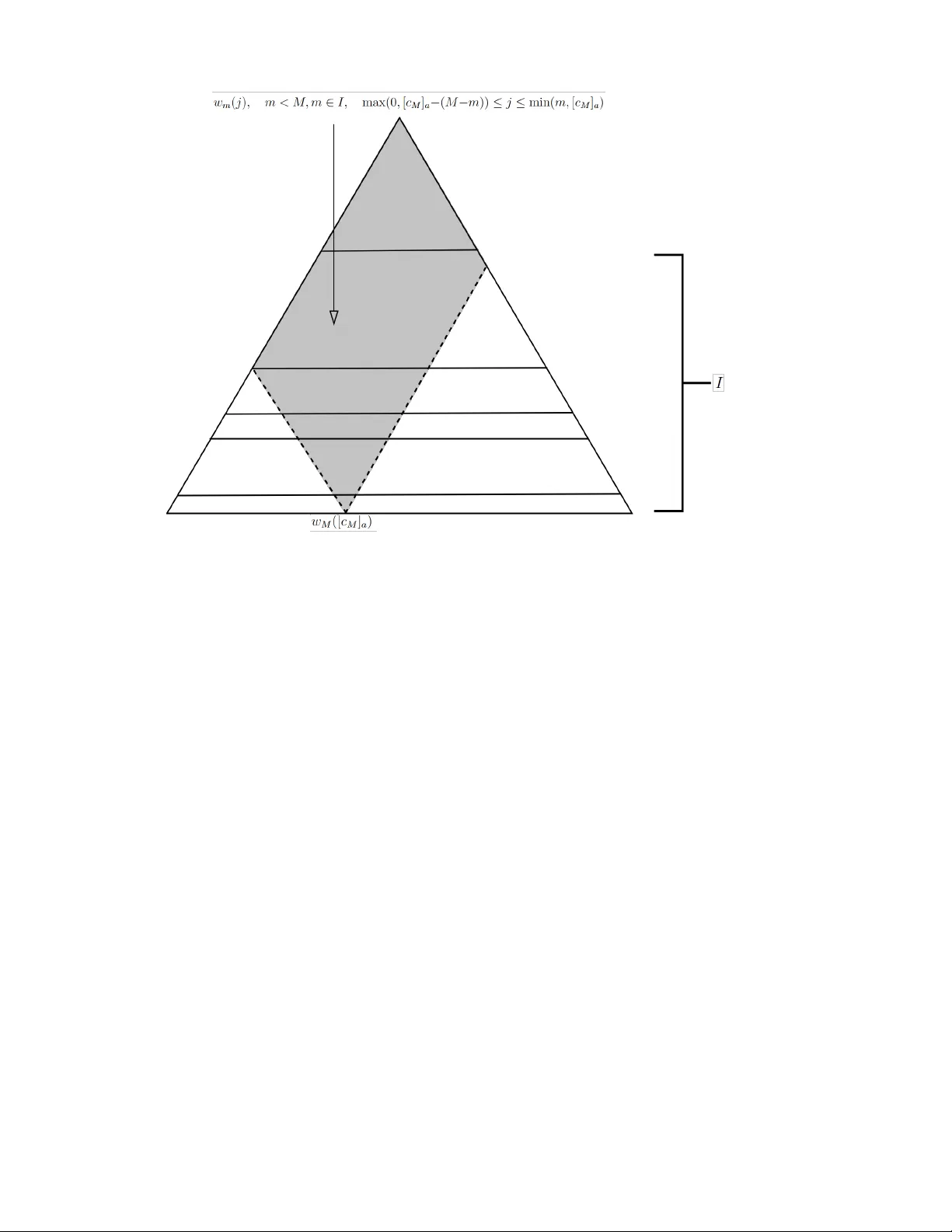
A W eak Structural F orm of Comm utativ e Equiv alence in Finite Co des Dean Kraizb erg ∗ Marc h 31, 2026 Abstract W e in v estigate the structural relationship b et w een prefix-free co des o ver the binary alphab et and a class of unlab eled ro oted trees, which we call symmetric trees. W e establish a canonical corresp ondence betw een prefix-free codes and symmetric trees, preserving not only the lengths of co dew ords but also some additional comm utative structure. Using this corresp ondence, w e pro vide a result related to the commutativ e equiv alence conjecture. W e sho w that for every co de, there exists a prefix-free co de such that, for each fixed word length, the sums of p o w ers of tw o determined by the occurrences of a distinguished sym b ol are equal. Keywor ds: Prefix F ree Codes, Symmetric T rees, Commutativ e Equiv alence, F ree Monoid. MSC2020: 68R15, 20M05, 94A45. 1 In tro duction 1.1 Some Bac kground on Co des F or basic exp osition in co ding theory , w e refer the reader to [ 5 ]. W e in tro duce only the necessary notation and definitions. Throughout, w e w ork ov er the binary alphab et { a, b } . Notation 1.1 We denote by { a, b } < N the fr e e monoid gener ate d by { a, b } ; that is, the set of al l finite wor ds over { a, b } : { a, b } < N = {⟨ x 1 , . . . , x n ⟩ : n ≥ 1 , x i ∈ { a, b }} ∪ {⟨⟩} , wher e ⟨⟩ denotes the empty wor d. We use angle br ackets to denote wor ds when it is ne c essary to emphasize their se- quenc e structur e. F or a wor d w = ⟨ x 1 , . . . , x n ⟩ ∈ { a, b } < N , we define its length by | w | = n . Given two wor ds w 1 = ⟨ x 1 , . . . , x n ⟩ and w 2 = ⟨ y 1 , . . . , y m ⟩ , their c onc atenation is define d by w 1 w 2 = ⟨ x 1 , . . . , x n , y 1 , . . . , y m ⟩ . ∗ Sc ho ol of Mathematical Sciences, T el Aviv Univ ersity , deank@mail.tau.ac.il 1 W e now recall the notion of a (uniquely deco dable finite) co de. F rom this p oint on ward, w e shall refer to suc h ob ject simply as co de. Definition 1.2 A co de is a finite set C ⊆ { a, b } < N of finite wor ds such that the fol- lowing pr op erty holds: whenever w 1 · · · w n = w ′ 1 · · · w ′ m , with w 1 , . . . , w n , w ′ 1 , . . . , w ′ m ∈ C , then n = m and w i = w ′ i for al l 1 ≤ i ≤ n . A fundamental constrain t on the lengths of co dew ords is given b y the classical Kraft–McMillan theorem. This result asserts not only that the lengths of co dewords in an y co de m ust satisfy a certain constrain t, but also that every sequence satisfying this condition arises from the lengths of co dew ords of a prefix-free co de. Theorem 1.3 (Kraft–McMillan) L et C b e a c o de over an alphab et of size k . Then X w ∈ C k −| w | ≤ 1 . Conversely, let A b e a finite multiset of p ositive inte gers satisfying X a ∈ A k − a ≤ 1 . Then ther e exists a pr efix-fr e e c o de C such that the multiset of c o dewor d lengths of C is pr e cisely A , that is, {| c | : c ∈ C } = A as multisets. In particular, ev ery co de is length-e quivalent to a prefix-free co de; that is, for every co de C there exists a prefix-free co de C ′ together with a bijection f : C → C ′ suc h that | w | = | f ( w ) | for all w ∈ C . P errin and Sch¨ utzen b erger introduced a stronger notion of equiv alence [ 3 ]. F or a w ord w = ⟨ x 1 , . . . , x n ⟩ ∈ { a, b } n , w e define [ w ] a := # { 1 ≤ i ≤ n : x i = a } , [ w ] b := # { 1 ≤ i ≤ n : x i = b } . Definition 1.4 Two c o des C 1 , C 2 ar e said to b e commutativ ely equiv alen t if ther e ex- ists a bije ction f : C 1 → C 2 such that for every w ∈ C 1 , [ w ] a = [ f ( w )] a and [ w ] b = [ f ( w )] b . Originally it w as conjectured that every code is commutativ ely equiv alen t to a prefix- free co de [ 3 ]. Ho w ever, this conjecture w as disprov ed b y P eter Shor [ 7 ], who found the co de C Shor = b { 1 , a, a 7 , a 13 , a 14 } ∪ { a 3 , a 8 } b { 1 , a 2 , a 4 , a 6 } ∪ a 11 b { 1 , a, a 2 } , whic h is not commutativ ely equiv alen t to any prefix-free co de. See [ 1 ] for additional coun terexamples. In light of this counterexample, the conjecture w as restricted to a sp ecial class of co des [ 6 ], 2 Conjecture 1.5 (Sc h ¨ utzen b erger) Every maximal c o de—that is, a c o de C such that for every w ∈ { a, b } < N \ C , the set C ∪ { w } is not a c o de—is c ommutatively e quivalent to a pr efix-fr e e c o de. The ab o v e conjecture is also referred to as the Commutative Equivalenc e Conje ctur e . P artial results on the comm utativ e equiv alence conjecture ha ve b een found, for example in [ 3 , 9 ]. Our main result, Theorem 1.9 , is somewhat related to this conjecture, as it establishes the existence of a prefix-free co de that preserv es certain quantities asso ciated with sym b ol o ccurrences within the co de. 1.2 Symmetric T rees and Main Results W e no w introduce the framework in which we consider trees. This formulation is consisten t with the standard graph-theoretic notion of a ro oted tree. the reader is referred to [ 8 ] for basic terminology and definitions in graph theory . Definition 1.6 A ro oted tree is a finite, c onne cte d, acyclic gr aph T to gether with a distinguishe d vertex o ∈ V ( T ) , c al le d the ro ot . We denote by dist the usual gr aph distanc e on T . Given vertic es u, v ∈ V ( T ) , we say that u is a c hild of v if u and v ar e adjac ent and dist( u, o ) = dist( v , o ) + 1 . F or v ∈ V ( T ) \ { o } , we denote by T v the subtree ro oted at v , c onsisting of v to gether with al l its desc endants. A leaf is a vertex without childr en—e quivalently v is a le af if and only if T v = { v } is a tr e e with a single vertex. F or k ∈ N , we define L k ( T ) := { v ∈ V ( T ) : v is a le af and dist( v , o ) = k } . W e next introduce a symmetry condition on ro oted trees. Definition 1.7 L et T b e a finite r o ote d tr e e with r o ot o , and supp ose that e ach vertex has at most thr e e childr en (that is, T is a finite subtr e e of the ful l 3 -ary tr e e). We say that T is symmetric if for every vertex v ∈ V ( T ) with at le ast two childr en, ther e exist distinct childr en u 1 , u 2 of v such that the r o ote d subtr e es T u 1 and T u 2 ar e identic al. W e no w state the main results, whic h justify the in tro duction of symmetric trees in the study of prefix-free co des. Theorem 1.8 Ther e exists a bije ctive c orr esp ondenc e b etwe en pr efix-fr e e c o des and symmetric tr e es. Mor e over, under this c orr esp ondenc e, if C is a pr efix-fr e e c o de and T is the asso ciate d symmetric tr e e, then for every k ∈ N , |L k ( T ) | = X w ∈ C | w | = k 2 [ w ] a . 3 W e will use this corresp ondence to establish the following result: Theorem 1.9 F or every c o de C , ther e exists a pr efix-fr e e c o de C ′ such that for every k ∈ N , one has X w ∈ C | w | = k 2 [ w ] a = X w ′ ∈ C ′ | w ′ | = k 2 [ w ′ ] a . Remark 1.10 In gener al, the c o de C ′ in The or em 1.9 ne e d not have the same c ar di- nality as C . Inde e d, this fails in gener al, as demonstr ate d by Shor’s c ounter example. T o se e this, supp ose that ther e existe d a pr efix-fr e e c o de C satisfying the c onclusion of The or em 1.9 and such that | C | = | C Shor | . Then C and C Shor would ne c essarily b e c ommutatively e quivalent, c ontr adicting Shor’s r esult. 2 Pro ofs of Main Results 2.1 Pro of of Theorem 1.8 W e begin with the pro of of the first direction, which follo ws ideas similar to those app earing in [ 2 ]. T o this end, we introduce sev eral auxiliary notions. W e first give an equiv alent formulation of ro oted lab eled trees in terms of finite w ords. This form ulation is consisten t with the one giv en in [ 4 ]. Definition 2.1 L et A b e a finite alphab et. A lab eled tree over A is a nonempty set T ⊆ A < N of finite wor ds such that T is pr efix-close d; that is, whenever w ∈ T and w ′ is a pr efix of w , then w ′ ∈ T . Elements of T ar e c al le d v ertices 1 . Given w , w ′ ∈ T , we say that w ′ is a c hild of w if w ′ extends w by exactly one symb ol, that is, | w ′ | = | w | + 1 and w is a pr efix of w ′ . F or w ∈ T , we define the subtree ro oted at w by T w := { w ′ ∈ T : w is a pr efix of w ′ } . It is straightforw ard to verify that this definition is equiv alen t to the usual graph- theoretic notion of a ro oted lab eled tree. W e next introduce the free group and its asso ciated Cayley graph. Definition 2.2 L et A b e a finite set. The free group F ( A ) is the gr oup c onsisting of al l r e duc e d wor ds over the alphab et A ∪ A − 1 , wher e r e duction me ans that no symb ol app e ars adjac ent to its inverse. In the c ase A = { a, b } , we write F ( A ) = F ( a, b ) . Definition 2.3 The Cayley graph of the fr e e gr oup F ( A ) , denote d Ca y ( F ( A )) , is the gr aph define d as fol lows: 1 Throughout, v ertices—like co dewords—are denoted using angle brac kets ⟨·⟩ . 4 1. The vertex set is F ( A ) . 2. F or e ach w ∈ F ( A ) and e ach s ∈ A ∪ A − 1 , ther e is an e dge lab ele d s c onne cting w to w s . W e now complete the pro of. Let C b e a prefix-free co de ov er the alphab et { a, b } . Define Z b ( C ) := {⟨ b, c 1 , b, c 2 , . . . , b, c n ⟩ : ⟨ c 1 , . . . , c n ⟩ ∈ C } , and let T b denote the asso ciated lab eled tree whose leav es corresp ond precisely to the elemen ts of C . Consider the map π : Ca y ( F ( a, b )) → { a, b } < N , π ⟨ c ε 1 1 , . . . , c ε n n ⟩ = ⟨ c 1 , . . . , c n ⟩ , where c i ∈ { a, b } and ε i ∈ {± 1 } for all i . W e consider the lifted subtree π − 1 ( T b ) inside the Ca yley graph Ca y( F ( a, b )). It is shown in [ 2 ] that the induced subtree consisting of v ertices whose words ha ve the sym b ol b in ev ery o dd p osition corresp onds to a prefix-free co de ov er an alphab et of size 3. Let T be the tree obtained by restricting this subtree to its ev en co ordinates. More explicitly , T consists of all words ⟨ c ′ 1 , . . . , c ′ n ⟩ ov er the (formally) free alphab et { a, a − 1 , b } suc h that ⟨ b, c ′ 1 , b, c ′ 2 , . . . , b, c ′ n ⟩ ∈ π − 1 ( T b ) . W e claim that the underlying (unlab eled) tree T is symmetric. Indeed, let w ∈ T b e a ve rtex with at least tw o c hildren. Then there exist distinct elemen ts s 1 , s 2 ∈ { a, b } ∪ { a − 1 , b − 1 } suc h that ws 1 , w s 2 ∈ T . W e first note that none of these extensions can inv olv e b − 1 , since this w ould pro duce a reduced word in π − 1 ( T b ) con taining a sub word of the form bb − 1 , whic h is imp ossible. Moreo ver, at most one of s 1 , s 2 can b e equal to b . Consequen tly , without loss of generalit y , we ma y assume that s 1 = a . By symmetry of the construction, it follows that w a − 1 ∈ T as well. It follo ws that the subtrees rooted at wa and wa − 1 are isomorphic (ignoring edge lab els), and hence T satisfies the symmetry condition. Finally , it is sho wn in [ 2 ] that the num b er of leav es of T that are mapped b y π to a giv en leaf ⟨ b, c 1 , . . . , b, c k ⟩ ∈ T b , where ⟨ c 1 , . . . , c k ⟩ = w ∈ C, is precisely 2 |{ i ∈ [ k ]: c i = b }| = 2 [ w ] a . Therefore, |L k ( T ) | = X w ∈ C | w | = k 2 [ w ] a , as required. 5 W e now pro ve the con verse direction. Let T b e a symmetric ro oted tree. W e construct a lab eling of T b y elemen ts of the free monoid { a, a − 1 , b } < N . W e pro ceed inductiv ely . Assign to the ro ot o the empt y word, denoted ⟨⟩ . Supp ose that a vertex v ∈ V ( T ) has already b een assigned a lab el w v ∈ { a, a − 1 , b } < N . W e describ e ho w to lab el its children. • If v has three children u 1 , u 2 , u 3 , and tw o of them (sa y u 1 , u 2 ) satisfy T u 1 ∼ = T u 2 , then assign w u 1 := w v a, w u 2 := w v a − 1 , w u 3 := w v b. • If v has exactly t wo c hildren u 1 , u 2 with T u 1 ∼ = T u 2 , then assign w u 1 := w v a, w u 2 := w v a − 1 . • If v has a single c hild u , assign w u := w v b. This lab eling defines an embedding of T into the free monoid { a, a − 1 , b } < N , whic h w e con tinue to denote b y T by a sligh t abuse of notation. Consider no w the pro jection map P : { a, a − 1 , b } < N → { a, b } < N , P ⟨ a ⟩ = P ⟨ a − 1 ⟩ = a, P ⟨ b ⟩ = b, P ( w 1 · w 2 ) = P ( w 1 ) P ( w 2 ) It is straightforw ard to verify that P ( T ) is a lab eled tree whose set of leav es forms a prefix-free co de C , such that, |L k ( T ) | = X w ∈ C | w | = k 2 [ w ] a , as required. ■ Remark 2.4 The ab ove c onstruction shows, in p articular, that a symmetric tr e e admits a c anonic al lab eling by elements of F ( a, b ) , and henc e determines a unique asso ciate d pr efix-fr e e c o de. 2.2 Pro of of Theorem 1.9 W e b egin b y stating tw o auxiliary lemmas. Lemma 2.5 L et C b e a c o de. Then X c ∈ C 3 −| c | 2 [ c ] a ≤ 1 . 6 Pro of. Using the notation from the pro of of Theorem 1.8 , define ˆ C = ⟨ c ′ 1 , . . . , c ′ n ⟩ : ⟨ b, c ′ 1 , b, c ′ 2 , . . . , b, c ′ n ⟩ ∈ π − 1 ( T b ) ⊆ { a, a − 1 , b } < N . The k ey observ ation is that ˆ C forms a co de o ver an alphab et of size 3. Indeed, supp ose that a word admits t wo distinct factorizations in to elemen ts of ˆ C : w 1 · · · w n = w ′ 1 · · · w ′ m , w 1 , . . . , w n , w ′ 1 , . . . , w ′ m ∈ ˆ C . Applying the pro jection P to b oth sides yields tw o factorizations of the same word in to elemen ts of C . Since C is a co de, it follows that n = m and P ( w i ) = P ( w ′ i ) for all 1 ≤ i ≤ n. Since w 1 · · · w n = w ′ 1 · · · w ′ n , w e conclude that w i = w ′ i for ev ery 1 ≤ i ≤ n , con tradicting the assumption that the tw o factorizations are distinct. Thus, ˆ C is a co de. The desired inequalit y no w follo ws from McMillan’s theorem applied to ˆ C , viewed as a co de o ver a 3-letter alphabet, together with the same counting argument as in the pro of of Theorem 3 in [ 2 ]. Lemma 2.6 L et A b e a finite multiset of natur al numb ers, and let N ∈ N . Supp ose that X n ∈ A 2 n ≥ 2 N and n ≤ N for al l n ∈ A. Then ther e exists a sub-multiset A ′ ⊆ A such that P n ∈ A ′ 2 n = 2 N . Pro of. W e proceed b y induction on N . Base c ase: N = 0. In this case, the only p ossible elements in A are 0, and the condition P n ∈ A 2 n ≥ 2 0 = 1 implies that A contains at least one copy of 0. Let A ′ b e a m ultiset consisting of exactly one 0 from A . Then P n ∈ A ′ 2 n = 2 0 = 1, as required. Inductive step: Consider N > 0, and assume that the statement holds for all natural n umbers less than N . If N ∈ A , then w e ma y tak e A ′ = { N } and the result follo ws immediately . Oth- erwise, N / ∈ A . By assumption, P n ∈ A 2 n ≥ 2 N ≥ 2 N − 1 . By the induction h yp othesis applied to N − 1, there exists a sub-multiset A 1 ⊆ A such that P n ∈ A 1 2 n = 2 N − 1 . Consider the remaining multiset A \ A 1 . W e hav e X n ∈ A \ A 1 2 n = X n ∈ A 2 n − X n ∈ A 1 2 n ≥ 2 N − 2 N − 1 = 2 N − 1 . Applying the induction h yp othesis again to A \ A 1 for N − 1, w e obtain a sub-multiset A 2 ⊆ A \ A 1 suc h that P n ∈ A 2 2 n = 2 N − 1 . Setting A ′ = A 1 ∪ A 2 , we ha v e P n ∈ A ′ 2 n = 2 N , as desired. W e now turn to the pro of of the Main Result. Let C b e a co de. By Theorem 1.8 , it suffices to construct a symmetric tree T suc h that |L k ( T ) | = X w ∈ C | w | = k 2 [ w ] a . 7 W e pro ceed b y induction on | C | . Base case: If | C | = 1, the statement is trivial. Inductiv e step: Assume the statement holds for all co des of size less than | C | , and let c M ∈ C b e a word of maximal length M := | c M | = max {| c | : c ∈ C } . By the induction h yp othesis, there exists a symmetric tree T 0 corresp onding to the co de C \ { c M } , i.e., |L k ( T 0 ) | = X c ∈ C \{ c M } | c | = k 2 [ c ] a . Let E x M ( T 0 ) denote the symmetric tree obtained b y extending each leaf of T 0 to depth M . F ormally , for a leaf v ∈ T 0 at distance k from the ro ot, we attac h a copy of the 3-ary tree of depth M − k ro oted at v . Equiv alen tly , in terms of the canonical lab eled tree, each leaf c ∈ T 0 is replaced by the set of new lea v es { c · w : w ∈ { a, a − 1 , b } M −| c | } . By construction, all leav es of E x M ( T 0 ) are at distance M from the ro ot. Moreo v er, b y Lemma 2.5 , w e ha v e |L M ( E x M ( T 0 )) | = X c ∈ C \{ c M } 3 M −| c | · 2 [ c ] a = 3 M X c ∈ C \{ c M } 3 −| c | · 2 [ c ] a ≤ 3 M − 2 [ c M ] a . Denote the complete 3-ary tree of depth M by T M (3), and consider no w the com- plemen t of the extended tree within T M (3): E x M ( T 0 ) C := T M (3) \ E x M ( T 0 ) . Then |L M ( E x M ( T 0 ) C ) | = 3 M − |L M ( E x M ( T 0 )) | ≥ 2 [ c M ] a . F urthermore, E x M ( T 0 ) C is itself a symmetric tree. Therefore, it corresponds to a subset S ⊆ { a, b } M satisfying X w ∈ S 2 [ w ] a ≥ 2 [ c M ] a . Observ e that if [ w ] a ≤ [ c M ] a for all w ∈ S , then by Lemma 2.6 , there exists a subset S ′ ⊆ S suc h that X w ∈ S ′ 2 [ w ] a = 2 [ c M ] a . Adding the symmetric tree corresp onding to S ′ to T 0 then yields the desired symmetric tree for the full co de C (i.e. with the desired num b er of leav es), completing the inductiv e step. Here, by “adding”, we mean forming the symmetric tree corresp onding to the union of S ′ with the prefix free co de asso ciated to T 0 . Remark 2.7 A lso observe that, in gener al, at most one vertex at e ach depth c an satisfy [ w ] a = 0 ; furthermor e, a c o de c ontains at most one wor d with this pr op erty. Thus, if we assume that [ c M ] a = 0 , it fol lows, by p arity c onsider ations, that ther e ne c essarily exists w ∈ S such that [ w ] a = 0 . In this c ase, we may take S ′ = { w } as the desir e d subset. 8 If the previous case does not hold, then there exists some w ∈ S suc h that [ w ] a > [ c M ] a . Let i > [ c M ] a b e minimal such that there exists w ∈ S with [ w ] a = i . Abusing notation and den tifying T 0 with the corresponding prefix-free co de, we in tro duce the notation C k ( j ) := { w ∈ T 0 : | w | = k , [ w ] a = j } , w k ( j ) := | C k ( j ) | , k ∈ N , 0 ≤ j ≤ k i.e., C k ( j ) is the set of words in T 0 of length k with exactly j o ccurrences of the letter a . Also denote I := {| c | : c ∈ T 0 } to b e the set of lengths of words in the prefix free co de corresp onding to T 0 . Observ e that w k ( i ) ≤ k i , since there are at most k i sequences of length k with exactly i letters equal to a . No w, supp ose there exists some m ∈ I , with m < M , such that for som e j satisfying max(0 , [ c M ] a − ( M − m )) ≤ j ≤ min( m, [ c M ] a ) , w e ha ve w m ( j ) < m j . Then there exists a “missing” word w ∈ { a, b } m \ C m ( j ) , with [ w ] a = j. W e can extend this w ord to a new w ord of length M b y app ending w ′ := w · ⟨ a, . . . , a | {z } [ c M ] a − j times , b, . . . , b | {z } M − m − ([ c M ] a − j ) times ⟩ , whic h, by construction, has no prefix in T 0 . Therefore, adding the symmetric tree corresp onding to w ′ to the tree T 0 then yields the desired symmetric tree for the full co de C , completing the inductive step. Otherwise, let w ∈ S b e suc h that [ w ] a = i . By construction of S there must exist some m < M and a minimal index j satisfying max(0 , i − ( M − m )) ≤ j ≤ min( m, i ) suc h that w m ( j ) < m j . By assumption, let j ′ < j b e maximal such that max(0 , [ c M ] a − ( M − m )) ≤ j ′ ≤ min( m, [ c M ] a ) , and w m ( j ′ ) = m j ′ , w m ( j ′ + 1) = m j ′ + 1 , . . . , w m ( j − 1) = m j − 1 . In this situation, w e may perform the following adjustmen t: delete tw o words from C m ( j − 1) and add one of the missing elements to C m ( j ). Since w m ( j ) < m j , the 9 Figure 1: Region in which we seek a w ord that is neither a prefix of nor has a prefix in the existing co de T 0 . op eration is p ossible, and b y construction, the total n umber of leav es of each depth in the symmetric tree remains unchanged. This can b e seen b y the fact that the total n umber of leafs of depth m ∈ I is m X k =0 2 k w m ( k ) . W e contin ue this pro cess iterativ ely . As long as w m ( j ′ ) ≥ 2, the adjustmen t can b e rep eated without issue. If w m ( j ′ ) = 1, we m ust ha v e j ′ = 0. In particular, by the maximality of j ′ , this w ould imply that [ c M ] a = 0, which we already discussed in Remark 2.7 . Consequen tly , after p erforming the describ ed adjustmen ts, the total num b er of lea ves in the mo dified tree remains equal to that in T 0 , and the “v acancy” in C m ( j ) has b een “shifted” in to a region where a word con taining [ c M ] a o ccurrences of a can b e added. Therefore, the configuration can b e resolved as in the previous argument, completing the desired construction. ■ 3 F urther Discussion W e note that Theorem 1.9 extends to co des o ver arbitrary finite alphabets. More precisely , we ha ve the follo wing statement. Let C b e a finite co de o ver an alphab et A of size A . Then, for ev ery a ∈ A , there 10 exists a prefix-free co de C ′ o ver A suc h that, for ev ery k ∈ N with k ≥ A 2 , X w ∈ C | w | = k A k − [ w ] a = X w ′ ∈ C ′ | w ′ | = k A k − [ w ′ ] a . W e omit the pro of in this general setting, as it follows b y the same argument as in the binary case, which already captures the essential ideas. F or example, in the general setting, Lemma 2.5 states that for co des o v er an alphab et A of size A , one has X w ∈ C (2 A − 1) −| w | A | w |− [ w ] a ≤ 1 . This is sho wn using the same argumen t presen ted ab o v e (together with the same coun t- ing argumen t as in the pro of of Theorem 3 in [ 2 ]). Also, in ligh t of Remark 1.10 , it is natural to ask how close, in cardinalit y , a co de can b e to a corresp onding prefix-free co de satisfying the conclusion of Theorem 1.9 . More precisely , giv en a code C , can one alwa ys find a prefix-free co de C ′ satisfying the conclusion of Theorem 1.9 such that | C | − | C ′ | = O ( | C | )? or even | C | − | C ′ | = O (1)? References [1] C. Cordero. A note with c omputer explor ation on the triangle c onje ctur e. , Language and Automata Theory and Applications (2019). [2] D. Kraizberg. Winning Criteria for Op en Games: A Game-The or etic Appr o ach to Pr efix Co des. , arXiv preprin t (2026). [3] D. Perrin, M.P . Sc h ¨ utzen b erger. Un pr obl‘eme ´ el ´ ementair e de la th ´ e orie de l’information. Th ´ eorie de l’Information 276, CNRS (1977) 249-260. [4] E. Solan. Bor el Games , Routledge T a ylor & F rancis Group (2025). [5] J. Berstel, D. P errin, C. Reutenauer, Co des and A utomata , Encyclop edia of Math- ematics and its Applications No. 129, Cambridge Universit y Press, Cambridge, (2009). [6] M.P . Sc h ¨ utzen b erger. Co des ‘a longueur variable . man uscript.Dominique Perrin, editor, Actes de la 7‘eme Ecole de Printemps d’Informatique Th ´ eorique, LITP and ENST A (1980) 247–271. [7] P .W. Shor. A c ounter example to the triangle c onje ctur e . J. Comb. Theory , Ser. A, 38(1) (1985) 110–112. [8] R. Diestel. Gr aph The ory , sixth edition, Graduate T exts in Mathematics, v ol. 173, Springer, Berlin, (2025). [9] S. Mauceri, A. Restivo. A family of c o des c ommutatively e quivalent to pr efix c o des. Inf. Pro cess. Lett., 12(1) (1981) 1–4. 2 The restriction k ≥ A is imposed only to ensure that the condition w k ( j ) < A implies j = 0. 11
Original Paper
Loading high-quality paper...
Comments & Academic Discussion
Loading comments...
Leave a Comment