RADAR-Q: Resource-Aware Distributed Asynchronous Routing for Entanglement Distribution in Multi-Tenant Quantum Networks
Scalable quantum networks must support concurrent entanglement requests, yet existing routing protocols fail when users compete for shared repeater resources, wasting fragile quantum states. This paper presents RADAR-Q, a resource-aware decentralized…
Authors: Chenliang Tian, Zebo Yang, Raj Jain
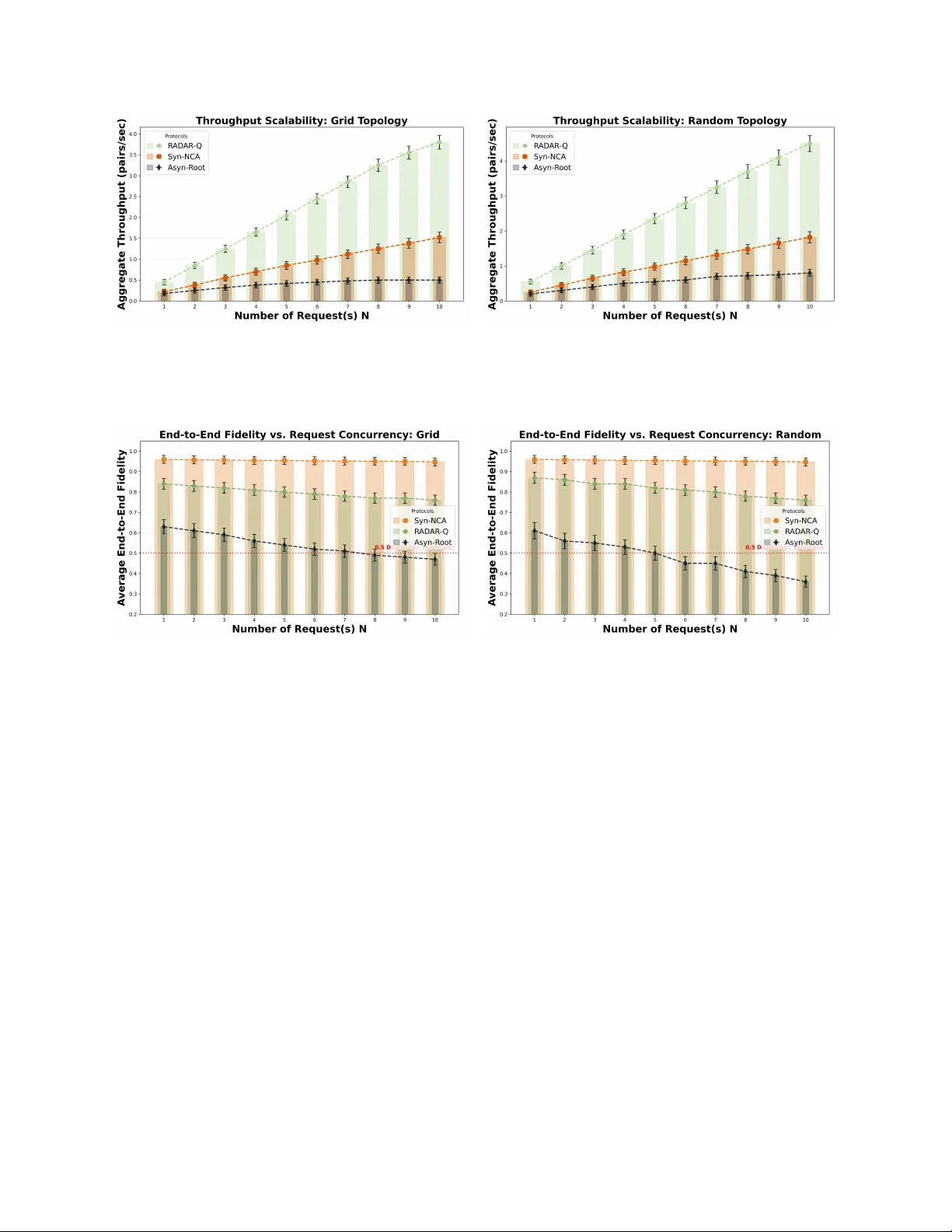
RAD AR-Q: Resource-A w are Distributed Async hronous Routing for En tanglemen t Distribution in Multi-T enan t Quan tum Net w orks Chenliang Tian ∗ 1 , Zeb o Y ang 2 , Ra j Jain 1 , Ramana K omp ella 3 , Reza Nejabati 3 , Eneet Kaur 3 , Aiman Erbad 4 , Mohamed Ab dallah 5 , and Mounir Hamdi 5 1 Departmen t of Computer Science and Engineering, W ashington Universit y in St. Louis, USA 2 Departmen t of Electrical Engineering and Computer Science, Florida A tlantic Universit y , USA 3 Quan tum Lab, Cisco, USA 4 Departmen t of Computer Science and Engineering, Qatar Universit y , Qatar 5 Departmen t of Science and Engineering, Hamad Bin Khalifa Univ ersity , Qatar chenliang.t@wustl.edu, yangz@fau.edu, jain@wustl.edu, rkompell@cisco.com, rnejabat@cisco.com, ekaur@cisco.com, aerbad@qu.edu.qa, moabdallah@hbku.edu.qa, mhamdi@hbku.edu.qa Abstract. Scalable quantum netw orks m ust support concurren t en tanglement requests from multiple users, yet existing routing proto cols fail when users compete for shared repeater resources and waste fragile quantum states that decay rapidly and cannot be buffered lik e classical data. This pap er presents RAD AR-Q, a resource-aw are decen tralized routing proto col that embeds real-time resource conten tion directly into path selection. Unlik e prior designs that either require global co ordination or route all traffic through a cen tral anc hor, RAD AR-Q mak es in telligent lo cal decisions b y balancing three factors: (1) path length and link fidelity , (2) instan taneous av ailability of quan tum memory at each node, and (3) the num b er of in termediate Bell-State Measuremen t (BSM) op erations needed to connect a source–destination pair. By iden tifying the Nearest Common Ancestor (NCA) within a DOD AG routing hierarc hy , RADAR-Q lo calizes entanglemen t swapping close to the communicating users—av oiding unnecessary detours through the net w ork cen ter and reducing b oth the BSM chain length and qubit exp osure to decoherence. W e ev aluate RADAR-Q on grid and random top ologies—representing regular and irregular net work fabrics, respectively—against state-of-the-art synchronous and root-centric asynchronous baselines. Results demonstrate that RAD AR-Q achiev es 2 . 5 × and 7 . 6 × higher aggregate throughput than sync hro- nized and ro ot-cen tric async hronous designs, resp ectively . While baseline proto cols suffer catastrophic fidelit y collapse below the 0.5 distillation threshold under high load, RAD AR-Q consisten tly main tains end-to-end fidelit y abov e 0.76—ensuring every generated pair remains ph ysically usable for do wnstream quan tum applications. F urthermore, RADAR-Q exhibits near-p erfect fairness (Jain’s F airness Index 96–98%) and retains ov er 50% of its ideal throughput even under stringent 1.0 ms coherence times. These findings establish con tention-a w are decentralized routing as a scalable foundation for multi-tenan t quan tum netw orks, with direct applicabilit y to emerging quantum data center and distributed quan tum computing environmen ts. Keyw ords: Entanglemen t Routing · Quan tum Repeaters · Multi-tenant Quan tum Netw orks · Conten tion- A ware Routing · Resource-aw are Net w orking. 1 In tro duction The scalabilit y of multi-tenan t quantum netw orks hinges on their ability to supp ort concurrent entangle- men t requests from multiple users [9]. While our previous proto cols—Async hronous Entanglemen t Routing (AER) [16] and Multipartite Asynchronous En tanglemen t Routing (MAER) [14]—ha ve demonstrated efficient async hronous routing for single-pair and m ultipartite sessions and outp erform existing sync hronous metho ds, they lac k mechanisms to resolv e local resource conten tion when multiple source–destination (S–D) pairs comp ete for shared rep eater no des [4] or entanglemen t links. In such multi-tenan t scenarios, a naiv e extension of single-request protocols like AER and group-based pro- to cols like MAER—whic h assume isolated entanglemen t sessions—can result in resource deadlock. Specifically , Submitted to the Fifth In ternational Conference on Innov ations in Computing Researc h (ICR’26), August 2026, Berlin, Germany . when m ultiple S–D pairs concurren tly select paths that share a common rep eater node, they ma y eac h reserv e a qubit for sw apping [10] without co ordination. Since quantum memory is finite and non-bufferable, and neither AER nor MAER pro vides a mechanism for distributed resource arbitration, all competing requests ma y blo ck indefinitely , leading to m utual failure. This limitation is ackno wledged in b oth works, where unco ordinated resource conten tion degrades b oth throughput and end-to-end fidelity . A fundamen tal challenge arises: how can a no de make in telligent routing decisions using only lo cal kno wledge, while sim ultaneously accounting for (i) probabilistic Bell-State Measurement (BSM) success, (ii) qubit decoherence due to storage and gate noise, and (iii) real-time comp etition for limited quan tum memory? Sync hronous proto cols sidestep this by assuming global coordination [13]; while effective, suc h co ordination incurs sc heduling o verhead that gro ws with ne t work size and user concurrency , and requires all no des to share a common time reference. Conv ersely , existing distributed asynchronous approac hes—such as shortest-path routing o ver instan taneous link graphs [11]—do not accoun t for real-time resource a v ailability . When m ultiple requests indep enden tly select ov erlapping paths, the resulting con tention induces queuing dela ys that exhaust the limited coherence time of qubits and degrade o verall throughput. This paper presents the RAD AR-Q protocol to address these c hallenges. Unlike prior works suc h as AER [16] and MAER [14], which treat multi-tenan t supp ort as an add-on co ordination lay er, RADAR-Q em b eds resource comp etition directly into the path selection metric. Specifically , it introduces a rank- differen tial-based ob jective that jointly optimizes (i) path potential (via hop coun t d hop and fidelity F v ), (ii) real-time link av ailability , and (iii) the n umber of in termediate BSM operations along the path (i.e., BSM depth)—a quantit y that gov erns b oth the aggregate success probability ( ∝ q k ) and the cumulativ e decoherence exposure. This metric is ev aluated lo cally at eac h node using only its Destination-Oriented Directed Acyclic Graph (DODA G)-main tained rank hierarch y and immediate neigh b or state, eliminating any need for global top ology knowledge or centralized sc heduling. By selecting paths with high rank differentials and low conten tion (quantified b y memory o ccupancy Q v ), RADAR-Q proactively resolv es conflicts during the routing decision itself. Our k ey insight is that conten tion-a wareness, not mere async hronicit y , is the cornerstone of scalable m ulti-tenant quantum routing. This reframing transforms RADAR-Q from an incremental extension of AER/MAER in to a conceptually distinct protocol: whereas prior protocols fo cus on preserving en tanglements across rounds, RAD AR-Q optimizes their concurrent utilization under resource comp etition. F or instance, b y identifying the Nearest Common Ancestor (NCA) as a lo calized swapping point, RAD AR-Q establishes shorter paths compared to ro ot-cen tric approaches [11], reducing both the BSM chain length and the time qubits sp end in memory . Our simulation results demonstrate that RAD AR-Q achiev es substantially higher entanglemen t rates compared to both a synchronized NCA-based baseline and an as ync hronous root-centric baseline. While global co ordination yields the highest fidelity , RADAR-Q sustains a stable end-to-end fidelity w ell ab ov e the 0.5 distillation threshold [2]. It strategically accepts marginal increases in memory exp osure to av oid structural b ottlenec ks, thereby preserving ph ysical usability for all generated pairs. In stark contrast, naiv e async hronous proto cols suffer catastrophic fidelit y collapse b elo w the distillation threshold and sev ere fairness degradation (Jain’s fairness index [7] ≪ 100% ), precluding their deplo yment in m ulti-tenant environmen ts where service predictability and en tanglemen t v alidity are non-negotiable. The problem of m ulti-tenan t resource conten tion arises in an y shared quan tum infrastructure—from near-term Noisy In termediate-Scale Quantum (NISQ) testb eds to future error-corrected quan tum data cen ters and distributed quantum computing platforms. In this work, w e mo del the netw ork as a resource-constrained graph where users concurrently compete for finite quantum memory at rep eater no des (i.e., intermediate net work nodes equipp ed with quantum memories and BSM capabilities) and en tanglemen t links, following the abstraction in [12]. W e ev aluate RADAR-Q on t w o representativ e top ologies: a 10 × 10 grid, whic h pro vides a regular fabric with uniform connectivity , and a random graph ( N = 100 , av erage degree 4), which captures irregular, heterogeneous link structures. These general top ologies allo w us to isolate RADAR-Q’s core con tribution—conten tion-aw are resource arbitration—without presupp osing a sp ecific physical arc hitecture, while remaining directly applicable to structured quantum data cen ter interconnects as they mature. The remainder of this pap er is organized as follows. Section 2 defines the netw ork mo del and routing c hallenges. Section 3 details the RADAR-Q proto col, including its conten tion-aw are routing metric and DOD AG-based path discov ery . Section 4 presen ts simulation settings and results with analysis. Finally , Section 5 concludes the pap er. 2 Preliminaries This section giv es bac kground for the prop osed routing sc heme. W e first explain en tanglemen t generation and sw apping. After that, we describ e existing sync hronous routing proto cols and their main problems. Finally , w e define the m ulti-tenant en tanglement routing problem. 2.1 En tanglement Generation and Swapping W e assume a heralded en tanglemen t generation process in which successful link creation is confirmed b y a classical herald signal [12]. One concrete realization is the Emitter–Scatter (E-S) sc heme: a source no de generates a locally en tangled pair, retains one stationary qubit Q A , and transmits a flying qubit Q F en tangled with Q A . Up on successful reception, the receiv er stores the photon-mediated state as Q B and returns a classical herald confirming link establishment. Other heralded sc hemes—such as Emitter–Emitter or Scatter–Scatter proto cols—pro duce equiv alen t link-lev el entanglemen t; the routing lay er of RAD AR-Q is agnostic to the sp ecific generation mechanism and requires only that eac h link rep orts a success probability p uv and an initial fidelit y F uv . T o extend connectivit y across multiple hops, in termediate rep eater no des p erform Bell-State Measuremen ts (BSMs) that pro ject lo cally entangled segmen ts on to end-to-end EPR pairs ( Q A , Q B ). This ph ysical-lay er foundation enables RADAR-Q’s con tention-a w are routing under asynchronous op eration. 2.2 Existing Sync hronous Approaches Most current routing proto cols use synchronized time slots, such as [11]. Time is divided into equal-size slots. There are t wo steps. First, adjacen t no des generate direct-link en tanglement pairs in one slot. This creates an “instan t top ology .” Second, the net work tries to build end-to-end entanglemen t b y swapping along pre-chosen paths based on the instant topology in the next slot. Ho wev er, the protocol enforces a strict boundary b etw een slots: at the end of each one, all en tangled pairs—used or un used—are discarded. This is necessary because en tangled states decay quickly and cannot b e copied or buffered across rounds. Consequently , an y entanglemen t not utilized within its slot is lost, wasting resources and reducing throughput under conten tion. F urthermore, maintaining strict global synchronization across a large-scale netw ork introduces significan t signaling ov erhead and hardware complexity [13, 16], making suc h centralized coordination increasingly costly as the netw ork gro ws. These limitations motiv ate our asynchronous, locality-first approac h. 2.3 Problem Statemen t In m ulti-tenant quan tum netw orks, man y users often share the same rep eater nodes. This causes resource con tention. En tangled states cannot b e copied due to the no-cloning theorem [15]. They also lose quality o ver time b ecause of T 2 decoherence—the transverse relaxation time that gov erns how quic kly a qubit’s phase coherence decays [17]. Therefore, they cannot be stored for long or queued like classical data. If a request w aits to o long, its en tanglement may expire. This lo w ers b oth the success rate and the fidelit y of the final link. T o a void this, we need a routing proto col that handles conten tion w ell. Its goal is to find paths that reduce conten tion and maximize the num b er of successful end-to-end EPR pairs p er second. 3 RAD AR-Q: Conten tion-A w are Async hronous Entanglemen t Routing This section describ es the RADAR-Q proto col. W e first define our netw ork mo del. Then we explain how no des form and main tain a logical DOD AG for topology discov ery . Next, w e show the adv antages of path selection using the NCA based on the DODA G structure. Finally , we presen t the routing algorithm and the con tention-a ware metric used to select optimal paths. (a) Neighbor Discovery: Solicited and Unsolicited Root Node 1 Node 2 DIS DIO (b) Local Rank Computation and Route Registration Root Node 1 Node 2 DIO DA O (c) DOD A G Expansion Root Node 1 Node 2 Node 3 DA O DA O DIO DIS Fig. 1: Distributed signaling for DOD AG maintenance. Neigh b or discov ery and rank propagation via DIS, DIO, and DA O messages in an asynchronous en vironmen t. 3.1 Net work T op ology Model W e consider a ph ysical quantum net work topology mo deled as an undirected graph G = ( V , E ) , where V is the set of no des (users and rep eaters) and E represen ts bidirectional classical-quantum h ybrid channels. Eac h c hannel supp orts b oth qubit transmission and classical communication. Eac h node v ∈ V is equipp ed with a finite quantum memory of size M v qubits and a lo cal BSM device capable of p erforming entanglemen t sw apping b etw een any t wo qubits stored in its memory . A direct link ( u, v ) ∈ E can generate entangled pairs at a success probabilit y p uv p er attempt, with a fidelity F uv that decays due to tw o primary noise sources in the NISQ era: (i) storage noise, which accum ulates exp onentially during the coherence time T CO , and (ii) gate noise introduced by eac h BSM op eration, which itself succeeds with a probability q . T o ensure physical feasibilit y , the routing state at any node v is constrained by its memory size M v . Let Q v ∈ { 0 , 1 , . . . , M v } denote the current quan tum memory occupancy at no de v , i.e., the num b er of qubits currently storing en tangled states. The memory utilization ratio is then Q v / M v ∈ [0 , 1] . Under a b est-effort deliv ery mo del, we assign uniform weigh ts to all requests ⟨ s, d ⟩ ∈ R . 3.2 DOD AG F ormation and Main tenance RAD AR-Q adopts the DODA G structure from the Routing Proto col for Low-P ow er and Lossy Netw orks (RPL) proto col [1]. A single root no de anchors the DODA G, serving as the reference p oin t for rank computation. All other no des self-organize by calculating their rank using only local information and advertisemen ts receiv ed from neighbors. The DODA G is constructed and main tained via three classical control message t yp es, extended in RAD AR-Q with quantum-specific parameters: – DOD AG Information Ob ject (DIO): multicast do wn ward to adv ertise a no de’s rank, DODA G v ersion, and quantum metrics including a v erage link fidelit y F v and memory utilization Q v . – DOD AG Information Solicitation (DIS): multicast b y a no de to solicit DIO messages from neighbors for joining or state refresh. – Destination A dvertisemen t Ob ject (DA O): sen t unicast upw ard to the selected parent after parent selection. D AOs propagate reachabilit y information to w ard the ro ot. It allows storing-mo de ancestors to cache do wnw ard routes to descendants. Figure 1 illustrates this distributed signaling sequence. Rank-0 Rank-1 Rank-2 Rank-3 Physical Grid T op ology Root NCA 1 R2 R3 R1 NCA 2 s 1 d 1 s 2 d 2 Logical DODA G T op ology Root NCA 1 R1 R2 R3 NCA 2 s 1 d 1 s 2 d 2 • Bounded Lo cal Knowledge DODA G MAPPING Legend: User Pair 1 ( s 1 , d 1 ) User Pair 2 ( s 2 , d 2 ) Repeater / NCA Pair 1 Optimized P ath Pair 2 Optimized P ath Entanglement Links Fig. 2: Structural mapping from a physical grid top ology (left) to the corresp onding logical DODA G (righ t). No de colors indicate roles: cy an for user pair 1 ( s 1 , d 1 ), green for user pair 2 ( s 2 , d 2 ), blue for rep eater no des, and red for the DOD AG ro ot. Red dashed arrows sho w ro ot-centric default paths; colored solid lines sho w RADAR-Q’s NCA-optimized paths. The grid serves as an illustrative example; RAD AR-Q op erates on arbitrary graph top ologies. 3.3 Rank Definition and Loop-F ree Guaran tee The rank of no de v in a DOD AG is defined as a comp osite metric that prioritizes path length while penalizing p o or quantum quality or resource conten tion: rank ( v ) = d hop ( v ) + α (1 − F v ) + β ( Q v / M v ) α + β | {z } ∈ [0 , 1) (1) where – d hop ( v ) ∈ N 0 is the hop distance from v to the root, – F v ∈ [0 , 1] is the av erage fidelit y ov er v ’s links to candidate parents, – Q v / M v ∈ [0 , 1] is the fraction of o ccupied quantum memory slots at v , – α, β > 0 are tunable weigh ts balancing fidelity loss v ersus memory load. The fractional term is strictly bounded in [0 , 1) , ensuring that a no de’s rank is alw a ys less than its paren t’s rank plus one: rank ( v ) < rank ( parent ( v )) + 1 This strict monotonic increase along any do wnw ard path prev en ts routing lo ops, while still allo wing quantum- a ware tie-breaking within the same hop distance. Each no de selects as its preferred paren t the neighbor adv ertising the low est rank. Combined with DA O-based reachabilit y cac hing at ancestors, this mechanism enables ev ery no de to lo cally trace a consistent up ward path tow ard p otential NCAs for an y S–D pair and b ypass the global kno wledge need. Figure 2 exemplifies the mapping from a physical grid topology to the resulting logical DODA G. Note that Eq. 1 gov erns the DODA G construction phase (line 1 of Algorithm 1): when Upda teDODA G is in vok ed, eac h no de recomputes its rank using Eq. 1 based on the latest fidelit y and memory adv ertisements Algorithm 1 RADAR-Q: Con ten tion-A ware Routing Require: Local DOD AG view G inst , concurrent requests R = {⟨ s i , d i ⟩} Ensure: Routing status and established paths 1: G inst ← UpdateDODA G ( G inst ) ▷ Ranks via Eq. 1 2: Sort R by d hop ( nca ( s, d )) descending ▷ Lo cality-first 3: for each ⟨ s, d ⟩ ∈ R do 4: P ← GenerateCandidateP aths ( s, d, G inst ) 5: if P = ∅ then contin ue 6: end if 7: p ∗ ← arg max p ∈P d hop ( nca ( s,d ))+1 1+max e ∈ p (1 − av ail ( e )) ▷ Eq. 2 8: if AttemptSw aps ( p ∗ ) succeeds then 9: LogSuccess ( ⟨ s, d ⟩ , p ∗ ) 10: else 11: NotifyF ailure ( p ∗ ) ; T riggerLocalizedUp date ( p ∗ ) 12: end if 13: end for from neigh b ors. The resulting rank hierarch y determines parent selection and, consequently , the set of candidate upw ard paths av ailable for routing. The conten tion-a ware path selection metric (Eq. 2) then op erates ov er these DOD AG-deriv ed paths. 3.4 NCA-Cen tric P ath Disco v ery and Selection In man y existing protocols, entanglemen t paths are computed as shortest paths o v er instantaneous link graphs [11], without considering ho w multiple concurrent requests in teract at shared nodes. When these shortest paths conv erge at common rep eaters, conten tion emerges. RADAR-Q addresses this by adopting an NCA-cen tric approac h. As illustrated in the left p ortion of Figure 2, RADAR-Q iden tifies a lo calized sw apping p oin t closer to the users. F or example, the request pair ⟨ s 2 , d 2 ⟩ can complete entanglemen t swapping at N C A 2 instead of trav ersing the entire path to the ro ot. F or any S–D pair ⟨ s, d ⟩ , entanglemen t sw apping is lo calized at their NCA no de, defined as the deep est common ancestor in the DODA G tree. The resulting path consists of tw o upw ard segments: s → nca ( s, d ) follow ed by d → nca ( s, d ) . Let k ′ = d hop ( s, nca ) + d hop ( d, nca ) denote the path length in hops. By construction, k ′ ≤ k , where k is the length of the root-routed path s → ro ot → d . Equalit y holds only when the ro ot is the sole common ancestor. 3.5 NCA-Cen tric Routing and Con tention A w areness Algorithm 1 implemen ts a conten tion-aw are routing logic op erating entirely on lo cal state. Up on receiving concurren t requests R = {⟨ s i , d i ⟩} , RADAR-Q emplo ys a Lo cality-First Priorit y mechanism: requests are pro cessed in descending order of NCA depth d hop ( nca ( s, d )) , prioritizing lo calized routes that require fewer BSM op erations and maximize success probability under finite coherence times. F or eac h req uest ⟨ s, d ⟩ , the no de iden tifies all common ancestors of s and d within its lo cal DOD A G view G inst , sorted by depth (deep est first). Candidate paths are constructed by concatenating up ward routes s → nca and d → nca ; any path con taining a saturated link ( a v ail ( e ) = 0 ) is discarded. The optimal path p ∗ maximizes the conten tion-a ware metric: p ∗ = arg max p ∈P d hop ( nca ( s, d )) + 1 1 + max e ∈ p (1 − av ail ( e )) , (2) where the n umerator rewards locality (deeper NCA ⇒ shorter BSM depth) and the denominator p enalizes congestion. Up on BSM failure or decoherence, a ligh tw eight notification triggers localized DODA G updates among affected neighbors, ensuring rapid conv ergence without global o verhead. The FindAllCommonAncestors function op erates fully distributed: no des indep endently broadcast ancestor lists upw ard via parent pointers; their first intersection yields the NCA. This reframes multi-tenan t routing from reactiv e conflict management to proactive, metric-driv en path optimization. 4 Sim ulation and Ev aluation W e ev aluate RADAR-Q against t wo arc hitectural extremes—Syn-NCA [13] and Asyn-Ro ot [11]—to v alidate its p erformance in multi-user quan tum net works. These baselines represen t the upp er b ounds of global sync hronization and the current standard for distributed ro ot-centric routing, respectively . Our exp eriments address three primary ob jectives: (1) Measuring throughput scalability under increasing concurrent demand; (2) Analyzing the trade-off b etw een throughput and end-to-end fidelity; and (3) Assessing the proto col’s fairness and robustness in resource-constrained environmen ts. 4.1 Exp erimen tal Setup Baselines. T o ev aluate the impact of conten tion-a wareness and async hronicity , w e implement the follo wing proto cols: – Sync h-NCA : A synchronized protocol that utilizes global knowledge for path assignmen t via Nearest Common Ancestors. It represents an upper b ound for fidelit y due to its idealized synchronization. – Async h-Ro ot : A traditional asynchronous proto col where all requests default to the DODA G ro ot, represen ting the standard distributed approach without con ten tion aw areness. Net work T opologies. W e emplo y tw o distinct top ologies to mo del resource conten tion dynamics in shared quan tum netw orks [12]: (i) a 10 × 10 grid net work, where repeaters form a regular switc hing fabric with uniform resource distribution; and (ii) a random graph ( N = 100 no des, av erage degree 4) capturing heterogeneous netw ork structures with non-uniform link qualities. These configurations are in tentionally c hosen to isolate the protocol’s core contribution to resource arbitration. Specifically , they allo w us to ev aluate RAD AR-Q’s ability to manage concurrent m ulti-tenan t requests under decoherence constrain ts without presupp osing a sp ecific physical arc hitecture, while remaining representativ e of b oth structured interconnects (e.g., quantum data cen ters) and irregular deploymen ts (e.g., metrop olitan quantum net w orks). P arameters. W e use realistic near-term parameters: link generation probabilit y p = 0 . 8 and BSM success probabilit y q = 0 . 9 , consistent with matter-based quan tum platforms suc h as nitrogen-v acancy (NV) centers in diamond [3, 8] and trapp ed-ion systems that supp ort deterministic BSMs. W e note that linear-optical photonic BSMs are fundamentally limited to q ≤ 0 . 5 [6]; our parameter choice reflects the higher-fidelit y regime ac hiev able with matter-qubit rep eaters, while the proto col itself is agnostic to the specific q v alue. The initial fidelity F 0 = 0 . 95 , aligning with rep orted tw o-qubit entanglemen t fidelities in near-term hardware [3]. In scalability tests, w e assume T co = ∞ to isolate proto col logic, while robustness tests v ary T co from 1 . 0 ms to ∞ . The end-to-end fidelit y of generated entanglemen t pairs degrades due to tw o primary mechanisms: (i) memory decoherence during storage, we mo del the fidelity decays exp onentially with w aiting time as F ( t ) = 1 4 + ( F 0 − 1 4 ) e − t/τ (with τ prop ortional to coherence time T co ) [5]; and (ii) infidelit y introduced by each en tanglement sw apping operation via imp erfect BSMs, whic h m ultiplicatively reduces fidelity roughly as ∝ q k p er attempt (where k = the num b er of hops along the path − 1 , and q is the p er-swap success probabilit y). 4.2 Throughput Scalabilit y Analysis Figures 3a and 3b demonstrate RADAR-Q’s sup erior throughput scalability under idealized conditions ( T co = ∞ ), effectiv ely isolating the impact of its conten tion-resolution mec hanism. In the grid top ology , at N = 10 concurrent requests, RAD AR-Q ac hieves an aggregate throughput of approximately 3.8 pairs/sec, represen ting a 2.5 × impro vemen t ov er Synch-NCA and a 7.6 × gain relative to Async h-Ro ot. In the random top ology , RADAR-Q delivers approximately 4.5 pairs/sec at N = 10 , confirming its robust performance across diverse and less structured net work en vironmen ts. The near-linear growth of RADAR-Q’s throughput curv e v alidates its ability to distribute load efficien tly across the netw ork fabric. By prioritizing NCA-based paths that circum v ent the root no de, RADAR-Q enables parallel en tanglement establishmen t for multiple user pairs, thereb y av oiding the sev ere resource starv ation observ ed in Asyn-Ro ot. This adv an tage extends even to Syn-NCA. Despite its global co ordination, Syn-NCA incurs significant sc heduling o verhead and lac ks a proactive mec hanism to handle path ov erlapping. (a) Grid T op ology (b) Random T op ology Fig. 3: Aggregate throughput scalability ( T co = ∞ ). RAD AR-Q achiev es near-linear growth, outperforming the ro ot-centric baseline b y up to 7.6 × in Grid netw orks. (a) Grid T op ology (b) Random T op ology Fig. 4: End-to-end fidelity vs. request concurrency . While baseline fidelity collapses b elo w the 0.5 threshold, RAD AR-Q maintains ph ysical usability (fidelit y ≈ 0 . 76 ) through precision trading. This p erformance is a direct consequence of RAD AR-Q’s conten tion-aw are routing metric (Eq. 2). It proactiv ely identifies lo w-con tention paths using only lo cal state. The divergence betw een RAD AR-Q and the baselines widens significantly as concurrency increases stretching from a mo dest 2 × gap at N = 1 to o ver 7 × at N = 10 . This trend demonstrates that RADAR-Q’s scalabilit y is not merely incremen tal but fundamen tally transformative for supp orting high-densit y multi-tenan t quantum comm unications. 4.3 Fidelit y vs. Throughput T rade-off Figures 4a and 4b presen t the av erage end-to-end fidelit y as a function of concurrent request coun t N . As an ticipated, Syn-NCA maintains the highest fidelity ( ≈ 0 . 95 ), b enefiting from its globally co ordinated path assignmen t that minimizes link reuse and av oids aged en tanglements. In con trast, RADAR-Q exhibits a stable y et sligh tly low er fidelit y profile, ho v ering around 0.76–0.77 at N = 10 in b oth top ologies. W e view this small fidelity drop as a necessary cost for the p erformance gains describ ed in Section 4. By removing the need for global sync hronization, RADAR-Q trades a slight increase in memory exposure for the abilit y to handle many more concurren t users. While Syn-NCA represen ts an idealized upper bound, RAD AR-Q significantly outp erforms the more practical Asyn-Ro ot baseline, drops to 0.48 in Grid and 0.36 in Random. Notably , Asyn-Root fails the 0.5 distillation threshold [2] under high load, while RAD AR-Q maintains graceful degradation w ell ab ov e this limit. This ensures that every pair w e generate is actually useful for telep ortation or error correction. The high p erformance of RADAR-Q comes from keeping the BSM coun t lo w. Since the aggregate suc cess probabilit y for a single entanglemen t attempt scales ∝ q k , where q is the hardw are-specific BSM success probabilit y and k is the n umber of BSM op erations required along an end-to-end path. A larger k severely limits the success rate p er time slot. This increased latency forces qubits to b e stored for extended durations, inducing significan t memory-induced decoherence. By prioritizing NCA-based paths to minimize k (Eq. 2), RAD AR-Q ensures that the exp onential b enefit of few er BSM operations translates directly in to higher end-to-end fidelity , effectively neutralizing the ’retry-induced’ noise that plagues non-lo calized proto cols. 4.4 Conflict Resolution and F airness RAD AR-Q also demonstrates exceptional p erformance in netw ork fairness, a critical metric for multi-tenan t quan tum netw orks where users must comp ete for constrained entanglemen t resources. Figures 5a and 5b ev aluate this using Jain’s F airness Index [7], where a v alue of 1.0 represen ts perfect equit y in service distribution. RAD AR-Q maintains a stable fairness profile, with the index consistently ho vering betw een 0.96 and 0.98 across b oth top ologies. This high level of equity demonstrates that the proto col effectively prev ents resource monop olization, ensuring that aggregate throughput gains are distributed uniformly among all user pairs. In con trast, the fairness of the Asyn-Ro ot baseline collapses as request concurrency N increases, plummeting to 0.39 in the grid topology and 0.24 in the random top ology at N=10. This trend confirms that in standard ro ot-cen tric netw orks, no des geographically closer to the ro ot monop olize av ailable links, leaving peripheral no des in a state of resource starv ation. The equitable p erformance of RAD AR-Q is driven by its proactiv e conten tion resolution. By em b edding real- time link av ailability in to the path selection metric (Eq. 2), the proto col steers requests tow ard underutilized NCA no des. This dynamic identification of parallel paths allo ws RAD AR-Q to bypass the structural b ottlenecks that typically root-centric async hronous designs. (a) Grid T op ology (b) Random T op ology Fig. 5: Jain’s F airness Index for resource allo cation. RAD AR-Q preserves perfect equity (Index ≈ 0 . 98 ), prev enting the structural b ottlenec ks that cause the 74% collapse in Asynch-Root. 4.5 Robustness to Coherence Time Figures 6a and 6b ev aluate RADAR-Q’s performance under v arying qubit coherence times ( T co ), ranging from a stringen t 1 . 0 ms up to idealized infinit y . RAD AR-Q maintains linear throughput growth across all coherence regimes. Ev en in the random top ology at T C O = 1 . 0 ms, the protocol delivers appro ximately 2.1 pairs/sec when N = 10 , retaining ov er 50% of its idealized throughput when T C O = ∞ . This robustness is due to our NCA-cen tric path selection, which inheren tly caps the storage duration for any qubit b y prioritizing short, lo calized en tanglement segmen ts. As a result, finite coherence time imposes only a constant m ultiplicative p enalt y on absolute throughput, rather than triggering the load-dep endent failures observed in root-centric proto cols. This structural decoupling of netw ork scalabilit y from hardware volatilit y makes RAD AR-Q suitable for near-term NISQ-era platforms where coherence is a primary constraint. Ov erall, these results establ ish RAD AR-Q as a s calable alternativ e to b oth centralized sync hronous and ro ot-cen tric asynchronous designs. By making con tention-a w are decisions based on lo cal state, the proto col ac hieves near-linear throughput gro wth and stable fairness without exceeding the 0.5 fidelit y threshold ev en under the stringent coherence constrain ts of near-term NISQ hardware. (a) Grid T op ology (b) Random T op ology Fig. 6: Throughput robustness across coherence regimes. RADAR-Q av erts the scaling collapse even at T co = 1 ms, transforming hardware v olatilit y into a manageable p enalt y . 5 Conclusion In this pap er, w e hav e demonstrated that the path to scalable multi-user quan tum net working lies in local resource con tention a wareness rather than complex global scheduling. By em b edding resource comp etition directly in to the routing metric, RADAR-Q eliminates the structural bottlenecks inherent in traditional ro ot-cen tric designs. This decentralized approac h allo ws no des to identify localized swapping points via the NCA, significantly reducing the BSM depth required for eac h session. Our ev aluation v alidates that this architectural shift yields substan tial p erformance dividends: RAD AR-Q deliv ers up to 7 . 6 × the throughput of standard asynchronous baselines while main taining a high end-to-end fidelit y of 0.76. Our results also show that while naiv e proto cols render en tanglement ph ysically obsolete by falling b elo w the 0.5 distillation limit, RADAR-Q’s proactiv e path selection preserves the viabilit y of every generated pair for downstream quan tum applications. With near-p erfect fairness (Jain’s Index > 0 . 96 ) and robust scalability down to 1.0 ms coherence times, RADAR-Q establishes a new b enchmark for resource- efficien t communication in multi-tenan t quantum netw orks, with direct applicabilit y to quan tum data centers, distributed quantum computing, and other shared quan tum infrastructures as they scale. A c knowledgmen ts This w ork was supported in part b y Cisco Universit y Researc h Grant #98690499 and the Qatar Research, Dev elopment, and Innov ation (QRDI) A cademic Research Grant #AR G02-0415-240191. The statements made here are solely the resp onsibility of the authors. References 1. Alexander, R., Brandt, A., V asseur, J., Hui, J., Pister, K., Thubert, P ., Levis, P ., Struik, R., Kelsey , R., Win ter, T.: RPL: IPv6 Routing Protocol for Lo w-Po wer and Lossy Net w orks. RFC 6550 (Mar 2012). h ttps://doi.org/10.17487/RFC6550, https://www.rfc-editor.org/info/rfc6550 2. Bennett, C.H., Brassard, G., Popescu, S., Sch umacher, B., Smolin, J.A., W o otters, W.K.: Purification of noisy en tanglemen t and faithful mixed-state teleportation. Ph ysical Review Letters 76 (5), 722–725 (1996). h ttps://doi.org/10.1103/PhysRevLett.76.722 3. Bradley , R.N., Randall, J., Abob eih, M.H., Berke, R.C., Degen, M.J., Bakker, M.A., Markham, M., T witc hen, D.J., T aminiau, T.H.: T en-qubit entanglemen t and quan tum teleportation in a diamond spin system. Physical Review Letters 123 (16), 160501 (2019). h ttps://doi.org/10.1103/PhysRevLett.123.160501 4. Briegel, H.J., Dür, W., Cirac, J.I., Zoller, P .: Quan tum rep eaters: The role of imp erfect lo cal op erations in quantum comm unication. Ph ysical Review Letters 81 (26), 5932–5935 (1998). h ttps://doi.org/10.1103/PhysRevLett.81.5932 5. Dür, W., Briegel, H.J., Cirac, J.I., Zoller, P .: Quantum repeaters based on entanglemen t pu- rification. Ph ysical Review A 59 , 169–181 (Jan 1999). https://doi.org/10.1103/Ph ysRevA.59.169, h ttps://link.aps.org/doi/10.1103/PhysRevA.59.169 6. Humphreys, P .C., Kalb, N., Morits, J.P .J., Sc houten, R.N., V ermeulen, R.F.L., T witc hen, D.J., Markham, M., Hanson, R.: Deterministic delivery of remote entanglemen t on a quantum netw ork. Nature 558 (7709), 268–273 (2018). https://doi.org/10.1038/s41586-018-0200-5 7. Jain, R., Chiu, D.M.W., Ha we, W.R.: A quantitativ e measure of fairness and discrimination for resource allo cation in shared computer systems. T ech. rep., Digital Equipment Corp oration, Hudson, MA (1984) 8. Kalb, N., Reiserer, A.A., Humphreys, P .C., Bakk er, J.J.W., v an der Poel, S.J.M., Schouten, R.N., V ermeulen, R.F.L., T wi tc hen, D.J., Markham, M., Hanson, R.: Entanglemen t distillation b etw een solid-state quantum netw ork no des. Science 356 (6341), 928–932 (2017). h ttps://doi.org/10.1126/science.aan0070 9. Kim ble, H.J.: The quantum internet. Nature 453 (7198), 1023–1030 (2008). https://doi.org/10.1038/nature07127 10. P an, J.W., Bouwmeester, D., W einfurter, H., Zeilinger, A.: Exp erimental demonstration of entanglemen t swapping. Ph ysical Review Letters 80 (18), 3891–3894 (1998). h ttps://doi.org/10.1103/Ph ysRevLett.80.3891 11. P ant, M., Krovi, H., Guha, S., Englund, D.: Routing en tanglement in quantum netw orks. np j Quantum Information 5 (1), 1–9 (2019). https://doi.org/10.1038/s41534-019-0152-4 12. Shap ourian, H., Kaur, E., Sewell, T., Zhao, J., Kilzer, M., Kompella, R., Nejabati, R.: Quantum data center infrastructures: A scalable arc hitectural design p ersp ectiv e (2025), 13. Shi, R., Qian, T.: Concurrent entanglemen t routing with global synchronization. In: A CM SIGCOMM Conference on Data Communication (SIGCOMM ’24) (2024). h ttps://doi.org/10.1145/1234567.1234568 14. Tian, C., Y ang, Z., Jain, R., Kompella, R., Nejabati, R., Kaur, E., Erbad, A., Hamdi, M., Abdallah, M.: Async hronous routing for multipartite en tanglement in quan tum netw orks. In: 2026 IEEE 16th Annual Com- puting and Comm unication W orkshop and Conference (CCWC). pp. 1–7. Las V egas, NV, USA (January 2026), h ttp://www.cse.wustl.edu/˜jain/pap ers/maer_ccwc.h tm 15. W o otters, W.K., Zurek, W.H.: A single quantum cannot b e cloned. Nature 299 (5886), 802–803 (Oct 1982). h ttps://doi.org/10.1038/299802a0, h ttp://dx.doi.org/10.1038/299802a0 16. Y ang, Z., Gh ubaish, A., Jain, R., Shap ourian, H., Shabani, A.: Async hronous en tanglement routing for the quantum internet. A VS Quantum Science 6 (1), 013801 (2024). https://doi.org/10.1116/5.0172819, h ttps://doi.org/10.1116/5.0172819 17. Y oussef, R.: Measuring and simulating t1 and t2 for qubits. T ech. rep. (08 2020). h ttps://doi.org/10.2172/1656632, h ttps://www.osti.gov/biblio/1656632
Original Paper
Loading high-quality paper...
Comments & Academic Discussion
Loading comments...
Leave a Comment