Stacked Intelligent Metasurfaces for Near-Field Multi-User Covert Communications
Reconfigurable intelligent surfaces have emerged as a cutting-edge technology for next-generation wireless communications that are capable of reconfiguring the wireless environment using a large number of cost-effective reflecting elements. However, …
Authors: Ahmed M. Benaya, Ali A. Nasir, Khaled M. Rabie
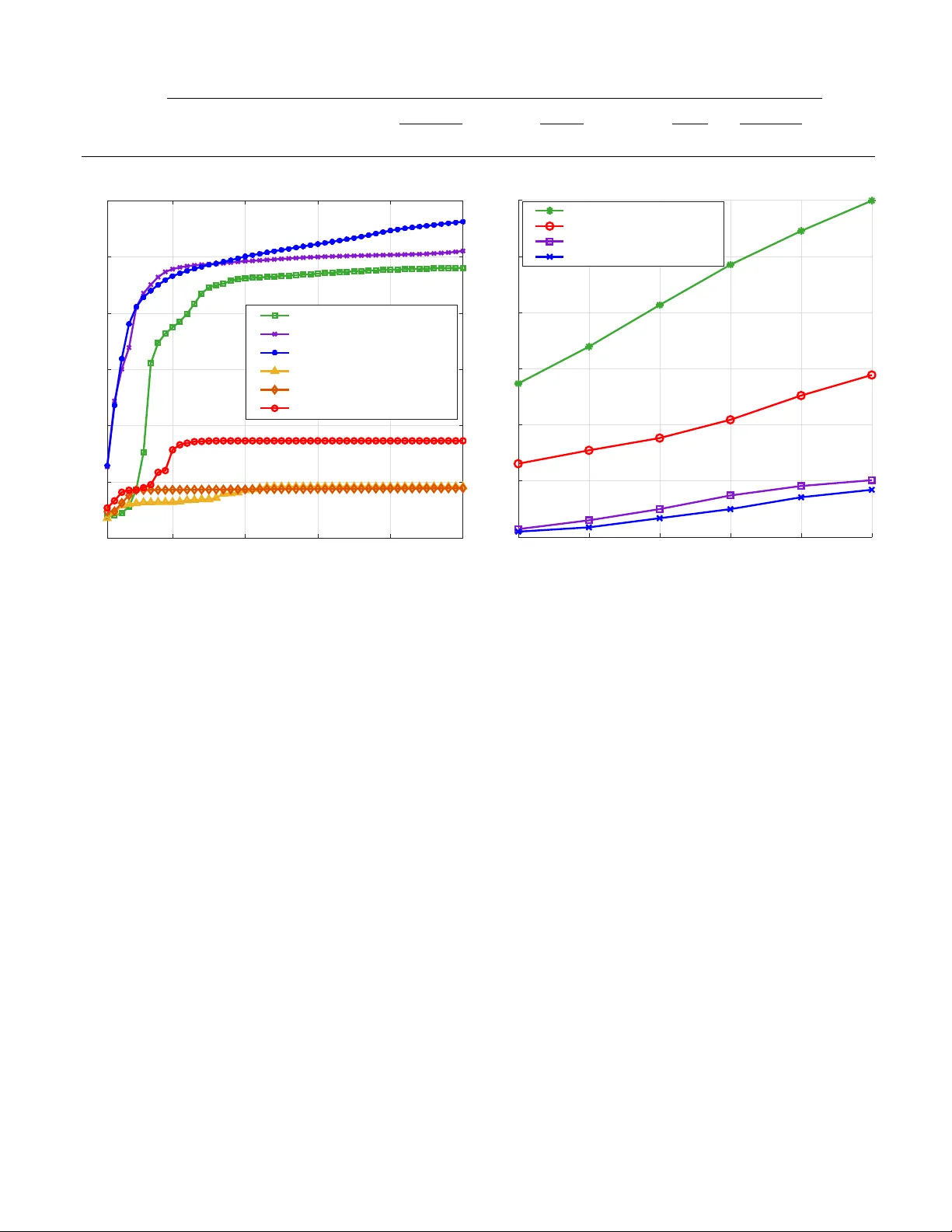
1 Stac k ed In telligen t Metasurfaces for Near-Field Multi-User Co v ert Comm unications Ahmed M. Bena ya, Mem b er, IEEE, Ali A. Nasir, Senior Member, IEEE, Khaled M. Rabie, Senior Member, IEEE, and Daniel B. da Costa, Senior Member, IEEE Abstract—Recongurable in telligent surfaces ha ve emerged as a cutting-edge technology for next-generation wireless com- m unications that are capable of reconguring the wireless en vironment using a large num b er of cost-eective reecting elemen ts. How ever, a signican t bo dy of prior studies has fo cused on single-lay er surfaces that lack the capability of signican tly mitigating inter-user in terference. Moreov er, pre- vious studies mostly consider far-eld op eration and neglect w orking in the near-eld region. In this pap er, w e prop ose a stack ed intelligen t metasurfaces (SIM)-assisted near-eld m ulti-user multiple-input-single-output cov ert comm unication system. More sp ecically , w e hav e a multi-an tenna base station that is assisted with a SIM to serve multiple single-antenna users in the presence of multiple single-antenna wardens. W e aim at optimizing the b eamfo cusing v ectors at the BS and SIM phase shift matrices to maximize the sum co vert rate under maxim um transmit p ow er budget constraint, quality-of-service (QoS) constraint for all users, and cov ertness constraint. Since the formulated problem is highly non-conv ex due to the cou- pling b et ween the v ariables, we adopt alternating optimization to tackle it, where we divide the problem into b eamfocusing sub-problem and SIM phase shift sub-problem, which are solv ed alternately until con vergence. W e leverage successive con vex appro ximation (SCA) to solve the tw o sub-problems. A dditionally , we form ulate the SIM phase shift sub-problem using the widely adopted pro jected gradient ascent (PGA) metho d for comparison purp oses. The conducted simulations rev eal that the SCA-based algorithm outp erforms the existing PGA-based algorithm as w ell as other b enchmarks in terms of the achiev ed sum cov ert rate, demonstrating its consistent p erformance and robustness under v arious system parameter congurations. Index T erms—Stack ed intelligen t metasurfaces, near-eld comm unications, cov ert communications, alternating optimiza- tion (A O), successive conv ex approximation (SCA), pro jected gradien t ascent (PGA). I. Introduction This work is supp orted by the Deanship of Researc h at King F ahd Universit y of Petroleum and Minerals (KFUPM) for funding under the Interdisciplinary Research Center for Communication Systems and Sensing (IRC-CSS). Ahmed M. Bena ya is with the In terdisciplinary Research Center for Comm unication Systems and Sensing (IR C-CSS), King F ahd Universit y of Petroleum and Minerals (KFUPM), Dhahran 31261, Saudi Arabia. (e-mail: ahmed.diab@kfupm.edu.sa) Ali A. Nasir and Daniel B. da Costa are with the Department of Electrical Engineering, King F ahd Universit y of Petroleum and Min- erals (KFUPM), Dhahran 31261, Saudi Arabia, while Khaled M. Ra- bie is with the Department of Computer Engineering, King F ahd Uni- versit y of Petroleum and Minerals (KFUPM), Dhahran 31261, Saudi Arabia. They all are also aliated with the Center for Communica- tion Systems and Sensing at KFUPM. (e-mail: anasir@kfupm.edu.sa, k.rabie@kfupm.edu.sa, danielb costa@ieee.org). T HE global vision for sixth-generation (6G) wireless systems is dened by a demand for unprecedented data rates, ultra-low latency , and ubiquitous connectiv- it y [1]. How ev er, the p erformance of 6G wireless systems is fundamentally constrained by the wireless propagation en vironment, whic h is often uncon trollable and suers from blo c kages and multi-path fading [2]. Recongurable in telligent surface (RIS) technology has emerged as a paradigm shifting solution for next-generation wireless net works due to its abilit y to con trol the wireless en- vironmen t and o vercome the limitations of con ven tional wireless communication systems [3]–[7]. RISs are in telli- gen t surfaces consisting of a large num b er of recongurable passiv e/active elements that can dynamically adjust their reection prop erties to steer wireless signals tow ard tar- get receivers, thereby mitigating blo c kages, ov ercoming non-line-of-sigh t (NLOS) conditions, and enhancing link qualit y [8], [9]. A large p ortion of the existing research eorts on RIS- aided wireless systems has fo cused on single-lay er meta- surface arc hitectures. Although such designs are simple in implementation, they inheren tly restrict the av ailable degrees-of-freedom for reconguring the wireless en viron- men t, thereby limiting their capability to eectively sup- press in ter-user interference in multi-user communication scenarios [10], [11]. T o ov ercome these inherent limitations, stac ked in telligent metasurfaces (SIMs) hav e recently emerged as the latest developmen t in in telligent surface tec hnology , providing energy-ecien t signal pro cessing in the wa ve domain [12], [13]. Unlike conv en tional single-la y er RIS, SIMs are comp osed of multiple cascaded metasur- face lay ers, signicantly improving the degrees-of-freedom a v ailable for w av e manipulation [14]. This m ulti-lay er arc hitecture enables more exible and ne-grained control of the electromagnetic propagation environmen t, thereby impro ving interference management and ov erall system p erformance in complex multi-user wireless scenarios. In addition to adv anced intelligen t surface architectures, op erating in high-frequency bands ab o ve 6 GHz oers signican tly higher data rates for future wireless systems. The integration of high-frequency op eration with large in telligent surfaces fundamen tally reshapes the propa- gation characteristics of 6G net works by substan tially expanding the near-eld region. This can b e attributed to the increased Rayleigh distance, which scales with b oth the carrier frequency and the ph ysical ap erture size of the surface [15]. Within the near-eld regime, electromagnetic wa ve propagation is mo deled by spherical 2 w av es rather than con ven tional planar wa v es for far- eld scenarios, pro viding enhanced b eamfo cusing capabil- ities [16]. Although the adoption of large-scale SIMs can eectiv ely impro ve cov erage and sp ectral/energy ecien- cies at high frequencies by creating additional controllable propagation paths, they also uninten tionally increase the vulnerabilit y of transmitted signals to b e intercepted by unin tended receivers [17]. Consequently , the developmen t of SIM-assisted near-eld cov ert transmission strategies is crucial to minimize signal detectabilit y while main taining reliable communication. A. Related W ork Recen tly , signican t research eorts hav e b een dev oted to inv estigating SIM-assisted wireless comm unication sys- tems [12], [18]–[21]. In [12], a SIM-assisted downlink multi- user m ultiple-input-single-output (MISO) system has b een prop osed to eliminate the need for digital beamforming b y optimizing the transmit p ow er at the base station (BS) and the phase shift of the SIM suc h that the sum rate is maximized. In that w ork, the authors prop osed a computationally-ecient algorithm to solve the formu- lated problem. A customized deep reinforcement learning (DRL)-based approach has been prop osed in [18] to tackle the transmit p ow er and SIM phase shift optimization in a similar multi-user MISO do wnlink scenario. A dditionally , the same problem has b een inv estigated with the design of a digital b eamformer at BS along with the SIM phase shifts in [19]. The authors in that work concluded that the order of alternating optimization (A O) greatly aects the ac hieved p erformance. Moreov er, iterative optimization of the SIM phase shift sub-problem may further enhance the system p erformance. Integration of SIM-assisted netw orks with in tegrated sensing and communication (ISA C) has b een considered in [20], where a SIM-enabled base station generates a b eam pattern for sim ultaneously comm u- nicating with multiple do wnlink users and detecting a target. The authors form ulated an optimization problem to maximize sp ectral eciency through optimizing the SIM phase shifts and the p ow er allocation at the base station. Also, in [21], b oth SIM and sim ultaneously trans- mitting and reecting RIS ha ve b een integrated together in THz ISAC system to address the challenge of m ulti- user comm unication and multi-target sensing. In that w ork, the SIM has b een used to enable high-precision w av edomain beamforming, while the ST AR-RIS has b een used to ac hiev e full-space cov erage for improv ed m ulti-user sensing and communication capabilities. F ew er research attempts hav e fo cused on SIM-assisted systems op erating in the near-eld regime [22]–[24]. In [22], a SIM-assisted multi-user MISO near-eld system has b een prop osed, where the SIM-enabled BS perform b eamfo- cusing in the w av e domain instead of the conv entional digital b eamfo cusing. A SIM-assisted multi-user multiple- input-m ultiple-output (MIMO) system that op erates in the near-eld region has b een proposed in [23]. The authors in that work formulated a weigh ted sum rate maximization problem that optimizes the p ow er allo ca- tion at the BS as w ell as the SIM phase shifts, where blo c k coordinate descen t algorithm is utilized to solve the formulated problem. In [24], a hybrid beamforming framew ork for a SIM-assisted wideband holographic multi- user MIMO system adopting a near-eld channel mo del has b een prop osed, where the holographic b eamformer is designed to maximize aggregate eigen-c hannel gains. More sp ecically , a minimum mean square error (MMSE)-based digital tramsnit preco ding and iterativ e water-lling are emplo yed to enable ecient multi-user transmission and p o wer allo cation. In addition, a lay er-by-la yer iterativ e algorithm is developed to optimize SIM phase shifts. In the context of secure communication, SIMs ha ve b een adopted to enhance the performance of single-input- single-output (SISO) wireless systems by exploiting the additional spatial degrees of freedom introduced by m ulti- la yer metasurface arc hitectures. In particular, the authors in [25], [26] proposed a SIM-assisted SISO transmission framew ork in whic h the SIM is deploy ed at the transmitter to directly manipulate electromagnetic wa ves, enabling join t modulation, beamforming, and articial noise gen- eration in the wa ve domain. Closed-form solutions and A O algorithms were dev elop ed to congure SIM phase shifts and transmit pow er ecien tly , aiming at improving secrecy rate without relying on multiple radio frequency (RF) chains. In that work, simulation results demonstrate that SIMs can eectiv ely compensate for the limited spatial degrees of freedom in conv en tional SISO systems and signican tly outperform b enc hmark single-lay er or an tenna-based sc hemes in terms of achiev able secrecy p erformance. B. Motiv ation and Con tribution A closer examination of the aforementioned studies rev eals that most of the research eorts on SIM-assisted systems ha ve fo cused on far-eld op eration and neglected the expanded near-eld region b ecause of the large SIM ap erture size and potential high frequencies. Moreo ver, the few research attempts that considered near-eld high- frequency SIM-assisted systems hav e neglected the vulner- abilit y of the net w ork to securit y issues due to the inheren t broadcast nature of the channel. Although [25], [26] hav e in vestigated the eectiv eness of SIM-assisted systems in impro ving physical-la yer security , their designs generally rely on secrecy rate maximization, which assumes that the transmission is detectable b y potential eav esdropp ers. Ho wev er, in emerging near-eld high-frequency systems, prev enting signal detection itself b ecomes a more funda- men tal requiremen t. Motiv ated b y this fact, in this w ork w e prop ose the adoption of cov ert communication frame- w orks that aims to minimize transmission detectabilit y rather than merely securing the transmitted information. T o the b est of our knowledge, this is the rst work to consider a SIM-assisted near-eld multi-user co vert comm unication system. The nov el contributions of our w ork compared to the state-of-the-art are summarized in T able I. The main con tributions are as follows; 3 T ABLE I Comparison of Our W ork with Existing SIM-Assisted Wireless Systems Our pap er [12] [18] [19] [20] [21] [22] [23] [24] Multi-user access 3 3 3 3 3 3 3 3 3 Near-eld channel mo del 3 3 3 3 Digital b eamfo cusing design 3 3 3 PGA-based phase shift design 3 3 3 3 3 3 SCA-based phase shift design 3 Cov ert communication 3 • W e prop ose a SIM-assisted m ulti-user MISO downlink co vert comm unication framework op erating in the near-eld region. The prop osed framework aims at maximizing the sum co vert rate at all user equip- men t (UEs), while main taining a minim um qualit y-of- service (QoS) at all UEs and minimizing the detection capabilities at multiple p oten tial wardens. • W e analyze the detection error probabilit y at each w arden and derive the cov ertness constraint that ensures minimizing the detection capabilities at war- dens. • W e formulate a sum cov ert rate maximization prob- lem in which we design the digital b eamfo cusing v ectors at the BS as w ell as the SIM phase shift ma- trices under minim um QoS at all UEs, p ow er budget, phase shift, and co vertness constrain ts. Due to the coupling b et ween v ariables, we adopt AO to tackle the formulated problem, where we prop ose successiv e con vex approximation (SCA)-based algorithms to solv e b oth b eamfo cusing and phase shift problems alternately . Additionally , w e adopt the widely used pro jected gradient ascent (PGA) algorithm to solve the phase shift problem and compare its p erformance with the SCA-based scheme. • Extensive sim ulation results are provided to illustrate ho w dierent system parameters aect the achiev able sum co vert rate and to demonstrate the sup eriority of the prop osed scheme ov er existing b enchmarks. The remainder of the pap er is organized as follows; The SIM-assisted multi-user system and near-eld c hannel mo dels are presen ted in Section II. Section II I pro vides the error detection probability analysis for dierent wardens. In Section IV, the optim ization problem formulation and the corresp onding solution are presented, with some detailed deriv ations given in the App endix. Simulation results and discussions are presen ted in Section V. Finally , Section VI concludes the paper and outlines several directions for future research. Notations: Matrices and vectors are denoted b y bold upp ercase and low ercase letters, resp ectively . F or a vector a , diag ( a ) denotes a diagonal matrix whose main diagonal en tries are giv en b y the elements of a . The op erators ( · ) T and ( · ) H represen t the transp ose and Hermitian (conjugate transp ose), resp ectively . The symbols |·| , ∥·∥ , and E [ · ] denote the absolute v alue, the Euclidean norm, and the exp ectation op erator. Moreov er, R [ · ] and I [ · ] corresp ond UE 1 UE 2 UE K EV E 1 EV E U EV E 2 XL - SI M L - l a y ers N ea r - F i e l d C o m m uni ca ti o ns SI M - ena bl ed BS Fig. 1. SIM-assisted multi-user multi-warden near-eld downlink cov ert communication system. to the real and imaginary parts of a complex-v alued scalar, resp ectiv ely . The op erators ⌊·⌋ , ⌈·⌉ , and mo d( · ) denote the o or, ceiling, and mo dulo op erations, resp ectively . I I. System Mo del In this section, we describ e the prop osed SIM-assisted near-eld co vert comm unication system, the signaling mo del, and the adopted near-eld channel mo del. A. System Description and Signaling mo del As depicted in Fig. 1, we consider an SIM-assisted do wnlink near-eld cov ert communication system, which consists of a BS equipp ed with a uniform linear array (ULA) of M -an tennas, a group of K single-antenna legiti- mate UEs, and a group of U single-antenna w ardens. The BS op erates in the high-frequency band and is assisted by a SIM that comprises L equidistance-spaced recongurable metasurface la yers, each comp osed of N elements. Let 4 K = { 1 , 2 , . . . , K } , U = { 1 , 2 , . . . , U } , L = { 1 , 2 , . . . , L } , and N = { 1 , 2 , . . . , N } represent the sets of legitimate UEs, wardens, metasurface la yers, and metasurface ele- men ts in each lay er, respectively . W e denote the complex- v alued coecient of the n -th elemen t in the l -th la yer b y α l n e j θ l n , ∀ n ∈ N , l ∈ L , where α l n ∈ [0 , 1] and θ l n ∈ [0 , 2 π ) represent the amplitude and phase shift of the n -th elemen t in the l -th la y er, resp ectiv ely . F or maximum energy transfer, we set α l n = 1 , ∀ n ∈ N , l ∈ L . Hence, the diagonal phase shift matrix Θ l of the l th metasurface la yer is given b y: Θ l = diag e j θ l 1 , e j θ l 2 , . . . e j θ l N ∈ C N × N , ∀ l ∈ L . (1) Eac h SIM la y er is modeled as a rectangular uniform planner array (UP A) of N = N x × N z elemen ts, where N x and N z represen t the n umber of elements in the x -axis and z -axis directions, resp ectively . F ollowing the Ra yleigh– Sommerfeld diraction mo del [27], [28], the in ter-lay er propagation co ecient from the ˜ n -th element in the ( l − 1) - th SIM la yer to the n -th element in the l -th SIM lay er, ∀ n, ˜ n ∈ N , l ∈ L , can b e written as: w l n, ˜ n = A cos χ l n, ˜ n r l n, ˜ n 1 2 π r l n, ˜ n − j 1 λ ! e 2 πr l n, ˜ n /λ , (2) where A , χ l n, ˜ n , r l n, ˜ n , and λ are the area of each element, the angle b et ween the propagation direction and the normal direction of the ( l − 1) -th SIM lay er, the propagation distance, and the wa v elength, resp ectiv ely . Hence, the ov erall SIM resp onse can b e expressed as: G = Θ L W L . . . Θ 2 W 2 Θ 1 W 1 ∈ C N × M , (3) where W l ∈ C N × N , ∀ l ∈ L / { 1 } is the propaga- tion co ecient matrix from the ( l − 1) -th SIM la y er to the l -th SIM lay er. The propagation co ecient matrix from the 1 -st SIM la yer to the transmit an tenna lay er, W 1 ∈ C N × M , can also be obtained from (2) by replacing r l n, ˜ n , χ l n, ˜ n , ∀ n, ˜ n ∈ N with r 1 n,m , χ 1 n,m ∀ n ∈ N , m ∈ M . Let x = [ x 1 , x 2 , . . . , x K ] T ∈ C K × 1 denotes the column v ector of the transmitted sym b ols for all UEs, where E [ ∥ x ∥ 2 ] = 1 and x k represen ts the transmitted symbol to the k -th UE. Hence, the received signal at the k -th UE can b e written as: y k = h H k GVx + n k = h H k Gv k x k + K X i =1 ,i = k h H k Gv i x i + n k , (4) where h k ∈ C N × 1 is the near-eld channel v ector from the L -th SIM lay er to the k -th UE, V ∈ C M × K is the digital b eamfocusing matrix at the BS with v k ∈ C M × 1 denoting the beamfo cusing vector of the k -th UE, and n k is the additiv e white Gaussian noise (A W GN) comp onent with v ariance σ 2 n , i.e. n k ∼ C N 0 , σ 2 n . The received signal-to- in terference-plus-noise ratio (SINR) at the k -th UE can b e expressed as: γ k = h H k Gv k 2 P K i =1 ,i = k h H k Gv i 2 + σ 2 n . (5) The achiev ed sum rate of all UEs can b e written as: R = K X k =1 R k = K X k =1 log 2 (1 + γ k ) . (6) B. Near-Field Channel Mo del In this w ork, w e adopt the uniform surface wa v e (USW) near-eld line-of-sight (LoS) channel mo del [29]. As mentioned earlier, the SIM is placed in the x - z plane and is comp osed of N = N x × N z elemen ts, where N x = 2 ˜ N x + 1 is the num b er of elements in the x -direction and N z = 2 ˜ N z + 1 is the num b er of elements in the z - direction. Let the inter-elemen t distance in the x -direction and z -direction b e d x and d z , resp ectively . Hence, the near-eld LoS channel from the L -th la y er to the k -th UE can b e mo deled as: h k = β k e − j 2 π λ r k [ a x k ( θ k , ϕ k , r k ) ⊗ a z k ( ϕ k , r k )] , (7) where a x k ( θ k , ϕ k , r k ) and a z k ( ϕ k , r k ) are column v ectors represen ting the array resp onse in the x - and z -directions, resp ectiv ely . In addition, β k = β 0 r − η k , r k , θ k , and ϕ k denote the large-scale fading co ecient, the propagation distance, the azim uth angle, and the elev ation angle of the link b etw een the L -th SIM la y er and the k -th UE, resp ectiv ely , where β 0 = λ 4 π 2 is the free space path loss at a reference distance 1 m and η is the path loss exp onen t. Assuming d x /r k ≪ 1 and d z /r k ≪ 1 , and exploiting the F resnel appro ximation [29], the elemen ts of the array resp onse can b e written as: (8) [ a x k ( θ k , ϕ k , r k )] n x = e − j 2 π λ − n x d x cos θ k sin ϕ k + n 2 x d 2 x ( 1 − cos 2 θ k sin 2 ϕ k ) 2 r k , and [ a z k ( ϕ k , r k )] n z = e − j 2 π λ − n z d z cos ϕ k + n 2 z d 2 z sin 2 ϕ k 2 r k , (9) where [ a x k ( θ k , ϕ k , r k )] n x and [ a z k ( ϕ k , r k )] n z represen t the n x -th element in the column v ector a x k ( θ k , ϕ k , r k ) and the n z -th element in the column vector a z k ( ϕ k , r k ) , resp ectiv ely , where n x ∈ n − ˜ N x , . . . , ˜ N x o and n z ∈ n − ˜ N z , . . . , ˜ N z o . Similarly , the near-eld LoS c hannel from the L -th SIM lay er to the u -th warden, ∀ u ∈ U , can b e mo deled as: h u = β u e − j 2 π λ r u [ a x u ( θ u , ϕ u , r u ) ⊗ a z u ( ϕ u , r u )] , (10) where the arra y response in the x - and z -directions, a x u ( θ u , ϕ u , r u ) and a z u ( ϕ u , r u ) , can be dened in similar w ays to (8) and (9) . Additionally , β u = β 0 r − η u , r u , θ u , and ϕ u denote the large-scale fading coecient, the propagation distance, the azim uth angle, and the elev ation angle of the link b etw een the L -th SIM la y er and the u -th w arden, respectively . In this work, we adopt a practical insider-threat mo del in whic h the wardens are initially legitimate users that are later identied as suspicious based on abnormal behavior detected via upp er-la yer 5 net work proto cols. Consequently , their lo cations and CSI are assumed to b e known at the BS through prior channel estimation and signaling pro cedures [30]–[32]. I II. Detection Performance Analysis F ollo wing [30], [33], the detection error probability (DEP) is utilized as the cov ertness metric in the prop osed co vert communication system. With common equal prior probabilities, let ξ u = P F A u + P MD u denotes the DEP at the u -th w arden, where P F A u and P MD u represen t the probabilities of false alarm and missed detection at the u -th w arden, resp ectively . Let us assume that all w ardens mak e J observ ations in each time slot as in [34]. Hence, the receiv ed signal in the j -th observ ation at the u -th warden can b e expressed as: y ( j ) u = ( n ( j ) u , H 0 , P K i =1 h H u Gv i x ( j ) i + n ( j ) u , H 1 , (11) where H 0 denotes the null hypothesis that the BS is not transmitting and H 1 denotes the alternative h yp othesis that the BS is transmitting. In addition, n ( j ) u ∼ C N 0 , σ 2 n is the A W GN comp onent at the u -th warden. Let the receiv ed vector at the u -th warden b e expressed as: y u = h y (1) u , y (2) u , . . . , y ( J ) u i T . (12) Since all the elements of y u are indep endent and iden- tical complex Gaussian random v ariables, the likelihoo d functions of y u under b oth H 1 and H 0 can b e expressed as follows: P 1 ,u = p H 1 ,u ( y u ) = 1 π J δ J 1 ,u e − y H u y u δ 1 ,u P 0 ,u = p H 0 ,u ( y u ) = 1 π J δ J 0 ,u e − y H u y u δ 0 ,u , (13) where δ 1 ,u = P K i =1 | h H u Gv i | 2 + σ 2 u and δ 0 ,u = σ 2 u . Assuming the minimum DEP at the u -th warden is ξ ∗ u , the co v ertness constrain t can be set as ξ ∗ u ≥ 1 − ϵ , where ϵ ∈ [0 , 1] is a very small p ositive n umber to ensure cov ertness. A ccording to [35], for the optimal detector, the minim um DEP at the u -th w arden is ξ ∗ u = 1 − V u ( P 0 ,u , P 1 ,u ) , where V u ( P 0 ,u , P 1 ,u ) is the total v ariation distance (TVD) b et ween P 0 ,u and P 1 ,u . F ollowing [35], [36], the TVD b et ween P 0 ,u and P 1 ,u can b e expressed in terms of Pinsk er’s inequality as follows: V u ( P 0 ,u , P 1 ,u ) ≤ r D u ( P 1 ,u ∥ P 0 ,u ) 2 , (14) where D u ( P 1 ,u ∥ P 0 ,u ) is Kullback-Leibler (KL) div ergence, whic h can b e expressed as: D u ( P 1 ,u ∥ P 0 ,u ) = Z ∞ −∞ P 1 ,u ln P 1 ,u P 0 ,u d y u = J ν δ 1 ,u − δ 0 ,u δ 0 ,u , (15) where ν ( x ) = x − ln (1 + x ) . Consequently , we can write ξ ∗ u ≥ 1 − q D u ( P 1 ,u ∥ P 0 ,u ) 2 . Hence, the co vertness constraint can b e set as: D u ( P 1 ,u ∥ P 0 ,u ) ≤ 2 ϵ 2 . (16) IV. Optimization Problem F ormulation and Solution The main aim of this w ork is to design the beamfo cusing v ectors at the BS and the SIM phase shift matrices to maximize the sum co vert rate of all UEs under mini- m um rate requiremen ts, p o wer, and cov ert comm unication constrain ts. This can b e formulated mathematically as follo ws: P 1 : max { v k } K k =1 , { Θ l } L l =1 K X k =1 log 2 (1 + γ k ) , (17a) Sub ject to: R k ≥ R min k , ∀ k ∈ K , (17b) K X k =1 ∥ v k ∥ 2 ≤ P max , ∀ k ∈ K , (17c) θ l n = 1 , ∀ n ∈ N , l ∈ L , (17d) D u ( P 1 ,u ∥ P 0 ,u ) ≤ 2 ϵ 2 , ∀ u ∈ U . (17e) Constrain t (17b) ensures that the achiev ed cov ert rate at eac h UE is abov e the minimum cov ert rate require- men t R min k , while constraint (17c) ensures that the total transmit p ow er at the BS is b elow the maximum p ow er budget P max . Additionally , constraint (17d) ensures that the amplitude and the phase shift of each SIM meta atom is set as α l n = 1 and θ l n ∈ [0 , 2 π ) ∀ n ∈ N , l ∈ L . Finally , constrain t (17e) ensures that optimal DEP at eac h warden is ab ov e a given threshold to achiev e co vertness. It’s clear that problem P 1 is highly non-conv ex with resp ect to the optimization v ariables { v k } K k =1 and Θ l L l =1 due to the coupling betw een the v ariables in the non-con vex ob jective function, (17a), and the non-conv ex constraints, (17b) and (17d). T o tackle this issue, we are going to decouple P 1 in to t w o disjoin t sub-problems and adopt AO until con vergence. In the rst sub-problem we will design the b eamfocusing v ectors for xed phase shift matrices at dieren t SIM lay ers, while in the second sub-problem, we will design the phase shift matrices for xed b eamfocusing v ectors. A. Beamfo cusing V ectors Optimization Assuming xed phase shift matrices Θ l L l =1 , the b eam- fo cuing vectors optimization problem can b e formulated as: P 2 : max { v k } K k =1 K X k =1 log 2 (1 + γ k ) , (18a) Sub ject to: (17b) , (17c) , and (17e) . (18b) Problem P 2 remains non-conv ex due to the fractional nature of the SINR term γ k in the objective function (18a) and in the rate requirement constraint (17b). T o handle this non-con vexit y , we adopt SCA framework to transform 6 P 2 into a conv ex one. W e in tro duce the set of p ositive auxiliary v ariables ρ k and ϖ k , ∀ k ∈ K such that: h H k Gv k 2 ϖ k ≥ ρ k . (19) and K X i =1 ,i = k h H k Gv i 2 + σ 2 n ≤ ϖ k . (20) Although (19) is still non-conv ex, it is apparent that (20) is conv ex with respect to v k . Since the left- hand side of (19) is lo wer-bounded b y its rst-order T a ylor expansion around an initial point v ( m ) k , ϖ ( m ) k in the m - th iteration, we get h H k Gv k 2 ϖ k ≥ − h H k Gv ( m ) k ϖ ( m ) k 2 ϖ k + 2 R h H k Gv ( m ) k H h H k Gv k ϖ ( m ) k ≡ Λ T aylor k ( m ) . (21) No w, the right-hand side of (21) is an ane function that can b e used to approximate the left-hand side of (19). Regarding constraint (17e), it can b e rewritten as: δ 1 ,u δ 0 ,u − ln δ 1 ,u δ 0 ,u − 1 ≤ 2 ϵ 2 J . (22) W e introduce the p ositive set of auxiliary v ariables τ u , ∀ u ∈ U , such that δ 1 ,u ≤ τ u δ 0 ,u . Hence, problem P 2 can b e reformulated in the m -th iteration as: P 3 : max { v k ,ρ k ,ϖ k } K k =1 , { τ u } U u =1 K X k =1 log 2 (1 + ρ k ) , (23a) Sub ject to: ρ k ≥ γ min , ∀ k ∈ K , (23b) Λ T aylor k ( m ) ≥ ρ k , ∀ k ∈ K , (23c) K X i =1 ,i = k h H k Gv i 2 + σ 2 n ≤ ϖ k , ∀ k ∈ K , (23d) K X i =1 | h H u Gv i | 2 ≤ σ 2 u ( τ u − 1) , ∀ u ∈ U , (23e) τ u − ln τ u − 1 ≤ 2 ϵ 2 J , ∀ u ∈ U , (23f ) (17c) , (23g) where γ min = 2 R min k − 1 . Now, problem P 3 is con vex and can b e directly solved using standard conv ex optimization to ols, such as CVX to olb o x [37]. B. SIM Phase Shift Optimization Assuming xed b eamfocusing vectors { v k } K k =1 , the SIM phase shift optimization problem can b e form ulated as: P 4 : max { Θ l } L l =1 K X k =1 log 2 (1 + γ k ) , (24a) Sub ject to: (17b) , (17d) , and (17e) . (24b) Problem P 4 is c hallenging due to the coupling b et ween the phase shift matrices among all SIM lay ers in the ob jectiv e function (24a) as w ell as the constraints (17b), (17d), and (17e). T o solve this problem, w e will rst adopt SCA to solve the problem la yer-b y-lay er. Then, w e will solve the same problem b y adopting the PGA algorithm [38]. 1) Per Lay er SCA-based Phase Shift Design: In this sc heme, we are going to solve the problem la yer-b y- la yer, where to optimize the phase shift of the l -th lay er, the phase shift of other la yers in the set L / { l } will b e considered xed. Consequently , w e ha v e to separate Θ l from the matrix G . Denote G = G l L Θ l G l R , where G l L and G l R are given by: G l L = ( Θ L W L . . . Θ l +1 W l +1 , if l = L, I N , if l = L, (25) G l R = ( W l Θ l − 1 W l − 1 . . . Θ 1 W 1 , if l = 1 , W 1 , if l = 1 . (26) As we did in the b eamfo cusing problem, to handle the fractional SINR term in the objective (24a), w e in tro duce the set of auxiliary v ariables ς k and υ k , ∀ k ∈ K suc h that: ϕ ϕ ϕ T l ˜ h k 2 ς k ≥ υ k , (27) and K X i =1 ,i = k ϕ ϕ ϕ T l ˜ h i 2 + σ 2 n ≤ ς k , (28) where h H k Gv k = ϕ ϕ ϕ T l ˜ h k h H k Gv i = ϕ ϕ ϕ T l ˜ h i , where ˜ h k = diag h H k G l L G l R v k and ˜ h i = diag h H k G l L G l R v i . In addition, ϕ ϕ ϕ l = h e j θ l 1 , e j θ l 2 , . . . e j θ l N i T is the column v ector that comprises the phase shift of the l -th la yers. Equa- tion (28) is conv ex with resp ect to ϕ ϕ ϕ l . How ever, (27) is still non-conv ex. Since the left-hand side of (27) is low er- 7 b ounded by its rst-order T aylor expansion around an initial p oint ϕ ϕ ϕ ( m ) l , ς ( m ) k at the m -th iteration, w e get ϕ ϕ ϕ T l ˜ h k 2 ς k ≥ − ϕ ϕ ϕ T l ( m ) ˜ h k ς ( m ) k 2 ς k + 2 R " ϕ ϕ ϕ T l ( m ) ˜ h k H ϕ ϕ ϕ T l ˜ h k # ς ( m ) k ≡ Ξ T aylor k ( m ) . (29) No w, the right-hand side of (29) is an ane function that can b e used to approximate the left-hand side of (27). The constraint (17d) can b e relaxed to θ l n ≤ 1 , ∀ n ∈ N , l ∈ L . Regarding the constrain t (17e), it can b e handled in a similar manner as in the b eamfo cusing sub-problem by in tro ducing the p ositive set of auxiliary v ariables ζ u , ∀ u ∈ U , such that δ 1 ,u ≤ ζ u δ 0 ,u . Hence, problem P 4 can be reform ulated in the m -th iteration as: P 5 : max { ϕ ϕ ϕ l } L l =1 , { υ k ,ς k } K k =1 , { ζ u } U u =1 K X k =1 log 2 (1 + υ k ) , (30a) Sub ject to: υ k ≥ γ min , ∀ k ∈ K , (30b) Ξ T aylor k ( m ) ≥ υ k , ∀ k ∈ K , (30c) K X i =1 ,i = k ϕ ϕ ϕ T l ˜ h i 2 + σ 2 n ≤ ς k , ∀ k ∈ K , (30d) K X i =1 ϕ ϕ ϕ T l ˜ h u 2 ≤ σ 2 u ( ζ u − 1) , ∀ u ∈ U , (30e) ζ u − ln ζ u − 1 ≤ 2 ϵ 2 J , ∀ u ∈ U , (30f ) θ l n ≤ 1 , ∀ n ∈ N , l ∈ L , (30g) where h H u Gv i = ϕ ϕ ϕ T l ˜ h u , where ˜ h u = diag h H u G l L G l R v i . No w, problem P 5 is con vex and can b e directly solv ed using standard conv ex optimization to ols, such as CVX to olbox [37]. After solving the problem, the obtained phase shifts can b e pro jected back on to the unit mo dulus set. 2) PGA-based Phase Shift Design: First, to facilitate handling P 4 , we transform constraints (17b) and (17e) as p enalty terms in the ob jectiv e function to obtain the follo wing problem: P 6 : max { Θ l } L l =1 F θ l n = R θ l n + µ 1 A θ l n − µ 2 B θ l n , (31a) Sub ject to: θ l n = 1 , ∀ n ∈ N , l ∈ L , (31b) where µ 1 , µ 2 ∈ R + are the penalty factors that are used to force compliance of the constraints. In addition, A θ l n = K X k =1 min γ k θ l n − γ min , 0 2 , and B θ l n = U X u =1 max δ 1 ,u θ l n δ 0 ,u − ln δ 1 ,u θ l n δ 0 ,u − 1 − 2 ϵ 2 J , 0 ! 2 . No w, the structure of P 6 mak es the PGA metho d a suitable c hoice to solve it, since the elemen ts of Θ l lie on the unit circle in the complex plane. PGA can be applied to handle P 6 according to the following steps: Step 1 (Initialize the SIM Phase Shifts): In this part, w e randomly initialize the SIM phase shifts θ l n ∈ [0 , 2 π ) suc h that θ l n = 1 , ∀ n ∈ N , l ∈ L . Step 2 (Calculate the Partial Deriv atives): W e calculate the partial deriv atives of the ob jectiv e function F with resp ect to the phase shift of the n -th meta atom in the l -th lay er, i.e., θ l n , ∀ n ∈ N , l ∈ L as follows: ∂ F θ l n ∂ θ l n = ∂ R θ l n ∂ θ l n + µ 1 ∂ A θ l n ∂ θ l n − µ 2 ∂ B θ l n ∂ θ l n . (32) Step 3 (Normalize the Partial Deriv atives): After calcu- lating all the partial deriv atives of the ob jectiv e function F with resp ect to θ l n , we normalize the partial deriv ativ es to mitigate oscillation during optimization as follows [20]: ∂ F θ l n ∂ θ l n ← π κ ∂ F θ l n ∂ θ l n , (33) where κ = max ∂ F ( θ l n ) ∂ θ l n , ∀ n ∈ N , l ∈ L . Step 4 (Update the SIM Phase Shifts): After calculating all the partial deriv atives of the objective function F with resp ect to θ l n , we up date the phase shifts as follows: θ l n ← θ l n + α ∂ F θ l n ∂ θ l n , (34) where α denotes the Armijo step size, which is up dated at each iteration according to the backtrac king line search pro cedure [20], [38]. Step 5 (Iterate Until Conv ergence): The last step is to rep eat steps 2 and 3 un til the improv ement in the ob jective function F falls b elo w a given threshold. T o calculate the partial deriv atives of the ob jective function F in (32), w e start by calculating the partial deriv ativ es of the sum cov ert rate R θ l n . Applying the c hain rule, we get: ∂ R θ l n ∂ θ l n = 1 ln 2 K X k =1 1 1 + γ k ( θ l n ) ∂ γ k θ l n ∂ θ l n . (35) Theorem 1. The partial deriv ativ es of ∂ γ k ∂ θ l n is given by: ∂ γ k θ l n ∂ θ l n = 2 ϱ k γ k θ l n K X i =1 ,i = k ψ k,i − ψ k,k , (36) where ϱ k = 1 P K i =1 ,i = k h H k Gv i 2 + σ 2 n , (37) and ψ k,i = I h e j θ l n h H k Gv i ∗ h H k G l L E n,n G l R v i i , (38) 8 (43) ∂ F θ l n ∂ θ l n = K X k =1 ∂ γ k θ l n ∂ θ l n 1 ln 2 (1 + γ k ( θ l n )) + 2 µ 1 × 1 [ γ k <γ min ] γ k θ l n − γ min − 2 µ 2 U X u =1 1 g u > 2 ϵ 2 J g u θ l n − 2 ϵ 2 J ∂ g u θ l n ∂ θ l n ! . where E n,n is an N × N matrix whose entries are all zero except for the ( n, n ) -th element, whic h is equal to 1. Pro of. See the App endix. Using the result of Theorem 1, the partial deriv ative of the second term on the right-hand side of (32) is given as: ∂ A θ l n ∂ θ l n = 2 K X k =1 1 [ γ k <γ min ] γ k θ l n − γ min ∂ γ k θ l n ∂ θ l n , (39) where 1 [ γ k <γ min ] denotes the indicator function that equals 1 to p enalize the ob jectiv e function when constraint (17b) violates and 0 otherwise. T o calculate the partial deriv ative of the last term on the right-hand side of (32), denote (40) g u θ l n = δ 1 ,u θ l n δ 0 ,u − ln δ 1 ,u θ l n δ 0 ,u − 1 = z u θ l n − ln z u θ l n − 1 , where z u θ l n = K k =1 | h H u Gv k | 2 + σ 2 u σ 2 u . No w, we can write ∂ B θ l n ∂ θ l n = 2 U X u =1 1 g u > 2 ϵ 2 J g u θ l n − 2 ϵ 2 J ∂ g u θ l n ∂ θ l n , (41) where, following similar pro cedures as in App endix A, ∂ g u θ l n ∂ θ l n = 1 − 1 z u ( θ l n ) ∂ z u θ l n ∂ θ l n = − 2 σ 2 u 1 − 1 z u ( θ l n ) × K X k =1 I h e j θ l n h H u Gv k ∗ h H u G l L E n,n G l R v k i . (42) Based on (35), (39), and (41), the gradient of the ob jectiv e function F with resp ect to the phase shift of the n -th meta-atom in the l -th lay er can b e derived, and is given in (43) at the top of the next page. C. Overall Algorithm and Complexit y Analysis Based on the previously formulated sub-problems and their corresp onding solution metho ds, the o verall pro ce- dure of the t wo prop osed AO algorithms is summarized in Algorithm 1 for the SCA-based phase shift design and in Algorithm 2 for the PGA-based phase shift design. Algorithm 1 AO algorithm with SCA-based phase shift design 1: Input: Channel vectors h k , ∀ k ∈ K , h u , ∀ u ∈ U , SIM propagation co ecient matrices W l , ∀ l ∈ L , and noise v ariance σ 2 n . 2: Initialize: v (0) k , ∀ k ∈ K , Θ l (0) , ∀ l ∈ L and the auxiliary v ariables ϖ (0) k , ς (0) k , ∀ k ∈ K . 3: Set m ← 1 . 4: rep eat 5: Beamfo cusing optimization: 6: Solv e problem P 3 to design v ( m ) k , ∀ k ∈ K using v ( m − 1) k , Θ l ( m − 1) , ∀ l ∈ L . 7: Phase-shift optimization: 8: Solv e problem P 5 to design Θ l ( m ) , ∀ l ∈ L using the designed v ( m ) k and Θ l ( m − 1) , ∀ l ∈ L . 9: Up date all the optimization and auxiliary v ariables. 10: m ← m + 1 . 11: until Conv ergence. 12: Output Optimal b eamformers v ∗ k , ∀ k ∈ K and phase- shift matrices Θ l ∗ , ∀ l ∈ L . As shown in Algorithm 1, the complexity of the o verall algorithm is dominated by the complexity of solving problems P 3 and P 5 . The transmit b eamfo- cusing problem P 3 and the SCA-based phase shift problem P 5 , are formulated as second-order cone pro- gramming (SOCP) problems, which are solved through the CVX’s interior p oin t metho d solvers. The com- plexities of these problems are O √ K + U ( K M ) 3 and O √ K + U + N LN 3 , resp ectively . Consequen tly , the ov erall computational complexit y is in the order of O Q √ K + U ( K M ) 3 + √ K + U + N LN 3 , where Q is the num b er of iterations in Algorithm 1. Re- garding Algorithm 2, the complexit y of the PGA- based phase shift design method is O ( K LN ) . Hence, the ov erall computational complexity of algorithm 2 is O Q T √ K + U ( K M ) 3 + K LN , where T is the num- b er of iterations in the inner Armijo step size lo op. V. Simulation Results In this section, we conduct extensiv e n umerical sim ula- tions to ev aluate the p erformance of the proposed SIM- assisted near-eld cov ert communication system. The BS is lo cated at the p oin t (0 , 0 , Z ) of a three-dimensional Cartesian co ordinate system, where Z is the BS heigh t, and all communication UEs and w ardens are randomly lo- 9 T ABLE I I Simulation Parameters Parameter V alue Parameter V alue Number of T x antennas, M 6 Number of cov ert UEs, K 3 Noise p ow er sp ectral density − 174 dBm/Hz Number of wardens, U 3 Number of SIM lay ers, L 5 Number of meta atoms, N 45 Carrier frequency 10 GHz Communication bandwidth, B 1 MHz BS height, Z 5 m Radius of service area 10 m Maximum allowed transmit p ow er P max 40 dBm Cov ertness threshold ϵ 0 . 1 Users’ rate requirement, R min k 0 . 1 bps/Hz Number of W arden’s observ ations p er time slot, J 10 Meta atoms spacing, dx , dz λ m Area of each meta atom λ 2 / 4 m 2 Algorithm 2 A O algorithm with PGA-based phase shift design 1: Input: Channel vectors h k , ∀ k ∈ K , h u , ∀ u ∈ U , SIM propagation co ecien t matrices W l , ∀ l ∈ L , noise v ariance σ 2 n , and p enalty factors µ 1 , µ 2 . 2: Initialize: v (0) k , ∀ k ∈ K and Θ l (0) , ∀ l ∈ L . 3: Set m ← 1 . 4: rep eat 5: Calculate the partial deriv atives of the ob jectiv e function F with resp ect to θ l n ( m ) , ∀ n ∈ N , l ∈ L using (43). 6: Normalize the partial deriv ativ es using (33). 7: Initialize: Armijo step size α 0 = α 0 > 0 , the factor ε ∈ (0 , 1) , and t ← 1 . 8: rep eat 9: Up date Θ l ( t ) , ∀ l ∈ L using (34). 10: Solv e problem P 3 to obtain v ( t ) k , ∀ k ∈ K using Θ l ( t ) , ∀ l ∈ L . 11: if F ( t ) < F ( t − 1) then 12: α ( t ) ← εα ( t − 1) 13: end if 14: t ← t + 1 15: until F ( t ) ≥ F ( t − 1) . 16: Up date optimization v ariables. 17: m ← m + 1 . 18: until Conv ergence 19: Output: Optimal b eamformers v ∗ k , ∀ k ∈ K and phase- shift matrices Θ l ∗ , ∀ l ∈ L . cated in the x − y plane according to a uniform distribution within a circle of radius 10 m centered at (10 , 10 , 0) m to comply with the near-eld Rayleigh distance conditions. The thic kness of the SIM is set to 5 λ . Hence, the spacing b et ween any tw o lay ers and b etw een the BS and lay er 1 is d SIM = 5 λ/L . The path loss exponent is set to η = 2 . 5 . Unless otherwise stated, the simulation parameters are set as sho wn in T able I I. The propagation distance, r l n, ˜ n , from the ˜ n -th meta atom in the l − 1 -th la yer to the n -th meta atom in the l -th lay er is given by: r l n, ˜ n = v u u t d 2 SIM + λ 2 | n − ˜ n | N max 2 + [ mo d ( | n − ˜ n | , N max )] 2 ! , (44) where N max = max { N x , N z } . Additionally , the propaga- tion distance, r 1 n,m , from the m -th transmit an tenna to the n -th meta atom in the 1 st la yer is given by (45) in the top of the next page. All simulation results are av eraged o ver 100 independent channel realizations drawn from the adopted near-eld channel mo del. F or comparison purp oses, we are going to compare our prop osed SCA-based and PGA-based algorithms with t wo benchmarks; 1) Random phase shift: in whic h the b eamfocusing vectors are designed by solving P 3 , while the phase shift matrices of all lay ers are c hosen randomly to comply with the unit mo dulus constraint for the phase shift of eac h meta atom. 2) Co deb o ok-based phase shift: in which we generate a co deb o ok for the phase shift v ectors that comprises 100 phase shift matrices each of size ( L × N ) . F or each matrix, the b eamfo cusing vectors are designed by solving P 3 , and the phase shift matrix that giv es the maximum ac hieved sum co vert rate is selected. The conv ergence p erformance of the prop osed SCA- based phase shift and PGA-based phase shift algorithms is presented in Fig. 2 at dieren t num b er of SIM lay ers assuming M = 4 transmit an tennas. As we can see in the gure, both algorithms conv erge to a stationary point in a relativ ely small num b er of iterations, most of the time less than 20 iterations. In addition, the sum cov ert rate achiev ed b y adopting the proposed SCA-based phase shift algorithm is higher than that achiev ed by adopting the PGA-based phase shift algorithm for all v alues of L . F or example, the SCA-based phase shift algorithm outp erforms the PGA-based phase shift algorithm with almost 225 % at L = 5 la yers. Moreov er, for b oth al- gorithms, the achiev ed sum cov ert rate increases with increasing the num b er of lay ers, where the achiev ed rate b y the SCA-based phase shift algorithm at L = 5 la yers is higher with almost 17 . 2 % that that achiev ed b y the same algorithm adopting only single la yer. This can be attributed to the fact that increasing the num b er of SIM la yers provides more opp ortunity to congure the wireless 10 r 1 n,m = s d 2 SIM + λ 2 mo d ( n − 1 , N max ) − 1 + N max 2 − m − 1 + M 2 2 + λ 2 n N max − 1 + N max 2 2 (45) Iterations 1 10 20 30 40 50 Achieved Sum Rate (bps/Hz) 0 5 10 15 20 25 30 L = 1, SCA-Phase Shift L = 3, SCA-Phase Shift L = 5, SCA-Phase Shift L = 1, PGA-Phase Shift L = 3, PGA-Phase Shift L = 5, PGA-Phase Shift Fig. 2. Conv ergence performance of the proposed system for dierent num ber of Lay ers. c hannel to reduce the in ter-user interference. Ho w ever, the further increase of the num b er of SIM lay ers may cause degradation of the ac hieved cov ert rate as a result of the m ultiplication of the propagation co ecient matrices in the eective channel from the BS to the UEs. In Fig. 3, the sum cov ert rate p erformance of the prop osed system is studied as a function of the maxi- m um allow ed transmit p ow er assuming M = 4 transmit an tennas. The achiev ed cov ert rate is compared with the PGA-based phase shift algorithm as w ell as with the b enc hmarks mentioned abov e. As sho wn in the gure, as the maximum transmit p o wer increases, the ac hiev ed sum co vert rate increases for all phase shift design schemes. In addition, the prop osed SCA-based algorithm achiev es the highest sum co v ert rate for all v alues of maximum transmit p o wer. F or example, there is an av erage increase in the sum rate of almost 120% in fa vor of the SCA-based method compared to the PGA-metho d. Moreo ver, the ac hiev ed sum rate by the PGA-based metho d is higher than that ac hieved b y the codeb o ok-based phase shift or the random phase shift by more than 300%. W e can also observe that the co deb ook-based phase shift and the random phase shift sc hemes ac hieve very close p erformance o ver the full transmit p o wer range. This is b ecause b oth approaches do not p erform SIM phase shift optimization; instead, the random phase shift sc heme applies completely random phase shift matrices for all lay ers while the co deb o ok- Maximum T r ansmit Po wer, P max , (dBm) 15 20 25 30 35 40 Achiev ed Sum Rate (bps/Hz) 0 5 10 15 20 25 30 SCA-based Phase Shift PGA-based Phase Shift Codebook-based Phase Shift Random Phase Shift Fig. 3. Sum rate p erformance of the prop osed system against the maximum transmit p ow er as compared with b enc hmarks. based phase shift selects non-optimized phase congura- tions from a random po ol. Consequently , b oth sc hemes do not eectively exploit the b eamfo cusing capability of the SIM, leading to comparable and relativ ely limited sum rate p erformance. The eect of increasing the num b er of transmit anten- nas on the achiev ed sum rate of the prop osed system is presen ted in Fig. 4. The gure shows that as the num b er of transmit antennas increases, the achiev ed sum rate increases for all the schemes. Additionally , the prop osed SCA-based phase shift algorithm outperforms other algo- rithms o ver the entire range of transmit antennas, where the ac hieved sum rate with the SCA-based phase shift design scheme is almost 100 % higher than that achiev ed with the PGA-based phase shift algorithm and almost 173 % higher than that ac hieved with the codeb o ok-based and random phase shift schemes at M = 8 an tennas. Moreo ver, we can notice that the PGA-based phase shift algorithm p erforms b etter with a higher num b er of transmit an tennas as compared to the co deb o ok-based phase shift and random phase shift algorithms. More sp ecically , the PGA-based method seems to provide po or p erformance at M < 6 . Consequently , we will set M = 6 transmit antennas in all subsequent results. In Fig. 5, we ev aluate the eect of increasing the n umber of co vert UEs on the ac hieved sum rate. Since the n umber of UEs m ust b e equal to or less than the 11 Number of T ransmit Antennas, M 4 5 6 7 8 Achiev ed Sum Rate (bps/Hz) 0 5 10 15 20 25 30 35 SCA-based Phase Shift PGA-based Phase Shift Codebook-based Phase Shift Random Phase Shift Fig. 4. Sum rate p erformance of the prop osed system against the num ber of transmit antennas as compared with benchmarks. Number of Cov ert Users, K 2 3 4 5 6 Achiev ed Sum Rate (bps/Hz) 5 10 15 20 25 30 35 40 SCA-based Phase Shift PGA-based Phase Shift Codebook-based Phase Shift Random Phase Shift Fig. 5. Sum rate p erformance of the prop osed system against the num ber of cov ert users as compared with b enchmarks. n umber of transmitting an tennas, we set the n umber of transmit an tennas to M = 6 , and we change the num b er of UEs from 2 to 6 . As w e can see from the gure, the sum rate starts to increase with increasing the n umber of UEs up to a certain lev el, after whic h the sum rate starts to degrades with further increasing the num b er of UEs. This is b ecause of the substantial increase in the in ter-user interference as the num b er of UEs increases, where the b eamfocusing design and the SIM phase shift Number of W ardens, U 2 3 4 5 6 Achiev ed Sum Rate (bps/Hz) 5 10 15 20 25 30 35 40 SCA-based Phase Shift PGA-based Phase Shift Codebook-based Phase Shift Random Phase Shift Fig. 6. Sum rate p erformance of the prop osed system against the num ber of wardens as compared with b enc hmarks. design cannot eectiv ely mitigate this in terference. W e can conclude that approximately for K > 4 , the system sum rate starts to gradually decrease for all phase shift design sc hemes. Moreo v er, the SCA-based phase shift design algorithm pro vides the highest p erformance among other algorithms, where it outp erforms the sum rate achiev ed b y PGA-based phase shift and co debo ok-based phase shift sc hemes with almost 47 % and 228 %, resp ectiv ely . The eect of increasing the n umber of wardens U on the ac hieved sum rate for dierent phase shift design strategies is presen ted in Fig. 6. In general, the sum rate decreases as U increases, revealing that adding more w ardens in tro duces stricter constraints on the system that mak e it harder to optimize. The SCA-based phase shift consistently outp erforms the other schemes, ac hieving the highest sum rate across all v alues of U , indicating its stronger ability to handle such strict cov ertness con- strain ts. In comparison, PGA-based and co debo ok-based metho ds result in lo wer sum rates, while the random phase shift p erforms the worst. The p erformance gap b ecomes more evident as U grows, showing that simpler or non- optimized designs struggle to cop e with the increasing n umber of wardens. These results highlight the eective- ness and robustness of the SCA-based approach in dealing with systems with multiple w ardens. The eect of increasing the n umber of meta atoms on the achiev ed sum co vert rate is studied in Fig. 7. As sho wn in the gure, the sum rate tends to increase as the num b er of meta atoms in eac h SIM la yer increases for b oth the prop osed algorithms as well as the b enc hmarks. This improv ement can b e attributed to the enhanced b eamfocusing gain and higher array gain pro vided b y a larger surface, which improv es the received SINR at the 12 Number of Meta Atoms, N 45 75 105 135 165 195 225 Achiev ed Sum Rate (bps/Hz) 0 10 20 30 40 50 60 70 SCA-based Phase Shift PGA-based Phase Shift Codebook-based Phase Shift Random Phase Shift Fig. 7. Sum rate p erformance of the prop osed system against the num ber of meta atoms as compared with b enchmarks. legitimate users while maintaining the cov ert constraint. Moreo ver, the additional spatial degrees of freedom oered b y more meta atoms enable more accurate phase shift design, which leads to more eective signal fo cusing and in terference mitigation. How ever, the p erformance gain gradually diminishes and even tually saturates b eyond a certain n umber of meta atoms. This behavior is because of the fact that, after a giv en surface size, the system becomes limited b y other factors, such as transmit pow er. Con- sequen tly , increasing the n umber of meta atoms further pro vides a marginal b eamforming improv emen t and yields only limited additional rate enhancement. A dditionally , b oth the co debo ok-based and the random phase shift based algorithms oer almost the same performance, while the prop osed SCA-based phase shift design algorithm outp erforms other algorithms ov er the whole range of the num b er of meta atoms. F or example, the SCA-based phase shift algorithm achiev es an almost 103 % higher sum rate compared to the PGA-based algorithm and an almost 270 % higher sum rate compared to the co debo ok- based and random phase shift based algorithms at 45 meta atoms. These p ercentages are further increased with increasing the num b er of meta atoms. In Fig 8, the impact of increasing the cov ertness thresh- old (tolerance) ϵ and the num b er of wardens’ observ ations J on the p erformance of the prop osed system is studied. It is clear from the gure that the ac hieved sum co v ert rate increases as the cov ertness threshold ϵ increases. This is b ecause as ϵ increases, the cov ertness requirement of the system b ecomes easier, and therefore, the system tends to direct the resources tow ards increasing the SINR of the legitimate UEs. On the other hand, we can notice that there is a slight decrease or almost no decrease in Fig. 8. Sum rate p erformance of the proposed system as a function of the cov ertness threshold ϵ and the num ber of wardens’ observ ations J . the achiev ed sum cov ert rate as the num b er of wardens’ observ ation increases, which can be attributed to the fact that increasing the num ber of observ ation increases the warden’s capability of detection, and therefore, the system directs the resources to ensure the fulllmen t of the cov ertness constraint, whic h reduces the achiev ed sum co vert rate. How ev er, the p erformance tends to saturate with further increasing the num b er of observ ations. VI. Conclusion In this pap er, we prop osed a SIM-assisted m ulti-user MISO do wnlink co vert communication system adopting near-eld channel mo del. A sum cov ert rate maximization problem was formulated, where the digital b eamfo cusing v ectors and the SIM phase shift matrices were optimized at all lay ers while fullling constraints of maximum p o wer budget, minim um rate requirement, unit mo dulus phase shifts, and minimum detection probability at m ultiple w ardens. Due to the highly non-conv ex nature of the form ulated problem and the coupling b etw een v ariables, A O-based algorithms w ere prop osed, where the b eam- fo cusing v ectors and the SIM phase shift sub-problems are optimized alternately until conv ergence. W e adopted SCA-based phase shift design as well as PGA-based phase shift design algorithms and compared the results with other b enchmarks. The conducted simulations reveal that the SCA-based phase shift design metho d outp erforms all other sc hemes with a considerable performance gap o ver dieren t ranges of v arious system parameters, whic h indicates the robustness and eectiveness of the proposed metho d. In future work, the prop osed framew ork can b e extended to scenarios inv estigating wideband and multi-cell near- 13 eld cov ert communication systems, whic h constitutes an in teresting research direction. In addition, extending the prop osed framew ork to secure in tegrated sensing and communications (ISAC) systems with join t sensing and cov ert comm unication is also of signicant interest. Finally , developing low-complexit y learning-based opti- mization frameworks for large-scale SIM architectures is another promising direction for real-time implemen tation. App endix Pro of of Theorem 1 Using the quotien t rule, the partial deriv atives of the SINR with resp ect to θ l n can b e expressed as: ∂ γ k ∂ θ l n = ∂ ∂ θ l n n um k den k = den k ∂ num k ∂ θ l n − n um k ∂ den k ∂ θ l n den 2 k , (46) where n um k = h H k Gv k 2 and den k = P K i =1 ,i = k h H k Gv i 2 + σ 2 n . T o nd these deriv ativ es for all n ∈ N and l ∈ L , and according to (1), ∂ Θ l ∂ θ l n = diag n 0 , . . . , j e j θ l n , . . . , 0 o = j e j θ l n E n,n , where E n,n is an N × N matrix whose entries are all zero except for the ( n, n ) -th element, which is equal to 1. Now, we get: ∂ G ∂ θ l n = j e j θ l n G l L E n,n G l R . (47) Consequen tly , we can write: (48) ∂ num k ∂ θ l n = 2 R h j e j θ l n h H k Gv k ∗ h H k G l L E n,n G l R v k i = − 2 I h e j θ l n h H k Gv k ∗ h H k G l L E n,n G l R v k i = − 2 ψ k,k , and ∂ den k ∂ θ l n = 2 K X i =1 ,i = k R h j e j θ l n h H k Gv i ∗ h H k G l L E n,n G l R v i i = − 2 K X i =1 ,i = k I h e j θ l n h H k Gv i ∗ h H k G l L E n,n G l R v i i = − 2 K X i =1 ,i = k ψ k,i . (49) Substituting with (48) and (49) in (46), w e get (36), whic h completes the pro of. References [1] C.-X. W ang, X. Y ou, X. Gao, X. Zh u, Z. Li, C. Zhang, H. W ang, Y. Huang, Y. Chen, H. Haas, J. S. Thompson, E. G. Larsson, M. D. Renzo, W. T ong, P . Zhu, X. Shen, H. V. P o or, and L. Hanzo, “On the road to 6G: Visions, requirements, key technologies, and testbeds,” IEEE Communications Surveys & T utorials, vol. 25, no. 2, pp. 905–974, 2023. [2] C. Liask os, S. Nie, A. T sioliaridou, A. Pitsillides, S. Ioannidis, and I. Akyildiz, “A new wireless comm unication paradigm through soft ware-con trolled metasurfaces,” IEEE Comm unica- tions Magazine, vol. 56, no. 9, pp. 162–169, 2018. [3] Y. Liu, X. Liu, X. Mu, T. Hou, J. Xu, M. Di Renzo, and N. Al- Dhahir, “Recongurable intelligent surfaces: Principles and opportunities,” IEEE Communications Surv eys & T utorials, vol. 23, no. 3, pp. 1546–1577, 2021. [4] W. Mei, B. Zheng, C. Y ou, and R. Zhang, “Intelligen t reecting surface-aided wireless netw orks: F rom single-reection to mul- tireection design and optimization,” Pro ceedings of the IEEE, vol. 110, no. 9, pp. 1380–1400, 2022. [5] K. Cao, H. Ding, L. Lv, Z. Su, J. T ao, F. Gong, and B. W ang, “Physical-la yer security for intelligen t-reecting-surface-aided wireless-powered communication systems,” IEEE Internet of Things Journal, vol. 10, no. 20, pp. 18 097–18 110, 2023. [6] M. Hua, Q. W u, W. Chen, O. A. Dobre, and A. L. Swindleh urst, “Secure intelligen t reecting surface-aided integrated sensing and communication,” IEEE T ransactions on Wireless Commu- nications, vol. 23, no. 1, pp. 575–591, 2023. [7] A. M. Benay a, M. S. Hassan, M. H. Ismail, and T. Landolsi, “Double-faced activ e intelligen t reecting surfaces-assisted sym- biotic radio communications,” IEEE Op en Journal of V ehicular T echnology , vol. 5, pp. 577–591, 2024. [8] Q. W u, S. Zhang, B. Zheng, C. Y ou, and R. Zhang, “Intelligen t reecting surface-aided wireless communications: A tutorial,” IEEE T ransactions on Comm unications, v ol. 69, no. 5, pp. 3313– 3351, 2021. [9] A. A. Salem, M. Rihan, L. Huang, and A. Benay a, “Intelligen t reecting surface assisted h ybrid access vehicular comm unica- tion: NOMA or OMA contributes the most?” IEEE Internet of Things Journal, vol. 9, no. 19, pp. 18 854–18 866, 2022. [10] L. W ei, C. Huang, G. C. Alexandropoulos, W. E. Sha, Z. Zhang, M. Debbah, and C. Y uen, “Multi-user holographic MIMO surfaces: Channel mo deling and sp ectral eciency analysis,” IEEE Journal of Selected T opics in Signal Pro cessing, v ol. 16, no. 5, pp. 1112–1124, 2022. [11] H. Guo, Y.-C. Liang, J. Chen, and E. G. Larsson, “W eigh ted sum-rate maximization for recongurable intelligen t surface aided wireless net works,” IEEE T ransactions on Wireless Com- munications, vol. 19, no. 5, pp. 3064–3076, 2020. [12] J. An, M. Di Renzo, M. Debbah, H. V. Poor, and C. Y uen, “Stack ed intelligen t metasurfaces for multiuser downlink b eam- forming in the wa ve domain,” IEEE T ransactions on Wireless Communications, 2025. [13] Q. Li, M. El-Ha jjar, C. Xu, J. An, C. Y uen, and L. Hanzo, “Stack ed intelligent metasurfaces for holographic mimo-aided cell-free networks,” IEEE T ransactions on Comm unications, vol. 72, no. 11, pp. 7139–7151, 2024. [14] H. Liu, J. An, X. Jia, L. Gan, G. K. Karagiannidis, B. Clerc kx, M. Bennis, M. Debbah, and T. J. Cui, “Stack ed intelligen t metasurfaces for wireless comm unications: Applications and challenges,” IEEE Wireless Communications, vol. 32, no. 4, pp. 46–53, 2025. [15] M. Cui, Z. W u, Y. Lu, X. W ei, and L. Dai, “Near-eld MIMO communications for 6G: F undamen tals, c hallenges, po- tentials, and future directions,” IEEE Communications Maga- zine, vol. 61, no. 1, pp. 40–46, 2022. [16] Y. Liu, C. Ouyang, Z. W ang, J. Xu, X. Mu, and A. L. Swindlehurst, “Near-eld communications: A comprehensive survey ,” IEEE Communications Surv eys & T utorials, 2024. [17] A. M. Benay a, M. H. Ismail, A. S. Ibrahim, and A. A. Salem, “Physical lay er securit y enhancement via intelligen t omni- surfaces and UA V-friendly jamming,” IEEE Access, vol. 11, pp. 2531–2544, 2023. [18] H. Liu, J. An, G. C. Alexandrop oulos, D. W. K. Ng, C. Y uen, and L. Gan, “Multi-user MISO with stack ed intelligen t meta- surfaces: A DRL-based sum-rate optimization approach,” IEEE T ransactions on Cognitive Communications and Netw orking, 2025. [19] E. E. Bahingayi, S. Lin, M. Uysal, M. Di Renzo, and L.- N. T ran, “A rened alternating optimization for sum rate maximization in sim-aided multiuser MISO systems,” IEEE Wireless Communications Letters, vol. 15, pp. 1250–1254, 2025. [20] H. Niu, J. An, A. Papazafeiropoulos, L. Gan, S. Chatzinotas, and M. Debbah, “Stack ed in telligent metasurfaces for in tegrated sensing and communications,” IEEE Wireless Communications Letters, 2024. [21] K. Ebrahimi, Z. Mehrzad, S. Jav adi, M. R. Mili, E. Jorswieck, and N. Al-Dhahir, “Stac ked in telligent metasurfaces and ST AR- RIS-enabled terahertz ISAC system,” IEEE T ransactions on V ehicular T echnology , 2025. 14 [22] X. Jia, J. An, H. Liu, L. Gan, M. Di Renzo, M. Debbah, and C. Y uen, “Stac ked intelligen t metasurface enabled near-eld multiuser b eamfocusing in the w av e domain,” in 2024 IEEE 99th V ehicular T ec hnology Conference (VTC2024-Spring). IEEE, 2024, pp. 1–5. [23] A. Papazafeiropoulos, P . Kourtessis, S. Chatzinotas, D. I. Kak- lamani, and I. S. V enieris, “Near-eld b eamforming for stacked intelligen t metasurfaces-assisted MIMO netw orks,” IEEE Wire- less Communications Letters, 2024. [24] Q. Li, M. El-Ha jjar, C. Xu, J. An, C. Y uen, and L. Hanzo, “Stack ed intelligent metasurface-based transceiv er design for near-eld wideband systems,” IEEE T ransactions on Comm u- nications, 2025. [25] H. Niu, J. An, L. Zhang, X. Lei, and C. Y uen, “Enhancing physical la yer securit y for SISO systems using stack ed intelli- gent metasurfaces,” in 2024 IEEE VTS Asia Pacic Wireless Communications Symp osium (APWCS). IEEE, 2024, pp. 1–5. [26] H. Niu, X. Lei, J. An, L. Zhang, and C. Y uen, “On the ecient design of stack ed in telligent metasurfaces for secure SISO transmission,” IEEE T ransactions on Information F orensics and Security , 2024. [27] X. Lin, Y. Riv enson, N. T. Y ardimci, M. V eli, Y. Luo, M. Jarrahi, and A. Ozcan, “All-optical machine learning using diractive deep neural netw orks,” Science, vol. 361, no. 6406, pp. 1004–1008, 2018. [28] C. Liu, Q. Ma, Z. J. Luo, Q. R. Hong, Q. Xiao, H. C. Zhang, L. Miao, W. M. Y u, Q. Cheng, L. Li et al., “A programmable diractive deep neural netw ork based on a digital-coding meta- surface array ,” Nature Electronics, vol. 5, no. 2, pp. 113–122, 2022. [29] Y. Liu, Z. W ang, J. Xu, C. Ouy ang, X. Mu, and R. Sc hob er, “Near-eld communications: A tutorial review,” IEEE Op en Journal of the Communications So ciety , vol. 4, pp. 1999–2049, 2023. [30] J. Liu, G. Y ang, Y. Liu, and X. Zhou, “RIS emp ow ered near- eld cov ert communications,” IEEE T ransactions on Wireless Communications, 2024. [31] X. Hu, P . Zhao, H. Xiao, T.-X. Zheng, W. W ang, and K. Y ang, “Recongurable intelligen t surface-aided cov ert communica- tions: A multi-user scenario,” IEEE T ransactions on V ehicular T echnology , 2025. [32] X. Chen, T.-X. Zheng, L. Dong, M. Lin, and J. Y uan, “En- hancing MIMO cov ert comm unications via intelligen t reecting surface,” IEEE Wireless Comm unications Letters, vol. 11, no. 1, pp. 33–37, 2021. [33] T. Zhou, K. Xu, G. Hu, C. Li, X. Xia, C. W ei, and Y. Chen, “ST AR-RIS-emp ow ered integrated sensing and cov ert comm u- nication system with mov able elements: Joint robust beam- forming and element deploymen t design,” IEEE T ransactions on Cognitive Communications and Networking, 2025. [34] X. Jiang, Z. Y ang, N. Zhao, Y. Chen, Z. Ding, and X. W ang, “Resource allo cation and trajectory optimization for UA V- enabled multi-user cov ert communications,” IEEE T ransactions on V ehicular T ec hnology , vol. 70, no. 2, pp. 1989–1994, 2021. [35] S. Y an, Y. Cong, S. V. Hanly , and X. Zhou, “Gaussian signalling for covert communications,” IEEE T ransactions on Wireless Communications, vol. 18, no. 7, pp. 3542–3553, 2019. [36] Y. Zhang, W. Ni, J. W ang, W. T ang, M. Jia, Y. C. Eldar, and D. Niyato, “Robust transceiver design for cov ert integrated sensing and communications with imp erfect CSI,” IEEE T rans- actions on Communications, 2024. [37] M. Gran t, S. Boyd, and Y. Y e, “CVX: Matlab softw are for disciplined conv ex programming,” 2009. [38] J. An, M. Di Renzo, M. Debbah, and C. Y uen, “Stac ked intelligen t metasurfaces for multiuser beamforming in the w av e domain,” in ICC 2023 - IEEE International Conference on Communications, 2023, pp. 2834–2839.
Original Paper
Loading high-quality paper...
Comments & Academic Discussion
Loading comments...
Leave a Comment