Jutted BMOCZ for Non-Coherent OFDM
In this work, we propose a zero constellation for binary modulation on conjugate-reciprocal zeros (BMOCZ), called jutted BMOCZ (J-BMOCZ), and study its application to non-coherent orthogonal frequency division multiplexing (OFDM). With J-BMOCZ, we in…
Authors: Parker Huggins, Alphan Sahin
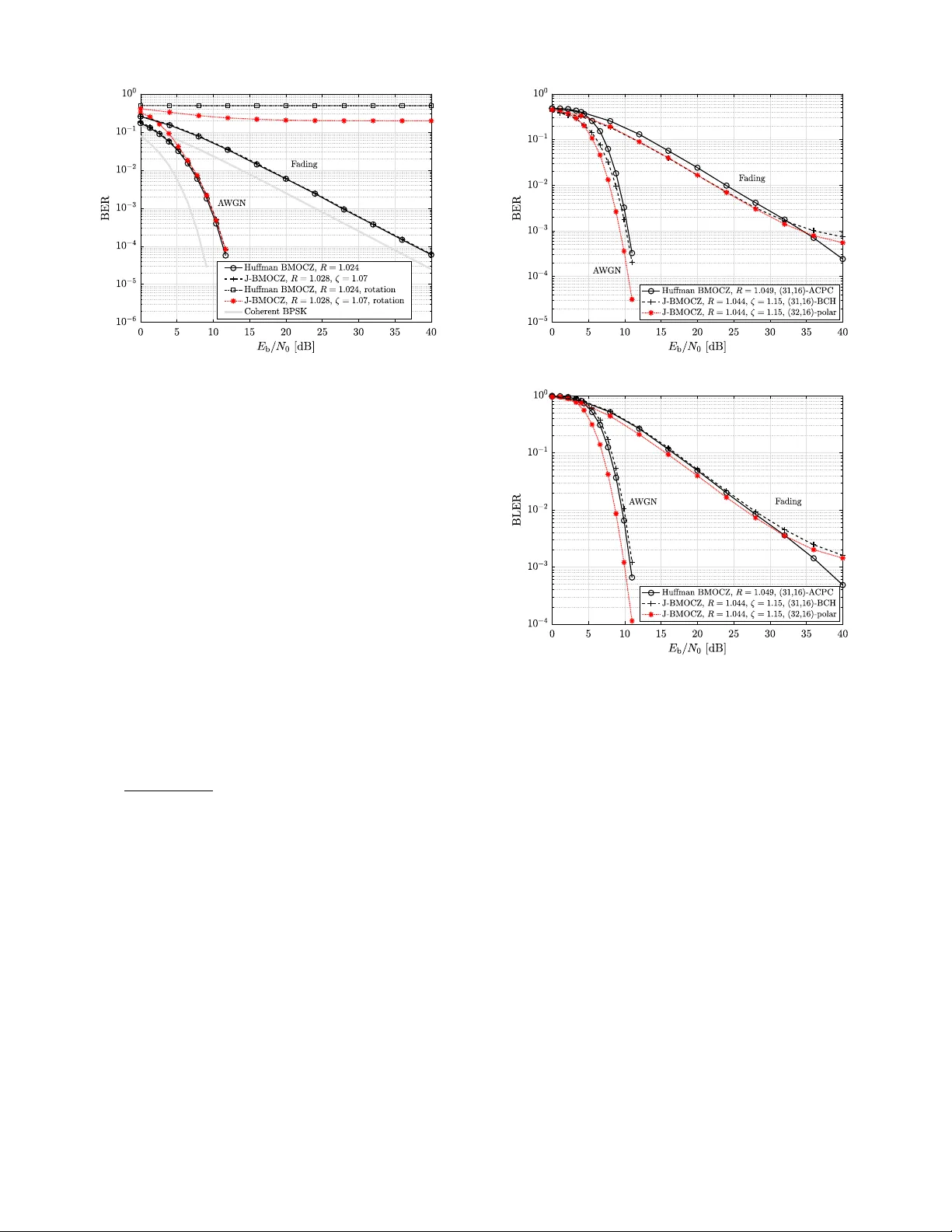
1 Jutted BMOCZ for Non-Coherent OFDM Park er Huggins, Student Member , IEEE and Alphan S ¸ ahin, Member , IEEE Abstract —In this work, we propose a zero constellation for binary modulation on conjugate-recipr ocal zeros (BMOCZ), called jutted BMOCZ (J-BMOCZ), and study its application to non-coherent orthogonal fr equency division multiplexing (OFDM). With J-BMOCZ, we introduce rotational asymmetry to the zero constellation for Huffman BMOCZ, which removes ambiguity at the recei ver under a unif orm rotation of the zer os. The asymmetry is controlled by the magnitude of “jutted” zeros and enables the receiver to estimate zero r otation using a simple cross-corr elation. The proposed method, however , leads to a natural trade-off between asymmetry and zero stability . Accordingly , we introduce a reliability metric to measure the stability of a polynomial’ s zeros under an additive perturbation of the coefficients, and we apply the metric to optimize the J-BMOCZ zero constellation parameters. W e then combine the advantages of J-BMOCZ and Huffman BMOCZ to design a hybrid wav eform for OFDM with BMOCZ (OFDM-BMOCZ). The pilot-free wav eform enables blind synchronization/detection and has a fixed peak-to-a verage power ratio that is independent of the message. Finally , we assess the proposed scheme through simulation and demonstrate non-coherent OFDM-BMOCZ using low-cost software-defined radios. Index T erms —Auto-corr elation function, BMOCZ, OFDM, polynomials, timing offset, zero stability . I . I N T R O D U C T I O N Orthogonal frequency division multiple xing (OFDM) is ubiquitous in modern wireless networks. The widespread adoption of OFDM is driv en by its flexibility in resource allocation, its robustness to frequency-selecti ve fading, and its compatibility with multi-antenna and multi-user systems. T ogether with its implementation simplicity , these properties hav e established scalable OFDM as the dominant wav eform in the standards, including in work to wards 6G [ 2 ], [ 3 ]. At the same time, howe ver , OFDM often employs coherent modula- tions, such as quadrature amplitude modulation (QAM), which require pilot overhead to estimate the channel and equalize the receiv ed data symbols. This overhead can comprise a significant fraction of the packet for small payloads, rendering non-coher ent detection as an attractive alternativ e, where the data are decoded without knowledge of the instantaneous channel state information (CSI). Parker Huggins was with the Department of Electrical Engineering, Uni- versity of South Carolina, Columbia, SC 29206 USA. He is now with the Department of Electrical and Computer Engineering, Ne w Y ork University , Brooklyn, NY 11201 USA (e-mail: parker .huggins@nyu.edu). Alphan S ¸ ahin is with the Department of Electrical Engineering, Univ ersity of South Carolina, Columbia, SC 29206 USA (e-mail: asahin@mailbox.sc.edu). This paper was presented in part at the IEEE International Symposium on Personal, Indoor , and Mobile Radio Communications 2025 [ 1 ]. This article has supplementary do wnloadable material available at https://github .com/parkerkh/Jutted-BMOCZ, provided by the authors. This work has been supported by the National Science Foundation through the award CNS-2438837. There are various non-coherent OFDM schemes proposed in the literature. Principal among these is non-coherent OFDM with index modulation (IM) [ 4 ], where the bits are encoded into the indices of the active subcarriers, which can be vie wed as a generalization of frequency-shift keying (FSK). Many works have studied extensions to non-coherent OFDM-IM, such as peak-to-av erage power ratio (P APR) reduction [ 5 ], code design [ 6 ], and receive div ersity [ 7 ]. Another prominent class of non-coherent OFDM schemes are those based on differential encodings. In [ 8 ], for example, the authors propose a differential modulation for multiple-input multiple-output (MIMO)-OFDM that exploits the beam-forming capabilities of the base station to enable low-comple xity , non-coherent detection in the downlink. Similarly , in [ 9 ], deep learning (DL) is employed for non-coherent detection in the downlink using differential phase-shift keying (DPSK). Differential OFDM has also been studied extensiv ely for underwater acoustic communications, as in [ 10 ], which considers non-coherent OFDM with dif ferential chaos-shift ke ying (DCSK). In this study , howe ver , we focus on an unconv entional but emerging non-coherent modulation technique, called modulation on conjugate-reciprocal zeros (MOCZ), which was first proposed in [ 11 ]. The core principle of MOCZ is to transmit the coefficients of a polynomial whose zeros encode information bits. If the coefficients are modulated in time, as with a single-carrier wa veform, then the con volution of the coefficients with the channel impulse response (CIR) becomes polynomial multiplication in the z -domain, which preserves the zeros of the transmitted polynomial, regardless of the CIR realization [ 12 ]. In this w ay , the zeros pass through the channel unaltered, enabling the receiv er to estimate the transmitted bits without knowledge of the instantaneous CSI. Howe ver , in practice the coefficients are perturbed by additiv e noise at the receiver , which non-trivially distorts the zeros. MOCZ is especially sensitive to noise, as the zeros of a polynomial are, in general, unstable under an additi ve perturbation of the coefficients. T o combat this sensitivity , the authors in [ 12 ] propose a stable binary MOCZ (BMOCZ) design, called Huffman BMOCZ , where the coefficients of each polynomial form a Huf fman sequence [ 13 ]. For its numerical stability and fa vorable auto-correlation properties (e.g., see Section II-A ), Huffman BMOCZ has been the subject of numerous recent studies. In [ 14 ], for example, the authors address the effects of hardware impairments on Huffman BMOCZ and propose cyclically permutable codes (CPCs) for non-coherent detection under uniform zero rotation. Multi-user MOCZ is studied in [ 15 ] and [ 16 ]. The authors in [ 17 ] apply faster-than-Nyquist signaling to improve the spectral efficiency of MOCZ. In [ 18 ], Huffman BMOCZ is utilized for non-coherent, over -the-air majority vote computation. In [ 19 ] and [ 20 ], recei ve di versity and soft-decision decoding are studied, respectiv ely . 2 T o our knowledge, besides our preliminary work in [ 21 ], multi-carrier MOCZ has not been considered in the literature. The primary reason for this fact is that MOCZ was proposed in [ 12 ] for communication ov er unknown multi-path channels, which are modeled via con volutions in the time domain. Indeed, [ 12 ] and [ 14 ] consider a one-shot scenario, where a single polynomial is transmitted whose duration may ev en be shorter than the delay spread. In this regime, single-carrier MOCZ is attracti ve. Howe ver , we seek to extend MOCZ to more con ventional communication scenarios, such as uplink orthogonal frequency di vision multiple access (OFDMA), by exploiting the unique properties of BMOCZ together with the flexibility of OFDM. Our specific motiv ation for studying OFDM-BMOCZ is dri ven by three factors: 1) its near-optimal P APR with Huffman sequences, which is in stark contrast to the high P APR of single-carrier Huffman BMOCZ [ 22 ]; 2) its support for continuous transmission with a cyclic prefix (CP), which a voids the null between adjacent polynomials required for single-carrier MOCZ [ 12 ], [ 14 ], [ 15 ]; and 3) its capacity to multiplex users ov er orthogonal time and frequency resources. Of course, integrating BMOCZ with OFDM has a particular disadvantage: it sacrifices the in variance of BMOCZ to the CIR realization. Accordingly , we in vestigate techniques to address frequency selectivity for OFDM-BMOCZ, including blind channel estimation. Our analysis takes into account timing and frequency offsets, as considered in [ 14 ]. W e note, ho wever , that [ 14 ] ignores pulse shaping and the loss of orthogonality under a frequenc y offset, which we account for in this work. A. Contributions Our principal contribution is jutted BMOCZ (J-BMOCZ), which increases the flexibility of Huffman BMOCZ and is applicable to both single- and multi-carrier MOCZ. Howe ver , our emphasis in this work is on OFDM-BMOCZ, where J-BMOCZ is utilized to correct a timing error . For reference, we summarize our specific contributions below . • W e propose J-BMOCZ, a modified Huffman BMOCZ zero constellation featuring a “jutted” zero pair . The key idea of J-BMOCZ is to introduce rotational asymmetry to the Huffman BMOCZ zero constellation. The asymmetry remov es the ambiguity during decoding induced by a uniform rotation of the zeros, which is caused by either a timing or frequency offset. W e exploit the asymmetry to derive a method for estimating zero rotation that relies on a simple cross-correlation. Our approach a voids the use of CPCs proposed for Huffman BMOCZ in [ 14 ] and thereby of fers increased flexibility , including support for soft-decision decoding. In fact, we demonstrate that both the bit error rate (BER) and block error rate (BLER) of polar-coded J-BMOCZ outperform Huffman BMOCZ with a CPC. • W e introduce a reliability metric to measure the stability of a polynomial’ s zeros under an additiv e perturbation of the coefficients. The metric is based on the unique interpretation of a polynomial as a frequency-selecti ve but parallel channel, where the channel capacity corresponds to zero stability . Through sev eral examples, we sho w that the reliability metric enables one to quantify the stability of individual zeros, as well as polynomials and entire MOCZ codebooks. W e then apply the reliability metric to optimize the zero constellation parameters using an approach that generalizes to other MOCZ schemes. • W e design a hybrid OFDM-BMOCZ wa veform enabling joint time-frequency synchronization and detection, all without pilot overhead. The wav eform exploits J-BMOCZ for timing while otherwise lev eraging the zero stability and low P APR of Huffman BMOCZ. By design, howe ver , the wa veform is fundamentally limited by the coherence bandwidth. T o address frequency selecti vity , we propose a BMOCZ-based method for blind channel estimation that permits implementation with larger bandwidths at the expense of increased P APR. Finally , we assess the proposed wav eform through simulation and demonstrate its application using software-defined radios (SDRs). Or ganization: The remainder of the paper is organized as follo ws: Section II provides the system model, including preliminaries on BMOCZ and its integration with OFDM; Section III introduces J-BMOCZ, our method for estimating zero rotation, and our metric for measuring zero stability; Section IV proposes a hybrid wa veform for OFDM-BMOCZ, analyzes its P APR, and discusses blind channel estimation and soft-decision decoding; Section V presents our simulation results and an SDR implementation; Section VI concludes the paper with remarks on future work. Notation: The real, complex, and natural numbers are denoted by R , C , and N , respectiv ely , and we denote by [ N ] = { 0 , 1 , . . . , N − 1 } the least N natural numbers. The binary field of dimension n is denoted by F n 2 , and the polynomial ring ov er C is denoted by C [ z ] . W e denote the complex conjugate and principal value of z ∈ C by z and Arg( z ) , respectiv ely . Small boldface letters denote vectors; large boldface letters denote matrices. The ℓ 2 -norm of a vector v ∈ C N is denoted by || v || 2 = √ v H v . The operator E [ · ] returns the expected value of its argument, and C N (0 , σ 2 ) denotes the circularly-symmetric complex normal distribution with mean zero and variance σ 2 . I I . S Y S T E M M O D E L W e consider a single-user , single-antenna scenario, where the transmitter and receiver communicate over a wireless multi-path channel. The system employs OFDM, and each packet comprises S acti ve subcarriers and M OFDM symbols. Let f s and N > S denote the sampling rate and the in verse discrete Fourier transform (IDFT) size, respectively . Then, the duration of each OFDM symbol in the time domain is T s = N /f s , and the spacing between adjacent subcarriers in the frequency domain is F s = 1 /T s . For a CP duration T cp , the m th transmitted OFDM symbol is gi ven by s m ( t ) = S − 1 X ℓ =0 d ℓ,m e j 2 πℓF s t , t ∈ [ − T cp , T s ) , (1) where d ℓ,m ∈ C is the data symbol on the ℓ th subcarrier of the m th OFDM symbol. 3 During transmission, we assume the channel is quasi-static with L paths, where g l ∈ C and τ l > 0 are the gain and delay of the l th path, respectively . At the receiv er, the oscillator used for do wnconv ersion is not synchronized with the oscillator at the transmitter , inducing a carrier frequency offset (CFO) ∆ f . Additionally , since the receiv er has no knowledge of the CSI or the time of transmission, let ∆ t > 0 denote a timing offset (TO) from the point of initial acquisition, which defines the duration of the receiv ed signal r ( t ) residing before the packet (see Fig. 5 ). Under these conditions, the m th OFDM symbol observed by the receiv er is giv en by r m ( t ) = e j 2 π ∆ f t L − 1 X l =0 g l s m ( t − ∆ t − τ l ) + w m ( t ) , (2) where w m ( t ) is additi ve white Gaussian noise (A WGN). When the CP duration exceeds the delay spread of the channel, i.e., T cp > τ L , each subcarrier observes a single complex gain, and the recei ved symbol in ( 2 ) can be reexpressed as [ 23 ], [ 24 ] r m ( t ) = e j 2 π ∆ f t S − 1 X ℓ =0 d ℓ,m H ℓ,m e j 2 πℓF s ( t − ∆ t ) + w m ( t ) , (3) where H ℓ,m ∈ C is defined as H ℓ,m ≜ e j 2 π ∆ f ( T s + T cp ) m L − 1 X l =0 g l e − j 2 πℓF s τ l . (4) In ( 3 ), the CFO induces a shift in the frequency domain, while the TO results in a phase modulation of the data symbols. Although the frequenc y shift introduced by the CFO breaks the orthogonality between the subcarriers, in practical systems ∆ f can be minimized through a control loop [ 25 , Chapter 8.1.1] or readily compensated using con ventional methods, such as that of Schmidl and Cox [ 26 ], [ 27 ]. In fact, we augment this method in Section IV -B for OFDM-BMOCZ, enabling the receiv er to estimate the CFO and decode header bits with a single OFDM symbol. Still, the distortion due to the TO is the primary focus of this work; it is addressed in Section III and a corresponding implementation is described in Section IV -C . A. Preliminaries on Binary MOCZ The principle of BMOCZ is to encode information bits into the zeros of the transmitted sequence’ s z -transform. Considering a K -bit message b = ( b 0 , b 1 , . . . , b K − 1 ) ∈ F K 2 , the k th bit b k is mapped to the zero of a polynomial as α k = ( ρ k e j ψ k , b k = 1 ρ − 1 k e j ψ k , b k = 0 , k ∈ [ K ] , (5) where the magnitude ρ k > 1 and phase ψ k ∈ [0 , 2 π ) define the conjugate-r eciprocal zero pair Z k ≜ { ρ k e j ψ k , ρ − 1 k e j ψ k } . Under ( 5 ), each binary message b ∈ F K 2 maps to a distinct zer o pattern α = [ α 0 , α 1 , . . . , α K − 1 ] T ∈ C K , which uniquely defines the polynomial X ( z ) = K X k =0 x k z k = x K K − 1 Y k =0 ( z − α k ) , (6) up to the scalar x K = 0 ∈ C . The polynomial X ( z ) has K + 1 coefficients and is the z -transform of the sequence x = [ x 0 , x 1 , . . . , x K ] T ∈ C K +1 . T o render ( 6 ) one-to-one, the leading coefficient x K is selected such that || x || 2 2 = K + 1 . The set of all normalized polynomial sequences then defines a codebook , denoted by C K , with cardinality | C K | = 2 K . The merit of single-carrier BMOCZ is that, regardless of the CIR realization, the zero structure of X ( z ) is preserved at the recei ver [ 11 ], [ 12 ]. F or example, consider a single-carrier wa veform modulated by x ∈ C K . After matched filtering, assuming no TO or CFO, the receiv ed sequence y ∈ C L t is giv en by y = x ∗ h + w , where h ∈ C L e is the CIR of ef fectiv e length L e ≥ 1 , and w ∈ C L t is A WGN with L t = K + L e . In the z -domain, the con volution of x with the CIR becomes polynomial multiplication as Y ( z ) = X ( z ) H ( z ) + W ( z ) = x K h L e − 1 K − 1 Y k =0 ( z − α k ) L e − 2 Y l e =0 ( z − β l e ) + w L t − 1 L t − 2 Y l t =0 ( z − γ l t ) , (7) where H ( z ) and W ( z ) are the z -transforms of h and w , respectiv ely . Observe that the receiv ed polynomial in ( 7 ) has L t − 1 zeros, i.e., the K data zeros { α k } and the L e − 1 zeros { β l e } introduced by the channel, all perturbed by noise. Since the data zeros remain approximately as roots of the receiv ed polynomial (exactly in the noiseless case), BMOCZ enables non-coherent detection at the receiver . In particular, a simple direct zer o-testing (DiZeT) decoder is introduced in [ 12 ], where Y ( z ) is ev aluated (tested) at the zeros in Z k , and the k th message bit b k is estimated as ˆ b k = ( 1 , | Y ( ρ k e j ψ k ) | < ρ L t − 1 k | Y ( ρ − 1 k e j ψ k ) | 0 , otherwise , k ∈ [ K ] . (8) The e valuation | Y ( ρ − 1 k e j ψ k ) | is scaled by ρ L t − 1 k to balance the gro wth of | Y ( z ) | for | z | > 1 and thereby ensure a fair comparison between α (1) k ≜ ρ k e j ψ k and α (0) k ≜ ρ − 1 k e j ψ k . See the analysis in [ 12 , Section III-D] for more details. It is worth noting that the DiZeT decoder is sensitive to zero perturbation under noise, since mov ement of the zeros can induce erroneous ev aluations in ( 8 ) and thus a misdetection. Therefore, as discussed in [ 12 , Section IV] and Section III-C of this work, it is important to optimize the zero constellation parameters { ρ k } and { ψ k } to ensure robustness against noise. Furthermore, the DiZeT decoder assumes kno wledge of the effecti ve CIR length via L t = K + L e . For single-carrier BMOCZ, then, it is necessary to estimate L e at the receiv er to limit the number of channel zeros introduced in ( 7 ) and ensure proper scaling in ( 8 ). W ith OFDM-BMOCZ, howe ver , the coefficients are multiplied pointwise with channel gains (not con volved), and hence no zeros are introduced to the transmitted polynomials. The distortion of the zeros under pointwise multiplication depends on the frequenc y selecti vity of the channel and the mapping of the polynomial coefficients to time-frequency resources (see Section II-B ). 4 W e now define the aperiodic auto-correlation function (AA CF) of a sequence x ∈ C K +1 , which is of importance moving forward. Definition 1. The AA CF of x = [ x 0 , x 1 , . . . , x K ] T ∈ C K +1 is the comple x-valued function A ( z ) ≜ P K ℓ = − K a ℓ z ℓ , wher e the coefficient a ℓ ∈ C is defined as a ℓ ≜ P K − ℓ i =0 x i x i + ℓ , 0 ≤ ℓ ≤ K P K + ℓ i =0 x i x i − ℓ , − K ≤ ℓ < 0 0 , otherwise . (9) For BMOCZ, the AACF of x ∈ C K can be computed directly from the zeros of X ( z ) as A ( z ) = K X ℓ = − K a ℓ z ℓ = X ( z ) X (1 /z ) = z − K x K x 0 K − 1 Y k =0 ( z − α k ) K − 1 Y k =0 ( z − 1 /α k ) . (10) It follows that A ( z ) in ( 10 ) is independent of the zero pattern, and hence each sequence x ∈ C K has an identical AA CF. By le veraging this property and the underlying zero structure of Huffman sequences [ 13 ], Huffman BMOCZ is proposed in [ 12 ], where the zeros in ( 5 ) lie uniformly along two circles of radii R and R − 1 , i.e., ρ k = R > 1 and ψ k = 2 π k/K , k ∈ [ K ] . A polynomial X H ( z ) generated with this encoding is called a Huffman polynomial , since its coefficients x ∈ C K form a Huffman sequence. Notably , Huffman sequences hav e an impulsi ve AA CF of the form A H ( z ) = ( K + 1)( − η H z − K + 1 − η H z K ) , (11) where η H ≜ 1 / ( R K + R − K ) [ 12 ]. The impulse-like AACF of Huffman sequences makes them ideal for applications in radar [ 28 ], [ 29 ]. Furthermore, as demonstrated through BER simulations and polynomial perturbation analysis, the zeros of Huffman polynomials are stable under noise [ 12 ], a desirable property for the DiZeT decoder in ( 8 ). A disadvantage of Huffman sequences in the time domain, ho wev er , is their large P APR, as the first and last coefficients carry nearly half of the sequence ener gy [ 12 ], [ 14 ], [ 22 ]. B. Subcarrier Mappings for OFDM-BMOCZ Assume that we transmit P polynomials, each of degree K , and let x k,p denote the k th coefficient of the p th polynomial for k ∈ [ K + 1] and p ∈ [ P ] . In this work, the coefficients are mapped to the subcarriers using frequenc y mapping (FM) [ 21 ], where S = K + 1 subcarriers and M = P OFDM symbols are resourced, and the data symbol d ℓ,m in ( 1 ) is selected as d ℓ,m = x ℓ,m . Equiv alently , the m th OFDM symbol is given by the m th transmit polynomial X m ( z ) ev aluated along the unit circle, i.e., s m ( t ) = P K ℓ =0 x ℓ,m e j 2 πℓF s t = X m (e j 2 πF s t ) . For Huffman BMOCZ, FM yields very lo w P APR due to the impulsiv e AACF of Huffman sequences [e.g., see Fig. 6 (a)]. Howe ver , FM is sensiti ve to frequency selecti vity , as the m th receiv ed polynomial (noiseless) Y m ( z ) = P K ℓ =0 x ℓ,m H ℓ,m z ℓ has coef ficients given by a pointwise product over fr equency . FM is thus suited for narrowband, small payload applications, such as transmitting uplink control information (UCI) within an OFDMA framework. Time mapping (TM) is an alternative to FM with S = P subcarriers and M = K + 1 OFDM symbols, where d ℓ,m in ( 1 ) is set to d ℓ,m = x m,ℓ . TM is robust against frequency selectivity , for the ℓ th recei ved polynomial Y ℓ ( z ) = P K m =0 x m,ℓ H ℓ,m z m has coefficients giv en by a pointwise product ov er time , and H ℓ,m is roughly constant in m by our assumption that the channel is quasi-static. The disadvantage of TM is its high P APR with Huffman sequences (see [ 21 , Fig. 7]). Nevertheless, we show in Section IV -E that TM can be exploited for blind channel estimation while simultaneously con veying information to the recei ver . W e refer the reader to [ 21 , Fig. 2] for visualizations of TM and FM. C. Problem Statement: Zer o Rotation under T iming Offset After coarse synchronization to the first OFDM symbol, it is con ventional to “step back” a fe w samples and ensure that the discrete Fourier transform (DFT) window excludes samples from the subsequent OFDM symbol, which would lead to intersymbol interference (ISI) [ 30 ]. In practice, then, there persists a residual TO after coarse synchronization. The residual TO depends on both the synchronization error and the OFDM symbol index m , as recei ver clock drift results in gradual sampling misalignments [ 30 ], [ 31 ], [ 32 ]. Let c ∆ t > 0 denote a coarse estimate of the TO, and assume a step back of N back ∈ N samples. W e express the residual TO as δ m = ∆ t − c ∆ t − N back f s | {z } synchronization error + ϵ m |{z} clock drift , (12) where ϵ m ∈ R is the aggregate clock drift by the symbol m (see Fig. 5 ). W ith FM, after synchronization and CP remo val, and assuming no CFO or noise for the ease of exposition, the n th sample of the m th OFDM symbol in ( 3 ) becomes ˜ r m ( n/f s ) = S − 1 X ℓ =0 y ℓ,m e − j 2 π ℓ N δ m f s e j 2 π ℓ N n , n ∈ [ N ] , (13) where y ℓ,m ≜ x ℓ,m H ℓ,m . T aking the N -point DFT of ( 13 ) to retriev e the coef ficients { y ℓ,m } , we obtain ˜ y ℓ,m = y ℓ,m e − j 2 π ℓ N δ m f s , ℓ ∈ [ K + 1] . (14) Defining the angle ϕ m ≜ 2 π δ m f s / N and transforming ( 14 ) into the z -domain, the received polynomial ov er the m th OFDM symbol is given by ˜ Y m ( z ) = K X ℓ =0 y ℓ,m e − j ϕ m ℓ z ℓ = Y m (e − j ϕ m z ) = e − j ϕ m K y K,m K − 1 Y k =0 ( z − ˜ α k e j ϕ m ) . (15) In ( 15 ), the coefficients of Y m ( z ) are phase modulated due to the residual TO δ m ∈ [0 , T cp ] , which induces uniform, coun- terclockwise rotation of the K receiv ed zeros { ˜ α k } through the angle ϕ m ∈ [0 , 2 π T cp /T s ] . 5 (a) Zero constellation. Imaginary axis (b) T ransmitted zeros. Imaginary axis (c) Receiv ed zeros. Imaginary axis (d) Corrected zeros. Fig. 1. Proposed J-BMOCZ zero pattern for K = 8 , R = 1 . 176 , and ζ = 1 . 15 . (a) Full zero constellation with 2 K zero positions. (b) Transmitted zeros corresponding to the message b = (1 , 0 , 1 , 1 , 1 , 0 , 0 , 1) . (c) Recei ved zeros rotated by ϕ = (12 / 7) θ K radians. (d) Recei ved zeros after correcting ϕ via ( 24 ), which exactly correspond to the transmitted message. Zero rotation is problematic for Huf fman BMOCZ, since any rotation of the zeros is ambiguous modulo θ K ≜ 2 π /K (see [ 14 , Fig. 4(a)]). T o address this ambiguity , the authors in [ 14 ] decompose the rotation ϕ as ϕ = ( u + µ ) θ K , where u ∈ [ K ] and µ ∈ [0 , 1) are integer and fractional multiples of the base angle θ K , respectively . The fractional rotation µθ K is estimated using an ov ersampled DiZeT decoder , while the integer rotation uθ K , which induces a cyclic permutation of the transmitted message for u ≥ 1 , is determined using an affine CPC (ACPC) . Although effecti ve, the proposed ACPC restricts the choice of coding to CPCs and places numerous constraints on the message length and rate. In this work, tow ards increasing the flexibility of Huf fman BMOCZ under zero rotation, we seek to answer the following question: how can we design a CPC-fr ee method for estimating zer o r otation and apply it to synthesize OFDM-BMOCZ waveforms r obust against hardwar e impairments at the physical layer? I I I . J U T T E D B M O C Z The high-lev el idea behind J-BMOCZ is simple: introduce asymmetry to the Huf fman BMOCZ zero constellation to remov e the ambiguity under zero rotation. Though there are many ways to inject asymmetry into the zero constellation, perhaps the simplest is to augment the magnitude of a single conjugate-reciprocal zero pair, which is what we consider with J-BMOCZ. Specifically , we maintain uniform phase separation of the zeros with ψ k = 2 π k/K , k ∈ [ K ] , b ut we set ρ k = ( ζ R , k = 0 R, otherwise , k ∈ [ K ] , (16) where ζ ≥ 1 is an asymmetry factor . With this encoding, each zero in ( 5 ) lies on a circle of radius R or R − 1 , except for the zero corresponding to the first message bit, α 0 , which is real and lies on a circle of radius ζ R ≥ R or ( ζ R ) − 1 ≤ R − 1 . The asymmetry factor controls how far α 0 “juts out. ” In the special case ζ = 1 , ρ k = R for all k ∈ [ K ] , and the proposed encoding reduces to Huffman BMOCZ. An illustration with ζ > 1 is provided in Fig. 1 . W e discuss in Section III-A how we exploit the rotational asymmetry to estimate zero rotation at the recei ver . Barring the first zero pair Z 0 = { α 0 , 1 /α 0 } , note that the J-BMOCZ and Huffman BMOCZ zero constellations are identical. Hence, in light of ( 10 ), we can express the AA CF for J-BMOCZ in terms of the Huffman BMOCZ AACF in ( 11 ) by removing the factors ( z − R ) and ( z − R − 1 ) and replacing them with the factors ( z − ζ R ) and ( z − ζ − 1 R − 1 ) , respectiv ely . This approach gi ves A J ( z ) = − η J ( K + 1) ( z K − R K )( z K − R − K ) ( z − R )( z − R − 1 ) × ( z − ζ R )( z − ζ − 1 R − 1 ) z − K , (17) where η J ∈ R scales A J ( z ) such that a 0 = K + 1 , which is necessary since the coefficients of X J ( z ) hav e energy K + 1 . T o identify η J in terms of K , R , and ζ , we define X ( R,ζ ) ( z ) ≜ z K − R K z − R ( z − ζ R ) = − ζ R K + K − 1 X k =1 (1 − ζ ) R K − k z k + z K = K X k =0 c k ( R, ζ ) z k , (18) where c k ( R, ζ ) = − ζ R K , k = 0 (1 − ζ ) R K − k , k = 1 , 2 , . . . , K − 1 1 , k = K . (19) Then, A J ( z ) = − η J ( K + 1) X ( R,ζ ) ( z ) X ( R − 1 ,ζ − 1 ) ( z ) z − K , and with ( 9 ) we get a 0 K + 1 = − η J K X k =0 c k ( R, ζ ) c K − k ( R − 1 , ζ − 1 ) = 1 ⇐ ⇒ η − 1 J = − K X k =0 c k ( R, ζ ) c K − k ( R − 1 , ζ − 1 ) . (20) It is easy to see that the terms for k = 0 and k = K in ( 20 ) simplify to − ζ R K and − ζ − 1 R − K , respectiv ely , while the middle K − 1 terms are of the form (1 − ζ )(1 − ζ − 1 ) R K − 2 k for k ∈ { 1 , 2 , . . . , K − 1 } . In voking the identity K − 1 X k =1 R K − 2 k = R K − 1 − R − ( K − 1) R − R − 1 , (21) 6 we then obtain η J = 1 ζ R K + ζ − 1 R − K − (1 − ζ )(1 − ζ − 1 ) R K − 1 − R − ( K − 1) R − R − 1 . (22) Notice that for ζ = 1 , η J = 1 / ( R K + R − K ) = η H , and A J ( z ) reduces to A H ( z ) in ( 11 ). Additionally , ev aluating A J ( z ) along the unit circle { z = e j ω | ω ∈ [0 , 2 π ) } gi ves A J (e j ω ) = η J η H 2 cos( ω ) − ( ζ R + ζ − 1 R − 1 ) 2 cos( ω ) − ( R + R − 1 ) A H (e j ω ) , (23) where A H (e j ω ) = ( K + 1)[1 − 2 η H cos( K ω )] . The functions A H (e j ω ) and A J (e j ω ) represent the instantaneous baseband signal power of FM-based OFDM-BMOCZ symbols with Huffman BMOCZ and J-BMOCZ, respecti vely; they are used in Section IV -D to deriv e expressions for the P APR in terms of the zero constellation parameters K , R , and ζ . A. T emplate-based Estimation of Zer o Rotation From ( 10 ), we have A (e j ω ) = X (e j ω ) X (e j ω ) = | X (e j ω ) | 2 . Recalling that A ( z ) is fixed, it follows that the magnitude | X (e j ω ) | is identical for each code word x ∈ C K . Hence, let us define T ( ω ) ≜ | X (e j ω ) | , which we call a template tr ansform (or simply template ), as it corresponds to the magnitude of the in verse discrete-time F ourier transform (IDTFT) of each x ∈ C K , i.e., T ( ω ) = | P K k =0 x k e j ωk | . Since T ( ω ) is common to every codeword, it is known at the receiver and captures the expected “shape” of | Y m (e j ω ) | . Howe ver , under the uniform zero rotation in ( 15 ), the recei ver observes a frequency-shifted version of | Y m (e j ω ) | , namely , | ˜ Y m (e j ω ) | = | Y m (e j ( ω − ϕ m ) ) | . Thus, we estimate ϕ m by correlating T ( ω ) with | ˜ Y m (e j ω ) | as ˆ ϕ m = arg max φ ∈ [0 , 2 π ) Z 2 π 0 T ( ω − φ ) | ˜ Y m (e j ω ) | d ω . (24) Importantly , for the cross-correlation in ( 24 ) to hav e a unique maximum, thus ensuring the estimate of ϕ m is unambiguous, T ( ω ) must be aperiodic over ω ∈ [0 , 2 π ) . Equiv alently , it is required that the zero constellation be rotationally asymmetric . W e plot example template transforms for J-BMOCZ in Fig. 2 . As expected, for ζ = 1 (i.e., Huffman BMOCZ), the template is periodic with a period equal to the base angle θ K = 2 π /K . For ζ > 1 , the jutted zero introduces a peaky env elope to the sinusoidal Huffman BMOCZ template that breaks its periodicity . Indeed, the template transform T ( ω ) = | X J (e j ω ) | for J-BMOCZ is well-suited for the cross-correlation in ( 24 ), as the product T ( ω − φ ) | ˜ Y m (e j ω ) | has a maximum when the shift φ aligns the peaks of T ( ω − φ ) and | ˜ Y m (e j ω ) | . Beyond shifting due to zero rotation, howe ver , the receiv ed template | ˜ Y m (e j ω ) | is also distorted by fading and noise. For example, with single-carrier J-BMOCZ, the channel zeros introduced in ( 7 ) non-linearly distort | ˜ Y m (e j ω ) | . Y et, we sho w in Section V -A that, with coding, the template-based estimator still yields good performance for single-carrier J-BMOCZ (see Fig. 8 ). Similarly , for OFDM-BMOCZ with FM, the receiv ed template is distorted by frequenc y-selecti ve fading. The template-based implementation in Section IV -C thus relies on the narrowband assumption of Section II-B , or the use of blind channel estimation and equalization, as considered in Section IV -E . Fig. 2. Example J-BMOCZ template transforms for K = 16 and R = 1 . 093 . B. Reliability Metric for Measuring Zer o Stability Zero stability is of paramount importance for BMOCZ. If the roots of the recei ved polynomial shift significantly under additiv e noise perturbing the coefficients, then the recei ver will struggle to identify the intended zero pattern. Such instability sev erely degrades performance with the DiZeT decoder , since any confusion of the zeros induces bit errors. Ensuring the stability of each possible zero pattern is therefore essential to guaranteeing reliable communication. Ho wever , analyzing zero stability is challenging, for the relationship between a polynomial and its roots is highly non-linear . While there exists rele vant literature [ 33 ], [ 34 ], conv entional zero-stability metrics, such as that deriv ed from Rouch ´ e’ s theorem in [ 12 ], only provide an upper bound on the root perturbation for a giv en noise v ariance. Indeed, to the best of our kno wledge, there is no general metric to measure the zero stability of an arbitrary polynomial, which we address ne xt. Assume X ( z ) ∈ C [ z ] is a polynomial of degree K with the zeros { α 0 , α 1 , . . . , α K − 1 } and the K + 1 coefficients x = [ x 0 , x 1 , . . . , x K ] T ∈ C K +1 , which satisfy || x || 2 2 = 1 . 1 Additionally , let W ( z ) ∈ C [ z ] be a noise polynomial that perturbs X ( z ) as Y ( z ) = X ( z ) + W ( z ) . W e seek to quantify the stability of each zero α k , k ∈ [ K ] . T o that end, consider Y ( z ) = ( z − α k ) H k ( z ) + W ( z ) , (25) where we define H k ( z ) as H k ( z ) ≜ X ( z ) z − α k = x K K − 1 Y k ′ =0 k ′ = k ( z − α k ′ ) , k ∈ [ K ] . (26) In particular , notice that ( 25 ) resembles the form of ( 7 ), which motiv ates our follo wing interpretation: H k ( z ) acts as a fr equency-selective channel formed by the neighboring zeros of α k , i.e., we transmit ( z − α k ) in ( 25 ), and the receiver observes Y ( z ) . W ith this interpretation, the capacity of H k ( z ) corresponds to the reliability of α k . T ow ards computing this capacity , let us probe the channel H k ( z ) with a unit input 1 The energy of a polynomial’ s coefficients does not affect its zero locations. Hence, we assume the coefficients are normalized for simplicity . 7 such that ( 25 ) simplifies to ˜ Y ( z ) = H k ( z ) + W ( z ) . Then, analogous to OFDM, we parallelize H k ( z ) across frequency by ev aluating it at the N th roots of unity , which yields the samples ˜ Y (e j 2 πn/ N ) = H k (e j 2 πn/ N ) + W (e j 2 πn/ N ) , n ∈ [ N ] . Although the perturbation W ( z ) may be arbitrary , here we assume the samples { W (e j 2 πn/ N ) } are independent with E [ | W (e j 2 πn/ N ) | 2 ] = 1 for all n ∈ [ N ] . W ith these simplifications, the resulting transformed channel represents a parallel A WGN channel , where each sub-channel has unit noise v ariance and an input of unit power . The capacity of such a parallel channel is giv en by [ 35 , Eq. (5.38)] C k = N − 1 X n =0 log 2 1 + H k (e j 2 π n N ) 2 , k ∈ [ K ] , (27) which we scale by 1 / N and assign as a metric for the stability of α k , i.e., ˆ C k = C k / N . T o measure the stability of X ( z ) , taking into account all K of its zeros, we then av erage ov er ˆ C k for k ∈ [ K ] as C x = 1 K K − 1 X k =0 ˆ C k . (28) W e use the notation C x to emphasize that ( 28 ) quantifies the zero stability of the polynomial X ( z ) , which is given by its normalized coefficients x ∈ C K +1 . This definition naturally extends to the codebook le vel, where stability is estimated by av eraging over C x for the 2 K codew ords x ∈ C K as ¯ C = 1 2 K X x ∈ C K C x . (29) Since the cardinality of C K scales exponentially with K , computing ¯ C via ( 29 ) becomes computationally intractable for K ≫ 1 . Howe ver , an approximation of ¯ C is readily obtained by a veraging over a random subset of code words. W e now illustrate our proposed reliability metric with sev eral examples. In each example, we set N = 1024 and normalize || x || 2 2 to one. Example 1. The Huffman BMOCZ codebook with K = 8 and R = 1 . 176 has a stability ¯ C = 1 . 149 . The most stable of such Huf fman polynomials has all zeros of magnitude R − 1 and a reliability C x R − 1 = 1 . 250 ; the least stable has all zeros of magnitude R and a reliability C x R = 1 . 048 . Example 2. W ilkinson’ s polynomial [ 36 ], which is given by X W ( z ) = Q 20 k =1 ( z − k ) , famously exhibits instability under noise. If the coef ficient x 19 is decreased by just 2 − 23 , then the zero structure of the polynomial is destroyed. W e compute C x W = 0 . 0381 with ( 28 ), a reliability 32 times less than the least stable Huffman polynomial with K = 20 and R = 1 . 075 . Example 3. In Fig. 3 , we plot the zeros of a J-BMOCZ polynomial under A WGN for K = 8 , R = 1 . 176 , ζ = 1 . 15 . Each zero is shaded according to its reliability ˆ C k , where a darker shade corresponds to lower reliability , i.e., less stability . Observe that the jutted zero is the least stable and that the reliability of each root correlates with the area of its perturbation “cloud. ” Fig. 3. J-BMOCZ zero perturbation at E b / N 0 = 10 dB with K = 8 , R = 1 . 176 , and ζ = 1 . 15 . The zeros are shaded according to their stability estimated via ( 27 ) as ˆ C k = C k / N , where N = 1024 . C. Optimization of Zer o Constellation P arameters In this section, we attempt to answer the following question: for a given K , what ar e the optimal R and ζ for J-BMOCZ? On one hand, ζ should be small (i.e., ζ ≈ 1 ) to retain the numerical stability of Huffman BMOCZ. On the other hand, if ζ is too small, T ( ω ) does not ha ve a prominent peak, which can lead to erroneous estimates of zero rotation with ( 24 ). Hence, there exists a trade-off between zero stability and template “peakiness” (or , equiv alently , rotational asymmetry). W e first introduce a method to choose R > 1 for fixed K and ζ , which is as follows: select the radius R ∗ ( K, ζ ) maximizing the minimum stability in the codebook, i.e., R ∗ ( K, ζ ) = arg max R> 1 min x ∈ C K C x . (30) This approach is illustrated in Fig. 4 (a), which plots the minimum stability min x ∈ C K C x against R for J-BMOCZ with K = 128 and ζ ∈ { 1 , 1 . 03 , 1 . 06 } , where we hav e annotated R ∗ ( K, ζ ) from ( 30 ). W e highlight that for ζ = 1 , R ∗ (128 , 1) = 1 . 015 , which is almost identical to the con ven- tional radius for Huffman BMOCZ with K = 128 zeros, i.e., R = p 1 + sin( π/ 128) = 1 . 012 [ 12 ], [ 14 ], [ 37 ]. Furthermore, we note that for both Huffman BMOCZ and J-BMOCZ, the codeword with all zeros outside (inside) the unit circle consistently is the least (most) stable under ( 28 ). Of course, prior to calculating R ∗ ( K, ζ ) , we must first select ζ ≥ 1 giv en K . T o do this, we sweep ζ and simultaneously record min x ∈ C K C x and template “peakiness, ” which we measure via P APR. For each value of ζ , we employ the radius R ∗ ( K, ζ ) . Fig. 4 (b) illustrates this method, where the zero stability is normalized with respect to Huffman BMOCZ (i.e., ζ = 1 ). The figure clearly depicts the aforesaid trade-off: increasing ζ increases template P APR, b ut it strictly reduces zero stability . The utility of Fig. 4 is that it enables one to select ζ for a target template P APR while understanding exactly ho w much stability is lost relative to Huffman BMOCZ. 8 (a) Zero stability against radius for K = 128 . (b) Zero stability against rotational asymmetry . Fig. 4. Design curves for J-BMOCZ parameter selection showing the minimum zero stability identified via ( 28 ) as a function of the radius and asymmetry factor . Remark 1. Our presented methods for tuning the parameters of the zero constellation generalize to other MOCZ schemes. In fact, giv en K , one could pose a constrained optimization problem and attempt to identify the zero constellation that maximizes ¯ C or min x ∈ C K C x . Howe ver , an optimization of this nature is beyond the scope of this work. I V . P I L O T - F R E E O F D M F R A M E W O R K In this section, we combine the concepts introduced in the previous sections to propose an end-to-end, non-coherent OFDM-BMOCZ framework. Our approach uses a two-stage timing procedure [ 30 ], [ 38 ], [ 39 ] to address radio impairments at the physical layer while remaining free of pilot symbols. A. Hybrid P acket Structure Consider a payload of B tot bits to be transmitted using an OFDM-BMOCZ wav eform. First, we subdivide the bits into P = ⌈ B tot /B ⌉ blocks, where B ≤ K denotes the number of bits encoded per polynomial, 2 and we allocate S = K + 1 2 If B does not divide B tot , then B pad = B − ( B tot mod B ) bits must be padded to the payload. subcarriers and M = P OFDM symbols for the payload. W e utilize J-BMOCZ for the first OFDM symbol to estimate the residual TO at the receiver , while the remaining M − 1 OFDM symbols employ Huffman BMOCZ for its superior zero stability and low P APR. For coarse synchronization and CFO estimation, we adopt the Schmidl-Cox technique [ 26 ] and prepend a repeated Huffman BMOCZ preamble to the payload that encodes a header of ⌊ K / 2 ⌋ bits (uncoded). A waveform with the proposed hybrid packet structure is depicted in Fig. 5 . The wav eform comprises back-to-back hybrid packets, each having a repeated Huffman BMOCZ preamble and a J-BMOCZ symbol to refresh estimates of the CFO and residual TO, respectiv ely . In practice, refreshing these estimates is only necessary for long frames and not for short packets, but we illustrate it here for completeness. Further , we consider the addition of a TM-based preamble for blind channel estimation in Section IV -E . B. Coarse Synchr onization and CFO Estimation Let s sync ( t ) denote the synchronization symbol prepended to the payload. W e choose the synchr onization polynomial X sync ( z ) as a Huffman polynomial with the K ′ ≜ ⌊ K / 2 ⌋ zeros α sync ∈ C K ′ , which can encode a header of K ′ bits. The k ′ th coefficient of X sync ( z ) , denoted by x k ′ , sync , defines the data symbol d ℓ, sync in ( 1 ) as d ℓ, sync = ( x ℓ/ 2 , sync , ℓ e ven 0 , otherwise , ℓ ∈ [ S ] . (31) The coefficients of X sync ( z ) are mapped to e very other subcar- rier such that, after the IDFT operation in ( 1 ), s sync ( t ) exhibits a half-symbol repetition, i.e., s sync ( t ) = s sync ( t + T s / 2) for t ∈ [ − T cp , T s / 2) . At the receiv er, we define N ′ ≜ N/ 2 and search for the repeated preamble using the normalized correlation metric [ 26 ] Γ τ = U τ /V τ , where U τ accumulates correlated samples as U τ = N ′ − 1 X n ′ =0 n r ([ τ + n ′ ] /f s ) × r ([ τ + n ′ + N ′ ] /f s ) o , (32) and V τ accumulates symbol ener gy as V τ = N ′ − 1 X n ′ =0 r ([ τ + n ′ + N ′ ] /f s ) 2 . (33) W e then obtain an estimate of the TO (i.e., ∆ t ) by identifying the largest candidate offset τ ∈ N (in samples) for which Γ τ is within a set fraction λ ∈ (0 , 1] of Γ max ≜ max τ Γ τ as c ∆ t = τ sync f s with τ sync = max { τ ∈ N | Γ τ ≥ λ Γ max } . (34) Additionally , since the samples correlated in ( 32 ) v ary by a phase term proportional to the CFO [ 26 ], [ 27 ], we use U τ sync to estimate ∆ f as c ∆ f = − Arg( U τ sync ) 2 π N ′ f s , (35) where we assume that ∆ f < F s . After correcting the CFO and the residual TO δ 0 (see Section IV -C ), the header data can be recov ered from the receiv ed synchronization polynomial Y sync ( z ) = P K ′ k ′ =0 y k ′ , sync z k ′ via the DiZeT decoder . 9 T im e DF T window CP OF DM OF DM CP OF DM CP CP A A Huf fma n B MOCZ J - B MOCZ A A R e pe a ted pre a mbl e (H uf fma n B MOCZ ) Hy brid pa c ke t CP OF DM OF DM CP CP A A Fig. 5. Proposed hybrid OFDM-BMOCZ wa veform with repeated Huffman BMOCZ preamble for coarse time synchronization and CFO estimation, J-BMOCZ symbol for residual TO estimation, and Huffman BMOCZ payload. Observe that, without correction, the residual T O (and hence the DFT window) ev olves with the OFDM symbol index. C. Implementation of Residual TO Estimation For residual TO estimation, we implement ( 24 ) using the receiv ed samples of the first OFDM symbol in the payload. Hence, we set X 0 ( z ) as a J-BMOCZ polynomial such that the receiv er observes ˜ v ∈ C N , which comprises the noisy samples ˜ v n = | ˜ r 0 ( n/f s ) | = | Y 0 (e j (2 πn/ N − ϕ 0 ) ) | , n ∈ [ N ] . T o approximate the continuous search o ver φ ∈ [0 , 2 π ) in ( 24 ), we quantize the interval [0 , 2 π ) into N uniform bins with the T oeplitz matrix T ∈ R N × N giv en by T ≜ T ( ω 0 ) T ( ω N − 1 ) · · · T ( ω 1 ) T ( ω 1 ) T ( ω 0 ) · · · T ( ω 2 ) . . . . . . . . . . . . T ( ω N − 1 ) T ( ω N − 2 ) · · · T ( ω 0 ) , (36) where ω n = 2 π n/ N for n ∈ [ N ] . The residual TO (i.e., δ 0 ) is then estimated from the inner product (correlation) of ˜ v with the columns of T as ˆ δ 0 = ˆ n f s with ˆ n = arg max n ∈ [ N ] ( ˜ v T T ) n . (37) In ( 37 ), the resolution of ˆ δ 0 is limited by the IDFT size N . Howe ver , as we sho w in Section V -A , the performance loss for small N is not large, especially at low E b / N 0 (see Fig. 9 ). D. P APR Analysis with FM For OFDM-BMOCZ with FM, recall that an OFDM symbol s ( t ) is giv en by the corresponding polynomial X ( z ) ev aluated on the unit circle, i.e., s ( t ) = X (e j 2 πF s t ) . In particular , A (e j 2 πF s t ) = | X (e j 2 πF s t ) | 2 = | s ( t ) | 2 , and hence the baseband signal power at time t ∈ [0 , T s ) can be expressed directly in terms of the AA CF A ( z ) . Indeed, F s = 1 /T s implies { e j 2 πF s t | t ∈ [0 , T s ) } = { e j ω | ω ∈ [0 , 2 π ) } , so A (e j ω ) completely characterizes the instantaneous power at baseband. Here we exploit this fact to deri ve expressions for the P APR of OFDM-BMOCZ symbols, defined for a given polynomial X ( z ) of degree K ≥ 2 as P APR { X (e j ω ) } ≜ max ω ∈ [0 , 2 π ) | X (e j ω ) | 2 E [ | X (e j ω ) | 2 ] . (38) Furthermore, since A ( z ) = | X ( z ) | 2 is fixed for BMOCZ and the coef ficients are normalized in energy such that E [ | X (e j ω ) | 2 ] = K + 1 , the P APR with FM is independent of the message. This contrasts with TM, where the P APR is a function of the data, much like con ventional OFDM systems. W e refer the reader to [ 21 , Section IV -C] for a brief analysis on the P APR with TM. W e be gin with Huf fman BMOCZ, where from ( 11 ) we get A H (e j ω ) = ( K + 1)[1 − 2 η H cos( K ω )] . Since cos( K ω ) is periodic and achie ves local minima at odd multiples of π /K , it follows that max ω ∈ [0 , 2 π ) A H (e j ω ) = ( K + 1)(1 + 2 η H ) and P APR { X H (e j ω ) } = 1 + 2 η H . (39) In fact, for K ≥ 2 and R > 1 , it holds that η H ∈ (0 , 1 / 2) , which implies P APR { X H (e j ω ) } < 2 , i.e., the P APR with Huffman BMOCZ is bounded abov e by 10 log 10 (2) ≈ 3 dB. W e now consider J-BMOCZ with A J (e j ω ) giv en in ( 23 ). Here the analysis is less straightforward, as A J (e j ω ) is aperiodic on ω ∈ [0 , 2 π ) , and the existence of a global maximum at ω = 0 depends jointly on the parameters K , R , and ζ (see Fig. 2 ). Hence, we utilize the below proposition. Proposition 1. Let K ≥ 2 and R, ζ > 1 . A sufficient condition for arg max ω ∈ [0 , 2 π ) A J (e j ω ) = 0 is K 2 < 1 η H ( a − b )(1 − 2 η H ) [ a − 2 cos( π/K )][ b − 2 cos( π /K )] , (40) wher e a ≜ ζ R + ζ − 1 R − 1 and b ≜ R + R − 1 . The proof is given in Appendix A . For a triple ( K , R, ζ ) satisfying ( 40 ), the P APR with J-BMOCZ follows readily as P APR { X J (e j ω ) } = η J η H a − 2 b − 2 (1 − 2 η H ) , (41) since 2 < b < a implies (2 − a ) / (2 − b ) = ( a − 2) / ( b − 2) . For reference, we plot the P APR with J-BMOCZ in Fig. 6 as a function of K and R for various ζ . Fig. 6 (a) shows the low P APR af forded by Huf fman BMOCZ (i.e., ζ = 1 ), while Fig. 6 (b) and Fig. 6 (c) sho w that for lar ge K and small R , the P APR with J-BMOCZ can exceed 10 dB, especially for increasing ζ . In Section V , howe ver , we demonstrate good performance with a template P APR less than 9 dB. Remark 2. For fixed K , the BMOCZ codebook C K consists of the 2 K non-trivial ambiguities x ∈ C K +1 sharing the common AA CF A ( z ) [ 12 ]. In much the same way , with FM, the OFDM-BMOCZ signal set comprises the 2 K non-trivially distinct signals s ( t ) [cf. ( 1 )] with common en velope | s ( t ) | . From a time-domain perspective, then, OFDM-BMOCZ is an implementation of angle coding , which was first described by V oelcker in [ 40 ], [ 41 ]. W ith angle coding, the transmitted wa veform has a predetermined en velope, and information is con veyed entirely through its phase trajectory . 10 (a) ζ = 1 . 00 (Huffman BMOCZ). (b) ζ = 1 . 05 (J-BMOCZ). (c) ζ = 1 . 10 (J-BMOCZ). Fig. 6. P APR for OFDM-BMOCZ with FM. For a given triple ( K, R, ζ ) , the P APR is fixed and independent of the message. Pairs ( K , R ) above the black curves in (b) and (c) satisfy the condition in ( 40 ) for fixed ζ . E. Blind Channel Estimation with TM T o improve performance with FM under frequency-selecti ve fading, we consider the addition of a TM-based preamble for blind channel estimation, placed just after the synchronization symbol in Fig. 5 . The preamble comprises S = K + 1 polynomials of degree K tm ≥ 2 and encodes K tm ( K + 1) bits (uncoded). Let X ℓ ( z ) = P K tm m =0 x m,ℓ z m be the polynomial transmitted over K tm + 1 consecutiv e OFDM symbols of the subcarrier ℓ ∈ [ S ] . At the recei ver , after CP remo val and a DFT operation, we observe the polynomial Y ℓ ( z ) = K tm X m =0 x m,ℓ H ℓ,m z m + W ( z ) ≈ H ℓ X ℓ ( z ) + W ( z ) , (42) where the approximation follows from our quasi-static channel assumption and the prior CFO compensation of Section IV -B . 3 Decoding Y ℓ ( z ) via ( 8 ) gi ves ˆ b ℓ ∈ F K tm 2 , which we re-encode to obtain an estimate of the transmitted polynomial X ℓ ( z ) as ˆ X ℓ ( z ) = P K tm m =0 ˆ x m,ℓ z m . W ith Y ℓ ( z ) and ˆ X ℓ ( z ) , we compute the channel estimate ˆ H ℓ ∈ C by solving the least-squares problem ˆ H ℓ = arg min H ℓ ∈ C P K tm m =0 | y m,ℓ − ˆ x m,ℓ H ℓ | 2 , whose solution for y m,ℓ ≜ x m,ℓ H ℓ,m has the closed form ˆ H ℓ = P K tm m =0 ˆ x m,ℓ y m,ℓ P K tm m =0 | ˆ x m,ℓ | 2 , ℓ ∈ [ S ] . (43) Using the channel estimate ˆ H ℓ and the noise variance N 0 , estimated from the null subcarriers in ( 31 ), we synthesize the minimum mean-squared error (MMSE) equalizer F ℓ = ˆ H ℓ | ˆ H ℓ | 2 + N 0 / E [ | ˆ x m,ℓ | 2 ] , ℓ ∈ [ S ] , (44) where E [ | ˆ x m,ℓ | 2 ] = || ˆ x ℓ || 2 2 / ( K tm + 1) = 1 . Then, prior to decoding the FM-based payload, we equalize the coefficients of ˜ Y m ( z ) in ( 15 ) to obtain ˆ Y m ( z ) = K X ℓ =0 y ℓ,m e − j ϕ m ℓ F ℓ z ℓ ≈ K X ℓ =0 x ℓ,m z ℓ = X m ( z ) . (45) 3 W e note that for TM, it is the CFO that induces zero rotation, not a TO. In fact, a TO has no effect on the zeros with TM. Note that the TO-induced phase modulation in ( 45 ) is absorbed by the channel estimates and hence is corrected following equalization. Thus, with a TM-based preamble, the use of J-BMOCZ for residual T O estimation is not strictly necessary . Additionally , the reliability of the channel estimates impro ves as K tm increases, since the av eraging in ( 43 ) becomes more robust to noise. This improvement, ho wev er , comes at the cost of a longer preamble and increased P APR, as the P APR of a Huffman sequence increases with its length [ 22 ]. F . Soft-decision DiZeT Decoding As noted in Section II-C , our motiv ation for J-BMOCZ is to maintain performance under zero rotation without relying on a CPC. This, in turn, increases flexibility and enables decoding using soft information . Soft-decision decoding is ideal for J-BMOCZ, as the asymmetry inherently renders some zeros (and hence bits) more reliable than others (see Fig. 3 ). T o obtain soft information from a received polynomial Y ( z ) with the coef ficients y ∈ C L t , we perform direct zero-testing and compute the pseudo-log-likelihood ratios (PLLRs) [ 15 ] PLLR k = log e − ρ − ( L t − 1) k | Y ( α (1) k ) | 2 e − ρ L t − 1 k | Y ( α (0) k ) | 2 , k ∈ [ K ] , (46) where we first normalize the coefficient energy as || y || 2 2 = 1 . W e call the LLRs in ( 46 ) pseudo-LLRs , since the distribution of the perturbed zeros is assumed as Gaussian, though the true distribution of the perturbed zeros is unknown. Lastly , we remark that in [ 20 ] it is shown coding across multiple polynomials greatly improves the performance. While this approach extends naturally to FM with coding performed over consecutiv e OFDM symbols, it is not considered here for the purpose of analyzing the basic limitations of the scheme. V . N U M E R I C A L R E S U L T S This section presents the results of numerical simulations and an SDR implementation. W e first consider baseline simulations without OFDM to compare the performance of J-BMOCZ to Huf fman BMOCZ. W e then perform an OFDM simulation under timing errors to assess the hybrid wa veform and its extensions. Finally , we demonstrate OFDM-BMOCZ in practice using low-cost SDRs. 11 Fig. 7. Comparison of uncoded J-BMOCZ to uncoded Huffman BMOCZ for K = 64 and L e = 5 . The curves marked with “rotation” are impaired by random zero rotation. A. Comparison to Huffman BMOCZ In this section, we perform sequence-level simulations, as in [ 12 ] and [ 14 ], to compare the performance of J-BMOCZ to Huffman BMOCZ, i.e., the state-of-the-art BMOCZ scheme. In our simulations, we uniformly sample messages b ∈ F B 2 and normalize x ∈ C K as || x || 2 2 = K + 1 , where K ≥ B represents the codeword length. Each transmitted codeword observes an independent CIR realization h ∈ C L e , where the taps are modeled according to a uniform power-delay profile (PDP) [ 12 ], [ 14 ] as E [ | h l e | 2 ] = 1 /L e , l e ∈ [ L e ] . The channel output is then perturbed by A WGN w ∈ C L t with w l t ∼ C N (0 , N 0 ) , l t ∈ [ L t ] . Hence, the received coefficients y ∈ C L t are given by y = x ∗ h + w . W e also consider the A WGN channel as a baseline, where y = x + w ∈ C K +1 . In simulations with zero rotation, we modulate y through an angle ϕ sampled uniformly from [0 , 2 π ) . Of course, uniformly random zero rotation represents an exaggerated impairment, but it is treated for consistency with [ 14 ]. W e use the radius R = p 1 + sin( π/K ) proposed in [ 12 ] for Huffman BMOCZ, while J-BMOCZ employs the radius R ∗ ( K, ζ ) in ( 30 ) with ζ > 1 selected for a template P APR of 8 . 5 dB. All schemes utilize the hard-decision DiZeT decoder in ( 8 ), except for polar-coded J-BMOCZ, which e xploits soft information via the PLLRs in ( 46 ) and uses a successi ve interference cancellation (SIC) decoder . Similar to [ 12 ], we assume knowledge of L e at the recei ver to ensure proper scaling in ( 8 ) and ( 46 ). 1) Uncoded P erformance: Fig. 7 compares the uncoded BER performance of J-BMOCZ and Huffman BMOCZ for K = 64 and L e = 5 . W ithout any zero rotation, the BER of the two schemes is nearly identical; J-BMOCZ performs ≤ 0 . 3 dB worse in both the A WGN and fading channels. This result is expected, as with the constellation parameters in Fig. 7 , we get from ( 29 ) ¯ C J ≈ 1 . 305 < ¯ C H ≈ 1 . 337 , i.e., the stability of the J-BMOCZ codebook is marginally less than that of Huffman BMOCZ. More generally , we conjecture that the BER of a BMOCZ scheme is correlated with the stability in ( 29 ). Establishing such a relationship, howe ver , requires theoretical BER analysis with the DiZeT decoder , which is (a) Coded BER performance under zero rotation. (b) Coded BLER performance under zero rotation. Fig. 8. Comparison of coded J-BMOCZ to coded Huffman BMOCZ under random zero rotation for K ∈ { 31 , 32 } and L e = 5 . All schemes encode B = 16 bits per polynomial. challenging due to the non-linear relationship between the zeros and the coefficients. Under zero rotation, notice that Huffman BMOCZ experiences an immediate error floor , since without the ACPC, integer rotations uθ K cannot be resolved (see Section II-C ). In contrast, J-BMOCZ incurs a modest loss in performance under A WGN that decreases with E b / N 0 . Y et, J-BMOCZ also experiences an error floor in the selectiv e channel, as the channel zeros distort the receiv ed template non-linearly and hinder the correlation in ( 24 ). Interestingly , we sho w next that coding largely resolves this issue. 2) Coded P erformance: W e compare the performance of coded J-BMOCZ to coded Huffman BMOCZ with a message length of B = 16 and a codew ord length of K ∈ { 31 , 32 } . Both schemes are impaired by uniformly random zero rotation. For Huf fman BMOCZ, to correct the fractional rotation µθ K , we adopt the oversampled DiZeT decoder [ 14 , Eq. (34)] with an oversampling factor of Q = 200 . Then, to correct the integer rotation uθ K , we employ the (31,16)-ACPC [ 14 ], which inherits a 2-bit error-correction capability from its outer (31,21)-BCH code. For J-BMOCZ, we consider both a 12 Fig. 9. MSE of zero rotation estimators for J-BMOCZ and Huffman BMOCZ with K = 31 and L e = 1 . (31,16)-BCH code and a (32,16)-polar code, 4 and we estimate ϕ using the approach of Section IV -C as ˆ ϕ = 2 π ˆ n/ N , where N = 1024 and ˆ n ∈ [ N ] is defined as in ( 37 ) (see also [ 1 ]). Fig. 8 pictures the coded BER and BLER performance under uniformly random zero rotation with L e = 5 . In BER, both J-BMOCZ-BCH and polar -coded J-BMOCZ outperform Huffman BMOCZ-A CPC at moderate-to-low E b / N 0 , with polar-coded J-BMOCZ achie ving gains of 1 . 5 dB and 1 dB in the A WGN and fading channels, respectiv ely . In BLER, Huffman BMOCZ-A CPC just outperforms J-BMOCZ-BCH, but polar-coded J-BMOCZ again achiev es a 1 dB gain relative to Huffman BMOCZ-A CPC. This result highlights the efficac y of soft decoding for J-BMOCZ. Note, howe ver , that J-BMOCZ still experiences an error floor at high E b / N 0 due to the selectivity of the channel. Hence, if the channel is especially selectiv e (e.g., if L e > K ), then low code rates are required. 3) Estimation P erformance: W e compare the MSE of the J-BMOCZ and Huffman BMOCZ-ACPC zero rotation estima- tors for K = 31 and L e = 1 (Rayleigh fading). The MSE is computed experimentally by av eraging over P estimates as MSE ˆ ϕ = 1 P P − 1 X p =0 min n [ ϕ p − ˆ ϕ p ] 2 , [ ϕ p − (2 π − ˆ ϕ p )] 2 o , (47) where ϕ p and ˆ ϕ p denote, respectiv ely , the true and estimated zero rotation for the p th polynomial. For Huffman BMOCZ, we utilize the oversampled DiZeT decoder with Q = 200 and the (31,16)-ACPC to obtain ˆ µ and ˆ u , respecti vely , which combine to yield the composite estimate ˆ ϕ = ( ˆ u + ˆ µ ) θ K . For J-BMOCZ, we compute ˆ ϕ as described in Section V -A2 , and here we consider ζ ∈ { 1 . 12 , 1 . 15 } and N ∈ { 64 , 1024 } . Fig. 9 plots MSE ˆ ϕ against E b / N 0 , where the J-BMOCZ estimators outperform that of Huffman BMOCZ-A CPC by a margin ≥ 2 . 6 dB. Notice that increasing N only marginally improv es the MSE for J-BMOCZ, especially at low E b / N 0 . 4 W e consider the (31,16)-BCH code with hard-decision decoding for a “fair” comparison to the (31,16)-ACPC, which also relies on hard decisions. Howe ver , the precise advantage of J-BMOCZ is that it enables soft decoding. (a) BER performance under residual TO. (b) BLER performance under residual TO. Fig. 10. Comparison of OFDM schemes in 802.11n Channel-B. FM uses the hybrid packet structure of Fig. 5 . All schemes are impaired by a residual TO of N back ∈ [6] samples. B. OFDM Simulation with Residual T O In this section, we perform OFDM-based simulations in 802.11n Channel-B [ 42 ], which has a delay spread of 80 ns and models multi-path propagation in an indoor , residential area. For OFDM-BMOCZ, we set B tot = 512 , K = 32 , B = 16 , and we compare three different schemes: FM, FM with blind channel estimation, and TM. FM uses the hybrid packet of Fig. 5 (minus the synchronization preamble) with S = K + 1 subcarriers and M = ⌈ B tot /B ⌉ = 32 OFDM symbols. For blind channel estimation, we select K tm = 4 and prepend a TM-based, Huf fman BMOCZ preamble of K + 1 subcarriers and K tm + 1 OFDM symbols to the FM waveform. TM is also based on Huffman BMOCZ with S = ⌈ B tot /B ⌉ = 32 subcarriers and M = K + 1 OFDM symbols. W e use the con ventional radius R = p 1 + sin( π/K ) = 1 . 048 [ 12 ] for Huffman BMOCZ (similarly , R tm = 1 . 307 ), while J-BMOCZ uses ζ = 1 . 15 and R ∗ ( K, ζ ) = 1 . 044 . A (32,16)-polar code is employed for all OFDM-BMOCZ schemes. As a baseline, we simulate uncoded, non-coherent OFDM-IM with K + 1 subcarriers, I = 4 of which are active; this enables the encoding of ⌊ log 2 K +1 I ⌋ = 15 ≈ B bits per OFDM symbol. 13 T ABLE I S U MM A RY OF S I M UL ATE D O FD M S C HE M E S FM FM + CHEST TM IM Subcarriers 33 33 32 33 OFDM symbols 32 38 33 34 Spectral eff. [bits/s/Hz] 0.47 0.49 0.46 0.44 W e fix f s = 10 MHz, N = 256 , and N cp = 8 , which yields an approximate bandwidth of 1 . 3 MHz for all schemes. T o simulate a residual TO, we assume perfect synchronization and then randomly back off N back ∈ [6] samples. For FM, both with and without blind channel estimation, we correct the residual T O using ( 37 ). F or TM and OFDM-IM, howe ver , a timing error has no effect and so no correction is considered. A summary of the simulated schemes is pro vided in T able I . Fig. 10 shows the simulated BER and BLER performance against E b / N 0 . Measured at a BER of 10 − 1 , FM performs 3 dB and 4 dB worse than TM and OFDM-IM, respectiv ely . Adding the TM-based preamble for blind channel estimation reduces the gap to 2 dB and 3 dB, respectiv ely . In fact, FM with blind channel estimation outperforms all schemes at high E b / N 0 due to the reliability of the channel estimates in the absence of noise. This result suggests that further av eraging at low E b / N 0 to denoise the channel estimates could significantly improve the performance. As noted in Section IV -E , howe ver , av eraging requires a longer preamble, which is undesirable for small payloads. Still, we remark that other techniques can improve the performance with FM. Multiple receiv e antennas, for example, would facilitate fre- quency di versity and enhance both detection [ 14 ], [ 19 ] and the reliability of the blind channel estimates. T ime-frequency coding represents another natural extension [ 43 ]. C. SDR Implementation In this section, we transmit and recei ve B tot = 424 bits using OFDM-BMOCZ and off-the-shelf, ADALM-PLUT O SDRs, which are equipped with an AD9363 RF front end [ 44 ]. 5 Note that the payload size B tot is too large to transmit in one shot (i.e., using a single polynomial) with BMOCZ. Hence, we synthesize a multi-polynomial packet with FM following the hybrid structure of Section IV -A , where we set B = 106 , K = 127 , K ′ = ⌊ K/ 2 ⌋ = 63 , and we encode each block of B bits using a (127,106)-BCH code. The payload thus comprises S = K + 1 = 128 activ e subcarriers and M = ⌈ B tot /B ⌉ = 4 OFDM symbols. W e use the radii R sync = 1 . 025 , R J = 1 . 018 , and R H = 1 . 012 for the synchronization preamble, J-BMOCZ symbol ( ζ = 1 . 03 ), and Huffman BMOCZ payload, respectiv ely . Since ( K, R J , ζ ) does not satisfy ( 40 ), we obtain the template P APR numeri- cally as 7 . 27 dB, while the P APR of the preamble and payload are computed via ( 39 ) as 1 . 50 dB and 1 . 48 dB, respectiv ely . The sampling rate is fixed to f s = 20 MHz, and we set N = 512 and N cp = 8 so that the symbol and CP times are T s = 25 . 6 µ s and T cp = 0 . 4 µ s. The packet duration is 5 A version of this demo is available on GitHub, along with other example codes related to this work: https://github.com/parkerkh/Jutted-BMOCZ. T pack et = ( T s + T cp )( M + 1) = 0 . 13 ms, and the bandwidth is W = ( S + 1) /T s ≈ 5 MHz. W e utilize a carrier at 910 MHz in the ISM band, and the transmit and receiv e gains set to − 5 dB and 15 dB, respectiv ely . In our implementation, the receiv er knows the basic system parameters (e.g., B , K , N ) but not the CSI. Fig. 11 summarizes the results of our experiment, where we transmitted (TX) and received (RX) the 424 -bit payload. Fig. 11 (a) shows the SDR setup, while Fig. 11 (b) plots the in-phase (I) and quadrature (Q) components of the TX signal. The synchronization preamble, J-BMOCZ timing symbol, and Huffman BMOCZ payload have been annotated for reference. Fig. 11 (c) shows the power spectral density (PSD) of both the TX and RX signals at baseband. The spikes in the PSD, located at the edges of the occupied bandwidth, are due to the fact that the first and last coef ficients for Huffman BMOCZ (placed on the first and last subcarriers) carry nearly half of the sequence energy [ 12 ], [ 14 ]. Fig. 11 (d) plots the I and Q components of the RX signal after coarse synchronization, CFO compensation, and cropping. Fig. 11 (e) shows the sam- pled templates in the time domain before and after correcting the residual TO. Notice that the RX template is shifted by 3 samples, which represents the timing error following coarse synchronization with λ = 0 . 99 . Finally , Fig. 11 (f) plots the TX and RX zeros of the J-BMOCZ polynomial. The RX zeros overlap with the TX zeros due to the correctly identified residual TO and the high signal-to-noise ratio (SNR), which we estimate as 18 . 9 dB. Indeed, with the DiZeT decoder in ( 8 ), we recov ered error-free both the header data of K ′ = 63 bits and the payload of B tot = 424 bits, achieving a data rate of D = ( K ′ + B tot ) /T pack et = 3 . 75 Mbps and a throughput of D /W = 0 . 743 bits/s/Hz. V I . C O N C L U S I O N In this work, we propose J-BMOCZ, a generalization of Huffman BMOCZ to include an asymmetry parameter . Fundamentally , our motiv ation for introducing asymmetry to the Huffman BMOCZ zero constellation is to remove the ambiguity associated with zero rotation and thereby enable CPC-free decoding. The proposed method, howe ver , leads to a trade-off between asymmetry and zero stability . Accordingly , we introduce a reliability metric to measure zero stability and apply it to optimize the J-BMOCZ zero constellation parameters. Then, building on this analysis, we propose an OFDM-BMOCZ framework for the flexible transmission of multi-polynomial packets. W e deriv e the P APR in closed form, and we describe a technique for blind channel estimation to improv e the performance under frequency-selecti ve f ading. The contributions of this work lead to se veral natural research directions. F or example, beyond its rele vance to OFDM-BMOCZ, it is mathematically interesting to analyze how the roots of a polynomial beha ve when its coefficients are perturbed multiplicativ ely . Similarly , one can study the roots under N -point circular con volution of the coefficients, which is equiv alent to pointwise multiplication after a DFT and corresponds to polynomial multiplication modulo z N − 1 . In addition to these considerations, the reliability metric of 14 (a) Experimental setup. (b) I & Q components of the TX signal. (c) PSD of the TX and RX signals. (d) I & Q components of the RX signal. (e) Normalized template transforms. (f) Zeros of the J-BMOCZ polynomial. Fig. 11. SDR demonstration of the proposed hybrid wav eform in Fig. 5 . (a) Experimental setup with two AD ALM-PLUTO SDRs. (b) TX signal at baseband. (c) PSD of the TX and RX signals. (d) RX signal at baseband (after cropping). (e) Normalized template transforms before and after residual TO correction. (f) Zeros of the J-BMOCZ polynomial following residual TO correction ( K = 127 ). Section III-B also has interesting applications. For instance, as Remark 1 suggests, one can apply it to study the “optimal” MOCZ design with respect to zero stability , or to develop a reliability sequence for polar-coded MOCZ. Finally , a practical research direction is to study extensions not considered in the system model of this work, such as Doppler , multiple users, and multiple antennas. A P P E N D I X A P RO O F O F P R O P O S I T I O N 1 Pr oof. Suppose A J (e j ω ) , gi ven in ( 23 ), has a global maximum on the interv al [0 , 2 π ) . W e seek a suf ficient condition such that arg max ω ∈ [0 , 2 π ) = 0 . Since A J (e j ω ) is ev en with period 2 π , it suffices to consider the smaller interval [0 , π ) ⊂ [0 , 2 π ) . Let us ignore the scaling ( K + 1)( η J /η H ) in ( 23 ) and define F ( ω ) ≜ E ( ω ) S ( ω ) , where E ( ω ) = 2 cos( ω ) − a 2 cos( ω ) − b and S ( ω ) = 1 − 2 η H cos( K ω ) , (48) and a, b ∈ R are defined as in Proposition 1 . Now compute E ′ ( ω ) = − 2( a − b ) sin( ω ) (2 cos( ω ) − b ) 2 and S ′ ( ω ) = 2 η H K sin( K ω ) . (49) Since cos( K ω ) ≥ − 1 , we hav e S ( ω ) ≤ 1 + 2 η H = S ( π /K ) . Similarly , E ′ ( ω ) < 0 on ω ∈ (0 , π ) , which implies that E ( ω ) ≤ E ( π /K ) for all ω ∈ [ π /K, π ) . Then, combining we obtain F ( ω ) ≤ F ( π /K ) on ω ∈ [ π /K, π ) , and hence arg max ω ∈ [0 ,π ) F ( ω ) / ∈ ( π /K, π ) . Now note that because F ( ω ) is ev en, it necessarily has a local extremum at ω = 0 . Hence, a sufficient condition for arg max ω ∈ [0 ,π/K ] F ( ω ) = 0 is F ′ ( ω ) = E ′ ( ω ) S ( ω ) + E ( ω ) S ′ ( ω ) < 0 on ω ∈ (0 , π /K ) , which holds if and only if 2 η H K sin( K ω ) 1 − 2 η H cos( K ω ) | {z } ≜ f ( ω ) < 2( a − b ) sin( ω ) [ a − 2 cos( ω )][ b − 2 cos( ω )] | {z } ≜ g ( ω ) . (50) Recall that 2 < b < a . Thus, for ω ∈ (0 , π /K ) , sin( K ω ) > 0 ensures f ( ω ) > 0 . Similarly , for ω ∈ (0 , π /K ) , sin( ω ) > 0 implies g ( ω ) > 0 . W e proceed by bounding f ( ω ) and g ( ω ) from abov e and below , respectively . Upper bound on f : Since cos( K ω ) < 1 on ω ∈ (0 , π /K ) , it follows that 1 − 2 η H cos( K ω ) > 1 − 2 η H . Moreov er , sin( K ω ) < K sin( ω ) for all ω ∈ (0 , π /K ) , which yields f ( ω ) < 2 η H K 2 sin( ω ) 1 − 2 η H . (51) Lower bound on g : Since a − 2 cos( ω ) < a − 2 cos( π/K ) and b − 2 cos( ω ) < b − 2 cos( π /K ) on ω ∈ (0 , π /K ) , we hav e g ( ω ) > 2( a − b ) sin( ω ) [ a − 2 cos( π/K )][ b − 2 cos( π /K )] . (52) Therefore, ( 50 ) holds for all ω ∈ (0 , π /K ) if 2 η H K 2 sin( ω ) 1 − 2 η H < 2( a − b ) sin( ω ) [ a − 2 cos( π/K )][ b − 2 cos( π /K )] , (53) and rearranging we obtain the inequality in ( 40 ). ■ 15 R E F E R E N C E S [1] P . Huggins, A. J. Perre, and A. S ¸ ahin, “Fourier-domain CFO estimation using jutted binary modulation on conjugate-reciprocal zeros, ” in Pr oc. IEEE Int. Symp. P ers., Indoor Mob . Radio Commun. (PIMRC) , 2025, pp. 1–6. [2] 3GPP, “3GPP TSG-RAN WG4 Meeting #116bis, ” 3GPP RAN W orking Group 4 (RAN4), T echnical Report R1-2506550, 2025. [3] ——, “3GPP TSG-RAN WG4 Meeting #116bis, ” 3GPP RAN W orking Group 4 (RAN4), T echnical Report R1-2506595, 2025. [4] J. Choi, “Noncoherent OFDM-IM and its performance analysis, ” IEEE T rans. W ireless Commun. , vol. 17, no. 1, pp. 352–360, 2017. [5] S. Gopi and S. Kalyani, “ An optimized SLM for P APR reduction in non-coherent OFDM-IM, ” IEEE W ireless Commun. Lett. , vol. 9, no. 7, pp. 967–971, 2020. [6] A. F azeli and H. H. Nguyen, “Code design for non-coherent index modulation, ” IEEE Commun. Lett. , vol. 24, no. 3, pp. 477–481, 2019. [7] A. Fazeli, H. H. Nguyen, and M. Hanif, “Generalized OFDM-IM with noncoherent detection, ” IEEE T rans. W ireless Commun. , vol. 19, no. 7, pp. 4464–4479, 2020. [8] K. Chen-Hu, Y . Liu, and A. G. Armada, “Non-coherent massive MIMO- OFDM down-link based on differential modulation, ” IEEE T rans. V eh. T echnol. , vol. 69, no. 10, pp. 11 281–11 294, 2020. [9] T . V an Luong, Y . K o, N. A. V ien, M. Matthaiou, and H. Q. Ngo, “Deep energy autoencoder for noncoherent multicarrier MU-SIMO systems, ” IEEE Tr ans. on W ireless Commun. , v ol. 19, no. 6, pp. 3952–3962, 2020. [10] X. Cai, W . Xu, L. W ang, and G. Kaddoum, “Joint ener gy and correlation detection assisted non-coherent OFDM-DCSK system for underwater acoustic communications, ” IEEE T rans. Commun. , vol. 70, no. 6, pp. 3742–3759, 2022. [11] P . W alk, P . Jung, and B. Hassibi, “Short-message communication and FIR system identification using Huffman sequences, ” in Pr oc. IEEE Int. Symp. Inf. Theory (ISIT) , 2017, pp. 968–972. [12] ——, “MOCZ for blind short-packet communication: Basic principles, ” IEEE T rans. W ireless Commun. , vol. 18, no. 11, pp. 5080–5097, 2019. [13] D. Huffman, “The generation of impulse-equivalent pulse trains, ” IEEE T rans. Inf. Theory , vol. 8, no. 5, pp. 10–16, 1962. [14] P . W alk, P . Jung, B. Hassibi, and H. Jafarkhani, “MOCZ for blind short-packet communication: Practical aspects, ” IEEE Tr ans. W ireless Commun. , vol. 19, no. 10, pp. 6675–6692, 2020. [15] P . W alk and W . Xiao, “Multi-user MOCZ for mobile machine type com- munications, ” in Pr oc. IEEE Wir eless Commun. Netw . Conf. (WCNC) , 2021, pp. 1–6. [16] T . Eren, “Non-coherent short-packet communications: Novel z-domain user multiplexing, ” Digital Signal Process. , vol. 156, p. 104777, 2025. [17] A. A. Siddiqui, E. Bedeer, H. H. Nguyen, and R. Barton, “Spectrally- efficient modulation on conjugate-reciprocal zeros (SE-MOCZ) for non- coherent short packet communications, ” IEEE T rans. W ireless Commun. , 2023. [18] A. S ¸ ahin, “Over -the-air majority vote computation with modulation on conjugate-reciprocal zeros, ” IEEE T rans. W ir eless Commun. , vol. 23, no. 11, pp. 17 714–17 726, 2024. [19] Y . Sun, Y . Zhang, G. Dou, Y . Lu, and Y . Song, “Noncoherent SIMO transmission via MOCZ for short packet-based machine-type commu- nications in frequency-selective fading environments, ” IEEE Open J. Commun. Soc. , vol. 4, pp. 1544–1550, 2023. [20] M. Ott and S. Pfletschinger, “Binary MOCZ with soft decoding, ” in Pr oc. 28th Int. W orkshop Smart Antennas (WSA) , 2025, pp. 288–294. [21] P . Huggins and A. S ¸ ahin, “On the optimal radius and subcarrier mapping for binary modulation on conjugate-reciprocal zeros, ” in Proc. IEEE Mil. Commun. Conf. (MILCOM) , 2024, pp. 1–6. [22] B. Sasidharan, E. V iterbo, and Y . Hong, “ Alternative zero codebooks for MOCZ with reduced P APR, ” IEEE Commun. Lett. , 2024. [23] Q. Zhan and H. Minn, “Ne w integer normalized carrier frequency offset estimators, ” IEEE T rans. Signal Pr ocess. , vol. 63, no. 14, pp. 3657–3670, 2015. [24] B. Xie, W . Qiu, and H. Minn, “Exact signal model and new carrier fre- quency offset compensation scheme for OFDM, ” IEEE T rans. W ireless Commun. , vol. 11, no. 2, pp. 550–555, 2011. [25] E. Dahlman, S. Parkvall, and J. Skold, 5G NR: The Next Generation W ireless Access T echnology . Academic Press, 2020. [26] T . M. Schmidl and D. C. Cox, “Rob ust frequency and timing synchro- nization for OFDM, ” IEEE T rans. Commun. , vol. 45, no. 12, pp. 1613– 1621, 1997. [27] P . H. Moose, “ A technique for orthogonal frequenc y di vision multiplex- ing frequenc y of fset correction, ” IEEE Tr ans. Commun. , v ol. 42, no. 10, pp. 2908–2914, 1994. [28] M. H. Ackroyd, “The design of Huffman sequences, ” IEEE T rans. Aer osp. and Electron. Syst. , no. 6, pp. 790–796, 1970. [29] S. K. Dehkordi, P . Jung, P . W alk, D. Wieruch, K. Heuermann, and G. Caire, “Integrated sensing and communication with MOCZ wav eform, ” 2023, arXiv:2307.01760. [Online]. A vailable: https://arxiv . org/abs/2307.01760 [30] B. Y ang, K. B. Letaief, R. S. Cheng, and Z. Cao, “T iming recovery for OFDM transmission, ” IEEE J. Sel. Ar eas Commun. , vol. 18, no. 11, pp. 2278–2291, 2000. [31] B. Stantche v and G. Fettweis, “Time-v ariant distortions in OFDM, ” IEEE Commun. Lett. , vol. 4, no. 10, pp. 312–314, 2002. [32] H. Lee and J. Lee, “Joint clock and frequency synchronization for OFDM-based cellular systems, ” IEEE Signal Pr ocess. Lett. , vol. 18, no. 12, pp. 757–760, 2011. [33] R. T . Farouki and C. Y . Han, “Root neighborhoods, generalized lem- niscates, and robust stability of dynamic systems, ” Applicable Algebra Eng., Commun. Comput. , vol. 18, no. 1, pp. 169–189, 2007. [34] M. Marden, Geometry of P olynomials . Providince, RI, USA: American Mathematical Soc., 1949. [35] D. Tse and P . V iswanath, Fundamentals of Wir eless Communication . Cambridge, UK: Cambridge Univ . Press, 2005. [36] J. H. Wilkinson, “The perfidious polynomial, ” Studies in Numerical Analysis , vol. 24, pp. 1–28, 1984. [37] A. J. Perre, P . Huggins, and A. S ¸ ahin, “Learning zero constellations for binary MOCZ in fading channels, ” in Proc. IEEE Int. Symp. P ers., Indoor Mob . Radio Commun. W orkshops (PIMRC WRKSHP) , 2025, pp. 1–6. [38] D. Lee and K. Cheun, “ A new symbol timing recovery algorithm for OFDM systems, ” IEEE T rans. Consum. Electr on. , vol. 43, no. 3, pp. 767–775, 1997. [39] H. Minn, V . K. Bhargav a, and K. B. Letaief, “ A robust timing and frequency synchronization for OFDM systems, ” IEEE T rans. W ireless Commun. , vol. 2, no. 4, pp. 822–839, 2003. [40] H. B. V oelcker , “T ow ard a unified theory of modulation part I: Phase- en velope relationships, ” Pr oc. IEEE , vol. 54, no. 3, pp. 340–353, 1966. [41] ——, “T oward a unified theory of modulation—Part II: Zero manipula- tion, ” Proc. IEEE , vol. 54, no. 5, pp. 735–755, 1966. [42] V . Erceg, L. Schumacher , P . Kyritsi, A. Molisch, D. Baum, A. Gorokho v et al. , “IEEE 802.11-03/940r4: TGn channel models, ” 2004. [43] Z. Liu, Y . Xin, and G. B. Giannakis, “Space-time-frequency coded OFDM over frequency-selecti ve fading channels, ” IEEE T rans. Signal Pr ocess. , vol. 50, no. 10, pp. 2465–2476, 2002. [44] Analog Devices, “AD9363 RF agile transceiv er, ” 2025. [Online]. A vailable: https://www .analog.com/media/en/technical- documentation/ data- sheets/AD9363.pdf
Original Paper
Loading high-quality paper...
Comments & Academic Discussion
Loading comments...
Leave a Comment