Chiral Spin Liquid and Quantum Phase Transition in the Triangular Lattice Hofstadter-Hubbard Model
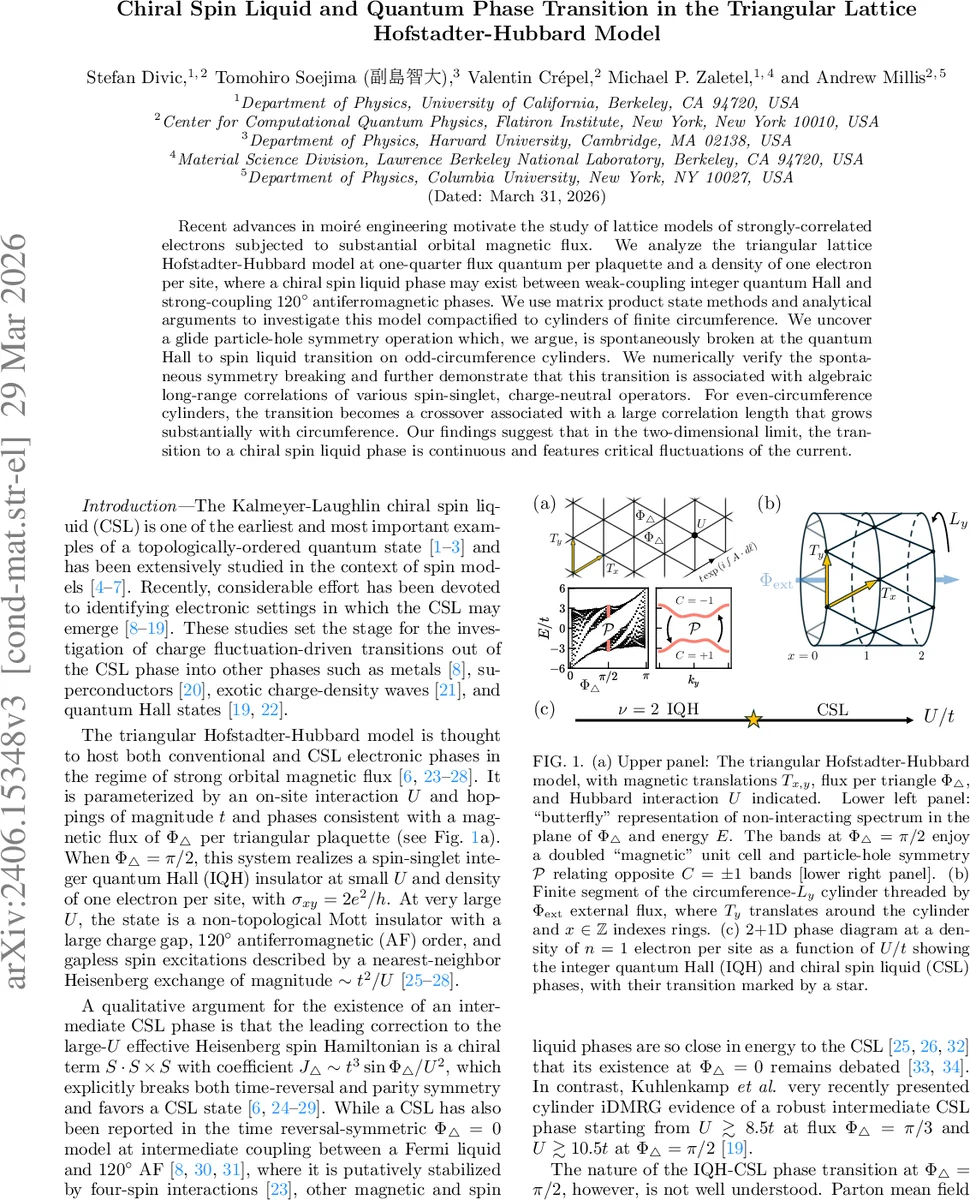
Recent advances in moiré engineering motivate the study of lattice models of strongly-correlated electrons subjected to substantial orbital magnetic flux. We analyze the triangular lattice Hofstadter-Hubbard model at one-quarter flux quantum per plaquette and a density of one electron per site, where a chiral spin liquid phase may exist between weak-coupling integer quantum Hall and strong-coupling 120$^\circ$ antiferromagnetic phases. We use matrix product state methods and analytical arguments to investigate this model compactified to cylinders of finite circumference. We uncover a glide particle-hole symmetry operation which, we argue, is spontaneously broken at the quantum Hall to spin liquid transition on odd-circumference cylinders. We numerically verify the spontaneous symmetry breaking and further demonstrate that this transition is associated with algebraic long-range correlations of various spin-singlet, charge-neutral operators. For even-circumference cylinders, the transition becomes a crossover associated with a large correlation length that grows substantially with circumference. Our findings suggest that in the two-dimensional limit, the transition to a chiral spin liquid phase is continuous and features critical fluctuations of the current.
💡 Research Summary
The paper investigates the triangular‑lattice Hofstadter‑Hubbard model at one‑quarter magnetic flux per triangular plaquette (Φ△ = π/2) and at half‑filling (one electron per site). The Hamiltonian consists of a nearest‑neighbor hopping t with Peierls phases that generate the flux, and an on‑site Hubbard repulsion U. At small U/t the non‑interacting band structure yields a spin‑singlet integer quantum Hall (IQH) insulator with Hall conductance σxy = 2e^2/h, while at large U/t the system becomes a Mott insulator with a 120° antiferromagnetic (AF) order described by an effective Heisenberg model. The leading correction to the Heisenberg exchange is a chiral three‑spin term JΔ ∼ t^3 sinΦ△ / U^2, which explicitly breaks time‑reversal and parity and is expected to stabilize a chiral spin liquid (CSL) at intermediate coupling.
To explore whether such a CSL actually appears, the authors employ infinite density‑matrix renormalization group (iDMRG) with matrix‑product‑state (MPS) representations on cylinders of finite circumference L_y (the length is taken infinite). Both even and odd values of L_y are studied, allowing the authors to probe the role of a newly identified glide particle‑hole symmetry G. G combines a translation along the x‑direction with a particle‑hole transformation; it is an exact symmetry of the model at Φ△ = π/2. The numerical results reveal that on odd‑circumference cylinders G is spontaneously broken at a critical interaction strength U_c/t ≈ 8.5–9.0, whereas on even‑circumference cylinders the symmetry remains intact.
The breaking of G on odd L_y is accompanied by algebraic (power‑law) correlations of spin‑singlet, charge‑neutral operators O_i = ∑{αβ} c†{iα} σ^μ_{αβ} c_{iβ} (μ = x, y, z). The correlation functions decay as ⟨O_i O_j⟩ ∼ |i−j|^{−η} with η ≈ 1.2–1.5, indicating critical fluctuations at the transition. Moreover, the current operator shows long‑range fluctuations, suggesting that the transition is a “current transition” where the emergent gauge flux of the CSL becomes critical. By contrast, for even L_y the same interaction range shows a large but finite correlation length ξ that grows roughly proportionally to L_y, signalling a crossover rather than a true phase transition.
The authors interpret these findings in terms of the effective spin model. The chiral three‑spin term JΔ, maximal at Φ△ = π/2, favors the CSL, while the conventional Heisenberg exchange drives the 120° AF order. The spontaneous breaking of the glide symmetry on odd cylinders is identified with the onset of topological order (C = ±1) in the CSL. The algebraic correlations and the divergent ξ on odd L_y suggest that in the two‑dimensional limit (L_y → ∞) the IQH–CSL transition becomes continuous, with critical current fluctuations governing the universal behavior.
Overall, the work provides strong numerical evidence for an intermediate chiral spin liquid in the triangular Hofstadter‑Hubbard model at quarter flux, clarifies the nature of the IQH–CSL quantum phase transition, and highlights the importance of lattice geometry (even vs. odd circumference) in revealing or obscuring the critical behavior. The results are directly relevant to moiré‑engineered systems where strong orbital magnetic fields and strong correlations coexist, and they suggest experimental signatures such as a change in Hall conductance, emergence of chiral edge modes, and critical spin‑current fluctuations that could be probed by transport or spin‑noise spectroscopy.
Comments & Academic Discussion
Loading comments...
Leave a Comment