Communication-Induced Bifurcation and Collective Dynamics in Power Packet Networks: A Thermodynamic Approach to Information-Constrained Energy Grids
This paper investigates the nonlinear dynamics and phase transitions in power packet network connected with routers, conceptualized as macroscopic information-ratchets. In the emerging paradigm of cyber-physical energy systems, the interplay between …
Authors: Takashi Hikihara
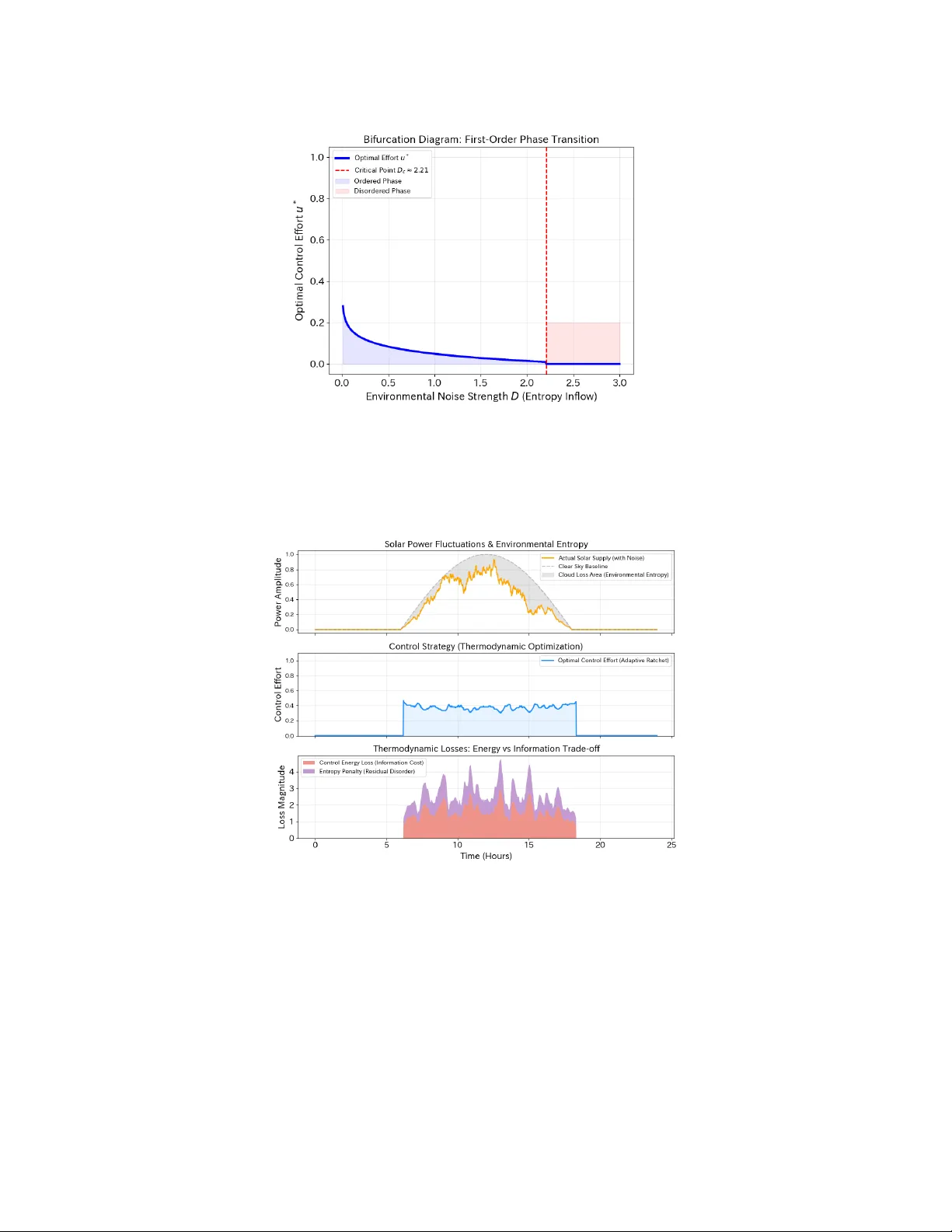
C O M M U N I C A T I O N - I N D U C E D B I F U R C A T I O N A N D C O L L E C T I V E D Y N A M I C S I N P O W E R P A C K E T N E T W O R K S : A T H E R M O DY N A M I C A P P R O A C H T O I N F O R M A T I O N - C O N S T R A I N E D E N E R G Y G R I D S T akashi HIKIHARA Kyoto Uni versity Y oshida-Honmachi, Sakyo, K yoto 606-8501, J AP AN hikihara.takashi.2n@kyoto-u.ac.jp March 31, 2026 A B S T R AC T This paper in vestigates the nonlinear dynamics and phase transitions in po wer packet network connected with routers, conceptualized as macroscopic information-ratchets . In the emerging paradigm of cyber -physical energy systems, the interplay between stochastic energy fluctuations and the thermodynamic cost of control information defines fundamental operational limits. W e first for- mulate the dynamics of a single router using a Langevin framew ork, incorporating an exponential cost function for information acquisition. Our analysis reveals a discontinuous (first-order) phase transition, where the system adopts a strategic abandon of regulation as noise intensity exceeds a critical threshold D c . This transition represents a fundamental information-barrier inherent to au- tonomous ener gy management. Here, we extend this model to network configurations, where mul- tiple routers are linked through dif fusiv e coupling, sharing energy between them. W e demonstrate that the network topology and coupling strength significantly extend the bifurcation points, with col- lectiv e resilient behaviors against local fluctuations. These results provide a rigorous mathematical basis for the design of future complex communication-energy network, suggesting that the stability of proposed systems is governed by the synergistic balance between physical energy flow and the thermodynamics of information exchange. It will serve to design future complex communication- energy netw orks, including internal energy management for autonomous robots. K eywords Power Pack et Networks, Bifurcation, Collectiv e dynamics, Information-Thermodynamics 1 Introduction The rapid expansion of rene wable energy sources introduces intense stochastic fluctuations into the power grid, man- ifesting as an influx of en vironmental entropy . Traditional power systems ha ve maintained stability through margins for physical dissipation, such as mechanical inertia and excessiv e reserve capacity . Howe ver , as the penetration of in- termittent po wer sources rises, these con ventional stabilization methods are f acing their thermodynamic and economic limits. In this context, the power packet network is one of emerged technologies as a promising paradigm, where energy is discretized into pack ets associated with information tags (headers) for autonomous routing. The physics of such a system can be understood through the view of information thermodynamics, especificly as a macroscopic implementation of an information-ratchet. In this framew ork, po wer pack et routers operate as Maxwell’ s Demons, reducing system entropy by acquiring and consuming information to extract ef fectiv e work from stochastic fluctuations. Previous studies [1, 2, 3, 4] have demonstrated the concept of power packet transfer . The further studies rev ealed the fundamental physical limit and relationship to information science [7, 5, 8, 9]. The cost of communication and the increasing entrop y came out for scaling up the netw orks. Unlike idealized theoretical models, real-world com- A P R E P R I N T - M A R C H 3 1 , 2 0 2 6 munication and information processing in po wer packet routers cannot avoid ener gy dissipation due to computational complexity and high-speed po wer switching. In this paper , we propose the concept of Communication-Induced Bifurcation, a phenomenon where the thermody- namic cost of control information triggers a discontinuous phase transition in the system dynamics. W e first obtain a model for single router using a Lange vin equation with an exponential information processing cost. W e clarify that when environmental noise exceeds a critical threshold D c , the system undergoes a strategic abandon by control to av oid catastrophic energy dissipation. Then, we extend the discussion to networked configurations, for demonstrating how collectiv e dynamics and spatial entrop y smoothing through dif fusiv e coupling appear and push these information barriers. The result enhances the resilience of the grid finally . This theoretical framew ork provides a new design principle for future possible information-constrained energy grids, where the ultimate stability is governed by the synergistic balance between physical po wer flo w and the thermodynamics of information exchange. 2 Mathematical F ormulation of Power P acket Networks as Inf ormation Ratchets W e consider the power packet distribution by routers and the network as sho wn in 1. The required information for routing co-exists with the energy pulse within the power packet structure (1(a)). Consequently , the acquisition of this co-transmitted information inevitably imposes a thermodynamic o verhead on the router’ s dynamics. 2.1 Physical Model of P ower Packet Router In a distributed po wer network using po wer packets, a node (router) is defined as a non-equilibrium open system with energy state x ∈ R . Let H ( x t , λ t ) be the Hamiltonian of the system at time t . Here, λ t ∈ { 0 , 1 } is a control parameter representing the packet selecting operation (open/close of a switch) in the router . The dynamics of the input po wer can be expressed by the follo wing Langevin equation, including stochastic fluctuations from the supply side: dx t dt = −∇ H ( x t , λ t ) + √ 2 D ξ ( t ) (1) Here, x denotes the energy storage lev el (buffer energy) within the router , and ˙ x governs the dynamics of the active power flo w . −∇ H ( x t , λ t ) denotes the energy dissipation in router . ξ ( t ) is white noise with mean 0 and variance 1, and D represents the noise intensity (dif fusion coefficient) from the environment, which reflects the intermittency of renewable energy supply depending on weather conditions. In the following discussion, u is the optimized rate of selection of λ i ∈ { 0 , 1 } . The hardware realization of this switching, synchronized with the information tag, was established for bidirectional flows in [9]. 2.2 Information Ratchet Mechanism and Mutual Inf ormation In power packet networks [5, 6, 8, 7, 9], the operation of a router can be understood as an information ratchet, an engineering implementation of Maxwell’ s Demon. The router feedback-controls the switch λ t at appropriate timings based on observations of supply side fluctuations to reduce the system’ s entropy and provide a stable power flow required by the demand side. In this process, the following inequality , an extension of the Sagawa-Ueda relation, holds between the mutual information I obtained from observ ation and the ef fective work W output by the system [10]: ⟨ W ⟩ ≤ − ∆ F + kT ⟨ I ⟩ (2) where ∆ F is the change in free energy . In the power packet network of this study , k T ⟨ I ⟩ on the right side provides the theoretical upper limit for the improv ement of power quality e xtracted by information. 2.3 Exponential Communication and Information Pr ocessing Cost Model In real routers, the acquisition and erasure of information are accompanied by unav oidable energy dissipation. Re- flecting the physical complexity and high-speed switching losses reported in, we model the dissipation cost Φ( u, D ) for maintaining control effort u ∈ [0 , 1] as: Φ( u, D ) = κ · D · (exp( β u ) − 1) (3) In this equation, the coefficient β represents the computational complexity required to maintain the system’ s demand response, and κ represents the dissipation constant per unit noise. In particular , the characteristic that the cost increases exponentially relativ e to the product of D and u becomes a physical factor that limits information in high-noise en vironments. 2 A P R E P R I N T - M A R C H 3 1 , 2 0 2 6 (a) Input Output C Switch Switch Ground (b) Source 1 Source M Mixer Router Router Router Router Router Demand 1 Demand N Input Output Multi Agent (c) Figure 1: Concept of power packet and its physical modeling as an information-ratchet. (a) Structure of a power packet, where the information payload (header and footer) is physically integrated and transmitted simultaneously with the energy unit. (b) Schematic of a power packet router , which operates as a Maxwell’ s demon by processing the integrated information to regulate stochastic energy flows. (c) Equiv alent dynamical model under information- constrained feedback. The control input u is determined by the information co-transmitted with the packet, incurring a thermodynamic cost Φ( u ) that acts as a nonlinear feedback to the Lange vin dynamics. 2.4 Definition of System Evaluation Function T o inte grally ev aluate the quantity of energy , its entropic quality , and the inf ormation cost , we introduce the follow- ing ev aluation function J : J ( u ) = α · G ( u ) − Φ( u, D ) − T ∆ S (4) Here, G ( u ) = 1 − exp( − γ u ) is the gain function for satisfying demand through control, α is the market or physical value of energy quality , and T ∆ S is the loss penalty due to residual entropy . Searching for the u ∗ that maximizes J ( u ) reduces to a thermodynamic optimization problem in po wer packet networks. Note that all terms in the objectiv e function J ( u ) , including the control gain and the information cost Φ , are defined in terms of ener gy rates (W atts, J /s ) to ensure dimensional consistency with the po wer flow dynamics ˙ x . 3 Numerical Calculation Algorithm and Optimization Process In this report, we sequentially determine the control amount u ∗ ( t ) that maximizes the net ev aluation value J of the system under dynamically changing en vironmental noise D ( t ) . T o maximize J ( u ) under a non-stationary en vironment D ( t ) , the follo wing steps are executed sequentially: 3.1 Sequential Estimation Algorithm for En vironmental Noise The router observes input po wer fluctuations in real time and estimates the local noise intensity (diffusion coef ficient) D ( t ) . At discrete time steps ∆ t , the following moving av erage is calculated based on the differences in the observed 3 A P R E P R I N T - M A R C H 3 1 , 2 0 2 6 energy state x : ˆ D ( t ) = 1 2∆ t [ x ( κ ) − x ( κ − 1)] 2 W (5) where ⟨·⟩ W represents the sample average over a time windo w of length W . This estimated value ˆ D serves as a parameter for the optimization in the next section. 3.2 Maximization of Thermodynamic Evaluation Function At each sampling time, the following nonlinear optimization problem is solv ed: u ∗ ( t ) = arg max u ∈ [0 , 1] n αG ( u ) − κ ˆ D ( t )( e β u − 1) − T ∆ S ( u ) o (6) 3.3 Physical Mapping of Contr ol Parameters The optimized u ∗ ( t ) is con verted into the switching operation of a physical power packet router . Packet generation is considered to be the discretization of input energy into constant quanta ∆ E . The duty ratio of the switch can be con verted from the calculated u ∗ into the operating rate (effecti ve packet selection rate) of the unidirectional switch corresponding to the ratchet pa wl. Dissipation corresponds to subtracting the actually consumed computational energy Φ( u ∗ , ˆ D ) from the system’ s state variables. 4 Numerical Experimental Results and Physical Considerations 4.1 Setting the Randomness of Pseudo-Solar Output In this section, we verify the effecti veness of the proposed optimization algorithm. Input power is giv en stochastic intermittency by a stochastic process modeling solar power generation. White noise with variance D ( t ) is superim- posed on a steady expected output, and this D ( t ) is used as a control parameter defining the en vironmental randomness (entropy influx intensity) to scan the response. As shown in Fig. 2, increasing the control amount u causes the gain for meeting demand response to saturate, while the information processing cost increases exponentially . From these asymmetric physical characteristics, it is clear that an optimal solution u ∗ exists for the system that balances energy reserves with entropic quality . 4.2 A utonomous Adaptation to En vironmental Noise Fig. 3 shows the change in the profile of the system ev aluation function J as the environmental noise intensity D ( t ) changes. As noise intensity increases, the peak (optimal point) of the ev aluation function curve shifts continuously to Figure 2: Thermodynamic trade-off between energy and information. Profile of the system ev aluation function J (thick blue line) against control amount u . While the gain for satisfying demand response (dotted green line) saturates, the information processing cost (dotted red line) increases exponentially . It is shown that the global optimal solution u ∗ (dotted yellow line) is obtained in a re gion where energy and entropy are balanced. 4 A P R E P R I N T - M A R C H 3 1 , 2 0 2 6 the lower side (left). This quantitatively represents the behavior where, as the environment becomes rougher , the cost of information to satisfy demand jumps, and the system autonomously relaxes control to suppress energy consumption. Figure 3: Autonomous adaptation of control to environmental noise. Showing the change in ev aluation function J with increasing environmental noise intensity D ( t ) . As noise becomes more severe, dissipation costs associated with information processing become dominant, and the system autonomously shifts u ∗ to the low-output side to av oid excessi ve ener gy consumption. 4.3 Analysis of Discontinuous Phase T ransition at Critical Noise D c This section analyzes the communication-induced bifurcation, where the thermodynamic cost of information exchange triggers a discontinuous transition. As environmental noise D ( t ) increases, a discontinuous transition occurs in the control response. As the bifurcation diagram in Fig. 4 sho ws, the moment the noise intensity reaches a critical value D c ≈ 2 . 21 , the optimal control effort u ∗ jumps discontinuously from a finite v alue (approx. 0.01) to 0. In the ordered phase ( D < D c ) before reaching the critical point, the system functions as Maxwell’ s Demon, actively continuing to flo w packets in one direction. This is because the gain obtained for satisfying demand exceeds the exponential dissipation cost associated with information processing. Howe ver , when noise D ( t ) e xceeds the critical value D c , the maximum of the ev aluation function J ( u ) disappears, or the e v aluation v alue of information f alls belo w the e valuation function at the origin, resulting in thermodynamic failure. At this time, the system enters an autonomous suppression operation, transitioning to a state that preserves stored energy to avoid self-destruction due to excessiv e dissipation. The dissipation corresponds to energy loss for information re writing and erasure and power switching. The phase transition stems from a nonlinear trade-off between the cost of acquiring information and the gains of establishing order . At low noise D , the rectifying fluctuations is advantages to the information cost. As the cost Φ grows exponentially with D ( t ) and u , the overhead of control becomes greater than the resulting ener gy benefits at a crossov er point D c , where further control is stopped because of the disadvantage. 4.4 Thermodynamic Superiority of the Proposed Contr ol Method The proposed adaptiv e control is applied to the dynamic optimization and loss decomposition under pseudo-solar supply in Fig. 4, which corresponds to the dynamic control reduction in the adapti ve strategy (Fig. 5 (Middle)) . The drop in control amount observed at the noise peak physically demonstrates the emergence of a discontinuous phase transition (first-order phase transition) due to thermodynamic adaptation in harsh en vironments. In con ventional control, information costs increase exponentially under high noise, causing the system’ s ev aluation function J to fall into a negati ve region, which is a region where control becomes counterproductive. In contrast, the proposed adaptiv e ratchet treats the critical point D c as a physical limit, dynamically adjusting information consump- tion and reducing the burden in harsh en vironments to maximize operational feasibility . 5 A P R E P R I N T - M A R C H 3 1 , 2 0 2 6 Figure 4: Bifurcation diagram of discontinuous phase transition. Showing a discontinuous (first-order) phase transition where u ∗ drops vertically to 0 the moment noise D ( t ) exceeds the critical value D c . At the critical value D c ≈ 2 . 21 , the system shifts discontinuously from an ordered phase to a disordered phase. This corresponds to a state where the system autonomously abandons control to provide thermodynamic suppression because the dissipation cost of information has ov erwhelmed the gain of order formation. Figure 5: Dynamic optimization and loss decomposition under pseudo-solar supply by adapti ve control strate gy under communication constraints. (T op) Fluctuations in pseudo-solar output and the resulting transition of environmental entropy influx intensity . (Middle) Real-time transition of optimal control effort u ∗ (adaptiv e ratchet) according to estimated noise intensity . (Bottom) Stacked chart showing the dynamic balance between energy dissipation due to information processing (red) and quality loss due to residual entropy (purple). 5 Cooperative Beha vior in Multi-Agent Systems 5.1 Network Model with Diffusion Coupling Having shown the bifurcation behavior of a single router, this section e xtends the system to multiple routers exchanging packets between adjacent nodes. For the energy balance of node i , a dif fusion coupling term using a coupling constant 6 A P R E P R I N T - M A R C H 3 1 , 2 0 2 6 g with the set of adjacent nodes N i is introduced: dx i dt = f ( x i , λ i ) + g X j ∈ N i ( x j − x i ) + p 2 D i ξ i ( t ) (7) where f ( x i , λ i ) represents the deterministic contribution based on the previously mentioned Hamiltonian. The cou- pling constant g represents the communication-induced energy sharing, which depends on x j − x i . It spatially dissi- pates energy and entrop y from high-noise nodes to low-noise nodes. 5.2 Extension of Critical Points as a Collecti ve Phenomenon The discontinuous phase transition identified in the single node represents the thermodynamic limit when operating routers independently . Ho wev er , in the multi-agent network proposed in this paper, energy and entropy are shared between adjacent nodes, making it possible to dynamically e xtend this critical point D c . An entropy smoothing effect arises due to the netw ork topology; nodes e xposed to locally intense noise distribute the ef fecti ve load to adjacent lo w- noise nodes via dif fusion coupling g . This interaction spatially relaxes the information barriers faced by individual nodes, pushing the single-node critical point D c,sing le to a higher noise intensity D c,networ k and triggering collectiv e phenomena. Fig. 6 shows the simulation results for the transition of stored energy in the routers. It is observed that collectiv e order maintenance is clearly emerging. Even in high-noise regions where indi vidual nodes would be forced to sup- press control, the y operate cooperati vely through coupling, maintaining a low-entrop y state for the system as a whole. This clarifies that the power packet network goes beyond a simple physical transmission infrastructure to share in- formation dissipation costs and collecti vely maintain order , emerging as a collective function in terms of information thermodynamics. Figure 6: Autonomous decentralized po wer pack et exchange and spatial smoothing of entropy in multi-agent systems. It sures a collectiv e resilience emerging from networked communication. In a networked fiv e routers with diffusion coupling g , the transition of stored energy in buf fer for each node is obtained. Sudden supply fluctuations (entropy influx) occurring at specific nodes are distributed and shared across the entire network through autonomous packet exchange between adjacent nodes. This collective phenomenon suppresses the risk of indi vidual nodes reaching the information critical point and abandoning control, which implies phase transition, thereby expanding the operating range. 6 Discussion Furthermore, the relationship between the noise intensity D and the control input u suggests an important extension of the fluctuation-dissipation theorem (FDT) within this information-ratchet framework. In con ventional physical systems, FDT reveals the spontaneous fluctuations of a system to its linear response through temperature T . In our model, the en vironmental noise D behaves as an effecti ve temperature. W e introduced the information processing cost Φ( u, D ) which represents a computational dissipation and in not considered in classical passiv e systems. The emergence of the critical point D c can be interpreted as a breakdown point of the steady-state balance between energy extraction and this information-induced dissipation. This formulation provides a perspective on how the generalized 7 A P R E P R I N T - M A R C H 3 1 , 2 0 2 6 second law of thermodynamics governs the operational limits of cyber -physical systems. It will be the way for a unified variational principle for netw orked information-thermodynamic system. 7 Conclusion This report redefines the physical essence of energy transport in distributed power networks using po wer packets as an information-ratchet mechanism from the perspecti ve of non-equilibrium statistical mechanics. W e formulated the process where the stochastic fluctuations of the supply side, accompanying the expansion of renew able energy , are treated as en vironmental entropy influx, which power packet routers control through the acquisition and consumption of information [11]. Through numerical experiments, it was clarified that an unavoidable thermodynamic trade-off exists between the quantity of energy and its entropic quality via information processing costs. As Fig. 2 shows, while the gain for satisfying orders saturates, the dissipation cost associated with information processing increases exponentially , which can act as a ph ysical barrier . This re veals that fix ed stabilization does not necessarily maximize the system’ s e valuation function and that information-thermodynamic constraints arise. Furthermore, it was clarified that a discontinuous phase transition, first-order phase transition, occurs when en viron- mental noise intensity exceeds a critical value D c . T o prev ent the free energy from falling into the negativ e under harsh fluctuations, the system chooses to autonomously abandon control and minimize dissipation; thus, the dynamic reduction in control amount observed at noise peaks in Fig. 5 can be a thermodynamically honest adaptation. Finally , confirmed ef fects of diffusion coupling in multi-agent systems showed that spatial smoothing of entropy by network topology pushes up individual critical points and generates collecti ve phenomena for the whole system. W e clarify that J ( u ) serves as a generalized potential that incorporates the rate of free energy change and informa- tion flow within the framew ork of non-equilibrium thermodynamics. Then, we will add a discussion regarding the prospectiv e generalization of this theory , specifically its reduction to a variational principle. It indicates a potential paradigm shift in the design of power networks from con ventional stabilization relying on physical mar gins to thermo- dynamic optimization based on information. In po wer packet networks that guide energy by consuming information, power packet routers demonstrate the behavior of Maxwell’ s Demon through the process of entropy reduction. This framew ork is particularly relev ant for the internal ener gy management of autonomous robots, in which communication bandwidth and energy reserv es are strictly constrained. References [1] J. T oyoda and H. Saitoh, Proposal of an Open-Electric-Energy-Network (OEEN) to Realize Cooperative Opera- tions of IOU and IPP , Pr oceedings of 1998 International Confer ence on Ener gy Management and P ower Delivery (EMPD’98)) , 1, 218 (1998). [2] T . T akuno, M. Ko yama, T . Hikihara, In-home Po wer Distribution Systems by Circuit Switching and Po wer Packet Dispatching, 1st IEEE Int. Conf. on Smart Grid Communications, 427-430 (2010). [3] R. Abe, H. T aoka and D. McQuilkin, Digital Grid: Communicativ e Electrical Grids of the Future, IEEE T rans. Smart Grid, 2, 399 (2011). [4] E. Gelenbe, Ener gy Pack et Networks: Adapti ve Ener gy Management for the Cloud, Pr oceedings of 2nd Interna- tional W orkshop on Cloud Computing Platforms , 1 (2012). [5] R. T akahashi, K. T ashiro, and T . Hikihara, Router for Po wer Packet Distrib ution Network: Design and Experi- mental V erification, IEEE T ransactions on Smart Grid, 6, 2, 618 (2015). [6] H. Sugiyama, Pulsed Power Network Based on Decentralized Intelligence for Reliable and Lowloss Electrical Power Distrib ution, J. Artif. Intell. Soft Comput. Res., 5 (2), 97 (2015). [7] S. Naw ata, A. Maki, and T . Hikihara, Po wer packet transferability via symbol propagation matrix, Proceedings of The Royal Society A, 474(2213) (2018). [8] S. Katayama and T . Hikihara, Power Packet Router with Power and Signal Switches for a Single Power Packet, IEEE T rans. on CAS II: Express Briefs, 67(12), 3242 (2020). [9] S. Mochiyama, K. Hiwatashi and T . Hikihara, Upstream Allocation of Bidirectional Load Demand by Power Packetization, Int. J. Circ. Theor . Appl., 53, 12, 6846 (2025). [10] T . Saga wa and M. Ueda, Second Law of Thermodynamics with Discrete Quantum Feedback Control, Phys. Re v . Lett. 100, 080403 (2008). 8 A P R E P R I N T - M A R C H 3 1 , 2 0 2 6 [11] S. Inagaki, S. Mochiyama and T . Hikihara, Electric po wer processingusing logic operation and error correction, Royal Society Open Science, 8, 7, 8202344 (2021). 9
Original Paper
Loading high-quality paper...
Comments & Academic Discussion
Loading comments...
Leave a Comment