Free modules with isomorphic duals
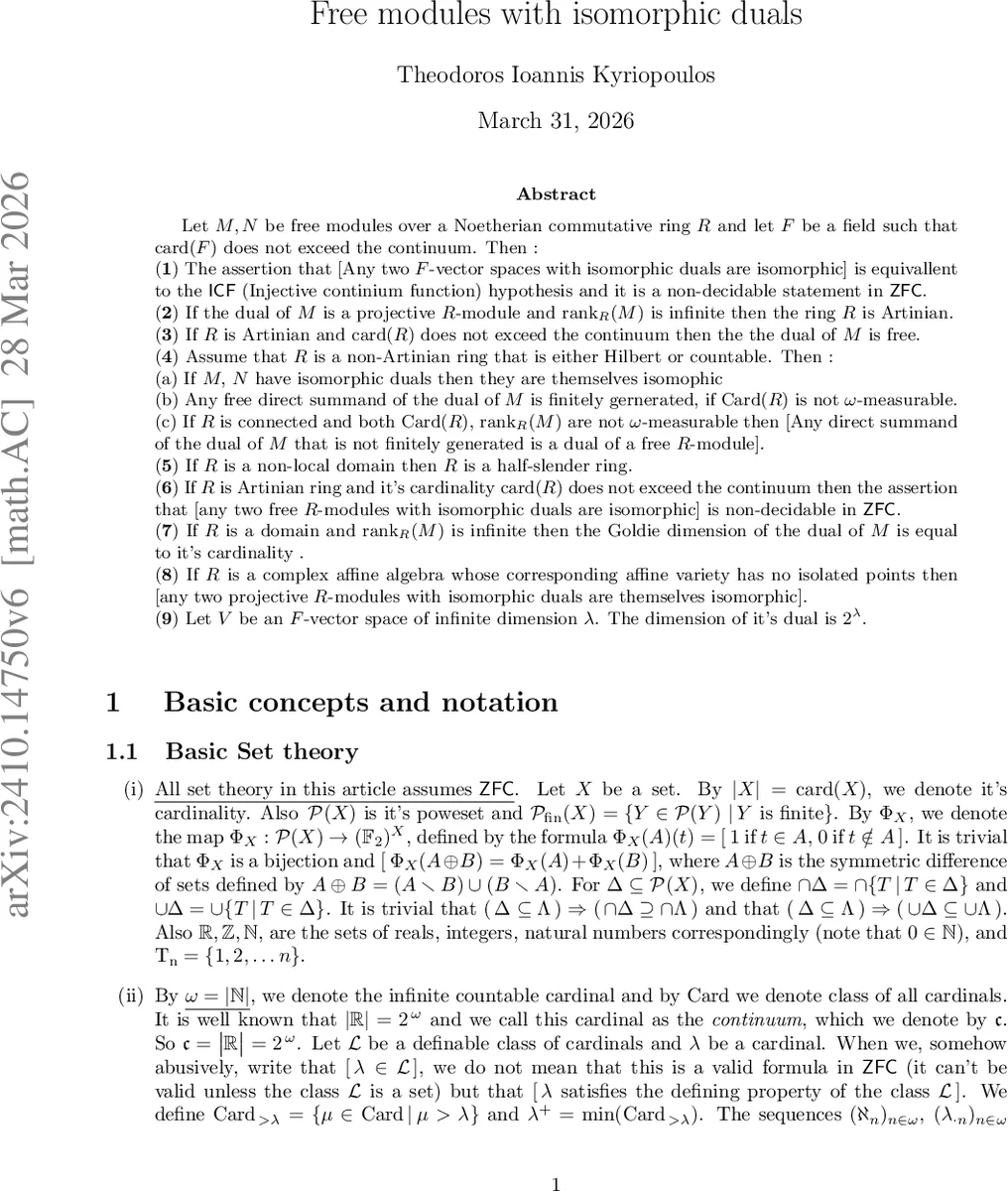
Let M, N be free modules over a Noetherian commutative ring R and let F be a field such that card(F) does not exceed the continuum. Then : (1) The assertion that [Any two F-vector spaces with isomorphic duals are isomorphic] is equivallent to the ICF (Injective continium function) hypothesis and it is a non-decidable statement in ZFC. (2) If the dual of M is a projective R-module and rank(M) is infinite then the ring R is Artinian. (3) If R is Artinian and card(R) does not exceed the continuum then the the dual of M is free. (4) Assume that R is a non-Artinian ring that is either Hilbert or countable. Then : (a) If M, N have isomorphic duals then they are themselves isomorphic (b) Any free direct summand of the dual of M is finitely generated, if Card(R) is not omega-measurable. (c) If R is connected and both Card(R), rank(M) are not omega-measurable then [Any direct summand of the dual of M that is not finitely generated is a dual of a free R-module]. (5) If R is a non-local domain then R is a half-slender ring. (6) If R is Artinian ring and it’s cardinality card(R) does not exceed the continuum then the assertion that [any two free R-modules with isomorphic duals are isomorphic] is non-decidable in ZFC. (7) If R is a domain and rank(M) is infinite then the Goldie dimension of the dual of M is equal to it’s cardinality . (8) If R is a complex affine algebra whose corresponding affine variety has no isolated points then [any two projective R-modules with isomorphic duals are themselves isomorphic]. (9) Let V be an F-vector space of infinite dimension . The dimension of it’s dual is cardinality of the powerset of the the dimension of V.
💡 Research Summary
The paper investigates the relationship between free modules over a Noetherian commutative ring R and the isomorphism types of their duals. The central question is whether two free R‑modules M and N must be isomorphic whenever their duals M* = Hom_R(M,R) and N* are isomorphic as ˆR‑modules. The author explores this problem under a variety of algebraic and set‑theoretic hypotheses, producing a list of nine statements that together paint a nuanced picture of when dual‑isomorphism forces module‑isomorphism and when it does not.
-
Vector‑space case and the ICF hypothesis.
For any field F with |F| not exceeding the continuum 𝔠, the assertion “any two F‑vector spaces with isomorphic duals are isomorphic” is shown to be equivalent to the Injective Continuum Function (ICF) hypothesis. The paper proves that this statement is undecidable in ZFC, i.e., it can neither be proved nor refuted without adding extra set‑theoretic axioms such as the Continuum Hypothesis. -
Projective duals force Artinianity.
If the dual M* of a free module M is a projective R‑module and rank(M) is infinite, then R must be Artinian. The proof uses the fact that a projective dual of an infinite‑rank free module forces the ring to satisfy descending chain conditions on ideals. -
Artinian rings with small cardinality give free duals.
Conversely, if R is Artinian and |R| ≤ 𝔠, then the dual of any free module is itself free. This result relies on the structure theorem for modules over Artinian rings and on the fact that over such rings every projective module is free. -
Non‑Artinian rings that are Hilbert or countable.
Assuming R is non‑Artinian but either Hilbert (every finitely generated submodule is finitely presented) or countable, three finer statements hold:
(a) Dual‑isomorphism implies module‑isomorphism.
(b) Any free direct summand of M* is finitely generated provided |R| is not ω‑measurable.
(c) If R is connected and both |R| and rank(M) are not ω‑measurable, then every non‑finitely‑generated direct summand of M* is itself the dual of a free R‑module.
The notions of ω‑measurability refer to the existence of ω‑complete non‑principal ultrafilters, a large‑cardinal condition that influences the structure of direct summands. -
Half‑slender domains.
If R is a non‑local domain, the paper proves that R is “half‑slender”: any homomorphism from a countable direct sum of copies of R into a slender module is forced to factor through a finite sub‑sum. This is a weakening of the classical slender property and is derived from the behavior of duals in the non‑local setting. -
Undecidability for free modules over Artinian rings.
Mirroring statement (1), the claim “any two free R‑modules with isomorphic duals are isomorphic” is shown to be undecidable in ZFC when R is Artinian and |R| ≤ 𝔠. The proof adapts the ICF argument to the module‑theoretic context. -
Goldie dimension of duals.
For a domain R and a free module M of infinite rank, the Goldie dimension of M* equals its cardinality. This shows that the dual of an infinite‑rank free module is “maximally non‑uniform” in the sense of having the largest possible uniform dimension. -
Geometric application to complex affine algebras.
If R is a complex affine algebra whose associated affine variety has no isolated points, then any two projective R‑modules with isomorphic duals are themselves isomorphic. The proof uses the fact that the absence of isolated points forces projective modules to be determined by their duals via global sections of the structure sheaf. -
Dimension of the dual of an infinite‑dimensional vector space.
Finally, the classical result is restated: for an F‑vector space V of infinite dimension λ, dim V* = 2^λ. This underlines the exponential growth of dual dimensions and connects back to statement (1).
Overall, the paper intertwines module theory, ring theory, and set theory. It demonstrates that the simple‑looking question about duals is deeply sensitive to cardinal invariants of the base ring, to large‑cardinal hypotheses (ω‑measurability), and to foundational set‑theoretic principles such as the Continuum Hypothesis. The results suggest new avenues: exploring other classes of rings (e.g., Prüfer domains), investigating the impact of stronger large‑cardinal axioms, and applying the dual‑isomorphism principle to geometric contexts where the spectrum of the ring has prescribed topological properties.
Comments & Academic Discussion
Loading comments...
Leave a Comment