Surfaces without quasi-isometric simplicial triangulations
We construct a complete Riemannian surface $Σ$ that admits no triangulation $G\subset Σ$ such that the inclusion $G^{(1)} \hookrightarrow Σ$ is a quasi-isometry, where $G^{(1)}$ is the simplicial 1-skeleton of $G$. Our construction is without boundar…
Authors: James Davies
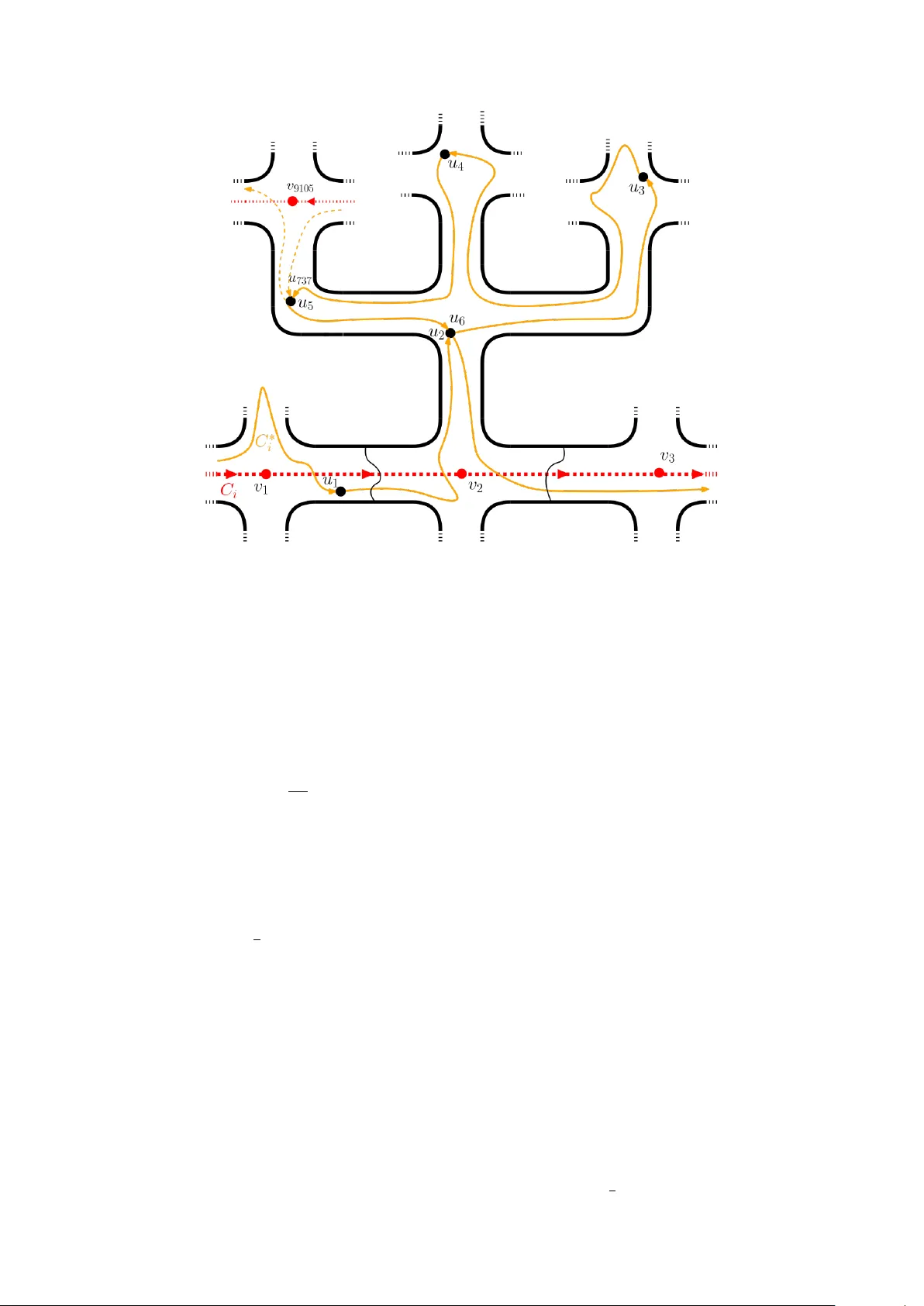
Surfaces without quasi-isometric simplicial triangulations James Davies ∗ Leipzig University , Germany Abstract W e construct a complete Riemannian surface Σ that admits no triangulation G ⊂ Σ such that the inclusion G (1) , → Σ is a quasi-isometry , where G (1) is the simplicial 1- skeleton of G . Our construction is without b oundary , has arbitrarily large systole, and furthermore, there is no embedde d graph G ⊂ Σ such that G (1) , → Σ is a quasi-isometry . This answers a question of Georgakopoulos. 1 Introduction It is w ell known that for ev er y complete Riemannian surface Σ , there is a locally nite metric graph G ⊂ Σ whose metric is induced by Σ and so that the inclusion map G → Σ is a quasi- isometry [ 1 , 4 , 5 , 9 , 17 , 19 ]. In fact, Ntalampekos and Romney [ 17 ] showed that G ⊂ Σ can even be chosen so that G → Σ is a (1 , ) -quasi-isometr y for any > 0 and Ge orgakopoulos and Vigolo [ 9 ] recently showed that G ⊂ Σ can furthermore also be taken to b e a triangulation of Σ . In other words, the coarse geometry of Riemannian surfaces can be approximated arbitrarily well by metric graphs triangulating the surface. Such results or similar have se en a numb er of applications. For instance, Bonamy , Bous- quet, Esperet, Groenland, Liu, Pirot, and Scott [ 1 ] use d this to prove that complete Riemannian surfaces of bounded genus have asymptotic dimension at most 2. Maillot [ 15 ] used a similar result in his proof that virtual surface groups are e xactly the groups quasi-isometric to a com- plete simply-connecte d Riemannian surfaces. Ntalampekos and Romney [ 17 ] use d a version for length surfaces as a step in their proof that any length surface is the Gromov–Hausdor limit of polyhedral surfaces with controlled ge ometry . They gave further applications of this including a new proof of the Bonk-Kleiner theorem [ 2 ] characterizing Ahlfors 2-regular qua- sispheres. The coarse geometr y of metric graphs tends to be much more complicated and harder to work with than that of simplicial graphs (where all e dge lengths are equal to 1). For in- stance, one can compare the proofs that minor-free (simplicial) graphs [ 1 ] and minor-free metric graphs [ 13 ] have asymptotic dimension at most 2. So, it is ther efore desirable to deter- mine when metric graphs with particular properties are quasi-isometric to simplicial graphs with analogous properties. Such a the orem has been prov en for planar metric graphs [ 6 ] and very recently for minor-free metric graphs [ 7 ]. ∗ The author was supported by the Alexander von Humb oldt Foundation in the framework of the Alexander von Humboldt Professorship of Daniel Kráľ endowed by the Federal Ministry of Education and Research. 1 Georgakopoulos [ 11 ] aske d if these results for Riemannian surfaces on quasi-isometric em- bedde d metric graphs [ 1 , 4 , 5 , 9 , 17 , 19 ] could be improved so that there is some emb edded graph or ev en triangulation G ⊂ Σ such that G (1) → Σ is a quasi-isometr y , wher e G (1) is the simpli- cial 1-skeleton of G . Recently , Ge orgakopoulos and Vigolo [ 9 ] proved that complete Rieman- nian surfaces with uniform nets admit such quasi-isometric simplicial triangulations, which improv e d on some similar results of Maillot [ 15 ]. Answ ering a question of Georgakop oulos and Papasoglu [ 10 ], the author recently proved that complete Riemannian surfaces of bounde d genus have such simplicial triangulations [ 6 ]. Bowditch [ 3 ] also proved that complete smooth n -dimensional Riemannian manifolds of bounded ge ometry admit quasi-isometric simplicial triangulations. In this paper we answer Georgakopoulos’s [ 11 ] question in the negative. Theorem 1. There is a complete Riemannian surface Σ with no triangulation G ⊂ Σ such that G (1) → Σ is a quasi-isometr y . Our constructed surfaces are without boundar y and have arbitrarily large systole (the min- imum length of a non-contractible loop). In other words, the surfaces can b e taken to b e ar- bitrarily locally planar . This is perhaps surprising as it contrasts with the fact that complete Riemannian planes do admit quasi-isometric simplicial triangulations [ 6 ]. Furthermore, our construction shows that there is no such embe dded graph G ⊂ Σ , rather than just no such triangulation. So, the strongest version of our result is as follo ws. Theorem 2. For every K ⩾ 0 , there exists a complete Riemannian surface Σ without b oundary , with systole at least K , and with no embedde d graph G ⊂ Σ such that G (1) → Σ is a quasi- isometry . Since complete Riemannian surfaces do admit quasi-isometric triangulations by metric graphs [ 9 ] ( or even just have quasi-isometric emb edded graphs [ 1 , 4 , 5 , 9 , 17 , 19 ]), these results are also another go od demonstration of how the coarse structur e of metric graphs tends to be more complex than that of simplicial graphs. T o prove The orem 2, we will actually prove a version that for any xed M , A gives compact Riemannian surfaces of bounded genus that have no such ( M , A ) -quasi-isometry (see Theo- rem 4). In Section 3 we discuss the resulting b ounds on the genus of the surfaces constructed in Theorem 4 in comparison with the results of [ 6 ] that bounded genus complete Rieman- nian surfaces do admit quasi-isometric simplicial triangulations. In the next section, we pr ove Theorem 2. 2 Proof Before pro ving The orem 2, we intr o duce some necessary preliminaries. For M , A ⩾ 0 with M ⩾ 1 , an ( M , A ) -quasi-isometr y from a metric space X to another metric space Y is a map f : X → Y such that 1. M − 1 d X ( u, v ) − A ⩽ d Y ( f ( u ) , f ( v )) ⩽ M d X ( u, v ) + A for every u, v ∈ X , and 2. for every y ∈ Y , there exists some x ∈ X with d Y ( y , f ( x )) ⩽ A . W e say that X is ( M , A ) -quasi-isometric to Y if there exists an ( M , A ) -quasi-isometr y from X to Y . A quasi-isometr y is just a ( M , A ) -quasi-isometr y for some M , A ⩾ 0 with M ⩾ 1 , and we say that tw o metric spaces X and Y are quasi-isometric if there is a quasi-isometry between X and Y . 2 A Riemannian surface is a surface Σ together with a Riemannian metric d Σ dened by a scalar product on the tangent space of ev er y point. A Riemannian surface Σ is complete if the metric space (Σ , d Σ ) is complete. Note that compact Riemannian surfaces are also com- plete. The systole of a Riemannian surface is equal to the inmum of the lengths of its non- contractible loops. For more on Riemannian surfaces, see [ 20 ]. In our construction we shall start by constructing some surface and then cho ose some suit- able (Riemannian) metric on the surface. W e give a sketch of a standard way of constructing a Riemannian surface starting with a smooth surface Σ and a lo cally nite triangulation of H ⊂ Σ by a metric graph H such that for each triangular face, the length of the longest side is less than the sum of the other two sides. This will just be one way to se e in the proof of Theorem 2 that the metric we choose can further b e chosen to b e a Riemannian metric. Such smoothing arguments are standard appear for instance in [ 18 ]. From such a locally nite triangulation H ⊂ Σ , one can equip each triangular face with the standard Euclidean metric on the triangle with sides of length equal to that of the triangular face. This gives a complete piecewise Euclidean metric d E on Σ , which is singular only at vertices of H . Then for each verte x v of H , we can choose some 0 < v < 1 so that the closed disk E v around v of radius v is contained in the Euclidean triangles incident to v and so that v is less than half the length of any e dge incident to v . This ensures that the disks are pair wise disjoint. Then, each such disk can b e r eplace d with a Euclidean disk D v whose boundary is of equal length to that of E v and is attached isometrically along the b oundary of E v . Finally , each of these boundaries can be smoothe d to obtain a quasi-isometric Riemannian metric d Σ . For any given > 0 , we can make this a (1 , ) -quasi-isometr y by cho osing each v to be suciently small. W e require some more graph theoretic notation. W e denote the vertex set of a graph G by V ( G ) . For a vertex u of a graph G , we let N G ( u ) denote the neighb ourhood of u in G (the vertices of G adjacent to u ). For a set of vertices A of a graph G and a positive real t , we let N t G [ A ] be the vertices at distance at most t from A in G . If A = { u } , then we simply use N t G [ u ] . W e denote the v ertex set of a graph G by V ( G ) . T o construct the Riemannian surfaces as in The orem 2, we require some nite graphs with useful properties that will embe d naturally into our constructe d surface. The girth of a graph is equal to the length of its shortest cycle . A graph is k -regular if every verte x of G has degree k . W e require nite 4-regular graphs of large girth as constructed (probabilistically) by Erdős and Sachs [ 8 ]. For explicit constructions, see [ 14 , 16 ]. Theorem 3 (Erdős, Sachs [ 8 ]) . There exists nite 4-regular graphs with arbitrarily large girth. W e are now ready to pr ove a version of Theorem 2 with xed constants in the considered quasi-isometry . In this case, we actually construct compact bounded genus surfaces as will be discussed further in Section 3. Theorem 4. For every triple of non-negative reals K, M , A with M ⩾ 1 , there exists a compact Riemannian surface Σ without boundar y , of bounded genus, with systole at least K , and with no embedde d graph G ⊂ Σ such that G (1) → Σ is a ( M , A ) -quasi-isometry . Proof. Fix K ⩾ M ⩾ A ⩾ 1 , and set = 1 / (33 M 2 ) , and g = 3400 M 5 K . Let F be some nite conne cted 4-regular (simplicial) graph of girth at least g as given by Theorem 3. Since F is 4-regular , it is Eulerian, and is ther efore the union of some collection of edge-disjoint cycles C 1 , . . . , C k . Note that every vertex v of F is contained in exactly two of these cycles, say C v and C ′ v . Now , take a 2-cell embedding of F into some smo oth surface Σ such that for ev er y vertex v of F , the two cy cles C v and C ′ v cross at v in the embe dding (note 3 Figure 1: The emb edded graph F consists of the dashed edges and the b oundary of D is the thick black edges around F . For the centre vertex v , we illustrate the two cycles C v and C ′ v of the Eulerian de composition that cross at v in red and blue . Also featured are the curves ρ e 1 , ρ e 2 , ρ e 3 , ρ e 4 crossing their corresponding edges incident to v . T ogether with part of the boundar y of D , they bound the subset D ( v ) of D , which is purple in the gure. that such a surface and embe dding can b e found by rst xing such a clockwise ordering of incident edges for each verte x, and then adding in 2-cells to create the faces). Note that Σ has bounded genus and is compact since F is a nite graph with a 2-cell embedding into Σ . W e remark that Σ is also orientable. W e still need to choose a Riemannian metric d on Σ . Now we take some small neighbourhood D ⊂ Σ ar ound F in the embedding so that each face of F in the emb edding contains one of the b oundary components of D . For each edge e of F , we draw a curve ρ e in Σ between boundar y points of D near the midpoint of e and crossing e as in Figure 1. For each vertex v of F , we let D ( v ) be the subset of D containing v and bounde d by a subset of the boundar y of D and ρ e 1 ∪ ρ e 2 ∪ ρ e 3 ∪ ρ e 4 , where e 1 , e 2 , e 3 , e 4 are the four e dges of F incident to F (see Figur e 1 for an illustration). More generally , for X ⊆ V ( F ) , we let D ( X ) = S x ∈ X D ( x ) . Choose some Riemannian metric d on Σ such that • for each edge uv of F , its ends u and v in the emb edding are at distance between / 2 and in Σ , • the distance between F (in its embe dding in Σ ) and the boundar y of D is greater than both K and 12 M 3 , and • for ev er y v ∈ V ( F ) and r ⩾ 0 , the p oints of D at distance at most r from v in Σ are contained in D ( N 1+ r/ϵ F [ v ]) . Such a Riemannian metric d on Σ can be chosen by starting with a suitable triangulation of Σ by a metric H such that F ⊂ H ⊂ Σ (wher e the edges of F have length slightly less than in H ) and smoothing the resulting piecewise Euclidean metric as discussed. Clearly Σ has systole at least K with this choice of Riemannian metric since F is a 2-cell emb edding of Σ and F has girth at least 3400 M 5 K ⩾ 100 M 3 K/ . 4 Figure 2: An illustration of (tw o parts of ) the of closed walk C ∗ i (orange) of G (1) and p C i given the cycle C i (red) of the Eulerian decomposition of F . W e have that p C i ( u 1 ) = v 1 , p C i ( u 2 ) = p C i ( u 3 ) = p C i ( u 4 ) = p C i ( u 5 ) = p C i ( u 6 ) = v 2 , and p C i ( u 737 ) = v 9105 . Suppose now for the sake of contradiction that there exists an emb edded graph G ⊂ Σ such that G (1) → Σ is a ( M , A ) -quasi-isometry . So, ev er y p oint of Σ is at distance at most A from a p oint of G in the embedding, the points on every edge are within distance at most M + A ⩽ 2 M from each of the edges ends in Σ , and for any vertices x, y ∈ V ( G (1) ) ⊂ Σ , we have that 1 M d ( x, y ) − A ⩽ d G (1) ( x, y ) ⩽ M d ( x, y ) + A. Note furthermor e that ev er y point of Σ is at distance at most 2 M + A ⩽ 3 M from a v ertex of G (1) in the embedding. Consider one of the cycles C i in the Eulerian decomp osition C 1 , . . . , C k of F . W e now aim to nd a closed walk C ∗ i (it ne eds not b e a cy cle) of G (1) that closely follo ws C i in Σ and that is far shorter than C i . The reader may wish to refer to Figure 2. Cho ose vertices c i, 1 , . . . , c i,ℓ i in order on C i so that 1 2 ⩽ d ( c i,j , c i,j +1 ) ⩽ 1 for each 1 ⩽ j ⩽ i (taking c i,ℓ i +1 = c i, 1 ). Note that this can be done since C i has length at least g = 3400 M 5 K ⩾ 2 + 1 / . As the ends of edge of C i are at distance at most in Σ , we further have that i ⩽ 2 | C i | . Now , for each 1 ⩽ j ⩽ i , let c ∗ i.j be a vertex of G (1) at distance at most M + 2 A ⩽ 3 M from c i,j in Σ . For each 1 ⩽ j ⩽ i , we have that d ( c ∗ i,j , c ∗ i,j +1 ) ⩽ d ( c ∗ i,j , c i,j ) + d ( c i,j , c i,j +1 ) + d ( c i,j +1 , c ∗ i,j +1 ) ⩽ 3 M + 1 + 3 M ⩽ 7 M . Therefore, G (1) contains a path P i,j between c ∗ i,j and c ∗ i,j +1 of length at most 7 M 2 + A ⩽ 8 M 2 . Ever y point of P i,j in Σ is at distance at most 8 M 3 + A ⩽ 9 M 3 from c ∗ i,j in Σ , and ther efore at distance at most 9 M 3 + 3 M ⩽ 12 M 3 from c i,j in Σ . Note that this further implies that every such point is contained in D ( N 400 M 5 F [ c i,j ]) (and in particular , contained in D ) since 1 + 12 M 3 / ⩽ 1 + 396 M 5 ⩽ 400 M 5 . Let C ∗ i be the close d walk in G (1) obtained by concatenating the walks given by the paths P i, 1 , . . . , P i,ℓ i in order . Then, C ∗ i is contained in D , and furthermore, the length of the closed walk C ∗ i is at most 8 M 2 (2 | V ( C i ) | ) = 16 M 2 | V ( C i ) | < 1 2 | V ( C i ) | , as = 1 / (33 M 2 ) . 5 Figure 3: An illustration of γ 1 (orange) and γ 2 (purple) contained within D ∗ . They intersect at a point z coinciding with a vertex u of the closed walk C ∗ 1 with p C 1 ( u ) = v . W e further examine C i and C ∗ i . Each vertex u along the closed walk C ∗ i belongs to a subwalk given by some P i,j and is distinct from its end vertex. For each such u along the closed walk C ∗ i , let c i,u be the vertex c i,j of C i such that c ∗ i,j is the corresponding starting vertex of P i,j . Since u is containe d in D ( N 400 M 5 F [ c i,u ]) , it follows that u is contained in D ( N 800 M 5 F − N C i ( v ) [ v ]) for some v at distance at most 840 M 5 from c i,u in C i . Such a v ertex v is unique since the induced subgraph of F with vertex set N 1640 M 5 F [ c i,u ] is a tree due to the girth of F b eing at least 3400 M 5 . (W e p oint out that although 800 M 5 and 840 M 5 here could clearly be impro ved to 400 M 5 , it is this uniqueness why we relax things to 800 M 5 and 840 M 5 ). W e dene p C i ( u ) = v as above for each such vertex u along the closed walk C ∗ i of G (1) (note that the closed walk might possibly repeat vertices with u = u ′ where u ′ comes after u in the closed walk, howev er p C i ( u ) and p C i ( u ′ ) can still be distinct by slight abuse of notation). For an illustrative example of the function p C i , see Figure 2. One can intuitively think of p C i as b eing a function mapping vertices of the close d walk C ∗ i to their nearest vertex of C i in Σ that is also close the part of C i that the portion of the close d walk C ∗ i is supp osed to b e following (w e must take care here since there might b e vertices much further along C i that are closer in Σ to the given vertex of the closed walk C ∗ i than the vertices of C i that this portion of the closed walk is suppose d to be following). For each C i , we have that the length of the closed walk C ∗ i is strictly less than 1 2 | V ( C ) | , and so it follows by pigeonhole principle that there exists some vertex v of F such that p C i ( u ) = v for both cycles C i of the Eulerian decomposition that contains v and every u along the closed walk C ∗ i . Without loss of generality , we may assume that the two cycles of the Eulerian decomposition containing v are C 1 and C 2 . T o obtain our desired contradiction, we will show that since C ∗ 1 and C ∗ 2 can only cross in Σ by sharing common vertices or edges, there must in fact be some verte x u along the closed walk C ∗ i for some i ∈ { 1 , 2 } such that p C i ( u ) = v . The vertex u will be a vertex of both C ∗ 1 and C ∗ 2 (see Figure 3). 6 For e ver y 1 ⩽ j ⩽ 1 , since the distance between c 1 .j and c 1 ,j +1 along C 1 in Σ is at most 1, it follows that the distance between c 1 .j and c 1 ,j +1 in the graph C 1 (and also in G (1) ) is at most 1 / = 33 M 2 . So, we can choose vertices c 1 ,s 1 , c 1 ,t 1 at distance between 400 M 5 + (400 M 5 + 1) = 800 M 5 + 1 and 800 M 5 + 1 + 33 M 2 ⩽ 840 M 5 from v in C 1 and so that the distance between c 1 ,s 1 and c 1 ,t 1 in C 1 is at least 1600 M 5 . Since F has girth at least 3400 M 5 , we may assume without loss of generality that s 1 = 1 and t 1 ⩽ 1700 M 5 . Let Q 1 be the subpath of C 1 between c 1 , 1 and c 1 ,t 1 that contains v . Let P ∗ 1 be the subwalk of C ∗ 1 obtained by concatenating the walks given by the paths P 1 , 1 , . . . , P 1 ,t 1 − 1 in order . So, P ∗ 1 is a walk between c ∗ 1 , 1 and c ∗ 1 ,t 1 in G (1) , and is also contained in D ( N 400 M 5 F [ V ( Q 1 )]) . Let e 1 be the edge of Q 1 between v and c 1 , 1 and at distance ⌊ 400 M 5 ⌋ from v in C 1 , and similarly , let f 1 be the edge of Q 1 between v and c 1 ,t 1 and at distance ⌊ 400 M 5 ⌋ from v in C 1 . Let Q ′ 1 be the subpath of Q 1 between e 1 and f 1 . As c ∗ 1 , 1 is contained in D ( N 400 M 5 F [ c 1 , 1 ]) and c ∗ 1 ,t 1 is contained in D ( N 400 M 5 F [ c 1 ,t 1 ]) , it follows that the embe dding of P ∗ 1 in Σ contains a cur ve γ 1 contained in D ( N 400 M 5 F −{ e 1 ,f 1 } [ Q ′ 1 ]) that starts on ρ e 1 (which is a curve contained in the b oundary of D ( N 400 M 5 F −{ e 1 ,f 1 } [ Q ′ 1 ]) ) and ends on ρ f 1 (which again is a curve containe d in the boundar y of D ( N 400 M 5 F −{ e 1 ,f 1 } [ Q ′ 1 ]) ). Similarly for C 2 , we nd a curve γ 2 contained in D ( N 400 M 5 F −{ e 2 ,f 2 } [ Q ′ 2 ]) that starts on ρ e 2 and ends on ρ f 2 . For an illustration of γ 1 and γ 2 , see Figure 3. Let D ∗ = D ( N 800 M 5 F −{ e 1 ,f 1 ,e 2 ,f 2 } [ v ]) . Then since F has girth greater than 1600 M 5 + 1 , D ∗ is homeomorphic to a disk and furthermore ρ e 1 , ρ f 1 , ρ e 2 , ρ f 2 are disjoint cur ves contained in the boundar y of D ∗ (appearing in order) and for i ∈ { 1 , 2 } , γ i is a curve containe d in D ∗ between ρ e i and ρ f i . By the Jordan curve theorem, γ 1 and γ 2 intersect at some point z , which is a common vertex along the walks P ∗ 1 and P ∗ 2 . Without loss of generality , since D ∗ ⊆ D ( N 800 M 5 F − N C 1 ( v ) [ v ]) ∪ D ( N 800 M 5 F − N C 1 ( v ) [ v ]) we may assume that z ∈ D ( N 800 M 5 F − N C 1 ( v ) [ v ]) . Let u b e a vertex along the subwalk P ∗ 1 of C ∗ 1 that coincides with the point z in its embedding in Σ as in Figure 3. Then c 1 ,u ∈ V ( Q 1 ) , so the distance between c 1 ,u and v in C 1 is at most 840 M 5 . Therefore p C 1 ( u ) = v , a contradiction. Theorem 2 now follows fr om Theorem 4 by for each pair of positive integers M , A taking a Riemannian surface Σ M ,A as in Theorem 4 of systole at least K and joining them together with thick enough tub es (which can be attached somewhere far from D as in the proof of Theorem 2, so that this part of the resulting complete Riemannian surface still has no such ( M , A ) -quasi-isometr y) and so that the systole r emains at least K . This can be done as before by taking a suitable triangulation of the resulting surface by a lo cally nite metric graph H and adjusting the resulting piecewise Euclidean metric to a (1 , ) -quasi-isometric complete Riemannian metric. 3 Concluding remarks In [ 6 ] w e pro ved that complete Riemannian surfaces Σ of genus at most g admit triangula- tions G ⊂ Σ such that G (1) → Σ is a (10 6 , O ( g )) -quasi-isometr y . The orem 4 shows that the dependence on g is ne cessary . One can obtain explicit bounds of the genus of the Riemannian surface constructed in Theorem 4. T aking K = M = A ⩾ 1 for simplicity , in the proof of The orem 4 we start with a 4-regular graph F of girth at least 3400 M 6 and create a surface in which F has a 2-cell em- bedding. By Euler’s formula it can easily b e shown that the genus of the resulting surface is at most | V ( F ) | . Since there are 4 -regular graphs with girth at least g and at most 3 g vertices [ 12 ], it follows that the surface can be taken to have genus at most 3 3400 M 6 . 7 With mor e care, for xed K M , it can be shown that the resulting Riemannian surface has genus at most 3 O ( A 2 ) . Thus, there are complete Riemannian surfaces Σ of genus at most g admitting no triangulation G ⊂ Σ such that G (1) → Σ is a (10 6 , Ω( √ log g ) -quasi-isometr y . It would be interesting to obtain better upp er and lower b ounds for the constants of such a quasi-isometry depending on the genus g . It also remains open whether such (1 , f ( g )) -quasi- isometric simplicial triangulations exist. Ackno wle dgements W e thank Matija Bucić, Agelos Georgakopoulos, and Federico Vigolo for helpful discussions and comments. References [1] Marthe Bonamy , Nicolas Bousquet, Louis Esperet, Carla Groenland, Chun-Hung Liu, François Pirot, and Alexander Scott, Asymptotic dimension of minor-closed families and assouad–nagata dimension of surfaces , Journal of the Eur opean Mathematical Society 26 (2023), no. 10, 3739–3791. 1, 2 [2] Mario Bonk and Bruce Kleiner , Quasisymmetric parametrizations of two-dimensional metric spheres , Inventiones mathematicae 150 (2002), no. 1, 127–183. 1 [3] Brian H Bowditch, Bilipschitz triangulations of riemannian manifolds , (2020). 2 [4] Dmitri Burago, Y uri Burago, and Sergei Ivanov , A course in metric geometry , vol. 33, American Mathematical Soc., 2001. 1, 2 [5] Paul Creutz and Matthew Romney , Triangulating metric surfaces , Proceedings of the London Math- ematical Society 125 (2022), no. 6, 1426–1451. 1, 2 [6] James Davies, String graphs are quasi-isometric to planar graphs , arXiv preprint (2025). 1, 2, 7 [7] James Davies, Mar c Distel, and Robert Hickingbotham, Coarse structure for minor-free metrics , (In preparation). 1 [8] Paul Erdős and Horst Sachs, Reguläre graphen gegebener taillenweite mit minimaler knotenzahl , Wiss. Z. Martin-Luther-Univ . Halle- Wittenberg Math.-Natur . Reihe 12 (1963), no. 251-257, 22. 3 [9] Agelos Georgakopoulos and Vigolo Federico, Tirangulating surfaces quasi-isometrically , arXiv preprint arXiv:2603.21189 (2026). 1, 2 [10] Agelos Georgakopoulos and Panos Papasoglu, Graph minors and metric spaces , arXiv preprint arXiv:2305.07456 (2023). 2 [11] Agelos ( https://mathoverow .net/users/69681/agelos), Quasi-isometric embe dding of graphs in non-compact riemannian surfaces , MathO verow , URL:https://mathoverow .net/q/394166 (ver- sion: 2021-05-31). 2 [12] Felix Lazebnik, V asiliy A Ustimenko, and Andrew J W oldar , Upp er bounds on the order of cages , the electronic journal of combinatorics (1997), R13–R13. 7 [13] Chun-Hung Liu, Assouad–Nagata dimension of minor-close d metrics , Proceedings of the London Mathematical Society 130 (2025), no. 3, e70032. 1 8 [14] Alexander Lubotzky , Ralph P hillips, and Peter Sarnak, Ramanujan graphs , Combinatorica 8 (1988), no. 3, 261–277. 3 [15] Sylvain Maillot, Quasi-isometries of groups, graphs and surfaces , Commentarii Mathematici Hel- vetici 76 (2001), no. 1, 29–60. 1, 2 [16] Grigorii A Margulis, Explicit constructions of graphs without short cycles and low density codes , Combinatorica 2 (1982), no. 1, 71–78. 3 [17] Dimitrios Ntalampekos and Matthew Romney , Polyhedral appr oximation of metric surfaces and applications to uniformization , Duke Mathematical Journal 172 (2023), no. 9, 1673–1734. 1, 2 [18] Yu G Reshetnyak, Isothermal coordinates on manifolds of bounded cur vature i , Reshetnyak’s Theor y of Subharmonic Metrics, Springer , 2023, pp. 167–197. 3 [19] Emil Saucan, Intrinsic dierential geometr y and the existence of quasimeromorphic mappings , arXiv preprint arXiv:0901.0125 (2008). 1, 2 [20] Michael Spivak, A comprehensive introduction to dierential geometr y , publish or p erish , Inc., Berke- ley 2 (1979). 3 9
Original Paper
Loading high-quality paper...
Comments & Academic Discussion
Loading comments...
Leave a Comment