Vector Similarity Search-Based MCS Selection in Massive Multi-User MIMO-OFDM
This paper proposes a novel modulation and coding scheme (MCS) selection framework that integrates mutual information (MI) prediction based on vector similarity search (VSS) for massive multi-user multiple-input multiple-output orthogonal frequency-d…
Authors: Fuga Kobayashi, Takumi Takahashi, Shinsuke Ibi
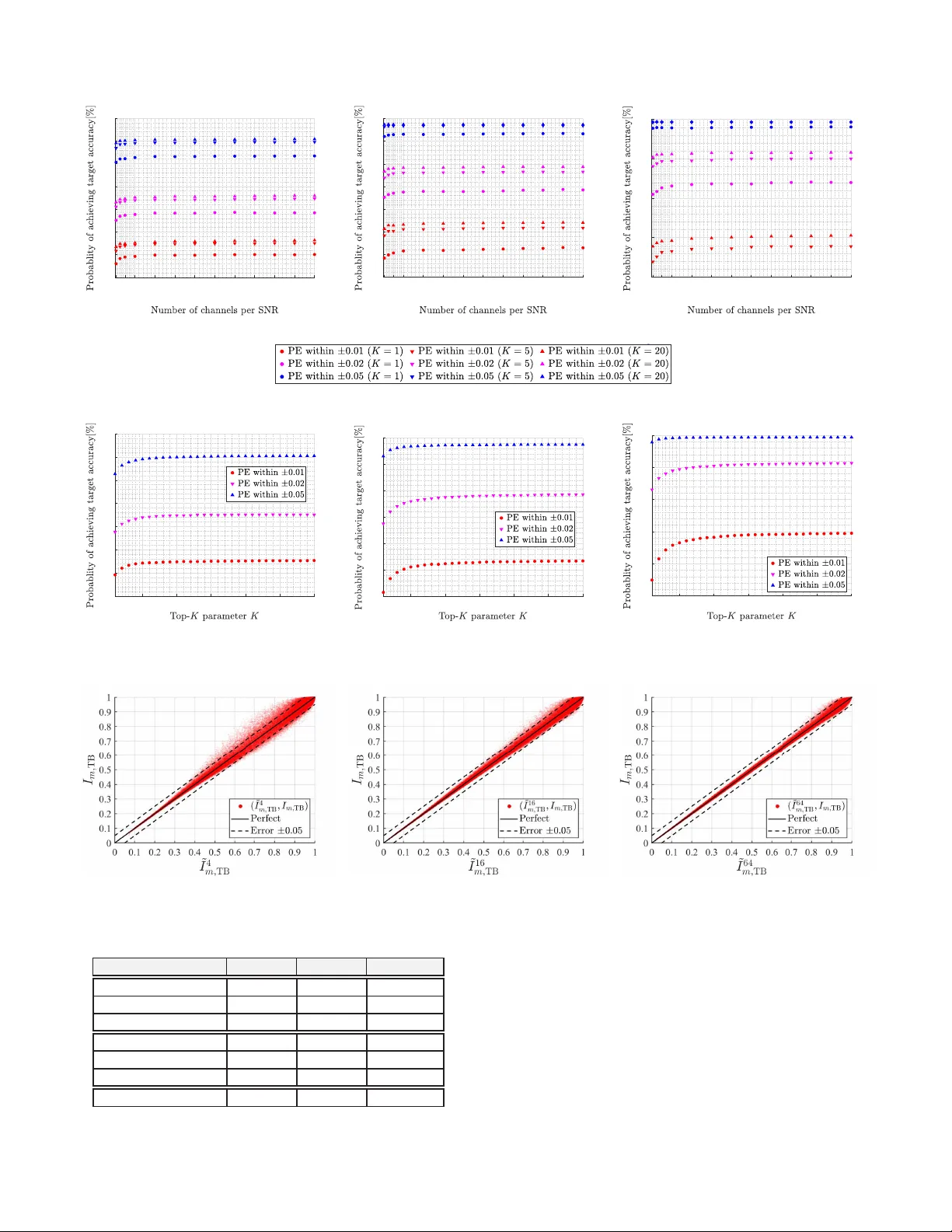
JOURNAL OF L A T E X CL ASS FILES, VOL. 14, NO. 8, A UGUST 2021 1 V ector Similari ty Search-Based MCS Selec tion in Massi v e Multi-User MIMO-OFDM Fuga K obaya s hi, Graduate Student Member , IEEE, T akumi T aka hashi, Memb e r , IEEE, Shinsuke Ibi, Senior Member , IEEE, T akanobu Doi, Member , IEEE, Kazu s hi Muraoka , Member , IEEE, and Hideki Oc hiai, F ellow , IEEE Abstract —This paper proposes a nove l modulation and cod- ing scheme (MCS ) selection framework that in tegrates mutual informa tion (MI) prediction based on vector similarity sear ch (VSS) fo r massiv e multi -user multiple-input multiple-output orthogonal frequency-division mu ltiplexing (MU-MIMO-OFDM) systems with advanced uplink multi-user detection (MUD). The framewo rk perfo rms MCS selection at the transport block (TB)- lev el MI and establishes the mapping from post-MUD M I to post- decoding b lock error rate ( B LER) using a prediction function generated from extrinsic informa tion transfer ( EXIT) cu rves. A key innovation is the VSS-b ased MI prediction sch eme, which addresses the challenge of analytically predicting MI in iterativ e detectors such as expectation propagation (EP) . In this scheme, an offline vector database (VDB) stores feature vectors deriv ed from c hannel state informa tion (CSI) and a verage recei ved signal- to-noise ratio (SNR), together with corres pondi ng MI va lues achiev ed with advanced MUD. Durin g online operation, an ap- proximate nearest neighb or (ANN) search on graphics processing units (GPUs) enables ultra-fast and accurate M I p rediction, effectiv ely capturing iterativ e detection gains. Simulation results under fifth-generation new radio (5G NR) - compli ant settings demonstrate th at t h e proposed framewo rk si gnificantly imp roves both system and u ser throughput, ensu ring that the detection gains of advanced MUD are faithfully translated in to tangible system-lev el performa nce improv ements. Index T erms —MU-MIMO-OFDM systems, iterativ e detection, expectation propagation, M C S selection, mutual information, vector database, vecto r si milarity search. I . I N T RO D U C T I O N Massi ve multi-user multiple- in put m u ltiple-outp u t orthog- onal frequ ency-division multiplexing (MU-MIMO- OFDM ) is a key technolog y to cope with the explosi ve growth in the number of up link user equipmen t ( UE) devices in f uture wireless networks [1] – [3]. Le veraging the large anten n a array at th e base station (BS) enables m ultiplexing of uplink traffic from multiple UE s in both spatial an d freq uency domains, significantly impr oving spectral efficiency and increa sin g the number of sup ported UE s [4 ] –[6]. T o separate the se spa- tially multiplexed sig nals, the BS requires multi-user detection (MUD) with low comp lexity and high accuracy [7], [8 ]. Spatial filtering method s such as zero-fo rcing (ZF) an d linear mini- mum mean-sq uare error (LMMSE) detection are widely used This work was supported in part by JSPS KAKENHI under Grant JP23K13335, JP23 K22754, and JP25H01111; in part by JST , CR ONOS, Japan under Grant J PMJCS24N1; and in part by MIC/FOR W ARD under Grant JPMI240710001. (Corre sponding author: T akumi T akahashi.) F . Kobayashi , T . T akahashi, and H. Ochiai are with Graduat e S chool of Engineering, The Univ ersity of Osaka 2-1 Y amada-oka , Suita, 565– 0871, Japan (e-mail: kobaya shi-f@wcs.comm.eng.osaka-u.ac .jp, { takah ashi, ochiai } @comm.eng.osaka-u.ac.jp ). S. Ibi is with Faculty of Scienc e and E nginee ring, Doshisha Uni- versi ty 1-3 T ataramiyak odani, K yotanabe , 610–0394, Japan (e-mail: sibi@mail .doshisha.ac.jp). T . Doi and K. Muraoka are with NEC Corporation, 1753 Shimonumabe, Nakahara -ku, Ka wasaki, Kanaga wa 211–8666, Japan (e-mail: { doi-taka nobu, k-muraoka } @ nec.com). for this purp ose in MUDs, but their perfo r mance degrade s as the ratio of transmit streams to the receive antenn as increases. Advanced MUD algorithm s, o ffering a better compro mise between complexity and perf ormance, have therefore attracted increasing attention [9]– [11]. Maximizing th e u plink th rough put of MU-MIMO- OFDM systems require s adap ti ve assignment of the mo d ulation and coding scheme (M CS) in dex to each UE based on wir e less channel qu ality [12], [ 1 3]. A commo n chan nel quality metric is the pred icted subcar rier-wise signal-to-inter f erence-p lu s-noise ratio (SINR) achie vable with MUD [ 14]–[ 1 6]. Th e e ffective signal-to-n oise ra tio (SNR) h as also been widely adop ted for MCS selection [17 ] , [18 ]. Howe ver , in many standar diza- tion specifications [19]– [ 21], cha n nel coding is app lied per transport blo c k (TB), which sp ans multiple time slots and subcarriers, resulting in a sing le co d ew ord distributed over time-frequ ency resour c es with v aryin g quality . Therefo r e, it is essential to ev aluate TB-level channel q uality while accoun tin g for f requency-selective variations. Mutu al in formation (MI ) , which can be co mputed per TB, has been reco g nized a s a more su itable metric for this pu rpose [2 2]–[2 4]. W ith spatial filterin g metho d s such as LMMSE detection, the post-MUD SINR can b e ana lytically estimated from the channel state inform ation (CSI). Th e estimated sub carrier- wise SINR is then conv erted to MI, and the predic ted MI of the dem odulator outp u t is o btained by averaging over all sub carriers within the allocated resour ce ( i.e. , one TB). In contra st, with nonlin ear iterative dete c tion such a s ex- pectation prop agation ( E P) [ 25]–[ 2 7], an a lytical estimation of the post-MUD SINR is challengin g, since the detection accuracy depen ds on the conv ergence b ehavior o f the iterati ve process [15] , [2 8]. If the MI of the demodulato r outpu t c a nnot be predicted accurately , the gains in MUD p erform a n ce from iterativ e detection cann ot be fully utilized in MCS selection . Consequently , even if advanced iterative MUD im proves link - lev el detection accur acy , as repo rted in the literature [29]– [31], it may not translate into hig her overall system through put. Based on th ese o bservations, this paper p roposes a novel vector similarity search (VSS)-based offline learn ing ap - proach for predictin g the achiev able MI of the demo d ula- tor o u tput when using ad vanced MUD , employing a vector database (VDB) and app roximate neare st neighb or (ANN) search [32], [33]. Th e me thod co nsists of two phases: VDB construction via offline lea rning and on lin e MI pr ediction using the constructed VDB. In the offline ph ase, fe a ture vectors ( keys )—computed fro m the CSI an d average rece ived SNR—are generated and stored in the VDB toge th er with the correspo n ding MIs ( values ) ob tained from a ctual transmission s over those c hannels. Repeating this process for numer ous channel realization s yields a large-scale key-value stored database. In the online phase, a featu re vector is gener ated JOURNAL OF L A T E X CL ASS FILES, VOL. 14, NO. 8, A UGUST 2021 2 from th e estimated CSI an d average r eceiv ed SNR, and VSS is perf ormed via ANN sear ch on the VDB to r etriev e the MI value associated with the most similar key . As this value correspo n ds to the demodu lator outp ut MI achieved for a sim- ilar chan nel, the p r ediction inhe r ently reflects the con vergence characteristics of iterative MUD, en abling high pred iction accuracy . A NN sear ch has been employed to perfor m accurate VSS by exploiting similarities or correlatio n s in the d ata [34] and h a s been developed in fields such as cro ss-language translation and high- dimensional im a g e c la ssification [ 3 2], [33]. Recently , high-spee d ANN libraries capable of executing search algorithms o n gra phics p r ocessing un its (GPUs), such as Faiss [35 ], Milvus [36] , and SONG [ 3 7], have eme rged. Lev erag ing th ese advances, ANN search h as been applied to wire le ss commu nication p roblems, includ ing tran smission power allo cation [38] and meta-lea rning fo r deep unfolding (DU)-aided signal detection [39] . This study can be co nsidered an extension of suc h applicatio ns, targeting MI predictio n fo r advanced iterative MUD. The main contributions o f th is work ar e as follows: • A novel VSS-based MI prediction m ethod is developed for EP-b ased itera tive detection 1 . Th e VDB stores feature vectors co mputed from the CSI and average r eceiv ed SNR, pa ired with the me asured MI obtained v ia EP detection. Durin g prediction, VSS retrieves the MI that correspo n ds to the mo st similar f eature vector using ANN search. T o further enh ance p rediction accuracy , the MI values correspon ding to m ultiple high -similarity vectors can be averaged—referred to as th e top- K method. Sim- ulation results demonstra te that the pr o posed approach achieves high prediction accura cy ev en with iterative MUD, addressing the limitations of conventional SINR- based prediction metho ds. • Th e decod ing ch aracteristics of th e chann e l d ecoder for each MCS index described in the fifth- g eneration n ew radio (5G NR) standa rd are modeled using extrinsic informa tio n tra n sfer (EXIT) fu nctions [40 ], [41]. The de- coding behavior is represented by an EXIT curve, wh ich relates the MI between the deco der input and ou tput. By replacing the decoder output MI with th e post-decod ing block error ra te ( BLER) in th e E X I T curve, the post- decodin g BLER ca n be pr edicted from the in put MI with - out perfo rming actual decoding. Simulations demonstrate highly accurate pred ic tio n of deco ding char a c teristics. • An MI -based MCS selection framework is established b y integrating the above two meth ods. For eac h m odulation scheme, MI values are pred icted using th e VDB and ANN search b a sed on the estimated CSI. Th e achiev able po st- decodin g BLER is then obtained from the predicted MI via EXIT cur ves. For each UE, the highest M CS in dex that satisfies the target (ref erence) BLER is selected, illustrating the p erform a nce gains a chiev ed throu g h EP- based advanced MUD. • Comp rehensive e valuations are c onducted , d emonstrat- ing significan t improvements in b oth system an d user throug hput compared with conv ention al SINR-based schemes. Th e results h ighlight the importan c e o f selecting MCS ac c ording to th e actual d etection per forman c e. An 1 While the proposed frame work can be applied to arbitrary MUD schemes, we adopt EP as an initi al study beca use of its strong theoretic al foundati on, exc ellent prac tical performa nce, and stable conv erge nce [26], [27]. MCS selection strategy that in corpor ates the im p roved perfor mance o f advanced iterative M UD yields substan - tial through put b enefits. Analysis of the selected MCS indices un der varying ch annel co nditions p rovides quan- titati ve evidence of the adaptab ility of the metho d and its ability to optimize overall system perf ormance. T o our kn owledge, no previous work h as pr oposed an MCS selection framework for m assi ve MU - MIMO-OFDM systems that can assess ch a n nel qu ality while accoun ting f or conv er- gence char acteristics of advanced iterativ e MUD. Althoug h numero us studies have imp roved MUD p erforma n ce in link- lev el simulations using iterative detection, many such simula- tions r e ly on idealized conditions th at differ su bstantially f rom practical wireless environments. T his work bridges that gap, serving as a cru cial first step tow ard tran slatin g theor etical advances in iterati ve MUD into tan gible p e r forman c e gains in real-world wir eless c ommunica tio n systems. The remaind e r o f th is paper is organized as follows. Sec- tion II describ es th e system mod el. Section III presen ts the MCS selection framework using LMMSE filtering as MUD, where f unctionalizin g de c oder chara c teristics via EXI T analy- sis und er th e 5G NR standa r d constitutes a novel contribution. It also demo n strates that LMMSE-b ased MUD enables ana- lytically accu rate MI pr e diction and iden tifies the challenges posed by EP- based iterative M UD. Section IV addresses these challenges by introduc ing a VSS-b ased MI prediction method that accur ately estimates post-MUD MI for EP-based MUD. Section V integrates these techniqu es into the MCS selection framework a nd demonstrates sig n ificant improvements in sy s- tem an d user throug h put. Sectio n VI discusses the f easibility and perfo rmance implications of the p r oposed meth od using dynamic system-level simulations that incorp orate long-ter m variations in ch a nnel statistics, integration with outer-loop link adaptation (OLL A), and schedu ling mechanisms f o r resour ce allocation. Section VII conclud es the pap er . Notation: Sets of real and complex numb ers are de n oted by R and C , resp e cti vely . V ectors are represented by lower - case boldface letters, an d m atrices by upp er-case boldface letters. The tr anspose and conju gate tran spose operato rs are denoted by · T and · H , respectively . T h e a × a identity matr ix is represented by I a . A diago nal matrix with e lements of the vector a on its main d iagonal is den oted by diag [ a ] . The element in the i -th row and j -th colu mn of m atrix A is d enoted by [ A ] i,j . A complex Gaussian distribution with mean a and variance b is d enoted by C N ( a, b ) . Finally , the notatio n O ( · ) denotes the complexity or der unless otherwise specified. A. Related W orks T o the b est of our knowledge, there is no prior work that explicitly translates th e iterative gain achieved b y itera- ti ve detec to rs into through put imp rovement thro ugh advanced MCS selection. Altho ugh theoretical stu d ies fo cusing o n th e behavior analy sis o f detectors themselves, a s well as practical studies ded icated to link adap tatio n, hav e been rep orted so far , r esearch that integrates these two aspects r emains scarce, despite its fun d amental impo rtance. For example, advanced iterative detector s, including E P, have historically ev olved alongside asym ptotic perfo rmance analyzes in the large-system lim it, and a vast bo d y of literature exists on their asymptotic o ptimality [26], [2 7]. Howe ver , such JOURNAL OF L A T E X CL ASS FILES, VOL. 14, NO. 8, A UGUST 2021 3 Multi-User Detection UE BS Receiver IFFT FFT Channel Estimation MCS Selection Feedback # # W ireless Channel Information Bit Stream UE FFT … … … CSI … IFFT Information Bit Stream … Channel Decoder Demodulator Demodulator Channel Decoder Estimated Bit Stream Estimated Bit Stream … Modulator Modulator Channel Encoder Channel Encoder Fig. 1. Block diagram of the MU-MIMO-OFDM system, where the MCS selecti on stage is highlight ed in blue. asymptotic analyz e s cann ot be d irectly applied to the statisti- cally n on-un iform a n d practically importan t finite-dimensio nal systems considere d in th is study . In particular, it is intrinsically difficult to predic t the conv ergence behavior in advance in en viron ments where multiple modu latio n scheme s coexist. On the o ther ha nd, learning -based MCS selection ha s been extensi vely studied u sing Q-lear ning-ba sed app roaches [42], [43], whe r e a Q-table is iteratively upd ated to m aximize the expected long-ter m reward for each MCS. Howe ver , be- cause the Q- table size grows expone ntially with th e state dimension, such method s bec ome imp ractical f or large-scale or con tinuous state sp a ces, restricting their applica b ility to small state– action spaces. T o alle viate th is scalability issue, deep Q-network (DQN ) -based m ethods em ploying deep neu ral networks (DNNs) to app r oximate the Q-function have b e e n propo sed [ 44]–[4 7]. While th ese method s can handle high - dimensiona l continu ous state spaces without explicitly stor ing a Q-table, they also intro duce inhere nt drawbacks, includin g increased learnin g c o mplexity , sensiti vity to chan nel variations and hyperp arameters, and a la c k of theor etical guaran tees on conv ergence and stability . Moreover, their focus on single- link adaptatio n and glob al o ptimization under div erse channel condition s limits their ap plicability to large-scale systems with stringent latency co nstraints. In con trast, the appro a c h pro posed in this study is fu n- damentally different. By leveraging instan taneous CSI a n d av erage r e cei ved SNR as key features and significantly r e- ducing the search space throu gh offline lear ning, the p ro- posed m ethod enab les fast and accurate MI pred iction and instantaneou s channel- aware MCS selectio n even in massi ve MU-MIMO-OFDM systems. The appr oach can be regar ded as offloading the complex pro cessing task to the offline do main. Furthermo re, the VDB suppo rts effi cient updates by add ing or removing data entr ies as lon g -term cha nnel statistics chang e, eliminating the need for re tr aining. I I . S Y S T E M M O D E L A. Signal Model Consider an u plink massiv e MU- MIMO-OFDM system confor ming to th e 5G NR specification, as illustrated in Fig. 1. Each UE has one tr a nsmit (TX) a ntenna, an d M UEs p erform spatial mu ltiplexing to a BS equipped with N rece ive (RX) an te n nas arrang ed in a un iform r ectangular array (URA). Based on the acq uired CSI, the BS perfo rms resource allocation and MCS selection for up link transm ission and fee d s back th e results to each UE. Each UE e ncodes and m odulates its information bit stream u sin g the selected MCS, then transmits the signal via OFDM over the allo cated time–freq uency re sources. I n 5G NR [48], the smallest TB is a resource block (RB) consisting of 14 OFDM sym bols (time) × 12 sub carriers (frequen cy). In this work, M UEs are assumed to perform spatial multiplexing transmission over time-frequ ency r esources consisting of R O FDM sym bols and L subcarr iers, a s d etermined by resou rce allocation; thus, we focus on the tr ansmission of a single T B co ntaining R × L symbols. The cyclic prefix is a ssumed to b e id e ally inserted and rem oved. At the receiver , fr equency-do main MIMO sign al detection is perf o rmed via MUD, followed by dem odulation and channe l decodin g. Let x m [ r , ℓ ] deno te the fr equency-d o main symbo l trans- mitted b y th e m -th UE a t d iscrete time r on the subcar rier ℓ . Each sym bol is drawn from the q uadratur e amplitud e modulatio n ( QAM) co nstellation X with average energy E s and mod ulation o rder Q , |X | . Deno ting th e TX vector spatially multiplexed on the [ r, ℓ ] -th tim e-freque ncy resource by x [ r , ℓ ] , [ x 1 [ r , ℓ ] , . . . , x m [ r , ℓ ] , . . . , x M [ r , ℓ ]] T ∈ C M × 1 , the correspon ding RX vector can be expressed as y [ r, ℓ ] , [ y 1 [ r , ℓ ] , . . . , y n [ r , ℓ ] , . . . , y N [ r , ℓ ]] T ∈ C N × 1 = H [ ℓ ] x [ r, ℓ ] + z [ r , ℓ ] , (1) where H [ ℓ ] , [ h 1 [ ℓ ] , . . . , h m [ ℓ ] , . . . , h M [ ℓ ]] ∈ C N × M de- notes the frequ ency-doma in MIMO channel m atrix of the ℓ -th subcarrier, with h m [ ℓ ] ∈ C N × 1 representin g its m -th c o lumn. The channel is a ssumed to b e con stant over on e time slot ( 1 ≤ r ≤ R ) , and z [ r, ℓ ] , [ z 1 [ r , ℓ ] , . . . , z n [ r , ℓ ] , . . . , z N [ r , ℓ ]] T ∈ C N × 1 is the additive white Gaussian n oise ( A WGN) vector, each entry o f wh ich follows C N (0 , N 0 ) with N 0 denoting the noise power spectral den sity . Since the MCS for each UE m ust be d etermined prior to actual transmission, the BS pred icts the achiev able de m odula- tor outp ut M I under MUD u sing the estimated CSI H [ ℓ ] , ∀ ℓ , and the average receiv ed SNR ρ , M E s / N 0 , withou t relying on the RX signal y [ r , ℓ ] , ∀ r, ∀ ℓ . For simplicity , both the CSI H [ ℓ ] , ∀ ℓ and average received SNR ρ a re assumed to be perfectly estimated at the BS, and the assign ed MCS index is assumed to be notified to eac h UE without er ror . JOURNAL OF L A T E X CL ASS FILES, VOL. 14, NO. 8, A UGUST 2021 4 Algorithm 1 EP-based MUD algorith m Require: y ∈ C N × 1 , H ∈ C N × M , T (Num. of iteration s) Ensure: q ( T ) m, A → B ( χ ) , ∀ m, ∀ χ ∈ X /* ————— Initialization ————— */ 1: x (1) B → A = 0 ∈ C M × 1 , V (1) B → A = E s I M /* —————— Iteration —————– */ 2: for t = 1 to T do // Module A 3: Ψ ( t ) = N 0 I N + H V ( t ) B → A H H − 1 4: Ξ ( t ) = diag h H 1 Ψ ( t ) h 1 , . . . , h H M Ψ ( t ) h M − 1 5: x ( t ) A → B = x ( t ) B → A + Ξ ( t ) H H Ψ ( t ) y − H x ( t ) B → A 6: V ( t ) A → B = Ξ ( t ) − V ( t ) B → A 7: ∀ m, ∀ χ ∈ X : q ( t ) m, A → B ( χ ) = exp − χ − x ( t ) m, A → B 2 v ( t ) m, A → B ! // Module B 8: ∀ m : x ( t ) m, B = P χ ∈X χ · q ( t ) m, A → B ( χ ) P χ ′ ∈X q ( t ) m, A → B ( χ ′ ) 9: ∀ m : v ( t ) m, B = P χ ∈X | χ | 2 · q ( t ) m, A → B ( χ ) P χ ′ ∈X q ( t ) m, A → B ( χ ′ ) − x ( t ) m, B 2 10: ∀ m : 1 v ( t ) m, B → A = 1 v ( t ) m, B − 1 v ( t ) m, A → B 11: ∀ m : x ( t ) m, B → A = v ( t ) m, B → A · x ( t ) m, B v ( t ) m, B − x ( t ) m, A → B v ( t ) m, A → B 12: x ( t ) B → A = h x ( t ) 1 , B → A , . . . , x ( t ) m, B → A , . . . , x ( t ) M , B → A i T 13: V ( t ) B → A = diag h v ( t ) 1 , B → A , . . . , v ( t ) m, B → A , . . . , v ( t ) M , B → A i 14: x ( t +1) B → A = α x ( t ) B → A + (1 − α ) x ( t ) B → A 15: V ( t +1) B → A = α V ( t ) B → A + (1 − α ) V ( t ) B → A 16: end for B. EP-based MUD Algorithm The p seu docode of the EP-based MUD alg orithm, designed following [9], [2 5 ]–[27 ], is g iv en in Algorithm 1. For clar- ity , the qualifier [ r, ℓ ] is omitted since MUD is perfo rmed indepen d ently for each time–fr equency ind ex. T h e following notation is used: x ζ , [ x 1 ,ζ , . . . , x m,ζ , . . . , x M ,ζ ] T , V ζ , diag [ v 1 ,ζ , . . . , v m,ζ , . . . , v M ,ζ ] , wh ere ζ ∈ { A → B , B → A } . The EP detector compr ises module A, which applies soft interfere n ce c a n cellation and signa l sep a r ation using an LMMSE filter, and module B, which com putes the condition al expectation— i.e. , th e gen eral minim um mean-squ are error (MMSE) solution—b ased on the outpu t of mo dule A. Detec- tion accu racy improves progressively thro ugh the exchange of extrinsic infor mation b etween the two mod ules. Further algorithm ic details can be fo und in [9], [2 5]–[2 7]. The numbe r of iterations is denoted by T , and ( · ) ( t ) indicates the iteration index. The par a m eter α in lines 14 an d 15 is a da m ping factor . When T = 1 , Algorithm 1 reduces to the conventional LMMSE detector . C. Computatio n of Bit-W ise LLRs Continuing from the pr evious subsection, the qualifier [ r, ℓ ] is om itted. Based on the message q ( T ) m, A → B ( χ ) from modu le A to B in the final iteration o f Alg orithm 1, the log- likelihood ratios (LL Rs) of the cod ed b its com p osing the TX symbo l x m are computed . When x m consists of S , log 2 Q coded bits c m, 1 , . . . , c m,s , . . . , c m,S , the bit-wise LLR corr espondin g to c m,s is giv en by [49 ] λ ( c m,s ) , ln " P χ ∈X | c s =1 q ( T ) m, A → B ( χ ) P χ ′ ∈X | c s =0 q ( T ) m, A → B ( χ ′ ) # , (2) where X | c s = c ( c ∈ { 0 , 1 } ) den o tes the set of cand idate constellation points whose s -th bit equa ls c . D. MI Computation per TB Let λ den ote the b it-wise LLR corre sp onding to the coded bit c . The b it-wise MI b etween c and λ at the d e modulator output LLRs can then be expressed as [40] I ( λ ; c ) = X c ∈{ 0 , 1 } p c ( c ) Z ∞ −∞ p λ | c ( λ | c ) log 2 p λ | c ( λ | c ) P c ′ ∈{ 0 , 1 } p c ( c ′ ) p λ | c ′ ( λ | c ′ ) ! dλ. (3) W ith the qualifier [ r, ℓ ] , the d e te c tor outpu t LLRs for the coded bits comp osing x m [ r , ℓ ] are denote d by λ ( c m,s )[ r , ℓ ] , ∀ s, as g i ven in ( 2). The total numb er o f cod e d bits in on e TB is N TB = R × L × S . Using all correspond ing LLRs, the demodu lator outpu t MI in (3) can be approxim ated as [ 5 0] I m, TB ≈ 1 − 1 N TB R X r =1 L X ℓ =1 S X s =1 η m,s [ r , ℓ ] , (4a) η m,s [ r , ℓ ] , log 2 (1 + exp [ − (2 c m,s [ r , ℓ ] − 1) λ ( c m,s )[ r , ℓ ]]) , (4b) where c m,s [ r , ℓ ] denotes the coded bit corr esponding to λ ( c m,s )[ r , ℓ ] , which con sists of the TX symbol x m [ r , ℓ ] in (1 ). A key point to no te is th at MCS selectio n must be com pleted prior to tran smission; thus, the demod ulator o utput MI I m, TB in (4) must be predicted solely based o n the estimated CSI an d av erage received SNR. For determinin g the MCS, the pred icted MI is then conv erted to th e deco d er output BLER acco rding to the decod ing ch aracteristics. It is only throug h this two-stage process-MI prediction followed by BLER conv ersion- th at the MCS can be appr opriately selected. In the fo llowing sectio n, we presen t the MI-based MCS selection fr amew ork, which is on e of the main contributions of this work, u sin g LMMSE-b ased MUD as a representative example. I I I . M I - B A S E D M C S S E L E C T I O N Fig. 2 illustrates the b lock diagram of the MI-based M CS selection pro cedure using the analytical MI p rediction method. In this scheme, the BS determin es the appr opriate M CS for each UE fro m th e estimated CSI and the averaged re c ei ved SNR. Th e process compr ises three steps: (i) predictin g the demodu lator outp ut ( i.e. , po st-MUD) MI fo r all modulatio n schemes predefine d in th e MCS tab le, ( ii) co n verting each predicted po st-MUD MI to the cor respondin g post-d ecoding BLER accor ding to th e specific decodin g characteristics, and (iii) selectin g the M CS ind ex that ma x imizes throu ghput while satisfying the referenc e BLER. No te that since MI depend s on the modula tio n scheme, the step (i) must be p erforme d in di- vidually fo r e a ch scheme. The detailed procedur e is presented below , where the LMMSE filter is em p loyed as MUD. JOURNAL OF L A T E X CL ASS FILES, VOL. 14, NO. 8, A UGUST 2021 5 Estimated CSI A veraging Convert to Demodulator Output MI Demodulator Output MI Prediction Subsection III -A Post-LMMSE Filtering SINR Predicted MI of each Subcarrier BLER BLER Prediction via EXIT Curves Subsection III -B … … … MCS Index Selection Subsection III -C MCS Index Selection Candidate MCS Indices per Modulation Scheme Conversion to Decoder Output BLER Fig. 2. Block diagram of the proposed MI-based MCS selectio n process incorpora ting the analyti cal MI predicti on method. -20 -15 -10 -5 0 5 10 15 20 25 0 0.1 0.2 0.3 0.4 0.5 0.6 0.7 0.8 0.9 1 Fig. 3. A verage recei ved SNR versu s MI in an A WGN channel. A. Analytical MI Pr ediction for LMMSE F ilter Outp ut When emp loying the LMMSE filter as MUD, the post-MU D SINR can be derived analytically . For d e te c ting x m [ r , ℓ ] , ∀ r, from the RX signal y [ r , ℓ ] , ∀ r, in (1), the SINR at the LMMSE filter outpu t can be expressed in closed-f orm as [51 ] γ m, LMMSE [ ℓ ] = 1 h ( ρ H H [ ℓ ] H [ ℓ ] + I M ) − 1 i m,m − 1 . (5) Next, by modeling the LMMSE filter outpu t as the outp ut of an A WGN chann el with the same SNR as in ( 5), th e po st-MUD SINR for each sub carrier can be converted to the predic ted demodu lator ou tput MI as ˜ I Q m [ ℓ ] = ψ Q ( γ m, LMMSE [ ℓ ]) , wher e ψ Q ( · ) , with Q ∈ { 4 , 16 , 64 } , is the conversion fu nction shown in Fig . 3 . By av eragin g over all L subcarr iers, the p redicted demodu lator outpu t MI I m, TB in (4) can be expressed as ˜ I Q m, TB = 1 L L X ℓ =1 ˜ I Q m [ ℓ ] , ∀ Q. (6) For MCS selection , th e po st-MUD MIs ar e first co mputed using ( 6 ) for all modulation orders. Eac h pred icted MI is th en conv erted to the corr esponding d e coder output MI acco rding to the de c oding character istics, and the hig hest MCS index meeting the referen ce BLER is selected . B. Con version to Deco der Ou tput BLER The deco d ing charac te r istics a r e m odeled using EXIT curves [50] , [52], [5 3]. Traditionally , these cur ves ar e ob tained MCS Index 0 A WGN MCS Index T able MCS Index i MCS Index 27 … … Bit Stream Channel Decoder Demodulator Estimated Bit Stream BLER Measurement MI Calc. LLRs Plotting EXIT Curve BLER Modulator Channel Encoder Fig. 4. Block diagram for measuri ng the relationshi p between the demodula tor output MI and the decod er output BL ER in an A WGN channel. by gen erating id eal LLR seq uences that satisfy the co nsistency condition 2 [41] and measurin g the dec o der input–ou tput M I. Howe ver , for hig her-order modu lation schemes ( e.g. , 16 QAM, 64 QAM), th e decod er inp ut LLRs d e viate fr om the ideal statistics d ue to the non- o rthogo nal m apping between bits and constellatio n po ints [49]. This m ismatch cau ses the MI observed in p ractice to differ from that predicted by the ideal EXIT curve. In additio n, for MCS selection , the relev ant metric is the d e c oder output BLER, no t MI . Consequently , un like conv ention al EXIT cu r ves, which focu s solely o n MI , the derived cu rves must captu re BLER characteristics to enab le accurate MCS selection. T o ensure accurate conversion from pred icted post-MUD MI to deco der output BLER (post-d ecoding BLER), we derive EXIT curves using the pro cedure illustrated in Fig. 4, which reflects the actual LLR statistics for each MCS index: 1) Simulatio n Setup: Generate coded symbols a ccording to the target MCS ind ex. 2) Chan n el Modeling : Pass the symbo ls th rough an A WGN channel adjusted to achieve the desired input MI. 3) LLR Comp utation: Obtain demodu lator output LL Rs directly from the ch annel o u tput, p reserving their actual statistical distribution. 4) Deco der Evaluation: Measur e the de c oder inpu t MI fro m 2 The distributio n of ideal L LRs satisfying the consistenc y condit ion is the Gaussian distrib ution with the m ean µ and the varia nce σ 2 = 2 µ . JOURNAL OF L A T E X CL ASS FILES, VOL. 14, NO. 8, A UGUST 2021 6 0 0.1 0.2 0.3 0.4 0.5 0.6 0.7 0.8 0.9 1 10 -3 10 -2 10 -1 10 0 MCS:0 MCS:1 MCS:2 MCS:3 MCS:4 MCS:5 MCS:6 MCS:7 MCS:8 MCS:9 (a) 4 QAM. 0 0.1 0.2 0.3 0.4 0.5 0.6 0.7 0.8 0.9 1 10 -3 10 -2 10 -1 10 0 MCS:10 MCS:11 MCS:12 MCS:13 MCS:14 MCS:15 MCS:16 (b) 16 QAM. 0 0.1 0.2 0.3 0.4 0.5 0.6 0.7 0.8 0.9 1 10 -3 10 -2 10 -1 10 0 MCS:17 MCS:18 MCS:19 MCS:20 MCS:21 MCS:22 MCS:23 MCS:24 MCS:25 MCS:26 MCS:27 (c) 64 QAM. Fig. 5. EXIT curve s sho wing decoder input MI I m, TB versus BLE R for each MCS. (a) LMMSE detecti on, 4 QAM. (b) L MMSE detec tion, 16 QAM. (c) LMMSE detecti on, 64 QAM. (d) E P dete ction, 4 QAM. (e) EP detect ion, 16 QAM. (f) EP detecti on, 64 QAM. Fig. 6. Scatter plots of the measured MI I m, TB versus the predi cted MI ˜ I Q m, TB based on the LMMSE detec tor . T ABL E I S I M U L AT I O N P A R A M E T E R S Item V alue MIMO configu r ation ( N , M ) = (64 , 16 ) Center frequen cy 4 . 7 GHz Bandwidth 100 M Hz Subcarrier spacing 30 kHz Number of subcarriers 192 Number of FFT point 256 Delay spread 100 n s Delay profile CDL-B [54] Channel estimation Perfect Modulation scheme Gray-code d 4 QAM, 16 QAM, 6 4 QAM Channel coding scheme LDPC [21] Number of EP iterations T = 8 Damping Parameter α = 0 . 5 these LLRs and determin e the outp ut BLE R by r unning the chann el decod er . 5) Curve Construction: Repeat over a r ange o f input MIs to obtain the com p lete EXIT curve. By preco mputing EXIT curves for all MCS in dices in the 5G NR–co mpliant MCS table, the po st-decoding BLER f or each MCS can be pre d icted directly fr om the de modulator output MI—eliminating the need for the actual deco ding process. These cu rves ar e generated to reflect the statistical proper ties of the LLRs in practical high er-order modu lations. Fig. 5 shows the resulting EXIT curves, illu strating the relationship between the de coder input MI I TB and the po st- decodin g BLER f o r each MCS in dex. The MCS table follows the 5G NR specification [55] and de fin es 28 MCS indices, group ed by mod ulation scheme: 4 QA M (indices 0 – 9 ), 16 QAM (indices 10 – 16 ), and 64 QAM (ind ice s 17 to 27 ) . Low-density parity-ch eck (LDPC) cod es [21] are used f or channel cod ing. As the MCS index increases, the co rrespond ing co de rate—and thus th e data rate—a lso increases. Figs. 5 ( a)–(c) co rrespond to 4 QAM, 16 QAM, and 64 QA M , respectively . C. MCS Index Selection Giv en the pr e dicted post-MUD MI ˜ I Q m, TB in (6) for Q ∈ { 4 , 16 , 64 } , the h ighest MCS ind ex ξ 4 m , ξ 16 m , ξ 64 m that sat- isfies th e re f erence BLER is selected for each UE using the JOURNAL OF L A T E X CL ASS FILES, VOL. 14, NO. 8, A UGUST 2021 7 0 0.1 0.2 0.3 0.4 0.5 0.6 0.7 0.8 0.9 1 10 -3 10 -2 10 -1 10 0 MCS:3 MCS:7 MCS:9 EXIT curve (a) LMMSE detecti on, 4 QAM. 0 0.1 0.2 0.3 0.4 0.5 0.6 0.7 0.8 0.9 1 10 -3 10 -2 10 -1 10 0 MCS:11 MCS:14 MCS:16 EXIT curve (b) L MMSE detec tion, 16 QAM. 0 0.1 0.2 0.3 0.4 0.5 0.6 0.7 0.8 0.9 1 10 -3 10 -2 10 -1 10 0 MCS:18 MCS:21 MCS:25 EXIT curve (c) LMMSE detecti on, 64 QAM. 0 0.1 0.2 0.3 0.4 0.5 0.6 0.7 0.8 0.9 1 10 -3 10 -2 10 -1 10 0 MCS:3 MCS:7 MCS:9 EXIT curve (d) E P dete ction, 4 QAM. 0 0.1 0.2 0.3 0.4 0.5 0.6 0.7 0.8 0.9 1 10 -3 10 -2 10 -1 10 0 MCS:11 MCS:14 MCS:16 EXIT curve (e) EP detect ion, 16 QAM. 0 0.1 0.2 0.3 0.4 0.5 0.6 0.7 0.8 0.9 1 10 -3 10 -2 10 -1 10 0 MCS:18 MCS:21 MCS:25 EXIT curve (f) EP detecti on, 64 QAM. Fig. 7. Scatter plots of decode r input MI I m, TB versus BLE R. EXIT curves in Fig. 5. The final MCS index ξ m assigned to each UE is then determined as the maximum among these candidates: ξ m = ma x ξ 4 m , ξ 16 m , ξ 64 m . (7) This proced u re underscor es that in MI -based MCS selection, accurate predictio n of the post-MUD MI is essential for achieving optim a l per formanc e . D. E valuation of P ost-MUD MI P r ed iction Computer simulations were perform ed to ev aluate the accu - racy o f the post-MUD MI pred icted by (6) fo r the LMM SE fil- tering in a ma ssive MU-MIMO-OFDM system. The simu lation parameters are summar ized in T ab . I. Sixteen synch ronized UEs ( M = 16 ), each with a sing le TX antenna, simu ltaneously transmit to a BS equ ip ped with N = 64 RX antenn a s. The 3rd g eneration partn ership project ( 3 GPP) clustered d elay line (CDL) chann e l model [54] is employed . The carrier freq uency is 4 . 7 GHz, the system ban dwidth is 100 MHz, and the OFDM subcarrier spacing is 30 kHz . W e consider one time- slot OFDM transmission over L = 192 subcar riers ( 1 6 RBs) with an fast Fourier tran sform (FFT) size of 256 . T h e n umber of cod ed b its per TB is N TB = R × L × S = 2 6 88 S . Th e demodu lator outpu t MI is com puted fro m ( 4) fo r eac h N TB -bit codeword. T o isolate predictio n accuracy , all UEs ar e assumed to use the same mo dulation scheme ( Q ∈ { 4 , 16 , 64 } ), an d the av erage received SNR ρ is varied fr om − 10 dB to 24 dB in 0 . 5 dB increme n ts. Fig. 6 shows scatter plots of the measured MI I m, TB from (4) (vertical axis) versus the pred icted MI ˜ I Q m, TB from (6 ) (horizo ntal ax is). Th e solid b lack line re p resents the idea l case ( I m, TB = ˜ I Q m, TB ), indicating perfect prediction, while the dashed lines ( I m, TB = ˜ I Q m, TB ± 0 . 05 ), deno te a refere n ce prediction e rror ( PE) of 0 . 0 5 . Figs. 6(a) - (c) present resu lts for LMMSE-b ased MUD across all modu lation scheme s. As expected, the measure d samples (red dots) lie c lo sely alon g the ideal line, confirming the high accuracy of th e analytical MI predictio n. This validates the accuracy o f the p rediction proced u re described in Subsection III- A . Next, we investigate the deviation observed when the actual MUD employs EP-based itera tive detec tion, compared with prediction s assuming LMMSE - based MUD. As sho wn in Figs. 6(d )-(f) for EP-based MUD ( T = 8 in Algorithm 1), most samples lie above th e ideal line due to the iter ati ve gain in MI over the LMMSE - based pr ediction. These results indicate th at using (6) for MCS selectio n together with EP- b ased MUD can p rovide highly r eliable commun ication wh ile sub stantially redu cing retran smissions, and furth er sug gest that if MI pr e diction tailored for EP- based MUD could ach ieve accu racy co mparable to that for LMMSE- based MUD, addition a l throughp ut gains co uld be realize d throug h better-aligned MCS selection . E. Evaluation of P ost-Deco ding BLER P r e d iction Finally , using the same simulation settings as in the pr evious subsection, we ev aluate the accuracy of con verting post- MUD M I to post-deco ding BLER via the EXIT curves in Fig. 5. Fig. 7 shows BLER versus th e measured M I I m, TB from (4 ), with the aim o f isolating the EXIT-cu rve-based conv ersion accura cy; thus, pred icted MI is not used in this ev aluation. T he b lack cu rves are th e EXIT curves fo r the selected MCS ind ices, directly taken from Fig. 5 , while the scatter plots represent (post-MUD MI, po st-decoding BLER) pairs measur e d in actual M U-MIMO-OFDM transmission. For each modulation scheme, three MCS in dices from the 5G NR MCS table [55 ] are tested. Figs. 7 ( a ) -(c) presen t results with LMMSE-based MUD ( T = 1 in Alg o rithm 1), and Figs. 7 (d)-(f ) with EP-based MUD ( T = 8 ). JOURNAL OF L A T E X CL ASS FILES, VOL. 14, NO. 8, A UGUST 2021 8 In both cases, the measured samples align closely with the EXIT curves, co nfirming that even with non linear iterative detection, each stream after MUD behaves equiv alently to an A WGN chan nel and th at the d esigned EXIT cu rves ac c urately characterize th e relationship be tween decoder inpu t ( i.e. , post- MUD) MI and p ost-decodin g BLER. This validates the ac- curate mo deling o f the dec o ding c haracteristics describ e d in Subsection II I-B. Th erefore, the EXIT c urves in Fig. 5 can serve as con version function s f rom pr edicted post-MUD MI ˜ I m, TB to p redicted BLER. By prepar in g EXIT curves for each code length in advance, th e predicted post-MUD MI can b e directly map p ed to the expected post-deco ding BLER for any MCS index. The above findings indica te th at realizing the system throug hput g ains offered b y advanced iterati ve MUD requ ires accurate prediction o f th e enh anced post-M UD MI ob served in Figs. 6 (d)– (f). In the n ext section, we pr esent a p r ediction method specifically designed to captu r e th is im provement. I V . P R O P O S E D V S S - BA S E D M I P R E D I C T I O N Fig. 8 illustrates th e prop osed VSS-based MI prediction framework employing AN N search over a VDB, wh ich co m- prises two phases: (a) an offline VDB constru ction phase and (b) an o nline MI prediction p h ase. In the offline phase ( a ), a feature vector (key) is genera te d fro m the CSI H and the av erage received SNR ρ and is pair ed with the me a su red MI (value) obtaine d fr om MU-MIMO - OFDM tran smission over the correspon ding wireless channel when detection is perfor med using the EP-b ased MUD. These key–value pairs are stored in the VDB in vector fo rmat. This proce ss is typically perfo rmed o ffline—either through simulations or measuremen ts in real environments—but can also be executed online, with the VDB bein g increm entally updated as n ew measuremen t data becom e s av ailable. In the on line ph a se (b ) , a key is generated in th e sam e manner from the estimated CSI an d average rec e ived SNR. An ANN search is then co nducted on th e VDB to retrieve a specified number of nearest-neighb or keys, and the associated values ar e r eturned. These values correspon d to MIs achiev ed under similar channel co nditions; thu s, with an app ropriately designed feature vector, highly accurate MI pred ictions can be achieved. In th is study , th e Faiss library [3 5] is a d opted for ANN search d u e to its efficient GPU-based imp lementation. The detailed proced ures for b oth p hases are described in the following subsection s. A. Offline VDB Constructio n P hase The VDB contains D VDB entries, each comprising a f eature vector (key) υ ∈ R D key × 1 and its associated acqu ired kn owl- edge (value) ε ∈ R , sto r ed as a pair ( υ , ε ) . In this study , keys are extracted fro m the CSI H ∈ C N × M × L and the av erage received SNR ρ ∈ R via th e feature extraction fu nction: υ = f ( H , ρ ) , (8) whose design critically influenc e s pred iction accu racy . Since MCS selection requ ires M I predictio n on a per- UE basis, feature vector s are computed individually for each UE, with υ m ∈ R D key × 1 denoting the vector for th e m - th UE, as illustrated in Fig. 8 (a). The values ε corr e sp ond to the m easured demod ulator o utput (post-MUD) MI I m, TB in V alue Key Multi-User Detection FFT Channel Estimation FFT … … Demodulator Demodulator Feature Extractor VDB Feature V ector (Key) Measured MI (V alue) MI Calc. LLR … Registration CSI (a) Offli ne VDB construction phase. Multi - User Detection FFT Channel Estimation FFT … … Demodulator Demodulator Feature Extractor VDB Feature V ector (Key) CSI VSS … ANN Search A veraging T op- K Method V alue Key (b) Online MI predic tion phase. Fig. 8. Block diagra m of MI predict ion using the VDB and VSS. (4), obtained fro m the LLRs comp uted af te r actual OFDM transmission over wireless ch annel H and sub sequent MUD. A large set of channel r ealizations is g enerated acco rding to a stochastic chan nel model, an d all resu lting ( υ m , I m, TB ) pa ir s are stored in the VDB fo r later ANN- b ased retriev al. B. Online MI Pr ediction Phase The first task is to com pute the featur e vector correspo nding to the curr ent channel state, f ollowing the same proced ure as in the offline ph a se. Let the estimated CSI and average recei ved SNR be denoted by ´ H ∈ C N × M × L and ´ ρ ∈ R , re spectiv ely . The key for the m -th UE is then generate d using (8) as ´ υ m = f ´ H , ´ ρ , (9) and used as a quer y vector for ANN search on the VDB. In the GPU- b ased imple m entation, the Faiss library [35] employs two ke y techniqu e s to enable large- scale, low-latency VSS. The first is inverted file (IVF) indexing [56], which parti- tions th e datab ase into K IVF clusters u sin g k- m eans clustering and stor es only th e repr esentativ e vector ( centr oid ) of each cluster , with e a c h da ta point associated with its correspo nd- ing centro id. The secon d is product quantizatio n (PQ) [57 ], which decompo ses each D key -dimension al key into D sub - dimensiona l sub-vectors, each inde p endently qu antized. As a result, each d ata poin t is stored as a quantization cod e, elimi- nating the nee d to store th e original high -dimension al vector . This a pproach significantly reduces the memo ry foo tprint o f JOURNAL OF L A T E X CL ASS FILES, VOL. 14, NO. 8, A UGUST 2021 9 the VDB and en ables fast distance c omputation throu gh the use of look up tab les. During an ANN search , Faiss first perfor ms a nea rest-neighb or sear c h amon g the centro ids and selects the P IVF clusters, inclu ding the cluster who se centro id has the highest similarity to the query vector an d its n e ig h- boring clusters. A similar ity sear ch is sub seq uently con d ucted only within th e selected clu sters to re tr ie ve the appr oximate nearest neighb o r . Th is approac h av o ids an exhaustive search across all data p oints and significantly re duces the search spa ce by focusing o n ly on data points that are likely to b e close to the q uery vector . T he p a rameter P IVF governs th e trade- off between search accuracy and compu tational complexity , enabling efficient r etriev al with low m emory usage even for large-scale VDB. The cost o f the VSS is ev aluated in term s of the n u mber of search o perations N s . I n a n exha u sti ve nearest-neig hbor search, referr e d to as the Flat index in th e Faiss librar y , th e number o f search operatio n s N s for a single query vector is equal to the VDB size and thus scales o n the o rder of N s . I n contrast, for the IV FPQ index, which combines an IVF in dex with PQ, N s grows on the orde r o f O K IVF + P IVF × D VDB K IVF . (10) The first term in (10) rep r esents the num ber of distance com- putations req uired for th e nearest-ce n troid search , whereas the second term corre sponds to the number of distance com puta- tions for d ata points within the selected clusters. From ( 1 0), N s is minimized when K IVF = √ P IVF D VDB . I n th is study , based on the guidelin es pr ovid ed in the official doc u mentation [35] as well as em pirical experim ents fro m practical use, we adopt K IVF = 4 √ D VDB as a setting that achieves a fav orable balance between co mputation al efficiency and search a ccuracy . By approp riately adjusting K IVF , the search complexity N s can b e controlled to scale at m ost as O √ D VDB , thereby ensuring both efficiency and scalability . Although it is po ssible to directly use the value return ed by the ANN search with the key ´ υ m generated in (9) as the predicted MI, the inher ent a pproxim ation in the ANN search does not gu a rantee retriev al of the exact neare st neigh bor . Moreover , depen ding on the design o f the feature vectors and the scale of the VDB, the value associated with the n earest key may n ot necessarily y ield the op tim al MI pred iction. T o improve the robustness o f the p rediction, we also employ the T op- K method for the ANN o utput [3 8 ]. Sp ecifically , as illustrated in Fig. 8 (b), during the ANN search , we extract th e values associated with th e top K ke ys th a t yield th e highe st approx imate vector similarity co m puted inter nally , and then use their average as the final MI pr ediction, as giv en by ˜ I Q m, TB = 1 K K X k =1 ε k , (11) where ε 1 . . . , ε K are the values associated with the to p K keys. Th e pseu docode of the VSS-based MI pred iction using the T o p - K method is presented in Algor ithm 2. C. Design of F eature V ector A f eature vector is a low-dimension al r epresentation that robustly an d sufficiently extracts the info rmation req uired f or the target task f rom an extremely high-dim ensional parameter Algorithm 2 VSS-b ased MI predictio n using T op- K meth o d Require: Estimated CSI ´ H , average SNR ´ ρ , VDB for Q -QAM Ensure: Predicted MI ˜ I Q m, TB 1: Co m pute th e feature vecto r ( key): ´ υ = f ( ´ H , ´ ρ ) 2: E xecute T o p- K ANN search using qu ery ´ υ 3: O b tain top K pairs in d escending order of similar ity: ( υ 1 , ε 1 ) , ( υ 2 , ε 2 ) , . . . , ( υ K , ε K ) 4: Co m pute th e av erage: ˜ I Q m, TB = 1 K P K k =1 ε k space character iz in g the wireless environment. I n other words, its design is the key factor that d etermines the su c cess or fail- ure o f th e p roposed appro ach. Meanwhile, althou gh wireless channels vary accordin g to stochastic ev ents, th eir variations exhibit strong co rrelations acr o ss the time, fr equency , and spatial d omains. By d esigning a featu r e vector th at effectively captures these c haracteristics, it beco mes possible to achieve accurate pred ictions with a m uch smaller datab ase size than that required fo r other ap plications, such as natu ral lan g uage processing and high- dimensional image classification. The fu ndamenta l princip le of featu r e vector design in this study is that, within the lim its of p ractical feasibility , one should identify a low-dimension al represen ta tio n that can analytically explain the target task, relying as much as possible on a mathema tical app roach. In Sectio n III, we dem o nstrated that the d emodulato r output MI after LMMSE detection can be analytically estimated on a TB-wise basis. On the oth er h and, analytically predictin g the c o n vergence b ehavior of EP is in- trinsically d ifficult. Therefo re, the d e m odulator outp ut MI after LMMSE de tec tion, which corr e sp onds to th e first iteratio n of EP, is positioned as a lim iting metric th at can a n alytically explain the target task of predicting the demodu lator output MI after EP detection. Based o n the above discu ssion, we c o nstruct the featur e vector in this p aper using the predicted MI obtained with LMMSE-based M U D for each sub c arrier, i.e. , ˜ I Q m [ ℓ ] in (6). Considering all L = 192 subcarr iers that constitute one TB, the feature vector is giv en by 3 υ m = h ˜ I Q m [1] , ˜ I Q m [2] , . . . , ˜ I Q m [192] i T ∈ R 192 × 1 , (12) where the ANN search over the VDB can be interpr eted as transform ing the p er-subcarrier MI obtained with LMMSE - based MUD into the TB-wise MI with EP-based MUD. D. E valuation o f MI Pr ediction Accuracy Computer simulations were conducted to ev aluate th e pre - diction accu racy achieved with the feature vector de fined in (12). The simulation con ditions were id entical to those in Subsection I II-E, i.e. , th e par ameters listed in T ab . I. The VDB size was fixed at D VDB for all modu lation sche mes, and th e da ta po ints ( 2 20800 ), correspond ing to 200 ch annels, were used for accu r acy ev a luation. Th e channel r ealizations for evaluation were generated inde p endently f r om those u sed 3 In fact, through a prelimina ry abla tion study , we hav e confirmed that this mathemati cally grounded feature vector achie ves clearly superior performanc e compared with other conc eiv able alternati ve designs. JOURNAL OF L A T E X CL ASS FILES, VOL. 14, NO. 8, A UGUST 2021 10 10 5 10 6 10 7 0 1 2 3 4 5 Fig. 9. Search time versus VDB size under a worst-case e val uation scenario, where the VDB stores 192 -dimensional real-v alued feature vectors with indepen dently and uniformly distrib uted ele ments in the range [ 0 , 1] . for o ffl ine VDB constru ction. T he average received SNR was varied f rom − 10 dB to 24 dB in 0 . 5 dB inc r ements. Consequently , the VDB size is given by th e p roduct of the number of ch annel realizatio n s, the numb e r of SNR points, and the n umber of UEs. The intern al ANN search par ameters were set to ( K IVF , D sub , P IVF ) = (4 √ D VDB , 12 , 10) , First, to d emonstrate the practical feasibility of the prop osed method, we ev aluate the online search latency of VSS im- plemented on a GPU u sing the Faiss library . Although the processing laten cy in practical de p loyments depen ds on the system configu ration a nd execution cond itions, all simulation results presented in this pap er were ob tained on a commer- cially av ailable per sonal compu ter eq uipped with an NVIDIA GeForce R T X 4070 SUPER GPU. Fig. 9 shows the search time as a f unction of the VDB size D VDB for e ach ind ex type, namely , the Flat index and the IVFPQ in dex. The horizon tal axis re presents D VDB , wh ile the vertical axis shows the search time per q uery vector . For the Flat index, sin ce distance comp u tations are req uired fo r all data p oints, the search time increases r apidly in p ropor tion to the VDB size. In co ntrast, for the IVFPQ index ( i.e. , ANN search), the search time r emains alm ost constant even as the VDB size increases. This behavior arises be cause the search is restricted to a small number of cluster s in the v icinity of the q uery vector, in dicating tha t an incr ease in the VDB size has little impact on the actu al nu mber of can d idate po ints examined dur ing the search . Although th e requ ired VDB size is discussed later, these results indicate that, with fast ANN- based VSS, the search time can be reduced to the order of several hu ndred micro seco nds even o n a commercia lly av ailable GPU. Moreover , owing to its high scalability , we conclud e th at th e VSS sear ch time d oes no t con stitute a dominan t compu tational bottlene ck in the pr oposed meth od. In the fo llowing, we first evaluate th e variation in pred ic tio n accuracy an d robustness with respect to the VDB size and the T op- K par ameter . Based on th e se results, we then assess the MI pred iction accuracy of the propo sed m ethod using the selected parameter settings. 1) Impact of th e VDB Size: Fig. 10 illustrates the v aria- tion in predictio n ac c u racy as a functio n o f the VDB scale. The horizo ntal axis represen ts the nu m ber o f u ser ch annel realizations f or each average received SNR, which determines the database scale and is propo rtional to the VDB size. The vertical axis shows the prob ability th at the pre diction error, defined as ˜ I Q m, TB − I m, TB , falls within the r a nges o f ± 0 . 01 , ± 0 . 02 , and ± 0 . 0 5 . The T op- K par a meter is set to K = 1 , 5 , and 20 , respectively . From th e results, it can b e o b served tha t, for all mod ulation schemes, once the numb er of user chan nel realizations exceed s approx imately 3 , 200 ( i.e. , 200 ch annel realizations × 16 UEs), the pred ic tio n accur acy beco mes almost in sen siti ve to further in creases in the VDB scale. T h is ind icates that app roxi- mately 3 , 2 00 user ch a nnel rea liza tio ns are sufficient to capture the statistical c h aracteristics of the CDL- B chann el mod el compliant with the 5G NR specification that are r equired to acco m plish th e target task of predicting the demodu lato r output MI after E P detection. At the same time, this ob serva- tion su ggests that the effectiveness of the proposed approa c h strongly de pends on the approp r iately d esigned feature vecto r . Furthermo re, these findings not only indicate that offline VDB construction do es not in cur excessi ve compu ta tio nal costs but also suggest the feasibility of o n line VDB updates. 2) Impact of the T op- K P a rameter: Next, based on the results of th e previous exp e r iments, we ev a luate the imp act of the T op- K parameter on th e prediction accuracy by fixing the n umber o f user ch annel realizations per average received SNR to 3 , 200 . Fig. 11 illustrates th e variation in pr ediction accuracy as a function o f the T op- K param eter . The ho rizontal axis represents the n umber o f samp les K u sed for av eragin g in the T op - K metho d , while the vertical axis sho ws, as in Fig. 10 , th e prob ability that the p rediction err or falls within a prescribed range. From Fig. 11, it can be ob served th at, for all mo dulation schemes, the prediction a c curacy impr oves mon otonically as the averaging parameter K increases. This is beca use the candidates r eturned by the ANN search ar e appr oximate rather than exact neare st neighbo r s. When only a single search result is used, the appro ximation err o r inheren t in ANN search can degrade prediction accuracy . In contrast, av erag in g the prediction values obtained from multiple ANN ou tputs effecti vely gen eralizes the estimation and mitigates the imp act of a pproxim ation err ors. Althou gh increa sin g K enlarges the scale of parallel searches, values of K o n the order of se veral tens—sufficient to achie ve a dequate gener a liza tion perf or- mance—do not pose practical computatio nal burdens even o n commercia lly available GPUs. Fur thermore, as expected, th e improvement in predictio n accur acy exhibits diminishin g re- turns as K becom es sufficiently large and e ventually saturates. Under the experimen tal conditions considered in this study , we confirmed that K = 20 provid e s a fav o rable trad e-off between prediction accuracy and the degree of par allel search . 3) MI Pr ediction Accu racy: Based on the above results, we set the p arameters accord in gly an d ev aluate the MI pr e- diction accur acy . A total o f 400 M U - MIMO-OFDM chan n el realizations satisfying the parameter settings in T ab. I were generated , of which 200 were used for VDB construction and the rem a ining 200 f or ev aluation . I n this setup, th e VDB size is gi ven by the product of the number of c h annel r ealizations, the nu mber of UEs, and the num ber of SNR po in ts, i.e. , D VDB = 200 × 16 × 69 = 2 20800 . The internal A NN search parameters are set to ( K IVF , D sub , P IVF ) = (1879 , 12 , 10) , and the T op- K param e ter is set to K = 20 . Fig. 12 shows scatter plots o f the p redicted and m easured JOURNAL OF L A T E X CL ASS FILES, VOL. 14, NO. 8, A UGUST 2021 11 160 1600 3200 6400 9600 12800 16000 19200 22400 25600 28800 32000 65 70 75 80 85 90 95 100 (a) 4 QAM. 160 1600 3200 6400 9600 12800 16000 19200 22400 25600 28800 32000 65 70 75 80 85 90 95 100 (b) 16 QAM. 160 1600 3200 6400 9600 12800 16000 19200 22400 25600 28800 32000 80 85 90 95 100 (c) 64 QAM. Fig. 10. Predictio n performance versus V DB size, ev aluate d by the probability that the MI prediction error falls within specified bounds. 1 5 10 15 20 25 30 65 70 75 80 85 90 95 100 (a) 4 QAM. 1 5 10 15 20 25 30 70 75 80 85 90 95 100 (b) 16 QAM. 1 5 10 15 20 25 30 75 80 85 90 95 100 (c) 64 QAM. Fig. 11. Predictio n performance versus T op- K parameter , ev aluat ed by the probability that the MI prediction error falls within specified bounds. (a) EP detection, 4 QAM. (b) E P detectio n, 16 QAM. (c) EP detect ion, 64 QAM. Fig. 12. Scatter plots of the measured MI I m, TB versus the predi cted MI ˜ I Q m, TB based on the proposed method. T ABL E II P R E D I C T I O N A C C U R A C Y Modulation scheme 4 QAM 16 QAM 64 QAM PE within ± 0 . 01 72 . 61% 76 . 57% 84 . 67% PE within ± 0 . 02 82 . 60% 89 . 13% 95 . 64% PE within ± 0 . 05 95 . 21% 98 . 73% 99 . 70% PE over +0 . 01 12 . 23% 11 . 17% 7 . 66% PE over +0 . 02 7 . 47% 4 . 67 % 1 . 71% PE over +0 . 05 1 . 27% 0 . 12 % 0 . 014 % MSE 0 . 0004 62 0 . 0001 85 0 . 00 00676 MI p airs ( ˜ I Q m, TB , I m, TB ) in the same manner as Fig. 6. T ab. II summ arizes the percenta g e of samples with a PE within ± 0 . 01 , ± 0 . 02 , and ± 0 . 05 ; the percentag e exceeding the measured values by mor e than +0 . 01 , + 0 . 02 , and + 0 . 05 ; and the MSE between the predicted and measured MIs. From Fig. 12, the sample points are concentr a ted near the ideal prediction line I m, TB = ˜ I Q m, TB , and the ir variance d e creases as the mod u lation o r der inc reases. From the num erical results in T ab. II, f or all m o dulation sche m es, m ore than 9 5% o f the samples have a PE within ± 0 . 05 , an d more than 70% are within ± 0 . 0 1 . Sinc e a PE exceedin g 0 . 05 could le a d to selectin g an adjacent M CS ind ex, this accu racy ca n be considered sufficient fo r the inten ded purpo se. Furthermo re, the percentage of M I overestimations relative to the measured JOURNAL OF L A T E X CL ASS FILES, VOL. 14, NO. 8, A UGUST 2021 12 Estimated CSI Demodulator Output MI Prediction Feature Extractor Feature V ector key value VDB T op- K VSS … Conversion to Decoder Output BLER BLER BLER Prediction via EXIT Curves … … … MCS Index Selection MCS Index Selection Candidate MCS Indices per Modulation Scheme Subsection IV -B Subsection III -B Subsection III -C Fig. 13. Block diagram of the proposed MI-based MCS selecti on process incorporat ing the VSS-based MI predicti on method. values—which co uld increase the BLER—is less than 2% for a PE thr e shold of 0 . 05 ( i. e. , ˜ I Q m, TB ≥ I m, TB + 0 . 0 5 ) , and is even smaller for h ig her-order m odulation schemes, whe re such erro rs ar e more cr itica l. These results de m onstrate that the pro p osed meth od, using (12 ) as the key , can pred ict the post-MUD MI for EP-ba sed MUD with sufficient accu racy to enable appro priate MCS index selection. V . T H RO U G H P U T E V A L U A T I O N Finally , the effecti veness of the pr oposed MCS selection framework is validated from a th roughp ut perspective. A. Pr op osed VSS-aid ed MCS Selection F ramework Fig. 13 illustrates th e overall work flow o f th e MCS selectio n process incorpor ating the proposed VSS-b ased MI predic tio n scheme, cor respondin g to Fig. 2 in Section III . Note th at the demod ulator outpu t (po st-MUD) MI prediction b lo ck in Fig. 2 is replaced with the pr oposed meth o d describ e d in Section IV . The key advantage o f the pro posed framework is its applicability to any MUD sch eme whose decod e r input cannot b e derived analytically . As a represen tati ve example, this p aper investigates EP-b ased MUD, well known for its high detection accuracy , an d verifies wheth e r its pe r forman c e gains can be translated into thro ughpu t imp rovements. B. Thr ou ghput Eva luation The simulation condition s are identical to those in Section III, as listed in T ab. I, and the VDB u sed f or MI predic- tion is the same as in Section IV. The MCS table follows the 5G NR stan dard [55], enablin g BLER p rediction using the EXIT c urves shown in Fig . 5 in Subsectio n III -B. Th e referenc e BLE R for MCS selection is set to 0 . 001 4 . For system perf ormance e valuation, 200 indep endently gen erated channels are used. These channels are identical to those used for evaluating MI p rediction accu racy in Su bsection IV -D. Throu g hput is calculated b y perfor ming OFDM transm ission over N slot time slots. Sm a ll-scale fading varies across slots, and MCS selection is up dated every 20 slots, 5 correspo n ding to one frame [ 48]. Th e user th r oughp ut is calcu lated as the 4 While a refere nce BLE R of 0 . 1 is commonly adopted in practice [58], [59], this study emplo ys a more stringent v alue to ensure highly relia ble trans- mission with adv anced detect ors. This also mitigates the risk of throughput degra dation due to overest imation of channel quality . 5 Accordin g to the 5G NR standard [48], when the subcarrier spacing is 30 kHz, one frame consists of two subframes, each containing 10 time slots. sum of bits successfully transmitted witho ut error per TB in each time slot by each UE, as follows: τ user ,m , P N slot n slot =1 N sucbit ,m ( n slot ) N slot · T slot [Mbps] , (13) where N sucbit ,m ( n slot ) [Mbit] is the numb er of inf o rmation bits tr ansmitted by the m -th UE in time slot n slot and successfully rec ei ved, coun ted only when the en tire TB is error-free. Th e slot du ration T slot is set to 0 . 5 × 10 − 3 s, based on the 5 G NR specification with a 3 0 kHz subcar rier spacing [48 ]. The system throug hput is calculated fro m the total num ber of successfully transmitted bits acro ss all UEs as follows: τ sys , M X m =1 τ user ,m = P M m =1 P N slot n slot =1 N sucbit ,m ( n slot ) N slot · T slot [Mbps] . (14) Fig. 1 4 shows the c u mulative distribution f unction (CDF) of system thro ughpu t fo r average r eceiv ed SNR values of 4 , 12 , and 20 dB. The following me th ods fo r p r edicting th e post-MUD M I ar e com pared, where (*) spe c ifies th e d e tector employed as the M U D (either LMMSE or EP): • ZF-b ased SINR (*) : T h is scheme assumes equalization based on the least sq uare (LS) criterio n and predicts the MI using the effecti ve SI N R of each subcarrier [1 4], [15]. It is a well-kn own pr ediction approa ch employed in the classical MCS selection framework and serves as a refer- ence to evaluate the effecti veness of the propo sed scheme. This approach is eq uiv alent to using a ZF detector as the MUD, in which case the po st-M UD SINR is analytically computed in closed form fr om th e CSI and the average received SNR as γ m, ZF [ ℓ ] = ρ · 1 h ( H H [ ℓ ] H [ ℓ ]) − 1 i m,m . (15) For the TB-level channel q uality metr ic, th e average effecti ve SINR is used. T his is obtained by co n verting the compu ted per-subcarrier effectiv e SINR values into transmission r ates based on Shannon ca p acity , a veraging them over all subcarrie r s, and then c on verting the re sult back in to effecti ve SINR: ¯ γ m, ZF = φ − 1 ¯ R m , (16a) JOURNAL OF L A T E X CL ASS FILES, VOL. 14, NO. 8, A UGUST 2021 13 60 70 80 90 100 110 120 130 0 0.1 0.2 0.3 0.4 0.5 0.6 0.7 0.8 0.9 1 (a) SNR = 4 dB. 190 200 210 220 230 240 250 0 0.1 0.2 0.3 0.4 0.5 0.6 0.7 0.8 0.9 1 (b) SNR = 12 dB. 370 380 390 400 410 420 430 440 0 0.1 0.2 0.3 0.4 0.5 0.6 0.7 0.8 0.9 1 (c) SNR = 20 dB. VSS-based MI (EP) LMMSE-based MI (EP) LMMSE-based MI (LMMSE) ZF-based SINR (LMMSE) Fig. 14. System throughput performance for va rious avera ge recei ved SNR le vel s in an MU-MIMO-OFDM system. 2 3 4 5 6 7 8 9 10 0 0.1 0.2 0.3 0.4 0.5 0.6 0.7 0.8 0.9 1 (a) SNR = 4 dB. 10 11 12 13 14 15 16 17 18 0 0.1 0.2 0.3 0.4 0.5 0.6 0.7 0.8 0.9 1 (b) SNR = 12 dB. 21 22 23 24 25 26 27 28 29 0 0.1 0.2 0.3 0.4 0.5 0.6 0.7 0.8 0.9 1 (c) SNR = 20 dB. VSS-based MI (EP) LMMSE-based MI (EP) LMMSE-based MI (LMMSE) ZF-based SINR (LMMSE) Fig. 15. User throughput performance for va rious averag e rece iv ed SNR le vel s in an MU-MIMO-OFDM system. ¯ R m = 1 L L X ℓ =1 φ ( γ m, ZF [ ℓ ]) , (16b) where φ ( x ) , log 2 (1 + x ) . MCS selection is th e n perfor med by mapp ing th e average SINR in (16) to BLER using th e SNR–BLER ch aracteristics of an A WGN channel, and selecting, for each UE, the highest MCS index that satisfies the r eference BLER [14], [15]. • LMM SE -based MI (*) : This schem e employs the MI- based MCS selection framework described in Section III, with the workflow diagra m shown in Fig. 2. The MI pre diction metho d in (6) is ad opted [23], whe r e the prediction a ccuracy of th e po st-MUD MI correspon ds to Fig. 6, an d its m apping to post-deco ding BLER corre- sponds to Fig. 7. • VSS-b a sed MI ( *): This scheme inco rporates the VSS- based MI p rediction d escribed in Section IV, with the workflow dia g ram shown in Fig. 1 3. Post-MUD MI prediction is perfor m ed using th e VDB and ANN, wher e the p rediction a c c uracy of the p ost-MUD M I cor responds to Fig. 12, and its mappin g to post-d ecoding BLER correspo n ds to Fig. 7 (d) -(f). W e examine the results in Fig. 14. First, f or the ZF- based SINR sche m e [ 1 5], the system throug h put markedly degrades, especially in the low-SNR r egime. There are two causes: (i) reduced accuracy of po st-MUD M I p rediction du e to the detection-pe r forman c e gap be twe e n the LMM SE a n d ZF d etectors, and (ii) BLER-map ping error intro duced by th e av eragin g operation via Shann on capacity , which is not aligne d with transm ission u sing discrete co nstellations. Consequen tly , although th is framework is wid ely ad opted regardless of the underly ing MUD, it often fails to assign an appro priate MCS in practice. Many pr actical system s grad ually mitig a te this issue using cor rection mechanisms such as OLLA [15 ], [58]– [60]; howev er, the through put durin g the initial phase o f link adaptation tend s to b e significan tly reduced . Th ese results also suggest that wh e n OLLA u nderper forms, or in mission- critical comm u nications, the conventional ap proach may fail to ensure highly reliable co mmunicatio n. Next, with the LMMSE-based MI scheme (LMMSE), substan tial throug hput gains are o bserved over the con ventional ZF-based metho d, despite using the same MUD. This improvement stems fr om analytical post-MUD MI prediction and accurate mapping to post-deco ding BLER via EXIT curves, which enable pr o per MCS selection . Specifically , the average thr o ughpu t improves by approx imately (a) 4 0 Mb ps at 4 d B, ( b ) 2 0 Mbps at 12 dB, and ( c) 5 Mbp s at 20 dB. T h e smaller gain at high SNR arises because the p erforman ce g a p between the LMMSE a nd ZF detectors narr ows in this region. The most n otable o bservation is that ch anging the MUD from LMMSE to EP do e s not improve th e system thr oughp u t when MCS selectio n r e m ains based on the LMMSE criterio n ( i.e. , the LMMSE-based MI scheme with EP). This indicates that merely enh a ncing the detecto r do es not translate into throug hput g ains un less the MCS selection strategy is co- designed with the adopte d MUD. Finally , when the EP detecto r is u sed as th e MUD and the JOURNAL OF L A T E X CL ASS FILES, VOL. 14, NO. 8, A UGUST 2021 14 1 2 3 4 5 6 7 8 9 10 11 12 13 14 15 0 0.1 0.2 0.3 0.4 VSS-based MI LMMSE-based MI ZF-based SINR (a) SNR = 4 dB. 10 11 12 13 14 15 16 17 18 19 20 21 22 0 0.1 0.2 0.3 0.4 VSS-based MI LMMSE-based MI ZF-based SINR (b) SNR = 12 dB. 18 19 20 21 22 23 24 25 26 27 0 0.1 0.2 0.3 0.4 VSS-based MI LMMSE-based MI ZF-based SINR (c) SNR = 20 dB. Fig. 16. PMF of MCS indice s assigned to UEs. propo sed VSS-based MI prediction is incorpo rated into MCS selection, the sy stem through put im proves sign ificantly across all SNRs. Relati ve to the LMM SE-based M CS assignment, the average imp r ovements are appro x imately (a) 10 Mbp s at 4 dB, (b ) 15 Mbps at 12 d B, and (c) 2 5 Mbps at 20 dB. These results d emonstrate that the p roposed framework is cruc ia l fo r lev eragin g advanced iterative MUD in practica l systems. Fig. 15 sh ows the CDF of user through p ut fo r the same simulation setup as in Fig . 14. This allows us to observe variations in throug hput for in dividual UEs under different channel c o nditions, wh ich cannot be captured when o nly the aggregated system throug hput is consid ered. An imp ortant insight fro m these results is that the prop osed schem e achieves throug hput improvemen ts acro ss all SNR and rate region s. In oth er words, the propo sed framework do es no t improve the rates of certain UEs at the expe n se of degradin g o thers but rath er provides ga in s fo r all UEs. This pr operty is high ly desirable in terms of UE fairness in m ore realistic system- lev el simu lations. The overall trend is consistent with the system throu ghput results, ind ic a tin g that th e p r oposed scheme also offers substantial perfo rmance im p rovements over the conv ention al ZF-b ased method fro m the perspective of user throug hput. Moreover , the gain f rom u sing th e VSS-based MI prediction is most pronou nced in the high SNR region, where the iterativ e gain of the EP detector is significan t. Fig. 16 shows the pro bability mass f unction (PMF) of the MCS indices assigned to each UE in th e above simulation s. W ith VSS-b ased MI pred iction, the MCS selection reflects the super ior detection p erforman ce of EP-based MUD, which is especially evident for high er-order mo dulations where the perfor mance gap b etween the LMMSE and EP detecto rs is large. T his observation explains the throug hput impr ovemen ts seen in the previous re sults. No tably , the change in the PMF resulting from different p ost-MUD MI p rediction method s is not mere ly a simple parallel shift. This fact sug gests that the propo sed method impr oves the accuracy o f the pre d icted MI at a fu ndamen ta lly different lev el, rather th an merely app lying a fixed b ackoff co rrection to the predicted values. V I . D I S C U S S I O N A N D F U T U R E W O R K In Section V, simulation resu lts wer e p resented u nder the assumption o f a long- term statistically static environment after resource allocation . T o prep are f or the practical use an d further development o f th e propo sed method, it is importan t to com p rehensively ev aluate its perfor mance in mo re realistic system-level simulation s that incorp orate long-term variations in c hannel statistics, integratio n with OL LA, a nd sched uling mechanisms respo nsible for resource allocatio n. Prior to such system-level ev aluation s, this section provides supplemen ta r y discussion an d insigh ts into the feasibility o f th e p roposed method in practical systems and the p otential ch allenges associated with integrating the se compone n ts. A. Long-T erm V ariations in Cha n nel Sta tistics In practical op eration, the VDB d eployed at a BS is expected to be constructe d based on a com bination o f simulatio n data and r eal me a surement data co llec te d during a warm- up phase, thereby tailoring it to the surroundin g propa g ation en viron - ment. As a result, the occurre n ce of chan nels that significantly deviate fr o m those stored in the VDB is un likely to be both random and frequen t. This ten dency is par ticularly pro nounced in low-frequency ban ds such as sub-6 GHz, where long -term en viron mental variations that affect chann e l models generally ev olve slowly . Und er su ch conditions, the propo sed fram ework is expected to maintain hig h pred iction accuracy stably over extended pe riods of oper ation. Th is expectation is further sup- ported by the results in Subsection I V -D, where high p rediction accuracy was ach iev ed ev en though the ev a luation emp loyed channel realizations tha t were gener ated independ ently o f those used for VDB constru ction and in c luded medium- and short-term chann e l fluctuations. Nev ertheless, it is also possible that long-term chann el statistics m ay change sign ificantly d ue to gradual or abrupt en viron mental variations. Even in such scenario s, the p roposed method is expected to maintain r elati vely high predictio n accuracy or to r ecover its accuracy within a sho rt period JOURNAL OF L A T E X CL ASS FILES, VOL. 14, NO. 8, A UGUST 2021 15 throug h VDB updates. This is because, as shown in Fig. 10, the p roposed appro ach can achieve an accurate p rediction with a relatively small VDB, implyin g that the gr adual addition and up dating of VDB entr ie s enable flexible adapta tio n to en viron mental ch anges. Immediately after a chan ge in chann el statistics, the system perfo rms a prediction based o n the most similar e n tries stored in the VDB, allowing rapid adaptation ev en to previously unseen en viron ments. Th is capability to realize such flexibility throu gh loc alized datab a se updates constitutes on e of the key advantages of the VDB-based frame- work and repre sen ts a sig nificant ben efit over con ventiona l learning- based appro aches, whic h typically rely on retrain ing. B. Inte gration with OLLA The propo sed framework can b e seam lessly integrated into system-level simulations as an inner-loop link a d aptation (ILLA) mech anism and oper ated in con junction with conv en- tional OLLA. In this config uration, it improves th e predic tio n accuracy of the de m odulator output MI at periodic CSI acqui- sition instances and enable s approp riate initial M CS selection for each UE. As a r esult, block err o r occu rrences—par ticularly in the initial stage—can be suppressed, thereby reduc ing the retran smission p robability and co ntributing no t only to throug hput improvement but also to m ore stab le O L LA con- vergence. A pa rticularly relev ant a p plication scenario for th e propo sed method is ultra-re liab le low-latency communic a tions (URLLC). In gen eral, since target BLER values are set to be very low in high -reliability comm unications, the update step size of OLLA becomes extremely small, which m ay cause OLLA alon e to fail to track ch annel variations adequa te ly or e ven to co n verge [59] . Moreover, un der stringe nt latency constraints, oper ating OLLA alon e—while implicitly assum- ing the o ccurrence of transmission erro rs—is n ot necessarily approp riate. Under such condition s, integrating the pr oposed framework with OLLA as an IL LA mechanism can imp rove the accu r acy of initial MCS selection, ther eby enabling bo th enhanced system perfo r mance and impr oved stability . On the o ther h and, to en su re op timal op e r ation of this integrated scheme, carefu l design of OLLA-r elated parameters, such a s th e upd ate step size and contro l policies f o r spatial multiplexing, is require d . These issues con stitute imp ortant directions for future researc h . C. Future Challenges and Practical F easibility In system-level simulation s, it is necessary to account for the behavior of schedulers respo nsible fo r resour c e allocation across the time, frequ ency , an d sp a tial d omains. I n suc h scenarios, th e r esources alloc a ted to eac h UE dy namically vary on a per-slot basis, leading to increased diversity in the channe l structures experien c e d by individual UEs. In p articular, the combinatio ns o f spatially m ultiplexed UEs determin ed by spatial resou r ce a llocation have a significant impa c t on detecto r perfor mance and, consequ e n tly , on com munication quality assessment for rate contro l. Under suc h sched uler-coupled environments, th e design and operation of a VDB tailored to th e sch eduler behavior becom e importan t issues fo r fu r ther inv estigation. Specifically , this introdu c es n ew ch allenges, includ ing further r efinement of feature vector design, advanced VDB c o nstruction strategies ( e.g. , d atabase scale, partitioning method s, and gr anularity de- sign), an d more sophisticated VSS pro cesses ( e.g. , hierarch ical search and param e te r optimizatio n) [6 1]. Nevertheless, these challenges do n ot con stitute fundamen tal tech nical barrier s that underm ine the practical feasibility o f th e p roposed framework and are expected to be adeq uately addr essed th r ough system- atic future studies. Overall, these consideratio ns h ighlight that the propo sed framework pr ovides a flexible an d extensible found ation fo r system-level o peration in scheduler-driven wireless n etworks. V I I . C O N C L U S I O N In this p a per , we propo sed an MI-based MCS selec- tion framework that incorp orates a VSS-b ased MI prediction scheme for ma ssi ve MU-MIMO-OFDM systems e m ploying advanced MUD. The framework designs all MCS selection processing based on TB-level MI, where the mappin g fr om high-acc u racy post-MUD MI to post-de coding BLER is en- abled thro u gh a predictio n function tailored to the M CS table using EX I T cu rves. When an LMM SE detecto r, f or which the post-MUD MI can b e analytically pred icted, is employed, the framework achieves optimal M CS selection with respect to the referenc e BLER. Furth ermore, when an EP detecto r is used as an advanced iterative M UD, the framework incor p orates high-acc u racy MI pred iction based on VSS, utilizing VDB and ANN search, thereby r eflecting iterative detection gains in MCS selectio n. T h e key ad vantage of the prop o sed framework is its applicability to any MUD sch eme whose d ecoder inpu t cannot be analytically derived. Computer simulation results verify the effecti veness of the pro posed metho d from both system and user th r oughp ut p erspectives in a setup complian t with the 5G NR standard. T he results dem onstrate that the propo sed MCS selection fr a mew ork can effectiv ely translate the perfo r mance gains of advanced iterative de tec tors into tan - gible system-lev el improvements and that it can significantly enhance reliability and spectral efficiency . R E F E R E N C E S [1] H. T ataria, M. Shafi, A. F . Molisch, M. Dohler , H. Sj ¨ oland, and F . Tufv esson, “6G wireless systems: V ision, requirement s, challe nges, insights, and opport unities, ” Pr oc. IEEE , vol. 109, no. 7, pp. 1166–1199, 2021. [2] W . Jiang, B. Han, M. A. Habibi, and H. D. S chotten, “The road to wards 6G: A comprehen siv e s urvey , ” IE EE Open J. Commun. Soc. , vol. 2, pp. 334–366, 2021. [3] W . Chen, X. Lin, J. Lee, A. T oskala, S. Sun, C. F . Chiasserini, and L. Liu, “5G-adv anced to ward 6G: Past, present, and future, ” IEEE J. Sel. Area s Commun. , vol. 41, no. 6, pp. 1592–1619, 2023. [4] A. Hussein, P . Mitran, and C. Rosenberg , “Operatin g multi-user m assive MIMO networks: Tra de-of f between performance and runtime, ” IEEE T rans. Netw . Service Manag . , vol. 21, no. 2, pp. 2170–2186, 2024. [5] K. Ito, T . T akahashi , K. Ishibashi, K. Igarashi, and S. Ibi, “Joint channel , CFO, and data estimati on via Bayesian inferenc e for multi-user MIMO- OFDM systems, ” IEE E Tr ans. W ireless Commun. , vol. 24, no. 3, pp. 1898–1915, 2025. [6] K. Ito, T . T akahashi, K. Ishibashi, S. Ibi, and H. Ochiai , “Cross-domain joint channel and data estimati on for mmwav e MIMO-OFDM systems with low- resolution ADCs, ” IEEE J. Sel. T op. Signal Pro cess. , vol. 19, no. 6, pp. 1009–1025, 2025. [7] A. Chockalingam and B. S. Rajan , Larg e MIMO Systems . Cambridg e Uni versity Press, 2014. [8] S. Y ang and L . Hanzo, “Fifty years of MIMO detectio n: The road to larg e-scale MIMOs, ” IEEE Commun. Surve ys T uts. , vol. 17, no. 4, pp. 1941–1988, 2015. [9] J. ´ Cespedes, P . M. Olmos, M. S ´ anchez -Fern ´ andez, and F . Perez-Cruz, “Expecta tion propagation detection for high-orde r high-dimensiona l MIMO systems, ” IE EE T rans. Commun. , vol. 62, no. 8, pp. 2840–2849, Aug. 2014. [10] T . T akahashi, S. Ibi, and S. Sampei, “Design of adapt iv ely scaled belief in m ulti-di mensional s ignal detection for higher -order m odulat ion, ” IEEE T rans. Commun. , vol. 67, no. 3, pp. 1986–2001, Mar . 2019. JOURNAL OF L A T E X CL ASS FILES, VOL. 14, NO. 8, A UGUST 2021 16 [11] T . Furudoi, T . T akahashi, S. Ibi, and H. Ochiai, “Discret e-va lued signal estimati on via lo w-complexity m essage passing algorithm for highly correlat ed measurements, ” 2024. [Online]. A vaila ble: https:/ /arxi v . org/ abs/2411.07558 [12] F . J. Mart ´ ın-V ega, J. C. Ruiz-Sic ilia, M. C. Aguayo, and G. G ´ omez, “Emergin g tools for link adaptation on 5G NR and beyo nd: Challenge s and opportuni ties, ” IEE E Access , vol. 9, pp. 126 976–126 987, 2021. [13] Q . An, M. Zafari , C. Dick, S. Segarra , A. Sabharwa l, and R. Doost- Mohammady , “ML-based feedba ck-free adapti ve MCS select ion for massi ve multi-user MIMO, ” in Pr oc. 57th A silomar Conf. Signals Syst. Comput. , 2023, pp. 157–161. [14] J . Shikida, N. Ishii, and Y . Kakura , “Performanc e analysis of lo w comple xity multi-user MIMO scheduli ng schemes for massiv e MIMO system, ” in Pr oc. 22nd Asia-P acific Conf. Commun. (APCC) , 2016, pp. 180–184. [15] T . Doi, J. Shikida , D. Shirase, K. Muraoka, N. Ishii, T . T akahashi, and S. Ibi, “Outer loop link adap tation based on user multiple xing for general ized approximate message passing in massi ve MIMO, ” in Pr oc. IEEE W irel ess Commun. Netw . Conf. (WCNC) , 2024, pp. 1–6. [16] K . P . Srinath and J. Hoydis, “Bit-metric decoding rate in m ulti-u ser MIMO systems: Theory , ” IEEE T rans. W ire less Commun. , vol . 22, no. 11, pp. 7961–7974, 2023. [17] A . M. Cipria no, R. V isoz, and T . Salzer , “Calibratio n issues of PHY layer abstractio ns for wireless broadband systems, ” in Pr oc. IEEE V eh. T echnol. Conf. (VTC F all) , 2008, pp. 1–5. [18] J . Francis and N. B. Mehta, “EESM-based link adaptat ion in point- to-point and multi-cell OFDM systems: Modeling and analysis, ” IEEE T rans. W ireless Commun. , vol. 13, no. 1, pp. 407–417, 2014. [19] IE EE, “IEEE standard for information techno logy—tele communications and information excha nge between systems local and metropolit an area networks—spec ific require ments - part 11: W ireless LAN medium access control (MAC) and physical layer (PHY) specificatio ns, ” IEEE Std 802.11-2016 (Revi sion of IEEE Std 802.11-2012) , pp. 1–3534, 2016. [20] 3GPP , “L TE; ev olved univ ersal terrestria l radi o access (E-UTRA); mul- tiple xing and channel codi ng, ” 3GPP , TS 38.212, 2022, v17.1.0. [21] ——, “5G; NR; multiple xing and channel coding, ” 3GPP , T S 38.212, 2024, v18.4.0. [22] K . K. Sayana, J . Zhuang, and K. A. Ste wart, “Link performance abstrac tion based on mean mutual information per bit (MMIB) of the LLR channel , ” in IEEE Standar d 802.16 Bro adband W irele ss A ccess W orking Group. , 2007. [23] T . L. Jensen, S. Kant, J. W ehinger , and B. H. Fleury , “Fast link adapta tion for MIMO OFDM, ” IEEE T rans. V eh. T echno l. , vol. 59, no. 8, pp. 3766–3778 , 2010. [24] X . Hu and X. Dai, “PER predict ion in MIMO-OFDM systems with approximat e demodulation: A GMI-based method, ” IE EE T rans. V eh. T echnol. , vol. 72, no. 9, pp. 11 548–11 557, 2023. [25] T . P . Minka, “Expectati on propagation for approxi mate Bayesia n inferen ce, ” Computin g Researc h Reposito ry (CoRR) , vol . abs/1301.2294, 2013. [Online]. A vai lable: http://arxi v .org/abs/ 1301.2294 [26] S . Rangan, P . Schniter , and A. K. Fletc her , “V ector approximat e message passing, ” IEEE T rans. Inf. Theory , vol. 65, no. 10, pp. 6664–6684, 2019. [27] K . T akeuchi, “Rigoro us dynamics of expect ation-propa gation-based sig- nal recove ry from unitaril y inv ariant measurement s, ” IEEE T rans. Inf. Theory , vol. 66, no. 1, pp. 368–386, 2020. [28] F . Ko bayashi, T . T akahashi, S. Ibi, H. Ochiai, K . Muraoka, T . Doi, and N. Ishii, “V ector similarit y s earch -based MCS selection for iterati ve signal detectio n in massive multi- user MIMO-OFDM systems, ” in Proc. IEEE W irel ess Commun. Netw . Conf. (WCNC) , 2025, pp. 1–6. [29] H . W ang, A. Kosasih, C.-K. W en, S. Jin, and W . Hardja wana, “Expec- tatio n propaga tion detector for extra- large scale massi ve MIMO, ” IEE E T rans. W ireless Commun. , vol. 19, no. 3, pp. 2036–2051, 2020. [30] R. T amaki, K. Ito, T . T akahashi, S. Ibi, and S. Sampei, “Suppression of self-noise feedback in GAMP for highly correlate d lar ge MIMO detec tion, ” in Pr oc. IEEE Int. Conf. Commun. (ICC) , 2022, pp. 1300– 1305. [31] T . T akahashi, A. T ¨ olli, S. Ibi, and S. Sampei, “Lo w-complex ity large MIMO detect ion via layered belief propagation in beam domain, ” IEEE T rans. W ireless Commun. , vol. 21, no. 1, pp. 234–249, 2022. [32] Y . Cao, H. Qi, W . Zhou, J . Kato, K. Li, X. Liu, and J. Gui, “Binary hashing for approximate nearest neighbor search on big data: A s urve y , ” IEEE Access , vol. 6, pp. 2039–2054, 2018. [33] J . Johnson, M. Douze, and H. J ´ egou, “Bill ion-scale similarity s earch with GPUs, ” IEEE T rans. B ig Data , vol. 7, no. 3, pp. 535–547, 2019. [34] J . J. Pan, J. W ang, and G. Li, “Survey of vector database m anage ment systems, ” VLDB J. , vol. 33, no. 5, pp. 1591–1615, 2024. [35] M. Douze, A. Guzhv a, C. Deng, J. Johnson, G. Szilv asy , P .-E. Mazar ´ e, M. L omeli, L . Hosseini, and H. J ´ egou, “The Faiss library , ” IEEE T rans. Big Data , pp. 1–17, 2025. [36] W . Jianguo et al. , “Milvus: A purpose-b uilt vecto r data management system, ” in Proc . Int. Conf. Manag e. Data , 2021, pp. 2614–2627. [37] W . Zhao, S. T an, and P . Li, “Song: Approximate nearest neighbo r search on gpu, ” in Proc . IEEE 36th Int. Conf. D ata Eng. (ICDE) , 2020, pp. 1033–1044. [38] Z . Y ang, A. Nakai-Kasai, and T . W adayama, “ Approximate nearest search with vecto r databeses for power alloc ation in interfere nce chan- nels, ” in Pr oc. 46th SIT A , 2023, pp. 238–243. [39] L . W ei, T . W adayama, and K. Hayashi, “V ector similari ty search based of fline learning for deep-unfo lded MIMO signal dete ctor , ” in Pr oc. IEEE Int. Conf. Mach. Learn. Commun. Netw . (ICMLCN) , 2024, pp. 7–12. [40] S . ten Brink, “Con ver gence beha vior of iterati vely decoded parallel concat enated code s, ” IEEE T rans. Commun. , vol. 49, no. 10, pp. 1727– 1737, 2001. [41] J . Hagenau er , “The EXIT chart - Introduct ion to ext rinsic informati on transfer in iterati ve processing, ” in Pr oc. 12th Eur opean Signal Process. Conf . , 2004, pp. 1541–1548. [42] R. Bruno, A. Masaracchia , and A. Passarella , “Robust adapti ve modu- latio n and coding (AMC) select ion in lte systems using reinfor cement learni ng, ” in Proc. IEEE V eh. T echnol. Conf . (VTC F all) , 2014, pp. 1–6. [43] M. P . Mota, D. C. Araujo, F . H. Costa Neto, A. L . F . de Almeida, and F . R. Cav alcanti, “ Adapti ve modulati on and coding based on reinforce- ment learning for 5G networks, ” in Proc. IEEE Global Commun. Conf. (GLOBECOM) WS , 2019, pp. 1–6. [44] N . C. Luong, D. T . Hoang, S. Gong, D. Niyato, P . W ang, Y .-C. Liang, and D. I. Kim, “ Applicatio ns of deep reinforc ement learn ing in communicat ions and networkin g: A survey , ” IEEE Commun. Surve ys T uts. , vol. 21, no. 4, pp. 3133–3174 , 2019. [45] L . Zhang, J. T an, Y .-C. Liang, G. Feng, and D. Niyato, “Deep re- inforce ment lea rning-based m odulat ion and coding scheme selecti on in cogniti ve heterogeneous net works, ” IEEE T rans. W ir eless Commun. , vol. 18, no. 6, pp. 3281–3294, 2019. [46] X . Y e, Y . Y u, and L . Fu, “Deep reinforc ement learning based link adapta tion techni que for L TE/NR systems, ” IEEE T rans. V eh. T echnol. , vol. 72, no. 6, pp. 7364–7379, 2023. [47] Y . Liao, Z. Y ang, Z. Y in, and X. Shen, “DQN-based adapt iv e MCS and SDM for 5G massiv e MIMO-OFDM downli nk, ” IEEE Commun. Lett. , vol. 27, no. 1, pp. 185–189, 2023. [48] 3GPP , “5G; NR; physica l chan nels and modulation, ” 3GPP , TS 38.211, 2024, v18.4.0. [49] F . Ko bayashi, T . T akahashi, S. Ibi, and H. Ochiai, “EXIT chart analysi s of expe ctation propagat ion-based iterati ve detecti on and decoding, ” IEEE Open J . Commun. Soc. , vol. 6, pp. 5249–5268, 2025. [50] S . Ibi, T . Matsumoto, R. T hom ¨ a, S. Sampei, and N. Morina ga, “EXIT chart-a ided adapt iv e coding for multil ev el BICM with turbo equaliza tion in frequency-se lecti ve MIMO channels, ” IEE E T rans. V eh. T echnol. , vol. 56, no. 6, pp. 3757–3769, Nov . 2007. [51] A . Paulra j, R. Nabar , and D. G ore, Introd uction to Space-T ime W irel ess Communicat ions , 1st ed. USA: Cambridge Univ ersity Press, 2008. [52] A . Ashikhmin, G. Kramer , and S. ten Brink, “Extrinsic information transfer functions: m odel and erasure channel properti es, ” IEE E T rans. Inf. Theory , vol. 50, no. 11, pp. 2657–2673, 2004. [53] E . Sharon, A. Ashikhmin, and S. L itsyn, “ Analysis of low-densit y parity - check codes based on EXIT functions, ” IE E E T rans. Commun. , vol. 54, no. 8, pp. 1407–1414, 2006. [54] 3GPP , “5G; study on channel model for frequenc ies from 0.5 to 100 GHz, ” 3GPP , TR 38.901, 2024, v18.0.0. [55] ——, “5G; NR; physical layer procedu res for data, ” 3GPP , TS 38.214, 2024, v18.4.0. [56] J . Sivi c and A. Zisserman, “V ideo Google: a text retrie v al approach to object matching in videos, ” in Pro c. IEEE Int. Conf. Comput. V is. , 2003, pp. 1470–1477 vol .2. [57] H . J ´ egou, M. D ouze, and C. Schmid, “Product quantizati on for nearest neighbor search, ” IEEE T rans. P attern Anal. Mac h. Intell. , vol. 33, no. 1, pp. 117–128, 2011. [58] A . Dur ´ an, M. T oril, F . Ruiz, and A. Mendo , “Self-opt imization algorithm for outer loop link adaptati on in L TE, ” IEEE Commun. Lett. , vol. 19, no. 11, pp. 2005–2008, 2015. [59] E . Peralt a, G. Pocov i, L. Kuru, K. Jayasinghe, and M. V alkama, “Outer loop link adaptati on enhance ments for ultra reliable lo w latenc y communicat ions in 5G, ” in Pr oc. IE EE 95th V eh. T echnol . Conf. (VTC Spring) , 2022, pp. 1–7. [60] M. Liu, J. Chen, G. Wu, L. Ji, and H. W ang, “Soft-A CK based outer loop link adaptat ion for latenc y-constrain ed 5G video confere ncing, ” in Pr oc. IEEE Global Commun. Conf. (GLOBECOM) , 2023, pp. 388–393. [61] K . Hashimoto, F . Koba yashi, T . T akahashi , S. Ibi, K. Muraoka, T . Doi, and H. Ochiai, “Low-co mplexity MCS selecti on via vector similarity search for multi-user MIMO systems, ” in Pro c. IEEE Global Commun. Conf . (GLOBECOM) WS , 2025, pp. 1–6.
Original Paper
Loading high-quality paper...
Comments & Academic Discussion
Loading comments...
Leave a Comment