Isomorphic daisy cubes based on their $τ$-graphs
We prove that if $A$ and $B$ are daisy cubes whose $τ$-graphs are forests, then $A$ and $B$ are isomorphic if and only if their $τ$-graphs are isomorphic. The result is applied to show that a daisy cube with at least one edge is the resonance graph o…
Authors: Zhongyuan Che, Niko Tratnik, Petra Žigert Pleteršek
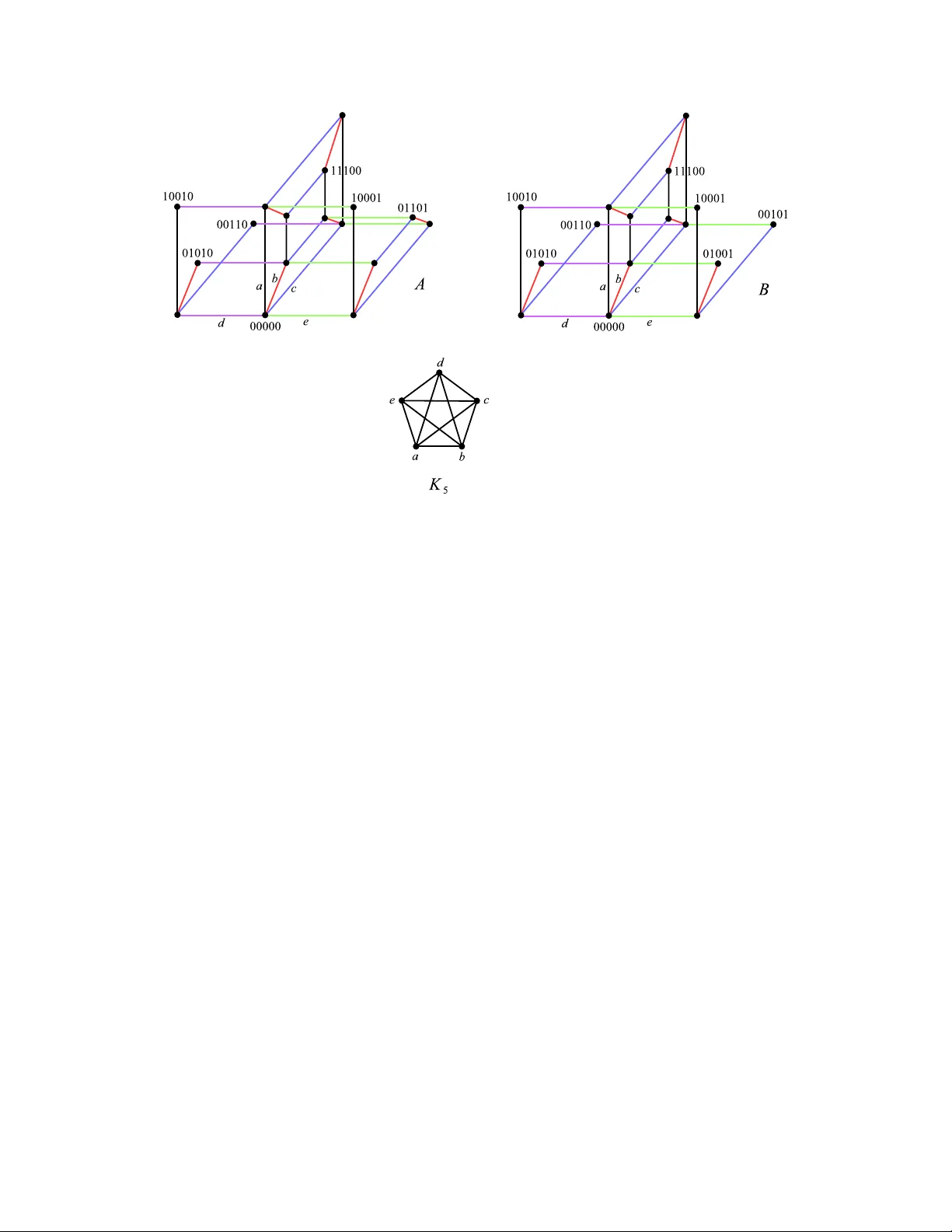
Isomorphic daisy cub es based on their τ -graphs Marc h 27, 2026 Zhongyuan Che a , Nik o T ratnik b,c , P etra Žigert Pleteršek d,b a Dep artment of Mathematics, Penn State University, Be aver Campus, Monac a, USA b University of Marib or, F aculty of Natur al Scienc es and Mathematics, Slovenia c Institute of Mathematics, Physics and Me chanics, Ljubljana, Slovenia d University of Marib or, F aculty of Chemistry and Chemic al Engine ering, Slovenia zxc10@psu.edu, niko.tratnik@um.si, petra.zigert@um.si Abstract W e pro ve that if A and B are daisy cub es whose τ -graphs are forests, then A and B are isomorphic if and only if their τ -graphs are isomorphic. The result is applied to sho w that a daisy cub e with at least one edge is the resonance graph of a plane bipartite graph G if and only if its τ -graph is a forest whic h is isomorphic to the inner dual of the subgraph of G obtained by removing all forbidden edges. As a consequence, some w ell known prop erties of Fibonacci cubes and Lucas cub es are pro vided as examples with differen t pro ofs. K eywor ds : daisy cub e, τ -graph, p eripherally 2-colorable graph, resonance graph 1 In tro duction Daisy cub es and median graphs are t w o imp ortant subfamilies of partial cub es, b oth of them are closely related to the resonance graphs in c hemical graph theory . It is kno wn [21] that the resonance graph of a plane w eakly elementary bipartite graph is a median graph. A c haracterization of plane bipartite graphs whose resonance graphs are daisy cubes w as giv en recen tly in [1]. More structural prop erties of resonance graphs that are daisy cub es were pro vided in [2] and [5]. 1 The τ -graphs of median graphs were in tro duced b y V esel [20] to c haracterize resonance graphs of catacondensed hexagonal graphs: A graph G is the resonance graph of a catacon- densed hexagonal graph if and only if G is a median graph whose τ -graph is a tree T with v ertex degree at most 3 , and the degree-3 vertices of T corresp ond to the p eripheral Θ -classes of G . Kla vžar and Ko vše [10] extended the concept of the τ -graphs to partial cub es, and sho w ed that every graph is a τ -graph of some median graph, the τ -graph of a median graph is K n -free if and only if it does not con tain an y conv ex K 1 ,n , and the τ -graph of a graph G is connected if and only if G is a prime graph with resp ect to the Cartesian pro duct. W e use P n and C n to represent a path and a cycle on n vertices, resp ectively . It is kno wn [10] that non-isomorphic partial cubes can hav e the same τ -graph: the partial cub e C 6 (neither a median graph nor a daisy cub e), the median graph K 1 , 3 (also the Lucas cub e Λ 3 ), and the daisy cub e Q − 3 (not a median graph) all hav e the same τ -graph K 3 , see Figure 1. Figure 1: P artial cub es C 6 , Λ 3 , and Q − 3 with Θ -classes a, b, c ha v e the same τ -graph K 3 . Besides the example presen ted in Figure 1, we observ e that for n ≥ 3 , a path P n +1 (not a daisy cub e) and a Fib onacci cub e Γ n (a daisy cub e) are non-isomorphic partial cubes with the same τ -graph P n . W e also observ e that non-isomorphic daisy cub es can ha v e the same τ -graph, see Figure 2. In this pap er, we fo cus on studying τ -graphs of daisy cub es. F or t w o daisy cub es A and B whose τ -graphs are forests, w e pro ve that A and B are isomorphic if and only if their τ -graphs A τ and B τ are isomorphic. W e then apply the result to c haracterize that a daisy cub e with at least one edge is the resonance graph of a plane bipartite graph G if and only if the τ -graph of the daisy cub e is a forest which is isomorphic to the inner dual of the subgraph of G obtained b y removing all forbidden edges. In particular, a daisy cube is the resonance graph of a plane elemen tary bipartite graph G with more than tw o v ertices if and only if the τ -graph of the daisy cub e is a tree which is isomorphic to the inner dual of G . Related well known prop erties of τ -graphs of Fib onacci cub es and Lucas cub es are considered as examples with different pro ofs. 2 Figure 2: T w o non-isomorphic daisy cub es with the same τ -graph K 5 . 2 Preliminaries Let G b e a simple graph. W e use V ( G ) and E ( G ) to denote the vertex set and the edge set of G , resp ectiv ely . A vertex of G is called non-isolate d if it is adjacent to at least one other vertex of G . A c omp onent of G is a maximal connected induced subgraph of G . The c omplement of G , written as G C , is a graph with the same v ertex set as G suc h that tw o v ertices are adjacen t in G C if and only if they are not adjacen t in G . A subgraph of G induced by a vertex subset X ⊆ V ( G ) is denoted as ⟨ X ⟩ . A clique K of G is a subgraph suc h that any tw o vertices of K are adjacent in G . The simplex gr aph of G , denoted by K ( G ) , is the graph whose v ertices are the cliques of G (including the clique on empt y set), and tw o cliques are adjacent if they differ in exactly one v ertex. An isomorphism b etw een t wo graphs G 1 and G 2 , denoted by f : G 1 → G 2 , is a bijection f b et ween V ( G 1 ) and V ( G 2 ) such that u 1 v 1 ∈ E ( G 1 ) if and only if f ( u 1 ) f ( v 1 ) ∈ E ( G 2 ) . W e call that G 1 and G 2 are isomorphic if there exists an isomorphism b etw een them, and non-isomorphic otherwise. A Cartesian pr o duct 2 n i =1 G i of n graphs G 1 , G 2 , . . . G n , where n ≥ 2 , is a graph whose v ertex set is V ( G 1 ) × V ( G 2 ) × · · · × V ( G n ) and t w o v ertices ( x 1 , . . . , x n ) and ( y 1 , . . . , y n ) are adjacen t in 2 n i =1 G i if there exists an i ∈ { 1 , . . . , n } such that x i y i ∈ E ( G i ) , and x j = y j for an y j ∈ { 1 , . . . , n } \ { i } . An n -dimensional hyp er cub e Q n is a Cartesian pro duct 2 n i =1 K 2 for n ≥ 2 , while Q 0 is a one-v ertex graph, and Q 1 is the one-edge graph. It is easily seen that Q n = K ( K n ) , where K n is the complete graph on n v ertices. Let G be a connected graph. The distanc e d G ( x, y ) is the length of a shortest path b et ween tw o v ertices x and y of G , and the interval I G ( x, y ) is the set of all vertices on shortest paths b et ween tw o vertices x and y in G . A subgraph H of G is an isometric 3 sub gr aph if d H ( u, v ) = d G ( u, v ) for ev ery t w o v ertices u and v of H . Partial cub es are isometric subgraphs of h yp ercub es. A graph G is a me dian gr aph if G is a connected graph suc h that for every triple of v ertices u, v , w in G , | I G ( u, v ) ∩ I G ( u, w ) ∩ I G ( v , w ) | = 1 . It is w ell kno wn [16, 11] that median graphs are partial cub es. Let n be a p ositiv e in teger. Let ( B n , ≤ ) b e a poset on the set of all binary strings of length n with the partial order u 1 u 2 . . . u n ≤ v 1 v 2 . . . v n if u i ≤ v i for all 1 ≤ i ≤ n . A daisy cub e gener ate d by X ⊆ B n is an induced subgraph of Q n , and defined as Q n ( X ) = ⟨{ u ∈ B n | u ≤ x for some x ∈ X }⟩ [12]. The vertex 0 n is the minimum vertex of Q n ( X ) . Djoković-Winkler r elation (briefly , r elation Θ ) is a relation on the set of edges of a connected graph G such that tw o edges x 1 x 2 and y 1 y 2 of G are in r elation Θ if d G ( x 1 , y 1 ) + d G ( x 2 , y 2 ) = d G ( x 1 , y 2 ) + d G ( x 2 , y 1 ) . The relation Θ is an equiv alence relation on the edge set of any partial cub e, see [7]. Let ab b e an edge of a connected graph G . Then four subsets of the v ertex set V ( G ) can b e defined: W ab = { w | w ∈ V ( G ) , d G ( w , a ) < d G ( w , b ) } , W ba = { w | w ∈ V ( G ) , d G ( w , b ) < d G ( w , a ) } , U ab = { u ∈ W ab | u is adjacen t to a vertex in W ba } , U ba = { v ∈ W ba | v is adjacen t to a vertex in W ab } . An y Θ -class of a partial cube G is a set of edges represented b y F ab = { e ∈ E ( G ) | e Θ ab } for some edge ab ∈ G and the spanning subgraph G − F ab has exactly t w o components: ⟨ W ab ⟩ and ⟨ W ba ⟩ [11]. Moreov er, a Θ -class of a partial cub e is called a p eripher al Θ -class if either W ab = U ab or W ba = U ba . Supp ose that H is a graph with V ( H ) = V 1 ∪ V 2 , where V 1 ∩ V 2 = ∅ , ⟨ V 1 ⟩ and ⟨ V 2 ⟩ are isometric subgraphs of H , and there is no edge of H b et ween V 1 \ V 2 and V 2 \ V 1 . The exp ansion of H with respect to ⟨ V 1 ∩ V 2 ⟩ is the graph G obtained from H b y the follo wing steps: (i) Replace eac h v ∈ V 1 ∩ V 2 b y an edge v 1 v 2 . (ii) Insert edges b etw een v 1 and all neigh b ors of v in V 1 \ V 2 , and insert edges b etw een v 2 and all neighbors of v in V 2 \ V 1 . (iii) Insert the edges u 1 v 1 and u 2 v 2 if u, v ∈ V 1 ∩ V 2 are adjacent in H . See [ 11]. If H = ⟨ V 1 ⟩ , then the expansion is called a p eripher al exp ansion of H with resp ect to H 0 = ⟨ V 2 ⟩ , and denoted b y p e( H , H 0 ) . By definition, we can see that if G = pe( H , H 0 ) , then H 0 is an isometric subgraph of H , and H is an isometric subgraph of G such that H 0 is isomorphic to G \ V ( H ) , which is the induced subgraph of G obtained b y remo ving all v ertices from H . Moreo v er, if H is a partial cub e, then the edges b etw een H 0 ⊆ H and G \ V ( H ) form the Θ -class { e ∈ E ( G ) | e Θ ab } for some edge ab ∈ E ( G ) suc h that H = ⟨ W ab ⟩ and H 0 = ⟨ U ab ⟩ , whic h is isomorphic to ⟨ W ba ⟩ = ⟨ U ba ⟩ = G \ V ( H ) . If ⟨ V 1 ∩ V 2 ⟩ is an isometric subgraph (resp ectively , a conv ex subgraph) of H , then the expansion is call an isometric expansion (resp ectively , a conv ex expansion). A graph G is a partial cub e if and only if G can b e obtained from the one-v ertex graph b y a sequence of isometric expansions [6]. A graph G is a median graph if and only if G can be obtained from the one-vertex graph by a sequence of conv ex expansions [15]. The inv erse op eration of an expansion in partial cub es G is called a c ontr action , that is, a con traction of a partial cub e G is obtained by con tracting the edges of a given Θ -class E , which is denoted b y G/ E . It is kno wn [19] that ev ery Θ -class of a daisy cub e is p eripheral. 4 Therefore, if G is a daisy cub e, then G/ E is an induced subgraph of G for an y Θ -class E of G . Let G b e a partial cub e whose vertex set is a p oset ( V ( G ) , ≤ ) contained in ( B n , ≤ ) . Let P ( V ( G )) b e the p ow er set of V ( G ) . Then an op erator o : P ( V ( G )) → P ( V ( G )) can b e defined with o ( X ) = { u ∈ V ( G ) | u ≤ v for some v ∈ X } for an y X ⊆ V ( G ) . An induced subgraph H of G is called a ≤ -sub gr aph of G if V ( H ) = o ( V ( H )) . Assume that G is a daisy cub e and H is a ≤ -subgraph of G . Then the peripheral expansion of G with resp ect to H is called the ≤ -exp ansion of G with resp ect to H . A connected graph is a daisy cub e if and only if it can b e obtained from the one-v ertex graph b y a sequence of ≤ -expansions [19]. It is well known that a con traction of a daisy cub e is also a daisy cub e [12]. Fib onacci cub es and Lucas cub es are sp ecial t yp es of daisy cub es. F or each n ≥ 1 , a Fib onac ci cub e Γ n is a graph whose vertex set is the set of all binary strings of length n without consecutiv e 1’s, and tw o v ertices are adjacen t in Γ n if they differ in exactly one p osition. A Luc as cub e Λ n is the induced subgraph of the Fib onacci cub e Γ n suc h that the v ertex set of Λ n consists of all binary strings of length n without consecutive 1’s and also without 1 in the first and the last p ositions. The τ -gr aph of a p artial cub e H , denote d by H τ , is a graph whose v ertex set is the set of Θ -classes of H , and t w o distinct Θ -classes E and F are adjacent in H τ if H has tw o edges uv ∈ E and v w ∈ F such that uv w is a conv ex path on three vertices, that is, vertex v is the only common neighbor of t w o nonadjacen t vertices u and w [10]. Note that the τ -gr aph R ( G ) τ of the resonance graph R ( G ) of a plane bipartite graph G is equiv alen t to the induc e d gr aph Θ( R ( G )) defined in [4] as a graph whose v ertex set is the set of Θ -classes of R ( G ) , and t w o v ertices E and F of Θ( R ( G )) are adjacent if R ( G ) has t wo incident edges uv ∈ E and v w ∈ F such that uv and v w are not contained in a common 4-cycle of R ( G ) . F or clarity and consistence, we will use the notation τ -gr aph R ( G ) τ in tro duced in [10]. 3 Isomorphic daisy cub es based on their τ -graphs In this section, w e prov e the main result of the pap er. Firstly , w e show that a daisy cub e is a hypercub e Q n if and only if its τ -graph is an empty graph on n vertices. Lemma 3.1 L et H b e a daisy cub e with n Θ -classes for some p ositive inte ger n . Then H = Q n if and only if H τ = K C n . Pro of. The necessity part is ob vious. Let H τ = K C n , which is an empt y graph on n v ertices. Pro v e the sufficiency b y induction on n . If n = 1 , then an y daisy cub e with exactly one Θ -class is the one-edge graph which is Q 1 , and so H = Q 1 . If n = 2 , then an y daisy cub e with exactly tw o Θ -classes is either P 3 or Q 2 , where P τ 3 = K 2 and Q τ 2 = K C 2 . It follows that H = Q 2 . Supp ose that the sufficiency is true for any daisy cub e with less than n Θ -classes where n ≥ 3 . Let H b e a daisy cube with n Θ -classes suc h that H τ = K C n . Recall [19] that a connected graph is a daisy cub e if and only if it can b e obtained from the one-vertex graph b y a sequence of ≤ -expansions, and any Θ -class of a daisy cub e is p eripheral. Then H can b e obtained from a daisy cube H ′ b y a peripheral ≤ -expansion with resp ect to a ≤ -subgraph H ′′ of H ′ , and a new Θ -class E n is generated during the expansion. It is w ell known [12] that every Θ -class of a daisy cub e H has exactly one edge incident to 0 n . Then the new 5 Θ -class E n has one edge incident to at least one edge from each of other Θ -class of H . Since H τ = K C n , it follo ws that H ′′ = H ′ and H = H ′ 2 K 2 to a v oid an y conv ex path of length 2 with one edge from E n . By induction h yp othesis, H ′ = Q n − 1 . Hence, H = Q n . 2 Theorem 3.2 L et A and B b e daisy cub es whose τ -gr aphs A τ and B τ ar e for ests. L et {E 1 , . . . , E n } and {F 1 , . . . , F n } b e the sets of Θ -classes of A and B , r esp e ctively. If Υ : A τ → B τ is an isomorphism such that Υ( E i ) = F i for i ∈ { 1 , . . . , n } , then ther e exists an isomorphism λ : A → B such that uv ∈ E i if and only if λ ( u ) λ ( v ) ∈ F i for i ∈ { 1 , . . . , n } . Mor e over, the r estriction of λ on A/ E j is an isomorphism b etwe en A/ E j and B / F j for any j ∈ { 1 , . . . , n } . Pro of. By the definition of a τ -graph, w e know that the v ertex set of the τ -graph of a daisy cub e is the set of Θ -classes of the daisy cub e. Let n be the n um b er of Θ -classes of eac h of daisy cub es A and B . Then eac h of their τ -graphs A τ and B τ has n vertices. By Lemma 3.1, if A τ and B τ are K C n , then A and B are Q n , and so the result holds true. W e call a forest nontrivial if it con tains at least one edge. Let A τ and B τ b e non trivial forests with n v ertices. Then n ≥ 2 since a daisy cub e with exactly one Θ -class is the one-edge graph, and its τ -graph is the one-v ertex graph whic h is a trivial forest. Pro v e b y induction on n ≥ 2 . If n = 2 , a daisy cub e with exactly t w o Θ -classes is either P 3 or Q 2 . Since P τ 3 = K 2 , and Q τ 2 = K C 2 , a daisy cube with exactly t w o Θ -classes and whose τ -graph is a nontrivial forest m ust b e P 3 , and so the result holds true. W e assume that the result holds true for daisy cub es with less than n Θ -classes where n ≥ 3 and whose τ -graphs are nontrivial forests. Let A and B b e daisy cubes with exactly n Θ -classes where n ≥ 3 and whose τ -graphs A τ and B τ are isomorphic non trivial forests. W e observ e that {E 1 , . . . , E n } and {F 1 , . . . , F n } are the v ertex sets of τ -graphs A τ and B τ , resp ectively . If Υ : A τ → B τ is an isomorphism b et ween A τ and B τ suc h that Υ( E i ) = F i for i ∈ { 1 , . . . , n } , then b y the assumption that A τ and B τ are non trivial forests, w e can let E n and F n b e non-isolated vertices of A τ and B τ resp ectiv ely suc h that Υ( E n ) = F n . Let Υ ′ b e the restriction of Υ on A τ \ {E n } . Then Υ ′ : A τ \ {E n } → B τ \ {F n } is an isomorphism b etw een t w o forests A τ \ {E n } and B τ \ {F n } suc h that Υ ′ ( E i ) = F i for i ∈ { 1 , . . . , n − 1 } . By Prop osition 2.1 in [19], every Θ -class of a daisy cub e is p eripheral. Then a con- traction of any Θ -class of a daisy cub e results an induced subgraph of the daisy cub e. Let ¯ A = A/ E n (resp ectiv ely , ¯ B = B / F n ) b e the induced subgraph of the daisy cub e A (resp ec- tiv ely , the daisy cub e B ) obtained b y contracting edges of the Θ -class E n (resp ectiv ely , the Θ -class F n ). Then b oth ¯ A and ¯ B are daisy cub es since a contraction of a daisy cub e is also a daisy cub e b y Prop osition 2.2 in [12]. By definitions, a con traction is the inv erse op eration of an expansion. Then daisy cub e A can b e obtained from daisy cub e ¯ A by a p eripheral expansion with resp ect to an isometric subgraph ¯ A of ¯ A . A new p eripheral Θ -class E n is generated during the expansion whic h is contained in the subgraph ¯ A 2 K 2 of A . It is clear that ¯ A is a nonempty proper induced subgraph of A by the definition of a p eripheral expan- sion. W e observ e that ¯ A must b e a nonempty prop er induced subgraph of ¯ A . Otherwise, eac h edge of E n is contained in a 4-cycle of A , and so E n is an isolated vertex of A τ . This is a contradiction to the assumption that E n is a non-isolated vertex of A τ . Similarly , we can 6 see that daisy cub e B can b e obtained from a daisy cub e ¯ B b y a p eripheral expansion with resp ect to an isometric subgraph ¯ B of ¯ B . A new p eripheral Θ -class F n is generated during the expansion whic h is contained in the subgraph ¯ B 2 K 2 of B . Moreov er, ¯ B is a nonempt y prop er induced subgraph of B , and ¯ B is a nonempty prop er induced subgraph of ¯ B . F or each i ∈ { 1 , . . . , n − 1 } , let ¯ E i = E i ∩ E ( ¯ A ) and ¯ F i = F i ∩ E ( ¯ B ) . Then { ¯ E 1 , . . . , ¯ E n − 1 } and { ¯ F 1 , . . . , ¯ F n − 1 } are the sets of Θ -classes of daisy cubes ¯ A and ¯ B , resp ectively . Let ¯ A τ and ¯ B τ b e τ -graphs of ¯ A and ¯ B , resp ectively . Claim 1. There exists an isomorphism ¯ Υ : ¯ A τ → ¯ B τ b et ween t wo forests ¯ A τ and ¯ B τ and such that ¯ Υ( ¯ E i ) = ¯ F i for i ∈ { 1 , . . . , n − 1 } . Pr o of of Claim 1. The conclusion is obvious if ¯ A τ and ¯ B τ are K C n − 1 . Let ¯ A τ and ¯ B τ b e nontrivial forests. Let f : ¯ A τ → A τ \ {E n } suc h that f ( ¯ E i ) = E i for i ∈ { 1 , . . . , n − 1 } . W e will show that f is an isomorphism b etw een ¯ A τ and A τ \ {E n } . Note that this is not necessarily true if A τ is not a forest, see Figure 3. Figure 3: Daisy cub e A with Θ -classes {E 1 , E 2 , E 3 } suc h that A τ \ {E 3 } is not isomorphic to ¯ A τ . W e first show that if ¯ E i and ¯ E j are adjacent in ¯ A τ , where distinct i, j ∈ { 1 , . . . , n − 1 } , then E i and E j are adjacen t in A τ \ {E n } . This can b e seen as follo ws. If ¯ E i and ¯ E j are adjacen t in ¯ A τ , then ¯ A con tains a con v ex path ¯ u ¯ v ¯ w of length 2, where ¯ u ¯ v ∈ ¯ E i and ¯ v ¯ w ∈ ¯ E j suc h that ¯ u ¯ v ¯ w is not con tained in an y 4-cycle of ¯ A . It remains to show that ¯ u ¯ v ¯ w is also a con v ex path of A . It is w ell known [11] that for a partial cub e, tw o inciden t edges of a 4-cycle are contained in different Θ -classes, and t w o an tip o dal edges of a 4-cycle are contained in the same Θ -class. Then an y 4-cycle of A that con tains ¯ u ¯ v ¯ w must ha v e all edges from E i ∪ E j since ¯ u ¯ v ∈ ¯ E i ⊆ E i and ¯ v ¯ w ∈ ¯ E j ⊆ E j . By the definition of ¯ A whic h is the daisy cub e obtained the con traction of E n of A , w e observ e that the spanning subgraph A − E n of A has exactly t w o components ¯ A and A \ V ( ¯ A ) . It follows that an y 4-cycle of A containing ¯ u ¯ v ¯ w must b e 7 a 4-cycle of ¯ A . Since ¯ u ¯ v ¯ w is not con tained in any 4-cycle of ¯ A , it follows that ¯ u ¯ v ¯ w is not con tained in any 4-cycle of A . Then ¯ u ¯ v ¯ w is also a conv ex path of length 2 in A , and so E i and E j are adjacent in A τ . It follows that E i and E j are adjacent in A τ \ {E n } . W e then sho w that if E i and E j are adjacent in A τ \ {E n } , where i, j ∈ { 1 , . . . , n − 1 } and i = j , then ¯ E i and ¯ E j are adjacent in ¯ A τ . Pro v e by contradiction. Supp ose that E i and E j are adjacent in A τ \ {E n } , but ¯ E i and ¯ E j are not adjacen t in ¯ A τ . Then any tw o inciden t edges of ¯ A , where one edge in ¯ E i and the other in ¯ E j are contained in a 4-cycle of ¯ A , while there exists an edge uv ∈ E i and an edge v w ∈ E j suc h that uv w is a conv ex path of length 2 in A . Recall that the spanning subgraph A − E n of A has exactly tw o comp onents ¯ A and A \ V ( ¯ A ) . Then the con v ex path uv w of A is contained in A \ V ( ¯ A ) . W e observ e that A \ V ( ¯ A ) is isomorphic to ¯ A , and the subgraph ¯ A 2 K 2 of A is generated on the v ertex set of ¯ A ∪ ( A \ V ( ¯ A )) . Then there exists a path ¯ u ¯ v ¯ w in ¯ A ⊂ ¯ A such that the induced subgraph ⟨ ¯ u ¯ v ¯ w ∪ uvw ⟩ is isomorphic to ¯ u ¯ v ¯ w 2 K 2 and con tained in ¯ A 2 K 2 . It is clear that u ¯ u , v ¯ v , w ¯ w are edges of E n . Recall that uv ∈ E i and v w ∈ E j . Then ¯ u ¯ v ∈ ¯ E i and ¯ v ¯ w ∈ ¯ E j . By our assumption that ¯ E i and ¯ E j are not adjacent in ¯ A τ , it follows that ¯ u ¯ v ¯ w is contained in a 4-cycle ¯ u ¯ v ¯ w ¯ x in ¯ A . Supp ose that u ¯ u ¯ x is contained in a 4-cycle of A . Then the 4-cycle m ust b e u ¯ u ¯ xx where ¯ xx ∈ E n , since t w o an tip o dal edges of a 4-cycle are contained in the same Θ -class. It follows that uv w x is a 4-cycle in A \ V ( ¯ A ) con taining the conv ex path uv w of A , whic h is a con tradiction. Therefore, u ¯ u ¯ x cannot b e contained in a 4-cycle of A . Similarly , w ¯ w ¯ x cannot b e contained in a 4-cycle of A . Now, A con tains tw o con vex paths u ¯ u ¯ x and w ¯ w ¯ x of length 2. Recall that tw o edges u ¯ u and w ¯ w of A are con tained in E n . Note that ¯ u ¯ x ∈ ¯ E j ⊆ E j and ¯ w ¯ x ∈ ¯ E i ⊆ E i . Then E n is adjacen t to t wo distinct Θ -classes of A in A τ : E i and E j where distinct i, j ∈ { 1 , . . . , n − 1 } . Then E n , E i , and E j form a 3-cycle in A τ , since E i and E j are also adjacent in A τ . This is a con tradiction to the assumption that A τ is a forest. Therefore, we ha ve sho wn that if f : ¯ A τ → A τ \ {E n } such that f ( ¯ E i ) = E i for i ∈ { 1 , . . . , n − 1 } , then f is an isomorphism b etw een tw o forests ¯ A τ and A τ \ {E n } . Let g : ¯ B τ → B τ \ {F n } suc h that g ( ¯ F i ) = F i for i ∈ { 1 , . . . , n − 1 } . Similarly , we can show that g is an isomorphism b etw een tw o forests ¯ B τ and B τ \ {F n } . Recall that Υ ′ : A τ \ {E n } → B τ \ {F n } is an isomorphism where Υ ′ is the restriction of Υ on A τ \ {E n } such that Υ ′ ( E i ) = F i for i ∈ { 1 , . . . , n − 1 } . Let ¯ Υ := g − 1 ◦ Υ ′ ◦ f . Then ¯ Υ : ¯ A τ → ¯ B τ is an isomorphism such that ¯ Υ( ¯ E i ) = ¯ F i for i ∈ { 1 , . . . , n − 1 } . Therefore, ¯ A τ and ¯ B τ are isomorphic forests. This ends the pro of of Claim 1. Therefore, the follo wing statements hold true trivially if ¯ A τ and ¯ B τ are trivial forests since ¯ A and ¯ B are Q n − 1 b y Lemma 3.1, or b y induction hypothesis if ¯ A τ and ¯ B τ are not trivial forests: There exists an isomorphism ¯ λ : ¯ A → ¯ B such that uv ∈ ¯ E i if and only if ¯ λ ( u ) ¯ λ ( v ) ∈ ¯ F i for i ∈ { 1 , . . . , n − 1 } . Moreo v er, the restriction of ¯ λ on ¯ A/ ¯ E j is an isomorphism b et ween ¯ A/ ¯ E j and ¯ B / ¯ F j for any j ∈ { 1 , . . . , n − 1 } . Claim 2. Both ¯ A and ¯ B are daisy cub es. Pr o of of Claim 2. W e know that A = p e( ¯ A, ¯ A ) , where ¯ A is a nonempt y prop er induced subgraph of daisy cub e ¯ A . Let ab be an edge of Θ -class E n of A . Then E n = { e ∈ E ( A ) | e Θ ab } . Without loss of generalit y supp ose that ¯ A = ⟨ W ab ⟩ and ¯ A = ⟨ U ab ⟩ . Then ⟨ W ba ⟩ = ⟨ U ba ⟩ = A \ V ( ¯ A ) whic h is isomorphic to ¯ A . It follo ws that | W ab | > | W ba | . By Prop osition 3.1 in [19], we can see that the minim um v ertex of A is con tained in ¯ A = ⟨ W ab ⟩ . By Prop osition 2.8 in [19], it follo ws that ¯ A = ⟨ U ab ⟩ is a ≤ -subgraph of daisy cub e A . It is 8 clear that ¯ A = ⟨ U ab ⟩ is also a ≤ -subgraph of daisy cub e ¯ A . Hence, A, ¯ A, ¯ A ha ve the same minim um vertex whic h is contained in ¯ A . Similarly , we hav e that B = p e( ¯ B , ¯ B ) where ¯ B is a ≤ -subgraph of daisy cub es B and ¯ B , and B , ¯ B , ¯ B ha ve the same the minim um vertex whic h is contained in ¯ B . By Prop osition 2.7 in [19], b oth ¯ A and ¯ B are daisy cub es since an y ≤ -subgraph of a daisy cub e is isomorphic to a daisy cub e. This ends the pro of of Claim 2. W e further let E n (resp ectiv ely , F n ) b e a degree-1 v ertex of A τ (resp ectiv ely , B τ ). Then E n (resp ectiv ely , F n ) is adjacent to exactly one vertex E α ( n ) (resp ectiv ely , F α ( n ) ) of A τ (resp ectiv ely , B τ ). Figure 4: Illustration of Claim 3. Claim 3. ¯ E α ( n ) = E α ( n ) and ¯ F α ( n ) = F α ( n ) . The spanning subgraph ¯ A − E α ( n ) of daisy cub e ¯ A has exactly t w o comp onents ¯ A and ¯ A \ V ( ¯ A ) . The spanning subgraph ¯ B − F α ( n ) of daisy cub e ¯ B has exactly t w o comp onents ¯ B and ¯ B \ V ( ¯ B ) . Pr o of of Claim 3. Note that ¯ A is a nonempt y prop er induced subgraph of daisy cub e ¯ A . Since ¯ A is connected, there exists a v ertex ¯ w of ¯ A \ V ( ¯ A ) suc h that ¯ w is adjacen t to a v ertex ¯ u of ¯ A . By the well kno wn facts that an y tw o edges on a shortest path of a bipartite graph cannot b e in the same Θ -class [11], we can see that tw o edges incident to the same v ertex ¯ w cannot b e in the same Θ -class of ¯ A . It follows that if a vertex ¯ w of ¯ A \ V ( ¯ A ) is adjacen t to tw o distinct vertices ¯ u, ¯ v of ¯ A , then ¯ w ¯ u ∈ ¯ E i ⊆ E i and ¯ w ¯ v ∈ ¯ E j ⊆ E j for distinct i, j ∈ { 1 , 2 , . . . , n − 1 } . Note that A = p e( ¯ A, ¯ A ) suc h that the set of edges b et ween ¯ A and A \ V ( ¯ A ) is a matching which forms the Θ -class E n of A . Since ¯ u, ¯ v ∈ V ( ¯ A ) , it follows that there exist t w o vertices u, v of A \ V ( ¯ A ) suc h that edges ¯ uu, ¯ v v ∈ E n . Since ¯ w is a vertex of ¯ A \ V ( ¯ A ) , ¯ w cannot b e incident to an y edge contained in the Θ -class E n . Since tw o antipo dal edges of a 4-cycle are contained in the same Θ -class, it follo ws that ¯ w ¯ uu and ¯ w ¯ v v cannot be con tained in a 4-cycle. Hence, ¯ w ¯ uu and ¯ w ¯ v v are tw o con v ex paths of length 2 in A , and E n is adjacent to b oth E i and E j in A τ . This is a contradiction to our assumption that E n is a degree-1 vertex of A τ . If a vertex ¯ u of ¯ A is adjacent to t w o distinct vertices ¯ x, ¯ y of ¯ A \ V ( ¯ A ) , then ¯ u ¯ x ∈ ¯ E i ⊆ E i and ¯ u ¯ y ∈ ¯ E j ⊆ E j for distinct i, j ∈ { 1 , 2 , . . . , n − 1 } since tw o edges incident to the same v ertex ¯ u cannot b e in the same Θ -class. Note that A = p e( ¯ A, ¯ A ) such that the set of edges 9 b et ween ¯ A and A \ V ( ¯ A ) is a matc hing whic h forms the Θ -class E n of A , and ¯ u ∈ V ( ¯ A ) . It follo ws that there exists a v ertex u of A suc h that the edge u ¯ u ∈ E n . Since ¯ x, ¯ y ∈ ¯ A \ V ( ¯ A ) , neither ¯ x or ¯ y can b e inciden t to an edge contained in the Θ -class E n . It follo ws that u ¯ u ¯ x and u ¯ u ¯ y are t w o con v ex paths of length 2, and E n is adjacent to b oth E i and E j in A τ . This is a contradiction to our assumption that E n is a degree-1 vertex of A τ . As a consequence, the edges b etw een ¯ A \ V ( ¯ A ) and ¯ A are pairwise v ertex disjoin t edges. W e observ e that eac h edge b etw een ¯ A \ V ( ¯ A ) and ¯ A can b e written as ¯ x ¯ w where ¯ x is a v ertex of ¯ A \ V ( ¯ A ) , ¯ w is a vertex of ¯ A , and ¯ x ¯ w w is a con v ex path of A where ¯ w w ∈ E n . Since E n is a degree-1 vertex and adjacent to E α ( n ) in A τ , it follows that the set of edges b et ween ¯ A \ V ( ¯ A ) and ¯ A must be E α ( n ) . Then the spanning subgraph A − E α ( n ) of A has exactly t wo comp onen ts ¯ A \ V ( ¯ A ) and ¯ A ∪ ( A \ V ( ¯ A )) , where eac h edge of E α ( n ) has one end v ertex in ¯ A \ V ( ¯ A ) and the other end vertex in ¯ A (see also [18]). It follo ws that E α ( n ) = ¯ E α ( n ) since the spanning subgraph ¯ A − ¯ E α ( n ) of ¯ A has exactly t w o comp onents ¯ A \ V ( ¯ A ) and ¯ A , where each edge of ¯ E α ( n ) has one end v ertex in ¯ A \ V ( ¯ A ) and the other end vertex in ¯ A . Similarly w e can show that F α ( n ) = ¯ F α ( n ) , while the spanning subgraph B − F α ( n ) of B has exactly t wo comp onen ts ¯ B \ V ( ¯ B ) and ¯ B ∪ ( B \ V ( ¯ B )) and the spanning subgraph ¯ B − F α ( n ) of ¯ B has exactly tw o comp onen ts ¯ B \ V ( ¯ B ) and ¯ B . This ends the pro of of Claim 3. Claim 4. Daisy cube ¯ A (resp ectively , ¯ B ) has exactly n − 2 Θ -classes ¯ E i = ¯ E i ∩ E ( ¯ A ) (resp ectiv ely , ¯ F i = ¯ F i ∩ E ( ¯ B ) ) for all i ∈ { 1 , . . . , n } \ { n, α ( n ) } . (Note that this is not necessarily true if A τ (resp ectiv ely , B τ ) is not a forest or E n (resp ectiv ely , F n ) is not a degree-1 v ertex of A τ (resp ectiv ely , B τ ). F or example, see Figure 3 where daisy cube ¯ A is induced on vertices 000 , 100 , and 010 , daisy cub e ¯ A is the 4-cycle con taining daisy cub e ¯ A and con tained in daisy cube A . Both ¯ A and ¯ A ha v e n − 1 Θ -classes while A has n Θ -classes, where n = 3 .) Pr o of of Claim 4. Recall that ¯ A has n − 1 Θ -classes { ¯ E 1 , . . . , ¯ E n − 1 } , where ¯ E i = E i ∩ E ( ¯ A ) for i ∈ { 1 , 2 . . . , n − 1 } . By Prop osition 2.1 in [ 19], ev ery Θ -class of a daisy cub e is p eripheral. By the pro of of Claim 2, we know that ¯ A, ¯ A , A ha ve the same minim um v ertex. By Prop osition 3.1 in [19] and Claim 3, w e can see that ¯ A can b e obtained from ¯ A by a p eripheral expansion, and a new Θ -class ¯ E α ( n ) = E α ( n ) is generated during the pro cess. So, ¯ A = ¯ A/ ¯ E α ( n ) where ¯ E α ( n ) = E α ( n ) . Recall that ¯ A = A/ E n . Then ¯ A can b e obtained from daisy cub e A by contracting t w o p eripheral Θ -classes E n and E α ( n ) . Let ¯ E i = ¯ E i ∩ E ( ¯ A ) = E i ∩ E ( ¯ A ) for eac h i ∈ { 1 , . . . , n } \ { n, α ( n ) } . It follo ws that daisy cub e ¯ A has exactly n − 2 Θ -classes ¯ E i , where ¯ E i ⊂ ¯ E i ⊂ E i for i ∈ { 1 , . . . , n } \ { n, α ( n ) } . Let ¯ F i = ¯ F i ∩ E ( ¯ B ) = F i ∩ E ( ¯ B ) for eac h i ∈ { 1 , . . . , n } \ { n, α ( n ) } . Similarly , daisy cub e ¯ B has exactly n − 2 Θ -classes ¯ F i , where ¯ F i ⊂ ¯ F i ⊂ F i for i ∈ { 1 , . . . , n } \ { n, α ( n ) } . This ends the pro of of Claim 4. W e ha ve shown that there exists an isomorphism ¯ λ : ¯ A → ¯ B suc h that uv ∈ ¯ E i if and only if ¯ λ ( u ) ¯ λ ( v ) ∈ ¯ F i for i ∈ { 1 , . . . , n − 1 } . Moreov er, the restriction of ¯ λ on ¯ A/ ¯ E j is an isomorphism b etw een ¯ A/ ¯ E j and ¯ B / ¯ F j for any j ∈ { 1 , . . . , n − 1 } . When j = α ( n ) , w e ha v e shown that ¯ A = ¯ A/ ¯ E α ( n ) where ¯ E α ( n ) = E α ( n ) , and ¯ B = ¯ B / ¯ F α ( n ) where ¯ F α ( n ) = F α ( n ) . Let ¯ ¯ λ be the restriction of ¯ λ on ¯ A . It follows that ¯ ¯ λ : ¯ A → ¯ B is an isomorphism suc h that uv ∈ ¯ E i = E i ∩ E ( ¯ A ) if and only if ¯ ¯ λ ( u ) ¯ ¯ λ ( v ) ∈ ¯ F i = F i ∩ E ( ¯ B ) for i ∈ { 1 , . . . , n } \ { n, α ( n ) } . No w, we sho w that there exists an isomorphism λ : A → B suc h that uv ∈ E i if and only if λ ( u ) λ ( v ) ∈ F i for any i ∈ { 1 , . . . , n } . 10 Recall that A = p e( ¯ A, ¯ A ) and B = p e( ¯ B , ¯ B ) . By the definition of a p eripheral expansion, we can see that the spanning subgraph A − E n of A has exactly t w o com- p onen ts ¯ A and A \ V ( ¯ A ) , and the edge set E n is a matc hing b et ween ¯ A and A \ V ( ¯ A ) whic h induces an isomorphism h A : ¯ A → A \ V ( ¯ A ) suc h that uv ∈ ¯ E i = E i ∩ E ( ¯ A ) if and only if h A ( u ) h A ( v ) ∈ E i ∩ E ( A \ V ( ¯ A )) for i ∈ { 1 , . . . , n } \ { n, α ( n ) } . Similarly , the spanning subgraph B − F n of B has exactly t w o comp onents ¯ B and B \ V ( ¯ B ) , and the edge set F n is a matching b et w een ¯ B and B \ V ( ¯ B ) which induces an isomorphism h B : ¯ B → B \ V ( ¯ B ) such that uv ∈ ¯ F i = F i ∩ E ( ¯ B ) if and only if h B ( u ) h B ( v ) ∈ F i ∩ E ( B \ V ( ¯ B )) for i ∈ { 1 , . . . , n } \ { n, α ( n ) } . Let ¯ ¯ λ c = h B ◦ ¯ ¯ λ ◦ h − 1 A , where ¯ ¯ λ : ¯ A → ¯ B is the isomorphism obtained b y the restriction of ¯ λ : ¯ A → ¯ B on ¯ A suc h that uv ∈ E i ∩ E ( ¯ A ) if and only if ¯ ¯ λ ( u ) ¯ ¯ λ ( v ) ∈ F i ∩ E ( ¯ B ) for i ∈ { 1 , . . . , n } \ { n, α ( n ) } . Then ¯ ¯ λ c : A \ V ( ¯ A ) → B \ V ( ¯ B ) is an isomorphism such that uv ∈ E i ∩ E ( A \ V ( ¯ A )) if and only if ¯ ¯ λ c ( u ) ¯ ¯ λ c ( v ) ∈ F i ∩ E ( B \ V ( ¯ B )) for i ∈ { 1 , . . . , n } \ { n, α ( n ) } . Define λ : A → B suc h that the restriction of λ on ¯ A is ¯ λ , which is an isomorphism from ¯ A to ¯ B , and the restriction of λ on A \ V ( ¯ A ) is ¯ ¯ λ c , whic h is an isomorphism from A \ V ( ¯ A ) to B \ V ( ¯ B ) . F or simplicit y , we write λ = ¯ λ ∪ ¯ ¯ λ c . By the prop erties of ¯ λ and ¯ ¯ λ c , w e can see that for i ∈ { 1 , . . . , n − 1 } , uv ∈ E i = ( E i ∩ E ( ¯ A )) ∪ ( E i ∩ E ( A \ V ( ¯ A ))) if and only if λ ( u ) λ ( v ) ∈ F i = ( F i ∩ E ( ¯ B )) ∪ ( F i ∩ E ( B \ V ( ¯ B ))) . T o sho w that λ is an isomorphism b et ween A and B , it remains to sho w that uv ∈ E n if and only if λ ( u ) λ ( v ) ∈ F n . Let uv ∈ E n . Then without loss of generality , w e can assume that u ∈ V ( ¯ A ) and v = h A ( u ) ∈ V ( A \ V ( ¯ A )) . Then λ ( u ) = ¯ ¯ λ ( u ) ∈ V ( ¯ B ) and λ ( v ) = ¯ ¯ λ c ( v ) = ¯ ¯ λ c ( h A ( u )) = h B ( ¯ ¯ λ ( u )) ∈ V ( B \ V ( ¯ B )) . So, λ ( u ) λ ( v ) = ¯ ¯ λ ( u ) ¯ ¯ λ c ( v ) = ¯ ¯ λ ( u ) h B ( ¯ ¯ λ ( u )) ∈ F n . Hence, uv ∈ E n implies that λ ( u ) λ ( v ) ∈ F n . On the other hand, if λ ( u ) λ ( v ) ∈ F n , then without loss of generality , w e can assume that λ ( u ) ∈ V ( ¯ B ) and λ ( v ) = h B ( λ ( u )) ∈ V ( B \ V ( ¯ B )) . Since ¯ ¯ λ : ¯ A → ¯ B is an isomorphism obtained by the restriction of λ on ¯ A , it follows that if λ ( u ) ∈ V ( ¯ B ) , then λ ( u ) = ¯ ¯ λ ( u ) where u ∈ V ( ¯ A ) . Since ¯ ¯ λ c : A \ V ( ¯ A ) → B \ V ( ¯ B ) is an isomorphism obtained by the restriction of λ on A \ V ( ¯ A ) , it follows that if λ ( v ) = h B ( λ ( u )) ∈ V ( B \ V ( ¯ B )) , then v ∈ V ( A \ V ( ¯ A )) and λ ( v ) = ¯ ¯ λ c ( v ) . Moreov er, λ ( v ) = h B ( ¯ ¯ λ ( u )) = ¯ ¯ λ c ( h A ( u )) . No w ¯ ¯ λ c ( v ) = ¯ ¯ λ c ( h A ( u )) . Then v = h A ( u ) ∈ V ( A \ V ( ¯ A )) since ¯ ¯ λ c : A \ V ( ¯ A ) → B \ V ( ¯ B ) is an isomorphism. Hence, λ ( u ) λ ( v ) ∈ F n implies that uv = uh A ( u ) ∈ E n . Therefore, λ : A → B is an isomorphism suc h that λ ( E i ) = F i for i ∈ { 1 , . . . , n } . Finally , w e show that the restriction of λ on A/ E j is an isomorphism b etw een A/ E j and B / F j for any j ∈ { 1 , . . . , n } . By the definition of λ , w e kno w that the restriction of λ on ¯ A is the isomorphism ¯ λ : ¯ A → ¯ B where ¯ A = A/ E n and ¯ B = B / F n . The conclusion holds true when j = n . Note that A/ E α ( n ) is the induced subgraph of A generated on the v ertex set of ¯ A ∪ ( A \ V ( ¯ A )) , and B / F α ( n ) is the induced subgraph of B generated on the vertex set of ¯ B ∪ ( B \ V ( ¯ B )) . Recall that the restriction of ¯ λ on ¯ A is an isomorphism ¯ ¯ λ : ¯ A → ¯ B such that uv ∈ E i ∩ E ( ¯ A ) if and only if ¯ ¯ λ ( u ) ¯ ¯ λ ( v ) ∈ F i ∩ E ( ¯ B ) for i ∈ { 1 , . . . , n } \ { α ( n ) , n } . Moreo v er, ¯ ¯ λ c : A \ V ( ¯ A ) → B \ V ( ¯ B ) is an isomorphism such that uv ∈ E i ∩ E ( A \ V ( ¯ A )) if and only if ¯ ¯ λ c ( u ) ¯ ¯ λ c ( v ) ∈ F i ∩ E ( B \ V ( ¯ B )) for i ∈ { 1 , . . . , n } \ { α ( n ) , n } . W e observe that if uv ∈ E n , then u ∈ V ( ¯ A ) and v = h A ( u ) ∈ V ( A \ V ( ¯ A )) ; and if λ ( u ) λ ( v ) ∈ F n , then λ ( u ) = ¯ ¯ λ ( u ) ∈ V ( ¯ B ) and λ ( v ) = ¯ ¯ λ c ( v ) ∈ V ( B \ V ( ¯ B )) . W e also ha v e shown that uv ∈ E n 11 if and only if λ ( u ) λ ( v ) = ¯ ¯ λ ( u ) ¯ ¯ λ c ( v ) ∈ F n . It follows that the restriction of λ = ¯ ¯ λ ∪ ¯ ¯ λ c on A/ E α ( n ) is an isomorphism b etw een A/ E α ( n ) and B / F α ( n ) . So, the conclusion holds true when j = α ( n ) . It remains to sho w that the restriction of λ = ¯ λ ∪ ¯ ¯ λ c on A/ E j is an isomorphism b et ween A/ E j and B / F j for an y j ∈ { 1 , . . . , n } \ { α ( n ) , n } . Recall that λ : A → B is an isomorphism suc h that uv ∈ E i if and only if λ ( u ) λ ( v ) ∈ F i for any i ∈ { 1 , . . . , n } . Moreov er, ¯ λ : ¯ A → ¯ B is an isomorphism obtained b y the restriction of λ on ¯ A , ¯ ¯ λ : ¯ A → ¯ B is an isomorphism obtained b y the restriction of ¯ λ on ¯ A , and ¯ ¯ λ c : A \ V ( ¯ A ) → B \ V ( ¯ B ) is an isomorphism obtained b y the restriction of λ on A \ V ( ¯ A ) . Recall that ¯ A is a daisy cub e with n − 1 Θ -classes and ¯ A is a daisy cub e with n − 2 Θ -classes. Then for any j ∈ { 1 , . . . , n } \ { α ( n ) , n } , the restriction of the isomorphism ¯ λ : ¯ A → ¯ B on ¯ A/ ( E j ∩ E ( ¯ A )) is an isomorphism b et w een ¯ A/ ( E j ∩ E ( ¯ A )) and ¯ B / ( F j ∩ E ( ¯ B )) ; and the restriction of ¯ ¯ λ on ¯ A / ( E j ∩ E ( ¯ A )) is an isomor- phism b etw een ¯ A / ( E j ∩ E ( ¯ A )) and ¯ B / ( F j ∩ E ( ¯ B )) . By the definition of the isomorphism ¯ ¯ λ c : A \ V ( ¯ A ) → B \ V ( ¯ B ) , it follows that the restriction of ¯ ¯ λ c on ( A \ V ( ¯ A )) / ( E j ∩ E ( A \ V ( ¯ A ))) is an isomorphism betw een ( A \ V ( ¯ A )) / ( E j ∩ E ( A \ V ( ¯ A ))) and ( B \ V ( ¯ B )) / ( F j ∩ E ( B \ V ( ¯ B ))) for any j ∈ { 1 , . . . , n } \ { α ( n ) , n } . Note that A/ E j is an induced subgraph of A on the union of the vertex sets of ¯ A/ ( E j ∩ E ( ¯ A )) and ( A \ V ( ¯ A )) / ( E j ∩ E ( A \ V ( ¯ A ))) , and B / F j is an induced subgraph of B on the union of the v ertex sets of ¯ B / ( F j ∩ E ( ¯ B )) and ( B \ V ( ¯ B )) / ( F j ∩ E ( B \ V ( ¯ B ))) . It follows that the restriction of λ = ¯ λ ∪ ¯ ¯ λ c on A/ E j is an isomorphism b etw een A/ E j and B / F j for any j ∈ { 1 , . . . , n } \ { α ( n ) , n } . Therefore, the conclusion holds true for all j ∈ { 1 , . . . , n } . 2 By the ab ov e theorem we immediately get the following corollary . Corollary 3.3 L et A and B b e daisy cub es whose τ -gr aphs A τ and B τ ar e for ests. Then A and B ar e isomorphic if and only if A τ and B τ ar e isomorphic. 4 Daisy cub es that are resonance graphs In this final section, w e characterize daisy cubes that are resonance graphs of plane bipartite graphs. W e start with some basic definitions. A p erfe ct matching (or, a 1 -factor) of a graph G is a subset M ⊆ E ( G ) of edges suc h that ev ery v ertex of G is inciden t with exactly one edge of M . An edge is said to b e al lowe d if it b elongs to at least one p erfect matching of G ; otherwise it is called forbidden . A graph with a p erfect matc hing is called elementary if the subgraph induced by all allow ed edges is connected. It is known [14] that a bipartite graph G is elemen tary if and only if it is connected and all of its edges are allo w ed. F or an y graph that admits a p erfect matc hing, eac h comp onen t of the subgraph obtained by remo ving all forbidden edges is elementary . Let G be a plane graph. A face s of G is a region enclosed by a set of edges of G , whic h forms the p eriphery of s . A face s of G is called finite if the p eriphery of s encloses a finite region, and infinite otherwise. The inner dual of G is a graph whose vertices are finite faces of G such that tw o vertices are adjacent if the t w o corresponding finite faces of G hav e an edge in common. 12 The notion of a plane w eakly elemen tary bipartite graph was originally introduced in [24] for connected graphs. F or practical reasons, the definition is t ypically extended to graphs that are not connected (see, for example, [25]). A plane bipartite graph (not necessarily connected) with a p erfect matching is called we akly elementary if the remo v al of all forbidden edges do es not create an y new finite faces. By definition, ev ery plane elementary bipartite graph is weakly elemen tary . The r esonanc e gr aph (also called Z -tr ansformation gr aph ) R ( G ) of a plane bipartite graph G is the graph whose v ertices are the p erfect matchings of G , and t w o p erfect matchings M 1 , M 2 are adjacen t if their symmetric difference M 1 ⊕ M 2 forms the edge set of exactly one cycle that is the p eriphery of a finite face s of G [25]. It is well known [24] that if G is a plane w eakly elemen tary bipartite graph with ele- men tary comp onents G 1 , G 2 , . . . , G t , then its resonance graph R ( G ) is the Cartesian pro duct 2 t i =1 R ( G i ) . F or more details see Section 2.3 in [1]. P eripherally 2-colorable graphs w ere introduced in [1] to characterize resonance graphs that are daisy cub es. Let G b e a plane elementary bipartite graph differen t from K 2 . Then G is called p eripher al ly 2-c olor able if ev ery vertex of G has degree 2 or 3, vertices with degree 3 (if exist) are all exterior v ertices of G , and G can b e prop erly colored black and white so that tw o v ertices with the same color are nonadjacent, and v ertices with degree 3 (if exist) are alternatively black and white along the clo ckwise orientation of the p eriphery of G . In order to pro v e the main result of this section, w e firstly need the following tw o lemmas. Lemma 4.1 L et G b e a plane we akly elementary bip artite gr aph whose elementary c omp o- nents differ ent fr om K 2 ar e p eripher al ly 2-c olor able gr aphs G 1 , G 2 , . . . , G t for some p ositive inte ger t . Then R ( G ) τ = R ( G 1 ) τ ∪ R ( G 2 ) τ ∪ · · · ∪ R ( G t ) τ is a for est, wher e R ( G i ) τ is a tr e e and isomorphic to the inner dual of G i for 1 ≤ i ≤ t . In p articular, if G is a p eripher al ly 2-c olor able gr aph, then R ( G ) τ is a tr e e and isomorphic to the inner dual of G . Pro of. It is well kno wn [24] that R ( G ) = R ( G 1 ) 2 R ( G 2 ) 2 · · · 2 R ( G t ) where G 1 , G 2 , . . . , G t are elementary comp onents of G differen t from K 2 , since R ( K 2 ) is the one v ertex graph and contributes a trivial factor to the Cartesian pro duct. By Lemma 3.2 in [ 10], the τ - graph of a Cartesian pro duct is a disjoint union of τ -graphs of its factors, then R ( G ) τ = R ( G 1 ) τ ∪ R ( G 2 ) τ ∪ · · · ∪ R ( G t ) τ . F or 1 ≤ i ≤ t , b y the pro of of Theorem 3.5 in [1], w e kno w that eac h p eripherally 2-colorable graph G i is either a 2-connected outerplane bipartite graph, or can be trans- formed in to a 2-connected outerplane bipartite graph G ′ i suc h that the resulting 2-connected outerplane bipartite graph G ′ i is also p eripherally 2-colorable, the inner dual of G ′ i is iso- morphic to the inner dual of G i , and R ( G ′ i ) is isomorphic to R ( G i ) . It is clear that the inner dual of any 2-connected outerplane bipartite graph is a tree. So, the inner dual of an y peripherally 2-colorable graph is a tree. By Theorem 3.4 in [4], it follo ws that for 1 ≤ i ≤ t , eac h R ( G i ) τ is a tree and isomorphic to the inner dual of G i . Therefore, R ( G ) τ = R ( G 1 ) τ ∪ R ( G 2 ) τ ∪ · · · ∪ R ( G t ) τ is a forest isomorphic to the inner dual of the subgraph of G obtained b y removing all forbidden edges. In particular, if G is a p eripherally 2-colorable graph, then R ( G ) τ is a tree and isomorphic to the inner dual of G . 2 13 Lemma 4.2 L et H b e a daisy cub e with at le ast one e dge. If H is isomorphic to the r eso- nanc e gr aph of a plane bip artite gr aph G , then its τ -gr aph H τ is a for est whose c omp onents ar e tr e es isomorphic to the inner duals of elementary c omp onents of G differ ent fr om K 2 . In p articular, if H is isomorphic to the r esonanc e gr aph of a plane elementary bip artite gr aph G , then H τ is a tr e e isomorphic to the inner dual of G . Pro of. Let H b e a daisy cub e with at least one edge. If H is isomorphic to the resonance graph R ( G ) of a plane bipartite graph G , then R ( G ) is a daisy cub e with at least one edge. Recall that [1] R ( G ) is a daisy cub e if and only if G is w eakly elementary such that an y elementary comp onen t of G differen t from K 2 is p eripherally 2-colorable. Moreov er, G has at least one elementary comp onent different from K 2 since R ( G ) has at least one edge. Let G 1 , G 2 , . . . , G t b e all elementary comp onen ts of G different from K 2 for some p ositiv e integer t . Then each G i is p eripherally 2-colorable for 1 ≤ i ≤ t . By Lemma 4.1, R ( G ) τ = ∪ t i =1 R ( G i ) τ is a forest, where R ( G i ) τ is a tree and isomorphic to the inner dual of G i for 1 ≤ i ≤ t . Since H is isomorphic to R ( G ) , it follo ws that H τ is isomorphic to R ( G ) τ , and so H τ is a forest with the describ ed prop erties. In particular, if H is isomorphic to the resonance graph of a plane elemen tary bipartite graph G differen t from K 2 , then its τ -graph H τ is a tree isomorphic to the inner dual of G . 2 Theorem 4.3 A daisy cub e H with at le ast one e dge is isomorphic to the r esonanc e gr aph of a plane bip artite gr aph if and only if its τ -gr aph H τ is a for est. In p articular, a daisy cub e H is isomorphic to the r esonanc e gr aph of a plane elementary bip artite gr aph differ ent fr om K 2 if and only if its τ -gr aph H τ is a tr e e. Pro of. The necessit y part follows by Lemma 4.2. F or the sufficiency part, suppose that H τ is a forest. Let ( H τ ) 1 , . . . , ( H τ ) t b e the connected comp onents of H τ . F or 1 ≤ i ≤ t , eac h ( H τ ) i is a tree, and it is easy to construct a peripherally 2-colorable graph G i whose inner dual is isomorphic to ( H τ ) i . Let G b e a disjoint union of graphs G 1 , . . . , G t . Then G is a plane w eakly elemen tary bipartite graph. By Lemma 4.1, R ( G ) τ = R ( G 1 ) τ ∪ R ( G 2 ) τ ∪ · · · ∪ R ( G t ) τ , where R ( G i ) τ is a tree isomorphic to the inner dual of G i for 1 ≤ i ≤ t . Since the inner dual of G i is isomorphic to ( H τ ) i for 1 ≤ i ≤ t , it follo ws that R ( G ) τ and H τ are isomorphic forests. Therefore, by Corollary 3.3, daisy cub es R ( G ) and H are isomorphic. 2 Note that the τ -graph of a h yp ercub e Q n ( n ≥ 2 ) is K C n , whic h is the graph on n v ertices without edges. By Theorem 4.3, the hypercub e Q n ( n ≥ 2 ) cannot b e the resonance graph of an y plane elementary bipartite graph. The same conclusion can b e obtained from Theorem 3.6 in [23] that the distributiv e lattice ( M ( G ) , ≤ ) on the set of p erfect matchings of a plane elementary bipartite graph G is irreducible, or Corollary 3.3 in [3] that the resonance graph of a plane elementary bipartite graph cannot b e the Cartesian pro duct of non trivial median graphs. How ev er, an y hypercub e Q n ( n ≥ 1 ) is the resonance graph of a plane w eakly elementary bipartite graph with n elementary comp onen ts that are ev en cycles, since the resonance graph of any ev en cycle is K 2 . Recall that Fib onacci cub es Γ n and Lucas cub es Λ n are sp ecial types of daisy cub es [12]. Fib onacci cub es are the resonance graphs of fib onaccenes, i.e., zigzag hexagonal c hains [13]. 14 Lemma 4.4 (i) Γ τ n = P n , wher e P n is a p ath on n vertic es. (ii) Λ τ n = C n for n ≥ 3 , wher e C n is a cycle on n vertic es. (iii) Λ n c annot b e the r esonanc e gr aph of any plane bip artite gr aph for n ≥ 3 . Pro of. F rom Theorem 2.3 in [10] we know that for an y graph G , the τ -graph of of the simplex graph of the complement of G is isomorphic to G , i.e. G = K ( G C ) τ . It is kno wn that Fibonacci cub e Γ n = K ( P C n ) [9, 8] and Lucas cub e Λ n = K ( C C n ) ( n ≥ 3 ) [17]. Hence, Γ τ n = P n , and Λ τ n = C n ( n ≥ 3 ). By Theorem 4.3, it follows that Lucas cub e Λ n cannot b e the resonance graph of any plane bipartite graph for n ≥ 3 . 2 Remark. Lemma 4.4 (i) is Theorem 8 in [20] given by V esel with a differen t proof. Lemma 4.4 (iii) is a strong version of Lemma 11 in [22] giv en b y Zhang et al. that Lucas cub es Λ n ( n ≥ 3) cannot b e the resonance graph of any plane elemen tary bipartite graphs. W e conclude this section with a different pro of for the fact that Λ τ n = C n ( n ≥ 3 ). Prop osition 4.5 L et Λ n b e a Luc as cub e wher e n ≥ 3 . Then its τ -gr aph Λ τ n is a cycle C n . Pro of. F or eac h in teger i ∈ { 1 , . . . , n } , let X i b e the Θ -class of the edges in E (Λ n ) suc h that the binary codes of t w o end v ertices of each edge in X i differ exactly in the i -th p osition. W e first pro v e that X 1 is adjacen t to X 2 and X n in Λ τ n . Obviously , v ertices with binary codes 0 n , 010 n − 2 , 10 n − 1 form a con v ex path on three v ertices since 110 n − 2 do es not exist in a Lucas cub e. Therefore, X 1 and X 2 are adjacent. Similarly , w e can sho w that X 1 and X n are adja- cen t. F urther, w e show that X 1 is not adjacent to X j for each j ∈ { 3 , . . . , n − 1 } . Supp ose that X 1 and X j are adjacent. Then there exist a conv ex path on vertices 1 u 2 . . . u j − 1 0 u j +1 . . . u n , 0 u 2 . . . u j − 1 0 u j +1 . . . u n , 0 u 2 . . . u j − 1 1 u j +1 . . . u n in Λ n , where the first edge belongs to X 1 and the other edge to X j . How ev er, 1 u 2 . . . u j − 1 1 u j +1 . . . u n is also a v ertex in Λ n , so w e obtain a 4 -cycle, which is a contradiction. It follows that X 1 cannot b e adjacent to X j in Λ τ n , where j ∈ { 3 , . . . , n − 1 } . Therefore, X 1 is adjacen t only to X 2 and X n in Λ τ n . Similar argumen t can b e applied for any vertex of Λ τ n , and so Λ τ n is a cycle on n v ertices. 2 A c kno wledgemen t: Niko T ratnik and P etra Žigert Pleteršek ackno wledge the financial supp ort from the Slov enian Research and Inno v ation Agency: research programme P1-0297 and research pro jects J1-70016 (Niko T ratnik, Petra Žigert Pleteršek), N1-0285 (Nik o T rat- nik), and J7-50226 (Petra Žigert Pleteršek). References [1] S. Brezovnik, Z. Che, N. T ratnik, P . Žigert Pleteršek, Resonance graphs of plane bipar- tite graphs as daisy cub es, Discrete Appl. Math. 366 (2025) 75–85. [2] S. Brezo vnik, Z. Che, N. T ratnik, P . Žigert Pleteršek, Resonance graphs that are daisy cub es: from hypercub es to indep endent sets via resonant sets, submitted, 15 [3] Z. Che, Structural prop erties of resonance graphs of plane elementary bipartite graphs, Discrete Appl. Math. 247 (2018) 102–110. [4] Z. Che, Characterizations of the resonance graph of an outerplane bipartite graph, Discrete Appl. Math. 258 (2019) 264–268. [5] Z. Che, Z. Chen, A decomp osition structure of resonance graphs that are daisy cub es, Discrete Appl. Math. 377 (2025) 529–540. [6] V. D. Chep oi, Isometric subgraphs of Hamming graphs and d-con v exity , Cyb ernetics 24 (1988) 6–11. [7] D. Ž. Djok o vić, Distance preserving subgraphs of hypercub es, J. Com bin. Theory Ser. B 14 (1973) 263–267. [8] Ö. Eˇ gecioˇ glu, S. Kla vžar, M. Mollard, Fibonacci cub es with applications and v ariations, W orld Scientific Publishing, Singap ore, 2023. [9] S. F on tanesi, E. Munarini, N. Zagaglia Salvi, On the Fib onacci semilattices. In Algebras and combinatorics (1997), 237–245, Springer-V erlag Singap ore, Singap ore, 1999. [10] S. Kla vžar, M. K o vše, Partial cub es and their τ -graphs, European J. Com b. 28 (2007) 1037–1042. [11] R. Hammac k, W. Imrich, S. Kla vžar, Handb o ok of pr o duct gr aphs , Second edition. Dis- crete Mathematics and its Applications (Bo ca Raton). CR C Press, Bo ca Raton, FL, 2011. [12] S. Kla vžar, M. Mollard, Daisy cub es and distance cub e p olynomial, Europ ean J. Com- bin. 80 (2019) 214–223. [13] S. Klavžar, P . Žigert Pleteršek, Fib onacci cub es are the resonance graphs of fib onac- cenes, Fib onacci Q. 43 (2005) 269–276. [14] L. Lov asz, M. D. Plummer, Matching the ory , North-Holland Mathematics Studies, v ol. 121, Annals of Discrete Mathematics, vol. 29, North-Holland Publishing Co., Amster- dam, 1986. [15] H. M. Mulder, The structure of median graphs, Discrete Math. 24 (1978) 197–204. [16] H. M. Mulder, The interv al function of a graph, in: Math. Centre T racts, vol. 132, Mathematisc h Cen trum, Amsterdam, 1980. [17] E. Munarini, C. Perelli Cipp o, N. Zagaglia Salvi, On the Lucas cub es, Fib onacci Q. 39 (2001) 12–21. [18] S. Ov c hinnik ov, Partial cub es: structures, c haracterizations, and constructions, Discrete Math. 308 (2008) 5597–5621. 16 [19] A. T aranenk o, Daisy cub es: a characterization and a generalization, European J. Com- bin. 85 (2020) 103058. [20] A. V esel, Characterization of resonance graphs of catacondensed hexagonal graphs, MA TCH Commun. Math. Comput. Chem. 53 (2005) 195–208. [21] H. Zhang, P . C. B. Lam, W. C. Shiu, Resonance graphs and a binary co ding for the 1-factors of b enzenoid systems, SIAM J. Discrete Math. 22 (2008) 971–984. [22] H. Zhang, L. Ou and H. Y ao, Fib onacci-like cubes as Z -transformation graphs, Discrete Math. 309 (2009) 1284–1293. [23] H. Zhang, D. Y ang and H. Y ao, Decomp osition theorem on matc hable distributive lattices, Discrete Appl. Math. 166 (2014) 239–248. [24] H. Zhang, F. Zhang, Plane elemen tary bipartite graphs, Discrete Appl. Math. 105 (2000) 291–311. [25] H. Zhang, F. Zhang, H. Y ao, Z -transformation graphs of perfect matchings of plane bipartite graphs, Discrete Math. 276 (2004) 393–404. 17
Original Paper
Loading high-quality paper...
Comments & Academic Discussion
Loading comments...
Leave a Comment