Intelligent Reflection as a Service (IRaaS): System Architecture, Enabling Technologies, and Deployment Strategy
Reflecting intelligent surface (RIS) is a promising technology for 6G mobile communications. However, identifying the niche of RIS within the mobile networks is a challenging task. To mitigate the escalating system complexity of mobile networks, we p…
Authors: Wei Wang, Yutian Shen
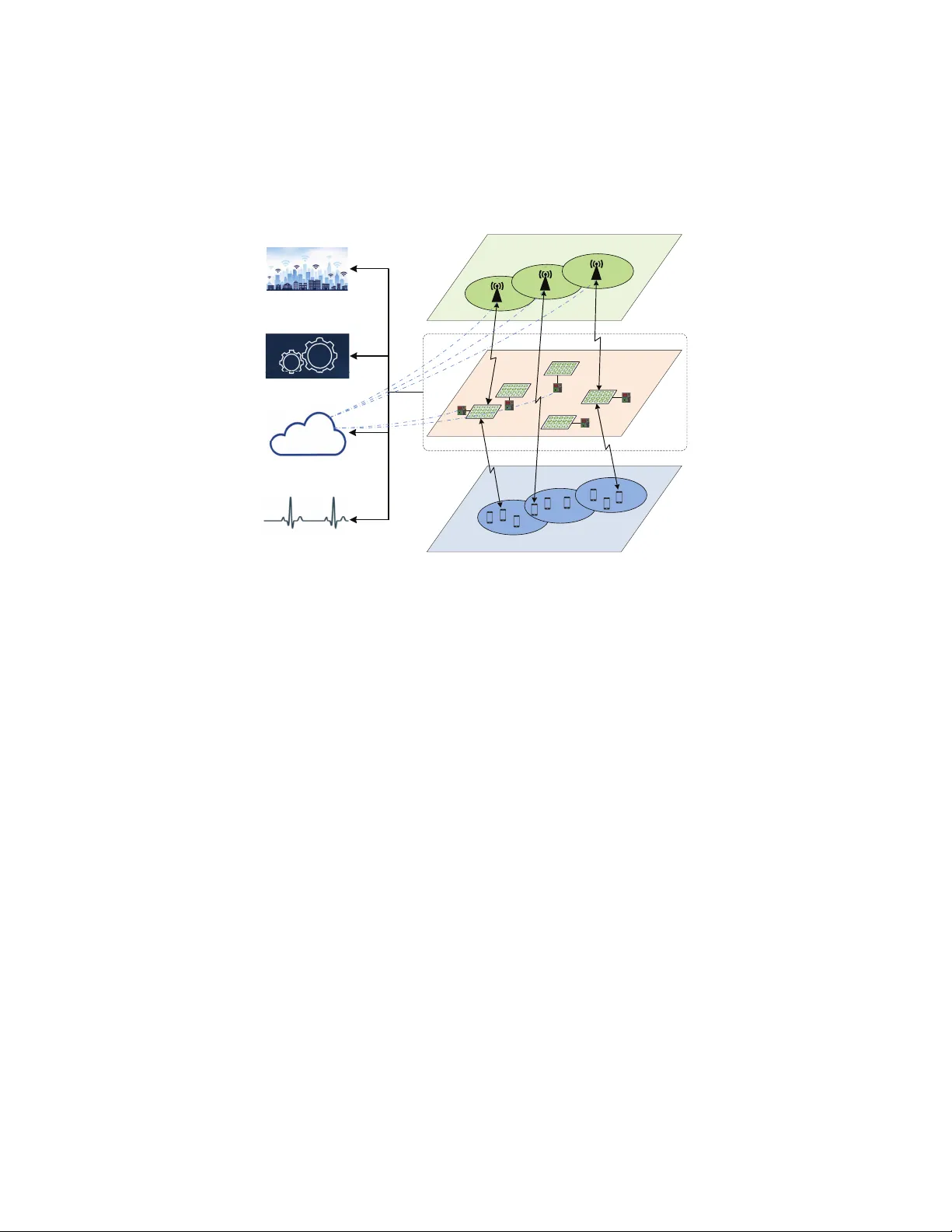
In telligen t Reection as a Service (IRaaS): System Arc hitecture, Enabling T ec hnologies, and Deplo ymen t Strategy W ei W ang, Senior Mem b er, IEEE, and Y utian Shen Abstract Reecting in telligen t surface (RIS) is a promising technology for 6G mobile communications. Ho w ev er, iden tifying the niche of RIS within the mobile net w orks is a challenging task. T o mitigate the escalating system complexity of mobile netw orks, w e prop ose the concept of In telligen t Reection as a Service (IRaaS), and discuss its system architecture, enabling tec hnologies, and deplo ymen t strategy , resp ectively . By leveraging technologies suc h as resource p ooling, service- based architecture (SBA), cloud infrastructure, and model-free signal pro cessing, IRaaS emp o w ers telecom op erators to deliver on-demand intelligen t reection services without a radical up date of curren t comm unication proto cols. In addition, IRaaS brings a nov el deploymen t strategy that creates new opportunities for the v endors of in telligen t reection service and balances the in terests of b oth telecom op erators and prop erty owners. IRaaS is exp ected to sp eed up the rollout of RIS from b oth technical p ersp ectiv e and commercial p erspective, fostering an authentic smart radio en vironment for future mobile comm unications. I. In tro duction The lo w-cost passiv e programmable metasurfaces are capable of tailoring electromagnetic w a ve and are th us en visioned as a rev olutionary technology that c hanges the paradigm of wireless comm unications from “adapting to wireless c hannels” to “c hanging wireless c hannel” [1]. When applied to wireless c hannel recongurations, programmable metasurfaces are usually termed as reecting in telligen t surfaces (RISs) or intelligen t reecting surfaces W. W ang is with the School of Information Science and T ec hnology , Harbin Institute of T echnology , Shenzhen 518055, China (e-mail: wang_w ei@hit.edu.cn) Y. Shen w as with the Business School of Shenzhen T ec hnology Univ ersity , Shenzhen 518118, China (e-mail: harryyutianshen@gmail.com). 1 (IRSs). Both IRS and RIS are characterized by intelligence, which refers to the capability of eectively conguring the reecting elements of RIS for a b etter radio propagation envi- ronmen t. Compared with the conv en tional active wireless devices, RIS incurs no additional p o w er consumption and is free from the thermal noise introduced by radio frequency (RF) mo dules, but the cost is its inabilit y to sense signal. A signican t c hallenge that telecom op erators are confron ted with the massiv e deplo yment of RIS is how to smo othly shift from current radio infrastructure and mobile standards to RIS-assisted wireless comm unications, giv en the former’s in tricate system structure and complex w orko w. F ollowing the con ven tional practice of MIMO communications, most solutions of RIS conguration [2] dep end on the av ailabilit y of channel state information (CSI) of RIS-T x, RIS-Rx, T x-Rx sub-channels. The acquisition of the sub-channel CSIs hinges up on the co ordination among T x, Rx, and RISs, thereby creating a strong coupling be- t w een the wireless comm unication system and the RISs. The coupling inevitably diminishes the exibilit y , scalabilit y , and manageability of the RIS-assisted wireless comm unication systems. F urthermore, a radical up date of the existing wireless proto cols, which were originally designed only for T x–Rx op eration, is imperative to accommo date the co ordination of T x, Rx and RISs. In addition, public migh t be against the massiv e deploymen t of RISs due to aesthetics and health concerns. Note that RIS can b e classied in to t w o categories: the non-transparent RIS and the transparen t RIS [3]. Non-transparent RISs are anticipated to be installed on building facades and in terior walls to improv e outdo or and indo or radio environmen ts. T ransparent RISs are designed for installation as windo ws of buildings to enhance b oth outdo or and indo or radio environmen t. Comparable to the hurdles encoun tered in deploying base stations, the installation of RISs in residential areas, despite their passive nature, faces inheren t opp osition from the public. The opp osition to the installation of RISs stems from m ultiple factors suc h as cost, aesthetics, and health concerns. P ersuading prop ert y o wners to opt for transparen t RISs, despite their higher costs compared to con v en tional glass windo ws, requires an eective strategy . A dditionally , securing p ermission for the installation of large- scale non-transparent RISs on residen tial building facades necessitates addressing concerns ab out their visual impact. On the other hand, the mobile netw ork has b ecome more dynamic and exible, enabled b y the service based architecture (SBA) and characterized by the extensive use of cloudied 2 net w ork functions (NF s) of the 5G core netw ork (5GC) [4]. The 5GC with SBA consists of a set of interconnected NF s that are soft w arized and cloud-native. The NF s access the services of others through the authen tication and authorization mechanism. Hence, eac h individual service can b e autonomously up dated with minimal disruption to other services, facilitating on-demand deploymen t and enabling automation and agile op erational pro cesses. In the mean time, the telecom industry organizations, e.g., O-RAN alliance, are also working to w ards the virtualization of radio access net w ork (RAN) to in troduce SBA to RANs, aiming to increase exibility and scalability , reduce costs, and meet growing demand [4]. Ho w to enable eective in tegration and interaction b et w een RIS and RAN has b een a key c hallenge for RIS applications and has b een widely discussed [5], [6]. Dierent from existing solutions, we prop ose the concept of In telligen t Reection as a Service (IRaaS), which oers intelligen t reection capabilities in an on-demand manner and enables an incremen tal ev olution of RIS deploymen t. In this article, we discuss the challenges and opp ortunities of IRaaS, aimed at exp editing the widespread implemen tation of RISs. Exploiting the tec hnologies such as resource p o oling, SBA, cloud infrastructure, and mo del-free signal pro cessing, IRaaS enables telecom op erators to provide on-demand services of intelligen t reection without a radical up date of communication proto cols. In addition, IRaaS brings a new business mo del that op ens new opp ortunities for the vendors of intelligen t reection service and balances the in terests of b oth telecom op erators and prop erty o wners. IRaaS is exp ected to accelerate the massiv e deploymen t of RIS, fostering an authentic smart radio en vironmen t for the future mobile communications. I I. The Status Quo of RIS Congurations F rom the p ersp ective of mo del dep endance, RIS congurations can b e categorized into t w o types, namely mo del-based RIS congurations and mo del-free RIS congurations. This section reviews b oth congurations, as they critically inuence the architectural design of RIS-assisted mobile netw orks. A. Mo del-based RIS congurations Mo del-based RIS congurations treat the RIS as a part of the wireless communication system, and they rely on the aw areness of sub-channel status [1], [7]. T o acquire sub-channel CSI, conv en tional channel estimation tec hniques must be up dated to introduce co ordination 3 among the transmitter, receiver and RIS to comp ensate for the RIS’s inability to sense. Co ordinated channel estimation aims to acquire the CSIs of the T x-Rx sub-c hannel, T x-RIS sub-c hannel, and Rx-RIS sub-channel, and then optimize the reection pattern of the RIS based on these sub-channel CSIs. Ho w ev er, channel estimation incurs excessiv e training o v erhead and is highly dep enden t on accurate reection parameters, whic h are dicult to con trol with wideband signals. Additionally , the decoupled structure of RISs from the radio access netw ork (RAN) results in p o or scalability and high maintenance costs. B. Mo del-free RIS Congurations Mo del-free RIS congurations treat the RIS as an integral part of the radio en vironmen t rather than as a comp onent of the wireless communication system [8]. These congurations determine the passiv e reection pattern of the RIS directly from channel measuremen ts and p erformance indicators of the wireless communication system, without inferring the sub- c hannel CSI. Mo del-free RIS congurations aim to maximize the accumulated or exp ected o v erall p erformance through the contin uous small-scale adjustmen t of reection co ecients. The goal of mo del-free metho ds is to decouple the RIS system from the wireless system, creating a scenario where wireless communication op erates seamlessly , una w are of the RIS system. The RIS, in turn, congures itself indep endently using only the information provided b y in terfaces connected to the wireless communication system. I I I. The Arc hitecture of IRaaS IRaaS refers to the provision of in telligen t reection services via the RIS resource p ool and the cloud computing infrastructure. Analogous to other “as a service” oerings suc h as Platform as a Service (PaaS), Soft w are as a Service (SaaS), and Articial Intelligence as a Service (AIaaS), IRaaS provides b oth telecom op erators and mobile users with the abilit y to improv e link qualities without the necessity of infrastructure in v estmen ts or sp ecialized exp ertise. Instead of embedding RISs into the RAN as a whole, the RISs are decoupled with the RAN in the prop osed framework. This implies that the RIS resource p ool functions as an autonomous la y er, in teracting with b oth the RAN and core net w ork (CN) through in terfaces. A. Design Philosophies Our view is that RIS deploymen t should preferably follow the philosophies such as 4 $LU,QWHUIDFH 8( 8VHU(TXLSPHQW '1 'DWD1HWZRUN 83) 8VHU3ODQH)XQFWLRQ 60) 6HVVLRQ0DQDJHPHQW)XQFWLRQ $0) $FFHVVDQG0DQDJHPHQW 0RELOLW\)XQFWLRQ 5,63 5HIOHFWLRQ,QWHOOLJHQW6XUIDFH3RRO 5$1 5DGLR$FFHVV1HWZRUN 5&) 5HIOHFWLRQ,QWHOOLJHQW6XUIDFH &RQILJXUDWLRQ)XQFWLRQ 1() 1HWZRUN([SRVXUH)XQFWLRQ 8'0 8QLILHG'DWD0DQDJHPHQW 1 1 1 1 1 ,Q ,Q Fig. 1. The architecture of 5G mobile netw ork with IRaaS, where RCF and RISP are newly dened entities, and ln1 and ln2 are newly dened interface. • Incremen tal evolution: The RIS system should expand gradually , without requiring a fully built-out infrastructure from the b eginning. • Best-eort principle: The conguration of RIS follows an In ternet-lik e philosoph y , where the RIS system deliv ers reection services without guaran teed Quality of Service (QoS), lea ving strict p erformance assurances to upp er-lay er scheduling or the RAN. • Lo ose coupling: IRaaS connects RAN using standard proto cols, a v oiding the enormous complexit y of unied management. The philosophies of incremen tal ev olution, the b est-eort principle, and lo ose-coupling collectiv ely help reduce the complexit y and enhance the scalabilit y of next-generation RAN. They also facilitate low ering b oth the cost and the deploymen t risks asso ciated with RIS deplo ymen t. B. The Architecture of 5G NR with IRaaS 1) 5GC SBA: Without loss of generality , w e use 5G NR to demonstrate the in tegration of IRaaS in to mobile netw orks. In the SBA of 5GC, NF s interact by providing and consuming services via well-dened interfaces, as sho wn in Fig. 1. The NG-RAN, i.e., the RAN of 5G NR, which comprises a set of gNBs, i.e., 5G base stations, is connected to the 5GC, via the NG interface. There are t w o in terfaces under the NG in terface, i.e., NG-C (a.k.a., N2 in terface) for the control plane that connects with the Access and Mobility Management 5 F unction (AMF), and NG-U (a.k.a., N3 interface) for the user plane that connects with the User Plane F unction (UPF) [9]. The user equipment (UE) is connected to AMF through the N1 in terface, and N1 is a logical in terface, which is indeed the combined path from UE to RAN and onw ard to AMF. The N4 interface connects the UPF to the Session Management F unction (SMF) and caters to the k ey session managemen t pro cedures. The N6 in terface is used to connect the UPF to the Data Net w ork (DN). 2) New Entities and Interfaces of IRaaS: IRaaS is realized through tw o crucial entities, namely the RIS p o ol (RISP) and the RIS conguration function (RCF), where the former pro vides the hardware platform of electromagnetic (EM) reection, and the latter pro vides in tellectual supp ort to maximize the capabilit y of RISs in optimizing the radio environmen t. The intelligen t reection service is interconnected with the 5GC via interfaces. Among the in terfaces, w e designate the In1 in terface to connect the RISP and the RCF such that the conguration settings are received by the RISP from the RCF. A dditionally , the In2 in terface is designated to supp ort information exchange b et w een the RAN and the RCF. R CF, the control plane of IRaaS, can b e implemented as either an application function (AF) or an NF. This choice represen ts a trade-o in the level of decoupling. An AF imple- men tation is preferable for a higher degree of decoupling, whereas an NF implemen tation oers a more tigh tly integrated approach. • AF: F rom an architectural decoupling p ersp ectiv e, implementing the RCF as an AF is simpler and av oids added complexity or misalignment with 3GPP sp ecications. As an AF, the R CF can only inuence the net w ork indirectly via NEF, and do es not in v olv e core netw ork control. • NF: If implemented as an NF, the RCF w ould b e more tigh tly integrated with the CN, thereby enabling more direct control, lo w er latency , and unied security and managemen t. If the RCF is owned by an aliated subsidiary of the telecom op erator, then deploying the R CF as an NF is feasible. In contrast, if the provider is an external entit y , the R CF can only b e p ositioned as an AF, as op erators are typically reluctant to op en their core netw ork to non-internal parties. How ever, w e remain certain that the R CF should b e decoupled from the RAN. Note that the R CF can in teract with 5G core netw ork functions, e.g., the AMF, SMF, and UDM, in tw o feasible wa ys, dep ending on the deploymen t scenario and coupling level. 6 Both approaches are aligned with the 3GPP SBA. As an NF, the R CF can b e implemented as a new native netw ork function that directly participates in the SBA. Alternatively , as an AF, the RCF indirectly inv ok es services from the AMF, SMF, and UDM through the NEF, using their standardized APIs. C. The W orko w of IRaaS The RCF of IRaaS primarily p erforms the following functions: • RIS registration:The R CF is resp onsible for registering a RIS with the mobile net w ork, and storing in the registry the RIS’s key information essential for RIS conguration, e.g., lo cation, orientation, size of the reectiv e element array , phase quan tization level, and etc. • Session management: The RCF manages the establishment, mo dication, and termi- nation of reection service according to the requests from gNB. It interacts with other NF s to obtain the actual p erformance metrics of the QoS Flows within P ac k et Data Unit (PDU) sessions, such as throughput and pack et loss. These QoS indicators enable the RCF to determine whether the current RIS allo cation and conguration satisfy the QoS requirements. • RIS allocation: The RIS resource po ol serv es m ultiple UEs with pro visional and scalable in telligen t reection services. Those services can b e dynamically adjusted based on the demand from UEs without any discernible c hanges to the UEs. The R CF is resp onsible for RIS allo cation, and ensures that the RIS, as a type of resource, is appropriately allo cated in to the UEs that subscrib e to the intelligen t reection service. • Radio en vironment analysis and RIS co ecient deriv ation: The RCF collects and arc hiv es radio environmen t data, e.g., CSI and link qualit y indicator, from the RAN. Subsequen tly , it conducts comprehensiv e analysis lev eraging model-free algorithms, e.g., deep learning, reinforcement learning and deriv ativ e-free optimization. F ollowing this analysis, the RCF gov erns the phase shift adjustmen ts of the allo cated RIS units. T o explain the w orkow of IRaaS, w e use a sequence diagram, shown in Fig. 2, to illustrate how R CF and RISP interact with the mobile netw ork by depicting the sequence of messages exchanged betw een them. IRaaS, as a service within the comm unication pro cesses, is activ ated selectively to enhance communication quality when necessary . F or instance, it b ecomes operational when the UE exp eriences high pac ket loss rates caused by signal 7 R I S P R I S P o o l R A N R a d i o A c c e s s N e t w o r k R C F R I S C o n f i g u r a t i o n F u n c t i o n L o o p R I S a l l o c a t i o n R a d i o e n v i r o n m e n t a n a l y s i s a n d R I S c o e f f i c i e n t d e r i v a t i o n S e n d c o e f f i c i e n t s C h a n n e l a w a r e n e s s f e e d b a c k R I S c o n f i g u r a t i o n S e r v i c e e s t a b l i s h m e n t U E U s e r E q u i p m e n t C o m m u n i c a t i o n l i n k I n t e l l i g e n t r e f l e c t i o n s e r v i c e r e q u e s t R e l e a s e R I S r e s o u r c e R e s e t c o e f f i c i e n t s R I S c o n f i g u r a t i o n I n t e l l i g e n t r e f l e c t i o n s e r v i c e r e q u e s t I n t e l l i g e n t r e f l e c t i o n s e r v i c e t e r m i n a t i o n I n t e l l i g e n t r e f l e c t i o n s e r v i c e t e r m i n a t i o n Fig. 2. The sequence diagram of IRaaS blo c kages. Typically , the initiation of IRaaS stems from the UE, as it p ossesses the most direct aw areness of its link qualit y . The pro cess b egins with the UE sending a service request to R CF through the air in terface and the In2 interface. Up on receipt of this request, RCF pro ceeds to allo cate RIS resources based on the disparity b etw een the UE’s curren t communication quality and the desired quality lev el. Subsequently , utilizing the allo cated RIS resources, mo del-free signal pro cessing algorithms are employ ed to optimize the reection co ecien ts based on radio en vironmen t information. The derived in termediate co ecien ts are then transmitted to the RIS via the In1 interface to up date the RIS’s impact on the radio en vironmen t. The service terminates either when the UE’s communication task concludes or when its requested comm unication qualit y degrades. Subsequen tly , the R CF releases the UE’s requested RIS resources back to the p o ol and resets their co ecients. 8 IV. The Enabling T ec hnologies of IRaaS The enabling technologies of IRaaS and the logical relationship b et w een RAN, UE, and RIS are presented in Fig. 3. 5,6SRRO 5$1 8(V 5,6 FRQWUROOHU 5,6 &ORXG3URFHVVLQJ 0RGHOIUHH6LJQDO 3URFHVVLQJ 6HUYLFHEDVHG $UFKLWHFWXUH6%$ RI 65HVRXUFH3RROLQJ Fig. 3. The enabling technologies of IRaaS and the logical relationship b etw een RAN, UE and RIS A. RIS Resource Pooling Resource p o oling is applied to aggregate m ultiple RISs to act like one p ow erful resource for the more exible and more ecient utilization of RISs in the complex radio en vironmen t [10]. The RIS resource p o ol consists of a set of RISs shown in Fig. 3. Resource p o oling gran ts the on-demand av ailability of RISs as a resource without direct management by the base stations (BSs) or the UEs. The RIS resource p o ol can b e assigned to dieren t tasks or shared by several tasks. F or instance, a RIS in the resource p o ol might b e allo cated to enhance the o v erall communication quality of multiple users o ccup ying dierent radio resources [8]. Ho w ever, the resource p o oling tec hnology in wireless domain is fundamentally dierent from those used in cloud computing and faces great c hallenges. In cloud computing, the capacit y of resources such as CPU, GPU, memory , and storage, is largely indep enden t of their physical lo cations, except for considerations related to latency . By con trast, the capacit y of RIS’s signal enhancemen t is strongly related to the distance b etw een RIS and 9 the transceivers, due to the propagation loss of electromagnetic wa v e. In other words, the resource map of RIS is distance-dep endent and is related to the lo cations of T x and Rx. B. Cloud Pro cessing The ecien t RIS resource allo cation and eective RIS conguration depend on the computing p ow er of the RIS conguration units. Considering the delay-toleran t but com- putationally demanding nature of RIS congurations, the RIS conguration units can b e realized in the cloud, which allows for a muc h more p ow erful computing resource p o ol to ac hiev e lo w-cost op eration of the RISs. Analogous to the virtual baseband units in the cloud radio access netw orks (C-RAN) [4], [11], virtual RCF units can b e realized in the centralized cloud lo cated aw a y from the RISs to lev erage the computing p ow er of the existing cloud infrastructure as sho wn in Fig. 3. By lev eraging centralized cloud computing with a global net w ork view, IRaaS enables co ordinated and globally optimized RIS reconguration [12]. C. Mo del-F ree Signal Pro cessing As a service, intelligen t reection should b e disaggregated from the other functions of RAN. Ho w ever, the con ven tional mo del-based RIS congurations are strongly coupled with the RAN [7]. Sp ecically , they require the acquisition of the CSI for the T x–Rx, T x–RIS and RIS–Rx sub-c hannels to enable RIS congurations. T o support IRaaS, it is necessary to adopt mo del-free signal processing tec hniques in the ph ysical lay er for decoupling [8]. These techniques treat the RIS as an indep enden t comp onen t of the RAN and optimize RIS congurations based on the interactions b etw een the RIS and the RAN. As an example, the RIS controller p erio dically applies candidate reection congurations, collects p erformance feedbac k from the RAN, e.g., SINR or throughput, to sense the state of the radio environmen t, and renes the conguration through trial-and-feedback iterations, thereb y realizing RIS optimization without explicit c hannel mo deling. Within the realm of mo del-free signal pro cessing techniques in RIS conguration, there exists a broad sp ectrum of approaches that op erate indep endently of the sub-channel CSI that forms the aggregated wireless channel. This encompasses metho dologies such as extrem um seeking control (ESC), a.k.a., deriv ative-free optimization [13], alongside deep reinforcemen t learning [14], and v arious other machine learning tec hnologies. 10 Mo del-free signal pro cessing techniques are particularly well suited to the SBA, as they are indep endent of sub-c hannel CSI and the internal w orking mec hanisms of wireless comm unication systems. With model-free RIS conguration, the op eration of the RIS only requires exchanging output information with the RAN through well-dened interfaces, without necessitating any mo dication to existing RAN functionalities. D. On-Demand Intelligen t Reection Service Enabled by SBA The in telligen t reection service provided by IRaaS is an on-demand service that can b e activ ated only when needed. F or instance, the intelligen t reection service can b e initialized b y a user to construct a virtual direct link to substitute a blo c ked mm W a v e direct link, and it can remain deactiv ated when not needed. In this con text, the intelligen t reection service is deplo y ed without aecting the standalone op eration of the 5G RAN. Suc h a design reects the philosophies of incremental evolution, b est-eort, and lo ose coupling. The SBA oers the most natural and standardized mec hanism for supp orting on-demand in telligen t reection service in 5G and b ey ond. First, the SBA pro vides service registration and discov ery , allowing a function to b e activ ated only when another function explicitly requests its service. Second, its RESTful, API-driv en interactions eliminate the need for p ersisten t bindings b et ween NF s, enabling a clean separation of lifecycle management and on- demand in vocation. Third, SBA ensures interoperability and standardization across vendors, tec hnically enabling IRaaS to b e provided by a third party . E. Ov erview of the T echnological Adv an tages In summary , from a technological p ersp ectiv e, IRaaS oers several k ey adv an tages: (1) arc hitectural decoupling and backw ard compatibility , (2) high scalability , (3) global opti- mization capability , and (4) reduced signal pro cessing complexity . Sp ecically , adv an tages (1) and (2) are enabled by RIS p o oling and the SBA architecture, (3) is enabled by cloud pro cessing, and (4) is achiev ed through mo del-free signal pro cessing. V. The Deploymen t Strategy of IRaaS The deplo ymen t of RIS system in v olv es not only tec hnical considerations but also v arious non-tec hnical factors, such as commercial b enets, prop ert y-use agreements, and ownership structures. The business mo del of IRaaS pla ys a pivotal role in faciliating the deploymen t 11 ,QWHUIDFH 5&) &RUH1HWZRUN 5,6LQIUDVWUXFWXUH 5$1 3URSHUW\RZ QHUV %RG\FRUSRUDWH 0RELOHQHWZR UN 7HOHFRPR SHUDWRUV 563 6HUYLFHSURYLVLRQ 6HUYLFHIHH 5,6UHQW5,6LQVWDOODWLRQ VSRQVRUVKLS 8VDJHRI5,6LQIUDVWUXFWXUH &ORXG 5,6VHU YLFH Fig. 4. The three-party business mo del of IRaaS of RIS system within and b eyond mobile net w orks, which precisely outlines the metho ds of income sources, o wnership of the RIS infrastructure, required in v estmen t, and managemen t of op erations and maintenance. It serves as the blueprint for ensuring ecient functioning and sustainability of the RIS system in the evolving mobile netw ork landscap e. A. The Three-Part y Business Mo del In con trast to the traditional telecom paradigm, in whic h op erators b oth build and op erate the infrastructure, we prop ose a three-party business mo del for the deplo ymen t and managemen t of RIS. W e prop ose to in tro duce a new actor, i.e., reection service provider (RSP), as the in termediary , to facilitate the smo oth and gradual ev olution of RIS-assisted mobile net w orks in the business mo del shown in Fig. 4. The roles of the three parties in our prop osed new business mo del are explained as follows. (1) RIS infrastructure o wners: The property owners, or the b o dy co operate, o wn the RIS infrastructure installed on their buildings. The implementation of RIS infrastructure inevitably encounters civic obstacles stemming from its installation on buildings. In addition, the capital exp enditure (CAPEX) costs to purchase and install the RIS system p oses a signican t burden on the construction of the next-generation mobile netw ork, which will nally lead to escalated plan rates. Dra wing inspiration from the solar industry , inv olving prop ert y o wners as stakeholders in the RIS business can mitigate residen t resistance and alleviate CAPEX pressures. W ays of incorp orating prop erty owners in to the RIS business include installation sp onsorship, a long-term ren t con tract and etc. In this regard, the 12 prop ert y o wners in v olv e in the RIS business without extra upfront costs. (2) Reection service pro viders (RSPs): RSP is a third part y entit y that acts as the bridge b et w een RIS infrastructure owners and telecom op erators. RSPs hold the usage righ ts of the RIS infrastructure and generate rev en ue through service fees charged to telecom op erators for delivering intelligen t reection services. RSPs are resp onsible for op erating, maintaining, and ensuring optimal p erformance of the RIS system. The core tec hnical comp etitiveness of RSPs is their RIS conguration algorithm that relies on signal pro cessing and articial in telligence (AI), and the core business competitiveness of RSPs is their cost con trol in massiv e RIS deplo ymen t. RSPs can mitigate inv estment risks by starting their RIS business from a small region, as the decoupled nature of the system allows for exible deploymen t adjustmen ts in terms of lo cation and density at any time. (3) T elecom op erators: The telecom op erators that own the mobile net w ork are customers of the RIS business. They circumv ent the upfront inv estmen t in RIS infrastructure through this new business mo del. T elecom op erators pro cure reection services from RSPs to tac kle p o or cov erage issues, particularly in high-frequency bands lik e mm W av e. In addition, telecom op erators can oer on-demand in telligen t reection service to users willing to pay extra for impro v ed signal quality . T elecom op erators reap the b enets of an ecient RIS system by reducing the deplo ymen t cost of RAN. Nevertheless, it is essential for telecom op erators to supp ort RSPs during the start-up stages of the RIS business through v arious means. B. Benets of the Business Mo del for RIS Deploymen t A go o d business mo del not only unlo c ks nancial incen tiv es and opp ortunities but also aligns with the industry’s dedication to a sustainable and prosperous future for all stak eholders. The prop osed business mo del is adv antageous in the following asp ects. • A win–win empow erment mo del for property o wners: The proposed business mo del pro vides prop ert y owners with the chance to mak e prot from their building ownership, while simultaneously providing prop ert y owners, who are mobile netw ork users in the mean time, with improv ed communication quality at a reduced rate. • A high-barrier, asset-exclusiv e business paradigm for RSPs: The proposed business mo del introduces new av en ues for wealth generation and establishes a nov el business en tit y , known as RSP . RSPs op erate their business leveraging the cutting-edge tech- nologies, e.g., information metamaterials and AI, whic h come with a high technical 13 barrier to entry . Moreov er, the rental agreement with RIS owners gran ts RSPs a form of resource monop oly , ensuring stable and sustained rev en ue. • A zero-CAPEX, bac kward-compatible smart radio en vironment solution for telecom op erators: The prop osed business mo del enables telecom op erators to achiev e a smart radio environmen t with zero upfront costs, thereby mitigating their inv estmen t risks in next-generation mobile net w orks. F urthermore, by oering an op en interface, current mobile netw orks can seamlessly adopt the smart radio environmen t without requiring an y up dates. C. Ov erview of IRaaS Comp onents and Their Ownership Based on the ab o v e discussions, w e use T able I to summarize the k ey entities, interfaces, and their ownership. Ov erall, IRaaS introduces only minimal arc hitectural c hanges to the RAN. Through an on-demand service mo del enabled by op en interfaces, together with the three-part y business mo del, it pro vides a practical approac h to addressing technical and deplo ymen t challenges for RIS. T ABLE I. A summary of the newly dened entities and interfaces of IRaaS En tities/Interfaces F unction Ownership R CF RIS conguration (softw are) RSP RISP RIS p ool (hardware) Owned by prop ert y owners and leased by RSP In terface In1 The interface b et w een RISP and R CF for co ecien t transmission RSP In terface In2 The interface b et w een RAN and R CF for channel aw areness feedback T elecom op erators VI. An Illustrative Example In this section, w e use an example to illustrate the w orking mechanism of IRaaS, and to sho w wh y it is tec hnologically adv an tageous. A. Sim ulation Settings Assume that four UEs, eac h equipp ed with 4 an tennas are serv ed by a BS equipp ed with 16 antennas within a cell. An optically transparent RIS, in tegrated in to windo w glass 14 and o wned by the prop erty o wner, is managed by the RSP . The conguration function of the RIS, namely R CF, is realized remotely in the cloud. The UEs may subscrib e to the service of in telligen t reections to their telecom op erators through the core netw ork, which is interconnected with the RCF. 3.2791 3.5478 2.3337 2.3681 2.369 2.2116 2.9605 3.4243 2.2915 2.5269 2.5221 2.3571 RIS with RCF 1 RIS with RFC 2 Without RIS Different Configurations of RIS 0 0.5 1 1.5 2 2.5 3 3.5 4 Spectral efficiency (bps/Hz) UE1 UE2 UE3 UE4 Fig. 5. Comm unication p erformance under dierent congurations of RIS, where UE 1 and UE 3 subscrib e to the service of intelligen t reection, while UE 2 and UE 4 do not. The simulation setting is as follo ws. W e adopt the practical mo del of RIS [15], where the reection co ecien t is giv en by v n = Z n ( C n ,R n ) − Z 0 Z n ( C n ,R n )+ Z 0 , which is a function of C n and R n and v aries according to the op erating frequency of the inciden t RF signal. The reected electromagnetic wa ves can b e manipulated in a controllable and programmable manner by v arying C n and R n . The imp edance of air is Z 0 = 377 Ω . According to [15], the equiv alent mo del of the n -th reecting elemen t is represen ted as a parallel resonant circuit, with its imp edance given by Z n ( C n , R n ) = j ω L 1 ( j ω L 2 + 1 j ωC n + R n ) j ω L 1 +( j ω L 2 + 1 j ωC n + R n ) , where L 1 , L 2 , C n , R n , and ω denote the b ottom lay er inductance, top lay er inductance, eectiv e capacitance, eectiv e resistance, and angular frequency of the inciden t signal, resp ectively . C n is v aried from 0 . 47 pF to 2 . 35 pF, L 1 = 2 . 5 nH, L 2 = 0 . 7 nH, ω = 2 π × 2 . 4 × 10 9 . Each UE o ccupies 20 MHz bandwidth protected by a 2 MHz guard band. The num b er of reecting elemen ts is 128 , RIS lo cation is (0 . 5 , 0 , 3) , and BS lo cation is (0 , 0 , 3) , the four UEs are evenly distributed along a semicircular area cen tered at (0 , 0 , 0) . The wireless channel consists of 1 line-of-sight (LoS) path and 4 non-line-of-sigh t (NLoS) paths. Blo ckage probabilities of the BS-UE link and the RIS-UE link are 0 . 3 , while that of the BS–RIS link is 0 , and blo ckage results in a 15 propagation attenuation of 30 dB. B. Observ ations and Discussions UE 1 and UE 3 subscrib e to the intelligen t reection service, whereas UE 2 and UE 4 do not. The p erformance of all UEs are illustrated in Fig. 5, based on which w e draw the follo wing observ ations. Observ ation 1: The p erformance of signal enhancement by RIS is determined b y R CF. In RCF 1, the RIS is partitioned into t w o halves, with the reection co ecients of each half optimized indep endently to impro v e the p erformance of UE 1 and UE 3, resp ectively; In RCF 2, the reection co ecien ts are optimized to enhance the ov erall p erformance of UE 1 and UE 3. In Fig. 5, we adopt the mo del-free signal pro cessing algorithm ESC [8]. F rom the gure, it can b e observ ed that RFC 2 outp erforms RF C 1 for b oth UE 1 and UE 3. This is b ecause RCF 2 co ordinates all RISs to optimize the p erformance of all users, enabling a global view and conferring global optimization capabilit y . Observ ation 2: Even UEs that do not subscrib e to the intelligen t reection service can b enet from the deplo ymen t of RIS. Under both RF C 1 and RFC 2, UE 2 and UE 4, whic h do not subscrib e to the service, achiev e b etter p erformance compared to the case without RIS deplo ymen t. This is b ecause rich scattering is essential for MIMO communications, even if the UEs that do not subscribe to the intelligen t reection service are not explicitly optimized. This b ehavior aligns with the principle of incremen tal ev olution, where new capabilities are introduced in an on-demand manner, deliv ering p erformance gains to subscrib ed UEs without degrading other UEs’ p erformance. Observ ation 3: Mo del-free signal pro cessing signicantly reduces the complexity of RIS conguration, enabling R CF to b e compatible with dierent types of RIS. While the reection coecient v aries with the operating frequency of the incident signal (e.g., in Fig. 5, UEs 1–4 op erate at dierent frequencies and thus exhibit dierent reection co ecien ts), its precise expression is unnecessary in mo del-free signal pro cessing. The data-driven nature enables p erv asive adaptability to dieren t types of RIS, aligning well with the principles of AI and making it suitable for deplo ymen t on general-purp ose cloud hardware. Given that sucien t runtime data of the RIS-assisted mobile communication system is provided, the RSP can contin uously improv e the p erformance of RIS to reac h excellence. 16 Observ ation 4: F or RIS manufacturers, it is sucien t to provide a standardized in terface that enables interoperability among the RIS, RAN, and CN, thereby ensuring architectural decoupling, backw ard compatibilit y , and high scalabilit y of IRaaS. The primary challenge lies in reducing the cost of RIS to mak e it an aordable option for prop ert y owners who wish to deploy a smart radio en vironmen t to ensure high-quality signal cov erage. VI I. Conclusion and F uture W ork In this article, w e in tro duce the concept of IRaaS and discuss its enabling technolo- gies, w orko w, and business mo del, aimed at accelerating the rollout of RISs in wireless comm unication netw orks. IRaaS enables telecom op erators to pro vide on-demand services of in telligen t reection without requiring radical up dates to the current comm unication proto cols. Additionally , the decoupling of the RIS system and the RAN, facilitated b y IRaaS, prev en ts the RIS-assisted RAN from b ecoming a cum bersome monolithic system. F urthermore, IRaaS creates opp ortunities for v endors of intelligen t reection services and balances the interests of b oth telecom op erators and prop erty owners. In summary , IRaaS is exp ected to accelerate the in tegration of RIS into mobile netw orks, fostering an authentic smart radio environmen t for future mobile comm unications. It is worth noting that progressiv ely enhancing the p erformance and impact of IRaaS will require co ordinated eorts across multiple dimensions in the future. First, as hardw are fundamen tally determines the p erformance ceiling of IRaaS, future RIS designs must con- tin ue to impro v e key hardw are capabilities, e.g., reection eciency and switching delay . Second, on the soft w are side, mo del-free conguration metho ds must ensure compatibility across dierent generations of RIS hardw are during incremental evolution. As RIS hard- w are capabilities scale up (e.g., in terms of quan tit y or p er-unit p erformance), mo del-free algorithms should b e able to fully unleash their p otential. Third, the degree of integration b et w een RIS and the CN, particularly whether RCF should b e realized as an AF or as an NF, remains an op en question that merits further exploration. References [1] E. Basar, M. Di Renzo, J. De Rosny , M. Debbah, M.-S. Alouini, and R. Zhang, “Wireless communications through recongurable intelligen t surfaces,” IEEE Access, vol. 7, pp. 116 753–116 773, 2019. [2] Q.-U.-A. Nadeem, H. Alw azani, A. Kammoun, A. Chaaban, M. Debbah, and M.-S. Alouini, “In telligen t reecting surface-assisted multi-user MISO communication: Channel estimation and b eamforming design,” IEEE Op en J. Commun. So c., vol. 1, pp. 661–680, 2020. 17 [3] ETSI, “Recongurable In telligen t Surfaces (RIS); T echnological c hallenges, architecture and impact on standardization,” ETSI, Group Rep ort, Aug. 2023, v1.1.1. [4] E. Zeydan, J. Mangues-Bafalluy , J. Baranda, M. Requena, and Y. T urk, “Service based virtual RAN arc hitecture for next generation cellular systems,” IEEE Access, vol. 10, pp. 9455–9470, 2022. [5] K. Katsalis, A. Arfaoui, C. Liaskos, and J. T riay , “RIS technology integration with the 5G system: Challenges and op en questions,” in 2024 IEEE Conference on Standards for Communications and Netw orking (CSCN), 2024, pp. 14–19. [6] C. Liaskos, K. Katsalis, J. T riay , and S. Schmid, “Resource management for programmable metasurfaces: Concept, prosp ects and challenges,” IEEE Commun. Mag., vol. 61, no. 11, pp. 208–214, 2023. [7] W. Mei, B. Zheng, C. Y ou, and R. Zhang, “In telligent reecting surface-aided wireless netw orks: F rom single- reection to multireection design and optimization,” Pro c. IEEE, vol. 110, no. 9, pp. 1380–1400, 2022. [8] W. W ang, W. Zhang, and H. Xiong, “Mo del-free conguration of in telligen t reecting surfaces: T ow ard perv asive adaptabilit y and enhanced robustness,” IEEE Wireless Commun., vol. 31, no. 2, pp. 142–148, 2024. [9] 3GPP , “5G; NG-RAN; NG Application Proto col (NGAP),” 3rd Generation Partnership Pro ject (3GPP), T echnical Sp ecication (TS) 38.413, Jul. 2018, v15.0.0. [10] J. Qadir, A. Sathiaseelan, L. W ang, and J. Cro wcroft, “Resource p ooling for wireless netw orks: Solutions for the developing world,” ACM SIGCOMM Comp. Commun. Rev., vol. 46, no. 4, pp. 30–35, 2016. [11] J. W u, Z. Zhang, Y. Hong, and Y. W en, “Cloud radio access netw ork (C-RAN): a primer,” IEEE Netw ork, v ol. 29, no. 1, pp. 35–41, 2015. [12] X. Shen, J. Gao, W. W u, M. Li, C. Zhou, and W. Zhuang, “Holistic netw ork virtualization and p erv asive net w ork intelligence for 6G,” IEEE Commun. Surveys T uts., vol. 24, no. 1, pp. 1–30, 1st. Quart. 2022. [13] J. Larson, M. Menick elly , and S. M. Wild, “Deriv ative-free optimization metho ds,” Acta Numerica, vol. 28, pp. 287–404, 2019. [14] W. W ang and W. Zhang, “Intelligen t reecting surface congurations for smart radio using deep reinforcemen t learning,” IEEE J. Sel. Areas Commun., vol. 40, no. 8, pp. 1–1, 2022. [15] S. Ab eywic krama, R. Zhang, Q. W u, and C. Y uen, “Intelligen t reecting surface: Practical phase shift mo del and b eamforming optimization,” IEEE T rans. Commun., vol. 68, no. 9, pp. 5849–5863, 2020.
Original Paper
Loading high-quality paper...
Comments & Academic Discussion
Loading comments...
Leave a Comment