New convergence bound for the cluster expansion in canonical ensemble
We perform a cluster expansion in the canonical ensemble with periodic boundary conditions, introducing a new choice of polymer activities that differs from the standard ones. This choice leads to an improved bound for the convergence of the cluster …
Authors: Giuseppe Scola
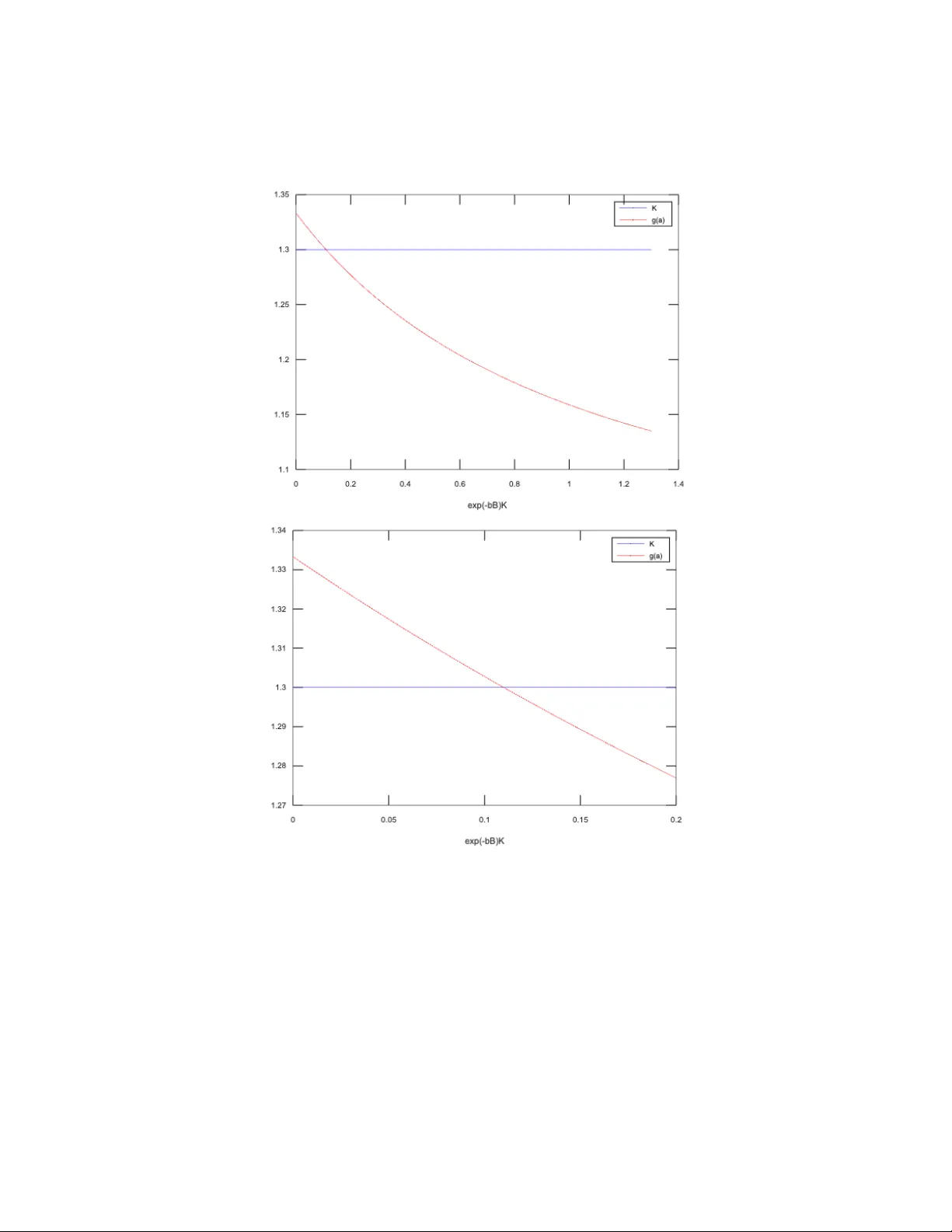
NEW CONVER GENCE BOUND F OR THE CLUSTER EXP ANSION IN CANONICAL ENSEMBLE GIUSEPPE SCOLA Abstract. W e perform a cluster expansion in the canonical e nsemble with perio dic b oundary conditions, in troducing a new choice of polymer activities that differs from the standard one used in [ 8 , 11 ]. This choice leads to an improv ed bound for the conv ergence of the cluster expansion, whic h we com- pare with the one obtained from [ 8 , 10 ]. W e also recov er the irreducible Mayer coefficients for the thermodynamic free energy . The results presen ted here can also b e applied to the case of zero boundary conditions and to the convergence of correlation expansions as in [ 6 , 12 ]. Keywords: cluster expansion, radius of convergence, canonical ensemble AMS classification: 82B05, 82D05 Contents 1. In tro duction 1 1.1. Structure of the pap er 2 2. Mo del and main result 2 3. P olymer mo del representation and con vergence of cluster expansion 4 4. F rom cluster co efficients to Ma y er’s co efficients (proof of (2.9)) 9 4.1. F ree case 9 4.2. In teracting case 10 References 13 1. Introduction Predicting macroscopic prop erties from microscopic structures remains a cen tral c hallenge in statistical mechanics. In the theory of non-ideal gases, an imp ortant theoretical and practical con tribution was made b y J. E. and M. G. May er [ 7 ], where the authors expressed the pressure p of the system as a p ow er series in the densit y ρ (virial expansion), view ed as a p erturbation of the ideal-gas equation of state at temperature T , with conv ergence prov ed later (see [ 13 , 1 ]). In [ 7 ], the thermo dynamic pressure is obtained as the infinite-v olume limit of the logarithm of the grand canonical partition function, which is a function of the activity of the system. Thus, obtaining an expansion in terms of the thermo dynamic density requires passing from activit y to densit y by applying the w ell-kno wn virial inv ersion (see, e.g., [ 5 ]). In this w ay , using the standard relation b et ween thermodynamic pressure and thermodynamic free energy (see, e.g., [ 11 , App endix]), one obtains an expansion of the free energy as a p ow er series in the densit y . 1 2 GIUSEPPE SCOLA An alternative and more direct w ay to do this is to compute the thermodynamic free energy as the thermodynamic limit of the canonical partition function, after applying cluster expansion methods directly to the latter. This strategy is adopted, for instance, in [ 8 , 11 , 14 ], and in the con text of densit y correlation functions in [ 6 , 12 ]. All the results men tioned ab ov e establish the v alidit y of the expansions under suitable assumptions on the activit y or on the densit y of the system. Our aim in this pap er is to deriv e an improv ed density condition for the conv ergence of the expansion of the thermo dynamic free energy . In [ 8 , 11 ], the authors p erform a cluster expansion for the canonical partition function of a system of N particles in a b ox Λ interacting via pair potential V ( q i − q j ) at p ositive in verse temperature β , that is, Z Λ ( N ) = 1 N ! Z Λ N dq 1 · · · dq N e − β P i,j V ( q i − q j ) , using a p olymer represen tation such that the activities of p olymers with a single elemen t are equal to one. This is achiev ed by redefining the measure dq as dq / | Λ | , in suc h a wa y that the conv ergence condition for the expansion is of the type C ( V , β ) N | Λ | ≤ C ∗ with C ( V , β ) constant dep ending on the interactions and the in v erse temp erature, for some p ositive constan t C ∗ . In our approach, instead of normalizing with resp ect to | Λ | , w e normalize the measure dq with K | Λ | ( K ≥ 1), whic h again allows p olymers with a single elemen t to be present. Thus, K serves as a free parameter that can be optimized to impro v e the con vergence condition for the cluster expansion of Z Λ ( N ). Moreo ver, as emphasized in Remark 2.2 , and following [ 6 , 12 ], the analysis pre- sen ted here - carried out for p erio dic b oundary conditions - can also b e applied in the case of zero b oundary conditions and to pro ve con vergence of multi-bo dy correlation functions as p ow er series in the density . 1.1. Structure of the pap er. In Section 2 w e presen t the model, state the main result of the pap er, and give some useful remarks in which we also compare our con vergence condition with the kno wn one. In Section 3 w e pro v e con v ergence of the cluster expansion under the new bound. Finally , in Section 4 w e analyse the structure of the co efficients in the expansion in order to recov er the irreducible May er’s co efficien ts [ 7 ]. 2. Model and main resul t W e consider a system of N in teracting particles in the b o x Λ := − L 2 , L 2 d ⊂ R d ( L > 0) interacting via a pair p otential V : R d → R at p ositiv e inv erse tem- p erature β . Since our in terest is in the infinite-volume limit of the free energy , w e work with p erio dic b oundary conditions. Denoting a particle configuration by q ≡ { q 1 , . . . , q N } , w e assume that V is a stable and temp ered p otential, i.e.: • (Stabilit y) there exists B ≥ 0 such that X 1 ≤ i 0, C ( β ) = Z R d dx 1 − e − β | V ( x ) | < ∞ . (2.2) P erio dic b oundary conditions are implemented b y tiling R d with copies of Λ and summing the interaction o ver all perio dic images, that is V per ( q i , q j ) := X n ∈ Z d V ( q i − q j + nL ) . (2.3) T o guaran tee the conv ergence of this series w e impose a decay condition on V . W e sa y that V is low er regular if there exists a decreasing function ψ : R + → R + suc h that V ( x ) ≥ − ψ ( | x | ) for all x ∈ R d , and R ∞ 0 ds s d − 1 ψ ( s ) < ∞ . W e call V regular if it is low er regular and there exists a finite p ositive real num b er r V suc h that V ( x ) ≤ ψ ( | x | ) whenever | x | ≥ r V ; this is our additional assumption (see also [ 3 ]). W e define the c anonic al p artition function of the system with perio dic boundary conditions b y Z per Λ ,β ( N ) := 1 N ! Z Λ N dq 1 · · · dq N exp − β X 1 ≤ i 0 log 1 + u (1 − e − a ) e a 1 + u (1 − e − a ) , (2.7) Our main result is the following. Theorem 2.1. Given inverse temp er atur e β > 0 and stability c onstant B ≥ 0 , ther e exists K ≥ 1 , such that for al l c omplex ρ with | ρ | ≤ ρ ∗ , wher e ρ ∗ := e − β B K C ( β ) F ( e − β B K ) , (2.8) the limit in ( 2.5 ) exists and the thermo dynamic fr e e ener gy is given by f β ( ρ ) = 1 β ρ (log ρ − 1) − X m ≥ 1 ρ m +1 m + 1 β m , (2.9) wher e the c o efficients β m ar e the irr e ducible Mayer c o efficients, define d by β m := 1 m ! X g ∈B m +1 1 ∈ V ( g ) Z ( R d ) m Y { i,j }∈ E ( g ) e − β V ( q i ,q j ) − 1 dq 2 · · · dq m +1 , q 1 ≡ 0 , (2.10) and B m +1 denotes the family of 2 -c onne cte d (irr e ducible) gr aphs with vertex set { 1 , . . . , m + 1 } . 4 GIUSEPPE SCOLA The pro of of Theorem 2.1 is divided into tw o parts. In Section 3 we prov e con vergence of the cluster expansion for the canonical partition function (that is, of the expansion of the finite-v olume free energy f per β , Λ ( N / | Λ | )). In Section 4 w e deriv e form ula ( 2.9 ) for the thermo dynamic free energy . R emark 2.1 . [Comparison with known radius of con vergence] As noted in [ 8 , Remark 2], the function F ( x ) defined in ( 2.7 ) , is an increasing function of x with F (0) = 0 , F (1) ≃ 0 . 1448 and lim x →∞ F ( x ) = e − 1 . On the other hand, a is decreasing function of x so that, a 0 ≃ 38 . 197, a x ≃ 1 if x ≃ 5 . 2691 · 10 − 16 and lim x →∞ a x = 0. Then, comparing the b ound ρ ∗ in Theorem 2.1 with the one obtained from [ 8 , 10 ], giv en by: ρ ∗ 1 := e − β B F ( e − β B ) C ( β ) (2.11) with F ( u ) defined in ( 2.7 ), we ha ve: ρ ∗ ≥ ρ ∗ 1 , (2.12) if K F ( e − β B K ) ≥ F ( e − β B ) , whic h is true for K ≥ 1. In particular, if we consider the hard-core case in R d , i.e. B = 0 and C ( β ) = | B r | , the v olume of the ball of radius r centred at the origin, w e get ρ ∗ = K | B r | F ( K ) ≥ ρ ∗ 1 = 1 | B r | F (1) , (2.13) where K has to b e prop erly chosen (see ( 3.22 ) in Section 3 ). In particular, one can prov e that, in this case, Theorem 2.1 is v alid if we c ho ose K ∈ [1 , 1 . 1462], so that the maximum v alue of ρ ∗ defined in ( 3.20 ) is given b y ρ ∗ = 0 . 1794 | B r | − 1 (for K = 1 . 1462) while, for ρ ∗ 1 defined in ( 2.11 ), we ha ve ρ ∗ 1 = 0 . 1448 | B r | − 1 . R emark 2.2 . [Zero b oundary conditions and correlations] The case of zero b oundary conditions (no particles outside Λ) is describ ed b y the Hamiltonian H Λ ( q ) := P 1 ≤ i 0. Since sup i ∈ [ N ] X V ⊂ [ N ] : i ∈ V V ≥ 1 | ζ ( V ) | ≤ 1 − 1 K + sup i ∈ [ N ] X V ⊂ [ N ] : i ∈ V | V |≥ 2 | ζ ( V ) | , (3.13) in order to verify ( 3.12 ), we need to analyse the second term in the r.h.s. of ( 3.13 ). T o do this, follo wing [ 8 ], we seek a condition on the densit y N/ | Λ | suc h that, for some a > 0, sup i ∈ [ N ] X V ⊂ [ N ]: i ∈ V | V |≥ 2 | ζ ( V ) | e a | V | < e a − 1 . (3.14) Using the fact that the sum in the l.h.s do es not dep end on i ∈ [ N ] and that | ζ ( V ) | dep ends only on the cardinality of V , calling | V | = n and ha ving that | ζ ( V ) | = | ζ n | N − 1 n − 1 , (3.15) condition ( 3.14 ) can b e written as N X n =2 N − 1 n − 1 | ζ n | e an ≤ e a − 1 . (3.16) Denoting b y C Λ ( β ) the quantit y defined in ( 2.2 ), where the integral runs ov er Λ instead of R d , from usual b ounds (cf. [ 10 , Eq. (2.12)], without the factor 1 /n !), one has | ζ n | e an ≤ e ( β B + a ) K n n − 2 e β B + a C Λ ( β ) K | Λ | n − 1 , so that ( 3.16 ) is satisfied when N X n =2 n n − 2 ( n − 1)! e β B + a C Λ ( β ) N | Λ | n − 1 ≤ e − β B K 1 − e − a i.e., calling κ = e β B C Λ ( β ) K N | Λ | − 1 , if X n ≥ 1 n n − 1 n ! e a κ n − 1 ≤ 1 + e − β B K 1 − e − a . (3.17) NEW CONVERGENCE BOUND FOR THE CLUSTER EXP ANSION IN CANONICAL ENSEMBLE 7 Hence, follo wing [ 8 ], we define G ( e − β B K ) := min a ≥ 0 inf κ : X n ≥ 1 n n − 1 n ! e a κ n − 1 ≤ 1 + e − β B K (1 − e − a ) , (3.18) F rom [ 8 ], G ( e − β B K ) can b e written as G ( e − β B K ) = min a ≥ 0 e a 1 + e − β B K (1 − e − a ) log[1 + e − β B K (1 − e − a )] , (3.19) so that, we get equation ( 3.17 ) and hence ( 3.14 ), hold if e β B C Λ ( β ) K N | Λ | − 1 ≥ G ( e − β B K ) that is, N | Λ | ≤ ρ ∗ := K e β B C Λ ( β ) F ( e − β B K ) (3.20) with F defined in ( 2.7 ). Note that if K = 1, i.e. the p olymers with one element are equal to zero, w e ob viously recov er the radius of conv ergence of [ 8 ]. Then, given β , B K , denoting by a ∗ the v alue of a in ( 3.18 ) at whic h the maxim um is attained and choosing c = a ∗ , condition ( 3.12 ) is satisfied b y ( 3.14 ), when 1 − 1 K e a ∗ + e a ∗ − 1 e a ∗ ≤ e a ∗ − 1 (3.21) whic h is true if K is such that K ≤ " 1 − e a ∗ − 1 e a ∗ 2 # − 1 (3.22) where, from ( 3.18 ), a ∗ ≡ a ∗ β ,B ,K ∗ Setting g ( x ) := " 1 − e x − 1 e x 2 # − 1 , w e ha ve that g is an increasing function of x while a x is a decreasing function (see Remark 2.1 ). Then, noting that e − β B K ∈ (0 , K ], from a numerical analysis of ( 3.22 ), w e hav e max { K ≥ 1 | ( 3.22 ) holds ∀ β > 0 , B ≥ 0 } =: K ∗ = 1 . 1462 , (3.23) so that g ( a β ,B ,K ∗ ) ≃ 1 . 1463 (where a β ,B ,K ∗ ≥ 0 . 4421). R emark 3.1 . Given β , B suc h that e − β B is “small enough”, one can c ho ose K > K ∗ , in such a w a y that the radius of conv ergence ρ ∗ defined in ( 3.20 ), ev aluated in K is larger than the one ev aluated in K ∗ . F or example, as seen in Figure 1 , if we choose K = 1 . 3 we ha v e that ( 3.22 ) is true for all β , B suc h that 1 . 3 · e − β B ≤ 0 . 1099, i.e. if β B ≥ 2 . 476. In this case, for the v alues of β , B for which ( 3.22 ) holds, we get 1 . 3 · F (1 . 3 · e − β B ) ∈ (0 , 0 . 56586], while F ( e − β B ) ∈ (0 , 0 . 34507] (see Remark 2.1 ). Figure 1 corresp onds to case of K = K ∗ defined in ( 3.23 ), and β > 0 , B ≥ 0. 8 GIUSEPPE SCOLA Figure 1. First graph: red line g ( a ∗ β ,B ,K ), blue line K = 1 . 3 with e − β B K ∈ (0 , 1 . 3]. Second graph: particular with e − β B K = 1 . 3 · e − β B ∈ (0 , 0 . 2]. NEW CONVERGENCE BOUND FOR THE CLUSTER EXP ANSION IN CANONICAL ENSEMBLE 9 Figure 2. Red line g ( a ∗ β ,B ,K ), blue line K = 1 . 1462 with e − β B K ∈ (0 , 1 . 1462]. 4. From cluster coefficients to Ma yer ’s coefficients (proof of ( 2.9 ) ) T o conclude our analysis we organize the structure of the cluster expansion ( 3.10 ) in order to recov er the irreducible Ma y er’s co efficients ( 2.10 ). Starting from ( 3.10 ) and followin g [ 11 , Sec. 5], we rewrite the finite-v olume free energy defined in ( 2.6 ) as − β f per β , Λ N | Λ | = N | Λ | X n ≥ 0 1 n + 1 P N , | Λ | ( n ) B Λ ,β ( n ) , (4.1) where P N , | Λ | ( n ) := ( N − 1) · · · ( N − n ) | Λ | n , n ≥ 1 , 0 , n = 0 , (4.2) and B Λ ,β ( n ) := | Λ | n n ! X m ≥ 1 1 m ! X V 1 ,...,V m ⊂ [ N ] | V i |≥ 1 , i ∈ [ m ] ∪ i ∈ [ m ] V i = n +1 ϕ T ( V 1 , . . . , V m ) m Y i =1 ζ ( V i ) . (4.3) Moreo ver, N | Λ | P N , | Λ | ( n ) − → ρ n +1 as | Λ | , N → ∞ , N / | Λ | = ρ. 4.1. F ree case. W e first consider the con tribution with n = 0 in ( 4.1 ), i.e. the case where no V has more than one element. In this case one finds N | Λ | B Λ ,β (0) = N | Λ | X m ≥ 1 ( − 1) m − 1 m 1 K − 1 m = N | Λ | log 1 + 1 K − 1 = − N | Λ | log K . (4.4) 10 GIUSEPPE SCOLA On the other hand, from ( 3.1 ) we ha ve 1 | Λ | log Z free Λ ,β ( N ) = N | Λ | log K + 1 | Λ | log | Λ | N N ! , (4.5) and, as usual, if N / | Λ | → ρ then lim | Λ | ,N →∞ N/ | Λ | = ρ 1 | Λ | log | Λ | N N ! = ρ (1 − log ρ ) . (4.6) Therefore the first term in ( 4.5 ) cancels exactly against ( 4.4 ). R emark 4.1 . Recall that ( 4.4 ) comes from the fact that, in this case, the only graph in ( 3.11 ) is the complete graph on n vertices. Using the iden tity (see [ 10 ]) ϕ T ( V 1 , . . . , V n ) = ( − 1) n − 1 |T R | = ( − 1) n − 1 X τ ∈T n 1 { τ ∈P g ( V 1 ,...,V n ) } , (4.7) where P g ( V 1 , . . . , V n ) is the set of Penrose trees of the graph g ∈ C n (with V i ∼ V j ) ro oted at a fixed v ertex in [ n ], and |T R | = ( n − 1)! for the Penrose partition scheme R , one recov ers ( 4.4 ). 4.2. In teracting case. W e now turn to the terms with n ≥ 1 in ( 4.1 ). W e rewrite ( 4.3 ) as B Λ ,β ( n ) := | Λ | n n ! X m ≥ 1 1 m ! ∗ X V 1 ,...,V m ⊆ [ N ] ϕ T ( V 1 , . . . , V m ) m Y i =1 ζ ( V i ) + R Λ ,β ( n ) , (4.8) where the sup erscript ∗ means that the sum in ( 4.8 ) runs ov er p olymers such that • | V i | ≥ 1 , for all i ∈ [ m ] , • ∪ i ∈ [ m ] V i = n + 1 , • | V i ∩ V j | ∈ { 0 , 1 } , for all i, j ∈ [ m ], and, as in [ 11 ], | R Λ ,β ( n ) | ≤ C | Λ | . (4.9) A direct computation of the algebraic cancellations in | Λ | n n ! X m ≥ 1 1 m ! ∗ X V 1 ,...,V m ⊂ [ N ] ϕ T ( V 1 , . . . , V m ) m Y i =1 ζ ( V i ) (4.10) is rather inv olv ed, due to the combinatorics generated by the presence of polymers with a single element, w eighted b y K − 1 − 1. In order to recov er ( 2.9 ) we proceed in tw o steps: (1) w e explicitly iden tify the terms conv erging to the irreducible May er’s coef- ficien ts ( 2.10 ); (2) w e compare the thermodynamic free energy obtained from ( 4.1 ) with the usual expression, and deduce the cancellation of the remaining co efficien ts. NEW CONVERGENCE BOUND FOR THE CLUSTER EXP ANSION IN CANONICAL ENSEMBLE 11 Step 1 . Consider first the case where there is only one V with | V | ≥ 2. In this situation one finds (see [ 8 ]) | Λ | n n ! ζ ( V ) X m ≥ 1 1 m ! m X m 1 =1 1 K − 1 m − 1 ∗ X V 1 ,...,V m − 1 ⊂ [ N ] ϕ T ( V 1 , . . . , V m ) = | Λ | n n ! w ( V ) K − ( n +1) X m ≥ 1 1 ( m − 1)! 1 − 1 K m − 1 X τ ∈T m ∗∗ X V 1 ,...,V m − 1 ⊂ [ N ] 1 { τ ∈P g ( V 1 ,...,V n ) } , (4.11) where the sup erscript ∗∗ means that • | V i | = 1 , for all i ∈ [ m − 1] , • ∪ m − 1 i =1 V i ∪ V = n + 1 , • | V i ∩ V j | ∈ { 0 , 1 } , for all i, j ∈ [ m − 1] , • | V i ∩ V | = 1 , for all i ∈ [ m − 1] , in the second equality w e used ( 4.7 ) and w ( V ) := X g ∈C V Z Λ V Y { i,j }∈ E ( g ) f i,j Y i ∈ V dq i | Λ | . (4.12) Denoting with | V | = n + 1, we get | Λ | n n ! w ( V ) K − ( n +1) X m ≥ 1 1 ( m − 1)! 1 − 1 K m − 1 × × X m 1 ,...,m n +1 ≥ 0 P n +1 i =1 m i = m − 1 m − 1 m 1 , . . . , m n +1 n +1 Y i =1 m i ! . (4.13) Using no w that X m ≥ 1 1 ( m − 1)! 1 − 1 K m − 1 X m 1 ,...,m n +1 ≥ 0 P n +1 i =1 m i = m − 1 m − 1 m 1 , . . . , m n +1 n +1 Y i =1 m i ! = 1 n ! d n dx n x n X m ≥ 1 x m x =1 − 1 K Λ ( β ,B ) = 1 n ! n ! (1 − x ) n +1 x =1 − 1 K Λ ( β ,B ) = K n +1 , (4.14) ( 4.13 ) reduces to | Λ | n n ! w ( V ) . Arguing as in [ 11 ], if we no w introduce the p olymer activit y w ∗ ( V ) := X g ∈B V Z Λ | V | Y { i,j }∈ E ( g ) f i,j Y i ∈ V dq i | Λ | , (4.15) w e find that | Λ | m m ! w ∗ ( V ) | V | = m +1 − → β m , | Λ | → ∞ , (4.16) with β m giv en in ( 2.10 ). 12 GIUSEPPE SCOLA Step 2 . F or the general case of k (at least) tw o by t w o incompatible p olymers with more than one elemen t we pro ceed as follows. Let us fix k incompatible p olymers with more than one particle and denote them b y V 1 , . . . , V k so that | S k i =1 V i | = n + 1. Moreo ver, giv en 1 ≤ m i ≤ m, i ∈ [ n + 1], w e call V m i the set of o v erlapping p olymers with one element, i.e., V m i := { V j } j ∈ J : | J | = m i , | V j | = 1 , V j ∩ V j ′ = ∅ , ∀ j, j ′ ∈ J , m i ∈ [ m ] Then the corresp onding term in ( 4.8 ), is given b y ( − 1) k − 1 | Λ | n n ! Q k i =1 w ( V i ) K n +1+ l X m ≥ k 1 m ! m k 1 − 1 K m − k × × X m 1 ,...,m n +1 ≥ 0 P m i = m − k m − k m 1 . . . m n +1 φ ( V m i ) i ∈ [ n +1] ; ( V j ) j ∈ [ k ] (4.17) with φ ( V m i ) i ∈ [ n +1] ; ( V j ) j ∈ [ k ] := k X j =1 n +1 Y ℓ =1 1 L j ( { V s } s ∈ [ m − k ] , { V l } l ∈ [ k ] ) ( V m ℓ )( m ℓ + ( j − 1))! (4.18) where, denoting with K (( V I ) , V J ) the complete graph with v ertex in I ∪ J for some I ⊂ [ m − k ] , J ⊂ [ m ] \ [ m − ( k + 1)], we defined L j { V s } s ∈ [ m − k ] , { V l } l ∈ [ k ] := { V s : s ∈ [ m − k ] , V s v ertex of K (( V I ) , ( V J )) , J ⊂ [ k ] , | J | = j } . (4.19) In ( 4.18 ), we count the num b er of Penrose trees that we can construct from p olymers labelled in [ m − k ] (with one elemen t), ov erlapping with j p olymers with more than one element, as j ranges from 1 to k . Hence, using ( 4.4 ), ( 4.5 ), ( 4.8 ), ( 4.16 ) and ( 4.17 ), the thermo dynamic limit of ( 4.1 ) is given b y f β ( ρ ) = 1 β ( ρ (log ρ − 1) − X m ≥ 1 ρ m +1 m + 1 β m − X m ≥ 2 ρ m +1 m + 1 B β ( m ) ) (4.20) where w e defined B β ( m ) := 1 m ! X n ≥ 2 1 n ! n X k =1 n k ( − 1) k − 1 Q k i =1 w ( V i ) K m + k +1 X ℓ ≥ k 1 − 1 K ℓ − k × × X ℓ 1 ,...,ℓ m +1 ≥ 0 P ℓ i = ℓ − k ℓ − k ℓ 1 . . . ℓ m +1 ϕ ( V ℓ i ) i ∈ [ m +1] ; ( V j ) j ∈ [ k ] . (4.21) with p olymers V ’s so that V ⊆ [ m ] . NEW CONVERGENCE BOUND FOR THE CLUSTER EXP ANSION IN CANONICAL ENSEMBLE 13 Comparing ( 4.20 ), with the thermo dynamic free energy obtained by [ 8 ], given b y f β ( ρ ) = 1 β ρ (log ρ − 1) − X m ≥ 1 ρ m +1 m + 1 β m . (4.22) using the notation given in Remark 2.1 , from ( 4.20 ) and ( 4.22 ), w e get X m ≥ 4 ρ m +1 m + 1 B β ( m ) = 0 (4.23) for all ρ ∈ (0 , ρ ∗ ] ∩ (0 , ρ ∗ 1 ], with ρ ∗ , ρ ∗ 1 giv en by ( 3.20 ), ( 2.11 ), whic h implies B β ( m ) = 0 (4.24) for all m ≥ 2 and hence the v alidit y of ( 2.9 ), also when ρ ∗ > ρ ∗ 1 , since B β ( m ) is indep enden t of ρ . References [1] M. Campanino, D. Ioffe, and Y. V elenik. Fluctuation theory of connectivities for subcritical random cluster models. 2008. [2] R. F ern´ andez and A. Procacci. Cluster expansion for abstract p olymer mo dels. new b ounds from an old approach. Communications in Mathematical Physics, 274(1):123–140, 2007. [3] M. E. Fisher and J. L. Leb owitz. Asymptotic free energy of a system with p erio dic b oundary conditions. Communications in Mathematical Physics, 19(4):251–272, 1970. [4] S. Jansen. Cluster and virial expansions for the multi-species tonks gas. Journal of Statistical Physics, 161(5):1299–1323, 2015. [5] S. Jansen, T. Kuna, and D. Tsagk arogiannis. Virial in version and densit y functionals. Journal of F unctional Analysis, 284(1):109731, 2023. [6] T. Kuna and D. Tsagkarogiannis. Conv ergence of density expansions of correlation functions and the ornstein–zernike equation. 19(4):1115–1150, 2018. [7] J. E. May er and M. G. May er. Statistical mec hanics, v olume 28. John Wiley & Sons New Y ork, 1940. [8] T. Morais and A. Procacci. Contin uous particles in the canonical ensemble as an abstract polymer gas. Journal of Statistical Physics, 151(5):830–849, 2013. [9] A. Pro cacci and B. Scopp ola. Polymer gas approach to n-b o dy lattice systems. Journal of statistical physics, 96(1):49–68, 1999. [10] A. Pro cacci and S. A. Y uhjtman. Conv ergence of ma yer and virial expansions and the penrose tree-graph identit y . Letters in Mathematical Physics, 107(1):31–46, 2017. [11] E. Pulvirenti and D. Tsagk arogiannis. Cluster expansion in the canonical ensemble. Communications in Mathematical Physics, 316(2):289–306, 2012. [12] E. Pulvirenti and D. Tsagk arogiannis. Finite v olume corrections and decay of correlations in the canonical ensemble. Journal of Statistical Physics, 159(5):1017–1039, 2015. [13] D. Ruelle. Statistical mechanics: Rigorous results. W orld Scientific, 1969. [14] G. Scola. Cluster expansion for the ising model in the canonical ensemble. Mathematical Physics, Analysis and Geometry, 24(2):8, 2021. Dip ar timento di Ma tema tica e Informa tica, Universit ` a della Calabria (UNICAL), Cubo 30B, Via Pietro Bucci, 87036, Arca v aca t a di Rende (CS), It al y. Email address : giuseppe.scola@unical.it
Original Paper
Loading high-quality paper...
Comments & Academic Discussion
Loading comments...
Leave a Comment