On Stanley-Reisner Rings with Minimal Betti Numbers
We study simplicial complexes with a given number of vertices whose Stanley-Reisner ring has the minimal possible Betti numbers. We find that these simplicial complexes have very special combinatorial and topological structures. For example, the Bett…
Authors: Pimeng Dai, Li Yu
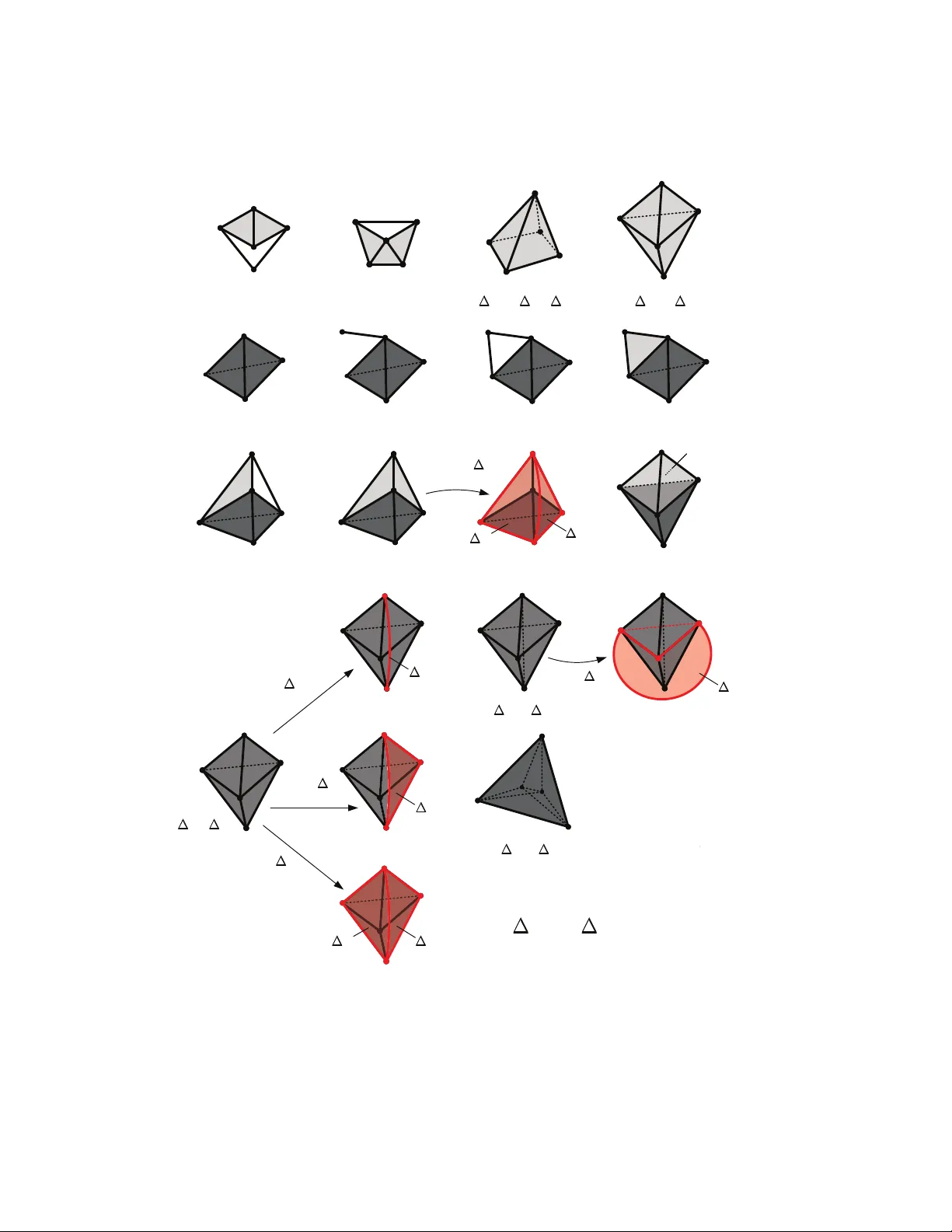
ON ST ANLEY-REISN ER RINGS WITH MINI MAL B ETTI NUMBERS PIMENG D AI*, LI YU** Abstract. W e study simplicial complexes w ith a given num ber o f vertices whose Stanley-Reisner ring ha s the minimal p ossible Betti n um ber s. W e find that these simplicial complexes hav e v ery sp e cial combinatorial and top ologica l structures. F o r example, the Betti n umbers of their Sta nley -Reisner rings are given by the binomial coefficients, and their f ull subcomplexes a re homotopy equiv alent either to a p oint or to a sphere. Thes e prop erties make it p o s sible for us to either classify them or construct them inductiv ely from instances with few er vertices. 1. Introduction In this paper, w e study Betti n umbers and bigra ded Betti n um b ers of the Stanley-Reisner ring of a simplicial complex . Let K b e a simplici al complex with m vertic es. The Stanley-R eisner ring of K ov er a field F (see Stanle y [ 28 ]) is F [ K ] = F [ v 1 , · · · , v m ] / I K where I K is the ideal in the po lynomial ring F [ v 1 , · · · , v m ] generated b y all the squarefree monomials v i 1 · · · v i s where { i 1 , · · · , i s } is not a simplex of K . The ideal I K is called the Stanley-R eisner ide al of K . Since F [ K ] is naturally a mo dule ov er F [ v 1 , · · · , v m ] , by the standard construction in homolog ical a lg ebra, w e obtain a canonical algebra T or F [ v 1 , ··· ,v m ] ( F [ K ] , F ) from F [ K ] , where F is conside red as the trivial F [ v 1 , · · · , v m ] -mo dule. Moreov er, there is a bigraded F [ v 1 , · · · , v m ] -mo dule structure o n T or F [ v 1 , ··· ,v m ] ( F [ K ] , F ) (see [ 28 ]): T or F [ v 1 , ··· ,v m ] ( F [ K ] , F ) = M i,j > 0 T or − i, 2 j F [ v 1 , ··· ,v m ] ( F [ K ] , F ) where deg ( v l ) = 2 for eac h 1 6 l 6 m . The in tegers (1) β − i, 2 j ( F [ K ]) := dim F T or − i, 2 j F [ v 1 , ··· ,v m ] ( F [ K ] , F ) 2020 Mathematics Subje ct Classific ation. 13F55, 13D02, 05E40, 05E45. Key wor ds and phr ases. Stanley-Reisner r ing, Betti n umber , bigraded Betti num b er, moment -angle complex, weakly tight s implicial complex. 1 2 PIMENG DAI*, LI YU** are called the big r ade d B e tti numb ers of F [ K ] . Note that unlik e the ordinary Betti n umbers of K , bigraded Betti n um b ers of F [ K ] are not top olog ical in v ariants, but only combin atorial in v arian ts of K in general. Definition 1.1. The i -th Betti numb er of the Stanley-Reisner ring F [ K ] is (2) β − i ( F [ K ]) = X j > 0 β − i, 2 j ( F [ K ]) . The t otal Betti numb er of F [ K ] is (3) e D ( K ; F ) = X i > 0 β − i ( F [ K ]) = X i,j > 0 β − i, 2 j ( F [ K ]) = dim F T or F [ v 1 , ··· ,v m ] ( F [ K ] , F ) . Remark 1.2. In man y literatures, p eople also use β i,j ( F [ K ]) and β i ( F [ K ]) to refer to bigraded Betti num b ers and Betti num b ers of F [ K ] , resp ectiv ely . Our notations in ( 1 ) and ( 2 ) are ta k en from toric to p ology (see Buc hstab er and Pano v [ 5 ]) whic h are used to a v oid confus ions with the notations for ordinary Betti num b ers of a simplicial complex. In this pap er, w e fo cus our study on t ho se simplic ial complexe s whose Stanley- Reisner rings ha ve the minim um Betti num b ers or minim um total Betti n um b er. Note that in some earlier researc hes, p eople ha v e studie d whether the set of sets o f bigraded Betti n um b ers of monomial ideals attaining a giv en Hilb ert function has a unique minimal elemen t with resp ect to the lexicographic ordering, see Char- alam b ous and Ev ans [ 10 ], Ric hert [ 26 ], Do dd, Marks, Me y erson and Ric hert [ 12 ] and R agusa and Zappalá [ 25 ]. But our at t ention here is a little differen t. F or conv enience, w e in tro duce the follow ing n otation. • F or a pair of integers ( m, d ) with d < m , let Σ( m, d ) denote the set of all d -dimensional simplicial complexes with v ertex set [ m ] . By abuse of notation, we consider the irr elevant c omplex { ∅ } a s the only elemen t of Σ(0 , − 1) . • Let Σ min F ( m, d ) = n K ∈ Σ( m, d ) | e D ( K ; F ) = min L ∈ Σ( m,d ) e D ( L ; F ) o ⊆ Σ( m, d ) . W e call an y mem b er of Σ min F ( m, d ) a e D -minima l simplicial c o m plex (ov er F ). A basic fact related to this problem w as pro v ed b y Ustino vskii [ 30 ] whic h sa ys: (4) β − i ( F [ K ]) > m − dim( K ) − 1 i , for any 0 6 i 6 m − dim ( K ) − 1 . The pro of in [ 30 ] is based on a result of Ev ans and Griffith [ 15 , Corollary 2.5], whic h is related to the Buc hsbaum-Eisen bud-Horro c ks conjecture (see Section 4 ). It f ollo ws from ( 4 ) that (5) e D ( K ; F ) > 2 m − dim( K ) − 1 . 3 The inequalit y ( 5 ) w as also obtained b y Cao and Lü [ 7 , Theorem 1.4] b y some other metho d. In particular, according to ( 4 ), e D ( K ; F ) = 2 m − dim( K ) − 1 if and only if β − i ( F [ K ]) = m − dim( K ) − 1 i for ev ery 0 6 i 6 m − dim( K ) − 1 . The ab ov e low er b o und o f e D ( K ; F ) motiv ates us to define the followi ng notion. Definition 1.3 (Tigh t Simplicial Complex) . A simplic ial complex K with m v ertices is called tight (ov er F ) if e D ( K ; F ) = 2 m − dim( K ) − 1 . By our con v en tions, the irrelev an t complex { ∅ } is also tigh t. Moreo ve r, a stronger lo we r b ound o f e D ( K ; F ) w as obtained b y Ustino vskii in an e arlier paper [ 29 , Theorem 3.2]: (6) e D ( K ; F ) > 2 m − mdim( K ) − 1 , where mdim ( K ) is the minim al dimens ion of the maximal simplices of K . It is clear that mdim( K ) 6 dim ( K ) . In fact, w e can pro v e the follo wing theorem whic h implies ( 6 ) and giv es stronger lo w er b ounds of the Betti n umbers of F [ K ] than ( 4 ). Theorem 1.4 (see Theorem 4.2 ) . F or any si m plicial c ompl e x K with m vertic es, β − i ( F [ K ]) > m − mdim( K ) − 1 i , for every 0 6 i 6 m − mdim( K ) − 1 . Remark 1.5. One can actually prov e Theorem 1.4 by directly using the result of [ 15 , Corollary 2.5] together with Morey and Villarreal [ 23 , Corollary 3.33]. But our pro of of T heorem 1.4 in Section 4 does not use results from [ 1 5 ] or an y result on the Buc hsbaum-Eisen bud-Horro c ks conjec ture. In fact, we only use the Ho c hster’s form ula for the Stanley-Reisner ring and some s imple Ma y er- Vietoris argumen t. P arallely to Definition 1.3 , w e in tro duce the follo wing notion. Definition 1.6 (W eakly Tigh t Simplicial Complex) . A simplic ial complex K with m v ertices is called we akly tight (o v er F ) if e D ( K ; F ) = 2 m − mdim( K ) − 1 . Then w e obtain the fo llo wing corollary from The orem 1.4 immediately . Corollary 1.7. If K is a we akly tight simplicial c om plex with m vertic es, then β − i ( F [ K ]) = m − mdim( K ) − 1 i , fo r e very 0 6 i 6 m − mdim( K ) − 1 . If K is a w eakly tigh t simplicial complex, the ab ov e corollary implies that the pro jectiv e dimen sion of F [ K ] is p dim( F [ K ]) = m − mdim( K ) − 1 . So according to Auslender-Buc hsbaum theorem, the depth o f F [ K ] is depth( F [ K ]) = m − p dim( F [ K ]) = mdim( K ) + 1 . 4 PIMENG DAI*, LI YU** On the other hand, it is w ell kno wn that the Krul l dimension of F [ K ] is (se e Miller and Sturmfels [ 22 , Proposition 7.28]): Krdim( F [ K ]) = dim( K ) + 1 . So in this case, K is Cohen-Mac aulay if a nd only if mdim( K ) = dim( K ) (i.e . K is pure). There fore, w e ha v e the f o llo wing equiv a len t statemen ts: • K is a tigh t simplicial complex . • K is w eakly tigh t and pure. • K is w eakly tigh t and Cohen-Macaula y . W e will see that the tigh tness and w eakly tightness put v ery strong restrictions on the structure of a simplicial complex . W e can classify all the tigh t simplicial complexes in the theorem b elow . F or any integer m > 1 , le t ∆ [ m ] denote the ( m − 1) -dimensional sim plex with verte x set [ m ] . Then its b oundary ∂ ∆ [ m ] is a simplicial sphere of dimension m − 2 . In particular, ∂ ∆ [1] = { ∅ } . In addition, it is also con v enien t to de fine ∆ [0] = { ∅ } . Theorem 1.8 (see Theorem 6.5 ) . A finite simplicial c omplex K is tight if and only if K is of the form ∂ ∆ [ n 1 ] ∗ · · · ∗ ∂ ∆ [ n k ] or ∆ [ r ] ∗ ∂ ∆ [ n 1 ] ∗ · · · ∗ ∂ ∆ [ n k ] for som e p o sitive inte gers n 1 , · · · , n k and r , wher e ∗ is the join of simplicial c omplexes. Note that K ∗ { ∅ } = K . Theorem 1.8 implies that • The tightnes s of a sim plicial comple x is indep enden t on t he co efficien ts. • If K is a tigh t simplicial complex , then the link of ev ery simplex of K and all the full sub complexes of K are also tigh t. • If K ∈ Σ( m, d ) is tigh t, it is necessary that m − 1 2 6 d 6 m − 1 . In particular, the equality m − 1 2 = d is a c hiev ed b y ∂ ∆ [2] ∗ ∂ ∆ [2] ∗ · · · ∗ ∂ ∆ [2] when m is ev en and b y ∆ [1] ∗ ∂ ∆ [2] ∗ ∂ ∆ [2] ∗ · · · ∗ ∂ ∆ [2] when m is o dd. Con v ersely , for an y ( m, d ) with m − 1 2 6 d 6 m − 1 , there alwa ys exists a tigh t simp licial complex K ∈ Σ( m, d ) . Corollary 1.9. If m − 1 2 6 d 6 m − 1 , the e D -minima l simplicial c omp l e x es in Σ( m, d ) ar e exactly al l the tight simplicial c omplexes in Σ( m, d ) . But when d < m − 1 2 , a e D -minimal simp licial complex K in Σ( m, d ) is nev er tigh t, and so the Betti n umbers β − i ( F [ K ]) in this case cannot reac h the lo wer b ounds m − dim( K ) − 1 i sim ultaneously for all 1 6 i 6 m − dim ( K ) − 1 . Indeed, it is v ery hard to find all the e D - minimal simplicial complexes in Σ( m, d ) when d < m − 1 2 . One reason is that a full subcomplex of a e D - minimal simplicial complex may not b e e D -minimal. F or example , by exhausting a ll the 33 mem b ers of Σ(5 , 1) , w e find that all the e D - minimal simplicial complexes with rational 5 co efficien ts in Σ(5 , 1) are K 2 , 3 and C 5 (see Figure 1 ) whose e D -v alues are b oth 12 . But none of the full sub complexes of C 5 on its four v ertices are e D -minimal. This example suggests that w e cannot inductiv ely construct all the e D -minimal simplicial complexes with m vertic es from the e D - minimal ones with m − 1 v ertices. In addition, when d < m − 1 2 , the Stanley-Reisner rings of tw o e D -minimal simplicial complexes in Σ( m, d ) may hav e different Betti n umbers. F or example β − 3 ( K 2 , 3 ) = 2 whi le β − 3 ( C 5 ) = 1 . K 2,3 C 5 Figure 1. e D -minimal 1 -dimensional sim plicial complexe s with 5 v ertices By en umerating all the tigh t and w eakly tight simplicial complexes with few v ertices, w e find that there are a lot more w eakly tigh t simplicial complexes than t ig h t ones and it is not so easy to classify them as w e ha ve done for tight simplicial complexes in Theorem 1.8 . But on the other hand, there are some very nice prop erties of w eakly tight simplicial complexes as listed b elo w that mak e it p ossible for us inductiv ely construct them from instances with fewe r v ertices. Theorem 1.10 (see Theorem 5.5 ) . Every ful l sub c om plex of a we ak ly tigh t c om- plex is we akly tight. Theorem 1.11 (see Theorem 5.11 ) . If a simplicial c omplex K is we akly tight over a field F , then (a) Every ful l sub c omplex of K is homotopy e quivalent either to a p oin t or to a spher e; (b) K is we ak ly tight over an arbitr ary fiel d . This theorem implies a n in teresting fact that the we akly tigh tness of a simplicial complex is a lso indep enden t on whic h co efficien t field we use. Moreo ve r, b y Ho c hster’s formula fo r the bigraded Betti n umbers (see Theorem 3.1 and ( 7 )), we obtain the follo wing characterization of we akly tight simplicial complexes from Theorem 1.11 immediately . Corollary 1.12. L et K b e a simplicial c om plex with m vertic es. The fol low ing statements ar e e quivale nt: (a) K is we akly tight. 6 PIMENG DAI*, LI YU** (b) Each ful l sub c omplex of K is h omotopy e quivale n t either to a p oint or to a spher e, and the numb er of ful l sub c omplexe s of K that ar e homotopy e q uivalent to a spher e is 2 m − mdim( K ) − 1 . (c) Each ful l sub c omplex of K is either acyclic or a homolo gy spher e, and the numb er of homolo gy spher es among al l the ful l sub c omplexes of K is 2 m − mdim( K ) − 1 . Moreo ve r, w e will pro v e that the set of all we akly tight simpli cial complexes is closed under some com binatorial operations suc h as join (se e Lemma 5.1 ) and simplicial wed ge (see Theorem 7.9 ). In addition, w e find that (see Corollary 5 .13 ) if K ∈ Σ( m, d ) is weak ly tigh t, it is necess ary that m − 1 2 6 d 6 m − 1 (whic h is simi lar to tigh t simplicial complexes ). So when d < m − 1 2 , K ∈ Σ( m, d ) is nev er w eakly tigh t. The paper is orga nized as follo ws. In Section 2 , w e introduce some basic notations and con v entions for our discuss ion. In Section 3 , w e prov e some b asic prop erties of e D ( K ) . In Section 4 , w e giv e a pro o f of Theorem 1.4 and obtain some results on the (bigraded) Betti n um b ers of the Stanley-Reisner ring of a w eakly tigh t simplicial comple x. In Section 5 , we study the structures and v arious prop erties of we akly tight simplicial complexe s. In Section 6 , we g iv e a comp lete classification of tigh t simplicial complex es. In Section 7 , we describe ho w to inductiv ely cons truct a ll t he w eakly tig ht simplicial complexes. In the a pp endix, w e list all the we akly tigh t simplic ial complexe s with the n um b er of v ertices les s than or equal to fiv e. 2. Preliminar y F or a finite CW-complex X and a field F , let β i ( X ; F ) := dim F H i ( X ; F ) , e β i ( X ; F ) := dim F e H i ( X ; F ) where H i ( X ; F ) and e H i ( X ; F ) are the singular and reduced singular homology group of X with F -co efficien ts, respectiv ely . Moreov er, define tb ( X ; F ) := X i β i ( X ; F ) , e tb ( X ; F ) := X i e β i ( X ; F ) . W e call tb ( X ; F ) and e tb ( X ; F ) the total Betti numb er and r e d uc e d total Betti numb er of X with F -co efficien ts, resp ectiv ely . T he difference b et we en tb ( X ; F ) and e tb ( X ; F ) is just 1 . Let K be a simplicial comple x with m v ertices whose vertex set is denoted by V ( K ) = [ m ] = { 1 , 2 , · · · , m } . 7 Eac h simple x σ of K is considered as a su bset of [ m ] . So the dimension of σ is dim( σ ) = | σ | − 1 whe re | σ | is the cardinalit y of σ . In particular, w e will iden tify an y v ertex v of K with an elemen t of [ m ] . Sometimes, w e also us e fac e to refer to a simplex. The set of simplic es of K are ordered b y inclusions. So ev ery simplex of K is included in some m aximal simplex (ma y not b e unique). W e in tro duce the follo wing notatio ns: | K | = the geome tric re alization of K ; ∆ max ( K ) = the set of a ll maximal simplices of K ; mdim( K ) = the minimal dime nsion of the m aximal simplices of K ; ∆ max mdim ( K ) = { ξ ∈ ∆ max ( K ) | dim( ξ ) = mdim( K ) } ⊆ ∆ max ( K ); V mdim ( K ) = { v ∈ V ( K ) | v is a v ertex of some s implex in ∆ max mdim ( K ) } . Note that the differe nce b etw een dim( K ) a nd mdim( K ) could b e v ery large. If mdim( K ) = dim( K ) , then all the maximal simplices of K hav e the same dimension, whic h means that K is a pur e simplicial complex. F or a n y simplex σ of K , the link and the star o f σ are the s ub complexes link K σ = { τ ∈ K | σ ∪ τ ∈ K , σ ∩ τ = ∅ } ; star K σ = { τ ∈ K | σ ∪ τ ∈ K } . F or a n y subset J ⊆ V ( K ) = [ m ] , let K J = K | J := the ful l sub c omplex of K obtained b y restricting to J. When J = ∅ , K J = { ∅ } and define • β i ( { ∅ } ; F ) = 0 , for all i > 0; e β i ( { ∅ } ; F ) = ( 1 , if i = − 1 ; 0 , otherwise . F or a v ertex v of K , w e also use the following notation for brevit y: K \ v := K | V ( K ) \{ v } , m v := | V (link K v ) | . 3. Pr oper ties of e D ( K ) The follo wing formula due to Ho c hster [ 20 ] (also see [ 28 , Theorem 4 .8]) tells us that the bigraded Betti n umbers of a simplic ial complex K can b e computed from the homology groups of the full subcomplexes of K . 8 PIMENG DAI*, LI YU** Theorem 3.1 (Ho c hster’s form ula) . Supp ose K is a simpli cial c omp lex with m vertic e s. Then the bigr ade d Betti numb ers of F [ K ] c an b e c omp ute d as (7) β − i, 2 j ( F [ K ]) = X J ⊆ [ m ] , | J | = j dim F e H j − i − 1 ( K J ; F ) = X J ⊆ [ m ] , | J | = j e β j − i − 1 ( K J ; F ) . By this form ula, w e can immediately see the followi ng facts: • β − i, 2 j ( F [ K ∗ ∆ [ r ] ]) = β − i, 2 j ( F [ K ]) for an y r > 1 . • β − i, 2 j ( F [ K ]) = 0 if j 6 i or if j > m or i > m . • β 0 , 2 j ( F [ K ]) = 0 for an y j > 0 , and β 0 , 0 ( F [ K ]) = 1 . So the calculation of β − i, 2 j ( F [ K ]) is non trivial only when 1 6 i < j 6 m . By the Ho c hster’s form ula, w e c an ex press e D ( K ; F ) as (8) e D ( K ; F ) = X J ⊆ [ m ] e tb ( K J ; F ) . This explains wh y w e pu t “ e ” in the notation e D ( K ; F ) . There is another in terpretation of e D ( K ; F ) from a canonical CW-complex Z K asso ciated to K called the moment-angle c om plex of K (see Dav is and Jan uszkiewicz [ 11 , pp. 42 8–429] or Buch stab er and P ano v [ 5 , Section 4.1]). One w ay to write Z K is (9) Z K = [ σ ∈ K Y i ∈ σ D 2 ( i ) × Y i / ∈ σ S 1 ( i ) ⊆ Y i ∈ [ m ] D 2 ( i ) , where D 2 ( i ) and S 1 ( i ) are copies indexe d b y i ∈ [ m ] of respectiv ely the unit disk D 2 = { z ∈ C | | z | 6 1 } and the circle S 1 = ∂ D 2 = { z ∈ C | | z | = 1 } , and Q denotes Cartesian pro duct o f spaces. It is sho wn in [ 5 , Section 4] that T or F [ v 1 , ··· ,v m ] ( F [ K ] , F ) computes the cohomology ring of Z K , whic h implies (10) e D ( K ; F ) = dim F T or F [ v 1 , ··· ,v m ] ( F [ K ] , F ) = tb ( Z K ; F ) . In the rest of the pap er, the co efficien ts F will b e omitted when there is no am biguity in the con text or the co efficien t s are not essen tial for the argumen t. So w e also use e D ( K ) and e tb ( K ) b elo w to denote e D ( K ; F ) and e tb ( K ; F ) , resp ectiv ely . Next, w e pro v e some e asy lemmas on the prop erties of e D ( K ) . Lemma 3.2. I f L is a ful l sub c om plex of K , then e D ( L ) 6 e D ( K ) . Pr o of. This follo ws from the form ula ( 8 ) of e D ( K ) and the simple fact that an y full sub complex of L is also a full s ub complex of K . W e w arn that the statemen t of Lemma 3.2 is not true if L is only a subcomplex but not a full su b complex of K . 9 The follo wing lemma giv es a c hara cterization of a simple x from the p ersp ectiv e of e D -v alue. Lemma 3.3. L et K b e a simplicial c omplex with m vertic es. T hen e D ( K ) > 1 . Mor e over, e D ( K ) = 1 if an d only if K is the sim plex ∆ [ m ] . Pr o of. W e use the form ula of e D ( K ) in ( 8 ). Consider a minimal subset J ⊆ [ m ] that do es not span a simplex in K (called a minimal non-fac e ). If J is not the empt y set, then K | J is a simplicial sphere of dimens ion | J | − 2 and so e tb ( K | J ) = 1 . This implies e D ( K ) > e tb ( K | ∅ ) + e tb ( K | J ) = 2 . So e D ( K ) = 1 if and only if a ll the minimal non- faces of K are empt y , i.e. K is ∆ [ m ] . No t e that the lemm a still mak es sense when m = 0 . Lemma 3.4. F or any finite CW-c omplex es X and Y , tb ( X × Y ) = tb ( X ) tb ( Y ) , e tb ( X ∗ Y ) = e tb ( X ) e tb ( Y ) wher e X ∗ Y is the join of X a n d Y . Pr o of. The equalit y tb ( X × Y ) = tb ( X ) tb ( Y ) follows from the Künn eth formul a of homology groups. In addition, b y the homoto p y equiv alence X ∗ Y ≃ Σ( X ∧ Y ) where “ ∧ ” is the smash pro duct and “ Σ ” is the (redu ced) susp ension, w e obtain (with a field co efficien t) that (11) e H n ( X ∗ Y ) ∼ = H n − 1 ( X ∧ Y ) ∼ = M i ( e H i ( X ) ⊗ e H n − 1 − i ( Y ) ) . The second isomorphism in ( 11 ) f ollo ws from the relativ e v ersion of the Künneth form ula (see [ 19 , Corollary 3.B.7]). Notice that X ∗ Y is alw a ys path-connected and hence e H 0 ( X ∗ Y ) = 0 . Then it follo ws that e tb ( X ∗ Y ) = e tb ( X ) e tb ( Y ) . Lemma 3.5. F or any finite nonempty simplicial c omp l e xes K and L , e D ( K ∗ L ) = e D ( K ) e D ( L ) . Pr o of. Since Z K ∗ L ∼ = Z K × Z L (see [ 5 ]), w e obtain from ( 10 ) and Lemma 3.4 that e D ( K ∗ L ) = tb ( Z K ∗ L ) = tb ( Z K × Z L ) = tb ( Z K ) tb ( Z L ) = e D ( K ) e D ( L ) . 10 PIMENG DAI*, LI YU** 4. Lo wer bounds of Betti numbers of St anley-Reisner Ring The pro of of the low er bound ( 4 ) of β − i ( F [ K ]) b y Ustino vskii in [ 30 ] is based on the follo wing theorem from Ev a ns and Griffith [ 15 ]. Theorem 4.1 ([ 15 , Corollary 2.5 ]) . L et M b e a mo dule ove r the p olynomi a l ring R = F [ v 1 , · · · , v m ] of the form M = R/I wher e I is a mon omial ide al. Then (12) β − i ( M ) > p dim( M ) i , for any i > 0 , wher e p dim( M ) is the pr oje ctive dimension of M over R . This theorem provi des supp orting evide nces f or the follo wing long-standing conjecture in comm utativ e algebra (se e Buc hsbaum and Eisen bud [ 6 , § 1.4] a nd Hartshorne [ 18 , Problem 24]). Conjecture (Buc hsbaum-Eisen bud-Horro c ks). Supp ose R is a comm utativ e No etherian ring suc h that Sp ec( R ) is connected, and let M b e a nonzero, finitely generated R -mo dule of finite pro jectiv e dimension. Then for an y finite pro jectiv e resolution 0 → P d → · · · → P 1 → P 0 → M → 0 of M , w e ha v e rank R ( P i ) > c i , where c = height R (ann R ( M )) , the heigh t of the annihilator ideal of M . The reader is referred to W alke r [ 33 ], Iyen gar and W alker [ 21 ] and V andeBogert and W alk er [ 31 ] fo r the recen t progresses on the abov e conjecture. The lo w er bo und of β − i ( F [ K ]) in ( 4 ) is implied by Theorem 4.1 since the pro jectiv e dimension of F [ K ] alw a ys satisfie s: p dim( F [ K ]) = m − depth( F [ K ]) > m − Krdim( F [ K ]) = m − dim( K ) − 1 . Moreo ve r, according to [ 23 , Corollary 3.33], w e actually ha v e (13) p dim( F [ K ]) > m − mdim ( K ) − 1 . Then Theorem 1.4 follows immediately from ( 12 ) and ( 13 ). The proof of the inequalit y ( 13 ) in [ 23 ] is based on the follo wing characteriz ation of t he depth of F [ K ] du e to Smith [ 27 ] (also see F röb erg [ 1 6 ] for a simple pro of ). depth( F [ K ]) = 1 + max { i | K i is Cohen-Macaulay } , where K i = { σ ∈ K | dim( σ ) 6 i } is the i -sk eleton of K and − 1 6 i 6 dim( K ) . The reader is referre d to [ 28 , 22 , 13 , 32 ] for mor e discussion of the prop erties of Stanley-Reisner rings. W e will giv e an alternativ e pro of of Theorem 1.4 in the following k ey theorem of our paper. Our pro of only uses the Ho c hster’s form ula for β − i, 2 j ( F [ K ]) and some simple Ma y er-Vietoris argument. 11 Theorem 4.2. F or any simplicial c ompl e x K with m vertic es, (14) β − i ( F [ K ]) > m − mdim( K ) − 1 i , for every 0 6 i 6 m − mdim( K ) − 1 . Mor e over, for any vertex v ∈ V ( K ) and m v = | V (link K v ) | , we have fo r al l i, j > 0 (a) β − i, 2( j +1) ( F [ K ]) > X 0 6 s 6 j m − m v − 1 s β − ( i − s ) , 2( j − s ) ( F [link K v ]) + β − i, 2( j +1) ( F [ K \ v ]) − β − i, 2 j ( F [ K \ v ]) . (b) β − i ( F [ K ]) > X 0 6 s 6 i m − m v − 1 s β − ( i − s ) ( F [link K v ]) . (c) e D ( K ) > 2 m − m v − 1 e D (link K v ) . Pr o of. F or a v ertex v ∈ V ( K ) and an y sub set J ⊆ [ m ] \ { v } , consid er the pair star K v | J ∪{ v } , ( K \ v ) | J ∪{ v } = star K v | J ∪{ v } , K | J . Ob viously star K v | J ∪{ v } ∩ K | J = link K v | J , star K v | J ∪{ v } ∪ K | J = K | J ∪{ v } . So b y the May er-Vietoris sequenc e of the pair, we obtain a long exact seq uence: (15) · · · → e H n +1 ( K | J ∪{ v } ) − → e H n (link K v | J ) i ∗ − → e H n ( K | J ) − → e H n ( K | J ∪{ v } ) → where i ∗ is induced b y the inclusion i : link K v | J ֒ → K | J . It follo ws that (16) e β n (link K v | J ) 6 e β n +1 ( K | J ∪{ v } ) + e β n ( K | J ) , for all n ∈ Z . In particular, setting n = | J | − i − 1 a nd notice K | J = ( K \ v ) | J , w e obtain (17) e β | J | − i − 1 (link K v | J ) 6 e β | J | − i ( K | J ∪{ v } ) + e β | J | − i − 1 (( K \ v ) | J ) , for any i ∈ Z . If w e fix i and sum up ( 17 ) for all the s ubsets J ⊆ [ m ] \ { v } with | J | = j , w e obtain from the Ho c hster’s form ula ( 7 ) that • On the left side of ( 17 ), if | J ∩ link K v | = | J | − s , then e β | J | − i − 1 (link K v | J ) = e β | J ∩ l ink K v | + s − i − 1 (link K v | J ∩ li nk K v ) = e β ( | J |− s ) − ( i − s ) − 1 (link K v | J ∩ li nk K v ) . So the sum of the left side of ( 17 ) is X 0 6 s 6 j m − m v − 1 s β − ( i − s ) , 2( j − s ) ( F [link K v ]) . 12 PIMENG DAI*, LI YU** • On the right side of ( 17 ), the sum of the sec ond term g iv es β − i, 2 j ( F [ K \ v ]) . But writing the sum of the first term is a little t r icky . Indeed, w e hav e β − i, 2( j +1) ( F [ K ]) = X J ⊆ [ m ] \{ v } | J | = j +1 e β | J | − i − 1 ( K | J ) + X J ⊆ [ m ] \{ v } | J | = j e β | J ∪{ v }|− i − 1 ( K | J ∪{ v } ) since K | J = ( K \ v ) | J = X J ⊆ [ m ] \{ v } | J | = j +1 e β | J | − i − 1 (( K \ v ) | J ) + X J ⊆ [ m ] \{ v } | J | = j e β | J | − i ( K | J ∪{ v } ) = β − i, 2( j +1) ( F [ K \ v ]) + X J ⊆ [ m ] \{ v } | J | = j e β | J | − i ( K | J ∪{ v } ) . So the sum of the first te rm is β − i, 2( j +1) ( F [ K ]) − β − i, 2( j +1) ( F [ K \ v ]) . Com bining the ab ov e argumen t , w e obtain X 0 6 s 6 j m − m v − 1 s β − ( i − s ) , 2( j − s ) ( F [link K v ]) 6 β − i, 2( j +1) ( F [ K ]) − β − i, 2( j +1) ( F [ K \ v ]) + β − i, 2 j ( F [ K \ v ]) , whic h pro ves (a). Moreo v er, w e can easily deriv e (b) b y summing up the inequalit y in (a ) for all j > 0 . F urthermore, b y summing up the inequalit y in (b) for all i > 0 , w e obtain e D ( K ) = X i > 0 β − i ( F [ K ]) > X i > 0 X 0 6 s 6 i m − m v − 1 s β − ( i − s ) ( F [link K v ]) = X i > 0 X 0 6 q 6 i m − m v − 1 i − q β − q ( F [link K v ]) = X q > 0 2 m − m v − 1 β − q ( F [link K v ]) = 2 m − m v − 1 e D (link K v ) . This prov es (c). T o pro ve the inequ alit y ( 14 ), we do induction on the n umber of vertic es of K . Assume that the result is true when | V ( K ) | is le ss than m . W e c ho ose a v ertex v ∈ V mdim ( K ) . Then mdim ( K ) = mdim(link K v ) + 1 6 m v < m . So by our induction h yp o thesis, β − ( i − s ) ( F [link K v ]) > m v − mdim(link K v ) − 1 i − s . 13 Then com bining this inequalit y with (a ), w e obtain β − i ( F [ K ]) > X 0 6 s 6 i m − m v − 1 s β − ( i − s ) ( F [link K v ]) (18) > X 0 6 s 6 i m − m v − 1 s m v − mdim(link K v ) − 1 i − s (19) = X 0 6 s 6 i m − m v − 1 s m v − mdim ( K ) i − s = m − mdim( K ) − 1 i , where the last “ = ” is just the V andermonde iden tity of binomial coefficien t s. Th is finishes the induction and the theorem is pro ve d. Remark 4.3. If the R -mo dule M in the Buc hsbaum-Eisen bud-Hor r o c ks conjec- ture satisfies some extra conditi ons, there could be some stronger low er b ounds of β − i ( M ) than the lo w er b o unds predicted by the conjecture, see Charalam b ous, Ev ans and Mille r [ 8 ], Charalam b ous and Ev ans [ 9 ], Erm an [ 14 ] and Bo o ch er and Wiggleesw orth [ 4 ] for suc h kind of res ults. Corollary 4.4. I f K is a we a k l y tigh t simplicial c omplex with m vertic es, then for any vertex v ∈ V mdim ( K ) , m v = | V (link K v ) | , we have for al l i, j > 0 , (a) β − i, 2( j +1) ( F [ K ]) = X 0 6 s 6 j m − m v − 1 s β − ( i − s ) , 2( j − s ) ( F [link K v ]) + β − i, 2( j +1) ( F [ K \ v ]) − β − i, 2 j ( F [ K \ v ]) . (b) β − i ( F [ K ]) = X 0 6 s 6 i m − m v − 1 s β − ( i − s ) ( F [link K v ]) . (c) e D ( K ) = 2 m − m v − 1 e D ( link K v ) . (d) link K v is we ak ly tight. Pr o of. Since K is we akly tigh t and v ∈ V mdim ( K ) , the inequalitie s in Theorem 4.2 (a), ( 18 ) and ( 19 ) must all tak e equal signs, whic h give s (a ) (b) and (c) here. More- o ver, since e D ( K ) = 2 m − mdim( K ) − 1 , by the fact that mdim(link K v ) = mdim ( K ) − 1 , w e obtain e D ( F [link K v ]) = 2 m v − mdim(link K v ) − 1 from (c). This prov es (d). Remark 4.5. F or a v ertex u / ∈ V mdim ( K ) , link K u may not b e w eakly tigh t ev en if K is (see Figure 2 for example). 14 PIMENG DAI*, LI YU** u K Figure 2. K is w eakly tight but link K u is not ( u / ∈ V mdim ( K ) ). 5. Weakl y Tight Simplicial Complexes In this se ction, w e study the prop erties of w eakly tigh t simplicial complexes . W e will pro ve that these simplicial complexes ha v e v ery sp ecial com binatorial and top ological s tructures. Lemma 5.1. Supp ose L is a we akly tigh t simplic ial c omplex. Then a simplici a l c o mplex K is we akly tight if and only if K ∗ L is we akly tight. In p articular, K is we akly tight if and only if K ∗ ∆ [ r ] is we akl y tight. Pr o of. By Lemm a 3.5 , e D ( K ∗ L ) = e D ( K ) e D ( L ) . Then since | V ( K ∗ L ) | = | V ( K ) | + | V ( L ) | , mdim( K ∗ L ) = mdim( K ) + mdim( L ) + 1 , the lemma follo ws from the defi nition of w eakly tigh tness immediately . The follo wing theorem prov ides a useful crite rion for us to judge whether a simplicial complex is w eakly tigh t. Theorem 5.2. A simplicial c omplex K w i th m vertic es is we akly tight if and only if ther e exists a vertex v such that (a) link K v is we ak ly tight, (b) for e ach J ⊆ [ m ] \ { v } , the inclusion link K v | J ֒ → K | J = ( K \ v ) | J induc es a surje ction e H ∗ (link K v | J ) → e H ∗ (( K \ v ) | J ) . Pr o of. “ ⇒ ” Sup p ose K is we akly tight. Cho ose an arbitra ry v ertex v ∈ V mdim ( K ) . Then b y Corollary 4.4 (d), link K v is w eakly tigh t. Moreo v er, since K is w eakly tigh t, the equalit y in Theorem 4.2 (c) holds. This implie s that the equ alit y in ( 16 ) holds for all n ∈ Z . Then in the long exact se quence ( 15 ), the map i ∗ : e H n (link K v | J ) → e H n ( K | J ) = e H n (( K \ v ) | J ) m ust b e surjectiv e fo r all n ∈ Z . “ ⇐ ” The condition (b) implies tha t the equalit y in Theorem 4.2 (c) holds , i.e . e D ( K ) = 2 m − m v − 1 · e D (link K v ) . By condition (a), e D (link K v ) = 2 m v − mdim(link K v ) − 1 . So w e ha v e (20) e D ( K ) = 2 m − 1 − m v · 2 m v − mdim(link K v ) − 1 = 2 m − mdim(link K v ) − 2 . Moreo ve r, since e D ( K ) > 2 m − mdim( K ) − 1 b y ( 6 ), it follo ws that mdim(link K v ) 6 mdim( K ) − 1 . 15 But ob viously mdim(link K v ) > mdim( K ) − 1 . So mdim (link K v ) = mdim ( K ) − 1 . Plugging this in to ( 20 ) gives e D ( K ) = 2 m − mdim( K ) − 1 , i. e. K is we akly tigh t. F rom the a b o v e pro of w e see that if K is w eakly tigh t, the stateme n ts of Theorem 5.2 (a) and (b) hold for an y v ertex v ∈ V mdim ( K ) . T his is a v ery us eful fact for our in ves tigation on t he structure of w eakly tigh t simplicial complexes b elo w. Lemma 5.3. L et K b e a s i mplicial c om p lex with m vertic es with m > 2 . Then K is we a k ly tight and disc onne cte d i f and only if K is the disjoint union ∆ [1] ⊔ ∆ [ m − 1] . Pr o of. It is easy to c hec k that ∆ [1] ∪ ∆ [ m − 1] is w eakly tigh t b y definition. Supp o se K is w eakly tight and disconne cted. W e first prov e that K cannot ha ve more than t w o connected comp onen ts. Cho ose a v ertex v ∈ V mdim ( K ) and let L the comp onen t of K con taining v . If K ha s more than tw o connected componen ts, then there a re at least tw o other componen ts denoted by L ′ and L ′′ . Cho o se a v ertex v ′ of L ′ and a v ertex v ′′ of L ′′ , re sp ectiv ely and let J = { v ′ , v ′′ } ⊆ [ m ] \ v . Then by our assum ption, link K v | J = link L v | J = { ∅ } , ( K \ v ) | J = { v ′ } ∪ { v ′′ } . But b y T heorem 5.2 , w e shoul d ha ve a surjection e H ∗ (link K v | J ) → e H ∗ (( K \ v ) | J ) , whic h is a con tradiction. So supp ose K has only t wo connected componen ts L and L ′ . Assume that V ( L ) = [ n ] = { 1 , · · · , n } , V ( L ′ ) = [ m ] \ [ n ] = { n + 1 , · · · , m } . Then by the form ula ( 8 ) for e D ( K ) , we obtain e D ( K ) = X J ⊆ [ m ] e tb ( K J ) = e tb ( K ∅ ) + X ∅ 6 = J ⊆ V ( L ) e tb ( K J ) + X ∅ 6 = J ⊆ V ( L ′ ) e tb ( K J ) + X J ∩ V ( L ) 6 = ∅ J ∩ V ( L ′ ) 6 = ∅ e tb ( K J ) > 1 + X J ∩ V ( L ) 6 = ∅ J ∩ V ( L ′ ) 6 = ∅ e tb ( K J ) > 1 + # { J ⊆ [ m ] ; J ∩ [ n ] 6 = ∅ , J ∩ [ m ] \ [ n ] 6 = ∅ } = 1 + (2 n − 1)(2 m − n − 1 ) = 2 m − 1 + 2(2 n − 1 − 1)(2 m − n − 1 − 1 ) > 2 m − 1 . 16 PIMENG DAI*, LI YU** On the other hand, e D ( K ) = 2 m − mdim( K ) − 1 6 2 m − 1 . Hence e D ( K ) = 2 m − 1 and all the “ > ” ab o v e m ust be “ = ”. This implies: • X ∅ 6 = J ⊆ V ( L ) e tb ( K J ) = X ∅ 6 = J ⊆ V ( L ′ ) e tb ( K J ) = 0 , and s o b y Lemma 3.3 both L and L ′ are simplices . • Either 2 n − 1 − 1 = 0 or 2 m − n − 1 − 1 = 0 , i.e . ei ther n = 1 or m − n = 1 . Therefore, K m ust be ∆ [1] ⊔ ∆ [ m − 1] . W e imme diately ha v e the fo llo wing corollary from Lemma 5.3 . Corollary 5.4. If a sim plicial c omplex K is we akly tight, then the fol lowing statements ar e al l e quivalent: (a) K is disc onn e cte d. (b) mdim( K ) = 0 . (c) Ther e exists a vertex v ∈ V mdim ( K ) such that link K ( v ) = { ∅ } . (d) K is the disjoint union ∆ [1] ⊔ ∆ [ m − 1] for some m > 2 . Theorem 5.5. Eve ry ful l sub c om plex of a we akly tight si m plicial c om plex is we akly tight. Pr o of. Let K be an arbitrary w eakly tight simplicial complex. The statemen t is clearly true when K is disconnected (b y Lemma 5.3 ) or when dim( K ) = 0 . So w e assume that K is connected and dim( K ) > 1 in the follo wing. By induction on the num b er of v ertices of K , w e only need to pro v e t hat K \ v is w eakly tight for ev ery v ∈ V ( K ) . Note that since K is connected, w e m ust ha ve mdim( K ) > 1 b y Corollary 5.4 . So w e can tak e a v ertex w ∈ V ( K ) \ { v } with w ∈ V mdim ( K ) . By Corollary 4.4 (d), link K w is w eakly tight. Then since link K w has less v ertices than K , b y our induction its full sub complex (link K w ) \ v is also w eakly tigh t. In the following, w e use Theorem 5.2 to pro v e that K \ v is w eakly tigh t. • First, by defini tion link K \ v w = (link K w ) \ v . So link K \ v w is w eakly tight. • Second, b y Theorem 5.2 (b) the inclusion link K w | J ֒ → ( K \ w ) | J induces a surjection e H ∗ (link K w | J ) → e H ∗ (( K \ w ) | J ) for each J ⊆ [ m ] \ w . So in particular for ev ery J ′ ⊆ [ m ] \ { v , w } = V ( K \ v ) \ { w } , the inc lusion link K \ v w | J ′ = link K w | J ′ ֒ → ( K \ w ) | J ′ = (( K \ v ) \ w ) | J ′ induces a surjec tion e H ∗ (link K \ v w | J ′ ) → e H ∗ ((( K \ v ) \ w ) | J ′ ) . So w e can a ssert that K \ v is w eakly tigh t by applying The orem 5.2 to the v ertex w ∈ V ( K \ v ) . The theorem is pro v ed. 17 Remark 5.6. It is p ossible that a simplicial complex K is not w eakly tight while all its prop er full subcomplexes are we akly tigh t, se e F igure 3 for example. K Figure 3. All prop er f ull subcomplexes of K are we akly tigh t, but K is not. The following theorem tells us more ab out the structure of a w eakly tigh t simplicial complex K at a v ertex v ∈ V mdim ( K ) . Theorem 5.7. Supp ose K is a we akly tight simp l i cial c omplex. F or a vertex v ∈ V mdim ( K ) , let r v = | V ( K ) | − | V (star K v ) | . Then K \ v ∼ = K | V (link K v ) ∗ ∆ [ r v ] . Pr o of. Claim-1: F or each J ⊆ V ( K ) \ V (star K v ) , ( K \ v ) | J is a simpl ex. W e prov e this b y induction on the cardinality | J | . When | J | = 1 , ( K \ v ) | J is a v ertex. Assume that the claim is true when | J | 6 k − 1 . T ak e an arbitrary J ⊆ V ( K ) \ V (star K v ) with | J | = k . By our induction h yp othesis, ( K \ v ) | J ′ is a simplex for any J ′ ( J . So if the claim is not true for J , w e would hav e ( K \ v ) | J ∼ = ∂ ∆ [ k ] and link K v | J = { ∅ } . But this con tradicts the surjectivit y of the map e H ∗ (link K v | J ) → e H ∗ (( K \ v ) | J ) (see Theorem 5.2 (b)). This pro ve s Claim-1. By Claim-1, K | V ( K ) \ V (star K v ) is a simpl ex. F or brev it y , w e d enoted it b y ∆ [ r v ] . Claim-2: F or ev ery simplex σ of K | V (link K v ) , σ ∗ ∆ [ r v ] is a simplex of K \ v . Note that link K v ma y not b e a full sub complex of K (see F ig ure 2 for example). It is w ell p ossible that K | V (link K v ) has more simplice s than link K v . W e pro v e this claim b y induction on the cardinalit y | σ | of σ . If | σ | = 0 , this is true since ∆ [ r v ] is a simp lex of K \ v . Assume that the statemen t holds when | σ | < k . Let σ b e a simplex of K | V (link K v ) with | σ | = k > 1 . If σ ∗ ∆ [ r v ] is not a simple x o f K \ v , let J = ( V ( K ) \ V (star K v )) ∪ V ( σ ) . Then by our induction h yp othesis, • ( K \ v ) | J = σ ∪ ( ∂ σ ∗ ∆ [ r v ] ) whic h is homotop y equiv alen t to ∂ ∆ [ k +1] . • ( K \ v ) | V ( σ ) = σ ∼ = ∆ [ k ] . • link K v | J = link K v | V ( σ ) ⊆ ( K \ v ) | V ( σ ) ⊆ ( K \ v ) | J . Then t he follo wing compo sition of maps e H ∗ (link K v | J ) → e H ∗ ( K \ v ) | V ( σ ) → e H ∗ (( K \ v ) | J ) ∼ = e H ∗ ( ∂ ∆ [ k +1] ) 18 PIMENG DAI*, LI YU** cannot b e surjectiv e since the second map is not. But this contradicts our as- sumption v ∈ V mdim ( K ) b ecause of Theorem 5.2 (b). So σ ∗ ∆ [ r v ] has to b e a simplex of K \ v , whic h pro v es Claim-2. It follows immediately from Claim-2 that K \ v ∼ = K | V (link K v ) ∗ ∆ [ r v ] . A ccording to Theorem 5.7 , we can decomp ose a w eakly tigh t simplicial complex K at an y v ertex v ∈ V mdim ( K ) as: K = star K v ∪ link K v ( K \ v ) (21) ∼ = ( v ∗ link K v ) ∪ link K v K | V (link K v ) ∗ ∆ [ r v ] . A sc hematic picture of this decomp osition is sho wn in Figure 4 . Moreov er, b y Corollary 4.4 (d), link K v is w eakly tig ht. By Theorem 5.5 , K \ v is w eakly tight, whic h implies that K | V (link K v ) is also w eakly tigh t (b y Lemma 5.1 ). Note that when link K v = { ∅ } , K is the dis join t union { v } ⊔ ∆ [ r v ] (see Corollary 5.4 ). [ r ] v L X X = K | V (link v ) K L link v K = v V ( L ) V ( X ) = K Figure 4. A sc hematic picture of a w eakly tigh t simplic ial com- plex K at a v ertex v ∈ V mdim ( K ) Remark 5.8. In Figure 4 , if L = X , the n K = ( Cone ( X ) , if r = 0; Σ X, if r = 1 , where Σ X denotes the susp ension of X . So the decomp osition o f K in ( 21 ) can b e though t of as a generalization of taking cone o r taking susp ension of a s pace. As w e will see b elow, the decomp osition ( 21 ) is ve ry use ful for us to study the global structure of a w eakly tigh t simplicial complex . Lemma 5.9. F or a we akly tight sim p licial c ompl e x K and a vertex v ∈ V mdim ( K ) , let X = K | V (link K v ) and L = link K v . Then e i ther | K | ≃ | X | / | L | or | K | ≃ Σ( | L | ) . Pr o of. By ( 21 ), K = ( v ∗ L ) ∪ L ( X ∗ ∆ [ r v ] ) . T hen we obtain | K | = ( v ∗ | L | ) ∪ | L | | X ∗ ∆ [ r v ] | ≃ ( ( v ∗ | L | ) ∪ | L | | X | ≃ | X | / | L | , if r v = 0; ( v ∗ | L | ) ∪ | L | v ′ ∗ | X | ≃ Σ( | L | ) , if r v > 0 . 19 Lemma 5.10. L et K b e a w e akly tight simplicial c ompl e x over a field F . Then i ts ge ometric r e alization | K | is ho m otopy e quivalent either to a p oint or to a spher e. Pr o of. W e do induction on the num b er of v ertices. The one v ertex case is trivial. Supp ose K has m v ertices and w e c ho ose a v ertex v ∈ V mdim ( K ) . Then b y ( 21 ), w e can write K = ( v ∗ L ) ∪ L ( X ∗ ∆ [ r v ] ) where L = link K v and X = K | V (link K v ) are both w eakly tigh t sub complexes of K with | V ( X ) | < m and | V ( L ) | < m . So b y induction, b oth | X | a nd | L | are homotop y equiv alent eithe r to a point or to a sphere. Moreov er, b y Theorem 5.2 (b), the inclusion i : L ֒ → K \ v induces a surjection i ∗ : H ∗ ( L | J ; F ) → H ∗ (( K \ v ) | J ; F ) for any J ⊆ V ( K ) \ v . In particular, b y setting J = V (link K v ) , w e obtain a surjection (22) i ∗ : H ∗ ( L ; F ) → H ∗ ( X ; F ) . By Lemma 5.9 , we hav e the followi ng cas es: Case 1: | K | ≃ Σ( | L | ) . Then w e ha v e | K | ≃ ( pt, if | L | ≃ pt ; S n +1 , if | L | ≃ S n . Case 2: | K | ≃ | X | / | L | ≃ Cone ( | L | ) ∪ | L | | X | where X = K \ v . (i) If | X | ≃ pt , | K | ≃ Σ( | L | ) ≃ ( pt, if | L | ≃ pt ; S n +1 , if | L | ≃ S n . (ii) If | X | ≃ S n , then since i ∗ is a surjection, | L | cannot b e homotop y equiv alen t to a p oint. So | L | ≃ S l for some l ∈ Z . In f a ct, w e m ust ha ve l = n b ecause i ∗ : H ∗ ( L ; F ) = H ∗ ( S l ; F ) → H ∗ ( S n ; F ) = H ∗ ( X ; F ) is a surjection. Moreo v er, since H ∗ ( L ; Z ) and H ∗ ( X ; Z ) are b oth free ab elian, the surjectivit y of i ∗ implies that i ∗ : H ∗ ( L ; Z ) → H ∗ ( X ; Z ) is an isomorphism. Then by the long exact seq uence of the ho molo g y groups o f ( | X | , | L | ) , w e deduce that e H ∗ ( | K | ; Z ) ∼ = e H ∗ ( | X | / | L | ; Z ) = 0 . – If l = n = 0 , it is cl ear that | K | ≃ pt . – If l = n = 1 , i.e. | L | ≃ | X | ≃ S 1 , then i ∗ : π 1 ( | L | ) = H 1 ( | L | ; Z ) → H 1 ( | X | ; Z ) = π 1 ( | X | ) is an isomorphism. Therefore, | K | ≃ | X | / | L | is 1 -connected. Then by Whitehead’s theorem (see [ 19 , Section 4.2]), | K | ≃ pt . – If l = n > 2 , | L | ≃ | X | ≃ S n are b oth 1 -connected, and so is | K | . Then b y Whiteh ead’s theorem, | K | ≃ pt . So w e finish the induction and the theorem is pro v ed. Theorem 5.11. I f a simplicial c om p lex K is we akly tight over a field F , then 20 PIMENG DAI*, LI YU** (a) Every ful l sub c omplex of K is homotopy e quivalent either to a p oin t or to a spher e; (b) K is we ak ly tight over an arbitr ary fiel d . Pr o of. (a) By Theorem 5.5 , ev ery full sub complex of K is w eakly tight ov er F , and hence homotop y equiv a lent either to a point or to a sphere b y Lemma 5.10 . (b) Let G denote an arbitrary field. F or ev ery J ⊆ V ( K ) = [ m ] , the full sub complex K J satisfies e tb ( K J ; G ) = e tb ( K J ; F ) since its geometric realization | K J | is homotop y eq uiv alent either to a point or to a sphere. T hen e D ( K ; G ) = X J ⊆ [ m ] e tb ( K J ; G ) = X J ⊆ [ m ] e tb ( K J ; F ) = e D ( K ; F ) = 2 m − mdim( K ) − 1 . So K is w eakly tigh t o v er G . F rom the ab o ve results, w e see that the w eakly tightnes s of a simplic ial complex K put v ery strong restrictions on the top ology of K , either lo cally and globally . Next, w e pro v e some prop erties o f dim( K ) and mdim( K ) for a weak ly tigh t simplicial complex K . Lemma 5.12. Supp ose K is a we akly tight simpli c ial c om plex. Then for every vertex v ∈ V mdim ( K ) , we have (a) mdim(link K v ) 6 mdim( K \ v ) , and (b) mdim(link K v ) = mdim( K \ v ) if and only if link K v = K \ v . Pr o of. (a) Suppose V ( K ) = [ m ] . First, w e hav e mdim(link K v ) = mdim( K ) − 1 since v ∈ V mdim ( K ) . By Coro lla r y 4.4 (d) and Theorem 5.3 , link K v a nd K \ v are b oth weak ly tigh t. So w e hav e (23) e D ( link K v ) = 2 m − mdim(link K v ) − 1 , e D ( K \ v ) = 2 m − mdim( K \ v ) − 1 . Moreo ve r, from Theorem 5.2 (b) a nd the Ho c hster’s form ula, w e can deduce that e D (link K v ) > e D ( K \ v ) . Then b y ( 23 ), mdim(link K v ) 6 mdim( K \ v ) . (b) By The orem 5.7 , w e can w rite K as K = (star K v ) ∪ link K v ( K \ v ) = ( v ∗ link K v ) ∪ link K v ( K | V (link K v ) ∗ ∆ [ r v ] ) . If r v > 1 , w e ha ve ∆ max ( K ) = ∆ max ( v ∗ link K v ) ∪ ∆ max ( K \ v ) . Then b y the definition of mdim( K ) , we obtain mdim( K ) 6 mdim( K \ v ) and so mdim(link K v ) 6 mdim( K \ v ) − 1 . Therefore, if mdim(link K v ) = mdim ( K \ v ) , it is necessary that r v = 0 and hence V ( K \ v ) = V (link K v ) . In this case, w e ha v e e D (link K v ) = e D ( K \ v ) b y ( 23 ). So b y Theorem 5.2 (b), the inclusion i : link K v ֒ → K \ v must induce an isomorphism i ∗ : e H ∗ (link K v | J ) → e H ∗ (( K \ v ) | J ) fo r eve ry J ⊆ [ m ] . If link K v 6 = K \ v , w e c ho ose 21 a minimal (by inclusion) simplex σ in ( K \ v ) \ link K v . Since V ( K \ v ) = V (link K v ) , dim( σ ) > 1 . Then link K v | V ( σ ) = ∂ σ is a simplicial sph ere while ( K \ v ) | V ( σ ) = σ . This con tradicts that i ∗ : e H ∗ (link K v | V ( σ ) ) → e H ∗ (( K \ v ) | V ( σ ) ) is an isomorphism. Therefore, we m ust ha v e link K v = K \ v if mdim(link K v ) = mdim ( K \ v ) . Corollary 5.13. If a simplicial c o m plex K with m vertic e s is we ak ly tight, then m − 1 2 6 dim( K ) 6 m − 1 . Pr o of. W e do induction on the num b er of v ertices of K . Assume that the result is true when | V ( K ) | < m . T ak e a verte x v ∈ V mdim ( K ) . Then b y T heorem 5.7 , K \ v ∼ = K | V (link K v ) ∗ ∆ [ r v ] , where r v = | V ( K ) | − | V (star K v ) | . Note that | V (link K v ) | = m − r v − 1 , Moreo v er, by Theorem 5.2 and Theorem 5.5 , b oth link K v and K | V (link K v ) are w eakly tigh t. So b y the induction h yp othesis, dim(link K v ) > m − r v − 1 − 1 2 = m − r v 2 − 1 , dim( K | V (link K v ) ) > m − r v − 1 − 1 2 = m − r v 2 − 1 . Hence dim(star K v ) = dim(link K v ) + 1 > m − r v 2 , dim( K \ v ) = dim( K | V (link K v ) ) + r v > m + r v 2 − 1 . Then we ha v e dim( K ) > max { dim(star K v ) , dim( K \ v ) } > max m − r v 2 , m + r v 2 − 1 = m 2 , if r v = 0 ; m − 1 2 , if r v = 1; > m 2 , if r v > 2 . So w e a lw ays ha v e dim( K ) > m − 1 2 . No t e that this low er b ound can be reac hed b y tigh t simpli cial complex es (see the discu ssion follo wing T heorem 1.8 ). 22 PIMENG DAI*, LI YU** 6. Classifica t ion of Tight Simplicial Complexes In this section, w e classify all the tigh t simplicial complexes. W e first pro ve some easy lemmas ab out tigh t simplicial complex es. Lemma 6.1. Supp os e L is a tight simplici a l c ompl e x. The n a simplicial c omp l e x K is tight if and only if K ∗ L is tight. In p articular, K is tight if and only if K ∗ ∆ [ r ] is tight. Pr o of. By Lemm a 3.5 , e D ( K ∗ L ) = e D ( K ) e D ( L ) . Then since | V ( K ∗ L ) | = | V ( K ) | + | V ( L ) | , dim( K ∗ L ) = mdim( K ) + dim( L ) + 1 , the lemma follo ws from the defi nition of tigh tness immediate ly . Lemma 6.2. L et K b e a s i m plicial c omplex with m vertic es. If K is tight, then for every simplex σ of K , link K σ is tight. Pr o of. W e do induction on m . When m = 1 , this is trivial. Since K is tigh t, K is a pure simplicial complex. So an y vertex v of K belongs to V mdim ( K ) = V ( K ) . Then by Corollary 4.4 (d), link K v is w eakly tight. Moreov er, link K v is pure since K is pure. So link K v is tigh t. No w su pp ose w e hav e pro v ed that link K σ is tigh t for an y s implex σ of K with dimension less than j . Let τ b e a j -simplex in K and let v be a v ertex of τ . So σ = τ \ { v } is a ( j − 1) -simplex and it is easy to see that (24) link K τ = link (link K σ ) v . By our assumption, w e know that link K σ is tigh t. So by the precedin g argumen t, w e can assert that link K τ is also tight. This finishes the induction. Lemma 6.3. If a sim plicial c omplex K is tight but not c onne cte d, then K must b e the dis joint union of two p oin ts ∆ [1] ⊔ ∆ [1] = ∂ ∆ [2] . Pr o of. Since K is tigh t and hence w eakly tigh t, K can only be ∆ [1] ⊔ ∆ [ m − 1] for some m > 2 by Lemma 5.3 . Then it is easy to c hec k that only ∆ [1] ⊔ ∆ [1] = ∂ ∆ [2] is tight. It is easy to c heck that an y simplicial complex of the form ∂ ∆ [ n 1 ] ∗ · · · ∗ ∂ ∆ [ n k ] is tigh t. So b y Corollary 6.1 , ∆ [ r ] ∗ ∂ ∆ [ n 1 ] ∗ · · · ∗ ∂ ∆ [ n k ] is also tigh t for any r > 1 . F or brevit y , w e call ∂ ∆ [ n 1 ] ∗ · · · ∗ ∂ ∆ [ n k ] a spher e join and call ∆ [ r ] ∗ ∂ ∆ [ n 1 ] ∗ · · · ∗ ∂ ∆ [ n k ] a simp lex-spher e join for any p ositiv e in tegers n 1 , · · · , n k and r . The follo wing theorem pro ved in Y u and Masuda [ 34 ] will b e useful for our pro of later. Theorem 6.4 ([ 34 , Theorem 3.1]) . L et K b e a simplici a l c omplex of dimens ion n > 2 . Supp o s e that K satisfies the fol lowing two c onditions : 23 (a) K is an n -dimensional pseudomanifold, (b) the link of any vertex of K is a spher e join of dimen s i on n − 1 , Then K is a spher e join. Recall that a simplicial complex K is an n - dimensional pseudoman i f o ld if the follo wing conditions hold: (i) Ev ery simplex of K is a face of some n -simplex o f K (i.e. K is pur e ). (ii) Ev ery ( n − 1) -simplex o f K is the face of exactly t w o n -simplices of K . (iii) If σ and σ ′ are t w o n -simplices of K , the n there is a finite sequenc e o f n -simplices σ = σ 0 , σ 1 , . . . , σ k = σ ′ suc h that the inters ection σ i ∩ σ i +1 is an ( n − 1) -simplex fo r all i = 0 , . . . , k − 1 . In particular, an y closed connected PL-manifold is a pseudomanifold. Next, w e pro v e the following classifying theorem of tight simplicial comple xes. Theorem 6.5. A fini te simpli c ial c omp l e x K is tight if and only if K is of the form ∂ ∆ [ n 1 ] ∗ · · · ∗ ∂ ∆ [ n k ] or ∆ [ r ] ∗ ∂ ∆ [ n 1 ] ∗ · · · ∗ ∂ ∆ [ n k ] for some p ositive inte gers n 1 , · · · , n k and r . Pr o of. By our precedi ng discussion, an y sphere jo in o r simplex-sphere join is tigh t. Con v ersely , suppose K ∈ Σ( m, d ) is tight and w e do induction on m . When m 6 2 , it is easy to c hec k the statemen t. F or m > 3 , by Lemma 6.2 and L emma 6.3 , K is connected, pure and link K σ is tigh t for ev ery simplex σ of K . Then since the n um b er of ve rtices of link K σ is less than m , our induction h yp othesis implies that link K σ is either a s phere join or a simple x-sphere join. Case 1: If for ev ery v ertex v of K , link K v is a sphere join, then b y the relation in ( 24 ), w e can inductiv ely pro v e that for ev ery simple x σ of K , link K σ is also a sphere join. This implies that K is a closed connected PL-manifold hence a pseudomanifold. So b y Theorem 6.4 , K is a sphere join. Case 2: If there exists a v ertex v ∈ K su c h that link K v is a simplex-sphere join, let link K v = ∆ [ r ] ∗ ∂ ∆ [ n 1 ] ∗ · · · ∗ ∂ ∆ [ n k ] . Since K is a pure d - dimensional simplicial complex, dim(link K v ) = d − 1 . T ak e a v ertex w ∈ ∆ [ r ] and conside r the full subcomplex K \ w = K | [ m ] \ w of K . Note that link K \ w v = ∆ [ r ] \ w ∗ ∂ ∆ [ n 1 ] ∗ ∂ ∆ [ n 2 ] ∗ · · · ∗ ∂ ∆ [ n k ] , whic h has dimension d − 2 . So dim(star K \ w v ) = d − 1 , w hic h implies mdim( K \ w ) 6 d − 1 . But r emovin g a vertex can reduce mdim( K ) at most b y one. Moreo ver, s ince K is pure, w e ha v e mdim( K \ w ) > mdim( K ) − 1 = dim( K ) − 1 = d − 1 . 24 PIMENG DAI*, LI YU** So w e deduce that mdim( K \ w ) = d − 1 . Then b y ( 6 ), w e obtain e D ( K \ w ) > 2 m − 1 − mdim( K \ w ) − 1 = 2 m − d − 1 . But by Lemma 3.2 , e D ( K \ w ) 6 e D ( K ) = 2 m − d − 1 . So w e ha v e (25) e D ( K \ w ) = 2 m − d − 1 = e D ( K ) . Moreo ve r, b y the formula ( 8 ) of e D ( K ) , w e o btain e D ( K ) − e D ( K \ w ) = X w ∈ J ⊆ [ m ] e tb ( K J ) . So the equalit y ( 25 ) implies that e tb ( K J ) = 0 for ev ery J ⊆ [ m ] con taining w . Claim: F or any simplex σ of K \ w , { w } ∪ σ is a simplex of K . W e prov e the claim b y induction on the cardinalit y | σ | of σ . When | σ | = 1 , i.e. σ is a v ertex, { w } ∪ σ ∈ K since e tb ( K | { w }∪ σ ) = 0 . Assume that the cl aim is true when | σ | < s . If | σ | = s , then b y induction K | { w }∪ τ is a simplex for ev ery τ ( σ . If { w } ∪ σ is not a simplex of K , t hen K | { w }∪ σ is isomorphic to the b oundary of an s -dimensional simplex. But this con tradicts the ab ov e conclus ion that e tb ( K | { w }∪ σ ) = 0 . So the claim is pro v ed. By the ab o ve claim, K is a cone of w with K \ w , i.e. K = w ∗ ( K \ w ) . It f ollo ws that dim( K \ w ) = d − 1 . So b y ( 25 ), e D ( K \ w ) = 2 m − d − 1 = 2 m − 1 − dim( K \ w ) − 1 , i.e. K \ w is tigh t. Then by our induction, K \ w is either a sphere-join or a simplex-sph ere join. Therefore, K = w ∗ ( K \ w ) is a simplex-sphere join. The theorem is pro v ed. 7. Constr uc ting Weakl y Tight Simplicial Complexes Let K b e a w eakly tig ht simplicial complex. F or ev ery v ertex v ∈ V mdim ( K ) , the subcomplex link K v and K \ v are b oth w eakly tigh t b y Corollary 4.4 (d) a nd Theorem 5.5 , resp ectiv ely . Moreo ve r, b y the decomp osition ( 21 ), K = star K v ∪ link K v ( K \ v ) = ( v ∗ link K v ) ∪ link K v K | V (link K v ) ∗ ∆ [ r v ] . In addition, Theorem 5.2 (b) tells us that for eac h subset J ⊆ [ m ] \ { v } , the inclusion link K v | J ֒ → ( K \ v ) | J induces a surjection e H ∗ (link K v | J ) → e H ∗ (( K \ v ) | J ) . Then since K \ v = K | V (link K v ) ∗ ∆ [ r v ] , the statemen t of Theorem 5.2 (b) is equiv alen t to the followi ng: (26) for eac h J ⊆ V (link K v ) , e H ∗ (link K v | J ) → e H ∗ (( K | V (link K v ) ) | J ) is surjectiv e. So any w eakly tigh t simplic ial complex K with m v ertices can be written as K = Cone( L ) ∪ L Y = ( v ∗ L ) ∪ L Y 25 where Y is a w eakly tigh t simplic ial complex with m − 1 v ertices and L is a w eakly tigh t sub complex L of Y with mdim( L ) 6 mdim( Y ) where mdim( L ) = mdim( Y ) only when L = Y (by Lemma 5.12 ). These prop erties allow us to inductiv ely construct all w eakly tigh t si mplicial comp lexes as follow s. Let Σ w t ( m ) = the set of all w eakly tigh t simplicial complexes with m v ertices . Step 1: Σ w t (0) = { ∅ } , Σ w t (1) = ∆ [1] . Step 2: Supp o se w e ha v e c onstructed Σ w t ( m − 1 ) . F or e ac h Y ∈ Σ w t ( m − 1) , find all the subcomplexes L of Y that satisfy the following tw o conditions: Cond-I: L is w eakly tigh t w ith md im( L ) < mdim ( Y ) or L = Y . Cond-I I: the inclusion i : L ֒ → Y induces a surjection i ∗ : e H ∗ ( L | J ) → e H ∗ ( Y | J ) for ev ery subset J ⊆ V ( Y ) . Step 3: F or eac h Y ∈ Σ w t ( m − 1) and a sub complex L of Y satisfying Cond-I and Cond-I I, define a simplicial complex K = ( v ∗ L ) ∪ L Y . By our assumptions on L , w e can e asily se e that v ∈ V mdim ( K ) and K b elongs to Σ w t ( m ) (b y Theorem 5.2 ). Moreo ver, an y mem b er of Σ w t ( m ) can b e obta ined in this w ay b y the preceding discuss ion. Remark 7.1. Considering the computing load, the ab o v e w ay of constructing w eakly tight simplicial complexes is not v ery efficien t since c heck ing Cond-II is rather cum b ersome. In a practical algorithm, one may replace c hec king Cond-II b y c hec king whether e D (( v ∗ L ) ∪ L Y ) equals 2 m − mdim( L ) − 2 for a subcomplex L of Y ∈ Σ w t ( m − 1) . In the ab o ve steps, the hardest part is classifying all the sub complexes L in a w eakly tigh t simplic ial complex Y that satisfy Cond-I and Cond-I I. W e cons ider suc h a pair ( Y , L ) as a whole ob ject and in tro duce the follo wing notio n. Definition 7.2. Let ( Y , L ) b e a pair of w eakly tigh t simplicial complexes where L ⊆ Y . W e call ( Y , L ) a we akly tight germ (o r wt-germ for short) if Y a nd L satisfy the Cond-I and Cond-I I. Moreo v er, a wt-germ ( Y , L ) is called essential if V ( L ) = V ( Y ) . Note that in a wt-germ ( Y , L ) , it is possible that L = { ∅ } . • Let G ( m ) d enote the set o f wt-germs ( Y , L ) with Y ∈ Σ w t ( m ) . • Let G e ( m ) ⊆ Σ w t ( m ) × Σ w t ( m ) denote the set of ess en tial wt-germs ( Y , L ) where Y , L ∈ Σ w t ( m ) . Using the ab ov e definition, w e can rephrase the construction of Σ w t ( m ) as: inductiv ely construct G ( m − 1 ) and then an y mem b er of Σ w t ( m ) c an be realized as ( v ∗ L ) ∪ L Y f rom some ( Y , L ) ∈ G ( m − 1) . The following are some easy lemmas on essen tial wt-germs. Lemma 7.3. F or a wt-germ ( Y , L ) and any inte ger r > 0 , K = ( v ∗ L ) ∪ L ( Y ∗ ∆ [ r ] ) is a we a kly tight simplicial c om plex. 26 PIMENG DAI*, LI YU** Pr o of. By the Cond-I in the definition of wt-g erm, mdim( K ) = mdim( L ) + 1 a nd the ve rtex v b elongs to V mdim ( K ) . By the Cond-I I, w e can deduce that K is w eakly tigh t from Theorem 5.2 (also see ( 2 6 )). Lemma 7.4. I f ( Y , L ) is an essential wt-germ, then for any J ⊆ V ( Y ) , the p air ( Y | J , L | J ) is also an essential wt-germ. Pr o of. By Theorem 5.5 , Y | J and L | J are b oth weak ly tigh t. Since ( Y , L ) is a wt-germ, the inclusion i : L ֒ → Y induces a surje ction i ∗ : e H ∗ ( L | J ′ ) → e H ∗ ( Y | J ′ ) for ev ery J ′ ⊆ V ( Y ) . The n considering this fact for all J ′ ⊆ J , we can deduce that e D ( L | J ) > e D ( Y | J ) . This further implies that mdim( L | J ) 6 mdim( Y | J ) . Moreo ve r, if mdim( L | J ) = mdim( Y | J ) , then e D ( L | J ) = e D ( K | J ) since Y | J and L | J are bo t h w eakly tigh t. Then we can prov e that L | J = Y | J b y the similar argumen t as the proof of Lemma 5.12 (b). Therefore, ( Y | J , L | J ) is a n essen tial wt-germ. The following lemma is conv enien t for us to judge whether a pair of w eakly tigh t simplicial complexes form an e ssen tial wt-germ. Lemma 7.5. Supp ose Y and L ar e we akly tight simplicial c omp lexes with L ⊆ Y and V ( Y ) = V ( L ) = [ m ] . Then ( Y , L ) is an essential wt-germ if and only if • The inclusion i : L ֒ → Y ind uc es a surje ction i ∗ : H ∗ ( L ) → H ∗ ( Y ) . • F or e ach j ∈ [ m ] , Y | [ m ] \{ j } , L | [ m ] \{ j } is an essential wt-germ. Pr o of. The necessit y follow s immediately fro m the definition of essen tial wt-germ and Lemma 7.4 . Con vers ely , the ab ov e t wo conditions te ll us that if J = [ m ] or J = [ m ] \ { j } , i ∗ : H ∗ ( L | J ) → H ∗ ( Y | J ) is surjectiv e. Moreo v er, for a subs et J ⊆ [ m ] with | J | 6 m − 2 , there exists some j ∈ [ m ] suc h that J ⊆ [ m ] \{ j } . Then i ∗ : H ∗ ( L | J ) → H ∗ ( Y | J ) is also surjectiv e since Y | [ m ] \{ j } , L | [ m ] \{ j } is an essen t ia l wt-germ. This implies that e D ( L ) > e D ( Y ) and so mdim ( L ) 6 mdim( Y ) . Moreo ve r, if mdim( L ) = mdim( Y ) , w e can pro v e that L = Y b y the similar argumen t as the pro of of Lem ma 5.12 (b). So ( Y , L ) is an essen tial wt-germ. A ccording to the decomposition in ( 21 ), for a weak ly tigh t simplic ial complex K , there exists a seq uence of essen tial wt-germs (27) ( Y 0 , L 0 ) , ( Y 1 , L 1 ) , · · · , ( Y n , L n ) , where • ( Y 0 , L 0 ) = ( { ∅ } , { ∅ } ) ; • Y 0 ( Y 1 ( · · · ( Y n , and let K := Y n +1 ; • Y k +1 = ( v k ∗ L k ) ∪ L k ( Y k ∗ ∆ [ r k ] ) , r k > 0 for eac h 0 6 k 6 n . W e call the sequence in ( 27 ) an essential germ filtr ation of K , denoted by F and call n + 1 the length of F . 27 Note that a w eakly tigh t simplicial complex may admit t w o or more differen t essen t ia l germ filtrations. See Figure 5 for example. So it is natural to ask the follo wing question: K = L 1 = Y 0 Y 1 Y 2 Y 1 L 1 = Y 1 Figure 5. T wo differen t essen tial germ filtrations of K Question: F or a w eakly tight simplicial complex K , do all the essen tial g erm filtrations o f K ha v e the same length? All the examples w e kno w sugges t that the answ er to this qu estion should b e y es. But the pro of is not clear to us. The follo wing prop osition is immediate from the definition of ess en tial germ filtration. Prop osition 7.6. A we akly tight simplicial c omp lex K has an essential germ filtr ation of length one if and only if K = ∆ [1] or t he disjoint union ∆ [1] ⊔ ∆ [ m − 1] for some m > 2 . By the existence of essen tial germ filtrations for a weakl y tight simplicial complex, w e see that to construct Σ w t ( m ) , it is suffic ien t for us to construct {G e ( k ) | k < m } . The follow ing is an algorithm to construct ess en tial wt-germs. Step 1: G e (0) = ( { ∅ } , { ∅ } ) . Step 2: Supp o se we ha v e constructed {G e ( k ) | k < m } . Then any K ∈ Σ w t ( m ) can b e written as K = ( v ∗ L ) ∪ L ( Y ∗ ∆ [ r ] ) fo r some ( Y , L ) ∈ G e ( k ) , k < m . Step 3: Lo ok for all the K , K ′ ∈ Σ w t ( m ) suc h that ( K , K ′ ) is a n esse n tial wt-germ. Since w e hav e already constructed {G e ( k ) | k < m } , we can easily c hec k whether ( K, K ′ ) is an essen tial wt-germ using Lemma 7.5 . In fact, w e only need to c hec k those ( K , K ′ ) w ith m dim( K ) > mdim( K ′ ) . Another observ ation is that eac h essen tia l wt-germ ( Y , L ) ∈ G e ( k ) with k < m determines a unique simplicial complex ( v ∗ L ) ∪ L ( Y ∗ ∆ [ m − k − 1] ) ∈ Σ w t ( m ) . 28 PIMENG DAI*, LI YU** Con v ersely , ev ery K ∈ Σ w t ( m ) c an be obtained in this w ay b y ( 21 ). So w e ha v e (28) | Σ w t ( m ) | 6 m − 1 X k =0 |G e ( k ) | . By Lemma 5.1 , t a king the join with a weak ly tigh t simplic ial complex preserv es the w eakly tightnes s of a simplicial complex. In the follo wing, we show that there is another t yp e of op eration on simplicial complexes called simplicial we dge whic h also preserv es the w eakly tigh tness. This op eration was introduced b y Prov a n and Billera [ 24 , p. 578]. Definition 7.7 (Simplicial W edge) . Supp ose K is a simplicial complex with m v ertices. Choose a fix ed v ertex v of K and define a new simplicial complex K ( v ) with m + 1 ve rtices (29) K ( v ) := v 1 v 2 ∗ link K v ∪ ( v 1 ∪ v 2 ) ∗ ( K \ v ) where v 1 v 2 is a 1 -simplex spanned b y tw o new vertic es v 1 and v 2 . W e call K ( v ) the sim plicial we dge of K on v . Lemma 7.8. L et K b e a simplic i a l c ompl e x . F or any vertex v of K , e D ( K ( v )) = e D ( K ) . Pr o of. By defin ition, V ( K ( v )) = V ( K \ v ) ∪ { v 1 , v 2 } . Observ e that • If J ⊆ V ( K \ v ) , K ( v ) | J = K | J . • If J ⊆ V ( K \ v ) , K ( v ) | J ∪{ v 1 ,v 2 } = ( v 1 v 2 ∗ link K v ) ∪ K | J is homotopy equiv alen t to ( v ∗ link K v ) ∪ K | J = K | J ∪{ v } . • If J ⊆ V ( K ( v )) con tains v 1 or v 2 but not b oth, then K ( v ) | J is contractible . So b y the Ho c hster’s form ula ( 8 ) and the definition of K ( v ) , w e obtain e D ( K ( v )) = X J ⊆ V ( K \ v ) e tb ( K ( v ) | J ) + X J ⊆ V ( K \ v ) e tb ( K ( v ) | J ∪{ v 1 ,v 2 } ) = X J ⊆ V ( K \ v ) e tb ( K | J ) + X J ⊆ V ( K \ v ) e tb ( K | J ∪{ v } ) = e D ( K ) . Another wa y to pro v e this lemma is using the result of Bahri-Bendersky-Cohen- Gitler [ 1 , Corollary 7.6] whic h sa ys that Z K ( v ) and Z K ha ve isomorphic ungraded cohomology rings. So b y ( 10 ), e D ( K ( v )) = tb ( Z K ( v ) ) = tb ( Z K ) = e D ( K ) . Theorem 7.9. A simplicial c omplex K is we akly tight if and only if for any vertex v of K , the simplicial we dge K ( v ) is we akly tight. Pr o of. Let ξ be a maxim al simplex of K . If ξ contains v , the n from ( 29 ) w e can see that v 1 v 2 ∗ ( ξ \ v ) is a maximal simplex in K ( v ) . If ξ do es not con tain v , then 29 v 1 ∗ ξ and v 2 ∗ ξ are both maximal simplice s of K ( v ) . Con vers ely , it is easy to see that an y maximal simplex of K ( v ) can b e written in the form v 1 v 2 ∗ ( ξ \ v ) , v 1 ∗ ξ or v 2 ∗ ξ for some m aximal simp lex ξ of K . This implies mdim( K ( v )) = mdim( K ) + 1 . Then by Lemma 7.8 and the fact that | V ( K ( v )) | = | V ( K ) | + 1 , w e deduce that e D ( K ) = 2 | V ( K ) |− mdim( K ) − 1 if and only if e D ( K ( v )) = 2 | V ( K ( v )) |− mdim( K ( v )) − 1 . The the orem is pro v ed. Moreo ve r, fo r a simplicial complex K o n v ertices { v 1 , v 2 , . . . , v m } and a sequence of p ositiv e integers J = ( j 1 , j 2 , . . . , j m ) , one can define a new simplic ial complex K ( J ) on j 1 + j 2 + · · · + j m new v ertices, labelled v 11 , v 12 , . . . , v 1 j 1 , v 21 , v 22 , . . . , v 2 j 2 , . . . , v m 1 , v m 2 , . . . , v mj m , with the prop erty that { v i 1 1 , v i 1 2 , . . . , v i 1 j i 1 , v i 2 1 , v i 2 2 , . . . , v i 2 j i 2 , . . . , v i k 1 , v i k 2 , . . . , v i k j i k } is a minimal non-face of K ( J ) if and only if { v i 1 , v i 2 , . . . , v i k } is a minimal non- face of K . Moreo v er, all minimal non-fa ces of K ( J ) ha v e this form. The ab ov e definition of K ( J ) is in t ro duced in [ 1 , Definition 2.1]. In fact, K ( J ) can also b e pro duced b y iterativ ely applying the simplicial w edge cons truction to K . So b y Theorem 7.9 , K is w eakly tigh t if and only if K ( J ) is w eakly tigh t. In addition, in the essen tial germ filtration ( 27 ), w e can compute the bigraded Betti num b ers of F [ Y k +1 ] from ( Y k , L k ) by the for mula in Corollary 4.4 (a): β − i, 2( j +1) ( F [ Y k +1 ]) = X 0 6 s 6 j m − m v − 1 s β − ( i − s ) , 2( j − s ) ( F [ L k ]) (30) + β − i, 2( j +1) ( F [ Y k ]) − β − i, 2 j ( F [ Y k ]) . Here we use t he fact that Y k +1 \ v k = Y k ∗ ∆ [ r k ] , and so β − i, 2 j ( F [ Y k +1 \ v k ]) = β − i, 2 j ( F [ Y k ∗ ∆ [ r k ] ]) = β − i, 2 j ( F [ Y k ]) . Observ e that the bigraded Betti n um b ers of F [ Y k +1 ] do not dep end o n r k . So w e can use essen tial germ filtrations to construct man y differen t w eakly tight simplicial complexes whos e Sta nley-Reisner rings ha ve the same se t of bigraded Betti num b ers. 30 PIMENG DAI*, LI YU** T able 1. W eakly tight simplicial complexes with the n um b er of v ertices less or equal to 5 (obta ined b y computer pro grams based on SageMath.) m dim K index f -v ector mdim K maximal faces 1 0 1 1 [1] 0 [(1) ] 2 0 2 1 [2] 0 [(1) , (2)] 1 2 2 [2 , 1] 1 [(1 , 2)] 3 1 3 1 [3 , 1] 0 [(1 , 2) , (3)] 3 2 [3 , 2] 1 [(1 , 2) , (1 , 3)] 3 3 [3 , 3] 1 [(1 , 2) , (1 , 3) , (2 , 3)] 2 3 4 [3 , 3 , 1] 2 [(1 , 2 , 3)] 4 1 4 1 [4 , 4] 1 [(1 , 2) , (1 , 3) , (2 , 4) , (3 , 4)] 2 4 2 [4 , 3 , 1] 0 [(1 , 2 , 3) , (4)] 4 3 [4 , 4 , 1] 1 [(1 , 2 , 3) , (1 , 4)] 4 4 [4 , 5 , 1] 1 [(1 , 2 , 3) , (1 , 4) , (2 , 4)] 4 5 [4 , 5 , 2] 2 [(1 , 2 , 3) , (1 , 2 , 4)] 4 6 [4 , 6 , 2] 1 [(1 , 2 , 3) , (1 , 2 , 4) , (3 , 4)] 4 7 [4 , 6 , 3] 2 [(1 , 2 , 3) , (1 , 2 , 4) , (1 , 3 , 4)] 4 8 [4 , 6 , 4] 2 [(1 , 2 , 3) , (1 , 2 , 4) , (1 , 3 , 4) , (2 , 3 , 4)] 3 4 9 [4 , 6 , 4 , 1] 3 [(1 , 2 , 3 , 4)] 5 2 5 1 [5 , 7 , 2] 1 [(1 , 2 , 3) , (1 , 2 , 4) , (3 , 5) , (4 , 5)] 5 2 [5 , 8 , 3] 1 [(1 , 2 , 3) , (1 , 2 , 4) , (1 , 3 , 5) , (4 , 5)] 5 3 [5 , 8 , 4] 2 [(1 , 2 , 3) , (1 , 2 , 4) , (1 , 3 , 5) , (1 , 4 , 5)] 5 4 [5 , 9 , 6] 2 [(1 , 2 , 3) , (1 , 2 , 4) , (1 , 3 , 4) , (2 , 3 , 5) , (2 , 4 , 5) , (3 , 4 , 5)] 3 5 5 [5 , 6 , 4 , 1] 0 [(1 , 2 , 3 , 4) , (5)] 5 6 [5 , 7 , 4 , 1] 1 [(1 , 2 , 3 , 4) , (1 , 5)] 5 7 [5 , 8 , 4 , 1] 1 [(1 , 2 , 3 , 4) , (1 , 5) , (2 , 5)] 5 8 [5 , 8 , 5 , 1] 2 [(1 , 2 , 3 , 4) , (1 , 2 , 5)] 5 9 [5 , 9 , 5 , 1] 1 [(1 , 2 , 3 , 4) , (1 , 2 , 5) , (3 , 5)] 5 10 [5 , 9 , 6 , 1] 2 [(1 , 2 , 3 , 4) , (1 , 2 , 5) , (1 , 3 , 5)] 5 11 [5 , 9 , 7 , 1] 2 [(1 , 2 , 3 , 4) , (1 , 2 , 5) , (1 , 3 , 5) , (2 , 3 , 5)] 5 12 [5 , 9 , 7 , 2] 3 [(1 , 2 , 3 , 4) , (1 , 2 , 3 , 5)] 5 13 [5 , 10 , 7 , 2] 1 [(1 , 2 , 3 , 4) , (1 , 2 , 3 , 5) , (4 , 5)] 5 14 [5 , 10 , 8 , 1] 2 [(1 , 2 , 3 , 4) , (1 , 2 , 5) , (1 , 3 , 5) , (2 , 4 , 5) , (3 , 4 , 5)] 5 15 [5 , 10 , 8 , 2] 2 [(1 , 2 , 3 , 4) , (1 , 2 , 3 , 5) , (1 , 4 , 5)] 5 16 [5 , 10 , 9 , 2] 2 [(1 , 2 , 3 , 4) , (1 , 2 , 3 , 5) , (1 , 4 , 5) , ( 2 , 4 , 5)] 5 17 [5 , 10 , 9 , 3] 3 [(1 , 2 , 3 , 4) , (1 , 2 , 3 , 5) , (1 , 2 , 4 , 5)] 5 18 [5 , 10 , 10 , 3] 2 [(1 , 2 , 3 , 4) , (1 , 2 , 3 , 5) , (1 , 2 , 4 , 5) , (3 , 4 , 5 )] 5 19 [5 , 10 , 10 , 4] 3 [(1 , 2 , 3 , 4) , (1 , 2 , 3 , 5) , (1 , 2 , 4 , 5) , (1 , 3 , 4 , 5)] 5 20 [5 , 10 , 10 , 5] 3 [(1 , 2 , 3 , 4) , (1 , 2 , 3 , 5) , (1 , 2 , 4 , 5) , (1 , 3 , 4 , 5) , ( 2 , 3 , 4 , 5 )] 4 5 21 [5 , 10 , 10 , 5 , 1] 4 [[1 , 2 , 3 , 4 , 5]] 31 Appendix In T able 1 , w e list all the w eakly tigh t simpl icial complex es with the num b er of v ertices less than or equal to fiv e. In addition, w e draw these we akly tigh t simplicial comple xes in Figure 6 and Figure 7 b elo w where the 2 -dimensional simplices ar e dra wn in ligh t grey while 3 -dimensional sim plices are in dark grey . . . . [1] [2] ¶ [2] . [3] ¶ [3] . [2] ¶ [2] ¶ * [2] ¶ [2] * [1] [3] ¶ * [4] ¶ [4] [1] [2] ¶ * 1 1 2 4 1 1 3 1 3 2 3 3 3 4 2 4 3 4 4 4 5 4 6 4 7 4 8 4 9 4 2 2 empty Figure 6. W eakly tigh t simplicial comple xes with the num b er of v ertices less or equal to 4 . 32 PIMENG DAI*, LI YU** [2] ¶ [3] ¶ * [2] ¶ [2] * [1] * . [2] ¶ [3] * [3] ¶ [2] * [5] ¶ [5] hollow , [3] [3] [3] [3] [3] [3] add two [3] in the front [4] ¶ [1] * add two [3] in the front Add a [3] in the front Add a [3] Add a [2] in the front [2] 5 1 5 2 5 3 5 4 5 5 5 6 5 7 5 8 5 9 5 10 5 11 5 14 5 12 5 13 5 15 5 16 5 17 5 18 5 19 5 21 5 20 Figure 7. All the weakly tig h t simplicial complexes with 5 vertic es 33 References [1] A. Bahri, M. Bendersk y , F. R. Cohen and S. Gitler, O p er ations on p olyhe dr al pr o ducts and a new top olo gic al c onstruction of infin ite families of toric manifolds , Homology Homotopy Appl. 17 (2015), no. 2 , 137– 160. [2] A. Björner, T op olo gic al Metho ds , Handb o ok of Co mbinatorics, V ol. 1,2, 1819–1 872, Else- vier, Amsterdam, 1995. [3] A. Björner and M. W achs, S hel lable nonpur e c omplexes and p osets I I, T ra ns . Amer. Math. So c. 349 (1997), no. 10 , 3945– 3975 . [4] A. Boo cher and D. Wiggleesworth, L ar ge lower b ounds for t he b etti numb ers of gr ade d mo dules with low r e gularity , Collect. Math. 72 (2021 ), 393–41 0. [5] V. M. Buchstab e r and T. E. Pano v, T oric T op olo gy , Math. Surveys Monogr . 20 4, American Mathematical So ciety , Providence, RI, 20 15. [6] D. A. B uchsbaum a nd D. Eisenb ud, Alg ebr a structur es for finite fr e e r esolutions, and some structur e the or ems for ide als of c o dimension 3 , Amer. J. Math., 99 (1977), no. 3 447–48 5. [7] X. Cao a nd Z. Lü, Möbius tr ansform, moment-angle c omplexes and Halp erin-Carlsson c onje ctur e , J. Algebraic Combin 3 5 (2012), no. 1 , 121– 140. [8] H. Charalambous, E. G. Ev ans a nd M. Miller, Betti numb ers of mo dules of fin ite length , Pro c. Amer. Math. Soc . 109 (1990), no. 1 , 63–7 0. [9] H. Charalambous a nd E. G. Ev a ns, A deformation the ory appr o ach to Betti numb ers of finite length mo dules , J. Algebra 14 3 (1991), no. 1 , 246–25 1 . [10] H. Cha ralambous and E. G. Ev a ns , R esolutions with a given Hilb ert function , In: Com- m utative Algebra: Syzyg ies, Multiplicities, and Bira tional Algebra (South Hadley , MA, 1992). Contemp. Math. 159 . (1 994) Providence, RI: Amer. Math. So c., 1 9 –26. [11] M. W. Da vis a nd T. Januszkiewicz, Convex p olytop es, Coxeter orbif olds and torus actions . Duk e Math. J. 62 (1991), no. 2 , 417 –451. [12] C. Dodd, A. Marks, V. Mey erson and B. Richert, Minimal Betti numb ers , Co mm. Algebr a 35 (2007), 759– 772. [13] V. Ene and J. Herzog, Gr öbner Bases in Commutative Alg ebr a , Grad. Stud. Math. 130, American Mathematical So ciety , Providence (201 1). [14] D. Erman, A sp e cial c ase of the Buchsb aum–Eisenbud–Horr o cks r ank c onje ctur e , Math. Res. Lett. 17 (2010), no. 6 , 1079 – 1089 . [15] E. G. Ev ans and P . Griffith, Binomial b ehavior of Betti numb ers for mo dules of finite length , P acific J. Math, 1988 , 133, 267– 276. [16] R. F rö ber g, On Stanley–R eisner rings , in T opics in Algebra, Part 2 . B anach Center Publ., 26, P ar t 2, P olish Scient ific Publishers, 1990 , pp. 57–7 0. [17] S. Ha lper in, R ational homo topy and torus actions , In: Asp ects of T op ology . London Math. So c. Lecture Note Series, 93. Cambridge Univ. Press , Cam bridge (1985), 293–30 6. [18] R. Hartsho rne, Algebr aic ve ctor bund les on pr oje ctive s p ac es: a pr oblem list , T o po logy 18 (1979), no. 2 , 117–1 28. [19] A. Hatcher, Algebra ic to po logy , Cam bridge Universit y Press, Cambridge, 200 2 . [20] M. Ho chster, Cohen-Mac aulay rings, c ombinatorics, and simplicial c omplexes , Ring Theory II (Proc. Second Oklahoma Conference ), B. R. McDonald and R. Mo rris, eds. Dekker, New Y o rk (1977), 171– 2 23. [21] S. B. Iy eng ar and M. E. W alker, Examples of finite fr e e c omplexes of smal l r ank and smal l homolo gy , Acta Math. 221 (2018 ), no. 1 , 1 43–1 5 8. [22] E. Miller and B. Sturmfels, Combinatorial c ommu tative algebr a , Gra d. T exts in Math. 227 , Springer, Berlin (2004). 34 PIMENG DAI*, LI YU** [23] S. Morey and R. H. Villarreal, Edge ide als: algebr aic and c ombinatorial pr op ert ies , Pro g ress in commutativ e algebra 1, 85–12 6. W alter de Gruyter & Co., Berlin, 201 2. [24] J. S. Pro v an and L . J. Billera, D e c omp ositions of simplicial c omplexes r elate d to diameters of c onvex p olyhe dr a , Math. Oper. Res. 5 (19 80), 576–59 4. [25] A. Ra gusa and G. Za ppalá, L o oking for minimal gr ade d Betti numb ers , Illinois J. Math. 49 (2005), no. 2 , 453–4 73. [26] B. P . Ric her t, Smal lest gr ade d Betti numb ers , J . Algebra 2 44 (2001), no. 1 , 236 – 259. [27] D. E. Smith, On the Co hen–Mac aulay pr op erty in c ommu tative algebr a and simp licial top olo gy , P a cific J. Math. 141 (1990), 165– 196. [28] R. Stanley , Combinatorics and c ommutative algebr a , 2nd edition. Birkhäuser Boston, 2 007. [29] Y. M. Ustinovskii, T or al r ank c onje ct ur e for m oment -angle c omplexes , Mathematical Notes 90 (2011) no. 2 , 279–2 83. [30] Y. M. Ustino vskii, On almost fr e e torus actions and the Horr o cks c onje ctur e (Russia n), Dal’nevost. Mat. Zh. 12 (201 2), no . 1 , 98–10 7. [31] K. V andeBoger t and M. E. W alker, The total r ank c onje ctur e in char acteristic 2 , Duk e Math. J. 174 (2025), no. 2 , 287-3 12. [32] R. H. Villarreal, Monomial algebr as , Monogr . Res. Notes Math. CRC Press, Bo ca Rato n, FL, 2015 . [33] M. E. W alker, T otal Betti numb ers of mo dules of finite pr oje ctive dimensio n , Ann. of Ma th. (2) 186 (2017), no. 2 , 641– 646. [34] L. Y u and M. Masuda, On descriptions of pr o ducts of simplic es , Chines e Ann. Math. Ser. B 42 (2021), no. 5 , 777– 7 90. *School of Ma thema tics, Nanjing University, N anjing, 210093, P.R.China Email add r ess : pimeng dai@g mail.com **School of Ma thema tics, Nan jing University, Nanjing, 210093, P.R.China Email add r ess : yuli@n ju.ed u.cn
Original Paper
Loading high-quality paper...
Comments & Academic Discussion
Loading comments...
Leave a Comment