On separable permutations and three other pairs in the Schröder class
We study positional statistics for four families of pattern-avoiding permutations counted by the large Schröder numbers. Specifically, we focus on the pairs of patterns {2413,3142} (separable permutations), {1324,1423}, {1423,2413}, and {1324,2134}. …
Authors: Juan B. Gil, Oscar A. Lopez, Michael D. Weiner
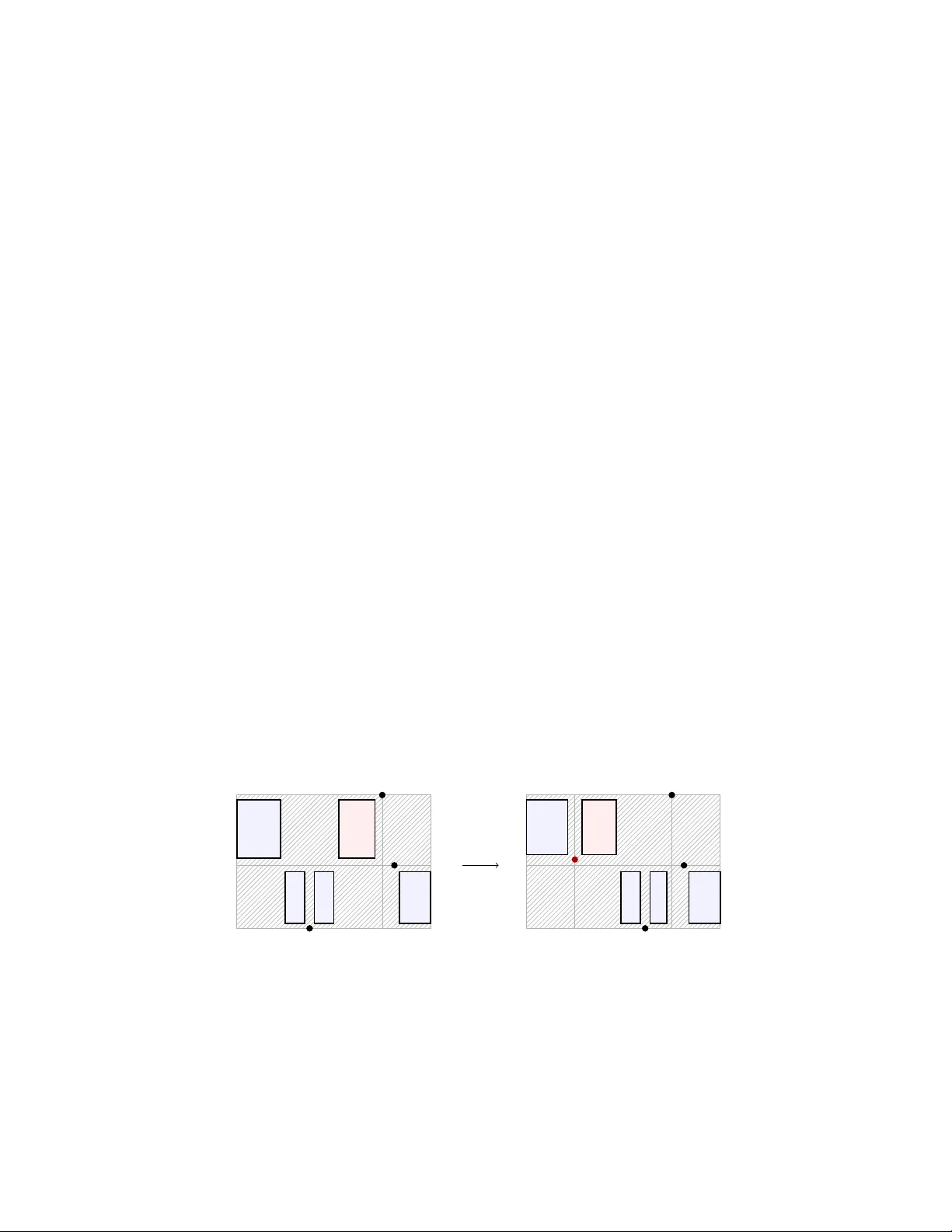
ON SEP ARABLE PERMUT A TIONS AND THREE OTHER P AIRS IN THE SCHR ¨ ODER CLASS JUAN B. GIL, OSCAR A. LOPEZ, AND MICHAEL D. WEINER Abstract. W e study p ositional statistics for four families of pattern-a v oiding p erm uta- tions coun ted b y the large Sc hr¨ oder n um bers. Sp ecifically , w e fo cus on the pairs of patterns { 2413 , 3142 } (separable p ermutations), { 1324 , 1423 } , { 1423 , 2413 } , and { 1324 , 2134 } . F or eac h class, w e deriv e m ultiv ariate generating functions that track the relativ e p ositions of sp ecific entries. Our approach com bines structural decompositions with the kernel method to obtain explicit form ulas in v olving the generating function for the Sc hr¨ oder n um bers. As a byproduct, w e obtain alternative pro ofs that each of these classes is enumerated b y the Schr¨ oder num bers. W e also identify sev eral kno wn triangular arrays arising from our positional refinements, including connections to the central binomial co efficients and sequences app earing in the work of Kreweras on cov ering hierarchies. 1. Introduction It is w ell kno wn that there are exactly ten symmetry classes of pairs of patterns of size 4 whose a v oidance classes are coun ted b y the large Schr¨ oder n um bers (see Kremer [4] and Kremer–Shiu [5]). In previous w ork [2], w e in tro duced a t ype of statistics, whic h we called p ositional statistics , to study the class of 1324-av oiding p ermutations. The main idea is to trac k the relativ e positions of specific entries in a permutation, suc h as the distance betw een the smallest and largest elemen ts, or the p osition of the minimum. As a pro of of concept, in this paper, we apply v arious t ypes of positional statistics to four families of pattern-a v oiding p erm utations coun ted b y the large Sc hr¨ oder n um b ers. W e focus on S (2413 , 3142) (separable p erm utations), and the classes S (1324 , 1423), S (1423 , 2413), and S (1324 , 2134). F or each class, we derive multiv ariate generating functions that refine the en umeration according to p ositional constraints. As a b ypro duct, w e obtain alternative pro ofs for the total en umeration of these classes. Our approach com bines structural decompositions of the p erm utations with the kernel metho d to solv e the resulting functional equations. The pap er is organized as follows. In Section 2, w e study the class S (2413 , 3142) of separable p ermutations. W e deriv e a generating function that tracks the p osition of the minim um and use it to giv e an alternativ e pro of that separable p ermu tations are counted b y the large Schr¨ oder num b ers. W e also obtain a m ultiv ariate generating function that trac ks the distance b etw een the maximum en try of a p ermutation and the smallest entry to its left (in one-line notation). When tracking the position of the 1 or the p ositive distance b et w een 1 and the maxim um, our results lead to triangular arrays not curren tly listed in the OEIS. W e lea v e it to the in terested reader to explore possible connections to Sc hr¨ oder paths or other combinatorial families counted b y the little or large Sc hr¨ oder n um b ers. In Section 3, w e turn to the class S (1324 , 1423) and en umerate its sk ew-indecomp osable elemen ts b y the p osition of the minimum. The resulting triangular array connects to w ork 1 2 J. GIL, O. LOPEZ, AND M. WEINER b y Krew eras [6] on co v ering hierarc hies, and the generating function yields the little Schr¨ oder n umbers, from which the large Sc hr¨ oder enumeration follows. Section 4 addresses the class S (1423 , 2413), where we enumerate p erm utations with 1 to the left of n according to the p osition of n . The resulting triangle relates to another arra y studied by Kreweras, and we reco ver again the Sc hr¨ oder en umeration as a consequence. Finally , in Section 5, w e study S (1324 , 2134) using a differen t p ositional statistic: the v alue of the last entry . W e deriv e the corresp onding generating function and pro vide y et another alternativ e pro of of the Schr¨ oder en umeration. W e also use the rev erse-complement symmetry to connect with S (1243 , 1324) and obtain a refinement by the distance b et ween en tries 1 and n , whic h leads to cen tral binomial co efficien ts and the triangle [9, A092392]. Bey ond the individual results, the broader p oint of this pap er is that positional statistics pro vide a systematic framework for extracting finer enumerativ e information from pattern- a voiding p erm utation classes. The alternative pro ofs of the Sc hr¨ oder en umeration were not in tended as a primary goal but rather a consequence of the refined recurrence relations and generating functions. The specific classes we c hose w ere motiv ated by our previous w ork [2] on S (1324), and by our indep endent interest in separable p ermutations. W e b elieve this approac h has p otential b ey ond the classes studied here, particularly for av oidance classes where existing en umeration tec hniques do not yield com binatorial decomp ositions. F or more on pattern-av oiding permutations, w e refer to the b o ok b y Kitaev [3]. 2. Sep arable permut a tions Let us start by setting up some notation. F or a, k ≥ 1 and a set of patterns P , we let S a ≺ n n,k ( P ) b e the set of P -a voiding p erm utations σ ∈ S n ( P ) such that: • σ − 1 ( n ) − σ − 1 ( a ) = k , • σ − 1 ( b ) − σ − 1 ( n ) > 0 for every b ∈ { 1 , . . . , a − 1 } . In other words, in one-line notation, every σ ∈ S a ≺ n n,k ( P ) has entry a to the left of n at distance k , and all the en tries less than a are to the righ t of n . Using generating trees, W est [11] show ed that the class S (2413 , 3142) of separable p er- m utations is coun ted by the large Schr¨ oder n umbers ([9, A006318]). In this section, we will pro vide an alternative pro of of this result using p ositional statistics. Let S ( x ) = 1 + x + 2 x 2 + 6 x 3 + 22 x 4 + 90 x 5 + 394 x 6 + · · · b e the generating function for the sequence a 0 = 1, a n = S n (2413 , 3142) . Let S ℓ 7→ 1 n (2413 , 3142) b e the subset of p ermutations ha ving en try 1 at p osition ℓ : S ℓ 7→ 1 n (2413 , 3142) = { σ ∈ S n (2413 , 3142) : σ ( ℓ ) = 1 } . Prop osition 2.1. The function g ( x, u ) = ∞ P n =1 n P ℓ =1 S ℓ 7→ 1 n (2413 , 3142) u ℓ x n satisfies g ( x, u ) = xuS ( x ) S ( xu ) S ( x ) + S ( xu ) − S ( x ) S ( xu ) . A few terms of S ℓ 7→ 1 n (2413 , 3142) ar e liste d in T able 1. ON SEP ARABLE PERMUT A TIONS AND OTHER P AIRS IN THE SCHR ¨ ODER CLASS 3 Pr o of. Let g i ( x, u ) and g d ( x, u ) b e the comp onents of g ( x, u ) coun ting, resp ectiv ely , the corresp onding indecomp osable and decomp osable p erm utations of size greater than 1. Thus, g i ( x, u ) = u 2 x 2 + ( u 2 + 2 u 3 ) x 3 + · · · , g d ( x, u ) = ux 2 + (2 u + u 2 ) x 3 + · · · , and g ( x, u ) = xu + g i ( x, u ) + g d ( x, u ). Note that, since every p erm utation is either inde- comp osable or has an indecomposable factor, we ha ve (2.1) g ( x, u ) = ( xu + g i ( x, u )) S ( x ) and g d ( x, u ) = ( xu + g i ( x, u ))( S ( x ) − 1) . Since the rev erse map is an in volution on S n (2413 , 3142), we hav e g ( x, u ) = ug ( xu, 1 u ) = ( xu + ug i ( xu, 1 u )) S ( xu ) . Moreo ver, since the rev erse of an indecomp osable separable p ermutation is decomp osable (this follows from the fact that ev ery separable p erm utation of size at least 2 is either a direct sum or a skew sum of smaller separable p ermutations), we also ha v e g d ( x, u ) = ug i ( xu, 1 u ), and therefore g ( x, u ) = ( xu + g d ( x, u )) S ( xu ) = xu + ( xu + g i ( x, u ))( S ( x ) − 1) S ( xu ) = xuS ( x ) S ( xu ) + g i ( x, u )( S ( x ) − 1) S ( xu ) . Com bining this with (2.1), w e arriv e at the equation ( xu + g i ( x, u )) S ( x ) = xuS ( x ) S ( xu ) + g i ( x, u )( S ( x ) − 1) S ( xu ) , whic h giv es g i ( x, u ) = xuS ( x )( S ( xu ) − 1) S ( x ) + S ( xu ) − S ( x ) S ( xu ) . Using again (2.1), we then get g ( x, u ) = ( xu + g i ( x, u )) S ( x ) = xuS ( x ) + xuS ( x ) 2 ( S ( xu ) − 1) S ( x ) + S ( xu ) − S ( x ) S ( xu ) = xuS ( x ) S ( xu ) S ( x ) + S ( xu ) − S ( x ) S ( xu ) , as claimed. □ Corollary 2.2. We have S ( x ) = 1 2 3 − x − √ x 2 − 6 x + 1 , which is the gener ating function for the se quenc e of lar ge Schr¨ oder numb ers. Pr o of. Note that g ( x, 1) = S ( x ) − 1. Therefore, S ( x ) − 1 = xS ( x ) S ( x ) S ( x ) + S ( x ) − S ( x ) S ( x ) = xS ( x ) 2 − S ( x ) , and so S ( x ) 2 − (3 − x ) S ( x ) + 2 = 0. Hence S ( x ) = 1 2 3 − x − √ x 2 − 6 x + 1 . □ W e pro ceed to en umerate the elemen ts of S a ≺ n n,k (2413 , 3142), starting with the case a = 1. 4 J. GIL, O. LOPEZ, AND M. WEINER n \ ℓ 1 2 3 4 5 6 7 8 Σ 1 1 1 2 1 1 2 3 2 2 2 6 4 6 5 5 6 22 5 22 16 14 16 22 90 6 90 60 47 47 60 90 394 7 394 248 180 162 180 248 394 1806 8 1806 1092 752 629 629 752 1092 1806 8558 T able 1. T riangle for S ℓ 7→ 1 n (2413 , 3142) from Prop osition 2.1. n \ k 2 3 4 5 6 7 8 Σ 2 1 1 3 2 1 3 4 5 4 2 11 5 16 13 10 6 45 6 60 46 37 32 22 197 7 248 180 140 125 120 90 903 8 1092 760 567 490 480 496 394 4279 T able 2. T riangle for S 1 ≺ n n,k (2413 , 3142) from Prop osition 2.3. Prop osition 2.3. The gener ating function f ( x, t ) = P n,k ≥ 1 S 1 ≺ n n,k (2413 , 3142) t k x n satisfies f ( x, t ) = x 2 tS ( x ) S ( xt ) 2 S ( xt ) + S ( x ) − S ( xt ) S ( x ) 2 . Pr o of. Ev ery σ ∈ S 1 ≺ n n,k (2413 , 3142) is decomp osable (since 1 is to the left of n ) and must b e of the form σ = π 1 ⊕ π 2 ⊕ π 3 , where π 1 is the indecomp osable comp onent con taining 1, π 3 is the indecomp osable comp onent con taining n , and π 2 is a separable p ermutation (p ossibly empt y). The distance betw een the en tries 1 and n is given b y k = ( | π 1 | − ℓ 1 ) + | π 2 | + ℓ n , where ℓ 1 is the p osition of the 1 in π 1 and ℓ n is the p osition of the largest elemen t of π 3 . Note that ℓ n is the position of the 1 in the complemen t of π 3 . Since t tracks the distance k , the contribution of π 2 to the generating function is S ( xt ) (eac h entry contributes one unit of distance), the contribution of π 3 is xt + g i ( x, t ) (where t marks the p osition ℓ n of the largest element), and the con tribution of π 1 is x + g i ( xt, 1 t ) (where t | π 1 | accoun ts for the size and t − ℓ 1 adjusts for the p osition of the 1). Therefore, f ( x, t ) = x + g i ( xt, 1 t ) S ( xt ) xt + g i ( x, t ) . ON SEP ARABLE PERMUT A TIONS AND OTHER P AIRS IN THE SCHR ¨ ODER CLASS 5 1 n x + g i ( xt, 1 t ) S ( xt ) xt + g i ( x, t ) Using (2.1), this implies f ( x, t ) = g ( xt, 1 t ) · g ( x, t ) S ( x ) , whic h b y Proposition 2.1 b ecomes f ( x, t ) = xS ( xt ) S ( x ) S ( xt ) + S ( x ) − S ( xt ) S ( x ) · xtS ( xt ) S ( x ) + S ( xt ) − S ( x ) S ( xt ) . This pro duct simplifies to the claimed formula. □ Finally , observe that for a > 1, an y p ermutation σ ∈ S a ≺ n n,k (2413 , 3142) must b e of the form σ = π ⊖ τ , where π ∈ S 1 ≺ m m,k (2413 , 3142) with m = n − a + 1, and τ ∈ S a − 1 (2413 , 3142). As a direct consequence, w e obtain the following prop osition. Prop osition 2.4. If F ( x, t, s ) = P n,k,a ≥ 1 S a ≺ n n,k (2413 , 3142) s a t k x n , then F ( x, t, s ) = f ( x, t ) · sS ( xs ) = x 2 tsS ( x ) S ( xt ) 2 S ( xs ) S ( xt ) + S ( x ) − S ( xt ) S ( x ) 2 . 3. (1324,1423)-a voiding permut a tions A p erm utation σ is called skew-de c omp osable if there are nonempt y p erm utations π and τ such that σ = π ⊖ τ . Otherwise, w e sa y that σ is skew-inde c omp osable . Let A s-ind n,ℓ = { σ ∈ S n (1324 , 1423) : σ is sk ew-indecomp osable and σ ( ℓ ) = 1 } . Clearly , A s-ind 1 , 1 = { 1 } , A s-ind 2 , 1 = { 12 } , and A s-ind n,n = ∅ for ev ery n ≥ 2. In this section, we will mak e use of the follo wing notation. Given a p erm utation π of size n − 1, we let ins k j ( π ) b e the p erm utation of size n obtained b y inserting k in to π at p osition j . More precisely , ins k j ( π ) is constructed by • increasing ev ery en try ≥ k in π b y one, • moving every en try at p osition ≥ j one unit to the righ t, and • placing k at p osition j . 6 J. GIL, O. LOPEZ, AND M. WEINER Prop osition 3.1. If a n,ℓ = A s-ind n,ℓ , then a 1 , 1 = 1 , a 2 , 1 = 1 , and for n ≥ 3 , a n,ℓ = 2 a n − 1 ,ℓ + ℓ − 1 X j =1 a n − 1 ,j for 1 ≤ ℓ ≤ n − 1 . Mor e over, its gener ating function g ( x, u ) = ∞ P n =1 n P ℓ =1 a n,ℓ u ℓ x n satisfies g ( x, u ) = ux h 4 u − 3 + 4 x − 3 ux − √ 1 − 6 ux + u 2 x 2 i 4 u − 1 − ux + 2 x . Pr o of. Let n ≥ 3 and supp ose ℓ is such that 1 ≤ ℓ ≤ n − 1. F or 1 ≤ j < ℓ every p erm utation τ j in A s-ind n − 1 ,j giv es rise to a unique p ermutation σ in A s-ind n,ℓ obtained b y inserting 1 at position ℓ . That is, σ = ins 1 ℓ ( τ j ). Note that since τ j ( j ) = 1, w e ha ve σ ( j ) = 2, so entry 2 is to the left of 1 in σ . On the other hand, for ℓ < n − 1, every τ ℓ ∈ A s-ind n − 1 ,ℓ giv es rise to tw o unique p ermutations σ ′ and σ ′′ in A s-ind n,ℓ obtained b y inserting 2 at p ositions ℓ + 1 and n , respectively . In other w ords, σ ′ = ins 2 ℓ +1 ( τ ℓ ) and σ ′′ = ins 2 n ( τ ℓ ). F or example, if τ ℓ = 2 5 1 4 3, then σ ′ = 3 6 1 2 5 4 and σ ′′ = 3 6 1 5 4 2. Note that in these cases, entry 2 app ears to the righ t of 1. Moreov er, the ascent 12 nev er happens at the end of σ ′ or σ ′′ b ecause τ ℓ is skew-indecomposable and cannot b e decomp osed as π ⊖ 1. Also note that a n − 1 ,n − 1 = 0 for n ≥ 3. All of the ab o ve insertions preserve the prop erty of b eing sk ew-indecomp osable and can- not create a 1324 or 1423 pattern unless the starting p ermutation of size n − 1 already had an y of these patterns. Finally , if entry 2 is to the right of 1 in σ , then it m ust b e either adjacen t to the 1 or at the end of σ . Otherwise, a subsequence of the form 1 a 2 b w ould create either a 1324 (if a < b ) or a 1423 (if a > b ) pattern. In conclusion, the set A s-ind n,ℓ is the disjoin t union of the three subsets defined by the p osition of the 2 relativ e to the p osition of the 1, as describ ed ab ov e. The subset of p erm utations where 2 is at p osition j < ℓ is in bijection to A s-ind n − 1 ,j , and the other t wo subsets (with 2 to the righ t of 1) are b oth in bijection to A s-ind n − 1 ,ℓ . Therefore, a n,ℓ = 2 a n − 1 ,ℓ + ℓ − 1 X j =1 a n − 1 ,j for 1 ≤ ℓ ≤ n − 1 . Using this recurrence relation and routine algebraic manipulations, w e arrive at the func- tional equation ( u − 1 − ux + 2 x ) g ( x, u ) = ux (1 − x )( u − 1) + uxg ( ux, 1) . Letting u = 2 x − 1 x − 1 (k ernel method), w e get g (2 x − 1) x x − 1 , 1 = x , and therefore g ( z , 1) = 1 + z − √ 1 − 6 z + z 2 4 . ON SEP ARABLE PERMUT A TIONS AND OTHER P AIRS IN THE SCHR ¨ ODER CLASS 7 n \ ℓ 1 2 3 4 5 6 7 Σ 1 1 1 2 1 1 3 2 1 3 4 4 4 3 11 5 8 12 14 11 45 6 16 32 48 56 45 197 7 32 80 144 208 242 197 903 T able 3. T riangle for { a n,ℓ } from Proposition 3.1. As a consequence, we get g ( x, u ) = ux (1 − x )( u − 1) + uxg ( ux, 1) u − 1 − ux + 2 x = ux h 4 u − 3 + 4 x − 3 ux − √ 1 − 6 ux + u 2 x 2 i 4( u − 1 − ux + 2 x ) . □ Remark. The triangular array in T able 3 app ears in work by Kreweras [6, p. 54] in the con text of cov ering hierarchies of in teger segments. Corollary 3.2. If G ( x ) is the gener ating function that c ounts the skew-inde c omp osable elements of S n (1324 , 1423) , then G ( x ) = g ( x, 1) = 1 + x − √ 1 − 6 x + x 2 4 . This is the gener ating function for the little Schr¨ oder numb ers. Sinc e the p atterns 1324 and 1423 ar e b oth skew-inde c omp osable, we r e c over the known fact that the class S n (1324 , 1423) is enumer ate d by the lar ge Schr¨ oder numb ers. 4. (1423,2413)-a voiding permut a tions The class S (1423 , 2413) is known to b e counted b y the large Sc hr¨ oder num b ers. This was sho wn by Kremer [4] using generating trees (see also Stanko v a [10] and Kremer–Shiu [5]). In this section, w e fo cus on the enumeration of S 1 ≺ n n (1423 , 2413) and use our results to pro vide an alternative pro of of this fact. Let A 1 ≺ n k 7→ n denote the set of p erm utations in S n (1423 , 2413) ha ving en try n at p osition k , and to the right of 1. That is, A 1 ≺ n k 7→ n = { σ ∈ S 1 ≺ n n (1423 , 2413) : σ ( k ) = n } . 8 J. GIL, O. LOPEZ, AND M. WEINER Prop osition 4.1. L et 2 ≤ k ≤ n . If a n,k = A 1 ≺ n k 7→ n , then a n, 2 = 1 , a n,n = a n,n − 1 + a n − 1 ,n − 1 for n ≥ 3 , a n,k = a n,k − 1 + a n − 1 ,k + a n − 1 ,k − 1 for 3 ≤ k < n. Pr o of. The only elemen t of A 1 ≺ n 2 7→ n is the permutation 1 n ( n − 1) · · · 2, so a n, 2 = 1. F or k ≥ 3, w e will give bijective maps to uniquely construct all the elements of A 1 ≺ n k 7→ n from the elemen ts of A 1 ≺ n k − 1 7→ n , A 1 ≺ n − 1 k 7→ n − 1 , and A 1 ≺ n − 1 k − 1 7→ n − 1 . First, for σ ∈ A 1 ≺ n k − 1 7→ n , w e let τ 1 = ϕ 1 ( σ ) b e the p ermutation obtained by swapping the en tries at p ositions k − 1 and k in σ . Th us τ 1 ( k − 1) = σ ( k ) and τ 1 ( k ) = σ ( k − 1) = n . Note that if k < n , then τ 1 ( k − 1) > τ 1 ( k + 1) (since σ av oids 1423). Clearly , τ 1 ∈ A 1 ≺ n k 7→ n . F or σ ∈ A 1 ≺ n − 1 k 7→ n − 1 and k < n , we let τ 2 = ϕ 2 ( σ ) b e the permutation in A 1 ≺ n k 7→ n obtained from σ by inserting n at position k . That is, τ 2 ( i ) = σ ( i ) for i < k , τ 2 ( k ) = n , and τ 2 ( j ) = σ ( j − 1) for j > k . In particular, τ 2 ( k + 1) = n − 1, so ϕ 1 ( A 1 ≺ n k − 1 7→ n ) and ϕ 2 ( A 1 ≺ n − 1 k 7→ n − 1 ) are disjoin t. Finally , for σ ∈ A 1 ≺ n − 1 k − 1 7→ n − 1 w e define the map ϕ 3 as follo ws. If σ ( n − 1) = n − 1, we let ϕ 3 ( σ ) = ins 1 n − 1 ( σ ), i.e., the p ermutation obtained b y inserting 1 at p osition n − 1. Observe that this t yp e of p ermutation is not in the image of ϕ 1 or ϕ 2 . Moreov er, ϕ 1 ( A 1 ≺ n n − 1 7→ n ) ∪ ϕ 3 ( A 1 ≺ n − 1 n − 1 7→ n − 1 ) ⊆ A 1 ≺ n n 7→ n , and ev ery τ ∈ A 1 ≺ n n 7→ n is either in the image of ϕ 1 (if τ ( n − 1) = 1) or in the image of ϕ 3 (if τ ( n − 1) = 1). Thus the ab ov e inclusion is an equalit y , giving the recurrence for a n,n . Supp ose no w that k − 1 < n − 1 and let m = σ ( k ). If there w ere positions i 1 < i 2 < σ − 1 (1) suc h that σ ( i 1 ) < m < σ ( i 2 ), then ( σ ( i 1 ) , σ ( i 2 ) , 1 , m ) would form a 2413 pattern, and if there w ere p ositions σ − 1 (1) < i 3 < i 4 < k such that σ ( i 3 ) > m > σ ( i 4 ), then (1 , σ ( i 3 ) , σ ( i 4 ) , m ) w ould form a 1423 pattern. Therefore, σ must be of the form depicted in Figure 1(a), where ev ery b ox represen ts a w ord (p ossibly empt y) a voiding (1423 , 2413). In fact, ϱ a voids 312 and the w ord to the right of m m ust be decreasing. 1 n − 1 m π ϱ (a) ϕ 3 1 n m P ˆ π ˆ ϱ (b) Figure 1. Graphical represen tation of ϕ 3 . Let j be the p osition of the rightmost elemen t of π . W e define ϕ 3 ( σ ) to b e the permutation obtained from σ b y inserting m + 1 at p osition j + 1, and moving ϱ as sho wn in Figure 1(b), ON SEP ARABLE PERMUT A TIONS AND OTHER P AIRS IN THE SCHR ¨ ODER CLASS 9 where P is the p oint with coordinates ( j + 1 , m + 1). The words ˆ π and ˆ ϱ are vertical shifts (b y one unit) of π and ϱ . It is easy to v erify that this op eration does not create any of the forbidden patterns 1423 or 2413, so ϕ 3 ( σ ) ∈ A 1 ≺ n k 7→ n . Since m is at most n − 2, the p ermutation τ 3 = ϕ 3 ( σ ) is not in the image of ϕ 2 . Moreov er, b y construction, τ 3 ( k − 1) < τ 3 ( k + 1), so τ 3 is not in the image of ϕ 1 either. Th us the images of the injective maps ϕ 1 , ϕ 2 , and ϕ 3 are disjoint, and we hav e ϕ 1 ( A 1 ≺ n k − 1 7→ n ) ∪ ϕ 2 ( A 1 ≺ n − 1 k 7→ n − 1 ) ∪ ϕ 3 ( A 1 ≺ n − 1 k − 1 7→ n − 1 ) ⊆ A 1 ≺ n k 7→ n . What ab out surjectivity? Let τ ∈ A 1 ≺ n k 7→ n . F or 3 ≤ k < n , either τ ( k − 1) > τ ( k + 1) or τ ( k − 1) < τ ( k + 1). In the first case, τ is in the image of the map ϕ 1 . In the latter case, τ is in the image of ϕ 2 if τ ( k + 1) = n − 1 or in the image of ϕ 3 if τ ( k + 1) < n − 1. In conclusion, the abov e inclusion is indeed an equality . □ n \ k 2 3 4 5 6 7 8 Σ 2 1 1 3 1 2 3 4 1 4 6 11 5 1 6 16 22 45 6 1 8 30 68 90 197 7 1 10 48 146 304 394 903 8 1 12 70 264 714 1412 1806 4279 T able 4. T riangle for { a n,k } from Proposition 4.1. Remark. The triangular arra y in T able 4 is listed in the OEIS [9, A033877] (with slightly shifted indexing) and has a known generating function; see sections 5-7 of Kreweras’ work [6]. Corollary 4.2. If a n,k = A 1 ≺ n k 7→ n and g ( x, t ) = ∞ P n =2 n P k =2 a n,k t k x n , then g ( x, t ) = xt 2 ( S ( xt ) − 1) 1 + t − S ( xt ) , wher e S ( x ) = 1 2 3 − x − √ x 2 − 6 x + 1 . In particular, the family S 1 ≺ n n (1423 , 2413) is counted b y the function g ( x, 1) = x ( S ( x ) − 1) 2 − S ( x ) whic h giv es the little Schr¨ oder n um b ers 1 , 3 , 11 , 45 , 197 , 903 , . . . . Remark. It is easy to prov e that a p erm utation in S n (2413) is skew-indecomposable if and only if entry 1 is to the left of en try n (in one-line notation). In addition, as w e argued in Corollary 3.2, since the patterns 1423 and 2413 are b oth sk ew-indecomp osable, the ab o ve results imply that the class S n (1423 , 2413) is en umerated b y the large Schr¨ oder num b ers. Remark. Observ e that our results reveal the prop erty that S n (1423 , 2413) has as many elemen ts with the 1 to the left of n as elemen ts with the 1 to the righ t of n . The same prop ert y holds for the class of separable permutations. 10 J. GIL, O. LOPEZ, AND M. WEINER 5. (1324,2134)-a voiding permut a tions In this final section, w e fo cus on a different type of p ositional refinemen t: we will coun t the elements of S n (1324 , 2134) by their entry at position n . The fact that this class is en umerated by the large Sc hr¨ oder num b ers was established b y Kremer [4] using generating trees; here w e pro vide an alternativ e proof. Let A n,ℓ = { σ ∈ S n (1324 , 2134) : σ ( n ) = ℓ } . Prop osition 5.1. L et 1 ≤ ℓ ≤ n . If s n,ℓ = A n,ℓ , then s 1 , 1 = 1 , s 2 , 1 = s 2 , 2 = 1 s n, 1 = s n, 2 = s n, 3 = n − 1 X m =1 s n − 1 ,m for n ≥ 3 , s n,ℓ = 2 s n − 1 ,ℓ − 1 + n − 1 X m = ℓ s n − 1 ,m for 4 ≤ ℓ ≤ n. Pr o of. The cases n = 1 , 2 are obvious. F or n ≥ 3 and i ∈ { 1 , 2 , 3 } , it can b e easily seen that ev ery p ermutation in A n,i can b e uniquely obtained from one in S n − 1 (1324 , 2134) b y inserting i at p osition n . By definition, the set S n − 1 (1324 , 2134) has a total of P n − 1 m =1 s n − 1 ,m elemen ts, hence the claimed form ulas for s n, 1 , s n, 2 , and s n, 3 hold. F or ℓ ≥ 4, the elements of A n,ℓ split naturally into tw o subsets dep ending on whether their second to last entry is larger or smaller than ℓ . On the one hand, ev ery σ ∈ A n,ℓ with σ ( n − 1) > ℓ can be uniquely obtained from one in A n − 1 ,m , for some m ≥ ℓ , b y inserting ℓ at p osition n . This insertion creates none of the forbidden patterns, and the corresp onding elemen t of A n − 1 ,m can b e reco vered from σ just by remo ving its last en try . In other words, there are P n − 1 m = ℓ s n − 1 ,m suc h permutations. On the other hand, the set of p ermutations σ ∈ A n,ℓ with σ ( n − 1) < ℓ (i.e. ending with an ascent) can in turn b e written as the disjoin t union of the sets U n,ℓ = { σ ∈ A n,ℓ : σ ( n − 1) = 1 } , V n,ℓ = { σ ∈ A n,ℓ : 1 < σ ( n − 1) < ℓ } . Insertion of 1 at p osition n − 1 gives a clear bijection from A n − 1 ,ℓ − 1 to U n,ℓ . Therefore, we ha ve U n,ℓ = s n − 1 ,ℓ − 1 . Moreo ver, the elemen ts of V n,ℓ can b e uniquely constructed via the bijectiv e map α : A n − 1 ,ℓ − 1 → V n,ℓ defined as follo ws. Let τ ∈ A n − 1 ,ℓ − 1 and let i and j b e such that τ ( i ) = 1 and τ ( j ) = 2. If j < i , then entry 2 is to left of 1, and the entries to the righ t of 1 form a decreasing sequence (since τ av oids the pattern 2134). In this case, w e let σ = α ( τ ) b e the p ermutation obtained by inserting 2 in to τ at p osition n − 1. By construction, σ ( n ) = ℓ , and it can b e easily v erified that this insertion do es not create a pattern 1324 or 2134. No w, if j > i , then τ must b e of the form τ = π 1 θ 2 δ ( ℓ − 1), with p ossibly empt y w ords π , θ , and δ . Since τ av oids 1324, the en tries of θ (if any) m ust all b e greater than ℓ − 1, and the en tries of δ that are less than ℓ − 1 (if any) m ust form an increasing sequence. If π is empt y , or if its entries are all larger than ℓ − 1, w e define α ( τ ) as the p erm utation obtained ON SEP ARABLE PERMUT A TIONS AND OTHER P AIRS IN THE SCHR ¨ ODER CLASS 11 n \ ℓ 1 2 3 4 5 6 7 Σ 1 1 1 2 1 1 2 3 2 2 2 6 4 6 6 6 4 22 5 22 22 22 16 8 90 6 90 90 90 68 40 16 394 7 394 394 394 304 192 96 32 1806 T able 5. T riangle for { s n,ℓ } from Proposition 5.1. from τ b y inserting ℓ − 1 at p osition n − 1. The p ermutation α ( τ ) ends with the ascent ( ℓ − 1) ℓ and belongs to V n,ℓ . Finally , if τ = π 1 θ 2 δ ( ℓ − 1) and π has an entry less than ℓ − 1, we let m = min( π ). Note that if m ≤ c < ℓ − 1, then c must be contained in π . W e define α ( τ ) as the p erm utation obtained from τ b y inserting m at p osition n − 1. In other w ords, α ( τ ) = ˆ π 1 ˆ θ 2 ˜ δ m ℓ , where m < ℓ − 1, ˆ π and ˆ θ are vertical shifts (by one) of π and θ , and ˜ δ is obtained from δ by increasing any entry greater than m by one. Since the entries of ˆ π and ˆ θ are larger than m , and since the entries of ˜ δ less than ℓ (if an y) form an increasing sequence, m is not part of a 2134 pattern. Moreov er, since every d with m < d < ℓ is contained in ˆ π , en try m cannot b e part of a 1324 pattern either. Therefore, α ( τ ) ∈ V n,ℓ . Observ e that the p erm utations obtained b y the ab ov e pro cess (when j > i ) don’t hav e the 2 in the second to last position, so there is no ov erlap with the pro cess when j < i . The map α is rev ersible, hence V n,ℓ = s n − 1 ,ℓ − 1 . In conclusion, there are 2 s n − 1 ,ℓ − 1 p erm utations in A n,ℓ ending with an ascent, and the recurrence for s n,ℓ holds. □ Remark. The triangular arra y in T able 5 is the rev erse of [9, A341695], whic h can be found in work by Lin and Kim [7, Section 3] in the context of in version sequences, and in work b y Mansour and Shattuc k [8] as the distribution of the first letter statistic on the class of (1243 , 1324)-a voiding p ermutations. Corollary 5.2. The gener ating function h ( x, u ) = ∞ P n =1 n P ℓ =1 s n,ℓ u ℓ x n is given by h ( x, u ) = 2 ux (1 − u )(1 − ux ) + ux 1 − u (1 − u ) x 1 − x − √ 1 − 6 x + x 2 2 1 − u (1 + x ) + 2 u 2 x . In p articular, h ( x, 1) = 1 − x − √ 1 − 6 x + x 2 2 , henc e |S n (1324 , 2134) | is c ounte d by the lar ge Schr¨ oder numb ers. 12 J. GIL, O. LOPEZ, AND M. WEINER Pr o of. Let H n ( u ) = n P ℓ =1 s n,ℓ u ℓ and r n = H n (1). Clearly , H 1 ( u ) = u and H 2 ( u ) = u + u 2 . Moreo ver, using the recurrence relation for s n,ℓ , one deriv es the functional equation (1 − u ) H n ( u ) = u (1 − 2 u ) H n − 1 ( u ) + r n − 1 u − r n − 2 u 2 (1 − u ) for n ≥ 3 . Since h ( x, u ) = ∞ P n =1 H n ( u ) x n and h ( x, 1) = ∞ P n =1 r n x n , the ab ov e functional equation and routine algebraic manipulations give 1 − u (1 + x ) + 2 u 2 x h ( x, u ) = ux (1 − u )(1 − ux ) + ux 1 − u (1 − u ) x h ( x, 1) . Letting 1 − u (1 + x ) + 2 u 2 x = 0, w e get u = 1+ x − √ 1 − 6 x + x 2 4 x , and so h ( x, 1) = 1 − x − √ 1 − 6 x + x 2 2 . This leads to the claimed form ula for h ( x, u ). □ 5.1. P ositional statistics for 1 ≺ n . W e finish the section with a related result: S 1 ≺ n n (1324 , 2134) = 2 n − 3 n − 1 for n ≥ 2 . Observ e that σ ∈ S 1 ≺ n n (1324 , 2134) if and only if σ rc ∈ S 1 ≺ n n (1243 , 1324). Since the structure of (1243 , 1324)-av oiding p ermutations with 1 ≺ n is more amenable to decomp osition, we will prov e the ab o ve formula for S 1 ≺ n n (1243 , 1324) instead. Recall that S 1 ≺ n n,k (1243 , 1324) denotes the set of p erm utations in S n (1243 , 1324) having the 1 to the left of n at distance k . W e will fo cus on these sets for 1 ≤ k ≤ n − 1, starting with the en umeration of S 1 ≺ n n, 1 (1243 , 1324). F or n ≥ 2 and ℓ ∈ { 1 , . . . , n − 1 } , let T n,ℓ = { σ ∈ S 1 ≺ n n, 1 (1243 , 1324) : σ (1) = ℓ } , and let t n,ℓ = T n,ℓ . Clearly , S 1 ≺ n n, 1 (1243 , 1324) = n − 1 S ℓ =1 T n,ℓ . Let s n = n − 1 P ℓ =1 t n,ℓ . Lemma 5.3. F or n ≥ 3 , we have t n, 1 = t n, 2 = 2 n − 3 and t n,n − 2 = t n,n − 1 = n − 2 X ℓ =1 t n − 1 ,ℓ . Pr o of. Ev ery p erm utation in T n, 1 is of the form σ = 1 n π , where red( π ) ∈ S n − 2 (132 , 213). Hence t n, 1 = 2 n − 3 . Moreov er, ev ery p ermutation in T n, 2 is of the form 21 n π or 2 τ 1 n π with a nonempty w ord τ . Every permutation of the form 21 n π can be obtained from an elemen t of T n − 1 , 1 b y inserting 2 at position 1. Now, if σ = 2 τ 1 n π and n ≥ 4, en try n − 1 in σ must b e adjacent to the left of 1. Otherwise, it would create a 1324 pattern (if it is in τ but not adjacen t to 1) or a 1243 pattern (if it is in π ). Ev ery σ of this t yp e can b e obtained from an element of T n − 1 , 2 b y inserting n − 1 to the immediate left of 1. In conclusion, we ha ve t 3 , 2 = 1 and t n, 2 = t n − 1 , 1 + t n − 1 , 2 for n ≥ 4 . This implies t n, 2 − t n − 1 , 2 = 2 n − 4 , which leads to t n, 2 = 2 n − 3 . ON SEP ARABLE PERMUT A TIONS AND OTHER P AIRS IN THE SCHR ¨ ODER CLASS 13 On the other hand, it can b e easily v erified that every p ermutation in T n,n − i for i = 1 or i = 2 can b e obtained from a unique permutation in T n − 1 ,ℓ , 1 ≤ ℓ ≤ n − 2, by inserting n − i at position 1. Th us, for i ∈ { 1 , 2 } , we hav e t n,n − i = P n − 2 ℓ =1 t n − 1 ,ℓ . □ n \ ℓ 1 2 3 4 5 6 7 Σ 2 1 1 3 1 1 2 4 2 2 2 6 5 4 4 6 6 20 6 8 8 14 20 20 70 7 16 16 30 50 70 70 252 8 32 32 62 112 182 252 252 924 T able 6. T riangle for { t n,ℓ } (reverse of [9, A171698]). Lemma 5.4. F or 3 ≤ ℓ ≤ n − 2 , we have t n,ℓ = t n,ℓ − 1 + t n − 1 ,ℓ . Pr o of. Recall that the elemen ts of T n,ℓ start with ℓ , ha ve the 1 adjacen t to the left of n , and a void the patterns 1243 and 1324. W e start b y splitting T n,ℓ in to three disjoint subsets: T 1 = { σ ∈ T n,ℓ : σ − 1 ( ℓ − 1) > σ − 1 ( n ) } , T 2 = { σ ∈ T n,ℓ : σ − 1 ( ℓ − 1) < σ − 1 ( m ) ≤ σ − 1 ( n ) for ev ery m > ℓ } , T 3 = T n,ℓ \ ( T 1 ∪ T 2 ) . In other w ords, the elemen ts of T 1 ha ve entry ℓ − 1 to the righ t of n , while the elemen ts of T 2 m ust b e of the form ℓ τ ( ℓ − 1) θ 1 n π , where τ and π are either empty or ha ve entries smaller than ℓ . In this case, each en try m with ℓ < m < n is con tained in θ . Ev ery element of T 1 ∪ T 2 can b e uniquely obtained from one of T n,ℓ − 1 b y swapping the en tries ℓ − 1 and ℓ . Thus T 1 ∪ T 2 = t n,ℓ − 1 . On the other hand, every σ ∈ T 3 m ust b e of the form σ = ℓ τ ( ℓ − 1) θ 1 n π , where τ or π ha ve at least one entry greater than ℓ . If τ is empty , then π m ust ha ve an elemen t k > ℓ , and ℓ + 1 m ust b e con tained in π (otherwise, it would b e in θ , and ( ℓ − 1 , ℓ + 1 , n, k ) would form a 1243 pattern). W e let σ ′ ∈ T n − 1 ,ℓ b e the permutation obtained from σ b y removing en tries ℓ and ℓ − 1 (thus eac h entry greater than ℓ go es down b y 2), and inserting ℓ bac k in to position 1. Note that σ ′ no w has entry ℓ − 1 to the right of n − 1. If τ is nonempt y , then it must con tain an entry larger than ℓ , sa y m . If σ (2) < ℓ , then ( σ (2) , m, ℓ − 1 , n ) would form a forbidden 1324 pattern. Thus σ (2) must b e greater than ℓ and greater than all en tries in π (to av oid a 1243 pattern). W e let σ ′ ∈ T n − 1 ,ℓ b e the p erm utation obtained from σ b y remo ving σ (2). In this case, the resulting p ermutation σ ′ has entry ℓ − 1 to the left of n − 1, so there are no duplicates with the case when τ is empt y . The inv erse map from T n − 1 ,ℓ to T 3 is straightforw ard. If σ ′ ∈ T n − 1 ,ℓ has entry ℓ − 1 to the right of n − 1, we build σ by inserting entry ℓ − 1 in to σ ′ at p osition 2 while k eeping ℓ in 14 J. GIL, O. LOPEZ, AND M. WEINER p osition 1. Now, if σ ′ ∈ T n − 1 ,ℓ has entry ℓ − 1 to the left of n − 1, w e insert max( ℓ, max( π ′ )) + 1 in to σ ′ at p osition 2, where π ′ is the w ord (possibly empt y) to the right of n − 1 in σ ′ . In conclusion, T 3 = t n − 1 ,ℓ , and w e arriv e at t n,ℓ = t n,ℓ − 1 + t n − 1 ,ℓ . □ Prop osition 5.5. The gener ating function g ( x, u ) = ∞ P n =2 n − 1 P ℓ =1 t n,ℓ u ℓ x n is given by g ( x, u ) = 1 1 − u − x u (1 − u ) x 2 (1 − x ) 2 1 − 2 x − u 3 x 3 √ 1 − 4 ux . In p articular, g ( x, 1) = x 2 √ 1 − 4 x = ∞ X n =2 2( n − 2) n − 2 x n , and ther efor e s n = S 1 ≺ n n, 1 (1243 , 1324) = 2( n − 2) n − 2 . Pr o of. Let G n ( u ) = n − 1 P ℓ =1 t n,ℓ u ℓ . Clearly , G 2 ( u ) = u and G 3 ( u ) = u + u 2 . Moreo ver, using the ab ov e t wo lemmas and the notation s n = n − 1 P ℓ =1 t n,ℓ , one deriv es the functional equation (1 − u ) G n ( u ) = G n − 1 ( u ) + u (1 − u )2 n − 4 − s n − 1 u n for n ≥ 4 . Since g ( x, u ) = ∞ P n =2 G n ( u ) x n and g ( x, 1) = ∞ P n =2 s n x n , we get (1 − u − x ) g ( x, u ) = u (1 − u ) x 2 (1 − x ) 2 1 − 2 x − uxg ( ux, 1) . The kernel metho d (letting u = 1 − x and z = (1 − x ) x ) then provides g ( z , 1) = z 2 √ 1 − 4 z . This leads to the claimed form ula for g ( x, u ). □ Prop osition 5.6. If a n,k = S 1 ≺ n n,k (1243 , 1324) , then for n ≥ 2 , a n, 1 = s n = 2 n − 4 n − 2 , a n,n − 1 = 1 , and a n,k = a n,k +1 + a n − 1 ,k − 1 for 2 ≤ k ≤ n − 2 . Ther efor e, a n,k = 2 n − k − 3 n − 2 for 1 ≤ k ≤ n − 1 . This gives the triangle [9, A092392] . Pr o of. The statemen t for a n, 1 w as pro ved in Proposition 5.5. Now, if a p erm utation starts with 1, ends with n , and av oids 1243 and 1324, it must b e the iden tity . So, a n,n − 1 = 1. F or 2 ≤ k ≤ n − 2, every element of S 1 ≺ n n,k (1243 , 1324) must b e of the form σ = τ 1 θ n π , where θ is nonempty and increasing. Since σ a voids 1243, entry n − 1 must b e either in τ or in θ . Let A τ and A θ b e the disjoin t subsets of S 1 ≺ n n,k (1243 , 1324) according to the corresp onding p osition of n − 1. Clearly , a n,k = A τ + A θ . Ev ery σ ∈ A θ can b e uniquely obtained from a p erm utation σ ′ ∈ S 1 ≺ n − 1 n − 1 ,k − 1 (1243 , 1324) b y inserting n in to σ ′ to the immediate right of n − 1. Therefore, A θ = a n − 1 ,k − 1 . ON SEP ARABLE PERMUT A TIONS AND OTHER P AIRS IN THE SCHR ¨ ODER CLASS 15 On the other hand, ev ery σ ∈ A τ m ust b e of the form σ = τ 1 ( n − 1) τ 2 1 θ n π with p ossibly empt y w ords τ 1 and τ 2 . Let m = n − 1 − τ 1 and let ˆ τ 1 b e the word obtained from τ 1 b y increasing its en tries by one. The map σ = τ 1 ( n − 1) τ 2 1 θ n π 7→ ˆ τ 1 τ 2 1 θ m n π giv es a bijection betw een A τ and S 1 ≺ n n,k +1 (1243 , 1324), hence A τ = a n,k +1 . □ Corollary 5.7. F or n ≥ 2 , we have S 1 ≺ n n (1243 , 1324) = n − 1 X k =1 a n,k = 2 n − 3 n − 1 . Data Av ailabilit y. This article has no asso ciated data. Statemen ts & Declarations. The authors declare that no funds, gran ts, or other financial supp ort w ere receiv ed during the preparation of this manuscript. The authors ha ve no comp eting interests to disclose. References [1] A. Ehrenfeuc ht, T. Harju, P . ten P as, G. Rozen b erg, P ermutations, paren thesis words, and Schr¨ oder n umbers, Discr ete Math. 190 (1998), 259–264. [2] J. B. Gil, O. A. Lop ez, M. D. W einer, A positional statistic for 1324-av oiding p ermutations, Discr ete Math. Theor. Comput. Sci. 26 (1) (2024), #14385. [3] S. Kitaev, Patterns in p ermutations and wor ds , Monographs in Theoretical Computer Science, an EA TCS Series, Springer, Heidelb erg, 2011. [4] D. Kremer, Perm utations with forbidden subsequences and a generalized Schr¨ oder num b er, Discr ete Math. 218 (2000), 121–130. [5] D. Kremer, W. C. Shiu, Finite transition matrices for p ermutations av oiding pairs of length four pat- terns, Discr ete Math. 268 (2003), 171–183. [6] G. Krew eras, Sur les hi ´ erarc hies de segments, Cahiers du Bur e au universitair e de r e cher che op´ er ation- nel le. S´ erie R e cher che , tome 20 (1973), 3–61. [7] Z. Lin, D. Kim, Refined Restricted Inv ersion Sequences, Ann. Comb. 25 (2021), 849–875. [8] T. Mansour, M. Shattuc k, On a conjecture of Lin and Kim concerning a refinemen t of Schr¨ oder n umbers, J. Combin. 14 (3) (2023), Article 2. [9] N. J. A. Sloane, The On-Line Encyclop edia of Integer Sequences, http://oeis.org . [10] Z. Stanko v a, F orbidden subsequences, Discr ete Math. 132 (1994), 291–316. [11] J. W est, Generating trees and the Catalan and Schr¨ oder num b ers, Discr ete Math. 146 (1995), 247–262. Penn St a te Al toona, 3000 Ivyside P ark, Al toona, P A 16601 Email address : jgil@psu.edu Penn St a te Harrisbur g, 777 West Harrisburg Pike, Middletown, P A 17057 Email address : oal5053@psu.edu Penn St a te Al toona, 3000 Ivyside P ark, Al toona, P A 16601 Email address : mdw8@psu.edu
Original Paper
Loading high-quality paper...
Comments & Academic Discussion
Loading comments...
Leave a Comment