Language-Free Generative Editing from One Visual Example
Text-guided diffusion models have advanced image editing by enabling intuitive control through language. However, despite their strong capabilities, we surprisingly find that SOTA methods struggle with simple, everyday transformations such as rain or…
Authors: Omar Elezabi, Eduard Zamfir, Zongwei Wu
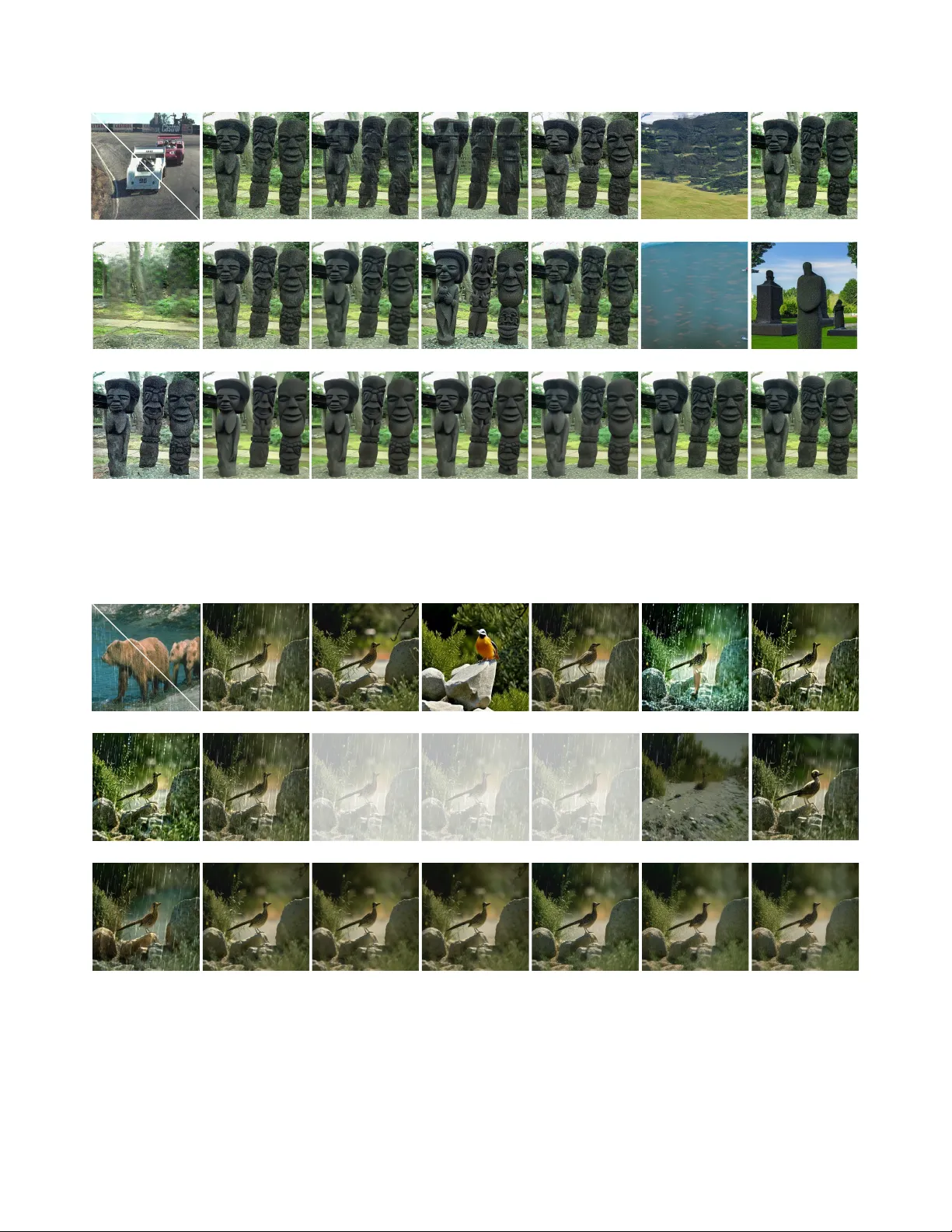
Language-Fr ee Generativ e Editing fr om One V isual Example Omar Elezabi Eduard Zamfir Zongwei W u * Radu T imofte Computer V ision Lab, CAID AS & IFI, University of W ¨ urzbur g Abstract T ext-guided diffusion models have advanced image editing by enabling intuitive contr ol thr ough language. However , despite their str ong capabilities, we surprisingly find that SO T A methods struggle with simple, everyday transforma- tions such as rain or blur . W e attribute this limitation to weak and inconsistent textual supervision during training , which leads to poor alignment between language and vi- sion. Existing solutions often r ely on extr a finetuning or str onger te xt conditioning, but suf fer from high data and computational r equirements. W e ar gue that diffusion-based editing capabilities ar en’t lost b ut merely hidden fr om text. The door to cost-efficient visual editing r emains open, and the ke y lies in a vision-centric paradigm that per ceives and r easons about visual change as humans do, beyond wor ds. Inspir ed by this, we intr oduce V isual Diffusion Condition- ing (VDC), a training-fr ee framework that learns condi- tioning signals directly fr om visual examples for pr ecise, language-fr ee image editing. Given a pair ed example—one image with and one without the targ et effect—VDC derives a visual condition that captur es the transformation and steers gener ation thr ough a novel condition-steering mech- anism. An accompanying in version-corr ection step miti- gates r econstruction error s during DDIM in version, pre- serving fine detail and realism. Acr oss diverse tasks, VDC outperforms both training-fr ee and fully fine-tuned text- based editing methods. The code and models ar e open- sour ced at omaralezaby.github.io/vdc/ 1. Introduction Diffusion models hav e rev olutionized visual synthesis, powering the current state-of-the-art in image editing [ 11 , 16 , 48 ]. Notably , text-guided diffusion models enable in- tuitiv e manipulation through natural language prompts [ 10 , 41 , 60 ], offering strong spatial and semantic control. Despite their impressive flexibility , we find that current text-guided diffusion models often struggle with simple vi- sual transformations such as rain, haze or blur . As we illus- trate in Fig. 1 , their internal representations fail to match the * Corresponding Author Paired Edit Test Samp le Objecti ve Text - Centr ic Visio n- Centric “Rain” ✓ Aligned × Misaligned × ✓ Clean Domain VDC LLM Output Output Features Ours Text - based Model Features Figure 1. T ext–image misalignment in dif fusion latent space. T ext- guided generati ve models rely on language, which often fails to capture appearance-level transformations, e.g. rain, leading to se- mantic but visually misaligned directions. Our method, V isual Diffusion Conditioning (VDC), instead learns a vision-centric conditioning signal directly from paired visual e xamples, uncov- ering the correct transformation direction within the latent space. By steering the diffusion process along this aligned path, VDC achiev es faithful and realistic edits, bridging the gap between text semantics and visual representations. semantics of these textual descriptions. W e link this behav- ior to weak and inconsistent supervision: diffusion models rely on image–caption pairs and thus learn only the concepts explicitly described in the training data. Consequently , vi- sual phenomena that are rarely or ambiguously captioned exhibit poor alignment between text prompts and their as- sociated visual features. A natural solution might be to fine-tune the model for these missing concepts [ 4 , 28 , 59 , 67 ]. Howe ver , retrain- ing large dif fusion models is computationally intensive and data-hungry , rendering it impractical for most editing sce- narios. Importantly , diffusion models already encode rich, structured visual representations that extend beyond their textual supervision [ 24 ]. The limitation arises from weak language-vision align- 1 ment, which obscures access to the full visual manifold, as shown in Fig. 2 . W e propose to bridge this gap through a vision-centric perspectiv e on editing. Rather than relying on language to approximate visual intent, our approach treats manipulation as a process grounded in perceptual change. V isual examples—unlike text—can unambiguously express such changes: a pair of images naturally encodes de grada- tions, or stylistic variations that are difficult to capture ver - bally . By e xtracting conditioning signals directly from vi- sual examples, we can translate observable dif ferences into latent-space directions that operate on the model’ s e xisting visual representations, c.f. Fig. 2 . This motiv ates an editing framew ork driven by visual e xemplars instead of language. Building on this, we introduce V isual Diffusion Con- ditioning (VDC), a training-free diffusion editing frame- work that learns visual conditioning signals from example image pairs. Instead of text prompts, VDC deriv es a com- pact representation that encodes the transformation between two visual domains ( e .g. , clean ↔ degraded). Once e x- tracted, this visual condition can be transferred to unseen images, enabling consistent and controllable edits. Prior training-free methods [ 5 , 15 , 18 , 23 , 31 , 35 – 37 , 51 , 53 – 55 , 61 ] typically operate by in verting the diffusion process and modifying latent trajectories through textual guidance. While effecti ve for semantic manipulation, the y remain lim- ited by language–vision misalignment and struggle to ex- press fine-grained, appearance-lev el changes. Besides, cur- rent exemplar -driven approaches [ 13 , 21 , 38 , 50 , 56 ] par- tially address this issue by defining edits from image pairs, but most rely on pretrained vision–language models [ 40 ] or additional finetuning [ 56 ], which reduces generality and in- creases computational cost. In contrast, our VDC framework introduces pure visual conditioning, lev eraging the pretrained latent structure. Our frame work builds on two core components: (i) a condition steering mechanism that modulates the sampling process via posterior score guidance [ 49 ], enabling precise and stable edits without retraining; and (ii) an inver sion corr ection step that compensates for error accumulation in DDIM inv ersion [ 11 , 48 ], preserving perceptual quality . In summary , our main contrib utions are: • A diffusion editing framew ork, termed V isual D iffusion C onditioning , that learns directly from visual examples. • A stable, lightweight neural embedding that captures edit semantics from a single example pair , enabling training- free yet generalizable editing. • A sampling and in version strategy that achiev es precise editing while preserving perceptual fidelity . 2. Related W orks T ext-based Image Editing. Instruction-based image edit- ing methods [ 4 ] were proposed to modify an input im- age according to text instructions. These approaches typ- Sample Text - Base d VDC Sample Text - Based VDC Rain Haze Figure 2. Language-V ision misalignment. The internal represen- tations of LDM [ 41 ] fail to accurately capture the semantics of degradations such as “rain” or “haze”. Attention maps under text- based conditioning remain object-centric and do not correspond to degradation-specific visual attributes. Our VDC framework re- aligns attention focus toward true visual cues, recov ering mean- ingful features that correspond to rain streaks and hazy regions. ically employ generativ e models to synthesize large-scale instruction-based editing datasets, which are then used to fine-tune diffusion models for conditional image edit- ing. Subsequent works refined this paradigm by curating higher-quality datasets [ 65 ] and leveraging improved ar- chitectures and generative backbones [ 25 , 28 , 45 , 59 , 67 ]. T o reduce the dependence on large-scale instruction data and computationally expensi ve training, train-free methods [ 5 , 15 , 18 , 20 , 23 , 31 , 35 – 37 , 51 , 53 – 55 , 61 ] were intro- duced. These methods exploit the intrinsic generati ve and semantic capabilities of pretrained text-to-image (T2I) dif- fusion models to perform edits without retraining. The y typically in vert the dif fusion process [ 11 , 18 , 48 , 55 , 61 ] to recover the latent noise representation of an input im- age, and then modify conditioning components such as the textual prompt [ 20 , 36 , 37 ], self-attention maps [ 5 , 51 , 53 ], or cross-attention modules [ 15 , 23 ] to realize desired ed- its. Despite their flexibility , purely te xt-based methods of- ten struggle to capture fine-grained or compositional edits that go beyond what can be easily e xpressed in language. Exemplar -based Editing. A core limitation of te xt-based editing lies in its reliance on natural language, which is of- ten ambiguous and insuf ficient for describing complex, lo- calized, or stylistic edits. T o address this, visual exemplar - based editing methods incorporate visual examples to define edits more precisely [ 13 , 21 , 38 , 50 , 56 ]. These approaches learn from pairs of “before” and “after” example images to infer a transformation that can be applied to new inputs. T ypically , the y employ textual or joint vision–language rep- resentations to model the relationship between the visual example pair and the input image. Ho wev er , even these methods depend on text-aligned latent spaces, inheriting the limitations of T2I diffusion models, such as the imperfect alignment between textual embeddings and visual features. Although some works attempt to fine-tune diffusion models directly for the visual instruction setting, they still rely on VLMs [ 40 ] to extract edit semantics [ 34 , 56 ]. This depen- dence often leads to the loss of global conte xt or fine visual details, constraining edit fidelity and controllability . 2 Rain 𝑍 !"# 𝑍 $ 𝑍 # 𝑍 % 𝐶 ! & 𝐶 $ & 𝐶 # & ∅ ∅ ∅ 𝑍 ! 𝑍 !"# 𝑍 $ 𝑍 # 𝑍 % … … No Rain Conditio n Stee ring DDIM Inversion (a) DDIM in version with Condition Steering. 𝑤 1 − 𝑤 𝑍 !"# 𝑍 $ 𝐶 ! % ∅ 𝑍 ! × × × DM DM … … Token In dex d N Steering Cond. [ 1 2 3 N [ … Conditi on Genera tor t (b) Steering Condition Generation. Figure 3. Pr oposed VDC framework. (a) Giv en a real image, we first inv ert it through DDIM and apply the learned steering condition C s t to guide sampling tow ard the desired visual feature (e.g., removing rain) while preserving content and quality . (b) A lightweight Condition Generator produces per-step steering embeddings from token indices, representing the target visual feature. These conditions modulate the diffusion outputs through weighted score blending, enabling training-free visual editing without te xtual prompts. Diffusion for Inv erse Problems. Diffusion models ha ve also been successfully applied to inv erse problems [ 6 , 7 , 12 , 57 , 69 ] due to their powerful ability to model com- plex data distributions. By reformulating image restora- tion as a guided sampling task, diffusion models can re- cov er clean images that correspond to a given degraded observation—achie ving zero-shot restoration without addi- tional training. Initially introduced for image-space diffu- sion models, these approaches were later extended to la- tent diffusion models to better exploit their semantic pri- ors and efficienc y [ 22 , 42 , 43 , 47 , 58 , 64 ]. Ne vertheless, these methods typically assume kno wn degradation opera- tors ( e .g. , blur kernels, noise lev els), which limits their gen- eralization to complex, spatially varying degradations such as haze, rain, or reflection remov al. 3. Methodology Diffusion Preliminaries. Diffusion models generate data by iterativ ely denoising a latent variable z t sampled from a Gaussian prior . At each timestep t , a noise prediction network ϵ θ ( z t , t, C ) estimates the denoised sample condi- tioned on C , which can be a text embedding or other guid- ance signal. In version methods such as DDIM [ 48 ] allow reconstruct- ing a latent trajectory from a real image, enabling editing in latent space. As sho wn in Fig. 3a , our framew ork builds on these foundations by replacing textual conditioning with a learned visual condition , used to steer the generative pro- cess tow ard appearance-level transformations. 3.1. Editing by V isual Conditioning VDC builds on the observation that diffusion models im- plicitly recognize visual features ev en when these features lack corresponding textual representations. Although text prompts fail to access such features, they can be rev ealed by shifting from language-based to purely visual conditioning. W e achiev e this by identifying a condition that captures a specific transformation through visual examples. Given an Algorithm 1 Steering Condition Generator Optimization Input: R B V isual Example Before Editing, R A V isual Ex- ample After Editing, I trs Number of optimization itera- tions, p ∼ [ T , 0) Diffusion step for resampling start, N Number of tokens in the condition, ϕ Null Condition, E and D Encoder and Decoder respecti vely . Output: Optimized Steering Condition C s Z B , Z A = E ( R B ) , E ( R A ) ▷ partial in version to step p Z B p = DDIM In version ( Z B , t = (1 , ...p ) , ϕ ) for i = 1 , ...I trs do for t = p, ... 1 do ▷ generate step condition C s t = MLP t (1 , ...N ) ϵ init = ϵ θ ( Z B t , t, ϕ ) ▷ adjust sampling ϵ steering = ϵ θ ( Z B t , t, C s t ) ˆ ϵ = (1 − w ) ∗ ϵ steering + w ∗ ϵ init Z B t − 1 = DDIM Step ( Z B t , t, ˆ ϵ ) end for ▷ Optimize Condition Generator L = || Z B 0 − Z A || 2 2 + || D ( Z B 0 ) − R A || 2 2 MLP 1 ,...t = MLP 1 ,...t + AdamGrad ( L ) end for retur n C s ← MLP 1 ,...t (0 , ...N ) image pair before and after editing, ( R B , R A ) , we derive a visual condition C s that encodes the transformation within the model’ s learned data distribution, as sho wn in Fig. 3b . By in verting a real image and applying this condition dur- ing the generativ e process, we steer the model to reproduce the desired edit. This enables representation and manipu- lation of visual features without textual prompts, unlocking the full expressi ve capacity of the diffusion latent space. 3.2. Condition Steering T o completely detach from the textual space, we consider an unconditional generativ e process and manipulate the image by steering the sampling trajectory using a condition that 3 Algorithm 2 DDIM In version Correction Input: Z 0 latent to be in verted , I number of iterations, p ∼ [ T , 0) Dif fusion resampling start, ϕ Null Condition Output: Corrected Noised Latent z ∗ p ¯ Z p = DDIM In version ( Z 0 , t = (1 , ...p ) , ϕ ) for i = 1 , ...I do ˆ Z 0 = DDIM Forward ( ¯ Z p , t = ( p, ... 1) , ϕ ) L = || ˆ Z 0 − Z 0 || 2 2 ¯ Z p = ¯ Z p − AdamGrad ( L ) end for retur n ¯ Z p represents the visual feature to be edited or remov ed ( e.g. , rain, fog, or noise). Giv en a condition representing a visual feature C s , we steer the generati ve process according to the posterior score function [ 49 ] of the unconditional model: ∇ x log p ( x | C s ) = ∇ x log p ( x ) + ∇ x log p ( C s | x ) (1) For tasks such as deraining or dehazing, where C s de- notes the feature to be remov ed, the goal is to steer sampling away from the high-density region of that feature. This can be expressed as the posterior score function for − C s : ∇ x log p ( x | − C s ) = ∇ x log p ( x ) − s ∗ ∇ x log p ( C s | x ) (2) Here, s is a hyperparameter controlling the steering inten- sity , and by Bayes’ rule, p ( C s | x ) ∼ p ( x | C s ) /p ( x ) . Ex- panding this relation giv es: ∇ x log p ( x | − C s ) = ∇ x log( x ) − s ∗ ( ∇ x log p ( x | C s ) − ∇ x log p ( x )) (3) Adapting this to the noise prediction model in LDM, where ∇ x log( x ) ∼ ϵ θ ( z t , t, ϕ ) and log p ( x | C s ) ∼ ϵ θ ( z t , t, C t ) , we can rewrite the formulation as: ϵ θ ( z t , − C s ) = ϵ θ ( z t , ϕ ) − s ∗ ( ϵ θ ( z t , C s ) − ϵ θ ( z t , ϕ )) = ϵ θ ( z t , C s ) + (1 + s ) ∗ ( ϵ θ ( z t , ϕ ) − ϵ θ ( z t , C s )) = (1 − w ) ∗ ϵ θ ( z t , C s ) + w ∗ ϵ θ ( z t , ϕ ) (4) where w = 1 + s . This formulation enables direct ma- nipulation of the visual feature represented by C s by steer- ing the trajectory of the unconditional generati ve process used to inv ert the real image. Editing the image in this way av oids generati ve artifacts, since we update the in verted im- age ( out = Z ( ϕ ) + Z ( C θ ) ) rather than generating a new image ( out = Z ( C θ ) ), analogous to a global residual con- nection in image-to-image networks [ 39 ]. W e visualize this process in Fig. 3a . 3.3. Condition Representation f or V isual Features In diffusion models, the conditioning input is typically rep- resented as a sequence of tokens, each corresponding to an encoded word in the textual prompt ( e.g . , Stable Dif- fusion [ 41 ] accepts up to 77 tokens as input). Optimizing textual embeddings has been used to improve diffusion in- version of real images [ 37 ] or to personalize the generative process by learning an embedding for a specific object [ 44 ]. This optimization treats text embeddings as trainable pa- rameters and updates them according to a chosen objectiv e function. Howe ver , the process depends on an initial prompt embedding and is often unstable, allowing optimization of only a small number of tokens [ 37 , 50 ]. T o fully remo ve textual dependency , we generate a ne w embedding directly from a condition generator network. In- spired by Implicit Neural Representations (INR) [ 46 , 52 ], which encode images as continuous functions ov er pixel co- ordinates, we represent the visual edit condition as a contin- uous function over token indices. Specifically , we employ a lightweight three-layer MLP and, follo wing INR litera- ture, apply F ourier features to the input indices to improve expressi veness [ 52 ]. This formulation provides stable op- timization when learning the steering condition that repre- sents a desired edit. The improv ed stability allows optimiza- tion of all 77 tokens, enabling full access to the model’ s vi- sual condition space. Further, since each tok en is generated from a continuous function conditioned on token indices, the network naturally establishes communication across to- kens, producing smooth and coherent condition representa- tions. For finer control during editing, we optimize a sepa- rate condition generator for each diffusion step. C s t = MLP t (1 , ....N ) min MLP t || Z ∗ t − 1 − Z t − 1 ( Z t , t, C t ) || 2 2 (5) 3.4. Optimization and In version Refinement Previous condition optimization methods typically optimize the condition using the output of a single diffusion step [ 37 ]. Howe ver , this approach forces most edits to occur during the early dif fusion steps, leaving the later stages primarily for refinement. In contrast, our VDC optimizes all condition generators jointly based on the final output after the com- plete diffusion process. This formulation allows the model to decide how edits are distributed across the diffusion tra- jectory , rather than concentrating them in the initial steps. Accordingly , the optimization in 5 becomes: C s p,... 1 = MLP 1 ,...p (1 , ....N ) min MLP 1 ,...p || Z ∗ 0 − Z 0 ( Z p , t = ( p, ... 1) , C p,... 1 ) || 2 2 (6) Here, N is the number of tokens in the condition, p ∼ [ T , 0) denotes the starting step of the partial diffusion pro- cess, and t ∼ [ p, 0) represents the current dif fusion step. z ∗ 0 is the ground-truth latent, while z 0 is the model output ob- tained using the optimized steering condition C p,... 1 . This formulation provides the model with greater flexibility to adapt the applied edits dynamically at each diffusion step. In version Corr ection. DDIM in version assumes that Z t − 1 ∼ Z t , meaning that adjacent dif fusion steps are nearly 4 T able 1. Comparison to state-of-the-art image editing. FID ( ↓ ) and LPIPS( ↓ ) are reported on the full RGB images. Our method sets a new state-of-the-art on av erage across all benchmarks. ‘-’ represents unreported results. The best performances are highlighted. T ype Method SR DeBlur DeNoise DeRain DeHaze Colorization FID ↓ LPIPS ↓ FID ↓ LPIPS ↓ FID ↓ LPIPS ↓ FID ↓ LPIPS ↓ FID ↓ LPIPS ↓ FID ↓ LPIPS ↓ T -Edit P2P [ 15 ] 126.47 0.6662 45.62 0.5220 142.95 0.5593 139.19 0.3122 44.09 0.2183 121.87 0.2931 Null-Opt [ 37 ] 73.48 0.5510 51.89 0.5258 160.88 0.6059 167.61 0.5050 91.76 0.4917 197.81 0.5881 Negati ve-Cond [ 36 ] 63.22 0.4807 43.61 0.4528 96.19 0.4764 118.76 0.3157 43.20 0.2193 135.63 0.3407 I-Edit Instruct-Pix2Pix [ 4 ] 92.79 0.5828 142.91 0.7081 155.12 0.6298 179.93 0.4285 36.42 0.2399 115.74 0.2975 OmniGen [ 59 ] 59.66 0.4596 46.18 0.4188 150.80 0.4663 119.87 0.3081 42.77 0.2169 134.43 0.3438 SuperEdit [ 28 ] 89.07 0.5481 56.22 0.5307 172.50 0.5866 185.98 0.4489 49.27 0.2960 116.37 0.3860 ICEdit [ 67 ] 50.14 0.4922 45.54 0.4734 128.55 0.5385 149.44 0.3300 170.11 0.5961 104.72 0.2882 Zero-IR PSLD [ 42 ] 31.90 0.2839 42.89 0.3683 115.17 0.3660 - - - - 202.71 0.6242 TReg[ 22 ] 49.15 0.5161 52.07 0.4379 94.11 0.5392 - - - - 183.27 0.7713 D APS[ 64 ] 47.14 0.3290 59.85 0.3413 148.42 0.4137 - - - - 213.36 0.6266 IE-Edit VISII [ 38 ] 110.39 0.4949 122.63 0.5465 248.79 0.8341 203.83 0.5011 198.69 0.6756 298.10 0.5402 Analogist [ 13 ] 83.88 0.4779 75.06 0.4692 143.62 0.5599 158.29 0.6006 68.02 0.3988 156.28 0.5779 EditClip [ 56 ] 77.64 0.5558 78.75 0.5114 99.00 0.5470 174.93 0.3809 44.69 0.2241 138.34 0.3008 One-Shot 41.41 0.2666 35.51 0.2654 89.51 0.2801 87.12 0.2559 35.52 0.1633 107.70 0.2908 Multi-Shot 45.89 0.2654 42.62 0.2651 88.58 0.2846 69.52 0.2214 34.18 0.1584 107.80 0.2744 VDC MS+In verse-Correction 45.00 0.2624 41.09 0.2593 82.57 0.2768 66.92 0.2155 33.23 0.1560 105.26 0.2729 identical. Howe ver , this assumption holds only for infinites- imally small step sizes, and in practice, it introduces ac- cumulated inv ersion errors across the diffusion trajectory . T o improve inv ersion accuracy , we propose a refinement method for DDIM inv ersion. W e first perform DDIM in- version up to the desired dif fusion step to obtain the ini- tial noised latent z p . Ne xt, we apply the forward diffusion process using the in verted latent to compute the reconstruc- tion error . Finally , we update the noised latent z p through gradient-based optimization to minimize this in version er - ror . The full procedure is summarized in Algorithm 2 . Loss. Since our approach relies on visual examples, we con vert the ground-truth image to the latent space and com- pute the loss directly in that domain. This av oids the dis- parity between pixel and latent spaces [ 42 ], where multi- ple images may correspond to the same latent representa- tion. Howe ver , encoding an image into latent space can re- sult in the loss of fine spatial details, producing inaccurate or o verly smoothed edits. T o address this, we additionally compute a pixel-space loss by decoding the diffusion latent output back to the image domain. Combining both latent and pixel losses helps preserve spatial fidelity while main- taining semantic consistency during editing: 4. Experiments W e conduct experiments across di verse editing and restora- tion tasks, comparing against works that adapt T2I dif fusion models under different input modalities, training regimes, and optimization strategies. For fairness, we use the same diffusion backbone and include instruction-based models explicitly trained for image editing. Implementation Details. VDC builds on Stable Diffu- sion v1.4 [ 41 ] with DDIM sampling [ 48 ] using 100 steps, operating only on the last 10 steps of the trajectory . The condition generator (CG) is a three-layer MLP network with dimensionality 128 . W e optimize CG with Adam ( β 1 =0 . 9 , β 2 =0 . 999 ) for 200 iterations (batch size 4) using a cosine-annealed learning rate decaying from 5 × 10 − 3 to 1 × 10 − 3 [ 32 ]. The one-shot setup uses single visual exam- ple with flip, rotation, and color-jitter augmentations, while the multi-shot setup increases to eight e xamples. Condi- tion steering is set to a scale of 7. All experiments run on a single R TX 4090 GPU. W e use identical settings across architectures (e.g., SD [ 41 ] vs. SAN A [ 60 ]) and tasks. Datasets. For super-resolution and deblurring, we use 1K FFHQ [ 19 ] samples following DPS [ 8 ] degradation. W e choose BSD400 [ 3 ] testset σ =25 for denoising. For deraining and dehazing, we e valuate on Rain100L [ 62 ] and SO TS [ 26 ], respectively . For colorization, we con vert DIV2K [ 2 ] to grayscale. W e randomly pick one image per dataset as reference for works requiring visual examples. Baselines. T ext-edit (T -Edit) methods manipulate the gen- eration prompt without retraining. W e use BLIP [ 27 ] to gen- erate captions ( e.g. , “photo of 3 bears in rain” → “photo of 3 bears”) as editing prompts. Instruction-edit (I-Edit) meth- ods are trained for text-instruction-based editing; we craft task-specific prompts ( e.g. , “Remove rain from the image”). Zer o-shot image restor ation (Zero-IR) methods address in- verse problems using diffusion priors; we follow DPS [ 8 ] for degradation settings. Image-example (IE-Edit) methods transfer edits from a reference image to a tar get; we use the same visual examples as our method for fair comparison. Please refer to the supplementary for more details. 4.1. Comparison to State-of-the-Art Methods In T ab . 1 , VDC surpasses all prior approaches using only a single visual example. Its language-free design provides 5 SR Blur Noise Rain Haze Color P2P ICEdit PSLD Edit - Clip VDC (Ours) Visual Example Query NA NA Figure 4. V isual comparison. T ext- and example-based methods struggle with complex edits due to misalignment or degradation priors. Our one-shot VDC (shown results) yields clean results, with multi-shot and correction modules impro ving generalization and fidelity . stronger conditioning than text, overcoming the misalign- ment that limits text-based methods. IE-Edit methods un- derperform due to their reliance on joint text–image em- beddings, while Zero-IR methods perform better b ut require known degradation kernels, limiting generalization. Addi- tionally , we compare to diffusion fine-tuning methods like ControlNet [ 66 ] and LoRA [ 17 ] in T ab . 4 , showing their ineffecti veness under low-data regime. Adding more vi- sual examples further improv es performance, especially for tasks with di verse degradations (see Sec. 4.2 ). VDC ef- fectiv ely captures multiple variations (e.g., rain patterns) within a single optimized condition, though too many exam- ples may cause slight overfitting on less v ariable tasks. De- spite in verting only 10% of the dif fusion trajectory , the cor- rection in version module in the multi-shot setup improves detail preservation, particularly for deraining and denois- ing. VDC is also efficient, requiring about 30 minutes of condition optimization for peak fidelity (200 optimization steps). Howe ver , Fig. 6 shows that VDC outperforms Om- niGen in just 10 steps ( ∼ 2 mins). Additionally , Inference incurs zero o verhead (just 10 timesteps), as VDC replaces CFG, leaving latency determined by the underlying diffu- sion model. Please r efer to supplementary for mor e r esults. V isual Results. Fig. 4 illustrates that text-based meth- ods (P2P , ICEdit) fail to perform complex edits due to text–visual misalignment, often producing corrupted re- sults. Image-e xample approaches (Edit-CLIP) show simi- lar issues, as they still depend on textual space. Zero-IR methods generate cleaner outputs b ut introduce noise or color artifacts and rely on known degradation kernels, re- 6 T able 2. Contrib ution analysis. The upper half ev aluates the impact of each module, while the lo wer half compares dif ferent configurations of the condition generator (CG). Best results are bolded; the final setup is highlighted . Method SR DeRain FID ↓ LPIPs ↓ FID ↓ LPIPs ↓ Modules w/o Data Augmentation 48.53 0.2958 131.82 0.3352 w/o Pixel Loss 46.93 0.2881 93.79 0.2723 w/o Condition Steering 55.08 0.2726 122.20 0.26858 w/o Condition Generator 44.31 0.2718 106.87 0.2568 Single/Not-Conditioned 41.74 0.3048 89.82 0.2567 Single/Step-Conditioned 46.49 0.3135 93.67 0.2585 Per-Step/T ext-Conditioned 56.88 0.3331 119.59 0.2828 CG-Setup Per-Step/Not-Conditioned 41.41 0.2666 87.12 0.2559 Input One - Shot Mult i- Shot Inv - Correcti on Coloriz ation Denoise Figure 5. Number of visual examples. Increasing the number of examples impro ves results, especially for tasks with high variabil- ity such as colorization. The inv ersion correction module further enhances detail preservation and o verall output quality . ducing their applicability to tasks such as deraining and de- hazing. In contrast, our one-shot VDC accurately captures task-specific visual features, achieving clean, artifact-free results. As sho wn in Fig. 5 , the multi-shot setup generalizes to more complex edits (e.g., colorization), while the cor- rection in version module further improv es fidelity and con- sistency . T ogether with the quantitati ve comparisons, these results showcase the ef fectiv eness of our approach. 4.2. Ablations W e analyze the contribution of each component and design choice in our method, along with insights into diffusion be- havior from a conditioning perspectiv e. All experiments use the One-Shot setup on SR and Derain tasks; additional re- sults are in the supplementary material. Module Contributions. As sho wn in T ab . 2 , we analyze the contribution of each proposed module. (I) Data aug- mentation is crucial in the One-Shot setup, pre venting ov er- fitting to the single visual e xample and improving gener- alization across di verse patterns. (II) Pixel loss substan- tially enhances quality , as relying solely on latent-space loss discards fine details that the model may misinterpret as edits. (III) Condition Generator (CG) implemented as an MLP , improves stability and generalization by gener- ating the full condition jointly rather than optimizing to- 0 50 100 150 200 Num Optimization Steps 45 50 55 60 FID VDC OmniGen (a) SR 0 50 100 150 200 Num Optimization Steps 90 100 110 120 130 140 150 FID VDC OmniGen (b) DeRain. Figure 6. Optimization trade-off . VDC outperforms OmniGen in just 10 steps ( ∼ 2 m); extended optimization is optional. 𝑍 ! ∗ 𝑍 # ∗ .. 𝑡 .. 𝐶 $ ∅ SR ∅ 𝐶 $ Rain 𝐶 % 𝐶 % Figure 7. Condition Steering ( C s ) vs. Condition Generation ( C g ). C s adapts the unconditional path ϕ for the target edit, whereas C g generates a new image from scratch. kens independently . (IV) Condition Steering provides the largest improvement by optimizing a steering condition that guides the unconditional dif fusion trajectory toward the de- sired edit instead of generating a new image. This focuses the optimization on the edit itself, av oiding entanglement with example content and reducing artifacts. As shown in Fig. 7 , our method ef fectiv ely steers samples within the data distribution toward the target output, producing cleaner and more faithful edits. Condition Generator Setup. As shown in the lower half of T ab . 2 , we ev aluate different setups for condition gen- eration. Using a separate condition for each sampling step increases the number of optimization parameters but grants the model greater flexibility , allowing step-specific updates that improv e results. W e implement this either by feeding the step index as input to a single generator or by assigning a dedicated generator to each step. The latter performs better , 7 T able 3. Diffusion path length. Extending the dif fusion path in- creases v ariation at the cost of fidelity . Best results are bolded; the final setup is highlighted . Path Length SR DeRain FID ↓ LPIPS ↓ FID ↓ LPIPS ↓ 5% 56.86 0.3037 89.89 0.2470 10% 41.41 0.2666 87.12 0.2559 20% 56.26 0.3134 104.33 0.2708 30% 58.12 0.3193 107.64 0.2856 offering more expressi ve po wer and independence across steps. Initializing the generator with a text-based condition, howe ver , reintroduces the text–visual misalignment prob- lem, as the conditioning shifts back into textual space, lead- ing to a notable performance drop. Our final setup employs independent generators for each diffusion step without any textual conditioning. Despite using multiple generators, the additional computational cost is negligible due to the small number of dif fusion steps (10) and the compact size of each generator network (approx. 100K parameters). VDC captures Degradation Attributes. T o analyze how visual conditions represent image degradations, we opti- mized a separate condition for 10 samples per task and vi- sualized them in the condition space in Fig. 8 . Conditions from the same task form compact clusters, indicating that similar degradations, such as rain or blur, are consistently encoded as related features, independent of textual repre- sentations. This confirms that our visually optimized con- ditions capture semantic similarities across varying appear - ances, enabling effecti ve adaptation. Further , in Fig. 13 , we report the performance variance across these models. De- spite minor fluctuations in complex tasks (DeRain), perfor- mance remains robust re gardless of the chosen example. Generalization and Expressi veness. Our method not only learns from synthetic examples but also generalizes to real data and div erse editing scenarios, highlighting the flex- ibility and scalability of visual conditioning. (I) Generaliza- tion to real data. Leveraging diffusion priors, VDC gener- alizes beyond synthetic data, performing well on real im- ages—only eight synthetic samples enable ef fecti ve derain- ing on unseen rain patterns (Fig. 9a ). (II) Expr essiveness . V isual examples offer more precise and controllable condi- tioning. As sho wn in Fig. 9b , the y clearly separate degrada- tions ( e.g. , haze vs. snow), whereas text prompts often blur this distinction. (III) Generality . VDC is model-agnostic and applicable to an y conditional diffusion framew ork, in- cluding flow-matching models [ 30 ]. Since it learns edits directly from visual examples, it naturally extends beyond pixel-le vel tasks to broader semantic and object-le vel modi- fications. (IV) Multi-tasking . Fig. 9b proves a single embed- ding can learn concurrent tasks (e.g., DeSnow+DeHaze), consolidating multiple needs into one ”generalist” solution. Diffusion Path Length. Follo wing deeper into the dif- fusion trajectory introduces greater noise to the latent, ex- 20 15 10 5 0 5 10 15 10 5 0 5 10 15 Blur SR DeR ain DeNoise DeHaze Figure 8. T -SNE visualization. Conditions from the same task form clear clusters, showing that similar visual features ( e .g. , rain, blur) are recognized without textual dependency . This enables one-shot adaptation via condition optimization. Inpu t DeHaze DeSnow Both (a) (b) Inpu t DeRain Inpu t DeRain Figure 9. Generalization & expr essiveness. (a) VDC generalizes from synthetic to real data (RealRain-1K [ 29 ]). (b) V isual exam- ples enable fine-grained edits (CDD-11 [ 14 ]). panding the output space b ut increasing de viations from the input image. As visualized in T ab. 3 , using longer diffusion paths degrades performance, while ov erly short paths limit the reachable output space and prev ent the desired edit. 5. Conclusion T ext-guided dif fusion models remain limited by weak lan- guage–vision alignment, hiding much of their visual editing potential behind text conditioning. V isual Diffusion Condi- tioning (VDC) unlocks this potential by replacing text with visual examples as the source of guidance. VDC learns vi- sual conditions directly from paired examples and steers the diffusion process tow ard precise, language-free edits through a lightweight condition generator and a condition- steering mechanism. An in version correction step further preserves fine details and realism. W ith as little as one e xample, VDC adapts text-to-image diffusion models for complex edits such as deraining, de- blurring, and dehazing—without retraining or fine-tuning. It achie ves accurate, artifact-free results while remaining efficient, training-free, and generalizable to real-world data. Future work could explore extending VDC to unposed or in- the-wild images and studying its behavior on more diverse real-world conditions. Acknowledgments: This work was supported by the Alexander v on Humboldt Foundation. 8 Language-Fr ee Generativ e Editing fr om One V isual Example Supplementary Material In the supplementary material, we first provide further details of the compared prior works in Sec. A . Additional ablations and analyses on out-of-distribution tasks are pre- sented in Sec. B , and Sec. E examines the sensitivity of VDC to its hyperparameters. W e then analyze the compu- tational comple xity of VDC in Sec. C . Finally , Sec. F dis- cusses the limitations of our approach, and Sec. G includes extended visual comparisons for all compared methods. A. Further Details on Prior W orks W e provide additional details on prior works used for com- parison, highlighting their reliance on language. T ext-Prompt Editing Methods (T -Edit). These methods require a complete text description of the input image. W e use this description as the text prompt to condition both the in version and generation processes. T o enable each edit, we manually append the visual attribute corresponding to the target task. Captions are generated using BLIP [ 27 ]. The te xt prompt for each de gradation type is constructed as follows : (i) Rain: “[T ext Description] + in the rain”, (ii) Fog: “[T ext Description] + in the fog”, (iii) SR: “Low- resolution image of [T ext Description]”, (iv) Blur: “Blurry image of [T ext Description]”, (v) Noise: “Noisy image of [T ext Description]”, (vi) Colorization: “Grayscale image of [T ext Description]” • Prompt-to-Prompt (P2P) [ 15 ]: Manipulates cross- attention during generation to adjust visual features as- sociated with specific prompt words. For our tests, we mask cross-attention features tied to the degradation be- ing remov ed (e.g., rain, fog, noise). • Null-T ext Optimization (Null-Opt) [ 37 ]: Improv es DDIM inv ersion for image editing. W e apply this opti- mization jointly with P2P for all edits. • Negative Condition [ 36 ]: Replaces standard null-te xt conditioning in classifier-free guidance with ne gative prompts describing the unwanted degradation (e.g., ”fog, foggy , haze, hazy , blurry , blur” for dehazing; ”noise, noisy , lo w quality” for denoising). T ext-Instruction Editing (I-Edit.) These methods take an input image and a natural-language instruction describ- ing the desired edit. Each model is trained or fine-tuned to apply edits according to the instruction. W e use the default configurations provided in the authors’ open-source imple- mentations. For text instruction, we used: for DeRain ”Remove rain and w ater drops from the image”, for DeHaze ”Remove fog and haze from the image”, for SR ”Increase image resolu- tion, improve quality and remove noise”, for DeBlur ”In- crease image sharpness, improv e quality and remo ve noise” for DeNoise ”Remo ve noise from the image”, for Coloriza- tion ”Color this grayscale image”. Zero-Shot Image Restoration (Zero-IR). Zero-IR meth- ods solve in verse problems using diffusion models as strong generativ e priors. They require a degradation kernel that models the corruption in the input image. These methods search the diffusion latent space for an image that degrades to an image that matches the input. W e use the released code and default task-specific settings for each method. For colorization, we adopt the kernel settings from Zero- Null [ 57 ]. For the remaining tasks, we use the kernels de- fined in DPS [ 8 ]. Image Exemplar-based Editing (IE-Edit). These meth- ods infer an edit from a before/after image pair and apply that edit to a ne w image. For fair comparison, we use the same reference example images employed to optimize our method. • VISII [ 38 ]: Builds on the text-instruction editing model Instruct-Pix2Pix [ 4 ]. It optimizes a text instruction that reproduces the edit shown in the example pair, then ap- plies the resulting instruction to new inputs. • Analogist [ 13 ]: Uses Stable Dif fusion Inpainting [ 41 ] to- gether with a lar ge language model that extracts the trans- formation between example images. It then applies this transformation to new inputs via inpainting. • EditClip [ 56 ]: Fine-tunes the CLIP image encoder [ 40 ] to capture relationships between the example images. It further fine-tunes Stable Diffusion [ 41 ] to condition on these relationships. The model is trained on hundreds of thousands of edited images paired with text instructions. B. Ablations on Generalization B.1. VDC is model-agnostic T o demonstrate that our method is not tied to a specific gen- erativ e model and can generalize to any conditional genera- tiv e framework, we adapt the SAN A model [ 60 ]—a condi- tional generativ e model based on Flow Matching [ 30 ]—for image editing using VDC. As shown in T ab. 4 , VDC successfully enables SAN A to perform image editing and restoration, and ev en surpasses the Stable Diffusion (SD)–based version on sev eral tasks (DeNoise and De- Haze), benefiting from SANA ’ s more advanced generative prior . These improvements stem from SAN A ’ s stronger prior , which yields higher-quality reconstructions of the in- verted image. Ho wever , SAN A ’ s latent encoder applies a significantly higher compression rate (8× for SD versus 32× 9 T able 4. VDC compared to fine-tuning and with differ ent generative models. FID ( ↓ ) and LPIPS( ↓ ) are reported on the full RGB images. Our method highly surpasses diffusion fine-tuning methods in low data regime. Additionally , VDC can be utilized with dif ferent conditional generativ e models. The best performances are highlighted. T ype Method Num. SR DeBlur DeNoise DeRain DeHaze Colorization Samples FID ↓ LPIPS ↓ FID ↓ LPIPS ↓ FID ↓ LPIPS ↓ FID ↓ LPIPS ↓ FID ↓ LPIPS ↓ FID ↓ LPIPS ↓ F-T ControlNet [ 66 ] 200 110.62 0.4291 80.03 0.3225 145.01 0.4777 153.29 0.4803 50.00 0.2750 143.50 0.4093 PairEdit [ 33 ] 8 98.68 0.3134 67.08 0.3959 168.68 0.4561 148.59 0.3924 85.69 0.3924 150.32 0.5089 SD One-Shot 1 41.41 0.2666 35.51 0.2654 89.51 0.2801 87.12 0.2559 35.52 0.1633 107.70 0.2908 Multi-Shot 8 45.89 0.2654 42.62 0.2651 88.58 0.2846 69.52 0.2214 34.18 0.1584 107.80 0.2744 MS+In v-Correc 8 45.00 0.2624 41.09 0.2593 82.57 0.2768 66.92 0.2155 33.23 0.1560 105.26 0.2729 SAN A One-Shot 1 50.20 0.2900 40.33 0.2587 82.72 0.2510 93.61 0.24807 29.20 0.1414 107.74 0.26254 Multi-Shot 8 48.25 0.2478 33.99 0.2140 73.57 0.2485 98.80 0.2432 29.46 0.1403 104.97 0.2596 MS+In v-Correc 8 45.81 0.24834 32.38 0.2134 69.65 0.24816 97.54 0.2446 28.70 0.1398 105.13 0.2603 T able 5. OOD Generalization. W e compare our method to state- of-the-art All-in-One Image Restoration (IR) on real image De- Rain. W e utilize RealRain-1k-L [ 29 ] dataset for testing. Our method is able to generalize to real data while prior works fail. Best results are highlighted. Methods Instruct-IR [ 9 ] MoCE-IR [ 63 ] VDC ( ours ) FID ↓ 124.82 154.94 106.89 LPIPS ↓ 0.2553 0.3646 0.2154 Input Instruct - IR MOE - IR VDC (ours) DeRain DeNoise Figure 9. V isual comparison for OOD samples. W e compare our method to SO T A restoration models on real data. Our method is able to work on real data, whereas IR methods trained on syntactic data fail to generalize. W e utilize RealRain-1k-L [ 29 ] for Derain, and SIDD [ 1 ] for denoising. for SANA), which can limit the preservation of fine details in the latent space—an effect visible in the DeRain results. Our in version correction module is likewise model-agnostic and can be used with Flow Matching models. As shown, it consistently improves performance, particularly on tasks that rely heavily on detail preservation. Finally , the visual comparisons in Figs. 14 – 19 further illustrate that VDC suc- cessfully adapts SANA for high-quality image editing and restoration. B.2. VDC impro ves o ver Fine-T uning Fine-tuning (F-T) and dif fusion adaptation methods like ControlNet [ 66 ] rely on massive supervision. T ab . 4 shows that fine-tuning fails in the low-data re gime: ControlNet [ 66 ] trained on 200 samples suf fers from severe domain shift. Even a few-shot fine-tuning method like PairEdit [ 33 ], based on LoRA and fine-tuned on 8 samples, yields poor fi- delity . Additionally , it requires optimizing a new content LoRA for each inference image, requiring around 20-30 minutes of inference time. In contrast, VDC achieves strong results using only a single example and with zero inference ov erhead. B.3. Out-of-distribution perf ormance A ke y advantage of adapting generativ e models for edit- ing is the ability to lev erage their real-data generative pri- ors, enabling strong generalization to out-of-distribution in- puts. In our frame work, the generati ve model itself per- forms the edit—VDC simply provides a mechanism to com- municate the desired transformation. In contrast, task- specific restoration or editing models learn the edit directly from training data, making their performance heavily de- pendent on the distribution and realism of that data. As a result, models trained on synthetic degradations often strug- gle to generalize to real-world scenarios. Despite using only synthetic examples to optimize the steering condition, our method generalizes ef fecti vely to real data. As sho wn in T ab . 5 , VDC achieves strong real-world DeRain per- formance using just eight synthetic examples, successfully handling rain patterns that dif fer substantially from those in the examples. Meanwhile, specialized restoration models fail to generalize even when trained on large-scale synthetic datasets. 10 As sho wn in Fig. 9 , the gap between synthetic and real rain patterns causes traditional image restoration methods to fail at detecting and removing real rain streaks. In con- trast, our approach lev erages the generati ve model’ s priors to correctly identify and remov e these streaks, resulting in accurate edits. A similar trend is observed on real-world denoising data, where our method continues to generalize effecti vely while baseline restoration methods struggle. B.4. Perf ormance on general editing tasks W e center our benchmark on fine-detail edits, global adjust- ments, and image restoration tasks—categories where exist- ing methods often struggle due to visual–text misalignment. Nonetheless, our approach is a general editing framework: it extracts the transformation from a giv en example and ap- plies it to a new input. As illustrated in Fig. 10 , by simply increasing dif fusion path length (60%), our method supports a wide range of edits, including semantic and object-specific modifications, compared to EditCLIP [ 56 ], which is trained for visual- instruction–guided editing. Our method more reliably inter- prets the edits present in the example pair, particularly for global adjustments. EditCLIP may introduce unintended ar- tifacts because its beha vior is influenced by CLIP represen- tation abilities and the common patterns in its large training corpus. Semantic & Non-Rigid Edits. W e clarify that VDC tar- gets visual attribute steering (e.g., restoration, stylization) where text is ambiguous. T o ensure high fidelity , we rely on pixel-space losses, which inherently prioritize structural preservation over non-rigid flexibility (e.g., pose changes). Howe ver , VDC resolves this by supporting textual control: as sho wn in Fig. 11 , VDC handles visual patterns (DeRain) while text driv es semantic shifts (e.g., bears → cats) and non- rigid edits (e.g., closing eyes). C. Complexity Analysis As sho wn in T ab . 7 , the complexity of other methods is largely determined by the inference requirements of their underlying generativ e models. Zero-IR methods, in partic- ular , incur significantly higher cost due to their sampling- based search procedures. In contrast, by directly optimiz- ing the steering condition for the chosen sampling path, our approach minimizes the number of required inference steps. This yields the highest efficiency among the com- pared methods, requiring only 20 total steps for editing (10 DDIM in version steps and 10 sampling steps) while still achieving the best performance. When the inv ersion cor- rection module is used, the total number of steps increases, but this module is optional and can be enabled based on the task or av ailable computational resources. Although our method is entirely train-free, it still re- quires optimizing the steering condition for each adapted VE - Before VE - After VE - Query Ed itCLIP VDC (ours) Figure 10. General Image Editing. W e show the output of our method on general edits. Our method is not just limited to fine details or global edits but can also extend to semantic and object- specific edits. Images from TOP-Bench [ 68 ] Dataset. Input + ”Cats” Input + ”Eyes Closed” Figure 11. Composability of VDC. VDC is used to steer the visual style while text independently controls the semantic content. task. This optimization consists of 200 full-path itera- tions (2000 diffusion steps) and needs to be performed only once per task. On an R TX 4090 GPU, this process takes roughly 30 minutes. This is comparable to other train-free methods that rely on test-time optimization—such as Null- Opt [ 37 ] (500 diffusion steps) and VISII [ 38 ] (5000 diffu- sion steps)—b ut with the advantage that our optimization is performed per task rather than per inference. Overall, train- free approaches remain substantially more efficient than methods that require training or fine-tuning on hundreds of thousands of images across multiple GPUs for several days. D. User Study T o better ev aluate the tested methods, the mean opinion score (MOS) w as calculated through a user study by asking 11 T able 6. User Study . This table represents the preferences of the participants in the user study from the compared methods’ outputs across different aspects. W e report the choice percentage av eraged across participants. ‘-’ represents unreported results. Best results are bolded. Method SR DeRain Perceptual % Artifact-Free % Preservation % Ov erall % Perceptual % Artifact-Free % Preserv ation % Overall % Negati ve-Cond [ 36 ] 1 3.5 6 1 35 23.5 20.5 18.5 OmniGen [ 59 ] 0.5 4.5 22 0.5 26.5 26.5 41.5 20 PSLD [ 42 ] 67 23.5 33.5 47.5 - - - - EditClip [ 56 ] 0 0 3.5 0 4.5 1 10.5 0 VDC 31.5 68.5 35 51 34 47.5 27.5 61.5 the participants to choose their fa vorite output according to different criteria. For a better understanding of the under- lying task and accurate ev aluation, the chosen user study participants are 10 imaging experts, including professional photographers. W e conducted the user study on 2 different tasks (SR and DeRain) utilizing 20 samples from each task, selected randomly , and were fixed for all participants. W e hide the names of the methods and randomly shuffle their position in the comparison grid to eliminate method bias. The comparison includes 5 dif ferent methods chosen by se- lecting the best overall performing method for its own type (T ext Edit, Instruction Edit, etc). Our VDC method com- pared is the one-shot method optimized only on one visual example. W e ask ed participants to choose their fav orite out- put for four different categories: Best Perceptual Quality , Least Artifacts, Best Content Preservation, and lastly Best Overall for the task. MOS for all categories is represented in T ab . 6 . As we see from the results, our method is the most preferred by the users, with 51% and 61% choice as the preferred method in SR and DeRain, respecti vely . In SR PSLD [ 42 ] produces sharper images, which results in a higher perceptual quality; ho we ver , this method produces noticeable artifacts and noise (Fig. 14 , 15 ), resulting in our method being chosen as the best for the task. For DeRain, we notice a similar trend; howe ver , because the other meth- ods tend to create artifacts and content changes to the input, our method is still preferred by a big margin. W e can ap- preciate our method’ s consistenc y across different tasks and compared aspects. E. Ablations on Hyperparameters Perf ormance Stability . Fig. 13 reports the variance across 10 models optimized on distinct reference pairs. De- spite minor fluctuations in complex tasks (DeRain), per - formance remains robust regardless of the chosen example. This aligns with Fig. 8 , which sho ws optimized conditions for the same task are closely similar regardless of the chosen visual example, pro ving reliable single-shot extraction. Number of V isual Examples. Increasing the number of visual examples helps optimize a more robust steering con- dition, especially for tasks with complex and highly variable patterns such as deraining. As shown in T ab. 8 , performance T able 7. Complexity Analysis. NFEs ↓ are Neural Function Eval- uations. Our method sets a ne w state-of-the-art while being the most inference-efficient. ‘-’ represents unreported results. The best performances are highlighted. T ype Method T rain-Free NFEs Deblur DeRain T -Edit P2P [ 15 ] ✓ 100 45.62 139.19 Null-Opt [ 37 ] ✓ 600 51.89 167.61 Negati ve-Cond [ 36 ] ✓ 100 43.61 96.19 I-Edit Instruct-Pix2Pix [ 4 ] × 100 142.91 179.93 OmniGen [ 59 ] × 50 46.18 119.87 SuperEdit [ 28 ] × 100 56.22 185.98 ICEdit [ 67 ] × 28 45.54 149.44 Zero-IR PSLD [ 42 ] ✓ 1000 42.89 - TReg[ 22 ] ✓ 200 52.07 - D APS[ 64 ] ✓ 150 59.85 - IE-Edit VISII [ 38 ] ✓ 40 122.63 203.83 Analogist [ 13 ] ✓ 50 75.06 158.29 EditClip [ 56 ] × 50 78.75 174.93 One-Shot ✓ 20 35.51 87.12 Multi-Shot ✓ 20 42.62 69.52 VDC MS+In verse-Correction ✓ 220 41.09 66.92 T able 8. Number of V isual Examples. Increasing the number of visual examples can introduce more variety for a more robust op- timized condition at the expense of increasing optimization time, which can affect the performance negati vely . Best results are bolded; the final setup is highlighted . Num Samples SR DeRain FID ↓ LPIPS ↓ FID ↓ LPIPS ↓ 1 41.41 0.2666 87.12 0.2559 4 46.24 0.2668 72.94 0.2197 8 45.89 0.2654 69.52 0.2214 16 47.30 0.2735 71.16 0.2227 improv es on the DeRain task as the number of e xamples in- creases. Howe ver , more examples also raise the optimiza- tion burden. When additional examples do not introduce new visual patterns, the added complexity can ne gati vely impact performance. DDIM Sampling Steps. Using more DDIM sampling steps provides additional opportunities to apply edits, im- proving the method’ s editability . Ho wever , increasing the sampling length also expands the number of conditions that 12 T able 9. Ablations on sampling steps and steering condition scale. (a) Increasing DDIM sampling steps impro ves editability but also introduces more optimization constraints. (b) Increasing the steering condition scale allows stronger deviations from the generative path, enhancing edit strength at the cost of fidelity . Best results are bolded, and the final chosen configuration is highlighted . (a) DDIM Sampling Steps. Steps SR DeRain FID ↓ LPIPS ↓ FID ↓ LPIPS ↓ 50 45.43 0.2858 87.41 0.2566 100 41.41 0.2666 87.12 0.2559 200 49.79 0.2815 91.94 0.2598 (b) Steering Condition Scale. Scale SR DeRain FID ↓ LPIPS ↓ FID ↓ LPIPS ↓ 5 47.17 0.2801 89.24 0.2612 7 41.41 0.2666 87.12 0.2559 9 45.73 0.2877 92.62 0.2733 Input 5% 10% 30% DeRain SR Figure 12. Diffusion path length effect . Extending the diffusion path increases variation, resulting in undesirable edits, while de- creasing the path limits edibility . 0.16 0.18 0.20 0.22 0.24 0.26 0.28 0.30 0.32 L P I P S ( ) SR DeBlur DeR ain DeNoise DeHaze Figure 13. Sensitivity analysis. W e assess sensitivity by optimiz- ing 10 models on unique e xamples; reporting the variance per task. must be optimized, making optimization more difficult and potentially degrading results. This trade-of f is e vident in T ab . 9a . Steering Condition Scale. A higher steering condition scale increases the allo wed de viation from the uncondi- tioned generati ve trajectory (i.e., deviation from the input), which boosts editing strength at the cost of fidelity . As shown in T ab . 9b , a small scale limits the model’ s ability to apply the desired edits, while an excessiv ely large scale expands the output space too aggressiv ely , reducing perfor- mance. Diffusion path length effect. As discussed in T ab. 3 , starting the sampling process deeper in the diffusion trajec- tory injects more noise into the latent, enlarging the output space but lowering fidelity . This ef fect is visible in Fig. 12 , where a longer diffusion path introduces unwanted content changes. Conv ersely , using too short a path ov erly restricts the output space, pre venting the model from reaching suit- able solutions and resulting in suboptimal edits. F. Limitations Our method lev erages strong generativ e priors to handle complex edits on real images, but its performance ulti- mately depends on the capabilities of the underlying gen- erativ e model. Although we mov e be yond the limitations of text-based conditioning to operate entirely in the visual do- main, our results still reflect the strengths and weaknesses of this visual latent space. As seen in Figs. 14 – 19 , some fine textures may be lost due to the limited generativ e fi- delity of Stable Dif fusion [ 41 ], particularly when editing images processed through inv ersion. These limitations can be mitigated by adopting a more capable generative model, as demonstrated in T ab . 4 . Howe ver , latent diffusion models introduce an additional constraint: images are compressed into latent representa- tions that may lose fine details. This affects both recon- struction quality and the ability to recognize subtle visual features. For instance, in T ab. 4 , SAN A-based methods un- derperform on the DeRain task due to SAN A ’ s higher com- pression ratio. Employing a latent encoder specifically op- timized for detail preservation could alle viate this issue. Additionally , VDC prioritizes structural fidelity over non-rigid flexibility to prev ent hallucinations, which lim- its large changes. Moreover , complex patterns (e.g., gen- eralization to real rain) can challenge one-shot alignment. Howe ver , T ab. 5 confirms that simply adding more visual examples (synthetic) ef fectively mitig ates this. G. V isual Results In Figs. 14 – 19 , we provide additional visual comparisons across all baseline methods, as well as all variants of our ap- proach using different generative models—Stable Dif fusion (SD) and SANA—and different setups: One-Shot (OS), Multi-Shot (MS), and Multi-Shot with In version Correction (MS+IC). 13 P2P Null - Opt Negative - Cond Ins - Pix2Pix VDC - SD - OS VDC - SD - MS VDC - SANA - OS VDC - SANA - MS Analogist Edit - Clip ICEdit PSLD TReg DAPS VISII Super Edit Query OmniGen VDC - SD - IC Visual Example VDC - SANA - IC Figure 14. V isual comparison on SR task. T ext- and example-based approaches either fail to recognize the required edits or produce undesired changes and artifacts in the output. Our one-shot (OS) VDC yields clean results, with multi-shot (MS) and inv ersion correction (IC) modules improving generalization and fidelity . P2P Null - Opt Negative - Cond Ins - Pix2Pix VDC - SD - OS VDC - SD - MS VDC - SA NA - OS VDC - SA NA - MS Analogist Edit - Clip ICEdit PSL D TReg DAPS VISII Super Edit Query OmniGen VDC - SD - IC Visual Example VDC - SANA - IC Figure 15. V isual comparison on DeBlurring task. T ext- and example-based approaches either fail to recognize the required edits or produce undesired changes and artifacts in the output. Our one-shot (OS) VDC yields clean results, with multi-shot (MS) and in version correction (IC) modules improving generalization and fidelity . 14 P2P Null - Opt Negative - Cond Ins - Pix2Pix VDC - SD - OS VDC - SD - MS VDC - SANA - OS VDC - SANA - MS Analogist Edit - Clip ICEdit PSLD TReg DAPS VISII Super Edit Query OmniGen VDC - SD - IC Visual Example VDC - SANA - IC Figure 16. V isual comparison on DeNoising task. T ext- and example-based approaches either fail to recognize the required edits or produce undesired changes and artifacts in the output. Our one-shot (OS) VDC yields clean results, with multi-shot (MS) and inv ersion correction (IC) modules improving generalization and fidelity . P2P Null - Opt Negative - Cond Ins - Pix2Pix VDC - SD - OS VDC - SD - MS VDC - SA NA - OS VDC - SA NA - MS Analogist Edit - Clip ICEdit PSL D TReg DAPS VISII Super Edit Query OmniGen VDC - SD - IC Visual Example VDC - SANA - IC NA NA NA Figure 17. V isual comparison on DeRaining task. T ext- and example-based approaches either fail to recognize the required edits or produce undesired changes and artifacts in the output. Our one-shot (OS) VDC yields clean results, with multi-shot (MS) and inv ersion correction (IC) modules improving generalization and fidelity . 15 P2P Null - Opt Negative - Cond Ins - Pix2Pix VDC - SD - OS VDC - SD - MS VDC - SA NA - OS VDC - SA NA - MS Analogist Edit - Clip ICEdit PSL D TReg DAPS VISII Super Edit Query OmniGen VDC - SD - IC Visual Example VDC - SANA - IC NA NA NA Figure 18. V isual comparison on DeHazing task. T ext- and example-based approaches either fail to recognize the required edits or produce undesired changes and artifacts in the output. Our one-shot (OS) VDC yields clean results, with multi-shot (MS) and inv ersion correction (IC) modules improving generalization and fidelity . P2P Null - Opt Negative - Cond Ins - Pix2Pix VDC - SD - OS VDC - SD - MS VDC - SA NA - OS VDC - SA NA - MS Analogist Edit - Clip ICEdit PSL D TReg DAPS VISII Super Edit Query OmniGen VDC - SD - IC Visual Example VDC - SANA - IC Figure 19. V isual comparison on Colorization task. T ext- and example-based approaches either fail to recognize the required edits or produce undesired changes and artifacts in the output. Our one-shot (OS) VDC yields clean results, with multi-shot (MS) and in version correction (IC) modules improving generalization and fidelity . 16 References [1] Abdelrahman Abdelhamed, Stephen Lin, and Michael S Brown. A high-quality denoising dataset for smartphone cameras. In Pr oceedings of the IEEE conference on com- puter vision and pattern r ecognition , pages 1692–1700, 2018. 10 [2] Eirikur Agustsson and Radu Timofte. Ntire 2017 challenge on single image super -resolution: Dataset and study . In Pr o- ceedings of the IEEE confer ence on computer vision and pat- tern r ecognition workshops , pages 126–135, 2017. 5 [3] Pablo Arbelaez, Michael Maire, Charless Fowlk es, and Ji- tendra Malik. Contour detection and hierarchical image se g- mentation. IEEE transactions on pattern analysis and ma- chine intelligence , 33(5):898–916, 2010. 5 [4] Tim Brooks, Aleksander Holynski, and Alexei A Efros. In- structpix2pix: Learning to follo w image editing instructions. In Pr oceedings of the IEEE/CVF confer ence on computer vi- sion and pattern r ecognition , pages 18392–18402, 2023. 1 , 2 , 5 , 9 , 12 [5] Mingdeng Cao, Xintao W ang, Zhongang Qi, Y ing Shan, Xi- aohu Qie, and Y inqiang Zheng. Masactrl: Tuning-free mu- tual self-attention control for consistent image synthesis and editing. In Proceedings of the IEEE/CVF international con- fer ence on computer vision , pages 22560–22570, 2023. 2 [6] Hyungjin Chung, Jeongsol Kim, Michael T Mccann, Marc L Klasky , and Jong Chul Y e. Diffusion posterior sam- pling for general noisy inv erse problems. arXiv pr eprint arXiv:2209.14687 , 2022. 3 [7] Hyungjin Chung, Byeongsu Sim, Dohoon Ryu, and Jong Chul Y e. Improving diffusion models for in verse prob- lems using manifold constraints. Advances in Neural Infor- mation Pr ocessing Systems , 35:25683–25696, 2022. 3 [8] Hyungjin Chung, Jeongsol Kim, Michael Thompson Mc- cann, Marc Louis Klasky , and Jong Chul Y e. Diffusion pos- terior sampling for general noisy inv erse problems. In The Eleventh International Conference on Learning Repr esenta- tions , 2023. 5 , 9 [9] Marcos V Conde, Gre gor Geigle, and Radu Timofte. Instruc- tir: High-quality image restoration follo wing human instruc- tions. In European Confer ence on Computer V ision , pages 1–21. Springer , 2024. 10 [10] Xiaoliang Dai, Ji Hou, Chih-Y ao Ma, Sam Tsai, Jialiang W ang, Rui W ang, Peizhao Zhang, Simon V andenhende, Xi- aofang W ang, Abhimanyu Dubey , et al. Emu: Enhanc- ing image generation models using photogenic needles in a haystack. arXiv pr eprint arXiv:2309.15807 , 2023. 1 [11] Prafulla Dhariwal and Alexander Nichol. Diffusion models beat gans on image synthesis. Advances in neural informa- tion pr ocessing systems , 34:8780–8794, 2021. 1 , 2 [12] Ben Fei, Zhaoyang L yu, Liang Pan, Junzhe Zhang, W eidong Y ang, Tian yue Luo, Bo Zhang, and Bo Dai. Generati ve dif- fusion prior for unified image restoration and enhancement. In Pr oceedings of the IEEE/CVF confer ence on computer vi- sion and pattern r ecognition , pages 9935–9946, 2023. 3 [13] Zheng Gu, Shiyuan Y ang, Jing Liao, Jing Huo, and Y ang Gao. Analogist: Out-of-the-box visual in-context learning with image dif fusion model. ACM T ransactions on Graphics (TOG) , 43(4):1–15, 2024. 2 , 5 , 9 , 12 [14] Y u Guo, Y uan Gao, Y uxu Lu, Ryan W en Liu, and Shengfeng He. Onerestore: A univ ersal restoration frame work for com- posite degradation. In Eur opean Confer ence on Computer V ision , 2024. 8 [15] Amir Hertz, Ron Mokady , Jay T enenbaum, Kfir Aberman, Y ael Pritch, and Daniel Cohen-Or . Prompt-to-prompt im- age editing with cross attention control. arXiv preprint arXiv:2208.01626 , 2022. 2 , 5 , 9 , 12 [16] Jonathan Ho, Ajay Jain, and Pieter Abbeel. Denoising dif- fusion probabilistic models. Advances in neural information pr ocessing systems , 33:6840–6851, 2020. 1 [17] Edward J Hu, Y elong Shen, Phillip W allis, Zeyuan Allen- Zhu, Y uanzhi Li, Shean W ang, Liang W ang, W eizhu Chen, et al. Lora: Low-rank adaptation of large language models. Iclr , 1(2):3, 2022. 6 [18] Xuan Ju, Ailing Zeng, Y uxuan Bian, Shaoteng Liu, and Qiang Xu. Direct in version: Boosting diffusion-based edit- ing with 3 lines of code. arXiv pr eprint arXiv:2310.01506 , 2023. 2 [19] T ero Karras, Samuli Laine, and T imo Aila. A style-based generator architecture for generative adversarial networks. In Pr oceedings of the IEEE/CVF confer ence on computer vi- sion and pattern r ecognition , pages 4401–4410, 2019. 5 [20] Bahjat Kaw ar , Shiran Zada, Oran Lang, Omer T ov , Huiwen Chang, T ali Dekel, Inbar Mosseri, and Michal Irani. Imagic: T ext-based real image editing with diffusion models. In Pr o- ceedings of the IEEE/CVF confer ence on computer vision and pattern r ecognition , pages 6007–6017, 2023. 2 [21] Hyunsoo Kim, Dongh yun Kim, and Suhyun Kim. Difference in version: Interpolate and isolate the difference with token consistency for image analogy generation. In Pr oceedings of the Computer V ision and P attern Recognition Confer ence , pages 18250–18259, 2025. 2 [22] Jeongsol Kim, Geon Y eong P ark, Hyungjin Chung, and Jong Chul Y e. Re gularization by texts for latent diffusion in verse solvers. arXiv pr eprint arXiv:2311.15658 , 2023. 3 , 5 , 12 [23] Jimyeong Kim, Jungwon Park, Y eji Song, Nojun Kwak, and W onjong Rhee. Reflex: T ext-guided editing of real images in rectified flo w via mid-step feature extraction and attention adaptation. arXiv pr eprint arXiv:2507.01496 , 2025. 2 [24] Mingi Kwon, Jaeseok Jeong, and Y oungjung Uh. Diffu- sion models already have a semantic latent space. In The Eleventh International Conference on Learning Repr esenta- tions , 2023. 1 [25] Black F orest Labs, Stephen Batifol, Andreas Blattmann, Frederic Boesel, Saksham Consul, Cyril Diagne, Tim Dock- horn, Jack English, Zion English, Patrick Esser, et al. Flux. 1 kontext: Flo w matching for in-context image generation and editing in latent space. arXiv preprint , 2025. 2 [26] Boyi Li, W enqi Ren, Dengpan Fu, Dacheng T ao, Dan Feng, W enjun Zeng, and Zhangyang W ang. Benchmarking single- image dehazing and beyond. IEEE transactions on image pr ocessing , 28(1):492–505, 2018. 5 17 [27] Junnan Li, Dongxu Li, Silvio Savarese, and Stev en Hoi. Blip-2: Bootstrapping language-image pre-training with frozen image encoders and large language models. In In- ternational conference on machine learning , pages 19730– 19742. PMLR, 2023. 5 , 9 [28] Ming Li, Xin Gu, Fan Chen, Xiaoying Xing, Longyin W en, Chen Chen, and Sijie Zhu. Superedit: Rectifying and facili- tating supervision for instruction-based image editing. arXiv pr eprint arXiv:2505.02370 , 2025. 1 , 2 , 5 , 12 [29] W ei Li, Qiming Zhang, Jing Zhang, Zhen Huang, Xinmei T ian, and Dacheng T ao. T oward real-world single image deraining: A new benchmark and beyond. arXiv pr eprint arXiv:2206.05514 , 2022. 8 , 10 [30] Y aron Lipman, Ricky TQ Chen, Heli Ben-Hamu, Maximil- ian Nickel, and Matt Le. Flo w matching for generati ve mod- eling. arXiv pr eprint arXiv:2210.02747 , 2022. 8 , 9 [31] Xihui Liu, Dong Huk Park, Samaneh Azadi, Gong Zhang, Arman Chopikyan, Y uxiao Hu, Humphrey Shi, Anna Rohrbach, and T re vor Darrell. More control for free! im- age synthesis with semantic dif fusion guidance. In Proceed- ings of the IEEE/CVF winter confer ence on applications of computer vision , pages 289–299, 2023. 2 [32] Ilya Loshchilov and Frank Hutter . Sgdr: Stochas- tic gradient descent with warm restarts. arXiv preprint arXiv:1608.03983 , 2016. 5 [33] Haoguang Lu, Jiacheng Chen, Zhenguo Y ang, Aurele T o- hokantche Gnanha, Fu Lee W ang, Li Qing, and Xudong Mao. Pairedit: Learning semantic v ariations for ex emplar- based image editing. arXiv preprint , 2025. 10 [34] Ziwei Luo, Fredrik K Gustafsson, Zheng Zhao, Jens Sj ¨ olund, and Thomas B Sch ¨ on. Controlling vision-language models for multi-task image restoration. arXiv preprint arXiv:2310.01018 , 2023. 2 [35] Chenlin Meng, Y utong He, Y ang Song, Jiaming Song, Jia- jun W u, Jun-Y an Zhu, and Stefano Ermon. Sdedit: Guided image synthesis and editing with stochastic differential equa- tions. arXiv pr eprint arXiv:2108.01073 , 2021. 2 [36] Daiki Miyake, Akihiro Iohara, Y u Saito, and T oshiyuki T anaka. Negati ve-prompt in version: Fast image inv ersion for editing with text-guided diffusion models. In 2025 IEEE/CVF W inter Confer ence on Applications of Computer V ision (W A CV) , pages 2063–2072. IEEE, 2025. 2 , 5 , 9 , 12 [37] Ron Mokady , Amir Hertz, Kfir Aberman, Y ael Pritch, and Daniel Cohen-Or . Null-text in version for editing real im- ages using guided dif fusion models. In Proceedings of the IEEE/CVF conference on computer vision and pattern r ecognition , pages 6038–6047, 2023. 2 , 4 , 5 , 9 , 11 , 12 [38] Thao Nguyen, Y uheng Li, Utkarsh Ojha, and Y ong Jae Lee. V isual instruction in version: Image editing via image prompting. Advances in Neur al Information Pr ocessing Sys- tems , 36:9598–9613, 2023. 2 , 5 , 9 , 11 , 12 [39] Y ingxue Pang, Jianxin Lin, T ao Qin, and Zhibo Chen. Image-to-image translation: Methods and applications. IEEE T ransactions on Multimedia , 24:3859–3881, 2021. 4 [40] Alec Radford, Jong W ook Kim, Chris Hallacy , Aditya Ramesh, Gabriel Goh, Sandhini Agarwal, Girish Sastry , Amanda Askell, P amela Mishkin, Jack Clark, et al. Learning transferable visual models from natural language supervi- sion. In International confer ence on machine learning , pages 8748–8763. PmLR, 2021. 2 , 9 [41] Robin Rombach, Andreas Blattmann, Dominik Lorenz, Patrick Esser , and Bj ¨ orn Ommer . High-resolution image synthesis with latent diffusion models. In Proceedings of the IEEE/CVF conference on computer vision and pattern r ecognition , pages 10684–10695, 2022. 1 , 2 , 4 , 5 , 9 , 13 [42] Litu Rout, Negin Raoof, Giannis Daras, Constantine Cara- manis, Alex Dimakis, and Sanjay Shakk ottai. Solving linear in verse problems provably via posterior sampling with latent diffusion models. Advances in Neural Information Pr ocess- ing Systems , 36:49960–49990, 2023. 3 , 5 , 12 [43] Litu Rout, Y ujia Chen, Abhishek Kumar , Constantine Cara- manis, Sanjay Shakkottai, and W en-Sheng Chu. Beyond first-order tweedie: Solving inv erse problems using latent diffusion. In Proceedings of the IEEE/CVF Conference on Computer V ision and P attern Recognition , pages 9472– 9481, 2024. 3 [44] Nataniel Ruiz, Y uanzhen Li, V arun Jampani, Y ael Pritch, Michael Rubinstein, and Kfir Aberman. Dreambooth: Fine tuning text-to-image diffusion models for subject-driv en generation. In Pr oceedings of the IEEE/CVF confer ence on computer vision and pattern r ecognition , pages 22500– 22510, 2023. 4 [45] Shelly Sheynin, Adam Polyak, Uriel Singer , Y uval Kirstain, Amit Zohar , Oron Ashual, Devi Parikh, and Y aniv T aigman. Emu edit: Precise image editing via recognition and gen- eration tasks. In Pr oceedings of the IEEE/CVF Confer ence on Computer V ision and P attern Recognition , pages 8871– 8879, 2024. 2 [46] V incent Sitzmann, Julien Martel, Alexander Bergman, David Lindell, and Gordon W etzstein. Implicit neural representa- tions with periodic activ ation functions. Advances in neural information pr ocessing systems , 33:7462–7473, 2020. 4 [47] Bowen Song, Soo Min Kwon, Zecheng Zhang, Xinyu Hu, Qing Qu, and Liyue Shen. Solving inv erse problems with latent dif fusion models via hard data consistency . arXiv pr eprint arXiv:2307.08123 , 2023. 3 [48] Jiaming Song, Chenlin Meng, and Stefano Ermon. Denoising diffusion implicit models. arXiv pr eprint arXiv:2010.02502 , 2020. 1 , 2 , 3 , 5 [49] Y ang Song, Jascha Sohl-Dickstein, Diederik P Kingma, Ab- hishek Kumar , Stefano Ermon, and Ben Poole. Score-based generativ e modeling through stochastic differential equa- tions. arXiv pr eprint arXiv:2011.13456 , 2020. 2 , 4 [50] Ad ´ ela ˇ Subrtov ´ a, Michal Luk ´ a ˇ c, Jan ˇ Cech, David Futschik, Eli Shechtman, and Daniel S ` ykora. Diffusion image analo- gies. In ACM SIGGRAPH 2023 Conference Proceedings , pages 1–10, 2023. 2 , 4 [51] W enhao Sun, Xue-Mei Dong, Benlei Cui, and Jingqun T ang. Attentiv e eraser: Unleashing dif fusion model’ s object re- mov al potential via self-attention redirection guidance. In Pr oceedings of the AAAI Conference on Artificial Intelli- gence , pages 20734–20742, 2025. 2 [52] Matthew T ancik, Pratul Srini v asan, Ben Mildenhall, Sara Fridovich-K eil, Nithin Raghav an, Utkarsh Singhal, Ra vi Ra- 18 mamoorthi, Jonathan Barron, and Ren Ng. Fourier features let networks learn high frequency functions in low dimen- sional domains. Advances in neural information processing systems , 33:7537–7547, 2020. 4 [53] Narek T umanyan, Michal Geyer , Shai Bagon, and T ali Dekel. Plug-and-play diffusion features for text-dri ven image-to-image translation. In Pr oceedings of the IEEE/CVF confer ence on computer vision and pattern recognition , pages 1921–1930, 2023. 2 [54] Bram W allace, Akash Gokul, and Nikhil Naik. Edict: Exact diffusion in version via coupled transformations. In Pr oceed- ings of the IEEE/CVF Confer ence on Computer V ision and P attern Recognition , pages 22532–22541, 2023. [55] Jiangshan W ang, Junfu Pu, Zhongang Qi, Jiayi Guo, Y ue Ma, Nisha Huang, Y uxin Chen, Xiu Li, and Y ing Shan. T am- ing rectified flow for in version and editing. arXiv pr eprint arXiv:2411.04746 , 2024. 2 [56] Qian W ang, Aleksandar Cvejic, Abdelrahman Eldesokey , and Peter W onka. Editclip: Representation learning for im- age editing. arXiv pr eprint arXiv:2503.20318 , 2025. 2 , 5 , 9 , 11 , 12 [57] Y inhuai W ang, Jiwen Y u, and Jian Zhang. Zero-shot im- age restoration using denoising diffusion null-space model. arXiv pr eprint arXiv:2212.00490 , 2022. 3 , 9 [58] Jie Xiao, Ruili Feng, Han Zhang, Zhiheng Liu, Zhantao Y ang, Y urui Zhu, Xueyang Fu, Kai Zhu, Y u Liu, and Zheng- Jun Zha. Dreamclean: Restoring clean image using deep diffusion prior . In The T welfth International Conference on Learning Repr esentations , 2024. 3 [59] Shitao Xiao, Y ueze W ang, Junjie Zhou, Huaying Y uan, Xin- grun Xing, Ruiran Y an, Chaofan Li, Shuting W ang, Tiejun Huang, and Zheng Liu. Omnigen: Unified image genera- tion. In Pr oceedings of the Computer V ision and P attern Recognition Confer ence , pages 13294–13304, 2025. 1 , 2 , 5 , 12 [60] Enze Xie, Junsong Chen, Junyu Chen, Han Cai, Haotian T ang, Y ujun Lin, Zhekai Zhang, Muyang Li, Ligeng Zhu, Y ao Lu, et al. Sana: Efficient high-resolution image syn- thesis with linear diffusion transformers. arXiv preprint arXiv:2410.10629 , 2024. 1 , 5 , 9 [61] Sihan Xu, Y idong Huang, Jiayi Pan, Ziqiao Ma, and Joyce Chai. Inv ersion-free image editing with natural language. arXiv pr eprint arXiv:2312.04965 , 2023. 2 [62] Fuzhi Y ang, Huan Y ang, Jianlong Fu, Hongtao Lu, and Bain- ing Guo. Learning texture transformer network for image super-resolution. In Pr oceedings of the IEEE/CVF con- fer ence on computer vision and pattern recognition , pages 5791–5800, 2020. 5 [63] Eduard Zamfir , Zongwei W u, Nancy Mehta, Y uedong T an, Danda Pani Paudel, Y ulun Zhang, and Radu Timofte. Com- plexity experts are task-discriminative learners for any image restoration. In Pr oceedings of the Computer V ision and P at- tern Recognition Confer ence , pages 12753–12763, 2025. 10 [64] Bingliang Zhang, W enda Chu, Julius Berner , Chenlin Meng, Anima Anandkumar, and Y ang Song. Impro ving diffusion in verse problem solving with decoupled noise annealing. In Pr oceedings of the Computer V ision and P attern Recognition Confer ence , pages 20895–20905, 2025. 3 , 5 , 12 [65] Kai Zhang, Lingbo Mo, W enhu Chen, Huan Sun, and Y u Su. Magicbrush: A manually annotated dataset for instruction- guided image editing. Advances in Neural Information Pr o- cessing Systems , 36:31428–31449, 2023. 2 [66] Lvmin Zhang, An yi Rao, and Maneesh Agraw ala. Adding conditional control to text-to-image diffusion models. In Pr oceedings of the IEEE/CVF international conference on computer vision , pages 3836–3847, 2023. 6 , 10 [67] Zechuan Zhang, Ji Xie, Y u Lu, Zongxin Y ang, and Y i Y ang. In-context edit: Enabling instructional image editing with in- context generation in large scale diffusion transformer . arXiv pr eprint arXiv:2504.20690 , 2025. 1 , 2 , 5 , 12 [68] Ruoyu Zhao, Qingnan Fan, Fei Kou, Shuai Qin, Hong Gu, W ei W u, Pengcheng Xu, Mingrui Zhu, Nannan W ang, and Xinbo Gao. Instructbrush: Learning attention-based in- struction optimization for image editing. arXiv preprint arXiv:2403.18660 , 2024. 11 [69] Y uanzhi Zhu, Kai Zhang, Jingyun Liang, Jiezhang Cao, Bi- han W en, Radu T imofte, and Luc V an Gool. Denoising dif- fusion models for plug-and-play image restoration. In Pr o- ceedings of the IEEE/CVF confer ence on computer vision and pattern r ecognition , pages 1219–1229, 2023. 3 19
Original Paper
Loading high-quality paper...
Comments & Academic Discussion
Loading comments...
Leave a Comment