Homogeneous Boltzmann-type equations on graphs: A framework for modelling networked social interactions
Homogeneous Boltzmann-type equations are an established tool for modelling interacting multi-agent systems in sociophysics by means of the principles of statistical mechanics and kinetic theory. A customary implicit assumption is that interactions ar…
Authors: Andrea Tosin
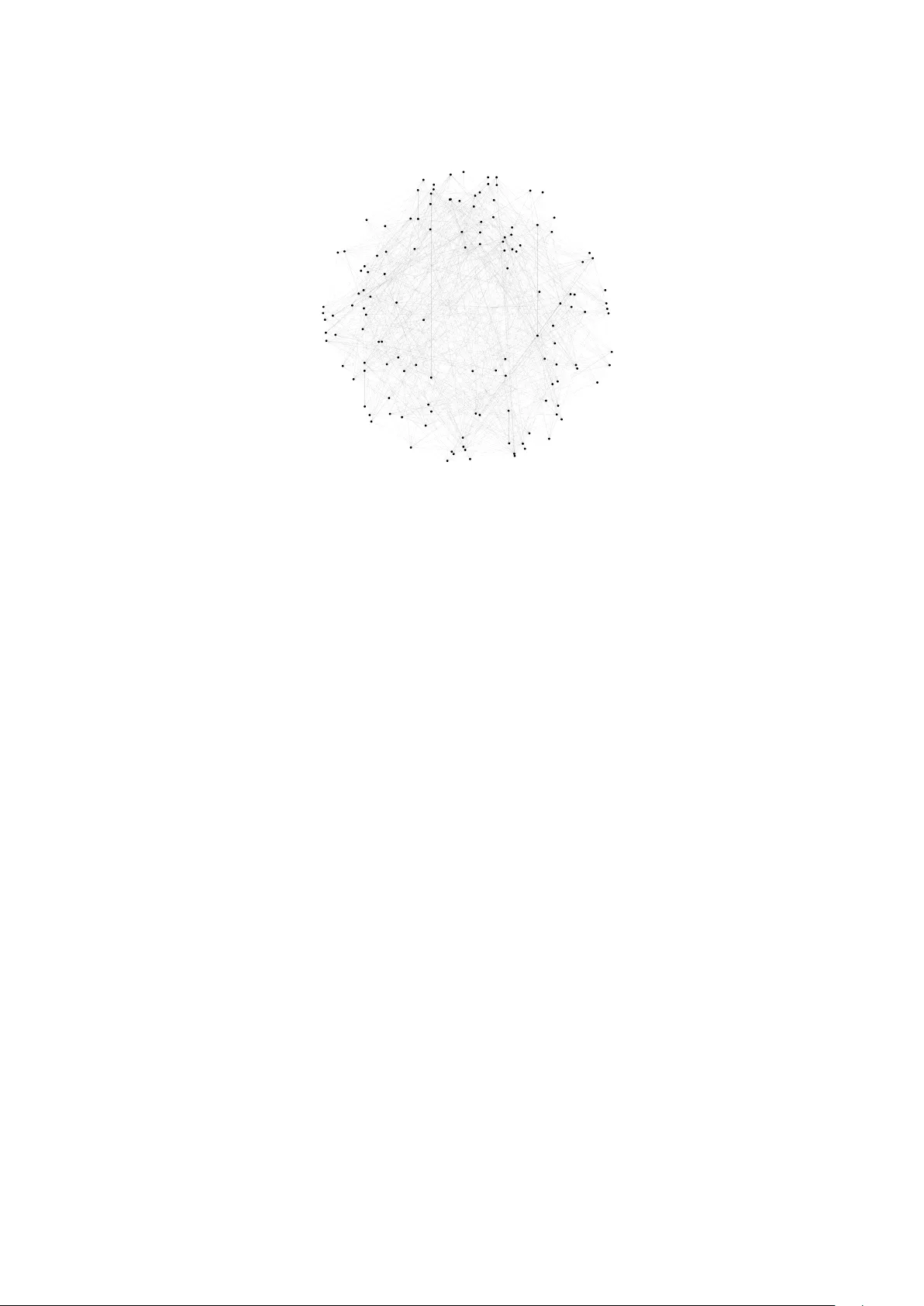
Homogeneous Boltzmann-t yp e equations on graphs: A framew ork for mo delling net w ork ed so cial in teractions Andrea T osin Departmen t of Mathematical Sciences “G. L. Lagrange” P olitecnico di T orino, Italy Abstract Homogeneous Boltzmann-type equations are an established to ol for mo delling interacting m ulti-agent systems in so cioph ysics by means of the principles of statistical mechanics and kinetic theory . A customary implicit assumption is that interactions are “all-to-all”, meaning that ev ery pair of randomly sampled agents may p oten tially interact. How ever, this legacy of classical kinetic theory , developed for collisions among gas molecules, ma y not b e equally ap- plicable to social interactions, which are often influenced by preferential connections b et ween agen ts. In this pap er, w e discuss ongoing research on incorporating graph structures into homogeneous Boltzmann-type equations, thereby accounting for the “some-to-some” nature of so cial interactions. Sommario Le equazioni di tip o Boltzmann omogenee sono uno strumento consolidato p er mo dellizzare sistemi m ulti-agente nella sociofisica mediante i princ ` ıpi della meccanica statistica e della teoria cinetica. Un’ipotesi implicita ricorren te ` e che le interazioni siano “tutti con tutti”, cio ` e c he ogni coppia di agen ti selezionati casualmente p ossa in teragire. T uttavia, questo retaggio della teoria cinetica classica, sviluppata p er descriv ere gli urti tra molecole di gas, non ` e probabilmen te altrettanto adeguato p er descriv ere le interazioni so ciali, c he sp esso risentono di connessioni preferenziali tra gli agenti. In quest’articolo discutiamo alcune linee di ricerca attualmen te in corso sull’in tegrazione di strutture a grafo nelle equazioni di tipo Boltzmann omogenee, con l’obiettiv o di tenere con to di interazioni so ciali di tipo “alcuni con alcuni”. Keyw ords: m ulti-agent systems, statistical mechanics, kinetic theory , graphs, sociophysics Mathematics Sub ject Classification: 35Q20, 35Q91, 91D30, 93A16 1 In tro duction The homo gene ous Boltzmann e quation , a special case of the integro-differen tial equation in tro duced b y Ludwig Boltzmann at the end of the 19th cen tury , describ es the statistics of elastic collisions among the molecules of a rarefied gas homogeneously distributed in space in accordance to the principles of the kinetic the ory . Gas molecules are regarded as indistinguishable , so that any of them is represen tative of all the molecules of the gas, and are c haracterised by their v elo cit y v ∈ R 3 , which changes in consequence of the collisions. Only binary , i.e. pairwise, collisions are considered, assuming that even ts of simultaneous collisions among more than tw o molecules are negligible. If v , v ∗ ∈ R 3 are the instantaneous v elo cities of t wo colliding molecules, the result of a colli- sion b etw een them is that the pr e-c ol lisional v elo cities v , v ∗ c hange in to p ost-c ol lisional velocities v ′ , v ′ ∗ ∈ R 3 , which are given by the physical laws of elastic collisions (those based on the conser- v ation of momen tum and kinetic energy of the tw o molecules): v ′ = v + [( v ∗ − v ) · n ] n, v ′ ∗ = v ∗ + [( v − v ∗ ) · n ] n, (1) 1 where n ∈ S 2 is a unit normal vector in the direction joining the centres of the colliding molecules, also termed the direction of collision, and · denotes the Euclidean inner pro duct in R 3 . The sup erposition of a large num ber of collisions of type ( 1 ) in the unit time causes a c hange in time of the statistical distribution of the v elo cities of the molecules. Notice that the reference to a statistical description is essential, for it would b e otherwise imp ossible to trac k deterministically the collisions among all pairs of gas molecules at ev ery time. F or this, one introduces the distribution function f = f ( v , t ) : R 3 × (0 , + ∞ ) → R + , suc h that f ( v , t ) dv yields the probability that at time t a representativ e molecule of the gas has a velocity in the infinitesimal v olume dv of the state space R 3 cen tred at v . In other words, for ev ery measurable (e.g., Borel) set A ⊆ R 3 it results Prob( V t ∈ A ) = Z A f ( v , t ) dv , V t b eing the random v ariable expressing the velocity of a representativ e gas molecule at time t . Moreo ver, the normalisation condition R R 3 f ( v , t ) dv = 1 holds for every t ≥ 0. The homogeneous Boltzmann equation is an integro-differen tial equation expressing the time ev olution of f under the collision rules ( 1 ). The equation writes as ∂ f ∂ t ( v , t ) = 1 4 π Z R 3 Z S 2 B (( v ∗ − v ) · n ) f ( ′ v , t ) f ( ′ v ∗ , t ) − f ( v , t ) f ( v ∗ , t ) dn dv ∗ (2) and, in practice, equates the time v ariation of f (on the left-hand side) to the mean effect of the elastic collisions ( 1 ) in the unit time (on the righ t-hand side). F or a given velocity v , suc h a mean effect is ev aluated by computing statistically the net balance b et ween: (i) The collisions leading a molecule to gain v as p ost-collisional v elo cit y starting from whatever pre-collisional velocity ′ v , thereby determining an increase in time of f . This is expressed b y the first term on the righ t-hand side of ( 2 ), called the gain term : 1 4 π Z R 3 Z S 2 B (( v ∗ − v ) · n ) f ( ′ v , t ) f ( ′ v ∗ , t ) dn dv ∗ , whic h is an av erage ov er all possible directions of collision n (notice that 1 4 π is the Hausdorff measure of S 2 , motiv ated by the implicit assumption that n is uniformly distributed in S 2 ) and all p ossible p ost-collisional velocities v ∗ of the other molecule participating in the collision. Here, ′ v , ′ v ∗ ∈ R 3 ha ve to b e understoo d as functions of the p ost-collisional velocities v , v ∗ . More precisely , they are the pre-collisional velocities whic h, after a collision ( 1 ), generate the p ost-collisional v elo cities v , v ∗ . As such, they are obtained by in verting the collision rules ( 1 ), which results in ′ v = v + [( v ∗ − v ) · n ] n, ′ v ∗ = v ∗ + [( v − v ∗ ) · n ] n. (3) These new rules are called the inverse c ol lisions . Notice that they are exactly the same as ( 1 ) with the roles of the pre-collisional and p ost-collisional velocities reversed. In particular, it is imp ortan t to pay attention to the fact that, while in ( 1 ) v , v ∗ denote the pre-collisional v elo cities, in ( 3 ) they denote the p ost-collisional v elo cities. (ii) The collisions leading a molecule having v as pre-collisional velocity to lose it, thereb y causing a decrease in time of f . This is expressed b y the second term on the righ t-hand side of ( 2 ), called the loss term : − 1 4 π Z R 3 Z S 2 B (( v ∗ − v ) · n ) f ( v , t ) f ( v ∗ , t ) dn dv ∗ , whic h is in turn an a verage ov er all p ossible directions of collision n and all possible v elo cities v ∗ of the other colliding molecule. 2 The sum of gain and loss terms gives the so-called c ol lisional op er ator Q : Q ( f , f )( v , t ) := 1 4 π Z R 3 Z S 2 B (( v ∗ − v ) · n ) f ( ′ v , t ) f ( ′ v ∗ , t ) − f ( v , t ) f ( v ∗ , t ) dn dv ∗ , a bilinear in tegral operator conferring on the homogeneous Boltzmann equation its typical inte gr o - differen tial character. The term B is the c ol lision kernel . It accounts for the rate of collision b et ween pairs of molecules with given pre-collisional v elo cities and, in particular, relates such a rate to the alignment of their relativ e velocity v ∗ − v to the direction of collision n . Common expressions of B are ev en functions, suc h as B ( ν ) = | ν | whence B (( v ∗ − v ) · n ) = | ( v ∗ − v ) · n | , whic h implies that the higher the said alignmen t the higher the rate of collision. Another widely used model is B ≡ 1, i.e. a constant rate of collision, indep enden t of the relativ e velocity , which c haracterises the so-called Maxwel lian mole cules . F or a thorough deriv ation of the homogeneous Boltzmann equation from molecule collisions, w e refer the in terested reader to [ 30 ]. Starting from the early 2000s, the homogeneous Boltzmann equation has been taken system- atically as a paradigm to mo del systems of interacting particles quite different from gas molecules. V ery often, suc h “particles” are not ev en particles in the sense of classical physics. Instead, they ma y b e vehicles along a road in car traffic problems [ 34 , 40 ], h uman b eings in opinion formation problems [ 12 , 38 ] or trading entities in w ealth distribution problems [ 7 , 18 ], to mention just a few examples. In such cases, they are preferentially called agents and one sp eaks of inter acting multi-agent systems [ 33 ]. The characteristic trait, still denoted b y v , of a representativ e agent of one of such systems is not necessarily the velocity like for gas molecules. Moreov er, it is t ypically assumed to b e scalar instead of vector-v alued, hence v ∈ R . In car traffic problems, v is the sp eed of the vehicles; in opinion formation problems, it is the opinion of the individuals about a certain topic, with v = 0 represen ting neutralit y and v > 0, v < 0 opp osite convictions; in wealth distribution problems, it is the wealth of the individuals, with v < 0 possibly standing for debts [ 37 ]. An in teraction b et ween tw o representativ e agen ts of the system with pre-interaction traits v , v ∗ consists in a transformation of v , v ∗ in to p ost-in teraction traits v ′ , v ′ ∗ according to prescribed relationships – the int er action rules – expressing v ′ , v ′ ∗ as functions of v , v ∗ . In this context, the in teraction rules are the coun terpart of the collision rules ( 1 ) in mo delling the “physics” of the m ulti-agent system. Motiv ated by the linearity and symmetry of the collision rules ( 1 ) – the symmetry meaning that either rule can be deduced from the other b y swapping the roles of v and v ∗ –, here we fo cus on general scalar linear symmetric in teraction rules of the form v ′ = pv + q v ∗ , v ′ ∗ = pv ∗ + q v (4) with prescrib ed interaction co efficien ts p, q ≥ 0. These rules are inv ertible provided q = p ; under this assumption, the inverse inter actions are expressed by ′ v = p p 2 − q 2 v − q p 2 − q 2 v ∗ , ′ v ∗ = p p 2 − q 2 v ∗ − q p 2 − q 2 v , (5) where ′ v , ′ v ∗ are the pre-interaction traits and v , v ∗ the p ost-in teraction traits. The distribution function f = f ( v , t ) : R × (0 , + ∞ ) → R + of the trait v is in tro duced in suc h a wa y that f ( v , t ) dv is the probability that at time t a representativ e agent has a trait in the infinitesimal in terv al dv centred at v . Such an interv al is sometimes identified explicitly with [ v − dv 2 , v + dv 2 ]. A homogeneous Boltzmann-typ e equation for the evolution of f can b e written as, cf. [ 30 , 38 ], ∂ f ∂ t ( v , t ) = Z R B ( ′ v , ′ v ∗ ) | p 2 − q 2 | f ( ′ v , t ) f ( ′ v ∗ , t ) − B ( v , v ∗ ) f ( v , t ) f ( v ∗ , t ) dv ∗ , (6) 3 where ′ v , ′ v ∗ are understo od as functions of v , v ∗ through ( 5 ) and 1 | p 2 − q 2 | is the Jacobian factor of the transformation ( 5 ). The similarit y of ( 6 ) with the homogeneous Boltzmann equation ( 2 ) is eviden t, yet t wo commen ts are in order: (i) in the homogeneous Boltzmann equation, there is apparently no Jacobian factor because that of the transformation ( 3 ) is unitary; (ii) in the homogeneous Boltzmann equation, an even collision kernel B together with the colli- sion rules ( 1 ), ( 3 ) implies B (( ′ v ∗ − ′ v ) · n ) = B (( v ∗ − v ) · n ), cf. [ 30 ], hence that term can b e factored out in the collisional operator. It is worth men tioning that often ( 6 ) is rewritten in w eak form to eliminate at once b oth the Jacobian factor and the inv erse interaction. F or this, one multiplies b oth sides of ( 6 ) by an observable φ = φ ( v ) : R → R , which plays the role of a test function, and integrates on R with resp ect to v to get d dt Z R φ ( v ) f ( v , t ) dv = Z R Z R B ( v , v ∗ ) φ ( v ′ ) − φ ( v ) f ( v , t ) f ( v ∗ , t ) dv dv ∗ , (7) where now v ′ is given as a function of v , v ∗ b y the in teraction rules ( 4 ). Equation ( 7 ) states that the time v ariation of the a verage of the observ able (left-hand side) is determined b y the mean v ariation of the observ able in a representativ e interaction (right-hand side). Notice indeed that the difference φ ( v ′ ) − φ ( v ) quantifies the v ariation of φ after an in teraction, b eing φ ( v ) , φ ( v ′ ) the pre-in teraction and post-interaction v alues of the observ able, resp ectiv ely . The interaction dynamics considered so far implicitly assume that any pair of agents randomly sampled from the entire po ol can interact; that is, the agents are homogeneously mixed and thus exp erience al l-to-al l interactions. This is appropriate for freely mo ving gas molecules, but ma y not hold in so cioph ysical applications, where agen ts exhibit pr efer ential c onne ctions . Examples include so cial or Internet netw orks, whose agents – human b eings or electronic devices – interact and exchange information only if they follow/are connected to eac h other. In this paper, we present v arious strategies for including a network structur e in kinetic de- scriptions of multi-agen t interactions. The basic idea is to in tro duce a gr aph , which mo dels the connections among the agents, and to em b ed the information enco ded in its adjac ency matrix into a homogeneous Boltzmann-t yp e equation, so as to discriminate whic h pairs of agents can actually in teract. W e also discuss the possibility to let the n umber of graph vertices and edges gro w to infinit y , in order to reco ver, in the limit, a statistical description of the connections v alid for large dense graphs, free from the detail of the single connections required b y the adjacency matrix. W e denote by G N the graph, where N ∈ N is the n umber of vertices. These are iden tified by an index i ∈ V N := { 1 , . . . , N } . Instead, the edges of G N are iden tified with pairs of vertices b elonging to a set E N ⊆ V 2 N . In more detail, given i, j ∈ V N , w e sa y that ( i, j ) ∈ E N if there exists an edge b et ween the v ertices i and j . Thus, G N = ( V N , E N ). F or simplicity , w e confine ourselv es to undir e cte d graphs, i.e. graphs for which vertices are either recipro cally connected or disconnected. F ormally , this means that if ( i, j ) ∈ E N then also ( j, i ) ∈ E N . As a consequence, the adjacency matrix of G N , which we denote by A N ∈ R N × N , is symmetric. The remainder of the pap er is organised as follo ws. In Section 2 , we consider networke d multi- agent systems , in which eac h v ertex of G N is a group of interacting agen ts that can migrate from v ertex to vertex following the graph connections. In this case, the num b er N of vertices remains fixed and finite. In Section 3 , we discuss instead networke d inter actions . In this case, each v ertex of G N is an agent, that may or may not in teract with other v ertices/agents in accordance with the connections enco ded in E N or, equiv alently , A N . Here, the focus is on letting N → ∞ , in line with the large n umber of agents required in kinetic theory , in order to obtain a coherent statistic al description of the netw ork structure and its impact on agent in teractions. T o this end, adv anced to ols from graph theory , suc h as random graphs and graphons, are fruitfully in tegrated in to kinetic equations, thereby op ening up promising directions for further research. 4 Figure 1: Five net work ed multi-agen t systems with binary interactions within each of them 2 Net w ork ed m ulti-agen t systems W e begin b y considering the case of networke d multi-agent systems . W e understand the latter as a collection of N groups of interacting agents, which may exchange individuals follo wing certain connections among them. The N groups are the vertices of the graph G N men tioned in the in tro ductory section. See Figure 1 . Suc h a structure is suited to model situations in which only the agents b elonging to the same group can interact, but agen ts mov e across the groups bringing their typical traits from group to group. F or example, this is the case of the spread of an infectious disease, where the N systems of agen ts ma y represen t groups of p eople living in the same cit y , region, or coun try , who propagate the disease locally through direct interactions and globally by moving from one place to another [ 29 ]. In this application, the trait v which c haracterises each agen t in the v arious groups may represent, for example, the viral load, see e.g., [ 19 , 20 , 24 ]. W e in tro duce the kinetic distribution function f i = f i ( v , t ) : R × (0 , + ∞ ) → R + , whic h pro vides the densit y of individuals in the i -th group that at time t feature a trait in the infinitesimal in terv al [ v − dv 2 , v + dv 2 ] centred at v . It is worth stressing that, unlike classical kinetic theory , f i is not a probabilit y density – nor, in more generality , a probability measure –, b ecause the num b er of agen ts in group i is not constant in time, due to the aforesaid migrations of the agen ts from group to group. This difficult y of the theory is ho wev er mitigated by the fact that the quantit y N X i =1 f i ( v , t ) is instead constant in time, because the agen ts switch from one group to another but they nev er lea ve the N groups as a whole. Hence, the total n umber of agents in the N groups is conserv ed. These considerations are at the basis of the pro cedure which leads to obtain a system of Boltzmann-t yp e equations for the f i ’s from the said dynamics of interactions and migrations. The pro cedure, whic h is describ ed in detail in [ 28 ], produces ∂ f i ∂ t = λQ ( f i , f i ) + χ N X j =1 a ij f j − f i , i = 1 , . . . , N . (8) Here, Q is the collisional operator Q ( f i , f i )( v , t ) = Z R 1 | p 2 − q 2 | f i ( ′ v , t ) f i ( ′ v ∗ , t ) − f i ( v , t ) f i ( v ∗ , t ) dv ∗ , 5 whic h expresses the statistics of the interactions taking place, at rate λ > 0, among the agents of group i with the rules ( 5 ). The second term on the right-hand side of ( 8 ) accounts instead for the migration pro cess which, at rate χ > 0, causes the agen ts to mo v e from one group to another. The a ij ’s, for i, j = 1 , . . . , N , are the entries of the adjacency matrix A N of G N . In particular, a ij ∈ [0 , 1] is the probabilit y that, in the unit time, an agen t mov es from group j to group i , so that N X i =1 a ij = 1 , ∀ j = 1 , . . . , N . (9) In other w ords, G N is, in general, a w eighted graph with left sto chastic adjacency matrix. In the particular case that a ij ∈ { 0 , 1 } , G N is an un weigh ted graph with a ij = 1 meaning that v ertices i and j are connected, hence that agen ts can mov e directly from group j to group i , and a ij = 0 meaning that they are not, hence that agents cannot mo ve directly from group j to group i . If we introduce the mass of agents of group i at time t : ρ i ( t ) := Z R f i ( v , t ) dv and we integrate ( 8 ) with resp ect to v , we discov er dρ i dt = χ N X j =1 a ij ρ j − ρ i , i = 1 , . . . , N , (10) where we ha ve used the fact that R R Q ( f i , f i )( v , t ) dv = 0, b ecause the interactions do not change the num b er of agents in eac h group. This sho ws that, due to the migrations of the agents through the groups, the mass of agents in eac h group is in general not constant in time, i.e. dρ i dt = 0. In particular, the v ariation in time of the mass of agents in a certain group i is determined by a balance b et ween: (i) the inflow of agen ts coming from adjacen t groups, expressed b y the term P N j =1 a ij ρ j ; (ii) the outflow of agents heading to other groups, whic h is prop ortional to the mass ρ i of agents in group i . 2.1 Outline of the basic qualitativ e theory In this section, we outline some basic facts of the qualitative theory of ( 8 ) as dev elop ed in [ 9 ] and further refined in [ 30 ]. They concern mainly the large time trend of the solutions to ( 8 ) and ( 10 ), which rev eals self-organised configurations of the system emerging, in the long run, from the interactions and the migrations of the agents. 2.1.1 Mass redistribution on the graph The redistribution of the agents in the v arious groups is gov erned b y ( 10 ), whic h is a self-consistent system of ordinary differential equations in the unkno wns ρ i , i = 1 , . . . , N , decoupled from the original system of kinetic equations ( 8 ). This makes it p ossible to study preliminarily the distri- bution of the mass of agen ts on the graph G N as the solution ρ := ( ρ 1 , . . . , ρ N ) to the following system of ODEs: d ρ dt = χ ( A N − I N ) ρ , whic h is the v ector form of ( 10 ), I N denoting the N × N identit y matrix. The system b eing linear, there exists a unique global solution for ev ery prescrib ed initial condition ρ 0 := ρ (0) = ( ρ 0 , 1 , . . . , ρ 0 ,N ) ∈ R N . Such a solution turns out to b e physically consistent in the sense stated by the following 6 Theorem 2.1 (See [ 30 ]) . If ρ 0 ∈ R N + , i.e. if the initial masses of agents ar e non-ne gative in every vertex of G N , then ρ i ( t ) ≥ 0 for al l t > 0 and al l i = 1 , . . . , N . In p articular, if ρ 0 ,i > 0 , i.e. if the initial mass in a given vertex i is non-zer o, then ρ i ( t ) > 0 for al l t > 0 , i.e. the mass in vertex i is in turn non-zer o at every suc c essive time. Summing b oth sides of ( 10 ) o ver i and recalling ( 9 ), w e see that d dt N X i =1 ρ i ( t ) = 0 . Therefore, it is p ossible to fix the v alue of the total mass of agents in G N . A frequent reference c hoice is a unitary initial total mass, which, owing to the prop ert y ab o ve, implies that the total mass is unitary at all successive times. As a consequence, it results 0 ≤ ρ i ( t ) ≤ 1 for all t > 0, th us each ρ i ( t ) can b e understo od as the percentage of total mass of agents in vertex i at time t . The big picture of the mass redistribution is completed by its time-asymptotic trend: Theorem 2.2 (See [ 30 ]) . L et G N b e str ongly c onne cte d. Then, ther e exists a unique mass distri- bution ρ ∞ := ( ρ ∞ 1 , . . . , ρ ∞ N ) ∈ R N , with ρ ∞ i > 0 for al l i = 1 , . . . , N and P N i =1 ρ ∞ i = 1 , which is a stable and glob al ly attr active e quilibrium of ( 10 ) . The assumption that G N is strongly connected means that ev ery pair of v ertices is connected b y a path of edges. F rom the mo delling p oin t of view, this implies that every group of agents is reacheable from an y other group, i.e. that there are no isolated groups. This assumption turns out to b e essen tial to ensure the v alidity of a result such as the one of Theorem 2.2 , whic h claims the existence of a mass distribution emerging for large times indep enden tly of the initial mass distribution. Clearly , the emerging mass distribution ρ ∞ dep ends instead on the adjacency matrix A N . 2.1.2 T rait distribution on the graph System ( 8 ) of homogeneous Boltzmann-t yp e kinetic equations is ric her than system ( 10 ) for the sole mass redistribution, as it can provide information on the detailed distribution of the microscopic trait v of the agen ts on the graph. Its analytical study is also more challenging, as it requires more adv anced to ols than those underlying the results discussed in Section 2.1.1 . One of such to ols is the F ourier metric for probabilit y measures, which, as first noticed b y Bob ylev [ 10 ], is particularly effectiv e in pro ducing a priori estimates for Boltzmann-t yp e equations with linear in teractions. T o introduce the topic, let µ b e a probability measure on R equipp ed with e.g., the Borel σ -algebra. F or ξ ∈ R , the b ounded and contin uous function ˆ µ : R → R defined as ˆ µ ( ξ ) := Z R e − iξv dµ ( v ) is the F ourier transform of the measure µ . If µ, ν are tw o probability measures on R such that R R | v | s dµ ( v ) < + ∞ and likewise R R | v | s dν ( v ) < + ∞ for some real s > 0 then d s ( µ, ν ) := sup ξ ∈ R \{ 0 } | ˆ ν ( ξ ) − ˆ µ ( ξ ) | | ξ | s (11) defines a metric, called the s -F ourier metric , whic h measures the distance betw een µ and ν . Notice that the well-posedness of d s ( µ, ν ) relies heavily on the fact µ, ν are probabilit y measures, whic h guaran tees ˆ µ (0) = ˆ ν (0) = 1. This, together with additional prop erties on the statistical momen ts of µ, ν , is at the basis of the finiteness of the right-hand side of ( 11 ) when ξ is close to 0, cf. [ 16 , 30 ] for details. Applying the F ourier transform to b oth sides of ( 8 ) simplifies greatly the Boltzmann-type equation. In fact, taking adv antage of the assumed linearity of the in teraction rules, it results Z R e − iξv Q ( f i , f i )( v , t ) dv = ˆ f i ( pξ , t ) ˆ f i ( q ξ , t ) − ˆ f i ( ξ , t ) , 7 cf. [ 30 ], thus ( 8 ) becomes ∂ ˆ f i ∂ t ( ξ , t ) = λ ˆ f i ( pξ , t ) ˆ f i ( q ξ , t ) − ˆ f i ( ξ , t ) + χ N X j =1 a ij ˆ f j ( ξ , t ) − ˆ f i ( ξ , t ) , i = 1 , . . . , N . (12) Ideally , this transformed equation is the starting p oin t for estimates in the F ourier metric. Nev- ertheless, unlike the standard kinetic setting, here the f i ’s are not probability measures, in fact R R f i ( v , t ) dv = ρ i ( t ) ≤ 1. Hence, definition ( 11 ) cannot b e applied straightforw ardly . T o bypass this difficulty of the theory , it is useful to introduce the representation f i ( v , t ) = ρ i ( t ) F i ( v , t ) , i = 1 , . . . , N , where F i : R × (0 , + ∞ ) → R + is the so-called ( i -th) normalise d kinetic distribution function . If w e confine ourselves to the case in which the initial mass distribution is strictly positive in ev ery v ertex of G N , i.e. ρ 0 ,i > 0 for all i = 1 , . . . , N , then Theorems 2.1 , 2.2 imply that the F i ’s are probabilit y distributions, as R R F i ( v , t ) dv = 1 for all t > 0 and all i = 1 , . . . , N . Consequen tly , the quantit y D s ( f ( t ) , g ( t )) := N X i =1 ρ i ( t ) d s ( F i ( t ) , G i ( t )) (13) turns out to b e a metric for every pair of vector-v alued kinetic distributions f ( v , t ) := ( f 1 ( v , t ) , . . . , f N ( v , t )) = ( ρ 1 ( t ) F 1 ( v , t ) , . . . , ρ N ( t ) F N ( v , t )) , g ( v , t ) := ( g 1 ( v , t ) , . . . , g N ( v , t )) = ( ρ 1 ( t ) G 1 ( v , t ) , . . . , ρ N ( t ) G N ( v , t )) ha ving the same mass ρ ( t ) = ( ρ 1 ( t ) , . . . , ρ N ( t )) on the graph. Notice that D s is well defined b ecause it is based on the F ourier distances b etw een the F i ’s and G i ’s, which are probability distributions b y construction, and b ecause the weigh ting co efficien ts in the sum ( 13 ) are strictly p ositiv e in our context. Notice also that it is quite easy to ensure that tw o kinetic distributions f , g ha ve the same mass in the vertices of the graph: owing to ( 10 ), it is sufficient that initially they hav e the same mass distribution to get that their mass distributions coincide at all successive times. In this setting, under technical assumptions rep orted in detail in [ 30 ], whic h inv olve, among other things, the rate λ in ( 8 ) and the co efficients p, q of the in teraction rules ( 4 ), one prov es that there exists a constant γ > 0 such that D 2 ( f ( t ) , g ( t )) ≤ D 2 ( f 0 , g 0 ) e − γ t , ∀ t > 0 , (14) where f 0 ( v ) := f ( v , 0) and g 0 ( v ) := g ( v , 0) are the initial kinetic distributions. The choice of s = 2 in ( 14 ) as the index of the F ourier metric is linked to the assumptions men tioned ab o ve on the co efficien ts p, q of the in teraction rules. It is worth stressing that ( 14 ) is not just a contin uous dep endence estimate for the solutions of ( 8 ). It sa ys, more specifically , that lim t → + ∞ D 2 ( f ( t ) , g ( t )) = 0 , meaning that solutions to ( 8 ) tend to exhibit the same time-asymptotic trend regardless of the initial data. In turn, this implies the a priori uniqueness and global asymptotic stability of the equilibrium distribution of the trait v emerging, in the long run, from the join t effect of intra- v ertex agen t interactions and inter-v ertex agen t migrations. Remark ably , in this context such an equilibrium distribution is the equiv alent of the Maxwellian distribution for the homogeneous Boltzmann equation of gas dynamics. T o complete the theoretical big picture, w e mention that b y means of other more standard metrics, such as the N -dimensional Lebesgue metrics induced by the norms ∥ f ( t ) ∥ ( L r ( R )) N := N X i =1 ∥ f i ( t ) ∥ r L r ( R ) ! 1 /r = N X i =1 Z R f r i ( v , t ) dv ! 1 /r , r = 1 , 2 , 8 Figure 2: A dense graph of interactions in a m ulti-agent system one pro ves an a priori contin uous dep endence and uniqueness estimate for the solutions of ( 8 ) in the form ∥ g ( t ) − f ( t ) ∥ ( L 2 ( R )) N ≤ ∥ g 0 − f 0 ∥ 2 ( L 2 ( R )) N + ψ ( t ) ∥ g 0 − f 0 ∥ ( L 1 ( R )) N 1 / 2 e C t , ∀ t > 0 , whic h is technically obtained from the F ourier-transformed system ( 12 ) inv oking P arsev al’s identit y and do es not require any of the technical assumptions on λ , p , q , and the initial mass distribution men tioned ab o ve. Here, ψ is a suitable non-negative and non-decreasing function with ψ (0) = 0 and, more imp ortan tly , the real constant C in the exponential function is p ositiv e. Therefore, unlik e ( 14 ), suc h an estimate, although fundamen tal for the well-posedness of the problem, do es not provide insights in to the time-asymptotic trend of the solutions. 3 Net w ork ed in teractions W e consider now the case of networke d inter actions , that depict a situation in which the agen ts of the m ulti-agent system are the v ertices of G N and in teractions among them may or ma y not take place dep ending on the edge structure of G N . In this case, therefore, there is formally a single m ulti-agent system, whose individuals are not sub ject, in general, to an “all-to-all” interaction pattern. In fact, only agents sharing a connection can p ossibly in teract, whereby they exc hange m utually their respective traits. See Figure 2 . Net work ed interactions are ubiquitous in so ciophysics and bioph ysics. Probably the most prominen t example is the opinion formation on so cial netw orks, see e.g., [ 2 , 3 , 15 , 21 , 23 , 27 , 32 , 39 ]. Moreov er, we men tion that models of the brain netw ork based on netw orked in teractions among neurons ha ve b een prop osed in the literature to describ e the progression of Alzheimer’s disease [ 6 ] and the activ ation/deactiv ation of neurons characterising the electrical brain activit y [ 8 , 17 ]. Recently , kinetic models on net works hav e also been employ ed to in vestigate the city size distribution sub ject to immigration and emigration phenomena [ 35 ]. On a heuristic basis, considering a system comp osed by a large n umber of agents – viz. a graph G N with large N –, one describes the microscopic state of a representativ e agent by means of a pair ( v , c ) ∈ R × R + , where v denotes the ph ysical trait of the agen t, such as e.g., their opinion, and c is the numb er of c onne ctions with other agents. Then one in tro duces the kinetic distribution function f = f ( v , c, t ) : R × R + × (0 , + ∞ ) → R + suc h that f ( v , c, t ) dv dc is the probabilit y that at time t the microscopic state of the represen tative agent is in the infinitesimal 9 v olume [ v − dv 2 , v + dv 2 ] × [ c − dc 2 , c + dc 2 ] of the state space R × R + cen tred at ( v , c ). In this context, conserv ation of the total mass of the agen ts holds true, whic h motiv ates the normalisation condition Z R + Z R f ( v , c, t ) dv dc = 1 , ∀ t ≥ 0 . A common assumption, which we will mak e throughout this section, is that the netw ork is non- c o evolving , meaning that the edges of G N do not v ary in time. This implies that the marginal distribution, say g , of the connections: g ( c, t ) := Z R f ( v , c, t ) dv , is constant in t and will b e therefore denoted simply b y g ( c ). The interested reader may refer e.g., to [ 14 , 22 ] for the case of c o evolving networks , i.e. net works with time-v arying connections. Considering prototypical interaction rules of the form ( 5 ), a general Boltzmann-t yp e description of such a m ulti-agent system is pro vided by the equation ∂ f ∂ t ( v , c, t ) = Z R + Z R B ( c, c ∗ ) 1 | p 2 − q 2 | f ( ′ v , c, t ) f ( ′ v ∗ , c ∗ , t ) − f ( v , c, t ) f ( v ∗ , c ∗ , t ) dv ∗ dc ∗ , (15) where the in teraction kernel B , giving the rate of in teraction, is assumed to dep end on the n umber of connections of the interacting agen ts but not on their traits. F or example, in [ 27 ] it is suggested that B ma y b e prop ortional to the pro duct cc ∗ , implying that the more the connections the more frequen t the in teractions. In tegrating ( 15 ) with resp ect to v pro duces ∂ g ∂ t ( c, t ) = Z R + B ( c, c ∗ ) g ( c, t ) g ( c ∗ , t ) − g ( c, t ) g ( c ∗ , t ) dc ∗ = 0 , thereb y confirming that the connection distribution is conserved in time. In practice, it can b e fixed by prescribing the initial condition f 0 ( v , c ) := f ( v , c, 0) in such a wa y that R R f 0 ( v , c ) dv = g ( c ). As for the c hoice of g , the literature offers several studies on the statistical distribution of graph connections, see e.g., [ 1 , 4 , 5 ]. In particular, it is interesting to notice that p ower-law- typ e distributions g , i.e. suc h that g ( c ) ∼ c − α for some α > 1 when c → + ∞ , can b e used to mo del social netw orks featuring the so-called influenc ers , i.e. agents able to affect significantly the opinion of other agents thanks to their large num b er of connections. An example is g ( c ) = e − 1 /c Γ( α − 1) c α , c > 0 , α > 1 , whic h, for c large, is a p ow er law of degree α . Here, Γ denotes the Euler gamma function. Con versely , distributions g such that g ( c ) = o ( c − α ) for every α > 1 when c → + ∞ can be used to mo del social netw orks substantially free from influencers. An example of this type is g ( c ) = µe − µc , c ≥ 0 , namely an exp onen tial distribution with parameter µ > 0. 3.1 F ormal deriv ation of a Boltzmann-type equation on a graph Equation ( 15 ) is built b y mimicking heuristically the classical homogeneous Boltzmann-type equa- tion ( 6 ). In particular, the graph G N is directly blurred in to a contin uous statistical description of its connections, with no explicit link to the genuinely discrete structure of vertices and edges con vey ed b y the adjacency matrix. In this section, we w ant to restore such a link by discussing ho w a statistical description of a graph can b e formally em b edded into a homogeneous Boltzmann-t yp e equation in the limit of an infinite num b er of vertices. 10 As stated in the in tro ductory section, we recall that we consider for simplicity undirected graphs G N with symmetric adjacency matrices A N . Hence, if an edge exists b et w een tw o vertices then the corresp onding agents can in teract and exchange their traits reciprocally via the symmetric in teraction rules ( 4 ), ( 5 ). Let f i = f i ( v , t ) : R × (0 , + ∞ ) → R + b e the distribution function of the trait v of v ertex i of G N at time t . T aking into accoun t the connections of vertex i with the other vertices of G N as expressed by A N , the distribution function f i satisfies [ 32 ]: ∂ f i ∂ t ( v , t ) = 1 N N X j =1 a ij Z R 1 | p 2 − q 2 | f i ( ′ v , t ) f j ( ′ v ∗ , t ) − f i ( v , t ) f j ( v ∗ , t ) dv ∗ , (16) see also [ 13 ], where a similar kinetic equation is deriv ed from a BBGKY-t yp e hierarch y . In weak form, for every observ able φ = φ ( v ) : R → R (test function), this writes d dt Z R φ ( v ) f i ( v , t ) dv = 1 N N X j =1 a ij Z R Z R φ ( v ′ ) − φ ( v ) f i ( v , t ) f j ( v ∗ , t ) dv dv ∗ , (17) cf. ( 7 ), and, letting f ( v , t ) := ( f 1 ( v , t ) , . . . , f N ( v , t )), further d dt Z R φ ( v ) f ( v , t ) dv = 1 N Z R Z R φ ( v ′ ) − φ ( v ) f ( v , t ) ⊙ A N f ( v ∗ , t ) dv dv ∗ , where ⊙ denotes the Hadamard product, i.e. the entrywise product of v ectors. Let now c i := deg ( i ) ∈ { 0 , . . . , N } b e the de gr e e of vertex i , i.e. the num b er of incoming/outgoing edges of i (for every i , these tw o n umbers are equal b ecause the graph is undirected) and set c := ( c 1 , . . . , c N ) T (column vector – the sup erscript T denoting transposition). Aiming to retain only the information ab out the n umber of connections of every vertex, we in tro duce the following approximation of the adjacency matrix A N : A N ≈ cc T d N , d N := N X i =1 deg ( i ) = N X i =1 c i . (18) The right-hand side of the approximation ≈ is a rank-one N × N matrix with the same v ertex degrees as A N . Suc h an appro ximate adjacency matrix corresp onds, in practice, to replacing G N with a r andom gr aph with the same degree sequence as G N , cf. the c onfigur ation mo del [ 11 , 31 ]. In fact, we observe that, on the one hand, the approximation ( 18 ) of A N loses the detailed structure of the connections of G N . On the other hand, it amounts to the following approximation of the generic entry a ij of A N : a ij ≈ c i c j d N , i, j = 1 , . . . , N , whence the exact degree of vertex i of G N , i.e. c i = P N j =1 a ij , coincides with the approximate degree P N j =1 c i c j /d N = c i . In terestingly , random graphs with a prescribed degree sequence hav e pro ved particularly suitable for mo delling so cial and In ternet netw orks. In parallel, we in tro duce the distribution function f = f ( v , c, t ) : R × { 0 , . . . , N } × (0 , + ∞ ) → R + suc h that f ( v , c, t ) dv is the probabilit y that at time t a v ertex/agent has c connections and a trait v comprised in [ v − dv 2 , v + dv 2 ]: f ( v , c, t ) := 1 N X i : deg ( i )= c f i ( v , t ) . 11 F rom this definition it follo ws, in particular, N X c =0 f ( v , c, t ) = 1 N N X i =1 f i ( v , t ) , N X c =0 cf ( v , c, t ) = 1 N N X i =1 c i f i ( v , t ) . Therefore, summing b oth sides of ( 17 ) o ver i while using ( 18 ) therein, w e get d dt N X c =0 Z R φ ( v ) f ( v , c, t ) dv = 1 d N N X c =0 N X c ∗ =0 Z R Z R cc ∗ φ ( v ′ ) − φ ( v ) f ( v , c, t ) f ( v ∗ , c ∗ , t ) dv dv ∗ . (19) A t this p oin t, to obtain a limiting mathematical structure as N → ∞ it is conv enient to normalise the degree of the v ertices as ˜ c := c N , so that the normalised degree ˜ c tak es v alues betw een 0 and 1 in the set ˜ C N := { k N : k = 0 , . . . , N } . A t the same time, we normalise also the distribution function f b y letting ˜ f ( v , ˜ c, t ) := N f ( v , N ˜ c, t ) . F or v , t fixed, it is useful to understand ˜ f ( v , · , t ) as a piecewise constant version of f ( v , · , t ) in the in terv al [0 , 1], after discretising the latter by means of the grid ˜ C N with grid step ∆ ˜ c := 1 N . In con trast, f ( v , · , t ) can b e view ed as an atomic measure on the discrete set { 0 , . . . , N } . Switc hing to ˜ f in ( 19 ) we disco ver d dt X ˜ c ∈ ˜ C N Z R φ ( v ) ˜ f ( v , ˜ c, t ) dv ∆ ˜ c = N 2 d N X ˜ c ∈ ˜ C N X ˜ c ∗ ∈ ˜ C N Z R Z R ˜ c ˜ c ∗ φ ( v ′ ) − φ ( v ) ˜ f ( v , ˜ c, t ) ˜ f ( v ∗ , ˜ c ∗ , t ) dv dv ∗ ∆˜ c ∆ ˜ c ∗ . It is clear now that, when N → ∞ , the v ariables ˜ c , ˜ c ∗ span con tinuously the in terv al [0 , 1] whereas expressions such as P ˜ c ∈ ˜ C N ( . . . ) ∆ ˜ c conv erge formally to R 1 0 ( . . . ) d ˜ c , cf. the construction of the Riemann in tegral. Moreo ver, the ratio d N / N 2 con verges to the me an normalise d de gr e e of the graph: d N N 2 N →∞ − − − − → ˜ d := Z 1 0 Z R ˜ c ˜ f ( v , ˜ c, t ) dv d ˜ c, as prov ed in [ 32 ]. In conclusion, in the limit N → ∞ the following equation emerges: d dt Z 1 0 Z R φ ( v ) ˜ f ( v , ˜ c, t ) dv d ˜ c = Z 1 0 Z 1 0 Z R Z R ˜ c ˜ c ∗ ˜ d φ ( v ′ ) − φ ( v ) ˜ f ( v , ˜ c, t ) ˜ f ( v ∗ , ˜ c ∗ , t ) dv dv ∗ d ˜ c d ˜ c ∗ , whic h, o wing to the arbitrariness of φ , is a w eak form of the homogeneous Boltzmann-t yp e equation ∂ ˜ f ∂ t ( v , ˜ c, t ) = Z 1 0 Z R ˜ c ˜ c ∗ ˜ d 1 | p 2 − q 2 | ˜ f ( ′ v , ˜ c, t ) ˜ f ( ′ v ∗ , ˜ c ∗ , t ) − ˜ f ( v , ˜ c, t ) ˜ f ( v ∗ , ˜ c ∗ , t ) dv ∗ d ˜ c ∗ (20) for the in teraction rules ( 5 ). This equation resembles closely ( 15 ) with the sp ecific “non-Maxwellian”, i.e. non-unitary , interaction kernel B ( ˜ c, ˜ c ∗ ) = ˜ c ˜ c ∗ ˜ d . The most remark able difference is that here the normalised num b ers of connections are used, whic h range ov er [0 , 1] rather than ov er R + . F rom the previous discussion, it is clear that suc h a normalisation has b een essen tial to iden tify a limiting equation for N → ∞ . In summary , ( 20 ) describ es net work ed interactions on large r andom graphs with a prescrib ed non-co ev olving statistical distribution ˜ g (˜ c ) = R R ˜ f ( v , ˜ c, t ) dv of the (normalised) connections. 12 A 4 = 0 1 0 1 1 0 1 0 0 1 0 1 1 0 1 0 0 1 1 4 1 2 3 4 x 0 1 1 4 1 2 3 4 x ∗ Figure 3: A 4 × 4 adjacency matrix and the contours of the corresp onding piecewise constan t function W 4 on the unit square [0 , 1] 2 (white is 0, black is 1) 3.2 Em b edding graphons in Boltzmann-type equations By revisiting the approach that led to ( 17 ) and ( 20 ), w e can obtain a different homogeneous Boltzmann-t yp e equation, whic h accounts for netw orked interactions on large but not necessar- ily random graphs. In particular, such an equation k eeps trac k of the structure of the graph connections. T o this purpose, the main concept to b e b orro wed from graph theory is that of gr aphon , a name inspired b y “ gr aph functi on ” which b ecame standard in the mid-2000s after the work s by Lo v´ asz and collab orators, see e.g., [ 25 , 26 ]. In essence, the idea b ehind a graphon works as follo ws. Giv en a finite graph G N with N vertices and N × N adjacency matrix A N , one first introduces a partition of the interv al [0 , 1] ⊂ R made b y the subin terv als I 1 := 0 , 1 N , I i := i − 1 N , i N , i = 2 , . . . , N , whic h are such that ∪ N i =1 I i = [0 , 1] and I i ∩ I j = ∅ for all i = j , and then defines a t wo-v ariable scalar function W N : [0 , 1] 2 → [0 , 1] as W N ( x, x ∗ ) := N X i =1 N X j =1 a ij χ I i ( x ) χ I j ( x ∗ ) , where χ ( · ) denotes the characteristic function of the set sp ecified b y the subscript. In p ractice, W N is a piecewise constant function repro ducing A N on a pixelation of the unit square [0 , 1] 2 ⊂ R 2 , in the sense that W N ( x, x ∗ ) = a ij for ( x, x ∗ ) ∈ I i × I j , I i × I j b eing a sub-square, viz. a pixel, in [0 , 1] 2 . See Figure 3 for an example. As the graph G N gets larger and larger, in particular for N → ∞ , one may expect the sequence of functions { W N } N ∈ N to conv erge, under a suitable concept of con vergence to b e defined, to some limit function W : [0 , 1] 2 → [0 , 1] expressing the connectivit y of G N in the limit of an infinite num b er of vertices. Suc h a function W is the so-called graphon. While the entry a ij of the adjacency matrix A N describ es whether the vertices i and j of G N are ( a ij = 1) or are not ( a ij = 0) connected by an edge, the v alue W ( x, x ∗ ) ∈ [0 , 1] is typically in terpreted as the probability of an edge betw een the tw o p oin ts x, x ∗ ∈ [0 , 1], where, o wing to the construction set forth abov e, the latter are understoo d as a con tinuous coun terpart of the (normalised) vertices of G N . In the context of graphons, the most p opular concept of conv ergence is that induced by the so-called cut norm , which is denoted b y ∥ · ∥ □ and is defined as ∥ W ∥ □ := sup S, T ⊆ [0 , 1] Z Z S × T W ( x, x ∗ ) dx dx ∗ , W ∈ L ∞ ([0 , 1] 2 ) . 13 When applied to the function W N in tro duced ab o ve, the cut norm yields ∥ W N ∥ □ = sup S, T ⊆ [0 , 1] N X i =1 N X j =1 a ij | S ∩ I i | · | T ∩ I j | , where | S ∩ I i | is the Leb esgue measure of the set S ∩ I i and similarly for | T ∩ I j | . F rom here, we see that, informally speaking, the cut norm scans the sub-regions of a graph, coun ting the n umber of edges betw een pairs of v ertices in those sub-regions, to detect the maxim um density of c onne ctions of the graph. As usual, we sa y that the sequence { W N } N ∈ N con verges to W in the cut norm when N → ∞ if lim N →∞ ∥ W N − W ∥ □ = 0. Giv en a m ulti-agent system with net work ed interactions taking place on G N , w e denote by f N = f N ( x, v , t ) the probability density function of the pair ( x, v ) ∈ [0 , 1] × R at time t > 0. Thus, f N ( x, v , t ) dx dv is the probability that at time t an agent/v ertex is in the sub-region [ x − dx 2 , x + dx 2 ] of the graph centred at x with a trait in [ v − dv 2 , v + dv 2 ]. On the whole, Z 1 0 Z R f N ( x, v , t ) dv dx = 1 , ∀ t > 0 , ∀ N ∈ N . F ollowing [ 36 ], thus using in particular the function W N to express the connections among the agen ts/vertices, w e write an analogue of ( 16 ) in the form ∂ f N ∂ t ( x, v , t ) = Z 1 0 Z R W N ( x, x ∗ ) 1 | p 2 − q 2 | f N ( x, ′ v , t ) f N ( x ∗ , ′ v ∗ , t ) − f N ( x, v , t ) f N ( x ∗ , v ∗ , t ) dv ∗ dx ∗ for the interaction rules ( 5 ), where the discrete indices i, j and the entries a ij of A N ha ve b een replaced by the contin uous v ariables x, x ∗ and the function W N , resp ectiv ely . Similarly to ( 16 ), this equation constitutes a kinetic description of netw orked interactions on a “physical” graph, namely a finite one with a p oin t wise structure of edges and connections. In the limit N → ∞ , if the sequence { W N } N ∈ N con verges to a graphon W it is reasonable to expect that the distribution function f N con verges to the solution f of the follo wing limit homogeneous Boltzmann-type equation: ∂ f ∂ t ( x, v , t ) = Z 1 0 Z R W ( x, x ∗ ) 1 | p 2 − q 2 | f ( x, ′ v , t ) f ( x ∗ , ′ v ∗ , t ) − f ( x, v , t ) f ( x ∗ , v ∗ , t ) dv ∗ dx ∗ . (21) Suc h an in tuition is made precise b y the follo wing a priori estimate prov ed in [ 36 ]: sup t ∈ [0 , T ] W 1 ( f N ( t ) , f ( t )) ≲ W 1 ( f N (0) , f (0)) + ∥ W N − W ∥ 1 / 2 □ + √ N ∥ W N − W ∥ □ , ∀ T > 0 , (22) where W 1 denotes the 1-Wasserstein metric for probability measures: W 1 ( f N ( t ) , f ( t )) := sup Φ ∈ Lip 1 ([0 , 1] × R ) Z Z [0 , 1] × R Φ( x, v ) f N ( x, v , t ) − f ( x, v , t ) dx dv , b eing Lip 1 ([0 , 1] × R ) the set of Lipschitz-con tinuous functions on [0 , 1] × R with at most unitary Lipsc hitz constant. Estimate ( 22 ) sho ws that if the W N ’s conv erge to a graphon W sufficiently fast in the cut norm, in particular in such a w ay that ∥ W N − W ∥ □ = o ( N − 1 / 2 ) when N → ∞ , and if, in addition to this, 14 the initial conditions f N ( x, v , 0) con verge to some f ( x, v , 0) then the f N ’s conv erge, uniformly in time on every compact in terv al [0 , T ], to the solution of ( 21 ) issuing from f ( x, v , 0). This establishes that ( 21 ) is the limit kinetic mo del v alid in the abstraction of an infinite graph describ ed by a graphon. As discussed ab o ve, it also clarifies the structural assumptions required for ( 21 ) to b e regarded as a universal model for families of growing finite graphs. Notice that ( 21 ) is a homogeneous Boltzmann-t yp e equation on the state space [0 , 1] × R with the graphon W playing the role of the interaction k ernel B . With this interpretation, a similar kinetic equation has b een prop osed heuristically in [ 21 ] for a problem of opinion formation on so cial net works. References [1] R. Albert and A.-L. Barab´ asi. Statistical mec hanics of complex netw orks. R ev. Mo dern Phys. , 74(1):1–47, 2002. [2] G. Albi, L. Paresc hi, and M. Zanella. On the optimal control of opinion dynamics on ev olving net works. In L. Bo ciu, J.-A. D ´ esid´ eri, and A. Habbal, editors, System Mo deling and Optim- ization , v olume 494 of IFIP A dvanc es in Information and Communic ation T e chnolo gy , pages 58–67. Springer, Cham, 2016. [3] G. Albi, L. P areschi, and M. Zanella. Opinion dynamics ov er complex netw orks: kinetic mo delling and n umerical metho ds. Kinet. R elat. Mo dels , 10(1):1–32, 2017. [4] A.-L. Barab´ asi and R. Albert. Emergence of scaling in random net works. Scienc e , 286(5439):509–512, 1999. [5] A.-L. Barab´ asi, R. Alb ert, and H. Jeong. Mean-field theory for scale-free random netw orks. Phys. A , 272(1-2):73–187, 1999. [6] M. Bertsch, B. F ranchi, N. Marcello, M. C. T esi, and A. T osin. Alzheimer’s disease: a mathematical mo del for onset and progression. Math. Me d. Biol. , 34(2):193–214, 2017. [7] M. Bisi. Some kinetic mo dels for a market economy . Bol l. Unione Mat. Ital. , 10(1):143–158, 2017. [8] M. Bisi, M. Conte, and M. Groppi. Action p oten tial dynamics on heterogeneous neural net works: from kinetic to macroscopic equations. In M. ˇ Coli ´ c, J. Giesselmann, J. Gl ¨ uck, M. Kramar Fija vˇ z, A. Mauroy , and D. Mugnolo, editors, Mathematic al Mo dels for Inter act- ing Dynamics on Networks , MA T-DYN-NET 2024. T rends in Mathematics, pages 139–157. Birkh¨ auser, Cham, 2026. [9] D. Bisoglio. A priori estimates for Boltzmann-type equations on graphs. Master’s thesis, P olitecnico di T orino, T urin, Italy , 2024. [10] A. V. Bobylev. F ourier transform metho d in the theory of the Boltzmann equation for Maxw ellian molecules. Dokl. A kad. Nauk SSSR , 225(5):1041–1044, 1975. [11] B. Bollob´ as. A probabilistic proof of an asymptotic form ula for the n um b er of labelled regular graphs. Eur op e an J. Combin. , 1(4):311–316, 1980. [12] L. Boudin and F. Salv arani. A kinetic approac h to the study of opinion formation. ESAIM Math. Mo del. Numer. Anal. , 43(3):507–522, 2009. [13] M. Burger. Netw ork structured kinetic mo dels of so cial in teractions. Vietnam J. Math. , 49(3):937–956, 2021. [14] M. Burger. Kinetic equations for pro cesses on co-ev olving netw orks. Kinet. R elat. Mo dels , 15(2):187–212, 2022. 15 [15] M. Burger, N. Loy , and A. Rossi. Asymptotic and stabilit y analysis of kinetic models for opin- ion formation on netw orks: an Allen-Cahn approach. SIAM J. Appl. Dyn. Syst. , 24(2):1042– 1069, 2025. [16] J. A. Carrillo and G. T oscani. Contractiv e probability metrics and asymptotic b eha vior of dissipativ e kinetic equations. Riv. Mat. Univ. Parma , 7(6):75–198, 2007. [17] M. Con te, M. Groppi, and A. T osin. Kinetic and macroscopic equations for action p oten tial in neural net works. In A. d’Onofrio, A. F asano, F. P apa, and C. Sinisgalli, editors, Pr oblems in Mathematic al Biophysics , v olume 38 of SEMA SIMAI Springer Series , pages 77–104. Springer, Cham, 2024. [18] S. Cordier, L. P areschi, and G. T oscani. On a kinetic mo del for a simple market economy . J. Stat. Phys. , 120(1):253–277, 2005. [19] R. Della Marca, N. Lo y , and A. T osin. An SIR-lik e kinetic mo del trac king individuals’ viral load. Netw. Heter o g. Me dia , 17(3):467–494, 2022. [20] R. Della Marca, N. Loy , and A. T osin. An SIR mo del with viral load-dep enden t transmission. J. Math. Biol. , 86(4):61/1–28, 2023. [21] B. D ¨ uring, J. F ranceschi, M.-T. W olfram, and M. Zanella. Breaking consensus in kinetic opinion formation mo dels on graphons. J. Nonline ar Sci. , 34(79), 2024. [22] M. F raia, N. Loy , and A. T osin. Kinetic mo delling of opinion dynamics on co-evolving net- w orks. In preparation, 2026. [23] M. F raia, N. Lo y , and A. T osin. Linear inelastic kinetic equations mo delling the spread of fak e news and its interpla y with p ersonal a wareness. Kinet. R elat. Mo dels , 19:1–34, 2026. [24] T. Lorenzi, E. Paparelli, and A. T osin. Mo delling co ev olutionary dynamics in heterogeneous SI epidemiological systems across scales. Commun. Math. Sci. , 22(8):2131–2165, 2024. [25] L. Lov´ asz. Lar ge Networks and Gr aph Limits , volume 60 of Col lo quium Public ations . Amer- ican Mathematical So ciet y , 2012. [26] L. Lov´ asz and B. Szegedy . Limits of dense graph sequences. J. Combin. The ory Ser. B , 96(6):933–957, 2006. [27] N. Loy , M. Raviola, and A. T osin. Opinion p olarization in so cial net works. Philos. T r ans. R oy. So c. A , 380(2224):20210158/1–15, 2022. [28] N. Lo y and A. T osin. Boltzmann-t yp e equations for m ulti-agent systems with label switc hing. Kinet. R elat. Mo dels , 14(5):867–894, 2021. [29] N. Loy and A. T osin. A viral load-based mo del for epidemic spread on spatial netw orks. Math. Biosci. Eng. , 18(5):5635–5663, 2021. [30] N. Loy and A. T osin. Essentials of the kinetic theory of multi-agen t systems. Preprint (), 2025. [31] M. Molloy and B. Reed. A critical p oin t for random graphs with a giv en degree sequence. R andom Structur es Algorithms , 6(2–3):161–180, 1995. [32] M. Nurisso, M. Raviola, and A. T osin. Netw ork-based kinetic models: Emergence of a stat- istical description of the graph topology . Eur op e an J. Appl. Math. , pages 1–22, 2024. [33] L. Paresc hi and G. T oscani. Inter acting Multiagent Systems: Kinetic e quations and Monte Carlo metho ds . Oxford Univ ersity Press, 2013. 16 [34] I. Prigogine and F. C. Andrews. A Boltzmann-lik e approach for traffic flow. Op er ations R es. , 8(6):789–797, 1960. [35] V. T aralli. Mo delling the city size distribution on spatial netw orks via the kinetic theory of m ulti-agent systems. Master’s thesis, Politecnico di T orino, T urin, Italy , 2026. [36] G. T aricco. Mo delling opinion dynamics on large-scale netw orks by Boltzmann-type kinetic equations and graphons. Master’s thesis, P olitecnico di T orino, T urin, Italy , 2026. [37] M. T orregrossa and G. T oscani. W ealth distribution in presence of debts: A Fokker-Planc k description. Commun. Math. Sci. , 16(2):537–560, 2018. [38] G. T oscani. Kinetic mo dels of opinion formation. Commun. Math. Sci. , 4(3):481–496, 2006. [39] G. T oscani, A. T osin, and M. Zanella. Opinion modeling on social media and marketing asp ects. Phys. R ev. E , 98(2):022315/1–15, 2018. [40] A. T osin and M. Zanella. Kinetic-con trolled h ydro dynamics for traffic models with driver- assist vehicles. Multisc ale Mo del. Simul. , 17(2):716–749, 2019. 17
Original Paper
Loading high-quality paper...
Comments & Academic Discussion
Loading comments...
Leave a Comment