The Self-Replication Phase Diagram: Mapping Where Life Becomes Possible in Cellular Automata Rule Space
What substrate features allow life? We exhaustively classify all 262,144 outer-totalistic binary cellular automata rules with Moore neighbourhood for self-replication and produce phase diagrams in the $(λ, F)$ plane, where $λ$ is Langton's rule densi…
Authors: Don Yin
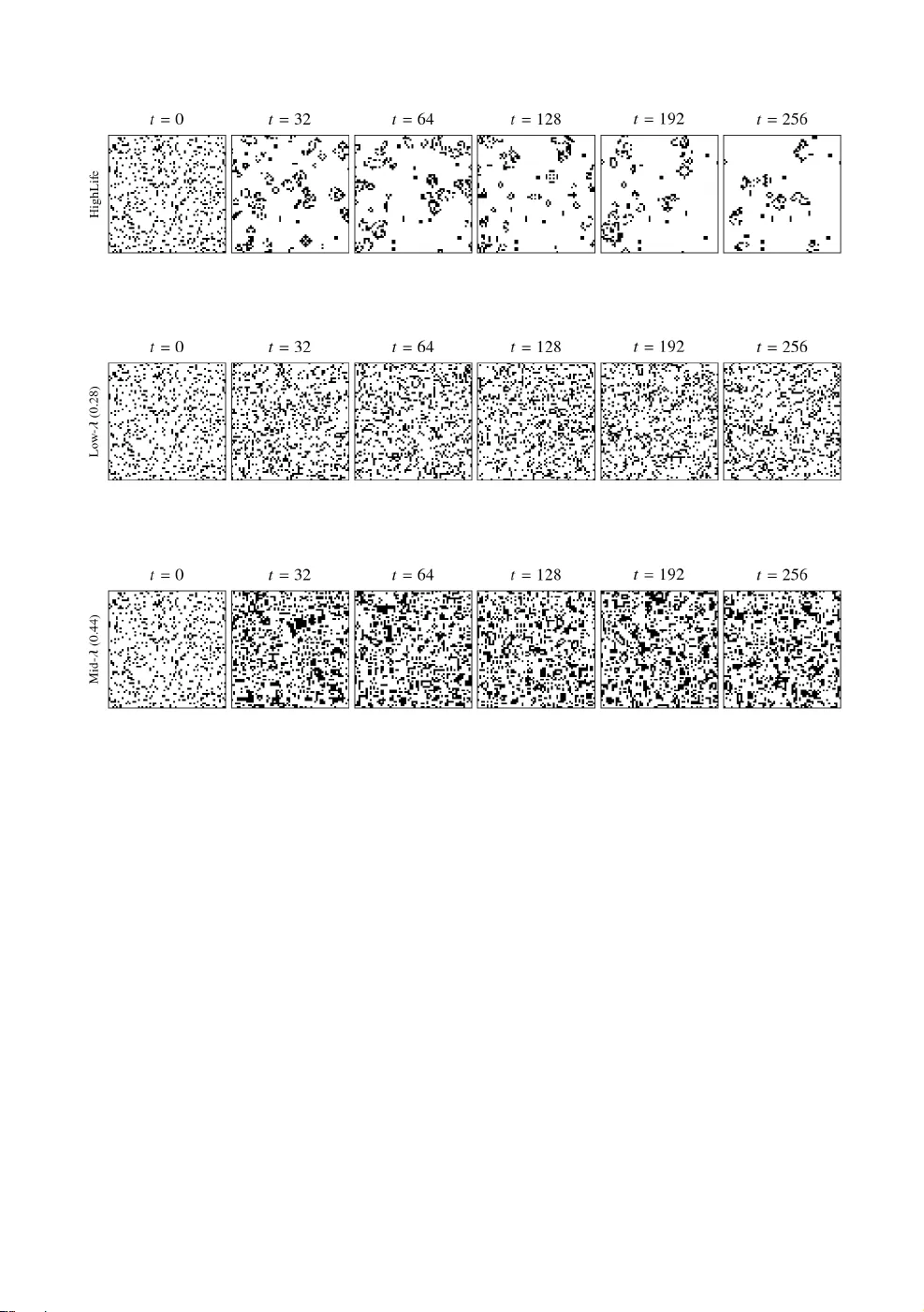
J. R. Soc. Interface (2026), xx :xx 1–20 R e s e a r c h A r t i c l e The Self-R eplication Phase Diagram: Mapping Where Lif e Becomes P ossible in Cellular A utomat a Rule Space Don Yin ∗ 1 1 School of Clinical Medicine, Univ ersity of Cambridge, Cambr idge, United Kingdom. Ke ywords: cellular automata, self-replication, phase diagram, edg e of chaos, artificial lif e Abstract What substrate f eatures allow lif e? W e exhaustiv ely classify all 262,144 outer -totalistic binary cellular automata rules with Moore neighbourhood for self-replication and produce phase diagrams in the ( 𝜆 , 𝐹 ) plane, where 𝜆 is Langton ’ s rule density and 𝐹 is a bac kground-stability parameter . Of these rules, 20,152 (7.69%) suppor t pattern prolif eration, concentrated at low rule density ( 𝜆 ≈ 0 . 15 – 0 . 25 ) and lo w-to-moderate background stability ( 𝐹 ≈ 0 . 2 – 0 . 3 ), in the weakl y supercritical regime (Derr ida coefficient 𝜇 = 1 . 81 f or replicators vs. 1 . 39 for non-replicators). Self-replicating rules are more approximatel y mass-conser ving (mass-balance 0.21 vs. 0.34), and this generalises to 𝑘 = 3 Moore r ules. A three-tier detection hierarch y (patter n prolif eration, extended-length confirmation, and causal per turbation) yields an estimated 1.56% causal self-replication rate. Self-replication rate increases monotonically with neighbourhood size under equalised detection: v on Neumann 4.79%, Moore 7.69%, e xtended Moore 16.69%. These results identify back ground stability and approximate mass conser v ation as the primar y axes of the self-replication phase boundary . 1. Introduction What substrate features allow lif e? Self-replication, the ability of a patter n to produce copies of itself, is a fundamental signature of living sys tems. In cellular automatons (CAs) , some r ule configurations support self-replicating structures while others do not [ 21 , 10 ]. Despite decades of study , no w ork has sys tematically mapped where in substrate parameter space self-replication becomes possible. Langton [ 11 ] established that CA dynamics undergo a phase transition as a function of rule density 𝜆 , with comple x behaviour that concentrates at an inter mediate critical value 𝜆 𝑐 [see also 12 ]. W oot- ters and Langton [ 23 ] show ed that this transition shar pens as the number of cell states 𝑘 increases. Ho w e v er , 𝜆 alone is a noisy predictor of individual r ule behaviour [ 13 ]. Sakai et al. [ 19 ] introduced a second parameter 𝐹 that measures quiescent-background stability and show ed, f or one-dimensional 𝑘 = 4 totalistic r ules, that the order–chaos boundar y occupies onl y ∼ 11% of the 𝐹 range at fix ed 𝜆 , a tenf old shar pening relativ e to 𝜆 alone. Self-replicating CAs ha ve been studied in specific substrates: Langton [ 10 ] designed 8-state loops, By l [ 2 ] reduced this to 6 states, Reggia et al. [ 17 ] obser v ed emergent replication in CA space, Chou and R eggia [ 3 ] show ed that self-replicating s tructures can emerg e from random initial conditions, and Y ang [ 24 ] and Hintze and Bohm [ 7 ] disco v ered spontaneous distributed self-replication in a binar y CA . Brown and Sneppen [ 1 ] recently catalogued replicators in a 3-state Game of Life (GoL) e xtension with varying sur viv al thresholds. In continuous sys tems, Papadopoulos et al. [ 14 ] found self-replication near phase boundar ies in multi-channel Lenia, and Plantec et al. [ 16 ] show ed that mass conservation increases the frequency of self-maintaining patterns. 2 Yin Complementary effor ts hav e character ised the full Life-lik e rule space ( 2 18 = 262 , 144 outer -totalistic binary r ules with Moore neighbourhood) without targ eting self-replication. Eppstein [ 6 ] classified the non-B0 subset (roughly half ) of these r ules by gro wth and decay proper ties. T urney [ 20 ] computed beha vioural f eature vectors for all 262,144 rules, and Kumar et al. [ 9 ] used CLIP-based open-endedness scores to search Life-lik e rule space via optimisation in their AS AL frame work. None of these studies mapped the prev alence of self-replication across r ule-space parameters. Y et no study has parameter ised the space of substrates themsel ves (v ar ying cell states, neighbourhood geometry , rule density , and background stability simultaneously) and mapped where self-replication occurs. Here we present a systematic mapping. W e exhaus tivel y classify all 262,144 outer -totalistic binary CA r ules with Moore neighbourhood f or self-replication and produce phase diag rams in the ( 𝜆, 𝐹 ) plane. W e find that: 1. Self-replication concentrates at low r ule density ( 𝜆 ≈ 0 . 15 – 0 . 25 ) and lo w-to-moderate background stability ( 𝐹 ≈ 0 . 2 – 0 . 3 ), in the weakl y supercr itical regime; Derr ida coefficient analy sis yields 𝜇 = 1 . 81 f or replicators versus 1 . 39 f or non-replicators, which places self-replication abov e the edg e of chaos ( 𝜇 = 1 ) rather than below it. Under an equalised detection protocol, self-replication rate increases monotonically with neighbourhood size ( von Neumann (vN) 4.79% [3.6–6.3%], Moore 7.69%, e xtended Moore 16.69% [15.97–17.44%]). 2. 20,152 of 262,144 Lif e-like r ules (7.69%) support patter n prolif eration. 3. Rules with self-replication are more approximatel y mass-conserving than those without (mass- balance score 0.21 vs. 0.34), ev en without an explicit conser vation constraint. 4. A three-tier detection hierarch y finds that 97.8% of rules with patter n prolif eration are confirmed under an extended-length rescreen, and 20.8% of those contain causall y fragile self-replicating patterns, for an es timated 1.56% causal self-replication rate. Rules with self-replication sho w stronger spatial synergy (O-inf ormation Ω = − 0 . 30 vs. − 0 . 24 , 𝑝 < 10 − 12 ), though multivariate analy sis sho w s this signal is larg el y accounted f or b y mass-balance (logistic regression A UC = 0 . 85 , mass- balance dominant). Approximate mass conservation generalises to 𝑘 = 3 Moore rules ( 𝑑 = − 1 . 04 , 𝑝 = 4 . 2 × 10 − 227 ). 2. Methods 2.1. Substrate parameterisation W e study two-dimensional CAs on a square lattice with periodic boundary conditions. Each cell takes one of 𝑘 states and is updated synchronously according to an outer-totalis tic (OT) rule: the ne w state depends only on the cur rent centre-cell state and the sum of neighbour states. W e sw eep f our parameters: 1. Cell states 𝑘 ∈ { 2 , 3 } : controls inf or mation capacity per cell. W e enumerate 𝑘 = 2 exhaus tiv ely and sample 𝑘 = 3 . 2. Neighbour hood geome try : vN ( | 𝑁 | = 5 ) and Moore ( | 𝑁 | = 9 ). 3. Rule density 𝜆 : the fraction of non-quiescent entries in the r ule table [ 11 ]. W e sweep 𝜆 from 0.05 to 1 − 1 / 𝑘 in 20 steps. 4. Backgr ound stability 𝐹 : adapted from the back ground-stability concept of Sakai et al. [ 19 ], re- w eighted f or outer-totalis tic r ules. 𝐹 OT quantifies how aggressivel y the r ule destro ys quiescent- back ground regions. For OT rules: 𝐹 OT = Í 𝑆 max 𝑠 = 0 𝑤 ( 𝑠 ) · ⊮ [ 𝑇 ( 0 , 𝑠 ) ≠ 0 ] Í 𝑆 max 𝑠 = 0 𝑤 ( 𝑠 ) , 𝑤 ( 𝑠 ) = 1 − 𝑠 𝑆 max 2 J. R. Soc. Interface 3 where 𝑇 ( 0 , 𝑠 ) is the r ule-table output f or centre state 0 with neighbour sum 𝑠 , 𝑆 max is the maximum possible sum, and 𝑤 ( 𝑠 ) weights low -neighbour -sum configurations more hea vily (a quiescent centre surrounded by mostl y quiescent neighbours is the canonical “background” condition). For 𝑘 = 2 with Moore neighbourhood, the OT r ule space contains 2 18 = 262 , 144 rules (the “Lif e- like ” r ules), which w e enumerate exhaus tiv el y . For 𝑘 = 2 with vN neighbourhood, the space contains 2 10 = 1 , 024 r ules, also enumerated exhaus tiv el y . For 𝑘 = 3 Moore, e xtended Moore, and C4 r ule samples, w e dre w 10,000 r ules each, stratified by 𝜆 (500 r ules per 𝜆 bin across 20 bins, rejection sampling was used to achie v e the targ et density). The ( 𝜆 , 𝐹 ) space is a discrete combinator ial lattice, not a continuum. 𝜆 = 𝑛 / ( 𝑘 · | 𝑁 | ) takes 𝑘 · | 𝑁 | + 1 ev enly spaced values (19 f or 𝑘 = 2 Moore), with r ule counts per lev el giv en b y 𝑘 · | 𝑁 | 𝑛 . 𝐹 is a weighted subset sum o ver the quiescent-centre ro w; f or 𝑘 = 2 Moore it takes 147 distinct v alues. The lattice therefore has structurally empty regions (no r ule can e xist there), visible as white cells in the phase diag rams. 2.2. Defining self-replication: three tiers The phase boundary location depends on the definition of self-replication. Motivated by the f ormal distinction between pattern copying and self-replication in Cotler et al. [ 4 ], w e operationalise three detection tiers: Tier 1 (pattern prolif eration): A rule suppor ts pattern proliferation if a bounded non-quiescent pattern 𝑃 appears in strictly increasing cop y count (at least 3 increases) ov er 𝑇 max timesteps. Detection uses connected-component labelling with rotation- and reflection-in variant canonical hashing. Tier 2 (e xtended-length confirmation): The same pattern-proliferation cr iterion is applied at e xtended simulation length (512 steps, 8 chec kpoints instead of 4) and pro vides an independent confirmation of detection robustness. Tier 3 (causal self-replication): A replicating patter n is isolated on an empty g rid, confirmed to self-replicate alone, then eac h cell is individuall y deleted and the simulation re-r un. If ≥ 50% of single- cell deletions pre v ent replication ( 𝑁 = 10 tr ials), the pattern is causally fragile; its structure is necessar y f or replication, not merely sufficient. Figure 1 illustrates the three tiers using the HighLif e (B36/S23) replicator as a w orked ex ample. 2.3. Detection pipeline Stage 1 (screening): Each rule is tested from two initial densities ( 𝐷 0 = 0 . 15 and 0 . 35 ) on a 64 × 64 gr id f or 256 timesteps with snapshots ev ery 64 steps. A rule is flagg ed if any indicator triggers: (A) monotonically increasing component count o ver 3+ checkpoints, or (B) an y multi-cell canonical component hash accumulating 3+ instances across all snapshots. Stage 2 (extended-length rescreen): For flagged rules, the same prolif eration cr iterion is re-applied at 512 steps with 8 chec kpoints (twice the initial screen length) and pro vides independent confir mation of detection robustness. Stage 3 (causal test): For r ules confirmed at e xtended length, per turbation experiments destro y parent patterns early (when the gr id is sparse) via minimal single-cell deletions. 2.4. Derived measures At each rule, we compute: 4 Yin Figure 1: W orked e xample of the three-tier detection hierarch y using HighLife (B36/S23). (a) Tier 1: component count 𝑛 𝑐 increases from 1 to 10 ov er 112 steps, which tr igg ers the patter n-prolif eration criter ion. (b) Tier 2: the same pattern tested at extended length (160 steps); prolif eration continues ( 𝑛 𝑐 = 13 ), whic h confir ms sustained replication. (c) Tier 3: a seed patter n is isolated on an empty gr id and self-replicates ( 𝑛 𝑐 = 1 → 8 ); a single-cell deletion from the seed pre v ents replication ( 𝑛 𝑐 = 1 ), which establishes causal fragility . • Mass-balance score : the mean absolute mass chang e per step, normalised by g rid area: 𝑀 = 1 𝑇 𝑇 𝑡 = 1 | 𝑚 ( 𝑡 ) − 𝑚 ( 𝑡 − 1 ) | 𝑊 × 𝐻 where 𝑚 ( 𝑡 ) = Í 𝑖 , 𝑗 𝑐 𝑖 𝑗 ( 𝑡 ) is the total liv e-cell count at step 𝑡 , and 𝑊 × 𝐻 = 64 × 64 is the g rid size. W e compute 𝑀 from a dedicated 64-s tep simulation at initial density 𝐷 0 = 0 . 15 . Low er values indicate more appro ximatel y conservativ e dynamics. • O-inf ormation Ω = TC − DTC [ 18 ]: computed from the joint distribution of 3 × 3 spatial patches across simulation snapshots. Neg ative Ω indicates synergy dominance (the whole carr ies more inf or mation than the sum of its parts); positive Ω indicates redundancy . J. R. Soc. Interface 5 • Spatial entrop y : mean local Shannon entrop y computed o v er 3 × 3 patches across the gr id. 2.5. Derr ida coefficient T o locate the edge of chaos experimentally , w e computed the Der rida coefficient 𝜇 [ 5 ] f or sampled r ules. For each rule, we initialised a 32 × 32 g rid at 50% density , then ran 100 single-cell perturbation tr ials: in each tr ial, one randomly chosen cell w as flipped, and both the original and per turbed gr ids w ere e v ol v ed f or 𝑇 = 10 steps with snapshots at ev er y step. The Hamming distance 𝛿 𝑡 betw een the two trajectories was recorded at each step. The Derr ida coefficient is defined as the mean ratio of consecutive distances: 𝜇 = ⟨ 𝛿 𝑡 + 1 / 𝛿 𝑡 ⟩ a v erag ed ov er all time steps where 𝛿 𝑡 > 0 and ov er all per turbation tr ials. 𝜇 < 1 indicates ordered (subcritical) dynamics, 𝜇 = 1 marks the critical point, and 𝜇 > 1 indicates chaotic (supercr itical) dynamics. 2.6. Computational details Simulations use FFT -based conv olution for neighbour-sum computation and achiev e 118 ms per r ule including detection. The full 𝑘 = 2 Moore census (262,144 rules) completed in 8.7 hours on a single w orkstation. The detection pipeline was tested agains t known benchmarks: the GoL (B3/S23) and HighLife (B36/S23) are correctly identified as positiv e for self-replication, while both a dead r ule (all-zero table) and a high- 𝜆 chaotic r ule are cor rectl y identified as negativ e. All code is av ailable at https: //github.com/Don- Yin/self- replication . 3. Results 3.1. Exhaustiv e census of Lif e-like rules W e exhaus tiv el y tested all 262,144 OT binar y CA r ules with Moore neighbourhood f or pattern prolif era- tion. Of these, 20,152 rules (7.69%) suppor t patter n proliferation. For comparison, the vN neighbourhood ( | 𝑁 | = 5 , 1,024 rules exhaus tiv ely tested) yields a tier -1 rate of 4.79% under an equalised detection protocol (Section 3.4 ). 3.2. Phase diagram in the ( 𝜆, 𝐹 ) plane Figure 2 sho ws the self-replication phase diag ram in the ( 𝜆 , 𝐹 ) plane f or all 262,144 Life-lik e r ules. Self-replication concentrates in a localised region at low rule density ( 𝜆 ≈ 0 . 1 – 0 . 3 ) and lo w-to-moderate back ground stability ( 𝐹 ≈ 0 . 15 – 0 . 35 ). Figure 3 sho ws a smoothed 3D sur face interpolated from the same data, which makes the localised “island of life ” visually apparent: a sharp peak rises from an otherwise flat landscape of zero replication. Self-replication peaks at 𝜆 ≈ 0 . 15 – 0 . 25 . The Der rida analy sis (Section 3.3 ) show s that the edge of chaos ( 𝜇 = 1 ) occurs at 𝜆 ≈ 0 . 05 – 0 . 10 , so self-replicating rules concentrate in the weakl y supercritical regime ( 𝜇 ≈ 1 . 4 – 1 . 8 ), just abo v e the critical threshold rather than deep in the chaotic phase. This is consistent with the biological requirement that replicators need substrates with enough dynamical capacity to propagate structure, yet not so much disorder that patter ns are des tro y ed. The “island of lif e” is qualitativ ely robust to the choice of 𝐹 -weighting scheme. Under unif orm, linear , and quadratic weightings of birth/sur viv al contributions to 𝐹 , the island persists in all three cases with peak replication rates of ∼ 14%, but the 𝐹 -axis position of the peak shifts (0.225, 0.275, and 0.375 6 Yin Figure 2: Phase diagram f or all 262,144 Lif e-like (outer -totalistic 𝑘 = 2 Moore) r ules. Columns cor re- spond to the 19 exact 𝜆 = 𝑛 / 18 values; 𝐹 is binned into 22 inter v als (the 147 distinct 𝐹 values, which are weighted subset sums of binar y rule-table entries, are too dense to resolv e individually). White cells indicate structurall y empty regions where no rule exis ts. (a) Rule density (log scale): the binomial con- centration at 𝜆 ≈ 0 . 5 reflects 18 9 = 48 , 620 r ules. (b) Self-replication rate: the “island of life ” at low 𝜆 and lo w-to-moderate 𝐹 concentrates in the weakl y supercr itical regime identified b y the Der r ida analy - sis (Section 3.3 ). respectiv el y). The island’ s e xistence is theref ore a structural feature of Life-lik e r ule space, while its precise 𝐹 -coordinate depends on the weighting conv ention. Figure 4 sho w s the self-replication rate as a function of 𝜆 , conditioned on 𝐹 terciles. Figure 5 sho ws the complementary vie w: self-replication rate as a function of 𝐹 , conditioned on 𝜆 terciles. Self-replication peaks at lo w -to-moderate 𝐹 ( ≈ 0 . 2 – 0 . 4 ) and drops at both e xtremes. 3.3. Derr ida coefficient and the edg e of chaos T o locate the edg e of chaos experimentally rather than by heur istic, we computed the Der rida coefficient 𝜇 for each rule by measur ing the mean Hamming-distance ratio between successor pairs of initially close configurations. A value 𝜇 < 1 indicates ordered (sub-cr itical) dynamics; 𝜇 = 1 marks the critical point; 𝜇 > 1 indicates chaotic (supercritical) dynamics. Tier -1-positiv e rules hav e a mean Der rida coefficient 𝜇 = 1 . 81 , compared to 𝜇 = 1 . 39 for tier - 1-negativ e r ules; both groups are supercritical on a v erage, but replicators are more so. Binning r ules b y 𝜆 show s a monotonic profile: 𝜇 rises from 0.76 ( 𝜆 < 0 . 1 ) to 1.41 ( 0 . 1 – 0 . 2 ), 1.63 ( 0 . 2 – 0 . 3 ), 1.78 ( 0 . 3 – 0 . 4 ), and 1.82 ( 0 . 4 – 0 . 5 ). The edge of chaos ( 𝜇 = 1 ) f alls at 𝜆 ≈ 0 . 05 – 0 . 10 , which places the self- replication peak ( 𝜆 ≈ 0 . 15 – 0 . 25 ) fir mly in the weakl y supercr itical regime. Self-replicating r ules are not anomalously sub-cr itical; they sit just abo v e the cr itical threshold, where dynamics are e xpansiv e enough to propagate copies y et structured enough to maintain pattern coherence. Figure 6 show s the Derr ida coefficient across the ( 𝜆 , 𝐹 ) plane. J. R. Soc. Interface 7 Figure 3: Smoothed 3D sur face of the self-replication rate o v er the ( 𝜆, 𝐹 ) plane (Gaussian filter 𝜎 = 0 . 8 , cubic spline interpolation; colour encodes log rule density). The shar p peak at lo w 𝜆 and low 𝐹 sho w s that lif e-suppor ting rules occupy a nar ro w island in parameter space. The Der rida anal ysis (Section 3.3 ) places this peak in the w eakly supercritical regime ( 𝜇 ≈ 1 . 4 – 1 . 8 ), just abov e the edge of chaos. Note: both 𝜆 and 𝐹 are discrete; the smooth surface is a visual aid, not a claim of continuity . Figure 4: Self-replication rate v ersus 𝜆 , ov erall (black) and conditioned on 𝐹 terciles (coloured). The peak shifts with 𝐹 lev el, which indicates that back ground stability adds discriminator y pow er bey ond 𝜆 alone. 8 Yin Figure 5: Self-replication rate v ersus 𝐹 , o v erall (blac k) and conditioned on 𝜆 terciles (coloured). Self- replication peaks at low -to-moderate 𝐹 ( ≈ 0 . 2 – 0 . 4 ) and drops at both extremes, consistent with the localised island in the phase diagram. Figure 6: Derr ida coefficient 𝜇 in the ( 𝜆, 𝐹 ) plane. Colour encodes 𝜇 (blue: subcr itical, 𝜇 < 1 ; red: supercritical, 𝜇 > 1 ; dashed line: 𝜇 = 1 boundary). Tier -1-positive r ules (diamonds) cluster in the red region at 𝜇 ≈ 1 . 4 – 1 . 8 , abo v e the cr itical threshold. J. R. Soc. Interface 9 3.4. V on Neumann versus Moor e neighbourhood U nder the original detection protocol (4 initial conditions per density , 512 steps), the vN neighbourhood ( | 𝑁 | = 5 ) yields a tier -1 rate of 33.2% (340/1,024), higher than Moore (7.69%). Ho we v er , the original protocol allocated more detection effor t to vN r ules than to Moore rules. T o control f or this, we re-ran the full vN census under an equalised protocol matched to the Moore screening conditions (1 initial condition per density , 256 steps). Under equalised detection, the vN tier-1 rate drops to 4.79% (95% CI 1 : [3.6%, 6.3%]; 49/1,024). Figure 7: Phase diag ram f or all 1,024 outer -totalistic 𝑘 = 2 vN rules on the discrete ( 𝜆 , 𝐹 ) lattice. U nder equalised detection (1 IC/density , 256 steps), the tier -1 rate is 4.79%. The lattice is coarser ( 𝜆 = 𝑛 / 10 , 11 values) because the vN r ule table has onl y 10 entries. W e additionall y sampled 10,000 𝑘 = 2 e xtended Moore rules ( | 𝑁 | = 25 ). The self-replication rate is 16.69% (95% CI: [15.97%, 17.44%]). Under equalised detection, the relationship betw een neighbour - hood size and self-replication is monotonicall y increasing with | 𝑁 | : vN 4.79% [3.6–6.3%] ( | 𝑁 | = 5 ) < Moore 7.69% ( | 𝑁 | = 9 ) < e xtended Moore 16.69% [15.97–17.44%] ( | 𝑁 | = 25 ). Larg er neighbourhoods pro vide each cell with a wider receptive field, which enables richer local computations and increases the fraction of r ule space suppor ting self-replication. The higher vN rate under the or iginal protocol reflects greater detection sensitivity (more initial conditions, longer simulation), not necessar il y false positiv es; the equalised protocol sacr ifices sensitivity f or cross-substrate comparability . 3.5. Derived measures at the boundary W e sampled 300 replication-positive and 300 replication-negativ e rules from the Moore census and computed derived measures. T able 1 summar ises the comparison and Figure 8 sho ws the distributions. The mass-balance difference is the strong est signal: self-replicating r ules are 1.6 × more appro xi- mately mass-conser ving than non-replicating rules, despite no explicit conser vation constraint . This is consistent with the h ypothesis that conser vation facilitates self-replication [ 16 , 15 ], e v en in discrete 1 All reported CIs are Wilson score intervals. 10 Yin Measure Replication+ R eplication − Difference 𝑝 (Mann–Whitne y) Cohen ’ s 𝑑 Mass balance 0.210 0.345 − 0 . 135 1 . 9 × 10 − 26 − 0 . 94 O-inf or mation ( Ω ) − 0 . 299 − 0 . 236 − 0 . 063 9 . 3 × 10 − 13 − 0 . 27 Dual total correlation 0.774 0.621 + 0 . 153 1 . 2 × 10 − 7 + 0 . 27 T otal cor relation 0.474 0.385 + 0 . 090 6 . 7 × 10 − 4 + 0 . 17 Spatial entrop y 0.798 0.719 + 0 . 080 0 . 055 † + 0 . 39 T able 1: Derived measures for r ules at the self-replication phase boundar y (300 r ules per class, Mann– Whitne y 𝑈 test). Mass balance is the strong est discriminator ( 𝑑 = − 0 . 94 , large effect); O-information sho w s a smaller univ ariate effect ( 𝑑 = − 0 . 27 ) that does not survive multivariate control (Section 3.12 ). † Not significant at 𝛼 = 0 . 05 . Figure 8: Scatter plots comparing replication-positiv e (red) and replication-neg ativ e (gre y) rules. (a) Mass balance v ersus 𝜆 : replicating r ules cluster at lo wer mass balance (more appro ximately con- serving). (b) Spatial entrop y versus 𝜆 . (c) Mass balance versus spatial entropy : the two measures jointly separate the classes. rule sys tems where ex act number conser vation f orces intr insically one-dimensional dynamics for binar y adjacent-cell rules [ 22 ], which sev erely limits the str uctural reper toire av ailable. T o control f or potential conf ounding between self-replication status and location in ( 𝜆 , 𝐹 ) space, w e repeated the compar ison with 𝜆 / 𝐹 -matched negativ e controls (nearest-neighbour matching in the ( 𝜆 , 𝐹 ) plane). The mass-balance signal sur viv ed matching (Cohen ’ s 𝑑 = − 0 . 94 , 𝑝 = 1 . 9 × 10 − 26 ), as did O- inf or mation ( 𝑑 = − 0 . 27 , 𝑝 = 9 . 3 × 10 − 13 ). A permutation test (10,000 shuffles) yielded 𝑝 < 10 − 4 f or mass-balance and 𝑝 = 0 . 001 f or O-information. 3.6. O-inf ormation: synergy at the boundary W e computed O-inf or mation [ 18 ] f or 300 replication-positiv e and 300 replication-negativ e rules. W e estimated total cor relation (TC), dual total cor relation (DTC), and their difference Ω = TC − DTC from the joint distr ibution of 3 × 3 spatial patches across simulation snapshots. Negativ e Ω indicates J. R. Soc. Interface 11 synergy dominance (the whole car ries more inf or mation than the sum of its parts); positiv e Ω indicates redundancy . Both g roups are synergy-dominated ( Ω < 0 ), but self-replicating rules sho w mor e synergy: Ω = − 0 . 30 f or replication-positive v ersus − 0 . 24 f or replication-neg ativ e rules. The dual total cor relation is ∼ 25% higher in replicating r ules (DTC = 0 . 77 vs. 0 . 62 ), which indicates strong er higher-order statis tical dependencies. Figure 9 show s the distributions. Figure 9: Information-theoretic measures at the self-replication boundary . Left: O-inf ormation (negativ e = synergy). Centre: total correlation (TC). Right: dual total cor relation (DTC). Replicating r ules (red) sho w more synergy (more negativ e Ω ) and hea vier tails in both TC and DTC. The synergy signal suggests that self-replicating substrates e xhibit information structure that cannot be decomposed into pairwise correlations; the spatial patter n of a replicator car ries higher-order depen- dencies. How ev er , as the multiv ar iate anal ysis in Section 3.12 show s, this signal does not add predictiv e po w er be y ond mass-balance, which indicates that O-inf ormation and approximate conser v ation share substantial variance. 3.7. Multi-state extension: 𝑘 = 3 T o test whether the phase boundar y shifts with state count, we sampled 10,000 OT 𝑘 = 3 Moore rules across 20 𝜆 bins. The self-replication rate is 15.55% (95% CI: [14.85%, 16.28%]), appro ximately double the 𝑘 = 2 rate (7.69%). Figure 10 compares the 𝜆 profiles. The doubling from 𝑘 = 2 to 𝑘 = 3 indicates that state count is an axis of the self-replication phase diagram: more states shift the boundar y outward and increase the fraction of rule space that suppor ts self-replication. 3.8. Rule symmetr y : totalistic constraint helps T o test whether the outer -totalistic constraint restricts or facilitates self-replication, w e sampled 10,000 rotationally -symmetr ic (C4) 𝑘 = 2 Moore rules from the 2 140 -dimensional space where the Outlier CA [ 24 ] resides. C4 r ules preser v e 4-f old rotational symmetr y but break reflection symmetr y and are not constrained to depend only on neighbour sums. 12 Yin Figure 10: Self-replication rate versus 𝜆 f or 𝑘 = 2 (blue, exhaus tive) and 𝑘 = 3 (red, sampled). The 𝑘 = 3 rate is consistentl y higher and peaks at a slightly higher 𝜆 , consistent with a richer state alphabet that enables more compact replicators. The C4 self-replication rate is 3.57% (95% CI: [3.22%, 3.95%]; 357 / 10,000), low er than the OT rate of 7.69%. This is counter intuitiv e: relaxing the totalistic constraint, which nominally allo w s r ic her dynamics, reduces the frequency of self-replication. One inter pretation is that the totalistic constraint acts as a regulariser . By restr icting the rule table to neighbour counts (18 entries) rather than specific neighbour configurations (512 entr ies), it suppresses chaotic dynamics and increases the fraction of rules in the structured regime where self-replication is possible. As with the conservation finding, structural constraints that reduce dynamical freedom can parado xically increase the prev alence of comple x beha viour . 3.9. Tier -2 confirmation: extended-length rescreen T o distinguish g enuine self-replication from transient ar tef acts, we rescreened 1,000 replication-positive rules at e xtended simulation length (512 steps, 8 checkpoints; Section 2 ). Of these, 978 (97.8%, 95% CI: [96.7%, 98.6%]) w ere confirmed as positive under the extended-length screen. This high confir mation rate indicates that the vas t majority of rules flagged by the initial screen produce sustained proliferation at longer time hor izons, not merely transient ar tefacts or boundar y - condition cop ying. The 2.2% non-confirmation rate provides an upper bound on the screening er ror . 3.10. Tier -3 causal test: pattern-level per turbation W e tested all 978 tier -2-confirmed rules f or causal self-replication. For each rule, w e (1) identified a replicating component from an earl y simulation snapshot, (2) placed it in isolation on an empty gr id J. R. Soc. Interface 13 and confir med it self-replicates alone, and (3) sy stematicall y deleted single cells from the seed pattern (10 trials per r ule) and chec ked whether replication was pre v ented. Of the 978 r ules tested, 203 (20.8%, 95% CI: [18.3%, 23.4%]) passed the causal self-replication test (prev ention rate ≥ 0 . 5 ). The remaining rules f ell into three categor ies: 571 (58.4%) w ere robust r eplicators whose seed patter ns replicate in isolation but tolerate single-cell per turbations; 119 (12.2%) e xhibited distributed replication , where patterns proliferate from random initial conditions but not from isolated seed patterns; and 85 (8.7%) could not be tested due to density or e xtraction limitations. The distributed-replication class (12.2%) contains r ules that support pattern prolif eration only through cooperativ e multi-component dynamics, not from an y single self-replicating structure. This is consistent with the distr ibuted selfhood obser v ed by Hintze and Bohm [ 7 ] in the Outlier cellular automaton, and sugges ts that distributed self-replication may be more common than previousl y assumed in Lif e-like rule space. Combining the pass rates across the three-tier detection hierarc h y (7.69% at tier 1, 97.8% [96.7–98.6%] at tier 2, 20.8% [18.3–23.4%] at tier 3) yields an estimated 1.56% (95% CI: [1.2%, 2.0%]) of all 262,144 Lif e-like r ules as causal self-replicators. 3.11. Detection robustness T o test whether the census results depend on detection hyperparameters, we re-ran tier -1 detection on 5,000 rules (2,500 original positives, 2,500 negativ es) at 512 steps with varied snapshot intervals (32, 64, 128) and minimum-increase thresholds (2, 3, 4, 5). A t the census settings (inter v al 64, threshold 3), 99.9% of or iginal tier -1 rules are reco v ered. At the s tr icter setting (inter v al 64, threshold 4), 96.3% are s till reco vered while the false-positiv e rate among original negativ es drops from 66% to 40%. The separation betw een original positives and negativ es is consistent across all 12 parameter combinations, which supports the conclusion that the phase-diag ram structure is robust e v en though the absolute tier -1 rate shifts with detection stringency . 3.12. Multivariate prediction of self-replication A logistic reg ression trained on ( 𝜆 , 𝐹 , mass-balance, spatial entropy , O-inf ormation) achie v es A UC = 0 . 85 (5-fold cross-validation) f or predicting self-replication status. Mass-balance is the dominant predictor (standardised coefficient − 2 . 09 ), f ollo w ed by spatial entrop y ( + 1 . 35 ) and 𝜆 ( − 0 . 42 ). O- inf or mation contributes negligibly after controlling for the other features (coefficient − 0 . 01 ), which sugges ts that the O-information signal in T able 1 is larg el y accounted for by shared variance with mass-balance and 𝜆 . The mass-balance signal generalises across substrates. For 𝑘 = 3 Moore r ules, the replication- positiv e/negativ e mass-balance difference is large (Cohen ’ s 𝑑 = − 1 . 04 , 𝑝 = 4 . 2 × 10 − 227 ), ex ceeding the 𝑘 = 2 effect size. For vN r ules (with tier -1 labels from the or iginal protocol, 𝑛 pos = 340 ), the effect is weak er and non-significant ( 𝑑 = − 0 . 31 , 𝑝 = 0 . 30 ), likel y reflecting both the smaller r ule space (1,024 rules) and the reduced statistical pow er of the vN parameter space. Approximate mass conservation is therefore a cross-substrate predictor of self-replication, at least f or r ule spaces with sufficient combinatorial r ichness. Figure 11 summar ises the cross-substrate compar ison. 3.13. Cross-comparison with ASAL open-endedness T o test whether self-replication cor relates with visual open-endedness, we computed the Spearman rank correlation betw een each r ule ’ s tier-1 replication status and its ASAL open-endedness score [ 9 ], which quantifies the div ersity of CLIP-embedded visual patter ns produced across simulation tra jectories. The 14 Yin Figure 11: Cohen’ s 𝑑 f or the mass-balance difference betw een replication-positiv e and replication- negativ e rules across three substrates. 𝑘 = 2 Moore and 𝑘 = 3 Moore sho w larg e, significant effects; 𝑘 = 2 v on Neumann is weak er and non-significant. correlation is effectiv el y zero ( 𝜌 = − 0 . 002 , 𝑝 = 0 . 24 ). Self-replication is theref ore independent of CLIP - based visual open-endedness: r ules that produce diverse visual patter ns are no more (or less) likel y to support self-replication than r ules that con v erg e to unif or m or repetitiv e fields. This dissociation sugg ests that the computational requirements f or self-replication (appro ximate conser vation, moderate dynamical comple xity) are or thogonal to those f or visual diversity as measured b y f oundation-model embeddings. 3.14. V er ification at larg er scale T o test whether the pattern-proliferation results are finite-size ar tefacts, we re-ran the 100 low est- 𝜆 replication-positiv e r ules on a 256 × 256 gr id f or 8,192 timesteps (compared to 64 × 64 and 256 steps in the census). All 100 r ules (100%) were positiv e at the larger scale, with no false positiv es. This indicates that the patterns detected in the census represent scale-robust prolif eration dynamics. 3.15. Example replicators Figure 12 sho ws time-lapse visualisations of three example self-replicators: HighLife (B36/S23), a lo w - 𝜆 replicator ( 𝜆 = 0 . 28 ), and a mid- 𝜆 replicator ( 𝜆 = 0 . 44 ). All three show the characteristic pattern of localised structures that spawn copies into quiescent space. 4. Discussion 4.1. Beyond the edge of c haos: conservation as the binding constraint The conv entional e xpectation, follo wing Langton [ 11 ], was that self-replication should concentrate at the edge of chaos, where dynamical activity is maximal yet still controllable. Our data refine this picture. Self-replication peaks at 𝜆 ≈ 0 . 15 – 0 . 25 , where the Der rida coefficient is already supercr itical: 𝜇 = 1 . 81 f or tier -1-positiv e r ules v ersus 𝜇 = 1 . 39 for tier -1-negativ e r ules at matched 𝜆 . The edg e of chaos ( 𝜇 = 1 ) itself falls at 𝜆 ≈ 0 . 05 – 0 . 10 , below the self-replication peak. This means self-replicators are not poised at cr iticality ; the y inhabit a w eakly supercr itical regime. Moreo v er , replicating r ules are more dynamicall y active than non-replicating rules at the same 𝜆 , not less. The Der rida gap ( Δ 𝜇 ≈ 0 . 4 ) is consistent with a picture in which replication requires enough J. R. Soc. Interface 15 Figure 12: Time-lapse visualisations of three self-replicators on 64 × 64 gr ids from density 𝐷 0 = 0 . 15 . Columns sho w snapshots at 𝑡 = 0 , 32 , 64 , 128 , 192 , 256 . T op: HighLif e (B36/S23). Middle: low - 𝜆 replicator . Bottom: mid- 𝜆 replicator. All exhibit localised structures that proliferate ov er time. perturbation growth to propagate spatial copies, while r ules that merely conser v e structure without amplifying it cannot sustain proliferation. If dynamical activity alone were sufficient, the self-replication rate should peak near the Derr ida maximum, well abov e 𝜆 = 0 . 25 . It does not, because a second constraint binds first: appro ximate mass conservation. R ules at higher 𝜆 are supercr itical but non-conser ving; their dynamics destro y patter ns fas ter than copies can f orm. The binding cons traint is theref ore conser vation, not cr iticality . Self- replication requires w eak supercr iticality plus appro ximate conservation, and the nar ro w 𝜆 window where both conditions are jointly satisfied defines the island of life in the phase diagram. This reframes the Langton hypothesis. Dynamical activity at or abo v e the edge of chaos is necessary (rules in the ordered regime ( 𝜇 < 1 ) almost nev er self-replicate), but it is not sufficient. Conser v ation pro vides the additional structural constraint that channels supercr itical dynamics into patter n-preserving replication rather than pattern-destro ying chaos. 4.2. Back ground stability as a hidden variable The adapted 𝐹 parameter (Section 2 ; cf. [ 19 ]) captures a dimension of rule str ucture that 𝜆 misses: which entr ies in the r ule table are non-quiescent. T wo r ules with identical 𝜆 but different 𝐹 hav e the 16 Yin same activity lev el but differ in whether that activity disr upts quiescent regions. Our phase diagrams sho w that self-replication is localised in the ( 𝜆, 𝐹 ) plane; background stability is a relev ant axis for characterising lif e-suppor ting substrates. 4.3. Appro ximate conser vation without design The finding that self-replicating r ules are more appro ximatel y mass-conser ving connects to recent w ork on mass-conser ving CAs . Plantec et al. [ 16 ] sho w ed that adding e xact mass conser v ation to Lenia transforms the system from one where self-maintaining patterns are rare to one where the y are abundant. Papadopoulos and Guichard [ 15 ] reported a similar patter n in continuous CAs using their MaCE framew ork. Our data extend this patter n to discrete sys tems: ev en without e xplicit conser v ation constraints, the r ules that happen to approximatel y conser v e mass are those most likely to suppor t self-replication. This association survives 𝜆 / 𝐹 matching (Cohen’ s 𝑑 = − 0 . 94 ) and per mutation testing ( 𝑝 < 10 − 4 ). The conservation effect generalises bey ond binary Moore rules. For 𝑘 = 3 outer -totalistic Moore rules, the mass-balance effect is e v en strong er ( 𝑑 = − 1 . 04 , 𝑝 = 4 . 2 × 10 − 227 ), which suggests that conser v ation becomes a more pow er ful discriminator as the state alphabet grow s. For the vN neighbourhood, the effect is weak er ( 𝑑 = − 0 . 31 ), though this estimate draw s on only 49 tier -1-positive rules under the equalised protocol and may be underpow ered. Across these three substrates, appro ximate conservation is a con v erg ent proper ty of lif e-suppor ting r ules, not merely an engineer ing conv enience imposed by design. 4.4. Mass-balance as the primar y discriminator A logistic regression combining 𝜆 , 𝐹 , mass-balance, spatial entropy , and O-inf or mation achie v es A UC = 0 . 85 for predicting self-replication status, with mass-balance as the dominant f eature (standardised coefficient − 2 . 09 ). O-information, despite a significant univ ariate signal ( 𝑑 = − 0 . 27 , 𝑝 < 10 − 12 ), con- tributes negligibly once mass-balance is controlled (coefficient ≈ 0 ). This indicates that the spatial synergy observed in replicating r ules shares substantial variance with appro ximate conser v ation: r ules that appro ximately conser v e mass tend also to produce synergy -dominated spatial patter ns. Conser va- tion, rather than higher -order information structure per se, appears to be the more fundamental substrate property associated with self-replication. 4.5. N eighbourhood size: monotonically increasing self-replication U nder an equalised detection protocol (matching the number of initial conditions and simulation length across neighbourhoods), self-replication rate increases monotonically with neighbourhood size: vN ( | 𝑁 | = 5 , 4.79%) < Moore ( | 𝑁 | = 9 , 7.69%) < extended Moore ( | 𝑁 | = 25 , 16.69%). The original vN rate of 33.2% reflects the higher detection sensitivity of a protocol with 4 × more initial conditions and 2 × longer simulation time; once these factors are equalised, the vN neighbourhood produces the lo w est replication rate, not the highest. The monotonic relationship admits a straightf orward interpretation: larg er receptive fields provide each cell with more spatial inf or mation f or encoding replication mec hanisms. A 5 × 5 e xtended Moore kernel can represent spatial templates that are inaccessible to the 3 × 3 Moore kernel, which in tur n can encode r icher neighbour interactions than the 4-cell vN k ernel. The relationship betw een neighbourhood size and self-replication is thus go verned by inf ormation capacity , not by a tension betw een locality and dilution. J. R. Soc. Interface 17 A cav eat is w arranted: the e xtended Moore rate (16.69%) derives from a 10,000-r ule sample of the 2 50 rule space, whereas the Moore census is e xhaustiv e. Sampling variance ma y affect the extended Moore estimate, and the tr ue population rate could differ . 4.6. Self-replication versus open-endedness Comparing our exhaus tiv e self-replication census against the AS AL open-endedness scores of K umar et al. [ 9 ] f or the same 262,144 r ules yields a near -zero cor relation ( 𝜌 = − 0 . 002 ). CLIP -based visual no v elty does not predict self-replication, and self-replicating rules are no more or less “interesting” in the AS AL sense than non-replicating rules. This null result has a clear implication: self-replication is a substrate-s tructural phenomenon, go v erned b y conser v ation and mild supercr iticality , not by the kind of visual comple xity that f oundation- model embeddings capture. A r ule can produce visually nov el, open-ended dynamics without supporting self-replication, and conv ersely , many self-replicating rules produce visually repetitive patter ns that score lo w on AS AL no v elty . The mechanisms that underlie self-replication (appro ximate conservation, lo w 𝜆 , appropr iate 𝐹 ) are structural features of the r ule table, not emerg ent aesthetic proper ties of the dynamics. 4.7. Comparison with Brown and Sneppen (2025) Bro wn and Sneppen [ 1 ] studied replicators in a three-state e xtension of the Game of Life (“3-Lif e ”) with v arying sur viv al thresholds, and found that self-replication emerg es preferentiall y in lo w-activity regimes. Their w ork, selected as a PRE Editors ’ Sugges tion, provides a deep characterisation of replicator dynamics within a single r ule f amily . Our study takes a complementar y approach: rather than varying thresholds within one f amily , w e e xhaustiv ely surve y the full 262,144 outer-totalis tic binar y rule space and sample 10,000 𝑘 = 3 r ules to map the self-replication phase boundar y across substrate parameters. The con v erg ent finding that replication f a v ours low -activity regimes in both studies strengthens confidence that this is a generic property of Life-lik e substrates, not an ar tefact of any par ticular r ule family . Our 𝑘 = 3 sweep (15.55% tier-1 rate, 95% CI: [14.85%, 16.28%]) provides a quantitativ e complement to the Bro wn and Sneppen analy sis: by sampling across 𝑘 = 3 outer-totalis tic r ule space rather than within a single r ule, w e can estimate the prev alence of self-replication as a function of 𝜆 and 𝐹 . The mass- balance finding ( 𝑑 = − 1 . 04 for 𝑘 = 3 ) sugges ts that appro ximate conser vation ma y also be relev ant in 3-Lif e, though Brown and Sneppen [ 1 ] did not test this directly . The difference between the two studies is one of scope versus depth: we pro vide a systematic phase diagram across substrate parameters and identify conservation and mild supercr iticality as the binding constraints, whereas Brown and Sneppen [ 1 ] provide detailed mechanis tic analy sis of replicator dynamics, including replication cy cles and spatial org anisation, within a single substrate. The two perspectiv es are complementar y and together sugg est that the conditions f or self-replication are both nar ro w and universal across Lif e-like cellular automata. 4.8. Limitations Our pattern-proliferation definition is per missiv e, but the extended-length rescreen (Section 3.9 ) repro- duces 97.8% of flagg ed r ules, which bounds the non-confir mation rate at 2.2%. The causal per turbation test (Section 3.10 ) fur ther nar ro ws this to an estimated 1.56% tr ue causal self-replication rate. Of the 𝑛 = 978 confirmed r ules tested, the fraction classified as “robust replicators ” (those that replicate in iso- lation but tolerate single-cell deletions) may represent a genuine categor y of robust self-replication or ma y require multi-cell perturbation tests to rev eal fragility . A dditionally , we tested onl y outer -totalistic rules. All kno wn non-trivial self-replicators at 𝑘 > 2 use non-totalistic rules with directional inf or ma- tion flow [ 10 , 7 ]. The outer-totalis tic restriction may structurally e xclude self-replication mechanisms 18 Yin at higher 𝑘 , though our C4 rotationally -symmetr ic sample (Section 3.8 ) begins to probe non-totalistic rule spaces. The 𝐹 parameter’ s axis location in the phase diagram depends on the w eighting scheme used to compute it: under alter nativ e w eightings the island of life shifts along the 𝐹 axis, though its exis tence and localisation are preserved across all weightings tested. This means the precise 𝐹 coordinates we report are con v ention-dependent, while the qualitativ e conclusion, that back ground stability is a relev ant second axis, is robust. The equalised vN census sho ws that neighbourhood compar isons are sensitiv e to detection protocol. The raw vN rate (33.2%) and the equalised rate (4.79%) differ b y nearl y an order of magnitude, which underscores that protocol-matched compar isons are essential f or cross-substrate claims. 4.9. Outlook The immediate ne xt steps are: (1) extending the sw eep to 𝑘 = 4 , 6 , 8 with both outer -totalistic and rotationally -symmetr ic rules; (2) computing causal emerg ence [ 8 ] at the phase boundary to test whether the macroscale dynamics of self-replicating r ules car ry more effective inf or mation than their microscale; (3) e xtending the Der rida analy sis to continuous CA substrates (Lenia, Flow -Lenia) to tes t whether the w eakly supercritical regime generalises bey ond discrete sys tems; and (4) in v estig ating why the mass- balance effect is w eaker f or vN than for Moore and 𝑘 = 3 , whether this reflects a genuine substrate difference or merely the small sample size under equalised detection. Ref erences [1] F . D. Bro wn and Kim Sneppen, Replicators in Game-of-Lif e-like automata , Phy sical Revie w E 111 (2025), 054306. [2] John Byl, Self-r eproduction in small cellular automata , Phy sica D: Nonlinear Phenomena 34 (1989), 295–299. [3] Hui-Hsien Chou and James A. Reggia, Emerg ence of self-replicating structures in a cellular automata space , Phy sica D: Nonlinear Phenomena 110 (1997), 252–276. [4] Jordan Cotler, Clément Hongler , and Barbora Hudcova, Self-replication and computational univer sality , arXiv prepr int arXiv:2510.08342 (2025). [5] Bernard Derr ida and Y ves Pomeau, Random netw orks of automata: A simple annealed appr oximation , Europhy sics Letters 1 (1986), 45–49. [6] David Eppstein, Growt h and decay in lif e-like cellular automata , Game of Life Cellular Automata (2010), 71–98. [7] Arend Hintze and Christopher Bohm, Rethinking self-replication: Det ecting distributed selfhood in the outlier cellular automaton , npj Complexity 3 (2026), 11. [8] Erik P . Hoel, Lar issa Albantakis, and Giulio T ononi, Quantifying causal emerg ence show s that macro can beat micro , Proceedings of the National Academ y of Sciences 110 (2013), 19790–19795. [9] Akarsh Kumar, Samuel Ear le, et al., ASAL: Automat ed sear ch for artificial life , arXiv prepr int arXiv :2412.17799 (2024). [10] Christopher G. Langton, Self-repr oduction in cellular automata , Phy sica D: Nonlinear Phenomena 10 (1984), 135–144. [11] , Computation at the edg e of c haos: Phase transitions and emerg ent computation , Ph ysica D: Nonlinear Phenomena 42 (1990), 12–37. [12] W entian Li, Norman H. Packard, and Chr istopher G. Langton, T ransition phenomena in cellular automata r ule space , Phy sica D: Nonlinear Phenomena 45 (1990), 77–94. [13] Melanie Mitchell, Peter T . Hraber, and James P . Cr utchfield, Revisiting the edge of chaos: Evol ving cellular automata to perform computations , Complex Systems 7 (1993), 89–130. [14] V assilis Papadopoulos, Guilhem Doat, Arthur Renard, and Clément Hongler , Looking f or complexity at phase boundaries in continuous cellular automata , Proceedings of the Genetic and Evolutionary Computation Conf erence Companion, 2024. J. R. Soc. Interface 19 [15] V assilis Papadopoulos and Etienne Guichard, MaCE: General mass conser ving dynamics for cellular automata , arXiv preprint arXiv:2507.12306 (2025). [16] Erwan Plantec, Gautier Hamon, et al., Flow-Lenia: Emerg ent evolutionary dynamics in mass conser v ative continuous cellular automata , Artificial Life (2025). [17] James A. Reggia, Ste ven L. Armentrout, Hui-Hsien Chou, and Y un Peng, Simple sys tems that exhibit self-directed replication , Science 259 (1993), 1282–1287. [18] Fernando E. R osas, Pedro A. M. Mediano, Michael Gastpar , and Henrik J. Jensen, Quantifying high-order interdependencies via multivariate extensions of the mutual information , Ph ysical Re view E 100 (2019), 032305. [19] Sunao Sakai, Megumi Kanno, and Y ukar i Saito, Phase diagr am on a g eneralized cellular automata r ule space , Ph ysical Re view E 69 (2004), 066117. [20] Peter D. T ur ne y , Measuring behavioural similarity of cellular automata , Ar tificial Life 27 (2021), 62–71. [21] John von Neumann, Theor y of self-repr oducing automata , Univ ersity of Illinois Press, 1966, Edited and completed b y Ar thur W . Burks. [22] Barbara W olnik and Bernard De Baets, All binar y number -conser ving cellular automata based on adjacent cells ar e intrinsically one-dimensional , Phy sical Revie w E 100 (2019), 022126. [23] William K. W ootters and Christopher G. Langton, Is ther e a sharp phase transition for deterministic cellular automata? , Phy sica D: Nonlinear Phenomena 45 (1990), 95–104. [24] Bo Y ang, Emerg ence of self-replicating hierarc hical structures in a binar y cellular automaton , Ar tificial Lif e 31 (2025), 96–105. A ckno wledg ements The author thanks the Cambr idge T rust and the Doctoral Training Programme in Medical Research for their support. Ethics This work is computational and inv ol v es no human participants, animal subjects, or personal data. No ethics appro val was required. AI and AI-assisted technologies GitHub Copilot was used for wr iting assistance and grammar checking. All outputs w ere revie wed, v erified, and edited by the author , who takes full responsibility f or the content. Data accessibility All code and data are a vailable at https://github.com/ Don- Yin/self- replication . The pipeline is fully reproducible from the single entry point run.py . Inter mediate results (JSON) and publication figures (PN G) are included in the repositor y . Declaration of AI use See AI and AI-assisted technologies statement abo ve. Competing interests The author declares no competing interests. A uthors’ contributions D.Y .: Conceptualization, Methodology , Software, F ormal analy sis, Inv estig ation, Data curation, W r iting (or iginal draft), W riting (revie w and editing), Visualization. 20 Yin Funding D.Y . is supported by the Doctoral T raining Programme in Medical Research (DTP-MR), Univ ersity of Cambridge School of Clinical Medicine, and by the Cambr idge T rust.
Original Paper
Loading high-quality paper...
Comments & Academic Discussion
Loading comments...
Leave a Comment