The 27-qubit Counterexample to the LU-LC Conjecture is Minimal
It was once conjectured that two graph states are local unitary (LU) equivalent if and only if they are local Clifford (LC) equivalent. This so-called LU-LC conjecture was disproved in 2007, as a pair of 27-qubit graph states that are LU-equivalent, …
Authors: Nathan Claudet
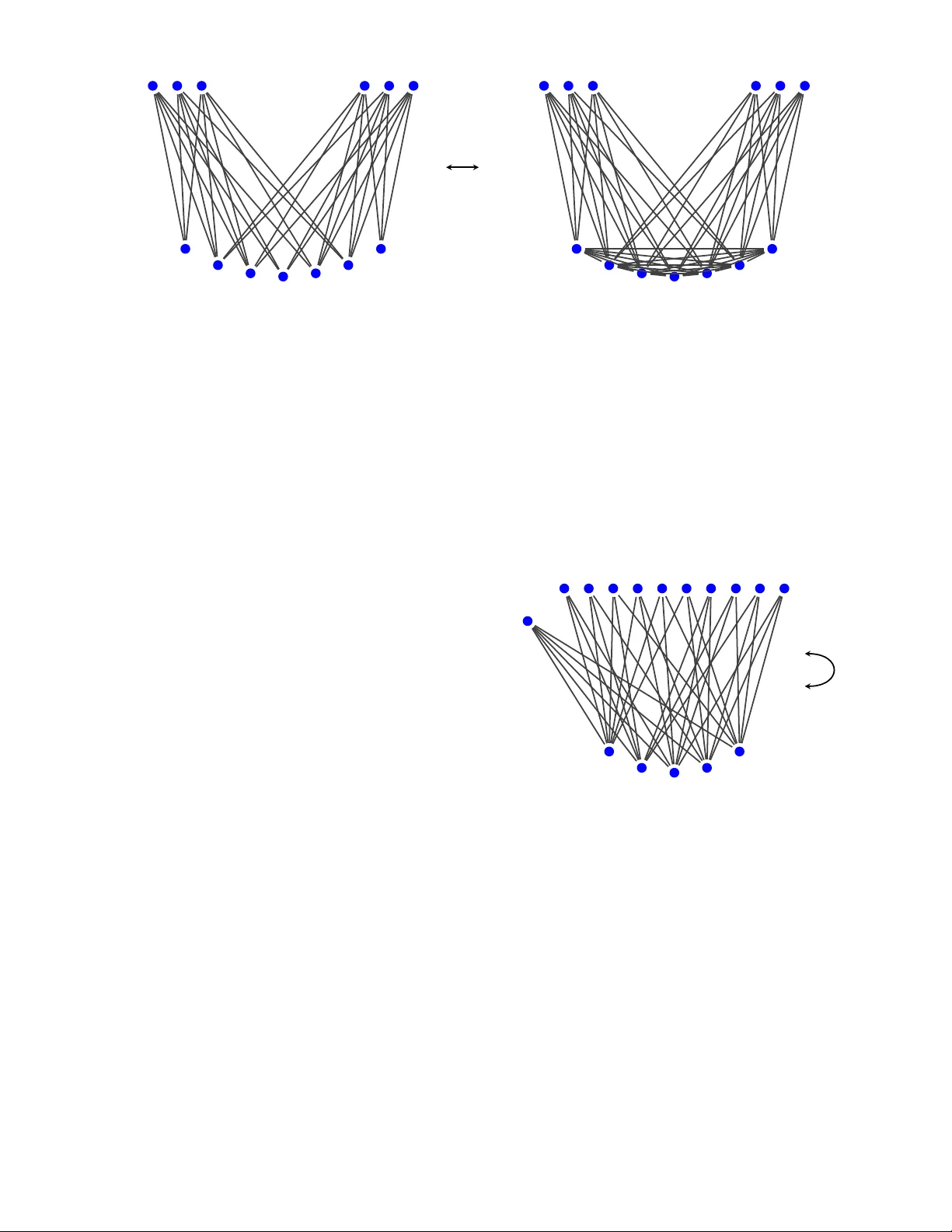
The 27-qubit Coun terexample to the LU-LC Conjecture is Minimal Nathan Claudet ∗ University of Innsbruck, Dep artment of The or etic al Physics, T e chnikerstr aße 21a, A-6020 Innsbruck, Austria It was once conjectured that tw o graph states are lo cal unitary (LU) equiv alent if and only if they are lo cal Clifford (LC) equiv alent. This so-called LU-LC conjecture was disprov ed in 2007, as a pair of 27-qubit graph states that are LU-equiv alent, but not LC-equiv alent, w as discov ered. W e pro ve that this coun terexample to the LU-LC conjecture is minimal. In other words, for graph states on up to 26 qubits, the notions of LU-equiv alence and LC-equiv alence coincide. This result is obtained b y studying the structure of 2-local complementation, a special case of the recently introduced r-lo cal complemen tation, and a generalization of the well-kno wn lo cal complementation. W e make use of a connection with triorthogonal co des and Reed-Muller co des. Graph states form a versatile family of entangled quan- tum states, that allo w for easy and compact represen- tations thanks to their one-to-one corresp ondence with mathematical graphs [ 1 , 2 ]. Graph states are universal resources for measurement-based quan tum computation [ 3 – 5 ], a paradigm introduced b y Hans Briegel and Rob ert Raussendorf in the early 2000s. Graph states first ap- p eared as a generalization of the cluster states [ 6 ], the original resources for measurement-based quan tum com- putation [ 1 ]. Graph states also arise naturally in the con text of quantum error correction [ 7 – 11 ] and quantum comm unication net works [ 12 – 23 ]. In these applications, graph states are used as a resource of entanglemen t. It is thus an essential task to classify graph states accord- ing to their entanglemen t. F or general quantum states, ha ving the same entanglemen t is often formalized at be- ing related b y SLOCC (sto c hastic local op erations and classical communication). F or graph states in particular, this is the same as b eing lo cal unitary equiv alen t, or LU- e quivalent for short, meaning that the graph states are related by single-qubit unitary operators [ 2 , 24 ]. Th us, classifying graph states according to their entanglemen t amoun ts to understanding when tw o graph states are LU- equiv alent. If we restrict the single-qubit unitaries to b e in the so-called Clifford group, this defines a stronger notion of equiv alence: the graph states are said lo cal Clifford equiv alent, or LC-e quivalent for short. LC-equiv alence of graph states is particularly easy to characterize, as it is captured by a simple and well-studied graphical op- eration, called lo cal complemen tation [ 25 ]. This implies for example the existence of an efficient algorithm for recognizing LC-equiv alent graph states [ 26 , 27 ]. Ob viously , t w o LC-equiv alent graph states are LU- equiv alent. Con versely , it was once conjectured that t wo LU-equiv alent graph states are alw a ys LC-equiv alent [ 28 ]: this is often referred to as the LU-LC c onje ctur e . More precisely , we write that LU=LC holds for a graph state | G ⟩ when every graph state LU-equiv alent to | G ⟩ , is actually LC-equiv alen t to | G ⟩ : the LU-LC conjecture predicts that LU=LC holds for every graph state. En- couraging preliminary results were obtained, providing evidence in support of the LU-LC conjecture [ 29 – 32 ]. In fact, LU=LC holds for v arious families of graph states [ 31 – 36 ]. How ever, in 2007, Zhengfeng Ji, Jianxin Chen, Zhaoh ui W ei, and Mingsheng Ying sho wed that the LU- LC conjecture is false [ 37 ], as they discov ered a 27-qubit coun terexample, i.e. a pair of 27-qubit graph states that are LU-equiv alent but not LC-equiv alen t. The original 27-qubit counterexample corresp onds to a pair of graphs that differ by only one edge. Since, an equiv alent coun- terexample has been found, with a more elegan t bipartite form [ 38 ]. W e depict it in Figure 1 . Since 2007, it has b een an op en question whether this 27-qubit counterexample to the LU-LC conjecture is min- imal (in the num b er of qubits). In other w ords, do es LU=LC holds for graph states on up to 26 qubits? In 2003, by generating every graph on up to 7 vertices, it was prov ed that LU=LC holds for graph states on up to 7 qubits [ 1 ]. In 2009, this n umber w as impro v ed to 8 [ 39 ]. Recen tly , this n um b er w as improv ed to 10 [ 40 ] (when graph states are considered up to qubit permutation), then to 11 [ 41 ] (also when graph states are considered up to qubit p erm utation), then to 19 [ 42 ]. In this pap er, we provide a final answer: the 27-qubit coun terexample is minimal. Theorem 1. LU=LC holds for gr aph states on up to 26 qubits. As any stabilizer state is LC-equiv alent to a graph state [ 25 ], the result extends to stabilizer states. Corollary 1. LU=LC holds for stabilizer states on up to 26 qubits. As graph states are in one-to-one correspondence with graphs, it theoretically possible [ 35 ] but in practice out of the question to generate every graph and chec k whether LU=LC holds for the corresponding graph state. In- deed, the num b er of graphs on up to 26 vertices is of the order of 2 ( 26 2 ) ∼ 7 × 10 97 , and this num b er stays very high even when considering unlab eled graphs, i.e. iso- morphism classes of graphs: a low er b ound is given by 2 ( 26 2 ) / 26! ∼ 2 × 10 71 . 2 . . . . . . Figure 1. A 27-qubit counterexample to the LU-LC conjecture [ 37 , 38 ], that is, a pair of graph states that are LU-equiv alent but not LC-equiv alen t. The graphs hav e 6 b ottom v ertices. There is one top vertex of degree 5 p er set of 5 b ottom vertices, and one top vertex of degree 4 per set of 4 b ottom vertices; leading to 6 5 + 6 4 = 21 top vertices. In the leftmost graph, the b ottom vertices form an indep enden t set, while in the rightmost graph, the b ottom vertices are fully connected. Applying X ( π / 4) on the top qubits and Z ( π / 4) on the b ottom qubits maps one graph state to the other. Proving that these t wo graph states are not LC-equiv alent is more in volv ed, a proof can b e found in [ 38 ]. Our pro of instead makes heavy use of the recen tly in- tro duced formalism of r -local complementation. While lo cal complementation captures the LC-equiv alence of graph states [ 25 ], r -local complemen tation (where r is an integer) captures the LU-equiv alence of graph states [ 35 ], in the sense that t wo graph states are LU-equiv alent if and only if the corresp onding graphs are related by r - lo cal complemen tations. In this work, w e fo cus in partic- ular on 2-lo c al c omplementation . Indeed, 2-lo cal comple- men tation captures the LU-equiv alence of graph states on up to 31 qubits. W e b egin b y giving relev ant notations and definitions, b efore introducing 2-lo cal complementation. Then, w e pro ve Theorem 1 . Finally , w e discuss op en questions. Notations. A gr aph G = ( V , E ) is comp osed of t wo sets, a set V of vertices, and a set E of edges connecting t wo v ertices each, i.e., a subset of {{ u, v } | u, v ∈ V } . W e only consider graphs that are undirected (i.e. edge do not hav e a direction) and simple (there is at most one edge b et ween tw o distinct vertices, and no edge connects a vertex to itself ). Given A ⊆ V , | A | denotes the num- b er of vertices in A . W e use the notation u ∼ G v when { u, v } ∈ E , and w e sa y u and v are adjac ent . Giv en a v ertex u ∈ V , N G ( u ) = { v ∈ V | u ∼ G v } is the neigh- b orho o d of u , i.e., the set of vertices adjacent to u . The de gr e e of a v ertex is the size of its neighborho o d. Two v ertices u and v that share the same common neighbor- ho od, more precisely N G ( u ) \ { v } = N G ( v ) \ { u } , are said to b e twins . A set of vertices S is said indep endent when no t wo vertices in S are adjacen t. A graph is said bip ar- tite if its vertex set can b e partitioned into tw o disjoint indep enden t set. T o any simple undirected graph G = ( V , E ) on n v er- tices, is associated an n -qubit quan tum state | G ⟩ , called gr aph state , defined as | G ⟩ = Q { u,v }∈ E C Z uv | + ⟩ V where | + ⟩ = | 0 ⟩ + | 1 ⟩ √ 2 and C Z = | 00 ⟩ ⟨ 00 | + | 01 ⟩ ⟨ 01 | + | 10 ⟩ ⟨ 10 | − | 11 ⟩ ⟨ 11 | . Alternatively , | G ⟩ is defined as the unique fixpoint (up to global phase) of the op erators X u Z N G ( u ) for ev ery u ∈ V , where Z = | 0 ⟩ ⟨ 0 | − | 1 ⟩ ⟨ 1 | and X = | 0 ⟩ ⟨ 1 | + | 1 ⟩ ⟨ 0 | . Single-qubit unitary gates include the Hadamar d gate H = 1 √ 2 ( | 0 ⟩ ⟨ 0 | + | 0 ⟩ ⟨ 1 | + | 1 ⟩ ⟨ 0 | − | 1 ⟩ ⟨ 1 | ), the Z-r otation Z ( α ) = | 0 ⟩ ⟨ 0 | + e iα | 1 ⟩ ⟨ 1 | and the X-r otation X ( α ) = H Z ( α ) H . Single-qubit Clifford gates are those generated b y H and Z ( π 2 ), up to global phase. L o c al c omplementation and pivoting. Lo cal comple- men tation on a v ertex u of a graph consists in comple- men ting the subgraph induced by the neigh b orhoo d of u . F ormally , a lo cal complemen tation on u maps the graph G to the graph G ⋆ u = G ∆ K N G ( u ) where ∆ denotes the symmetric difference on edges and K A is the complete graph on the vertices of A ⊆ V . A lo cal complementa- tion is implemented on a graph state with single-qubit Clifford op erators [ 25 ]: X ( π 2 ) u Z ( − π 2 ) N G ( u ) | G ⟩ = | G ⋆ u ⟩ , con versely if tw o graph states are LC-equiv alen t, the corresp onding graphs are related by a sequence of lo cal complemen tations [ 25 ]. Pivoting on an edge uv consists in three successiv e local complemen tations: G ∧ uv = G ⋆ u ⋆ v ⋆ u = G ⋆ v ⋆ u ⋆ v . F or a bipartite graph, piv oting on uv consists in toggling all edges b et w een N G ( u ) \ { v } and N G ( v ) \ { u } , then sw apping u and v , keeping the graph bipartite (but changing the bipartition). A pivot- ing is implemented on a bipartite graph state with t w o Hadamard gates [ 43 , 44 ]: H u H v | G ⟩ = | G ∧ uv ⟩ . 2-lo c al c omplementation. As lo cal complemen tations on non-adjacen t vertices commute, lo cal complemen ta- tion ov er an independent set S , called 1-lo cal comple- men tation and denoted G ⋆ 1 S , is w ell-defined (and con- sists in applying a local complemen tation on ev ery v ertex in S in any order). Similarly , 2-lo cal complemen tation, denoted G ⋆ 2 S , is applied ov er an independent set S . 3 F urthermore, there is a condition on S for the 2-local complemen tation to b e v alid, called 2-incidenc e . Note that in general an r -lo cal complemen tation is defined on a m ultiset rather than a set, making 2-local complemen- tation easier to introduce than the general case. Refer to [ 45 ] for an accessible introduction to r -local complemen- tation. Definition 1 ([ 35 ]) . An indep endent set S of v ertices is called 2-incident if every pair and triplet of vertices has an even num ber of common neighbors in S , i.e. for any distinct u, v , w ∈ V \ S , | N G ( u ) ∩ N G ( v ) ∩ S | = 0 mod 2 and | N G ( u ) ∩ N G ( v ) ∩ N G ( w ) ∩ S | = 0 mo d 2. Definition 2 ([ 35 ]) . A 2-lo cal complemen tation on a 2- inciden t independent set of v ertices S consists in toggling edges of v ertices with a n umber of common neigh b ors in S that is 2 mo d 4. F ormally , u ∼ G⋆ 2 S v ⇔ ( u ∼ G v ⊕ | N G ( u ) ∩ N G ( v ) ∩ S | = 2 mod 4) where ⊕ denotes the logical XOR. Example 1. The 27-qubit coun terexample to the LU-LC conjecture (see Figure 1 ) corresponds to a pair of graphs mapp ed one to another with a 2-lo cal complementation on the 21 top vertices (whic h form a 2-inciden t indepen- den t set). Prop osition 1 ([ 35 ]) . A 2-lo c al c omplementation is im- plemente d on a gr aph state with lo c al unitaries: O u ∈ S X π 4 O v ∈ V \ S Z − π 4 | N G ( v ) ∩ S | | G ⟩ = | G ⋆ 2 S ⟩ As mentioned ab o ve, 2-lo cal complementation captures the LU-equiv alence of small graph states. Prop osition 2 ([ 42 ]) . If two gr aph states on up to 31 qubits ar e LU-e quivalent, then the c orr esp onding gr aphs ar e r elate d by a se quenc e of lo c al c omplementations c on- taining at most one 2-lo c al c omplementation. In other words, a counterexample to the LU-LC con- jecture on up to 31 qubits exhibits a 2-local complemen- tation that cannot be implemen ted with lo cal comple- men tations. W e will pro ve Theorem 1 b y showing that this do es not occur in graph states on up to 26 qubits. Pr o of of The or em 1 . A natural strategy is to gener- ate every indep enden t 2-inciden t set that can o ccur in a graph on up to 26 v ertices. This is easier than gen- erating every graph on up to 26 v ertices, still, there are to o many possible indep enden t 2-incident sets for an ex- haustiv e generation in reasonable time. W e thus further reduce the problem. Lemma 1. Supp ose ther e exists an n -qubit c ounter exam- ple to the LU-LC c onje ctur e wher e n ⩽ 31 . Then, ther e exists a gr aph G bip artite with r esp e ct to a bip artition S, V \ S of the vertic es such that: 1. G has at most n + 1 vertic es; 2. the de gr e e of every vertex is o dd and at le ast 3; 3. no two distinct vertic es ar e twins; 4. S is 2-incident; 5. ther e exists no set A ⊆ S such that G ⋆ 2 S = G ⋆ 1 A . The pro of of Lemma 1 is constructive, and is provided in the app endix. Example 2. The bipartite graph corresponding to the 27-qubit counterexample to the LU-LC conjecture (see Figure 1 , left), do es not satisfy prop erty 2. In fact, only graphs on an even num b er of v ertices may satisfy prop- ert y 2, according to the handshaking lemma. Applying Lemma 1 to this bipartite graph leads to the 28-qubit coun terexample to the LU-LC conjecture [ 38 ], depicted in Figure 2 . Thanks to Lemma 1 , showing that no bipartite graph on up to 27 vertices satisfies properties 2-5, is enough to pro ve Theorem 1 . A natural strategy is to generate ev ery suc h graph, which ma y b e feasible. It is ho wev er not nec- essary , b ecause of a strong connection b et ween bipartite graphs satisfying prop erties 2-4 and triorthogonal co des [ 46 – 48 ], a class of quan tum error-correcting co des used in magic state distillation proto cols [ 49 – 51 ]. This con- nection is not surprising b ecause, as we will see b elo w, the notions of 2-incidence and triorthogonality are very similar. T o make the connection with triorthogonal co des, to eac h graph G bipartite with resp ect to a bipartition S, V \ S of the v ertices, we asso ciate a matrix, whose n umber of rows is | V \ S | , and whose n umber of columns is | S | + | V \ S | = | V | . More precisely , G is associated with the matrix M G = [ I | A ] where I is the | V \ S | × | V \ S | iden tity matrix, and A is the biadjacency matrix of G , i.e. A describ es the connectivity b et ween S and V \ S . Namely , A has | V \ S | ro ws and | S | columns, and for any a ∈ S , b ∈ V \ S , A ba = 1 if a ∼ G b , and A ba = 0 oth- erwise. This construction is analogous to the connection b et w een bipartite graphs and binary linear co des [ 52 ], or binary matroids [ 53 ]. The latter connection hints at further links b et w een entanglemen t of graph states and matroid theory . Lemma 2. The bip artite gr aph G satisfies pr op erties 2-4 if and only if: • every c olumn in M G has o dd Hamming weight; • M G has no r ep e ate d c olumns; • for any thr e e r ows r 1 , r 2 and r 3 , P i ∈ [1 , | V | ] r 1 i r 2 i r 3 i = 0 mo d 2 , i.e. the pr o d- uct of any thr e e r ows has even Hamming weight. 4 . . . . . . Figure 2. A 28-qubit coun terexample to the LU-LC conjecture [ 38 ], that is, a pair of graph states that are LU-equiv alent but not LC-equiv alent. The graphs hav e 7 b ottom vertices. The top vertices are all of degree 5, and there is one top v ertex p er set of 5 b ottom vertices, leading to 7 5 = 21 top v ertices. In the leftmost graph, the b ottom vertices form an indep enden t set, while in the rightmost graph, the b ottom v ertices are fully connected. Applying X ( π / 4) on the top qubits and Z ( π / 4) on the b ottom qubits maps one graph state to the other. Proving that these tw o graph states are not LC-equiv alent is more in volv ed, a pro of can b e found in [ 38 ], and a proof in the formalism of r -lo cal complementation can b e found in [ 35 ]. The 27-qubit coun terexample to the LU-LC conjecture (see Figure 1 ) can be reco vered b y remo ving one bottom vertex. Note that the three ro ws r 1 , r 2 , r 3 need not b e dis- tinct. The proof of Lemma 2 is pro vided in the appendix. The F 2 -subspace generated by the rows of a matrix sat- isfying the properties men tioned in Lemma 2 is called a unital triortho gonal subsp ac e [ 47 ]. More precisely , the triorthogonalit y corresp onds to the property where for an y three rows r 1 , r 2 , r 3 , P i ∈ [1 ,k ] r 1 i r 2 i r 3 i = 0 mo d 2, and unital means that the subspace con tains the all-1 v ector, whic h is true here as the all-1 v ector is nothing but the sum of all rows, as each column has o dd Ham- ming weigh t. Small unital triorthogonal subspaces were classified in [ 47 ], making use of a strong connection with Reed-Muller codes. There is no canonical choice of a gen- erator matrix for a given unital triorthogonal subspace, ho wev er the row op erations give all possible generator matrices. Moreov er, column p ermutations generate the isomorphism class of the unital triorthogonal subspace. Note that generator matrices are supp osed to hav e full ro w-rank, th us the generator matrix of a unital triorthog- onal subspace can alwa ys be put in to the form M G with ro w op erations and columns p erm utations. In the graphical picture, pivoting and vertex permu- tation corresp ond to these row op erations and columns p erm utations. More precisely , M G ′ can be obtained from M G b y row op erations and columns p erm utations if and only if G and G ′ are related b y pivotings and vertex p er- m utations [ 52 ]. According to Lemma 2 , this pro ves that prop erties 2-4 are stable b y pivoting and vertex p ermu- tation, as well as the follo wing equiv alence. Lemma 3. Ther e is a one-to-one c orr esp ondenc e b e- twe en classes of bip artite gr aphs satisfying pr op erties 2-4 up to pivoting and vertex p ermutation, and isomorphism classes of unital triortho gonal subsp ac es. Our strategy to pro ve Theorem 1 is thus to sho w that if a unital triorthogonal subspace corresp onds to graphs on up to 27 vertices, then none of these graphs satisfies prop ert y 5. F ortunately , prop ert y 5 is stable b y piv oting for bipartite graphs satisfying prop erties 2-4, which we pro ve in the app endix (see Lemma 7 ), implying that we only need to chec k a single representativ e graph for eac h unital triorthogonal subspace. Figure 3. One of the 16-v ertex bipartite graphs corresponding to the unique unital triorthogonal subspace in F 16 2 , from which the original magic state distillation co de by Bravyi and Kitaev [ 49 ] and the first code of the Bra vyi-Haah family [ 46 ] can b e deriv ed [ 47 ]. W e name the b ottom vertices 1, 2, 3, 4 and 5, and w e name the top vertices after their neighborho od. One of the top v ertices is adjacent to every b ottom vertex: { 1 , 2 , 3 , 4 , 5 } . The 5 3 = 10 other top vertices are all p ossible vertices of de- gree 3: { 1 , 2 , 3 } , { 1 , 2 , 4 } , { 1 , 2 , 5 } , { 1 , 3 , 4 } , { 1 , 3 , 5 } , { 1 , 4 , 5 } , { 2 , 3 , 4 } , { 2 , 3 , 5 } , { 2 , 4 , 5 } and { 3 , 4 , 5 } . The set of top ver- tices is 2-incident. A 2-lo cal complementation on the top v er- tices lea ves the graph in v ariant, i.e. does not create or remo v e an y edge. Th us, no counterexample to the LU-LC conjecture can b e derived from this graph. Surprisingly , up to isomorphism, there are only tw o unital triorthogonal subspaces that corresp ond to graphs on up to 27 v ertices [ 47 ]. The first one corresp onds to a graph on 16 vertices (see Figure 3 ), and the second cor- 5 . . . . . . Figure 4. The leftmost graph is one of the 24-vertex bipartite graphs corresp onding to the unique unital triorthogonal subspace in F 24 2 , from whic h the second co de of the Bravyi-Haah family [ 46 ] can b e derived [ 47 ]. W e name the b ottom vertices 1, 2, 3, 4, 5, 6 and 7, and we name the top v ertices after their neigh borho o d. One of the top vertices is adjacen t to every b ottom vertex: { 1 , 2 , 3 , 4 , 5 , 6 , 7 } . 3 top v ertices are of degree 5: { 1 , 2 , 3 , 4 , 5 } , { 1 , 2 , 3 , 4 , 6 } and { 1 , 2 , 3 , 4 , 7 } . The 3 2 × 4 1 + 3 3 = 3 × 4 + 1 = 11 other top vertices are of degree 3, they are all p ossible v ertices of degree 3 with 2 or more neighbors among the v ertices 4, 5 and 6: { 1 , 5 , 6 } , { 2 , 5 , 6 } , { 3 , 5 , 6 } , { 4 , 5 , 6 } , { 1 , 5 , 7 } , { 2 , 5 , 7 } , { 3 , 5 , 7 } , { 4 , 5 , 7 } , { 1 , 6 , 7 } , { 2 , 6 , 7 } , { 3 , 6 , 7 } , { 4 , 6 , 7 } and { 5 , 6 , 7 } . The set of top v ertices is 2-incident. A 2-lo cal complemen tation on the top vertices maps the leftmost graph to the rightmost graph by creating 3 edges: one b et w een 5 and 6, one b etw een 5 and 7, and one b et w een 6 and 7. This transformation can also b e obtained with a single local complementation on the v ertex { 5 , 6 , 7 } . Thus, no counterexample to the LU-LC conjecture can b e derive d from these graphs. resp onds to a graph on 24 v ertices (see Figure 4 ). As ex- p ected, these tw o graphs satisfy properties 2-4. Ho wev er, it is easy to see that no counterexample to the LU-LC conjecture can b e derived from these tw o graphs, as they do not satisfy property 5. Indeed, in the 16-v ertex graph, the 2-lo cal complementation lea ves the graph in v ariant, and in the 24-vertex graph, the 2-lo cal complementation can b e implemented with lo cal complemen tations. This pro ves Theorem 1 , that is, the 27-qubit counterexample to the LU-LC conjecture is minimal. The 28-qubit coun terexample to the LU-LC conjecture (see Figure 2 ) is reco vered from one of the t wo unital triorthogonal subspaces in F 28 2 . Discussion. When the LU-LC conjecture w as dis- pro ved [ 37 ], tw o main questions remained op en: whether the 27-qubit counterexample is minimal, and the exis- tence of an efficien t algorithm to decide when tw o graph states are LU-equiv alent. These questions were b oth addressed with the r -local complementation formalism. This presen t pap er giv es a final answ er to the first ques- tion. The second question was partially answered [ 42 ], but remains op en for the time b eing. While the question of the minimal counterexample to the LU-LC conjecture is now closed, the existence of an infinite strict hierarch y of lo cal equiv alences b et ween graph states [ 35 ] pav es the wa y for a generalization of this question. When r is fixed, r -lo cal complementation exactly captures when graph states are equiv alent up to lo cal unitaries in the level r + 1 of the so-called Clifford hierarc hy [ 35 ]. It is kno wn that for an y r ⩾ 2, there exist graphs related by r -lo cal complemen tations but not ( r − 1)-lo cal complemen tations. F or an y in teger r ⩾ 1, w e ma y define a num ber c ( r ) that is the num b er of v ertices of a minimal pair of graphs related by r -lo cal complemen- tations but not ( r − 1)-local complementations, equiv a- len tly the num b er of qubits of a minimal pair of graphs states equiv alen t up to lo cal unitaries in the level r + 1 but not r of the Clifford hierarc h y . While 0-local comple- men tation is not prop erly defined, lo cal unitaries in the lev el 1 of the Clifford hierarch y are Pauli strings, which ma y only map a given graph state to itself. Thus, we set c (1) = 3, as | K 3 ⟩ and | P 3 ⟩ (where K 3 is the triangle, and P 3 is the path of length 3) are LC-equiv alen t but not the same graph state. This present pap er prov es c (2) = 27, but no v alue of c ( r ) when r ⩾ 3 is currently kno wn. W e ha ve how ever low er and upp er b ounds, c ( r ) ⩾ 2 r +2 [ 42 ] (when r ⩾ 2) and c ( r ) = O (2 r 2 ) (an exact upp er b ound is presen ted in [ 35 ]). While c grows at least exp onen- tially , the upper bound do es not forbid super-exp onen tial gro wth, thus the question of the gro wth of c is currently op en. Note that c ( r ) = Θ(2 r 2 ) would imply that LU- equiv alence of graph states can b e recognized in time n √ log 2 ( n )+ O (1) rather than n log 2 ( n )+ O (1) (where n is the n umber of qubits) [ 42 ]. The main result of this pap er was obtained through a connection b et w een 2-lo cal complemen tation and tri- orthogonal co des. This connection is not surprising, as b oth are strongly related to the third level of the Clif- ford hierarch y . Man y w orks fo cus on co des admitting transv ersal gates at higher lev els of the Clifford hierar- c hy [ 30 , 54 – 59 ]: inv estigating potential connections with r -local complementation is a promising direction. 6 A cknow le dgments. W e thank Lina V andr´ e and Piotr Mitosek for discussions on early ideas to ward proving this result. W e thank Hans Briegel and Rob ert Raussendorf for interesting discussions on the history of graph states and the LU-LC conjecture. This researc h w as funded b y the Austrian Science F und (FWF) [SFB Bey ondC F7102, DOI: 10.55776/F71]. F or op en access purp oses, the au- thors hav e applied a CC BY public copyrigh t license to an y author accepted man uscript v ersion arising from this submission. ∗ Nathan.Claudet@uibk.ac.at [1] Marc Hein, Jens Eisert, and Hans J. Briegel. Multi- part y entanglemen t in graph states. Physic al R eview A , 69(6), Jun 2004. arXiv:quant- ph/0307130 , doi: 10.1103/physreva.69.062311 . [2] Marc Hein, W olfgang D ¨ ur, Jens Eisert, Rob ert Raussendorf, Maarten V an den Nest, and Hans J. Briegel. En tanglemen t in graph states and its appli- cations. Quantum computers, algorithms and chaos , 162, Mar 2006. arXiv:quant- ph/0602096 , doi:10.3254/ 978- 1- 61499- 018- 5- 115 . [3] Rob ert Raussendorf and Hans J. Briegel. A one- w ay quantum computer. Physic al R eview L etters , 86(22):5188, 2001. doi:10.1103/PhysRevLett.86.5188 . [4] Rob ert Raussendorf, Daniel E. Browne, and Hans J. Briegel. Measurement-based quan tum computation on cluster states. Physic al r eview A , 68(2):022312, 2003. arXiv:quant- ph/0301052 , doi:10.1103/PhysRevA.68. 022312 . [5] Hans J. Briegel, Da vid E. Browne, W olfgang D¨ ur, Robert Raussendorf, and Maarten V an den Nest. Measurement- based quantum computation. Natur e Physics , 5(1):19– 26, 2009. , doi:10.1038/nphys1157 . [6] Hans J. Briegel and Rob ert Raussendorf. P ersisten t en- tanglemen t in arrays of interacting particles. Physic al R eview L etters , 86:910–913, Jan 2001. arXiv:quant- ph/ 0004051 , doi:10.1103/PhysRevLett.86.910 . [7] Daniel Gottesman. Stabilizer codes and quan tum er- ror correction, 1997. doi:10.48550/arXiv.quant- ph/ 9705052 . [8] Markus Grassl, Andreas Klapp enec k er, and Martin Rot- teler. Graphs, quadratic forms, and quantum codes. In Pr o c e e dings of the 2002 IEEE International Symp o- sium on Information The ory (ISIT 2002) , 2002. arXiv: quant- ph/0703112 , doi:10.1109/ISIT.2002.1023317 . [9] Dirk Sc hlingemann and Reinhard F. W erner. Quan- tum error-correcting codes asso ciated with graphs. Phys- ic al R eview A , 65(1):012308, 2001. arXiv:quant- ph/ 0012111 , doi:10.1103/PhysRevA.65.012308 . [10] Dirk Schlingemann. Stabilizer co des can b e realized as graph co des, 2001. doi:10.48550/arXiv.quant- ph/ 0111080 . [11] Andrey Boris Khesin. Quantum Computing fr om Gr aphs . PhD thesis, 2025. doi:10.48550/arXiv.2501.17959 . [12] Damian Markham and Barry C. Sanders. Graph states for quantum secret sharing. Physical R eview A , 78(4):042309, 2008. , doi:10.1103/ PhysRevA.78.042309 . [13] Adrian Keet, Ben F ortescue, Damian Markham, and Barry C. Sanders. Quantum secret sharing with q udit graph states. Physic al R eview A , 82:062315, Dec 2010. arXiv:1004.4619 , doi:10.1103/PhysRevA.82.062315 . [14] J´ erˆ ome Jav elle, Mehdi Mhalla, and Simon Perdrix. New proto cols and lo wer bounds for quan tum secret shar- ing with graph states. In Pr o c e edings of the 7th Confer- enc e on the Theory of Quantum Computation, Communi- c ation, and Crypto gr aphy (TQC 2012) , pages 1–12, 2013. arXiv:1109.1487 , doi:10.1007/978- 3- 642- 35656- 8_1 . [15] Sylv ain Gravier, J ´ erˆ ome Jav elle, Mehdi Mhalla, and Si- mon Perdrix. Quantum secret sharing with graph states. In Pr o c e e dings of the 8th Mathematic al and Engine er- ing Metho ds in Computer Scienc e International Do c- tor al Workshop (MEMICS 2012) , 2013. URL: https: //hal.science/hal- 00933722/document , doi:10.1007/ 978- 3- 642- 36046- 6_3 . [16] B. A. Bell, Damian Markham, D. A. Herrera-Mart ´ ı, Anne Marin, W. J. W adsworth, J. G. Rarity , and M. S. T ame. Exp erimen tal demonstration of graph-state quan tum se- cret sharing. Natur e Communic ations , 5(1):5480, Nov 2014. , doi:10.1038/ncomms6480 . [17] Ko ji Azuma, Kiyoshi T amaki, and Hoi-Kwong Lo. All-photonic quan tum repeaters. Natur e c ommunic a- tions , 6(1):1–7, 2015. , doi:10.1038/ ncomms7787 . [18] Ko ji Azuma, Sophia E. Economou, Da vid Elkouss, P aul Hilaire, Liang Jiang, Hoi-Kwong Lo, and Ilan Tz- itrin. Quan tum rep eaters: F rom quantum netw orks to the quantum internet. R eviews of Mo dern Physics , 95(4):045006, 2023. , doi:10.1103/ RevModPhys.95.045006 . [19] F rederik Hahn, Anna Pappa, and Jens Eisert. Quantum net work routing and lo cal complementation. npj Quan- tum Information , 5(1):1–7, 2019. , doi:10.1038/s41534- 019- 0191- 6 . [20] Sergey Bra vyi, Y ash Sharma, Mario Szegedy , and Ronald de W olf. Generating k epr-pairs from an n -party resource state. Quantum , 8:1348, 2024. , doi: 10.22331/q- 2024- 05- 14- 1348 . [21] Cl´ emen t Meignan t, Damian Markham, and F r´ ed ´ eric Grosshans. Distributing graph states ov er arbitrary quan tum net works. Physical R eview A , 100:052333, Nov 2019. , doi:10.1103/PhysRevA.100. 052333 . [22] Alex Fisc her and Don T o wsley . Distributing graph states across quan tum net works. In Pr o c e e dings of the 2021 IEEE International Conferenc e on Quantum Com- puting and Engine ering (QCE 2021) , pages 324–333, 2021. , doi:10.1109/QCE52317.2021. 00049 . [23] V aisakh Mannalath and Anirban P athak. Multiparty en tanglement routing in quantum net works. Physical R eview A , 108:062614, Dec 2023. , doi:10.1103/PhysRevA.108.062614 . [24] F rank V erstraete, Jero en Dehaene, and Bart De Moor. Normal forms and entanglemen t measures for multipar- tite quantum states. Physic al R eview A , 68:012103, Jul 2003. arXiv:quant- ph/0105090 , doi:10.1103/ PhysRevA.68.012103 . [25] Maarten V an den Nest, Jero en Dehaene, and Bart De Mo or. Graphical description of the action of lo cal Clif- ford transformations on graph states. Physic al R eview 7 A , 69(2), F eb 2004. arXiv:quant- ph/0308151 , doi: 10.1103/physreva.69.022316 . [26] Andr´ e Bouchet. An efficient algorithm to recognize lo- cally equiv alent graphs. Combinatoric a , 11(4):315–329, Dec 1991. doi:10.1007/BF01275668 . [27] Maarten V an den Nest, Jero en Dehaene, and Bart De Mo or. Efficient algorithm to recognize the lo cal Clif- ford equiv alence of graph states. Physic al R eview A , 70:034302, Sep 2004. arXiv:quant- ph/0405023 , doi: 10.1103/PhysRevA.70.034302 . [28] Olaf Krueger and Reinhard F. W erner. Some op en problems in quan tum information theory , 2005. doi: 10.48550/arXiv.quant- ph/0504166 . [29] David Gross and Maarten V an den Nest. The LU- LC conjecture, diagonal lo cal op erations and quadratic forms ov er GF(2). Quantum Information and Com- putation , 8(3):263–281, 2008. , doi: 10.26421/QIC8.3- 4- 3 . [30] Bei Zeng, Andrew Cross, and Isaac L. Ch uang. T ransver- salit y versus universalit y for additive quantum codes. IEEE T r ansactions on Information The ory , 57(9):6272– 6284, 2011. , doi:10.1109/TIT.2011. 2161917 . [31] Maarten V an den Nest, Jero en Dehaene, and Bart De Mo or. Lo cal unitary v ersus lo cal Clifford equiv alence of stabilizer states. Physic al Review A , 71(6), Jun 2005. arXiv:quant- ph/0411115 , doi:10.1103/physreva.71. 062323 . [32] Bei Zeng, Hyey oun Chung, Andrew W. Cross, and Isaac L. Chuang. Local unitary versus local Clifford equiv alence of stabilizer and graph states. Physic al R e- view A , 75(3), Mar 2007. arXiv:quant- ph/0611214 , doi:10.1103/physreva.75.032325 . [33] Pradeep Sarvepalli and Rob ert Raussendorf. Lo cal equiv- alence, surface-co de states, and matroids. Physic al R e- view A , 82(2), Aug 2010. , doi:10. 1103/physreva.82.022304 . [34] Ilan Tzitrin. Local equiv alence of complete bipartite and rep eater graph states. Physic al R eview A , 98(3):032305, 2018. , doi:10.1103/PhysRevA.98. 032305 . [35] Nathan Claudet and Simon Perdrix. Lo cal equiv alence of stabilizer states: a graphical c haracterisation. In Pr oc e e dings of the 42nd Symp osium on The or etic al As- p ects of Computer Scienc e (ST A CS 2025) , 2025. arXiv: 2409.20183 , doi:10.4230/LIPIcs.STACS.2025.27 . [36] F rederik Hahn, Rose McCarty , Hendrik Poulsen Nautrup, and Nathan Claudet. The structure of circle graph states, 2026. doi:10.48550/arXiv.2603.08847 . [37] Zhengfeng Ji, Jianxin Chen, Zhaohui W ei, and Ming- sheng Ying. The LU-LC conjecture is false. Quantum Information and Computation , 10(1):97–108, Jan 2010. arXiv:0709.1266 , doi:QIC10.1- 2- 8.html . [38] Nikoloz Tsimakuridze and Otfried G¨ uhne. Graph states and lo cal unitary transformations b ey ond lo cal Clifford op erations. Journal of Physics A: Mathematic al and The- or etical , 50(19):195302, Apr 2017. , doi:10.1088/1751- 8121/aa67cd . [39] Ad´ an Cab ello, Antonio J. L´ op ez-T arrida, Pilar Moreno, and Jos´ e R. P ortillo. Entanglemen t in eigh t-qubit graph states. Physics L etters A , 373(26):2219–2225, 2009. arXiv:0812.4625 , doi:10.1016/j.physleta.2009.04. 055 . [40] Lina V andr ´ e, Jarn de Jong, F rederik Hahn, Adam Bur- c hardt, Otfried G ¨ uhne, and Anna Pappa. Distinguishing graph states by the prop erties of their marginals. Physi- c al R eview A , 111:052449, Ma y 2025. , doi:10.1103/PhysRevA.111.052449 . [41] Adam Burchardt, Jarn de Jong, and Lina V andr´ e. Algo- rithm to verify lo cal equiv alence of stabilizer states, 2024. doi:10.48550/arXiv.2410.03961 . [42] Nathan Claudet and Simon P erdrix. Deciding lo cal uni- tary equiv alence of graph states in quasi-p olynomial time. In Pr o c e e dings of the 52nd International Col lo quium on Automata, L anguages, and Pr o gr amming (ICALP 2025) , 2025. , doi:10.4230/LIPIcs.ICALP. 2025.59 . [43] Maarten V an den Nest and Bart De Mo or. Edge-lo cal equiv alence of graphs. 2005. doi:10.48550/arXiv.math/ 0510246 . [44] Mehdi Mhalla and Simon Perdrix. Graph states, pivot minor, and universalit y of (X,Z)-measuremen ts. Interna- tional Journal of Unc onventional Computing , 9(1-2):153– 171, 2013. doi:10.48550/arXiv.1202.6551 . [45] Nathan Claudet. L o c al Equivalenc es of Gr aph States . PhD thesis, 2025. doi:10.48550/arXiv.2511.22271 . [46] Sergey Bravyi and Jeongwan Haah. Magic-state distilla- tion with low ov erhead. Physic al R eview A , 86(5):052329, 2012. , doi:10.1103/PhysRevA.86. 052329 . [47] Sep ehr Nezami and Jeongwan Haah. Classification of small triorthogonal co des. Physic al R eview A , 106:012437, Jul 2022. , doi:10.1103/ PhysRevA.106.012437 . [48] Minjia Shi, Hao dong Lu, Jon-Lark Kim, and P atrick Sol ´ e. T riorthogonal co des and self-dual co des. Quan- tum Information Pr o c essing , 23(7):280, Jul 2024. arXiv: 2408.09685 , doi:10.1007/s11128- 024- 04485- 9 . [49] Sergey Bravyi and Alexei Kitaev. Universal quantum computation with ideal Clifford gates and noisy ancil- las. Physic al R eview A , 71:022316, F eb 2005. arXiv: quant- ph/0403025 , doi:10.1103/PhysRevA.71.022316 . [50] Jeongwan Haah, Matthew B. Hastings, D. P oulin, and D. W eck er. Magic state distillation with low space o verhead and optimal asymptotic input count. Quan- tum , 1:31, Oct 2017. , doi:10.22331/ q- 2017- 10- 03- 31 . [51] Jeongwan Haah and Matthew B. Hastings. Co des and Protocols for Distilling T , controlled- S , and T offoli Gates. Quantum , 2:71, Jun 2018. , doi:10.22331/q- 2018- 06- 07- 71 . [52] Lars Eirik Danielsen and Matthew G Park er. Edge local complemen tation and equiv alence of binary linear codes. Designs, Co des and Cryptogr aphy , 49(1):161–170, 2008. arXiv:0710.2243 , doi:10.1007/s10623- 008- 9190- x . [53] Sang-il Oum. Rank-width and vertex-minors. Journal of Combinatorial The ory, Series B , 95(1):79–100, 2005. doi:10.1016/j.jctb.2005.03.003 . [54] Jonas T Anderson and T omas Joch ym-O’Connor. Clas- sification of transv ersal gates in qubit stabilizer co des. 2014. doi:10.48550/arXiv.1409.8320 . [55] Jeongwan Haah. T ow ers of generalized divisible quantum co des. Physic al R eview A , 97(4):042327, 2018. arXiv: 1709.08658 , doi:10.1103/PhysRevA.97.042327 . [56] Naray anan Rengaswam y , Rob ert Calderbank, Michael Newman, and Henry D Pfister. On optimalit y of CSS co des for transversal T. IEEE Journal on Sele cte d A r- 8 e as in Information The ory , 1(2):499–514, 2020. arXiv: 1910.09333 , doi:10.1109/JSAIT.2020.3012914 . [57] Jingzhen Hu, Qingzhong Liang, and Robert Calderbank. Clim bing the diagonal Clifford hierarch y . A c ademia Quantum , 2(4), 2025. , doi:10. 20935/AcadQuant7957 . [58] Louis Golowic h and Ting-Chun Lin. Quantum LDPC co des with transversal non-Clifford gates via pro ducts of algebraic co des. In Pro c ee dings of the 57th Annual ACM Symp osium on The ory of Computing (STOC 2025) , pages 689–696, 2025. , doi:10.1145/ 3717823.3718139 . [59] Yichen Xu and Xiao W ang. Controlled jump in the Clif- ford hierarch y . 2026. doi:10.48550/arXiv.2602.22201 . Pro ofs W e b egin by giving some technical lemmata that will b e useful for the pro of of Lemma 1 . Lemma 4 , Lemma 5 and Lemma 6 help simplify pro ofs in v olving graph states, informally they show that X-rotations alone define lo- cal transformations b etw een graph states. Lemma 7 sho ws that prop erties 4-5 are inv ariant under piv oting. Lemma 8 shows ho w pivoting can b e used to obtain bi- partite graphs with only v ertices of odd degree. Lemma 9 presen ts some properties of bipartite graphs with only v ertices of o dd degree. Lemma 4. Given a gr aph state | G ⟩ , if N v ∈ V Z ( θ v ) | G ⟩ is also a gr aph state | G ′ ⟩ , then for every v ∈ V , θ v = 0 mo d 2 π i.e. G ′ = G . Pr o of. F or any a ∈ V , ⟨ 0 | V \ a | G ′ ⟩ = 1 √ 2 | V | ( | 0 ⟩ a + | 1 ⟩ a ) (see for example [ 45 ]), thus ⟨ 0 | V \ a ⟨ 1 | a | G ′ ⟩ = 1 √ 2 | V | . Also, ⟨ 0 | V \ a ⟨ 1 | a O v ∈ V Z ( θ v ) | G ⟩ = e iθ a √ 2 | V | Lemma 5. Given a gr aph G and an indep en- dent set A, if ther e exist angles θ v such that N u ∈ A X π 2 N v ∈ V \ A Z ( θ v ) | G ⟩ is a gr aph state, then the angles θ v ar e uniquely define d, multiples of π 2 and N u ∈ A X π 2 N v ∈ V \ A Z ( θ v ) | G ⟩ = | G ⋆ 1 A ⟩ . Pr o of. It is known [ 25 ] that O u ∈ A X π 2 O v ∈ V \ A Z − π 2 | N G ( v ) ∩ A | | G ⟩ = | G ⋆ 1 A ⟩ Th us, O u ∈ A X π 2 O v ∈ V \ A Z ( θ v ) | G ⟩ = O v ∈ V \ A Z θ v + π 2 | N G ( v ) ∩ A | | G ⋆ 1 A ⟩ is a graph state. Lemma 4 allows us to conclude. Lemma 6. Given a gr aph G and an inde- p endent set S, ther e exist angles θ v such that N u ∈ S X π 4 N v ∈ V \ S Z ( θ v ) | G ⟩ is a gr aph state if and only if S is 2-incident. Also, in that c ase, the angles θ v ar e uniquely define d, multiples of π 4 and N u ∈ S X π 4 N v ∈ V \ S Z ( θ v ) | G ⟩ = | G ⋆ 2 S ⟩ . Pr o of. The following are equiv alent [ 45 ]: • S is 2-incident; • N u ∈ S X π 4 N v ∈ V \ S Z − π 4 | N G ( v ) ∩ S | | G ⟩ is a graph state; • N u ∈ S X π 4 | G ⟩ is a graph state up to Z-rotations on V \ S . Th us, if N u ∈ S X π 4 N v ∈ V \ S Z ( θ v ) | G ⟩ is a graph state, then S is 2-incident and O u ∈ S X π 4 O v ∈ V \ S Z ( θ v ) | G ⟩ = O v ∈ V \ S Z θ v + π 4 | N G ( v ) ∩ S | | G ⋆ 2 S ⟩ is a graph state. Lemma 4 allows us to conclude. Lemma 7. L et G b e a gr aph bip artite with r esp e ct to a bip artition S, V \ S of the vertic es wher e S satisfies pr op erties 4-5. L et a ∈ S and b ∈ V \ S such that a ∼ G b . • If b has o dd de gr e e: let G ′ = G ∧ ab and S ′ = S ∆ { a, b } ; • If b has even de gr e e: let G ′ = G ∧ ab − b and S ′ = S \ { a } . Then, G ′ is bip artite with r esp e ct to the bip artition S ′ , V ′ \ S ′ of the vertic es and S ′ satisfies pr op erties 4-5. Pr o of. In b oth cases (b of degree odd or even) we pro v e, using Lemma 6 , that S ′ is 2-incident in G ∧ ab and that G ⋆ 2 S ∧ ab = G ∧ ab ⋆ 2 S ′ ⋆ 1 B , where B = ∅ or { b } . | G ⋆ 2 S ∧ ab ⟩ = H a H b O u ∈ S X π 4 O v ∈ V \ S Z − π 4 | N G ( v ) | | G ⟩ = O u ∈ B X π 2 O u ∈ S ′ X π 4 O v ∈ V \ ( S ′ ∪ B ) Z ( θ v ) H a H b | G ⟩ = O u ∈ B X π 2 O u ∈ S ′ X π 4 O v ∈ V \ ( S ′ ∪ B ) Z ( θ v ) | G ∧ ab ⟩ = O u ∈ S ′ X π 4 O v ∈ V \ ( S ′ ∪ B ) Z e θ v | G ∧ ab ⋆ 1 B ⟩ = | G ∧ ab ⋆ 1 B ⋆ 2 S ′ ⟩ = | G ∧ ab ⋆ 2 S ′ ⋆ 1 B ⟩ The last equality holds b ecause S ′ ∪ B is an indep en- den t set in G ∧ ab [ 35 ]. 9 In b oth cases (b of degree o dd or ev en), that trans- lates to S ′ b eing 2-incident in G ′ . Then, supp ose b y con tradiction that there exists a set A ′ ⊆ S ′ suc h that G ′ ⋆ 2 S ′ = G ′ ⋆ 1 A ′ . In b oth cases (b of degree odd or ev en), this translates to G ∧ ab ⋆ 2 S ′ = G ∧ ab ⋆ 1 A ′ . W e pro ve, using Lemma 5 , that this implies the existence of some set A ⊆ S such that G ⋆ 2 S = G ⋆ 1 A . | G ⋆ 2 S ⟩ = | G ⋆ 2 S ∧ ab ∧ ab ⟩ = | G ∧ ab ⋆ 2 S ′ ⋆ 1 B ∧ ab ⟩ = | G ∧ ab ⋆ 1 A ′ ⋆ 1 B ∧ ab ⟩ = H a H b O u ∈ A ′ ∆ B X π 2 O v ∈ V \ ( A ′ ∪ B ) Z − π 2 | N G ∧ ab ( v ) ∩ ( A ′ ∆ B ) | H a H b | G ⟩ = O u ∈ A X π 2 O v ∈ V \ A Z ( θ v ) | G ⟩ = | G ⋆ 1 A ⟩ Ov erall, A ∆ A ′ = ∅ , { a } , { b } or { a, b } . Lemma 8. L et G b e a gr aph bip artite with r esp e ct to a bip artition S, V \ S of the vertic es. L et a ∈ S and b ∈ V \ S such that a ∼ G b and b is the only vertex of even de gr e e in G . Then, G ∧ ab − b has only vertic es of o dd de gr e e. Pr o of. The neighborho od of b in G ∧ ab is the same as the neighborho o d of a in G , more precisely , N G ∧ ab ( b ) = N G ( a )∆ { a, b } . First, let us prov e that the degree of ev ery neighbor of b in G ∧ ab is ev en. | N G ∧ ab ( a ) | = | N G ( b )∆ { a, b }| = | N G ( b ) | + |{ a, b }| mo d 2 = 0 mo d 2. Also, for any u ∈ N G ∧ ab ( b ) \ { a } = N G ( a ) \ { b } , | N G ∧ ab ( u ) | = | N G ( u )∆ N G ( b )∆ { a }| = | N G ( u ) | + | N G ( b ) | + |{ a }| mo d 2 = 0 mo d 2. Second, the degree of every vertex other than b and its neighborho od in G ∧ ab is o dd, in particular, for an y v ∈ N G ∧ ab ( a ) \ { b } = N G ( b ) \ { a } , | N G ∧ ab ( v ) | = | N G ( v )∆ N G ( a )∆ { b }| = | N G ( v ) | + | N G ( a ) | + |{ b }| mod 2 = 1 mo d 2. Th us, after removing b from G ∧ ab , each v ertex has o dd degree. Lemma 9. L et G b e a gr aph bip artite with r esp e ct to a bip artition S, V \ S of the vertic es wher e e ach vertex in G has o dd de gr e e, also S is 2-incident and c ontains no vertic es of de gr e e 1. Then, V \ S c ontains no vertic es of de gr e e 1 and no twins. Pr o of. First, supp ose by contradiction that b, c ∈ V \ S are twins. Then, | N G ( b ) ∩ N G ( c ) ∩ S | = | N G ( b ) | = 1 mod 2, contradicting the 2-incidence of S . Second, supp ose by contradiction that b ∈ V \ S is adjacen t to a unique vertex a ∈ S . As a do es not hav e degree 1, there exists a vertex c ∈ V \ S adjacent to a . Then, | N G ( b ) ∩ N G ( c ) ∩ S | = |{ a }| = 1, con tradicting the 2-incidence of S . W e are now ready to pro ve Lemma 1 , whic h we restate b elo w for con venience. Lemma 1. Supp ose ther e exists an n -qubit c ounter exam- ple to the LU-LC c onje ctur e wher e n ⩽ 31 . Then, ther e exists a gr aph G bip artite with r esp e ct to a bip artition S, V \ S of the vertic es such that: 1. G has at most n + 1 vertic es; 2. the de gr e e of every vertex is o dd and at le ast 3; 3. no two distinct vertic es ar e twins; 4. S is 2-incident; 5. ther e exists no set A ⊆ S such that G ⋆ 2 S = G ⋆ 1 A . Pr o of. If there exists an n -qubit coun terexample to the LU-LC conjecture where n ⩽ 31, then there exists a graph G = ( V , E ) on n vertices and an indep enden t set S ⊆ V satisfying prop erties 4-5 [ 42 ]. W e introduce an al- gorithm that transforms G into a graph satisfying prop- erties 1-5. • Step 1: Remov e the edges b et w een vertices of V \ S . This makes G bipartite with resp ect to the bipar- tition S, V \ S of the v ertices. • Step 2: Remo v e each v ertex in S of degree 1. Then, un til S contains no t wins, remov e pairs of twins in S (one pair at a time). Finally , remo ve eac h vertex in G of degree 0. • Step 3: If V \ S contains a vertex b of even degree, c ho ose a ∈ S such that a ∼ G b , then replace G by G ∧ ab − b and S by S \ { a } , then go to step 2. • Step 4: If S contains vertices of even degree, i.e. if the set S even = { u ∈ S | | N G ( u ) | = 0 mo d 2 } is not empt y , add a v ertex b even to G and connect it to every vertex in S even , then go to step 3. Corr e ctness. Step 1 preserv es properties 4-5, and after step 1, G remains bipartite. Step 2 preserv es prop- erties 4-5. When step 2 is completed, there is no v ertex of degree 0 in G and S contains no vertices of degree 1 and no t wins. According to Lemma 7 , step 3 preserves prop- erties 4-5. When step 3 is completed, every vertex in V \ S has o dd degree. Step 4 preserves that there is no v ertex of degree 0 in G and that S con tains no v ertices of degree 1 and no twins. Also, we show that step 4 preserves prop- ert y 4, i.e. S remains 2-incident. W e need to chec k that for any (not necessarily distinct) u, v ∈ ( V \ S ) \ b even , 10 | N G ( u ) ∩ N G ( v ) ∩ S even | = 0 mo d 2. First note that S even = S ∆ ∆ w ∈ ( V \ S ) \ b even N G ( w ) . Then, | N G ( u ) ∩ N G ( v ) ∩ S even | = | N G ( u ) ∩ N G ( v ) | + X w ∈ ( V \ S ) \ b even | N G ( u ) ∩ N G ( v ) ∩ N G ( w ) | mo d 2 =0 mo d 2 Th us, S is still 2-inciden t. It is also easy to chec k that step 4 preserv es prop erty 5. When step 4 is completed, the degree of every vertex is o dd, and S contains only v ertices of degree at least 3 and con tains no twins. V \ S con tains only vertices of degree at least 3 and con tains no t wins either, according to Lemma 9 . In other words, prop erties 1-5 are satisfied. T ermination. The n um b er of vertices strictly de- creases when the condition of step 3 is met, which guar- an tees to reac h step 4. If the condition of step 4 is not met, the algorithm ends. If the condition of step 4 is met, after adding b even to G , every v ertex other than b even has o dd degree. If b even has o dd degree, afterward the algo- rithm ends, as the conditions of b oth step 3 an d 4 are not met. If b even has even degree, afterward, step 3 chooses a even ∈ S even suc h that a even ∼ G b even , then replaces G b y G ∧ a even b even − b even and S b y S \ { a even } . Every v er- tex in G is now o dd according to Lemma 8 . Afterw ard, either step 2 strictly decreases the n umber of v ertices, or the algorithm ends, as the conditions of b oth step 3 and 4 are not met. W e also give the pro of of Lemma 2 , which we restate b elo w for con venience. Lemma 2. The bip artite gr aph G satisfies pr op erties 2-4 if and o nly if: • every c olumn in M G has o dd Hamming weight; • M G has no r ep e ate d c olumns; • for any thr e e r ows r 1 , r 2 and r 3 , P i ∈ [1 , | V | ] r 1 i r 2 i r 3 i = 0 mo d 2 , i.e. the pr o d- uct of any thr e e r ows has even Hamming weight. Pr o of. It is ob vious that if G satisfies properties 2-4, then M G satisfies these properties abov e. Conv ersely , if M G satisfies these prop erties abov e, then G (bipartite accord- ing to a bipartition S, V \ S of the vertices) con tains only v ertices of o dd degree. Also, S contains only v ertices of degree at least 3, con tains no twins, and is 2-incident. Lemma 9 allows us to conclude.
Original Paper
Loading high-quality paper...
Comments & Academic Discussion
Loading comments...
Leave a Comment