Curvature Corrections to the Yukawa Potential in Tolman Metrics
This work investigates curvature-induced modifications to the Yukawa potential in static, spherically symmetric spacetimes described by Tolman metrics, focusing on their implications for compact stellar objects, with particular application to solutio…
Authors: J. V. Zamperlini, C. C. Barros
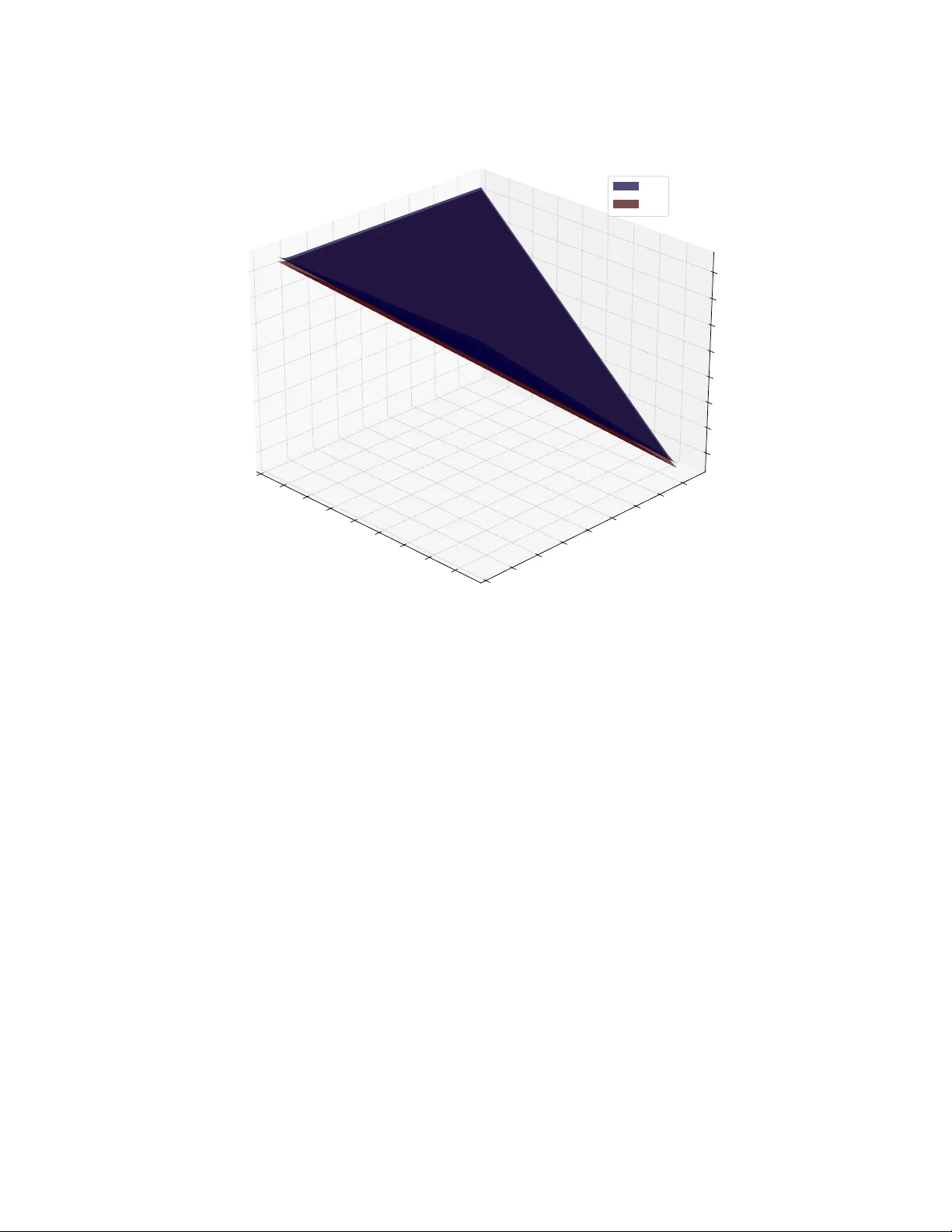
Curv atur e Corr ections to the Y ukawa P otential in T olman Metrics J. V . Zamperlini 1, 2 , ∗ and C. C. Barros Jr . 1 , † 1 Departamento de F ´ ısica, CFM - Univer sidade F eder al de Santa Catarina; C.P . 476, CEP 88.040-900, Florian ´ opolis, SC, Brazil 2 Departamento de F ´ ısica (D AFIS), Universidade T ecnol ´ ogica F ederal do P aran ´ a (UTFPR), Curitiba - PR, 80230-901, Brasil Abstract This work in vestigates curv ature-induced modifications to the Y ukawa potential in static, spherically symmetric spacetimes described by T olman metrics, focusing on their implications for compact stellar ob- jects, with particular application to solutions IV and VI. Moti v ated by the interplay of quantum interactions and strong gravitational fields in systems like neutron stars, we deriv e explicit corrections to the Y ukaw a potential for these metrics based on recent work. Re visiting the pre vious result, contrary to what was found, that curvature corrections break the interacting potential radial symmetry near a highly charged black hole, we sho w that T olman metric corrections still provide the same symmetry in the local inertial frame. Nu- merical estimates for astrophysical objects rev eal energy shifts of the order of 10 − 34 MeV for the solution IV . The T olman VI solution, while singular at the center , yields comparable corrections for most of the fluid sphere radius. A detailed analysis of the repulsi ve or attractiv e feature of the curv ature corrections for a local observer is done for each scenario. Despite providing small corrections, these results highlight the role of spacetime geometry in shaping quantum interactions and provide a foundation for future studies of nuclear interactions within the context of relati vistic stars. ∗ joao.zamperlini@posgrad.ufsc.br † barros.celso@ufsc.br 1 I. INTR ODUCTION In recent decades, reconciling the principles of quantum mechanics with those of general rel- ati vity has emerged as a central challenge in modern physics, inspiring extensi ve ef forts to un- derstand the influence of the structure of the spacetime on quantum phenomena. This quest has dri ven research into ho w its curvature, as described by v arious metric solutions, may subtly affect the behavior of quantum systems such as the energy lev els of particles, wav e functions, and ev en traditional interaction potentials themselves. In this context, the relativistic quantum mechanics in curved spacetimes [1] has been exten- si vely in vestig ated in recent years, providing a lar ge amount of results for dif ferent kinds of space- time backgrounds. Some illustrati v e examples are static and rotating black hole metrics [2, 3], the Hartle-Thorne spacetime [4] and also cylindrical symmetric metrics such as cosmic strings and other configurations [5 – 10]. These in vestigations also encompass quantum oscillators [11 – 16], the Casimir ef fect [17], and other phenomena [18 – 21], which ha ve moti vated numerous studies. In this context, relativistic quantum mechanics in curved spacetimes [21] has been extensi vely in vestigated, with foundational work on one-electron atoms in these en vironments [1]. As illustra- ti ve examples, for static black hole metrics, e xact series solutions for the Klein-Gordon equation were obtained in the Schwarzschild geometry [2], while rotating black holes were e xplored by solving the Dirac equation in the Kerr metric [3]. Similarly , the behavior of spin-0 bosons near slo wly rotating stars has been modeled using the Hartle-Thorne spacetime [4]. Cylindrical symmetric metrics and topological defects are also equally rich grounds for re- search. For example, the dynamics of scalar fields hav e been analyzed in cosmic string spacetime under noninertial effects in [5], with extensions in [6], while rotating effects in spacetimes with space-like and spiral dislocations were studied in [7]. Similar w orks were done recently , consid- ering black strings within anisotropic quintessence [8] and exact solutions in the Bonnor -Melvin uni verse [9] with extension re garding the Klein-Gordon oscillator in [10]. Such system has been widely adapted, for example, to in vestigate effects by non-trivial topologies in [11], [12] and [13], G ¨ odel-type uni verses in [14], Ellis-Bronniko v wormholes in [15], and accelerating Rindler spacetimes in [16]. In general, these background geometries influence div erse phenomena, for example, recently , rotational effects on Casimir energy were explored in [17], Aharonov-Bohm ef fect for bound states in [20], and also fermion dynamics in both Som-Raychaudhuri [18] and defect-generated spacetimes [19]. 2 A further step in this kind of de velopment is to consider the possibility of the influence of the metric on the interactions between particles. In [22] and [23] a representation for the Feynman propagator in the Riemann normal coordinates has been proposed, and based on this formalism, as extensi vely explained in literature (such in the revie w [24] and in the books [25] and [26]), in a recent work [27] it was shown that the Y ukawa potential acquires corrections if an arbitrary metric is considered. This offers an interesting perspecti ve in the study of nuclear interactions of particles inside strong gra vitational fields, suggesting a way for these particles to probe spacetime curv ature quantum mechanically , affecting fundamental interactions and generating corrections to the potential, similar works re garding the Ne wtonian potential can be seen in [28] and [29]. It is then natural to in vestig ate how different systems with strong gravitational fields might in- fluence the v arious particle interactions. For instance, considering the Y ukawa potential, neutron stars (revie wed in [30], [31], [32], and [33]) provide a natural setting for studying how the metric af fects nucleon interactions. This paper extends the in vestigation of curv ature-induced modifi- cations presented in [27] by examining them within the T olman metric framework [34], a static, spherically symmetric perfect fluid solution often used as a first approximation for describing compact stars in General Relativity . As a first approach, the ΦΦ interaction in a ϕ 3 -like theory is considered as far as it generates a Y ukawa-lik e potential and allows the calculation of the cor- rections of the potential in terms of an analytical expression, similar to the one obtained if the nucleon-nucleon interaction is taken into account, without the need of introducing spinors in the formalism. So, in this work, the Feynman amplitude for this interaction will be considered for an arbitrary spacetime with spherical symmetry , and then the T olman IV and T olman VI solutions will be used. W ith this procedure, the corrections to the propagator and then to the potential can be estimated by considering dif ferent v alues for the parameters of the theory . This paper is structured as follows: Section II reexamines the corrected Y ukawa potential, explicitly deriving the interaction potential for generic spherically symmetric metrics and specif- ically for the T olman IV and VI metrics, follo wed by a qualitati ve discussion of their ef fects. In Section III these results are applied to known astrophysical objects with specific mass and radius v alues, providing numerical estimates of the expected energy shift magnitudes. Finally , Section IV presents our conclusions and the discussion of the results. Throughout the paper , we make use of natural units, where ℏ = c = 1 and G = m − 2 P ≈ 6 . 709 × 10 − 45 MeV − 2 , rendering all physical quantities in po wers of ener gy . 3 II. YUKA W A PO TENTIAL WITHIN THE CONTEXT OF TOLMAN METRICS In this work, we are interested in studying the corrections for a Y uka wa-type potential for particles interacting in a T olman metric. W e will consider the approach proposed in [22] and [23], and e xplored in [27], where the system is described in terms of Riemann normal coordinates. By calculating the propagator in an arbitrary metric, the potential of such an interaction in the Born approximation may be determined. In this section, we will show these expressions and then calculate them for general static spherically symmetric spaces. These results will be applied to the T olman IV and T olman VI solutions. The Green function for spin-0 particles G F ( x, x ′ ) may be determined by the equation □ c + m 2 G F ( x, x ′ ) = − δ (4) ( x − x ′ ) √ − g , (1) where □ c = g µν ∂ µ ∂ ν is the curv ed space d’Alembertian and m is the ϕ mass, and it may be expressed as G ( y ) = Z d 4 k (2 π ) 4 e ik · y G ( k ) = Z d 4 k (2 π ) 4 e ik · y G 0 ( k ) + G 1 ( k ) + G 2 ( k ) + · · · , (2) in terms of the flat-space propagator G 0 ( k ) and its corrections G j ( k ) for j = 1 , 2 , ... relativ e to the curved space in the momentum representation. In a Riemann normal coordinate expansion, keeping up to first order in the Ricci tensor , it is gi ven by G ( k ) = 1 k 2 + m 2 + 1 3 R ′ ( k 2 + m 2 ) 2 − 2 3 R ′ µν k µ k ν ( k 2 + m 2 ) 3 + O k − 5 , (3) as obtained in [22], [23] and [26], where R ′ µν and R ′ are respectiv ely the Ricci tensor components and the Ricci scalar calculated at the spacetime point x ′ . Considering the ϕ 3 -like model with L = 1 2 ( ∂ µ ϕ ) 2 − µ 2 2 ϕ 2 + 1 2 ∂ µ Φ ∗ ∂ µ Φ − m 2 Φ 2 | Φ | 2 − λ Φ ∗ ϕ Φ , (4) and supposing the scattering Φ + Φ → Φ + Φ at the tree lev el as it is shown in the diagram of Fig. 1, where ϕ represents the particle in the internal line, which can hav e a different mass, the 4 Feynman amplitude is gi ven by M = i ( − iλ ) 2 − i µ 2 − q 2 , (5) in Minkowski space, which determines the potential in the momentum space in a non-relati vistic Born approximation ˜ V | q | = M 4 m 2 Φ , (6) that is a Y ukawa-lik e potential in the configuration space. FIG. 1: Leading order diagram for the process Φ + Φ → Φ + Φ . Strictly speaking, in a general curved, non-homogeneous spacetime interior , constructing glob- ally defined in/out free states is challenging. For this reason, we emphasize our assumption of a local inertial frame around the point x ′ (where we build the Riemann normal coordinate patch from), within a normal neighborhood small compared to curvature scales, curv ature and its gradi- ents are slowly varying, so that one may define approximate local plane-wav e states and employ the standard Born relation / Fourier transforms. In summary , this is a quasi-local approximation, and the results are v alid only where these assumptions hold. In a curved spacetime, considering the local patch of Riemann coordinates, from Eq. 3 we hav e [27] V ( r ) = − λ 2 4 m 2 Φ Z d 3 q (2 π ) 3 e i q · r 1 µ 2 + | q | 2 + 1 3 R ′ µ 2 + | q | 2 2 − 2 3 R ′ µν q µ q ν µ 2 + | q | 2 3 + · · · , (7) 5 where the first term generates a usual Y uka wa-type potential and the other ones are gi ven in terms of the corrections determined by R ′ and R ′ µν in the local inertial frame. If we place a frame at a position r ′ from the origin, which represents the center of the stellar object, such as the one sho wn in Fig. 2, we may write the ΦΦ potential with spacetime curvature corrections V ( g ′ µν , r ) ≡ V ( r ) in terms of the flat-space potential V 0 ( r ) : V ( r ) = V 0 ( r ) 1 − 1 12 − 2 R ′ + R ′ ( x )( x ) + R ′ ( y )( y ) + R ′ ( z )( z ) r µ + − R ′ ( x )( x ) x 2 − R ′ ( y )( y ) y 2 − R ′ ( z )( z ) z 2 + − 2 R ′ ( x )( y ) xy − 2 R ′ ( x )( z ) xz − 2 R ′ ( y )( z ) y z , (8) where the indices, or directional-axis x, y , z are defined and interpreted relativ e to some choice of basis in the local frame. Alternativ ely , one can use the matrix notation for the position vector x and for the spatial sector of the Ricci tensor in these local cartesian coordinates R ij ≡ R , to re write Eq. 8 in compact form: V ( r ) = V 0 ( r ) ( 1 − 1 12 − 2 R ′ + tr R ′ r µ − x T R ′ x ) . (9) FIG. 2: Example of choice of coordinate system for two particles interacting via an interacting potential dependent on local position r , in the interior of a spherically symmetric object of radius r ⋆ , around some point in the position r ′ relati ve to the metric origin. 6 A. Y ukawa potential in a general static spherically symmetric spacetime If one wishes to express the same potential, but within a spherically symmetric metric gi ven by: d s 2 = − e f ( r ) d t 2 + e g ( r ) d r 2 + r 2 d θ 2 + r 2 sin 2 ( θ )d φ 2 , (10) one can con veniently define these directions accordingly to the Fig. 3, where the y -axis defines the axis connecting the Y ukawa potential center and the metric center , or origin, defining a parallel (globally-radial) orientation ˆ y = ˆ r ′ ; and then defining the ˆ x = ˆ φ ′ and ˆ z = ˆ θ ′ directions as transversal ones. FIG. 3: Diagram of vectors and directions giv en by a spherical metric at point x ′ , depicting our choice for the local unit vectors orientations and labeling. W ith this identification, one can re write Eq. 9, with respect to the labels from the spherical metric, as: V ( r ) = V 0 ( r ) ( 1 − 1 12 − 2 R ′ + R ′ ( r )( r ) + R ′ ( θ )( θ ) + R ′ ( φ )( φ ) r µ − R ′ ( r )( r ) y 2 − R ′ ( θ )( θ ) z 2 − R ′ ( φ )( φ ) x 2 ) , (11) where the local spherical components of the Ricci tensor , R ′ ( i )( j ) , are related to the global coordi- 7 nate components, R µν , via the projection onto the local inertial frame through R ( a )( b ) = e ( a ) µ e ( b ) ν R µν , (12) via the spatial tetrad ( dr eibein ): e ( r ) µ ( x ′ ) = 0 , e − g ( r ′ ) / 2 , 0 , 0 ; e ( θ ) µ ( x ′ ) = 0 , 0 , 1 /r ′ , 0 ; e ( φ ) µ ( x ′ ) = 0 , 0 , 0 , 1 / r ′ sin θ ′ , (13) such that the spatial coordinate components for the metric gi ven in Eq. 10 are then: R rr = − d dr f ( r ) 2 4 + d dr f ( r ) d dr g ( r ) 4 − d 2 dr 2 f ( r ) 2 + d dr g ( r ) r (14) R θθ = − r d dr f ( r ) + r d dr g ( r ) + 2 e g ( r ) − 2 e − g ( r ) 2 (15) R φφ = − r d dr f ( r ) + r d dr g ( r ) + 2 e g ( r ) − 2 e − g ( r ) sin 2 ( θ ) 2 = sin 2 ( θ ) R θθ (16) and the corresponding curv ature scalar is R = − r 2 d dr f ( r ) 2 + r 2 d dr f ( r ) d dr g ( r ) − 2 r 2 d 2 dr 2 f ( r ) − 4 r d dr f ( r ) + 4 r d dr g ( r ) + 4 e g ( r ) − 4 e − g ( r ) 2 r 2 . (17) One can sho w , from Eqs. 13, 14, 15 and 16, that Eq. 12 will yield: R ′ ( r )( r ) = e − g ( r ) R ′ rr ; R ′ ( θ )( θ ) = R ′ θθ r ′ 2 ; R ′ ( φ )( φ ) = R φφ r ′ 2 sin 2 θ ′ = R ′ θθ ( r ′ ) sin 2 θ ′ r ′ 2 sin 2 θ ′ = R ′ ( θ )( θ ) . (18) Eq. 18 explicitly shows the normalization by metric factors between coordinate components and “measured” components in the inertial frame. 8 Gi ven the configuration of the local curv ature 18, we can define R ( r ′ )( r ′ ) = R ∥ , R ( θ ′ )( θ ′ ) = R ( φ ′ )( φ ′ ) = R ⊥ , (19) whose spatial trace tr R = R ( r )( r ) + R ( θ )( θ ) + R ( φ )( φ ) = R ∥ + 2 R ⊥ . This allo ws to re write Eq. 11 as 1 : V ( r ) = V 0 ( r ) ( 1 + 1 12 2 R ′ − tr R r µ + R ⊥ r 2 + ( R ∥ − R ⊥ ) y 2 ) , (20) which shows that if the local curv ature R ∥ = R ⊥ , the original potential loses its radial symmetry due to the spacetime structure. And if R ∥ = R ⊥ , it becomes: V ( r ) = V 0 ( r ) ( 1 + 1 12 2 R ′ − 3 R ∥ r µ + R ∥ r 2 ) . (21) From Eq. 20, to hav e significant curvature ef fects, the relev ant Ricci tensor components and curv ature scalar must be on the order of the in verse square of the coordinates probed by the in- teracting particle. For nuclear interactions, such corrections become relev ant when the spacetime curv ature quantities are approximately 10 fm − 2 ( ∼ (20 MeV) 2 in natural units). Focusing on the spacetime curvature corrections for the Y ukawa potential, it is interesting to define ∆ V V 0 = V ( g µν , r ) − V 0 ( r ) V 0 ( r ) , (22) as a quantity to study the magnitude of the corrections to the potential, which will be gi ven by: ∆ V V 0 = 1 12 2 R ′ − tr R r µ + R ⊥ r 2 + ( R ∥ − R ⊥ ) y 2 . (23) Eq. 23 can be used to study the curv ature corrections of the Y ukaw a potential for an y spheri- cally symmetric metric by replacing the functions f ( r ) and g ( r ) . W e interpret ∆ V as the energy shift experienced by a commoving (or local) observer in the immediate normal neighborhood of the interacting particles (i.e. in the local inertial patch with origin in the potential source x ′ ). This is the frame in which the potential is defined locally . 1 Using that x 2 + z 2 = r 2 − y 2 . 9 No w we focus our attention on two specific T olman solutions, which are used as models of compact stars in many studies, by applying the e xpressions to kno wn astrophysical objects. B. T olman-IV solution One of the most reasonable T olman solutions is the fourth one presented in his paper , which displays a sensible solution of a compressible fluid sphere with the pressure dropping to zero at the surface, with appropriate boundary conditions. This solution serves as a good approximation to describe compact stars, as sho wn recently in [35]. The assumption for the T olman IV solution is that e f f ′ 2 r = constant, which for the metric implies that e g ( r ) = 1 + 2 r 2 / A 2 (1 − r 2 /R 2 )(1 + r 2 / A 2 ) and e f ( r ) = B 2 (1 + r 2 / A 2 ) , (24) that provides the specific forms for the pressure and ener gy density gi ven by: 8 π Gp = 1 A 2 1 − A 2 /R 2 − 3 r 2 /R 2 1 + 2 r 2 / A 2 ! + Λ , 8 π Gρ = 1 A 2 1 + 3 A 2 /R 2 + 3 r 2 /R 2 1 + 2 r 2 / A 2 + 2 A 2 1 − r 2 /R 2 (1 + 2 r 2 / A 2 ) 2 − Λ , (25) with A , R , and B being constants to be found or fitted to data. By constraining the pressure to be null at the boundary at the star surface r = r ⋆ , we find that r ⋆ = R √ 3 r 1 − A 2 R 2 , (26) and by setting the metric to connect the exterior Schwarzschild solution, the mass of the sphere must be M = r ⋆ 2 G " 1 − 1 − r 2 ⋆ /R 2 1 + r 2 ⋆ / A 2 1 + 2 r 2 ⋆ / A 2 # . (27) W ithin this metric framew ork, one can find the relation between A and R from Eq. 26: A = p R 2 − 3 r 2 ⋆ , (28) and by substituting Eq. 28 in 27, one can find the relationship between mass and radius depending 10 on R , which can be calculated from R 2 = r 3 ⋆ GM = 2 r 3 ⋆ r s , (29) where r s = 2 GM is the Schwarzschild radius for the mass M . So, by having the mass and radius as input one can find the values of the parameters A and R , which are the ones that are rele v ant for this work 2 . Calculating the coordinate components of the Ricci tensor for this specific solution, considering Λ = 0 , we hav e R ′ rr = − 2 A 4 − A 2 R 2 − 6 A 2 r ′ 2 − 6 r ′ 4 ( − A 4 R 2 + A 4 r ′ 2 − 3 A 2 R 2 r ′ 2 + 3 A 2 r ′ 4 − 2 R 2 r ′ 4 + 2 r ′ 6 ) ; R ′ = 2 3 A 4 + 11 A 2 r ′ 2 − 2 R 2 r ′ 2 + 12 r ′ 4 R 2 ( A 4 + 4 A 2 r ′ 2 + 4 r ′ 4 ) ; R ′ θθ r ′ 2 = 2 A 4 + A 2 R 2 + 6 A 2 r ′ 2 + 6 r ′ 4 R 2 ( A 4 + 4 A 2 r ′ 2 + 4 r ′ 4 ) , (30) and in the local basis at the expansion point at r ′ we will hav e R ∥ = R ⊥ = 2 A 4 + A 2 R 2 + 6 A 2 r ′ 2 + 6 r ′ 4 R 2 ( A 2 + 2 r ′ 2 ) 2 , (31) such that the interacting potential at Eq. 20 becomes V ( r ) = V 0 ( r ) 1 + 1 12 2 2 3 A 4 + 11 A 2 r ′ 2 − 2 R 2 r ′ 2 + 12 r ′ 4 R 2 ( A 2 + 2 r ′ 2 ) 2 + − 2 A 4 + A 2 R 2 + 6 A 2 r ′ 2 + 6 r ′ 4 R 2 ( A 2 + 2 r ′ 2 ) 2 (3 − µr ) r µ , (32) or separating into terms proportional to po wers of r inside the brackets: V ( r ) = V 0 ( r ) ( 1 + 1 12 6 A 4 + 26 A 2 r ′ 2 − 3 A 2 R 2 − 8 R 2 r ′ 2 + 30 r ′ 4 R 2 ( A 2 + 2 r ′ 2 ) 2 r µ + + 2 A 4 + A 2 R 2 + 6 A 2 r ′ 2 + 6 r ′ 4 R 2 ( A 2 + 2 r ′ 2 ) 2 r 2 ) . (33) 2 The last parameter B , can also be found by connecting with Schwarzschild solution, and will be gi ven by B = q 1 − r 2 ⋆ /R 2 1 + 2 r 2 ⋆ / A 2 . 11 So, the curvature corrections still leav e the interaction with radial symmetry , which must be related to the isotropic nature of the matter content that provides the T olman metrics, coded in the isotropic pressure in the energy-momentum tensor of the spherical fluid [34]. 1. Limit r ′ → 0 W e can expect the largest corrections to be at the center of the spherical object, where the pressure is highest. The pressure and density at the center are giv en by (with Λ = 0 ) p c = 1 − A 2 /R 2 8 π GA 2 , (34) ρ c = 3 + 3 A 2 /R 2 8 π GA 2 . (35) From the corrections sho wn in Equations 30 and 31, taking the limit r ′ → 0 , we hav e lim r ′ → 0 R ′ = 6 R 2 ; (36) lim r ′ → 0 R ∥ = 2 R 2 + 1 A 2 . (37) Thus, if the interacting system is located at the center of the spherical object, the corrected Y ukawa potential reads as: V ( r ) = V 0 ( r ) 1 + 1 12 " 6 R 2 − 3 A 2 r µ + 2 R 2 + 1 A 2 r 2 # , (38) T o simplify , we define: R 1 = 6 R 2 − 3 A 2 ; R 2 = 2 R 2 + 1 A 2 . (39) From here onward, we re write the expressions in (39) e xplicitly in terms of r ⋆ and the corre- 12 sponding r s , from the mass. Using (28) and (29), we obtain after simplifications: R 1 = 6 R 2 − 3 A 2 = 3 r s ( r ⋆ − 3 r s ) r 3 ⋆ 2 r ⋆ − 3 r s , R 2 = 2 R 2 + 1 A 2 = 3 r s ( r ⋆ − r s ) r 3 ⋆ 2 r ⋆ − 3 r s . (40) These final forms highlight a common factor 3 r s r 3 ⋆ (2 r ⋆ − 3 r s ) , facilitating the discussion about the signs of R 1 and R 2 . In particular , it is observed that R 1 v anishes for r ⋆ = 3 r s and changes sign for larger radius v alues, while R 2 v anishes at r ⋆ = r s . The condition 2 r ⋆ − 3 r s = 0 characterizes a mathematical singularity of the model ( r ⋆ = 3 2 r s ), causing modeled objects with a radius between 1 . 5 and 3 r s to yield R 1 < 0 and R 2 > 0 , while abov e 3 r s both corrections are positi ve, as we can infer from Fig. 4. 1 . 5 2 . 0 2 . 5 3 . 0 3 . 5 r ? /r s − 2 . 0 − 1 . 5 − 1 . 0 − 0 . 5 0 . 0 0 . 5 1 . 0 1 . 5 2 . 0 R i [km − 2 ] R 1 R 2 r ? = 1 . 5 r s r ? = 3 r s FIG. 4: V alues of R 1 and R 2 depend on r ⋆ /r s , that is, the compactness. For this example, a model of M = 2 M ⊙ was considered. 13 Thus, we re write the Y ukaw a potential at the highest pressure point in T olman-IV : V ( r ) = V 0 ( r ) ( 1 + 1 12 3 r s r 3 ⋆ 2 r ⋆ − 3 r s ( r ⋆ − 3 r s ) r µ + ( r ⋆ − r s ) r 2 ) , (41) or V ( r ) = V 0 ( r ) 1 + 1 12 3 r s r 3 ⋆ 2 r ⋆ − 3 r s " r ⋆ r µ + r 2 − r s 3 r µ + r 2 # . (42) Thus, the practical effect of the curv ature on the interaction depends on the particle’ s position r , b ut mainly on the compactness of the modeled object, encoded in r ⋆ /r s . C. T olman VI T o compare different T olman solutions, we analyze the T olman-VI one, which provides a sim- pler e xpression for the dependence of p on r , making it an ideal approach to in vestigate fluid spheres with infinite density and pressure at the center , as T olman further discusses in his paper . The assumption for the solution VI is that e − g = constant, which for the metric implies that e f = Ar 1 − n − B r 1+ n 2 and e g = 2 − n 2 , (43) providing a specific form for the pressure and ener gy density gi ven by 8 π Gp = 1 2 − n 2 1 r 2 (1 − n ) 2 A − (1 + n ) 2 B r 2 n A − B r 2 n + Λ , 8 π Gρ = 1 − n 2 2 − n 2 1 r 2 − Λ , (44) with n , A , and B being constants to be found, adjusted, or fitted to data. And again, for simplicity reasons, we will take Λ = 0 here onward. This solution also dif fers due to a singularity at the center , which can be inferred from the corresponding Kretschmann scalar: K ( n = 1 / 2) = 24 3 A 2 − 10 AB r + 15 B 2 r 2 49 r 4 ( A 2 − 2 AB r + B 2 r 2 ) . (45) 14 As T olman himself argues in Section 8 of his paper , a sensible choice is n = 1 / 2 , which results in the relationship p c ρ c = 1 3 , (46) with p c and ρ c being the pressure and energy density at the center ( r = 0 ), respecti vely . W ith this choice, the pressure and energy density are: 8 π Gp = 1 7 r 2 A − 9 B r A − B r , 8 π Gρ = 3 7 r 2 , (47) and the boundary of the fluid sphere is gi ven by r ⋆ = A 9 B , (48) where A has dimensions L − 1 / 2 and B has dimensions L − 3 / 2 . As T olman analyzed, this metric fixes the mass-radius ratio as M r ⋆ = 3 14 G , (49) and from the radius relationship, we kno w ho w to obtain A , A = 9 B r ⋆ . (50) By matching the Schwarzschild solution at the boundary , from the time component of the metric e f ( r ) , and substituting A , we hav e 9 B r ⋆ · r 1 / 2 ⋆ − B r 3 / 2 ⋆ 2 = 1 − 2 GM r ⋆ , (51) and simplifying this expression using Eq.49 results in: 8 B r 3 / 2 ⋆ 2 = 4 7 , (52) 15 which implies: B = 1 √ 112 r 3 / 2 ⋆ = √ 7 r − 3 / 2 ⋆ 28 . (53) W ithin this choice of n , the metric components become e f = Ar 1 / 2 − B r 3 / 2 2 and e g = 7 / 4 , (54) such that the curv ature quantities become: R ′ = 24 B 7 r ′ ( A − B r ′ ) ; (55) R ′ rr = A + 3 B r ′ 4 r ′ 2 ( A − B r ′ ) ; (56) R ′ θθ = A + 3 B r ′ 7 ( A − B r ′ ) , (57) and in the local base we hav e R ∥ = R ⊥ = A + 3 B r ′ 7 r ′ 2 ( A − B r ′ ) (58) and then the curv ature-corrected Y ukaw a potential on Eq. 20 will be V ( r ) = V 0 ( r ) ( 1 + 1 12 48 B 7 r ′ ( A − B r ′ ) − A + 3 B r ′ 7 r ′ 2 ( A − B r ′ ) (3 − µr ) r µ ) , (59) or , separating into terms proportional to powers of r inside the brackets, like Eq. 21: V ( r ) = V 0 ( r ) ( 1 + 1 12 39 B r ′ − 3 A 7 r ′ 2 ( A − B r ′ ) r µ + A + 3 B r ′ 7 r ′ 2 ( A − B r ′ ) r 2 ) . (60) Using Eqs. 50 e 53, we can rewrite Eq. 60 in terms only of the radius of the fluid sphere r ⋆ : V ( r ) = V 0 ( r ) 1 + 1 12 39 r ′ r ⋆ − 27 7 r ′ 2 9 − r ′ r ⋆ r µ + 9 + 3 r ′ r ⋆ 7 r ′ 2 9 − r ′ r ⋆ r 2 , (61) from which we see that the correction linear in local radial distance r is posit i ve for r ′ /r ⋆ > 27 / 39 and negati v e otherwise, indicating an attracti v e/repulsi ve effect dependent on the local frame po- sition r ′ for this order; whereas the correction quadratic in local radial distance is al ways positi ve, 16 since r ′ /r ⋆ ≤ 1 , providing an always attracti ve feature for this order . The full effect is going to be a distortion of the potential dependent on the local radial distance and the local frame position, being analyzed in the next section. At this point, it is interesting to inv estigate the corrections calculated for the potential in T olman IV and in T olman VI solutions. F or this purpose, a numerical analysis for reasonable values of the parameters must be carried out, and it will be done in the next section. 17 III. NUMERICAL RESUL TS A. T olman-IV Numerical Results In this section, we will e xplore the dependence of the corrections to the potential on the param- eters and on the distance from the origin for the considered T olman solutions. The parameters that describe observed astrophysical objects will be considered. Quantitati vely , we can analyze the magnitude of the corrections in terms of the variation of r ′ . Follo wing the results of [35], we plot the curv ature corrections for the linear and quadratic order in r , seen in Eq. 21, for two objects fitted to the T olman-IV metric: Massive Pulsar J0740+6620 (Fig. 5) and the Compact Object HESS J1731-347 (Fig. 6), which show values on the order of 10 − 34 – 10 − 32 MeV 2 for most of the objects’ radii. − 1 . 0 − 0 . 5 0 . 0 0 . 5 1 . 0 Curv ature corrections (fm − 2 ) × 10 − 38 0.00 0.20 0.40 0.60 0.80 1.00 r 0 /r ? − 4 − 2 0 2 4 Curv ature Corrections (MeV 2 ) × 10 − 34 R k 2 R 0 − 3 R k FIG. 5: V alues of the magnitude of the curvature corrections for the Y ukawa potential for a range of values of r ′ /r ⋆ for the object Pulsar J0740+6620 with mass M = 2 . 1 M ⊙ and a radius r ⋆ = 12 . 32 km . 18 − 5 − 4 − 3 − 2 − 1 0 1 Curv ature corrections (fm − 2 ) × 10 − 37 0.00 0.20 0.40 0.60 0.80 1.00 r 0 /r ? − 1 . 5 − 1 . 0 − 0 . 5 0 . 0 0 . 5 Curv ature Corrections (MeV 2 ) × 10 − 32 R k 2 R 0 − 3 R k FIG. 6: V alues of the magnitude of the curvature corrections for the Y ukawa potential for a range of values of r ′ /r ⋆ for the Compact Object HESS J1731-347 with mass M = 0 . 8 M ⊙ and a radius r ⋆ = 10 . 42 km . Moreov er , the curvature magnitudes plotted in Figs. 5 and 6 are man y orders of magnitude be- lo w the energy scale probed by the Y ukawa exchange in our analysis (Fermi scale). Consequently , curv ature gradients are negligible across the stellar parameter range sho wn, and the Riemann- normal-coordinate local expansion we employ to extract the effecti ve potential is well justified within the small patches probed. The curv ature corrections at the center of the compact object itself, as predicted by Eq. 38 and defined on Eq. 39, are expected to become significant at the nuclear interaction scale (around 10 − 15 m = 10 − 18 km ). Fig. 7 confirms this prediction, showing corrections of the order of MeV 2 for A and R near the Fermi scale. 19 − 20 . 0 − 17 . 5 − 15 . 0 − 12 . 5 − 10 . 0 − 7 . 5 − 5 . 0 − 2 . 5 0 . 0 log 10 ( A (km)) − 20 . 0 − 17 . 5 − 15 . 0 − 12 . 5 − 10 . 0 − 7 . 5 − 5 . 0 − 2 . 5 0 . 0 log 10 ( R (km)) -30.0 -25.0 -20.0 -15.0 -10.0 -5.0 0.0 5.0 log 10 (Curv ature in tensit y(MeV 2 )) R 1 R 2 FIG. 7: V alues of R 1 and R 2 against parameters R and A at r ′ = 0 . 20 W e can see quantitativ ely the value of ∆ V for some e xamples of stars fitted to the T olman IV model 3 , in the plot of Fig. 8. In it, we see that objects with 1 , 5 < r ⋆ /r s < 3 r s can weaken the interaction for shorter ranges ( < 3 fm ), in the region of the original potential well, with this range being smaller the greater the compactness. On the other hand, objects with r ⋆ > 3 r s hav e a decrease in potential energy for all ranges, enhancing the attracti ve character of the original interaction, in the order of 10 − 33 – 10 − 34 MeV . 2 4 6 8 10 r (fm) 0 . 0 0 . 5 1 . 0 1 . 5 2 . 0 2 . 5 ∆ V (MeV) × 10 − 33 J0952-0607, r ? /r s = 1 . 76 J0740+6620, r ? /r s = 1 . 99 Crab, r ? /r s = 2 . 54 J0030+0451, r ? /r s = 3 . 06 HESS J1731-347, r ? /r s = 4 . 41 FIG. 8: Radial Y ukawa potential energy shift due to spacetime curv ature corrections in the T olman- IV model, fitted to fi ve compact objects. Considering the change on the local ef fecti ve potential gi ven by: V eff ( g µν , r ) = ℓ ( ℓ + 1) 2 m Φ r 2 + V ( g µν , r ) , (62) where ℓ is the angular momentum quantum number , we can adjust the data for v arious astrophysi- cal objects and estimate the curvature-induced energy shift ∆ V . T ab . I shows that, for fi ve objects, the energy shift of the potential at the minimum of the flat effecti ve potential V eff ( η µν , r ) 4 is on the order of 10 − 34 MeV . 3 Considering the parameters to be the same as [27], which µ = m π ≈ 135 MeV and λ = 4450 MeV for interacting particles with mass m Φ = m p ≈ 939 MeV . 4 The minimum is calculated by finding d dr V eff ( η µν , r, ℓ = 1) | r = r min = 0 , which, for the parameters considered, giv es r min ≈ 1 . 173 fm . 21 Object M [ M ⊙ ] r ⋆ [km] r ⋆ /r s ∆ V ( r min ) [MeV ] PSR J0952–0607 2.35 12.25 1.764 6 . 54 × 10 − 34 PSR J0740+6620 2.1 12.32 1.986 1 . 15 × 10 − 34 Crab Pulsar 1.4 10.5 2.539 − 1 . 89 × 10 − 34 PSR J0030+0451 1.44 13.02 3.062 − 1 . 52 × 10 − 34 HESS J1731-347 0.8 10.42 4.410 − 2 . 14 × 10 − 34 T ABLE I: ∆ V (in MeV ) only at r = r min for the system located at the center of the fluid sphere described by the T olman-IV metric for selected different astrophysical objects (with data extracted from the literature, which can be found in [36], [37], [38], [39], [40], [41], [42], and [43]), along with the mass, estimated radius considered for the calculation and compactness r ⋆ /r s . W e stress that the e xtremely small magnitude of the ener gy shifts obtained for realistic neutron stars is not unexpected. Since, for compact stars the in variants relati ve to the curv ature corrections in the Riemann normal coordinate expansion are many orders of magnitude smaller than the typi- cal mass scale entering the Y uka wa interaction. Consequently , the curvature-induc ed modification of the potential is parametrically suppressed by the hierarchy between the stellar curvature scale and the characteristic length scale of the interaction. The smallness therefore reflects the physical separation between nuclear and curvature scales in macroscopic compact stars, rather than a lim- itation of the formalism itself. W e must remark that is possible to find astrophysical objects with configurations that present corrections of greater magnitude in determined regions. This analysis is left for future works. 22 B. T olman-VI Numerical Results The T olman-VI solution (with n = 1 / 2 ) lacks physical correspondence with realistic star mod- els due to its fixed mass-radius relation, which does not align with observational data, and its singular center . Ho we ver , it offers interesting aspects for comparison with the T olman-IV solu- tion. For example, we can set a radius or a mass, and we can obtain all the curvature corrections inside the sphere. If we start with a star radius of 10 km , then Eq. 49 gi ves a mass of 1 . 45 M ⊙ and the profile of the corrections can be seen on Fig. 9, which also shows that the magnitude of the corrections is of the order of 10 − 30 MeV 2 , comparable to the results from the T olman-IV solution. − 4 − 3 − 2 − 1 0 1 Curv ature corrections (fm − 2 ) × 10 − 35 0.20 0.40 0.60 0.80 r 0 /r ? − 1 . 5 − 1 . 0 − 0 . 5 0 . 0 0 . 5 Curv ature Corrections (MeV 2 ) × 10 − 30 R k 2 R 0 − 3 R k 0 . 680 0 . 685 0 . 690 0 . 695 0 . 700 0 . 705 0 . 710 − 1 . 0 − 0 . 5 0 . 0 0 . 5 1 . 0 1 . 5 2 . 0 × 10 − 34 FIG. 9: V alues of R ′ − 3 R ∥ and R ∥ against r ′ v alues for a fluid sphere of radius r ⋆ = 10 km and mass M = 1 . 45 M ⊙ accordingly to the T olman-VI solution. Therefore, for T olman-VI, the same order-of-magnitude smallness holds throughout the bulk of the fluid sphere when compared with the T olman-IV results, with the clear exception of the unphysical singular center where curv ature in variants di verge. Hence, e xcluding that pathological core, the curvature remains ne gligible at the Y uka wa probe scale and the RNC-patch approxima- tion used in our estimates remains applicable. Furthermore, a similar analysis can be done for the change in curvature induced in the potential 23 energy , as done for the T olman-IV metric, that is, we can analyze the dif ference ∆ V ( r ) when r = r min , using the same parameters. This way , we hav e the result of Figures 10 and 11, when we use an object of 10 km radius. W e observe that, despite being negligible quantitativ ely speaking, the behavior of the energy displacement brings aspects to be interpreted. It varies along the spherical fluid of T olman-VI, and in the regions closest to the boundary at r ⋆ the contrib ution of the curv ature is negati ve, indicating a “strengthening” of the Y ukawa interaction in these regions, b ut for a certain r ′ /r ⋆ < r ′ crit /r ⋆ = 9 / 13 ≈ 0 . 69 , the beha vior of the curvature corrections alternates, inducing a positiv e correction (repulsi ve character) for a small local range of the potential r < r div ( r ′ ) , found from Eq. 61: r div ( r ′ ) = 13 r ′ r ⋆ − 9 3 + r ′ r ⋆ · 1 µ for r ′ r ⋆ > 9 13 . (63) These characteristics can be interpreted by considering the effecti ve potential, potentially influ- encing the decrease of the ef fecti v e potential well and a decrease of the potential barrier , altering the stability of the nuclear bond; extrapolating, this would indicate the breaking of this type of interaction in the vicinity of the singularity of the T olman-VI metric. W e reemphasize that the T olman-VI solution possesses a central curvature singularity and a rigid mass–radius relation, which limits its astrophysical realism. Accordingly , results in the im- mediate vicinity of the center should not be interpreted as describing realistic neutron star cores. Instead, T olman-VI is emplo yed here as an analytic laboratory to e xplore how the formalism be- hav es in strongly curved interior geometries. A w ay from the singular center , the curv ature correc- tions remain of the same suppressed order found in T olman-IV , reinforcing the general conclusion regarding the smallness of ef fects in stellar-scale systems. 24 2 4 6 8 10 r (fm) 0 . 0 0 . 5 1 . 0 1 . 5 ∆ V (MeV ) × 10 − 35 r 0 = 0 . 05 r ? r 0 = 0 . 10 r ? r 0 = 0 . 30 r ? r 0 = 0 . 50 r ? r 0 = 0 . 80 r ? r 0 = 0 . 90 r ? FIG. 10: V alues of ∆ V ( r ) for dif ferent v alues of r ′ /r ⋆ for an object of r ⋆ = 10 km in the T olman- VI metric. 25 2 4 6 8 10 r (fm) − 2 0 2 4 ∆ V (MeV ) × 10 − 37 r 0 = 0 . 05 r ? r 0 = 0 . 10 r ? r 0 = 0 . 30 r ? r 0 = 0 . 50 r ? r 0 = 0 . 80 r ? r 0 = 0 . 90 r ? FIG. 11: Zoomed-in version of the ∆ V ( r ) values for different v alues of r ′ /r ⋆ for an object of r ⋆ = 10 km in the T olman-VI metric. Follo wing the analysis of compact objects, we can infer , at first glance, that gra vitational effects would hav e a minimal impact on nuclear interactions, ev en in this high-pressure system, and likely also hav e a minimal effect on observables deriv ed from an equation of state for nuclear matter . Thus, concluding that, within the scope of these phenomenological results, ev en in a simplified version, they indicate that the interaction of nuclear matter with primordial black holes is a more fertile ground for extracting non-ne gligible quantum ef fects in gra vitation as fruits [27]. IV . CONCLUSIONS In this work, we revisited the Y ukawa potential deriv ed from a ϕ 3 -like theory in curved space- time, as presented in [27], and then applied the result to a generic spherically symmetric metric, with particular applications for the T olman-IV and T olman-VI metrics. In the Riemann normal 26 coordinates, the corrections for the propagator have been determined, and the ΦΦ potential for a one-boson exchange has been ev aluated. By this procedure, it was possible to obtain the correction terms generated by the influence of the structure of spacetime. The choice of the ΦΦ interaction instead of the nucleon-nucleon interaction is due to techni- cal aspects and may be viewed as a first approach to the problem. The curvature dependence of the corrected potential originates from the modification of the propagator in the local Riemann normal frame. While the scalar model produces a Y ukawa-type central potential, a realistic nu- cleon–nucleon interaction would require Dirac fields and pion exchange, leading to the familiar one-pion-exchange (OPE) structure with central and tensor components. In such a formulation, curv ature would modify both the scalar and tensorial sectors of the OPE potential through a sim- ilar geometric mechanism affecting the propagator , although with different spin-dependent coef- ficients. Therefore, the present analysis captures the geometric origin and order of magnitude of curv ature corrections, while a full spinorial treatment is left for future works. Anyway , ev en con- sidering the limitations of our approach, the analytical form of the potential that we obtain, with a correct set of parameters, generated results for the corrections that we believ e that are of the order of the magnitude of the ones that we would find if Dirac fields had been considered in the formulation of the system. Applying the results for an e xpansion around a point x ′ for a spherically symmetric metric, we defined local curvature corrections contributions in the parallel and transversal directions towards the metric center , simplifying the corrected potential; where anisotropy in the local potential exists if those two curvature terms are different. When ev aluating for the T olman metrics, the curvature contributions from the local Ricci tensor are the same for ev ery direction, which we interpret as stemming from the condition of a perfect fluid in the ener gy-momentum tensor in Einstein equations, which has isotropic pressure; thus making the curv ature-corrected potential radially symmetric in the local inertial frame. The results for the T olman IV solution depend on the compactness of the object considered. Depending on the regime of the values, the curvature corrections have different signs and then, dif ferent ef fects on the interacting potential. As for the numerical results, applying the solution to kno wn astrophysical objects, which can represent compact stars, showed a correction of around 10 − 33 MeV with the local frame at the regular center of solution IV . In this sense, the neutron star estimates serve primarily as a quantitati v e benchmark for the formalism in realistic astrophysical en vironments. For objects with 1 . 5 < r ⋆ /r s < 3 , there are local regions (very short range) 27 with positi ve energy shifts, indicating a weakening of the interacting potential, potentially in the region of the effecti ve potential well, and negati v e energy shifts for the remaining range; whereas for r ⋆ /r s > 3 , there are just negati ve ones, which we can interpret as a “strengthening” of the interaction due to spacetime curvature, b ut this would represent a deeper ef fecti ve potential well but also a decreased ef fectiv e potential barrier . Additionally , we compare the results for the T olman-VI solution, which is singular at the origin, with an infinite central pressure. T aking a choice suggested by T olman, we calculate the curvature corrections and plot them for a fluid sphere with 10 km radius and 1 . 45 solar masses. Such results sho wed a correction of the order 10 − 30 MeV 2 for most of the sphere radii, with a div er gence at the origin. The numerical results show a very tiny ener gy shift due to curv ature for the potential center located throughout the object radius, as example, at 5% of the radius it is in the order of 10 − 35 MeV . Characteristic of this solution VI, there is some position of the system for which r ′ < r ′ crit , the corrections allow positi ve potential energy shift, possibly af fecting the region of the ef fecti ve potential well, decreasing its size, weakening the interaction, and for a larger range it sho ws a neg ati ve ener gy shift, possibly decreasing the ef fecti v e potential barrier . W e also consider the comparison with [27], which focuses on the corrected potential outside the external e vent horizon of a Reissner-Nordstr ¨ om black hole. For a highly charged black hole ( Q = 0 . 999 Q lim , where Q lim is the maximum possible electric charge) with a mass of 3 solar masses, the corrections near the horizon are similar in magnitude to our results for the T olman-IV and VI metrics, around 10 − 30 MeV 2 . This f act is essentially due to the size of the considered astrophysical object. The results obtained suggest that these corrections could hav e significant implications for primordial black holes [44], with e vent horizons located at very small distances from the center , providing larger v alues for the corrections than for the interiors of compact objects, and would be important in the study of the early Univ erse, or ev en to extract some observ able between the interaction of nuclear matter with this dark matter candidate [45]. Future research could explore more realistic relati vistic star models. This includes numerically solving the T olman-Oppenheimer -V olkof f (TO V) equations [46] with appropriate equations of state and inv estigating potential implications for these models using multi-messenger observ ations; nuclear dynamics were studied in this context, for e xample in [47], [48], [49], and [50]. Studies of the kind proposed in this paper are very important for in vestigating the behavior of quantum systems within the frame work of general relativity , aiming to further elucidate the interplay between quantum fields and curved spacetime in the pursuit of a deeper description of 28 nature. V . A CKNO WLEDGMENTS W e thank the Coordenac ¸ ˜ ao de Aperfeic ¸ oamento de Pessoal de N ´ ıvel Superior (CAPES), pro- cess number 88887.655373/2021-00, and Conselho Nacional de Desen volvimento Cient ´ ıfico e T ecnol ´ ogico (CNPq) for the financial support, process number 312414/2021-8. [1] L. Park er , “One-Electron Atom in Curved Space-Time, ” Phys. Rev . Lett. , vol. 44, no. 23, p. 1559, 1980. [2] E. Elizalde, “Series solutions for the klein-gordon equation in schwarzschild space-time, ” Physical r eview D: P articles and fields , v ol. 36, pp. 1269–1272, 09 1987. [3] S. Chandrasekhar, “The solution of dirac’ s equation in kerr geometry , ” Pr oceedings of the Royal So- ciety of London. A. Mathematical and Physical Sciences , vol. 349, no. 1659, pp. 571–575, 1976. [4] E. O. Pinho and C. C. Barros Jr ., “Spin-0 bosons near rotating stars, ” Eur . Phys. J. C , vol. 83, no. 8, p. 745, 2023. [5] L. C. N. Santos and C. C. Barros Jr ., “Scalar bosons under the influence of noninertial effects in the cosmic string spacetime, ” Eur . Phys. J . C , vol. 77, no. 3, p. 186, 2017. [6] L. C. N. Santos and C. C. Barros Jr ., “Relativistic quantum motion of spin-0 particles under the in- fluence of noninertial ef fects in the cosmic string spacetime, ” Eur . Phys. J. C , vol. 78, no. 1, p. 13, 2018. [7] R. L. L. V it ´ oria and K. Bakke, “Rotating effects on the scalar field in the cosmic string spacetime, in the spacetime with space-like dislocation and in the spacetime with a spiral dislocation, ” Eur . Phys. J. C , vol. 78, no. 3, p. 175, 2018. [8] M. d. L. Deglmann, L. G. Barbosa, and C. d. C. Barros, “Black strings and string clouds embedded in anisotropic quintessence: Solutions for scalar particles and implications, ” Annals Phys. , vol. 475, p. 169948, 2025. [9] L. G. Barbosa and C. C. Barros, “Scalar bosons in Bonnor-Melvin- Λ univ erse: exact solution, Landau le vels and Coulomb-lik e potential, ” Phys. Scripta , vol. 100, no. 3, p. 035302, 2025. 29 [10] L. G. Barbosa and C. C. Barros, “Klein-Gordon Oscillator Subject to a Coulomb-type Potential in Bonnor-Melvin Uni verse with a Cosmological Constant, ” F ew Body Syst. , vol. 66, no. 1, p. 7, 2025. [11] F . Ahmed, “Gravitational field ef fects produced by topologically nontrivial rotating space–time under magnetic and quantum flux fields on quantum oscillator, ” Int. J. Mod. Phys. A , vol. 37, no. 28n29, p. 2250186, 2022. [12] F . Ahmed, “Klein–Gordon oscillator with magnetic and quantum flux fields in non-trivial topological space-time, ” Commun. Theor . Phys. , v ol. 75, no. 2, p. 025202, 2023. [13] L. C. N. Santos, C. E. Mota, and C. C. Barros Jr ., “Klein–Gordon Oscillator in a T opologically Non- tri vial Space-T ime, ” Adv . High Ener gy Phys. , vol. 2019, p. 2729352, 2019. [14] Y . Y ang, Z.-W . Long, Q.-K. Ran, H. Chen, Z.-L. Zhao, and C.-Y . Long, “The generalized Klein–Gordon oscillator with position-dependent mass in a particular G ¨ odel-type space–time, ” Int. J . Mod. Phys. A , vol. 36, no. 03, p. 2150023, 2021. [15] A. R. Soares, R. L. L. V it ´ oria, and H. Aounallah, “On the Klein–Gordon oscillator in topologically charged Ellis–Bronnik ov-type w ormhole spacetime, ” Eur . Phys. J . Plus , vol. 136, no. 9, p. 966, 2021. [16] T . I. Rouabhia, A. Boumali, and H. Hassanabadi, “Ef fect of the Acceleration of the Rindler Spacetime on the Statistical Properties of the Klein–Gordon Oscillator in One Dimension, ” Phys. P art. Nucl. Lett. , vol. 20, no. 2, pp. 112–119, 2023. [17] L. C. N. Santos and C. C. Barros Jr ., “Rotational ef fects on the Casimir energy in the space–time with one extra compactified dimension, ” Int. J . Mod. Phys. A , vol. 33, no. 20, p. 1850122, 2018. [18] P . Sedaghatnia, H. Hassanabadi, and F . Ahmed, “Dirac fermions in Som–Raychaudhuri space-time with scalar and vector potential and the energy momentum distributions, ” Eur . Phys. J. C , vol. 79, no. 6, p. 541, 2019. [19] A. Guvendi, S. Zare, and H. Hassanabadi, “Exact solution for a fermion–antifermion system with Cornell type nonminimal coupling in the topological defect-generated spacetime, ” Phys. Dark Univ . , vol. 38, p. 101133, 2022. [20] R. L. L. V it ´ oria and K. Bakke, “On the interaction of the scalar field with a Coulomb-type potential in a spacetime with a scre w dislocation and the Aharono v-Bohm effect for bound states, ” Eur . Phys. J . Plus , vol. 133, no. 11, p. 490, 2018. [21] C. C. Barros Jr ., “Quantum mechanics in curv ed space-time, ” Eur . Phys. J . C , vol. 42, pp. 119–126, 2005. 30 [22] L. Bunch, T . S.; Parker , “Fe ynman propagator in curved spacetime: A momentum-space representa- tion, ” Physical Review D 1979-no v 15 vol. 20 iss. 10 , vol. 20, no v 1979. [23] T . S. Bunch, “Local Momentum Space and T wo Loop Renormalizability of λϕ 4 Field Theory in Curved Space-time, ” Gen. Rel. Grav . , v ol. 13, pp. 711–723, 1981. [24] I. L. Shapiro, “Effecti ve Action of V acuum: Semiclassical Approach, ” Class. Quant. Grav . , vol. 25, p. 103001, 2008. [25] L. Parker and D. J. T oms, Quantum F ield Theory in Curved Spacetime . Cambridge Univ ersity Press, 2009. [26] I. L. Buchbinder and I. Shapiro, Intr oduction to Quantum F ield Theory with Applications to Quantum Gravity . Oxford Graduate T exts, Oxford Uni versity Press, 2 2023. [27] J. V . Zamperlini and C. C. Barros, Jr ., “Spacetime curvature corrections for the Y uka wa potential and its application for the Reissner-Nordstr ¨ om metric, ” Nucl. Phys. B , vol. 1014, p. 116871, 2025. [28] N. E. J. Bjerrum-Bohr , J. F . Donoghue, and B. R. Holstein, “Quantum gravitational corrections to the nonrelati vistic scattering potential of two masses, ” Phys. Rev . D , vol. 67, p. 084033, 2003. [Erratum: Phys.Re v .D 71, 069903 (2005)]. [29] R. Ferrero and C. Ripken, “De Sitter scattering amplitudes in the Born approximation, ” SciP ost Phys. , vol. 13, p. 106, 2022. [30] F . ¨ Ozel and P . Freire, “Masses, Radii, and the Equation of State of Neutron Stars, ” Ann. Rev . Astr on. Astr ophys. , vol. 54, pp. 401–440, 2016. [31] N. Chamel and P . Haensel, “Physics of Neutron Star Crusts, ” Living Rev . Rel. , vol. 11, p. 10, 2008. [32] J. M. Lattimer and M. Prakash, “Neutron star structure and the equation of state, ” Astr ophys. J . , vol. 550, p. 426, 2001. [33] D. P . Menezes, “A Neutron Star Is Born, ” Universe , v ol. 7, no. 8, p. 267, 2021. [34] R. C. T olman, “Static solutions of Einstein’ s field equations for spheres of fluid, ” Phys. Rev . , vol. 55, pp. 364–373, 1939. [35] G. Panotopoulos, “Stellar Modeling via the T olman IV Solution: The Cases of the Massiv e Pulsar J0740+6620 and the HESS J1731-347 Compact Object, ” Universe , vol. 10, no. 9, p. 342, 2024. [36] M. C. Miller et al. , “The Radius of PSR J0740+6620 from NICER and XMM-Newton Data, ” Astr o- phys. J . Lett. , vol. 918, no. 2, p. L28, 2021. [37] T . E. Riley et al. , “A NICER V ie w of the Massiv e Pulsar PSR J0740+6620 Informed by Radio T iming and XMM-Ne wton Spectroscopy, ” Astr ophys. J. Lett. , v ol. 918, no. 2, p. L27, 2021. 31 [38] T . Salmi et al. , “The Radius of PSR J0740+6620 from NICER with NICER Background Estimates, ” Astr ophys. J. , v ol. 941, no. 2, p. 150, 2022. [39] V . Doroshenko, V . Suleimanov , G. P ¨ uhlhofer , and A. Santangelo, “A strangely light neutron star within a supernov a remnant, ” Natur e Astr on. , vol. 6, no. 12, pp. 1444–1451, 2022. [40] T . E. Riley et al. , “A N I C E R V iew of PSR J0030+0451: Millisecond Pulsar Parameter Estimation, ” Astr ophys. J. Lett. , v ol. 887, no. 1, p. L21, 2019. [41] M. C. Miller et al. , “PSR J0030+0451 Mass and Radius from N I C E R Data and Implications for the Properties of Neutron Star Matter, ” Astr ophys. J . Lett. , v ol. 887, no. 1, p. L24, 2019. [42] M. Bejger and P . Haensel, “Moments of inertia for neutron and strange stars: Limits derived for the Crab pulsar, ” Astr on. Astr ophys. , vol. 396, p. 917, 2002. [43] R. W . Romani, D. Kandel, A. V . Filippenko, T . G. Brink, and W . Zheng, “PSR J0952 − 0607: The Fastest and Hea viest Kno wn Galactic Neutron Star, ” Astr ophys. J. Lett. , v ol. 934, no. 2, p. L17, 2022. [44] B. J. Carr and S. W . Hawking, “Black holes in the early Univ erse, ” Mon. Not. Roy . Astr on. Soc. , vol. 168, pp. 399–415, 1974. [45] B. Carr and F . Kuhnel, “Primordial Black Holes as Dark Matter: Recent Dev elopments, ” Ann. Rev . Nucl. P art. Sci. , vol. 70, pp. 355–394, 2020. [46] J. R. Oppenheimer and G. M. V olkof f, “On massiv e neutron cores, ” Phys. Rev . , vol. 55, pp. 374–381, 1939. [47] A. Maselli, A. Sabatucci, and O. Benhar , “Constraining three-nucleon forces with multimessenger data, ” Phys. Rev . C , vol. 103, no. 6, p. 065804, 2021. [48] A. Sabatucci, Modeling nuclear dynamics in the age of multimessenger astr ophysics . PhD thesis, Rome U., 2023. [49] P . T iwari, D. Zhou, B. Biswas, M. M. Forbes, and S. Bose, “Framew ork for Multi-messenger Inference from Neutron Stars: Combining Nuclear Theory Priors, ” 6 2023. [50] H. Rose, N. Kunert, T . Dietrich, P . T . H. Pang, R. Smith, C. V an Den Broeck, S. Gandolfi, and I. T ews, “Re vealing the strength of three-nucleon interactions with the proposed Einstein T elescope, ” Phys. Rev . C , v ol. 108, no. 2, p. 025811, 2023. 32
Original Paper
Loading high-quality paper...
Comments & Academic Discussion
Loading comments...
Leave a Comment