Conflict-Based Search for Multi Agent Path Finding with Asynchronous Actions
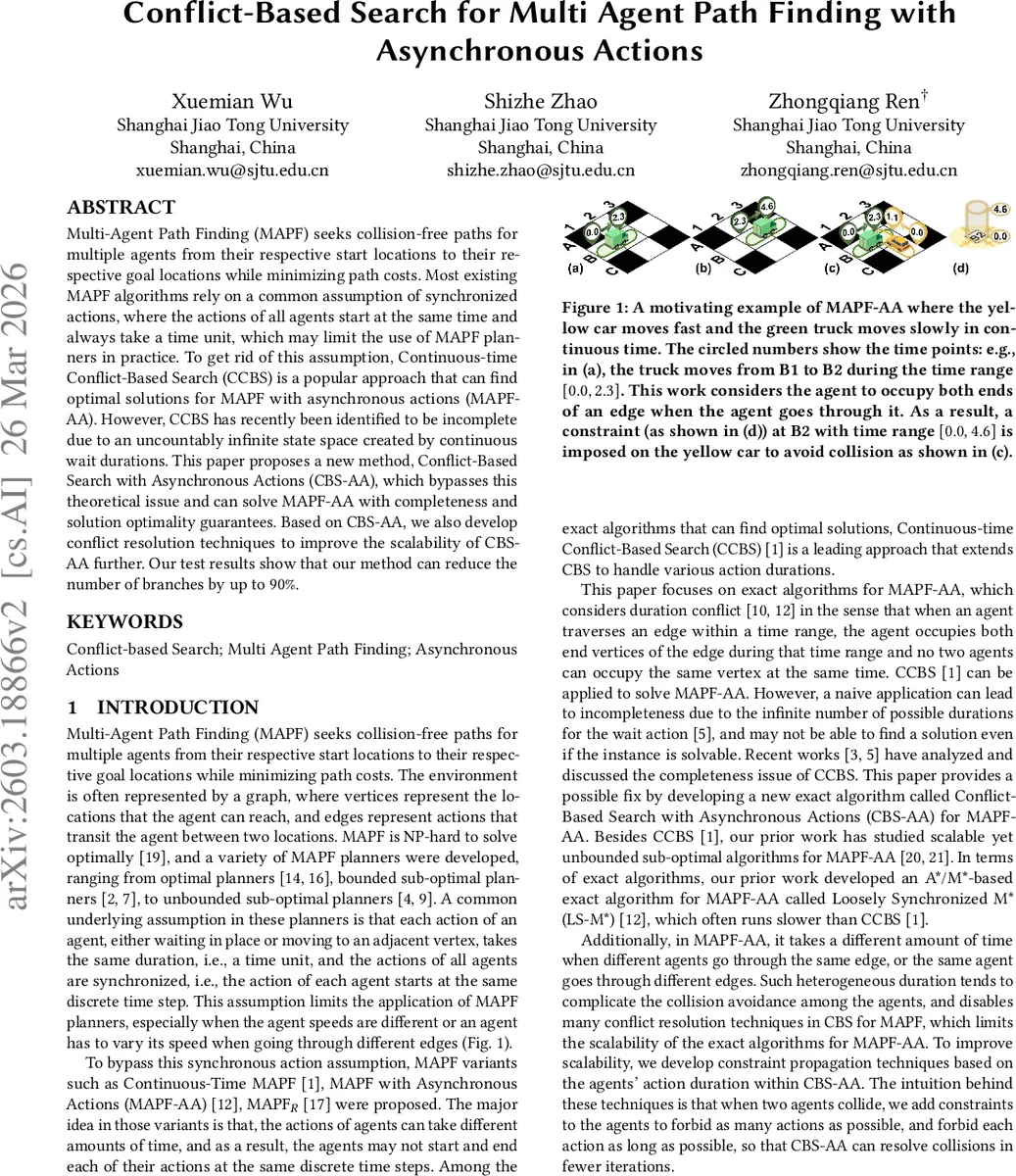
Multi-Agent Path Finding (MAPF) seeks collision-free paths for multiple agents from their respective start locations to their respective goal locations while minimizing path costs. Most existing MAPF algorithms rely on a common assumption of synchronized actions, where the actions of all agents start at the same time and always take a time unit, which may limit the use of MAPF planners in practice. To get rid of this assumption, Continuous-time Conflict-Based Search (CCBS) is a popular approach that can find optimal solutions for MAPF with asynchronous actions (MAPF-AA). However, CCBS has recently been identified to be incomplete due to an uncountably infinite state space created by continuous wait durations. This paper proposes a new method, Conflict-Based Search with Asynchronous Actions (CBS-AA), which bypasses this theoretical issue and can solve MAPF-AA with completeness and solution optimality guarantees. Based on CBS-AA, we also develop conflict resolution techniques to improve the scalability of CBS-AA further. Our test results show that our method can reduce the number of branches by up to 90%.
💡 Research Summary
The paper addresses the Multi‑Agent Path Finding problem with Asynchronous Actions (MAPF‑AA), where agents may have heterogeneous travel times and start actions at arbitrary moments, thus breaking the usual assumption of synchronized, unit‑duration moves. Existing optimal solvers such as Continuous‑time Conflict‑Based Search (CCBS) extend the classic CBS framework to continuous time, but they suffer from incompleteness because the space of possible wait durations is uncountably infinite. When a conflict involves a wait action, CCBS generates a constraint that only excludes a single specific duration, leaving infinitely many other wait durations that still cause the conflict. Consequently, the high‑level search may never terminate.
To overcome this limitation, the authors propose Conflict‑Based Search with Asynchronous Actions (CBS‑AA). CBS‑AA retains the two‑level structure of CBS but modifies three core components: low‑level planning, conflict detection, and constraint generation. The low‑level planner adapts Safe Interval Path Planning (SIPP) to handle real‑valued time intervals directly. Instead of discretizing time, CBS‑AA cuts safe intervals precisely at the boundaries imposed by constraints, guaranteeing that every possible wait duration is either allowed or explicitly forbidden.
Conflict detection is refined by introducing three action categories for each vertex: IN (entering the vertex), OUT (leaving the vertex), and WAIT (remaining at the vertex). Each action occupies the vertex for a continuous time interval, called Duration Occupancy. A conflict occurs when two agents’ occupancy intervals overlap on the same vertex. The authors prove that only conflicts involving at least one IN action need to be considered, reducing the nine possible action‑pair combinations to three meaningful types: IN‑IN, OUT‑IN, and WAIT‑IN. This classification simplifies both detection and resolution.
Constraint generation is where CBS‑AA diverges most significantly from CCBS. Two strategies are introduced: Constraint on Single Action (CSA) and Constraint on Multiple Actions (CMA). CSA mirrors CCBS but correctly restricts the exact time interval of the offending action, avoiding the over‑approximation that leads to missed feasible solutions. CMA goes further by simultaneously forbidding as many actions as possible and extending the forbidden interval as far as it remains safe, thereby pruning large portions of the high‑level search tree. This aggressive propagation dramatically reduces the number of high‑level nodes explored.
The authors provide formal proofs that CBS‑AA is both complete (it will find a solution whenever one exists) and optimal (the solution minimizes the sum of individual travel times). Empirical evaluation compares CBS‑AA against the original CCBS implementation and the previously proposed LS‑M* algorithm. Experiments on grid and random graphs with up to 30 agents show that CBS‑AA achieves a success rate far higher than CCBS, reduces the number of high‑level branches by up to 90 %, and solves instances faster while always returning the same optimal cost as LS‑M*. Importantly, CBS‑AA eliminates the non‑termination issue of CCBS caused by infinite wait‑duration branching.
In summary, CBS‑AA offers a theoretically sound and practically efficient exact algorithm for MAPF‑AA. By handling continuous wait times through precise safe‑interval splitting and by propagating multi‑action constraints, it resolves the core incompleteness of CCBS and scales to larger, more heterogeneous agent teams. Future work may explore bounded‑suboptimal variants, dynamic environments, and integration with real‑world robotic platforms.
Comments & Academic Discussion
Loading comments...
Leave a Comment