Coloopless and cosimple zonotopes, and the Lonely Runner Conjectures
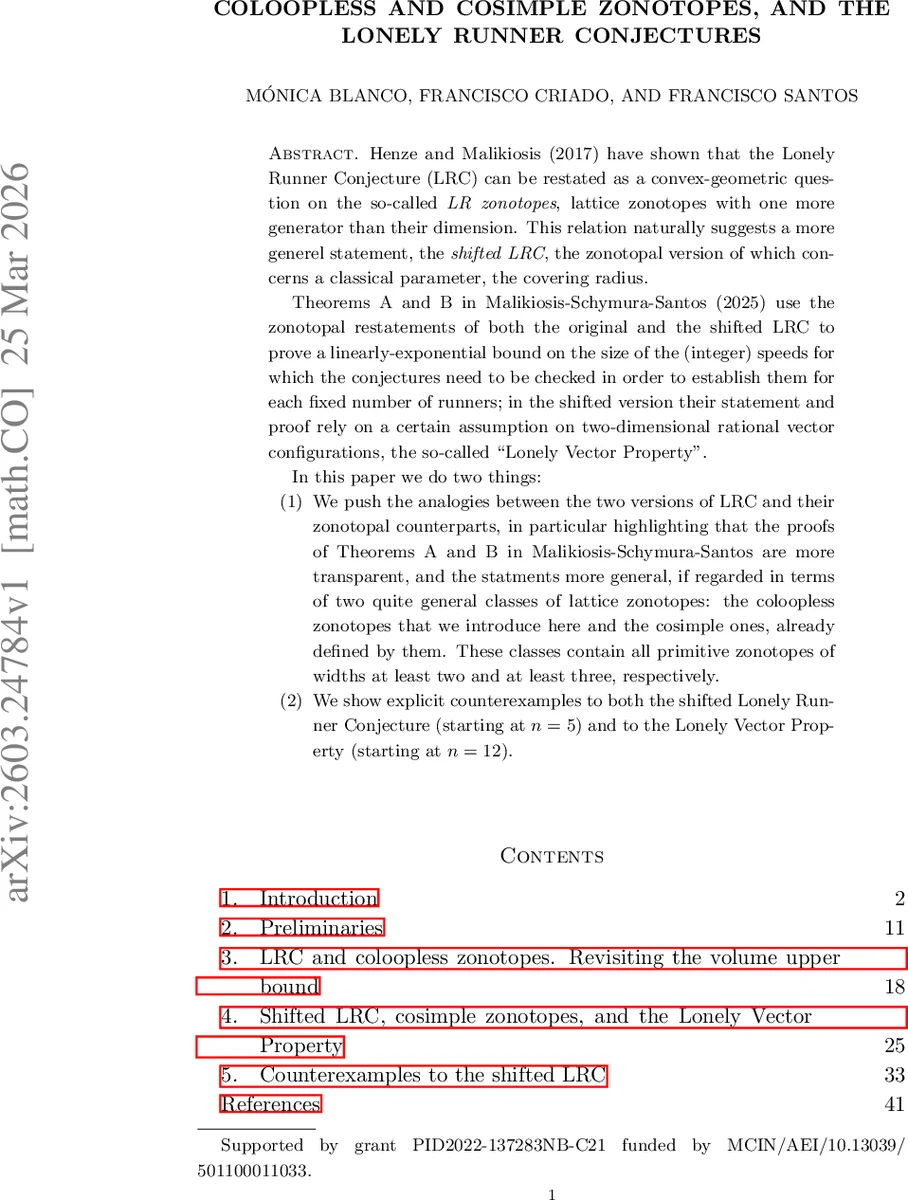
Henze and Malikiosis (2017) have shown that the Lonely Runner Conjecture (LRC) can be restated as a convex-geometric question on the so-called LR zonotopes, lattice zonotopes with one more generator than their dimension. This relation naturally suggests a more generel statement, the \emph{shifted LRC}, the zonotopal version of which concerns a classical parameter, the covering radius. Theorems A and B in Malikiosis-Schymura-Santos (2025) use the zonotopal restatements of both the original and the shifted LRC to prove a linearly-exponential bound on the size of the (integer) speeds for which the conjectures need to be checked in order to establish them for each fixed number of runners; in the shifted version their statement and proof rely on a certain assumption on two-dimensional rational vector configurations, the so-called ``Lonely Vector Property’’. In this paper we do two things: 1. We push the analogies between the two versions of LRC and their zonotopal counterparts, in particular highlighting that the proofs of Theorems A and B in Malikiosis-Schymura-Santos are more transparent, and the statments more general, if regarded in terms of two quite general classes of lattice zonotopes: the coloopless zonotopes that we introduce here and the cosimple ones, already defined by them. These classes contain all primitive zonotopes of widths at least two and at least three, respectively. 2. We show explicit counterexamples to both the shifted Lonely Runner Conjecture (starting at $n=5$) and to the Lonely Vector Property (starting at $n=12$).
💡 Research Summary
The paper revisits the classic Lonely Runner Conjecture (LRC) and its shifted variant (sLRC) through the lens of lattice zonotopes, introducing two broad classes—coloopless zonotopes and cosimple zonotopes—that encompass all previously studied LR‑zonotopes. Starting from the standard formulation, the authors define the “loneliness gap” γ(v) for a velocity vector v and its shifted counterpart γ_min(v). By expressing these gaps in terms of the L∞ distance to the half‑integer lattice, they translate the problem into a geometric one: γ(v)=½−½·κ(Z) and γ_min(v)=½−½·μ(Z), where Z is the associated LR‑zonotope, κ(Z) is its first c‑minimum (the Minkowski distance from the centre to the lattice) and μ(Z) its covering radius. Consequently, the original LRC is equivalent to the statement that every (n−1)-dimensional LR‑zonotope satisfies κ(Z)≤(n−1)/(n+1).
The authors then define a coloopless zonotope as a lattice zonotope generated by a set U={u₁,…,uₙ}⊂ℤᵈ that satisfies any of four equivalent conditions: (1) there exists a non‑trivial linear dependence Σλᵢuᵢ=0 with all λᵢ≠0, (2) no hyperplane contains all but one of the generators, (3) the Gale transform of U contains no zero vector, and (4) the lattice generated by U has width at least two. They prove that every LR‑zonotope is coloopless, and more importantly, that every coloopless zonotope Z contains a sub‑zonotope Z′ (obtained by combining generators) which is itself an LR‑zonotope with the same centre. Since κ is monotone under inclusion, κ(Z)≤κ(Z′), and the maximal κ among coloopless zonotopes is attained by an LR‑zonotope. This yields the equivalence: “LRC holds ⇔ every coloopless (n−1)-zonotope has κ≤(n−1)/(n+1)”.
The paper shows that the coloopless condition is essentially optimal: if a zonotope has even a single coloop, its κ can be arbitrarily close to 1. For any odd prime p>2 the authors construct a p‑zonotope with exactly one coloop, width at least three, and κ=(p−1)/p, demonstrating that dropping the coloopless hypothesis would break the bound.
Turning to the shifted conjecture, previous work (Malikiosis‑Schymura‑Santos, 2025) required the “Lonely Vector Property” (LVP): a geometric condition on every two‑dimensional rational vector configuration. The authors disprove both the shifted LRC and the LVP by explicit counterexamples. Using a computational algorithm that evaluates γ_min(v) for arbitrary integer vectors, they find that for v=(1,2,3,4,5) the shifted gap is 15/94 < 1/6, and similarly for several other vectors up to n=17 the gap falls below 1/(n+1). Hence the shifted conjecture fails for all n∈{5,…,17}. The same computations also exhibit configurations violating LVP, showing that the property is false in general.
A key technical contribution is Theorem 3.8, which gives a universal bound for coloopless zonotopes: if a d‑dimensional coloopless zonotope contains at least ℓ·d lattice points, then κ≤κ_LR_d−1+1/ℓ. Setting ℓ=⌊(n+1)/2⌋ reproduces the volume bound used in Theorem A of the earlier work, but now without any extra assumptions. This result abstracts the core idea of the previous proofs and places it in a more transparent, combinatorial framework.
In summary, the paper achieves three major advances: (1) it clarifies and generalizes the zonotopal reformulation of both the original and shifted Lonely Runner Conjectures, (2) it introduces the coloopless and cosimple classes, showing that the former captures exactly the extremal cases for the first c‑minimum, and (3) it provides concrete counterexamples that invalidate the shifted LRC and the Lonely Vector Property, thereby reshaping the landscape of open problems in this area. The work opens new directions, suggesting that any further progress on the LRC must either exploit the coloopless structure more deeply or seek alternative geometric invariants beyond covering radius.
Comments & Academic Discussion
Loading comments...
Leave a Comment