The conformal dimension of the Brownian sphere is two
The conformal dimension of a metric space $(X, d)$ is equal to the infimum of the Hausdorff dimensions among all metric spaces quasisymmetric to $(X, d)$. It is an important quasisymmetric invariant which lies non-strictly between the topological and…
Authors: Jason Miller, Yi Tian
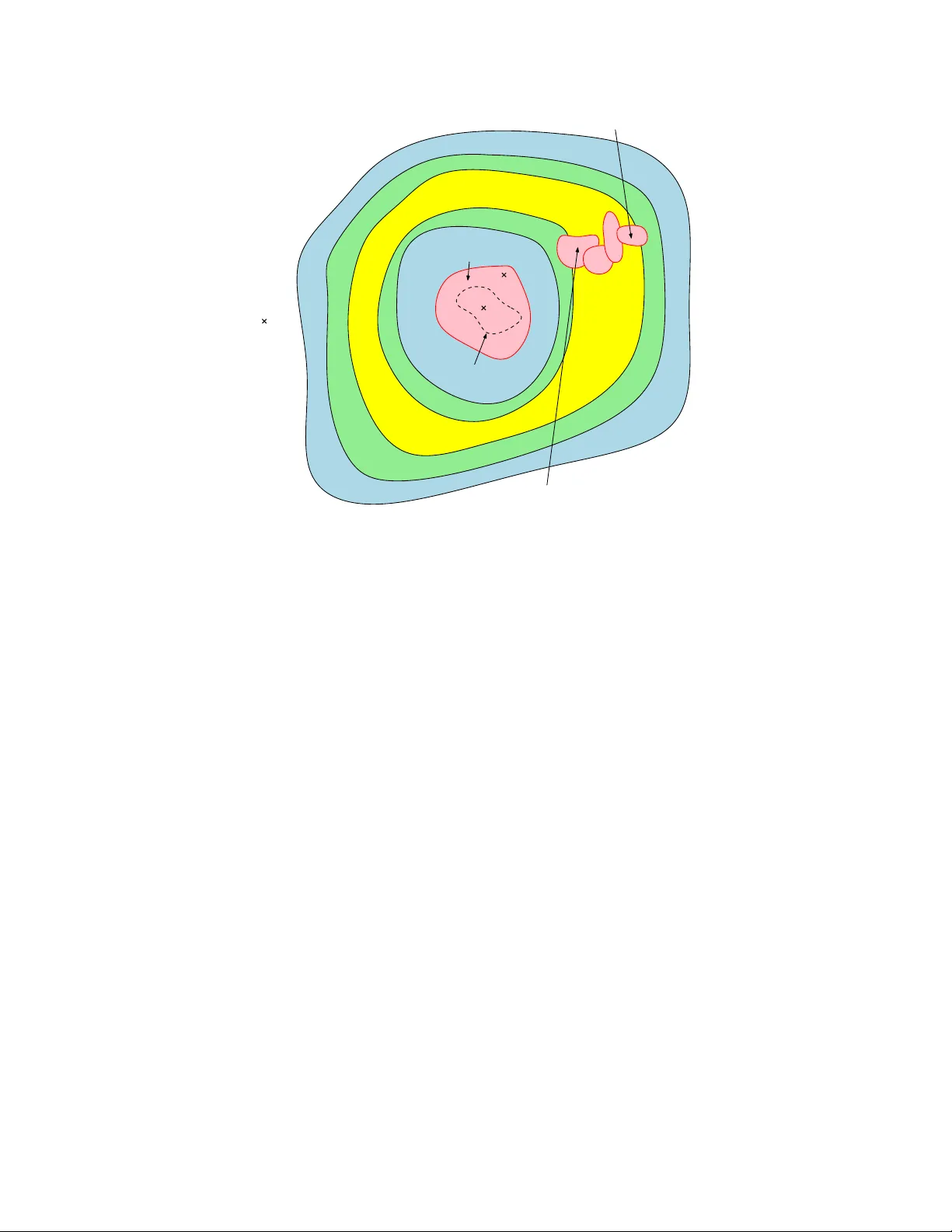
THE CONF ORMAL DIMENSION OF THE BR O WNIAN SPHERE IS TW O JASON MILLER AND YI TIAN Abstract. The conformal dimension of a metric space ( X, d ) is equal to the infim um of the Hausdorff dimensions among all metric spaces quasisymmetric to ( X, d ) . It is an imp ortan t qua- sisymmetric inv arian t whic h lies non-strictly b etw een the top ological and Hausdorff dimensions of ( X, d ) . W e consider the conformal dimension of the Bro wnian sphere (a.k.a. the Bro wnian map), whose la w can be though t of as the uniform measure on metric measure spaces homeomorphic to the standard sphere S 2 with unit area. Since the Hausdorff dimension of the Bro wnian sphere is 4 , its conformal dimension lies in [2 , 4] . Our main result is that its conformal dimension is equal to 2 , its top ological dimension. Contents 1. In tro duction 1 2. Bac kground on the Bro wnian sphere and Liouville quantum gra vity 5 3. Estimates for the Bro wnian plane 10 4. Bac kground on Gromo v hyperb olic geometry 19 5. Hyp erb olic fillings 21 6. Constructing an admissible w eight 30 7. Pro of of Theorem 1.1 40 References 42 1. Introduction The main object of study in this paper is the Br ownian spher e (a.k.a. the Br ownian map ), whose la w is the “uniform measure” on metric measure spaces homeomorphic to the tw o-dimensional sphere S 2 with unit area. This interpretation arises as it w as shown in indep endent w orks of Le Gall [ LG13 ] and Miermon t [ Mie13 ] that it is the Gromov–Hausdorff–Prokhoro v scaling limit of the natural discrete uniform measures on surfaces homeomorphic to S 2 coming from the theory of random planar maps. Recall that a planar map is a prop er embedding of a connected planar graph in to the t w o-dimensional sphere, considered up to orien tation-preserving homeomorphisms. A planar map is called a p -angulation if every face is incident to exactly p edges (i.e., has degree p ). Planar maps can b e though t of as surfaces by asso ciating with eac h face a cop y of a regular Euclidean polygon with the same num b er of sides as the degree of the face. The w ork [ Mie13 ] pro v ed the con vergence of random quadrangulations to the Bro wnian sphere while [ LG13 ] prov ed the conv ergence for p - angulations with p = 3 or p ≥ 4 ev en. A num b er of subsequent w orks sho wed that other families of random planar maps also con v erge to the Bro wnian sphere; see [ BJM14 , Abr16 , ABA17 , ABA21 ]. The Bro wnian sphere is also the scaling limit of random h yp erb olic surfaces with gen us zero and man y cusps [ BC25 ]. F urthermore, [ LG07 , LGP08 ] pro v ed that the Brownian sphere is almost surely homeomorphic to S 2 (non-trivial since b eing homeomorphic to S 2 is not preserv ed b y Gromo v– Hausdorff–Prokhoro v limits; see [ Mie08 ] for another pro of ) and has Hausdorff dimension 4 . Date : Marc h 26, 2026. 1 2 JASON MILLER AND YI TIAN The Bro wnian sphere can equiv alen tly be describ ed as the p 8 / 3 - Liouvil le quantum gr avity (LQG) sphere [ MS16 , MS20 , MS21a , MS21b , MS21c ]. As a consequence, these w orks sho w that if ( 𝒮 , D 𝒮 , M 𝒮 ) is a Brownian sphere, there is a natural homeomorphism 𝒮 → S 2 that is almost surely determined b y ( 𝒮 , D 𝒮 , M 𝒮 ) which is w ell-defined up to post-comp osition with conformal au tomorphisms of S 2 . This gives the Brownian sphere a natural conformal structure, allowing it to b e viewed (in some sense) as a random t wo-dimensional Riemannian manifold. Let ( X , d X ) and ( Y , d Y ) b e metric spaces. A homeomorphism f : ( X, d X ) → ( Y , d Y ) is quasisym- metric if there exists an increasing homeomorphism η : R ≥ 0 → R ≥ 0 suc h that d Y ( f ( x ) , f ( z )) d Y ( f ( y ) , f ( z )) ≤ η d X ( x, z ) d X ( y , z ) , ∀ distinct x, y , z ∈ X . T w o metric spaces ( X, d X ) and ( Y , d Y ) are quasisymmetric al ly e quivalent if there exists a quasisym- metric mapping b etw een them. Quasisymmetric mappings were introduced by [ TV80 ] as a generalization of quasiconformal map- pings. In turn, quasiconformal mappings — which extend the classical theory of conformal map- pings — were first considered in [ Grö20a , Grö20b ] and formally named b y [ Ahl35 ]. F or a com- prehensiv e introduction, we refer the reader to [ L V65 , Leh84 , HK95 , Hei01 , Ahl06 , Hei06 ]. Both quasisymmetric and quasiconformal mappings ha v e many applications across mathematics whic h w e will not attempt to summarize here. The c onformal dimension , introduced by Pansu [ Pan89 ], is an imp ortant quasisymmetric inv ariant. The conformal dimension of a metric space is the infimum of the Hausdorff dimensions of all metric spaces quasisymmetrically equiv alent to it. By definition, it is b ounded below b y the top ological dimension and ab o ve b y the Hausdorff dimension. A metric space is minimal for conformal di- mension if its conf ormal dimension equals its Hausdorff dimension. In particular, the conformal dimension of the Brownian sphere lies in the in terv al [2 , 4] . Our main result is that its conformal dimension matches its top ological dimension. Theorem 1.1. A lmost sur ely, the Br ownian spher e has c onformal dimension 2 . Man y naturally occurring fractals arise from random pro cesses. How ever, to the best of our kno wl- edge, prior to the present work, the graph of a one-dimensional Bro wnian motion was the only random fractal for whic h the conformal dimension had b een explicitly determined [ BHL25 ]. In con trast to [ BHL25 ], w e find that the conformal dimension of the Brownian sphere is equal to its top ological dimension 2 which is strictly smaller than its Hausdorff dimension 4 . That is, the Bro wnian sphere is not minimal. W e remark that there is a v ariant of the conformal dimension commonly considered called the Ahlfors regular conformal dimension, where one requires that the target space is Ahlfors regular. It w as sho wn in [ T ro21 ] that the Assouad dimension of the Brownian sphere is infinite, hence it cannot b e embedded quasisymmetrically into R n , or an y doubling space. In particular, its canonical em b edding into S 2 is not quasisymmetric and its Ahlfors regular conformal dimension is infinite. In general, a metric space has minimal conformal dimension if it contains a “sufficiently ric h family of rectifiable curv es” (see [ MT10 , Prop osition 4.1.8]). It w as sho wn in [ LG10 ] (and later [ AKM17 , MQ25 ]) that geo desics in the Brownian sphere ha ve the c onfluenc e pr op erty : T wo geodesics with nearb y starting and target points will inevitably merge and share a common segmen t outside a small neighborho o d of their endp oints. It was further shown in [ MQ25 ] that the ge o desic fr ame , the closure of the union of all geo desics minus their endp oints, of the Bro wnian sphere is equal to 1 , the dimension of a single geodesic. These results are strongly suggestive that the Brownian sphere lac ks a sufficien tly rich family of rectifiable curv es to be minimal. THE CONFORMAL DIMENSION OF THE BR OWNIAN SPHERE IS TWO 3 F or curves and surfaces which are rough and fractal in a controlled manner, one can appeal to the literature on quasisymmetric uniformization whic h serv es to generalize the classical uniformization. Recall that the latter states that ev ery simply connected t wo-dimensional Riemannian manifold is conformally equiv alen t to the upper half-plane, the complex plane, or the Riemann sphere. The quasisymmetric analogue asks: When is a metric space ( X, d X ) homeomorphic to a “standard” space ( Y , d Y ) quasisymmetrically equiv alen t to it? F or n = 1 , [ TV80 ] established that a metric space homeomorphic to S 1 is quasisymmetrically equiv alent to S 1 (a quasicir cle ) if and only if it is doubling and linearly locally connected (LLC). F or n = 2 , [ BK02 ] prov ed that if a metric space homeomorphic to S 2 is Ahlfors 2 -regular and LLC, then it is quasisymmetrically equiv alent to S 2 (see also [ Ra j17 , L W20 , MW25 , NR23 ]). The uniformization problem for dimensions n ≥ 3 currently remains op en. Quasicircles in particular hav e conformal dimension 1 and Ahlfors 2 -regular LLC surfaces homeomorphic to S 2 ha v e conformal dimension 2 . The Brownian sphere is not Ahlfors regular [ T ro21 ] and do es not satisfy the LLC prop ert y , so one cannot use [ BK02 ] to compute its conformal dimension. The conformal dimension is imp ortant in the theory of Gromov h yp erb olic spaces (see Section 4 ) and this was P ansu’s original motiv ation for introducing it [ P an89 ]. Sp ecifically , quasi-isometries b et w een Gromo v hyperb olic spaces induce quasisymmetric mappings on their Gromo v boundaries. Th us the conformal dimension of the Gromov b oundary is a quasi-isometric inv ariant for a Gromov h yp erb olic space. F or b oundaries homeomorphic to S 2 , this leads to Cannon’s conjecture [ Can94 ]: Let G be a Gromo v h yp erb olic group whose Gromo v b oundary ∂ ∞ G is homeomorphic to S 2 . Then the following equiv alent statemen ts hold: (i) There exists an isometric, prop erly discon tinuous, and cocompact action of G on the h y- p erb olic space H 3 . (ii) The Gromo v b oundary ∂ ∞ G is quasisymmetrically equiv alent to S 2 . Remarkably , Cannon’s conjecture is equiv alen t to stating that the Ahlfors regular conformal di- mension of ∂ ∞ G is attained as a minim um [ BK05 ]. There are man y works in the literature whic h study the conformal dimension of fractals, including: • The conformal dimension of any metric space with a Hausdorff dimension strictly less than 1 is 0 [ K ov06 ]. • F or ev ery d ≥ 1 , there exists a metric space with Hausdorff dimension d that is minimal for conformal dimension [ BT01 ]. • The conformal dimension of the Sierpiński gasket is exactly 1 [ TW06 ]. More generally , the conformal dimension of an y sufficiently nice metric space with enough lo cal cut p oints is 1 [ CP14 ]. • The exact conformal dimension of the Sierpiński carp et remains unkno wn; how ever, it lies strictly b etw een 1 and its Hausdorff dimension [ Tys00 , KL04 , Kig14 , Kw a20 ]. • Every Bedford–McMullen carpet with uniform fib ers is minimal for conformal dimension [ Mac11 , BHL25 ]. • F ractal p ercolation is almost surely not minimal for conformal dimension, although explicit v alues for this dimension ha ve not yet been determined [ RS21 ]. • The graph of a one-dimensional Brownian motion is almost surely minimal for conformal dimension [ BHL25 ]. In view of Theorem 1.1 and the equiv alence of the p 8 / 3 -LQG sphere and the Brownian sphere [ MS16 , MS20 , MS21a , MS21b , MS21c ], it is also natural to consider the conformal dimension of γ -LQG surfaces for general v alues of γ ∈ (0 , 2) . In this generalit y , the associated metric w as constructed in [ DDDF20 , DF G + 20 , GM20a , GM20b , GM21 ]. W e conjecture that the conformal dimension of the γ -LQG sphere is almost surely 2 for all γ ∈ (0 , 2) . 4 JASON MILLER AND YI TIAN 1.1. Outline of the pro of. Our argument is motiv ated by the w ork of [ CP13 ], which sho ws that the Ahlfors regular conformal dimension of a compact, doubling metric space is equal to the critical exp onen t associated with its com binatorial mo dulus. (See also the exp ository w ork [ ESS25 ] on the results of [ CP13 ].) The approach in [ CP13 ] relies heavily on the technique of hyperb olic fillings (see Section 5 for a more detailed review). Heuristically , for a compact metric space ( X , D ) with diam( X ; D ) < 1 , the hyperb olic filling is constructed as follows. Fix a sufficien tly small parameter α ∈ (0 , 1) . Let A 0 ⊂ A 1 ⊂ A 2 ⊂ · · · b e a sequence of finite subsets of X such that eac h A n is a maximal α n - separated subset. The hyperb olic filling is then defined as a graph whose vertices are the metric balls B α n ( x ; D ) for n ≥ 0 and x ∈ A n . T w o vertices B α m ( x ; D ) and B α n ( y ; D ) are connected by an edge if either m = n and the dilated balls B 4 α m ( x ; D ) and B 4 α n ( y ; D ) in tersect, or | m − n | = 1 and the balls B α m ( x ; D ) and B α n ( y ; D ) intersect. The resulting metric graph forms a Gromov h yp erb olic space whose Gromo v b oundary is quasisymmetrically equiv alen t to ( X , D ) . A weight function is an assignment σ from the v ertices of the h yp erb olic filling to the non-negativ e real num b ers. Such a w eight function is considered admissible if it satisfies the follo wing condition: Supp ose B α n − 1 ( y ; D ) is a vertex, and there exists a path of v ertices B α n ( x 0 ; D ) ∼ B α n ( x 1 ; D ) ∼ · · · ∼ B α n ( x N ; D ) suc h that B α n − 1 ( y ; D ) ∩ B 4 α n ( x 0 ; D ) = ∅ and ( C \ B 2 α n − 1 ( y ; D )) ∩ B 4 α n ( x N ; D ) = ∅ . Then we must hav e P N j =0 σ ( B α n ( x j ; D )) ≥ 1 . F ollo wing [ CP13 , ESS25 ], for eac h admissible w eigh t function, w e can construct a metric e D on X that is quasisymmetrically equiv alent to D . Heuristically , the e D -diameter of B α n ( x ; D ) is roughly b ounded ab o ve b y a constant multiple of Q n j =1 σ ( B α j ( x j ; D )) , where x n = x and B α j − 1 ( x j − 1 ; D ) represents the “paren t” of B α j ( x j ; D ) . Consequen tly , for p > 2 , to sho w that the conformal dimension of ( X , D ) is at most p , it suffices to construct an admissible w eight function σ suc h that (1.1) X x n ∈ A n n Y j =1 σ ( B α j ( x j ; D )) p → 0 as n → ∞ . W e no w fo cus on the case where ( X, D ) = ( 𝒮 , D 𝒮 ) is the Bro wnian sphere. Our construction of the desired admissible w eight function relies on the a priori em b edding 𝒮 → C ∪ {∞} . One natural candidate for the weigh t function is giv en b y σ ( B α n ( x ; D 𝒮 )) = diam( B α n ( x ; D 𝒮 )) inradius( B α n − 1 / 2 ( x ; D 𝒮 )) , where diam( • ) denotes the Euclidean diameter and inradius( B α n − 1 / 2 ( x ; D 𝒮 )) def = sup { R ≥ 0 : B R ( x ) ⊂ B α n − 1 / 2 ( x ; D 𝒮 ) } (with B R ( x ) denoting the Euclidean ball). One can immediately v erify that this c hoice satisfies the admissibility condition. Ho wev er, with this definition, it is not straightforw ard to verify ( 1.1 ). Instead, we define σ ( B α n ( x ; D 𝒮 )) = diam( B α n ( x ; D 𝒮 )) inradius( B • α n − 1 / 2 ( x ; D 𝒮 )) 1 E ( x,n ) + 1 E ( x,n ) c for some carefully designed ev ent E ( x, n ) . Here, B • α n − 1 / 2 ( x ; D 𝒮 ) denotes the filled metric ball, i.e., the complement of the unbounded connected component of C \ B α n − 1 / 2 ( x ; D 𝒮 ) . In order to verify ( 1.1 ), we first transfer our analysis from the Brownian sphere to a metric ball of the Bro wnian plane ( 𝒞 , D 𝒞 , M 𝒞 ) , or equiv alently , the p 8 / 3 -LQG cone, which serves as the natural unbounded v arian t of the Brownian sphere. Since the Hausdorff dimension of ( 𝒞 , D 𝒞 ) is 4 , the cardinalit y of A n (tak en to b e a maximal α n -separated subset of a metric ball B t (0; D 𝒞 ) of some radius t > 0 in ( 𝒞 , D 𝒞 ) centered at the “origin” of the Bro wnian plane) gro ws as # A n = α − (4+ o (1)) n as n → ∞ . By exploiting the prop erty of indep endence across scales, w e can reduce the v erification of ( 1.1 ) to showing that E [ σ ( B α n (0; D 𝒞 )) p ] = O ( α q ) as α → 0 for some q > 4 uniformly in n ∈ N . This will subsequen tly follo w from the fact that the ev ent E ( x, n ) o ccurs with THE CONFORMAL DIMENSION OF THE BR OWNIAN SPHERE IS TWO 5 sup erp olynomially high probabilit y as α → 0 , com bined with the corresp onding estimates for the ratio diam( B α n (0; D 𝒞 )) inradius( B • α n − 1 / 2 (0; D 𝒞 )) . The remainder of this paper is organized as follo ws. Section 2 pro vides the necessary bac kground material on the Brownian sphere, the Brownian plane, and Liouville quan tum gravit y . Section 3 establishes imp ortant estimates for the Brownian plane, with a particular fo cus on b ounding the ratio diam( B α n (0; D 𝒞 )) inradius( B • α n − 1 / 2 (0; D 𝒞 )) . Section 4 recalls basic concepts from Gromo v h yp erb olic geometry . In Section 5 , w e detail the framework of h yp erb olic fillings and explain ho w admissible weigh t functions are used to construct quasisymmetrically equiv alen t metrics. Section 6 is devoted to explicitly constructing our target weigh t function and rigorously verifying its admissibilit y . Finally , Section 7 consolidates these elemen ts to complete the pro of of our main result, Theorem 1.1 . A c kno wledgemen ts. J.M. received supp ort from ER C consolidator grant ARPF (Horizon Europ e UKRI G120614). Y.T. w as supp orted b y a Cam bridge In ternational Scholarship from Cam bridge T rust. 2. Back ground on the Bro wnian sphere and Liouville quantum gra vity 2.1. Notations and conv entions. W e let C , R , Z , and N denote the sets of complex n umbers, real num b ers, in tegers, and p ositiv e in tegers, respectively . W e shall write b C def = C ∪ {∞} . F or real n um b ers a < b , we define the discrete in terv al [ a, b ] Z def = [ a, b ] ∩ Z . F or v ariable non-negativ e quantities a and b , we write a ⪯ b (resp. a ⪰ b ) if there exists a constant C > 0 , independent of the relev ant parameters, suc h that a ≤ C b (resp. a ≥ C b ). W e write a ≍ b if b oth a ⪯ b and a ⪰ b hold. F or a non-negativ e quantit y a dep ending on a parameter t > 0 , and for a fixed exp onen t α > 0 , w e write a = O ( t α ) as t → 0 if there exists a constant C > 0 such that a ≤ C t α for all sufficiently small t . W e write a = O ( t ∞ ) as t → 0 if a = O ( t α ) as t → 0 for every α > 0 . Similarly , w e write a = O ( t − α ) and a = O ( t −∞ ) as t → ∞ to denote the analogous b ounds for large t . Let ( X , D ) be a metric space. F or x ∈ X and t > 0 , w e define the op en metric ball B t ( x ; D ) def = { y ∈ X : D ( x, y ) < t } . F or 0 < s < t , we define the op en metric ann ulus A s,t ( x ; D ) def = { y ∈ X : s < D ( x, y ) < t } . Finally , the diameter of the space is denoted by diam( X ; D ) def = sup { D ( x, y ) : x, y ∈ X } . When D is the Euclidean metric, we omit it from our notation. 2.2. The Bro wnian sphere and the Bro wnian plane. In the presen t subsection, w e review the construction and fundamental properties of the Brownian sphere and the Brownian plane. Let { X t } t ∈ [0 , 1] b e a normalized Brownian excursion. Giv en X , let { Z t } t ∈ [0 , 1] b e a cen tered Gaussian pro cess with cov ariance function E [ Z s Z t ] = inf u ∈ [ s,t ] X u , ∀ 0 ≤ s ≤ t ≤ 1 . W e define D ◦ ( s, t ) def = Z s + Z t − 2 inf u ∈ [ s,t ] Z u ∨ inf u ∈ [0 ,s ] ∪ [ t, 1] Z u ! , ∀ 0 ≤ s ≤ t ≤ 1 . Let D b e the maximal pseudo-metric on [0 , 1] suc h that D ≤ D ◦ and D ( s, t ) = 0 whenever D ◦ ( s, t ) = 0 . W e define the quotient space 𝒮 def = [0 , 1] / ∼ , where s ∼ t if and only if D ( s, t ) = 0 . Let D 𝒮 denote the metric on 𝒮 induced by D , and let M 𝒮 b e the pushforw ard of the Leb esgue measure on [ 0 , 1] 6 JASON MILLER AND YI TIAN under the canonical pro jection pr : [0 , 1] → 𝒮 . W e refer to the quin tuple ( 𝒮 , D 𝒮 , M 𝒮 ; pr(0) , pr( t ∗ )) as the Br ownian spher e with unit area, where t ∗ denotes the unique time at whic h Z attains its infim um. Almost surely , ( 𝒮 , D 𝒮 ) is a geo desic metric space homeomorphic to S 2 (cf. [ LGP08 , Mie08 ]), and its Hausdorff dimension is 4 (cf. [ LG07 ]). Conditional on ( 𝒮 , D 𝒮 , M 𝒮 ) , the marked p oin ts pr(0) and pr( t ∗ ) are indep enden t and distributed according to M 𝒮 (cf. [ LG10 ]). F urthermore, the measure M 𝒮 is almost surely giv en b y the Hausdorff measure asso ciated with the gauge function r 7→ r 4 log(log (1 /r )) (cf. [ LG22 ]). The law of the unconditioned Brownian sphere (i.e., with a random area) is defined as the pushfor- w ard of the measure P ⊗ ca − 3 / 2 d a , for some constant c > 0 , under the scaling ( 𝒮 , D 𝒮 , M 𝒮 ; x, y ) 7→ ( 𝒮 , a 1 / 4 D 𝒮 , a M 𝒮 ; x, y ) , where P denotes the law of the Brownian sphere with unit area. Equiv a- len tly , the unconditioned Bro wnian sphere can be constructed via the same pro cedure described ab o v e by replacing the normalized Bro wnian excursion with Itô’s excursion measure. The Brownian plane is an unbounded v arian t of the Bro wnian sphere and is constructed in a similar manner (cf. [ CLG14 ]). More precisely , let { X t } t ∈ R b e a pro cess such that { X t } t ≥ 0 and { X − t } t ≥ 0 are indep endent three-dimensional Bessel pro cesses starting from zero. Given X , let { Z t } t ∈ R b e a cen tered Gaussian pro cess with cov ariance function E [ Z s Z t ] = ( inf u ∈ [ s,t ] X u if s ≤ t ≤ 0 or 0 ≤ s ≤ t ; inf u ∈ ( −∞ ,s ] ∪ [ t, ∞ ) X u if s ≤ 0 ≤ t. W e define D ◦ ( s, t ) def = Z s + Z t − 2 inf u ∈ [ s,t ] Z u , ∀ s ≤ t. Let D b e the maximal pseudo-metric on R suc h that D ≤ D ◦ and D ( s, t ) = 0 whenev er D ◦ ( s, t ) = 0 . W e define the quotient space 𝒞 def = R / ∼ , where s ∼ t if and only if D ( s, t ) = 0 . Let D 𝒞 denote the metric on 𝒞 induced by D , and let M 𝒞 b e the pushforw ard of the Leb esgue measure on R under the canonical pro jection pr : R → 𝒞 . W e refer to the quadruple ( 𝒞 , D 𝒞 , M 𝒞 ; pr(0)) as the Br ownian plane . The Brownian plane satisfies a natural scaling prop erty: F or each deterministic scalar λ > 0 , the rescaled space ( 𝒞 , λD 𝒞 , λ 4 M 𝒞 ; pr(0)) has exactly the same law as the original space ( 𝒞 , D 𝒞 , M 𝒞 ; pr(0)) . 2.3. The breadth-first exploration. Recall that a c ontinuous-state br anching pr o c ess (CSBP) with br anching me chanism ψ is an R ≥ 0 -v alued Marko v pro cess Y suc h that E y [e − λY t ] = e − y u t ( λ ) , ∀ y > 0 , ∀ λ > 0 , ∀ t > 0 , where ∂ t u t ( λ ) = − ψ ( u t ( λ )) and u 0 ( λ ) = λ, and ψ takes the Lévy–Khin tc hine form ψ ( u ) = au + bu 2 + Z ∞ 0 (e − ux − 1 + ux ) Π(d x ) . When ψ ( u ) = cu α for some α ∈ (1 , 2] and c > 0 , w e refer to Y as an α -stable CSBP . In the present pap er, we consider the case where ψ ( u ) = p 8 / 3 u 3 / 2 . In this setting, u t ( λ ) = ( λ − 1 / 2 + q 2 / 3 t ) − 2 , ∀ λ > 0 . Let ζ def = inf { t > 0 : Y t = 0 } denote the lifetime of Y . Then P y [ ζ ≤ t ] = P y [ Y t = 0] = lim λ →∞ E y [e − λY t ] = exp − 3 y 2 t 2 , ∀ t > 0 , THE CONFORMAL DIMENSION OF THE BRO WNIAN SPHERE IS TWO 7 yielding the density (2.1) P y [ ζ ∈ d t ] = 3 y t − 3 exp − 3 y 2 t 2 d t, ∀ t > 0 . The 3 / 2 -stable CSBP and its asso ciated excursion measure can be obtained from the sp ectrally p ositiv e 3 / 2 -stable Lévy pro cess and its excursion measure, resp ectively , via the Lamp erti trans- formation. Let ( 𝒮 , D 𝒮 , M 𝒮 ; x, y ) b e an (unconditioned) Brownian sphere. Unlike Euclidean space, the com- plemen t of the metric ball B t ( x ; D 𝒮 ) for t > 0 has countably many connected comp onents (unless B t ( x ; D 𝒮 ) = 𝒮 ). W e define B y t ( x ; D 𝒮 ) as the complement of the connected comp onen t of 𝒮 \ B t ( x ; D 𝒮 ) that contains y . Informally , B y t ( x ; D 𝒮 ) is obtained by filling in the holes of B t ( x ; D 𝒮 ) that do not con tain y . By [ CLG16 , MS21a ], there exists a càdlàg pro cess { Y t } t ∈ [0 ,D 𝒮 ( x,y )] with only p ositiv e jumps, almost surely determined b y ( 𝒮 , D 𝒮 , M 𝒮 ; x, y ) , suc h that for eac h deterministic t ≥ 0 , almost surely on the ev en t that t < D 𝒮 ( x, y ) , Y D 𝒮 ( x,y ) − t = lim ε → 0 ε − 2 M 𝒮 ( B t + ε ( x ; D 𝒮 ) \ B y t ( x ; D 𝒮 )) . Moreo v er, the la w of { Y t } t ∈ [0 ,D 𝒮 ( x,y )] is given b y the 3 / 2 -stable CSBP excursion measure. Let ( 𝒞 , D 𝒞 , M 𝒞 ; x ) b e a Bro wnian plane. In a similar vein, let B • t ( x ; D 𝒞 ) denote the complemen t of the unbounded connected comp onen t of 𝒞 \ B t ( x ; D 𝒞 ) . There exists a càdlàg pro cess { Y − t } − t ≤ 0 with only p ositive jumps, almost surely determined b y ( 𝒞 , D 𝒞 , M 𝒞 ; x ) , suc h that for eac h deterministic t ≥ 0 , almost surely , Y − t = lim ε → 0 ε − 2 M 𝒞 ( B t + ε ( x ; D 𝒞 ) \ B • t ( x ; D 𝒞 )) . F urthermore, the law of { Y − t } t ≥ 0 is characterized b y the following prop erties: (2.2) • Y − t → ∞ as t → ∞ , and • for each deterministic x > 0 , if w e write τ x def = sup { t ≥ 0 : Y − t = x } , then { Y s − τ x } s ∈ [0 ,τ x ] has the law of a 3 / 2 -stable CSBP starting from x . W e define N 𝒮 ( ∂ B y t ( x ; D 𝒮 )) def = Y D 𝒮 ( x,y ) − t and, respectively , N 𝒞 ( ∂ B • t ( x ; D 𝒞 )) def = Y − t , and refer to them as the b oundary lengths of the filled metric balls. As shown in [ MS21a ], for each deterministic t > 0 , on the even t that t < D 𝒮 ( x, y ) , the b oundary length N 𝒮 ( ∂ B y t ( x ; D 𝒮 )) is almost surely determined b y (2.3) B y t ( x ; D 𝒮 ) , D 𝒮 ( • , • ; B y t ( x ; D 𝒮 )) , M 𝒮 | B y t ( x ; D 𝒮 ) ; x , where D 𝒮 ( • , • ; B y t ( x ; D 𝒮 )) denotes the internal metric (i.e., the infimum of the D 𝒮 -lengths of all paths entirely con tained in B y t ( x ; D 𝒮 ) ); it is also almost surely determined by (2.4) 𝒮 \ B y t ( x ; D 𝒮 ) , D 𝒮 ( • , • ; 𝒮 \ B y t ( x ; D 𝒮 )) , M 𝒮 | 𝒮 \ B y t ( x ; D 𝒮 ) ; y ; furthermore, ( 2.3 ) and ( 2.4 ) are conditionally indep enden t giv en N 𝒮 ( ∂ B y t ( x ; D 𝒮 )) . Moreo ver, the conditional law of ( 2.4 ) given N 𝒮 ( ∂ B y t ( x ; D 𝒮 )) do es not dep end on the choice of t . In fact, this conditional law is referred to as the p ointe d Br ownian disk of b oundary length N 𝒮 ( ∂ B y t ( x ; D 𝒮 )) . Analogously , for each deterministic t > 0 , the b oundary length N 𝒞 ( ∂ B • t ( x ; D 𝒞 )) is almost surely determined by (2.5) B • t ( x ; D 𝒞 ) , D 𝒞 ( • , • ; B • t ( x ; D 𝒞 )) , M 𝒞 | B • t ( x ; D 𝒞 ) ; x , 8 JASON MILLER AND YI TIAN and also by (2.6) 𝒞 \ B • t ( x ; D 𝒞 ) , D 𝒞 ( • , • ; 𝒞 \ B • t ( x ; D 𝒞 )) , M 𝒞 | 𝒞 \ B • t ( x ; D 𝒞 ) ; furthermore, ( 2.5 ) and ( 2.6 ) are conditionally indep endent giv en N 𝒞 ( ∂ B • t ( x ; D 𝒞 )) . Moreo v er, the conditional law of ( 2.6 ) given N 𝒞 ( ∂ B • t ( x ; D 𝒞 )) do es not dep end on the c hoice of t . Last but not least, the conditional laws of the filled metric balls ( 2.3 ) and ( 2.5 ) giv en their b oundary lengths are iden tical. F or 0 ≤ s < t , w e define the metric b ands A y s,t ( x ; D 𝒮 ) def = B y t ( x ; D 𝒮 ) \ B y s ( x ; D 𝒮 ) and A • s,t ( x ; D 𝒞 ) def = B • t ( x ; D 𝒞 ) \ B • s ( x ; D 𝒞 ) . F or ℓ 1 , ℓ 2 ≥ 0 , the conditional la w of (2.7) A y s,t ( x ; D 𝒮 ) , D 𝒮 ( • , • ; A y s,t ( x ; D 𝒮 )) , M 𝒮 | A y s,t ( x ; D 𝒮 ) ; ∂ B y s ( x ; D 𝒮 ) , ∂ B y t ( x ; D 𝒮 ) giv en N 𝒮 ( ∂ B y s ( x ; D 𝒮 )) = ℓ 1 , N 𝒮 ( ∂ B y t ( x ; D 𝒮 )) = ℓ 2 , and the ev ent that t ≤ D 𝒮 ( x, y ) , is identical to the conditional law of (2.8) A • s,t ( x ; D 𝒞 ) , D 𝒞 ( • , • ; A • s,t ( x ; D 𝒞 )) , M 𝒞 | A • s,t ( x ; D 𝒞 ) ; ∂ B • s ( x ; D 𝒞 ) , ∂ B • t ( x ; D 𝒞 ) giv en N 𝒞 ( ∂ B • s ( x ; D 𝒞 )) = ℓ 1 and N 𝒞 ( ∂ B • t ( x ; D 𝒞 )) = ℓ 2 . Moreov er, this common conditional la w dep ends only on ℓ 1 , ℓ 2 , and the width t − s , and we refer to it as the la w of the metric b and with inner b oundary length ℓ 1 , outer b oundary length ℓ 2 , and width t − s . Similarly , w e can consider the conditional la ws of ( 2.7 ) and ( 2.8 ) given only that the inner b oundary length is ℓ 1 (and, for the sphere, the even t that s < D 𝒮 ( x, y ) ), without conditioning on the outer b oundary length. While these t wo conditional laws still dep end only on ℓ 1 and t − s , they are no longer identical. W e refer to them as the metric b ands of spher e (r esp. c one) typ e with inner b oundary length ℓ 1 and width t − s . These metric bands satisfy a natural scaling prop erty: If ( 𝒜 , D 𝒜 , M 𝒜 ; I , O ) is a metric band with inner b oundary length ℓ 1 , outer b oundary length ℓ 2 , and width t − s , then for an y deterministic λ > 0 , the rescaled tuple ( 𝒜 , λD 𝒜 , λ 4 M 𝒜 ; I , O ) is a metric band with inner b oundary length λ 2 ℓ 1 , outer b oundary length λ 2 ℓ 2 , and width λ ( t − s ) . An analogous statemen t holds for metric bands of sphere (resp. cone) type. 2.4. Liouville quan tum gra vit y and space-filling SLE. Let γ ∈ (0 , 2) and Q def = 2 /γ + γ / 2 . A γ -LQG surfac e is an equiv alence class of triples ( U, g , Φ) , where U is a Riemann surface, g is a conformal metric on U (i.e., a Riemannian metric of the form ϱ ( z ) 2 d z d z in each lo cal c hart), and Φ is a Sch wartz distribution (an instance of the Gaussian free field) on ( U, g ) . T wo suc h triples ( U, g , Φ) and ( U ′ , g ′ , Φ ′ ) are equiv alent if there exists a conformal mapping ϕ : U ′ → U and a smo oth function ϱ : U ′ → R > 0 suc h that ϕ ∗ ( g ) = ϱ 2 g ′ and Φ ′ = Φ ◦ ϕ + Q log ( ϱ ) . The particular c hoice of a representativ e ( U, g , Φ) from the equiv alence class is referred to as an emb e dding of the γ -LQG surface. W e will also consider marke d γ -LQG surfaces: If A 1 , · · · , A n (resp. A ′ 1 , · · · , A ′ n ) are subsets of the completion of U (resp. U ′ ), then the tuples ( U, g , Φ; A 1 , · · · , A n ) and ( U ′ , g ′ , Φ ′ ; A ′ 1 , · · · , A ′ n ) are considered equiv alen t if the conformal mapping ϕ additionally satisfies ϕ ( A ′ j ) = A j for all j ∈ [1 , n ] Z . In the present paper, we fo cus on the case where U is an op en subset of C and g is the Euclidean metric; consequently , w e omit g from the notation. As shown in [ DS11 ], a γ -LQG surface admits a natural γ -LQG me asur e , denoted b y M Φ . This measure is formally given b y “ e γ Φ d x d y ” and do es not dep end on the choice of em b edding. F urthermore, the surface admits a natural γ -LQG metric , denoted by D Φ , which is formally giv en b y “ e γ Φ (d x 2 + d y 2 ) ” and similarly do es not dep end on the embedding. This metric w as initially THE CONFORMAL DIMENSION OF THE BRO WNIAN SPHERE IS TWO 9 constructed for the sp ecific case of γ = p 8 / 3 in [ MS16 , MS20 , MS21a , MS21b , MS21c ], and later extended to all γ ∈ (0 , 2) b y [ DDDF20 , DF G + 20 , GM20a , GM20b , GM21 ]. Recall that a whole-plane Gaussian fr e e field (GFF) Φ is defined as a random Sc hw artz distribution mo dulo additive constan ts suc h that ⟨ Φ , f ⟩ : f ∈ C ∞ c ( C ) , Z C f ( z ) d z = 0 forms a centered Gaussian pro cess with the cov ariance function E [ ⟨ Φ , f ⟩⟨ Φ , g ⟩ ] = − Z C × C log( | x − y | ) f ( x ) g ( y ) d x d y . Let H 1 ( C ) denote the completion of the space f ∈ C ∞ ( C ) / R : Z C ∥∇ f ( z ) ∥ 2 d z < ∞ with resp ect to the inner pro duct ⟨ f , g ⟩ H 1 ( C ) def = 1 2 π R C ∇ f ( z ) · ∇ g ( z ) d z . The field Φ can then equiv alen tly b e represented b y the series expansion P ∞ j =1 X j ψ j , where ( ψ j ) j ≥ 1 forms an orthonormal basis for H 1 ( C ) and ( X j ) j ≥ 1 is a sequence of indep endent standard Gaussian random v ariables. W e now pro ceed to define the γ -LQG sphere and the γ -LQG cone (cf. [ DMS21 ]). Observ e that H 1 ( C ) admits the orthogonal decomp osition H 1 ( C ) = H rad ( C ) ⊕ H circ ( C ) , where H rad ( C ) def = n f ∈ H 1 ( C ) : f is constant on { z ∈ C : | z | = t } for each t > 0 o ; H circ ( C ) def = n f ∈ H 1 ( C ) : f has mean zero on { z ∈ C : | z | = t } for each t > 0 o . Let us define the process { A t } t ∈ R b y A t def = B t + γ t for t ≥ 0 and A t def = e B − t + γ t for t < 0 , where { B t } t ≥ 0 is a standard Brownian motion starting from 0 , and { e B t } t ≥ 0 is an indep enden t Bro wnian motion starting from 0 , conditioned such that e B t + ( Q − γ ) t > 0 for all t > 0 . Next, let Φ be a whole-plane GFF indep enden t of { A t } t ∈ R . W e define Φ cone as the random Sch wartz distribution whose pro jection on to H rad ( C ) is given by A − log ( |•| ) (where the pro cess defined b y Φ cone r (0) def = A − log ( r ) for r > 0 is referred to as the cir cle aver age pro cess of Φ cone ), and whose pro jection onto H circ ( C ) coincides with that of Φ . The p ointed γ -LQG surface represented b y ( C , Φ cone ; 0 , ∞ ) is then referred to as a γ -LQG c one , with this sp ecific parametrization b eing its cir cle aver age emb e dding . Let e b e a Bessel excursion of dimension 4 − 8 /γ 2 . Let { A e t } t ∈ R b e the pro cess (2 /γ ) log ( e ) , reparameterized to hav e quadratic v ariation d t . If w e replace { A t } t ∈ R with { A e t } t ∈ R in the definition of the γ -LQG cone, we obtain the γ -LQG spher e . Since the Bessel excursion measure is σ -finite, the law of a γ -LQG sphere is also a σ -finite measure. It has b een established in [ MS20 , MS21a , MS21b , MS21c ] that the Brownian sphere ( 𝒮 , D 𝒮 , M 𝒮 ; x, y ) and the p 8 / 3 -LQG sphere ( b C , D Φ sph , M Φ sph ; 0 , ∞ ) are equiv alen t in la w as p ointed metric mea- sure spaces. F urthermore, the p 8 / 3 -LQG surface structure — and in particular, its conformal structure as a Riemann surface — is almost surely determined b y this underlying metric mea- sure space structure. Analogously , the Bro wnian plane ( 𝒞 , D 𝒞 , M 𝒞 ; x ) and the p 8 / 3 -LQG cone ( C , D Φ cone , M Φ cone ; 0) also share the same law as p oin ted metric measure spaces. Let κ def = γ 2 ∈ (0 , 4) and κ ′ def = 16 /κ > 4 . The whole-plane space-filling SLE κ ′ curv e from ∞ to ∞ , first constructed in [ MS17 ], is a v ersatile ob ject that, among its many applications, pro vides a natural framew ork for formulating the translation inv ariance prop erty of the γ -LQG cone. This curv e, denoted by η ′ : R → C , is almost surely non-self-crossing and space-filling, with η ′ ( t ) → ∞ 10 JASON MILLER AND YI TIAN as t → ±∞ . Modulo reparameterization, the la w of η ′ is inv ariant under Möbius transformations that fix ∞ . Consequently , the whole-plane space-filling SLE κ ′ curv e is naturally w ell-defined on a γ -LQG sphere or cone. W e ma y fix the parameterization such that η ′ (0) = 0 . As sho wn in [ DMS21 ], if ( C , Φ; 0 , ∞ ) is a γ -LQG cone independent of η ′ , and η ′ is parameterized b y the γ -LQG measure M Φ , then for any deterministic time t ∈ R , the p ointed γ -LQG surface ( C , Φ; η ′ ( t ) , ∞ ) also has the law of a γ -LQG cone. Throughout the remainder of the presen t pap er, we shall write γ def = q 8 / 3; Q def = 2 /γ + γ / 2 = 5 / √ 6; d γ def = 4; ξ def = γ /d γ = 1 / √ 6; κ def = γ 2 = 8 / 3; κ ′ def = 16 /κ = 6 . 3. Estima tes f or the Br ownian plane In the presen t section, we establish sev eral estimates for the Bro wnian plane. In Section 3.1 , w e collect estimates for 3 / 2 -stable CSBPs. These results show that the b oundary lengths of filled metric balls in the Brownian plane cannot significan tly exceed their exp ected v alues across m ultiple scales. In Section 3.2 , we presen t estimates for the volumes of metric balls. These volume b ounds will allo w us to construct dense nets for the Bro wnian plane with high probability via indep enden t random sampling. Finally , in Section 3.3 , we prov e estimates concerning the conformal mo duli of metric bands in the Brownian plane. These estimates control the ratio b etw een the Euclidean diameter and the inradius mentioned in Section 1.1 , whic h is an important ingredient for the pro of of our main theorem. 3.1. Boundary lengths of filled metric balls. Lemma 3.1. L et y , T > 0 . L et Y b e a 3 / 2 -stable CSBP starting fr om y with lifetime T . Then P y [ Y t > A ( T − t ) 2 ] ≤ 3 3 / 2 exp − A + 3( √ 3 − 1) y ( T − t ) /T 3 , ∀ t ∈ (0 , T ) , ∀ A > 0 . Pr o of. Let Y b e a 3 / 2 -stab le CSBP starting from y (without conditioning on its lifetime ζ ). Then it follows from the Marko v prop erty and ( 2.1 ) that E y [e λY t | ζ = T ] = E y [e λY t 1 { ζ ∈ d T } ] P y [ ζ ∈ d T ] = E y [e λY t P Y t [ ζ ∈ d( T − t )]] E y [ P Y t [ ζ ∈ d( T − t )]] = E y [ Y t e − ( θ − λ ) Y t ] E y [ Y t e − θY t ] = u ′ t ( θ − λ ) u ′ t ( θ ) exp( − y ( u t ( θ − λ ) − u t ( θ ))) , ∀ λ ∈ (0 , θ ) , where θ def = (3 / 2)( T − t ) − 2 . T ake λ def = ( T − t ) − 2 . Then u ′ t ( θ − λ ) u ′ t ( θ ) = θ θ − λ 3 / 2 θ − 1 / 2 + p 2 / 3 t ( θ − λ ) − 1 / 2 + p 2 / 3 t ! 3 = 3 3 / 2 θ − 1 / 2 + p 2 / 3 t ( θ − λ ) − 1 / 2 + p 2 / 3 t ! 3 ≤ 3 3 / 2 , and exp( − y ( u t ( θ − λ ) − u t ( θ ))) = exp 3 y 2 T 2 1 − 1 + ( √ 3 − 1)( T − t ) T ! − 2 ≤ exp 3( √ 3 − 1) y ( T − t ) /T 3 , where the last inequalit y follo ws from the fact that 1 − (1 + x ) − 2 ≤ 2 x for all x ≥ 0 . Thus, w e conclude that E y [e λY t | ζ = T ] ≤ 3 3 / 2 exp 3( √ 3 − 1) y ( T − t ) /T 3 , THE CONFORMAL DIMENSION OF THE BRO WNIAN SPHERE IS TWO 11 whic h implies that E y [ Y t ≥ A ( T − t ) 2 | ζ = T ] ≤ e − A E [e λY t | ζ = T ] ≤ 3 3 / 2 exp − A + 3( √ 3 − 1) y ( T − t ) /T 3 . This completes the pro of of Lemma 3.1 . □ Lemma 3.2. L et ( C , Φ; 0 , ∞ ) b e a γ -LQG c one. F or e ach t ≥ 0 , write Y − t def = N Φ ( ∂ B • t (0; D Φ )) . (i) F or e ach λ ∈ (0 , 1) , α > 0 , and b ∈ (0 , 1) , ther e exists A = A ( λ, α, b ) ∈ (0 , 1) such that the fol lowing is true: L et { t j } j ∈ N b e a de cr e asing se quenc e of p ositive r e al numb ers such that t j +1 /t j ≤ λ for al l j ∈ N . Then P [# { j ∈ [1 , n ] Z : Y − t j ≤ At 2 j } ≥ bn ] ≥ 1 − e − αn , ∀ n ∈ N . (ii) F or e ach ζ > 0 and b ∈ (0 , 1) , ther e exists λ ∗ = λ ∗ ( ζ , b ) ∈ (0 , 1) P [# { j ∈ [1 , n ] Z : Y − λ j ≤ λ 2 j − 2 ζ ) } ≥ bn ] ≥ 1 − exp( − λ − ζ n ) , ∀ λ ∈ (0 , λ ∗ ] , ∀ n ∈ N . Pr o of. First, we consider assertion ( i ). Fix β > 0 to b e c hosen later. F or eac h n ∈ N , write j n for the n -th smallest j ∈ N for which Y − t j ≤ At 2 j . Consider i 0 def = 1 and i n def = i n − 1 + log( Y − t i n − 1 /t 2 i n − 1 ) log(1 /λ ) for all n ∈ N . Recall from [ CLG16 , Prop osition 1.2] that Y − t is a Gamma random v ariable with shap e parameter 3 / 2 and mean t 2 . This implies that E [e β ( i 1 − 1) 1 { Y − t 1 >At 2 1 } ] ≤ C 1 e − C 2 A for some univ ersal constants C 1 , C 2 > 0 . Moreo ver, E h e β ( i n +1 − i n ) 1 { Y − t i n >At 2 i n } Y − t i n − 1 i ≤ e β E ( Y − t i n /t 2 i n ) β log(1 /λ ) 1 { Y − t i n >At 2 i n } Y − t i n − 1 = e β β log(1 /λ ) Z ∞ A x β log(1 /λ ) − 1 P h Y − t i n /t 2 i n ≥ x Y − t i n − 1 i d x ≤ e β β log(1 /λ ) Z ∞ A x β log(1 /λ ) − 1 C 3 e − C 4 x d x (b y Lemma 3.1 ) ≤ e β β log(1 /λ ) C 3 A β log(1 /λ ) − 1 e − C 5 A , where C 3 , C 4 , C 5 > 0 are universal constants. By choosing A to b e sufficien tly large, we may arrange that C 1 e − C 2 A ≤ 1 − 1 / e and e β β log(1 /λ ) C 3 A β log(1 /λ ) − 1 e − C 5 A ≤ 1 − 1 / e . W rite N def = inf { n ≥ 0 : Y − t i n ≤ At 2 i n } . Then j 1 ≤ i N . Thus, E [ e β ( j 1 − 1) ] ≤ E [e β ( i N − 1) ] ≤ P ∞ n =0 (1 − 1 / e) n = e . In a similar v ein, E [e β ( j n +1 − j n − 1) | j n ] ≤ e for all n ∈ N . This implies that E [e β ( j n − n ) ] ≤ e n for all n ∈ N . Thus, we conclude that P [# { j ∈ [1 , n ] Z : Y − t j ≤ At 2 j } < bn ] ≤ P [ j bn > n ] ≤ e bn − β (1 − b ) n , ∀ n ∈ N . This completes the pro of of assertion ( i ). By setting α = λ − ζ (hence β = ( λ − ζ + b ) / (1 − b ) ) and A = λ − 2 ζ , assertion ( ii ) follows immediately from a similar argument to the argument applied in the pro of of assertion ( i ). □ F urthermore, we record a lemma showing that the b oundary lengths of filled metric balls in the Bro wnian plane do not deviate significantly below their exp ected v alues. Lemma 3.3. L et ( C , Φ; 0 , ∞ ) b e a γ -LQG c one. F or e ach t ≥ 0 , write Y − t def = N Φ ( ∂ B • t (0; D Φ )) . Then ther e ar e universal c onstants α , C > 0 such that P h sup r ∈ [ s,t ] Y − r < ε ( t − s ) 2 Y − s = ℓ i ≤ C exp( − αε − 1 / 2 ) , ∀ 0 ≤ s < t, ∀ ε ∈ (0 , 1) , ∀ ℓ ≥ 0 . 12 JASON MILLER AND YI TIAN Pr o of. W e follo w the argumen t applied in the pro of of [ MS21b , Lemma 3.1]. Fix 0 ≤ s < t , ε ∈ (0 , 1) , and ℓ ≥ 0 . W rite σ = inf { r ≥ 0 : Y − r = ℓ } and τ def = sup { r ≥ 0 : Y − r = ε ( t − s ) 2 } . By the Marko v prop erty , P h sup r ∈ [ s,t ] Y − r < ε ( t − s ) 2 Y − s = ℓ i = P h sup r ∈ [ σ ,σ +( t − s )] Y − r < ε ( t − s ) 2 i . Again, b y the Marko v prop erty (cf. ( 2.2 )), { Y r − τ } r ∈ [ 0 ,τ ] has the la w of a 3 / 2 -stable CSBP starting from ε ( t − s ) 2 . W rite E for the even t that there exists a subinterv al of [0 , τ ] with length at least t − s during which Y r − τ is less than ε ( t − s ) 2 . It is clear that the even t that sup r ∈ [ σ ,σ +( t − s )] Y − r < ε ( t − s ) 2 is contained in the even t E . Th us, it suffices to show that there are univ ersal constants α, C > 0 suc h that P [ E ] ≤ C exp( − αε − 1 / 2 ) . This follo ws immediately from the pro of of [ MS21b , Lemma 3.1]. This completes the pro of of Lemma 3.3 . □ 3.2. V olumes of metric balls. Lemma 3.4. L et ( C , Φ; 0 , ∞ ) b e a γ -LQG c one. Then for e ach ζ > 0 , ther e almost sur ely exists ε ∗ ∈ (0 , 1) such that ε d γ + ζ ≤ M Φ ( B ε ( z ; D Φ )) ≤ ε d γ − ζ , ∀ z ∈ B 1 (0; D Φ ) , ∀ ε ∈ (0 , ε ∗ ] . Pr o of. By [ MQ25 , Lemma 2.2], for almost ev ery instance ( b C , Φ sph ; 0 , ∞ ) of a γ -LQG sphere, there exists ε ∗ ∈ (0 , 1) such that ε d γ + ζ ≤ M Φ sph ( B ε ( z ; D Φ sph )) ≤ ε d γ − ζ , ∀ z ∈ C , ∀ ε ∈ (0 , ε ∗ ] . Th us, Lemma 3.4 follo ws immediately from the fact that, on the even t that D Φ sph (0 , ∞ ) > 2 , the la ws of the γ -LQG surfaces parameterized b y B • 2 (0; D Φ ) and B • 2 (0; D Φ sph ) are mutually absolutely con tin uous. (Indeed, the la ws of the b oundary lengths of B • 2 (0; D Φ ) and B • 2 (0; D Φ sph ) are both m utually absolutely con tinuous with resp ect to the Leb esgue measure on R > 0 , and the γ -LQG surfaces parameterized b y B • 2 (0; D Φ ) and B • 2 (0; D Φ sph ) hav e the same conditional law given their b oundary lengths.) □ Lemma 3.5. L et ( C , Φ; 0 , ∞ ) b e a γ -LQG c one. L et η ′ : ( −∞ , ∞ ) → C b e an indep endent whole- plane sp ac e-fil ling SLE κ ′ curve fr om ∞ to ∞ p ar ameterize d by M Φ . L et T > 0 . Given Φ and η ′ , let { x n } n ∈ N b e c onditional ly indep endent samples fr om M Φ | η ′ ([ − T ,T ]) (r enormalize d to b e a pr ob ability me asur e). Then for e ach ζ > 0 , almost sur ely on the event that B 1 (0; D Φ ) ⊂ η ′ ([ − T , T ]) , ther e exists ε ∗ ∈ (0 , 1) such that (3.1) B 1 (0; D Φ ) ⊂ [ n B ε ( x n ; D Φ ) : n ∈ [1 , ε − d γ − ζ ] Z , x n ∈ B 1 (0; D Φ ) o , ∀ ε ∈ (0 , ε ∗ ] . Pr o of. W rite E 1 ( T ) for the even t that B 1 (0; D Φ ) ⊂ η ′ ([ − T , T ]) . F or each ε 0 ∈ (0 , 1) , write E 2 ( ε 0 ) for the even t that ε d γ + ζ / 2 ≤ M Φ ( B ε ( z ; D Φ )) ≤ ε d γ − ζ / 2 , ∀ z ∈ B 1 (0; D Φ ) , ∀ ε ∈ (0 , ε 0 ] . By Lemma 3.4 , it suffices to sho w that, almost surely on the even t E 1 ( T ) ∩ E 2 ( ε 0 ) , there exists ε ∗ ∈ (0 , 1) such that ( 3.1 ) holds. F or each j ∈ N , write F ( j ) for the even t that B 1 (0; D Φ ) ⊂ [ n B 2 − j − 1 ( x n ; D Φ ) : n ∈ [1 , 2 j ( d γ + ζ ) ] Z , x n ∈ B 1 (0; D Φ ) o . Note that if F ( j ) o ccurs for all j ≥ ⌊ log 2 (1 /ε ∗ ) ⌋ , then ( 3.1 ) holds. Note that if F ( j ) do es not o ccur, then there exists x ∈ B 1 (0; D Φ ) such that x n / ∈ B 2 − j − 1 ( x ; D Φ ) for all n ∈ [1 , 2 j ( d γ + ζ ) ] Z with x n ∈ B 1 (0; D Φ ) . In this case, if D Φ (0 , x ) ≥ 2 − j − 2 , let x ′ denote the p oin t on the D Φ - geo desic from 0 to x suc h that D Φ ( x ′ , x ) = 2 − j − 2 ; otherwise, let x ′ def = 0 . In either case, we hav e B 2 − j − 2 ( x ′ ; D Φ ) ⊂ B 1 (0; D Φ ) and x n / ∈ B 2 − j − 2 ( x ′ ; D Φ ) for all n ∈ [1 , 2 j ( d γ + ζ ) ] Z . W rite G ( j ) for the THE CONFORMAL DIMENSION OF THE BRO WNIAN SPHERE IS TWO 13 ev en t that x ⌊ 2 j ( d γ + ζ ) ⌋ +1 ∈ B 1 (0; D Φ ) and that D Φ ( x n , x ⌊ 2 j ( d γ + ζ ) ⌋ +1 ) ≥ 2 − j − 3 for all n ∈ [1 , 2 j ( d γ + ζ ) ] Z . Then P [ G ( j ) | E 1 ( T ) ∩ E 2 ( ε 0 ) ∩ F ( j ) c ] ≥ P h x ⌊ 2 j ( d γ + ζ ) ⌋ +1 ∈ B 2 − j − 3 ( x ′ ; D Φ ) E 1 ( T ) ∩ E 2 ( ε 0 ) ∩ F ( j ) c i ≥ 2 − ( j +3)( d γ + ζ / 2) / (2 T ) . On the other hand, P [ G ( j ) | E 1 ( T ) ∩ E 2 ( ε 0 )] ≤ (1 − 2 − ( j +3)( d γ + ζ / 2) / (2 T )) ⌊ 2 j ( d γ + ζ ) ⌋ ≤ exp( − c 2 j ζ / 2 ) for some c = c ( ζ , T ) > 0 . Thus, w e conclude that P [ F ( j ) c | E 1 ( T ) ∩ E 2 ( ε 0 )] ≤ P [ G ( j ) | E 1 ( T ) ∩ E 2 ( ε 0 )] P [ G ( j ) | E 1 ( T ) ∩ E 2 ( ε 0 ) ∩ F ( j ) c ] ≤ exp( − c 2 j ζ / 2 ) · 2 ( j +3)( d γ + ζ / 2) · (2 T ) . Th us, w e conclude from the Borel–Cantelli lemma that, almost surely on the even t E 1 ( T ) ∩ E 2 ( ε 0 ) , there exists j 0 ∈ N suc h that F ( j ) occurs for all j ≥ j 0 . This completes the pro of of Lemma 3.5 . □ 3.3. Conformal mo duli of metric bands. Prop osition 3.6. L et ( C , Φ; 0 , ∞ ) b e a γ -LQG c one. Then for e ach p > 2 , ther e exists q = q ( p ) > d γ such that E [e − 2 π m ε p ] = O ( ε q ) as ε → 0 , wher e m ε denotes the c onformal mo dulus of A • ε, 1 (0; D Φ ) . Prop osition 3.7. L et 𝒜 T b e a metric b and of c one typ e with inner b oundary length one and width T > 0 . W rite m T for the c onformal mo dulus of 𝒜 T . Then for e ach p > 2 , ther e exists q = q ( p ) > d γ such that E [e − 2 π m T p ] = O ( T − q ) as T → ∞ . Prop osition 3.7 is a fixed-inner-b oundary-length analogue of Prop osition 3.6 and follows easily from the latter. The pro of of Proposition 3.6 requires several preliminary lemmas. F or an o verview of the pro of strategy , see the discussion immediately preceding it. The follo wing lemma states that an y doubly connected domain surrounding the origin with a large conformal mo dulus contains a centered Euclidean annulus whose conformal mo dulus differs from that of the domain by at most an additiv e constant. Lemma 3.8. L et A ⊂ C b e a doubly c onne cte d domain such that the origin is c ontaine d in the b ounde d c onne cte d c omp onent of C \ A . W rite m for the c onformal mo dulus of A ; I (r esp. O ) for the inner (r esp. outer) b oundaries of A ; R 1 def = inf { R > 0 : I ⊂ B R (0) } ; R 2 def = sup { R > 0 : O ∩ B R (0) = ∅} . Then e 2 π m / 16 − 1 ≤ R 2 /R 1 ≤ e 2 π m . Pr o of. It is clear that m ≥ ( conformal mo dulus of A R 1 ,R 2 (0)) = 1 2 π log( R 2 /R 1 ) , whic h implies that R 2 /R 1 ≤ e 2 π m . On the other hand, by [ Ahl73 , Theorem 4-7 and (4-21)], m ≤ ( conformal mo dulus of C \ ([0 , R 1 ] ∪ [ R 2 , ∞ ))) ≤ 1 2 π log(16( R 2 /R 1 + 1)) , whic h implies that e 2 π m / 16 − 1 ≤ R 2 /R 1 . This completes the pro of of Lemma 3.8 . □ The following lemma shows that the Euclidean size of the metric ball is tightly con trolled by the circle av erage pro cess. 14 JASON MILLER AND YI TIAN Lemma 3.9. L et ( C , Φ; 0 , ∞ ) b e the cir cle aver age emb e dding of a γ -LQG c one. F or e ach t > 0 , write R t def = sup { r > 0 : Φ r (0) + Q log ( r ) = (1 /ξ ) log( t ) } . Then E [(inf { t > 0 : B 1 (0; D Φ ) ⊂ B R t (0) } ) s ] < ∞ , ∀ s > 0 . Pr o of. First, w e claim that inf { t > 0 : B 1 (0; D Φ ) ⊂ B R t (0) } has the same law as inf { t > 0 : B 1 /t (0; D Φ ) ⊂ B 1 (0) } = D Φ (0 , ∂ B 1 (0)) − 1 . T o this end, set Φ t ( • ) def = Φ( R t • ) + Q log ( R t ) − (1 /ξ ) log( t ) . By [ DMS21 , Prop osition 4.13, (i)], Φ t has the same law as Φ . On the other han d, note that B 1 /t (0; D Φ t ) = R − 1 t B 1 (0; D Φ ) almost surely . This completes the pro of of the claim . Recall that Φ | B 1 (0) agrees in law with the corresp onding restriction of a whole-plane GFF normalized so that its circle av erage o v er ∂ B 1 (0) is zero min us γ log( |•| ) . Thus, it follows immediately from [ DF G + 20 , Prop osition 3.12] that E [ D Φ (0 , ∂ B 1 (0)) − s ] < ∞ for all s > 0 . This completes the pro of of Lemma 3.9 . □ The follo wing lemma sho ws that if a doubly connected domain surrounding the origin has its conformal mo dulus b ounded from b elow, then its “eccentricit y” is b ounded from ab o v e by a constan t dep ending solely on this mo dulus. Lemma 3.10. F or e ach m > 0 , ther e exists b = b ( m ) ∈ (0 , 1) such that the fol lowing is true: L et A ⊂ C b e a doubly c onne cte d domain such that the origin is c ontaine d in the b ounde d c onne cte d c omp onent of C \ A . Supp ose that the c onformal mo dulus of A is at le ast m . Then ther e exists x > 0 such that • the planar Br ownian motion starting fr om x hits the inner b oundary of A b efor e the outer b oundary with pr ob ability 1 / 2 , • B bx ( x ) ⊂ A , • B bx (0) do es not interse ct the outer b oundary of A , and • the inner b oundary of A is c ontaine d in B b − 1 x (0) . Pr o of. Note that there exists x > 0 suc h that the planar Bro wnian motion starting from x hits the inner b oundary of A b efore the outer b oundary with probability 1 / 2 . It is w ell-known that there is a univ ersal constant c 1 > 0 such that the planar Brownian motion starting from x disconnects the inner and outer boundaries of A b efore exiting A with probabilit y at least c 1 e − π /m . W rite b 1 def = sup { b > 0 : B bx ( x ) ⊂ A } . W e observ e that ∂ A crosses b etw een the inner and outer b oundaries of A b 1 x,x ( x ) (i.e., there is a connected comp onen t of ∂ A ∩ A b 1 x,x ( x ) that intersects b oth ∂ B b 1 x ( x ) and ∂ B x ( x ) ). Th us, it follows from the Beurling estimate that there is a universal constan t c 2 > 0 suc h that the planar Brownian motion starting from x exits B x ( x ) before exiting A with probability at most c 2 b 1 / 2 1 . Thus, w e conclude that c 2 b 1 / 2 1 ≥ c 1 e − π /m . W rite b 2 def = sup { b > 0 : B bx (0) do es not in tersect the outer b oundary of A } . Then there exists y ∈ B b 2 x (0) such that the planar Brownian motion starting from y hits the inner b oundary of A b efore the outer b oundary with probabilit y 1 / 2 . This implies that the planar Brownian motion starting from y disconnects the inner and outer b oundaries of A b efore exiting A with probability at least c 1 e − π /m . On the other hand, we observ e that the outer b oundary of A crosses b etw een the inner and outer b oundaries of A 2 b 2 x, (1 − b 2 ) x ( y ) . Th us, it follo ws from the Beurling estimate that there is a universal constant c 3 > 0 suc h that the planar Bro wnian motion starting from y exits B (1 − b 2 ) x ( y ) b efore hitting the outer b oundary of A with probabilit y at most c 3 b 1 / 2 2 . This implies that c 3 b 1 / 2 2 ≥ c 1 e − π /m . THE CONFORMAL DIMENSION OF THE BRO WNIAN SPHERE IS TWO 15 W rite b 3 def = sup { b > 0 : the inner b oundary of A is contained in B b − 1 x (0) } . W e observe that the inner b oundary of A crosses b etw een the inner and outer boundaries of A x, ( b − 1 3 − 1) x ( x ) . Th us, it follo ws from the Beurling estimate that there is a universal constant c 4 > 0 such that the planar Bro wnian motion starting from x exits B ( b − 1 3 − 1) x ( x ) b efore hitting the inner b oundary of A with probabilit y at most c 4 b 1 / 2 3 . This implies that c 4 b 1 / 2 3 ≥ c 1 e − π /m . This completes the proof of Lemma 3.10 . □ Lemma 3.11. Fix a smo oth bump function ψ supp orte d on B 1 (0) with R ψ ( z ) d z = 1 . Then for e ach α > 0 , ther e exists m = m ( α ) > 0 , M = M ( α ) > 0 , and C = C ( α ) > 0 such that the fol lowing is true: L et ( C , Φ; 0 , ∞ ) b e a γ -LQG c one. F or e ach t > 0 , write E t = E t ( m, M ) for the event that the fol lowing ar e true: (i) The c onformal mo dulus of A • t/ e ,t (0; D Φ ) is at le ast m . (ii) F or e ach emb e dding A • t/ e ,t (0; D Φ ) ⊂ C such that the origin is c ontaine d in the b ounde d c onne cte d c omp onent of C \ A • t/ e ,t (0; D Φ ) , the fol lowing is true: L et b = b ( m ) ∈ (0 , 1) b e as in L emma 3.10 . Then ther e exists c = c ( m ) ∈ (0 , b ) such that for e ach x > 0 such that • the planar Br ownian motion starting fr om x hits the inner b oundary of A • t/ e ,t (0; D Φ ) b efor e the outer b oundary with pr ob ability 1 / 2 , and • B bx ( x ) ⊂ A • t/ e ,t (0; D Φ ) , we have ⟨ Φ , ψ x,c ⟩ ∈ [(1 /ξ ) log( t ) − Q log ( x ) − M , (1 /ξ ) log( t ) − Q log( x ) + M ] , wher e ψ x,c ( • ) def = ( cx ) − 2 ψ (( cx ) − 1 ( • − x )) . L et { t j } j ∈ N b e a de cr e asing se quenc e of p ositive r e al numb ers such that t j +1 ≤ t j / e 2 for al l j ∈ N . Then P [ ther e exists j ∈ [1 , n ] Z such that E t j / e o c curs ] ≥ 1 − C e − αn , ∀ n ∈ N . Pr o of of L emma 3.11 . It is clear that the ev ent E t is almost surely determined b y the γ -LQG surface parameterized b y A • t/ e ,t (0; D Φ ) . F or each t ≥ 0 , write Y − t def = N Φ ( ∂ B • t (0; D Φ )) . F or each n ∈ N , write j n for the n -th smallest j ∈ N for which Y − t j ≤ At 2 j . By Lemma 3.2 , we may c ho ose A to b e sufficien tly large so that P [ j ⌊ n/ 2 ⌋ ≤ n ] = 1 − O (e − αn ) as n → ∞ . W e claim that for each p ∈ (0 , 1) , w e may choose m to b e sufficiently small and M to b e sufficiently large so that P [ E t j / e | Y − t j = at 2 j ] ≥ p, ∀ j ∈ N , ∀ a ∈ [0 , A ] . By the scaling prop erty , P [ E t/ e | Y − t = at 2 ] do es not dep end on the choice of t . Th us, it suffices to consider the case t = 1 . The conditional law of the pro cess { Y s − 1 } s ∈ [0 , 1] giv en Y − 1 is that of a 3 / 2 -stable CSBP starting from Y − 1 and hitting zero at time one. This implies that the assignment a 7→ ( the conditional law of Y − 1 / e giv en Y − 1 = a ) for a ∈ R ≥ 0 is contin uous with resp ect to the total v ariation distance. Moreov er, A • 1 / e 2 , 1 / e (0; D Φ ) is conditionally indep endent of Y − 1 giv en Y − 1 / e . This implies that the assignment a 7→ ( the conditional law of A • 1 / e 2 , 1 / e (0; D Φ ) given Y − 1 = a ) for a ∈ R ≥ 0 is contin uous with resp ect to the total v ariation distance. In a similar vein, for each a ≥ 0 , the conditional law of A • 1 / e 2 , 1 / e (0; D Φ ) giv en Y − 1 = a and the marginal law of A • 1 / e 2 , 1 / e (0; D Φ ) are m utually absolutely contin uous (since the conditional la w of Y − 1 / e giv en Y − 1 = a and the marginal law of Y − 1 / e are b oth mutually absolutely con tin uous with resp ect to the Leb esgue measure 16 JASON MILLER AND YI TIAN on R ≥ 0 ). On the other hand, it is clear that P [ E 1 / e ] → 1 as m → 0 and M → ∞ . Indeed, it is clear that P [ ( i ) ] → 1 as m → 0 , and it follo ws immediately from Lemma 3.14 that P [ ( ii ) ] → 1 as M → ∞ . This implies that for each a ≥ 0 , we ha ve P [ E 1 / e | Y − 1 = a ] → 1 as m → 0 and M → ∞ . By the abov e discussion, the assignment R ≥ 0 → [0 , 1] : a 7→ P [ E 1 / e | Y − 1 = a ] is con tinuous. Th us, w e conclude that inf a ∈ [0 ,A ] P [ E 1 / e | Y − 1 = a ] → 1 as m → 0 and M → ∞ . This completes the pro of of the claim . The γ -LQG surfaces parameterized b y B • t j (0; D Φ ) and C \ B • t j (0; D Φ ) are conditionally indep endent giv en Y − t j . This implies that # { k ∈ [1 , n ] Z : E t j k o ccurs } sto c hastically dominates a binomial random v ariable with n trials and success probability p . Th us, b y choosing p to b e sufficiently close to one, P [ there do es not exist j ∈ [1 , n ] Z suc h that E t j / e o ccurs ] ≤ P [ j ⌊ n/ 2 ⌋ > n ] + P [ there do es not exist k ∈ [1 , n/ 2] Z suc h that E t j k o ccurs ] ≤ O (e − αn ) + (1 − p ) ⌊ n/ 2 ⌋ = O (e − αn ) as n → ∞ . This completes the pro of of Lemma 3.11 . □ R emark 3.12 . It follo ws immediately from a similar argumen t to the argument applied in the pro of of Lemma 3.11 that the follo wing is true: F or eac h λ ∈ (0 , 1) , α > 0 , and b ∈ (0 , 1) , there exists p = p ( λ, α , b ) ∈ (0 , 1) and C = C ( λ, α , b ) > 0 such that the following is true: Let ( C , Φ; 0 , ∞ ) b e a γ -LQG cone. Let { t j } j ∈ N b e a decreasing sequence of p ositiv e real num b ers such that t j +1 /t j ≤ λ for all j ∈ N . Let { E j } j ∈ N b e a sequence of ev ents suc h that eac h E j is almost surely determined b y the γ -LQG surface parameterized b y A • t j +1 ,t j (0; D Φ ) . Supp ose that P [ E j ] ≥ p for all j ∈ N . Then P [# { j ∈ [1 , n ] Z : E j o ccurs } ≥ bn ] ≥ 1 − C e − αn , ∀ n ∈ N . Lemma 3.13. F or e ach n ∈ N , ther e exists a n > 0 such that the fol lowing is true: L et ϕ : B 1 (0) → C b e a univalent function such that | ϕ ′ (0) | ≤ 1 . Then | ϕ ( n ) (0) | ≤ a n . Pr o of. Recall from the standard gradient estimate for harmonic functions that there is a univ ersal constan t C > 0 such that for each harmonic function u : B 1 (0) → R , |∇ u ( z ) | ≤ C (1 − | z | ) − 1 sup x ∈ B 1 (0) | u ( x ) | , ∀ z ∈ B 1 (0) . By Koeb e’s distortion theorem, there exists a 1 > 0 suc h that | ϕ ′ ( z ) | ≤ a 1 for all z ∈ B 1 / 2 (0) . By applying the ab ov e gradient estimate rep eatedly , we obtain a n > 0 such that | ϕ ( n ) ( z ) | ≤ a n for all z ∈ B 2 − n (0) , hence that | ϕ ( n ) (0) | ≤ a n . This completes the pro of of Lemma 3.13 . □ Lemma 3.14. In the notation of L emma 3.11 , let A ⊂ C b e a doubly c onne cte d domain of c on- formal mo dulus at le ast m . Consider the c ol le ction of functions of the form | ϕ ′ | 2 ( ψ x,c ◦ ϕ ) , wher e ϕ : A → ϕ ( A ) is a c onformal mapping such that • the origin is c ontaine d in the b ounde d c onne cte d c omp onent of C \ ϕ ( A ) , • the planar Br ownian motion starting fr om x hits the inner b oundary of ϕ ( A ) b efor e the outer b oundary with pr ob ability 1 / 2 , and • B bx ( x ) ⊂ ϕ ( A ) . Then ther e exists c = c ( m ) ∈ (0 , b ) such that this c ol le ction is r elatively c omp act in the sp ac e of test functions C ∞ c ( A ) . Pr o of. Recall that a subset S ⊂ C ∞ c ( A ) is relatively compact if THE CONFORMAL DIMENSION OF THE BRO WNIAN SPHERE IS TWO 17 • there is a compact subset K ⊂ A such that supp( ψ ) ⊂ K for all ψ ∈ S , and • for each m ulti-index α , there exists C α > 0 such that ∥ ∂ α ψ ∥ ∞ ≤ C α for all ψ ∈ S . W e may assume without loss of generality that A = A e − πm , e πm (0) . Moreo ver, b y the scaling prop- ert y , w e may assume without loss of generality that x = 1 . Thus, ϕ − 1 (1) ∈ ∂ B 1 (0) . By Koeb e’s distortion theorem, sup z ∈ B b/ 2 (1) | ( ϕ − 1 ) ′ ( z ) | is b ounded ab ov e by a constant dep ending only on m and b . This implies that there exists c = c ( m ) ∈ (0 , b/ 2) suc h that ϕ − 1 ( B c (1)) ⊂ A e − πm/ 2 , e πm/ 2 (0) . Note that supp( | ϕ ′ | 2 ( ψ 1 ,c ◦ ϕ )) ⊂ ϕ − 1 ( B c (1)) . Th us, we obtain that supp( | ϕ ′ | 2 ( ψ 1 ,c ◦ ϕ )) ⊂ A e − πm/ 2 , e πm/ 2 (0) . Fix a m ulti-index α . Note that there exists C α = C α ( ψ , c ) and a polynomial P α ∈ R [ X ] suc h that ∂ α | ϕ ′ | 2 ( ψ 1 ,c ◦ ϕ ) ∞ ≤ C α P α sup k ∈ [1 , | α | +1] Z ∥ ϕ ( k ) | ϕ − 1 ( B c (1)) ∥ ∞ ! . Th us, it suffices to sho w that for eac h k ∈ N , there exists a k = a k ( m ) > 0 suc h that ∥ ϕ ( k ) | ϕ − 1 ( B c (1)) ∥ ∞ ≤ a k . Fix y ∈ ϕ − 1 ( B c (1)) . It follows from the ab o ve discussion that y ∈ A e − πm/ 2 , e πm/ 2 (0) . In partic- ular, there exists a 0 = a 0 ( m ) > 0 suc h that B a 0 ( y ) ⊂ A . Since 0 / ∈ ϕ ( B a 0 ( y )) and | ϕ ( y ) | < 1 + c , it follo ws from Koeb e’s quarter theorem that | ϕ ′ ( y ) | ≤ a 1 for some a 1 = a 1 ( m ) > 0 . Com bining this with Lemma 3.13 , we conclude that there exists a k = a k ( a 0 , a 1 ) > 0 such that | ϕ ( k ) ( y ) | ≤ a k . This completes the pro of of Lemma 3.14 . □ The idea of the pro of of Prop osition 3.6 is as follo ws. W e first fix a sufficiently small ζ > 0 . Recall from Lemma 3.9 that we can b ound the Euclidean size of the metric ball. Suppose T > 0 is a deterministic time such that Φ e − T (0) − QT ≥ − ((1 − ζ ) /ξ ) log(1 /ε ) . Conditional on this, the pro cess { Φ e − t (0) } t ≥ T is a Brownian motion with drift γ starting from Φ e − T (0) . If w e define R def = sup { r ∈ (0 , e − T ) : Φ r (0) + Q log( r ) = − ((1 − ζ ) /ξ ) log (1 /ε ) } , then B ε (0; D Φ ) ⊂ B R (0) holds with sup erp olynomially high probability as ε → 0 . Com bining Lemma 3.9 with the Laplace transform of the first hitting time for a drifted Brownian motion, we obtain E [outradius( B • ε (0; D Φ )) p ∧ 1] = O ( ε q ) as ε → 0 for some constant q = q ( p ) > 4 . T o estimate the conformal mo dulus, w e also need to b ound the inradius of B • 1 (0; D Φ ) . W e do this b y applying Lemma 3.11 to the metric band A • ε ζ , 1 (0; D Φ ) . This implies that, with high probability , the band has a conformal mo dulus b ounded b elo w, and the av erage of Φ ov er a small Euclidean ball inside the band is b ounded. Next, Lemma 3.10 allo ws us to con trol the inradius of B • 1 (0; D Φ ) . It guaran tees there is a Euclidean circle cen tered at the origin that the metric band A • ε ζ , 1 (0; D Φ ) sta ys close to. The difference b etw een the circle av erage of Φ and its av erage ov er this small Euclidean ball has a Gaussian tail and is therefore w ell controlled. Finally , we apply the deterministic radius e − T discussed ab ov e to all p ossible spatial scales of this Euclidean circle. Pr o of of Pr op osition 3.6 . W e ma y assume without loss of generalit y that ( C , Φ; 0 , ∞ ) is the circle a v erage embedding. By Lemma 3.8 , it suffices to sho w that E outradius( B • ε (0; D Φ )) inradius( B • 1 (0; D Φ )) p ∧ 1 = O ( ε q ) as ε → 0 , where outradius( B • ε (0; D Φ )) def = inf { R > 0 : B • ε (0; D Φ ) ⊂ B R (0) } and inradius( B • 1 (0; D Φ )) def = sup { R > 0 : B R (0) ⊂ B • 1 (0; D Φ ) } . Fix p > 2 and α > 4 . Fix a sufficiently small ζ > 0 to b e c hosen later. By Lemma 3.11 , there exists m = m ( ζ , α ) > 0 and M = M ( ζ , α ) > 0 such that the follo wing is true: Let the ev ents { E j def = E e − j = E e − j ( m, M ) } j ∈ N b e as in Lemma 3.11 . Then it 18 JASON MILLER AND YI TIAN holds with probabilit y 1 − O ( ε α ) as ε → 0 that there exists j ∈ [ ζ log (1 /ε ) , 2 ζ log(1 /ε )] Z suc h that E j o ccurs. W rite F 1 ( ε ) for this ev en t, i.e., F 1 ( ε ) def = S j ∈ [ ζ log(1 /ε ) , 2 ζ log(1 /ε )] Z E j . By definition, on the even t F 1 ( ε ) , there exists j ∈ [ ζ log(1 /ε ) , 2 ζ log (1 /ε )] Z and x > 0 such that • B bx ( x ) ⊂ A • e − j − 1 , e − j (0; D Φ ) , • inradius( B • 1 (0; D Φ )) ≥ inradius( B • e − j (0; D Φ )) ≥ bx , and • ⟨ Φ , ψ x,c ⟩ ∈ [ − j /ξ − Q log( x ) − M , − j /ξ − Q log ( x ) + M ] . Set λ def = 1 − b . By p ossibly decreasing b , w e may assume without loss of generality that x = λ k for some k ∈ Z . W rite F 2 ( ε ) for the even t that B ε ζ (0; D Φ ) ⊂ B 1 (0) . Since E [ D Φ (0 , ∂ B 1 (0)) − s ] < ∞ for all s > 0 (cf. [ DF G + 20 , Prop osition 3.12]), it follows that P [ F 2 ( ε )] = 1 − O ( ε ∞ ) as ε → 0 . On the other hand, it follo ws from [ DF G + 20 , Prop osition 3.18] that we ma y choose a sufficiently large A = A ( ζ , α, b ) > 0 suc h that it holds with probability 1 − O ( ε α ) as ε → 0 that B ε A log(1 /λ ) (0) ⊂ B ε 2 ζ (0; D Φ ) . W rite F 3 ( ε ) for this ev ent. In particular, on the ev en t F 1 ( ε ) ∩ F 2 ( ε ) ∩ F 3 ( ε ) , if x = λ k is as in the preceding paragraph, then k ∈ [1 , A log(1 /ε )] Z . Since Φ | B 1 (0) agrees in la w with the corresp onding restriction of a whole-plane GFF normalized so that its circle a verage ov er ∂ B 1 (0) is zero min us γ log( |•| ) , this implies that for x ∈ (0 , 1) , the random v ariable Φ x (0) − ⟨ Φ , ψ x,c ⟩ is Gaussian with mean and v ariance not dep ending on x . Th us, it follows from the standard Gaussian tail estimate and a union b ound that it holds with sup erp olynomially high probabilit y as ε → 0 that | Φ λ k (0) − ⟨ Φ , ψ λ k ,b ⟩| ≤ ( ζ /ξ ) log(1 /ε ) for all k ∈ [1 , A log (1 /ε )] Z . W rite F 4 ( ε ) for this even t. In particular, w e conclude that, on the even t F 1 ( ε ) ∩ F 2 ( ε ) ∩ F 3 ( ε ) ∩ F 4 ( ε ) , there exists k ∈ [ 1 , A log (1 /ε )] Z suc h that • inradius( B • 1 (0; D Φ )) ≥ bλ k , and • Φ λ k (0) ∈ [ Qk log (1 /λ ) − M − (3 ζ /ξ ) log(1 /ε ) , Qk log(1 /λ ) + M ] . F or eac h k ∈ N , write Φ k ( • ) def = Φ( λ k • ) − Qk log(1 /λ ) ; F k for the even t that Φ λ k (0) ∈ [ Qk log (1 /λ ) − M − (3 ζ /ξ ) log (1 /ε ) , Qk log(1 /λ ) + M ] (or, equiv alently , that Φ k 1 (0) ∈ [ − M − (3 ζ /ξ ) log (1 /ε ) , M ] ); R k ε 1 − ζ def = sup { r ∈ (0 , 1) : Φ r (0) + Q log ( r ) + ((1 − ζ ) /ξ ) log (1 /ε ) = 0 } . Note that, giv en Φ k 1 (0) , Φ k | B 1 (0) agrees in la w with the corresp onding restriction of a whole-plane GFF normalized so that its circle a verage ov er ∂ B 1 (0) is equal to Φ k 1 (0) min us γ log( |•| ) . Th us, w e conclude from Lemma 3.9 that, almost surely on the ev ent F k , P B ε (0; D Φ k ) ⊂ B R k ε 1 − ζ (0) Φ k 1 (0) = 1 − O ( ε ∞ ) , at a rate which is uniform in k . Moreo v er, w e note that B ε (0; D Φ ) = λ k B ε (0; D Φ k ) . W rite F 5 ( ε ) for the eve nt that B ε (0; D Φ k ) ⊂ B R k ε 1 − ζ (0) for all k ∈ [1 , A log(1 /ε )] Z and F ( ε ) def = F 1 ( ε ) ∩ F 2 ( ε ) ∩ F 3 ( ε ) ∩ F 4 ( ε ) ∩ F 5 ( ε ) . It follows from the ab ov e discussion that E outradius( B • ε (0; D Φ )) inradius( B • 1 (0; D Φ )) p ∧ 1 ≤ E outradius( B • ε (0; D Φ )) inradius( B • 1 (0; D Φ )) p 1 F ( ε ) + P [ F ( ε ) c ] ≤ b − p X k ∈ [1 ,A log(1 /ε )] Z E h ( R k ε 1 − ζ ) p 1 F k i + O ( ε α ) as ε → 0 . Finally , since, given Φ k 1 (0) , log (1 /R k ε 1 − ζ ) has the law of the first time at which a Brownian motion with drift − ( Q − γ ) starting from Φ k 1 (0) hits − ((1 − ζ ) /ξ ) log (1 /ε ) , it follows that, almost surely THE CONFORMAL DIMENSION OF THE BRO WNIAN SPHERE IS TWO 19 on the even t F k , E h ( R k ε 1 − ζ ) p Φ k 1 (0) i = exp − q ( Q − γ ) 2 + 2 p − ( Q − γ ) ((1 − ζ ) /ξ ) log(1 /ε ) + Φ k 1 (0) ≤ exp − q ( Q − γ ) 2 + 2 p − ( Q − γ ) (((1 − 4 ζ ) /ξ ) log(1 /ε ) − M ) ≤ ε (1 − 4 ζ )( √ ( Q − γ ) 2 +2 p − ( Q − γ )) /ξ + o (1) as ε → 0 , at a rate which is uniform in k . By c ho osing ζ > 0 to b e sufficiently small, w e hav e (1 − 4 ζ ) q ( Q − γ ) 2 + 2 p − ( Q − γ ) ξ > q ( Q − γ ) 2 + 4 − ( Q − γ ) ξ = d γ . This completes the pro of of Prop osition 3.6 . □ Pr o of of Pr op osition 3.7 . Fix p > 2 . Let ( C , Φ; 0 , ∞ ) b e a γ -LQG cone. By Prop osition 3.6 and the scaling prop erty , there exists q > 4 suc h that E [ e − 2 π m 1 ,T p ] = O ( T − q ) as T → ∞ , where m 1 ,T denotes the conformal mo dulus of A • 1 ,T (0; D Φ ) . W rite τ def = inf { t ≥ 0 : N Φ ( ∂ B • t (0; D Φ )) = 1 } ∧ 1 . Note that τ is a stopping time for the filtration generated b y { the γ -LQG surface parameterized by B • t (0; D Φ ) } t ≥ 0 , and, given τ and the even t that τ < 1 , the γ -LQG surface parameterized by A • τ ,T (0; D Φ ) is condi- tionally a metric band of cone type with inner b oundary length one and width T − τ . This implies that E [e − 2 π m 1 ,T p ] ≥ E [e − 2 π m τ ,T p ] ≥ E [e − 2 π m τ ,T p 1 { τ < 1 } ] ≥ P [ τ < 1] E [e − 2 π m T p ] . Since P [ τ < 1] > 0 , it follows that E [e − 2 π m T p ] ≤ P [ τ < 1] − 1 E [e − 2 π m 1 ,T p ] = O ( T − q ) as T → ∞ . This completes the pro of of Prop osition 3.7 . □ 4. Back ground on Gr omov hyperbolic geometr y In the presen t section, w e review standard material on Gromo v h yp erb olic geometry (cf., e.g., [ Gro87 , CDP90 , GdlH90 , BH99 , Bon06 , BS07 , MT10 ]). Let ( X , d ) b e a metric space. The Gr omov pr o duct is given b y ( x, y ) o def = 1 2 ( d ( x, o ) + d ( y , o ) − d ( x, y )) , ∀ o, x, y ∈ X. The metric space ( X , d ) is called Gr omov ( δ -)hyp erb olic if there exists δ ≥ 0 suc h that ( x, y ) o ≥ ( x, z ) o ∧ ( y , z ) o − δ, ∀ o, x, y , z ∈ X . One verifies immediately that if there exists o ∈ X suc h that ( x, y ) o ≥ ( x, z ) o ∧ ( y , z ) o − δ for all x, y , z ∈ X , then ( X , d ) is Gromo v 2 δ -h yp erb olic. If ( X , d ) is geo desic, then it is Gromo v h yp erb olic if and only if there exists δ ′ ≥ 0 such that P x,y ⊂ B δ ′ ( P x,z ∪ P y ,z ; d ) for all x, y , z ∈ X , where P x,y denotes any d -geodesic connecting x and y . Let ( X , d X ) and ( Y , d Y ) b e metric spaces. A mapping F : ( X , d X ) → ( Y , d Y ) is called a quasi- isometry if there exists C ≥ 1 such that • C − 1 d X ( x, y ) − C ≤ d Y ( F ( x ) , F ( y )) ≤ C d X ( x, y ) + C for all x, y ∈ X , and • inf x ∈ X d Y ( F ( x ) , y ) ≤ C for all y ∈ Y . 20 JASON MILLER AND YI TIAN The metric spaces ( X , d X ) and ( Y , d Y ) are called quasi-isometric if there exists a quasi-isometry F : ( X , d X ) → ( Y , d Y ) . If ( X, d X ) and ( Y , d Y ) are geo desic and quasi-isometric, then ( X , d X ) is Gromo v hyperb olic if and only if ( Y , d Y ) is Gromov h yp erb olic. Let ( X , d ) b e a Gromov δ -hyperb olic space. The Gr omov b oundary of ( X , d ) is given b y ∂ ∞ ( X , d ) def = {{ x j } j ∈ N ⊂ X : ( x j , x k ) o → ∞ as j, k → ∞} / ∼ , where { x j } j ∈ N ∼ { y j } j ∈ N if ( x j , y j ) o → ∞ as j → ∞ . The Gromo v b oundary ∂ ∞ ( X , d ) do es not dep end on the choice of o . If ( X, d ) is prop er and geo desic, then ∂ ∞ ( X , d ) may b e naturally iden tified with { P : [0 , ∞ ) → X is a d -geo desic ray } / ∼ , where P ∼ Q if the d -Hausdorff distance b etw een P and Q is finite. The Gromo v pro duct extends naturally to the Gromov boundary ( a, b ) o def = inf { x j } j ∈ N , { y j } j ∈ N lim inf j →∞ ( x j , y j ) o ∈ [0 , ∞ ] , ∀ a, b ∈ ∂ ∞ ( X , d ) , where the infimum is o v er all { x j } j ∈ N , { y j } j ∈ N ⊂ X with { x j } j ∈ N ∼ a and { y j } j ∈ N ∼ b . (Here, w e note that ( a, b ) o = ∞ if and only if a = b .) Moreo v er, for eac h { x j } j ∈ N , { y j } j ∈ N ⊂ X with { x j } j ∈ N ∼ a and { y j } j ∈ N ∼ b , (4.1) ( a, b ) o ≤ lim inf j →∞ ( x j , y j ) o ≤ lim sup j →∞ ( x j , y j ) o ≤ ( a, b ) o + 2 δ. Let ( X, d ) b e a Gromo v δ -hyperb olic space. A metric D on the Gromo v b oundary ∂ ∞ ( X , d ) is called visual with parameter ε > 0 if there exists C ≥ 1 such that C − 1 e − ε ( a,b ) o ≤ D ( a, b ) ≤ C e − ε ( a,b ) o , ∀ a, b ∈ ∂ ∞ ( X , d ) . There exists ε ∗ = ε ∗ ( δ ) > 0 such that for each ε ∈ (0 , ε ∗ ] , there exists a visual metric on ∂ ∞ ( X , d ) with parameter ε . Let D (resp. D ′ ) b e a visual metric on ∂ ∞ ( X , d ) with parameter ε (resp. ε ′ ). Then there exists C ≥ 1 such that C − 1 D ( a, b ) ε ′ /ε ≤ D ′ ( a, b ) ≤ C D ( a, b ) ε ′ /ε , ∀ a, b ∈ ∂ ∞ ( X , d ) . In particular, any tw o visual metrics on ∂ ∞ ( X , d ) are quasisymmetrically equiv alen t, i.e., ∂ ∞ ( X , d ) is equipp ed with the conformal gauge of visual metrics. Let ( X , d ) b e a prop er and geo desic Gromov δ -hyperb olic space. Then there exists ε ∗ = ε ∗ ( δ ) > 0 suc h that for each ε ∈ (0 , ε ∗ ] , the following is true (cf. [ BHK01 ]): W rite ϕ ε ( x ) def = e − εd ( o,x ) , ∀ x ∈ X ; d ε ( x, y ) def = inf P Z b a ϕ ε ( P ( t )) d t, ∀ x, y ∈ X, where the infimum is ov er all paths P : [ a, b ] → X parameterized b y d -length. W rite ( X ε , d ε ) for the completion of ( X , d ε ) and ∂ ε X def = X ε \ X . Then ∂ ε X may b e naturally iden tified with ∂ ∞ ( X , d ) and d ε induces a visual metric on ∂ ∞ ( X , d ) with parameter ε . The following is w ell-known (cf., e.g., [ Haï09 , Théorème 3.1]). Theorem 4.1. L et ( X , d X ) and ( Y , d Y ) b e pr op er and ge o desic Gr omov hyp erb olic metric sp ac es. Then every quasi-isometry ( X , d X ) → ( Y , d Y ) induc es a natur al quasisymmetric mapping ∂ ∞ ( X , d X ) → ∂ ∞ ( Y , d Y ) . THE CONFORMAL DIMENSION OF THE BRO WNIAN SPHERE IS TWO 21 5. Hyperbolic fillings The presen t section reviews the technique of hyperb olic fillings, a framework utilized to construct a Gromo v hyperb olic space with a prescrib ed Gromov b oundary . This construction was first in- tro duced in [ BP03 ] (cf. also [ BS07 , BS18 , BBS22 ]). By employing this technique and adapting the argumen ts established in [ CP13 , ESS25 ], we sho w that for ev ery admissible weigh t function defined on the h yp erb olic filling, one can construct a metric space quasisymmetrically equiv alent to the prescrib ed one. T o ensure the presen t pap er remains self-contained, w e include complete pro ofs of these results. F urthermore, the arguments presented in the present section apply to an y compact metric space, without requiring the assumption of the doubling prop erty . Let ( X , D ) b e a compact metric space with diam( X ; D ) < 1 . Fix a sufficiently small parameter α ∈ (0 , 1) . Let A 0 ⊂ A 1 ⊂ A 2 ⊂ · · · b e a family of finite subsets of X such that each A n is a maximal α n -separated subset, i.e., X ⊂ [ x ∈ A n B α n ( x ; D ) and D ( x, y ) ≥ α n , ∀ distinct x, y ∈ A n . W e shall write V n def = { ( x, n ) : x ∈ A n } and V def = ` n ≥ 0 V n . F or distinct ( x, n ) , ( y , n ) ∈ V n , we shall write ( x, n ) ∼ ( y , n ) if B 4 α n ( x ; D ) and B 4 α n ( y ; D ) intersect. F or ( x, n ) ∈ V n and ( y , n + 1) ∈ V n +1 , w e shall write ( x, n ) ∼ ( y , n + 1) if B α n ( x ; D ) and B α n +1 ( y ; D ) in tersect. W e shall refer to the edges ( x, n ) ∼ ( y , n ) as horizontal ; w e shall refer to the edges ( x, n ) ∼ ( y , n + 1) as vertic al . Since diam( X ; D ) < 1 , it follows that # A 0 = 1 . W e shall write o ∈ V 0 for the ro ot. By con ven tion, we shall write u ∼ u for all u ∈ V . By c ho osing α to b e sufficiently small, w e ma y assume without loss of generality that the following is true: Let u 0 , u 1 , · · · , u 100 ∈ V n suc h that u 0 ∼ u 1 ∼ · · · ∼ u 100 . Let v 0 , v 100 ∈ V n − 1 suc h that u 0 ∼ v 0 and u 100 ∼ v 100 . Then v 0 ∼ v 100 . W e shall write ( G, d G ) for the metric graph asso ciated with ( V , ∼ ) ; ( u, v ) G def = 1 2 ( d G ( o, u ) + d G ( o, v ) − d G ( u, v )) , ∀ u, v ∈ G for the Gromov pro duct. Lemma 5.1. (i) Ther e exists δ = δ ( α ) ≥ 0 such that ( G, d G ) is Gr omov δ -hyp erb olic. (ii) The Gr omov b oundary ∂ ∞ ( G, d G ) may b e natur al ly identifie d with X , and D induc es a visual metric on ∂ ∞ ( G, d G ) with p ar ameter log (1 /α ) . Pr o of. W e follow the argument applied in the pro of of [ BBS22 , Theorem 3.4]. W e claim that there exists C = C ( α ) ≥ 1 such that (5.1) C − 1 α ( u,v ) G ≤ D ( x, y ) + α m + α n ≤ C α ( u,v ) G , ∀ u = ( x, m ) ∈ V , ∀ v = ( y , n ) ∈ V . W e may assume without loss of generality that m ≤ n . First, w e consider the first inequalit y in ( 5.1 ). First, w e consider the case where there exists a path ( y m , m ) ∼ · · · ∼ ( y n , n ) = ( y , n ) such that either ( x, m ) ∼ ( y m , m ) or ( x, m ) = ( y m , m ) . In this case, ( u, v ) G = 1 2 ( m + n − d G ( u, v )) ≥ 1 2 ( m + n − ( n − m + 1)) = m − 1 2 , Th us, D ( x, y ) + α m + α n ≥ α m ≥ α 1 / 2 α ( u,v ) G . Next, w e consider the case where k < m is the largest non-negative integer such that there exist paths ( x k , k ) ∼ · · · ∼ ( x m , m ) = ( x, m ) and 22 JASON MILLER AND YI TIAN ( y k , k ) ∼ · · · ∼ ( y n , n ) = ( y , n ) suc h that ( x k , k ) ∼ ( y k , k ) . In this case, ( x k +1 , k + 1) ≁ ( y k +1 , k + 1) , whic h implies that D ( x, y ) ≥ D ( x k +1 , y k +1 ) − D ( x, x k +1 ) − D ( y , y k +1 ) ≥ D ( x k +1 , y k +1 ) − ( D ( x m , x m − 1 ) + · · · + D ( x k +2 , x k +1 )) − ( D ( y n , y n − 1 ) + · · · + D ( y k +2 , y k +1 )) > 8 α k +1 − (( α m + α m − 1 ) + · · · + ( α k +2 + α k +1 )) − (( α n + α n − 1 ) + · · · + ( α k +2 + α k +1 )) > 6 α k +1 − 4 α k +2 1 − α . Moreo v er, ( u, v ) G = 1 2 ( m + n − d G ( u, v )) ≥ 1 2 ( m + n − ( m + n − 2 k + 1)) = k − 1 2 . Th us, D ( x, y ) + α m + α n > D ( x, y ) > 6 α k +1 − 4 α k +2 1 − α ≥ 6 α 3 / 2 − 4 α 5 / 2 1 − α ! α ( u,v ) G . This completes the pro of of the first inequality in ( 5.1 ). Next, we consider the second inequality in ( 5.1 ). Let ( x, m ) = ( x 0 , m 0 ) ∼ ( x 1 , m 1 ) · · · ( x N , m N ) = ( y , n ) be a d G -geo desic connecting ( x, m ) and ( y , n ) . Note that | m j − 1 − m j | ≤ 1 and D ( x j − 1 , x j ) ≤ 4 α m j − 1 + 4 α m j for all j ∈ [1 , N ] Z . This implies that D ( x, y ) ≤ (4 α m + 4 α m − 1 ) + · · · + (4 α k +1 + 4 α k ) + 8 α k + (4 α k + 4 α k +1 ) + · · · + (4 α n − 1 + 4 α n ) < 16 α k 1 − α , where k def = ⌊ ( m + n − N ) / 2 ⌋ ≤ m . Since ( u, v ) G = ( m + n − N ) / 2 , we conclude that D ( x, y ) + α m + α n < 16 α k 1 − α + 2 α k ≤ 16 α − 1 / 2 1 − α + 2 α − 1 / 2 ! α ( u,v ) G . This completes the pro of of the second inequality in ( 5.1 ). First, we consider assertion ( i ). W e conclude from ( 5.1 ) that C − 1 α ( u,v ) G ≤ D ( x, y ) + α m + α n ≤ D ( x, z ) + α m + α l + D ( y , z ) + α n + α l ≤ C α ( u,w ) G + C α ( v ,w ) G ≤ 2 C α ( u,w ) G ∧ ( v ,w ) G for all u = ( x, m ) ∈ V , v = ( y , n ) ∈ V , and w = ( z , l ) ∈ V . This implies that ( u, v ) G ≥ ( u, w ) G ∧ ( v , w ) G − δ for some δ = δ ( α ) ≥ 0 and all u, v , w ∈ V . By p ossibly increasing δ , this implies that ( u, v ) G ≥ ( u, w ) G ∧ ( v , w ) G − δ for some δ = δ ( α ) ≥ 0 and all u, v , w ∈ G . This completes the pro of of assertion ( i ). Next, we consider assertion ( ii ). One v erifies immediately that ∂ ∞ ( G, d G ) = {{ u j } j ∈ N ⊂ V : ( u j , u k ) G → ∞ as j, k → ∞} / ∼ , i.e., it suffices to consider the case where u j ∈ V for all j ∈ N . W rite u j = ( x j , m j ) . Then it follo ws from ( 5.1 ) that D ( x j , x k ) ≤ C α ( u j ,u k ) G − α m j − α n k → 0 as j, k → ∞ , i.e., that { x j } j ∈ N is a Cauc hy sequence in ( X , D ) . Since ( X , D ) is complete, x def = lim j →∞ x j exists. Th us, w e obtain a natural mapping (5.2) ∂ ∞ ( G, d G ) → X : { u j } j ∈ N 7→ x. THE CONFORMAL DIMENSION OF THE BRO WNIAN SPHERE IS TWO 23 Let { v j = ( y j , n j ) } j ∈ N ⊂ V b e another sequence in ∂ ∞ ( G, d G ) with y def = lim j →∞ y j . Suppose that { u j } j ∈ N ≁ { v j } j ∈ N . Then it follo ws from ( 5.1 ) that (5.3) D ( x, y ) = lim j →∞ D ( x j , y j ) ≥ lim sup j →∞ C − 1 α ( u j ,v j ) G − α m j − α n j > 0 . This implies that the mapping in ( 5.2 ) is injective. Let z ∈ X . Since X ⊂ S x ∈ A n B α n ( x ; D ) for all n ∈ N , there exists a sequence { w j = ( z j , n ) } j ∈ N suc h that D ( z j , z ) ≤ α n for all j ∈ N . By ( 5.1 ), C − 1 α ( w j ,w k ) G ≤ D ( z j , z k ) + α j + α k → 0 as j, k → ∞ . This implies that { w j } j ∈ N ∈ ∂ ∞ ( G, d G ) . Th us, the mapping in ( 5.2 ) is surjective, hence bijective. It remains to show that D induces a visual metric on ∂ ∞ ( G, d G ) . Indeed, it follo ws from ( 4.1 ) and ( 5.3 ) that D ( x, y ) ≥ lim sup j →∞ C − 1 α ( u j ,v j ) G − α m j − α n j ≥ C − 1 α ( x,y ) G +2 δ . It follows from ( 4.1 ) and ( 5.1 ) that D ( x, y ) = lim j →∞ D ( x j , y j ) ≤ lim inf j →∞ C α ( u j ,v j ) G − α m j − α n j ≤ C α ( x,y ) G . This completes the pro of of assertion ( ii ). □ Fix an assignment σ : V \ { o } → R ≥ 0 . Supp ose that the following condition is satisfied: ( ⋆ ) F or each ( y , n − 1) ∈ V n − 1 and ( x 0 , n ) , ( x 1 , n ) , · · · , ( x N , n ) ∈ V n suc h that ( x 0 , n ) ∼ ( x 1 , n ) ∼ · · · ∼ ( x N , n ) , B α n − 1 ( y ; D ) ∩ B 4 α n ( x 0 ; D ) = ∅ , and ( X \ B 2 α n − 1 ( y ; D )) ∩ B 4 α n ( x N ; D ) = ∅ , N X j =0 σ ( x j , n ) ≥ 1 . Fix a sufficiently small parameter η > 0 . F or eac h n ∈ N and u ∈ V n , we shall write (5.4) ν ( u ) def = 2 sup { σ ( w ) : v , w ∈ V n , u ∼ v ∼ w } ; µ ( u ) def = η ∨ ν ( u ) ∧ (1 − η ) . Cho ose a subgraph ( V , ∼ Z ) of ( V , ∼ ) with the same vertices satisfying the following conditions: • Every horizon tal edge u ∼ v is also an edge u ∼ Z v . • F or eac h ( y , n + 1) ∈ V n +1 , there is exactly one ( x, n ) ∈ V n suc h that ( x, n ) ∼ Z ( y , n + 1) and (5.5) D ( x, y ) ≤ sup ( x ′ ,n ) ∈ V n \{ ( x,n ) } D ( x ′ , y ) . In particular, the vertices together with the vertical edges of ( V , ∼ Z ) form a tree. (Note that if ( x, n ) ∼ Z ( y , n + 1) , then D Φ ( x, y ) ≤ α n .) F or each u ∈ V n , write o = g ( u ) 0 ∼ Z g ( u ) 1 ∼ Z · · · ∼ Z g ( u ) n = u for the unique v ertical path from the ro ot to u . W e shall write ( Z, d Z ) for the metric graph associated with ( V , ∼ Z ) . Note that if u ∈ V n and v ∈ V n +1 suc h that u ∼ v , then u ∼ g ( v ) n . This implies that d Z ( u, v ) ≤ 2 d G ( u, v ) + 2 for all u, v ∈ Z . Th us, ( Z, d Z ) and ( G, d G ) are quasi-isometric. In particular, ( Z, d Z ) is Gromo v h yp erb olic and the Gromo v b oundary ∂ ∞ ( Z, d Z ) is quasisymmetrically equiv alent to ( X, D ) . The following is repro duced from [ CP13 , Lemma 2.13] and [ ESS25 , Lemma 4.4]. Lemma 5.2. L et n ≥ 0 . L et π : V n → R > 0 and π ′ : V n +1 → R > 0 . Supp ose that the fol lowing c onditions ar e satisfie d: (a) η ≤ π ( u ) /π ( u ′ ) ≤ η − 1 for al l u, u ′ ∈ V n with u ∼ u ′ . (b) F or e ach v ∈ V n +1 , ther e exists u ∈ V n such that u ∼ v and 1 ≤ π ( u ) /π ′ ( v ) ≤ η − 1 . 24 JASON MILLER AND YI TIAN Then ther e exists π : V n +1 → R > 0 satisfying the fol lowing c onditions: (i) η ≤ π ( v ) /π ( v ′ ) ≤ η − 1 for al l v , v ′ ∈ V n +1 with v ∼ v ′ . (ii) F or e ach v ∈ V n +1 , either π ( v ) = π ′ ( v ) or π ( v ) = η sup { π ′ ( v ′ ) : v ′ ∈ V n +1 , v ∼ v ′ } > π ′ ( v ) . (iii) F or e ach v ∈ V n +1 , ther e exists u ∈ V n such that u ∼ v and 1 ≤ π ( u ) /π ( v ) ≤ η − 1 . Pr o of. F or each v ∈ V n +1 , let h ( v ) def = u b e as in condition ( b ). F or eac h v, v ′ ∈ V n +1 , w e shall write v ≻ v ′ if v ∼ v ′ and π ′ ( v ) > η − 1 π ′ ( v ′ ) . W e claim that there do not exist v, v ′ , v ′′ ∈ V n +1 suc h that v ≻ v ′ ≻ v ′′ . Indeed, since v ∼ v ′ ∼ v ′′ , it follo ws that h ( v ) ∼ h ( v ′′ ) . Ho wev er, π ( h ( v )) ≥ π ′ ( v ) > η − 2 π ′ ( v ′′ ) ≥ η − 1 π ( h ( v ′′ )) , in contradiction to condition ( a ). This completes the pro of of the claim . F or eac h v ∈ V n +1 , if there does not exist v ′ ∈ V n +1 suc h that v ′ ≻ v , then set π ( v ) def = π ′ ( v ) ; otherwise, set π ( v ) def = η sup { π ′ ( v ′ ) : v ′ ∈ V n +1 , v ′ ≻ v } > π ′ ( v ) . It is clear that condition ( ii ) is satisfied. Condition ( iii ) follows immediately from condition ( ii ), together with the fact that if v ∼ v ′ , then h ( v ) ∼ h ( v ′ ) . Thus, it suffices to verify condition ( i ). Let v , v ′ ∈ V n +1 with v ∼ v ′ . First, we consider the case where π ( v ) = π ′ ( v ) and π ( v ′ ) = π ′ ( v ′ ) . In this case, by definition, v ⊁ v ′ and v ′ ⊁ v , which implies that η ≤ π ( v ) /π ( v ′ ) = π ′ ( v ) /π ′ ( v ′ ) ≤ η − 1 . Next, w e consider the case where π ( v ) = π ′ ( v ) and π ( v ′ ) > π ′ ( v ′ ) . In this case, b y definition, there exists v ′′ ≻ v ′ suc h that π ( v ′ ) = η sup { π ′ ( v ′′′ ) : v ′′′ ∈ V n +1 , v ′ ∼ v ′′′ } = η π ′ ( v ′′ ) . In particular, π ( v ′ ) = η π ′ ( v ′′ ) ≥ η π ′ ( v ) = η π ( v ) . On the other hand, since v ∼ v ′ ∼ v ′′ , it follo ws that h ( v ) ∼ h ( v ′′ ) , whic h implies that π ( v ′ ) = η π ′ ( v ′′ ) ≤ η π ( h ( v ′′ )) ≤ π ( h ( v )) ≤ η − 1 π ′ ( v ) = η − 1 π ( v ) . Finally , we consider the case where π ( v ) > π ′ ( v ) and π ( v ′ ) > π ′ ( v ′ ) . By symmetry , it suffices to show that π ( v ) ≥ η π ( v ′ ) . By definition, there exists v ′′ ≻ v ′ suc h that π ( v ′ ) = η π ′ ( v ′′ ) . Since v ∼ v ′ ∼ v ′′ , it follows that h ( v ) ∼ h ( v ′′ ) . Th us, π ( v ) > π ′ ( v ) ≥ η π ( h ( v )) ≥ η 2 π ( h ( v ′′ )) ≥ η 2 π ′ ( v ′′ ) = η π ( v ′ ) . This completes the pro of of condition ( i ). □ Set π ( o ) def = 1 . Then, inductively , for each n ∈ N , set π ′ ( u ) def = π ( g ( u ) n − 1 ) µ ( u ) for all u ∈ V n and let π : V n → R > 0 b e as in Lemma 5.2 . (Here, we note that conditions ( a ) and ( b ) of Lemma 5.2 are satisfied.) W e shall write (5.6) ϱ ( u ) def = π ( u ) /π ( g ( u ) n − 1 ) , ∀ u ∈ V n . Lemmas 5.3 and 5.4 b elow corresp ond to Axioms (H1), (H2), and (H3) of [ CP13 ]. The pro of of Lemma 5.4 is adapted from [ ESS25 , Section 4.7]. Lemma 5.3. (i) L et n ∈ N and u ∈ V n . Then • η ≤ ϱ ( u ) ≤ 1 − η , and • µ ( u ) ≤ ϱ ( u ) ≤ sup { µ ( v ) : v ∈ V n , u ∼ v } . (ii) η 2 ≤ π ( u ) /π ( v ) ≤ η − 2 for al l u, v ∈ V with u ∼ v . Pr o of. First, we consider assertion ( i ). By Lemma 5.2 , ( ii ), either ϱ ( u ) = µ ( u ) or there exists a horizon tal edge u ∼ v such that ϱ ( u ) = η π ( g ( v ) n − 1 ) µ ( v ) π ( g ( u ) n − 1 ) > µ ( u ) . Since η ≤ µ ( u ) ≤ 1 − η , it suffices to consider the second case. Since g ( u ) n − 1 ∼ g ( v ) n − 1 , w e conclude that π ( g ( v ) n − 1 ) /π ( g ( u ) n − 1 ) ≤ η − 1 , which implies that η ≤ µ ( u ) < ϱ ( u ) ≤ µ ( v ) ≤ 1 − η . This completes the pro of of assertion ( i ). Next, we consider assertion ( ii ). If u ∼ v is a horizon tal edge, then the assertion follo ws immediately from Lemma 5.2 , ( i ). Supp ose that u ∈ V n and v ∈ V n +1 . By Lemma 5.2 , ( iii ), there exists u ′ ∈ V n THE CONFORMAL DIMENSION OF THE BRO WNIAN SPHERE IS TWO 25 suc h that u ′ ∼ v and 1 ≤ π ( u ′ ) /π ( v ) ≤ η − 1 . W e observe that u ∼ u ′ . Th us η ≤ π ( u ) /π ( u ′ ) ≤ η − 1 , hence η 2 ≤ π ( u ) /π ( v ) ≤ η − 2 . This completes the pro of of assertion ( ii ). □ W e shall write n ( u, v ) def = sup { n ≥ 0 : g ( u ) n ∼ g ( v ) n } ; π ( u, v ) def = π ( g ( u ) n ( u,v ) ) ∨ π ( g ( v ) n ( u,v ) ) for all u, v ∈ V . Lemma 5.4. L et u 0 ∼ Z u 1 ∼ Z · · · ∼ Z u N b e a p ath in ( V , ∼ Z ) . Then P N j =0 π ( u j ) ⪰ π ( u 0 , u N ) , wher e the implicit c onstant dep ends only on η . Pr o of. All edges considered in this pro of b elong to ( V , ∼ Z ) . Whenev er the unscripted notation ∼ is used instead of ∼ Z , it is to emphasize that the corresp onding edge is horizontal. T o lighten notation, for v = ( y , n − 1) ∈ V n − 1 , write Γ( v ) for the collection of paths ( x 0 , n ) ∼ ( x 1 , n ) ∼ · · · ∼ ( x N , n ) suc h that B α n − 1 ( y ; D ) ∩ B 4 α n ( x 0 ; D ) = ∅ and ( X \ B 2 α n − 1 ( y ; D )) ∩ B 4 α n ( x N ; D ) = ∅ . W e claim that for each v ∈ V n − 1 and ( u 0 ∼ u 1 ∼ · · · ∼ u N ) ∈ Γ( v ) , (5.7) N X j =1 inf { ϱ ( w ) : w ∈ V n , w ∼ u j − 1 or w ∼ u j } ≥ 1 . Indeed, by Lemma 5.3 , ( i ), N X j =1 inf { ϱ ( w ) : w ∈ V n , w ∼ u j − 1 or w ∼ u j } ≥ N X j =1 inf { µ ( w ) : w ∈ V n , w ∼ u j − 1 or w ∼ u j } . If inf { µ ( w ) : w ∈ V n , w ∼ u j − 1 or w ∼ u j } = 1 − η for some j ∈ [1 , N ] Z , since N ≥ 2 , it follows that N X j =1 inf { µ ( w ) : w ∈ V n , w ∼ u j − 1 or w ∼ u j } ≥ (1 − η ) + η = 1 . Th us, w e ma y assume without loss of generality that inf { µ ( w ) : w ∈ V n , w ∼ u j − 1 or w ∼ u j } < 1 − η for all j ∈ [1 , N ] Z . By the definition of µ , this implies that N X j =1 inf { µ ( w ) : w ∈ V n , w ∼ u j − 1 or w ∼ u j } ≥ N X j =1 inf { ν ( w ) : w ∈ V n , w ∼ u j − 1 or w ∼ u j } . By the definition of ν , inf { ν ( w ) : w ∈ V n , w ∼ u j − 1 or w ∼ u j } ≥ σ ( u j − 1 ) + σ ( u j ) for eac h j ∈ [1 , N ] Z . Combining this with ( ⋆ ), w e obtain that N X j =1 inf { ν ( w ) : w ∈ V n , w ∼ u j − 1 or w ∼ u j } ≥ N X j =0 σ ( u j ) ≥ 1 . This completes the pro of of ( 5.7 ). T o lighten notation, for u ∈ V n , write π ′ ( u ) def = inf { π ( v ) : v ∈ V n , u ∼ v } and ϱ ′ ( u ) def = inf { ϱ ( v ) : v ∈ V n , u ∼ v } . W rite ℓ ( u ∼ v ) def = π ′ ( u ) ∧ π ′ ( v ) if u ∼ v is horizontal ; ℓ ( g ( u ) n − 1 ∼ u ) def = η − 4 π ′ ( u ) if u ∈ V n for some n ≥ 1 . Note that for each path u 0 ∼ Z u 1 ∼ Z · · · ∼ Z u N in ( V , ∼ Z ) , w e ha ve P N j =0 π ( u j ) ≥ P N j =0 π ′ ( u j ) ≥ η 4 ℓ ( u 0 ∼ Z u 1 ∼ Z · · · ∼ Z u N ) . Thus, it suffices to show that (5.8) ℓ ( u 0 ∼ Z u 1 ∼ Z · · · ∼ Z u N ) ⪰ π ( u 0 , u N ) . 26 JASON MILLER AND YI TIAN W e claim that for each v ∈ V n − 1 and ( u 0 ∼ u 1 ∼ · · · ∼ u N ) ∈ Γ( v ) , (5.9) ℓ ( u 0 ∼ u 1 ∼ · · · ∼ u N ) ≥ π ′ ( v ) . W rite v = ( y, n − 1) and u j = ( x j , n ) for j ∈ [0 , N ] Z . W e may assume without loss of generalit y that B 4 α n ( x j ; D ) ∩ B 2 α n − 1 ( y ; D ) = ∅ for all j ∈ [0 , N ] Z . W e observe that for eac h j ∈ [0 , N ] Z and w ∈ V n suc h that w ∼ u j , we hav e v ∼ g ( w ) n − 1 . Indeed, if w e write w = ( z , n ) and g ( w ) n − 1 = ( z ′ , n − 1) , then D ( y , z ′ ) ≤ D ( y , x j ) + D ( x j , z ) + D ( z , z ′ ) ≤ (2 α n − 1 + 4 α n ) + 8 α n + α n − 1 < 8 α n − 1 . This implies that v ∼ g ( w ) n − 1 . Thus, w e conclude that ℓ ( u 0 ∼ u 1 ∼ · · · ∼ u N ) = N X j =1 inf { π ( w ) : w ∈ V n , w ∼ u j − 1 or w ∼ u j } ≥ π ′ ( v ) N X j =1 inf { ϱ ( w ) : w ∈ V n , w ∼ u j − 1 or w ∼ u j } = π ′ ( v ) N X j =1 ϱ ′ ( u j − 1 ) ∧ ϱ ′ ( u j ) ≥ π ′ ( v ) , where the last inequality follows from ( 5.7 ) and the definition of ϱ ′ . This completes the pro of of ( 5.9 ). Next, we claim that (5.10) for eac h path u 0 ∼ Z u 1 ∼ · · · ∼ u M − 1 ∼ Z u M with u 0 , u M ∈ V n and u 1 , · · · , u M − 1 ∈ V n +1 , there exists a p ath u 0 = v 0 ∼ v 1 ∼ · · · ∼ v N = u M suc h that v 0 , v 1 , · · · , v N ∈ V n and ℓ ( v 0 ∼ v 1 ∼ · · · ∼ v N ) ≤ ℓ ( u 1 ∼ · · · ∼ u M − 1 ∼ Z u M ) . (Here, w e note that the edge u 0 ∼ Z u 1 is excluded from the upper bound; this exclusion will b e necessary for the subsequent pro ofs of ( 5.12 ) and ( 5.13 ).) If u 0 ∼ u M , then it follows from Lemma 5.3 , ( ii ) and the definition of ℓ that ℓ ( u M − 1 ∼ Z u M ) = η − 4 inf { π ( v ) : v ∈ V n +1 , u M − 1 ∼ v } ≥ η − 2 π ( u M − 1 ) ≥ π ( u M ) ≥ ℓ ( u 0 ∼ u M ) . Th us, it suffices to consider the case u 0 ≁ u M . In this case, ( u 1 ∼ · · · ∼ u M − 1 ) ∈ Γ( u 0 ) . Indeed, if w e write u 0 = ( x 0 , n ) , u M = ( x M , n ) , and u j = ( x j , n + 1) for j ∈ [ 1 , M − 1] Z , then u 0 ∼ Z u 1 implies that B α n ( x 0 ; D ) ∩ B 4 α n +1 ( x 1 ; D ) = ∅ , and D ( x 0 , x M − 1 ) ≥ D ( x 0 , x M ) − D ( x M , x M − 1 ) > 8 α n − α n = 7 α n , whic h implies that ( X \ B 2 α n ( x 0 ; D )) ∩ B 4 α n +1 ( x M − 1 ; D ) = ∅ . W rite j 1 > 1 for the smallest n um b er such that ( u 1 ∼ · · · ∼ u j 1 ) ∈ Γ( u 0 ) . Then it follo ws from ( 5.9 ) and the pro of of ( 5.9 ) that u 0 ∼ g ( u j 1 ) n and ℓ ( u 0 ∼ g ( u j 1 ) n ) ≤ π ′ ( u 0 ) ≤ ℓ ( u 1 ∼ · · · ∼ u j 1 ) . Inductiv ely , for each k ∈ N , if g ( u j k ) n ≁ u M , then we ma y write j k +1 > j k for the smallest num b er suc h that ( u j k ∼ · · · ∼ u j k +1 ) ∈ Γ( g ( u j k ) n ) , in which case we hav e g ( u j k ) n ∼ g ( u j k +1 ) n and ℓ ( g ( u j k ) n ∼ g ( u j k +1 ) n ) ≤ π ′ ( g ( u j k ) n ) ≤ ℓ ( u j k ∼ · · · ∼ u j k +1 ) . Thus, w e obtain 1 < j 1 < · · · < j N ≤ M − 1 such that ℓ ( u 0 ∼ g ( u j 1 ) n ∼ · · · ∼ g ( u j N ) n ∼ u M ) ≤ ℓ ( u 1 ∼ · · · ∼ u M − 1 ) + ℓ ( g ( u j N ) n ∼ u M ) ≤ ℓ ( u 1 ∼ · · · ∼ u M − 1 ) + ℓ ( u M − 1 ∼ Z u M ) . This completes the pro of of ( 5.10 ). By rep eatedly applying ( 5.10 ), w e obtain that (5.11) for eac h path u 0 ∼ Z u 1 ∼ Z · · · ∼ Z u M with u 0 , u M ∈ V n , there exists a path u 0 = v 0 ∼ Z v 1 ∼ Z · · · ∼ Z v N = u M suc h that v 0 , v 1 , · · · , v N ∈ S n k =0 V k and ℓ ( v 0 ∼ Z v 1 ∼ Z · · · ∼ Z v N ) ≤ ℓ ( u 0 ∼ Z u 1 ∼ Z · · · ∼ Z u M ) , and that (5.12) for eac h path u 0 ∼ Z u 1 ∼ Z · · · ∼ Z u M with u 0 ∈ V n and u M ∈ S ∞ k = n +1 V k , there exists a path u 0 = v 0 ∼ Z v 1 ∼ Z · · · ∼ Z v N = g ( u M ) n suc h that v 0 , v 1 , · · · , v N ∈ S n k =0 V k and ℓ ( v 0 ∼ Z v 1 ∼ Z · · · ∼ Z v N ) ≤ ℓ ( u 0 ∼ Z u 1 ∼ Z · · · ∼ Z u M ) . THE CONFORMAL DIMENSION OF THE BRO WNIAN SPHERE IS TWO 27 Next, we claim that (5.13) for eac h path u 0 ∼ Z u 1 ∼ Z · · · ∼ Z u M with u 0 , u M ∈ V n , if u 0 ≁ u M and g ( u 0 ) n − 1 ≁ g ( u M ) n − 1 , then th ere exists a path g ( u 0 ) n − 1 = v 0 ∼ Z v 1 ∼ Z · · · ∼ Z v N = g ( u M ) n − 1 suc h that v 0 , v 1 , · · · , v N ∈ S n − 1 k =0 V k and ℓ ( v 0 ∼ Z v 1 ∼ Z · · · ∼ Z v N ) ≤ ℓ ( u 0 ∼ Z u 1 ∼ Z · · · ∼ Z u M ) . By ( 5.11 ), w e may assume without loss of generalit y that u 0 , u 1 , · · · , u M ∈ S n k =0 V k . First, w e consider the case where { u 0 , u 1 , · · · , u M } ⊂ V n . In this case, write j (resp. k ) for the smallest (resp. largest) n um b er such that u j ∈ V n − 1 (resp. u k ∈ V n − 1 ). By ( 5.10 ), there exists a path from g ( u 0 ) n − 1 to u j in ( V n − 1 , ∼ ) (resp. g ( u M ) n − 1 to u k in ( V n − 1 , ∼ ) ) whose ℓ -length is at most ℓ ( u 0 ∼ · · · ∼ u j − 1 ∼ Z u j ) (resp. ℓ ( u M ∼ · · · ∼ u k +1 ∼ Z u k ) ). By ( 5.11 ), there exists a path from u j to u k in ( S n − 1 k =0 V k , ∼ Z ) whose ℓ -length is at most ℓ ( u j ∼ Z · · · ∼ Z u k ) . By concatenating these three paths, we complete the pro of of the case where { u 0 , u 1 , · · · , u M } ⊂ V n . It remains to consider the case where u 0 , u 1 , · · · , u M ∈ V n . In this case, by a similar argumen t to the argumen t applied in the proof of ( 5.10 ), there are 0 = j 0 < j 1 < · · · < j N ≤ M suc h that if w e write u j = ( x j , n ) and g ( u j ) n − 1 = ( x ′ j , n − 1) , then • for each k ∈ [1 , N ] Z , – ( u j k − 1 ∼ · · · ∼ u j k ) ∈ Γ( g ( u j k − 1 ) n − 1 ) , – B 2 α n − 1 ( x ′ j k − 1 ; D ) ∩ B 4 α n ( x j k ; D ) = ∅ , – ℓ ( u j k − 1 ∼ · · · ∼ u j k ) ≥ π ′ ( g ( u j k − 1 ) n − 1 ) , • ( u j N ∼ · · · ∼ u M ) / ∈ Γ( g ( u j N ) n − 1 ) . This implies that D ( x ′ j N − 1 , x ′ M ) ≤ D ( x ′ j N − 1 , x j N ) + D ( x j N , x ′ j N ) + D ( x ′ j N , x M ) + D ( x M , x ′ M ) ≤ (2 α n − 1 + 4 α n ) + α n − 1 + 2 α n − 1 + α n − 1 < 8 α n − 1 , whic h implies that g ( u j N − 1 ) n − 1 ∼ g ( u M ) n − 1 . Thus, w e conclude that ℓ ( g ( u 0 ) n − 1 ∼ g ( u j 1 ) n − 1 ∼ · · · ∼ g ( u j N − 1 ) n − 1 ∼ g ( u M ) n − 1 ) ≤ N − 1 X k =0 π ′ ( g ( u j k ) n − 1 ) ≤ ℓ ( u 0 ∼ u 1 ∼ · · · ∼ u M ) . This completes the pro of of ( 5.13 ). W e are now ready to pro ve ( 5.8 ). By repeatedly applying ( 5.12 ) and ( 5.13 ), we reduce immediately to the case where u 0 , u N ∈ V n for some n ≥ 0 and either u 0 ∼ u N or g ( u 0 ) n − 1 ∼ g ( u N ) n − 1 , in whic h case one verifies immediately that ( 5.8 ) is true. This completes the proof of Lemma 5.4 . □ W e shall write d ϱ for the geo desic metric on Z suc h that len( u ∼ v ; d ϱ ) def = 2 log(1 /η ) if u ∼ v is horizontal ; len( g ( u ) n − 1 ∼ u ; d ϱ ) def = log(1 /ϱ ( u )) if u ∈ V n for some n ≥ 1 . It follo ws immediately from Lemma 5.3 , ( i ) that ( Z , d ϱ ) is bi-Lipschitz equiv alent to ( Z , d Z ) . In particular, ( Z , d ϱ ) is Gromo v h yp erb olic and the Gromo v b oundary ∂ ∞ ( Z, d ϱ ) is quasisymmetrically equiv alen t to ( X , D ) . W e shall write ( u, v ) ϱ def = 1 2 ( d ϱ ( o, u ) + d ϱ ( o, v ) − d ϱ ( u, v )) , ∀ u, v ∈ Z for the Gromov pro duct. 28 JASON MILLER AND YI TIAN F or each ε ∈ (0 , 1] , write ϕ ε ( u ) def = e − εd ϱ ( o,u ) , ∀ u ∈ Z ; d ε ( u, v ) def = inf P Z b a ϕ ε ( P ( t )) d t, ∀ u, v ∈ Z, where the infimum is ov er all paths P : [ a, b ] → Z from u to v parameterized by d ϱ -length. W rite ( Z ε , d ε ) for the completion of ( Z, d ε ) and ∂ ε Z def = Z ε \ X . By the discussion of Section 4 , there exists ε ∗ > 0 such that for each ε ∈ (0 , ε ∗ ] , we ha ve that ∂ ε Z may b e naturally identified with ∂ ∞ ( Z, d ϱ ) ∼ X and d ε induces a visual metric on X with parameter ε . It turns out that each d ε for ε ∈ (0 , 1] induces a visual metric on X with parameter ε . F or distinct x, y ∈ X , w e shall write n ( x, y ) def = sup { n ≥ 0 : there exists ( z , n ) ∈ V n suc h that x, y ∈ B 2 α n ( z ; D ) } ; c ( x, y ) def = { ( z , n ( x, y )) ∈ V n ( x,y ) : x, y ∈ B 2 α n ( x,y ) ( z ; D ) } ; π ( x, y ) def = sup { π ( u ) : u ∈ c ( x, y ) } . The following appears in [ CP13 , Prop osition 2.4]. Lemma 5.5. F or e ach ε ∈ (0 , 1] , we have d ε ( x, y ) ≍ π ( x, y ) ε for al l x, y ∈ X . Pr o of. First, w e claim that ev ery v ertical path in Z is a d ϱ -geo desic. In particular, d ϱ ( o, u ) = log(1 /π ( u )) for all u ∈ V . Indeed, it suffices to show that eac h vertical path in Z from o to a p oint of V is a d ϱ -geo desic. Supp ose b y wa y of con tradiction that this is false. Then there exists n ≥ 1 and u, v ∈ V n suc h that u ∼ v and log(1 /π ( v )) + 2 log (1 /η ) = len( o ∼ g ( v ) 1 ∼ · · · ∼ g ( v ) n − 1 ∼ v ∼ u ; d ϱ ) < len( o ∼ g ( u ) 1 ∼ · · · ∼ g ( u ) n − 1 ∼ u ; d ϱ ) = log(1 /π ( u )) , in contradiction to Lemma 5.3 , ( ii ). This completes the pro of of the claim . Next, we claim that for eac h ε ∈ (0 , 1] , (5.14) len( u ∼ Z v ; d ε ) ≍ π ( u ) ε , ∀ u, v ∈ V with u ∼ Z v . Indeed, b y Lemma 5.3 , ( i ) and the definition of d ϱ , w e ha ve len ( u ∼ Z v ; d ϱ ) ≍ 1 . Com bining this with the claim of the preceding paragraph, we obtain that e − εd ϱ ( o,u ) ≍ π ( u ) ε . Thus, ( 5.14 ) follows immediately from the definition of d ε . Fix ε ∈ (0 , 1] and x, y ∈ X . Fix u = ( x m , m ) ∈ V and v = ( y n , n ) ∈ V such that m ∧ n ≥ n ( x, y ) , x ∈ B α m ( x m ; D ) , and y ∈ B α n ( y n ; D ) . Since d ε ( u, v ) → d ε ( x, y ) as m, n → ∞ , it suffices to sho w that d ε ( u, v ) ≍ π ( x, y ) ε . First, we v erify that d ε ( u, v ) ⪯ π ( x, y ) ε . Fix ( z , n ( x, y )) ∈ c ( x, y ) . W e claim that g ( u ) n ( x,y ) ∼ ( z , n ( x, y )) ∼ g ( v ) n ( x,y ) . Indeed, if w e write g ( u ) j = ( x j , j ) , then D ( x n ( x,y ) , x m ) ≤ m − 1 X j = n ( x,y ) D ( x j , x j +1 ) ≤ m − 1 X j = n ( x,y ) α j ≤ α n ( x,y ) 1 − α , where the second inequality follo ws from ( 5.5 ). This implies that D ( x n ( x,y ) , z ) ≤ D ( x n ( x,y ) , x m ) + D ( x m , x ) + D ( x, z ) ≤ α n ( x,y ) 1 − α + α m + 2 α n ( x,y ) < 8 α n ( x,y ) , THE CONFORMAL DIMENSION OF THE BRO WNIAN SPHERE IS TWO 29 hence that g ( u ) n ( x,y ) ∼ ( z , n ( x, y )) . In a similar vein, ( z , n ( x, y )) ∼ g ( v ) n ( x,y ) . Thus, we conclude that d ε ( u, v ) ≤ len( g ( u ) m ∼ Z · · · ∼ Z g ( u ) n ( x,y ) ∼ Z ( z , n ( x, y )) ∼ Z g ( v ) n ( x,y ) ∼ Z · · · ∼ Z g ( v ) n ; d ε ) ⪯ m X j = n ( x,y ) π ( g ( u ) j ) ε + π ( z , n ( x, y )) ε + n X j = n ( x,y ) π ( g ( v ) j ) ε (b y ( 5.14 )) ≤ π ( z , n ( x, y )) ε 1 + 2 η − 2 ε ∞ X j =0 (1 − η ) j ε (b y Lemma 5.3 , ( i ) and ( ii )) . This completes the pro of that d ε ( u, v ) ⪯ π ( x, y ) ε . Next, w e verify that d ε ( u, v ) ⪰ π ( x, y ) ε . Let u = u 0 ∼ Z u 1 ∼ Z · · · ∼ Z u N = v b e a path in ( V , ∼ Z ) connecting u and v . Then it follows from ( 5.14 ) and Lemma 5.4 that len( u 0 ∼ Z u 1 ∼ Z · · · ∼ Z u N ; d ε ) ⪰ N X j =0 π ( u j ) ε ≥ N X j =0 π ( u j ) ε ⪰ π ( u, v ) ε , where the second inequalit y follows from the fact that ε ∈ (0 , 1] . Thus, it suffices to sho w that π ( u, v ) ⪰ π ( x, y ) . W rite g ( u ) n ( u,v ) = ( x n ( u,v ) , n ( u, v )) and g ( v ) n ( u,v ) = ( y n ( u,v ) , n ( u, v )) . By def- inition, either ( x n ( u,v ) , n ( u, v )) ∼ ( y n ( u,v ) , n ( u, v )) or x n ( u,v ) = y n ( u,v ) . W rite g ( u ) j = ( x j , j ) and g ( v ) j = ( y j , j ) . W e claim that x, y ∈ B 2 α n ( u,v ) − 1 ( x n ( u,v ) − 1 ; D ) . Indeed, D ( x n ( u,v ) − 1 , x ) ≤ D ( x n ( u,v ) − 1 , x n ( u,v ) ) + · · · + D ( x m − 1 , x m ) + D ( x m , x ) ≤ α n ( u,v ) − 1 + · · · + α m − 1 + α m < 2 α n ( u,v ) − 1 , and D ( x n ( u,v ) − 1 , y ) ≤ D ( x n ( u,v ) − 1 , x n ( u,v ) ) + D ( x n ( u,v ) , y n ( u,v ) ) + D ( y n ( u,v ) , y n ( u,v )+1 ) + · · · + D ( y n − 1 , y n ) + D ( y n , y ) ≤ α n ( u,v ) − 1 + 8 α n ( u,v ) + α n ( u,v ) + · · · + α n − 1 + α n < 2 α n ( u,v ) − 1 . This completes the pro of that x, y ∈ B 2 α n ( u,v ) − 1 ( x n ( u,v ) − 1 ; D ) . This implies that n ( x, y ) ≥ n ( u, v ) − 1 . Fix ( z , n ( x, y )) ∈ c ( x, y ) . W e claim that g ( z , n ( x, y )) n ( u,v ) − 1 ∼ ( x n ( u,v ) − 1 , n ( u, v ) − 1) . Indeed, if w e write g ( z , n ( x, y )) n ( u,v ) − 1 = ( z n ( u,v ) − 1 , n ( u, v ) − 1) , then D ( z n ( u,v ) − 1 , x n ( u,v ) − 1 ) ≤ D ( z n ( u,v ) − 1 , z ) + D ( z , x ) + D ( x, x n ( u,v ) − 1 ) ≤ α n ( u,v ) − 1 + · · · + α n ( x,y ) + 2 α n ( x,y ) + 2 α n ( u,v ) − 1 < 8 α n ( u,v ) − 1 . This completes the pro of that g ( z , n ( x, y )) n ( u,v ) − 1 ∼ ( x n ( u,v ) − 1 , n ( u, v ) − 1) . Th us, π ( z , n ( x, y )) ≤ π ( g ( z , n ( x, y )) n ( u,v ) − 1 ) ⪯ π ( x n ( u,v ) − 1 , n ( u, v ) − 1) ⪯ π ( x n ( u,v ) , n ( u, v )) ≤ π ( u, v ) , where the second and third inequalities follo w from Lemma 5.3 , ( ii ), and the last inequality follo ws from the definition that π ( u, v ) = π ( x n ( u,v ) , n ( u, v )) ∨ π ( y n ( u,v ) , n ( u, v )) . This completes the pro of that d ε ( u, v ) ⪰ π ( x, y ) ε , hence the pro of of Lemma 5.5 . □ Corollary 5.6. The metric d 1 induc es a visual metric on X with p ar ameter one such that diam( B α n ( x ; D ); d 1 ) ⪯ π ( u ) , ∀ u = ( x, n ) ∈ V . 30 JASON MILLER AND YI TIAN In p articular, sinc e π ( u ) ≤ (1 − η ) n for u ∈ V n (cf. L emma 5.3 , ( i ) ), if P u ∈ V n π ( u ) p → 0 as n → ∞ , then the Hausdorff dimension of ( X, d 1 ) (henc e also the c onformal dimension of ( X , D ) ) is at most p . Pr o of. Recall that there exists ε ∗ > 0 suc h that for each ε ∈ (0 , ε ∗ ] , we ha ve ∂ ε Z ma y b e naturally iden tified with ∂ ∞ ( Z, d ϱ ) ∼ X and d ε induces a visual metric on X with parameter ε . Com bining this with Lemma 5.5 , we obtain that d 1 ( x, y ) ε ∗ ≍ π ( x, y ) ε ∗ ≍ d ε ∗ ( x, y ) ≍ e − ε ∗ ( x,y ) ϱ , ∀ x, y ∈ X, hence that d 1 induces a visual metric on X with parameter one. Let u = ( x, n ) ∈ V and y , z ∈ B α n ( x ; D ) . By a similar argumen t to the argumen t applied in the proof of Lemma 5.5 , one verifies that n ≤ n ( y , z ) and u ∼ g ( v ) n for all v ∈ c ( y , z ) . Thus, w e conclude from Lemma 5.5 and Lemma 5.3 , ( ii ) that d 1 ( y , z ) ⪯ π ( y , z ) ≤ sup { π ( g ( v ) n ) : v ∈ c ( y , z ) } ⪯ π ( u ) . This completes the pro of of Corollary 5.6 . □ 6. Constructing an admissible weight In the present section, we adopt the notation of Section 5 with X a subset of C and D = D Φ , where ( C , Φ; ∞ ) is an embedding of a γ -LQG surface; we construct a w eigh t function σ : C × N → R ≥ 0 that satisfies ( ⋆ ). Fix sufficiently small parameters ζ > 0 and α = α ( ζ ) > 0 to b e chosen later. Definition 6.1. Let 𝒜 = ( A, Φ A ; I , O ) b e a γ -LQG surface parameterized by a doubly connected domain A , where I (resp. O ) denotes the inner (resp. outer) b oundary of A . Supp ose that (6.1) w def = D Φ A ( I , O ) = D Φ A ( I , x ) , ∀ x ∈ O . Then: • Let 0 ≤ s < t ≤ w . Then we shall write B O t ( I ; D Φ A ) for the complement of the connected comp onen t of A \ B t ( I ; D Φ A ) whose b oundary contains O ; we shall write A O s,t ( I ; D Φ A ) def = B O t ( I ; D Φ A ) \ B O s ( I ; D Φ A ) . • W e shall write G ( 𝒜 ) for the even t that the metric ball B w/ 8 ( x ; D Φ A ) do es not disconnect I and O for all x ∈ A O w/ 4 , 3 w / 4 ( I ; D Φ A ) . (Here, we note that B w/ 8 ( x ; D Φ A ) do es not intersect I and O for all x ∈ A O w/ 4 , 3 w / 4 ( I ; D Φ A ) .) Let x ∈ C . Then we shall write G s,t ( x ) def = G ( A • s,t ( x ; D Φ )) . Heuristically , the even t G ( 𝒜 ) ensures that the surface 𝒜 does not con tain a narro w b ottlenec k that could disconnect its inner and outer b oundaries. The point of defining G for an abstract γ -LQG surface (rather than only for metric bands) is that, view ed purely as a γ -LQG surface, a metric band do es not determine its cen ter or its inner and outer radii. Lemma 6.2. In the notation of Definition 6.1 , the event G ( 𝒜 ) is almost sur ely determine d by 𝒜 (as a γ -LQG surfac e). Pr o of. This follo ws immediately from the definitions. □ THE CONFORMAL DIMENSION OF THE BRO WNIAN SPHERE IS TWO 31 Definition 6.3. Let x ∈ C and n ∈ N . Then w e shall write F ( x, n ) for the ev ent that there exists α n − 1 / 8 ≤ t < t + 8 α n − 1+ ζ ≤ α n − 1 / 4 such that the even t G t,t +8 α n − 1+ ζ ( x ) o ccurs. Lemma 6.4. In the notation of Definition 6.3 , the event F ( x, n ) is almost sur ely determine d by the γ -LQG surfac e p ar ameterize d by A • α n − 1 / 8 ,α n − 1 / 4 ( x ; D Φ ); ∂ B • α n − 1 / 8 ( x ; D Φ ) , ∂ B • α n − 1 / 4 ( x ; D Φ ) . Pr o of. This follo ws immediately from the definitions and Lemma 6.2 . □ Definition 6.5. Let x ∈ C and n ∈ N . Then we shall write e F ( x, n ) for the ev ent that there exists a doubly connected domain A that is contained in A • α n − 1 / 16 , 5 α n − 1 / 16 ( x ; D Φ ) and disconnects the inner and outer b oundaries of A • α n − 1 / 16 , 5 α n − 1 / 16 ( x ; D Φ ) suc h that ( 6.1 ) is satisfied with w = 8 α n − 1+ ζ , and the even t G of the γ -LQG surface parameterized by A o ccurs. The p oint of introducing the even t e F ( x, n ) is to obtain a version of F ( x, n ) that is robust under small p erturbations of the center x . Lemma 6.6. L et x ∈ C and n ∈ N . If F ( x, n ) o c curs, then e F ( x ′ , n ) o c curs for al l x ′ ∈ B α n − 1 / 16 ( x ; D Φ ) . Pr o of. This follo ws immediately from the definitions. □ Lemma 6.7. Supp ose that ( C , Φ; 0 , ∞ ) is a γ -LQG c one. Then for e ach n ∈ N , (6.2) inf ℓ ≥ 0 P h F (0 , n ) N Φ ( ∂ B • α n − 1 / 8 (0; D Φ )) = ℓ i = 1 − O ( α ∞ ) , as α → 0 , at a r ate which is uniform in n . Pr o of. By the scaling prop ert y , the left-hand side of ( 6.2 ) do es not dep end on the choice of n . Thus, it suffices to consider the case n = 1 . W e observe that if t > 0 such that the even t G t,t +8 α ζ (0) do es not o ccur, then sup n D Φ ( x, y ; C \ B • t (0; D Φ )) : x, y ∈ ∂ B • t +8 α ζ (0; D Φ ) o ≤ 32 α ζ . Indeed, for eac h x, y ∈ ∂ B • t +8 α ζ (0; D Φ ) , we may choose D Φ -geo desics contained in A • t,t +8 α ζ (0; D Φ ) and connecting x and y to ∂ B • t (0; D Φ ) . By the definition of the ev ent G t,t +8 α ζ (0) , these t wo D Φ -geo desics must cross the same metric ball of radius α ζ , and this metric ball is con tained in A • t,t +8 α ζ (0; D Φ ) . This implies that D Φ ( x, y ; C \ B • t (0; D Φ )) ≤ 18 α ζ ≤ 32 α ζ . Let ( 𝒟 , D 𝒟 , M 𝒟 ) denote the random metric measure space defined by ( 2.6 ), conditioned to hav e b oundary length one. (Recall from the discussion immediately following ( 2.6 ) that the la w of this space is well-defined.) W rite I for its b oundary . W e may c ho ose a sufficiently small constan t c ∗ > 0 suc h that for eac h c ∈ (0 , c ∗ ] , it holds with probability at most 1 / 2 that sup x,y ∈ ∂ B • c ( I ; D 𝒟 ) D 𝒟 ( x, y ) ≤ 4 c . By the scaling prop erty , this implies that for each deterministic t > 0 , P h sup n D Φ ( x, y ; C \ B • t (0; D Φ )) : x, y ∈ ∂ B • t +8 α ζ (0; D Φ ) o ≤ 32 α ζ N Φ ( ∂ B • t (0; D Φ )) = ℓ i ≤ 1 / 2 , hence P [ G t,t +8 α ζ (0) | N Φ ( ∂ B • t (0; D Φ )) = ℓ ] ≥ 1 / 2 , for all ℓ ≥ c − 2 ∗ · 64 · α 2 ζ . On the other hand, it follo ws from Lemma 3.3 that there are univ ersal constants a, C > 0 suc h that for each deterministic t ≥ 0 and ℓ ≥ 0 , given N Φ ( ∂ B • t (0; D Φ )) = ℓ , it holds with conditional probabilit y at least 1 − C exp( − bα − ζ / 2 ) that there exists s ∈ [ t, t + α ζ / 2 ] such that N Φ ( ∂ B • t (0; D Φ )) ≥ c − 2 ∗ · 64 · α 2 ζ , where b def = ac ∗ / 8 . 32 JASON MILLER AND YI TIAN Set τ 1 def = inf { t ≥ 1 / 8 : N Φ ( ∂ B • t (0; D Φ )) ≥ c − 2 ∗ · 64 · α 2 ζ } . Inductiv ely , for eac h n ∈ N , set τ n +1 def = inf { t ≥ τ n + 8 α ζ : N Φ ( ∂ B • t (0; D Φ )) ≥ c − 2 ∗ · 64 · α 2 ζ } . Thus, we conclude from the ab ov e discussions that for each deterministic ℓ ≥ 0 , P h τ ⌊ α − ζ / 2 / 16 ⌋ ≤ 1 / 4 − 8 α ζ N Φ ( ∂ B • 1 / 8 (0; D Φ )) = ℓ i is at least the conditional probabilit y that for eac h j ∈ [1 , α − ζ / 2 / 16] Z , there exists s ∈ [1 / 8 + 2( j − 1) α ζ / 2 , 1 / 8 + (2 j − 1) α ζ / 2 ] such that N Φ ( ∂ B • t (0; D Φ )) ≥ c − 2 ∗ · 64 · α 2 ζ , which, by a union b ound, is at least 1 − C exp( − bα − ζ / 2 ) · ( α − ζ / 2 / 16) = 1 − O ( α ∞ ) as α → 0 . Moreo ver, it follows from the ab o v e discussions that P h there exists j ∈ [1 , α − ζ / 2 / 16] Z suc h that G τ j ,τ j +8 α ζ (0) o ccurs N Φ ( ∂ B • 1 / 8 (0; D Φ )) = ℓ i ≥ 1 − 2 −⌊ α − ζ / 2 / 16 ⌋ = 1 − O ( α ∞ ) as α → 0 . Th us, we conclude that P h F (0 , n ) c N Φ ( ∂ B • 1 / 8 (0; D Φ )) = ℓ i ≤ P h τ ⌊ α − ζ / 2 / 16 ⌋ > 1 / 4 − 8 α ζ N Φ ( ∂ B • 1 / 8 (0; D Φ )) = ℓ i + P [ j ∈ [1 ,α − ζ / 2 / 16] Z G τ j ,τ j +8 α ζ (0) c N Φ ( ∂ B • 1 / 8 (0; D Φ )) = ℓ = O ( α ∞ ) as α → 0 . This completes the pro of of Lemma 6.7 . □ Definition 6.8. Let x ∈ C and n ∈ N . Then we shall write σ ( x, n ) def = diam( B 4 α n ( x ; D Φ )) inradius( B • α n − 1+ ζ ( x ; D Φ )) ∧ 1 ! 1 e F ( x,n ) + 1 e F ( x,n ) c , where inradius( B • α n − 1+ ζ ( x ; D Φ )) def = sup { R > 0 : B R (0) ⊂ B • α n − 1+ ζ ( x ; D Φ ) } . Lemma 6.9. L et n ∈ N . L et y , x 0 , x 1 , · · · , x N ∈ C such that • B α n − 1 ( y ; D Φ ) ∩ B 4 α n ( x 0 ; D Φ ) = ∅ , • B 4 α n ( x j − 1 ; D Φ ) ∩ B 4 α n ( x j ; D Φ ) = ∅ for al l j ∈ [1 , N ] Z , and • ( C \ B 2 α n − 1 ( y ; D Φ )) ∩ B 4 α n ( x N ; D Φ ) = ∅ . Then P N j =0 σ ( x j , n ) ≥ 1 . In p articular, c ondition ( ⋆ ) is satisfie d. W e b egin b y outlining the pro of of Lemma 6.9 . The goal is to find a subinterv al [ a, b ] Z ⊂ [0 , N ] Z suc h that (6.3) [ k ∈ [ a,b ] Z B 4 α n ( x k ; D Φ ) ⊂ B • α n − 1+ ζ ( x j ; D Φ ) , ∀ j ∈ [ a, b ] Z . Indeed, in this case, we w ould hav e X j ∈ [ a,b ] Z diam( B 4 α n ( x j ; D Φ )) inradius( B • α n − 1+ ζ ( x j ; D Φ )) ≥ X j ∈ [ a,b ] Z diam( B 4 α n ( x j ; D Φ )) · diam [ k ∈ [ a,b ] Z B 4 α n ( x k ; D Φ ) − 1 ≥ 1 , where the last inequality follows from the fact that S j ∈ [ a,b ] Z B 4 α n ( x j ; D Φ ) is connected. W e c ho ose z ∈ C \ B 2 α n − 1 ( y ; D Φ ) such that the path of balls B 4 α n ( x 0 ; D Φ ) , B 4 α n ( x 1 ; D Φ ) , · · · , B 4 α n ( x N ; D Φ ) crosses b etw een the inner and outer b oundaries of A z α n − 1 , 2 α n − 1 ( y ; D Φ ) . The pro of is divided in to THE CONFORMAL DIMENSION OF THE BRO WNIAN SPHERE IS TWO 33 four cases. W e first distinguish b etw een t wo primary cases, depending on whether B z 3 α n − 1 / 2 ( y ; D Φ ) is b ounded or un b ounded. Supp ose B z 3 α n − 1 / 2 ( y ; D Φ ) is bounded, so that B z 3 α n − 1 / 2 ( y ; D Φ ) = B • 3 α n − 1 / 2 ( y ; D Φ ) . W e first consider the metric band A • α n − 1 +2 α n − 1+ ζ ,α n − 1 +4 α n − 1+ ζ ( y ; D Φ ) , which is centered at y , has width 2 α n − 1+ ζ , and lies near the inner b oundary of A • α n − 1 , 3 α n − 1 / 2 ( y ; D Φ ) . W e c ho ose a minimal subinterv al [ i 1 , j 1 ] Z ⊂ [0 , N ] Z suc h that the path B 4 α n ( x i 1 ; D Φ ) , B 4 α n ( x i 1 +1 ; D Φ ) , · · · , B 4 α n ( x j 1 ; D Φ ) crosses b etw een the inner and outer b oundaries of this metric band. W e then v erify that if y / ∈ B • α n − 1+ ζ ( x j ; D Φ ) for all j ∈ [ i 1 , j 1 ] Z , the subinterv al [ i 1 , j 1 ] Z satisfies ( 6.3 ). Alternativ ely , consider the sub case where B z 3 α n − 1 / 2 ( y ; D Φ ) is b ounded but there exists k 1 ∈ [ i 1 , j 1 ] Z suc h that y ∈ B • α n − 1+ ζ ( x k 1 ; D Φ ) . Here, w e rely on the even t e F ( x k 1 , n ) . Recall that the ev ent e F ( x k 1 , n ) ensures the existence of a “go o d” doubly connected domain A con tained within A • α n − 1 / 16 , 5 α n − 1 / 16 ( x k 1 ; D Φ ) that disconnects its inner and outer b oundaries. T o apply this, w e first v erify that A • α n − 1 / 16 , 5 α n − 1 / 16 ( x k 1 ; D Φ ) is contained in A • α n − 1 , 3 α n − 1 / 2 ( y ; D Φ ) and disconnects its inner and outer b oundaries; consequently , A also shares these prop erties. Thus, we may c ho ose a minimal subin terv al [ i k 1 , j k 1 ] Z ⊂ [0 , N ] Z suc h that the path B 4 α n ( x i k 1 ; D Φ ) , B 4 α n ( x i k 1 +1 ; D Φ ) , · · · , B 4 α n ( x j k 1 ; D Φ ) crosses b etw een the inner and outer b oundaries of A (more precisely , a sp ecific subdomain of A ). W e then use the conditions of the even t e F ( x k 1 , n ) to verify that [ i k 1 , j k 1 ] Z satisfies ( 6.3 ). When B z 3 α n − 1 / 2 ( y ; D Φ ) is un b ounded, the metric band A z 3 α n − 1 / 2 , 2 α n − 1 ( y ; D Φ ) must b e b ounded. In tuitiv ely , in this case, A z 3 α n − 1 / 2 , 2 α n − 1 ( y ; D Φ ) pla ys a role analogous to that of A • α n − 1 , 3 α n − 1 / 2 ( y ; D Φ ) in the b ounded setting (where ∂ B z 2 α n − 1 ( y ; D Φ ) and ∂ B z 3 α n − 1 / 2 ( y ; D Φ ) act as the inner and outer b oundaries, resp ectiv ely). The v erification follows from similar arguments. In all four cases, the path B 4 α n ( x a ; D Φ ) , B 4 α n ( x a +1 ; D Φ ) , · · · , B 4 α n ( x b ; D Φ ) crosses betw een the inner and outer b oundaries of a metric band of width 2 α n − 1+ ζ , and verifying ( 6.3 ) amounts to sho wing that for each j ∈ [ a, b ] Z , either B 4 α n ( x a ; D Φ ) ⊂ B • α n − 1+ ζ ( x j ; D Φ ) or B 4 α n ( x b ; D Φ ) ⊂ B • α n − 1+ ζ ( x j ; D Φ ) . The width of the metric band immediately implies that either B 4 α n ( x a ; D Φ ) ⊂ B α n − 1+ ζ ( x j ; D Φ ) or B 4 α n ( x b ; D Φ ) ⊂ B α n − 1+ ζ ( x j ; D Φ ) . How ever, some careful c hec king is still needed to pass from the (unfilled) metric balls to the filled metric balls. Pr o of of L emma 6.9 . By definition, w e may assume without loss of generalit y that e F ( x j , n ) o ccurs and σ ( x j , n ) = diam( B 4 α n ( x j ; D Φ )) inradius( B • α n − 1+ ζ ( x j ; D Φ )) for all j ∈ [0 , N ] Z (otherwise σ ( x j , n ) = 1 for some j ∈ [0 , N ] Z ). Note that there exists z ∈ C \ B 2 α n − 1 ( y ; D Φ ) such that the path B 4 α n ( x 0 ; D Φ ) , B 4 α n ( x 1 ; D Φ ) , · · · , B 4 α n ( x N ; D Φ ) crosses b etw een the inner and outer b oundaries of A z α n − 1 , 2 α n − 1 ( y ; D Φ ) . First, we consider the case where B z 3 α n − 1 / 2 ( y ; D Φ ) is b ounded, or, equiv alen tly , B z 3 α n − 1 / 2 ( y ; D Φ ) = B • 3 α n − 1 / 2 ( y ; D Φ ) . W rite • j 1 for the smallest j ∈ [0 , N ] Z suc h that B 4 α n ( x j ; D Φ ) intersects C \ B • α n − 1 +4 α n − 1+ ζ ( y ; D Φ ) ; • i 1 for the largest i ∈ [ 0 , N ] Z smaller than j 1 suc h that B 4 α n ( x i ; D Φ ) in tersects B • α n − 1 +2 α n − 1+ ζ ( y ; D Φ ) . First, we consider the case where y / ∈ B • α n − 1+ ζ ( x j ; D Φ ) for all j ∈ [ i 1 , j 1 ] Z (cf. Figure 1 ). W e claim that (6.4) X j ∈ [ i 1 ,j 1 ] Z σ ( x j , n ) = X j ∈ [ i 1 ,j 1 ] Z diam( B 4 α n ( x j ; D Φ )) inradius( B • α n − 1+ ζ ( x j ; D Φ )) ≥ 1 . 34 JASON MILLER AND YI TIAN y A • α n − 1 , 3 α n − 1 / 2 ( y ; D Φ ) B 4 α n ( x i 1 ; D Φ ) B 4 α n ( x j 1 ; D Φ ) A • α n − 1 +2 α n − 1+ ζ ,α n − 1 +4 α n − 1+ ζ ( y ; D Φ ) z Figure 1. Illustration of the first of four cases in the pro of of Lemma 6.9 . The blue region represents the metric band A • α n − 1 , 3 α n − 1 / 2 ( y ; D Φ ) , with the green metric band A • α n − 1 +2 α n − 1+ ζ ,α n − 1 +4 α n − 1+ ζ ( y ; D Φ ) ov erlaid upon it. The sequence of red metric balls, B 4 α n ( x i 1 ; D Φ ) , · · · , B 4 α n ( x j 1 ; D Φ ) , forms a minimal subpath crossing betw een the inner and outer b oundaries of the green band. This figure depicts the scenario where B z 3 α n − 1 / 2 ( y ; D Φ ) is b ounded and y / ∈ B • α n − 1+ ζ ( x j ; D Φ ) for all j ∈ [ i 1 , j 1 ] Z . Consequen tly , the subpath satisfies condition ( 6.3 ) with [ a, b ] = [ i 1 , j 1 ] . Note that the holes of the red metric balls are omitted for clarit y . It suffices to show that (6.5) [ i ∈ [ i 1 ,j 1 ] Z B 4 α n ( x i ; D Φ ) ⊂ B • α n − 1+ ζ ( x j ; D Φ ) , ∀ j ∈ [ i 1 , j 1 ] Z . Indeed, in this case, X j ∈ [ i 1 ,j 1 ] Z diam( B 4 α n ( x j ; D Φ )) inradius( B • α n − 1+ ζ ( x j ; D Φ )) ≥ X j ∈ [ i 1 ,j 1 ] Z diam( B 4 α n ( x j ; D Φ )) · diam [ i ∈ [ i 1 ,j 1 ] Z B 4 α n ( x i ; D Φ ) − 1 ≥ 1 , where the last inequality follows from the fact that S i ∈ [ i 1 ,j 1 ] Z B 4 α n ( x i ; D Φ ) is connected. Fix j ∈ [ i 1 , j 1 ] Z . Since the inner and outer boundaries of A • α n − 1 +2 α n − 1+ ζ ,α n − 1 +4 α n − 1+ ζ ( y ; D Φ ) ha v e D Φ - distance 2 α n − 1+ ζ , and the path B 4 α n ( x i 1 ; D Φ ) , B 4 α n ( x i 1 +1 ; D Φ ) , · · · , B 4 α n ( x j 1 ; D Φ ) crosses b etw een the inner and outer b oundaries of A • α n − 1 +2 α n − 1+ ζ ,α n − 1 +4 α n − 1+ ζ ( y ; D Φ ) , it follo ws that either • B α n − 1+ ζ ( x j ; D Φ ) do es not in tersect B • α n − 1 +2 α n − 1+ ζ ( y ; D Φ ) , or • B α n − 1+ ζ ( x j ; D Φ ) do es not in tersect C \ B • α n − 1 +4 α n − 1+ ζ ( y ; D Φ ) . THE CONFORMAL DIMENSION OF THE BRO WNIAN SPHERE IS TWO 35 y x k 1 B • α n − 1+ ζ ( x k 1 ; D Φ ) ∂ B • α n − 1 ( y ; D Φ ) ∂ B • 3 α n − 1 / 2 ( y ; D Φ ) A A O 3 α n − 1+ ζ , 5 α n − 1+ ζ ( I ; D Φ ) B 4 α n ( x i k 1 ; D Φ ) B 4 α n ( x j k 1 ; D Φ ) z Figure 2. Illustration of the second of four cases in the pro of of Lemma 6.9 . This figure depicts the scenario where B z 3 α n − 1 / 2 ( y ; D Φ ) is b ounded, but unlike the first case, y is contained in at least one of the filled metric balls forming the minimal sub- path (highligh ted here as the cen tral red ball). In this situation, w e utilize the ev ent e F ( x k 1 , n ) to iden tify a suitable metric band A , represen ted in green. W e then find a minimal subpath crossing the inner and outer b oundaries of A O 3 α n − 1+ ζ , 5 α n − 1+ ζ ( I ; D Φ ) , sho wn in y ello w, which satisfies condition ( 6.3 ). First, we consider the case where B α n − 1+ ζ ( x j ; D Φ ) do es not intersect B • α n − 1 +2 α n − 1+ ζ ( y ; D Φ ) . Since B • α n − 1 +2 α n − 1+ ζ ( y ; D Φ ) is connected and y / ∈ B • α n − 1+ ζ ( x j ; D Φ ) , it follows that B • α n − 1 +2 α n − 1+ ζ ( y ; D Φ ) ∩ B • α n − 1+ ζ ( x j ; D Φ ) = ∅ . Since (b y the definition of i 1 ) B • α n − 1 +2 α n − 1+ ζ ( y ; D Φ ) ∩ B 4 α n ( x i 1 ; D Φ ) = ∅ , it follo ws that B 4 α n ( x i 1 ; D Φ ) ⊂ B • α n − 1+ ζ ( x j ; D Φ ) . Next, we consider the case where B α n − 1+ ζ ( x j ; D Φ ) do es not intersect ( C \ B • α n − 1 +4 α n − 1+ ζ ( y ; D Φ )) . Since C \ B • α n − 1 +4 α n − 1+ ζ ( y ; D Φ ) is connected and un b ounded, it follo ws that ( C \ B • α n − 1 +4 α n − 1+ ζ ( y ; D Φ )) ∩ B • α n − 1+ ζ ( x j ; D Φ ) = ∅ . Since (by the definition of j 1 ) ( C \ B • α n − 1 +4 α n − 1+ ζ ( y ; D Φ )) ∩ B 4 α n ( x j 1 ; D Φ ) = ∅ , it follo ws that B 4 α n ( x j 1 ; D Φ ) ⊂ B • α n − 1+ ζ ( x j ; D Φ ) . This completes the pro of of ( 6.5 ), hence also the pro of of ( 6.4 ). Next, we consider the case where there exists k 1 ∈ [ i 1 , j 1 ] such that y ∈ B • α n − 1+ ζ ( x k 1 ; D Φ ) (cf. Fig- ure 2 ). W e claim that A • α n − 1 / 16 , 5 α n − 1 / 16 ( x k 1 ; D Φ ) is contained in A • α n − 1 , 3 α n − 1 / 2 ( y ; D Φ ) and discon- nects the inner and outer b oundaries of A • α n − 1 , 3 α n − 1 / 2 ( y ; D Φ ) , or, equiv alently , that B • α n − 1 ( y ; D Φ ) ⊂ B • α n − 1 / 16 ( x k 1 ; D Φ ) ⊂ B • 5 α n − 1 / 16 ( x k 1 ; D Φ ) ⊂ B • 3 α n − 1 / 2 ( y ; D Φ ) . Since A • α n − 1 +2 α n − 1+ ζ ,α n − 1 +4 α n − 1+ ζ ( y ; D Φ ) ∩ B 4 α n ( x k 1 ; D Φ ) = ∅ , it follo ws that B • α n − 1 ( y ; D Φ ) ∩ B α n − 1+ ζ ( x k 1 ; D Φ ) = ∅ and B 5 α n − 1 / 16 ( x k 1 ; D Φ ) ⊂ B • 3 α n − 1 / 2 ( y ; D Φ ) . Since B • α n − 1 ( y ; D Φ ) is connected and y ∈ B • α n − 1+ ζ ( x k 1 ; D Φ ) , it follows that B • α n − 1 ( y ; D Φ ) ⊂ B • α n − 1+ ζ ( x k 1 ; D Φ ) ⊂ B • α n − 1 / 16 ( x k 1 ; D Φ ) . Since B • 3 α n − 1 / 2 ( y ; D Φ ) is simply connected, it follo ws that B • 5 α n − 1 / 16 ( x k 1 ; D Φ ) ⊂ B • 3 α n − 1 / 2 ( y ; D Φ ) . This completes the pro of of the claim . 36 JASON MILLER AND YI TIAN Since the ev en t e F ( x k 1 , n ) o ccurs, b y definition, there exists a doubly connected domain A that is con tained in A • α n − 1 / 16 , 5 α n − 1 / 16 ( x k 1 ; D Φ ) and disconnects its inner and outer boundaries suc h that ( 6.1 ) is satisfied with w = 8 α n − 1+ ζ , and the ev ent G of the γ -LQG surface parameterized b y A o ccurs. W rite B for the connected comp onent of C \ A that con tains y . The claim of the preceding paragraph implies that B • α n − 1 ( y ; D Φ ) ⊂ B • α n − 1 / 16 ( x k 1 ; D Φ ) ⊂ B ⊂ B ∪ A ⊂ B • 5 α n − 1 / 16 ( x k 1 ; D Φ ) ⊂ B • 3 α n − 1 / 2 ( y ; D Φ ) . Th us, the path B 4 α n ( x 0 ; D Φ ) , B 4 α n ( x 1 ; D Φ ) , · · · , B 4 α n ( x N ; D Φ ) crosses betw een I and O . (By con- v en tion, I (resp. O ) is the b oundary of B (resp. the unbounded connected comp onent of C \ A ).) Th us, we ma y write • j k 1 for the smallest j ∈ [0 , N ] Z suc h that B 4 α n ( x j ; D Φ ) intersects ∂ B O 5 α n − 1+ ζ ( I ; D Φ ) ; • i k 1 for the largest i ∈ [ 0 , N ] Z smaller than j k 1 suc h that B 4 α n ( x i ; D Φ ) in tersects ∂ B O 3 α n − 1+ ζ ( I ; D Φ ) . W e claim that (6.6) X j ∈ [ i k 1 ,j k 1 ] Z σ ( x j , n ) = X j ∈ [ i k 1 ,j k 1 ] Z diam( B 4 α n ( x j ; D Φ )) inradius( B • α n − 1+ ζ ( x j ; D Φ )) ≥ 1 . By a similar argument to the argument applied in the pro of of ( 6.4 ), it suffices to show that (6.7) [ i ∈ [ i k 1 ,j k 1 ] Z B 4 α n ( x i ; D Φ ) ⊂ B • α n − 1+ ζ ( x j ; D Φ ) , ∀ j ∈ [ i k 1 , j k 1 ] Z . F or eac h t ∈ [0 , 8 α n − 1+ ζ ] , write B t def = B ∪ A O 0 ,t ( I ; D Φ ) . Since the inner and outer b oundaries of A O 3 α n − 1+ ζ , 5 α n − 1+ ζ ( I ; D Φ ) hav e D Φ -distance 2 α n − 1+ ζ , and the path B 4 α n ( x i k 1 ; D Φ ) , B 4 α n ( x i k 1 +1 ; D Φ ) , · · · , B 4 α n ( x j k 1 ; D Φ ) crosses b etw een the inner and outer b oundaries of A O 3 α n − 1+ ζ , 5 α n − 1+ ζ ( I ; D Φ ) , it follows that either • B 3 α n − 1+ ζ ∩ B α n − 1+ ζ ( x j ; D Φ ) = ∅ , or • ( C \ B 5 α n − 1+ ζ ) ∩ B α n − 1+ ζ ( x j ; D Φ ) = ∅ . F or simplicity , we consider the first case; the second case is entirely similar. Cho ose w ∈ ∂ B 3 α n − 1+ ζ ∩ B 4 α n ( x i k 1 ; D Φ ) . (By definition, ∂ B 3 α n − 1+ ζ ∩ B 4 α n ( x i k 1 ; D Φ ) = ∂ B O 3 α n − 1+ ζ ( I ; D Φ ) ∩ B 4 α n ( x i k 1 ; D Φ ) = ∅ .) Note that there is a D Φ -geo desic from w to I that is contained in B 3 α n − 1+ ζ . Since the even t G of the γ -LQG surface parameterized b y A o ccurs, b y definition, B α n − 1+ ζ ( x j ; D Φ ) do es not disconnect I and O . (One v erifies immediately that x j ∈ A O 2 α n − 1+ ζ , 6 α n − 1+ ζ ( I ; D Φ ) for all j ∈ [ i k 1 , j k 1 ] Z .) Th us, w e conclude that w and I and O are contained in the same connected comp onen t of C \ B α n − 1+ ζ ( x j ; D Φ ) . Since A ⊂ A • α n − 1 / 16 , 5 α n − 1 / 16 ( x k 1 ; D Φ ) is b ounded and B α n − 1+ ζ ( x j ; D Φ ) ⊂ A , it follo ws that this connected comp onent contains C \ A , hence is un b ounded. Thus, we conclude that w / ∈ B • α n − 1+ ζ ( x j ; D Φ ) . This completes the pro of of ( 6.7 ), hence also the pro of of ( 6.6 ). This completes the pro of of the case where B z 3 α n − 1 / 2 ( y ; D Φ ) is b ounded. Next, we consider the case where B z 3 α n − 1 / 2 ( y ; D Φ ) is unbounded. W rite • j 2 for the smallest j ∈ [0 , N ] Z suc h that B 4 α n ( x j ; D Φ ) in tersects C \ B z 2 α n − 1 − 2 α n − 1+ ζ ( y ; D Φ ) ; • i 2 for the largest i ∈ [ 0 , N ] Z smaller than j 2 suc h that B 4 α n ( x i ; D Φ ) in tersects B z 2 α n − 1 − 4 α n − 1+ ζ ( y ; D Φ ) . First, we consider the case where z / ∈ B • α n − 1+ ζ ( x j ; D Φ ) for all j ∈ [ i 2 , j 2 ] Z . W e claim that (6.8) X j ∈ [ i 2 ,j 2 ] Z σ ( x j , n ) = X j ∈ [ i 2 ,j 2 ] Z diam( B 4 α n ( x j ; D Φ )) inradius( B • α n − 1+ ζ ( x j ; D Φ )) ≥ 1 . THE CONFORMAL DIMENSION OF THE BRO WNIAN SPHERE IS TWO 37 By a similar argument to the argument applied in the pro of of ( 6.4 ), it suffices to show that (6.9) [ i ∈ [ i 2 ,j 2 ] Z B 4 α n ( x i ; D Φ ) ⊂ B • α n − 1+ ζ ( x j ; D Φ ) , ∀ j ∈ [ i 2 , j 2 ] Z . Fix j ∈ [ i 2 , j 2 ] Z . Since the inner and outer b oundaries of A z 2 α n − 1 − 4 α n − 1+ ζ , 2 α n − 1 − 2 α n − 1+ ζ ( y ; D Φ ) ha v e D Φ -distance 2 α n − 1+ ζ , and the path B 4 α n ( x i 2 ; D Φ ) , B 4 α n ( x i 2 +1 ; D Φ ) , · · · , B 4 α n ( x j 2 ; D Φ ) crosses b et w een the inner and outer b oundaries of A z 2 α n − 1 − 4 α n − 1+ ζ , 2 α n − 1 − 2 α n − 1+ ζ ( y ; D Φ ) , it follo ws that either • B α n − 1+ ζ ( x j ; D Φ ) do es not in tersect B z 2 α n − 1 − 4 α n − 1+ ζ ( y ; D Φ ) , or • B α n − 1+ ζ ( x j ; D Φ ) do es not in tersect C \ B z 2 α n − 1 − 2 α n − 1+ ζ ( y ; D Φ ) . First, w e consider the case where B α n − 1+ ζ ( x j ; D Φ ) do es not intersect B z 2 α n − 1 − 4 α n − 1+ ζ ( y ; D Φ ) . Since B z 2 α n − 1 − 4 α n − 1+ ζ ( y ; D Φ ) is connected and con tains B z 3 α n − 1 / 2 ( y ; D Φ ) (hence is un b ounded), it fol- lo ws that B z 2 α n − 1 − 4 α n − 1+ ζ ( y ; D Φ ) ∩ B • α n − 1+ ζ ( x j ; D Φ ) = ∅ . Ho wev er, since (by the definition of i 2 ) B z 2 α n − 1 − 4 α n − 1+ ζ ( y ; D Φ ) ∩ B 4 α n ( x i 2 ; D Φ ) = ∅ , it follo ws that B 4 α n ( x i 2 ; D Φ ) ⊂ B • α n − 1+ ζ ( x j ; D Φ ) . Next, w e consider the case where B α n − 1+ ζ ( x j ; D Φ ) do es not intersect C \ B z 2 α n − 1 − 2 α n − 1+ ζ ( y ; D Φ ) . Since C \ B z 2 α n − 1 − 2 α n − 1+ ζ ( y ; D Φ ) is connected and (by assumption) z / ∈ B • α n − 1+ ζ ( x j ; D Φ ) , it follo ws that ( C \ B z 2 α n − 1 − 2 α n − 1+ ζ ( y ; D Φ )) ∩ B • α n − 1+ ζ ( x j ; D Φ ) = ∅ . How ever, since (b y the definition of j 2 ) ( C \ B z 2 α n − 1 − 2 α n − 1+ ζ ( y ; D Φ )) ∩ B 4 α n ( x j 2 ; D Φ ) = ∅ , it follows that B 4 α n ( x j 2 ; D Φ ) ⊂ B • α n − 1+ ζ ( x j ; D Φ ) . This completes the pro of of ( 6.9 ), hence also the pro of of ( 6.8 ). Next, w e consider the case where there exists k 2 ∈ [ i 2 , j 2 ] suc h that z ∈ B • α n − 1+ ζ ( x k 2 ; D Φ ) . W e claim that A • α n − 1 / 16 , 5 α n − 1 / 16 ( x k 2 ; D Φ ) is contained in A z 3 α n − 1 / 2 , 2 α n − 1 ( y ; D Φ ) and disconnects the inner and outer b oundaries of A z 3 α n − 1 / 2 , 2 α n − 1 ( y ; D Φ ) , or, equiv alently , that C \ B z 2 α n − 1 ( y ; D Φ ) ⊂ B • α n − 1 / 16 ( x k 2 ; D Φ ) ⊂ B • 5 α n − 1 / 16 ( x k 2 ; D Φ ) ⊂ C \ B z 3 α n − 1 / 2 ( y ; D Φ ) . Since A z 2 α n − 1 − 4 α n − 1+ ζ , 2 α n − 1 − 2 α n − 1+ ζ ( y ; D Φ ) ∩ B 4 α n ( x k 2 ; D Φ ) = ∅ , w e ha ve ( C \ B z 2 α n − 1 ( y ; D Φ )) ∩ B α n − 1+ ζ ( x k 1 ; D Φ ) = ∅ and B 5 α n − 1 / 16 ( x k 1 ; D Φ ) ⊂ C \ B z 3 α n − 1 / 2 ( y ; D Φ ) . Since C \ B z 2 α n − 1 ( y ; D Φ ) is connected and z ∈ B • α n − 1+ ζ ( x k 2 ; D Φ ) , it follo ws that C \ B z 2 α n − 1 ( y ; D Φ ) ⊂ B • α n − 1+ ζ ( x k 2 ; D Φ ) ⊂ B • α n − 1 / 16 ( x k 2 ; D Φ ) . Since C \ B z 3 α n − 1 / 2 ( y ; D Φ ) is simply connected, w e ha ve B • 5 α n − 1 / 16 ( x k 2 ; D Φ ) ⊂ C \ B z 3 α n − 1 / 2 ( y ; D Φ ) , This completes the pro of of the claim . Since the ev en t e F ( x k 2 , n ) o ccurs, b y definition, there exists a doubly connected domain A that is con tained in A • α n − 1 / 16 , 5 α n − 1 / 16 ( x k 2 ; D Φ ) and disconnects its inner and outer boundaries suc h that ( 6.1 ) is satisfied with w = 8 α n − 1+ ζ , and the ev ent G of the γ -LQG surface parameterized b y A o ccurs. W rite B for the connected comp onent of C \ A that con tains z . The claim of the preceding paragraph implies that C \ B z 2 α n − 1 ( y ; D Φ ) ⊂ B • α n − 1 / 16 ( x k 2 ; D Φ ) ⊂ B ⊂ B ∪ A ⊂ B • 5 α n − 1 / 16 ( x k 2 ; D Φ ) ⊂ C \ B z 3 α n − 1 / 2 ( y ; D Φ ) . Th us, the path B 4 α n ( x 0 ; D Φ ) , B 4 α n ( x 1 ; D Φ ) , · · · , B 4 α n ( x N ; D Φ ) crosses betw een I and O . (By con- v en tion, I (resp. O ) is the b oundary of B (resp. the unbounded connected comp onent of C \ A ).) Th us, we ma y write • j k 2 for the smallest j ∈ [0 , N ] Z suc h that B 4 α n ( x j ; D Φ ) intersects ∂ B O 3 α n − 1+ ζ ( I ; D Φ ) ; • i k 2 for the largest i ∈ [ 0 , N ] Z smaller than j k 2 suc h that B 4 α n ( x i ; D Φ ) in tersects ∂ B O 5 α n − 1+ ζ ( I ; D Φ ) . W e claim that (6.10) X j ∈ [ i k 2 ,j k 2 ] Z σ ( x j , n ) = X j ∈ [ i k 2 ,j k 2 ] Z diam( B 4 α n ( x j ; D Φ )) inradius( B • α n − 1+ ζ ( x j ; D Φ )) ≥ 1 . 38 JASON MILLER AND YI TIAN By a similar argument to the argument applied in the pro of of ( 6.4 ), it suffices to show that (6.11) [ i ∈ [ i k 2 ,j k 2 ] Z B 4 α n ( x i ; D Φ ) ⊂ B • α n − 1+ ζ ( x j ; D Φ ) , ∀ j ∈ [ i k 2 , j k 2 ] Z . F or eac h t ∈ [0 , 8 α n − 1+ ζ ] , write B t def = B ∪ A O 0 ,t ( I ; D Φ ) . Since the inner and outer b oundaries of A O 3 α n − 1+ ζ , 5 α n − 1+ ζ ( I ; D Φ ) hav e D Φ -distance 2 α n − 1+ ζ , and the path B 4 α n ( x i k 2 ; D Φ ) , B 4 α n ( x i k 2 +1 ; D Φ ) , · · · , B 4 α n ( x j k 2 ; D Φ ) . crosses b etw een the inner and outer b oundaries of A O 3 α n − 1+ ζ , 5 α n − 1+ ζ ( I ; D Φ ) , it follows that either • B 3 α n − 1+ ζ ∩ B α n − 1+ ζ ( x j ; D Φ ) = ∅ , or • ( C \ B 5 α n − 1+ ζ ) ∩ B α n − 1+ ζ ( x j ; D Φ ) = ∅ . F or simplicity , we consider the first case; the second case is entirely similar. Cho ose w ∈ ∂ B 3 α n − 1+ ζ ∩ B 4 α n ( x j k 2 ; D Φ ) . (By definition, ∂ B 3 α n − 1+ ζ ∩ B 4 α n ( x j k 2 ; D Φ ) = ∂ B O 3 α n − 1+ ζ ( I ; D Φ ) ∩ B 4 α n ( x j k 2 ; D Φ ) = ∅ .) Note that there is a D Φ -geo desic from w to I that is contained in B 3 α n − 1+ ζ . Since the even t G of the γ -LQG surface parameterized b y A o ccurs, b y definition, B α n − 1+ ζ ( x j ; D Φ ) does not disconnect I and O . (One verifies immediately that x j ∈ A O 2 α n − 1+ ζ , 6 α n − 1+ ζ ( I ; D Φ ) for all j ∈ [ i k 2 , j k 2 ] Z .) Thus, w e conclude that w and I and O are contained in the same connected comp onent of C \ B α n − 1+ ζ ( x j ; D Φ ) . Since A ⊂ A z 3 α n − 1 / 2 , 2 α n − 1 ( y ; D Φ ) is b ounded (since, by assumption, B z 3 α n − 1 / 2 ( y ; D Φ ) is unbounded) and B α n − 1+ ζ ( x j ; D Φ ) ⊂ A , it follo ws that this connected component contains C \ A , hence is un b ounded. Thus, w e conclude that w / ∈ B • α n − 1+ ζ ( x j ; D Φ ) . This completes the pro of of ( 6.11 ), hence also the pro of of ( 6.10 ). This completes the pro of of Lemma 6.9 . □ Definition 6.10. Let x ∈ C and n ∈ N . Then we shall write ς ( x, n ) def = ( η + 128e − 2 π m n + 2 · 1 F ( x,n ) c ) ∧ 1 , where m n denotes the conformal mo dulus of A • 32 α n ,α n − 1+ ζ / 2 ( x ; D Φ ) ; we shall write ϖ ( x, n ) def = n Y j =1 ς ( x, j ) . Lemma 6.11. In the notation of Se ction 5 , π ( u ) ≤ ϖ ( x, n ) for al l n ∈ N and u = ( x, n ) ∈ V n . Pr o of. Recall from ( 5.6 ) that π ( u ) = Q n j =1 ϱ ( g ( u ) j ) . Thus, it suffices to show that (6.12) ϱ ( g ( u ) j ) ≤ ς ( x, j ) , ∀ j ∈ [1 , n ] Z . F or each j ∈ [1 , n ] Z , write g ( u ) j = ( x j , j ) . W e ha ve ϱ ( g ( u ) j ) ≤ sup { µ ( v ) : v ∈ V j with g ( u ) j ∼ v } (b y Lemma 5.3 , ( i )) ≤ η + sup { ν ( v ) : v ∈ V j with g ( u ) j ∼ v } (b y ( 5.4 )) ≤ η + 2 sup { σ ( v ′′ ) : v , v ′ , v ′′ ∈ V j with g ( u ) j ∼ v ∼ v ′ ∼ v ′′ } (b y ( 5.4 )) ≤ η + 2 sup { σ ( y , j ) : y ∈ C with D Φ ( x j , y ) ≤ 24 α j } , where the last inequality follows from the fact that if ( x j , j ) ∼ ( y , j ) is a horizon tal edge, then B 4 α j ( x j ; D Φ ) and B 4 α j ( y ; D Φ ) intersect. Note that D Φ ( x, x j ) = D Φ ( x n , x j ) ≤ n − 1 X k = j D Φ ( x k , x k +1 ) ≤ n − 1 X k = j α k < 2 α j , where the p enultimate inequalit y follows from ( 5.5 ). Thus, w e obtain that ϱ ( g ( u ) j ) ≤ η + 2 sup { σ ( y , j ) : y ∈ C with D Φ ( x, y ) ≤ 26 α j } . THE CONFORMAL DIMENSION OF THE BRO WNIAN SPHERE IS TWO 39 W e hav e σ ( y , j ) = diam( B 2 α j ( y ; D Φ )) inradius( B • α j − 1+ ζ ( y ; D Φ )) ∧ 1 ! 1 e F ( y ,j ) + 1 e F ( y ,j ) c (b y definition) ≤ diam( B 2 α j ( y ; D Φ )) inradius( B • α j − 1+ ζ ( y ; D Φ )) ∧ 1 ! + 1 e F ( y ,j ) c ≤ diam( B 28 α j ( x ; D Φ )) inradius( B • α j − 1+ ζ / 2 ( x ; D Φ )) ∧ 1 ! + 1 e F ( y ,j ) c (since 26 α j ≤ α j − 1+ ζ / 2 ) ≤ diam( B 28 α j ( x ; D Φ )) inradius( B • α j − 1+ ζ / 2 ( x ; D Φ )) ∧ 1 ! + 1 F ( x,j ) c (b y Lemma 6.6 ) ≤ diam( B 32 α j ( x ; D Φ )) inradius( B • α j − 1+ ζ / 2 ( x ; D Φ )) ∧ 1 ! + 1 F ( x,j ) c for all y ∈ C with D Φ ( x, y ) ≤ 26 α j . Thus, w e obtain that ϱ ( g ( u ) j ) ≤ η + 2 diam( B 32 α j ( x ; D Φ )) inradius( B • α j − 1+ ζ / 2 ( x ; D Φ )) ∧ 1 ! + 2 · 1 F ( x,j ) c . W e hav e diam( B 32 α j ( x ; D Φ )) inradius( B • α j − 1+ ζ / 2 ( x ; D Φ )) ∧ 1 ≤ 2 outradius( B • 32 α j ( x ; D Φ )) inradius( B • α j − 1+ ζ / 2 ( x ; D Φ )) ∧ 1 ≤ 2 (e 2 π m j / 16 − 1) ∨ 0 − 1 ∧ 1 (b y Lemma 3.8 ) ≤ 64e − 2 π m j , where outradius( B • 32 α j ( x ; D Φ )) def = inf { R > 0 : B • 32 α j ( x ; D Φ ) ⊂ B R (0) } and the last inequality follo ws from the fact that 2(( x − 1) ∨ 0) − 1 ∧ 1 ≤ 4 x − 1 for all x > 0 . Thus, w e obtain that ϱ ( g ( u ) j ) ≤ η + 128e − 2 π m j + 2 · 1 F ( x,j ) c . Com bining this with the fact that ϱ ( g ( u ) j ) ≤ 1 (cf. Lemma 5.3 , ( i )), we complete the pro of of ( 6.12 ), hence the pro of of Lemma 6.11 . □ Lemma 6.12. Set η def = α 100 . Supp ose that ( C , Φ; 0 , ∞ ) is a γ -LQG c one. Then for e ach p > 2 , ther e exists q = q ( p ) > d γ and ζ ∗ = ζ ∗ ( p ) > 0 such that for e ach ζ ∈ (0 , ζ ∗ ] , ther e exists α ∗ = α ∗ ( ζ ) ∈ (0 , 1) such that E [ ϖ (0 , n ) p ] ≤ α q n , ∀ α ∈ (0 , α ∗ ] , ∀ n ∈ N . Pr o of. Fix p > 2 . F or eac h t ≥ 0 , write Y − t def = N Φ ( ∂ B • t (0; D Φ )) . W rite E for the even t that # { j ∈ [1 , n ] Z : Y − 32 α j ≤ α 2 j − 2 ζ } ≥ (1 − ζ ) n . By Lemma 3.1 , P [ E c ] ≤ exp( − α − ζ n ) for all sufficien tly small α ∈ (0 , 1) and all n ∈ N . Recall that ϖ (0 , n ) = n Y j =1 ( η + 128e − 2 π m j + 2 · 1 F (0 ,j ) c ) ∧ 1 , where m j denotes the conformal mo dulus of A • 32 α j ,α j − 1+ ζ / 2 (0; D Φ ) . Note that E h ( η + 128e − 2 π m j + 2 · 1 F (0 ,j ) c ) p Y − 32 α j i ≤ 3 p − 1 η p + 2 7 p E [e − 2 π m j p | Y − 32 α j ] + 2 p P [ F (0 , j ) c | Y − 32 α j ] . 40 JASON MILLER AND YI TIAN By Lemma 6.7 , sup ℓ ≥ 0 P [ F (0 , j ) c | Y − 32 α j = ℓ ] = O ( α ∞ ) as α → 0 . By the scaling prop ert y , the conditional law of m j giv en Y − 32 α j is identical to the conditional la w of the conformal modulus of a metric band of cone t yp e with inner b oundary length one and width ( α j − 1+ ζ / 2 − 32 α j ) Y − 1 / 2 − 32 α j . W rite m for the conformal mo dulus of a metric band of cone type with inner b oundary length one and width ( α j − 1+ ζ / 2 − 32 α j ) α − ( j − ζ ) ≥ α 2 ζ − 1 / 4 . Thus, almost surely on the even t that Y − 32 α j ≤ α 2 j − 2 ζ , w e ha ve E [ e − 2 π m j p | Y − 32 α j ] ≤ E [e − 2 π mp ] . By Prop osition 3.7 , there exists q = q ( p ) > d γ and ζ ∗ = ζ ∗ ( p ) ∈ (0 , 1 − d γ /q ) such that E [ e − 2 π mp ] = o ( α q ) as α → 0 whenev er ζ ∈ (0 , ζ ∗ ] . Thus, w e conclude that there exists α ∗ = α ∗ ( ζ ) ∈ (0 , 1) such that for eac h α ∈ (0 , α ∗ ] , almost surely on the ev en t that Y − 32 α j ≤ α 2 j − 2 ζ , E h ( η + 128e − 2 π m j + 2 · 1 F (0 ,j ) c ) p Y − 32 α j i ≤ α q . F or eac h k ∈ N , write α j k for the k -th smallest num b er in { α j } j ∈ ( −∞ ,n ] Z for which Y − 32 α j ≤ α 2 j − 2 ζ . By definition, E = { j ⌈ (1 − ζ ) n ⌉ ≥ 1 } . Note that η + 128e − 2 π m j + 2 · 1 F (0 ,j ) c is almost surely determined b y the γ -LQG surfaces parameterized by A • 32 α j , 32 α j − 1 (0; D Φ ) (cf. Lemma 6.4 ). Since the γ -LQG surfaces parameterized by B • 32 α j (0; D Φ ) and C \ B • 32 α j (0; D Φ ) are conditionally indep enden t giv en Y − 32 α j , it follows that E " n Y k =1 ( η + 128e − 2 π m j k + 2 · 1 F (0 ,j k ) c ) p # ≤ α q n for all α ∈ (0 , α ∗ ] and all n ∈ N . Th us, we conclude that E [ ϖ (0 , n ) p ] ≤ E [ ϖ (0 , n ) p 1 E ] + P [ E c ] ≤ E ⌈ (1 − ζ ) n ⌉ Y k =1 ( η + 128e − 2 π m j k + 2 · 1 F (0 ,j k ) c ) p + exp( − α − ζ n ) ≤ α q (1 − ζ ) n + exp( − α − ζ n ) for all α ∈ (0 , α ∗ ] and all n ∈ N . Since q (1 − ζ ) ≥ q (1 − ζ ∗ ) > d γ (b y assumption), this completes the pro of of Lemma 6.12 . □ 7. Proof of Theorem 1.1 W e contin ue to use the notation of Sections 5 and 6 . Set η def = α 100 . By the construction of Section 5 (esp ecially Corollary 5.6 ), in order to show that the conformal dimension of the metric space ( X , D ) is equal to tw o, it suffices to show that for each p > 2 , w e may c ho ose the parameter α , the finite subsets A 0 ⊂ A 1 ⊂ A 2 ⊂ · · · ⊂ X , and the assignment σ : V \ { o } → R ≥ 0 in such a w ay that ( ⋆ ) is satisfied and P u ∈ V n π ( u ) p → 0 as n → ∞ . (W e shall alwa ys implicitly assume that A n is a maximal α n -separated subset.) Henceforth fix p > 2 . Let ( C , Φ; 0 , ∞ ) b e a γ -LQG cone. First, we consider the case where ( X , D ) = ( B t (0; D Φ ) , D Φ ) for some t ∈ (0 , 1 / 2) . W e claim that (7.1) there exists ζ > 0 and α ∈ (0 , 1) such that for eac h t ∈ (0 , 1 / 2) , there almost surely exist finite subsets A 0 ⊂ A 1 ⊂ A 2 ⊂ · · · ⊂ B t (0; D Φ ) such that X ( x,n ) ∈ V n ϖ ( x, n ; Φ) p → 0 as n → ∞ , where w e use the notation ϖ ( x, n ; Φ) = ϖ ( x, n ) to emphasize the dependence of ϖ ( x, n ) on Φ . THE CONFORMAL DIMENSION OF THE BRO WNIAN SPHERE IS TWO 41 Before pro ceeding, w e complete the pro of of Theorem 1.1 assuming ( 7.1 ). Let ( b C , Φ sph ; 0 , ∞ ) b e a γ - LQG sphere. By the scaling prop erty , we may assume without loss of generality that ( b C , Φ sph ; 0 , ∞ ) is conditioned so that diam( b C ; D Φ sph ) = 1 . Let { x k } k ∈ N and { y k } k ∈ N b e conditionally indep endent samples from M Φ sph (renormalized to b e a probabilit y measure). Let { t k } k ∈ N b e sampled indep en- den tly and indep endently of everything else from the uniform probabilit y measure on (0 , 1 / 2) . Then for each k ∈ N , on the even t that D Φ sph ( x k , y k ) > 1 / 2 , the laws of the γ -LQG surfaces parameter- ized by B y k 1 / 2 ( x k ; D Φ sph ) and B • 1 / 2 (0; D Φ sph ) are mutually absolutely contin uous. (Indeed, the laws of the b oundary lengths of the γ -LQG surfaces parameterized by B y k 1 / 2 ( x k ; D Φ sph ) and B • 1 / 2 (0; D Φ sph ) are b oth mutually absolutely contin uous with resp ect to the Leb esgue measure on R ≥ 0 , and they ha v e the same conditional la w giv en their boundary lengths.) This, together with ( 7.1 ), implies that for each k ∈ N , almost surely on the even t that • D Φ sph ( x k , y k ) > 1 / 2 , and • the restrictions of D Φ sph and D Φ sph ( • , • ; B y k 1 / 2 ( x k ; D Φ sph )) on B t k ( x k ; D Φ sph ) are equal (in whic h case the restriction of D Φ sph on B t k ( x k ; D Φ sph ) is almost surely determined b y the γ -LQG surfaces parameterized by B y k 1 / 2 ( x k ; D Φ sph ) ), there exist finite subsets A k 0 ⊂ A k 1 ⊂ A k 2 ⊂ · · · ⊂ B t k ( x k ; D Φ sph ) such that X ( x,n ) ∈ V k n ϖ ( x, n ; Φ sph ) p → 0 as n → ∞ . On the other hand, there almost surely exists a finite subset K ⊂ N such that the abov e ev ent o ccurs for all k ∈ K , and that b C = S k ∈ K B t k ( x k ; D Φ sph ) . W e may c ho ose A 0 ⊂ A 1 ⊂ A 2 ⊂ · · · ⊂ b C in such a w ay that A n ⊂ S k ∈ K A k n . Thus, X ( x,n ) ∈ V n π ( x, n ; Φ sph ) p ≤ X ( x,n ) ∈ V n ϖ ( x, n ; Φ sph ) p (b y Lemma 6.11 ) ≤ X k ∈ K X ( x,n ) ∈ V k n ϖ ( x, n ; Φ sph ) p → 0 as n → ∞ . Since condition ( ⋆ ) is satisfied (cf. Lemma 6.9 ), b y the discussion of the first paragraph of the presen t section, this completes the pro of of Theorem 1.1 . It remains to verify ( 7.1 ). Fix t ∈ (0 , 1 / 2) . Let η ′ : ( −∞ , ∞ ) → C b e an independent whole- plane space-filling SLE κ ′ curv e from ∞ to ∞ parameterized by M Φ . Fix T > 0 . Let { x k } k ∈ N b e conditionally indep endent samples from M Φ | η ′ ([ − T ,T ]) (renormalized to b e a probability measure). On the ev ent that B t (0; D Φ ) ⊂ η ′ ([ − T , T ]) , w e ma y arrange that A n ⊂ { x k : k ∈ [1 , k n ] Z , x k ∈ B t (0; D Φ ) } for all n ∈ N , where k n def = inf n K ∈ N : B t (0; D Φ ) ⊂ [ { B α n ( x k ; D Φ ) : k ∈ [1 , K ] Z , x k ∈ B t (0; D Φ ) } o . By Lemma 3.5 , almost surely on the even t that B t (0; D Φ ) ⊂ η ′ ([ − T , T ]) , w e hav e k n ≤ α − ( d γ + ζ ) n for all sufficien tly large n ∈ N . Fix n ∗ ∈ N . W rite E ( T , n ∗ ) for the ev en t that B t (0; D Φ ) ⊂ η ′ ([ − T , T ]) and k n ≤ α − ( d γ + ζ ) n for all n ≥ n ∗ . Note that each ( C , Φ; x k , ∞ ) has the same law as ( C , Φ; 0 , ∞ ) (as γ -LQG surfaces). Th us, E X ( x,n ) ∈ V n ϖ ( x, n ; Φ) p 1 E ( T ,n ∗ ) ≤ E X k ∈ [1 ,k n ] Z ϖ ( x k , n ; Φ) p 1 E ( T ,n ∗ ) ≤ α − ( d γ + ζ ) n E [ ϖ (0 , n ; Φ) p ] 42 JASON MILLER AND YI TIAN for all n ≥ n ∗ . Th us, by Lemma 6.12 , we may c ho ose ζ to be sufficien tly small (specifically , ζ ≤ ζ ∗ ∧ (( q − d γ ) / 2) in the notation of that lemma) to ensure the existence of some α ∈ (0 , 1) suc h that E X ( x,n ) ∈ V n ϖ ( x, n ; Φ) p 1 E ( T ,n ∗ ) ≤ α ζ n , ∀ n ≥ n ∗ . (Here, we note that ζ and α do not dep end on the choice of t , T , and n ∗ .) By the Borel–Cantelli lemma, this implies that, almost surely on the even t E ( T , n ∗ ) , X ( x,n ) ∈ V n ϖ ( x, n ; Φ) p → 0 as n → ∞ . Since there almost surely exists T > 0 and n ∗ ∈ N such that E ( T , n ∗ ) o ccurs, this completes the pro of of ( 7.1 ), hence also the pro of of Theorem 1.1 . □ References [ABA17] Louigi Addario-Berry and Marie Albenque. The scaling limit of random simple triangulations and random simple quadrangulations. A nn. Pr ob ab. , 45(5):2767–2825, 2017. [ABA21] Louigi A ddario-Berry and Marie Albenque. Con vergence of non-bipartite maps via symmetrization of lab eled trees. A nn. H. L eb esgue , 4:653–683, 2021. [Abr16] Céline Abraham. Rescaled bipartite planar maps con verge to the Bro wnian map. A nn. Inst. Henri Poinc ar é Pr ob ab. Stat. , 52(2):575–595, 2016. [Ahl35] Lars Ahlfors. Zur Theorie der überlagerungsflächen. A cta Math. , 65(1):157–194, 1935. [Ahl73] Lars V. Ahlfors. Conformal invariants: topics in geometric function the ory . McGra w-Hill Series in Higher Mathematics. McGra w-Hill Bo ok Co., New Y ork-Düsseldorf-Johannesburg, 1973. [Ahl06] Lars V. Ahlfors. L e ctur es on quasic onformal mappings , volume 38 of University L e ctur e Series . American Mathematical So ciety , Providence, RI, second edition, 2006. With supplemen tal chapters by C. J. Earle, I. Kra, M. Shishikura and J. H. Hubbard. [AKM17] Omer Angel, Brett Kolesnik, and Grégory Miermon t. Stability of geodesics in the Brownian map. A nn. Pr ob ab. , 45(5):3451–3479, 2017. [BBS22] Anders Björn, Jana Björn, and Nagesw ari Shanmugalingam. Extension and trace results for doubling metric measure spaces and their h yp erbolic fillings. J. Math. Pures A ppl. (9) , 159:196–249, 2022. [BC25] Timoth y Budd and Nicolas Curien. Random punctured hyperb olic surfaces & the brownian sphere. arXiv:2508.18792 , 2025. [BH99] Martin R. Bridson and André Haefliger. Metric sp ac es of non-p ositive curvatur e , v olume 319 of Grund lehr en der mathematischen Wissenschaften [F undamental Principles of Mathematic al Scienc es] . Springer-V erlag, Berlin, 1999. [BHK01] Mario Bonk, Juha Heinonen, and Pekka Kosk ela. Uniformizing Gromov hyperb olic spaces. A stérisque , (270):viii+99, 2001. [BHL25] Ilia Binder, Hrant Hakob yan, and W en-Bo Li. Conformal dimension of the Bro wnian graph. Duke Math. J. , 174(7):1341–1405, 2025. [BJM14] Jérémie Bettinelli, Emman uel Jacob, and Grégory Miermont. The scaling limit of uniform random plane maps, via the Am b jørn-Budd bijection. Ele ctr on. J. Pr ob ab. , 19:no. 74, 16, 2014. [BK02] Mario Bonk and Bruce Kleiner. Quasisymmetric parametrizations of t wo-dimensional metric spheres. Invent. Math. , 150(1):127–183, 2002. [BK05] Mario Bonk and Bruce Kleiner. Conformal dimension and Gromo v h yp erbolic groups with 2-sphere b ound- ary . Ge om. T op ol. , 9:219–246, 2005. [Bon06] Mario Bonk. Quasiconformal geometry of fractals. In International Congr ess of Mathematicians. Vol. II , pages 1349–1373. Eur. Math. Soc., Zürich, 2006. [BP03] Marc Bourdon and Hervé Pajot. Cohomologie l p et espaces de Besov. J. R eine A ngew. Math. , 558:85–108, 2003. [BS07] Sergei Buyalo and Viktor Sc hro eder. Elements of asymptotic ge ometry . EMS Monographs in Mathematics. Europ ean Mathematical Society (EMS), Züric h, 2007. [BS18] Mario Bonk and Eero Saksman. Sob olev spaces and hyperb olic fillings. J. R eine A ngew. Math. , 737:161– 187, 2018. [BT01] Christopher J. Bishop and Jerem y T. T yson. Locally minimal sets for conformal dimension. A nn. A c ad. Sci. F enn. Math. , 26(2):361–373, 2001. THE CONFORMAL DIMENSION OF THE BRO WNIAN SPHERE IS TWO 43 [Can94] James W. Cannon. The combinatorial Riemann mapping theorem. A cta Math. , 173(2):155–234, 1994. [CDP90] M. Coornaert, T. Delzant, and A. P apadop oulos. Gé ométrie et thé orie des group es , volume 1441 of L e ctur e Notes in Mathematics . Springer-V erlag, Berlin, 1990. Les group es h yp erboliques de Gromov. [Gromov h yp erb olic groups], With an English summary . [CLG14] Nicolas Curien and Jean-F ran ¸ cois Le Gall. The Brownian plane. J. The or et. Pr ob ab. , 27(4):1249–1291, 2014. [CLG16] Nicolas Curien and Jean-F ran ¸ cois Le Gall. The h ull pro cess of the Bro wnian plane. Pr ob ab. The ory Relate d Fields , 166(1-2):187–231, 2016. [CP13] Matias Carrasco Piaggio. On the conformal gauge of a compact metric space. A nn. Sci. Éc. Norm. Sup ér. (4) , 46(3):495–548, 2013. [CP14] Matias Carrasco Piaggio. Conformal dimension and canonical splittings of hyperb olic groups. Ge om. F unct. A nal. , 24(3):922–945, 2014. [DDDF20] Jian Ding, Julien Dub édat, Alexander Dunlap, and Hugo F alconet. Tightness of Liouville first passage p ercolation for γ ∈ (0 , 2) . Publ. Math. Inst. Hautes Études Sci. , 132:353–403, 2020. [DF G + 20] Julien Dub édat, Hugo F alconet, Ewain Gwynne, Joshua Pfeffer, and Xin Sun. W eak LQG metrics and Liouville first passage percolation. Prob ab. The ory R elate d Fields , 178(1-2):369–436, 2020. [DMS21] Bertrand Duplantier, Jason Miller, and Scott Sheffield. Liouville quantum gra vity as a mating of trees. A stérisque , (427):viii+257, 2021. [DS11] Bertrand Duplantier and Scott Sheffield. Liouville quantum gravit y and KPZ. Invent. Math. , 185(2):333– 393, 2011. [ESS25] Behnam Esmayli, Ry an Schardine, and Nageswari Shanmugalingam. On Carrasco Piaggio’s theorem con- necting com binatorial mo dulus and Ahlfors regular conformal dimension. A nalysis Mathematic a , 2025. [GdlH90] É. Ghys and P . de la Harp e, editors. Sur les gr oup es hyp erb oliques d’apr ès Mikhael Gr omov , v olume 83 of Pr o gr ess in Mathematics . Birkhäuser Boston, Inc., Boston, MA, 1990. Papers from the Swiss Seminar on Hyp erbolic Groups held in Bern, 1988. [GM20a] Ew ain Gwynne and Jason Miller. Confluence of geo desics in Liouville quantum gravit y for γ ∈ (0 , 2) . A nn. Pr ob ab. , 48(4):1861–1901, 2020. [GM20b] Ewain Gwynne and Jason Miller. Local metrics of the Gaussian free field. A nn. Inst. F ourier (Gr enoble) , 70(5):2049–2075, 2020. [GM21] Ew ain Gwynne and Jason Miller. Existence and uniqueness of the Liouville quan tum gravit y metric for γ ∈ (0 , 2) . Invent. Math. , 223(1):213–333, 2021. [Gro87] M. Gromov. Hyp erbolic groups. In Essays in gr oup the ory , volume 8 of Math. Sci. Res. Inst. Publ. , pages 75–263. Springer, New Y ork, 1987. [Grö20a] Herb ert Grötzsch. On some extremal problems of the conformal mapping. In Handb o ok of Teichmül ler the ory. Vol. VII , v olume 30 of IRMA L e ct. Math. The or. Phys. , pages 355–363. Eur. Math. So c., Zürich, [2020] © 2020. [Grö20b] Herb ert Grötzsch. On some extremal problems of the conformal mapping II. In Handb o ok of Teichmül ler the ory. Vol. VII , v olume 30 of IRMA L e ct. Math. The or. Phys. , pages 365–370. Eur. Math. So c., Zürich, [2020] © 2020. [Haï09] P eter Haïssinsky . Géométrie quasiconforme, analyse au b ord des espaces métriques h yp erb oliques et rigid- ités [d’après Mostow, Pansu, Bourdon, Pajot, Bonk, Kleiner . . . ]. Number 326, pages Exp. No. 993, ix, 321–362. 2009. Séminaire Bourbaki. V ol. 2007/2008. [Hei01] Juha Heinonen. L ectur es on analysis on metric sp ac es . Universitext. Springer-V erlag, New Y ork, 2001. [Hei06] Juha Heinonen. What is . . . a quasiconformal mapping? Notic es A mer. Math. So c. , 53(11):1334–1335, 2006. [HK95] Juha Heinonen and P ekka Kosk ela. Definitions of quasiconformality . Invent. Math. , 120(1):61–79, 1995. [Kig14] Jun Kigami. Quasisymmetric mo dification of metrics on self-similar sets. In Geometry and analysis of fr actals , volume 88 of Springer Pr o c. Math. Stat. , pages 253–282. Springer, Heidelb erg, 2014. [KL04] S. Keith and T. Laakso. Conformal Assouad dimension and mo dulus. Ge om. F unct. A nal. , 14(6):1278– 1321, 2004. [K ov06] Leonid V. K ov alev. Conformal dimension does not assume v alues b et ween zero and one. Duke Math. J. , 134(1):1–13, 2006. [K wa20] Jarosla w Kw apisz. Conformal dimension via p -resistance: Sierpiński carp et. A nn. A cad. Sci. F enn. Math. , 45(1):3–51, 2020. [Leh84] Olli Lehto. A historical surv ey of quasiconformal mappings. In On the work of Le onhar d Euler (Berlin, 1983) , pages 205–217. Birkhäuser, Basel, 1984. [LG07] Jean-F ran ¸ cois Le Gall. The top ological structure of scaling limits of large planar maps. Invent. Math. , 169(3):621–670, 2007. 44 JASON MILLER AND YI TIAN [LG10] Jean-F ran ¸ cois Le Gall. Geo desics in large planar maps and in the Brownian map. A cta Math. , 205(2):287– 360, 2010. [LG13] Jean-F ran ¸ cois Le Gall. Uniqueness and univ ersality of the Brownian map. A nn. Pr obab. , 41(4):2880–2960, 2013. [LG22] Jean-F ran ¸ cois Le Gall. The volume measure of the Bro wnian sphere is a Hausdorff measure. Ele ctr on. J. Pr ob ab. , 27:P ap er No. 113, 28, 2022. [LGP08] Jean-F ran ¸ cois Le Gall and F rédéric Paulin. Scaling limits of bipartite planar maps are homeomorphic to the 2-sphere. Ge om. F unct. A nal. , 18(3):893–918, 2008. [L V65] O. Lehto and K. I. Virtanen. Quasikonforme Abbildungen , volume Band 126 of Die Grund lehren der mathe- matischen Wissenschaften in Einzeldarstel lungen mit b esonder er Berücksichtigung der A nwendungsgebiete . Springer-V erlag, Berlin-New Y ork, 1965. [L W20] Alexander Lytchak and Stefan W enger. Canonical parameterizations of metric disks. Duke Math. J. , 169(4):761–797, 2020. [Mac11] John M. Mac kay . Assouad dimension of self-affine carpets. Conform. Ge om. Dyn. , 15:177–187, 2011. [Mie08] Grégory Miermon t. On the sphericity of scaling limits of random planar quadrangulations. Ele ctr on. Com- mun. Pr ob ab. , 13:248–257, 2008. [Mie13] Grégory Miermont. The Brownian map is the scaling limit of uniform random plane quadrangulations. A cta Math. , 210(2):319–401, 2013. [MQ25] Jason Miller and W ei Qian. Geo desics in the Bro wnian map: strong confluence and geometric structure. Mem. A mer. Math. So c. , 315(1602):vi+117, 2025. [MS16] Jason Miller and Scott Sheffield. Quantum Lo ewner evolution. Duke Math. J. , 165(17):3241–3378, 2016. [MS17] Jason Miller and Scott Sheffield. Imaginary geometry IV: interior rays, whole-plane rev ersibility , and space-filling trees. Pr ob ab. The ory R elate d Fields , 169(3-4):729–869, 2017. [MS20] Jason Miller and Scott Sheffield. Liouville quantum gravit y and the Brownian map I: the QLE(8 / 3 , 0) metric. Invent. Math. , 219(1):75–152, 2020. [MS21a] Jason Miller and Scott Sheffield. An axiomatic characterization of the Brownian map. J. Éc. p olyte ch. Math. , 8:609–731, 2021. [MS21b] Jason Miller and Scott Sheffield. Liouville quantum gravit y and the Brownian map II: Geo desics and con tinuit y of the embedding. A nn. Pr ob ab. , 49(6):2732–2829, 2021. [MS21c] Jason Miller and Scott Sheffield. Liouville quantum gravit y and the Brownian map I I I: the conformal structure is determined. Pr ob ab. The ory R elate d Fields , 179(3-4):1183–1211, 2021. [MT10] John M. Macka y and Jeremy T. Tyson. Conformal dimension , volume 54 of University Le cture Series . American Mathematical So ciet y , Providence, RI, 2010. Theory and application. [MW25] Damaris Meier and Stefan W enger. Quasiconformal almost parametrizations of metric surfaces. J. Eur. Math. So c. (JEMS) , 27(12):5133–5154, 2025. [NR23] Dimitrios Ntalamp ek os and Matthew Romney . P olyhedral approximation of metric surfaces and applica- tions to uniformization. Duke Math. J. , 172(9):1673–1734, 2023. [P an89] Pierre P ansu. Dimension conforme et sphère à l’infini des v ariétés à courbure négativ e. A nn. A c ad. Sci. F enn. Ser. A I Math. , 14(2):177–212, 1989. [Ra j17] Kai Ra jala. Uniformization of t wo-dimensional metric surfaces. Invent. Math. , 207(3):1301–1375, 2017. [RS21] Eino Rossi and Ville Suomala. F ractal p ercolation and quasisymmetric mappings. Int. Math. R es. Not. IMRN , (10):7372–7393, 2021. [T ro21] Sascha T roscheit. On quasisymmetric em b eddings of the Bro wnian map and con tinuum trees. Pr ob ab. The ory R elate d Fields , 179(3-4):1023–1046, 2021. [TV80] P . T ukia and J. Väisälä. Quasisymmetric embeddings of metric spaces. A nn. A c ad. Sci. F enn. Ser. A I Math. , 5(1):97–114, 1980. [TW06] Jeremy T. Tyson and Jang-Mei W u. Quasiconformal dimensions of self-similar fractals. R ev. Mat. Ib er o am. , 22(1):205–258, 2006. [T ys00] Jeremy T. Tyson. Sets of minimal Hausdorff dimension for quasiconformal maps. Pr o c. Amer. Math. So c. , 128(11):3361–3367, 2000.
Original Paper
Loading high-quality paper...
Comments & Academic Discussion
Loading comments...
Leave a Comment