Intertwined spin and charge dynamics in one-dimensional supersymmetric t-J model
Following the Bethe ansatz we determine the dynamical spectra of the one-dimensional supersymmetric t-J model. A series of fractionalized excitations are identified through two sets of Bethe numbers. Typical patterns in each set are found to yield wa…
Authors: Yunjing Gao, Ji, a Wu
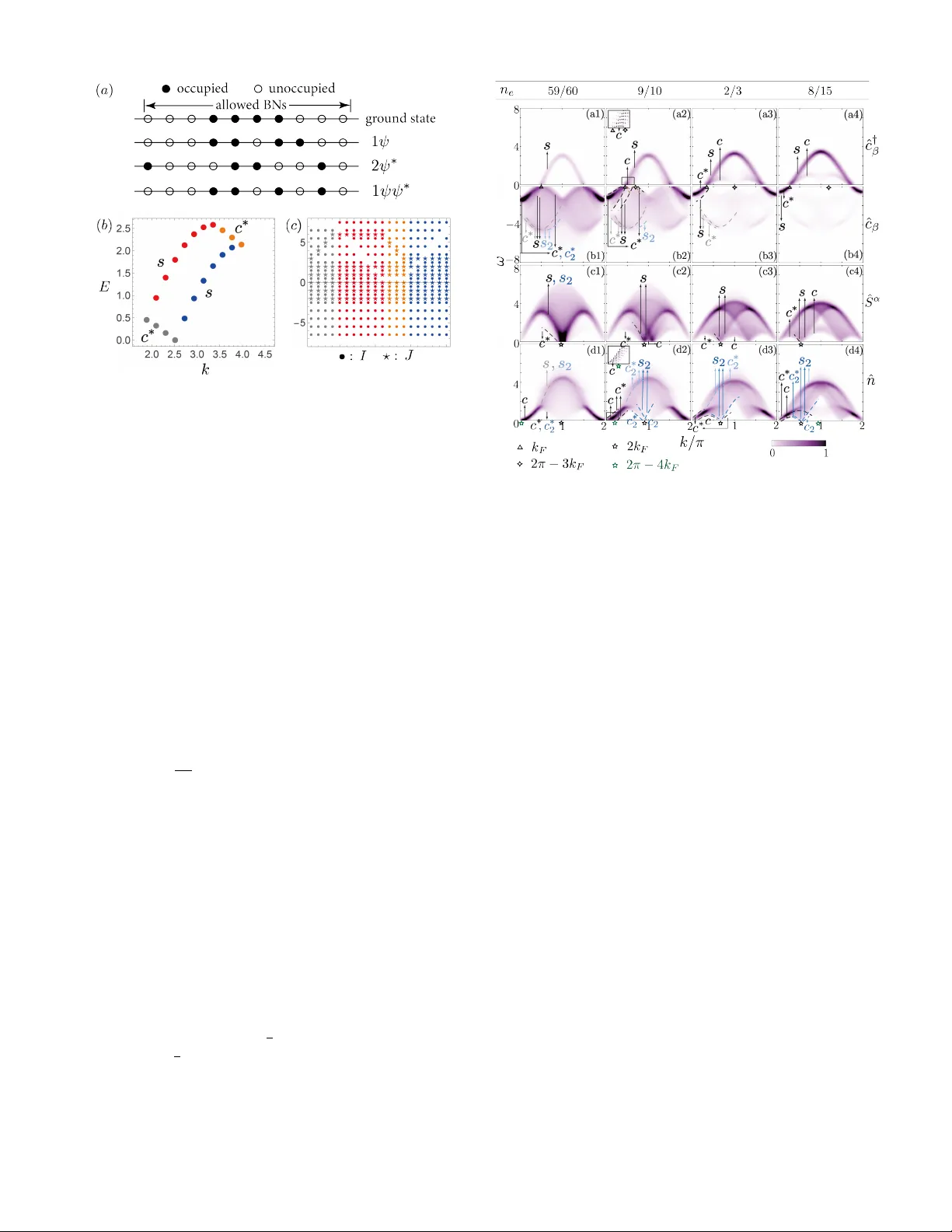
In tert wined spin and c harge dynamics in one-dimensional sup ersymmetric t-J mo del Y unjing Gao 1 and Jianda W u 2, 3, 1 , ∗ 1 Tsung-Dao L e e Institute, Shanghai Jiao T ong University, Shanghai, 201210, China 2 Scho ol of Physics Scienc e and Engine ering, T ongji University, Shanghai 200092, China 3 Shanghai Branch, Hefei National L ab or atory, Shanghai 201315, China (Dated: March 27, 2026) F ollowing the Bethe ansatz w e determine the dynamical sp ectra of the one-dimensional sup er- symmetric t - J mo del. A series of fractionalized excitations are identified through tw o sets of Bethe n umbers. Typical patterns in each set are found to yield wa vefunctions con taining elemen tary spin and charge carriers, manifested as distinct b oundaries of the collective excitations in the sp ectra of single electron Green functions. In spin c hannels, gapless excitations fractionalized in to t wo spin and a pair of p ositive and negative charge carriers, extending to finite energy as multiple contin ua. These patterns connect to the half-filling limit where only fractionalized spinons survive. In particle densit y channel, apart from spin-charge fractionalization, excitations inv olving only charge fluctua- tions are observed. F urthermore, nontrivial Bethe strings enco ding b ound state structure app ear in c hannels of reducing or conserving magnetization, where spin and charge constituents can also b e iden tified. These string states con tribute significantly even to the low-energy sector in the limit of v anishing magnetization. Intr o duction.— A cen tral challenge in condensed matter physics is understanding how charge and spin de- grees of freedom collectiv ely influence strongly correlated systems [ 1 – 5 ]. Due to b etter controllabilit y compared to higher-dimensional systems, one-dimensional (1D) mo d- els can offer reliable analytical insigh ts into this inter- pla y . A prominent example is the Luttinger liquid the- ory , which has prov en remark ably successful in describ- ing a wide range of 1D systems [ 6 – 10 ]. Ho w ev er, v alid- it y of the theory is restricted to the zero-energy limit as it is built on linearized disp ersions. In contrast, the Bethe ansatz (BA) approach is adv an tageous in rev eal- ing energy- and momen tum-resolved information across the full Brillouin zone. P articularly , it has b een em- plo yed to inv estigate dynamical structure factors (DSFs) of magnetic systems [ 11 – 18 ], yielding results in excel- len t agreement with exp erimental data from real mate- rials [ 19 , 20 ]. Ho wev er, the computational complexit y increases significantly when b oth spin and c harge come in to pla y . The BA-solv able 1D sup ersymmetric (SUSY) t - J mo del serves as an ideal playground here [ 21 – 28 ], where progress was made a decade ago in obtaining its form factors [ 29 – 32 ], thereby enabling the study of spin and charge dynamics in a rigorous fashion. In this article, after briefly reviewing BA solutions of the SUSY t - J mo del, we presen t detailed spin and c harge DSFs. F eatured Bethe n umber (BN) patterns are re- garded as elementary constituen ts (referred to as parti- cles). Differen t combinations of them give rise to v arious fractionalized excitations in different op erator channels. Among these, non-trivial string states are found to dom- inate the spectra b eyond low-energy sector, which grad- ually share dominance with the lo w-lying real solutions when magnetization approaches zero. Last, w e discuss the c on tribution of multi-particle states and evolution of the sp ectra with a series of electron fillings and magne- tizations, where rich multi-spin and charge fractionaliza- tions are rev ealed. The mo del and the Bethe wavefunctions.— The 1D sup ersymmetric t - J mo del with p erio dic b oundary con- dition in magnetic field is given by H = − t P L X j =1 ,σ = ↑ , ↓ ˆ c † j,σ ˆ c j +1 ,σ + ˆ c † j +1 ,σ ˆ c j,σ P + L X j =1 J ˆ S j · ˆ S j +1 − J 4 ˆ n j ˆ n j +1 − g ˆ S z j (1) with J = 2 t (set t = 1 in the follo wing), magnetic field g , electron creation and annihilation operators on j -th site ˆ c † j,σ and ˆ c j,σ , electron densit y ˆ n j , the pro jection op erator P = Q L j =1 (1 − ˆ n j, ↑ ˆ n j, ↓ ), and the spin op era- tors ˆ S + i = ˆ c † i, ↑ ˆ c i, ↓ , ˆ S − i = ˆ c † i, ↓ ˆ c i, ↑ , ˆ S z i = 1 2 ( ˆ n i, ↑ − ˆ n i, ↓ ) . The eigenfunctions of H can b e solv ed from the nested BA equations [ 28 ] whic h inv olv e t wo sets of rapidities { v j } and { γ α } , with j = 1 , · · · , N hd ≡ N h + N ↓ and α = 1 , · · · , N h . N h and N ↓ ( N ↑ ) lab el the n um b er of holes and down (up) spin electrons. W e adopt the string h yp othesis for v j to solve the equations [ 28 , 33 , 34 ], i.e., v n aj = v n a + i ( n + 1 − 2 j ), v n a ∈ R . Here j = 1 , · · · , n , a = N 1 , · · · , N n and n = 1 , 2 , · · · with the constrain t N hd = P n nN n . In the following states with real rapidi- ties are solely denoted as L 1 . String states con taining a set of { v 2 aj } or { v 3 aj } apart from real v 1 aj ’s are denoted as L 2 or L 3 , resp ectiv ely . The rapidities can b e solved 2 FIG. 1. ( a ) Examples of BN patterns. The ground state configurations for b oth { I n a } and { J } p ossess minimal total absolute v alue. nψ are created by choosing desired num b er of BNs out of ground state o ccupations combined with n in- nermost unoccupied BNs, either from the left, right or b oth sides. nψ ∗ are created by replacing n outermost occupied BNs by uno ccupied BNs. nψ ψ ∗ corresp onds to moving n oc- cupied BNs to unoccupied positions. These classifications can o verlap with each other, e.g., 1 ψ c is a subset of 1 ψ c ψ ∗ c . ( b , c ) Examples of the energy and momentum of Bethe states ( b ) solv ed from BN patterns in ( c ). Each column in ( c ) stands for a set of BNs for one state (here L = 30, N ↓ = 8, N h = 6). The colored dots and stars in ( c ) corresp ond to the states of the same color in ( b ), with the columns in ( c ) ordered ac- cording to the clo ckwise sequence of the p oin ts in ( b ) starting from the gapless point. P art of the c ∗ and s bands are also illustrated. from the BA equations [ 28 ], 2 π I n a = Lθ v n a n − X m N m X b =1 ( m,b ) =( n,a ) Θ nm ( X ) + N h X β =1 θ ( Y ) , 2 π J β = X n N n X a =1 θ ( Y ) , (2) with θ ( x ) = 2 arctan x , X = v n a − v m b , Y = ( v n a − γ β ) /n , Θ n = m ( x ) = θ ( x/ | n − m | ) + 2 θ ( x/ ( | n − m | + 2)) + · · · + 2 θ ( x/ ( n + m − 2)) + θ ( x/ ( n + m )) and Θ nn ( x ) = 2 θ ( x/ 2) + 2 θ ( x/ 4) + · · · + 2 θ ( x/ (2 n − 2)) + θ ( x/ (2 n )). { I n a } and { J β } are Bethe num bers (BNs) used to solve one set of rapidities to yield one Bethe state. I n a are in te- gers (half-integers) if L + N h − N n is o dd (even) and J β are in tegers (half-integers) if P n N n is even (o dd). The BNs are restricted b y | I n a | ≤ 1 2 ( L + N h − P m t mn N m − 1) and | J β | ≤ 1 2 P n N n − 1, with t mn = 2 min( m, n ) − δ nm . Energy and momentum of a Bethe state are given b y E = L − P N hd j =1 4 / (1 + v 2 j ) and P = P N hd j =1 k j = P N hd j =1 2 arctan( v j ) + π mo d ( L − P n N n − 1 , 2). FIG. 2. Dynamic structure factors at g = 0 for different fill- ings in each column. α = x, + , − and β = ↑ , ↓ in the second through fourth columns. In the single hole case shown in the first column, α = z and β = ↑ , with other channels exhibiting similarly as the SU(2) symmetry is slightly broken. k ↑ F and k ↓ F differ by π /L in this case, and w e omit the difference in the denotations. Some featured single particle disp ersions of L 1 t yp e are denoted by black and gra y text and arrows, rep- resen ting branc hes that reach or are gapp ed from the low est energy in L 1 region. The blue and light blue ones illustrate similarly for L 2 case. Mark ers on the horizontal axis illus- trate the gapless p oin ts. W e fo cus on the DSF D ( ˆ O ; q , ω ) = 2 π P ν |⟨ B ( q + k GS , ω ν ) |O q | GS ⟩| 2 δ ( ω − η ( ω ν − ω GS − µ ∆ N e )) where ground state | GS ⟩ carries momentum k GS and energy ω GS , ˆ O q = (1 /L ) P j ˆ O j e − iq j , and | B ( k , ω ν ) ⟩ is a state with momentum k and energy ω ν . µ denotes the chemi- cal p oten tial and ∆ N e denotes electron num b er difference b et w een the intermediate state and the ground state. η = − 1 for electron annihilation op erator O and η = 1 otherwise. Bethe states with typical BN configurations are found dominant in the DSF. W e adopt the termi- nology psinon ( ψ ) and an tipsinon ( ψ ∗ ) for spin mo dels [ 17 , 35 ], applying to b oth { I n a } and { J β } and denoting as ψ n s ( ψ ∗ n s ) and ψ c ( ψ ∗ c ), resp ectively [Fig. 1 (a)]. Multiple fr actionalizations.— Spin and charge char- acteristics are manifested as differen t kinds of fraction- alizations through different channels of the DSFs. This section fo cuses on low energy sector and identifies these excitations through BN configurations. W e in tro duce s n band as the set of L n states that inv olv e mo ving 1 ψ 1 s while keeping other BNs fixed, The s ∗ n , c n and c ∗ n bands are introduced analogously for the 1 ψ ∗ 1 , 1 ψ c and 1 ψ ∗ c 3 FIG. 3. DSFs for L = 60, n e = 0 . 9 ground states with dif- feren t magnetization in each ro w. W e define k ≡ π − k . The same notations are applied as in Fig. 2 , and purple color is used in L 3 case. cases, with the subscript n = 1 omitted subsequently [Fig. 1 (b,c)]. These basic patterns can b e regarded as elemen tary constituents in the collective excitations. In the thermo dynamic limit, { s, s ∗ } and { c, c ∗ } are c har- acterized by t wo v elo cities (slop e of the corresp onding branc hes) near zero energy [ 10 , 27 ]. F or brevity , we refer to certain momenta and their π -symmetric counterparts in terchangeably in the follo wing discussion. Adding an electron into the ground state leads to lo w energy excitations from F ermi p oin t k F = n e π / 2 to k > k F at m z = 0 ( n e denotes electron density), where frac- tionalized excitations 1 ψ s 1 ψ c comp osed by s and c can be iden tified at finite doping [Fig. 2 (a1-a4)]. In the presence of magnetic field, the up and down spin fermi points split in to k ↑ F = n e (1 + m z ) π / 2 and k ↓ F = n e (1 − m z ) π / 2, with magnetization m z = ( N ↑ − N ↓ ) / ( L − N h ). Adding an up spin electron leads to 1 ψ s 1 ψ c con tinuum [Fig. 3 (a1- a3)], while in D ( ˆ c † ↓ ) the low energy part is dominated b y 1 ψ ∗ s 1 ψ c [Fig. 3 (c1-c3)]. In b oth cases, the upp er and lo wer b oundaries follow differen t “single (quasi)particle” disp ersions which can b e understo o d as moving either s ( s ∗ ) or c particles, while keeping the other at rest. Remo ving an up spin electron is reflected as dominant 1 ψ ∗ s 1 ψ ∗ c excitations within k < k ↑ F [Fig. 3 (b1-b3)], par- allel to 1 ψ s 1 ψ ∗ c within k < k ↓ F in the down spin case [Fig. 3 (d1-d3)]. The t wo cases conv erge at g = 0 (zero field) appearing as 1 ψ s 1 ψ ∗ c con tinuum [Fig. 2 (b1-b4)]. Additional gapless p oints and finer structure can also b e observ ed, whic h enco des multiple pro cess and is deferred to the section of Particle-hole p airs . Mean while, spin-1 excitations are also fractionalized. Gapless spin flip inv olv es scattering an up-spin at ± k ↑ F to a down-spin at ± k ↓ F (or vice versa), resulting in mo- men tum transfers of ± k ↑ F ± k ↓ F . F or D ( ˆ S − ) the fractional constituen ts are implied b y the four explicit disp ersions, c ∗ , c and tw o s ∗ ’s starting from k ↑ F + k ↓ F with ω = 0. In addition to single particle branc hes, dominan t sp ectral w eight comes from v arying momenta of tw o particles out of the four, namely , the 2 ψ ∗ s , 1 ψ ∗ s 1 ψ c , 1 ψ ∗ s 1 ψ ∗ c and 1 ψ c ψ ∗ c con tinua [Fig. 3 (e1-e3)]. On the con trary , in D ( ˆ S + ) starting from k ↑ F + k ↓ F at zero energy , c ∗ , c and t wo s bands can b e identified, and the collectiv e t w o-particle com binations follo w [Fig. 3 (f1-f3)]. Particle-hole p airs.— W e b egin with D ( ˆ S z ). Perfect nesting scatterings app ear in b oth spin up and down F ermi surfaces, leading to gapless excitations at 2 k ↑ F and 2 k ↓ F [Fig. 3 (g1-g3)]. In connection with half-filling limit without external field, the significant sp ectral weigh t near k = π reflects strong antiferromagnetic correlations [Fig. 2 (c1)], in con trast to v anishing sp ectra weigh t at k = 0. The c , c ∗ , s and s ∗ disp ersions can be identified sprouting from 2 k ↑ / ↓ F , accompanied b y contin uum region dominated by pairwise combinations. And for zero field, 2 k ↑ F and 2 k ↓ F together with corresp onding contin ua merge together [Fig. 2 (c1-c4)]. 4 Next, w e discuss D ( ˆ n ) which also preserv es particle n umber and magnetization as the ˆ S z c hannel. D ( ˆ n ) in- v olves gapless particle-hole excitations from up/do wn- spin and hole F ermi surfaces with transfer momenta k = 0, 2 k ↑ F , 2 k ↓ F and 2 k h F = 2 π − 4 k F [Fig. 3 (h1-h3)]. Analogous to the D ( ˆ S z ), the excitations at 2 k ↑ / ↓ F exhibit fractionalizations that inv olv e b oth spin and charge de- grees of freedom. Besides, significant 1 ψ c ψ ∗ c con tinuum touc hes k = 0 and 2 k h F at zero energy , which is con- tributed b y charge degree of freedom solely , as opp osed to D ( ˆ S z ). The identification of hole F ermi surface excitations pro vides a further understanding in other channels. In D (ˆ c ↑ / ↓ ), gapless p oints k ↑ / ↓ F + 2 k h F (3 k F in the zero field limit) exist apart from k ↑ / ↓ F [Fig. 3 (b, d)]. Excitations asso ciated with the former and latter can b e regarded as comp osite pro cesses inv olving the remov al of a frac- tionalized electron, together with a nesting k = 2 k h F and k = 0 scattering on the hole F ermi surface. This pro vides a microscopic origin for the 3 k F anomaly in Ref. [ 36 ]. Consequen tly , b esides s (or s ∗ ) and c ∗ bands men tioned in the previous paragraph, c and another c ∗ bands with opp osite velocity can be found near zero energy at b oth k ↑ / ↓ F and k ↑ / ↓ F + 2 k h F (bro wn dashed lines in Fig. 2 (b2) and Fig. 3 (b1, d1)). It is w orth noticing that in D ( ˆ S z ), the tw o gapless points 2 k ↑ F and 2 k ↓ F are separated b y 2 k h F . The difference in their spectral weigh t can be understo od from the distinct b eha vior of the asso ciated hole scatter- ing [Fig. 3 (g1-g3)]. String c ontribution.— Apart from the real Bethe solutions ( L 1 ) discussed previously , non-trivial string states ( L n ≥ 2 ) also contribute significan tly to the ˆ c † ↓ , ˆ c ↑ , ˆ S − , ˆ S z , and ˆ n c hannels. A common feature for finite magnetization is that as m z decreases, the string states reac h low er energy with increasing sp ectral contribution [see the SM for individual contributions of L n states]. Viewing from the spectral weigh t distribution, distinct bands are preserv ed across different L n regions, and ex- plicit b oundaries of different L n con tinua align, particu- larly at lo w magnetization [Fig. 3 (b, c, e, g, h)]. Explicitly , for D (ˆ c † ↓ ) the dominant s ∗ band extending from zero energy , contin ues to higher energy with co ex- isting s and s 2 [Fig. 3 (c1)]. Analogous to 1 ψ s 1 ψ c frac- tionalization for L 1 states, 1 ψ 1 s 1 ψ c dominates the L 2 con tinuum. F or D (ˆ c ↑ ), the L 2 con tinuum has a lo wer b oundary c ∗ 2 near k = 0 aligning to an L 1 edge, as well as an explicit 1 ψ ∗ c 1 ψ 1 s region near the top [Fig. S1 (a2, c2, h2), Fig. 3 (b1-b3)]. It’s worth noting that in D ( ˆ c ↑ ) and D ( ˆ S − ) at low m z , the explicit single-particle dis- p ersions with differen t string lengths, s ∗ and s 2 , tend to connect contin uously [Fig. 3 (b1, e1)]. F or D ( ˆ S − ), domi- nan t contribution in the L 2 con tinuum includes 1 ψ 1 s 1 ψ 2 s , 1 ψ 1 s 1 ψ c , 1 ψ 2 s 1 ψ c and 2 ψ s . F urthermore, L 3 con tinuum can be observed ab ov e L 2 with small magnetization. In FIG. 4. DSFs for ground state with one hole and L = 60. Ground state with the same magnetization is illustrated b y the same color. The same notations are applied as in Figs. ( 2 , 3 ). Closed gapless points separated by k = 2 π /L is illustrated as one p oin t in the notations for brevity . D ( ˆ S z ), an explicit s 2 lo wer b oundary of the L 2 con tin- uum aligns to upp er edge of 1 ψ s ψ ∗ s [Fig. 3 (g1-g3)]. On the other hand, L 2 states contribute to D ( ˆ n ) across the L 1 dome ( s ) near k = π with dominant 1 ψ 1 s 1 ψ ∗ c [Fig. S1 (b2, f2), Fig. 3 (h1-h3)]. Multi-p article states and sp e ctr a evolution.— Consid- ering the full spectrum, multi-particle states b ey ond t w o- particle ones also pla y an imp ortan t role. These states app ear mainly in tw o wa ys. The first case is indicated b y multiple branches emerging from the gapless p oin ts, whic h inv olve mo v ement of more than tw o particles [e.g., 5 Fig. 3 (e1)]. Second, it app ears as an extension of tw o- particle states to broader energy and momentum, e.g., after 1 ψ ∗ touc hes the b oundary , another 1 ψ is excited [Fig. 3 (c1)]. Among these, BN sets with substantial con tributions are summarized in T ABLE I . T ABLE I. Dominant BN sets in the DSFs. O ˆ c † ↑ ˆ c † ↓ ˆ c ↑ ˆ c ↓ BN 1 ψ s 1 ψ c 1 ψ s ψ ∗ s 1 ψ c 1 ψ 1 s 1 ψ 2 ∗ s 1 ψ c 1 ψ s ψ ∗ s 1 ψ c 2 ψ ∗ c 1 ψ 1 s 1 ψ 2 ∗ s 1 ψ ∗ c 1 ψ c ψ ∗ c 1 ψ s ψ ∗ s O ˆ S + ˆ S − ˆ S z ˆ n BN 2 ψ s 1 ψ c ψ ∗ c 1 ψ s 2 ψ ∗ s 1 ψ c ψ ∗ c 2 ψ 1 s 1 ψ ∗ 2 s 1 ψ ∗ c 2 ψ 1 s 1 ψ ∗ 3 s 1 ψ ∗ c 2 ψ s ψ ∗ s 1 ψ c ψ ∗ c 2 ψ 1 s 1 ψ ∗ 2 s 1 ψ ∗ c 2 ψ s ψ ∗ s 1 ψ c ψ ∗ c 2 ψ 1 s 1 ψ ∗ 2 s 1 ψ ∗ c Next we discuss the ev olution of DSF sp ectrum vs. particle density and magnetization. The momentum ranges for complete s and s ∗ bands follow W s = 2 π − π n e (1 + m z ) and W s ∗ = 2 π n e m z . And for c and c ∗ ones, W c = 2 π (1 − n e ) and W c ∗ = n e π (1 − m z ). As n e in- creases, there is less space to create electrons, leading to shrinked ˆ c † sp ectra, consistent with smaller W c here. Similarly , larger m z leads to suppressed up-spin creation i.e., D ( ˆ S + ), also indicated by smaller W s . F eatured sp ectral weigh t transfer can b e observed. Consider sp ectrum ev olution with decreasing n e . ˆ c † main tains an explicit band-like shap e accompanied with a con tinuum [Fig. 2 (a1-a4)]. In contrast, for ˆ c , the sp ectra w eight of the contin uum distributed across k = π gradu- ally transfers to the band-like region near k = 0 [Fig. 2 (b1-b4)]. F or spin channels, the incommensurate gapless p oin ts mov e tow ards k = 0, leading to more separated collectiv e excitations for k > π and k < π , which meet at π and form a strong region at finite energy [Fig. 2 (c1- c4)]. F urthermore, collectiv e excitations inv olving 1 ψ c and/or 1 ψ ∗ c are enhanced. In ˆ n e c hannel, the pure c harge resp onse region 1 ψ c ψ ∗ c is broadened with decreasing n e [Fig. 2 (d1-d4)]. The contin uum inv olving b oth spin and c harge near k = π further splits, evolving tow ards band- lik e shap e with increasing sp ectral weigh t near k = π at the upp er b oundary . Either with small n e or large m z , b oth spin and charge sp ectra tend to a (broadened) band-lik e shape. Consider increasing m z [Fig. 3 , Fig. 4 ]. Near gapless p oin ts, explicit suppression of the v elo cities of the c , c ∗ particles can b e observed from the slop e of the branc hes. In D ( ˆ c ↑ ), sp ectral w eigh t of the con tin uum transfers to the boundaries, while in ˆ c ↓ branc h it narro ws in to a band-like shap e. In ˆ S z and ˆ n channels the sp ectra ev olve to wards similar contin uum shap e with s and s ∗ as b oundaries. Discussions.— At finite magnetization, adding or re- mo ving an electron reveals distinct b eha viors. F rom the gapless points, the s and s ∗ particles can b e understo od as carrying S z = 1 / 2 and − 1 / 2, resp ectiv ely , while c and c ∗ can b e attached c harge − 1 and +1, resp ectively . Branc hes emerging from the same gapless p oin ts together imply the spin and charge prop erties in the contin uum, whic h is consistent with the observ ations in other chan- nels. F or zero magnetic field, given the limited space of uno ccupied BNs for { I n a } , we do not distinguish s and s ∗ but only regard it as a spin-1 / 2 ob ject. A gap ∆ = g op ens in ˆ S − at k = 0, corresp onding to Larmor precession mo des [ 18 ]. Finite energy separation from ω = 0 can also be observed in the ˆ c ↑ and ˆ c ↓ c han- nels at k = 0 with ∆ ↑ = ( µ − g ) / 2 and ∆ ↓ = ( µ + g ) / 2, with the difference reflecting the Zeenman splitting. On the other hand, in finite hole doping cases, a region near k = π with finite energy ab ov e the lo wer b oundary con- tributes strong sp ectra w eigh t in the spin channels [Fig. 2 (c2-c4), Fig. 3 (e, f, g)]. This arises from a high densit y of states where tw o contin ua cross, originating from gapless p oin ts at k < π and k > π with left- and right-mo ving s ( s ∗ ) particles. The configuration N ↑ = N ↓ = N h = 1 / 3 leads to a merge of F ermi p oints. F or ˆ n c hannel, the ov erlap of 2 π − 4 k F with 2 k F brings together the charge-only and spin-c harge contin ua, yielding similar shap es in ˆ S z and ˆ n [Fig. 2 (c3, d3)]. This similarit y holds for n e < 2 / 3, reflecting an enhanced sp ectral weigh t inv olving b oth of spin and c harge fluctuations in D ( ˆ n ). A cknow le dgments— W e thank R. Y u, Y. Jiang, W. Ku, Z. Han and J. Y ang for helpful discussions. The w ork is sp onsored b y the National Natural Science F oundation of China Nos. 12450004, 12274288, the Innov ation Pro- gram for Quantum Science and T echnology Grant No. 2021ZD0301900. J.W. ac knowledges the hospitality of Wilczek Quantum Center at Shanghai Institute for Ad- v anced Studies of Universit y of Science and T ec hnology of China. ∗ wujd@tong ji.edu.cn [1] P . F azek as, L e ctur e Notes on Ele ctr on Corr elation and Magnetism (W orld Scien tific, 1999). [2] A. Auerbach, Inter acting Ele ctr ons and Quantum Mag- netism (W orld Scien tific, 1999). [3] K. A. Chao, J. Spalek, and A. M. Oles, J. Phys. C: Solid State Phys. 10 , L271 (1977) . [4] P . W. Anderson, Science 235 , 1196 (1987) . [5] F. C. Zhang and T. M. Rice, Phys. Rev. B 37 , 3759 (1988) . [6] S. T omonaga, Prog. Theor. Phys. 5 , 544 (1950) . [7] J. M. Luttinger, Phys. Rev. 119 , 1153 (1960) . [8] F. D. M. Haldane, Phys. Rev. Lett. 47 , 1840 (1981) . [9] F. D. M. Haldane, J. Phys. C: Solid State Ph ys. 14 , 2585 (1981) . [10] T. Giamarchi, Quantum Physics in One Dimension (Ox- ford Universit y Press, 2003). [11] M. Karbach and G. M ¨ uller, Phys. Rev. B 62 , 14871 (2000) . [12] D. Biegel, M. Karbac h, and G. M ¨ uller, Europhys. Lett. 59 , 882 (2002) . 6 [13] J. Sato, M. Shiroishi, and M. T ak ahashi, J. Phys. So c. Jpn. 73 , 3008 (2004) . [14] J.-S. Caux and J. M. Maillet, Phys. Rev. Lett. 95 , 077201 (2005) . [15] J.-S. Caux, R. Hagemans, and J. M. Maillet, J. Stat. Mec h.: Theory Exp 2005 , P09003 (2005) . [16] J.-S. Caux, J. Math. Phys. 50 , 095214 (2009) . [17] M. Kohno, Phys. Rev. Lett. 102 , 037203 (2009) . [18] W. Y ang, J. W u, S. Xu, Z. W ang, and C. W u, Phys. Rev. B 100 , 184406 (2019) . [19] A. K. Bera, J. W u, W. Y ang, R. Bewley , M. Boehm, J. Xu, M. Bartko wiak, O. Prokhnenko, B. Klemke, A. T. M. N. Islam, J. M. Law, Z. W ang, and B. Lake, Nat. Ph ys. 16 , 625 (2020) . [20] Z. W ang, M. Schmidt, A. Loidl, J. W u, H. Zou, W. Y ang, C. Dong, Y. Kohama, K. Kindo, D. I. Gorbuno v, S. Niesen, O. Breunig, J. Engelmay er, and T. Lorenz, Ph ys. Rev. Lett. 123 , 067202 (2019) . [21] B. Sutherland, Phys. Rev. B 12 , 3795 (1975) . [22] P . Sc hlottmann, Phys. Rev. B 36 , 5177 (1987) . [23] S. Sark ar, J. Phys. A: Math. Gen. 23 , L409 (1990) . [24] P . A. Bares and G. Blatter, Phys. Rev. Lett. 64 , 2567 (1990) . [25] F. H. L. Essler and V. E. Korepin, Phys. Rev. B 46 , 9147 (1992) . [26] P .-A. Bares, G. Blatter, and M. Ogata, Phys. Rev. B 44 , 130 (1991) . [27] P .-A. Bares, J. M. P . Carmelo, J. F errer, and P . Horsch, Ph ys. Rev. B 46 , 14624 (1992) . [28] A. F oerster and M. Karowski, Nucl. Phys. B 396 , 611 (1993) . [29] A. Hutsalyuk, A. Liashyk, S. Z. Pakuliak, E. Ragoucy , and N. A. Slavno v, J. Phys. A: Math. Theor. 49 , 454005 (2016) . [30] A. Hutsalyuk, A. Liashyk, S. Z. Pakuliak, E. Ragoucy , and N. A. Slavno v, J. Phys. A: Math. Theor. 50 , 034004 (2016) . [31] A. Hutsalyuk, A. Liashyk, S. Pakuliak, E. Ragoucy , and N. Slavno v, Nucl. Phys. B 911 , 902 (2016) . [32] J. F uksa and N. A. Slavno v, J. Stat. Mec h.: Theory Exp 2017 , 043106 (2017) . [33] H. Bethe, Z. Phys. 71 , 205 (1931) . [34] M. T ak ahashi, Prog. Theor. Phys. 46 , 401 (1971) . [35] M. Karbach, D. Biegel, and G. M ¨ uller, Ph ys. Rev. B 66 , 054405 (2002) . [36] A. Moreno, A. Muramatsu, and S. R. Manmana, Phys. Rev. B 83 , 205113 (2011) . 7 SUPPLEMENT AR Y MA TERIAL Sp ectra from individual L n states As magnetization approaches zero, the L n> 1 states contribute in the lo w-energy sector, and strongly o verlap with L 1 region. T o further clarify their con tribution, w e split the sp ectra into different L n parts shown in Fig. S1 . Con tribution of L n states are counted as the ratio of summation of corresp onding sp ectral weigh t, to the zero sum T ( O ) = P q ,ω D ( O ; q , ω ) in eac h channel. After excluding the v acuum con tribution, for electron creation and annihilation c hannels T ( ˆ c † ↑ / ↓ ) = N h and T ( ˆ c ↑ / ↓ ) = N ↑ / ↓ . F or spin and charge de nsities, T ( ˆ S z ) = ( N ↑ + N ↓ ) / 4 − ( N ↑ − N ↓ ) 2 / (4 L ), and T ( ˆ n ) = N h − N 2 h /L . At last, T ( ˆ S + ) = N h / 2 + N ↓ and T ( ˆ S − ) = N h / 2 + N ↑ . In summary , for finite m z , L n ≥ 2 con tribution increases with decreasing magnetization. FIG. S1. Example of DSFs contributed from L n states with size L = 60. Percen tage in each figure shows the zero sum saturation of sp ectral weigh t con tributed b y L n in the total sp ectrum.
Original Paper
Loading high-quality paper...
Comments & Academic Discussion
Loading comments...
Leave a Comment