XT-REM: A Two-Component Model for Meta-Analysis of Extreme Event Proportions
In this paper, we introduce a novel model for the meta-analysis of proportions that integrates the standard random-effects model (REM) with an extreme value theory (EVT)-based component. The proposed model, named XT-REM (Extreme-Tail Random Effects M…
Authors: Jovana Dedeić, Jelena Ivetić, Srđan Milićević
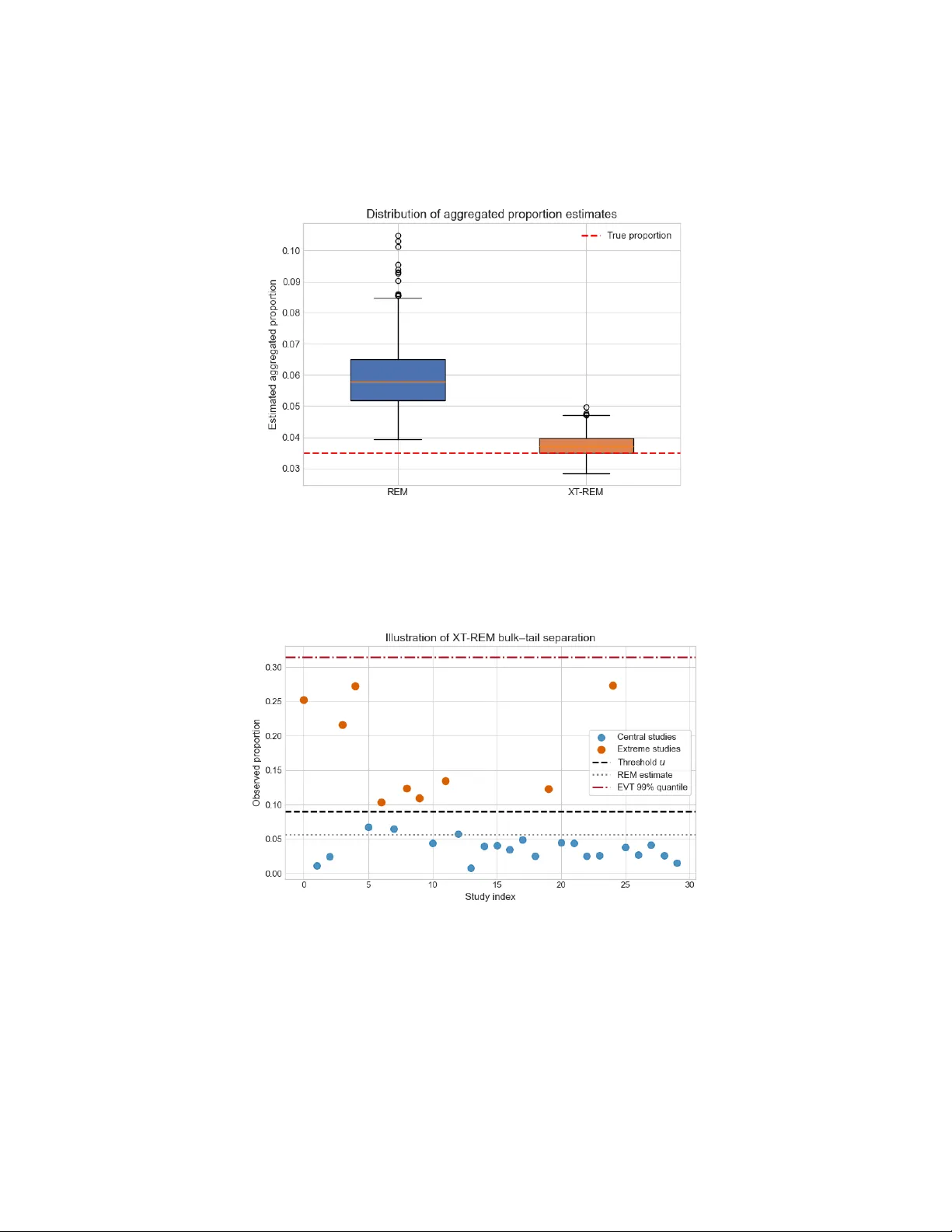
XT-REM: A T w o-Comp onen t Mo del for Meta-Analysis of Extreme Ev en t Prop ortions Jo v ana Dedeić a , Jelena Ivetić a , Srđan Milićević a , Katarina Vido jević a , Marija Delić a a University of Novi Sad, F aculty of T e chnic al Scienc es, T r g Dositeja Obr adović a 6, Novi Sad, 21000, Serbia Abstract In this pap er, w e introduce a nov el mo del for the meta-analysis of pro- p ortions that in tegrates the standard random-effects model (REM) with an extreme v alue theory (EVT)–based comp onen t. The prop osed model, named XT-REM (Extreme-T ail Random Effects Mo del), extends the classical REM framew ork b y explicitly accoun ting for extreme prop ortions through a partial segmen tation of the study set based on a predefined threshold. While the ma jority of prop ortions are modeled using REM, prop ortions exceeding the threshold are analyzed using the Generalized P areto Distribution (GPD). This formulation enables a dual interpretation of meta-analytic results, pro viding both an aggregate estimate for the central bulk of studies and a separate c haracterization of tail b eha vior. The XT-REM framew ork ac- commo dates heteroskedastic v ariance structures inherent to prop ortion data, while preserving identifiabilit y and consistency . Using real-world data on immunotherap y-related adverse even ts, together with simulation studies calibrated to empirical settings, we demonstrate that XT-REM yields a comparable central estimate while enabling a more explicit assessmen t of tail b eha vior, including high-p ercen tile extreme prop ortions. Compared with the classical REM, XT-REM achiev es higher log-lik eliho o d v alues and lo w er AIC, in the considered scenarios, indicating a b etter fit within this mo deling framework. In summary , XT-REM offers a theoretically grounded and practically useful extension of random-effects meta-analysis, with p oten tial relev ance to clinical contexts in whic h extreme ev ent rates carry imp ortan t implications for risk assessment. Keywor ds: meta-analysis of prop ortions, random-effects mo del, extreme v alue theory, tail mo deling, partial segmentation, rare and extreme ev en ts MSC co des: 62P10, 62F10, 60G70 1. In tro duction In contemporary biomedical researc h, rare ev ents with substantial clin- ical implications are increasingly b eing analyzed. One prominent example in volv es adverse ev ents during imm unotherapy , where ev ent rates are typ- ically low y et critically imp ortan t for patien t safet y . Meta-analysis plays a key role in syn thesizing information across multiple studies, particularly when individual studies hav e limited statistical p o wer [4, 13]. Consequen tly , its application is far-reaching, spanning a wide range of scientific disciplines, as demonstrated by numerous studies [16, 24, 17]. Within standard meta-analytic frameworks, random-effects mo dels (REM) are widely used. These models account for b et ween-study heterogeneity , i.e., v ariability not attributable to sampling error alone. The estimation of b et w een-study v ariance is a critical asp ect of REM, with several estimators a v ailable, each with differen t prop erties in terms of bias and efficiency [30]. On the other hand, extreme v alue theory (EVT) is used to mo del tail b e- ha vior of distributions. Namely , the highest or lo w est observ ed v alues. This approac h is particularly v aluable when analyzing rare but p oten tially seri- ous outcomes, such as high rates of toxicit y or severe complications [7, 3]. Indeed, EVT has already b een applied in public-health settings to estimate risks of rare but extreme ev ents, e.g., for mortality spik es or surges in hospital admissions [27]. The statistical literature has dev elop ed EVT-based mo dels that incorp orate regression components to estimate risk as a function of co- v ariates, op ening the p ossibility of linking EVT metho ds with hierarchical structures such as those found in meta-analysis, where b etw een-study v ari- abilit y is naturally represented through random effects [8]. Existing approaches to the meta-analysis of proportions in rare-even t set- tings t ypically treat REM and EVT separately . REM mo dels estimate central tendency and b etw een-study v ariability [4, 14], while EVT methods fo cus on mo deling distribution tails and quantifying extreme v alues [7, 3]. How ev er, neither approach alone enables simultaneous mo deling of b oth central and extreme b eha vior within the hierarchical structure c haracteristic of meta- analysis. Sev eral statistical framew orks ha v e been dev elop ed to com bine bulk and tail mo deling. Finite mixture mo dels represen t the o verall distribution as a 2 probabilistic com bination of comp onen t distributions, allo wing observ ations to arise from laten t subp opulations [26, 21]. Alternativ ely , spliced (or com- p osite) mo dels combine distinct parametric families b elo w and ab o v e a deter- ministic threshold, typically yielding a unified densit y ov er the entire supp ort [9]. These approaches pro vide flexible mechanisms for capturing heterogene- it y and heavy-tailed b eha vior, but they differ in structure and inferential ob jectives. Within hierarc hical and regression settings, recent studies hav e explored the in tegration of mixed effects mo dels with extreme v alue the- ory to improv e estimation for subgroups with small sample sizes [22]. This approac h b orro ws strength across subgroups, reducing bias and v ariance in extreme v alue estimates. It is conceptually aligned with our aim to combine information across studies while mo deling extreme outcomes, yet it fo cuses on improving extreme-v alue estimation itself. Although EVT models with regression components ha ve b een developed to allow extreme v alues to dep end on cov ariates [8], and v arious nonlinear extensions of REM ha v e b een explored for rare-ev en t settings [18, 15], a direct integration of EVT into the REM framew ork has not b een systemati- cally in v estigated. This gap motiv ates the developmen t of a combined mo del capable of simultaneously: • estimating the global (aggregated) proportion of adverse even ts, • iden tifying and quantifying extreme prop ortions that deviate from cen- tral tendencies, • linking tail b eha vior to the latent (random-effects) study structure. The meta-analysis of prop ortions presen ts sp ecific metho dological chal- lenges b ey ond those encoun tered in effect-size-based syntheses. In clinical settings, suc h as the ev aluation of imm unotherapy-related adv erse even ts, observ ed proportions can v ary widely across studies, and extreme v alues of- ten carry critical clinical information. T raditional REM provides a frame- w ork for estimating b et ween-study heterogeneity , but it relies on assump- tions that may not fully capture the sp ecific characteristics of prop ortion data. In meta-analyses of ev ent prop ortions, v ariabilit y arises at tw o lev els. The within-study v ariance follo ws from the binomial sampling pro cess and dep ends on the observed prop ortion and the study size, so precision differs across studies. The b et w een-study v ariance, on the other hand, is intro- duced as a mo del parameter to capture heterogeneity under the Gaussian 3 random-effects framework. When prop ortions are close to the b oundaries, this v ariability can in teract with the normal approximation in w a ys that ha ve b een discussed in the v ariance mo deling literature [5, 10, 12]. R ese ar ch Obje ctives. The aim of this research is to dev elop a nov el com bined statistical mo del, named XT-REM (Extreme-T ail Random Effects Mo del), which integrates REM with EVT within a un ified framework for estimating prop ortions in meta-analytic applications. Unlik e probabilistic mixture mo dels, which represen t the ov erall distribution as a weigh ted com- bination of laten t comp onen ts, or spliced density mo dels, whic h construct a single composite distribution across a threshold, XT-REM emplo ys de- terministic segmentation within a hierarchical meta-analytic structure. Its ob jective is not to defin e a unified densit y o v er the en tire support, but rather to achiev e inferential separation b et ween cen tral random-effects b eha vior and extreme tail dynamics. This separation preserves robust estimation of the cen tral effect while explicitly mo deling tail risk, making the framew ork par- ticularly well suited for rare-even t analyses in which b oth central and tail b eha vior must b e quan tified. The sp ecific ob jectives of the study are defined in the context of appli- cations where accurate characterization of tail b eha vior is as imp ortan t as estimating the central tendency: • to formalize the mathematical framework of the XT-REM mo del, which uses a REM component to describ e the baseline distribution of study- lev el proportions and an EVT comp onent for modeling extreme v alues, • to theoretically in v estigate the identifiabilit y and consistency of the mo del’s estimators, as well as their sensitivity to the threshold sepa- rating the central and tail regions, • to conduct an empirical ev aluation of XT-REM through simulation exp erimen ts with controlled parameters, and • to apply the mo del to real-world data on immunotherap y-related ad- v erse even ts, demonstrating its utility in a biomedical con text. Structur e of the p ap er. The paper is organized as follows. In Section 2, we presen t the statistical foundations of the mo del, b eginning with the classical REM framew ork and the key principles of EVT, to gradually in tro- duce the prop osed com bined XT-REM mo del. This is follo w ed by a formal 4 definition of the mo del, including its component structure, the threshold sep- arating central and extreme v alues, and the mechanism that links the t wo comp onen ts. P articular atten tion is given to the theoretical prop erties of XT-REM, including considerations of identifiabilit y , estimator consistency , and the implications of the mo deling assumptions . In Section 3 we describ e the parameter estimation metho dology , with an emphasis on maxim um like- liho od (ML) estimation and n umerical asp ects of the implementation. In Section 4, w e rep ort the results of a sim ulation study designed to assess the p erformance of the prop osed mo del under controlled conditions. Section 5 presen ts an application of XT-REM to real-world data on imm unotherapy- related adverse ev en ts, illustrating its practical relev ance and interpretabilit y . Finally , Section 6 concludes the pap er and outlines p oten tial directions for future research. 2. Preliminaries T o formally define the structure of our approac h, w e b egin b y revisiting the t wo well-kno wn foundational comp onen ts of the XT-REM mo del. The first is the classical REM, whic h captures b et ween-study heterogeneity in the logit-transformed prop ortions. The second is the Generalized P areto distribution from EVT, whic h mo dels the behavior of prop ortions that exceed a predefined threshold. 2.1. R andom-Effe cts Mo del (REM) In the meta-analysis of prop ortions, let r i denote the num b er of sub jects exp eriencing the ev ent of interest in study i , and n i the total num b er of sub jects. The observed prop ortion in study i is defined as p i = r i n i , i = 1 , 2 , . . . , N , (1) where N denotes the total num b er of studies. T o improv e statistical stabilit y and obtain an approximately normal sam- pling distribution, the logit transformation is applied: θ i = ln p i 1 − p i . (2) The logit transformation maps the unit interv al (0 , 1) to the real line ( −∞ , ∞ ) and is a standard link function in the meta-analysis of proportions 5 [4, 25]. Although the approximation may b ecome less accurate for extremely small or large prop ortions, it p erforms well for the central range of v alues and is therefore widely used in practice. Under the random-effects framework, the transformed prop ortion θ i is assumed to follow the additive mo del θ i = µ + u i + ε i , (3) where µ represen ts the ov erall mean logit-prop ortion, u i ∼ N (0 , τ 2 ) denotes the study-sp ecific random effect capturing b et w een-study heterogeneity , and ε i ∼ N (0 , σ 2 i ) represents the within-study sampling error. Assuming indep endence of the random comp onen ts, the total v ariance of the transformed outcome is V ar( θ i ) = τ 2 + σ 2 i , (4) where τ 2 quan tifies the b et ween-study heterogeneity and σ 2 i denotes the within-study v ariance on the logit scale. Under a binomial sampling mo del, the v ariance of the empirical prop or- tion is V ar( p i ) = p i (1 − p i ) n i . (5) Applying the delta metho d to the logit transformation yields the appro x- imate v ariance on the logit scale σ 2 i ≈ 1 n i p i (1 − p i ) . (6) In practice, a commonly used plug-in estimator of th e within-study v ari- ance is ˆ σ 2 i = 1 r i + 1 n i − r i , (7) whic h is algebraically equiv alent to the delta-metho d approximation. This estimator becomes undefined when r i = 0 or r i = n i (zero or all ev ents). In suc h cases, a contin uit y correction (e.g., adding 0 . 5 to b oth r i and n i − r i ) is t ypically applied. In the random-effects mo del, studies are w eighted according to the inv erse of their total v ariance, w i = 1 τ 2 + σ 2 i . (8) 6 This in verse-v ariance w eighting arises naturally from maximum likelihoo d estimation and ensures that studies with higher precision contribute more to the p o oled estimate, while still accounting for betw een-study heterogeneity . In the prop osed XT-REM framew ork, the logit-normal random-effects mo del is used primarily to describ e the central p ortion of the data, while extreme prop ortions, where the normal appro ximation b ecomes unreliable, are mo deled separately using extreme v alue theory . An alternativ e approach to addressing hea vy-tailed study distributions in meta-analysis in volv es the use of Student’s t-distribution for random ef- fects instead of the Gaussian distribution. While the t-distribution ensures robust inference b y symmetrically thic kening the tails, the XT-REM frame- w ork prop osed in this study addresses this challenge through a more flexible semi-parametric solution. By explicitly emplo ying the GPD for studies ex- ceeding a predefined threshold, XT-REM captures asymmetric extreme b e- ha vior and provides a distinct c haracterization of the tail-features that are not attainable through simple distributional substitution, suc h as the Studen t’s t-distribution, as considered in flexible and robust meta-analytic approaches [34, 35]. This distinction is particularly imp ortan t in applications in which extreme v alues differ structurally from the bulk of the data. 2.2. Extr eme V alue The ory Extreme V alue Theory deals with mo deling the b eha vior of distribution tails, i.e., v alues that significan tly deviate from the usual range of observed data. In the context of meta-analysis of prop ortions, EVT can b e used to mo del those studies whose prop ortions significan tly exceed (or fall b elo w) a certain threshold u . In this w ork, w e fo cus on mo deling the right tail of the dis- tribution, as high prop ortions are particularly imp ortan t in the application to adverse ev ents, represen ting a p oten tially elev ated risk. In the case of in terest in low v alues (left tail), the analytical pro cedure would b e carried out symmetrically , after transforming the data in the negative direction. F or the observ ed prop ortions p i that exceed the threshold u , i.e., p i > u , the GPD is used as a model for the excess ov er the threshold: Y i = p i − u suc h that Y i > 0 . (9) 7 The GPD has the follo wing probability density function (PDF): f ξ ,β ( y ) = 1 β 1 + ξ y β − 1 ξ − 1 , ξ = 0 , 1 β exp − y β , ξ = 0 , y > 0 , β > 0 , (10) where: • ξ is the shap e parameter, whic h determines the heaviness of the tail: – ξ > 0 : heavy tails (P areto Type I), – ξ = 0 : exp onen tial distribution (limiting case), – ξ < 0 : lighter tails with a finite upp er b ound. • β is the scale parameter, which stretc hes or con tracts the distribution. The fundamental differences and complementary roles of the REM and GPD comp onen ts within the prop osed framew ork are summarized in T able 1. T able 1: Comparison of Mo del Comp onen ts within the XT-REM F ramework F eature REM GPD Data Scope Central bulk ( p i ≤ u ) Right tail ( p i > u ) T ransformation Logit: ln p 1 − p Excess: Y = p − u Distribution Normal: N ( µ, τ 2 + σ 2 i ) GPD: f ξ,β ( y ) Key P arameters Mean ( µ ), Heterogeneity ( τ 2 ) Shap e ( ξ ), Scale ( β ) T ail Behavior Exp onen tial decay (thin tail) P olynomial / heavy / finite tail ( ξ ) Primary Role Estimating av erage effect size Quan tifying extreme risk and tail b eha vior In the next section, w e in tegrate the GPD into the hierarc hical REM framew ork. Sp ecifically , w e allow the tail parameters to v ary with study- sp ecific random effects, pro viding a consisten t mo del for b oth the cen tral bulk and extreme prop ortions. 3. No v el Mo deling F ramework XT-REM In this section, we introduce XT-REM (Extreme-T ail Random Effects Mo del), which is a nov el statistical mo del that in tegrates REM and EVT ap- proac hes within a unified hierarc hical structure. XT-REM emplo ys a thresh- old to distinguish b etw een standard and extreme prop ortions, and imple- men ts distinct mo del comp onen ts in eac h regime. In this w ay , it allows for 8 flexible and informativ e modeling of the distribution of prop ortions, including rare but clinically imp ortant even ts. W e proceed b y presen ting the mathematical formulation of the mo del, its comp onen t structure, and the asso ciated likelihoo d function, which forms the basis for parameter estimation and f or establishing its fundamen tal asymp- totic prop erties, including identifiabilit y and consistency of the maxim um lik eliho o d estimators. 3.1. Mo del F ormulation Let u denote the threshold for detecting extreme prop ortions. W e parti- tion the observ ations in to tw o regimes based on the threshold u : • F or studies where p i ≤ u , the standard REM mo del is applied as in equations (2) and (3). • F or studies where p i > u , th e EVT comp onen t is used, the exceedance o ver the threshold as in equation (9) is mo deled using the GPD. This form ulation allo ws the model to relate the tail characteristics of the prop ortion distribution to the laten t b etw een-study structure. By in- tegrating the REM and GPD comp onents, our nov el mo del sim ultaneously iden tifies laten t subgroups with elev ated risk of extreme prop ortions, pre- serv es the standard estimation of the aggregate prop ortion as in the classical REM mo del, and enhances meta-analytic inference by enabling more precise quan tification of tail b eha vior. The ov erall lik eliho od function for all studies can b e written as: L = Y i : p i ≤ u f N ,µ,τ 2 ,σ 2 i ( θ i ) · Y i : p i >u f GPD ,ξ ,β ( p i − u ) = Y i : p i ≤ u 1 p 2 π ( τ 2 + σ 2 i ) exp − ( θ i − µ ) 2 2( τ 2 + σ 2 i ) · Y i : p i >u 1 β 1 + ξ β ( p i − u ) − ( 1 ξ +1 ) . (11) The mo del partially segments the data in to standard and extreme v alues, allo wing for simultaneous mo deling of b oth the central and tail structures of the prop ortion distribution. This likelihoo d function describ es the prob- abilit y of the observed set of prop ortions under the XT-REM mo del. In a clinical context, it enables simultaneous estimation of the a verage risk of 9 adv erse ev ents and the b eha vior in the upp er tail of the distribution, whic h corresp onds to exceptionally unfav orable outcomes. The parameters of b oth distributions are estimated join tly , t ypically via maxim um likelihoo d, as describ ed in the following section. 3.2. Par ameter Estimation After defining the structure of the mo del, it is necessary to estimate its parameters based on the observed data. The estimated parameters include the fixed effect µ , the v ariance of the random effects τ 2 , as well as the pa- rameters of the GPD comp onent: the baseline shap e and scale parameters ( ξ , β ), and their dependence on the random effects ( γ , δ ). Estimation is conducted using the metho d of maxim um lik eliho od, which iden tifies the parameter v alues that maximize the likelihoo d of the observed data under the sp ecified mo del. Due to the hierarchical structure and the com bination of differen t distributions, the model’s log-likelihoo d is complex and consists of tw o comp onen ts, namely the normal REM comp onent and the Pareto EVT comp onen t. W e next presen t the explicit form of the mo del’s log-likelihoo d function along with the n umerical optimization pro cedure used to obtain parameter estimates. W e assume that the GPD distribution parameters are iden tical in all studies for whic h p i > u , to ensure stable estimation given the typically limited num b er of exceedances. F or p i ≤ u , the REM comp onen t is applied. The log-likelihoo d of the REM comp onen t is: ln L REM = − 1 2 X i ∈I 1 ln (2 π ( τ 2 + σ 2 i )) + ( θ i − µ ) 2 τ 2 + σ 2 i , (12) where I 1 = { i | p i ≤ u } . F or p i > u , the EVT component is used. The EVT log-likelihoo d is: ln L EVT = − n 2 ln β − 1 ξ + 1 X i ∈I 2 ln 1 + ξ Y i β , (13) where I 2 = { i | p i > u } , and n 2 represen ts the cardinalit y of I 2 . The total log-likelihoo d function is the sum of these tw o comp onen ts: ln L = ln L REM + ln L EVT . (14) 10 Numerical maximization of the total log-lik eliho o d can b e p erformed using quasi-Newton optimization algorithms. In particular, the L-BF GS- B metho d (Limited-memory Broyden–Fletc her–Goldfarb–Shanno with Box constrain ts) is an efficient v arian t of the BFGS algorithm, suitable for prob- lems with a large n umber of parameters and explicit constraints (e.g., τ 2 > 0 , β i > 0 ). This metho d utilizes gradient information and an approximation of the Hessian matrix to efficien tly find the optimum while supp orting pa- rameter b ounds [33]. When no explicit constraints are imposed, the default pro cedure used is the standard BFGS algorithm. W e no w turn to the c hoice of the segmen tation threshold u , whic h sepa- rates standard from extreme prop ortions. This threshold can b e defined ei- ther as a fixed constant or as a dynamic, data-dep enden t v alue. In the fixed v ersion, a constant suc h as u = 0 . 09 may b e used to facilitate simplicity and direct comparability b et ween different mo del sp ecifications. Alternativ ely , a dynamic threshold can b e defined based on the laten t REM distribution, for example, as its 90th percentile: u = in vlogit ( µ + z 0 . 9 · τ ) , (15) where z 0 . 9 ≈ 1 . 2816 , and invlo git denotes the in verse logit transformation. The dynamic threshold has the adv an tage of adapting to the disp ersion of the underlying distribution, p oten tially leading to more stable and con text- sensitiv e mo del b eha vior across v arying applications. 3.3. Identifiability of the mo del Iden tifiability is one of the most imp ortan t prop erties of a statistical mo del, ensuring that distinct parameter v alues induce distinct probability distributions for the observed data. F ormally , a parametric mo del with pa- rameter vector Θ is identifiable if f ( x | Θ 1 ) = f ( x | Θ 2 ) = ⇒ Θ 1 = Θ 2 , (16) where f ( x | Θ) denotes the join t probabilit y densit y function of the observ ed data [23]. In the XT-REM mo del, identifiabilit y requires particular atten tion due to the presence of structurally distinct comp onents corresp onding to the cen tral and tail parts of the mo del. These comp onen ts are separated by a predeter- mined threshold, whic h partitions the data in to disjoin t subsets. Although XT-REM is not a probabilistic mixture mo del, since no mixing w eights or 11 laten t allo cation v ariables are in tro duced, the co existence of multiple struc- tural comp onen ts necessitates v erification that differen t parameter v alues cannot generate the same join t distribution. Classical results on iden tifiabil- it y in mixture and related multi-component mo dels [26, 6, 2] illustrate the p oten tial difficulties that arise when several sources of v ariability are modeled sim ultaneously . In the p resen t setting, ho wev er, the deterministic segmenta- tion induced by the fixed threshold simplifies the analysis. In particular, it suffices to v erify that no nontrivial reparameterization of the bulk and tail comp onen ts yields the same join t likelihoo d. W e establish this prop ert y un- der the assumption that the extreme-v alue comp onen t is indep enden t of the random effects and characterized by fixed parameters. Let { p i } , i ∈ { 1 , 2 , ..., N } , denote the observed prop ortions and let u ∈ (0 , 1) be a fixed threshold. The data are partitioned into t wo disjoin t subsets: I 1 = { i : p i ≤ u } and I 2 = { i : p i > u } . F or studies i ∈ I 1 , the logit-transformed prop ortions as in the equation (2) are mo deled using a random-effects model: θ i ∼ N ( µ, τ 2 + σ 2 i ) , (17) where the within-study v ariances σ 2 i are assumed known. F or studies i ∈ I 2 , the excesses ov er the threshold as in the equation (9) are mo deled using a Generalized P areto Distribution with fixed shap e ( ξ ) and scale ( β ) parameters Y i ∼ GPD( ξ , β ) . (18) Therefore, the full parameter v ector of the mo del is: Θ = ( µ, τ 2 , ξ , β ) . (19) Under the XT-REM mo del, the join t lik eliho o d factorizes as L (Θ) = Y i ∈I 1 f N θ i | µ, τ 2 + σ 2 i · Y i ∈I 2 f GPD ( Y i | ξ , β ) , (20) where f N and f GPD denote the normal and GPD densities, respectively . Note that the tw o likelihoo d comp onen ts dep end on disjoint subsets of observ ations and on separate subsets of parameters. The normal random- effects mo del is identifiable with resp ect to ( µ, τ 2 ) under standard regularit y conditions, pro vided that the n umber of studies in I 1 is sufficien tly large and the within-study v ariances exhibit sufficient v ariabilit y . Similarly , the GPD 12 is identifiable with resp ect to ( ξ , β ) when based on a non-degenerate sample of excesses { Y i } , i ∈ I 2 , a well-established result in EVT [7]. Supp ose that t w o parameter v ectors Θ 1 = ( µ 1 , τ 2 1 , ξ 1 , β 1 ) and Θ 2 = ( µ 2 , τ 2 2 , ξ 2 , β 2 ) induce the same joint distribution of the observed data. Then, the equality of the lik eliho od con tributions from I 1 imply ( µ 1 , τ 2 1 ) = ( µ 2 , τ 2 2 ) , (21) b y the iden tifiabilit y of the normal random-effects component. Likewise, equalit y of the likelihoo d contributions from I 2 imply ( ξ 1 , β 1 ) = ( ξ 2 , β 2 ) , (22) b y the iden tifiability of the GPD. Therefore, Θ 1 = Θ 2 , establishing that the XT-REM mo del is identifiable. 3.4. Consistency of the maximum likeliho o d estimators In addition to iden tifiability , a k ey asymptotic prop ert y of the prop osed XT-REM mo del is the consistency of the maximum likelihoo d estimators (MLEs). Consistency ensures that the estimated parameters con v erge in probabilit y to their true v alues as the num b er of studies increases. Let Θ = ( µ, τ 2 , ξ , β ) denote the parameter v ector of the XT-REM mo del, and let ˆ Θ N b e the corresp onding MLE based on N studies. Under standard regularit y conditions for maximum likelihoo d estimation, consistency follows from three main requiremen ts: correct model specification, identifiabilit y , and suitable regularity of the likelihoo d function [31, 28]. In hierarc hical lik eliho o d settings, these conditions are satisfied provided that the mo del comp onen ts are identifiable and the lik eliho od is well b ehav ed. W e consider an asymptotic framework in which the n umber of studies N → ∞ , while the individual study sizes remain b ounded or sto c hastic but indep enden t of N , as is standard in meta-analytic settings. The threshold u is assumed fixed and deterministic. Moreo v er, w e assume that the probabilit y of exceeding the threshold is strictly positive, i.e., P ( p i > u ) = π u > 0 , so that the n umber of exceedances |I 2 | satisfies |I 2 | → ∞ and |I 2 | N → π u as N → ∞ . This ensures that b oth the REM and EVT comp onen ts are informed by an increasing num b er of observ ations. In the XT-REM framew ork, the inclusion of a tail-specific comp onen t do es not affect the consistency of the cen tral bulk estimators. Since the 13 extreme-v alue comp onen t is fitted to observ ations exceeding the predeter- mined threshold, its lik eliho o d con tribution remains separated from that of the REM comp onen t. This separation principle ensures that standard MLE consistency arguments apply . In the XT-REM mo del, the lik eliho o d function factorizes into t w o com- p onen ts corresp onding to disjoint subsets of the data: ln L (Θ) = ln L REM ( µ, τ 2 ) + ln L EVT ( ξ , β ) . (23) The REM comp onen t corresp onds to a standard normal random-effects mo del for the logit-transformed prop ortions and yields consisten t MLEs for ( µ, τ 2 ) under classical assumptions. The EVT comp onen t is based on the General- ized P areto Distribution and pro duces consistent MLEs for ( ξ , β ) provided that the n umber of exceedances ab o v e the threshold u increases and the threshold is fixed. Since the t wo lik eliho o d comp onen ts dep end on disjoin t parameter sub- sets and are based on iden tifiable parametric families, consistency of the full parameter vector follows directly from the consistency of the individual comp onen ts, i.e., ˆ Θ N = ( ˆ µ, ˆ τ 2 , ˆ ξ , ˆ β ) → ( µ, τ 2 , ξ , β ) , as N → ∞ . (24) These results establish XT-REM as a w ell-p osed likelihoo d-based mo del with sound asymptotic b eha vior for both its central and tail comp onents. 4. Sim ulation Study Design 4.1. Simulation Design T o ev aluate the p erformance of the prop osed XT-REM framew ork, a Mon te Carlo simulation study w as conducted. The ob jectiv e of the exp eri- men t was to compare the classical REM with the prop osed XT-REM mo del under v arying percentages of extreme studies. Three simulation scenarios w ere considered, corresp onding to different p ercen tages of extreme studies in the dataset: 5%, 15%, and 30%. These scenarios allo w us to assess how model p erformance c hanges as the percentage of extreme studies increases. F or eac h Mon te Carlo replication ( M = 500 ), a dataset consisting of K = 30 studies w as generated. Study sample sizes n i w ere randomly drawn from a uniform distribution on the interv al [100 , 1000] . 14 Cen tral study prop ortions wer e generated from a logit-normal random-effects mo del θ i ∼ N ( µ, τ 2 ) , p i = in vlogit( θ i ) , with parameter v alues µ = logit(0 . 035) and τ = 0 . 4 , corresp onding to a baseline even t prop ortion of approximately 3 . 5% . Extreme prop ortions were generated using a GPD abov e a predefined threshold p i = u + Y i , Y i ∼ GPD( ξ , β ) , where u = 0 . 09 denotes the segmen tation threshold separating central and extreme observ ations. This threshold was c hosen so that it lies well ab ov e the typical range of central study prop ortions generated b y the logit-normal mo del, thereby ensuring that the EVT comp onent is applied only to un usu- ally large prop ortions. In particular, the baseline even t rate of approximately 3 . 5% implies that prop ortions exceeding 9% corresp ond to rare and substan- tially elev ated outcomes. This c hoice provides a clear separation betw een the cen tral bulk of the data and the extreme tail while ensuring that a sufficien t n umber of observ ations remain a v ailable for estimation of the EVT comp o- nen t. More generally , the c hoice of the threshold reflects the standard bias– v ariance trade-off in the peaks-ov er-threshold approach of Extreme V alue Theory: a threshold that is to o lo w may include non-extreme observ ations and introduce bias, whereas a threshold that is to o high leads to increased v ariance due to a smaller n um b er of exceedances [7]. The parameters of the GPD were set to ξ = 0 . 6 and β = 0 . 05 . Giv en the true prop ortions p i and study sizes n i , the observed n um b er of ev ents was generated according to the binomial mo del r i ∼ Bin( n i , p i ) , and the observed prop ortions w ere computed as ˆ p i = r i n i . F or eac h sim ulated dataset, both mo dels w ere fitted using maxim um lik eli- ho od estimation. Numerical optimization was performed using the L-BF GS- B algorithm implemented in the scipy.optimize library . Mo del p erformance was ev aluated using the following metrics: • bias and RMSE of the estimated aggregated prop ortion, • a verage log-likelihoo d and AIC, • co verage probabilit y of the 95% confidence interv al for the REM esti- mate, 15 • estimated 99% p ercen tile of the EVT component. All simulations w ere implemen ted in Python using the NumPy and SciPy libraries. 4.2. Simulation R esults The results of the Mon te Carlo sim ulation study are summarized in T a- ble 2. The three scenarios corresp ond to increasing p ercen tages of extreme studies in the dataset (5%, 15%, and 30%). T able 2: Simulation results across three scenarios with increasing p ercentages of extreme studies. Scenario Mo del Bias RMSE AIC LogLik S1 (5%) REM 0.0041 0.0060 58.91 -27.45 XT-REM 0.0010 0.0033 36.48 -14.24 S2 (15%) REM 0.0108 0.0130 75.74 -35.87 XT-REM 0.0013 0.0035 26.67 -9.34 S3 (30%) REM 0.0245 0.0267 89.09 -42.55 XT-REM 0.0024 0.0043 12.82 -2.41 A clear deterioration in the p erformance of the classical random-effects mo del is observ ed as the percentage of extreme studies increases. In partic- ular, the bias of the REM estimator increases from 0.0041 in Scenario S1 to 0.0245 in Scenario S3. A similar pattern is observed for the RMSE, whic h rises from 0.0060 to 0.0267. In contrast, the prop osed XT-REM mo del re- mains stable across all scenarios. The bias sta ys very small, ranging from 0.0010 to 0.0024, while the RMSE increases only sligh tly from 0.0033 to 0.0043. These results indicate that the XT-REM framework pro vides more robust estimation when extreme study prop ortions are presen t. The difference in mo del fit is further reflected in the log-lik eliho o d and AIC v alues. As the n umber of extreme studies increases, the log-lik eliho o d of the REM mo del decreases considerably , whereas the XT-REM mo del con- sisten tly ac hiev es higher lik eliho o d v alues. Consequen tly , the AIC of the classical REM mo del increases from 58.91 to 89.09 across scenarios, while the XT-REM mo del ac hieves substan tially low er AIC v alues, decreasing from 36.48 to 12.82. These trends are illustrated in Figure 1, where the left panel 16 sho ws the evolution of AIC v alues across scenarios, while the righ t panel presen ts the estimated aggregated prop ortions relativ e to the true v alue used in the simulation. Figure 1: A verage AIC v alues and aggregated prop ortion estimates obtained across sim- ulation scenarios with increasing p ercen tages of extreme studies. The left panel presen ts the mean AIC v alues for th e REM and XT-REM models, while the right panel shows the estimated aggregated prop ortions. The dashed horizontal line indicates the true prop or- tion used in the sim ulation. T o further examine the v ariabilit y of the estimators across Mon te Carlo replications, Figure 2 presen ts the distribution of aggregated prop ortion es- timates obtained in rep eated simulations. Finally , Figure 3 illustrates the structure of the XT-REM framework by sho wing how observ ed study prop ortions are separated in to central and ex- treme regimes using the threshold u . T aken together, the simulation results indicate that explicitly mo deling the extreme tail of the distribution can substan tially impro v e estimation accuracy and mo del fit when extreme observ ations are present. 4.3. A dditional Simulation Sc enario T o further examine the b eha vior of the prop osed XT-REM mo del under a differen t data-generating mec hanism, an additional Monte Carlo simulation scenario was conducted. In this setting, study-level prop ortions were gener- ated from a logit-normal random-effects mo del with parameters µ = − 2 . 5 and τ = 0 . 6 , corresp onding to a baseline even t prop ortion of approximately in vlogit( − 2 . 5) ≈ 0 . 076 . 17 Figure 2: Distribution of aggregated proportion estimates across Mon te Carlo replications. The dashed horizontal line indicates the true prop ortion used in the simulation. The XT- REM mo del pro duces estimates that are more concentrated around the true v alue, whereas the classical REM mo del exhibits larger v ariability and systematic upw ard bias. Figure 3: Separation of central and extreme observ ations within the XT-REM framework. Eac h p oin t represents the observ ed prop ortion in a simulated study . Observ ations b elo w the threshold u are modeled using the REM comp onen t, whereas observ ations exceeding the threshold are treated as extreme v alues and mo deled using the EVT comp onent. The dotted line indicates the REM estimate of the aggregated prop ortion, and the dash–dot line represents the estimated 99% EVT quantile describing the upp er tail behavior. 18 As in the main simulation, extreme observ ations w ere in tro duced using a threshold-based EVT mec hanism. A threshold of u = 0 . 09 was used to distinguish b et w een central and extreme observ ations. With probability 10% , study prop ortions exceeding the threshold w ere generated from a GPD with parameters ξ = 0 . 15 and β = 0 . 03 , and then added to the threshold to reconstruct the extreme prop ortions. Each simulated dataset consisted of K = 30 studies, and the num b er of even ts in eac h study was generated from a binomial distribution with study sample sizes drawn uniformly from the interv al [100 , 1000] . A total of M = 500 Monte Carlo replications were p erformed. Both the classical REM and the XT-REM model were fitted to eac h sim ulated dataset using maxim um lik eliho o d estimation. Mo del p erformance w as ev aluated using bias and RMSE of the estimated aggregated prop ortion, as w ell as the AIC. The results of this additional simulation scenario are summarized in T able 3. T able 3: Results of the additional simulation scenario. Bias and RMSE are computed with resp ect to the true aggregated prop ortion used in the sim ulation. Scenario Mo del Bias RMSE AIC LogLik S ad (10%) REM 0.0065 0.0106 58.66 -27.33 XT-REM -0.0202 0.0208 -32.62 20.31 The results indicate that the classical REM provides slightly more accu- rate estimation of the central prop ortion in this scenario, exhibiting smaller bias and RMSE. This b eha vior is exp ected since the REM mo del treats all observ ations within a single logit-normal framework. In contrast, the XT- REM mo del explicitly separates extreme observ ations and mo dels them using the EVT comp onen t. While this segmentation in tro duces a mo dest bias in the central estimate, the XT-REM model ac hieves a substan tially impro v ed o verall model fit, reflected in considerably low er AIC v alues. This additional scenario highlights the trade-off b et w een accurate estimation of the central parameter and improv ed mo deling of extreme observ ations. Although the classical REM ma y yield sligh tly more accurate estimates of the cen tral ef- fect, explicitly mo deling the tail b eha vior allo ws the XT-REM framework to pro vide a more flexible and informative description of the data when extreme prop ortions are presen t. T aken together, the t wo sim ulation settings provide a more nuanced pic- 19 ture of the XT-REM framework’s p erformance. In scenarios with a pro- nounced presence of extreme studies (S1–S3), XT-REM consisten tly impro v es b oth bias and RMSE, while ac hieving a substan tially better lik eliho o d-based fit. Ho wev er, the additional scenario reveals a trade-off: in strictly homo- geneous settings, where the data structure is less aligned with heavy-tail assumptions, the adv antages of XT-REM b ecome more selectiv e. While it con tinues to offer su perior AIC and log-lik eliho o d v alues, the classical REM yields lo wer bias and RMSE for the central parameter µ . This div ergence suggests that the EVT component may o ccasionally in terpret sto chastic fluc- tuations as extreme b eha vior when the tail is not sufficiently pronounced. Consequen tly , while XT-REM remains a useful to ol for mo del fit and risk c haracterization, it is most appropriate in settings where tail b eha vior is of primary interest or where empirical evidence indicates a departure from normalit y . 5. Real Data Study 5.1. Data Description The real-data analysis is based on a meta-analysis of 16 clinical studies rep orting the incidence of pneumonitis in patien ts treated with immunother- ap y . The num b er of participan ts per study ranges from 58 to 917, indicating substan tial v ariabilit y in study sizes. The observ ed proportions of pneumoni- tis range from approximately 0.6% to 10.1%. Based on the empirical distribution of the observed prop ortions, a thresh- old of u = 0 . 09 w as selected to separate central and extreme observ ations. This v alue lies in the upp er tail of the empirical distribution and allo ws a small num b er of studies with elev ated prop ortions to b e mo deled using the EVT comp onen t. Studies with prop ortions exceeding this threshold w ere classified as extreme and mo deled th rough the EVT part of the XT-REM framew ork, while the remaining studies were included in the REM comp o- nen t. In total, t wo studies exceeded the threshold and w ere assigned to the EVT comp onen t, whereas the remaining fourteen studies formed the cen tral REM part. This separation pro vides a flexible mo deling framework in whic h the cen tral tendency is captured b y the random-effects structure, while un- usually high prop ortions are explicitly describ ed using extreme v alue theory . 20 5.2. Estimation of the Combine d XT-REM Mo del The com bined XT-REM mo del w as estimated using the metho d of max- im um likelihoo d. The mo del integrates a classical random-effects meta- analytic comp onen t for cen tral observ ations with an extreme v alue comp o- nen t for proportions exceeding the previously defined threshold . F or the central observ ations, the REM comp onen t was applied to logit- transformed prop ortions, assuming a normal distribution with mean µ and b et w een-study v ariance τ 2 . Within-study v ariances w ere treated as known and deriv ed from the binomial sampling mo del. Prop ortions exceeding the threshold were mo deled through a GPD, c haracterized b y a shap e parameter ξ and a scale parameter β . The estimated parameters of the XT-REM model are: • REM comp onen t: ˆ µ = − 3 . 42 , ˆ τ 2 = 0 . 36 , • EVT (GPD) comp onen t: ˆ ξ = − 0 . 14 , ˆ β = 0 . 0096 . Figure 4: Distribution of observed pneumonitis prop ortions across studies. Figure 4 illustrates the empirical d istribution of pneumonitis prop ortions across studies. The ma jority of studies exhibit relativ ely lo w incidence rates, while a small n umber of higher proportions motiv ate the use of an EVT comp onen t to explicitly mo del the upper tail behavior. The maximized log-lik eliho od of the XT-REM mo del equals ln L = − 6 . 36 , resulting in AIC XT-REM = 20 . 73 , 21 with k = 4 estimated parameters. This represents a substan tially improv ed mo del fit compared with the classical REM mo del (AIC = 39.57), despite the increased mo del complexity . 5.3. A ggr e gate and Extr eme Pr op ortion Estimates The XT-REM mo del enables a dual interpretation of pneumonitis inci- dence by separately c haracterizing the cen tral tendency of the data and the b eha vior of extreme observ ations. The aggregate estimate is obtained from the REM comp onen t, while extreme prop ortions are mo deled through the EVT comp onen t. The resulting estimates are summarized in T able 4. T able 4: Aggregate and extreme pneumonitis prop ortion estimates based on the XT-REM mo del. Comp onen t Estimate In terpretation REM (aggregate prop ortion) 3.16% Cen tral pneumonitis incidence EVT tail (99th p ercentile) 12.3% Extreme incidence level The REM comp onent yields an o v erall pneumonitis incidence estimate of appro ximately 3.2%, represen ting the central tendency across studies. The EVT component captures the upp er-tail behavior of the distribution, suggest- ing that extreme pneumonitis prop ortions may reach v alues slightly ab ov e 12%. Although only a small num b er of studies exceed the predefined thresh- old, mo deling these observ ations separately impro ves the robustness of the o verall inference. Figure 5 illustrates the fitted GPD for exceedances ab o v e the selected threshold. Only a small n umber of studies exceed the threshold, resulting in limited data for tail modeling. Nev ertheless, the fitted GPD suggests that extreme pneumonitis prop ortions may reach v alues sligh tly ab ov e 10%, supp orting the inclusion of an EVT comp onen t while highligh ting the ex- ploratory nature of the tail estimation. 5.4. Comp arison with the Classic al REM Mo del F or comparison, the classical REM was fitted to the complete dataset without separating extreme observ ations. The estimated parameters were ˆ µ REM = − 3 . 25 , ˆ τ 2 REM = 0 . 37 , with maximized log-likelihoo d ln L REM = − 17 . 78 and AIC REM = 39 . 57 . 22 Figure 5: Fitted GPD for exceedances of pneumonitis prop ortions ab o ve the selected threshold. The histogram sho ws observed exceedances and the curv e represents the fitted GPD density . The corresp onding aggregate pneumonitis prop ortion estimate was ap- pro ximately 3.74%. In contrast, the XT-REM mo del achiev ed a substan- tially lo wer AIC v alue (20.73), indicating impro v ed mo del fit despite the additional EVT parameters. This result suggests that explicitly accoun ting for extreme observ ations leads to a more stable and realistic characterization of pneumonitis incidence in meta-analytic settings. In this real-data analysis, the XT-REM mo del provides several adv an tages o ver the classical REM approach when analyzing meta-analytic data with p oten tial extreme prop ortions. First, the XT-REM mo del yields a slightly lo wer aggregate estimate of the cen tral pneumonitis incidence (appro ximately 3.2% compared with 3.7% under the classical REM mo del). This difference arises b ecause extreme observ ations are mo deled separately through the EVT comp onen t, which leads to a reduced influence of these observ ations on the estimation of the central random-effects structure. Second, the EVT compo- nen t enables an explicit, though data-limited, c haracterization of the upp er tail of the distribution. While the REM mo del implicitly assumes a symmet- ric logit-normal structure, the XT-REM framew ork provides quan titativ e insigh t in to extreme proportions. In the presen t analysis, the estimated 99th p ercen tile suggests that extreme pneumonitis incidences may reach v alues sligh tly ab o v e 12%, although this estimate should b e in terpreted cautiously due to the limited num b er of extreme observ ations. Third, the combined 23 mo del ac hieves a substantially impro v ed statistical fit. The XT-REM mo del attains a considerably lo wer Ak aike Information Criterion (AIC = 20.73) compared with the classical REM mo del (AIC = 39.57), indicating a b etter fit for the observed data within this mo deling framework. Finally , unlik e approac hes that treat extreme observ ations as outliers to b e remov ed, the XT-REM mo del explicitly incorp orates them in to the analysis. This pre- serv es information con tained in the tail of the distribution while main taining a stable estimation of the central tendency . Ov erall, the XT-REM framework pro vides a flexible and informative extension of classical random-effects meta-analysis, allowing simultaneous mo deling of typical study outcomes and rare but clinically relev an t extreme ev ents, while requiring cautious in terpretation when the n umber of extreme observ ations is limited. 6. Conclusion In this study , the XT-REM mo del is introduced as a t wo-component framew ork for the meta-analysis of proportions, integrating the standard random-effects paradigm with extreme v alue theory . The mo del enables par- tial segmen tation of the included studies based on a pre-sp ecified threshold and supp orts indep enden t mo deling of the cen tral and tail comp onen ts of the proportion distribution. This approac h is particularly relev ant in clinical settings where high prop ortions of adverse even ts are infrequent yet clinically significan t. Empirical v alidation based on data from a meta-analysis of imm unotherapy- related adv erse even ts is consistent with the o v erall findings of the sim ulation study . The XT-REM mo del demonstrates improv ed likelihoo d-based fit com- pared with the conv en tional random-effects model and enables a more explicit c haracterization of extreme prop ortions. Simulation exp erimen ts further in- dicate that XT-REM can reduce bias and ro ot mean squared error in settings with a pronounced presence of extreme observ ations, while in more homoge- neous scenarios its adv antages are less pronounced and primarily related to mo del fit. F uture researc h directions include a systematic assessment of the mo del’s sensitivit y to threshold selection, as well as the exploration of alternative sp ecifications of the EVT comp onen t. In p articular, a promising extension in volv es in tro ducing a hierarchical dep endence structure in which the param- eters of the GPD distribution are allow ed to dep end on the latent random 24 effects from the REM comp onen t. Such an approach would establish a di- rect link b et ween betw een-study heterogeneit y and tail b ehavior, potentially leading to a more coheren t join t mo deling framework, but it also raises addi- tional theoretical and computational challenges. F urther dev elopmen ts ma y also include an extension of the framework to ward dynamic models with time-v arying effects or the incorporation of cov ariate information. The mo del’s in terpretability and flexibility suggest that it may b e useful across diverse clinical and epidemiological domains, where extreme v alues are not only exp ected but also critical for informed decision-making. A c knowledgemen ts This researc h was funded b y the Science F und of the Republic of Ser- bia (Gran t No. 9393) through the pro ject "Optimization and Prediction in Therap y T reatmen ts of Cancer – OPTIC", and b y the Ministry of Science, T echnological Developmen t and Inno v ation (Con tract No. 451-03-34/2026- 03/200156) and the F acult y of T ec hnical Sciences, Univ ersity of No vi Sad through pro ject “Scientific and Artistic Researc h W ork of Researchers in T eaching and Asso ciate Positions at the F acult y of T ec hnical Sciences, Uni- v ersity of Novi Sad 2026” (No. 01-3609/1). References [1] Agresti, A., 2013. Cate goric al Data A nalysis (3r d e d.) , John Wiley & Sons. [2] A tienza, N., García-Heras, J., Muñoz-Pichardo, J. M., 2006. A new c ondition for identifiability of finite mixtur e distributions , Metrik a, V ol. 63, pp. 215–221. [3] Beirlan t, J., Go egeb eur, Y., Segers, J., T eugels, J. L., 2006. Statistics of Extr emes: The ory and Applic ations , John Wiley & Sons. [4] Borenstein, M., Hedges, L. V., Higgins, J. P . T., Rothstein, H. R., 2009. Intr o duction to Meta-A nalysis , John Wiley & Sons. [5] Carroll, R. J., Rupp ert, D., 1988. T r ansformation and W eighting in R e gr ession , Chapman & Hall. 25 [6] Chandra, S., 1977. On the Mixtur es of Pr ob ability Distributions , Scan- dina vian Journal of Statistics, V ol 4, No. 3, pp. 105–112. [7] Coles, S., 2001. An Intr o duction to Statistic al Mo deling of Extr eme V al- ues , Springer Series in Statistics. [8] Coles, S. G., T awn, J. A., 1996. Mo del ling Extr emes of the A r e al R ainfal l Pr o c ess , Journal of the Ro yal Statistical So ciet y Series B (Metho dolog- ical), V ol. 58, No. 2, pp. 329–347. [9] Co ora y , K., Ananda, M. M. A., 2005. Mo deling actuarial data with a c omp osite lo gnormal-Par eto mo del , Scandinavian A ctuarial Journal, V ol. 2005, No. 5, pp. 321–334. [10] Da vidian, M., Carroll, R. J., 1987. V arianc e F unction Estimation , Jour- nal of the American Statistical Asso ciation, V ol. 82, No. 400, pp. 1079– 1091. [11] DerSimonian, R., Laird, N., 1986. Meta-analysis in clinic al trials , Con- trol Clin T rials, V ol. 7, No. 3, pp. 177–188. [12] Hamza, T. H., v an Houw elingen, H. C., Stijnen, T., 2008. The bino- mial distribution of meta-analysis was pr eferr e d to mo del within-study variability , Journal of Clinical Epidemiology , V ol. 61, No. 1, pp. 41–51. [13] Higgins, J. P . T., Green, S., 2011. Co chr ane Handb o ok for Systematic R eviews of Interventions , The Co chrane Collab oration. [14] Higgins, J. P . T., Thompson, S. G., Spiegelhalter, D. J., 2009. A r e- evaluation of r andom-effe cts meta-analysis , Journal of the Roy al Statis- tical So ciet y , Series A: Statistics in So ciet y , V ol. 172, No. 1, pp. 137–159. [15] Ibrahim, J. G. Chen, M-H., Sinha, D., 2001. Bayesian Survival Analysis , Springer Series in Statistics. [16] Iv etić, J., Dedeić, J., Milićević, S., Vido jević, K., Delić, M., 2025. Comp ar ative Meta-A nalysis of Survival, Risk, and T r e atment Effic acy in Immunother apy for Metastatic Melanoma Using R andom-, Fixe d-, and Mixe d-Effe cts Mo dels , Journal of Clinical Medicine, V ol. 14, No. 14, pp. 5017. 26 [17] Ke, Q., Cheng, Y., 2015. Applic ations of meta-analysis to libr ary and information scienc e r ese ar ch: Content analysis , Library & Information Science Research, V ol. 37, No. 4, pp. 370–382. [18] Kuss, O., 2015. Statistic al metho ds for meta-analyses including infor- mation fr om studies without any events—add nothing to nothing and suc c e e d nevertheless , Statistics in Medicine, V ol. 34, No. 7, pp. 1097– 1116. [19] Louzada, F., F erreira, P . H., Diniz, C. A. R., 2014. Skew-normal distribu- tion for gr owth curve mo dels in pr esenc e of a heter osc e dasticity structur e , Journal of Applied Statistics, V ol. 41, No. 8, pp. 1785–1798. [20] Mak, T. K., 2000. Heter osc e dastic r e gr ession mo dels with non-normal ly distribute d err ors , Journal of Statistical Computation and Simulation, V ol. 67, No. 1, pp. 21–36. [21] McLac hlan, G. J., Peel, D., 2000. Finite Mixtur e Mo dels , John Wiley & Sons. [22] Momoki, K., Y oshida, T., 2025. Mixe d effe cts mo dels for extr eme value index r e gr ession , Communications in Statistics - Theory and Metho ds, V ol. 54, No. 19, pp. 6154–6171. [23] Rothen b erg, T. J., 1971. Identific ation in Par ametric Mo dels , Economet- rica: Journal of the Econometric Society , V ol. 39, No. 3, pp. 577-591. [24] Sc hmid, C. H., Lau, J., McIntosh, M. W., Capp elleri, J. C., 1998. An empiric al study of the effe ct of the c ontr ol r ate as a pr e dictor of tr e atment effic acy in meta-analysis of clinic al trials , Statistics in Medicine, V ol. 17, No. 17, pp. 1923–1942. [25] Sc hw arzer, G., Carp en ter, J. R., Rück er, G., 2015. Meta-Analysis with R , Springer. [26] T eicher, H., 1963. Identifiability of Finite Mixtur es , The A nnals of Math- ematical Statistics, V ol. 34, No. 4, pp. 1265–1269. [27] Thomas, M., Lemaitre, M., Wilson, M. L. Vib oud, C., Y ordanov, Y., W ack ernagel, H., Carrat, F., 2016. Applic ations of Extr eme V alue The- ory in Public He alth , PLoS One, V ol. 11, No. 7, pp. e0159312. 27 [28] v an der V aart, A. W., 1998. Asymptotic Statistics , Cam bridge Universit y Press. [29] V aida, F., Blanchard, S., 2005. Conditional A kaike information for Mixe d-Effe cts Mo dels , Biometrik a, V ol. 92, No. 2, pp. 351–370. [30] V eroniki, A. A., Jac kson, D., Viech tbauer, W., Bender, R., Bo wden, J., Knapp, G., Kuss, O., Higgins, J. P . T., Langan, D., Salan ti, G., 2016. Metho ds to estimate the b etwe en-study varianc e and its unc ertainty in meta-analysis , Journal Research Syn thesis Metho ds, V ol. 7, No. 1, pp. 55–79. [31] W ald, A., 1949. Note on the Consistency of the Maximum Likeliho o d Estimate , The Annals of Mathematical Statistics, V ol. 20, No. 4, pp. 595–601. [32] White, H., 1980. A Heter oske dasticity-Consistent Covarianc e Matrix Es- timator and a Dir e ct T est for Heter oske dasticity , Econometrica: Journal of the Econometric So ciety , V ol. 48, No. 4, pp. 817–838. [33] Zh u, C., Byrd, R. H., Lu, P ., No cedal, J., 1997. A lgorithm 778: L-BFGS- B: F ortr an subr outines for lar ge-sc ale b ound-c onstr aine d optimization , A CM T ransactions on Mathematical Soft ware, V ol. 23, No. 4, pp. 550- 560. [34] Noma, H., Nagashima, K., Kato, S., T eramuk ai, S., F uruk a w a, T. A., 2022. Meta-analysis using flexible r andom-effe cts distribution mo dels , Journal of Epidemiology , V ol. 32, No. 10, pp. 441-448. [35] P anagiotop oulou, K., Evrenoglou, T., Sc hmid, C.H. et al., 2025. Meta-analysis mo dels r elaxing the r andom-effe cts normality assumption: metho dolo gic al systematic r eview and simulation study , BMC Med Res Metho dol, V ol. 25, Article 231. 28
Original Paper
Loading high-quality paper...
Comments & Academic Discussion
Loading comments...
Leave a Comment