Mutation of theta functions
We give an account of mutation of theta functions in cluster scattering diagrams, starting with a notion of mutation that is related to, but different from, the notion of mutation defined by Gross, Hacking, Keel, and Kontsevich. This different approa…
Authors: Nathan Reading, Salvatore Stella
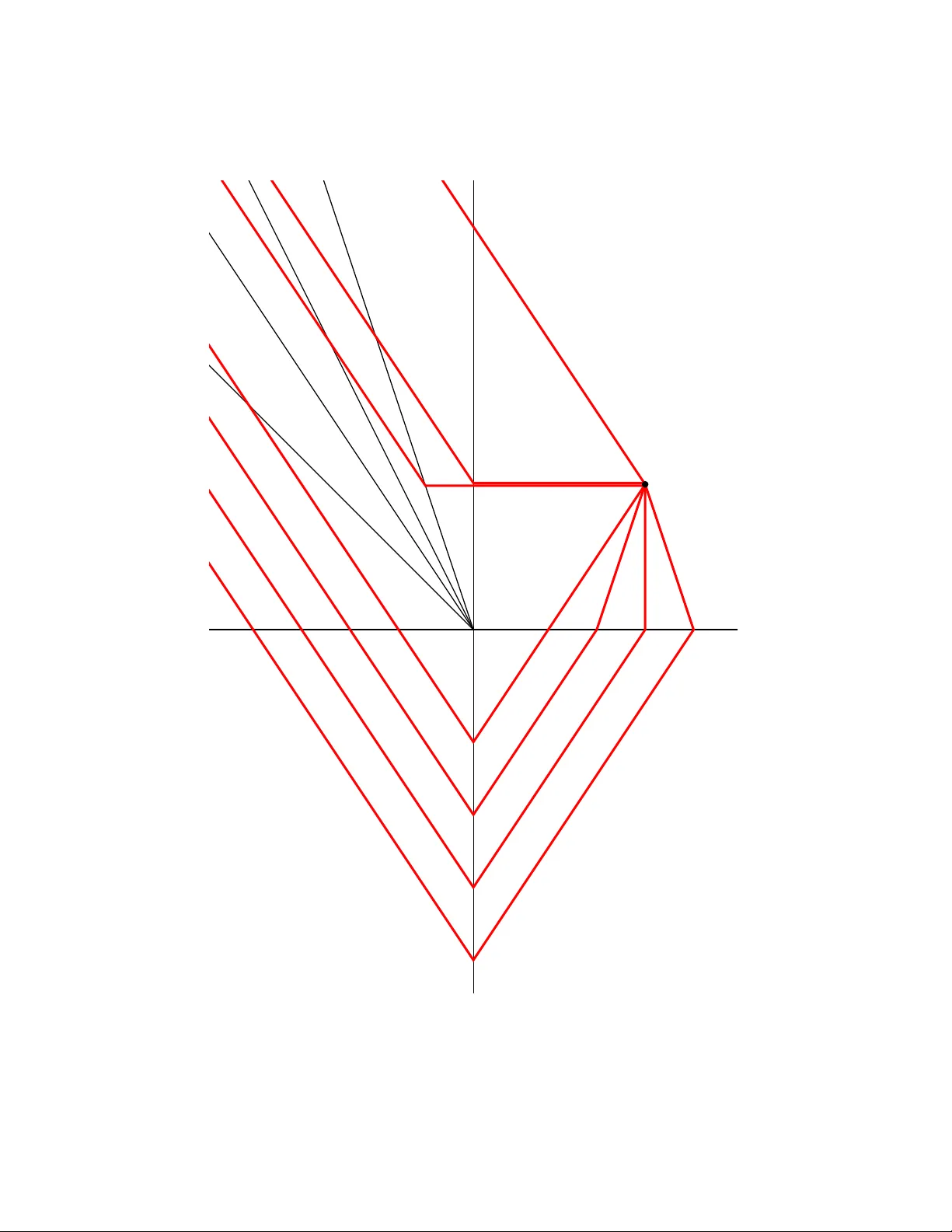
MUT A TION OF THET A FUNCTIONS NA TH AN READING AND SAL V A TORE STELLA Abstract. W e giv e an account of m utation of theta functions in cluster scat- tering diagrams, starting with a notion of mutation that is related to, but different from, the notion of m utation defined by Gross, Hacking, Keel, and Kontsevic h. This differen t approach to mutation leads to several applications. Three of the applications simplify the pro cess of computing structure constants for m ultiplication of theta functions, and these are used in another paper on cluster scattering diagrams of affine type. Notable in these three applications is the app earance of mutation symmetries and dominance regions. The other tw o applications hav e to do with p ointed reduced bases, a variation on the pointed bases of F an Qin. W e giv e a c haracterization of pointed reduced bases analogous to Qin’s c haracterization of p ointed bases. All of these applications take place in a v ersion of Gross, Hacking, Keel, and Kontsevic h’s canonical algebra that can be constructed for an arbitrary exchange matrix. Contents 1. In tro duction 2 2. Scattering diagrams and theta functions 3 2.1. Con text for scattering diagrams 4 2.2. Scattering diagrams 5 2.3. Theta functions 6 2.4. Structure constants 9 2.5. Matrix mutation, mutation maps, and the mutation fan 10 2.6. The choice of co efficients 11 3. The small canonical algebra 14 3.1. Definition of the small canonical algebra 14 3.2. Comparison with the Gross-Hacking-Keel-Kon tsevich approach 16 3.3. Bases and reduced bases for the small canonical algebra 17 4. Mutation of theta functions 21 5. Applications of m utation of theta functions 30 5.1. Mutation symmetry 30 5.2. Mutation of pairs of brok en lines 31 5.3. Dominance regions, B -cones, and p ointed elements 32 5.4. P ointed reduced bases 37 5.5. The ray basis 39 References 41 Nathan Reading was partially supp orted by the National Science F oundation under Grant Number DMS-2054489 and by the Simons F oundation under aw ard num b er 581608. Salv atore Stella was partially supp orted by PRIN 20223FEA2E - PE1 and b y INdAM - GNSAGA. 1 2 NA THAN READING AND SAL V A TORE STELLA 1. Introduction Cluster scattering diagrams were defined by Gross, Hacking, Keel, and Kontse- vic h [ 7 ] to prov e longstanding structural conjectures ab out cluster algebras. The key fact connecting cluster scattering diagrams to cluster algebras is that cluster v ariables (and more generally cluster monomials) can b e computed as theta functions for the cluster scattering diagram. Theta functions, in turn, are computed as sums of monomials obtained from piecewise-linear curv es called broken lines. In this pap er, w e give a detailed account of how brok en lines and theta functions c hange when the initial seed is mutated. This account of mutation can in principle b e recov ered from [ 7 , Prop osition 3.6] and vice v ersa, but we follow a v ery different con ven tion for what m utation should mean in the context of scattering diagrams. (F or a comparison of the tw o notions of mutation, see [ 14 , Section 4]. Briefly , the difference is that mutation in [ 7 ] mov es the “p ositive cham b er”, while mutation in this pap er fixes the positive cham b er.) The notion of mutation contemplated here is motiv ated by the notion of “initial seed mutations” of cluster algebras and also motiv ated by applications to t wo re- lated basic problems: Determining theta functions for a cluster scattering diagram and determining the structure constan ts for m ultiplication of theta functions. Giv en an n × n exchange matrix B and a sequence k of indices, the asso ciated mutation map η B k tak es a vector in R n , places it as a co efficien t row under B , m utates at indices k , and reads the new co efficient row. Mutation of cluster scat- tering diagrams amounts to applying a mutation map to walls and adjusting the scattering terms on the walls appropriately . (A precise statement is reproduced here as Theorem 4.6 . V ersions of this fact are in [ 3 , Section 3], [ 8 , Lemma 5.2.1] and [ 14 , Theorem 4.2]. The equiv alent fact using the other notion of mutation is [ 7 , Theorem 1.24].) The key technical lemma in this pap er (Lemma 4.9 ) is that theta functions also m utate by applying mutation maps and adjusting the (Laurent monomial) lab els appropriately . Rather than “translating” the result from [ 7 , Proposition 3.6] which pro ves it for the other notion of m utation, it is more straightforw ard to prov e it here directly . T o mak e Lemma 4.9 apply to an arbitrary initial exchange matrix B , w e work in an algebra (the smal l c anonic al algebr a , defined in Section 3 ) that, lo osely sp eaking, is “the algebra generated by the theta functions”. In [ 7 ], a canonical algebra is only defined when pro ducts of theta functions expand as finite sums of theta functions. Here, we appeal to the fact that theta functions can in any case b e m ultiplied as formal p ow er series to define an algebra (ho wev er p o orly b ehav ed) in whic h our result on structure constan ts makes sense. T o make the small canonical algebra a reasonable setting for m utation of theta functions, we need nondegeneracy conditions on the extended exchange matrix ˜ B (which is taken to b e wide rather than tall). W e say that ˜ B has nonde gener ate c o efficients if the ro ws that are adjoined right of B to make ˜ B are linearly indep endent. This is stronger than the requiremen t in [ 7 ] that the rows of ˜ B are linearly indep endent. (Ho wev er, w e p oin t out in Section 2.6 that there is a reasonable w ay to define some theta functions under weak er assumptions.) F or our results on m utating theta functions, w e assume signe d-nonde gener ating c o efficients , meaning that any m utation of ˜ B has nondegenerate co efficients, with c onsisten t signs in co efficient rows. A MUT A TION OF THET A FUNCTIONS 3 sufficien t condition for signed-nondegenerating co efficients is that there exists a seed at whic h the co efficients are principal. Lemma 4.9 implies the follo wing result, stated explicitly later as Theorem 4.2 . Theorem 1.1. Theta functions r elative to mutation-e quivalent exchange matri- c es with signe d-nonde gener ating c o efficients c an b e obtaine d fr om one another by multiplic ation with an appr opriate L aur ent monomial in fr ozen variables. Section 5 con tains v arious applications of Theorem 4.2 . One can think of these as applications of the notion of mutation used in this pap er. Three of these applications simplify the computation of structure constan ts for m ultiplication of theta functions. One application (Theorem 5.1 ) exploits m utation- symmetry . (A mutation-symmetry of an exchange matrix is a sequence of muta- tions that preserves the exchange matrix). Roughly , the simplification is as follows: When we multiply theta functions indexed by vectors in finite orbits under the m utation-symmetry , the pro duct expands as a sum of theta functions indexed b y v ectors in finite orbits. Sligh tly more precisely , we must also assume that the theta functions b eing multiplied are indexed by v ectors in a special subset of the ambien t lattice (called Θ in [ 7 ]), so that the pro duct expands as a finite sum. Another application (Prop osition 5.3 ) p oints out a scenario where pairs of brok en lines mu- tate together. A third application (Theorem 5.4 ) shows that the product of theta functions whose g -vectors are all in the same cone of the m utation fan expands as a combination of theta functions whose g -v ectors are in the dominance region of the g -vector of the pro duct. (The dominance region is a form ulation due to Rup el and Stella of F an Qin’s dominance partial order on g -vectors [ 11 , Section 3.1].) Theorem 5.4 is a corollary of the more precise but more tec hnical Theorem 5.7 . These simplifications in computing structure constants along with direct appli- cations of the tec hnical lemma are crucial in [ 18 ], where we giv e a complete descrip- tion of theta functions in the acyclic affine case, in the con text of a com binatorial mo del of the cluster scattering diagram developed in [ 17 ], discov er “imaginary” exc hange relations among theta functions, and iden tify an “imaginary subalgebra” of the small canonical algebra that is related to (and in some cases isomorphic to) a generalized cluster algebra of finite type. The remaining applications of Theorem 4.2 hav e to do with p ointe d r e duc e d b ases of the small canonical algebra, a v ariation on Qin’s p ointed bases [ 11 , The- orem 1.2.1]. W e give a characterization (Theorem 5.14 ) of p oin ted reduced bases analogous to Qin’s c haracterization [ 11 , Theorem 1.2.1] of pointed bases. W e giv e b oth precise necessary and sufficien t conditions for a set to be a pointed reduced ba- sis and also simpler necessary conditions, the latter being phrased in terms of dom- inance regions. F or more details on the relationship b etw een [ 11 , Theorem 1.2.1] and Theorem 5.14 , see Remark 5.15 . W e also define, in some cases, a basis for the small canonical algebra called the r ay b asis . In the case of a marked surface, the ra y basis is the bangles basis of [ 9 ]. Some ideas in this pap er are inspired by the ideas in F an Qin’s pap er [ 11 ], although our conv entions, metho ds, and goals are different enough that there is little actual o verlap betw een the tw o papers. 2. Sca ttering diagrams and thet a functions W e now in tro duce background material on scattering diagrams and their theta functions. 4 NA THAN READING AND SAL V A TORE STELLA 2.1. Con text for scattering diagrams. The underlying data for a scattering diagrams is a finite-dimensional lattice with a distinguished basis, a distinguished subset of the basis, and a skew-symmetric bilinear form on the lattice. In [ 7 ], the underlying data is divided into “fixed data” and “seed data”. Later in the pap er, w e will (crucially) take a different p oint of view on what is fixed and what changes, but for no w we make no distinction betw een fixed data and seed data. The scattering diagram itself lives in the dual space, and in volv es a set of inde- terminates in bijection with the basis elements. W e arrange the relev ant definitions in to four parts, related to: the index set; the lattice, the dual lattice; and the inde- terminates. Then w e sho w ho w all of this data arises from the choice of an extended exc hange matrix. Definitions r elate d to the index set. • A finite index set I . • I uf ⊆ I (“unfrozen”) and I fr = I \ I uf (“frozen”). • P ositive integers ( d i : i ∈ I ) with gcd( d i : i ∈ I ) = 1. Definitions r elate d to the lattic e. • A lattice N with basis ( e i : i ∈ I ) • The finite-index sublattice N ◦ ⊆ N spanned b y ( d i e i : i ∈ I ). • The sublattice N uf spanned by ( e i : i ∈ I uf ). • N 0+ uf = { P i ∈ I uf a i e i : a i ∈ Z , a i ≥ 0 } and N + uf = N 0+ uf \ { 0 } , the nonnegativ e and p ositive parts of N uf . • V = N uf ⊗ R , the ambien t v ector space of N uf (not of N ). • { · , · } : N × N → Q , a skew-symetric bilinear form, chosen so that { N uf , N ◦ } ⊆ Z and { N , N uf ∩ N ◦ } ⊆ Z . • ϵ ij = { e i , d j e j } (integers except p ossibly when i, j ∈ I fr ). • An element of a lattice is primitive if it is not a p ositive integer multiple of some other elemen t of the lattice. Giv en a primitive elemen t n ∈ N , let n ◦ b e the primitiv e elemen t of N ◦ that is a p ositive m ultiple of n . • W e partially order the lattice N c omp onentwise relative to the basis ( e i : i ∈ I ). That is, n ≤ n ′ ∈ N if and only if n = P i ∈ I a i e i and n ′ = P i ∈ I a ′ i e i with a i ≤ a ′ i for all i ∈ I . Definitions r elate d to the dual. • M = Hom( N , Z ), the dual lattice to N , with basis ( e ∗ i : i ∈ I ) dual to ( e i : i ∈ I ). • ⟨ · , · ⟩ : M ◦ × N → Q , the natural pairing. • M ◦ = Hom( N ◦ , Z ), the finite-index superlattice of M spanned by ( f i : i ∈ I ) with f i = d − 1 i e ∗ i . • The sublattice M ◦ uf spanned by ( f i : i ∈ I uf ). • V ∗ , the dual vector space to V , spanned by { e ∗ i : i ∈ I uf } . • ⟨ · , · ⟩ : V ∗ × V → R , the natural pairing. • The elemen ts P j ∈ I ϵ ij f j for i ∈ I uf are required to be linearly indep endent, but this is really a condition on { · , · } . • W e partially order M ◦ comp onen twise relative to the basis ( f i : i ∈ I ). Definitions r elate d to indeterminates. • Indeterminates ( z i : i ∈ I ). • z m means Q i ∈ I z c i i for m = P i ∈ I c i f i ∈ M ◦ . MUT A TION OF THET A FUNCTIONS 5 • Lauren t monomials σ i = Q j ∈ I fr z ϵ ij j and ζ i = Q j ∈ I z ϵ ij j for i ∈ I uf . • ζ n means Q i ∈ I uf ζ a i i and σ n means Q i ∈ I uf σ a i i for n = P i ∈ I uf a i e i ∈ N uf . • k [[ ζ ]] = k [[ ζ i : i ∈ I ]], the ring of formal pow er series in the ζ i , ov er a field k of characteristic 0. • Giv en n ∈ N uf , w e write nB for the v ector in M ◦ uf suc h that ζ n = z nB σ n . In other words, we write the e i -co ordinate vector of n as a row v ector, apply the matrix B = [ ϵ ij ] i,j ∈ I uf on the righ t, and in terpret the resulting ro w v ector as the f i -co ordinate vector of nB ∈ M ◦ uf . W e now explain how al l of the essential underlying data for a sc attering diagr am amounts to the choic e of an extende d exchange matrix. Giv en an indexing set I and I uf ⊆ I , define I fr as ab ov e. Let ˜ B = [ ϵ ij ] i ∈ I uf ,j ∈ I b e an integer matrix with linearly indep endent ro ws, and write B for the square submatrix [ ϵ ij ] i,j ∈ I uf . W e require that there exist in tegers ( d i : i ∈ I uf ) such that d i ϵ ij = − d j ϵ j i for all i, j ∈ I uf . W e can assume that gcd( d i : i ∈ I ) = 1. Th us B is a skew-symmetrizable integer matrix—an exchange matrix —and ˜ B is an extende d exchange matrix , extending B . (Contrary to the conv entions in [ 6 ], here we hav e extended B to mak e it wide rather than tal l . In [ 18 ], we give the translations of this pap er’s results into the tall extended matrix setting.) The definition of cluster scattering diagrams and theta functions b elow requires that the ro ws of ˜ B b e linearly indep endent, but we will see in Section 2.6 that there is a reasonable definition of theta functions for arbitrary ˜ B . All of the underlying data described ab ov e can b e constructed from ˜ B as follows. Let ( e i : i ∈ I ) b e formal symbols, take N to b e the lattice of formal Z -linear com binations of { e i : i ∈ I } , and define N ◦ , N uf , N + , and V as ab ov e. There is a c hoice to b e made b efore constructing the remaining data. Sp ecifically , w e must choose additional entries ϵ ij with i ∈ I fr , j ∈ I and additional in tegers ( d i : i ∈ I fr ) such that the additional en tries ϵ ij are integers when j ∈ I uf and such that the matrix [ ϵ ij : i, j ∈ I ] has d i ϵ ij = − d j ϵ j i for all i, j ∈ I . How ev er, this c hoice is inconsequential for our purp oses b ecause the data [ ϵ ij ] i ∈ I fr ,j ∈ I and ( d i : i ∈ I fr ) do es not app ear in the rest of the pap er. (One w ay to make the choice is to set d i = 1 for all i ∈ I fr , set ϵ ij = − d j ϵ j i for i ∈ I fr and j ∈ I uf , and set ϵ ij = 0 for i, j ∈ I fr .) W e emphasize again that al l of the essential data is al l c ontaine d in ˜ B . Define a bilinear form { · , · } : N × N → Q according to the rule { e i , d j e j } = ϵ ij for i, j ∈ I . This is skew-symmetric b ecause d i ϵ ij = − d j ϵ j i for all i, j ∈ I . The form has { N uf , N ◦ } ⊆ Z and { N , N uf ∩ N ◦ } ⊆ Z b ecause ˜ B is an in teger matrix. Finally , construct M , M ◦ , and V ∗ and define indeterminates and Lauren t mono- mials as ab ov e. The requirement that the v ectors ( P j ∈ I ϵ ij f j : i ∈ I uf ) are linearly indep enden t is precisely the linear indep endence of the ro ws of ˜ B . The extended exchange matrix ˜ B (and by extension, the underlying data for the cluster scattering diagram) is said to ha ve princip al c o efficients if there is a bijection π : I uf → I fr suc h that ϵ iπ ( j ) = δ ij (Kronec ker delta). Thus ˜ B is B , extended by adjoining a p erm utation of an iden tit y matrix. 2.2. Scattering diagrams. W e assume the most basic notions of scattering dia- grams from [ 7 ], and we follow the treatment in [ 14 ]. In particular, w e leav e out, from the scattering diagram, the extra dimensions related to frozen v ariables, and mo dify some definitions/constructions accordingly . (See [ 14 , Remarks 2.12–2.13].) 6 NA THAN READING AND SAL V A TORE STELLA A wal l is a pair ( d , f d ), where d is a codimension-1 p olyhedral cone in V ∗ and f d is in k [[ ζ ]]. More sp ecifically , the cone d is orthogonal to a vector n ∈ N + uf that is primitiv e in N , and the sc attering term f d is a univ ariate p ow er series in ζ n with constan t term 1. W e sometimes write ( d , f d ( ζ n )) as a w ay of naming n explicitly . A sc attering diagr am is a collection D of walls, satisfying a finiteness condition that amounts to the requiremen t that all relev ant computations are v alid as limits of formal pow er series. The wal l-cr ossing automorphism p γ , d for a path γ crossing a wall ( d , f d ( ζ n )) acts on Lauren t monomials in the z i b y p γ , d ( z m ) = z m f ⟨ m, ± n ◦ ⟩ d , (2.1) for m ∈ M ◦ uf , taking + n ◦ when crossing d against the direction of n or taking − n ◦ when crossing in the direction of n . As usual, p ath-or der e d pr o ducts are comp ositions of wall-crossing automor- phisms along generic paths, or more precisely , limits of such comp ositions in the sense of formal p ow er series. A scattering diagram D is c onsistent if a path- ordered product dep ends only on the starting p oint and ending p oint of the path, and tw o scattering diagrams D and D ′ are e quivalent if they determine the same path-ordered pro ducts. In this pap er, we do not need to compute an y path-ordered pro ducts explicitly , except in connection with the pro of of Prop osition 4.5 , where w e compute a single w all-crossing automorphism. A wal l ( d , f d ( ζ n )) is outgoing if the vector nB ∈ M ◦ uf is not contained in d . The cluster sc attering diagr am Scat( ˜ B ) is the unique (up to equiv alence) consistent scattering diagram consisting of walls { ( e ⊥ i , 1 + ζ i ) : i ∈ I uf } together with addi- tional walls, all of which are outgoing. The existence and uniqueness of Scat( ˜ B ) is [ 7 , Theorem 1.12]. 2.3. Theta functions. W e now define theta functions, quoting and reinterpreting definitions and results of [ 7 ] in the special case of Scat( ˜ B ). Theta functions depend on the choice of a p oint Q ∈ V ∗ and a vector m ∈ M ◦ uf , with Q required to not b e con tained in an y hyperplane n ⊥ for n ∈ N uf . W e hav e ϑ Q, 0 = 1, and for m = 0, ϑ Q,m is a sum of w eigh ts on broken lines, as w e now describ e. A br oken line for m with endpoint Q , relative to Scat( ˜ B ) is a piecewise linear path γ : ( −∞ , 0] → V ∗ with finitely many of domains of linearity (abbreviated “domains” in what follows), satisfying certain conditions. The first t wo conditions are directly on γ : (i) γ (0) = Q . (ii) γ do es not in tersect the relative boundary of an y wall of Scat( ˜ B ) and does not intersect an y intersection of walls of Scat( ˜ B ) (unless those walls are in the same h yp erplane). The remaining conditions are phrased in terms of an assignment of a Lauren t mono- mial c L z m L σ n L (with c L ∈ k , m L ∈ M ◦ uf , and n L ∈ N uf ) to each domain L of γ . The Lauren t monomials must satisfy the following conditions, whic h amount to conditions on γ , and which allo w us (if the conditions can b e satisfied) to recov er the Laurent monomials uniquely from the path γ . (iii) In each domain L , the deriv ativ e γ ′ of γ is constan tly equal to − m L . (iv) c L z m L σ n L = z m when L is the un b ounded domain of γ . (That is, c L = 1, m L = m , and n = 0.) MUT A TION OF THET A FUNCTIONS 7 (v) Supp ose t is a p oint of nonlinearity of γ , adjacent to domains L 1 and L 2 , with L 1 b eing of the form [ a, t ] or ( −∞ , t ) and L 2 b eing of the form [ t, b ]. Then γ ( t ) is required to b e contained in some wall. By condition (ii) , ab o ve, there exists n ∈ N uf suc h that every w all containing γ ( t ) is in n ⊥ . W e can c ho ose n to b e primitive in N and to hav e ⟨ m L , n ⟩ > 0. Let f b e the product of the f d for all walls ( d , f d ) with γ ( t ) ∈ d . Then c L 2 z m L 2 σ n L 2 is required to b e c L 1 z m L 1 σ n L 1 times a term in f ⟨ m L 1 ,n ◦ ⟩ . (W e say that γ b ends at t , and c L 2 z m L 2 σ n L 2 c L 1 z m L 1 σ n L 1 is the c ontribution at this b end.) Since each scattering term f d is a formal p o wer series in k [[ ζ ]], these conditions imply that each n L is in N 0+ uf , so that eac h z m L σ n L is a Laurent monomial in ( z i : i ∈ I uf ) times an ordinary monomial in ( σ i : i ∈ I uf ), and in fact each z m L σ n L is z m times an ordinary monomial in ( ζ i : i ∈ I uf ). W rite c γ z m γ σ n γ for the Laurent monomial on the domain con taining 0. Then the theta function ϑ Q,m is P c γ z m γ σ n γ , where the sum is ov er brok en lines for m with endpoint Q . W e see that ϑ Q,m ∈ z m k [[ ζ ]]. (That is, ϑ Q,m is z m times a formal p o wer series in ( ζ i : i ∈ I uf ).) The most important theta functions, from the p oint of view of cluster algebras, are theta functions where Q is chosen to be in the in terior of the p ositive orthan t D = T n i =1 { x ∈ V ∗ : ⟨ x, e i ⟩ ≥ 0 } . The theta function do es not dep end on the exact c hoice of Q in the interior of D , and th us w e write ϑ m to mean ϑ Q,m with Q in the in terior of D . Each theta function ϑ m is z m times a formal pow er series F m ∈ k [[ ζ ]]. W e will call F m the F -series of ϑ m . A broken line γ for m has n γ = 0 if and only if γ has exactly one domain of linearity . There is exactly one such brok en line for eac h m and Q , and it has c γ z m γ σ n γ = z m . Th us F m has constant term 1. Example 2.1. (T o understand this example, one m ust b e careful to distinguish b et ween n and n ◦ in the definitions of walls and broken lines.) Consider the ex- c hange matrix B = 0 − 3 1 0 and assume that ˜ B is some extension of B . W e take I uf = { 1 , 2 } indexing B in the usual wa y and write [ m 1 , m 2 ] for the f i -co ordinates of vectors in M ◦ uf . The blac k lines in Figure 1 are the w alls of the cluster scattering diagram. The figure is drawn so that f 1 is the horizontal co ordinate and f 2 is the v ertical, and f 1 and f 2 are sho wn with the same length. The skew-symmetrizing constan ts are d 1 = 3 and d 2 = 1, so e ∗ 1 = 3 f 1 and e ∗ 2 = f 2 . W e hav e ζ 1 = σ 1 z − 3 2 and ζ 2 = σ 2 z 1 The figure also shows, in red, the broken lines that arise in the computation of ϑ [ − 2 , 3] , for a particular choice of Q in the positive quadrant. The theta function is the sum of the monomials assigned to the domains inciden t to Q : ϑ [ − 2 , 3] = z − 2 1 z 3 2 + 2 σ 1 z − 2 1 + 3 σ 1 σ 2 z − 1 1 + σ 2 1 z − 2 1 z − 3 2 + 3 σ 2 1 σ 2 z − 1 1 z − 3 2 + 3 σ 2 1 σ 2 2 z − 3 2 + σ 2 1 σ 3 2 z 1 z − 3 2 = z − 2 1 z 3 2 (1 + 2 ζ 1 + 3 ζ 1 ζ 2 + ζ 2 1 + 3 ζ 2 1 ζ 2 + 3 ζ 2 1 ζ 2 2 + ζ 2 1 ζ 3 2 ) . R emark 2.2 . As mentioned at the b eginning of Section 2.2 , w e hav e follo wed [ 14 , Section 2] in leaving out some unnecessary dimensions from the definition of scattering diagrams and mo difying the definition of theta functions accordingly . This choice is explained and justified in [ 14 , Remark 2.1], [ 14 , Remark 2.12], and [ 14 , Remark 5.1]. Lea ving out the extra dimensions amounts to “demoting” the “frozen v ariables” ( z i : i ∈ I fr ) to the status of “coefficients”. While the difference 8 NA THAN READING AND SAL V A TORE STELLA 1 + ζ 1 1 + ζ 2 1 + ζ 1 1 + ζ 2 z − 2 1 z 3 2 2 σ 1 z − 2 1 σ 2 1 z − 2 1 z − 3 2 3 σ 2 1 σ 2 z − 1 1 z − 3 2 3 σ 2 1 σ 2 2 z − 3 2 σ 2 1 σ 3 2 z 1 z − 3 2 3 σ 1 σ 2 z − 1 1 z − 2 1 z 3 2 z − 2 1 z 3 2 z − 2 1 z 3 2 z − 2 1 z 3 2 z − 2 1 z 3 2 z − 2 1 z 3 2 σ 2 1 z − 2 1 z − 3 2 σ 2 1 z − 2 1 z − 3 2 σ 2 1 z − 2 1 z − 3 2 1 + ζ 1 ζ 2 1 + ζ 2 1 ζ 3 2 1 + ζ 1 ζ 2 2 1 + ζ 1 ζ 3 2 Q Figure 1. Broken lines for ϑ [ − 2 , 3] = ϑ Q, [ − 2 , 3] MUT A TION OF THET A FUNCTIONS 9 ma y b e a matter of taste and con venience, w e find that leaving out the extra di- mensions leads to b etter intuition on what is actually happening, for example when w e c hange co efficients. (See Section 2.6 .) W e now describ e the difference more specifically . F or the purp oses of this remark, temp orarily define V ∗ fr to b e the real span of { f i : i ∈ I fr } , so that M ⊗ R can b e iden tified with V ∗ ⊕ V ∗ fr . Starting with Scat( ˜ B ) in V ∗ as defined here, we reco ver the scattering diagram in M ⊗ R (as in [ 7 ]) by replacing eac h w all ( d , f d ) of Scat( ˜ B ) with ( d ⊕ V ∗ fr , f d ). Our definition constrains broken lines to V ∗ , but their “directions” in V ∗ ⊕ V ∗ fr are recorded on each domain b y the Laurent monomials z m L σ n L . Brok en lines for m ∈ M ◦ uf in our sense are easily seen to corresp ond bijectiv ely to broken lines in the larger space in the sense of [ 7 ], and the Lauren t monomials lab eling domains are the same. R emark 2.3 . In [ 7 ], the defini tion of theta functions allo ws m ∈ M ◦ , rather than the more restrictive condition m ∈ M ◦ uf in our definition. Ho wev er, if we allo w m ∈ M ◦ in our definition and adjust condition (iv) in the ob vious w ay , we obtain the same theta functions as in [ 7 ]. In either definition, the only interesting theta functions are the theta functions for m ∈ M ◦ uf . Indeed, if m ∈ M ◦ is written as m 0 + m 1 with m 0 ∈ M ◦ uf and m 1 in the span of { f i : i ∈ I fr } , then ϑ m = ϑ m 0 z m 1 . Thus we restrict our atten tion to theta functions ϑ m with m ∈ M ◦ uf . See also Section 3.2 . 2.4. Structure constants. W e no w explain a result of [ 7 ] that gives the structure constan ts for m ultiplication of theta functions ϑ m , reinterpreting this result in our setting where unnecessary dimensions hav e been remo ved. Sp ecifically , w e quote a result of [ 7 ] that is stated there under the hypothesis of principal co efficients, as defined in Section 2.1 . In Section 2.6 , we will show (as Prop osition 2.9 ) that the result quoted in this section holds without the hypothesis of principal coefficients. Supp ose p 1 , p 2 , m ∈ M ◦ uf and supp ose Q ∈ V ∗ is not contained in an y wall of Scat( ˜ B ). Define a Q ( p 1 , p 2 , m ) = X ( γ 1 ,γ 2 ) c γ 1 c γ 2 σ n γ 1 + n γ 2 , where the sum is ov er all pairs ( γ 1 , γ 2 ) of broken lines for p 1 and p 2 resp ectiv ely , b oth ha ving endp oin t Q , and with m γ 1 + m γ 2 = m . The definition of brok en lines implies that each n γ i is a nonnegative combination of { e i : i ∈ I uf } . Each σ n γ 1 + n γ 2 is a Lauren t monomial in ( z i : i ∈ I fr ). By [ 7 , Definition-Lemma 6.2], eac h Laurent monomial in ( z i : i ∈ I fr ) appears at most finitely many times, and with nonnegativ e co efficien ts, in the sum. Therefore, each monomial in ( σ i : i ∈ I uf ) app ears at most finitely man y times and with nonnegativ e co efficients. In particular, a Q ( p 1 , p 2 , m ) is well defined as a formal p ow er series in ( σ i : i ∈ I uf ) with nonnegative integer co efficien ts. F or an arbitrary sequence of points Q ∈ V ∗ , disjoint from the w alls of Scat( ˜ B ) and approaching m , define a ( p 1 , p 2 , m ) = lim Q → m a Q ( p 1 , p 2 , m ) . This limit is v alid as a limit of formal pow er series, by the finiteness condition in the definition of a scattering diagram. The following is part of [ 7 , Propos ition 6.4] sp ecialized to the present setting. Prop osition 2.4. Assume princip al c o efficients and supp ose p 1 , p 2 ∈ M ◦ uf . Then for every m ∈ M ◦ uf , the formal p ower series a ( p 1 , p 2 , m ) do es not dep end on the 10 NA THAN READING AND SAL V A TORE STELLA se quenc e of p oints Q appr o aching m . F urthermor e, (2.2) ϑ p 1 · ϑ p 2 = X m ∈ M ◦ uf a ( p 1 , p 2 , m ) ϑ m . The sum in Prop osition 2.4 may not reduce to a finite sum, but [ 7 , Definition- Lemma 6.2] and [ 7 , Prop osition 6.4] imply that it makes sense as conv ergent sum of formal p ow er series. More precisely , for eac h term cσ n of a ( p 1 , p 2 , m ), the ex- pression cσ n ϑ m can b e rewritten as cζ n z − nB z m F m . Since ζ n is the pro duct of the contributions of all b ends of some pair of broken lines for p 1 and p 2 , w e hav e m − nB = p 1 + p 2 . Th us cσ n ϑ m is z p 1 + p 2 times a formal p ow er series cζ n F m ∈ k [[ ζ ]]. Prop osition 2.4 (i.e. [ 7 , Prop osition 6.4]) sa ys that the sum of these formal p ow er series conv erges to z − p 1 − p 2 ϑ p 1 · ϑ p 2 so that the sum in ( 2.2 ) conv erges to ϑ p 1 · ϑ p 2 .) Roughly following [ 7 , Section 7], we define Θ ⊆ M ◦ uf to b e the set of v ectors m ∈ M ◦ uf suc h that only finitely many broken lines figure in to the definition of ϑ m . In particular, for m ∈ Θ, in the theta function ϑ m = z m · F m , the F -series F m is a p olynomial (the F -p olynomial ), rather than a more general formal p ow er series. The following is part of [ 7 , Theorem 7.5], rephrased to use the conv entions of this pap er. Theorem 2.5. If p 1 p 2 ∈ Θ then the sum in ( 2.2 ) has finitely many nonzer o terms, every a ( p 1 , p 2 , m ) is a p olynomial, and every m with a ( p 1 , p 2 , m ) = 0 has m ∈ Θ . 2.5. Matrix mutation, m utation maps, and the mutation fan. Of primary imp ortance in this paper is the notion of mutation. F or eac h k ∈ I uf , the mutation of ˜ B in direction k is the matrix µ k ( ˜ B ) = [ ϵ ′ ij ] given by (2.3) ϵ ′ ij = − ϵ ij if i = k or j = k ; ϵ ij + [ − ϵ ik ] + ϵ kj + ϵ ik [ ϵ kj ] + otherwise. Here, [ x ] + means max(0 , x ). Mutation of the smaller matrix B is defined by the same formula. The notation k = k q · · · k 1 stands for a sequence of indices in I uf , so that µ k means µ k q ◦ µ k q − 1 ◦ · · · ◦ µ k 1 . Giv en an exchange matrix B , there is a mutation map η B k : V ∗ → V ∗ for eac h sequence k of indices. T o compute η B k ( v ) for v = P i ∈ I uf a i f i ∈ V ∗ , w e extend B b y app ending a single row ( a i : i ∈ I uf ) b elo w B , apply µ k , and read off the ro w ( a ′ i : i ∈ I uf ) b elow µ k ( B ) in the mutated matrix. Then η B k ( v ) is defined to b e P i ∈ I uf a ′ i f i ∈ V ∗ . The map η B k : V ∗ → V ∗ is a piecewise linear homeomorphism. It is a comp osition (2.4) η B k = η B k q ,k q − 1 ...,k 1 = η B q k q ◦ η B q − 1 k q − 1 ◦ · · · ◦ η B 1 k 1 of mutation maps for singleton sequences, where B 1 = B and B i +1 = µ k i ( B i ) for i = 1 , . . . , q . F or v = P i ∈ I uf a i f i , we write sgn ( v ) for the vector (sgn( a i ) : i ∈ I uf ), where sgn( a ) ∈ {− 1 , 0 , 1 } is the sign of a as usual. Two vectors m, p ∈ V ∗ are B - e quivalent (written m ≡ B p ) if and only if sgn ( η B k ( m )) = sgn ( η B k ( p )) for all sequences k . The ≡ B -equiv alence classes are called B -classes and the closures of B -classes are called B -c ones . Eac h B -cone is a closed conv ex cone (i.e. it is closed in the usual sense and closed under nonnegativ e scaling and addition). The set consisting of all B -cones and their faces is a complete fan called the mutation fan F B [ 12 , Theorem 5.13]. MUT A TION OF THET A FUNCTIONS 11 2.6. The choice of co efficien ts. W e tak e the p oint of view that the exc hange matrix B is the most imp ortant initial data for a cluster scattering diagram, while the remaining entries of ˜ B are a choice of “co efficients”. W e no w discuss to what exten t, and in what wa y , the cluster scattering diagram, its theta functions, and their structure constan ts dep end on the c hoice of co efficients. This discussion leads us to in tro duce the hypothesis on coefficients that is needed for our main results. In the other direction, this discussion leads us to define some theta functions in greater generalit y b y relaxing the requirement that ˜ B has linearly indep endent ro ws. W e describ e in Prop osition 2.10 how results on structure constants for multiplying theta functions (e.g. those in Sections 5.1 and 5.3 ) can apply to this more general definition of theta functions. If ˜ B and ˜ B ′ b oth extend B (and b oth hav e linearly indep endent rows), then one can construct the underlying data as in Section 2.1 for both ˜ B and ˜ B ′ with the same ( e i : i ∈ I uf ) b oth times, so that the lattices N uf and M ◦ uf and the vector spaces V and V ∗ are the same for ˜ B and ˜ B ′ . Distinguishing the indeterminates and Lau- ren t monomials by placing primes on the indeterminates and Laurent monomials for ˜ B ′ , [ 14 , Prop osition 2.6] is the statement that a consistent scattering diagram for ˜ B can b e made into a consistent scattering diagram for ˜ B ′ b y replacing each w all ( d , f d ( ζ n 0 )) by ( d , f d (( ζ ′ ) n 0 )), where f d (( ζ ′ ) n 0 ) denotes the formal p ow er series in ( ζ ′ ) n 0 obtained from f d ( ζ n 0 ) by replacing ζ n 0 with ( ζ ′ ) n 0 throughout. As an immediate consequence, the cluster scattering diagram Scat( ˜ B ′ ) is obtained from Scat( ˜ B ) by making the same replacemen ts of walls. No w, lo oking at the definition of broken lines, w e migh t try to conclude that the theta functions for Scat( ˜ B ′ ) are obtained from the theta functions for Scat( ˜ B ) b y replacing ζ i b y ζ ′ i for each i ∈ I uf . W e might also try to conclude that the structure constan ts (given in Proposition 2.4 /Prop osition 2.9 ) for m ultiplying theta functions for Scat( ˜ B ′ ) are obtained from the structure constants for Scat( ˜ B ) b y replacing each σ i b y σ ′ i . How ever, there is a subtlety in the notion of “replacing each ζ i (or σ i ) b y ζ ′ i (or σ ′ i )” that must b e addressed. This subtlet y leads to our hypothesis on co efficien ts. As mentioned just after Prop osition 2.4 , the definition via broken lines describ es a theta function ϑ m as z m times a formal p ow er series in ( ζ i : i ∈ I uf ). T aking that expression, w e can replace each ζ i b y ζ ′ i to obtain the corresp onding theta function for Scat( ˜ B ′ ). How ever, the Laurent monomials ( σ i : i ∈ I uf ) ma y not b e linearly indep enden t in the lattice of Laurent monomials. If they are not, then, when we write ϑ m as a sum of Lauren t monomials in ( z i : i ∈ I ), we may not b e able to lo ok at a single Laurent monomial x and write it uniquely as z m times a monomial in ( ζ i : i ∈ I uf ). (Nevertheless, if we know m , then since ζ i = z P j ∈ I ϵ ij f j and the v ectors P j ∈ I ϵ ij f j are linearly indep enden t, we can divide x by z m and uniquely write the result as a monomial in ( ζ i : i ∈ I uf ).) The situation is even w orse for structure constants. Each a ( p 1 , p 2 , m ) is a formal p o wer series in ( σ i : i ∈ I uf ), and if we obtain a structure constan t a ( p 1 , p 2 , m ) for Scat( ˜ B ) in this form as in Prop osition 2.4 , we can replace each σ i b y σ ′ i to obtain the structure constan ts for theta functions for Scat( ˜ B ′ ). How ever, if we ha ve a ( p 1 , p 2 , m ) as a sum of Laurent monomials in ( z i : i ∈ I ) and if the Lauren t monomials ( σ i : i ∈ I uf ) are not linearly indep endent, then w e cannot uniquely reco ver monomials in ( σ i : i ∈ I uf ) and thus cannot “replace eac h σ i b y σ ′ i ” to find the corresp onding structure constant for Scat( ˜ B ′ ). 12 NA THAN READING AND SAL V A TORE STELLA These considerations motiv ate an additional condition on ˜ B . W e say that ˜ B has nonde gener ate c o efficients if, when B is deleted from ˜ B , what remains has linearly indep endent ro ws. Equiv alently , if σ n = 1 for some n ∈ N uf , then n = 0. This is stronger than requiring that the ro ws of ˜ B are linearly independent. Defining Laurent monomials ζ i and ζ ′ i for i ∈ I uf as b efore, and app ealing as suggested ab ov e to [ 14 , Prop osition 2.6] and to the definition of theta functions, the replacements indicated in the following prop osition are well defined, b ecause of the hypothesis of nondegenerate coefficients. Prop osition 2.6. Supp ose ˜ B and ˜ B ′ ar e extensions of B , b oth with line arly inde- p endent r ows, and supp ose that ˜ B has nonde gener ate c o efficients. Then e ach theta function ϑ ′ m define d in terms of Scat( ˜ B ′ ) is obtaine d fr om the theta function ϑ m define d in terms of Scat( ˜ B ) by r eplacing e ach ζ i by ζ ′ i (or e quivalently by r eplacing e ach σ i by σ ′ i ). R emark 2.7 . Readers familiar with the “separation of additions” formula [ 6 , Corol- lary 6.3] may b e suspicious of Prop osition 2.6 . The source of confusion is that, under our conv entions, theta functions “are” cluster monomials only in the case of principal coefficients. F or other choices of co efficients, a cluster monomial may b e a theta function times a monomial in the frozen v ariables. F or details, see [ 14 , Theorem 5.2] and [ 14 , Remark 5.3]. W e pause to p oint out another direct consequence of [ 14 , Prop osition 2.6] and the definition of broken lines. Prop osition 2.8. The set Θ of ve ctors m ∈ M ◦ uf such that only finitely many br oken lines figur e into the definition of ϑ m dep ends only on B , not on the choic e of an extension ˜ B with line arly indep endent r ows. As an immediate consequence of Prop osition 2.6 , we can now keep the promise that w e made earlier to w eaken the hypotheses of Proposition 2.4 , whic h w as pro ved in [ 7 ] under the h yp othesis of principal co efficients. Since principal co efficients are in particular nondegenerate, Prop osition 2.6 applies when ˜ B has principal coefficients. Since theta functions for ˜ B ′ can b e obtained from theta functions for ˜ B b y a well- defined substitution, the same is true for structure constants. Prop osition 2.9. Pr op osition 2.4 holds, mor e gener al ly, without the hyp othesis of princip al c o efficients (but r etaining the hyp othesis that the r ows of ˜ B ar e line arly indep endent). In Prop osition 2.9 , we m ust retain the h yp othesis that the ro ws of ˜ B are linearly indep enden t b ecause w e may not b e able to define theta functions in the case where the ro ws of ˜ B are not indep endent. How ever, Prop osition 2.6 suggests how w e might attempt to define theta functions for an arbitrary extension ˜ B of B , without the requirement of linearly indep enden t ro ws: W e find any extension ˜ B ′ of B with nondegenerate coefficients, define theta functions for those nondegenerate co efficien ts, and then obtain theta functions for ˜ B by the replacemen t describ ed ab o ve. This is indep enden t of the choice of ˜ B ′ in light of Prop osition 2.6 . Ho wev er, it may fail for a differen t reason, namely b ecause some sp ecializations of formal p o wer series are not well defined. Therefore, we extend the definition of a theta function ϑ m to arbitrary extensions ˜ B in this w ay only when m ∈ Θ. MUT A TION OF THET A FUNCTIONS 13 Prop osition 2.10. Supp ose ˜ B and ˜ B ′ ar e extensions of B such that ˜ B has non- de gener ate c o efficients, and write a ( p 1 , p 2 , m ) for the structur e c onstants for theta functions define d in terms of ˜ B . Assume either that ˜ B ′ has line arly indep endent r ows or that the ve ctors p 1 and p 2 ar e in Θ . Then r eplacing e ach ϑ by ϑ ′ in ( 2.2 ) and r eplacing e ach σ i by σ ′ i in e ach a ( p 1 , p 2 , m ) yields a valid r elation among theta functions ϑ ′ define d in terms of ˜ B ′ . F or some results, w e need an even stronger condition than nondegenerate coe ffi- cien ts. The main results of this paper describ e how theta functions c hange when w e m utate ˜ B . W e will also need to use Prop osition 2.6 on exc hange matrices obtained from ˜ B by m utation. How ever, it is p ossible that ˜ B has nondegenerate coefficients but some mutation of ˜ B fails to hav e nondegenerate co efficients. F or example, ˜ B = 0 − 1 − 1 1 1 0 0 − 1 has nondegenerate co efficien ts, but µ 1 ( ˜ B ) = 0 1 1 − 1 − 1 0 0 0 do es not. Th us we wan t ˜ B to ha ve nonde gener ating c o efficients , meaning that µ k ( ˜ B ) has nondegenerate co efficients for ev ery sequence k of indices (including the empty sequence). T o simplify mutation form ulas, we also wan t a certain sign condition on eac h µ k ( ˜ B ): W e say that ˜ B has signe d-nonde gener ating c o efficients if, for every sequence k of indices (including the empty sequence), the submatrix [ ϵ ( k ) ij ] i ∈ I uf ,j ∈ I fr of µ k ( ˜ B ) = [ ϵ ( k ) ij ] i ∈ I uf ,j ∈ I has linearly independent rows, and each ro w has a sign, meaning that it consists of either nonnegativ e entries or nonpositive entries. Equiv- alen tly , writing ( σ ( k ) i : i ∈ I uf ) for the Lauren t monomials associated to µ k ( ˜ B ), each σ ( k ) i is either an ordinary monomial in ( z i : i ∈ I fr ) or an ordinary monomial in ( z − 1 i : i ∈ I fr ). As a motiv ating example of this definition, if ˜ B is obtained b y an y sequence of mutations from an extended exchange matrix with principal co ef- ficien ts, then ˜ B has signed-nondegenerating co efficien ts. (Up to a transp ose, this is “sign-coherence of c -vectors” [ 7 , Corollary 5.5], com bined with “recipro city b et ween c -v ectors and g -vectors [ 10 , Theorem 1.2] and “linear indep endence of g -vectors”, whic h follo ws from the construction of the g -vector fan in [ 7 ].) If ˜ B has signed-nondegenerating co efficients, then for eac h i ∈ I uf , we write sgn( σ i ) ∈ {± 1 } for the sign (nonnegative or nonp ositive) of the exp onents in σ i (the sign of entries ( ϵ ij : j ∈ I fr )). The Laurent monomials ( σ i : i ∈ I uf ) span a sublattice of the lattice of Lau- ren t monomials in ( z i : i ∈ I fr ). Under the assumption of signed-nondegenerating co efficien ts, as an easy consequence of the definition of matrix mutation, the Lau- ren t monomials ( σ ( k ) i : i ∈ I uf ) span (and are a basis of ) the same sublattice, indep enden t of which sequence k of indices in I is c hosen. R emark 2.11 . The notion of signed-nondegenerating co efficients is closely related to the mutation fan. (See Section 2.5 .) In light of [ 12 , Proposition 5.3] and [ 12 , Prop osition 5.30], choosing signed-nondegenerating co efficients for B means c ho os- ing a full-dimensional cone C of the mutation fan for B T , choosing vectors in C that span the am bient space, and using those vectors as columns to extend B . It is algebraically tidier to choose a set that not only spans but is a basis for the am- bien t space. As explained in Section 3.2 , c ho osing a larger spanning set only adds additional indeterminates that are unin teresting in the small canonical algebra. 14 NA THAN READING AND SAL V A TORE STELLA 3. The small canonical algebra In this section, we define the small canonical algebra asso ciated to ˜ B . F or a comparison of our definition with the definition in [ 7 ], see Section 3.2 . Briefly , the small canonical algebra is the algebra generated by all theta functions. W e now define it more carefully . 3.1. Definition of the small canonical algebra. Assume that ˜ B has linearly indep enden t rows. Let k ( ( ζ ) ) = S n ∈ N uf ζ n k [[ ζ ]] b e the ring of formal Lauren t series in ( ζ i : i ∈ I uf ). The elements of k ( ( ζ ) ) are the formal series P n ∈ N uf c n ζ n suc h that { n ∈ N uf : c n = 0 } has a component wise low er b ound in N uf . (The low er bound need not b e an element of { n ∈ N uf : c n = 0 } .) The map n 7→ ζ n is one-to-one b ecause ˜ B has linearly indep endent rows, so each elemen t of k ( ( ζ ) ) is well defined as a formal series of Lauren t monomials in ( z i : i ∈ I ) with coefficients in k , indexed b y N uf . Let k [ z ± 1 ]( ( ζ ) ) b e the set of formal series P n ∈ N uf c n ζ n , with c n ∈ k , that can b e written (not necessarily uniquely) as a finite sum of elemen ts of the form z m · (formal Lauren t series in ( ζ i : i ∈ I uf )) with m v arying in M ◦ uf . The set k [ z ± 1 ]( ( ζ ) ) is closed under the obvious addition of series of Laurent monomials in ( z i : i ∈ I ). W e can also multiply elements of k [ z ± 1 ]( ( ζ ) ): Since the ro ws of ˜ B are linearly independent, each monomial z n i with n ∈ N app ears at most finitely times as a term in a finite pro duct of elements of k [ z ± 1 ]( ( ζ ) ). F urthermore, this multiplication can b e written in terms of the usual m ultiplication of Laurent monomials in ( z i : i ∈ I ) and of formal Lauren t series to sho w that that k [ z ± 1 ]( ( ζ ) ) is closed under m ultiplication. W e see that k [ z ± 1 ]( ( ζ ) ) is a ring, and since each σ i is ζ i Q j ∈ I uf z − ϵ ij j , it is also a k [ σ ± 1 ]-algebra, where k [ σ ± 1 ] is the ring of Lauren t p olynomials in ( σ i : i ∈ I uf ). Con tinuing to assume that the rows of ˜ B are linearly indep endent, we define the smal l c anonic al algebr a can( ˜ B ) to b e the k [ σ ± 1 ]-subalgebra of k [ z ± 1 ]( ( ζ ) ) generated by theta functions ϑ m for m ∈ M ◦ uf . Thus can( ˜ B ) is the set of finite k [ σ ± 1 ]-linear combinations of finite products of theta functions. (See Remark 3.3 for a definition of can( ˜ B ) for certain B , with no conditions on the extension ˜ B .) R emark 3.1 . In the definition of can( ˜ B ), w e ha ve inv erted the elements ( σ i : i ∈ I uf ). This is conv enient b ecause it will allo w us to write elemen ts of can( ˜ B ) as elements of can( ˜ B ′ ), where ˜ B ′ is obtained from ˜ B by m utation (Theorem 4.2 ). In other con texts, one ma y wan t a smaller algebra: the k [ σ ]-subalgebra of k [ z ± 1 ]( ( ζ ) ) gen- erated by theta functions. The pro ofs of the results in Section 5.1 on structure constan ts rely on the abilit y to mutate the initial matrix ˜ B . How ever, these results imply the analogous results in the smaller algebra, b ecause the structure constants a ( p 1 , p 2 , m ) in ( 2.2 ) are formal p ow er series in ( σ i : i ∈ I uf ) and don’t in volv e in verses of the σ i . W e emphasize that the multiplication in can ( ˜ B ) is the obvious m ultiplication of Lauren t monomials in ( z i : i ∈ I uf ) and Laurent series in ( ζ i : i ∈ I uf ). How ever, the m ultiplication is also given b y ( 2.2 ). W e will say that B is wel l b ehave d if the sum in ( 2.2 ) is finite for all p 1 and p 2 and the co efficien ts a ( p 1 , p 2 , m ) are p olynomials (rather than formal p ow er series) for all p 1 , p 2 , and m . In this case, can( ˜ B ) is the set of finite k -linear com binations of elements σ n ϑ m for ( n, m ) ∈ N uf ⊕ M ◦ uf . MUT A TION OF THET A FUNCTIONS 15 As mentioned just after Prop osition 2.4 , ˜ B can fail to b e well b ehav ed. The w ell b eha ved case is the case where the set Θ defined in Section 2.4 is all of M ◦ uf . In ligh t of Prop osition 2.8 , the prop erty of being w ell b ehav ed dep ends on B , not on the c hoice of extension ˜ B . W e will see in Remark 3.3 that in the w ell-b ehav ed case, we can define the canonical algebra for arbitrary extensions ˜ B , with no requirement of linearly indep endent rows. In order to define notions of con vergence and basis in the small canonical algebra, aside from Remark 3.3 , for the rest of Section 3 , we assume that ˜ B has nondegenerate co efficien ts in the sense of Section 2.6 . Under that assumption, the set { z i : i ∈ I uf } ∪ { ζ i : i ∈ I uf } is linearly indep endent. Consider the asso ciative k -algebra L m ∈ M ◦ uf z m k ( ( ζ ) ). F or eac h m ∈ M ◦ uf , the summand z m k ( ( ζ ) ) is a k -v ector space consisting of expressions of the form z m · (formal Lauren t series in ( ζ i : i ∈ I uf )) . The direct sum L m ∈ M ◦ uf z m k ( ( ζ ) ) is a k -algebra with the obvious multiplication (m ultiplying the Laurent monomials in z and m ultiplying the formal Lauren t series). Because of nondegenerate coefficients, the algebra k [ z ± 1 ]( ( ζ ) ) is naturally isomor- phic to L m ∈ M ◦ uf z m k ( ( ζ ) ). Otherwise, tw o differen t elemen ts of L m ∈ M ◦ uf z m k ( ( ζ ) ) could represent the same series of Lauren t monomials in ( z i : i ∈ I ). The algebra L m ∈ M ◦ uf z m k ( ( ζ ) ) is graded by the lattice M ◦ uf , with each direct summand z m k ( ( ζ ) ) having degree m . W e call this the g -ve ctor gr ading (using the name from [ 6 ] despite the difference in conv entions). If v is an element of z m k ( ( ζ ) ), then we write g ( v ) = m . Thus g ( z m ) = m for all m ∈ M ◦ uf and g ( ζ n ) = 0 for all n ∈ N uf . Since each σ i is ζ i · Q j ∈ I uf z − ϵ ij j , setting g ( ζ i ) = 0 amounts to setting g ( σ i ) = − P j ∈ I uf ϵ ij f j , so that g ( σ n ) = − nB for all n ∈ N uf . This definition of the g -vector would b e problematic without the assumption of nondegenerate co efficien ts, whic h allows us to indep endently assign a g -vector to each σ i . There is a natural notion of conv ergence that mak es L m ∈ M ◦ uf z m k ( ( ζ ) ) into a complete vector space ov er k . First, we sa y that a sequence of formal Laurent series in k ( ( ζ ) ) conv erges if (1) there exists a vector in N uf that is simultaneously a comp onent wise low er b ound on the exp onent v ectors of all nonzero terms of all Lauren t series in the sequence and (2) for every n ∈ N uf , the co efficient of ζ n ev entually stabilizes in the sequence. No w, given v = P m ∈ M ◦ uf z m H m in L m ∈ M ◦ uf z m k ( ( ζ ) ), write S ( v ) for the finite set { m ∈ M ◦ uf : H m = 0 } . A sequence v 0 , v 1 , . . . of ele men ts of L m ∈ M ◦ uf z m k ( ( ζ ) ) c onver ges if the set S = S k ≥ 0 S ( v k ) is finite and, writing v k = P m ∈ S z m H k,m for each k ≥ 0, the sequence H 0 ,m , H 1 ,m , . . . conv erges in k ( ( ζ ) ) for each m ∈ S . It is easy to see that if a sequence conv erges then every rearrangement of the sequence also conv erges. T aking the usual definition of an infinite sum as the limit of the sequence of partial sums, we note also that if a sum conv erges then every rearrangemen t of the sum con verges. Th us we will discuss con vergence of sums indexed by countable sets, without specifying an enumeration of the indexing set. The following is an immediate consequence of Prop osition 2.6 . Corollary 3.2. Supp ose ˜ B and ˜ B ′ ar e extensions of B , b oth with nonde gener ate c o efficients. Then the isomorphism fr om L m ∈ M ◦ uf z m k ( ( ζ ) ) to L m ∈ M ◦ uf z m k ( ( ζ ′ ) ) that fixes e ach z i and sends e ach σ i to σ ′ i 1. r estricts to an isomorphism fr om can( ˜ B ) to can( ˜ B ′ ) , and 16 NA THAN READING AND SAL V A TORE STELLA 2. sends c onver gent series to c onver gent series. R emark 3.3 . When B has the prop erty that Θ is all of M ◦ uf , Theorem 2.5 and Corollary 3.2 allow us to define a small canonical algebra for an arbitrary exten- sion ˜ B , with no requirement of linearly indep endent rows: Given an y extension ˜ B ′ of B with nondegenerate co efficients, the smal l c anonic al algebr a can( ˜ B ) is the algebra obtained from can( ˜ B ′ ) by replacing eac h σ ′ i with σ i . This makes sense b ecause the definition of Θ and Theorem 2.5 together imply that the elements of can ( ˜ B ′ ) are all finite sums of Lauren t monomials in ( z i : i ∈ I ). This definition of can( ˜ B ) is also indep endent of the c hoice of extension ˜ B ′ b ecause of Corollary 3.2 . The small canonical algebra can( ˜ B ) is the k [ σ ± 1 ]-algebra generated by the theta functions ϑ m for ˜ B , which were generalized in Section 2.6 to lift the requiremen t that ˜ B ha ve linearly indep endent rows when m ∈ Θ. 3.2. Comparison with the Gross-Hacking-Keel-Kon tsevich approach. W e no w discuss tw o differences b etw een our construction and the construction of Gross, Hac king, Keel, and Kontsevic h [ 7 ] (called “GHKK” in this section). W e also ex- plain why , and to what extent, our results apply to the GHKK construction. (The constructions and results of GHKK v ary as to h yp otheses such as principal coeffi- cien ts, etc. In this short comparison of our construction with GHKK, we will not carefully distinguish the v arious h yp otheses of the GHKK results, but rather refer the reader to [ 7 ] for such details.) The first and most significan t difference is that GHKK define a canonical algebra only in the well b ehav ed case, and under the hypothesis that ˜ B has linearly inde- p enden t ro ws. They define the canonical algebra as the v ector space of formal linear com binations of theta functions and give it an algebra structure using the structure constan ts determined in [ 7 , Definition-Lemma 6.2] and [ 7 , Proposition 6.4] (adapted here in Section 2.4 ). The algebra they define is finitely generated and contains the upp er cluster algebra (in the sense of [ 1 ]). See [ 7 , Theorem 0.12]. In the general (not necessarily w ell b ehav ed) case, GHKK also define a smaller algebra called the midd le cluster algebr a . They consider the subset Θ of M ◦ discussed in Section 2.4 . Theorem 2.5 implies that the vector space of formal linear combinations of the theta functions ϑ m suc h that m is in Θ has an algebra structure given by the structure constants a ( p 1 , p 2 , m ), whic h are polynomials. This is the middle cluster algebra. It con tains the or dinary cluster algebr a (the usual cluster algebra generated by the cluster v ariables) and is contained in the upp er cluster algebra. See [ 7 , Theorem 0.3]. By con trast, here w e define a canonical algebra in every case (well b ehav ed or not), with the h yp othesis of nondegenerate co efficients. W e can do this because, at w orst, eac h theta function ϑ m is a Laurent monomial z m times a formal pow er series in k [[ ζ ]], and there is no obstacle to multiplying suc h things in L m ∈ M ◦ uf z m k ( ( ζ ) ). In the well-behav ed case, we also define a canonical algebra with no hypotheses on the extension of ˜ B . Outside of the well-behav ed case, our can( ˜ B ) can ha ve severe disadv antages as an algebra, related to the fact that the structure constants a ( p 1 , p 2 , m ) can b e formal p o wer series rather than p olynomials and, worse, the fact that the sum in ( 2.2 ) can ha ve infinitely man y nonzero terms. W e w ould lik e for the theta functions to b e a basis for can( ˜ B ), but since pro ducts of theta functions may expand as infinite sums of theta functions, w e can only hop e to hav e a basis of theta functions with resp ect MUT A TION OF THET A FUNCTIONS 17 to the notion of conv ergen t sums defined ab ov e. Ho wev er, as explained later in Remark 3.4 , because can( ˜ B ) is not complete in the top ology implied by our notion of conv ergence, the theta functions may still fall short of what we w ould w ant from a basis, ev en in this sense of conv ergen t sums. Despite these drawbac ks, it is useful to define can( ˜ B ), the “algebra generated b y theta functions” with no restrictions on B , and define an imp erfect notion of “basis” later in Section 3.3 . The main adv antage is that we can pro ve results ab out structure constants for theta functions without worrying ab out whether B is w ell b eha ved. In the well b ehav ed case, our results in particular describ e structure constan ts for the canonical algebra in the sense of GHKK. F urthermore, our results describ e structure constants in the middle cluster algebra, whether or not ˜ B is well b eha ved. The second difference betw een our construction and the GHKK construction is that we ha v e in fact defined an algebra that is smaller than the GHKK canonical algebra (in the w ell b ehav ed case): T o recov er the GHKK “large” canonical algebra from our small canonical algebra can( ˜ B ), one may ha v e to put in some additional co efficien ts. Strictly from the p oint of view of defining an algebra generated b y theta functions, these additional co efficients are uninteresting, but from another p oin t of view, they are imp ortant: The small canonical algebra might need to b e enlarged in order to contain the cluster algebra asso ciated to ˜ B . That is b ecause, as mentioned in Remark 2.7 , a cluster monomial ma y not equal the corresp onding theta function, but rather ma y be the theta function times a monomial in the frozen v ariables. (Cluster monomials are equal to theta functions, for example, in the case of principal coefficients and in the co efficient-free case.) As already discussed in Remark 2.3 , the construction in [ 7 ] provides a theta function ϑ m for any m ∈ M ◦ (rather than only for m ∈ M ◦ uf ), but if we write m as m 0 + m 1 with m 0 ∈ M ◦ uf and m 1 in the span of { f i : i ∈ I fr } , then ϑ m = ϑ m 0 z m 1 . The GHKK canonical algebra is (when B is well b ehav ed) the k -subalgebra of L m ∈ M ◦ z m k ( ( ζ ) ) generated by theta functions ϑ m for m ∈ M ◦ . When | I fr | > | I uf | , our definition of can( ˜ B ) as the k [ σ ± 1 ]-algebra generated by { ϑ m : m ∈ M ◦ uf } is strictly smaller than the GHKK canonical algebra. But the larger algebra is easily obtained b y adjoining some additional Laurent monomials in ( z i : i ∈ I fr ). Sp ecif- ically , we c ho ose | I fr | − | I uf | of the indeterminates ( z i : i ∈ I fr ) in suc h a wa y that the ( σ i : i ∈ I uf ) and the additional indeterminates z i span the entire lattice of Lauren t monomials in ( z i : i ∈ I fr ). The GHKK canonical algebra is the tensor pro duct ov er k of can( ˜ B ) with the ring of Laurent polynomials in these additional indeterminates. 3.3. Bases and reduced bases for the small canonical algebra. W e contin ue to assume that ˜ B has nondegenerate coefficients. A countable subset U of can( ˜ B ) is a b asis for can( ˜ B ) if, for ev ery v ∈ can( ˜ B ), there is a unique function u 7→ a u from U to k suc h that P u ∈U a u u conv erges to v , in the sense of con vergence in L m ∈ M ◦ uf z m k ( ( ζ ) ) describ ed in Section 3.1 . R emark 3.4 . Our definition of a basis for can( ˜ B ) has an imp ortan t drawbac k: The vector space can( ˜ B ) is not complete under conv ergence in L m ∈ M ◦ uf z m k ( ( ζ ) ). (Indeed, one can easily con vince oneself that the completion of can( ˜ B ) is all of L m ∈ M ◦ uf z m k ( ( ζ ) ).) Thus a basis, as defined ab ov e, is not a so-called Schauder 18 NA THAN READING AND SAL V A TORE STELLA b asis for can( ˜ B ). Nevertheless, this notion of basis is useful. (By analogy , it is useful to describ e in v ertible linear transformations in an n -dimensional v ector space b y giving matrix entries, ev en though not every choice of n 2 en tries describ es an in vertible transformation.) Most imp ortantly for our purposes, this notion of basis allo ws us to state and prov e results without restricting to the w ell b ehav ed case. In accordance with the philosoph y of treating Lauren t monomials in ( σ i : i ∈ I uf ) as co efficients (discussed in Remarks 2.2 and 2.3 and in Section 2.6 ), we wan t to pass to a subset of the basis and recov er the whole basis using the coefficients. In the pro cess, w e will also put fairly strict conditions on the form of basis elements. A r e duc e d b asis for can ( ˜ B ) is a subset U = { u m : m ∈ M ◦ uf } of can( ˜ B ) suc h that eac h u m is z m times a formal pow er series in k [[ ζ ]] with c onstant c o efficient 1 and suc h that U = { σ n u : n ∈ N uf , u ∈ U } = { σ n u m : n ∈ N uf , m ∈ M ◦ uf } is a basis. In this case, we sa y that the basis U is r e ducible and r e duc es to U . In fact, we will see in Theorem 3.9 that the requirement that U is a basis is redundant: As long as eac h u m is z m times a formal p o wer series in k [[ ζ ]] with constant co efficien t 1, the set U = { u m : m ∈ M ◦ uf } of can( ˜ B ) is a reduced basis. F or the moment, we retain the additional h yp othesis. The theta functions are the motiv ating example of a reduced basis for can( ˜ B ). W e will call this basis the theta b asis later in the pap er. Prop osition 3.5. Supp ose ˜ B has nonde gener ate c o efficients. Then { ϑ m : m ∈ M ◦ uf } is a r e duc e d b asis for can( ˜ B ) . Pr o of. Each ϑ m is z m F m for a formal p o wer series F m in k [[ ζ ]] with constant term 1. W e m ust show that { σ n ϑ m : n ∈ N uf , m ∈ M ◦ uf } is a basis. First, we show ho w to express every element of can( ˜ B ) as a conv ergent sum P m ∈ M ◦ uf P n ∈ N uf c m,n σ n ϑ m . Since every elemen t of can( ˜ B ) is a finite k [ σ ± 1 ]-linear com bination of finite pro ducts of theta functions, it is enough to show that ev- ery finite pro duct ϑ p 1 · · · ϑ p k of theta functions admits such an expression. Since eac h a ( p 1 , p 2 , m ) in Prop osition 2.4 is in k [[ σ ]], a simple induction sho ws that ϑ p 1 · · · ϑ p k is P m ∈ M ◦ uf a ( p 1 , . . . , p k , m ) ϑ m for p ow er series a ( p 1 , . . . , p k , m ) ∈ k [[ σ ]]. Th us ϑ p 1 · · · ϑ p k can be expressed as a sum P m ∈ M ◦ uf P n ∈ N 0+ uf c m,n σ n ϑ m where eac h c m,n is an element of k . Recall from Section 2.1 (under the heading Definitions r e- late d to the dual ) the definition of nB ∈ M ◦ uf and recall that σ n = z − nB ζ n . W riting eac h theta function ϑ m as z m F m where F m ∈ k [[ ζ ]] is the F -series of ϑ m , w e rewrite the sum as P m ∈ M ◦ uf P n ∈ N 0+ uf c m,n ζ n z m − nB F m . W rite p for p 1 + · · · + p k . Since m ultiplication in can( ˜ B ) is graded by the g -vector, w e hav e m − nB = p whenev er c m,n = 0, so we can further rewrite the sum as z p P n ∈ N 0+ uf c p + nB ,n ζ n F p + nB . Since eac h F p + nB is a formal p ow er series in k [[ ζ ]], the sum con verges in k [[ ζ ]], and we conclude that the sum P m ∈ M ◦ uf P n ∈ N 0+ uf c m,n σ n ϑ m con verges in L m ∈ M ◦ uf z m k ( ( ζ ) ), as desired. If some element admits tw o expressions as a conv ergent sum, then the difference of the t wo expressions is a sum P m ∈ M ◦ uf P n ∈ N uf c m,n σ n ϑ m that conv erges to 0. W e will sho w that c m,n = 0 for all m ∈ M ◦ uf and n ∈ N uf . Again writing ϑ m as z m F m and using σ n = z − nB ζ n , we rewrite the sum as P m ∈ M ◦ uf P n ∈ N uf c m,n ζ n z m − nB F m Since the sum conv erges, among all the partial sums, there are only finitely differen t Lauren t monomials z m − nB app earing in the sum with c m,n = 0. MUT A TION OF THET A FUNCTIONS 19 Supp ose for the sake of contradiction that one or more coefficients c m,n is nonzero and write q for m − nB . W rite T q = { n ∈ N uf : c q + nB ,n = 0 } . Again b ecause the sum conv erges, there is a comp onent wise lo wer b ound for T q in N uf , and there- fore T q con tains at least one elemen t r with comp onent wise minimal f i -co ordinates. W e obtain a contradiction: By construction, c q + rB ,r is nonzero, so since the con- stan t term of F r is 1, the summand indexed by m = q + rB and n = r in P m ∈ M ◦ uf P n ∈ N uf c m,n ζ n z m − nB F m includes a nonzero term c q + rB ,r ζ r z q . But b e- cause r was chosen to b e minimal in T q , no other choice of m and n gives any terms in volving ζ r z q . This contradicts the fact that P m ∈ M ◦ uf P n ∈ N uf c m,n σ n ϑ m con verges to 0, and we conclude that c m,n = 0 for all m ∈ M ◦ uf and n ∈ N . This contradiction shows that each element of can( ˜ B ) admits only one expression as a con vergen t sum. □ If B is w ell behav ed, then every elemen t of can( ˜ B ) is a finite k -linear com bination of elements σ n ϑ m for n ∈ N uf and m ∈ M ◦ uf . Thus w e hav e the follo wing sp ecial case of Prop osition 3.5 . It will b e apparent from Lemma 3.8 that the corollary also holds with the theta basis replaced b e an y reduced basis. Corollary 3.6. Supp ose B is wel l b ehave d and ˜ B has nonde gener ate c o efficients. Then the r e duc e d b asis { ϑ m : m ∈ M ◦ uf } is a (Hamel) k [ σ ± 1 ] -b asis for can( ˜ B ) . Equivalently, the set { σ n ϑ m : n ∈ N uf , m ∈ M ◦ uf } is a (Hamel) k -b asis for can( ˜ B ) . Indeed, Corollary 3.6 essen tially recov ers the Gross-Hac king-Keel-Kontsevic h construction of the canonical algebra as the space of formal linear com binations of theta functions. (See Section 3.2 .) R emark 3.7 . One might hop e to extend Corollary 3.6 b eyond the well b eha ved case b y taking a larger base ring than k [ σ ± 1 ]. F or example, one might wonder whether the theta functions form a (Hamel) k ( ( σ ) )-basis for can( ˜ B ). But in fact, L m ∈ M ◦ uf z m k ( ( ζ ) ) is not ev en a k ( ( σ ) )-algebra, b ecause k ( ( σ ) ) is not even a subset of L m ∈ M ◦ uf z m k ( ( ζ ) ). (A formal Lauren t series in ( σ i : i ∈ I uf ) can b e nonzero in infinitely many direct summands of L m ∈ M ◦ uf z m k ( ( ζ ) ).) T o conclude this section, we give a characterization of general reduced bases in terms of the theta basis. Recall from Section 2.1 the definition of the v ector nB ∈ M ◦ uf , given n ∈ N uf . Recall also from Section 3.1 that the g -vector of σ n is g ( σ n ) = − nB . W e b egin with the follo wing lemma. Lemma 3.8. Supp ose ˜ B has nonde gener ate c o efficients. L et U = { u p : p ∈ M ◦ uf } b e a r e duc e d b asis for can( ˜ B ) , indexe d with g ( u p ) = p for al l p ∈ M ◦ uf . L et v ∈ can( ˜ B ) b e of the form z m H for some formal p ower series H ∈ k [[ ζ ]] with c onstant term 1 . If the expr ession for v in terms of U is v = P p ∈ M ◦ uf P n ∈ N uf c p,n σ n u p , then 1. Al l nonzer o terms c p,n σ n u p have g -ve ctor m . 2. c m, 0 = 1 . 3. c p, 0 = 0 for p ∈ M ◦ uf \ { m } . 4. If c p,n = 0 for some p ∈ M ◦ uf and n ∈ N uf , then n ∈ N 0+ uf and p = m + nB . In p articular, v = u m + P n ∈ N + uf ( c m + nB ,n ) σ n u m + nB . Pr o of. Since P p ∈ M ◦ uf P n ∈ N uf c p,n σ n u p con verges to v , whic h is homogeneous with g -vector m , the restriction of P p ∈ M ◦ uf P n ∈ N uf c p,n σ n u p to terms whose g -vector is 20 NA THAN READING AND SAL V A TORE STELLA not m con verges to 0. Since U is a reduced basis, the trivial expression is the only expression for 0 ∈ can( ˜ B ) as a conv ergent sum of terms σ n u p . Assertion 1 follows. Supp ose c p,n = 0. The g -vector of σ n u p is − nB + p , which equals m b y Asser- tion 1 . T o pro ve Assertion 4 , it remains to sho w that n ∈ N 0+ uf . The term c p,n σ n u p is z m ζ n times a formal p ow er series in k [[ ζ ]] with constant term 1. In particular, if c p,n = 0, then c p,n σ n u p con tributes a nonzero term c p,n z m ζ n plus constan t m ulti- ples of z m ζ n ′ suc h that n ′ ≥ n in the comp onent wise order on N uf . The fact that P p ∈ M ◦ uf P n ∈ N uf c p,n σ n u p con verges implies that there is a comp onen twise low er b ound on { n ∈ N uf : c m + nB ,n = 0 } . Therefore also { n ∈ N uf : c m + nB ,n = 0 } con- tains at least one element that is minimal in the component wise order. Cho ose n to b e minimal. Since v is z m times a formal p ow er series in k [[ ζ ]] with constant term 1, if n ∈ N 0+ uf , the term c p,n z m ζ n m ust cancel with some other term. Each σ n ′ u p ′ is z m ζ n ′ times a formal p ow er series in k [[ ζ ]], so σ n ′ u p ′ can only provide a term that cancels with c p,n z m ζ n if n ′ ≤ n comp onen twise. Since n was c hosen to b e minimal, w e see that the term c p,n z m ζ n cannot b e canceled by another term. By this con tradiction, we conclude that n ∈ N 0+ uf , and w e hav e prov ed Assertion 4 . Assertion 3 follo ws immediately . By hypothesis, v is z m times a formal p ow er series H in k [[ ζ ]] with constan t term 1. Also, Assertion 4 says that v = P n ∈ N 0+ uf ( c m + nB ,n ) σ n u m + nB . Each σ n u m + nB is z m ζ n times a formal p ow er series in k [[ ζ ]] with constan t term 1, so σ n u m + nB do es not contribute to the constan t term of H for n = 0. Thus the constan t term of H is c m, 0 , which is therefore 1, and w e hav e pro v ed Assertion 2 . These assertions together say that v = u m + P n ∈ N + uf ( c m + nB ,n ) σ n u m + nB . □ The following theorem is the desired characterization of reduced bases. W e emphasize an essen tial hypothesis of the theorem: W e m ust know a priori that U is a subset of can( ˜ B ). Theorem 3.9. If ˜ B has nonde gener ate c o efficients and U = { u m : m ∈ M ◦ uf } is a subset of can( ˜ B ) , then the fol lowing ar e e quivalent: (i) U is a r e duc e d b asis for can( ˜ B ) , indexe d so that g ( u p ) = p for al l p ∈ M ◦ uf . (ii) Each u m is z m times a formal p ower series in k [[ ζ ]] with c onstant c o effi- cient 1 . (iii) Each u m is ϑ m + P n ∈ N + uf c ( m ) n σ n ϑ m + nB for some c onstants c ( m ) n ∈ k . (iv) If V = { v p : p ∈ M ◦ uf } is a r e duc e d b asis for can( ˜ B ) , then e ach u m is e qual to v m + P n ∈ N + uf c ( m ) n σ n v m + nB for some c onstants c ( m ) n ∈ k . Pr o of. By definition, (i) implies (ii) . If (ii) holds, then (iv) holds by Lemma 3.8 . No w supp ose (iv) so that, taking c ( m ) 0 = 1, each u m is P n ∈ N 0+ uf c ( m ) n σ n v m + nB . F or eac h p ∈ M ◦ uf and r ∈ N 0+ uf , let d ( p ) r b e P ( − 1) k Q k i =1 c ( p + n i − 1 B ) n i − n i − 1 , a finite sum indexed b y all chains of the form 0 = n 0 < n 1 < · · · < n k = r in the comp onent wise order. Each k must be p ositiv e, except when r = 0, in which case k m ust b e zero and we in terpret the empty pro duct as 1, so that d ( p ) 0 = 1. F or each p ∈ M ◦ uf , we compute (taking s = n + r ): X r ∈ N 0+ uf d ( p ) r σ r u p + rB = X r ∈ N 0+ uf d ( p ) r σ r X n ∈ N 0+ uf c ( p + rB ) n σ n v p + rB + nB MUT A TION OF THET A FUNCTIONS 21 = X s ∈ N 0+ uf σ s v p + sB X 0 ≤ r ≤ s d ( p ) r c ( p + rB ) s − r = X s ∈ N 0+ uf σ s v p + sB X 0 ≤ r ≤ s c ( p + rB ) s − r X ( − 1) k k Y i =1 c ( p + n i − 1 B ) n i − n i − 1 , where the third sum is ov er c hains 0 = n 0 < n 1 < · · · < n k = r . The sum ov er r and the sum ov er c hains can b e com bined, and w e obtain X r ∈ N 0+ uf d ( p ) r σ r u p + rB = X s ∈ N 0+ uf σ s v p + sB X ( − 1) k k +1 Y i =1 c ( p + n i − 1 B ) n i − n i − 1 , where the sum is ov er chains 0 = n 0 < n 1 < · · · < n k ≤ n k +1 = s (and n k is the r from the earlier expression). That sum is 1 if s = 0 or 0 if s > 0. (If s > 0 then each chain in the interv al [0 , s ] app ears exactly twice, once with n k = n k − 1 and once with n k < n k − 1 . These ha ve the same w eight, except with opp osite signs, b ecause c ( p + n k B ) 0 = 1.) Th us P r ∈ N 0+ uf d ( p ) r σ r u p + rB con verges to v p . No w write each v m as z m H m for H m ∈ k [[ ζ ]]. Since also σ n = z − nB ζ n , eac h u m = P n ∈ N 0+ uf c ( m ) n σ n v m + nB is P n ∈ N 0+ uf c ( m ) n z − nB ζ n z m + nB H m + nB = z m K m for some K m ∈ k [[ ζ ]]. Supp ose w ∈ can( ˜ B ). Express w as a conv ergent linear combination of Laurent monomials in σ times elemen ts of V and replace each v p in the expression b y P r ∈ N 0+ uf d ( p ) r σ r u p + rB . The result is an expression for w as a con vergen t linear com bination of Laurent monomials in σ times elemen ts of U . The argument that suc h an expression is unique is the same as in Proposition 3.5 , using the expressions u m = z m K m in place of the expressions ϑ m = z m F m . Thus U is a reduced basis. W e ha ve sho wn that (i) , (ii) , and (iv) are all equiv alent. In light of Prop osition 3.5 , (iv) implies (iii) . Sp ecializing the argument ab ov e that (iv) implies (ii) , w e see that (iii) implies (ii) . □ 4. Mut a tion of thet a functions In this section, w e discuss the notion of “m utating” theta functions. Crucially , throughout Section 4 , w e assume that ˜ B has signed-nondegenerating co efficien ts . There are sev eral notions of what it should mean to “mutate” theta functions. The k ey tec hnical observ ation underlying this pap er describes the relationship b e- t ween t wo of them. The first, and simpler, notion is to compute theta functions relative to Scat( ˜ B ), pass from ˜ B to µ k ( ˜ B ), otherwise keeping everything the same, and then separately compute theta functions relativ e to Scat( µ k ( ˜ B )). Here is a more precise description of “otherwise keeping everything the same”: If we hav e constructed the underlying data from ˜ B as describ ed near the end of Section 2.1 , then w e construct the under- lying data again from µ k ( ˜ B ), using the same inte gers d i and the same symb ols e i and e ∗ i . Thus, all of the data in Section 2.1 is the same, except for the entries ϵ ij and the sk ew-symmetric bilinear form { · , · } . R emark 4.1 . In this pap er, w e will not use the notion of mutation in [ 7 ], whic h differs from the notion describ ed abov e because differen t things c hange and different 22 NA THAN READING AND SAL V A TORE STELLA things stay the same. In [ 7 ], everything stays the same, including { · , · } , except for ˜ B and the choice of bases ( e i : i ∈ I ) for N and ( f i : i ∈ I ) for M ◦ . A new basis ( e ′ i : i ∈ I ) is chosen for N such that { e ′ i , d j e ′ j } are the entries of the m utated matrix (and then f ′ i is defined to be d − 1 i ( e ′ ) ∗ i ). The mutation results that we quote and prov e here ha ve analogs in [ 7 ] for this different notion of m utation. The second notion of m utation of theta functions uses m utation of cluster v ari- ables as follo ws. The triple ( B , ( z i : i ∈ I uf ) , ( σ i : i ∈ I uf )) constitutes a seed of geometric t yp e in the sense of cluster algebras [ 6 ]. (How ever, to conform to the con- v entions of [ 7 ] as already describ ed, w e con tin ue with a “wide” extended exchange matrix ˜ B = [ ϵ ij ] i ∈ I uf ,j ∈ I rather than a “tall” one. Thus the construction is related to the constructions in [ 6 ] by a global transpose.) Mutation at k creates a new seed ( µ k ( B ) , ( z ′ i : i ∈ I uf ) , ( σ ′ i : i ∈ I uf )). The relationship b etw een the t wo seeds is given by matrix mutation and the exc hange relation. As part of the assumption that ˜ B has signed-nondegenerating co efficients, eac h σ i has a sgn( σ i ) ∈ {± 1 } , and similarly each σ ′ i has a sign, whic h simplifies the relationships b etw een primed and unprimed quan tities to the equations b elow. One may tak e Equation ( 4.1 ) to b e the definition of the exchange relation in this case, or refer to [ 6 , (3.11)]. The other relations b elow follow from the definition of matrix mutation. (Compare [ 6 , Prop osition 3.9] and its pro of.) z k z ′ k = (1 + ζ k ) σ − [ − sgn( σ k )] + k Y j ∈ I uf z [ − ϵ kj ] + j (4.1) z ′ i = z i for i ∈ I uf \ { k } (4.2) σ ′ k = σ − 1 k (4.3) σ ′ i = σ i ( σ k ) [sgn( σ k ) ϵ ik ] + for i ∈ I uf \ { k } (4.4) ζ ′ k = ζ − 1 k (4.5) ζ ′ i = ζ i ( ζ k ) [ ϵ ik ] + (1 + ζ k ) − ϵ ik for i ∈ I uf \ { k } . (4.6) The second notion of mutation of theta functions is to use the abov e relations b et ween primed and unprimed v ariables to write each theta function relative to Scat( ˜ B ′ ) in terms of the unprimed v ariables. W e will pro ve the following theorem relating the t wo notions. Theorem 4.2. Supp ose ˜ B has signe d-nonde gener ating c o efficients and, for some k ∈ I uf , write ˜ B ′ for µ k ( ˜ B ) . F or m ∈ M ◦ uf , write ϑ ˜ B m for a theta function define d in the unprime d variables using ˜ B , write m ′ = η B k ( m ) , and write ϑ ˜ B ′ m ′ for a theta function define d in the prime d variables using ˜ B ′ . R elating the prime d and unprime d variables as in ( 4.1 ) – ( 4.6 ) , we have ϑ ˜ B ′ m ′ = ϑ ˜ B m · ( σ k ) − [sgn( σ k ) ⟨ m,d k e k ⟩ ] + . In in terpreting Theorem 4.2 , it is useful to remem b er that σ ′ k = σ − 1 k , so that the conclusion of the theorem is equiv alent to ϑ ˜ B ′ m ′ = ϑ ˜ B m · ( σ ′ k ) [sgn( σ k ) ⟨ m,d k e k ⟩ ] + or equiv alently ϑ ˜ B m = ϑ ˜ B ′ m ′ · ( σ ′ k ) − [sgn( σ k ) ⟨ m,d k e k ⟩ ] + . Before proving Theorem 4.2 , we p oin t out a corollary , which is immediate b y induction on the length of a sequence k . Corollary 4.3. Supp ose ˜ B has signe d-nonde gener ating c o efficients. F or any se- quenc e k of indic es in I uf , if we identify indeterminates r elate d to ˜ B with indeter- minates r elate d to µ k ( ˜ B ) by iter ations of ( 4.1 ) – ( 4.6 ) , then can( µ k ( ˜ B )) = can( ˜ B ) . MUT A TION OF THET A FUNCTIONS 23 W e no w mo ve to the pro of of Theorem 4.2 . The proof consists of expressing b oth notions of mutation of theta functions in terms of formal sym b olic op erations and then comparing. First, ( 4.1 )–( 4.6 ) can b e rephrased as the follo wing prop osi- tion. (T o get the correct replacement for z k , it is use ful to rewrite (1 + ( ζ ′ k ) − 1 ) as (1 + ζ ′ k )( ζ ′ k ) − 1 .) Prop osition 4.4. Supp ose ˜ B has signe d-nonde gener ating c o efficients. L et v b e an expr ession in ( z i : i ∈ I uf ) , ( σ i : i ∈ I uf ) , and ( ζ i : i ∈ I uf ) . Then v c an b e expr esse d in terms of ( z ′ i : i ∈ I uf ) , ( σ ′ i : i ∈ I uf ) , and ( ζ ′ i : i ∈ I uf ) by simultane ously making the fol lowing substitutions: r eplac e z k by 1 + ζ ′ k z ′ k ( σ ′ k ) [sgn( σ k )] + Y j ∈ I uf ( z ′ j ) [ ϵ kj ] + r eplac e z i by z ′ i for i ∈ I uf \ { k } r eplac e σ k by ( σ ′ k ) − 1 r eplac e σ i by σ ′ i ( σ ′ k ) [sgn( σ k ) ϵ ik ] + for i ∈ I uf \ { k } r eplac e ζ k by ( ζ ′ k ) − 1 r eplac e ζ i by ζ ′ i ( ζ ′ k ) [ − ϵ ik ] + (1 + ζ ′ k ) ϵ ik for i ∈ I uf \ { k } . Our next goal is to prov e the following prop osition. Prop osition 4.5. Continuing hyp otheses and notation fr om The or em 4.2 , ϑ ˜ B ′ m ′ is obtaine d fr om ϑ ˜ B m by substitution and then multiplic ation, as fol lows: First, simul- tane ously make the fol lowing substitutions: r eplac e z k by 1 + ζ ′ k z ′ k ( σ ′ k ) [sgn( σ k )] + Y j ∈ I uf ( z ′ j ) [ ϵ kj ] + r eplac e z i by z ′ i for i ∈ I uf \ { k } r eplac e σ k by ( σ ′ k ) − 1 r eplac e σ i by σ ′ i ( σ ′ k ) [sgn( σ k ) ϵ ik ] + for i ∈ I uf \ { k } . Then multiply by ( σ ′ k ) [sgn( σ k ) ⟨ m,d k e k ⟩ ] + . The com bination of Prop ositions 4.5 and 4.4 immediately implies Theorem 4.2 . Sp ecifically , we use the fact that ζ n = z nB σ n for all n ∈ N uf to write ϑ ˜ B m in terms of the symbols z and σ only , without the symbols ζ . Then, using Prop osition 4.4 to write ϑ ˜ B m in terms of the symbols z ′ and σ ′ and comparing with Proposition 4.5 , w e see that ϑ ˜ B ′ m ′ = ϑ ˜ B m · ( σ ′ k ) sgn( σ k )[sgn( σ k ) ⟨ m,d k e k ⟩ ] + . W e now pro ceed to prov e Prop osition 4.5 . W e b egin by quoting [ 14 , Theo- rem 4.2], which is a reinterpretation of [ 7 , Theorem 1.24]. The theorem explains ho w to construct the cluster scattering diagram Scat( µ k ( ˜ B )) in terms of ( z ′ i : i ∈ I uf ) and ( ζ ′ i : i ∈ I uf ), giv en the cluster scattering diagram for ˜ B in terms of ( z i : i ∈ I uf ) and ( ζ i : i ∈ I uf ). (The difference b etw een the result in [ 14 ] and the result in [ 7 ] is that, in [ 14 ], a linear map is applied to c hange bases of V ∗ .) Up to equiv alence of scattering diagrams, we can assume that there is no wall ( d , f d ( ζ n )) of Scat( ˜ B ) such that d crosses the h yp erplane e ⊥ k in V ∗ . Th us, we 24 NA THAN READING AND SAL V A TORE STELLA can apply the piecewise-linear map η B k to whole walls, because it is linear on each halfspace defined b y e ⊥ k . The following is [ 14 , Theorem 4.2]. Theorem 4.6. Scat( µ k ( ˜ B )) (in the prime d variables) is obtaine d fr om Scat( ˜ B ) (in the unprime d variables) by changing the wal l ( e ⊥ k , 1 + ζ k ) to ( e ⊥ k , 1 + ζ ′ k ) and altering e ach other wal l ( d , f d ( ζ n )) as fol lows: R eplac e d by η B k ( d ) and make the fol lowing substitutions in f d ( ζ n ) : r eplac e ζ k by ( ζ ′ k ) − 1 r eplac e ζ i by ( ζ ′ i ( ζ ′ k ) [ ϵ ik ] + if d ⊆ { p ∈ V ∗ : ⟨ p, e k ⟩ ≤ 0 } ζ ′ i ( ζ ′ k ) [ − ϵ ik ] + if d ⊆ { p ∈ V ∗ : ⟨ p, e k ⟩ ≥ 0 } for i ∈ I uf \ { k } . Example 4.7. This example contin ues Example 2.1 . W e take B = 0 − 3 1 0 and ˜ B as b efore and consider mutation in p osition 1, so that µ 1 ( B ) = − B = 0 3 − 1 0 . The blac k lines and blac k labels in Figure 2 sho w Scat( µ 1 ( ˜ B )), in primed v ariables, for ˜ B as in Example 2.1 . The broken lines in the figure are explained in Example 4.10 . The following simple fact will be useful in applying Theorem 4.6 . Recall that for a primitive element n ∈ N , the primitive elemen t of N ◦ that is a p ositive multiple of n is written as n ◦ . Lemma 4.8. Supp ose n is a primitive element of N uf . Starting with ζ n , r eplac e ζ k by ( ζ k ) − 1 and e ach ζ i by ζ i ( ζ k ) [ ± ϵ ik ] + as in The or em 4.6 , and c al l the r esult ( ζ ) n ′ , so that n ′ = n − 2 ⟨ e ∗ k , n ⟩ e k + P i ∈ I uf [ ± ϵ ik ] + ⟨ e ∗ i , n ⟩ e k . Then n ′ is a primitive element of N uf and ( n ′ ) ◦ = n ◦ − 2 ⟨ f k , n ◦ ⟩ d k e k + P i ∈ I uf ⟨ f i , n ◦ ⟩ [ ∓ ϵ ki ] + d k e k . Pr o of. F or either rule in Theorem 4.6 for replacing ζ i , the map n 7→ n ′ is an auto- morphism of the lattice N uf , so it sends primitive elemen ts to primitiv e elements. Since N ◦ is a sublattice of N , the map also sends primitive elemen ts of N ◦ to primitiv e elements of N ◦ . Thus the maps n 7→ n ′ and n 7→ n ◦ comm ute, so ( n ′ ) ◦ is obtained simply b y applying the same linear map to n ◦ . W e compute that map on the basis ( d i e i : i ∈ I uf ). The map sends d k e k to − d k e k , and for i ∈ I uf \ { k } , sends d i e i to d i ( e i + [ ± ϵ ik ] + e k ), but since the d i are the skew-symmetrizing constan ts, this is d i e i + [ ± d i ϵ ik ] + e k = d i e i + [ ∓ d k ϵ ki ] + e k = d i e i + [ ∓ ϵ ki ] + d k e k . □ Lemma 4.9 , b elo w, relates broken lines in the scattering diagrams Scat( µ k ( ˜ B )) and Scat( ˜ B ). It is a version of [ 7 , Prop osition 3.6], but we need to mo dify that result in the same wa y that Theore m 4.6 is a mo dification of [ 7 , Theorem 1.24]. Rather than explaining how to mo dify [ 7 , Prop osition 3.6], w e pro v e the mo difica- tion directly using Theorem 4.6 and the same kind of argumen t giv en in the pro of of [ 7 , Proposition 3.6]. Call a curv e γ : ( −∞ , 0] → V ∗ a pr osp e ctive br oken line if it is piecewise-linear and has finitely many domains of linearit y , eac h lab eled by Lauren t monomials in ( z ± i : i ∈ I uf ) and ( σ i : i ∈ I uf ), with the infinite domain of linearity lab eled by a Lauren t monomial in the z i . W e extend each m utation map η B k to a map on the set of prospective broken lines. W e b egin by defining the map when k is a singleton k ; the map η B k for arbitrary sequences k is given by ( 2.4 ). Giv en a prosp ective broken line with its infinite domain of linearit y lab eled z m for m ∈ M ◦ , define η B k ( γ ), as a curve, to b e η B k ◦ γ . W e break all domains of γ and η B k ( γ ) at e ⊥ k so that we can assume that no domain of either curv e crosses e ⊥ k . Th us ev ery domain L ′ of η B k ( γ ) is η B k ( L ) for some domain L of γ . W e lab el L ′ with MUT A TION OF THET A FUNCTIONS 25 1 + ζ ′ 1 1 + ζ ′ 2 1 + ζ ′ 1 1 + ζ ′ 2 ( z ′ 1 ) 2 ( z ′ 2 ) − 3 ( z ′ 1 ) 2 ( z ′ 2 ) − 3 ( z ′ 1 ) 2 ( z ′ 2 ) − 3 ( z ′ 1 ) 2 ( z ′ 2 ) − 3 ( z ′ 1 ) 2 ( z ′ 2 ) − 3 ( z ′ 1 ) 2 ( z ′ 2 ) − 3 ( z ′ 1 ) 2 ( z ′ 2 ) − 3 ( σ ′ 1 ) 2 ( z ′ 1 ) 2 ( z ′ 2 ) 3 2 σ ′ 1 ( z ′ 1 ) 2 3 σ ′ 2 z ′ 1 ( z ′ 2 ) − 3 3 σ ′ 1 σ ′ 2 z ′ 1 3 σ ′ 2 z ′ 1 ( z ′ 2 ) − 3 3( σ ′ 2 ) 2 ( z ′ 2 ) − 3 ( σ ′ 2 ) 3 ( z ′ 1 ) − 1 ( z ′ 2 ) − 3 1 + ζ ′ 1 ζ ′ 2 1 + ( ζ ′ 1 ) 2 ( ζ ′ 2 ) 3 1 + ζ ′ 1 ( ζ ′ 2 ) 2 1 + ζ ′ 1 ( ζ ′ 2 ) 3 η B 1 ( Q ) Figure 2. Scat( µ 1 ( ˜ B )) and broken lines for ϑ µ 1 ( ˜ B ) η B 1 ( Q ) ,η B 1 ([ − 2 , 3]) 26 NA THAN READING AND SAL V A TORE STELLA the Laurent monomial obtained from c L z m L σ n L b y substitution and multiplication as follows. Simultaneously make these substitutions: replace z k b y ( z ′ k ) − 1 ( σ ′ k ) [ − sgn( σ k )] + Y j ∈ I uf ( z ′ j ) [ − ϵ kj ] + if L ⊆ { p ∈ V ∗ : ⟨ p, e k ⟩ ≤ 0 } ( z ′ k ) − 1 ( σ ′ k ) − [sgn( σ k )] + Y j ∈ I uf ( z ′ j ) [ ϵ kj ] + if L ⊆ { p ∈ V ∗ : ⟨ p, e k ⟩ ≥ 0 } replace z i b y z ′ i for i ∈ I uf \ { k } replace σ k b y ( σ ′ k ) − 1 replace σ i b y σ ′ i ( σ ′ k ) [sgn( σ k ) ϵ ik ] + for i ∈ I uf \ { k } . Then multiply by ( σ ′ k ) [sgn( σ k ) ⟨ m,d k e k ⟩ ] + , noting that it is m , not m L , that app ears in the expression for the exp onent. Lemma 4.9. F or m ∈ M ◦ uf and Q ∈ V ∗ and a se quenc e k , a pr osp e ctive br oken line γ is a br oken line, r elative to Scat( ˜ B ) , for m with endp oint Q if and only if η B k ( γ ) is a br oken line, r elative to Scat( µ k ( ˜ B )) , for η B k ( m ) with endp oint η B k ( Q ) . Example 4.10. This example contin ues Examples 2.1 and 4.7 . W e tak e B as b efore and assume, for conv enience, that ˜ B has principal co efficients, so that in particular it has signed-nondegenerating co efficients and sgn( σ 1 ) = sgn( σ 2 ) = 1. T aking m = [ − 2 , 3] as b efore, η B 1 ( m ) = [2 , − 3]. The broken lines, relativ e to Scat( µ k ( ˜ B )), for η B k ( m ) with endp oin t η B k ( Q ) are sho wn in red in Figure 2 . These are precisely the η B 1 ( γ ) for the broken lines γ shown in Figure 1 . Pr o of. It is enough to pro ve the case where k is a singleton sequence k . W rite m ′ = η B k ( m ) and Q ′ = η B k ( Q ) and γ ′ = η B k ( γ ). Up to the symmetry of swapping γ and γ ′ , it is enough to show that if γ is a brok en line then γ ′ is a brok en line. Conditions (i) , (iii) , and (iv) in the definition of a brok en line are equiv alent for γ and γ ′ . By Theorem 4.6 , Condition (ii) is also equiv alent for γ and γ ′ . It remains to chec k Condition (v) . In chec king this condition, we can leav e out the p ost- m ultiplication of Laurent monomials by ( σ ′ k ) [sgn( σ k ) ⟨ m L ,d k e k ⟩ ] + , b ecause it happ ens on ev ery domain and b ecause co efficien ts don’t affect how brok en lines b end at p oin ts of nonlinearity . Supp ose L 1 and L 2 are adjacen t domains of γ , with L 1 b efor e L 2 as w e follow γ from −∞ to 0. W rite c 1 , m 1 , and n 1 for c L 1 , m L 1 , and n L 1 , and similarly c 2 , m 2 , and n 2 . The domains L 1 and L 2 meet inside a wall, or a collection of w alls with the same normal vector. Supp ose n ∈ N + uf is a primitive normal v ector to this w all or walls, and that the pro duct of the scattering terms on those w alls is τ ( ζ n ), a formal pow er series in ζ n . W rite λ for |⟨ m 1 , n ◦ ⟩| . Thus, we assume that there is a nonzero term a · ( ζ n ) ν of ( τ ( ζ n )) λ suc h that c 2 z m 2 σ n 2 = c 1 z m 1 σ n 1 · a · ( ζ n ) ν . That is, we assume that there is a term a · ( ζ n ) ν suc h that c 2 = ac 1 (4.7) m 2 = m 1 + ν X i ∈ I uf ⟨ e ∗ i , n ⟩ X j ∈ I uf ϵ ij f j (4.8) n 2 = n 1 + ν n. (4.9) Let L ′ 1 and L ′ 2 b e the corresp onding domains of γ ′ . By Theorem 4.6 , w e can write the scattering term where L ′ 1 and L ′ 2 meet as τ ( ζ ′ ) n ′ for some n ′ and for the MUT A TION OF THET A FUNCTIONS 27 same τ as ab ov e. Similarly , we write c 1 · ( z ′ ) m ′ 1 ( σ ′ ) n ′ 1 and c 2 · ( z ′ ) m ′ 2 ( σ ′ ) n ′ 2 for the Lauren t monomials attached to L ′ 1 and L ′ 2 , for some m ′ 1 , n ′ 1 , m ′ 2 , and n ′ 2 . W rite λ ′ for |⟨ m ′ 1 , ( n ′ ) ◦ ⟩| . W e wan t to show that there is a term a ′ · ( ζ ′ ) n ′ ν ′ of τ ( ζ ′ ) n ′ λ ′ suc h that c 1 · ( z ′ ) m ′ 1 ( σ ′ ) n ′ 1 = c 2 · ( z ′ ) m ′ 2 ( σ ′ ) n ′ 2 · a ′ · ( ζ ′ ) n ′ ν ′ . That is, we wan t a term a ′ · ( ζ ′ ) n ′ ν ′ suc h that c 2 = a ′ c 1 (4.10) m ′ 2 = m ′ 1 + ν ′ X i ∈ I uf ⟨ e ∗ i , n ′ ⟩ X j ∈ I uf ϵ ′ ij f j (4.11) n ′ 2 = n ′ 1 + ν ′ n ′ , (4.12) where the sym b ols ϵ ′ ij are the en tries of µ k ( B ). The relationship betw een the primed and unprimed sym b ols depends on where L 1 and L 2 are relative to e ⊥ k . There are four cases, but we can treat them together in pairs as Case 1 and Case 2. In every case, we compute n ′ b y Theorem 4.6 and compute m ′ 1 , n ′ 1 , m ′ 2 , and n ′ 2 b y the definition of γ ′ , neglecting, as justified ab ov e, the p ost-multiplication. W e will see that λ ′ = λ in ev ery case. Case 1: L 1 and L 2 ar e on the same side of e ⊥ k . W e write expressions for the primed quantities using ± and ∓ , with the top sign referring to the case where L 1 and L 2 are on the negative side of e ⊥ k and the b ottom sign referring to the case where L 1 and L 2 are on the p ositive side. n ′ = n − 2 ⟨ e ∗ k , n ⟩ e k + X i ∈ I uf [ ± ϵ ik ] + ⟨ e ∗ i , n ⟩ e k (4.13) m ′ 1 = m 1 − 2 ⟨ m 1 , d k e k ⟩ f k + ⟨ m 1 , d k e k ⟩ X j ∈ I uf [ ∓ ϵ kj ] + f j (4.14) n ′ 1 = n 1 − ⟨ m 1 , d k e k ⟩ sgn( σ k )[ ∓ sgn( σ k )] + e k − 2 ⟨ e ∗ k , n 1 ⟩ e k (4.15) + X i ∈ I uf ⟨ e ∗ i , n 1 ⟩ [sgn( σ k ) ϵ ik ] + e k m ′ 2 = m 2 − 2 ⟨ m 2 , d k e k ⟩ f k + ⟨ m 2 , d k e k ⟩ X j ∈ I uf [ ∓ ϵ kj ] + f j (4.16) n ′ 2 = n 2 − ⟨ m 2 , d k e k ⟩ sgn( σ k )[ ∓ sgn( σ k )] + e k − 2 ⟨ e ∗ k , n 2 ⟩ e k (4.17) + X i ∈ I uf ⟨ e ∗ i , n 2 ⟩ [sgn( σ k ) ϵ ik ] + e k Using Lemma 4.8 , we compute λ ′ = ⟨ m ′ 1 , ( n ′ ) ◦ ⟩ = ⟨ m 1 , n ◦ ⟩ = λ . Thus τ ( ζ ′ ) n ′ λ ′ has a term a · ( ζ ′ ) n ′ ν , so w e will show that Conditions 4.10 , 4.11 , and 4.12 hold with a ′ = a and ν ′ = ν . Condition 4.10 is immediate. If ν = 0, then Condition ( 4.11 ) holds easily , so assume ν = 0 and compute (4.18) 1 ν ( m ′ 2 − m ′ 1 ) = 1 ν ( m 2 − m 1 ) − 2 ν ⟨ m 2 − m 1 , d k e k ⟩ f k + 1 ν ⟨ m 2 − m 1 , d k e k ⟩ X j ∈ I uf [ ∓ ϵ kj ] + f j . 28 NA THAN READING AND SAL V A TORE STELLA Replacing each m 2 − m 1 according to ( 4.8 ) and simplifying, we obtain (4.19) 1 ν ( m ′ 2 − m ′ 1 ) = X i ∈ I uf ⟨ e ∗ i , n ⟩ X j ∈ I uf ϵ ij f j − 2 X i ∈ I uf ⟨ e ∗ i , n ⟩ ϵ ik f k + X i ∈ I uf ⟨ e ∗ i , n ⟩ ϵ ik X j ∈ I uf [ ∓ ϵ kj ] + f j . W e w ant to show that 1 ν ( m ′ 2 − m ′ 1 ) equals P i ∈ I uf ⟨ e ∗ i , n ′ ⟩ P j ∈ I uf ϵ ′ ij f j . Using the definition of matrix m utation, we rewrite the latter as follows, with expressions like i = k standing for i ∈ I uf \ { k } : (4.20) − ⟨ e ∗ k , n ′ ⟩ X j ∈ I uf ϵ kj f j − X i ∈ I uf ⟨ e ∗ i , n ′ ⟩ ϵ ik f k + X i = k ⟨ e ∗ i , n ′ ⟩ X j = k ( ϵ ij + [ ∓ ϵ kj ] + ϵ ik + ϵ kj [ ± ϵ ik ] + ) f j Replacing n ′ in ( 4.20 ) with its formula in terms of n , w e can simplify to obtain the righ t side of ( 4.19 ). Finally , we establish ( 4.12 ) in this case. Again, we ma y as w ell assume ν = 0. Using ( 4.15 ) and ( 4.17 ), we calculate 1 ν ( n ′ 2 − n ′ 1 ) = 1 ν ( n 2 − n 1 ) − 1 ν ⟨ m 2 − m 1 , d k e k ⟩ sgn( σ k )[ ∓ sgn( σ k )] + e k (4.21) − 2 ν ⟨ e ∗ k , n 2 − n 1 ⟩ e k + 1 ν X i ∈ I uf ⟨ e ∗ i , n 2 − n 1 ⟩ [sgn( σ k ) ϵ ik ] + e k . No w ( 4.8 ) and ( 4.9 ) let us replace n 2 − n 1 and m 2 − m 1 with expressions in terms of n . W e simplify to obtain 1 ν ( n ′ 2 − n ′ 1 ) = n ′ , as desired. Case 2: L 1 and L 2 ar e on opp osite sides of e ⊥ k . In this case, we hav e n ′ = n = e k , and we use ± and ∓ with the top sign for the case where L 1 is on the negativ e side of e ⊥ k and the bottom sign for the case where L 1 is on the positive side. Thus m ′ 1 and n ′ 1 are describ ed by ( 4.14 ) and ( 4.15 ), while m ′ 2 and n ′ 2 are describ ed by ( 4.16 ) and ( 4.17 ) with ± and ∓ reversed. W e see that ⟨ m 1 , d k e k ⟩ = −⟨ m ′ 1 , d k e k ⟩ , so that λ ′ = λ in this case as well. More specifically , λ = ∓⟨ m 1 , d k e k ⟩ . W e will show that ( 4.10 ), ( 4.11 ), and ( 4.12 ) hold with ν ′ = λ − ν . Since τ ( ζ n ) = 1 + ζ k , the binomial theorem says that ν ∈ { 0 , . . . , λ } and a = λ ν . Similarly , τ (( ζ ′ ) n ′ ) = 1 + ζ ′ k , so ν ′ ∈ { 0 , . . . , λ } and a ′ = λ ν ′ , so ( 4.10 ) holds. Since n = e k , ( 4.8 ) b ecomes m 2 = m 1 + ν P j ∈ I uf ϵ kj f j . In particular, we ha ve ⟨ m 1 , d k e k ⟩ = ⟨ m 2 , d k e k ⟩ = ∓ λ . Since n ′ = e k , and since ϵ ′ kj = − ϵ kj for all j , the desired condition ( 4.11 ) is m ′ 2 = m ′ 1 − ( λ − ν ) P j ∈ I uf ϵ kj f j . Using ( 4.14 ) and ( 4.16 ), the latter with ± and ∓ reversed, we compute m ′ 2 − m ′ 1 = ( m 2 − m 1 ) ∓ λ X j ∈ I uf [ ± ϵ kj ] + f j ± λ X j ∈ I uf [ ∓ ϵ kj ] + f j (4.22) = ν X j ∈ I uf ϵ kj f j ∓ λ X j ∈ I uf [ ± ϵ kj ] + − [ ∓ ϵ kj ] + f j = ( ν − λ ) X j ∈ I uf ϵ kj f j . MUT A TION OF THET A FUNCTIONS 29 In this case, ( 4.9 ) is n 2 = n 1 + ν e k and ( 4.12 ) is n ′ 2 = n ′ 1 + ( λ − ν ) e k . Still k eeping in mind that ⟨ m 1 , d k e k ⟩ = ⟨ m 2 , d k e k ⟩ = ∓ λ , we compute n ′ 2 − n ′ 1 = ( n 2 − n 1 ) ± λ sgn( σ k )[ ± sgn( σ k )] + e k ∓ λ sgn( σ k )[ ∓ sgn( σ k )] + e k (4.23) − 2 ⟨ e ∗ k , n 2 − n 1 ⟩ e k + X i ∈ I uf ⟨ e ∗ i , n 2 − n 1 ⟩ [sgn( σ k ) ϵ ik ] + e k = ν e k + λe k − 2 ⟨ e ∗ k , ν e k ⟩ e k = ( λ − ν ) e k . W e ha ve v erified ( 4.10 ), ( 4.11 ), and ( 4.12 ) in all cases. □ T o prov e Prop osition 4.5 , we need one more ingredien t, namely [ 7 , Theorem 3.5], whic h allows us to change the theta functions with endp oin t Q ′ in Lemma 4.9 to theta functions with endpoint Q . The general statement of the theorem says that one can c hange the endp oints of theta functions b y applying a path-ordered pro duct. There is a path from Q ′ to Q that only crosses one w all, so the path-ordered pro duct in this case is a single wall-crossing automorphism. The w all is ( e ⊥ k , 1 + ζ ′ k ), so the theorem sa ys that ϑ µ k ( ˜ B ) Q,m ′ is obtained from ϑ µ k ( ˜ B ) Q ′ ,m ′ b y replacing z ′ k with z ′ k (1 + ζ ′ k ) − 1 . Pr o of of Pr op osition 4.5 . Cho ose Q appropriately in the in terior of D and write Q ′ for η B k ( Q ). Since in particular Q has ⟨ Q, d k e k ⟩ > 0, Lemma 4.9 implies that ϑ µ k ( ˜ B ) Q ′ ,m ′ is obtained from ϑ ˜ B Q,m as described in Prop osition 4.5 , except that z k is replaced by ( z ′ k ) − 1 ( σ ′ k ) − [sgn( σ k )] + Q ∈ I uf ( z ′ j ) [ ϵ kj ] + (instead of the replacement de- scrib ed in Proposition 4.5 ). By [ 7 , Theorem 3.5], as explained ab ov e, ϑ µ k ( ˜ B ) Q,m ′ is no w obtained by replacing z ′ k with z ′ k (1 + ζ ′ k ) − 1 . The net effect is to replace z k b y ( z ′ k ) − 1 (1 + ζ ′ k )( σ ′ k ) − [sgn( σ k )] + Q j ∈ I uf ( z ′ j ) [ ϵ kj ] + , which is the replacement describ ed in Prop osition 4.5 . □ As already explained (just after the statemen t of Proposition 4.5 ), this completes the pro of of Theorem 4.2 . Example 4.11. This example contin ues and concludes Examples 2.1 , 4.7 , and 4.10 . W rite m ′ = η B k ( m ) = [2 , − 3] and Q ′ = η B k ( Q ) as b efore. F rom Example 4.10 (Figure 2 ), w e see that ϑ Q ′ ,m ′ = ( z ′ 1 ) 2 ( z ′ 2 ) − 3 + 2 σ ′ 1 ( z ′ 1 ) 2 + ( σ ′ 1 ) 2 ( z ′ 1 ) 2 ( z ′ 2 ) 3 + 3 σ ′ 2 z ′ 1 ( z ′ 2 ) − 3 + 3 σ ′ 1 σ ′ 2 z ′ 1 + 3( σ ′ 2 ) 2 ( z ′ 2 ) − 3 + ( σ ′ 2 ) 3 ( z ′ 1 ) − 1 ( z ′ 2 ) − 3 . = ( z ′ 1 ) 2 ( z ′ 2 ) − 3 1 + 2 σ ′ 1 ( z ′ 2 ) 3 + ( σ ′ 1 ) 2 ( z ′ 2 ) 6 + 3 σ ′ 2 ( z ′ 1 ) − 1 + 3 σ ′ 1 σ ′ 2 ( z ′ 1 ) − 1 ( z ′ 2 ) 3 + 3( σ ′ 2 ) 2 ( z ′ 1 ) − 2 + ( σ ′ 2 ) 3 ( z ′ 1 ) − 3 . 30 NA THAN READING AND SAL V A TORE STELLA Replacing z ′ 1 with z ′ 1 (1 + ζ ′ 1 ) − 1 , we obtain ϑ µ 1 ( ˜ B ) m ′ = ( z ′ 1 ) 2 ( z ′ 2 ) − 3 1 + 2 σ ′ 1 ( z ′ 2 ) 3 + ( σ ′ 1 ) 2 ( z ′ 2 ) 6 (1 + ζ ′ 1 ) 2 + 3 σ ′ 2 ( z ′ 1 ) − 1 + 3 σ ′ 1 σ ′ 2 ( z ′ 1 ) − 1 ( z ′ 2 ) 3 1 + ζ ′ 1 + 3( σ ′ 2 ) 2 ( z ′ 1 ) − 2 + ( σ ′ 2 ) 3 ( z ′ 1 ) − 3 (1 + ζ ′ 1 ) = ( z ′ 1 ) 2 ( z ′ 2 ) − 3 1 + 2 ζ ′ 1 + ( ζ ′ 1 ) 2 (1 + ζ ′ 1 ) 2 + 3 ζ ′ 2 + 3 ζ ′ 1 ζ ′ 2 1 + ζ ′ 1 + 3( ζ ′ 2 ) 2 + ( ζ ′ 2 ) 3 (1 + ζ ′ 1 ) = ( z ′ 1 ) 2 ( z ′ 2 ) − 3 1 + 3 ζ ′ 2 + 3( ζ ′ 2 ) 2 + ( ζ ′ 2 ) 3 + ζ ′ 1 ( ζ ′ 2 ) 3 . 5. Applica tions of mut a tion of thet a functions 5.1. Mutation symmetry. A mutation symmetry of an exchange matrix B is a sequence k of indices such that µ k ( B ) = B . A mu tation symmetry induces a symmetry of cluster scattering diagrams. In this section, we state and prov e our main result, whic h simplifies some structure constan t computations in the presence of a mutation-symmetry . Recall from Section 2.4 that Θ ⊆ M ◦ uf is the set of vectors m ∈ M ◦ uf suc h that only finitely many broken lines figure in to the definition of ϑ m . Theorem 5.1. Supp ose ˜ B has signe d-nonde gener ating c o efficients and supp ose k is a mutation symmetry of B . L et v b e a monomial in a finite set { ϑ p : p ∈ P } of theta functions with P ⊂ Θ , expr esse d as v = P m ∈ M ◦ uf P n ∈ N uf c m,n σ n ϑ m in the theta b asis. If e ach p ∈ P is in a finite η B k -orbit but m ∈ M ◦ uf is in an infinite η B k -orbit, then c m,n = 0 for al l n ∈ N uf . W e pro ve Theorem 5.1 by wa y of the follo wing prop osition with the same hy- p otheses except that there is no requirement that P ⊂ Θ. Prop osition 5.2. Supp ose ˜ B has signe d-nonde gener ating c o efficients and sup- p ose k is a mutation symmetry of B . L et v b e a monomial in a finite set { ϑ p : p ∈ P } of theta functions and write v = P m ∈ M ◦ uf P n ∈ N uf c m,n σ n ϑ m . If ther e exists ℓ ≥ 0 such that ( η B k ) ℓ fixes e ach p ∈ P , then { m ∈ M ◦ uf : ∃ n ∈ N uf with c m,n = 0 } is a union of ( η B k ) ℓ -orbits. Pr o of. W rite η as a shorthand for ( η B k ) ℓ = η B k ℓ and write µ as shorthand for µ k ℓ . Con tinue, from the end of Section 2.6 , the notation ( σ ( k ) i : i ∈ I uf ) for the Lau- ren t monomials in { z j : j ∈ I fr } asso ciated to µ k ( ˜ B ), and write r for the map that replaces each σ i b y σ ( k ℓ ) i . The essence of the pro of is to combine Prop osition 2.6 with and Theorem 4.2 . Because µ ( B ) = B , Prop osition 2.6 lets us pass b etw een theta functions for ˜ B and theta functions for µ ( ˜ B ) using the map r . Sp ecifically , r ( ϑ ˜ B m ) = ϑ µ ( ˜ B ) m for an y m ∈ M ◦ uf . (W e emphasize that, although µ ( B ) = B , t ypically µ ( ˜ B ) = ˜ B .) Theorem 4.2 lets us pass b et ween theta functions for ˜ B and theta functions for µ ( ˜ B ) by applying η and multiplying by a Laurent monomial in the σ i . F or eac h m ∈ M ◦ uf , we apply Theorem 4.2 many times. Keeping in mind that ˜ B has signed-nondegenerating co efficients, w e see that ϑ µ ( ˜ B ) η ( m ) equals ϑ ˜ B m times a Laurent monomial in the σ i . MUT A TION OF THET A FUNCTIONS 31 Supp ose p ∈ P , so that η ( p ) = p by hypothesis. Then r ( ϑ ˜ B p ) is ϑ ˜ B p times a Lauren t monomial in the σ i . Since v is a monomial in { ϑ ˜ B p : p ∈ P } , also r ( v ) is v times a Lauren t monomial in the σ i , sp ecifically r ( v ) = σ q v for some q ∈ N uf . Apply r to b oth sides of the equation v = P m ∈ M ◦ uf P n ∈ N uf c m,n σ n ϑ ˜ B m and solve for v , to obtain v = X m ∈ M ◦ uf X n ∈ N uf c m,n ( σ ( k ℓ ) ) n σ − q ϑ µ ( ˜ B ) m . Since η is a permutation of M ◦ uf , we can reindex the sum as v = X m ∈ M ◦ uf X n ∈ N uf c η ( m ) ,n ( σ ( k ℓ ) ) n σ − q ϑ µ ( ˜ B ) η ( m ) . Since ϑ µ ( ˜ B ) η ( m ) equals ϑ ˜ B m times a Lauren t monomial in the σ i , this is v = X m ∈ M ◦ uf X n ∈ N uf c η ( m ) ,n ( σ ( k ℓ ) ) n σ q m − q ϑ ˜ B m , where q m is a v ector in N uf (dep ending on m ) that need not b e specified. Comparing this formula for v to the original equation v = P m ∈ M ◦ uf P n ∈ N uf c m,n σ n ϑ ˜ B m and remem b ering that the theta functions are a reduced basis, we conclude, for all m ∈ M ◦ uf , that there exists n suc h that c η ( m ) ,n = 0 if and only if there exists n such that c m,n = 0. □ Under the h yp otheses of Prop osition 5.2 , if also P ⊂ Θ, then Theorem 2.5 implies that { m ∈ M ◦ uf : P n ∈ N uf c m,n σ n = 0 } is finite. Thus we hav e pro ved Theorem 5.1 . 5.2. Mutation of pairs of brok en lines. W e no w develop another tool that is useful for computing structure constants for multiplication of theta functions. (F or example, this tool is essen tial in the case where B is of acyclic of affine t yp e, treated in [ 18 ].) The p oint of the following prop osition is that it gives conditions under whic h mutation takes a pair of broken lines that contributes to structure constan ts to another pair of brok en lines that contributes to structure constan ts. A t each step in applying a mutation map η B k to a v ector, there are tw o differen t cases. Sp ecifically , at step i , the cases depend on whic h side of the h yp erplane e ⊥ k i the output of η B k i − 1 ··· k 1 is on. Two vectors are in the same domain of definition of η B k if, at every step, the same case applies to b oth vectors. That is, at every step i , the output of η B k i − 1 ··· k 1 for the tw o v ectors is w eakly on the same side of e ⊥ k i . Recall the extension of η B k to a map on broken lines, defined in connection with Lemma 4.9 . Prop osition 5.3. Supp ose ˜ B has signe d-nonde gener ating c o efficients, let m ∈ M ◦ uf , supp ose Q ∈ V ∗ is not c ontaine d in any wal l of Scat( ˜ B ) , and let k b e a se quenc e of indic es. If m and Q ar e in the same domain of definition of η B k , then a p air ( γ 1 , γ 2 ) of br oken lines c ontributes to a Q ( p 1 , p 2 , m ) if and only if ( η B k ( γ 1 ) , η B k ( γ 2 )) c ontributes to a η B k ( Q ) ( η B k ( p 1 ) , η B k ( p 2 ) , η B k ( m )) . Pr o of. It is enough to pro ve the case where k consists of a single index k . Supp ose p 1 , p 2 ∈ M ◦ uf . Let γ 1 and γ 2 b e broken lines for p 1 and p 2 resp ectiv ely , each having endp oin t Q . Let γ ′ 1 and γ ′ 2 b e the brok en lines for η B k ( p 1 ) and η B k ( p 1 ) resp ectively , eac h ha ving endp oint η B k ( Q ), defined by the construction in Lemma 4.9 . In ligh t of 32 NA THAN READING AND SAL V A TORE STELLA Lemma 4.9 , the prop osition amounts to sho wing that m γ 1 + m γ 2 = m if and only if m γ ′ 1 + m γ ′ 2 = η B k ( m ). Because ( η B k ) − 1 = η µ k ( B ) k , it is enough to prov e one direction of implication. Supp ose m γ 1 + m γ 2 = m . The map η B k is piecewise linear, with tw o domains of linearit y separated by e ⊥ k . Since Q is not in an y wall of Scat( ˜ B ) and b ecause e ⊥ k is a wall of Scat( ˜ B ), the p oint Q is not on e ⊥ k . Therefore the domain of linearity of γ 1 con taining 0 has a piece that is strictly on the same side of e ⊥ k as Q , and therefore weakly on the same side of e ⊥ k as m . Since m γ 1 is the negative of the deriv ative of γ 1 on that domain of linearity , m γ ′ 1 is obtained from m γ 1 b y the same linear map that tak es m to η B k ( m ). The same is true for m γ ′ 2 , and we conclude that m γ ′ 1 + m γ ′ 2 = η B k ( m ). □ 5.3. Dominance regions, B -cones, and p ointed elemen ts. Given m ∈ M ◦ uf and a sequence k , define Dom B m, k = η B k − 1 η B k ( m ) + n · µ k ( B ) : n ∈ N 0+ uf ⊆ M ◦ uf . The inte gr al dominanc e r e gion of m with respe ct to B is Dom B m = T k Dom B m, k , where the in tersection is o ver all sequences k . The (r e al) dominanc e r e gion of m with resp ect to B is defined in the same wa y , but replacing n ∈ N 0+ uf ev erywhere with a vector in V with nonnegative en tries. The inclusion of M ◦ uf in to V ∗ sends the in tegral dominance region to a subset of the real dominance region. The definition of the dominance region originated, in the form of a partial order on M ◦ , in the w ork of F an Qin [ 11 ] and has b een defined and studied in the form of a set of p oin ts by Rup el and Stella [ 19 ]. The original motiv ation of the definition was to study bases for the upp er cluster algebra, and in Sections 5.4 we will make some statements in the style of [ 11 ] ab out dominance regions and certain sp ecial bases for the small canonical algebra. How ever, our main motiv ation for discussing dominance regions here is for computing structure constants for theta functions, sp ecifically the follo wing theorem. Theorem 5.4. Supp ose that ˜ B has signe d-nonde gener ating c o efficients and that m 1 , . . . , m ℓ ar e al l c ontaine d in the same B -c one. Write m = a 1 m 1 + · · · + a ℓ m ℓ for nonne gative inte gers a 1 , . . . , a ℓ . Then ther e exist c onstants c p,n ∈ k such that ϑ a 1 m 1 · · · ϑ a ℓ m ℓ = ϑ m + P p P n c p,n σ n ϑ p , summing over p ∈ Dom B m and n ∈ N + uf such that p = m + nB . As stated, Theorem 5.4 emphasizes that the only theta functions o ccurring in the expansion of ϑ a 1 m 1 · · · ϑ a ℓ m ℓ are ϑ p for p ∈ Dom B m . Alternatively , the conclusion of the corollary can b e written as ϑ a 1 m 1 · · · ϑ a ℓ m ℓ = ϑ m + P n c n σ n ϑ m + nB , summing ov er n ∈ N + uf suc h that m + nB ∈ Dom B m , with coefficients c n ∈ k . W e will pro ve Theorem 5.4 as a corollary of Theorem 5.7 , below, whic h is stronger in the sense that it giv es a smaller set of pairs ( n, p ) ∈ N + uf × M ◦ uf suc h that σ n ϑ p can app ear with nonzero co efficient in the expansion of ϑ a 1 m 1 · · · ϑ a ℓ m ℓ . How ever, Theorem 5.4 has the adv antage that it is phrased in terms of the dominance re- gion Dom B m . The dominance region takes considerable effort to compute, but has b een successfully computed when ˜ B = B is 2 × 2 and in affine t yp e. (See [ 19 ] and [ 15 ].) Theorem 5.7 is phrased in terms of a subset of N uf that is new to this paper and app ears to b e ev en more complicated. W e now prepare to state and prov e the stronger theorem (Theorem 5.7 ). One k ey to the pro of is that ϑ a 1 m 1 · · · ϑ a ℓ m ℓ is a p ointed elemen t of can( ˜ B ), in the sense that we now define. Giv en k , write ( µ k ( B ) , ( z ( k ) i : i ∈ I uf ) , ( σ ( k ) i : i ∈ I uf )) for MUT A TION OF THET A FUNCTIONS 33 the seed obtained by mutating ( B , ( z i : i ∈ I uf ) , ( σ i : i ∈ I uf )) along k , and define ( ζ ( k ) i : i ∈ I uf ) accordingly . As explained in Section 4 , using ( 4.1 )–( 4.6 ) for each index in the sequence k w e can write eac h z i and ζ i in terms of the z ( k ) i and ζ ( k ) i . An elemen t u ∈ can( ˜ B ) is p ointe d if it is a Laurent mononial in z tim es a formal p o wer series in k [[ ζ ]] with constant co efficient 1, and, for any sequence k , it is a Lauren t monomial in z ( k ) times a Laurent monomial in σ ( k ) times a formal pow er series in k [[ ζ ( k ) ]] with constan t co efficien t 1. The motiv ating example of pointed elements are the theta functions. Iterations of Theorem 4.2 imply the following proposition. Prop osition 5.5. Supp ose ˜ B has signe d-nonde gener ating c o efficients. The theta b asis { ϑ m : m ∈ M ◦ uf } c onsists of p ointe d elements. Another key to the pro of is a precise c haracterization of p ointed elements. F or eac h sequence k and each m ∈ M ◦ uf , let ( κ ( m, k ) , ϕ ( m, k )) ∈ M ◦ uf ⊕ N uf b e such that ϑ ˜ B m is ( σ ( k ) ) ϕ ( m, k ) ( z ( k ) ) κ ( m, k ) times a formal p ow er series in k [[ ζ ( k ) ]] with con- stan t coefficient 1. The v ectors κ ( m, k ) and ϕ ( m, k ) exist in light of Prop osition 5.5 . Indeed, Theorem 4.2 implies that κ ( m, k ) = η B k ( m ). W e define a map from N uf to itself that lets us write a Laurent monomial in ( σ i : i ∈ I uf ) in terms of ( σ ( k ) i : i ∈ I uf ). F or an index k , define (5.1) ψ ˜ B k ( n ) = n − 2 ⟨ e ∗ k , n ⟩ e k + X i ∈ I uf ⟨ e ∗ i , n ⟩ [sgn( σ k ) ϵ ik ] + e k , and for a sequence k = k q · · · k 1 , define (5.2) ψ ˜ B k = ψ µ k q − 1 ,...,k 1 ( ˜ B ) k q ◦ ψ µ k q − 2 ,...,k 1 ( ˜ B ) k q − 1 ◦ · · · ◦ ψ µ k 1 ( ˜ B ) k 2 ◦ ψ ˜ B k 1 . When k is the empty sequence, ψ ˜ B k is the identit y map on N uf . Prop osition 4.4 and an easy induction on q sho ws that σ n = ( σ ( k ) ) ψ ˜ B k ( n ) for an y n ∈ N uf . W e emphasize that ψ ˜ B k dep ends on ˜ B , not just B , b ecause sgn( σ k ) app ears in ( 5.1 ). F or the same reason, we define ψ ˜ B k only when ˜ B has signed-nondegenerating coefficients. Giv en m ∈ M ◦ uf and n ∈ N + uf and a sequence k , define ν ( m ) k ( n ) = ψ ˜ B k ( n ) + ϕ ( m + nB , k ) − ϕ ( m, k ) . F or an y m ∈ M ◦ uf and sequence k , define N ˜ B m, k = n ∈ N 0+ uf : η B k ( m + nB ) − η B k ( m ) = ν ( m ) k ( n ) · µ k ( B ) , ν ( m ) k ( n ) ∈ N 0+ uf Finally , for any m ∈ M ◦ uf , define N ˜ B m = \ k N ˜ B m, k (the intersection ov er all sequences k of indices in I uf ). W e will prov e the following theorem. Theorem 5.6. Supp ose ˜ B has signe d-nonde gener ating c o efficients and supp ose u ∈ can( ˜ B ) . The fol lowing ar e e quivalent. (i) u is p ointe d and g ( u ) = m . (ii) F or al l se quenc es k , u is ( σ ( k ) ) ϕ ( m, k ) ( z ( k ) ) κ ( m, k ) times a formal p ower se- ries in k [[ ζ ( k ) ]] with c onstant c o efficient 1 . (iii) Ther e exist c onstants c n ∈ k with c 0 = 1 such that u = P n ∈N ˜ B m c n σ n ϑ m + nB . 34 NA THAN READING AND SAL V A TORE STELLA Recall that can( µ k ( ˜ B )) = can( ˜ B ) for an y sequence k by Corollary 4.3 . How ev er, the notion of a reduced basis for can( ˜ B ) from Section 3.3 implicitly c ho oses the description of the small canonical algebra as can( ˜ B ) rather than can( µ k ( ˜ B )). F or the pro of of Theorem 5.6 , it will b e useful to make that choice explicit. A subset U ⊆ can( ˜ B ) is a r e duc e d b asis at k if { σ n u : n ∈ N uf , u ∈ U } is a basis for can( ˜ B ) and U is of the form { u m : m ∈ M ◦ uf } such that eac h u m is ( z ( k ) ) m times a formal p ow er series in k [[ ζ ( k ) ]] with constant co efficient 1. (Because ˜ B has signed-nondegenerating co efficients, we can write { σ n u : n ∈ N uf , u ∈ U } or { ( σ ( k ) ) n u : n ∈ N uf , u ∈ U } interc hangeably .) The term “reduced basis”, without referring to a sp ecific k , will contin ue to mean a reduced basis at the initial seed ( k = ∅ ). An element u is p ointe d at k if it is a Laurent monomial in z ( k ) times a formal p o wer series in k [[ ζ ( k ) ]] with constant coefficient 1, and for an y sequence k ′ , it is a Lauren t monomial in z ( k ′ ) times a Lauren t monomial in σ ( k ′ ) times a formal p ow er series in k [[ ζ ( k ′ ) ]] with constant co efficient 1. The term “p ointed”, not referring to k , will contin ue to mean pointed at k = ∅ . Pr o of of The or em 5.6 . Supp ose (i) . By definition, there is an expression for u as z m times a formal pow er series in H ∈ k [[ ζ ]] with constant co efficient 1. Rewrite this expression, using iterations of Prop osition 4.4 , to obtain an expression of u in terms of z ( k ) , σ ( k ) , and ζ ( k ) . Since u is p ointed, this is a Laurent monomial in z ( k ) times a Laurent monomial in σ ( k ) times a formal p ow er series in k [[ ζ ( k ) ]] with constant co efficien t 1. The exp onent vectors on σ ( k ) and z ( k ) dep end only on m and k , not on H . Thus these exp onent vectors are the same as if u were ϑ m . That is, they are ϕ ( m, k ) and κ ( m, k ). W e ha ve show ed that (i) implies (ii) . The conv erse implication is immediate, so (i) and (ii) are equiv alen t. Supp ose (i) and (ii) hold. Since u ∈ can ˜ B , w e can express u in the theta basis as u = P p ∈ M ◦ uf P n ∈ N uf c p,n σ n ϑ p . Supp ose c p,n = 0 for some p ∈ M ◦ uf and n ∈ N uf . Lemma 3.8 . 4 sa ys that p = m + nB . Cho ose a sequence k , so that (ii) says that u = ( σ ( k ) ) ϕ ( m, k ) ( z ( k ) ) κ ( m, k ) times a formal pow er series in k [[ ζ ( k ) ]] with constan t co efficient 1. W rite u ( k ) to stand for u · ( σ ( k ) ) − ϕ ( m, k ) . Since u is p ointed (at ∅ ), also u ( k ) is p oin ted at k . Each ϑ p is ( σ ( k ) ) ϕ ( p, k ) ( z ( k ) ) κ ( p, k ) times a formal pow er series in k [[ ζ ( k ) ]] with constant co- efficien t 1. W rite ϑ ( k ) κ ( p, k ) for ( σ ( k ) ) − ϕ ( p, k ) ϑ p . Theorem 3.9 sa ys that the set of all these ϑ ( k ) p ( k ) is a reduced basis at k . Starting from u = P p ∈ M ◦ uf P n ∈ N uf c p,n σ n ϑ p , we replace u and each ϑ p b y ap- propriate expressions in terms of u ( k ) and ϑ ( k ) κ ( p, k ) and rewrite σ n as ( σ ( k ) ) ψ ˜ B k ( n ) to obtain u ( k ) = X p ∈ M ◦ uf X n ∈ N uf c p,n ( σ ( k ) ) ψ ˜ B k ( n )+ ϕ ( p, k ) − ϕ ( m, k ) ϑ ( k ) κ ( p, k ) = X p ∈ M ◦ uf X n ∈ N uf c p,n ( σ ( k ) ) ν ( m ) k ( n ) ϑ ( k ) κ ( p, k ) . Since c p,n = 0, applying Lemma 3.8 . 4 for the element u ( k ) , which is p ointed at k and the set of elements ϑ ( k ) p ( k ) , which forms a reduced basis at k , we see that ν ( m ) k ( n ) ∈ N 0+ uf and κ ( p, k ) = κ ( m, k ) + ν ( m ) k ( n ) · µ k ( B ). The latter can b e rewritten MUT A TION OF THET A FUNCTIONS 35 as η B k ( m + nB ) − η B k ( m ) = ν ( m ) k ( n ) · µ k ( B ). This is true for an y sequence k , so n ∈ N ˜ B m . Th us, setting c n = c m + nB ,n w e hav e u = P n ∈N ˜ B m c n σ n ϑ m + nB , with c 0 = 1 (by (ii) at k = ∅ ). W e ha ve shown that (i) and (ii) imply (iii) . Finally , supp ose u = P n ∈N ˜ B m c n σ n ϑ m + nB with c 0 = 1 and let k b e an y se- quence. Each ϑ m + nB in the sum is ( σ ( k ) ) ϕ ( m + nB , k ) ( z ( k ) ) κ ( m + nB , k ) times a formal p o wer series F ( k ) m + nB in k [[ ζ ( k ) ]] with constant co efficient 1. Replacing each ϑ m + nB , replacing σ n b y ( σ ( k ) ) ψ ˜ B k ( n ) , and simplifying, we see that u = ( σ ( k ) ) ϕ ( m, k ) ( z ( k ) ) κ ( m, k ) X n ∈N ˜ B m c n ( z ( k ) ) η B k ( m + nB ) − η B k ( m ) ( σ ( k ) ) ν ( m ) k ( n ) F ( k ) m + nB . Since each n in the sum is in N ˜ B m and since ( z ( k ) ) ν B ( σ ( k ) ) ν = ( ζ ( k ) ) ν for all ν ∈ N uf , the sum is P n ∈N ˜ B m c n ( ζ ( k ) ) ν ( m ) k ( n ) F ( k ) m + nB , a formal p ow er series in k [[ ζ ( k ) ]] with constan t co efficient 1. Since this is true for all sequences k , w e hav e established (ii) and thus completed the pro of that (i) , (ii) , and (iii) are all equiv alent. □ W e no w state the stronger theorem that will imply Theorem 5.4 . Theorem 5.7. Supp ose that ˜ B has signe d-nonde gener ating c o efficients and that m 1 , . . . , m ℓ ar e al l c ontaine d in the same B -c one. Write m = a 1 m 1 + · · · + a ℓ m ℓ for nonne gative inte gers a 1 , . . . , a ℓ . Then ther e exist c onstants c n ∈ k with c 0 = 1 such that ϑ a 1 m 1 · · · ϑ a ℓ m ℓ = P n ∈N ˜ B m c n σ n ϑ m + nB . W e no w discuss the relationship betw een Theorems 5.4 and 5.7 by giving first, a lemma that shows that Theorem 5.7 implies Theorem 5.4 and second, an example that shows that Theorem 5.7 is strictly stronger. Lemma 5.8. F or any exchange matrix B , if n ∈ N ˜ B m then m + nB ∈ Dom B m . Pr o of. Supp ose n ∈ N ˜ B m . F or any k , η B k ( m + nB ) − η B k ( m ) = ν ( m ) k ( n ) · µ k ( B ) and ν ( m ) k ( n ) ∈ N 0+ uf . Th us m + nB ∈ η B k − 1 η B k ( m ) + ν · µ k ( B ) : ν ∈ N 0+ uf = Dom B m, k . □ Example 5.9. Consider B = h 0 2 − 2 − 2 0 2 2 − 2 0 i and ˜ B = h 0 2 − 2 1 0 0 − 2 0 2 0 1 0 2 − 2 0 0 0 1 i . This is the signed-adjacency matrix of the once-punctured torus, also known as the Markov quiver , with principal coefficients. Any m utation of B is µ k ( B ) = ± B , with the sign given by the parit y of the length of k . One can chec k that all m utation maps η B k preserv e the sum of the f i -co ordinates. One can also c heck that the nonnegativ e span of B or − B is the subspace consisting of v ectors whose f i -co ordinates sum to 0. F rom there, it is not difficult to see that Dom B m, k is the set of all v ectors whose f i -co ordinates hav e the same sum as the sum of f i -co ordinates of m . Thus Dom B m has the same description, so Theorem 5.4 allo ws terms c n σ n ϑ m + nB for all n ∈ N 0+ uf . Theorem 5.7 allows few er of these terms. F or example, writing m = [1 , 1 , 1] and 36 NA THAN READING AND SAL V A TORE STELLA n = [ n 1 , n 2 , n 3 ] and taking k to b e the singleton sequence 1, we compute ψ B 1 ( n ) = [ − n 1 + 2 n 3 , n 2 , n 3 ] ϕ ( m + nB , 1) = − [1 − 2 n 2 + 2 n 3 ] + , 0 , 0 ϕ ( m, 1) = [ − 1 , 0 , 0] ν ( m ) 1 ( n ) = ( [ − n 1 + 2 n 3 + 1 , n 2 , n 3 ] if n 2 > n 3 [ − n 1 + 2 n 2 , n 2 , n 3 ] if n 2 ≤ n 3 . The requiremen t that ν ( m ) 1 ( n ) ∈ N 0+ uf amoun ts to n 1 ≤ max(2 n 2 , 2 n 3 + 1), so N ˜ B m, 1 is strictly smaller than N 0+ uf . Interestingly , the requiremen t that η B 1 ( m + nB ) − η B 1 ( m ) equals ν ( m ) 1 ( n ) · µ 1 ( B ) is v acuous, so N ˜ B m, 1 = { n = [ n 1 , n 2 , n 3 ] ∈ N 0+ uf : n 1 ≤ max(2 n 2 , 2 n 3 + 1) } . In ligh t of Theorem 5.6 , we can pro ve Theorem 5.7 b y sho wing that the monomial ϑ a 1 m 1 · · · ϑ a ℓ m ℓ is p ointed. That fact is the last of the following three lemmas. Lemma 5.10. Supp ose ˜ B has signe d-nonde gener ating c o efficients. Given p ∈ M ◦ uf , a se quenc e k of indic es in I uf , and an index j ∈ I uf , 1. κ ( p, j k ) = η µ k ( B ) j ( κ ( p, k )) , and 2. ϕ ( p, j k ) = ψ µ k ( ˜ B ) j ( ϕ ( p, k )) − [sgn( σ ( k ) j ) ⟨ κ ( p, k ) , d j e j ⟩ ] + e j . Pr o of. Assertion 1 is immediate from Theorem 4.2 . Assertion 2 follows from the same theorem, as we no w explain. By Theorem 4.2 and the definition of ϕ ( p, k ), w e hav e ϑ ˜ B p = ϑ µ k ( ˜ B ) κ ( p, k ) · ( σ ( k ) ) ϕ ( p, k ) . Then, by Theorem 4.2 again, ϑ µ k ( ˜ B ) κ ( p, k ) = ϑ µ j k ( ˜ B ) κ ( p,j k ) · ( σ ( j k ) j ) − [sgn( σ ( k ) j ) ⟨ κ ( p, k ) ,d j e j ⟩ ] + . Th us ϑ ˜ B p = ϑ µ j k ( ˜ B ) κ ( p,j k ) · ( σ ( j k ) j ) − [sgn( σ ( k ) j ) ⟨ κ ( p, k ) ,d j e j ⟩ ] + · ( σ ( k ) ) ϕ ( p, k ) = ϑ µ j k ( ˜ B ) κ ( p,j k ) · ( σ ( j k ) ) − [sgn( σ ( k ) j ) ⟨ κ ( p, k ) ,d j e j ⟩ ] + e j + ψ µ k ( ˜ B ) j ( ϕ ( p, k )) □ Lemma 5.11. F or every se quenc e k the maps p 7→ κ ( p, k ) and p 7→ ϕ ( p, k ) ar e e ach line ar on every B -c one. Pr o of. The linearity of p 7→ κ ( p, k ) follo ws from the fact that κ ( p, k ) = η B k ( p ) and from [ 12 , Prop osition 5.3], whic h sa ys that η B k is linear on every B -cone. The linearit y of p 7→ ϕ ( p, k ) then follo ws using Lemma 5.10 and an easy induction on the length of k . □ Lemma 5.12. Supp ose ˜ B has signe d-nonde gener ating c o efficients and u 1 , . . . , u ℓ ar e p ointe d elements with g -ve ctors m 1 , . . . , m ℓ al l in the same B -c one. F or nonne g- ative a 1 , . . . , a ℓ , the monomial u a 1 m 1 · · · u a ℓ m ℓ is p ointe d with g -ve ctor a 1 m 1 + · · · + a ℓ m ℓ . Pr o of. F or any sequence k of indices, Theorem 5.6 sa ys that u a 1 m 1 · · · u a ℓ m ℓ is equal to ( σ ( k ) ) P a i ϕ ( m i , k ) ( z ( k ) ) P a i κ ( m i , k ) (b oth sums from 1 to ℓ ) times a formal p o wer series in k [[ ζ ( k ) ]] with constant co efficient 1. Setting m = a 1 m 1 + · · · + a ℓ m ℓ , Lemma 5.11 now says that u a 1 m 1 · · · u a ℓ m ℓ is equal to ( σ ( k ) ) ϕ ( m, k ) ( z ( k ) ) κ ( m, k ) times MUT A TION OF THET A FUNCTIONS 37 a formal p o wer series in k [[ ζ ( k ) ]] with constan t co efficient 1. By Theorem 5.6 , u a 1 m 1 · · · u a ℓ m ℓ is p ointed with g -vector m = a 1 m 1 + · · · + a ℓ m ℓ . □ Prop osition 5.5 , Lemma 5.12 , and Theorem 5.6 com bine to pro ve Theorem 5.7 , whic h, in light of Lemma 5.8 , implies Theorem 5.4 . 5.4. P ointed reduced bases. A reduced basis U for can( ˜ B ) is p ointe d if every elemen t of U is p ointed. More generally , U is p ointe d at k if every element of U is p oin ted at k . In this section, w e discuss p ointed reduced bases and c hange of basis b et ween them. Again, the motiv ating example is the theta basis. The following prop osition is the concatenation of Prop osition 3.5 and Prop osition 5.5 . Prop osition 5.13. Supp ose ˜ B has signe d-nonde gener ating c o efficients. The set { ϑ m : m ∈ M ◦ uf } is a p ointe d r e duc e d b asis for c an( ˜ B ) . Arbitrary p ointed reduced bases are characterized as follows. Theorem 5.14. Supp ose ˜ B has signe d-nonde gener ating c o efficients and supp ose U = { u m : m ∈ M ◦ uf } ⊆ can( ˜ B ) . The fol lowing ar e e quivalent. (i) U is a p ointe d r e duc e d b asis for can( ˜ B ) , indexe d so that g ( u m ) = m for al l m ∈ M ◦ uf . (ii) F or al l se quenc es k , e ach u m is ( σ ( k ) ) ϕ ( m, k ) ( z ( k ) ) κ ( m, k ) times a formal p ower series in k [[ ζ ( k ) ]] with c onstant c o efficient 1 . (iii) F or e ach m ∈ M ◦ uf , ther e exist c onstants c ( m ) n ∈ k with c ( m ) 0 = 1 such that u m = P n ∈N ˜ B m c ( m ) n σ n ϑ m + nB . (iv) If V = { v p : p ∈ M ◦ uf } is a p ointe d r e duc e d b asis for can( ˜ B ) , indexe d so that g ( v p ) = p for al l p ∈ M ◦ uf , then for e ach m ∈ M ◦ uf , ther e exist c onstants c ( m ) n ∈ k with c ( m ) 0 = 1 such that u m = P n ∈N ˜ B m c ( m ) n σ n v m + nB . If these c onditions hold, then U ( k ) = { ( σ ( k ) ) − ϕ ( p, k ) u p : m = η B k ( p ) ∈ M ◦ uf } is a p ointe d r e duc e d b asis at k , for every se quenc e k . R emark 5.15 . Theorem 5.14 is a v ersion of the motiv ating result of [ 11 ], with sig- nifican t differences. W e adopt the stronger hypothesis of signed-nondegenerating co efficien ts as opp osed to just that ˜ B has full rank. W e drop the hypothesis of existence of an injectiv e-reachable seed and therefore the conclusion is ab out the small canonical algebra. In accordance with our philosoph y ab out coefficients, we c haracterize reduced bases rather than bases. (The notion of reduced bases is also con templated in [ 11 , Remark 5.1.4].) Whereas Theorem 5.14 is a characterization of pointed r e duc e d bases, Qin’s result [ 11 , Theorem 1.2.1] is a characterization of p oin ted b ases (in an analogous sense) and can be phrased in terms of a higher- dimensional v ersion of dominance regions that also inv olves frozen v ariables. Qin’s result also includes the statement that ev ery pointed basis contains all cluster mono- mials. W e emphasize that [ 11 ] app eared during the early stages of this pro ject and w as influen tial in the developmen t of this pap er. R emark 5.16 . Remark 5.15 suggests a question: Why can Qin’s result [ 11 , Theo- rem 1.2.1] b e phrased in terms of a version of dominance regions while Theorem 5.14 is apparently more complicated, using the sets N ˜ B m ? The difference is that The- orem 5.14 amounts to a characterization of r e ducible bases (see Section 3.3 ) that are p ointed in the sense of [ 11 ], while Qin’s result c haracterizes arbitrary p ointed bases, reducible or not. 38 NA THAN READING AND SAL V A TORE STELLA The implication (i) = ⇒ (iii) in Theorem 5.14 shows ho w any p oin ted reduced basis for can( ˜ B ) must be related to the theta basis. The implication (i) = ⇒ (iv) giv es the form of the change of basis b etw een an y t wo pointed reduced bases. Before pro ving Theorem 5.14 , we state w eaker but simpler versions of these statements in terms of the dominance region. Corollary 5.17. Supp ose ˜ B has signe d-nonde gener ating c o efficients and supp ose U = { u m : m ∈ M ◦ uf } ⊆ can( ˜ B ) is a p ointe d r e duc e d b asis for can( ˜ B ) , indexe d so that g ( u m ) = m for al l m ∈ M ◦ uf . Then for e ach m , ther e exist c onstants c ( m ) p,n ∈ k such that u m = ϑ m + P p P n c ( m ) p,n σ n ϑ p , summing over p ∈ Dom B m and n ∈ N + uf such that p = m + nB . Corollary 5.18. Supp ose ˜ B has signe d-nonde gener ating c o efficients and supp ose U = { u m : m ∈ M ◦ uf } ⊆ can( ˜ B ) and V = { v m : m ∈ M ◦ uf } ar e p ointe d r e duc e d b ases for can( ˜ B ) , indexe d so that g ( u m ) = g ( v m ) = m for al l m ∈ M ◦ uf . Then for e ach m , ther e exist c onstants c ( m ) p,n ∈ k such that u m = v m + P p P n c ( m ) p,n σ n v p , summing over p ∈ Dom B m and n ∈ N + uf such that p = m + nB . In order to pro ve Theorem 5.14 , we mak e the following augmentation of Theo- rem 5.6 . Theorem 5.19. Supp ose ˜ B has signe d-nonde gener ating c o efficients and supp ose u ∈ can( ˜ B ) . The fol lowing ar e e quivalent. (i) u is p ointe d and g ( u ) = m . (ii) F or al l se quenc es k , u is ( σ ( k ) ) ϕ ( m, k ) ( z ( k ) ) κ ( m, k ) times a formal p ower se- ries in k [[ ζ ( k ) ]] with c onstant c o efficient 1 . (iii) Ther e exist c onstants c n ∈ k with c 0 = 1 such that u = P n ∈N ˜ B m c n σ n ϑ m + nB . (iv) If V = { v p : p ∈ M ◦ uf } is a p ointe d r e duc e d b asis for can( ˜ B ) , indexe d so that g ( v p ) = p for al l p ∈ M ◦ uf , then ther e exist c onstants c n ∈ k with c 0 = 1 such that u = P n ∈N ˜ B m c n σ n v m + nB . Pr o of. The equiv alence of (i) , (ii) , and (iii) is Theorem 5.6 . W e can show that (i) and (ii) are equiv alent to (iv) by essentially the same pro of for (i) , (ii) , and (iii) in Theorem 5.6 , as we no w explain. Sp ecifically , supp ose (i) and (ii) hold. Since u ∈ can ˜ B and V = { v p : p ∈ M ◦ uf } is a p ointed reduced basis for can( ˜ B ), we write u = P p ∈ M ◦ uf P n ∈ N uf c p,n σ n v p . If c p,n = 0, then, once again Lemma 3.8 . 4 says that p = m + nB . As b efore, the element u ( k ) = u · ( σ ( k ) ) − ϕ ( m, k ) is p ointed at k . Since V is a p ointed reduced basis for can( ˜ B ), indexed so that g ( v p ) = p for all p ∈ M ◦ uf , the equiv alence of (i) and (ii) says that each v p is ( σ ( k ) ) ϕ ( p, k ) ( z ( k ) ) κ ( p, k ) times a formal p ow er series in k [[ ζ ( k ) ]] with constant co efficient 1. W e write v ( k ) κ ( p, k ) for ( σ ( k ) ) − ϕ ( p, k ) v p . W e establish that u = P n ∈N ˜ B m c n σ n ϑ m + nB b y the same argument as in the pro of of Theorem 5.6 . Thus (i) and (ii) imply (iv) . Con versely , supp ose u = P n ∈N ˜ B m c n σ n v m + nB with c 0 = 1 and let k b e any sequence. W e already sa w that each v m + nB is ( σ ( k ) ) ϕ ( m + nB , k ) ( z ( k ) ) κ ( m + nB , k ) times a formal p o wer series in k [[ ζ ( k ) ]] with constant co efficien t 1. Arguing just as in the pro of of Theorem 5.6 , w e establish (ii) . □ Pr o of of The or em 5.14 . The follo wing condition is formally w eaker than (i) . MUT A TION OF THET A FUNCTIONS 39 (i ′ ) U is a set of pointed elements of can( ˜ B ), indexed so that g ( u p ) = p for all p ∈ M ◦ uf . Theorem 5.19 says that (i ′ ), (ii) , (iii) , and (iv) are equiv alent. But (i ′ ) says in particular that each u m is z m times a formal p ow er series in k [[ ζ ]] with constant co efficien t 1 and th us implies, by Theorem 3.9 , that U is a reduced basis for can( ˜ B ). W e see that (i ′ ) and (i) are equiv alen t. □ W e can no w obtain a v ersion of Theorem 5.7 that replaces the theta basis with an arbitrary p ointed reduced basis, under the assumption of signed-nondegenerating co efficien ts. Lemma 5.12 and Theorem 5.14 com bine to prov e the following theorem. Theorem 5.20. Supp ose that ˜ B has signe d-nonde gener ating c o efficients and that m 1 , . . . , m ℓ ar e al l c ontaine d in the same B -c one. L et V = { v p : p ∈ M ◦ uf } b e a p ointe d r e duc e d b asis for can( ˜ B ) . Write m = a 1 m 1 + · · · + a ℓ m ℓ for nonne gative inte gers a 1 , . . . , a ℓ . Then ther e exist c o efficients c n ∈ k with c 0 = 1 such that v a 1 m 1 · · · v a ℓ m ℓ = P n ∈N ˜ B m c n σ n v m + nB . 5.5. The ra y basis. W e highlight another example of a p ointed basis called the ra y basis that exists in man y cases, dep ending on prop erties of the mutation fan. The rational v ectors in V ∗ are the v ectors x ∈ V ∗ suc h that there exists an integer a such that ax ∈ M ◦ uf . A closed cone is r ational if it is the nonnegative R -linear span of a collection of rational vectors and also simplicial if those vectors are linearly indep endent. Given a rational simplicial cone C , there is a unique linearly indep enden t set of primitive v ectors in C ∩ M ◦ uf whose nonnegative R -linear span is C . (These are the primitiv e vectors of M ◦ uf in the extreme rays of C .) The cone C is inte gr al if the nonnegative Z -linear span of this set of primitiv e vectors is all of C ∩ M ◦ uf . W e b egin by defining the ra y basis in the simplest case where it exists. Supp ose, for some B , that the m utation fan F B is a rational, simplicial, in tegral fan, meaning that every cone in F B is rational, simplicial, and integral. F or ev ery m ∈ M ◦ uf , there is a smallest cone C m of F B con taining m , b ecause the mutation fan F B is complete. Since C m is rational and simplicial cone, writing m 1 , . . . , m ℓ for the primitiv e vectors of M ◦ uf in the extreme rays of C m , there is a unique expression m = P ℓ i =1 c i m i . The c i are all p ositive. Since F B is integral, the c i are all integers. Define ρ m to b e Q ℓ i =1 ϑ c i m i . W e will see b elow that the set of all the ρ m is a p oin ted reduced basis for can ( ˜ B ). But first, we will define the ρ m under weak er conditions on the m utation fan. Giv en a complete fan F , the r ational p art of F , if it exists, is a rational fan F Q with the follo wing t wo prop erties: First, each cone of F Q is contained in a cone of F . Second, for eac h C cone of F , there is a unique largest cone C ′ of F Q con tained in C , and C ′ con tains all of the rational v ectors in C . (See [ 13 , Definition 4.9].) The rational part of F is unique if it exists. When F is rational, it is its o wn rational part. R emark 5.21 . When F Q exists, it con tains all rational v ectors, b ecause F is com- plete and b ecause for each cone C of F , there is a cone C ′ of F Q that contains all rational vectors of C . How ever, F Q is not complete (i.e. do es not con tain all real v ectors) when F is not rational: If C ∈ F is irrational, the largest cone C ′ of F Q con tained in C is strictly smaller than C , b ecause C ′ is rational and C is not. 40 NA THAN READING AND SAL V A TORE STELLA No w supp ose that the rational part F Q B of the mutation fan F B exists and is simplicial and integral. F or every m ∈ M ◦ uf , let C m b e the smallest cone of F B con taining m and let C ′ m b e the largest cone of F Q B con tained in C m . Since C ′ m is rational, simplicial, and integral, if m 1 , . . . , m ℓ are the primitiv e vectors of M ◦ uf in the extreme ra ys of C ′ m , there is a unique expression m = P ℓ i =1 c i m i and the c i are all p ositive integers. Again in this case, define ρ m to b e Q ℓ i =1 ϑ c i m i . Theorem 5.22. Supp ose the r ational p art of the mutation fan F B exists and is simplicial and inte gr al. Supp ose also that ˜ B is an extension of B with signe d- nonde gener ating c o efficients. Then { ρ m : m ∈ M ◦ uf } is a p ointe d r e duc e d b asis for can( ˜ B ) . Pr o of. The hypothesis on the rational part of F B mak es it p ossible to define ρ m for every m ∈ M ◦ uf . Since each ρ m is a monomial in theta functions, it is z m times a formal pow er series in k [[ ζ ]] with constant co efficient 1. Thus Theorem 3.9 sa ys that { ρ m : m ∈ M ◦ uf } is a reduced basis for can( ˜ B ). Since the cone C ′ m in the definition of ρ m is contained in some cone C m of F B (a B -cone or a face of a B -cone), Lemma 5.12 sa ys that { ρ m : m ∈ M ◦ uf } is a p ointed reduced basis. □ W e call { ρ m : m ∈ M ◦ uf } the r ay b asis when it exists. A sufficient condition for the ray basis to exist is that B admits p ositive universal geometric co efficients o ver Z , in the sense of [ 12 ]. (That term do esn’t app ear in [ 12 ], but universal ge ometric c o efficients ov er Z exist for B if and only there is a Z -basis for B . There is a notion of a p ositive Z -basis for B , and the corresp onding universal geo- metric co efficients ma y therefore b e called p ositive. See [ 12 , Section 6], particularly [ 12 , Prop osition 6.7] and [ 12 , Prop osition 6.11].) W e conclude with some examples where the ray basis exists and do es not exist. Based on this examples, it seems reasonable to guess that the ra y basis exists precisely in the case of finite mutation t yp e (or for rank 2, when B is of finite or affine t yp e). Example 5.23. Supp ose B = [ 0 a b 0 ] with sgn( b ) = − sgn( a ). The ray basis exists if and only if ab ≥ − 4. The m utation fan F B in this case is characterized in [ 12 , Section 9]. When ab ≥ − 4, the ray basis exists b y [ 12 , Prop osition 9.8]. When ab < − 4, the ra y basis fails to exist b ecause F B has a full-dimensional cone that is not rational. Example 5.24. When B is of finite t yp e, F B is a finite, rational, simplicial, in tegral fan b ecause it coincides with the fan whose cones are the nonnegativ e R -span of the g -vectors of compatible sets of cluster v ariables for B T . (See [ 12 , Prop osition 9.4].) Th us the ra y basis exists in this case. It coincides with the theta basis, b ecause the theta basis essen tially coincides with the cluster monomials. (See Remark 2.7 .) Example 5.25. When B is of affine type, F B is a rational, simplicial, integral fan, as w e now explain. Starting with acyclic affine type, F B T coincides with a fan ν c (F an c (Φ)) [ 17 , Theorem 2.9]. Here F an c (Φ) is a complete fan in V that is rational and simplicial by construction and integral (relative to the lattice N uf in V ) b y [ 16 , Prop osition 5.14(2,6)]. The map ν c is a piecewise-linear, resp ects the fan structure of F an c (Φ), and takes N uf to M ◦ uf . Thus F B T is a rational, simplicial, integral when B is acyclic of affine type. W e can remov e the transp ose b e cause B T is acyclic of affine type if and only if B is. W e can remo ve the requirement of acyclicity because ev ery exchange matrix of affine t yp e is mutation-equiv alent to an acyclic matrix MUT A TION OF THET A FUNCTIONS 41 and b ecause each m utation map is an isomorphism of mutation fans and preserves M ◦ uf . Example 5.26. The motiv ating example for the definition of the ra y basis is the case where B is the signed adjacency matrix of a marked surface in the sense of [ 4 ]. T ravis Mandel and F an Qin [ 2 ] show ed that in this case, the theta basis coincides with the bracelets basis of [ 9 ] (except that for the once-punctured torus, the tw o bases agree up to certain constan t m ultiples.) Also in most marked surfaces cases, the rational part of the m utation fan is known to b e a rational, simplicial fan called the rational quasi-lamination fan, defined in terms of shear co ordinates of curves. (The exceptions are the once-punctured surface without b oundary and with genus > 1, where this fact is exp ected to b e true, but not yet prov ed.) The in tegrality of the rational lamination fan is a consequence of a theorem of William Thurston, quoted as [ 5 , Theorem 12.3] and rephrased for this purp ose as [ 13 , Theorem 3.10]. The ray basis in this case is easily seen to coincide with the bangles basis of [ 9 ]. Th us the ray basis in general should b e view ed as a generalization of the bangles basis. References [1] Ark ady Berenstein, Sergey F omin, and Andrei Zelevinsky . Cluster algebras. II I. Upper bounds and double Bruhat cells. Duke Math. J. , 126(1):1–52, 2005. [2] Qiyue Chen, T ravis Mandel, and F an Qin. Stabilit y scattering diagrams and quiv er cov erings. A dv. Math. , 459:Paper No. 110019, 30, 2024. [3] Man W ai Cheung, Mark Gross, Greg Muller, Gregg Musik er, Dylan Rup el, Salv atore Stella, and Harold Williams. The greedy basis equals the theta basis: a rank tw o haiku. J. Combin. The ory Ser. A , 145:150–171, 2017. [4] Sergey F omin, Michael Shapiro, and Dylan Thurston. Cluster algebras and triangulated sur- faces. I. Cluster complexes. A cta Math. , 201(1):83–146, 2008. [5] Sergey F omin and Dylan Thurston. Cluster algebras and triangulated surfaces Part I I: Lambda lengths. Mem. Amer. Math. So c. , 255(1223):v+97, 2018. [6] Sergey F omin and Andrei Zelevinsky . Cluster algebras. IV. Coefficients. Comp os. Math. , 143(1):112–164, 2007. [7] Mark Gross, Paul Hac king, Sean Keel, and Maxim Kontsevich. Canonical bases for cluster algebras. J. Amer. Math. So c. , 31(2):497–608, 2018. [8] Greg Muller. The existence of a maximal green sequence is not inv ariant under quiver muta- tion. Ele ctron. J. Combin. , 23(2):P ap er 2.47, 23, 2016. [9] Gregg Musik er, Ralf Schiffler, and Lauren Williams. Bases for cluster algebras from surfaces. Comp os. Math. , 149(2):217–263, 2013. [10] T omoki Nak anishi and Andrei Zelevinsky . On tropical dualities in cluster algebras. In Al- gebr aic gr oups and quantum gr oups , volume 565 of Contemp. Math. , pages 217–226. Amer. Math. Soc., Providence, RI, 2012. [11] F an Qin. Bases for upper cluster algebras and tropical p oints. J. Eur. Math. So c. (JEMS) , 26(4):1255–1312, 2024. [12] Nathan Reading. Universal geometric cluster algebras. Math. Z. , 277(1-2):499–547, 2014. [13] Nathan Reading. Universal geometric cluster algebras from surfaces. T r ans. Amer. Math. So c. , 366(12):6647–6685, 2014. [14] Nathan Reading. Scattering fans. Int. Math. R es. Not. IMRN , (23):9640–9673, 2020. [15] Nathan Reading, Dylan Rup el, and Salv atore Stella. Dominance regions for affine cluster algebras, 2025. [16] Nathan Reading and Salv atore Stella. An affine almost positive ro ots mo del. J. Comb. Alge- br a , 4(1):1–59, 2020. [17] Nathan Reading and Salv atore Stella. Cluster scattering diagrams of acyclic affine type. arXiv:2205.05125 , 2022. [18] Nathan Reading and Salvatore Stella. Theta functions in acyclic affine type. arXiv:2603.23429 , 2026. 42 NA THAN READING AND SAL V A TORE STELLA [19] Dylan Rup el and Salv atore Stella. Dominance regions for rank two cluster algebras. Ann. Comb. , 27(4):873–894, 2023. (N. Reading) Dep ar tment of Ma thema tics, Nor th Carolina St a te University, Raleigh, NC, USA (S. Stella) Dip ar timento di Ingegneria e Scienze dell ’Informazione e Ma tema tica, Uni- versit ` a degli Studi dell ’Aquila, IT
Original Paper
Loading high-quality paper...
Comments & Academic Discussion
Loading comments...
Leave a Comment